
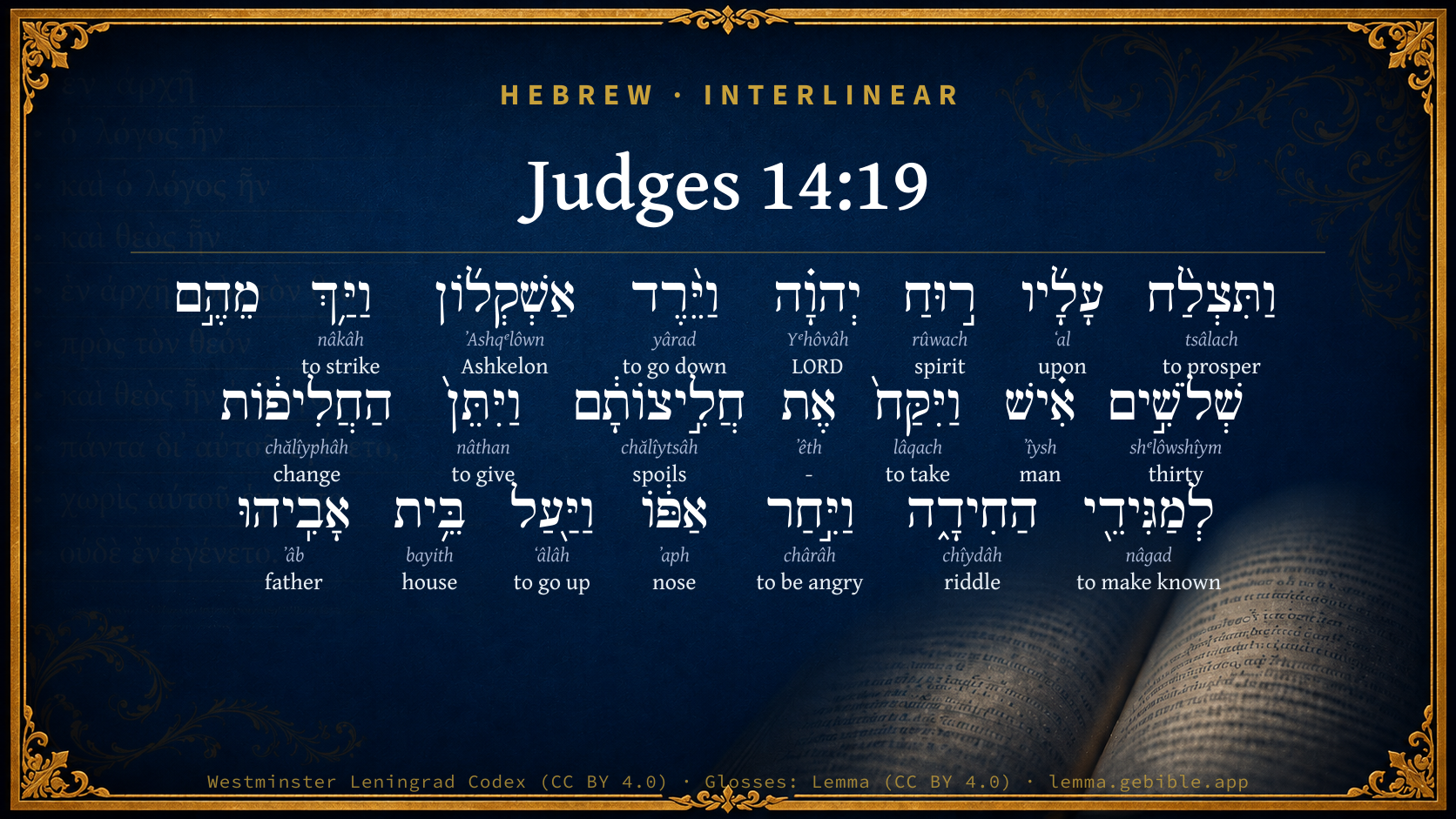
Judges 14:19

Hebrew (Westminster Leningrad Codex) Judges 14:19 appears in the Hebrew Old Testament. The text above is from the Westminster Leningrad Codex. Each word links to its Strong’s number, a concise gloss, and parsing drawn from the Open Scriptures Hebrew Bible morphology. Click any word for its full Brown-Driver-Briggs (BDB) entry.
Download image
Cite this verse

Judges 14:19 (World English Bible). Public Domain. Lemma interlinear Bible study tool, https://lemma.gebible.app/v/judges/14/19.

Show BibTeX & RIS
BibTeX
RIS
English Translation
The Spirit of Yahweh came mightily on him, and he went down to Ashkelon, and struck thirty men of them, and took their spoil, and gave the changes [of clothing] to those who declared the riddle. His anger was kindled, and he went up to his father's house.
World English Bible · Public Domain
Highlights
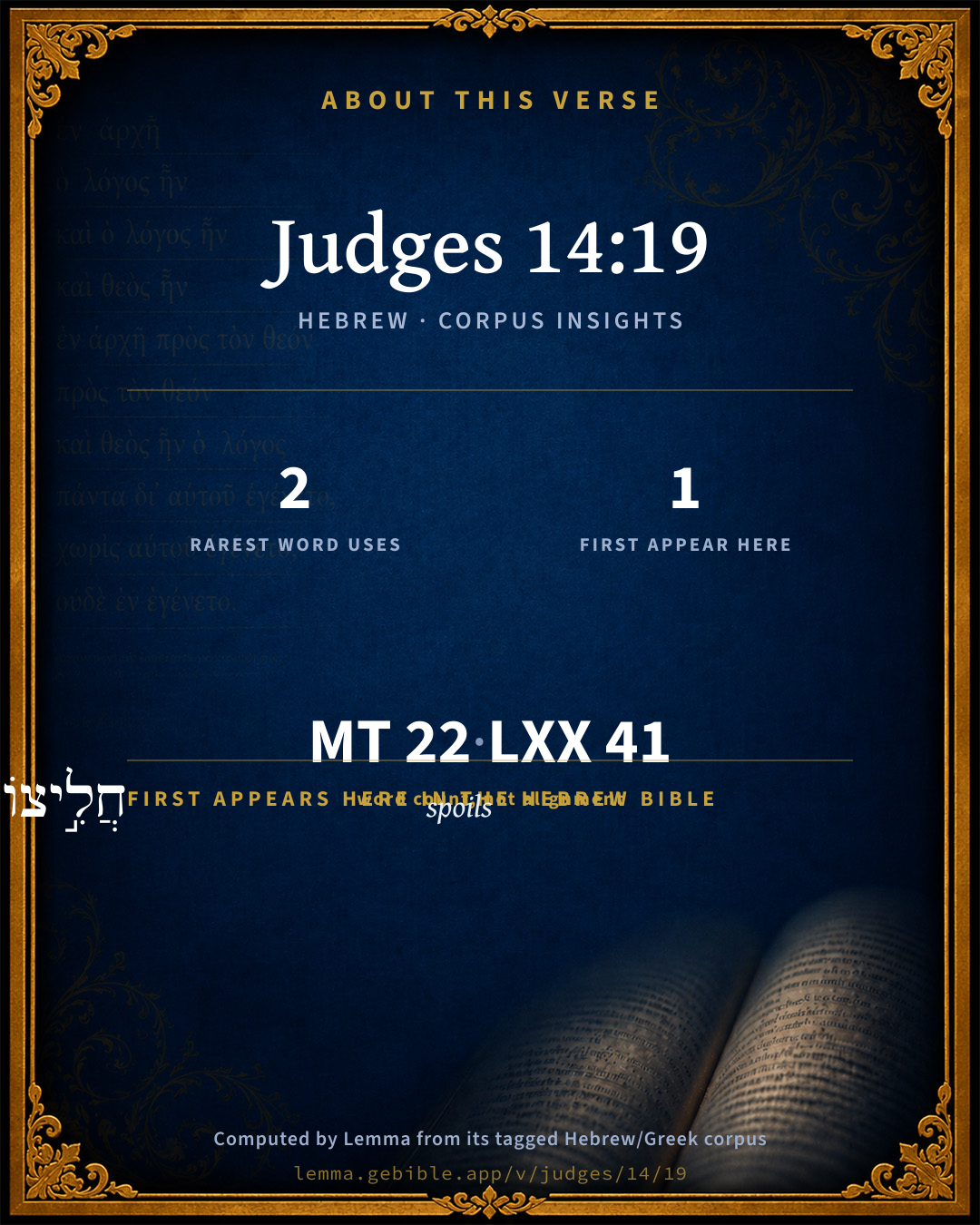
  • 1 first appearance in the Hebrew Bible
Full analysis ↓
Download a study sheet

One document with this verse’s original text, its word-by-word gloss line, the meaning frame, cross-references with their text, attributed commentary, and full source and license credits — printable, and it pastes into notes with its structure intact.

This verse Autodidact and up

Study sheet (.html) Plain text (.txt)

A passage Seminary Student

Up to 50 verses in one chapter. A passage sheet keeps up to 6 commentary sources and 12 cross-references per verse, in the order this page ranks them, and says so on the sheet whenever that leaves anything out. Ask for a single verse and you get the Autodidact verse sheet above.

Everything on this page stays free to read, with no account — the sheet is a download of what is already on screen, not access to it.

Want to remove ads? Support Godless Engineer
Compare translations 3

The same verse in 3 English versions, stacked beneath the original-language interlinear above. Click any original word for its lexicon entry.

Each is an independent rendering of the whole verse — the interlinear is not word-aligned to these translations.

Highlighted words mark where these versions differ — a whole-verse word diff, not a word-by-word alignment.

  • World English Bible Public Domain
    The Spirit of Yahweh came mightily on him, and he went down to Ashkelon, and struck thirty men of them, and took their spoil, and gave the changes [of clothing] to those who declared the riddle. His anger was kindled, and he went up to his father's house.
  • King James Version Public Domain
    And the Spirit of the LORD came upon him, and he went down to Ashkelon, and slew thirty men of them, and took their spoil, and gave change of garments unto them which expounded the riddle. And his anger was kindled, and he went up to his father's house.
  • unfoldingWord Literal Text CC BY-SA 4.0
    And the Spirit of Yahweh rushed on him, and he went down Ashkelon, and he struck 30 men from them. And he took their spoils, and he gave the changes to the declarers of the riddle. And his nose burned, and he went up the house of his father.

unfoldingWord Literal Text — © unfoldingWord, licensed CC BY-SA 4.0. Word-aligned USFM3 via Door43 (git.door43.org/unfoldingWord/en_ult).

Versions to compare (up to 4)

3 of 4 selected

Show all 18 translations

Every available English version of this verse, each an independent rendering of the whole verse.

  • World English Bible Public Domain
    The Spirit of Yahweh came mightily on him, and he went down to Ashkelon, and struck thirty men of them, and took their spoil, and gave the changes [of clothing] to those who declared the riddle. His anger was kindled, and he went up to his father's house.
  • Berean Standard Bible Public Domain
    Then the Spirit of the LORD came mightily upon him, and he went down to Ashkelon, killed thirty of their men, took their apparel, and gave their clothes to those who had solved the riddle. And burning with anger, Samson returned to his father’s house,
  • Majority Standard Bible Public Domain
    Then the Spirit of the LORD came mightily upon him, and he went down to Ashkelon, killed thirty of their men, took their apparel, and gave their clothes to those who had solved the riddle. And burning with anger, Samson returned to his father’s house,
  • King James Version Public Domain
    And the Spirit of the LORD came upon him, and he went down to Ashkelon, and slew thirty men of them, and took their spoil, and gave change of garments unto them which expounded the riddle. And his anger was kindled, and he went up to his father's house.
  • American Standard Version (1901) Public Domain
    And the Spirit of Jehovah came mightily upon him, and he went down to Ashkelon, and smote thirty men of them, and took their spoil, and gave the changes `of raiment' unto them that declared the riddle. And his anger was kindled, and he went up to his father's house.
  • Revised Version (1885) Public Domain
    And the spirit of the LORD came mightily upon him, and he went down to Ashkelon, and smote thirty men of them, and took their spoil, and gave the changes of raiment unto them that declared the riddle. And his anger was kindled, and he went up to his father’s house.
  • Geneva Bible (1599) Public Domain
    And the Spirite of the Lord came vpon him, and he went downe to Ashkelon, and slew thirtie men of them and spoyled them, and gaue chaunge of garments vnto them, which expounded the riddle: and his wrath was kindled, and he went vp to his fathers house.
  • Douay-Rheims (1899) Public Domain
    And the spirit of the Lord came upon him, and he went down to Ascalon, and slew there thirty men, whose garments he took away and gave to them that had declared the riddle. And being exceeding angry he went up to his father's house:
  • Young's Literal Translation Public Domain
    And the Spirit of Jehovah prospereth over him, and he goeth down to Ashkelon, and smiteth of them thirty men, and taketh their armour, and giveth the changes to those declaring the riddle; and his anger burneth, and he goeth up to the house of his father;
  • Literal Standard Version CC BY-SA 4.0
    And the Spirit of YHWH prospers over him, and he goes down to Ashkelon, and strikes down thirty of their men, and takes their armor, and gives the changes to those declaring the riddle; and his anger burns, and he goes up to the house of his father;
  • Unlocked Literal Bible CC BY-SA 4.0
    Then Yahweh's Spirit suddenly came on Samson with power. Samson went down to Ashkelon and killed thirty of their men. He took their plunder, and he gave their clothes to those who had explained the riddle. Burning with anger, he went up to his father's house.
  • unfoldingWord Literal Text CC BY-SA 4.0
    And the Spirit of Yahweh rushed on him, and he went down Ashkelon, and he struck 30 men from them. And he took their spoils, and he gave the changes to the declarers of the riddle. And his nose burned, and he went up the house of his father.
  • Darby Bible Public Domain
    And the Spirit of the LORD came mightily upon him, and he went down to Ash'kelon and killed thirty men of the town, and took their spoil and gave the festal garments to those who had told the riddle. In hot anger he went back to his father's house.
  • World Messianic Bible Public Domain
    The LORD’s Spirit came mightily on him, and he went down to Ashkelon and struck thirty men of them. He took their plunder, then gave the changes of clothing to those who declared the riddle. His anger burned, and he went up to his father’s house.
  • Webster's Bible Public Domain
    And the Spirit of the LORD came upon him, and he went down to Ashkelon, and slew thirty men of them, and took their spoil, and gave change of garments to them who expounded the riddle. And his anger was kindled, and he went up to his father's house.
  • Free Bible Version CC BY-SA 4.0
    The Spirit of the Lord swept over him and he went to Ashkelon, killed thirty of their men, took their clothing, and gave it to those who had explained the riddle. Furiously angry, Samson went back to his father's house.
  • Bible in Basic English Public Domain
    And the spirit of the Lord came rushing on him, and he went down to Ashkelon and, attacking thirty men there, took their clothing from them, and gave it to the men who had given the answer to his hard question. Then, full of wrath, he went back to his father's house.
  • JPS Tanakh (1917) Public Domain
    And the spirit of the LORD came mightily upon him, and he went down to Ashkelon, and smote thirty men of them, and took their spoil, and gave the changes of raiment unto them that declared the riddle. And his anger was kindled, and he went up to his father's house.

Literal Standard Version (2020), Covenant Press — licensed CC BY-SA 4.0. Text via the HelloAO Bible API (eBible.org). Unlocked Literal Bible (unfoldingWord) — licensed CC BY-SA 4.0. Text via the HelloAO Bible API (eBible.org). unfoldingWord Literal Text — © unfoldingWord, licensed CC BY-SA 4.0. Word-aligned USFM3 via Door43 (git.door43.org/unfoldingWord/en_ult). Free Bible Version, Dr. Jonathan Gallagher — licensed CC BY-SA 4.0. Text via the HelloAO Bible API (eBible.org).

Word by word

More ways to search: Search by grammar → Find every occurrence → Compare this word →

Practice this passage: Drill this verse → Learn its vocabulary →

חֲלִ֣יצוֹתָ֔ם
chălîytsâh
H2488
“spoils · their”
Noun, Common, Feminine, Plural, Construct + Suffix, Personal, 3rd Person, Masculine, Plural
Part of Speech
Noun
Type
Common
Gender
Feminine
Number
Plural
State
Construct
Full BDB Definition

Origin: from H2503

TWOT: 667a , 668a

what is stripped off (a person in war), armour, spoils, belt
  1. וַתִּצְלַ֨ח tsâlach H6743 “and · to prosper” Conjunction + Verb, Qal, Sequential Imperfect, 3rd Person, Feminine, Singular
  2. עָלָ֜יו ʻal H5921 “upon · him” Preposition + Suffix, Personal, 3rd Person, Masculine, Singular
  3. ר֣וּחַ rûwach H7307 “spirit of” Noun, Common, Both, Singular, Construct
  4. יְהוָ֗ה Yᵉhôvâh H3068 “LORD” Noun, Proper
  5. וַיֵּ֨רֶד yârad H3381 “and · to go down” Conjunction + Verb, Qal, Sequential Imperfect, 3rd Person, Masculine, Singular
  6. אַשְׁקְל֜וֹן ʼAshqᵉlôwn H831 “Ashkelon” Noun, Proper
  7. וַיַּ֥ךְ nâkâh H5221 “and · to strike” Conjunction + Verb, Hiphil, Sequential Imperfect, 3rd Person, Masculine, Singular
  8. שְׁלֹשִׁ֣ים shᵉlôwshîym H7970 “thirty” Adjective, Cardinal number, Both, Plural, Absolute
  9. אִ֗ישׁ ʼîysh H376 “man” Noun, Common, Masculine, Singular, Absolute
  10. וַיִּקַּח֙ lâqach H3947 “and · to take” Conjunction + Verb, Qal, Sequential Imperfect, 3rd Person, Masculine, Singular
  11. אֶת ʼêth H853 “-” Particle, Direct Object
  12. וַיִּתֵּן֙ nâthan H5414 “and · to give” Conjunction + Verb, Qal, Sequential Imperfect, 3rd Person, Masculine, Singular
  13. הַחֲלִיפ֔וֹת chălîyphâh H2487 “the · changes” Particle, Definite Article + Noun, Common, Feminine, Plural, Absolute
  14. לְמַגִּידֵ֖י nâgad H5046 “to/for · making known” Preposition + Verb, Hiphil, Participle Active, Masculine, Plural, Construct
  15. הַחִידָ֑ה chîydâh H2420 “the · riddle” Particle, Definite Article + Noun, Common, Feminine, Singular, Absolute
  16. וַיִּ֣חַר chârâh H2734 “and · to be angry” Conjunction + Verb, Qal, Sequential Imperfect, 3rd Person, Masculine, Singular
  17. אַפּ֔וֹ ʼaph H639 “nose · his” Noun, Common, Masculine, Singular, Construct + Suffix, Personal, 3rd Person, Masculine, Singular
  18. וַיַּ֖עַל ʻâlâh H5927 “and · to go up” Conjunction + Verb, Qal, Sequential Imperfect, 3rd Person, Masculine, Singular
  19. בֵּ֥ית bayith H1004 “house of” Noun, Common, Masculine, Singular, Construct
  20. אָבִֽיהוּ ʼâb H1 “father · his” Noun, Common, Masculine, Singular, Construct + Suffix, Personal, 3rd Person, Masculine, Singular

About this verse

These counts appear in no published source. They are computed here, from the morphology-tagged text and Lemma’s own curated glosses. What Lemma adds →

22
words
21
distinct lemmas
Historical
section

Notable vocabulary

The rarest word here is חֲלִ֣יצוֹתָ֔ם spoils H2488 — appearing just 2 times in the whole Hebrew Bible.

First appearance in Scripture

This word makes its first canonical appearance in the Hebrew Bible here:

  • חֲלִ֣יצוֹתָ֔ם spoils H2488

Shared distinctive vocabulary

חֲלִ֣יצוֹתָ֔ם spoils H2488 occurs in 2 verses of the Hebrew Bible. Also found in:

Grammatical profile

  • 8 verbs
  • 10 nouns
  • 1 adjective
  • 2 prepositions
  • 1 particle

Verb forms

  • וַתִּצְלַ֨ח Qal · Sequential Imperfect
  • וַיֵּ֨רֶד Qal · Sequential Imperfect
  • וַיַּ֥ךְ Hiphil · Sequential Imperfect
  • וַיִּקַּח֙ Qal · Sequential Imperfect
  • וַיִּתֵּן֙ Qal · Sequential Imperfect
  • לְמַגִּידֵ֖י Hiphil · Participle Active
  • וַיִּ֣חַר Qal · Sequential Imperfect
  • וַיַּ֖עַל Qal · Sequential Imperfect

Hebrew & Septuagint length

In English translation the verse runs 48 words from the Hebrew and 53 from the Septuagint (LXX English) — closely comparable.

A rough comparison of the two English renderings, which tokenize alike — not a word-level alignment.

Word counts can differ between the Hebrew and the Greek without any difference in meaning — e.g. the Hebrew direct-object marker אֵת has no separate Greek word, and Greek often adds the article ὁ.

In the original languages it is 22 Hebrew tokens and 41 Greek tokens — but the two are counted differently (Hebrew bundles its prefixes and suffixes into one token; the Greek is in lemma form), so that isn’t a like-for-like length.

Cross-references

5

Topical passages linked to Judges 14:19 in the Treasury of Scripture Knowledge — connected by theme and wording, ordered by reader-vote popularity; previews shown in the World English Bible.

  • Judges 3:10 The Spirit of Yahweh came on him, and he judged Israel; and he went out to war, and Yahweh delivered Cushan Rishathaim king of Mesopotamia into his hand: and his hand prevailed against Cushan Rishathaim.
  • 1 Samuel 11:6 The Spirit of God came mightily on Saul when he heard those words, and his anger was kindled greatly.
  • Judges 13:25 The Spirit of Yahweh began to move him in Mahaneh-dan, between Zorah and Eshtaol.
  • Judges 14:6 The Spirit of Yahweh came mightily on him, and he tore him as he would have torn a kid; and he had nothing in his hand: but he didn't tell his father or his mother what he had done.
  • Judges 15:14 When he came to Lehi, the Philistines shouted as they met him: and the Spirit of Yahweh came mightily on him, and the ropes that were on his arms became as flax that was burnt with fire, and his bands dropped from off his hands.

Cross-references courtesy of OpenBible.info (CC BY 4.0).

Hebrew and Greek witnesses Masoretic Hebrew ↔ Greek Septuagint

The same verse in the two great witnesses to the Old Testament, shown verse-for-verse.

These are two independent witnesses, not word-aligned to each other, and the Septuagint is shown in lemma (dictionary) form.

Hebrew Judges 14:19 Masoretic · Westminster Leningrad Codex

וַתִּצְלַ֨ח עָלָ֜יו ר֣וּחַ יְהוָ֗ה וַיֵּ֨רֶד אַשְׁקְל֜וֹן וַיַּ֥ךְ מֵהֶ֣ם שְׁלֹשִׁ֣ים אִ֗ישׁ וַיִּקַּח֙ אֶת חֲלִ֣יצוֹתָ֔ם וַיִּתֵּן֙ הַחֲלִיפ֔וֹת לְמַגִּידֵ֖י הַחִידָ֑ה וַיִּ֣חַר אַפּ֔וֹ וַיַּ֖עַל בֵּ֥ית אָבִֽיהוּ

The Spirit of Yahweh came mightily on him, and he went down to Ashkelon, and struck thirty men of them, and took their spoil, and gave the changes [of clothing] to those who declared the riddle. His anger was kindled, and he went up to his father's house.

World English Bible · Public Domain

Greek LXX Judges 14:19 Septuagint · lemma form

καί ἅλλομαι ἐπί αὐτός πνεῦμα κύριος καί καταβαίνω εἰς ἀσκαλών καί πατάσσω ἐκ αὐτός τριάκοντα ἀνήρ καί λαμβάνω ὁ ἱμάτιον αὐτός καί δίδωμι ὁ στολή ὁ ἀποἀγγέλλω ὁ πρόβλημα καί ὀργίζω θυμός σαμψων καί ἀναβαίνω εἰς ὁ οἶκος ὁ πατήρ αὐτός

And the Spirit of the Lord came upon him powerfully, and he went down to Ascalon, and destroyed of the inhabitants thirty men, and took their garments, and gave the changes of raiment to them that told the riddle; and Sampson was very angry, and went up to the house of his father.

LXX2012 (modern English Septuagint) · Public Domain

On this verse, Ellicott's Commentary for English Readers discusses the Septuagint’s reading. Read the note in Commentary ↓

Hebrew: Westminster Leningrad Codex (CC BY 4.0). Greek: Septuagint (public domain); English from LXX2012 (modern English Septuagint) (Public Domain). How the Septuagint differs from the Hebrew →

Targum (Aramaic paraphrase)

1

The Targum is the ancient Jewish Aramaic paraphrase of the Hebrew Scriptures — an interpretive translation, not the Hebrew text itself. Onkelos (literal) and Pseudo-Jonathan (expansive) render the Torah, and Jonathan the Prophets. Coverage is partial: where no permissively-licensed English translation exists for a verse, only the Aramaic is shown. This is verse-level text, not a word-by-word alignment to the Hebrew.

  1. Targum Jonathan Prophets (Joshua–Malachi)
    וּשְׁרַת עֲלוֹהִי רוּחַ גְבוּרָא מִן קֳדָם יְיָ וּנְחַת לְאַשְׁקְלוֹן וּקְטַל מִנְהוֹן תְּלָתִין גַבְרָא וּנְסִיב יַת זְרָזֵהוֹן וִיהַב אִצְטְלָוַיָא לִדְחַוִיאוּ חוּדִיתָא וּתְקֵיף רוּגְזֵיהּ וּסְלִיק לְבֵית אָבוּהִי:

    (no public-domain English translation for this verse)

    Targum Jonathan — Aramaic: “Mikraot Gedolot” (public domain). English: “Sefaria Community Translation” (CC0 1.0 (public-domain dedication)); “London "Chaldee Paraphrase," 1871” (public domain). Text via Sefaria.

Commentary

Notes on Judges 14:19 from classic Christian and Jewish commentators (each source and its license shown beneath its notes). The classic Christian expositions comment on the surrounding passage and are grouped to its opening verse, so a note may address several verses; the Jewish commentaries on the Tanakh (Rashi and others) are per-verse, so they appear only where the commentator wrote on this verse.

Lemma curates 59 commentaries, every one of them public domain or Creative Commons licensed, each selected and text-cleaned for this edition rather than reprinted as found. About our sources →

Jamieson, Fausset & Brown

Robert Jamieson, A. R. Fausset & David Brown

HE SLAYS THIRTY PHILISTINES. (Jdg 14:19-20)

went down to Ashkelon, and slew thirty men of them--This town was about twenty-four miles west by southwest from Timnah; and his selection of this place, which was dictated by the Divine Spirit, was probably owing to its bitter hostility to Israel.

took their spoil--The custom of stripping a slain enemy was unknown in Hebrew warfare.

Jamieson, Fausset & Brown — Commentary Critical and Explanatory on the Whole Bible (1871) — public domain (CC PDM 1.0). Text via the HelloAO Bible API.

Trapp's Complete Commentary

John Trapp

Jdg 14:19 And the Spirit of the LORD came upon him, and he went down to Ashkelon, and slew thirty men of them, and took their spoil, and gave change of garments unto them which expounded the riddle. And his anger was kindled, and he went up to his father’s house.

Ver. 19. And the Spirit of the Lord came upon him.] These extraordinary impulses of the Spirit Samson had not always, but when and as long as the Lord pleased. The prophets also had not always the gift of prophecy: nor the apostles the power of working miracles.

And he went down to Ashkelon.] Which was one of the five chief cities of the Philistines, {1Sa 6:17} where, by a bold attempt, he slew in that populous place thirty men of that tyrannical and accursed nation; the rest of the citizens running away, likely, and hiding themselves for fear of Samson. Did ever any Hercules do the like? The proverb is, Ne Hercules quidem contra duos.

And his anger was kindled,] viz., Against his perfidious wife and his injurious companions: and now he meditateth revenge, which is the next effect of anger.

And he went up to his father’s house.] Whose counsel he now wisheth he had taken in the choice of his wife. Leo cassibus irretitur, &c. Si praescivissem.

John Trapp, A Commentary or Exposition upon All the Books of the Old and New Testament (1647–1656) — public domain. Text from a community e-Sword module.

Geneva Bible (1599)

Geneva Bible translators

Which was one of the five chief cities of the Philistines.

Geneva Bible (1599) marginal notes — public domain. Text via Bolls.life.

Adam Clarke's Commentary

Verse 19. The Spirit of the Lord came upon him] "The spirit of fortitude from before the Lord."-Targum. He was inspired with unusual courage, and he felt strength proportioned to his wishes.

He - slew thirty men - and took their spoils] He took their hayks, their kumjas, and caftans, and gave them to the thirty persons who, by unfair means, had solved his riddle; thus they had what our version calls thirty sheets, and thirty changes of raiment. See Clarke on Jud 14:12.

Adam Clarke's Commentary on the Bible (1810–1826) — public domain. Text from a community e-Sword/MySword module.

Ellicott's Commentary for English Readers

(19) To Ashkelon.—Probably he seized the opportunity of some great feast to Dagon, or even of another marriage festival, since the linen robes and rich garments would not be such as would be worn every day.

Took their spoil.—The Hebrew word chalîsah is rendered “armour” in 2Sa_2:21 (LXX.,panoplia), and the Targum on Jdg_14:13 seems to understand “suits of armour.”

Gave . . . unto them which expounded the riddle.—They were unaware whence he had obtained the means to discharge his wager. The morality of the act can, of course, only be judged from the standpoint of the time.

A Bible Commentary for English Readers, edited by Charles John Ellicott (1878–1897) — public domain. Text from a community e-Sword module.

The Cambridge Bible for Schools and Colleges

gen. ed. J. J. S. Perowne

19. The sudden access of superhuman power seems to coincide with the outburst of natural passion, as in Jdg_14:6, Jdg_15:14.

Ashkelon] Perhaps Khirbet ‘Asḳalûn, about 4 m. S. of Tibneh (Timnah), rather than the well-known Ashkelon on the sea-coast, 24 m. or 8 hours distant. The anger ought to precede rather than follow the exploit; but the writer probably did not trouble about logical sequence in his narrative of marvels. There is no need to regard the feat at Ashkelon as a later addition (Moore, Budde, Nowack) because it leads to nothing in the sequel.

their spoil] lit. things stripped off a dead enemy, exuviae; only again 2Sa_2:21.

he went up] without consummating the marriage, as the previous verses seem to imply (esp. Jdg_14:18); although it is true that sometimes the consummation took place on the first and not on the last day of the feast, Gen_29:23.

The Cambridge Bible for Schools and Colleges (gen. ed. J. J. S. Perowne; Cambridge University Press, 1878–1918) — public domain. Text from a community e-Sword module.

John Gill's Exposition

And the Spirit of the Lord came upon him,.... The Spirit of might from the Lord, as the Targum; which filled him with zeal and courage, animating him to the following undertaking, and increased his bodily strength to perform it:

and he went down to Ashkelon; one of the five principal cities of the Philistines; it lay near the Mediterranean sea, and, according to Bunting (r), was twenty four miles from Timnath; why he went so far, is not easy to say; some think there was some grand solemnity or festival observed there at this time, which he knew of, when persons put on their best suits of apparel, and such he wanted: and slew thirty men of them; in vindication of which, it may be observed, that Samson was now raised up of God to be judge of Israel; and that he acted now as such, and under the direction and impulse of the Spirit of God, and the persons he slew were the common enemies of Israel; and if now observing a festival in honour of their gods, they were justly cut off for their idolatry:

and took their spoil; their clothes off their backs, stripped them of their apparel, and even of their shirts, all which he brought away with him: and here it may be observed, that though Samson was a Nazarite, yet not a common one, and was an extraordinary person, and not in all things bound to the law of the Nazarites; at least that law was dispensed with in various instances relative to him, as taking honey out of the carcass of the lion, and here stripping dead bodies which were defiling, and other things:

and gave change of garments unto them which expounded the riddle; to the thirty companions, to whom it was proposed, each man a suit of apparel taken from the thirty men he slew at Ashkelon, and sheets or shirts also no doubt, though not expressed. Indeed some have thought, because they did not find out the riddle of themselves, he did not give them the whole premium, and that by their own consent:

and his anger was kindled; against his wife, for her treachery and unfaithfulness to him, and against his companions for their deceitful usage of him, and against the citizens of the place, who perhaps laughed at him, being thus tricked and deceived:

and he went up to his father's house; left his wife, and her relations, and his companions, and the men of Timnath, and betook himself to his father's house again, as if he had been never married; his parents very probably had returned before him.

(r) Travels of the Patriarchs, &c. p. 116.

John Gill's Exposition of the Whole Bible (1746–1763) — public domain (CC PDM 1.0). Text via the HelloAO Bible API.

Haydock's Catholic Bible Commentary

Riddle. Samson must no longer be considered as a private man. He was authorized by the Spirit of the Lord, thus to punish the oppressors of Israel. (Calmet) --- Though these 30 men had done him no injury in person, (Haydock) they had sinned against God, and deserved to die. (Salien) --- He slew them publicly in the city (Menochius) though others believe that he did it in the neighbouring country, as it does not appear that the people knew of their death. (Calmet)

George Leo Haydock (1774–1849), Haydock's Catholic Family Bible and Commentary, 1859 edition — public domain. Excludes Psalms (Douay-Rheims chapter numbering differs from Protestant) and Deuterocanonical books (Catholic canon only).

Matthew Poole's English Annotations

The Spirit of the Lord came upon him; though he had a constant habit of eminent strength and courage, yet that was exceedingly increased upon special occasions, by the extraordinary influences of God’s Spirit.

To Ashkelon; either to the territory, which oft comes under the name of the city; or to the city itself, where he had both strength and courage enough to attempt what here follows; and upon the doing hereof they were doubtless struck with such a terror, that every one sought only to preserve himself, and none durst oppose or pursue him.

Change of garments, together with their sheets or shirts, which it sufficed to imply here, being expressed above, Jdg 14:13.

His anger was kindled, for the treachery of his wife and companions.

And he went up, to wit, alone, or without his wife.

Matthew Poole's English Annotations on the Holy Bible (1683–1685) — public domain. Text from a community e-Sword/MySword module.

Whedon's Commentary on the Bible

Daniel D. Whedon

19. Ashkelon — Some twenty-five miles distant to the southwest.

Slew thirty men of them — That is, men of Ashkelon. He would not stain his hands with the blood of the citizens of Timnath, but goes far off to take his spoil; yet will he make Philistine blood pay for this Philistine treachery. His whole object in going to Ashkelon to get his spoils is not clear. To justify this wholesale murder by any standard of New Testament morality is idle and absurd.

His anger was kindled — He doubtless felt that he did well to be angry, and his slaughter of the thirty men of Ashkelon is to be regarded largely as a fearful revenge, by which he would awe and terrify the Timnathites who had treated him so treacherously. The changes of garments which he paid them he probably flung at their feet all stained with human blood, and in a spell of ferocious indignation at their perfidy left them, and went up to his father’s house at Zorah.

Daniel D. Whedon (gen. ed.), Commentary on the Old and New Testaments (1874–1909) — public domain. Text from a community e-Sword module.

The Pulpit Commentary

The Spirit of the Lord, etc. as in ver. 6 and Jud_1:13:25, where see notes. The verb here, came upon him, is the same as in ver. 6. Thirty men the number of the companions to whom he felt bound to pay the thirty changes of garment. Ashkelon (Jud_1:18) one of the five Philistine cities, but the least often mentioned, owing, it is thought, to its remote situation "on the extreme edge of the shore of the Mediterranean, far down in the south." It still preserves its ancient name, and was famous in the time of the Crusaders. "Within the walls and towers now standing Richard (Coeur de Lion) held his court." The onion called eschalot, or shallot, is named from Eshkalon, or Ashkalon. Their spoil that which was stripped from them. His anger was kindled against the Philistines in general, and his wife in particular, so that he went back to his father s house without her.

The Pulpit Commentary (1880–1919), ed. H.D.M. Spence-Jones & Joseph S. Exell — public domain. Text from a community e-Sword module.

John Wesley's Explanatory Notes

The spirit came - Though he had constant strength and courage; yet that was exceedingly increased upon special occasions, by the extraordinary influences of God's spirit. To Ashkelon - Either to the territory; or to the city itself, where he had both strength and courage enough to attempt what follows; and upon the doing hereof they were doubtless struck with such terror, that every one sought only to preserve himself, and none durst pursue him. His anger was kindled - For the treachery of his wife and companions. He went - Without his wife. It were well for us, if the unkindnesses we meet with from the world, and our disappointments therein has this good effect on us, to oblige us to return by faith and prayer, to our heavenly father's house.

John Wesley, Explanatory Notes Upon the Whole Bible (1754–1765) — public domain. Text via the GEBible commentary corpus.

unfoldingWord translationNotes

Door43 World Missions Community

came on Samson with power

The phrase "came on" means that Yahweh's Spirit influenced Samson. In this case, he made him very strong. AT: "made Samson very strong" or "made Samson very powerful" (See: Idiom)

killed thirty of their men

"killed 30 of their men" - (See: Numbers)

their men

"the men who lived there"

plunder

things taken by force, usually after a fight or battle

their clothes

These were from the plunder he had taken from Ashkelon. AT: "the sets of clothing that he had taken" (See: Assumed Knowledge and Implicit Information)

Burning with anger

"Very angry"

went up to his father's house

The phrase "went up" is used here because Samson was at Timnah which is lower in elevation than where his father's house is located.

Samson's wife was given to his best friend

This can be stated in active form. AT: "his wife's father gave her to his best friend" (See: Active or Passive)

best friend

"closest friend"

translationWords

Yahweh

Holy Spirit

Samson

power

Ashkelon

unfoldingWord translationNotes — © Distant Shores Media and the Door43 World Missions Community, licensed CC BY-SA 4.0. Source: git.door43.org/Door43/en_tn.

Rashi

Rabbi Shlomo Yitzchaki (Rashi)

The Divine spirit. A spirit of power, Divinely inspired.

Their garments. The garments which he had stripped from them.

Rashi on the Tanakh — English translations: “The Judaica Press complete Tanach with Rashi, translated by A. J. Rosenberg” (CC BY 4.0); “Pentateuch with Rashi's commentary by M. Rosenbaum and A.M. Silbermann, 1929-1934” (public domain); “The Metsudah Tanach series, Lakewood, N.J” (CC BY 4.0); and “The Book of Joshua, Metsudah Publications, 1997” (CC BY 4.0). Text via Sefaria.

Lesson kit

Teaching starters — assembled from the data on this page, not authored interpretation. Every prompt links to the verse data it draws on. Edit before teaching.

Judges, in the Historical, opens this verse with 22 words (21 distinct Hebrew lemmas). Its most distinctive word is chălîytsâh (“spoils”). A historical commentator’s framing appears above. Read the whole chapter for the surrounding context.

Discussion questions

  1. What does “spoils” (chălîytsâh) contribute to the verse as a whole?
  2. This is the first place “spoils” appears in Scripture (first appears here). What does its debut here establish?
  3. How does 2 Samuel 2:21, which shares the word «spoils», read alongside this verse?
  4. These translations render this verse differently; the difference is in the English rendering, not the original. What questions does that raise?
  5. «וַתִּצְלַ֨ח» is a Qal Sequential Imperfect verb. How does that grammatical form shape the action described?
  6. Compare how Jamieson, Fausset & Brown and Trapp's Complete Commentary read this verse. Where do they agree or differ?

Things to notice

Reading settings

Reading text

Shown beneath each verse's original-language words.

Old Testament
Old Testament edition

Read the OT as the Masoretic Hebrew (MT) or the Greek Septuagint (LXX).

English shown for the Greek Septuagint (in the Hebrew ↔ Greek comparison).

Comparing translations? Open the Compare panel on any verse page to stack up to four side by side.