Psalms 135:7

Hebrew (Westminster Leningrad Codex) Psalms 135:7 appears in the Hebrew Old Testament. The text above is from the Westminster Leningrad Codex. Each word links to its Strong’s number, a concise gloss, and parsing drawn from the Open Scriptures Hebrew Bible morphology. Click any word for its full Brown-Driver-Briggs (BDB) entry.
Download image
Cite this verse

Psalms 135:7 (World English Bible). Public Domain. Lemma interlinear Bible study tool, https://lemma.gebible.app/v/psalms/135/7.

Show BibTeX & RIS
BibTeX
RIS
English Translation
Who causes the clouds to rise from the ends of the earth; Who makes lightnings with the rain; Who brings forth the wind out of his treasuries;
World English Bible · Public Domain
Download a study sheet

One document with this verse’s original text, its word-by-word gloss line, the meaning frame, cross-references with their text, attributed commentary, and full source and license credits — printable, and it pastes into notes with its structure intact.

This verse Autodidact and up

Study sheet (.html) Plain text (.txt)

A passage Seminary Student

Up to 50 verses in one chapter. A passage sheet keeps up to 6 commentary sources and 12 cross-references per verse, in the order this page ranks them, and says so on the sheet whenever that leaves anything out. Ask for a single verse and you get the Autodidact verse sheet above.

Everything on this page stays free to read, with no account — the sheet is a download of what is already on screen, not access to it.

Want to remove ads? Support Godless Engineer
Compare translations 3

The same verse in 3 English versions, stacked beneath the original-language interlinear above. Click any original word for its lexicon entry.

Each is an independent rendering of the whole verse — the interlinear is not word-aligned to these translations.

Highlighted words mark where these versions differ — a whole-verse word diff, not a word-by-word alignment.

  • World English Bible Public Domain
    Who causes the clouds to rise from the ends of the earth; Who makes lightnings with the rain; Who brings forth the wind out of his treasuries;
  • King James Version Public Domain
    He causeth the vapours to ascend from the ends of the earth; he maketh lightnings for the rain; he bringeth the wind out of his treasuries.
  • unfoldingWord Literal Text CC BY-SA 4.0
    bringing up clouds from the end of the earth, he makes lightning bolts for the rain— bringing out wind from his storehouses,

unfoldingWord Literal Text — © unfoldingWord, licensed CC BY-SA 4.0. Word-aligned USFM3 via Door43 (git.door43.org/unfoldingWord/en_ult).

Versions to compare (up to 4)

3 of 4 selected

Show all 17 translations

Every available English version of this verse, each an independent rendering of the whole verse.

  • World English Bible Public Domain
    Who causes the clouds to rise from the ends of the earth; Who makes lightnings with the rain; Who brings forth the wind out of his treasuries;
  • Berean Standard Bible Public Domain
    He causes the clouds to rise from the ends of the earth. He generates the lightning with the rain and brings forth the wind from His storehouses.
  • Majority Standard Bible Public Domain
    He causes the clouds to rise from the ends of the earth. He generates the lightning with the rain and brings forth the wind from His storehouses.
  • King James Version Public Domain
    He causeth the vapours to ascend from the ends of the earth; he maketh lightnings for the rain; he bringeth the wind out of his treasuries.
  • American Standard Version (1901) Public Domain
    Who causeth the vapors to ascend from the ends of the earth; Who maketh lightnings for the rain; Who bringeth forth the wind out of his treasuries;
  • Revised Version (1885) Public Domain
    He causeth the vapours to ascend from the ends of the earth; he maketh lightnings for the rain; he bringeth forth the wind out of his treasuries.
  • Geneva Bible (1599) Public Domain
    He bringeth vp the cloudes from the ends of the earth, and maketh the lightnings with ye raine: he draweth foorth the winde out of his treasures.
  • Young's Literal Translation Public Domain
    Causing vapours to ascend from the end of the earth, Lightnings for the rain He hath made, Bringing forth wind from His treasures.
  • Literal Standard Version CC BY-SA 4.0
    Causing vapors to ascend from the end of the earth, || He has made lightnings for the rain, || Bringing forth wind from His treasures.
  • Unlocked Literal Bible CC BY-SA 4.0
    He brings the clouds from far away, making lightning bolts accompany the rain and bringing the wind out of his storehouse.
  • unfoldingWord Literal Text CC BY-SA 4.0
    bringing up clouds from the end of the earth, he makes lightning bolts for the rain— bringing out wind from his storehouses,
  • Darby Bible Public Domain
    Who causeth the vapours to ascend from the ends of the earth; who maketh lightnings for the rain; who bringeth the wind out of his treasuries:
  • World Messianic Bible Public Domain
    He causes the clouds to rise from the ends of the earth. He makes lightnings with the rain. He brings the wind out of his treasuries.
  • Webster's Bible Public Domain
    He causeth the vapors to ascend from the ends of the earth; he maketh lightnings for the rain; he bringeth the wind out of his treasuries.
  • Free Bible Version CC BY-SA 4.0
    He causes the clouds to rise all over the earth, he makes lightning flash and give rain, he sends the winds from his storehouses.
  • Bible in Basic English Public Domain
    He makes the mists go up from the ends of the earth; he makes thunder-flames for the rain; he sends out the winds from his store-houses.
  • JPS Tanakh (1917) Public Domain
    Who causeth the vapours to ascend from the ends of the earth; He maketh lightnings for the rain; He bringeth forth the wind out of His treasuries.

Literal Standard Version (2020), Covenant Press — licensed CC BY-SA 4.0. Text via the HelloAO Bible API (eBible.org). Unlocked Literal Bible (unfoldingWord) — licensed CC BY-SA 4.0. Text via the HelloAO Bible API (eBible.org). unfoldingWord Literal Text — © unfoldingWord, licensed CC BY-SA 4.0. Word-aligned USFM3 via Door43 (git.door43.org/unfoldingWord/en_ult). Free Bible Version, Dr. Jonathan Gallagher — licensed CC BY-SA 4.0. Text via the HelloAO Bible API (eBible.org).

Word by word

More ways to search: Search by grammar → Find every occurrence → Compare this word →

Practice this passage: Drill this verse → Learn its vocabulary →

בְּרָקִ֣ים
bârâq
H1300
“lightnings”
Noun, Common, Masculine, Plural, Absolute
Part of Speech
Noun
Type
Common
Gender
Masculine
Number
Plural
State
Absolute
Full BDB Definition

Origin: from H1299

TWOT: 287a

lightning - lightnings, lightning flashes - of flashing arrow-head (figuratively)
  1. מַֽעֲלֶ֣ה ʻâlâh H5927 “going up” Verb, Hiphil, Participle Active, Masculine, Singular, Absolute
  2. נְשִׂאִים֮ nâsîyʼ H5387 “chiefs” Noun, Common, Masculine, Plural, Absolute
  3. מִקְצֵ֪ה qâtseh H7097 “from · end of” Preposition + Noun, Common, Both, Singular, Construct
  4. הָ֫אָ֥רֶץ ʼerets H776 “the · land” Particle, Definite Article + Noun, Common, Both, Singular, Absolute
  5. לַמָּטָ֣ר mâṭar H4306 “to/for the · rain” Preposition, Determined + Noun, Common, Masculine, Singular, Absolute
  6. עָשָׂ֑ה ʻâsâh H6213 “to do” Verb, Qal, Perfect, 3rd Person, Masculine, Singular
  7. מֽוֹצֵא yâtsâʼ H3318 “going out” Verb, Hiphil, Participle Active, Masculine, Singular, Absolute
  8. ר֝וּחַ rûwach H7307 “spirit” Noun, Common, Both, Singular, Absolute
  9. מֵאֽוֹצְרוֹתָֽיו ʼôwtsâr H214 “from · storehouses · his” Preposition + Noun, Common, Masculine, Plural, Construct + Suffix, Personal, 3rd Person, Masculine, Singular

About this verse

These counts appear in no published source. They are computed here, from the morphology-tagged text and Lemma’s own curated glosses. What Lemma adds →

10
words
10
distinct lemmas
Wisdom
section

Notable vocabulary

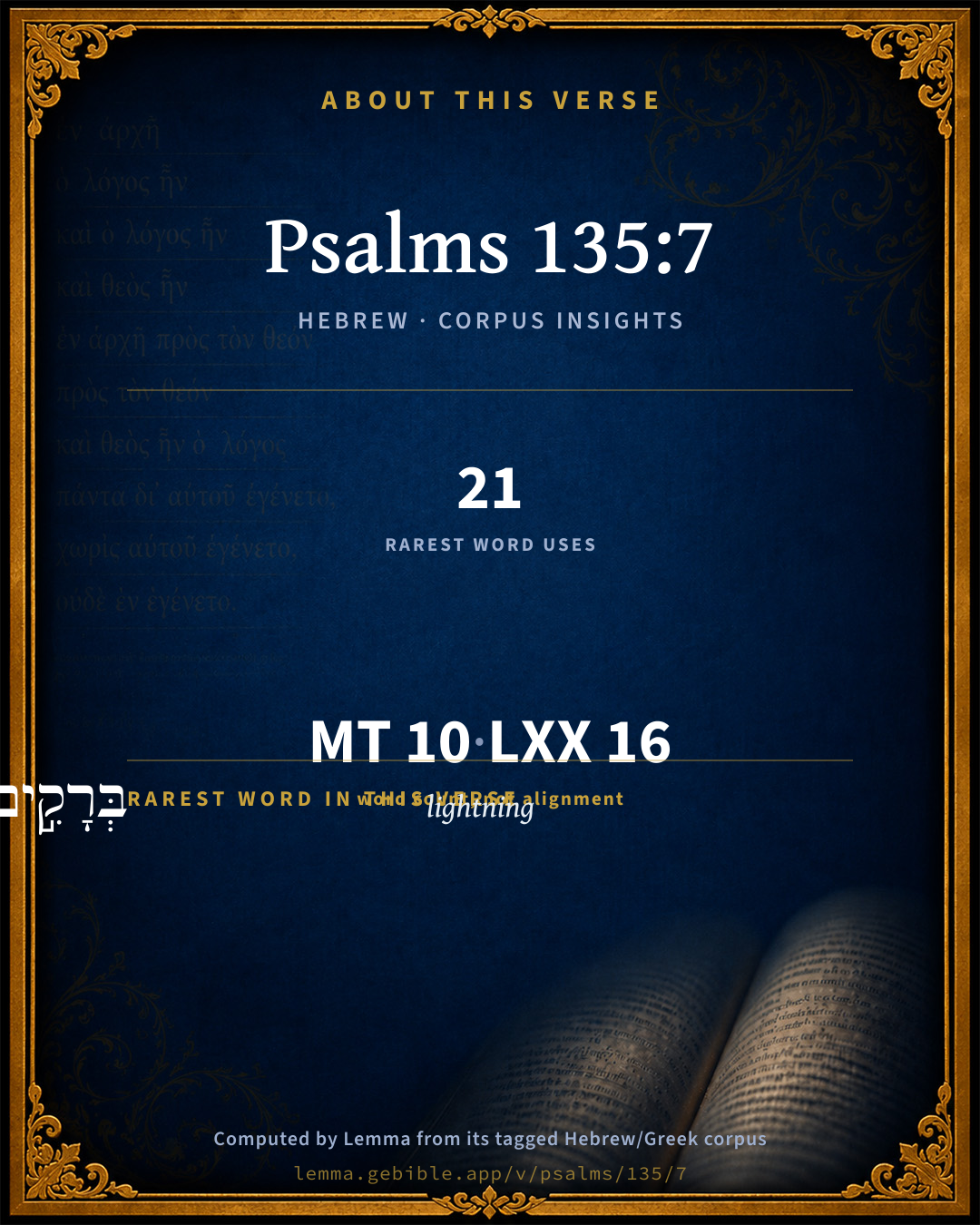
The rarest word here is בְּרָקִ֣ים lightning H1300 — appearing just 21 times in the whole Hebrew Bible.

Shared distinctive vocabulary

בְּרָקִ֣ים lightning H1300 occurs in 21 verses of the Hebrew Bible. Also found in:

Grammatical profile

  • 3 verbs
  • 7 nouns

Verb forms

  • מַֽעֲלֶ֣ה Hiphil · Participle Active
  • עָשָׂ֑ה Qal · Perfect
  • מֽוֹצֵא Hiphil · Participle Active

Hebrew & Septuagint length

In English translation the verse runs 27 words from the Hebrew and 24 from the Septuagint (LXX English) — closely comparable.

A rough comparison of the two English renderings, which tokenize alike — not a word-level alignment.

Word counts can differ between the Hebrew and the Greek without any difference in meaning — e.g. the Hebrew direct-object marker אֵת has no separate Greek word, and Greek often adds the article ὁ.

In the original languages it is 10 Hebrew tokens and 16 Greek tokens — but the two are counted differently (Hebrew bundles its prefixes and suffixes into one token; the Greek is in lemma form), so that isn’t a like-for-like length.

Cross-references

14

Topical passages linked to Psalms 135:7 in the Treasury of Scripture Knowledge — connected by theme and wording, ordered by reader-vote popularity; previews shown in the World English Bible.

  • Jeremiah 10:13 when he utters his voice, there is a tumult of waters in the heavens, and he causes the vapors to ascend from the ends of the earth; he makes lightnings for the rain, and brings forth the wind out of his treasuries.
  • Job 28:25–26 He establishes the force of the wind; Yes, he measures out the waters by measure.
  • Jeremiah 51:16 when he utters his voice, there is a tumult of waters in the heavens, and he causes the vapors to ascend from the ends of the earth; he makes lightnings for the rain, and brings forth the wind out of his treasuries.
  • Zechariah 10:1 Ask of Yahweh rain in the spring time, Yahweh who makes storm clouds, And he gives rain showers to everyone for the plants in the field.
  • Psalms 148:8 Lightning and hail, snow and clouds; Stormy wind, fulfilling his word;
  • John 3:8 The wind blows where it wants to, and you hear its sound, but don't know where it comes from and where it is going. So is everyone who is born of the Spirit."
  • Genesis 2:5–6 No plant of the field was yet in the earth, and no herb of the field had yet sprung up; for Yahweh God had not caused it to rain on the earth. There was not a man to till the ground,
  • 1 Kings 18:1 It happened after many days, that the word of Yahweh came to Elijah, in the third year, saying, Go, show yourself to Ahab; and I will send rain on the earth.
  • 1 Kings 18:41–45 Elijah said to Ahab, Get you up, eat and drink; for there is the sound of abundance of rain.
  • Job 5:10 Who gives rain on the earth, And sends waters on the fields;
  • Job 38:22–28 Have you entered the treasuries of the snow, Or have you seen the treasures of the hail,
  • Psalms 107:25 For he commands, and raises the stormy wind, Which lifts up its waves.
  • Jeremiah 14:22 Are there any among the vanities of the nations that can cause rain? or can the sky give showers? Aren't you he, Yahweh our God? therefore we will wait for you; for you have made all these things.
  • Jonah 1:4 But Yahweh sent out a great wind on the sea, and there was a mighty tempest on the sea, so that the ship was likely to break up.

Cross-references courtesy of OpenBible.info (CC BY 4.0).

Hebrew and Greek witnesses Masoretic Hebrew ↔ Greek Septuagint

The same verse in the two great witnesses to the Old Testament, shown verse-for-verse.

You’re reading Greek Psalm 134 (Hebrew Psalm 135). The Septuagint counts the superscription, so verse numbers can differ from the Hebrew — chapter-level alignment, not verse-by-verse. Numbering follows Rahlfs.

These are two independent witnesses, not word-aligned to each other, and the Septuagint is shown in lemma (dictionary) form.

Hebrew Psalms 135:7 Masoretic · Westminster Leningrad Codex

מַֽעֲלֶ֣ה נְשִׂאִים֮ מִקְצֵ֪ה הָ֫אָ֥רֶץ בְּרָקִ֣ים לַמָּטָ֣ר עָשָׂ֑ה מֽוֹצֵא ר֝וּחַ מֵאֽוֹצְרוֹתָֽיו

Who causes the clouds to rise from the ends of the earth; Who makes lightnings with the rain; Who brings forth the wind out of his treasuries;

World English Bible · Public Domain

Greek LXX Greek Psalm 134:7 Septuagint · lemma form

ἀναἄγω νεφέλη ἐκ ἔσχατος ὁ γῆ ἀστραπή εἰς ὑετός ποιέω ὁ ἐκἄγω ἄνεμος ἐκ θησαυρός αὐτός

Who brings up clouds from the extremity of the earth: he has made lightnings for the rain: he brings winds out of his treasures.

LXX2012 (modern English Septuagint) · Public Domain

On this verse, Albert Barnes' Notes on the Bible discusses the Septuagint’s reading. Read the note in Commentary ↓

Hebrew: Westminster Leningrad Codex (CC BY 4.0). Greek: Septuagint (public domain); English from LXX2012 (modern English Septuagint) (Public Domain). How the Septuagint differs from the Hebrew →

Commentary

Notes on Psalms 135:7 from classic Christian and Jewish commentators (each source and its license shown beneath its notes). The classic Christian expositions comment on the surrounding passage and are grouped to its opening verse, so a note may address several verses; the Jewish commentaries on the Tanakh (Rashi and others) are per-verse, so they appear only where the commentator wrote on this verse.

Lemma curates 59 commentaries, every one of them public domain or Creative Commons licensed, each selected and text-cleaned for this edition rather than reprinted as found. About our sources →

Trapp's Complete Commentary

John Trapp

Psa 135:7 He causeth the vapours to ascend from the ends of the earth; he maketh lightnings for the rain; he bringeth the wind out of his treasuries.

Ver. 7. He causeth the vapours] Not Jupiter, but Jehovah. {See Jer 10:13} He is the right Nubicoga, maker of the meteors, whether fiery, airy, or watery, Job 26:8-9; Job 28:26-27; Job 37:11; Job 37:15-16; Job 38:9. See the notes there.

He maketh lightnings for the rain] Or, with the rain, which is very strange, viz. that fire and water should mingle, and hard stones come out of the midst of thin vapours.

He bringeth the wind out of his treasuries] Or, coffers, storehouses, where he holdeth them close prisoners during his pleasure. This the philosopher knew not, and thence it is that they are of so diverse in their opinions about the winds. See Job 36:27-28; Job 37:11; Job 37:15-16 throughout.

John Trapp, A Commentary or Exposition upon All the Books of the Old and New Testament (1647–1656) — public domain. Text from a community e-Sword module.

The Treasury of David

Charles H. Spurgeon

Ver. 7. He causeth the vapours to ascend from the ends of the earth. Here we are taught the power of God in creation. The process of evaporation is passed by unnoticed by the many, because they see it going on all around them; the usual ceases to be wonderful to the thoughtless, but it remains a marvel to the instructed. When we consider upon what an immense scale evaporation is continually going on, and how needful it is for the existence of all life, we may well admire the wisdom and the power which are displayed therein. All around us from every point of the horizon the vapour rises, condenses into clouds, and ultimately descends as rain. Whence the vapours originally ascended from which our showers are formed it would be impossible to tell; most probably the main part of them comes from the tropical regions, and other remote places at "the ends of the earth." It is the Lord who causes them to rise, and not a mere law. What is law without a force at the back of it? He maketh lightnings for the rain. There is an intimate connection between lightning and rain, and this would seem to be more apparent in Palestine than even with ourselves; for we constantly read of thunderstorms in that country as attending heavy down pours of rain. Lightning is not to be regarded as a lawless force, but as a part of that wonderful machinery by which the earth is kept in a fit condition: a force as much under the control of God as any other, a force most essential to our existence. The ever changing waters, rains, winds, and electric currents circulate as if they were the life blood and vital spirits of the universe. He bringeth the wind out of his treasuries. This great force which seems left to its own wild will is really under the supreme and careful government of the Lord. As a monarch is specially master of the contents of his own treasure, so is our God the Lord of the tempest and hurricane; and as princes do not spend their treasure without taking note and count of it, so the Lord does not permit the wind to be wasted, or squandered without purpose. Everything in the material world is under the immediate direction and control of the Lord of all. Observe how the Psalmist brings before us the personal action of Jehovah: "he causeth", "he maketh", "he bringeth." Everywhere the Lord worketh all things, and there is no power which escapes his supremacy. It is well for us that it is so: one bandit force wandering through the Lord's domains defying his control would cast fear and trembling over all the provinces of providence. Let us praise Jehovah for the power and wisdom with which he rules clouds, and lightnings, and winds, and all other mighty and mysterious agencies.

Ver. 7. He causeth the vapours to ascend, etc. Dr. Halley made a number of experiments at St. Helena as to the quantity of water that is daily evaporated from the sea, and he found that ten square inches of the ocean's surface yielded one cubic inch of water in twelve hours a square mile therefore yields 401,448,960 cubic inches, or 6,914 tons of water. From the surface of the Mediterranean Sea during a summer's day there would pass off in invisible vapour five thousand millions of tons of water. This being only for one day, the quantity evaporated in a year would be 365 times greater, and in two thousand years it would amount to four thousand billions of tons, which evaporation would in time empty the Mediterranean Sea; but we have good reason for believing that there is as much water there now as in the time of the Romans, therefore the balance is kept up by the downpour of rain, the influx of the rivers, and the currents from the Atlantic.

Now let us consider the amount of power required for all this evaporation. Mr. Joule, whose experiments have given to the world so much valuable information, says that if we had a pool of water one square mile and six inches in depth to be evaporated by artificial heat, it would require the combustion of 30,000 tons of coal to effect it; therefore to evaporate all the water that ascends from the earth it would take 6,000,000,000,000 (six billion) tons, or more than all the coal that could be stowed away in half a dozen such worlds as this; and yet silently and surely has the process of evaporation been going on for millions of years. Samuel Kinns, in "Moses and Geology", 1882.

Ver. 7. He causeth the vapours to ascend, etc. There is no physical necessity that the boiling point of water should occur at two hundred and twelve degrees of the Fahrenheit scale. As far as we know, it might have been the same with the boiling points of oil of turpentine, alcohol or ether. We shall see the benevolence of the present adjustment by noticing some of the consequences which would follow if any change were made.

The amount of vapour given off at ordinary temperatures by any liquid depends on the temperature at which it boils. If the boiling point of water were the same as that of alcohol, the vapour given off by the ocean would be two and a half times as much as at present. Such an excess of aqueous vapour would produce continual rains and inundations, and would make the air too damp for animal, and too cloudy for vegetable, life. If water boiled at the same temperature as ether, the vapour rising from the ocean would be more than twenty-five times as much as at present. In such a state of things no man could see the sun on account of the clouds; the rain would be so excessive as to tear up the soil and wash away plants; inundations would be constant, and navigation would be impossible in the inland torrents which would take the place of our rivers. In winter the snow of one day might bury the houses. If, on the other hand, water boiled at the same temperature with oil of turpentine, the vapour given off by the ocean would be less than one fourth of its present amount. In this case rain would be a rarity, like an eclipse of the sun, the dryness of the desert of Sahara would be equalled in a large part of the globe, which would, therefore, be bare of vegetation, and incapable of sustaining animal life. Plants would be scorched by unclouded sunshine, springs and rivulets would be dry, and inland navigation would cease; for nearly all the rain would be absorbed by the porous earth.

We see, then, that the boiling point of water has been adjusted to various relations. It is adjusted to the capacity of space to contain aqueous vapour h transparent state; if it were higher than two hundred and twelve degrees, earth would be scorched by an unclouded sun; if it were lower, it would under continual shade. It is suited to the demand of plants for water; if it were higher, they would suffer from drought; if it were lower, they would torn up by floods. It is in harmony with the texture of the soil: if it higher, the earth would absorb all the rain which falls; if it were lower, the would often be washed away by the surface torrents after a shower. It is to the elevation of the continents above the sea; if it were higher, rivers their present inclination would be so shallow as to be often dry; if it lower, most rivers would be so deep as to be torrents, while the land would covered with floods. Professor Hemholtz.

Ver. 7. To ascend from the ends of the earth. Rains in England are introduced by a southeast wind. "Vapour brought to us by such a wind have been generated in countries to the south and east of our island. It is fore, probably, in the extensive valleys watered by the Meuse, the Moselle, the Rhine, if not from the more distant Elbe, with the Oder and the Weser, the water rises, in the midst of sunshine, which is soon afterwards to form our clouds, and pour down our thundershowers." "Drought and sunshine in part of Europe may be necessary to the production of a wet season in another" (Howard on the Climate of London). William Whewell (1795-1866), in "The Bridgewater Treatise" Astronomy and General Physics. 1839.

Ver. 7. From the surface of the earth raising the vapours. The whole description is beautifully exact and picturesque. Not "the ends", or even "summits" or "extreme mountains", for the original is in the singular number (huq), but from the whole of the extreme layer, the superficies or surface of the earth; from every point of which the great process of exhalation is perpetually going on to supply the firmament with refreshing and fruitful clouds. John Mason Good.

Ver. 7. He maketh lightnings for the rain. When the electrical clouds are much agitated, the rain generally falls heavily, and if the agitation is excessive, it hails. As the electricity is dissipated by the frequent discharges the cloud condenses, and there comes a sudden and heavy rain; but the greater the accumulation of electricity, the longer is the rain delayed. Thus connected as the electrical phenomena of the atmosphere are with clouds, vapour, and rain, how forcibly are we struck with these appropriate words in the Scriptures. Edwin Sidney, in "Conversations on the Bible and Science", 1866.

Ver. 7. He maketh lightnings for the rain. Dr. Russell, in his description of the weather at Aleppo, in September, tells us, that seldom a night passes without much lightning in the north west quarter, but not attended with thunder, and that when this lightning appears in the west or south west points, it is a sure sign of the approaching rain, which is often followed with thunder. This last clause, which is not perfectly clear, is afterwards explained in his more enlarged account of the weather of the year 1746, when he tells us that though it began to be cloudy on the 4th of September, and continued so for a few days, and even thundered, yet no rain fell till the 11th, which shows that his meaning was, that the lightning in the west or south west points, which is often followed with thunder, is a sure sign of the approach of rain. I have before mentioned that a squall of wind and clouds of dust are the usual forerunners of these first rains. Most of these things are taken notice of in Ps 135:7 Jer 10:13 51:16; and serve to illustrate them. Russell's account determines, I think, that the Nesiim, which our translators render vapours, must mean, as they elsewhere translate the word, clouds. It shows that God "maketh lightnings for the rain", they, in the west and south west points, being at Aleppo the sure prognostics of rain. The squalls of wind bring on these refreshing showers, and are therefore "precious things" of the "treasuries" of God. Thomas Harmer.

Ver. 7. He maketh lightnings for the rain. The Psalmist mentions it as another circumstance calling for our wonder, that lightnings are mixed with rain, things quite opposite in their nature one from another. Did not custom make us familiar with the spectacle, we would pronounce this mixture of fire and water to be a phenomenon altogether incredible. The same may be said of the phenomena of the winds. Natural causes can be assigned for them, and philosophers have pointed them out; but the winds, with their various currents, are a wonderful work of God. He does not merely assert the power of God, be it observed, in the sense in which philosophers themselves grant it, but he maintains that not a drop of rain falls from heaven without a divine commission or dispensation to that effect. All readily allow that God is the author of rain, thunder, and wind, in so far as he originally established this order of things in nature; but the Psalmist goes farther than this, holding that when it rains, this is not effected by a blind instinct of nature, but is the consequence of the decree of God, who is pleased at one time to darken the sky with clouds, and at another to brighten it again with sunshine. John Calvin.

Ver. 7. He maketh lightnings for the rain. It is a great instance of the divine wisdom and goodness, that lightning should be accompanied by rain, to soften its rage, and prevent its mischievous effects. Thus, in the midst of judgment, does God remember mercy. The threatenings in his word against sinners are like lightning; they would blast and scorch us up, were it not for his promises made in the same word to penitents, which, as a gracious rain, turn aside their fury, refreshing and comforting our frightened spirits. George Horne.

Ver. 7. He bringeth the wind out of his treasuries. That is, say some, out of the caves and hollow places of the earth; but I rather conceive that because the wind riseth many times on a sudden, and as our Saviour saith (Joh 3:8), we cannot tell whence it cometh, therefore God is said here to bring it forth, as if he had it locked up in readiness in some secret and hidden treasuries or store houses. Arthur Jackson.

Ver. 7. He bringeth the wind. The winds are, with great beauty, represented as laid up by him as jewels in a treasure house. Indeed, few verses better express creative control, than those in which the winds, which make sport of man's efforts and defy his power, are represented as thus ready to spring forth at God's bidding from the quarters where they quietly sleep. The occasion comes, the thoughts of Jehovah find expression in his providence, and his ready servants leap suddenly forth: "He bringeth the winds out of his treasuries." But this bringing forth is not for physical purposes only; it is for great moral and spiritual ends also. Take one illustration out of many. His people were on the edge of deepest and most brutish idolatry. They were ready to fall into a most degraded form of idol worship, when he offered to them that ever yearning heart of Fatherly love:

"Thus saith the Lord, Learn not the way of the heathen." Their god is only "the tree cut out of the forest", silvered over, or decked with gold; "upright as the palm tree, but speaks not: the stock is a doctrine of vanities; but the Lord is the true God; he maketh lightnings with rain; he bringeth the wind out of his treasures." Jer 10:2-16. Thus, too, the words of Agur to Ithiel and Ucal, "He hath gathered the wind in his fists." Pr 30:4. John Duns, in "Science and Christian Thought", 1868.

Psalms 135:8*

Charles H. Spurgeon's The Treasury of David (1869–1885) — public domain. Psalms only. Text from a community e-Sword/MySword module.

Joseph Benson's Commentary

Psa 135:7. He causeth the vapours to ascend, &c. — “They who in old time paid their devotions to the elements, imagined those elements to be capable of giving or withholding rain at pleasure. Therefore we find the Prophet Jeremiah reclaiming that power to Jehovah, as the God who made and governed the world, Jer 14:22. Among the Greeks and Romans we meet with a Jupiter, possessed of the thunder and the lightning, and an Æolus ruling over the winds. The psalmist teacheth us to restore the celestial artillery to its rightful owner. Jehovah, the God of Israel, and Creator of the universe, contrived the wonderful machinery of light and air, by which vapours are raised from the earth, compacted into clouds, and distilled into rain. At his command the winds are suddenly in motion, and as suddenly at rest again; we hear the sound, but cannot tell whence they come, or whither they go; as if they were taken from the secret store- houses of the Almighty, and then laid up till their service was required again.” He maketh lightnings for the rain — He makes thick clouds, which, being broken, produce lightnings, and so are dissolved into showers of rain. Or, he maketh lightnings with rain. “It is a great instance of the divine wisdom and goodness that lightning should be accompanied by rain, to soften its rage and prevent its mischievous effects.” — Horne. He bringeth the wind out of his treasures — Out of those secret places where he preserves them, and whence he brings them as he sees fit. Thus we read of treasures of snow and hail, Job 38:22, not that they are formally laid up in any certain places, but to signify that God hath them as much at his disposal as any man hath that which he hath laid up in his stores.

Joseph Benson's Commentary on the Old and New Testaments (1811–1818) — public domain. Text from a community e-Sword module.

J. A. Alexander on Psalms

Joseph Addison Alexander

7. (Psa 135:7) Causing vapours to ascend from the end of the earth—lightnings for the rain he makes—bringing out the wind from his treasures. As certain portions of the world are specified in Psa 135:6 to define the extent of his dominion, so here certain natural phenomena are mentioned as the product of his power. Compare Jer 10:13; Jer 51:16. From the end of the earth, i.e. from all parts of it, not excepting the most remote. See above, on Psa 61:2. The second clause is by some explained to mean, turning light pings into rain, i.e. causing the thunder-cloud to dissolve in rain. But this is not so natural as the common version, he maketh lightnings for the rain, i.e. to accompany it, or according to the paraphrase in the Prayer Book, sendeth forth lightnings with the rain. With the last clause compare Job 38:22.

Joseph Addison Alexander, The Psalms Translated and Explained (1850) — public domain. Text from a community e-Sword module.

Tyndale Open Study Notes

Tyndale Open Resources

135:7 The psalmist tells of God’s sovereignty over the weather (Pss 29; 77:17-18; 78:26; 104:4; 147:8-9; 148:5-6).

Tyndale Open Study Notes — © Tyndale Open Resources, licensed CC BY-SA 4.0. Text via the HelloAO Bible API.

Adam Clarke's Commentary

Verse 7. He causeth the vapours to ascend] Dr. Shaw thinks that the account here refers to the autumnal rains in the east. Of them he speaks as follows: "Seldom a night passes without much lightning in the north-west quarter, but not attended with thunder; and when this lightning appears in the west or south-west points, it is a sure sign of the approaching rain, which is often followed by thunder. A squall of wind and clouds of dust are the sure forerunners of the first rain." This account induces Mr. Harmer to believe that the word נשאים nesiim, should be translated clouds, not vapours. It shows that God-

Maketh lightnings for the rain] The squalls of wind bring on these refreshing showers, and are therefore precious things of the treasuries of God; and when he thunders, it is the noise of waters in the heavens. See Jer 10:13, which contains almost the same words as those in this verse: "When he uttereth his voice, there is a multitude of waters in the heavens; and he causeth the vapours to ascend from the ends of the earth; he maketh lightnings with rain, and bringeth forth the wind out of his treasuries."

Adam Clarke's Commentary on the Bible (1810–1826) — public domain. Text from a community e-Sword/MySword module.

John Calvin's Commentaries

7. Causing the clouds to ascend The Psalmist touches upon one or two particulars, in illustration of the point that nothing takes place of itself, but by the hand and counsel of God. Our understandings cannot comprehend a thousandth part of God’s works, and it is only a few examples which he brings forward to be considered in proof of the doctrine of a divine providence which he had just announced. He speaks of the clouds ascending from the ends of the earth; for the vapours which rise out of the earth form clouds, when they accumulate more densely together. Now who would think that the vapours which we see ascending upwards would shortly darken the sky, and impend above our heads? It strikingly proves the power of God, that these thin vapours, which steam up from the ground:, should form a body over-spreading the whole atmosphere. The Psalmist mentions it as another circumstance calling for our wonder, that lightnings are mixed with rain, things quite opposite in their nature one from another. Did not custom make us familiar with the spectacle, we would pronounce this mixture, of fire and water to be a phenomenon altogether incredible. “Si ce meslange du fen et de l’eau n’estoit cognu par usage, qui ne diroit que c’est une merveille,” etc. — Fr.

John Calvin's Commentaries (1540-1563) — public domain. Text from the Calvin Translation Society English edition (1840s-50s) via the Christian Classics Ethereal Library (ccel.org). Calvin's coverage is partial (roughly two-thirds of the Bible); uncommented books and verses are honest gaps, never fabricated. The 19th-century editor's footnotes and remarks are omitted so the notes are faithfully Calvin's own voice.

Ellicott's Commentary for English Readers

(7) Adapted from Jer_10:13; Jer_51:16.

Causeth the vapours to ascend.—Mr. Burgess is undoubtedly right in referring this to the mist which went up from the earth, and watered the whole face of the ground “before the useful trouble of the rain” (Gen_2:6), since the original passage in Genesis has a plain reference to the story of the Creation, and the rain is immediately mentioned as coming into existence after the vapours. That a different term is used in Genesis does not make against this since the Hebrew term here is a general one derived from the verb “to ascend.”

Lightnings for the rain—i.e., “to bring rain.” Such was the Oriental notion, see Zec_10:1 and compare 1Sa_12:17. Both of these places refer to showers out of the ordinary rainy season, such as thunder-storms in the harvest season. The sudden downfall of sheets of rain after a flash and peal is even in this climate sufficiently striking to make such a notion as the dependence of rain on lightning quite conceivable, how much more in tropical countries, and where, except in the due rainy season, it would never probably fall without thunder and lightning.

Wind out of his treasuries.—Comp. the Greek and Latin ideas of the “caves” of the winds.

A Bible Commentary for English Readers, edited by Charles John Ellicott (1878–1897) — public domain. Text from a community e-Sword module.

The Cambridge Bible for Schools and Colleges

gen. ed. J. J. S. Perowne

7. Taken almost verbatim from Jer_10:13 (= Psa_51:16), where the words occur in a similar context, contrasting Jehovah with idols.

from the ends of the earth] From the most remote quarters; so that “thou knowest not whence they arise” (S. Aug.); or from the horizon, where they seem to rise as they come into view. Cp. 1Ki_18:44.

for the rain] Along with the rain.

his treasuries] Cp. Psa_33:7; Job_38:22.

The Cambridge Bible for Schools and Colleges (gen. ed. J. J. S. Perowne; Cambridge University Press, 1878–1918) — public domain. Text from a community e-Sword module.

John Gill's Exposition

He causeth the vapours to ascend from the ends of the earth,.... Up to the heavens. Aben Ezra interprets this of the mist which went up out of the earth, and watered it, Gen 2:6; and still vapours are exhaled out of the earth by the force of the sun, and carried up into the air, and form various things, as wind, rain, &c. The Targum, Kimchi, and others, explain it of the "clouds", so called from their elevation on high: these rise up out of the sea, the borders, and boundaries, and uttermost parts of the earth; see Kg1 18:44. Jerom interprets these clouds, spiritually and mystically, of the apostles and prophets, raised from a low and mean estate; and so may be applied to the ministers of the word, who are clouds full of water; of good doctrine, which they are sent to carry about the world, and publish in it; see Isa 5:6;

he maketh lightnings for the rain: for the descent of the rain, as the Targum; by lightning oftentimes the clouds are broke, and so pour down rain; see Job 28:26; or, "lightnings with the rain" (g); as Kimchi: these frequently come together, which is very surprising, that two such different elements should meet together as fire and water; and yet the fire not quenched by the water, nor the water heated by the fire: these the above ancient Christian writer interprets of the light of knowledge, and the rain of doctrine; see Zac 9:14;

he bringeth the wind out of his treasuries; as he has his treasuries for the snow and hail, Job 38:22; so for the winds: not the caverns of the earth, thought to be the repositories of the wind (h); nor are there proper repositories of it: but the air, as Suidas (i); which, when without wind, is easily moved by the wise hand of God; so Theodoret, from whom he seems to have taken this hint. In Scripture only mention is made of four winds, Eze 37:9; and so the ancient Greeks only reckoned four cardinal winds, but at length they added four more; and at Athens was a marble temple, built by Andronicus Cyrrhestes, called "the temple of the eight winds": this was an octagon, and on each side were engraven the images of every wind; and on the top of it was a Triton of brass, with a rod in his right hand, which being moved about by the wind, pointed to that which then blew (k): but now, through the great improvement of navigation, the winds are divided and subdivided in the points of the compass; and, besides the four cardinal ones, there are twenty eight collateral ones, in all thirty two; but be they reckoned as many as they may, they are all in the hands of God, and disposed of at his pleasure. Jerom here interprets them of the angels; perhaps it might be better to apply them to the gifts and graces of the Spirit, sometimes compared to wind, which are treasured up in Christ; see Joh 3:8.

(g) "fulgura cum pluvia", Vatablus, Junius & Tremellius, Piscator, Gejerus; so Ainsworth. (h) "Vasto rex Aeolus antro----luctanteis ventos fraenat." Virgil. Aeneid. l. 1. (i) In voce (k) Vid. Vitruvium de Architect. l. 1. c. 6.

John Gill's Exposition of the Whole Bible (1746–1763) — public domain (CC PDM 1.0). Text via the HelloAO Bible API.

Albert Barnes' Notes on the Bible

He causeth the vapours to ascend from the ends of the earth - The word rendered vapors means literally risings; things raised up; and it may be applied, therefore, to vapors or clouds. The Septuagint, the Latin Vulgate, and Luther render it clouds. It is among the proofs of the divine wisdom and power that he causes them to ascend contrary to the common law which drags all things down toward the earth. The arrangement by which this is done is among the most wise and wonderful of all the works of God. See Job 26:8, note; Job 38:25-28, notes.

He maketh lightnings for the rain - To accompany the rain. See the notes at Job 28:26.

He bringeth the wind out of his treasuries - Where he has, as it were, treasured it up, to be used when there should be occasion for it. See the notes at Job 38:22.

Albert Barnes' Notes on the Bible (1834–1885) — public domain. Text from a community e-Sword/MySword module.

Matthew Poole's English Annotations

The vapours; which are the matter of clouds and rain.

From the ends of the earth; either,

1. From the sea, the common source of vapours, 1Ki 18:44; Amo 5:8; wherewith both the earth in general, and several particular countries, are terminated or bounded: or rather,

2. From all parts of the earth, from one end to another; as the borders of a land are commonly put for the whole land, from one border to another, as Psa 105:31,33; 147:14, and oft elsewhere. For in this sense this phrase is generally used in Scripture, as Job 28:24; 38:13; Psa 19:4,6; 48:10, and every where.

He maketh lightnings for the rain; he bringeth water even out of the fire; he maketh thick clouds, which being broken produce lightnings, and so are dissolved into showers of rain. So the lightnings are both a sign, and in some sort the cause of rain. Or, he maketh lightnings with (as this particle is used, Gen 46:26; Psa 89:4; 119:56,98) rain, i.e. he causeth both of them to come out of the same cloud.

Out of his treasuries; out of those secret places where he reserves them, and whence he bringeth them, as he sees fit. Thus we read of treasures of snow and hail, Job 38:22; not that they are formally laid up in any certain places, but to signify that God hath them as much at his disposal, as any man hath that which he hath laid up in his stores.

Matthew Poole's English Annotations on the Holy Bible (1683–1685) — public domain. Text from a community e-Sword/MySword module.

Whedon's Commentary on the Bible

Daniel D. Whedon

7. Here is a quotation from Jer_10:13. See Gen_2:6; Psa_115:3. Lightnings for the rain, may signify “lightnings” as an accompaniment of “rain,” or as having a causal influence upon the formation of rain drops, both of which are true.

Daniel D. Whedon (gen. ed.), Commentary on the Old and New Testaments (1874–1909) — public domain. Text from a community e-Sword module.

The Pulpit Commentary

He causeth the vapors to ascend from the ends of the earth (comp. Jer_10:13 Jer_51:16) By God"s contrivance vapor is continually rising from the remotest regions of the earth, to hang in clouds, descend in rain, and spread abroad fertility. He maketh lightnings for the rain. To accompany it, perhaps to give it its fertilizing qualities (see Dr. Kay"s comment "The Psalms," p. 428). He bringeth the wind out of his treasuries. (see Job_38:22, where God"s "treasuries" for the snow and the hail are spoken of; and comp. Virgil, "Aen.," 2:25)

The Pulpit Commentary (1880–1919), ed. H.D.M. Spence-Jones & Joseph S. Exell — public domain. Text from a community e-Sword module.

John Wesley's Explanatory Notes

From - From all parts of the earth, from one end to another. Rain - An eminent instance of his good providence.

John Wesley, Explanatory Notes Upon the Whole Bible (1754–1765) — public domain. Text via the GEBible commentary corpus.

unfoldingWord translationNotes

Door43 World Missions Community

bringing the wind out of his storehouse

A storehouse is a place where things are kept for future use. This imagery shows God's power to control the wind. AT: "causing the wind to blow by his power" (See: Metaphor)

translationWords

storehouse

unfoldingWord translationNotes — © Distant Shores Media and the Door43 World Missions Community, licensed CC BY-SA 4.0. Source: git.door43.org/Door43/en_tn.

Rashi

Rabbi Shlomo Yitzchaki (Rashi)

He made lightning for the rain They are the flashes in the sky, that flash and lighten before the rain; esloyde, esluyde, esludes, esloisdes, aleydonz in Old French.

He finds Heb. מוצא, an expression of finding. i.e., He prepared a treasury for the wind, and there they are accessible to Him to send them on His mission.

Rashi on the Tanakh — English translations: “The Judaica Press complete Tanach with Rashi, translated by A. J. Rosenberg” (CC BY 4.0); “Pentateuch with Rashi's commentary by M. Rosenbaum and A.M. Silbermann, 1929-1934” (public domain); “The Metsudah Tanach series, Lakewood, N.J” (CC BY 4.0); and “The Book of Joshua, Metsudah Publications, 1997” (CC BY 4.0). Text via Sefaria.

Lesson kit

Teaching starters — assembled from the data on this page, not authored interpretation. Every prompt links to the verse data it draws on. Edit before teaching.

Psalms, in the Wisdom, opens this verse with 10 words (10 distinct Hebrew lemmas). Its most distinctive word is bârâq (“lightning”). A historical commentator’s framing appears above. Read the whole chapter for the surrounding context.

Discussion questions

  1. What does “lightning” (bârâq) contribute to the verse as a whole?
  2. Exodus 19:16 shares the word «lightning» with this verse. How do the two illuminate each other?
  3. The translations on this page render this verse differently — a whole-verse word diff, not a word-by-word alignment. What might account for the different wordings?
  4. The verb «מַֽעֲלֶ֣ה» is Hiphil Participle Active. How does its form color the action?
  5. Reading how Trapp's Complete Commentary and The Treasury of David read this verse, where do the two commentators agree and where do they part?

Things to notice

Reading settings

Reading text

Shown beneath each verse's original-language words.

Old Testament
Old Testament edition

Read the OT as the Masoretic Hebrew (MT) or the Greek Septuagint (LXX).

English shown for the Greek Septuagint (in the Hebrew ↔ Greek comparison).

Comparing translations? Open the Compare panel on any verse page to stack up to four side by side.