Ecclesiastes 1:6

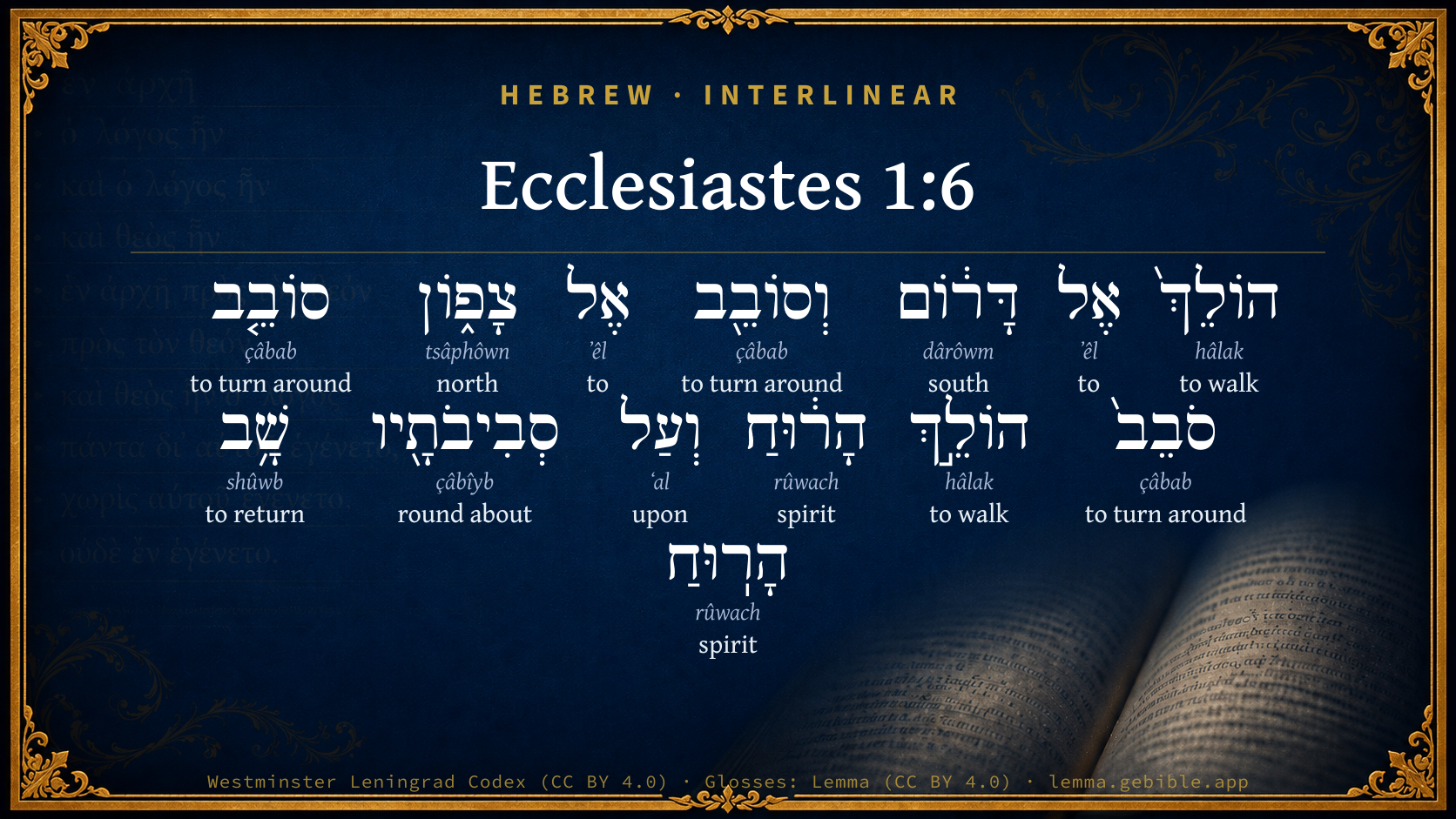
Hebrew (Westminster Leningrad Codex) Ecclesiastes 1:6 appears in the Hebrew Old Testament. The text above is from the Westminster Leningrad Codex. Each word links to its Strong’s number, a concise gloss, and parsing drawn from the Open Scriptures Hebrew Bible morphology. Click any word for its full Brown-Driver-Briggs (BDB) entry.
Download image
Cite this verse

Ecclesiastes 1:6 (World English Bible). Public Domain. Lemma interlinear Bible study tool, https://lemma.gebible.app/v/ecclesiastes/1/6.

Show BibTeX & RIS
BibTeX
RIS
English Translation
The wind goes toward the south, and turns around to the north. It turns around continually as it goes, and the wind returns again to its courses.
World English Bible · Public Domain
Download a study sheet

One document with this verse’s original text, its word-by-word gloss line, the meaning frame, cross-references with their text, attributed commentary, and full source and license credits — printable, and it pastes into notes with its structure intact.

This verse Autodidact and up

Study sheet (.html) Plain text (.txt)

A passage Seminary Student

Up to 50 verses in one chapter. A passage sheet keeps up to 6 commentary sources and 12 cross-references per verse, in the order this page ranks them, and says so on the sheet whenever that leaves anything out. Ask for a single verse and you get the Autodidact verse sheet above.

Everything on this page stays free to read, with no account — the sheet is a download of what is already on screen, not access to it.

Want to remove ads? Support Godless Engineer
Compare translations 3

The same verse in 3 English versions, stacked beneath the original-language interlinear above. Click any original word for its lexicon entry.

Each is an independent rendering of the whole verse — the interlinear is not word-aligned to these translations.

Highlighted words mark where these versions differ — a whole-verse word diff, not a word-by-word alignment.

  • World English Bible Public Domain
    The wind goes toward the south, and turns around to the north. It turns around continually as it goes, and the wind returns again to its courses.
  • King James Version Public Domain
    The wind goeth toward the south, and turneth about unto the north; it whirleth about continually, and the wind returneth again according to his circuits.
  • unfoldingWord Literal Text CC BY-SA 4.0
    Going to south and turning to north, turning, turning, the wind is going; and on its courses, the wind is returning.

unfoldingWord Literal Text — © unfoldingWord, licensed CC BY-SA 4.0. Word-aligned USFM3 via Door43 (git.door43.org/unfoldingWord/en_ult).

Versions to compare (up to 4)

3 of 4 selected

Show all 18 translations

Every available English version of this verse, each an independent rendering of the whole verse.

  • World English Bible Public Domain
    The wind goes toward the south, and turns around to the north. It turns around continually as it goes, and the wind returns again to its courses.
  • Berean Standard Bible Public Domain
    The wind blows southward, then turns northward; round and round it swirls, ever returning on its course.
  • Majority Standard Bible Public Domain
    The wind blows southward, then turns northward; round and round it swirls, ever returning on its course.
  • King James Version Public Domain
    The wind goeth toward the south, and turneth about unto the north; it whirleth about continually, and the wind returneth again according to his circuits.
  • American Standard Version (1901) Public Domain
    The wind goeth toward the south, and turneth about unto the north; it turneth about continually in its course, and the wind returneth again to its circuits.
  • Revised Version (1885) Public Domain
    The wind goeth toward the south, and turneth about unto the north; it turneth about continually in its course, and the wind returneth again to its circuits.
  • Geneva Bible (1599) Public Domain
    The winde goeth toward the South, and compasseth towarde the North: the winde goeth rounde about, and returneth by his circuites.
  • Douay-Rheims (1899) Public Domain
    Maketh his round by the south, and turneth again to the north: the spirit goeth forward surveying all places round about, and returneth to his circuits.
  • Young's Literal Translation Public Domain
    Going unto the south, and turning round unto the north, turning round, turning round, the wind is going, and by its circuits the wind hath returned.
  • Literal Standard Version CC BY-SA 4.0
    Going to the south, and turning around to the north, turning around, turning around, the wind is going, and by its circuits the wind has returned.
  • Unlocked Literal Bible CC BY-SA 4.0
    The wind blows south and circles around to the north, always going around along its pathway and coming back again.
  • unfoldingWord Literal Text CC BY-SA 4.0
    Going to south and turning to north, turning, turning, the wind is going; and on its courses, the wind is returning.
  • Darby Bible Public Domain
    The wind goeth towards the south, and turneth about towards the north: it turneth about continually, and the wind returneth again to its circuits.
  • World Messianic Bible Public Domain
    The wind goes toward the south, and turns around to the north. It turns around continually as it goes, and the wind returns again to its courses.
  • Webster's Bible Public Domain
    The wind goeth towards the south, and turneth about to the north; it whirleth about continually, and the wind returneth again according to its circuits.
  • Free Bible Version CC BY-SA 4.0
    The wind blows south, and then turns to the north. Round and round it spins, finally coming full circle.
  • Bible in Basic English Public Domain
    The wind goes to the south, turning back again to the north; circling round for ever.
  • JPS Tanakh (1917) Public Domain
    The wind goeth toward the south, and turneth about unto the north; it turneth about continually in its circuit, and the wind returneth again to its circuits.

Literal Standard Version (2020), Covenant Press — licensed CC BY-SA 4.0. Text via the HelloAO Bible API (eBible.org). Unlocked Literal Bible (unfoldingWord) — licensed CC BY-SA 4.0. Text via the HelloAO Bible API (eBible.org). unfoldingWord Literal Text — © unfoldingWord, licensed CC BY-SA 4.0. Word-aligned USFM3 via Door43 (git.door43.org/unfoldingWord/en_ult). Free Bible Version, Dr. Jonathan Gallagher — licensed CC BY-SA 4.0. Text via the HelloAO Bible API (eBible.org).

Word by word

More ways to search: Search by grammar → Find every occurrence → Compare this word →

Practice this passage: Drill this verse → Learn its vocabulary →

דָּר֔וֹם
dârôwm
H1864
“south”
Noun, Common, Masculine, Singular, Absolute
Part of Speech
Noun
Type
Common
Gender
Masculine
Number
Singular
State
Absolute
Full BDB Definition

Origin: of uncertain derivation

TWOT: 454d

south
  1. הוֹלֵךְ֙ hâlak H1980 “walking” Verb, Qal, Participle Active, Masculine, Singular, Absolute
  2. אֶל ʼêl H413 “to” Preposition
  3. וְסוֹבֵ֖ב çâbab H5437 “and · turning around” Conjunction + Verb, Qal, Participle Active, Masculine, Singular, Absolute
  4. אֶל ʼêl H413 “to” Preposition
  5. צָפ֑וֹן tsâphôwn H6828 “north” Noun, Common, Feminine, Singular, Absolute
  6. סוֹבֵ֤ב çâbab H5437 “turning around” Verb, Qal, Participle Active, Masculine, Singular, Absolute
  7. סֹבֵב֙ çâbab H5437 “turning around” Verb, Qal, Participle Active, Masculine, Singular, Absolute
  8. הוֹלֵ֣ךְ hâlak H1980 “walking” Verb, Qal, Participle Active, Masculine, Singular, Absolute
  9. הָר֔וּחַ rûwach H7307 “the · spirit” Particle, Definite Article + Noun, Common, Both, Singular, Absolute
  10. וְעַל ʻal H5921 “and · upon” Conjunction + Preposition
  11. סְבִיבֹתָ֖יו çâbîyb H5439 “surroundings · his” Noun, Common, Both, Plural, Construct + Suffix, Personal, 3rd Person, Masculine, Singular
  12. שָׁ֥ב shûwb H7725 “returning” Verb, Qal, Participle Active, Masculine, Singular, Absolute
  13. הָרֽוּחַ rûwach H7307 “the · spirit” Particle, Definite Article + Noun, Common, Both, Singular, Absolute

About this verse

These counts appear in no published source. They are computed here, from the morphology-tagged text and Lemma’s own curated glosses. What Lemma adds →

14
words
9
distinct lemmas
Wisdom
section

Notable vocabulary

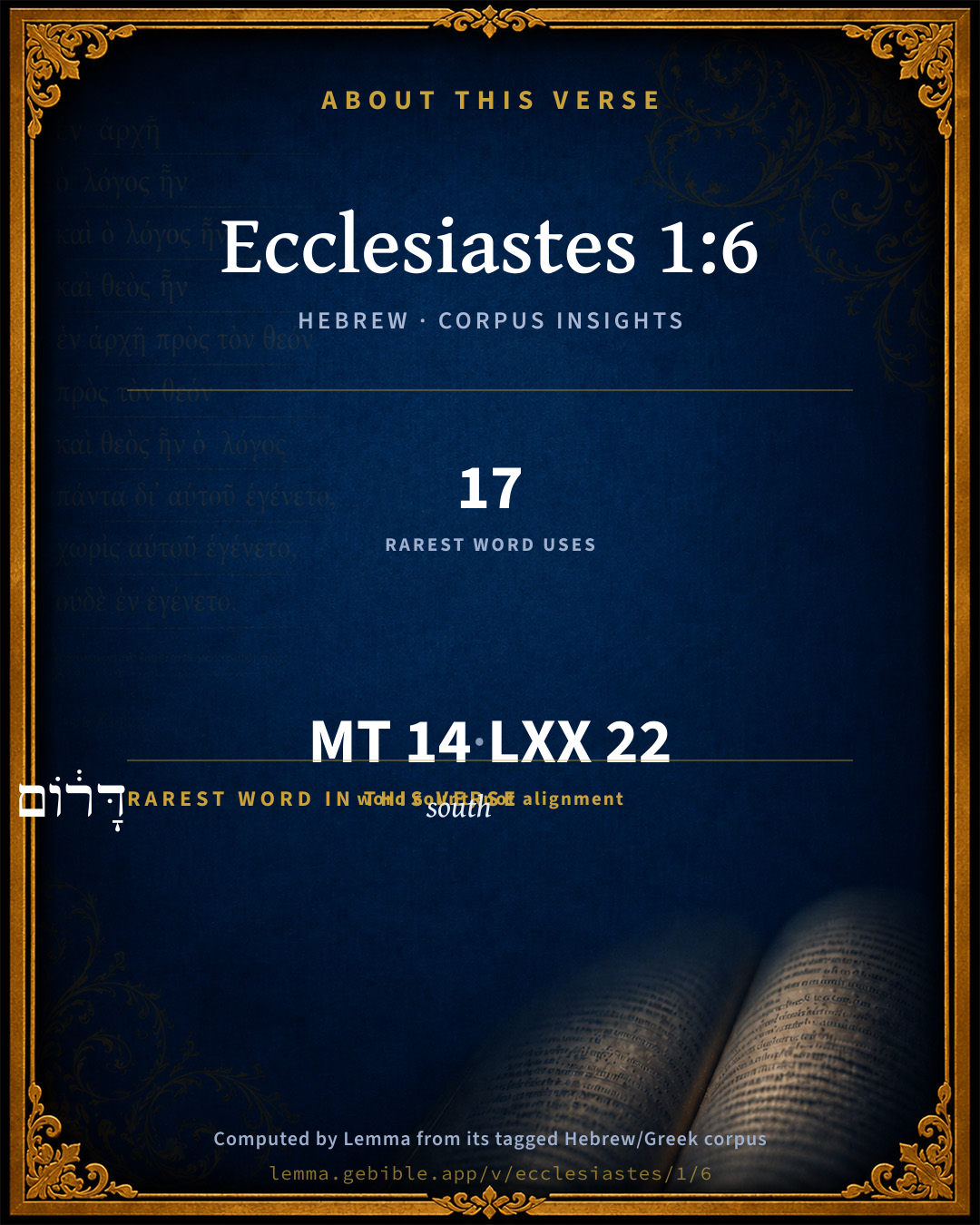
The rarest word here is דָּר֔וֹם south H1864 — appearing just 17 times in the whole Hebrew Bible.

Shared distinctive vocabulary

דָּר֔וֹם south H1864 occurs in 14 verses of the Hebrew Bible. Also found in:

Grammatical profile

  • 6 verbs
  • 5 nouns
  • 3 prepositions

Verb forms

  • הוֹלֵךְ֙ Qal · Participle Active
  • וְסוֹבֵ֖ב Qal · Participle Active
  • סוֹבֵ֤ב Qal · Participle Active
  • סֹבֵב֙ Qal · Participle Active
  • הוֹלֵ֣ךְ Qal · Participle Active
  • שָׁ֥ב Qal · Participle Active

Repetition

Words recur within this verse — often emphatic in Hebrew:

  • וְסוֹבֵ֖ב to turn around H5437 ×3
  • הוֹלֵךְ֙ to walk H1980 ×2
  • הָר֔וּחַ spirit H7307 ×2
  • אֶל to H413 ×2

Hebrew & Septuagint length

In English translation the verse runs 27 words from the Hebrew and 24 from the Septuagint (LXX English) — closely comparable.

A rough comparison of the two English renderings, which tokenize alike — not a word-level alignment.

Word counts can differ between the Hebrew and the Greek without any difference in meaning — e.g. the Hebrew direct-object marker אֵת has no separate Greek word, and Greek often adds the article ὁ.

In the original languages it is 14 Hebrew tokens and 22 Greek tokens — but the two are counted differently (Hebrew bundles its prefixes and suffixes into one token; the Greek is in lemma form), so that isn’t a like-for-like length.

Cross-references

6

Topical passages linked to Ecclesiastes 1:6 in the Treasury of Scripture Knowledge — connected by theme and wording, ordered by reader-vote popularity; previews shown in the World English Bible.

  • John 3:8 The wind blows where it wants to, and you hear its sound, but don't know where it comes from and where it is going. So is everyone who is born of the Spirit."
  • Ecclesiastes 11:5 As you don't know what is the way of the wind, Nor how the bones grow in the womb of her who is with child; Even so you don't know the work of God who does all.
  • Job 37:9 Out of its chamber comes the storm, And cold out of the north.
  • Job 37:17 You whose clothing is warm, When the earth is still by reason of the south wind?
  • Psalms 107:25 For he commands, and raises the stormy wind, Which lifts up its waves.
  • Psalms 107:29 He makes the storm a calm, So that its waves are still.

Cross-references courtesy of OpenBible.info (CC BY 4.0).

Hebrew and Greek witnesses Masoretic Hebrew ↔ Greek Septuagint

The same verse in the two great witnesses to the Old Testament, shown verse-for-verse.

These are two independent witnesses, not word-aligned to each other, and the Septuagint is shown in lemma (dictionary) form.

Hebrew Ecclesiastes 1:6 Masoretic · Westminster Leningrad Codex

הוֹלֵךְ֙ אֶל דָּר֔וֹם וְסוֹבֵ֖ב אֶל צָפ֑וֹן סוֹבֵ֤ב סֹבֵב֙ הוֹלֵ֣ךְ הָר֔וּחַ וְעַל סְבִיבֹתָ֖יו שָׁ֥ב הָרֽוּחַ

The wind goes toward the south, and turns around to the north. It turns around continually as it goes, and the wind returns again to its courses.

World English Bible · Public Domain

Greek LXX Ecclesiastes 1:6 Septuagint · lemma form

ἀνατέλλω αὐτός ἐκεῖ πορεύομαι πρός νότος καί κυκλόω πρός βορέας κυκλόω κύκλος πορεύομαι ὁ πνεῦμα καί ἐπί κύκλος αὐτός ἐπιστρέφω ὁ πνεῦμα

arising there it proceeds southward, and goes round toward the north. The wind goes round and round, and the wind returns to its circuits.

LXX2012 (modern English Septuagint) · Public Domain

On this verse, The Pulpit Commentary discusses the Septuagint’s reading. Read the note in Commentary ↓

Hebrew: Westminster Leningrad Codex (CC BY 4.0). Greek: Septuagint (public domain); English from LXX2012 (modern English Septuagint) (Public Domain). How the Septuagint differs from the Hebrew →

Commentary

Notes on Ecclesiastes 1:6 from classic Christian and Jewish commentators (each source and its license shown beneath its notes). The classic Christian expositions comment on the surrounding passage and are grouped to its opening verse, so a note may address several verses; the Jewish commentaries on the Tanakh (Rashi and others) are per-verse, so they appear only where the commentator wrote on this verse.

Lemma curates 59 commentaries, every one of them public domain or Creative Commons licensed, each selected and text-cleaned for this edition rather than reprinted as found. About our sources →

Trapp's Complete Commentary

John Trapp

Ecc 1:6 The wind goeth toward the south, and turneth about unto the north; it whirleth about continually, and the wind returneth again according to his circuits.

Ver. 6. The wind goeth toward the south, &c.] It is a little very small thing at first, a vapour rising out of the earth; but, by circuiting and whirling about, it gathers strength - now rushing toward the south, and anon toward the north, &c.; the original is very lively in expressing the manner of it. Una Eurusque Notusque ruunt, &c. {a} The restlessness of these insensible creatures, and diligence in doing their duties, as it taxeth our dulness and disaffection, so it reminds us of the instability of our states, and that we should seek and set up our rest in God alone. All earthly things are to the soul but as the air to the stone, - can give it no stay till it come to God the centre.

{a} Virg., Aeneid.

John Trapp, A Commentary or Exposition upon All the Books of the Old and New Testament (1647–1656) — public domain. Text from a community e-Sword module.

Keil & Delitzsch

C. F. Keil & F. Delitzsch

"It goeth to the south, and turneth to the north; the wind goeth ever circling, and the wind returneth again on its circuits." Thus designedly the verse is long-drawn and monotonous. It gives the impression of weariness. שׁב may be 3rd pret. with the force of an abstract present, but the relation is here different from that in 5a, where the rising, setting, and returning stand together, and the two former lie backwards indeed against the latter; here, on the contrary, the circling motion and the return to a new beginning stand together on the same line; שׁב is thus a part., as the Syr. translates it. The participles represent continuance in motion. In Ecc 1:4 the subjects stand foremost, because the ever anew beginning motion belongs to the subject; in Ecc 1:5 and Ecc 1:6, on the contrary, the pred. stands foremost, and the subject in Ecc 1:6 is therefore placed thus far back, because the first two pred. were not sufficient, but required a third for their completion. That the wind goes from the south (דּרום, R. דר, the region of the most intense light) to the north (צפון, R. צפן, the region of darkness), is not so exclusively true of it as it is of the sun that it goes from the east to the west; this expression requires the generalization "circling, circling goes the wind," i.e., turning in all directions here and there; for the repetition denotes that the circling movement exhausts all possibilities. The near defining part. which is subordinated to "goeth," elsewhere is annexed by "and," e.g., Jon 1:11; cf. Sa2 15:30; here סבב סובב , in the sense of סביב סביב, Eze 37:2 (both times with Pasek between the words), precedes. סביבה is here the n. actionis of סבב. And "on its circuits" is not to be taken adverbially: it turns back on its circuits, i.e., it turns back on the same paths (Knobel and others), but על and שׁב are connected, as Pro 26:11; cf. Psa 19:7 : the wind returns back to its circling movements to begin them anew (Hitzig). "The wind" is repeated (cf. Ecc 2:10; Ecc 4:1) according to the figure Epanaphora or Palindrome (vid., the Introd. to Isaiah, c. 40-66). To all regions of the heavens, to all directions of the compass, its movement is ceaseless, ever repeating itself anew; there is nothing permanent but the fluctuation, and nothing new but that the old always repeats itself. The examples are thoughtfully chosen and arranged. From the currents of air, the author now passes to streams of water.

Keil & Delitzsch — Biblical Commentary on the Old Testament (1861–1891) — public domain (CC PDM 1.0). Text via the HelloAO Bible API. (Old Testament only.)

Geneva Bible (1599)

Geneva Bible translators

By the sun, wind and rivers, he showeth that the greatest labor and longest hath an end, and therefore there can be no felicity in this world.

Geneva Bible (1599) marginal notes — public domain. Text via Bolls.life.

Jamieson, Fausset & Brown

Robert Jamieson, A. R. Fausset & David Brown

according to his circuits--that is, it returns afresh to its former circuits, however many be its previous veerings about. The north and south winds are the two prevailing winds in Palestine and Egypt.

Jamieson, Fausset & Brown — Commentary Critical and Explanatory on the Whole Bible (1871) — public domain (CC PDM 1.0). Text via the HelloAO Bible API.

Adam Clarke's Commentary

Verse 6. "The wind is continually whirling about, and the wind returneth upon its whirlings."

It is plain, from the clause which I have restored to the fifth verse, that the author refers to the approximations of the sun to the northern and southern tropics, viz., of Cancer and Capricorn. See Clarke on Ec 1:5.

All the versions agree in applying the first clause of the sixth verse to the sun, and not to the wind. Our version alone has mistaken the meaning. My old MS. Bible is quite correct:

The sunne riisith up, and goth doun, and to his place turnith agein; and there agein riising, goth about bi the south, and then agein to the north.

The author points out two things here:

1. Day and night, marked by the appearance of the sun above the horizon; proceeding apparently from east to west; where he sinks under the horizon, and appears to be lost during the night.

2. His annual course through the twelve signs of the zodiac, when, from the equinoctial, he proceeds southward to the tropic of Capricorn; and thence turneth about towards the north, till he reaches the tropic of Cancer; and so on.

Adam Clarke's Commentary on the Bible (1810–1826) — public domain. Text from a community e-Sword/MySword module.

Ellicott's Commentary for English Readers

(6) The order of the Hebrew words permits the first clause, “going towards the south and returning towards the north,” to be understood in continuation of the description of the movements of the sun, and so some interpreters have taken them, but probably erroneously. The verse gains in liveliness if more literally rendered, “going towards the south and circling towards the north, circling, circling goes the wind, and to its circles the wind returns.”

A Bible Commentary for English Readers, edited by Charles John Ellicott (1878–1897) — public domain. Text from a community e-Sword module.

The Cambridge Bible for Schools and Colleges

gen. ed. J. J. S. Perowne

6. The wind goeth toward the south] This comes after the sun as exhibiting a like, though more irregular, law of mutability. “South and north” only are named, partly, perhaps, because east and west were implied in the sunrise and sunset of the previous verse, more probably because these were the prevailing currents of air in Palestine. Comp. “Awake, O north wind; blow, O south,” in Son_4:16; Sir_43:20; Luk_12:55.

It whirleth about continually] The whole verse gains in poetic emphasis by a more literal rendering, It goeth to the south, and it circleth to the north, circling, circling goeth the wind, and on its circlings returneth the wind. The iteration and order of the words seem to breathe the languor of one who was weary with watching the endless and yet monotonous changes. (Comp. the illustration in Introduction, chap. iii.)

The Cambridge Bible for Schools and Colleges (gen. ed. J. J. S. Perowne; Cambridge University Press, 1878–1918) — public domain. Text from a community e-Sword module.

John Gill's Exposition

The wind goeth toward the south, and turneth about unto the north,.... The word "wind" is not in this clause in the original text, but is taken from the next, and so may be rendered, "it goeth towards the south", &c. that is, the sun (x) before mentioned, which as to its diurnal and nocturnal course in the daytime goes towards the south, and in the night towards the north; and as to its annual course before the winter solstice it goes to the south, and before the summer solstice to the north, as interpreters observe. And the Targum not only interprets this clause, but even the whole verse, of the sun, paraphrasing the whole thus,

"it goes all the side of the south in the daytime, and goes round to the side of the north in the night, by the way of the abyss; it goes its circuit, and comes to the wind of the south corner in the revolution of Nisan and Tammuz; and by its circuit it returns to the wind of the north corner in the revolution of Tisri and Tebet; it goes out of the confines of the east in the morning, and goes into the confines of the west in the evening.''

But Aben Ezra understands the whole of the wind, as our version and others do, which is sometimes in the south point of the heavens, and is presently in the north;

it whirleth about continually; and the wind returneth again according to his circuits; which may be meant of the circuits of the sun, which has a great influence on the wind, often raising it in a morning and laying it at night; but it is the wind itself which whirls and shifts about all the points of the compass, and returns from whence it came, where the treasures of it are. Agreeably to Solomon's account of the wind is Plato's definition of it,

"the wind is the motion of the air round about the earth (y).''

This also exemplifies the rotation of men and things, the instability, inconstancy, and restless state of all sublunary enjoyments; the unprofitableness of men's labours, who, while they labour for riches and honour, and natural knowledge, labour for the wind, and fill their belly with east wind, which cannot satisfy, Ecc 5:16; as well as the frailty of human life, which is like the wind that passes away and comes not again; and in this respect, like the rest of the instances, exceed man, which returns to its place, but man does not, Job 7:7.

(x) Jarchi, Alshech, and Titatzak, interpret it of the sun; so Mercerus, Varenius, Gejerus; accordingly Mr. Broughton renders it "he walketh to the south." (y) Definition. p. 1337. Ed. Ficin.

John Gill's Exposition of the Whole Bible (1746–1763) — public domain (CC PDM 1.0). Text via the HelloAO Bible API.

Albert Barnes' Notes on the Bible

More literally, Going toward the south and veering toward the north, veering, veering goes the wind; and to its veerings the wind returns.

Albert Barnes' Notes on the Bible (1834–1885) — public domain. Text from a community e-Sword/MySword module.

Haydock's Catholic Bible Commentary

Spirit. The sun, (St. Jerome) which is like the soul of the world, and which some have falsely asserted to be animated; or rather (Calmet) the wind is meant, as one rises in different parts of the world when another falls. (Pliny, [Natural History?] ii. 27.) (Menochius)

George Leo Haydock (1774–1849), Haydock's Catholic Family Bible and Commentary, 1859 edition — public domain. Excludes Psalms (Douay-Rheims chapter numbering differs from Protestant) and Deuterocanonical books (Catholic canon only).

Matthew Poole's English Annotations

The wind goeth toward the south, and turneth about unto the north; the wind also sometimes blows from one quarter of the world, and sometimes from another; all of them being synecdochically comprehended under these two eminent quarters. But because this word, the wind, is not expressed in the Hebrew, but is only borrowed or understood from the latter clause of the verse, this first clause is by other judicious interpreters understood of the sun, of whom he last spake; the words being thus rendered according to the Hebrew, He (the sun) goeth towards the south, (which he doth one half of the year,) and turneth about unto the north, which he doth the other half. And so here is the whole motion of the sun towards the four quarters of the world particularly described; his daily motion from east to, vest, and back again, Ecc 1:5; and his yearly motion from north to south, between the signs of Cancer and Capricorn.

The wind returneth again according to his circuits: this clause is by all understood of the wind, which is fitly mentioned immediately after the sun, because it hath its rise from the sun, who is therefore called the father of winds, and the winds do usually rise with the sun, and are laid when he sets. But then it is rendered thus, and that very agreeably to the Hebrew, the wind goeth continually whirling or compassing about, and he returneth again to his circuits, being sometimes in one, and sometimes in another quarter, and successively returning to the same quarters in which he had formerly been.

Matthew Poole's English Annotations on the Holy Bible (1683–1685) — public domain. Text from a community e-Sword/MySword module.

Whedon's Commentary on the Bible

Daniel D. Whedon

6. The wind goeth — It is as if the tireless winds were in sympathy with changeful man, and were a fitting companion for him. “O, remember that, my life is wind,” groaned Job, as he thought of its rapid changes and its early vanishing.

Returneth… to his circuits — The permanency of the courses of certain winds — perhaps of the Etesian winds of the Eastern Mediterranean — seems familiar to the writer, though its cause had not been investigated.

Daniel D. Whedon (gen. ed.), Commentary on the Old and New Testaments (1874–1909) — public domain. Text from a community e-Sword module.

The Pulpit Commentary

The wind goeth toward the south, and turneth about unto the north; literally, going towards the south, and circling towards the north. These words, as we have seen above, are referred to the sun by the Septuagint, Vulgate, and Syriac; but it is best to make this verse refer only to the wind a fresh example of motion continually repeated with no real progress to an end. Thus each verse comprises one subject and idea, ver. 4 being concerned with the earth, ver. 5 with the sun, ver. 6 with the wind, and ver. 7 with the waters. There seems to be no particular force in the naming of north and south, unless it be in contrast to the sun"s motion from east to west, mentioned in the preceding verse. The words following show that these two directions are not alone intended. Thus the four quarters are virtually included. It whirleth about continually. The original is more forcible, giving by its very form the idea of weary monotony. The subject is delayed till the last, thus: Going towards the south circling, circling, goeth the wind; i.e. it blows from all quarters at its own caprice. And the wind returneth again according to his circuits. And on its circlings returneth the wind; it comes back to the point whence it started. The wind, seemingly the freest of all created things, is bound by the same law of immutable changeableness, insensate repetition.

The Pulpit Commentary (1880–1919), ed. H.D.M. Spence-Jones & Joseph S. Exell — public domain. Text from a community e-Sword module.

John Wesley's Explanatory Notes

The wind - The wind also sometimes blows from one quarter of the world, and sometimes from another; successively returning to the same quarters in which it had formerly been.

John Wesley, Explanatory Notes Upon the Whole Bible (1754–1765) — public domain. Text via the GEBible commentary corpus.

Rashi

Rabbi Shlomo Yitzchaki (Rashi)

the will Heb. הָרוּחַ, the will of the sun, talant in Old French, like (Ezek. 1:12): “wherever would be the will (הָרוּחַ) to go.”

returns to its circuits Also on the morrow, the entire circuit and encircling that it encircled yesterday, it encircles and goes around today.

it goes to the south forever in the day.

and goes around to the north forever in the night.

goes around and around to the eastern and western sides, which it sometimes goes through by day, and sometimes goes around at night. In Tammuz it goes through them, and in Teveth it goes around them. Also the wicked, no matter how much their sun rises, they will ultimately set. No matter how much they gain power, they will ultimately return to the place of filth. From the place of filth they came, and to the place of filth they will go. And so...

Rashi on the Tanakh — English translations: “The Judaica Press complete Tanach with Rashi, translated by A. J. Rosenberg” (CC BY 4.0); “Pentateuch with Rashi's commentary by M. Rosenbaum and A.M. Silbermann, 1929-1934” (public domain); “The Metsudah Tanach series, Lakewood, N.J” (CC BY 4.0); and “The Book of Joshua, Metsudah Publications, 1997” (CC BY 4.0). Text via Sefaria.

Lesson kit

Teaching starters — assembled from the data on this page, not authored interpretation. Every prompt links to the verse data it draws on. Edit before teaching.

Ecclesiastes, in the Wisdom, opens this verse with 14 words (9 distinct Hebrew lemmas). Its most distinctive word is dârôwm (“south”). A historical commentator’s framing appears above. Read the whole chapter for the surrounding context.

Discussion questions

  1. What does “south” (dârôwm) contribute to the verse as a whole?
  2. How does Deuteronomy 33:23, which shares the word «south», read alongside this verse?
  3. What does the repetition of “to turn around” (3× in this one verse) do in this verse?
  4. The translations on this page render this verse differently — a whole-verse word diff, not a word-by-word alignment. What might account for the different wordings?
  5. «הוֹלֵךְ֙» is a Qal Participle Active verb. How does that grammatical form shape the action described?
  6. Compare how Trapp's Complete Commentary and Keil & Delitzsch read this verse. Where do they agree or differ?

Things to notice

Reading settings

Reading text

Shown beneath each verse's original-language words.

Old Testament
Old Testament edition

Read the OT as the Masoretic Hebrew (MT) or the Greek Septuagint (LXX).

English shown for the Greek Septuagint (in the Hebrew ↔ Greek comparison).

Comparing translations? Open the Compare panel on any verse page to stack up to four side by side.