Numbers 11:29

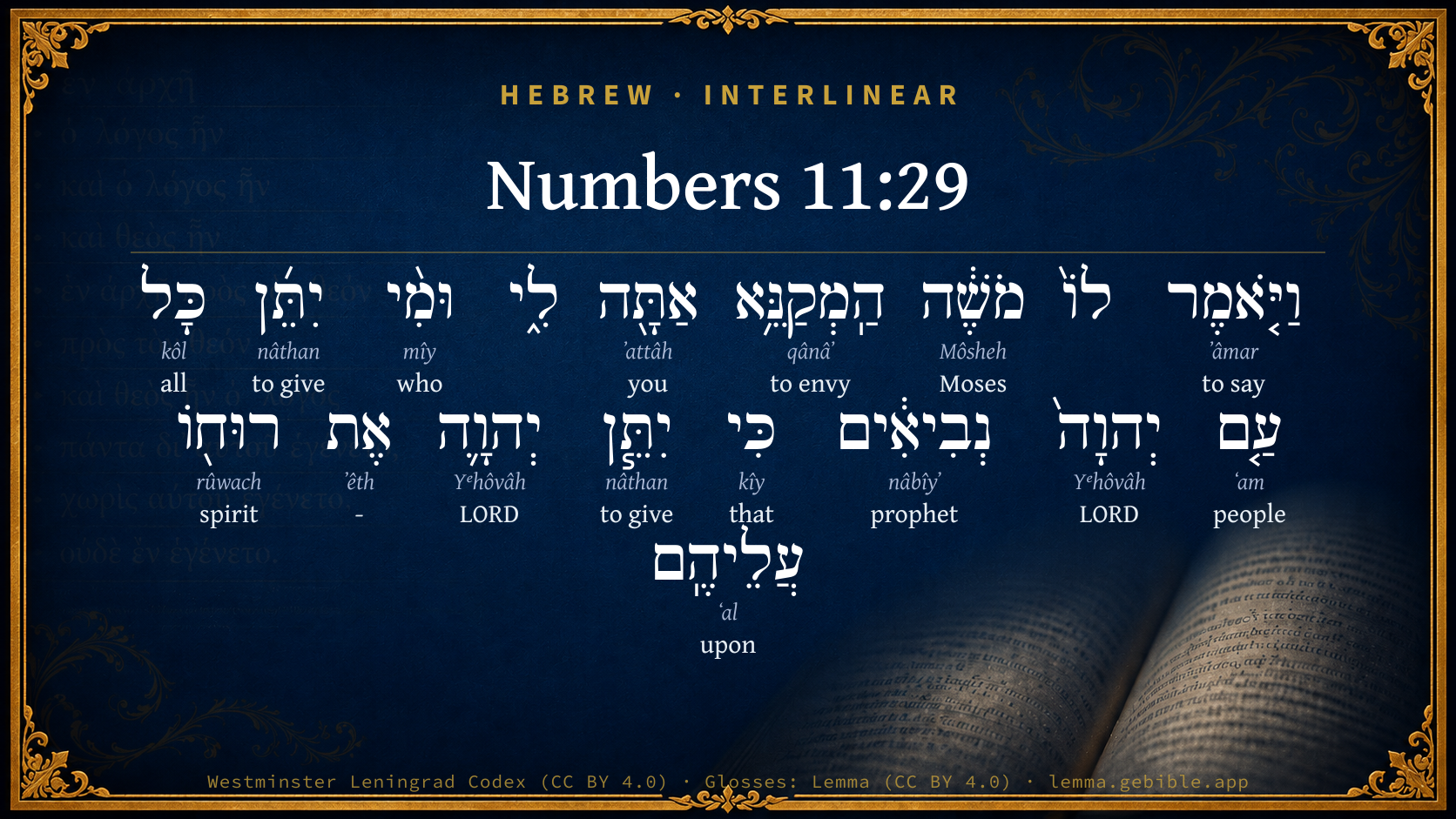
Hebrew (Westminster Leningrad Codex) Numbers 11:29 appears in the Hebrew Old Testament. The text above is from the Westminster Leningrad Codex. Each word links to its Strong’s number, a concise gloss, and parsing drawn from the Open Scriptures Hebrew Bible morphology. Click any word for its full Brown-Driver-Briggs (BDB) entry.
Download image
Cite this verse

Numbers 11:29 (World English Bible). Public Domain. Lemma interlinear Bible study tool, https://lemma.gebible.app/v/numbers/11/29.

Show BibTeX & RIS
BibTeX
RIS
English Translation
Moses said to him, Are you jealous for my sake? would that all Yahweh's people were prophets, that Yahweh would put his Spirit on them!
World English Bible · Public Domain
Download a study sheet

One document with this verse’s original text, its word-by-word gloss line, the meaning frame, cross-references with their text, attributed commentary, and full source and license credits — printable, and it pastes into notes with its structure intact.

This verse Autodidact and up

Study sheet (.html) Plain text (.txt)

A passage Seminary Student

Up to 50 verses in one chapter. A passage sheet keeps up to 6 commentary sources and 12 cross-references per verse, in the order this page ranks them, and says so on the sheet whenever that leaves anything out. Ask for a single verse and you get the Autodidact verse sheet above.

Everything on this page stays free to read, with no account — the sheet is a download of what is already on screen, not access to it.

Want to remove ads? Support Godless Engineer
Compare translations 3

The same verse in 3 English versions, stacked beneath the original-language interlinear above. Click any original word for its lexicon entry.

Each is an independent rendering of the whole verse — the interlinear is not word-aligned to these translations.

Highlighted words mark where these versions differ — a whole-verse word diff, not a word-by-word alignment.

  • World English Bible Public Domain
    Moses said to him, Are you jealous for my sake? would that all Yahweh's people were prophets, that Yahweh would put his Spirit on them!
  • King James Version Public Domain
    And Moses said unto him, Enviest thou for my sake? would God that all the LORD's people were prophets, and that the LORD would put his spirit upon them!
  • unfoldingWord Literal Text CC BY-SA 4.0
    And Moses said to him, “ you being jealous for me? And who will give all the people of Yahweh prophets, that Yahweh will give his Spirit on them?”

unfoldingWord Literal Text — © unfoldingWord, licensed CC BY-SA 4.0. Word-aligned USFM3 via Door43 (git.door43.org/unfoldingWord/en_ult).

Versions to compare (up to 4)

3 of 4 selected

Show all 18 translations

Every available English version of this verse, each an independent rendering of the whole verse.

  • World English Bible Public Domain
    Moses said to him, Are you jealous for my sake? would that all Yahweh's people were prophets, that Yahweh would put his Spirit on them!
  • Berean Standard Bible Public Domain
    But Moses replied, “Are you jealous on my account? I wish that all the LORD’s people were prophets and that the LORD would place His Spirit on them!”
  • Majority Standard Bible Public Domain
    But Moses replied, “Are you jealous on my account? I wish that all the LORD’s people were prophets and that the LORD would place His Spirit on them!”
  • King James Version Public Domain
    And Moses said unto him, Enviest thou for my sake? would God that all the LORD's people were prophets, and that the LORD would put his spirit upon them!
  • American Standard Version (1901) Public Domain
    And Moses said unto him, Art thou jealous for my sake? would that all Jehovah's people were prophets, that Jehovah would put his Spirit upon them!
  • Revised Version (1885) Public Domain
    And Moses said unto him, Art thou jealous for my sake? would God that all the LORD’S people were prophets, that the LORD would put his spirit upon them!
  • Geneva Bible (1599) Public Domain
    But Moses saide vnto him, Enuiest thou for my sake? yea, would God that all the Lordes people were Prophets, and that the Lord woulde put his Spirit vpon them.
  • Douay-Rheims (1899) Public Domain
    But he said: Why hast thou emulation for me? O that all the people might prophesy, and that the Lord would give them his spirit!
  • Young's Literal Translation Public Domain
    And Moses saith to him, `Art thou zealous for me? O that all Jehovah's people were prophets! that Jehovah would put His Spirit upon them!'
  • Literal Standard Version CC BY-SA 4.0
    And Moses says to him, “Are you zealous for me? O that all YHWH’s people were prophets! That YHWH would put His Spirit on them!”
  • Unlocked Literal Bible CC BY-SA 4.0
    Moses said to him, “Are you jealous for my sake? I wish that all of Yahweh's people were prophets and that he would put his Spirit on them all!”
  • unfoldingWord Literal Text CC BY-SA 4.0
    And Moses said to him, “ you being jealous for me? And who will give all the people of Yahweh prophets, that Yahweh will give his Spirit on them?”
  • Darby Bible Public Domain
    But Moses said to him, Enviest thou for my sake? would that all Jehovah's people were prophets, [and] that Jehovah would put his Spirit upon them!
  • World Messianic Bible Public Domain
    Moses said to him, “Are you jealous for my sake? I wish that all the LORD’s people were prophets, that the LORD would put his Spirit on them!”
  • Webster's Bible Public Domain
    And Moses said to him, Enviest thou for my sake? I would that all the LORD'S people were prophets, and that the LORD would put his spirit upon them.
  • Free Bible Version CC BY-SA 4.0
    “Are you jealous for my reputation?” Moses replied. “I wish that every one of the Lord's people were prophets and that the Lord would give his Spirit to all of them!”
  • Bible in Basic English Public Domain
    And Moses said to him, Are you moved by envy on my account? If only all the Lord's people were prophets, and the Lord might put his spirit on them!
  • JPS Tanakh (1917) Public Domain
    And Moses said unto him: 'Art thou jealous for my sake? would that all the LORD'S people were prophets, that the LORD would put His spirit upon them!'

Literal Standard Version (2020), Covenant Press — licensed CC BY-SA 4.0. Text via the HelloAO Bible API (eBible.org). Unlocked Literal Bible (unfoldingWord) — licensed CC BY-SA 4.0. Text via the HelloAO Bible API (eBible.org). unfoldingWord Literal Text — © unfoldingWord, licensed CC BY-SA 4.0. Word-aligned USFM3 via Door43 (git.door43.org/unfoldingWord/en_ult). Free Bible Version, Dr. Jonathan Gallagher — licensed CC BY-SA 4.0. Text via the HelloAO Bible API (eBible.org).

Word by word

More ways to search: Search by grammar → Find every occurrence → Compare this word →

Practice this passage: Drill this verse → Learn its vocabulary →

הַֽמְקַנֵּ֥א
qânâʼ
H7065
“envying”
Particle, Interrogative + Verb, Piel, Participle Active, Masculine, Singular, Absolute
Part of Speech
Particle + Verb
Stem
Piel
Form
Participle Active
Gender
Masculine
Number
Singular
State
Absolute
Full BDB Definition

Origin: a primitive root

TWOT: 2038

to envy, be jealous, be envious, be zealous - (Piel) - to be jealous of - to be envious of - to be zealous for - to excite to jealous anger - (Hiphil) to provoke to jealous anger, cause jealousy
  1. וַיֹּ֤אמֶר ʼâmar H559 “and · to say” Conjunction + Verb, Qal, Sequential Imperfect, 3rd Person, Masculine, Singular
  2. מֹשֶׁ֔ה Môsheh H4872 “Moses” Noun, Proper
  3. אַתָּ֖ה ʼattâh H859 “you” Pronoun, Personal, 2nd Person, Masculine, Singular
  4. וּמִ֨י mîy H4310 “and · who” Conjunction + Particle, Interrogative
  5. יִתֵּ֜ן nâthan H5414 “to give” Verb, Qal, Imperfect, 3rd Person, Masculine, Singular
  6. כָּל kôl H3605 “all of” Noun, Common, Masculine, Singular, Construct
  7. עַ֤ם ʻam H5971 “people of” Noun, Common, Masculine, Singular, Construct
  8. יְהוָה֙ Yᵉhôvâh H3068 “LORD” Noun, Proper
  9. נְבִיאִ֔ים nâbîyʼ H5030 “prophets” Noun, Common, Masculine, Plural, Absolute
  10. כִּי kîy H3588 “that” Conjunction
  11. יִתֵּ֧ן nâthan H5414 “to give” Verb, Qal, Imperfect, 3rd Person, Masculine, Singular
  12. יְהוָ֛ה Yᵉhôvâh H3068 “LORD” Noun, Proper
  13. אֶת ʼêth H853 “-” Particle, Direct Object
  14. רוּח֖וֹ rûwach H7307 “spirit · his” Noun, Common, Both, Singular, Construct + Suffix, Personal, 3rd Person, Masculine, Singular
  15. עֲלֵיהֶֽם ʻal H5921 “upon · them” Preposition + Suffix, Personal, 3rd Person, Masculine, Plural

About this verse

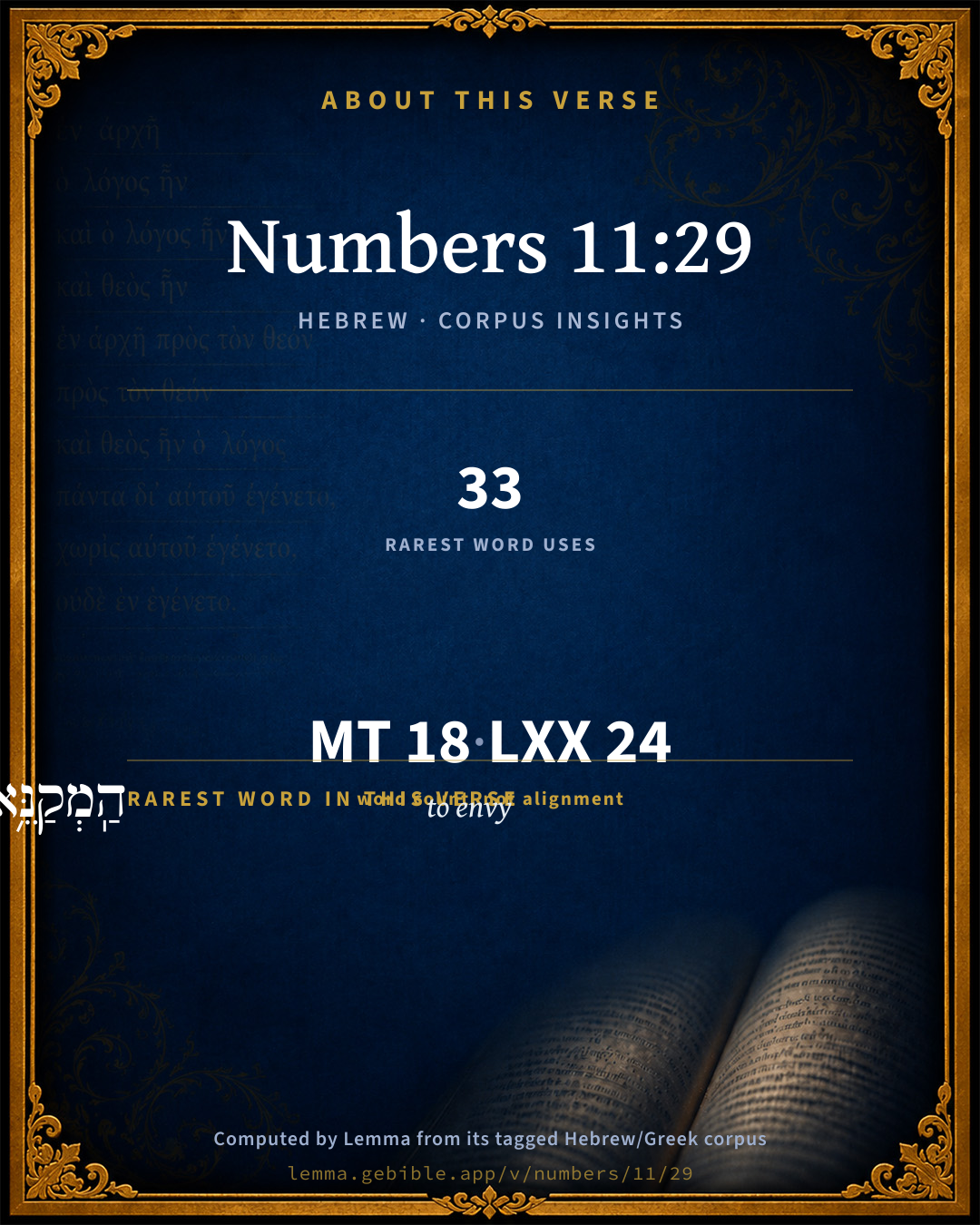
These counts appear in no published source. They are computed here, from the morphology-tagged text and Lemma’s own curated glosses. What Lemma adds →

18
words
14
distinct lemmas
Pentateuch
section

Shared distinctive vocabulary

הַֽמְקַנֵּ֥א to envy H7065 occurs in 28 verses of the Hebrew Bible. Also found in:

Grammatical profile

  • 4 verbs
  • 7 nouns
  • 1 pronoun
  • 3 prepositions
  • 1 conjunction
  • 2 particles

Verb forms

  • וַיֹּ֤אמֶר Qal · Sequential Imperfect
  • הַֽמְקַנֵּ֥א Piel · Participle Active
  • יִתֵּ֜ן Qal · Imperfect
  • יִתֵּ֧ן Qal · Imperfect

Repetition

Words recur within this verse — often emphatic in Hebrew:

  • יִתֵּ֜ן to give H5414 ×2
  • יְהוָה֙ LORD H3068 ×2

Hebrew & Septuagint length

In English translation the verse runs 25 words from the Hebrew and 29 from the Septuagint (LXX English) — closely comparable.

A rough comparison of the two English renderings, which tokenize alike — not a word-level alignment.

Word counts can differ between the Hebrew and the Greek without any difference in meaning — e.g. the Hebrew direct-object marker אֵת has no separate Greek word, and Greek often adds the article ὁ.

In the original languages it is 18 Hebrew tokens and 24 Greek tokens — but the two are counted differently (Hebrew bundles its prefixes and suffixes into one token; the Greek is in lemma form), so that isn’t a like-for-like length.

Cross-references

13

Topical passages linked to Numbers 11:29 in the Treasury of Scripture Knowledge — connected by theme and wording, ordered by reader-vote popularity; previews shown in the World English Bible.

  • 1 Corinthians 14:5 Now I desire to have you all speak with other languages, but rather that you would prophesy. For he is greater who prophesies than he who speaks with other languages, unless he interprets, that the assembly may be built up.
  • Matthew 9:37–38 Then he said to his disciples, "The harvest indeed is plentiful, but the laborers are few.
  • Luke 10:2 Then he said to them, "The harvest is indeed plentiful, but the laborers are few. Pray therefore to the Lord of the harvest, that he may send out laborers into his harvest.
  • James 4:5 Or do you think that the Scripture says in vain, "The Spirit who lives in us yearns jealously"?
  • James 5:9 Don't grumble, brothers, against one another, so that you won't be judged. Behold, the judge stands at the door.
  • Philippians 1:15–18 Some indeed preach Christ even out of envy and strife, and some also out of good will.
  • Philippians 2:3 doing nothing through rivalry or through conceit, but in humility, each counting others better than himself;
  • James 3:14–15 But if you have bitter jealousy and selfish ambition in your heart, don't boast and don't lie against the truth.
  • 1 Corinthians 3:21 Therefore let no one boast in men. For all things are yours,
  • 1 Peter 2:1 Putting away therefore all wickedness, all deceit, hypocrisies, envies, and all evil speaking,
  • Acts 26:29 Paul said, "I pray to God, that whether with little or with much, not only you, but also all that hear me this day, might become such as I am, except for these bonds."
  • 1 Corinthians 3:3 for you are still fleshly. For insofar as there is jealousy, strife, and factions among you, aren't you fleshly, and don't you walk in the ways of men?
  • 1 Corinthians 13:4 Love is patient and is kind; love doesn't envy. Love doesn't brag, is not proud,

Cross-references courtesy of OpenBible.info (CC BY 4.0).

Hebrew and Greek witnesses Masoretic Hebrew ↔ Greek Septuagint

The same verse in the two great witnesses to the Old Testament, shown verse-for-verse.

These are two independent witnesses, not word-aligned to each other, and the Septuagint is shown in lemma (dictionary) form.

Hebrew Numbers 11:29 Masoretic · Westminster Leningrad Codex

וַיֹּ֤אמֶר לוֹ֙ מֹשֶׁ֔ה הַֽמְקַנֵּ֥א אַתָּ֖ה לִ֑י וּמִ֨י יִתֵּ֜ן כָּל עַ֤ם יְהוָה֙ נְבִיאִ֔ים כִּי יִתֵּ֧ן יְהוָ֛ה אֶת רוּח֖וֹ עֲלֵיהֶֽם

Moses said to him, Are you jealous for my sake? would that all Yahweh's people were prophets, that Yahweh would put his Spirit on them!

World English Bible · Public Domain

Greek LXX Numbers 11:29 Septuagint · lemma form

καί εἶπον αὐτός μωυσῆς μή ζηλόω σύ ἐγώ καί τίς δίδωμι πᾶς ὁ λαός κύριος προφήτης ὅταν δίδωμι κύριος ὁ πνεῦμα αὐτός ἐπί αὐτός

And Moses said to him, Are you jealous on my account? and would that all the Lord's people were prophets; whenever the Lord shall put his spirit upon them.

LXX2012 (modern English Septuagint) · Public Domain

Hebrew: Westminster Leningrad Codex (CC BY 4.0). Greek: Septuagint (public domain); English from LXX2012 (modern English Septuagint) (Public Domain). How the Septuagint differs from the Hebrew →

Targum (Aramaic paraphrase)

2

The Targum is the ancient Jewish Aramaic paraphrase of the Hebrew Scriptures — an interpretive translation, not the Hebrew text itself. Onkelos (literal) and Pseudo-Jonathan (expansive) render the Torah, and Jonathan the Prophets. Coverage is partial: where no permissively-licensed English translation exists for a verse, only the Aramaic is shown. This is verse-level text, not a word-by-word alignment to the Hebrew.

  1. Targum Onkelos Torah (Genesis–Deuteronomy)
    וַאֲמַר לֵהּ משֶׁה הֲקִנְאָתִי אַתְּ מְקַנֵא לִי רְעֵינָא פוּן דִיהוֹן כָּל עַמָא דַיְיָ נְבִיאִין אֲרֵי יִתֵּן יְיָ יָת רוּחַ נְבוּאֲתֵהּ עֲלֵיהוֹן

    (no public-domain English translation for this verse)

    Targum Onkelos — Aramaic: “Onkelos Genesis” (public domain); “Onkelos Exodus” (public domain); “Onkelos Leviticus” (public domain); “Onkelos Numbers” (public domain); “Onkelos Deuteronomy” (public domain). English: “Sefaria Community Translation” (CC0 1.0 (public-domain dedication)); “J.W. Etheridge. The Targums of Onkelos and Jonathan Ben Uzziel on the Pentateuch. London: Longmans, Green, 1862” (public domain). Text via Sefaria.

  2. Targum Pseudo-Jonathan Torah (Genesis–Deuteronomy)
    וַאֲמַר לֵיהּ משֶׁה הֲמִן בִּגְלַל דְאִתְנַבּוּ עָלַי דַאֲנָא מִתְכְּנַשׁ מִן עַלְמָא וְאַנְתְּ מְשַׁמֵשׁ מִן בַּתְרַיי אַנְתְּ מְקַנֵי לִי רְעֵינָא פּוֹן דִיהוֹן כָּל עַמָא דַיְיָ נְבִייָן אֲרוּם יִתֵּן יְיָ יַת רוּחַ נְבִיאוּתֵיהּ עֲלֵיהוֹן

    But Mosheh said to him, Because they prophesy concerning me that I am to be gathered from the world, and that thou art to minister after me, art thou jealous for my sake? I would that all the Lord's people were prophets, and that He would bestow the Spirit of prophecy upon them.

    Targum Pseudo-Jonathan — Aramaic: “Targum Jonathan on Genesis” (public domain); “Targum Jonathan on Exodus” (public domain); “Targum Jonathan on Leviticus” (public domain); “Targum Jonathan on Numbers” (public domain); “Targum Jonathan on Deuteronomy” (public domain). English: “The Targum of Jonathan ben Uzziel, trans. J. W. Etheridge, London, 1862” (public domain). Text via Sefaria.

Commentary

Notes on Numbers 11:29 from classic Christian and Jewish commentators (each source and its license shown beneath its notes). The classic Christian expositions comment on the surrounding passage and are grouped to its opening verse, so a note may address several verses; the Jewish commentaries on the Tanakh (Rashi and others) are per-verse, so they appear only where the commentator wrote on this verse.

Lemma curates 59 commentaries, every one of them public domain or Creative Commons licensed, each selected and text-cleaned for this edition rather than reprinted as found. About our sources →

Trapp's Complete Commentary

John Trapp

Num 11:29 And Moses said unto him, Enviest thou for my sake? would God that all the LORD’S people were prophets, [and] that the LORD would put his spirit upon them!

Ver. 29. That all the Lord’s people.] This is not meant of a sacrifically teaching others, but a political discoursing unto others. {See Trapp on "Num 11:25"}

John Trapp, A Commentary or Exposition upon All the Books of the Old and New Testament (1647–1656) — public domain. Text from a community e-Sword module.

Joseph Benson's Commentary

Num 11:29. Enviest thou for my sake? — Art thou grieved because the gifts and graces of God’s Spirit are imparted to others besides me? Or rather, Art thou jealous for my sake? Art thou afraid that their exercising these prophetic gifts will be a diminution of my honour? Would God that all the Lord’s people were prophets — That they were all so inspired by his Spirit as to be enabled to speak to his praise, and to the edification of others! He saith prophets, not rulers, for that, he knew, could not be. Thus we see, though Joshua was Moses’s particular friend and confidant, and though he said this out of respect for Moses, whose honour he was very unwilling to see lessened by the call of those elders, yet Moses reproves him, as Christ did the disciples on the occasion just mentioned, and, in him, all who are of such a spirit. “We must take care,” says Henry, “that we do not secretly grieve at the gifts, graces, or usefulness of others, and that we be not forward to condemn and silence those that differ from us, as if they did not follow Christ, because they do not follow him with us. Shall we reject those whom Christ has owned? or restrain any from doing good because they are not in every thing of our mind? Moses was of another spirit; so far from silencing these two, and quenching the spirit in them, he wishes that all the Lord’s people were prophets, and that he would put his Spirit upon them. Not that he would have had any to set up for prophets who were not duly qualified; or that he expected the spirit of prophecy to be made thus common; but he thus expresseth the love and esteem he had for all the Lord’s people, the complacency he took in the gifts of others, and how far he was from being displeased at Eldad and Medad’s prophesying from under his eye. Such an excellent spirit as this blessed Paul was of; rejoicing that Christ was preached, though it were by those who therein intended to add affliction to his bonds, Php 1:16. We ought to be pleased that God is served and glorified, and good done, though to the lessening of our credit and the credit of our way.”

Joseph Benson's Commentary on the Old and New Testaments (1811–1818) — public domain. Text from a community e-Sword module.

Adam Clarke's Commentary

Verse 29. Enviest thou for my sake?]

Moses, the minister of God,

Rebukes our partial love,

Who envy at the gifts bestow'd

On those we disapprove.

We do not our own spirit know,

Who wish to see suppress'd

The men that Jesu's spirit show,

The men whom God hath bless'd.

Would God that all the Lord's people were prophets]

SHALL we the Spirit's course restrain,

Or quench the heavenly fire?

Let God his messengers ordain,

And whom he will inspire.

Blow as he list, the Spirit's choice

Of instruments we bless;

We will, if Christ be preached, rejoice,

And wish the word success.

Can all be prophets then? are all

Commission'd from above?

No; but whome'er the Lord shall call

We joyfully approve.

O that the Church might all receive

The spirit of prophecy,

And all in Christ accepted live,

And all in Jesus die!

Short Hymns on Select Passages of the Holy Scriptures, by

Charles Wesley, M. A., and Presbyter of the Church of England.

Bristol, 1762. 2 vols. 12mo.

These sentiments are the more particularly remarkable as they come from one who was sufficiently bigoted to what was called ecclesiastical orders and regularity.

Adam Clarke's Commentary on the Bible (1810–1826) — public domain. Text from a community e-Sword/MySword module.

Ellicott's Commentary for English Readers

(29) Enviest thou for my sake?-Better, Art thou zealous for me? or, Art thou displeased on my account? (Comp. Num_25:13; 1Ki_19:10; 1Ki_19:14.)

A Bible Commentary for English Readers, edited by Charles John Ellicott (1878–1897) — public domain. Text from a community e-Sword module.

The Cambridge Bible for Schools and Colleges

gen. ed. J. J. S. Perowne

29. Moses’ reply indicates the special object with which the writer recorded the incident. His object was religious, and the narrative possesses an abiding religious value. The conceptions of the divine Spirit and His activity have differed in different ages; but Moses expresses the conviction which is true for all time, that the possession of the Spirit is not confined to particular persons or classes. With a deeper realisation of the truth Jeremiah (Num_31:33 f.) and Joel (Num_2:28 f.[Heb_3:1 f.]) teach that the gift of the Spirit is universal. Joel’s words were claimed by S. Peter to have been fulfilled (Act_2:16 ff.); and S. Paul rejoices in the unity of the Body of Christ because it is animated by ‘one Spirit’ (Eph_4:3-4), ‘dividing to each one severally even as He will’ (1Co_12:4-11).

The Cambridge Bible for Schools and Colleges (gen. ed. J. J. S. Perowne; Cambridge University Press, 1878–1918) — public domain. Text from a community e-Sword module.

John Gill's Exposition

Moses said unto him, enviest thou for my sake?.... Lest his authority should be weakened, and his honour lessened, because they began not to prophesy in his presence, and at the tabernacle, and among the rest of the elders, and so seemed not to have received of the Spirit that was upon him, and to be independent of him:

would God that all the Lord's people were prophets; this is not to he understood in the most absolute sense, as if Moses wished that every individual person among the people of Israel were prophets, as the word may signify a set and order of men, and an office in the church or state, as ministers of the word extraordinary or ordinary; for then there would be none to prophesy to, or to teach and instruct; and so likewise not rulers, or helps and assistants in government, for then there would be none to be governed; but it is to be taken comparatively, and is designed to show how far Moses was from an envious spirit at the gifts of others, that he could wish, if it was the will of God, and consistent with the order of things, that every man had as great or greater gifts than he had, qualifying them for public service and usefulness; such was the modesty and meekness of Moses: there is a sense indeed, in which all the Lord's people, all good men, are and should be prophets, and for which by the grace of the Spirit of God they are qualified; and should act as such, by praying and singing praises, which are sometimes meant by prophesying, and by spiritual conferences in private with one another, building up each other on their most holy faith, and by teaching and instructing all under their care in their families:

and that the Lord would put his Spirit upon them; the gifts of it, which are necessary to fit men for public service in church or state, or for private usefulness, Co1 12:7.

John Gill's Exposition of the Whole Bible (1746–1763) — public domain (CC PDM 1.0). Text via the HelloAO Bible API.

Matthew Poole's English Annotations

Enviest thou; art thou grieved because the gifts and graces of God are imparted to others besides me? Compare Joh 3:26. He saith

prophets, not rulers, for that he knew was absurd and impossible.

Matthew Poole's English Annotations on the Holy Bible (1683–1685) — public domain. Text from a community e-Sword/MySword module.

Whedon's Commentary on the Bible

Daniel D. Whedon

29. Enviest thou for my sake — Do you think this act is derogatory to my dignity, and disrespectful to my office as the human head of Israel?

All… were prophets — This strongly expressed wish evinces the unselfishness of Moses, his freedom from unholy ambition, and his desire for the spiritual well-being of all the people.

Put his Spirit upon them — This may be regarded as prophetic of the dispensation more distinctly announced by Joel, (Joe_2:28,) proclaimed by John the Baptist as at hand, (Mat_3:11,) promised by Jesus Christ, (Joh_14:16,) and ushered in by the coming of the Comforter on the day of Pentecost. Acts 2. All who enjoy the fulness of the Spirit most earnestly desire the universal diffusion of this unspeakable gift — “a well of water springing up into everlasting life.” Compare Joh_4:14; Joh_7:37-39; Eph_3:19; Eph_5:18. This desire of Moses, in view of the spiritual desolation of the world, even in Israel, is only an anticipatory outbreaking of the prayer for more labourers which Jesus taught his disciples. Mat_9:37-38, notes.

Daniel D. Whedon (gen. ed.), Commentary on the Old and New Testaments (1874–1909) — public domain. Text from a community e-Sword module.

The Pulpit Commentary

Enviest thou for my sake? In this answer speaks for once "the meekest of men." It was his sad fate that his position as representative of God obliged him to see repressed with terrible visitations any rebellion against his sole and absolute authority. But he was devoid of personal ambition at all times, and at this time weary and disgusted with the responsibility of ruling such a people. How much more for the glory of God, and for his own peace, would it be if not only these, but all the people, shared the gifts of the Spirit! Mar_9:38, 39 presents a partial, but still a striking, parallel.

The Pulpit Commentary (1880–1919), ed. H.D.M. Spence-Jones & Joseph S. Exell — public domain. Text from a community e-Sword module.

John Wesley's Explanatory Notes

Enviest thou for my sake - Art thou grieved because the gifts and graces of God are imparted to others besides me? Prophets - He saith prophets, not rulers, for that he knew was absurd and impossible. So we ought to be pleased, that God is glorified and good done, tho' to the lessening of our own honour.

John Wesley, Explanatory Notes Upon the Whole Bible (1754–1765) — public domain. Text via the GEBible commentary corpus.

Rashi

Rabbi Shlomo Yitzchaki (Rashi)

המקנא אתה לי means, “art thou envying where I should envy”.

לי — the word לי meaning the same as בשבילי, “for my sake”. Wherever an expression of the root קנא is used it implies that a person sets his heart on the matter, whether it be to take vengeance or to help; — emportement in O. F. (English = zeal) — he holds the thickest (heaviest) part of the load (i.e. he takes the responsibility for carrying out a matter).

Rashi on the Tanakh — English translations: “The Judaica Press complete Tanach with Rashi, translated by A. J. Rosenberg” (CC BY 4.0); “Pentateuch with Rashi's commentary by M. Rosenbaum and A.M. Silbermann, 1929-1934” (public domain); “The Metsudah Tanach series, Lakewood, N.J” (CC BY 4.0); and “The Book of Joshua, Metsudah Publications, 1997” (CC BY 4.0). Text via Sefaria.

Lesson kit

Teaching starters — assembled from the data on this page, not authored interpretation. Every prompt links to the verse data it draws on. Edit before teaching.

Numbers, in the Pentateuch, opens this verse with 18 words (14 distinct Hebrew lemmas). Its most distinctive word is qânâʼ (“to envy”). A historical commentator’s framing appears above. Read the whole chapter for the surrounding context.

Discussion questions

  1. How does “to envy” (qânâʼ) shape what this verse is saying?
  2. How does Genesis 26:14, which shares the word «to envy», read alongside this verse?
  3. What does the repetition of “to give” (2× in this one verse) do in this verse?
  4. These translations render this verse differently. What is at stake in choosing one wording over another?
  5. «וַיֹּ֤אמֶר» is a Qal Sequential Imperfect verb. How does that grammatical form shape the action described?
  6. Compare how Trapp's Complete Commentary and Joseph Benson's Commentary read this verse. Where do they agree or differ?

Things to notice

Reading settings

Reading text

Shown beneath each verse's original-language words.

Old Testament
Old Testament edition

Read the OT as the Masoretic Hebrew (MT) or the Greek Septuagint (LXX).

English shown for the Greek Septuagint (in the Hebrew ↔ Greek comparison).

Comparing translations? Open the Compare panel on any verse page to stack up to four side by side.