
2 Chronicles 18:23

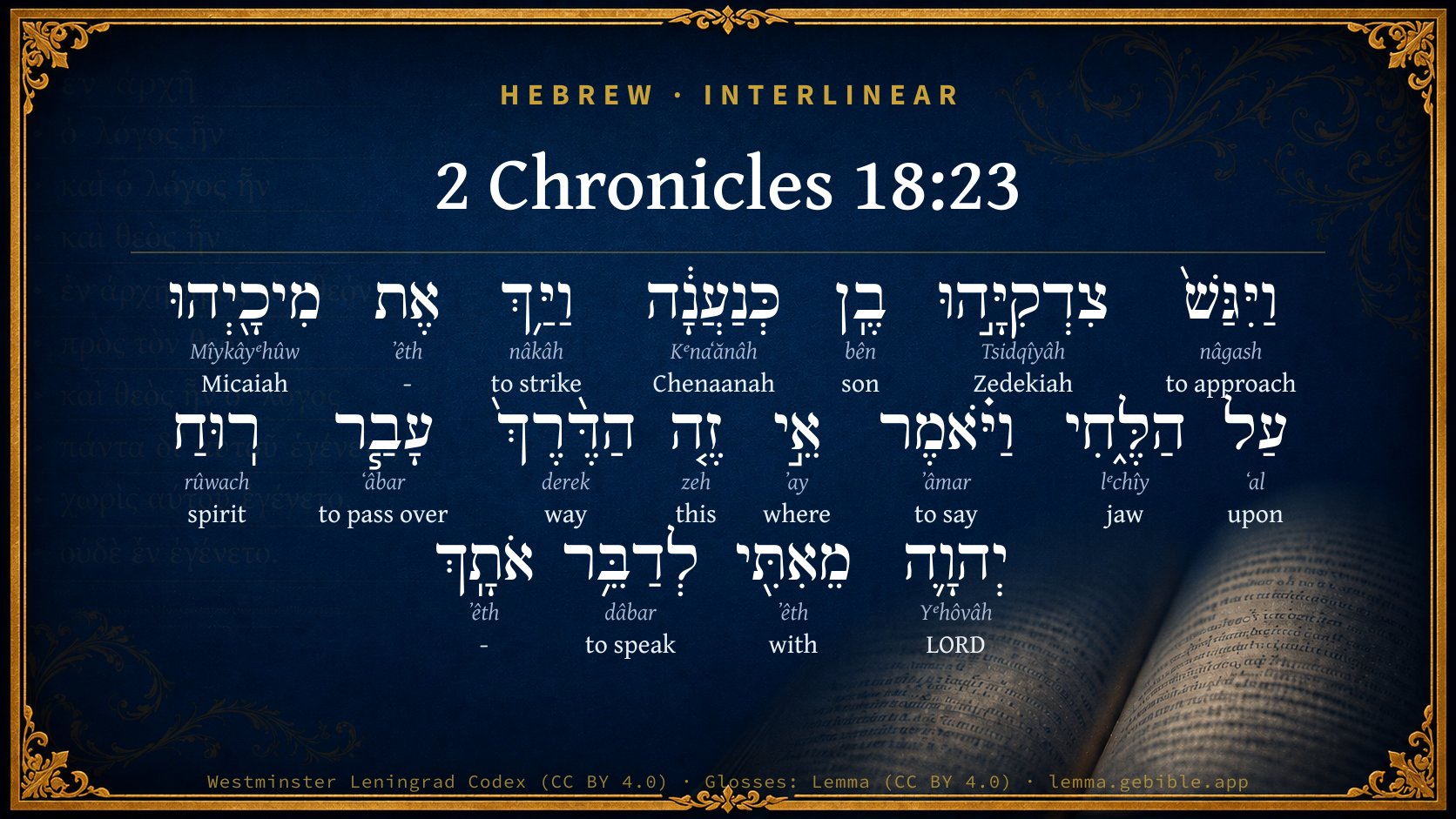
Hebrew (Westminster Leningrad Codex) 2 Chronicles 18:23 appears in the Hebrew Old Testament. The text above is from the Westminster Leningrad Codex. Each word links to its Strong’s number, a concise gloss, and parsing drawn from the Open Scriptures Hebrew Bible morphology. Click any word for its full Brown-Driver-Briggs (BDB) entry.
Download image
Cite this verse

2 Chronicles 18:23 (World English Bible). Public Domain. Lemma interlinear Bible study tool, https://lemma.gebible.app/v/2-chronicles/18/23.

Show BibTeX & RIS
BibTeX
RIS
English Translation
Then Zedekiah the son of Chenaanah came near, and struck Micaiah on the cheek, and said, Which way went the Spirit of Yahweh from me to speak to you?
World English Bible · Public Domain
Download a study sheet

One document with this verse’s original text, its word-by-word gloss line, the meaning frame, cross-references with their text, attributed commentary, and full source and license credits — printable, and it pastes into notes with its structure intact.

This verse Autodidact and up

Study sheet (.html) Plain text (.txt)

A passage Seminary Student

Up to 50 verses in one chapter. A passage sheet keeps up to 6 commentary sources and 12 cross-references per verse, in the order this page ranks them, and says so on the sheet whenever that leaves anything out. Ask for a single verse and you get the Autodidact verse sheet above.

Everything on this page stays free to read, with no account — the sheet is a download of what is already on screen, not access to it.

Want to remove ads? Support Godless Engineer
Compare translations 3

The same verse in 3 English versions, stacked beneath the original-language interlinear above. Click any original word for its lexicon entry.

Each is an independent rendering of the whole verse — the interlinear is not word-aligned to these translations.

Highlighted words mark where these versions differ — a whole-verse word diff, not a word-by-word alignment.

  • World English Bible Public Domain
    Then Zedekiah the son of Chenaanah came near, and struck Micaiah on the cheek, and said, Which way went the Spirit of Yahweh from me to speak to you?
  • King James Version Public Domain
    Then Zedekiah the son of Chenaanah came near, and smote Micaiah upon the cheek, and said, Which way went the Spirit of the LORD from me to speak unto thee?
  • unfoldingWord Literal Text CC BY-SA 4.0
    And Zedekiah the son of Kenaanah, drew near, and he struck Micaiah on the cheek. And he said, “Where is this, the way the Spirit of Yahweh passed over from me to speak with you?”

unfoldingWord Literal Text — © unfoldingWord, licensed CC BY-SA 4.0. Word-aligned USFM3 via Door43 (git.door43.org/unfoldingWord/en_ult).

Versions to compare (up to 4)

3 of 4 selected

Show all 18 translations

Every available English version of this verse, each an independent rendering of the whole verse.

  • World English Bible Public Domain
    Then Zedekiah the son of Chenaanah came near, and struck Micaiah on the cheek, and said, Which way went the Spirit of Yahweh from me to speak to you?
  • Berean Standard Bible Public Domain
    Then Zedekiah son of Chenaanah went up, struck Micaiah in the face, and demanded, “Which way did the Spirit of the LORD go when He departed from me to speak with you?”
  • Majority Standard Bible Public Domain
    Then Zedekiah son of Chenaanah went up, struck Micaiah in the face, and demanded, “Which way did the Spirit of the LORD go when He departed from me to speak with you?”
  • King James Version Public Domain
    Then Zedekiah the son of Chenaanah came near, and smote Micaiah upon the cheek, and said, Which way went the Spirit of the LORD from me to speak unto thee?
  • American Standard Version (1901) Public Domain
    Then Zedekiah the son of Chenaanah came near, and smote Micaiah upon the cheek, and said, Which way went the Spirit of Jehovah from me to speak unto thee?
  • Revised Version (1885) Public Domain
    Then Zedekiah the son of Chenaanah came near, and smote Micaiah upon the cheek, and said, Which way went the spirit of the LORD from me to speak unto thee?
  • Geneva Bible (1599) Public Domain
    Then Zidkiah the sonne of Chenaanah came neere, and smote Michaiah vpon the cheeke, and sayde, By what way went the Spirit of the Lord from me, to speake with thee?
  • Douay-Rheims (1899) Public Domain
    And Sedecias the son of Chanaana came, and struck Micheas on the cheek and said: Which way went the spirit of the Lord from me, to speak to thee?
  • Young's Literal Translation Public Domain
    And Zedekiah son of Chenaanah cometh nigh, and smiteth Micaiah on the cheek, and saith, `Where `is' this -- the way the Spirit of Jehovah passed over from me to speak with thee?'
  • Literal Standard Version CC BY-SA 4.0
    And Zedekiah son of Chenaanah comes near and strikes Micaiah on the cheek, and says, “Where [is] this—the way the spirit [from] YHWH passed over from me to speak with you?”
  • Unlocked Literal Bible CC BY-SA 4.0
    Then Zedekiah son of Kenaanah, came up, slapped Micaiah on the cheek, and said, “Which way did the Spirit of Yahweh take to go from me to speak to you?”
  • unfoldingWord Literal Text CC BY-SA 4.0
    And Zedekiah the son of Kenaanah, drew near, and he struck Micaiah on the cheek. And he said, “Where is this, the way the Spirit of Yahweh passed over from me to speak with you?”
  • Darby Bible Public Domain
    Then Zedekiah the son of Chenaanah went near, and smote Micah upon the cheek, and said, Which way now went the Spirit of Jehovah from me to speak to thee?
  • World Messianic Bible Public Domain
    Then Zedekiah the son of Chenaanah came near, and struck Micaiah on the cheek, and said, “Which way did the LORD’s Spirit go from me to speak to you?”
  • Webster's Bible Public Domain
    Then Zedekiah the son of Chenaanah came near, and smote Micaiah upon the cheek, and said, Which way went the spirit of the LORD from me to speak to thee?
  • Free Bible Version CC BY-SA 4.0
    Then Zedekiah, son of Chenaanah, went and slapped Micaiah in the face, and demanded, “Which way did the Spirit of the Lord go when he left me to speak to you?”
  • Bible in Basic English Public Domain
    Then Zedekiah, the son of Chenaanah, came near and gave Micaiah a blow on the side of his face, saying, Where is the spirit of the Lord whose word is in you?
  • JPS Tanakh (1917) Public Domain
    Then Zedekiah the son of Chenaanah came near, and smote Micaiah upon the check, and said: 'Which way went the spirit of the LORD from me to speak unto thee?'

Literal Standard Version (2020), Covenant Press — licensed CC BY-SA 4.0. Text via the HelloAO Bible API (eBible.org). Unlocked Literal Bible (unfoldingWord) — licensed CC BY-SA 4.0. Text via the HelloAO Bible API (eBible.org). unfoldingWord Literal Text — © unfoldingWord, licensed CC BY-SA 4.0. Word-aligned USFM3 via Door43 (git.door43.org/unfoldingWord/en_ult). Free Bible Version, Dr. Jonathan Gallagher — licensed CC BY-SA 4.0. Text via the HelloAO Bible API (eBible.org).

Word by word

More ways to search: Search by grammar → Find every occurrence → Compare this word →

Practice this passage: Drill this verse → Learn its vocabulary →

כְּנַעֲנָ֔ה
Kᵉnaʻănâh
H3668
“Chenaanah”
Noun, Proper
Part of Speech
Noun
Type
Proper
Full BDB Definition

Origin: from H3667

TWOT: None

Chenaanah = "trader" - father of Zedekiah the false prophet of Ahab - son of Bilhan, grandson of Jediael, and great grandson of Benjamin and the founder of a house of Benjamin
  1. וַיִּגַּשׁ֙ nâgash H5066 “and · to approach” Conjunction + Verb, Qal, Sequential Imperfect, 3rd Person, Masculine, Singular
  2. צִדְקִיָּ֣הוּ Tsidqîyâh H6667 “Zedekiah” Noun, Proper
  3. בֶֽן bên H1121 “son of” Noun, Common, Masculine, Singular, Construct
  4. וַיַּ֥ךְ nâkâh H5221 “and · to strike” Conjunction + Verb, Hiphil, Sequential Imperfect, 3rd Person, Masculine, Singular
  5. אֶת ʼêth H853 “-” Particle, Direct Object
  6. מִיכָ֖יְהוּ Mîykâyᵉhûw H4321 “Micaiah” Noun, Proper
  7. עַל ʻal H5921 “upon” Preposition
  8. הַלֶּ֑חִי lᵉchîy H3895 “the · jaw” Particle, Definite Article + Noun, Common, Both, Singular, Absolute
  9. וַיֹּ֗אמֶר ʼâmar H559 “and · to say” Conjunction + Verb, Qal, Sequential Imperfect, 3rd Person, Masculine, Singular
  10. אֵ֣י ʼay H335 “where” Particle, Interrogative
  11. זֶ֤ה zeh H2088 “this” Pronoun, Demonstrative, Masculine, Singular
  12. הַדֶּ֨רֶךְ֙ derek H1870 “the · way” Particle, Definite Article + Noun, Common, Both, Singular, Absolute
  13. עָבַ֧ר ʻâbar H5674 “to pass over” Verb, Qal, Perfect, 3rd Person, Masculine, Singular
  14. רֽוּחַ rûwach H7307 “spirit of” Noun, Common, Both, Singular, Construct
  15. יְהוָ֛ה Yᵉhôvâh H3068 “LORD” Noun, Proper
  16. מֵאִתִּ֖י ʼêth H854 “from · with · me” Preposition + Preposition + Suffix, Personal, 1st Person, Common, Singular
  17. לְדַבֵּ֥ר dâbar H1696 “to speak” Preposition + Verb, Piel, Infinitive Construct
  18. אֹתָֽךְ ʼêth H853 “- · you” Particle, Direct Object + Suffix, Personal, 2nd Person, Feminine, Singular

About this verse

These counts appear in no published source. They are computed here, from the morphology-tagged text and Lemma’s own curated glosses. What Lemma adds →

19
words
18
distinct lemmas
Historical
section

Notable vocabulary

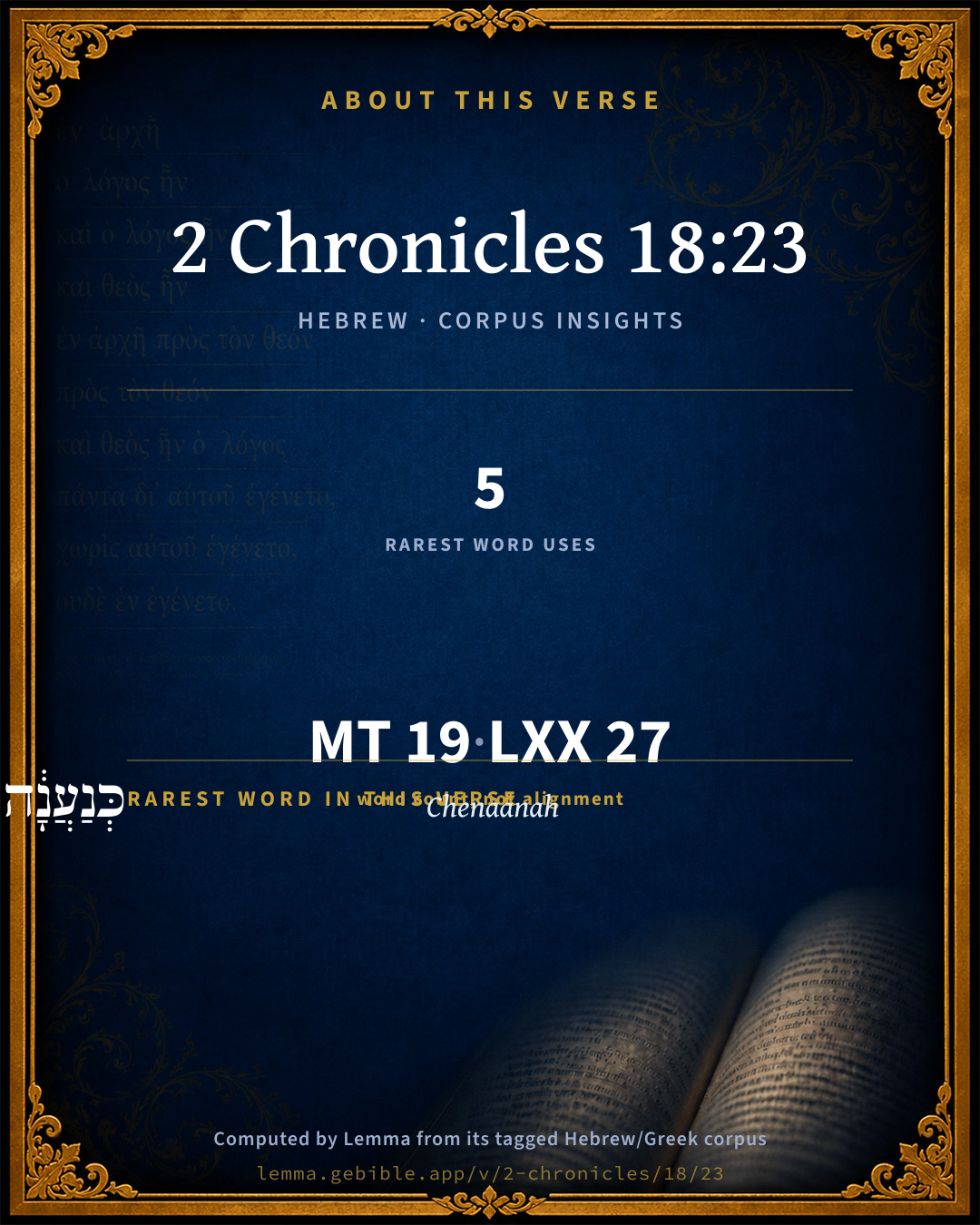
The rarest word here is כְּנַעֲנָ֔ה Chenaanah H3668 — appearing just 5 times in the whole Hebrew Bible.

Shared distinctive vocabulary

כְּנַעֲנָ֔ה Chenaanah H3668 occurs in 5 verses of the Hebrew Bible. Also found in:

Grammatical profile

  • 5 verbs
  • 8 nouns
  • 1 pronoun
  • 2 prepositions
  • 3 particles

Verb forms

  • וַיִּגַּשׁ֙ Qal · Sequential Imperfect
  • וַיַּ֥ךְ Hiphil · Sequential Imperfect
  • וַיֹּ֗אמֶר Qal · Sequential Imperfect
  • עָבַ֧ר Qal · Perfect
  • לְדַבֵּ֥ר Piel · Infinitive Construct

Hebrew & Septuagint length

In English translation the verse runs 29 words from the Hebrew and 33 from the Septuagint (LXX English) — closely comparable.

A rough comparison of the two English renderings, which tokenize alike — not a word-level alignment.

Word counts can differ between the Hebrew and the Greek without any difference in meaning — e.g. the Hebrew direct-object marker אֵת has no separate Greek word, and Greek often adds the article ὁ.

In the original languages it is 19 Hebrew tokens and 27 Greek tokens — but the two are counted differently (Hebrew bundles its prefixes and suffixes into one token; the Greek is in lemma form), so that isn’t a like-for-like length.

Cross-references

12

Topical passages linked to 2 Chronicles 18:23 in the Treasury of Scripture Knowledge — connected by theme and wording, ordered by reader-vote popularity; previews shown in the World English Bible.

  • Mark 14:65 Some began to spit on him, and to cover his face, and to beat him with fists, and to tell him, "Prophesy!" The officers struck him with the palms of their hands.
  • Jeremiah 20:2 Then Pashhur struck Jeremiah the prophet, and put him in the stocks that were in the upper gate of Benjamin, which was in the house of Yahweh.
  • 1 Kings 22:23–25 Now therefore, behold, Yahweh has put a lying spirit in the mouth of all these your prophets; and Yahweh has spoken evil concerning you.
  • 2 Chronicles 18:10 Zedekiah the son of Chenaanah made him horns of iron, and said, Thus says Yahweh, With these shall you push the Syrians, until they be consumed.
  • Isaiah 50:5–6 The Lord Yahweh has opened my ear, and I was not rebellious, neither turned away backward.
  • Jeremiah 29:26–27 Yahweh has made you priest in the place of Jehoiada the priest, that there may be officers in the house of Yahweh, for every man who is mad, and makes himself a prophet, that you should put him in the stocks and in shackles.
  • Lamentations 3:30 Let him give his cheek to him who strikes him; let him be filled full with reproach.
  • Micah 5:1 Now you shall gather yourself in troops, Daughter of troops. He has laid siege against us; They will strike the judge of Israel with a rod on the cheek.
  • Matthew 26:67–68 Then they spit in his face and beat him with their fists, and some slapped him,
  • John 9:40–41 Those of the Pharisees who were with him heard these things, and said to him, "Are we also blind?"
  • John 18:22–23 When he had said this, one of the officers standing by slapped Jesus with his hand, saying, "Do you answer the high priest like that?"
  • Acts 23:2–3 The high priest, Ananias, commanded those who stood by him to strike him on the mouth.

Cross-references courtesy of OpenBible.info (CC BY 4.0).

Hebrew and Greek witnesses Masoretic Hebrew ↔ Greek Septuagint

The same verse in the two great witnesses to the Old Testament, shown verse-for-verse.

These are two independent witnesses, not word-aligned to each other, and the Septuagint is shown in lemma (dictionary) form.

Hebrew 2 Chronicles 18:23 Masoretic · Westminster Leningrad Codex

וַיִּגַּשׁ֙ צִדְקִיָּ֣הוּ בֶֽן כְּנַעֲנָ֔ה וַיַּ֥ךְ אֶת מִיכָ֖יְהוּ עַל הַלֶּ֑חִי וַיֹּ֗אמֶר אֵ֣י זֶ֤ה הַדֶּ֨רֶךְ֙ עָבַ֧ר רֽוּחַ יְהוָ֛ה מֵאִתִּ֖י לְדַבֵּ֥ר אֹתָֽךְ

Then Zedekiah the son of Chenaanah came near, and struck Micaiah on the cheek, and said, Which way went the Spirit of Yahweh from me to speak to you?

World English Bible · Public Domain

Greek LXX 2 Chronicles 18:23 Septuagint · lemma form

καί ἐγγίζω σεδεκιας υἱός χανανα καί πατάσσω ὁ μιχαιας ἐπί ὁ σιαγών καί εἶπον αὐτός ποῖος ὁ ὁδός παραἔρχομαι πνεῦμα κύριος παρά ἐγώ ὁ λαλέω πρός σύ

Then Sedekias the son of Chanaan drew near, and struck Michaias on the cheek, and said to him, By what way passed the Spirit of the Lord from me to speak to you?

LXX2012 (modern English Septuagint) · Public Domain

Hebrew: Westminster Leningrad Codex (CC BY 4.0). Greek: Septuagint (public domain); English from LXX2012 (modern English Septuagint) (Public Domain). How the Septuagint differs from the Hebrew →

Commentary

Notes on 2 Chronicles 18:23 from classic Christian and Jewish commentators (each source and its license shown beneath its notes). The classic Christian expositions comment on the surrounding passage and are grouped to its opening verse, so a note may address several verses; the Jewish commentaries on the Tanakh (Rashi and others) are per-verse, so they appear only where the commentator wrote on this verse.

Lemma curates 59 commentaries, every one of them public domain or Creative Commons licensed, each selected and text-cleaned for this edition rather than reprinted as found. About our sources →

Trapp's Complete Commentary

John Trapp

2Ch 18:23 Then Zedekiah the son of Chenaanah came near, and smote Micaiah upon the cheek, and said, Which way went the Spirit of the LORD from me to speak unto thee?

Ver. 23. And smote Micaiah.] To do this in open court, and in such a presence, was great impudency; besides the violence, which yet is usually offered to Christ’s servants, when other arguments are wanting. Argumenta sua formant in Barbara et Ferio, as one saith wittily. If Micaiah should have smitten Zedekiah, there would have been somewhat to do. But some may better steal a horse, than others look over the hedge.

John Trapp, A Commentary or Exposition upon All the Books of the Old and New Testament (1647–1656) — public domain. Text from a community e-Sword module.

Geneva Bible (1599)

Geneva Bible translators

By this cruelty, his ambition and hypocrisy was discovered: thus the hypocrites boast of the Spirit which they have not, and declare their malice against them in whom the true Spirit is.

Geneva Bible (1599) marginal notes — public domain. Text via Bolls.life.

Ellicott's Commentary for English Readers

(23) Then.—And.

And smote.—Way-yak, a correction of way-yakkèh (Kings), such as the chronicler often makes.

which way.—Literally, where is the way the spirit of Jehovah passed. Kings, where passed the spirit, &c.

Unto thee.—With thee.

A Bible Commentary for English Readers, edited by Charles John Ellicott (1878–1897) — public domain. Text from a community e-Sword module.

The Cambridge Bible for Schools and Colleges

gen. ed. J. J. S. Perowne

23. Zedekiah] He takes the lead as in 2Ch_18:10.

smote … upon the cheek] This phrase is tantamount to “gave an insulting blow”; cp. Mic_5:1; Mat_5:39.

The Cambridge Bible for Schools and Colleges (gen. ed. J. J. S. Perowne; Cambridge University Press, 1878–1918) — public domain. Text from a community e-Sword module.

The Pulpit Commentary

Which way went the Spirit of the Lord from me to speak unto thee? This question of Zedekiah, and Micaiah"s answer to him in the following verse, arc both obscure and of doubtful interpretation, but their drift not at all so. Keil and Bertheau correctly say, in that Zedekiah used the force and the language that he did, it is not a bad sign that he was under a spirit"s influence, but in that it was physical force which he used in a moral subject, this was a conclusive sign of the character of the spirit that he was amenable to. Among many possible suggestions as to the exact meaning of the question, "Which way," etc.? it is possible that a sceptical taunt best explains Zedekiah"s words, and that he meant that he did not believe the Spirit of the Lord went any way to Micaiah. He will not yield to a doubt or to a suspicion thrown upon it that the Spirit had been with himself, and he will fain throw great doubt, whether he had proceeded from him to Micaiah!

The Pulpit Commentary (1880–1919), ed. H.D.M. Spence-Jones & Joseph S. Exell — public domain. Text from a community e-Sword module.

unfoldingWord translationNotes

Door43 World Missions Community

Kenaanah

Translate this man's name the same as in 2 Chronicles 18:10. (See: How to Translate Names)

Which way did the Spirit of Yahweh take to go from me to speak to you?

Zedekiah asks this sarcastic question to insult and rebuke Micaiah. AT: "Do not think that Yahweh's Spirit left me to speak to you!" (See: Rhetorical Question)

Look

"Listen" or "Pay attention to what I am about to tell you"

you will know that

"you will know the answer to your question." If Zedekiah's rhetorical question is translated as a statement, this phrase may be translated to supply implicit information. AT: "you will know that the Spirit of Yahweh has spoken to me" (See: Assumed Knowledge and Implicit Information)

translationWords

Zedekiah

Holy Spirit

unfoldingWord translationNotes — © Distant Shores Media and the Door43 World Missions Community, licensed CC BY-SA 4.0. Source: git.door43.org/Door43/en_tn.

Lesson kit

Teaching starters — assembled from the data on this page, not authored interpretation. Every prompt links to the verse data it draws on. Edit before teaching.

2 Chronicles, in the Historical, opens this verse with 19 words (18 distinct Hebrew lemmas). Its most distinctive word is Kᵉnaʻănâh (“Chenaanah”). A historical commentator’s framing appears above. Read the whole chapter for the surrounding context.

Discussion questions

  1. How does “Chenaanah” (Kᵉnaʻănâh) shape what this verse is saying?
  2. 1 Kings 22:11 shares the word «Chenaanah» with this verse. How do the two illuminate each other?
  3. The translations on this page render this verse differently — a whole-verse word diff, not a word-by-word alignment. What might account for the different wordings?
  4. The verb «וַיִּגַּשׁ֙» is Qal Sequential Imperfect. How does its form color the action?
  5. Reading how Trapp's Complete Commentary and Geneva Bible (1599) read this verse, where do the two commentators agree and where do they part?

Things to notice

Reading settings

Reading text

Shown beneath each verse's original-language words.

Old Testament
Old Testament edition

Read the OT as the Masoretic Hebrew (MT) or the Greek Septuagint (LXX).

English shown for the Greek Septuagint (in the Hebrew ↔ Greek comparison).

Comparing translations? Open the Compare panel on any verse page to stack up to four side by side.