
Job 30:15

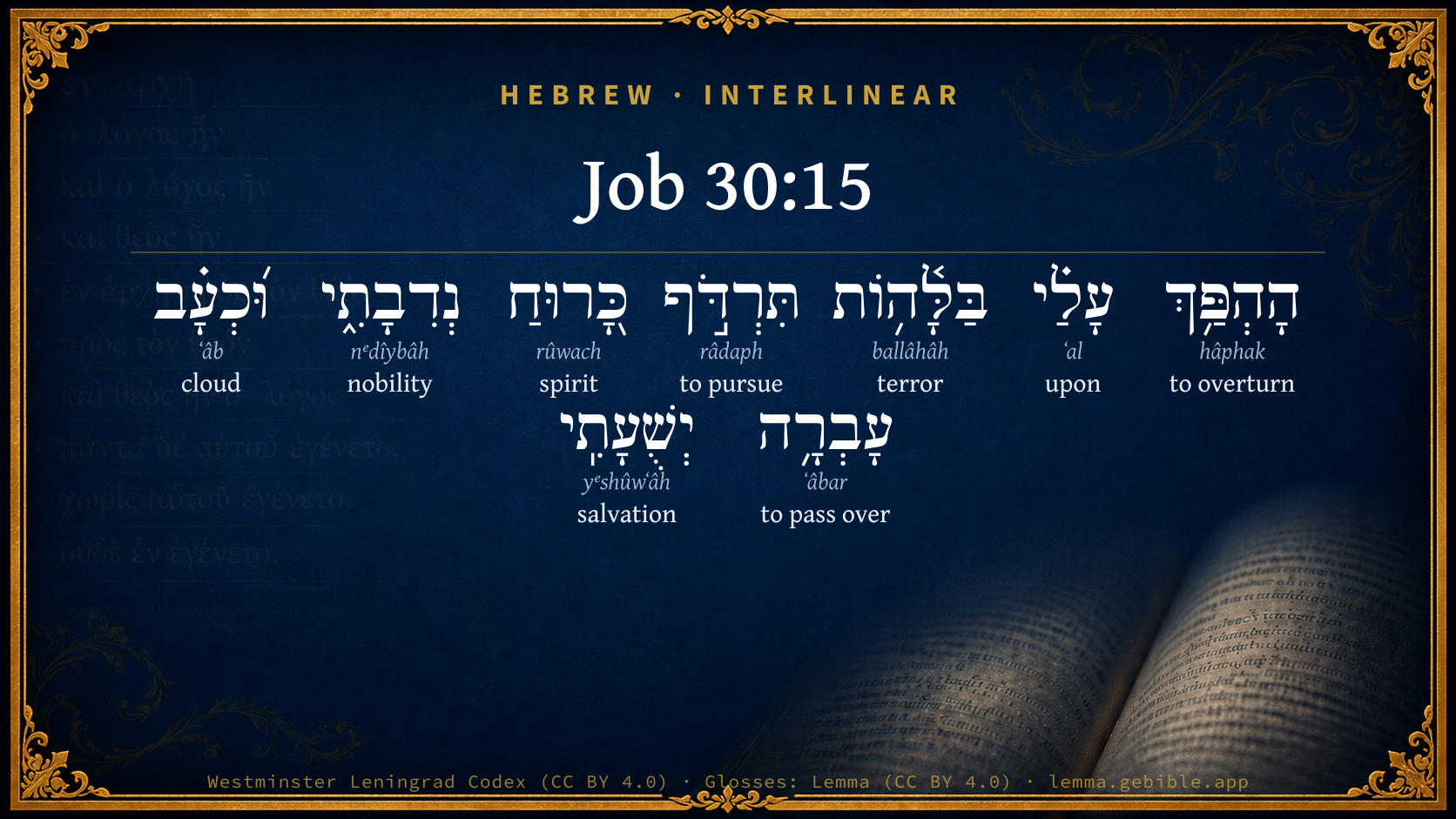
Hebrew (Westminster Leningrad Codex) Job 30:15 appears in the Hebrew Old Testament. The text above is from the Westminster Leningrad Codex. Each word links to its Strong’s number, a concise gloss, and parsing drawn from the Open Scriptures Hebrew Bible morphology. Click any word for its full Brown-Driver-Briggs (BDB) entry.
Download image
Cite this verse

Job 30:15 (World English Bible). Public Domain. Lemma interlinear Bible study tool, https://lemma.gebible.app/v/job/30/15.

Show BibTeX & RIS
BibTeX
RIS
English Translation
Terrors are turned on me. They chase my honor as the wind. My welfare has passed away as a cloud.
World English Bible · Public Domain
Highlights
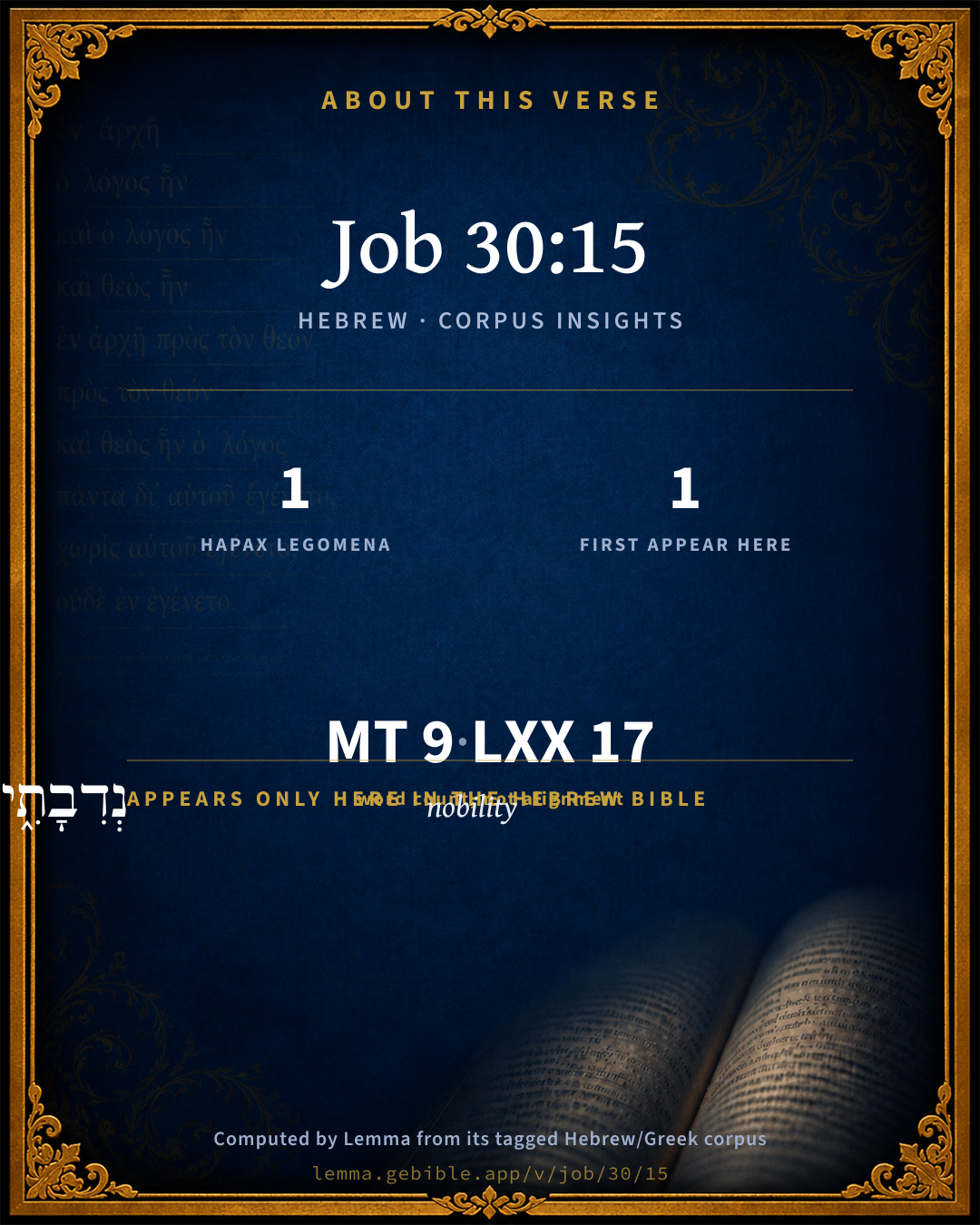
  • 1 hapax legomenon — only here in the Hebrew Bible
  • 1 first appearance in the Hebrew Bible
Full analysis ↓
Download a study sheet

One document with this verse’s original text, its word-by-word gloss line, the meaning frame, cross-references with their text, attributed commentary, and full source and license credits — printable, and it pastes into notes with its structure intact.

This verse Autodidact and up

Study sheet (.html) Plain text (.txt)

A passage Seminary Student

Up to 50 verses in one chapter. A passage sheet keeps up to 6 commentary sources and 12 cross-references per verse, in the order this page ranks them, and says so on the sheet whenever that leaves anything out. Ask for a single verse and you get the Autodidact verse sheet above.

Everything on this page stays free to read, with no account — the sheet is a download of what is already on screen, not access to it.

Want to remove ads? Support Godless Engineer
Compare translations 3

The same verse in 3 English versions, stacked beneath the original-language interlinear above. Click any original word for its lexicon entry.

Each is an independent rendering of the whole verse — the interlinear is not word-aligned to these translations.

Highlighted words mark where these versions differ — a whole-verse word diff, not a word-by-word alignment.

  • World English Bible Public Domain
    Terrors are turned on me. They chase my honor as the wind. My welfare has passed away as a cloud.
  • King James Version Public Domain
    Terrors are turned upon me: they pursue my soul as the wind: and my welfare passeth away as a cloud.
  • unfoldingWord Literal Text CC BY-SA 4.0
    Terrors are turned against me; one pursues my dignity like the wind, and my deliverance passes away like a cloud.

unfoldingWord Literal Text — © unfoldingWord, licensed CC BY-SA 4.0. Word-aligned USFM3 via Door43 (git.door43.org/unfoldingWord/en_ult).

Versions to compare (up to 4)

3 of 4 selected

Show all 18 translations

Every available English version of this verse, each an independent rendering of the whole verse.

  • World English Bible Public Domain
    Terrors are turned on me. They chase my honor as the wind. My welfare has passed away as a cloud.
  • Berean Standard Bible Public Domain
    Terrors are turned loose against me; they drive away my dignity as by the wind, and my prosperity has passed like a cloud.
  • Majority Standard Bible Public Domain
    Terrors are turned loose against me; they drive away my dignity as by the wind, and my prosperity has passed like a cloud.
  • King James Version Public Domain
    Terrors are turned upon me: they pursue my soul as the wind: and my welfare passeth away as a cloud.
  • American Standard Version (1901) Public Domain
    Terrors are turned upon me; They chase mine honor as the wind; And my welfare is passed away as a cloud.
  • Revised Version (1885) Public Domain
    Terrors are turned upon me, they chase mine honour as the wind; and my welfare is passed away as a cloud.
  • Geneva Bible (1599) Public Domain
    Feare is turned vpon mee: and they pursue my soule as the winde, and mine health passeth away as a cloude.
  • Douay-Rheims (1899) Public Domain
    I am brought to nothing: as a wind thou hast taken away my desire: and my prosperity hath passed away like a cloud.
  • Young's Literal Translation Public Domain
    He hath turned against me terrors, It pursueth as the wind mine abundance, And as a thick cloud, Hath my safety passed away.
  • Literal Standard Version CC BY-SA 4.0
    He has turned terrors against me, || It pursues my abundance as the wind, || And as a thick cloud, || My safety has passed away.
  • Unlocked Literal Bible CC BY-SA 4.0
    Terrors are turned upon me; my honor is driven away as if by the wind; my prosperity passes away as a cloud.
  • unfoldingWord Literal Text CC BY-SA 4.0
    Terrors are turned against me; one pursues my dignity like the wind, and my deliverance passes away like a cloud.
  • Darby Bible Public Domain
    Terrors are turned against me; they pursue mine honour as the wind; and my welfare is passed away like a cloud.
  • World Messianic Bible Public Domain
    Terrors have turned on me. They chase my honor as the wind. My welfare has passed away as a cloud.
  • Webster's Bible Public Domain
    Terrors are turned upon me: they pursue my soul as the wind: and my welfare passeth away as a cloud.
  • Free Bible Version CC BY-SA 4.0
    Terrors overcome me; my honor is blown away by the wind; my salvation vanishes like a cloud.
  • Bible in Basic English Public Domain
    Fears have come on me; my hope is gone like the wind, and my well-being like a cloud.
  • JPS Tanakh (1917) Public Domain
    Terrors are turned upon me, they chase mine honour as the wind; and my welfare is passed away as a cloud.

Literal Standard Version (2020), Covenant Press — licensed CC BY-SA 4.0. Text via the HelloAO Bible API (eBible.org). Unlocked Literal Bible (unfoldingWord) — licensed CC BY-SA 4.0. Text via the HelloAO Bible API (eBible.org). unfoldingWord Literal Text — © unfoldingWord, licensed CC BY-SA 4.0. Word-aligned USFM3 via Door43 (git.door43.org/unfoldingWord/en_ult). Free Bible Version, Dr. Jonathan Gallagher — licensed CC BY-SA 4.0. Text via the HelloAO Bible API (eBible.org).

Word by word

More ways to search: Search by grammar → Find every occurrence → Compare this word →

Practice this passage: Drill this verse → Learn its vocabulary →

נְדִבָתִ֑י
nᵉdîybâh
H5082
“nobility · my”
Noun, Common, Feminine, Singular, Construct + Suffix, Personal, 1st Person, Common, Singular
Part of Speech
Noun
Type
Common
Gender
Feminine
Number
Singular
State
Construct
Full BDB Definition

Origin: from H5081

TWOT: 1299c

nobility, nobleness, noble deeds - nobility (of rank), honour - noble things
  1. הָהְפַּ֥ךְ hâphak H2015 “to overturn” Verb, Hophal, Perfect, 3rd Person, Masculine, Singular
  2. עָלַ֗י ʻal H5921 “upon · me” Preposition + Suffix, Personal, 1st Person, Common, Singular
  3. בַּלָּ֫ה֥וֹת ballâhâh H1091 “terrors” Noun, Common, Feminine, Plural, Absolute
  4. תִּרְדֹּ֣ף râdaph H7291 “to pursue” Verb, Qal, Imperfect, 3rd Person, Feminine, Singular
  5. כָּ֭רוּחַ rûwach H7307 “like/as the · spirit” Preposition, Determined + Noun, Common, Both, Singular, Absolute
  6. וּ֝כְעָ֗ב ʻâb H5645 “and · like/as · cloud” Conjunction + Preposition + Noun, Common, Both, Singular, Absolute
  7. עָבְרָ֥ה ʻâbar H5674 “to pass over” Verb, Qal, Perfect, 3rd Person, Feminine, Singular
  8. יְשֻׁעָתִֽי yᵉshûwʻâh H3444 “salvation · my” Noun, Common, Feminine, Singular, Construct + Suffix, Personal, 1st Person, Common, Singular

About this verse

These counts appear in no published source. They are computed here, from the morphology-tagged text and Lemma’s own curated glosses. What Lemma adds →

9
words
9
distinct lemmas
Wisdom
section

Notable vocabulary

1 hapax legomenon — a word that appears only here in the entire Hebrew Bible:

  • נְדִבָתִ֑י nobility H5082

First appearance in Scripture

This word makes its first canonical appearance in the Hebrew Bible here:

  • נְדִבָתִ֑י nobility H5082

Shared distinctive vocabulary

בַּלָּ֫ה֥וֹת terror H1091 occurs in 10 verses of the Hebrew Bible. Also found in:

Grammatical profile

  • 3 verbs
  • 5 nouns
  • 1 preposition

Verb forms

  • הָהְפַּ֥ךְ Hophal · Perfect
  • תִּרְדֹּ֣ף Qal · Imperfect
  • עָבְרָ֥ה Qal · Perfect

Hebrew & Septuagint length

In English translation the verse runs 20 words from the Hebrew and 18 from the Septuagint (LXX English) — closely comparable.

A rough comparison of the two English renderings, which tokenize alike — not a word-level alignment.

Word counts can differ between the Hebrew and the Greek without any difference in meaning — e.g. the Hebrew direct-object marker אֵת has no separate Greek word, and Greek often adds the article ὁ.

In the original languages it is 9 Hebrew tokens and 17 Greek tokens — but the two are counted differently (Hebrew bundles its prefixes and suffixes into one token; the Greek is in lemma form), so that isn’t a like-for-like length.

Cross-references

12

Topical passages linked to Job 30:15 in the Treasury of Scripture Knowledge — connected by theme and wording, ordered by reader-vote popularity; previews shown in the World English Bible.

  • Hosea 13:3 Therefore they will be like the morning cloud, And like the dew that passes away early, Like the chaff that is driven with the whirlwind out of the threshing floor, And like the smoke out of the chimney.
  • Job 6:4 For the arrows of the Almighty are within me, My spirit drinks up their poison. The terrors of God set themselves in array against me.
  • Job 31:23 For calamity from God is a terror to me, By reason of his majesty I can do nothing.
  • Psalms 55:4–5 My heart is severely pained within me. The terrors of death have fallen on me.
  • Psalms 88:15 I am afflicted and ready to die from my youth up. While I suffer your terrors, I am distracted.
  • Isaiah 44:22 I have blotted out, as a thick cloud, your transgressions, and, as a cloud, your sins: return to me; for I have redeemed you.
  • Job 3:25 For the thing which I fear comes on me, That which I am afraid of comes to me.
  • Job 7:9 As the cloud is consumed and vanishes away, So he who goes down to Sheol shall come up no more.
  • Job 7:14 Then you scar me with dreams, And terrify me through visions:
  • Job 9:27–28 If I say, 'I will forget my complaint, I will put off my sad face, and cheer up;'
  • Job 10:16 If my head is held high, you hunt me like a lion. Again you show yourself powerful to me.
  • Hosea 6:4 "Ephraim, what shall I do to you? Judah, what shall I do to you? For your love is like a morning cloud, And like the dew that disappears early.

Cross-references courtesy of OpenBible.info (CC BY 4.0).

Hebrew and Greek witnesses Masoretic Hebrew ↔ Greek Septuagint

The same verse in the two great witnesses to the Old Testament, shown verse-for-verse.

These are two independent witnesses, not word-aligned to each other, and the Septuagint is shown in lemma (dictionary) form.

Hebrew Job 30:15 Masoretic · Westminster Leningrad Codex

הָהְפַּ֥ךְ עָלַ֗י בַּלָּ֫ה֥וֹת תִּרְדֹּ֣ף כָּ֭רוּחַ נְדִבָתִ֑י וּ֝כְעָ֗ב עָבְרָ֥ה יְשֻׁעָתִֽי

Terrors are turned on me. They chase my honor as the wind. My welfare has passed away as a cloud.

World English Bible · Public Domain

Greek LXX Job 30:15 Septuagint · lemma form

ἐπιστρέφω δέ ἐγώ ὁ ὀδύνη οἴχομαι ἐγώ ὁ ἐλπίς ὥσπερ πνεῦμα καί ὥσπερ νέφος ὁ σωτηρία ἐγώ

My pains return upon me; my hope is gone like the wind, and my safety as a cloud.

LXX2012 (modern English Septuagint) · Public Domain

On this verse, Albert Barnes' Notes on the Bible discusses the Septuagint’s reading. Read the note in Commentary ↓

Hebrew: Westminster Leningrad Codex (CC BY 4.0). Greek: Septuagint (public domain); English from LXX2012 (modern English Septuagint) (Public Domain). How the Septuagint differs from the Hebrew →

Commentary

Notes on Job 30:15 from classic Christian and Jewish commentators (each source and its license shown beneath its notes). The classic Christian expositions comment on the surrounding passage and are grouped to its opening verse, so a note may address several verses; the Jewish commentaries on the Tanakh (Rashi and others) are per-verse, so they appear only where the commentator wrote on this verse.

Lemma curates 59 commentaries, every one of them public domain or Creative Commons licensed, each selected and text-cleaned for this edition rather than reprinted as found. About our sources →

Matthew Henry's Commentary

In this second part of Job's complaint, which is very bitter, and has a great many sorrowful accents in it, we may observe a great deal that he complains of and some little that he comforts himself with.

I. Here is much that he complains of.

1. In general, it was a day of great affliction and sorrow. (1.) Affliction seized him, and surprised him. It seized him (Job 30:16): The days of affliction have taken hold upon me, have caught me (so some); they have arrested me, as the bailiff arrests the debtor, claps him on the back, and secures him. When trouble comes with commission it will take fast hold, and not lose its hold. It surprised him (Job 30:27): "The days of affliction prevented me," that is, "they came upon me without giving me any previous warning. I did not expect them, nor make any provision for such an evil day." Observe, He reckons his affliction by days, which will soon be numbered and finished, and are nothing to the ages of eternity, Co2 4:17. (2.) He was in great sorrow by reason of it. His bowels boiled with grief, and rested not, Job 30:27. The sense of his calamities was continually preying upon his spirits without any intermission. He went mourning from day to day, always sighing, always weeping; and such cloud was constantly upon his mind that he went, in effect, without the sun, Job 30:28. He had nothing that he could take any comfort in. He abandoned himself to perpetual sorrow, as one that, like Jacob, resolved to go to the grave mourning. He walked out of the sun (so some) in dark shady places, as melancholy people use to do. If he went into the congregation, to join with them in solemn worship, instead of standing up calmly to desire their prayers, he stood up and cried aloud, through pain of body, or anguish of mind, like one half distracted. If he appeared in public, to receive visits, when the fit came upon him he could not contain himself, nor preserve due decorum, but stood up and shrieked aloud. Thus he was a brother to dragons and owls (Job 30:29), both in choosing solitude and retirement, as they do (Isa 34:13), and in making a fearful hideous noise as they do; his inconsiderate complaints were fitly compared to their inarticulate ones.

2. The terror and trouble that seized his soul were the sorest part of his calamity, Job 30:15, Job 30:16. (1.) If he looked forward, he saw every thing frightful before him: if he endeavoured to shake off his terrors, they turned furiously upon him: if he endeavoured to escape from them, they pursued his soul as swiftly and violently as the wind. He complained, at first, of the terrors of God setting themselves in array against him, Job 6:4. And still, which way soever he looked, they turned upon him; which way soever he fled, they pursued him. My soul (Heb., my principal one, my princess); the soul is the principal part of the man; it is our glory; it is every way more excellent than the body, and therefore that which pursues the soul, and threatens that, should be most dreaded. (2.) If he looked back, he saw all the good he had formerly enjoyed removed from him, and nothing left him but the bitter remembrance of it: My welfare and prosperity pass away, as suddenly, swiftly, and irrecoverably, as a cloud. (3.) If he looked within, he found his spirit quite sunk and unable to bear his infirmity, not only wounded, but poured out upon him, Job 30:16. He was not only weak as water, but, in his own apprehension, lost as water spilt upon the ground. Compare Psa 22:14, My heart is melted like wax.

3. His bodily diseases were very grievous; for, (1.) He was full of pain, piercing pain, pain that went to the bone, to all his bones, Job 30:17. It was a sword in his bones, which pierced him in the night season, when he should have been refreshed with sleep. His nerves were affected with strong convulsions; his sinews took no rest. By reason of his pain, he could take no rest, but sleep departed from his eyes. His bones were burnt with heat, Job 30:30. He was in a constant fever, which dried up the radical moisture and even consumed the marrow in his bones. See how frail our bodies are, which carry in themselves the seeds of our own disease and death. (2.) He was full of sores. Some that are pained in their bones, yet sleep in a whole skin, but, Satan's commission against Job extending both to his bone and to his flesh, he spared neither. His skin was black upon him, Job 30:30. The blood settled, and the sores suppurated and by degrees scabbed over, which made his skin look black. Even his garment had its colour changed with the continual running of his boils, and the soft clothing he used to wear had now grown so stiff that all his garments were like his collar, Job 30:18. It would be noisome to describe what a condition poor Job was in for want of clean linen and good attendance, and what filthy rags all his clothes were. Some think that, among other diseases, Job was ill of a quinsy or swelling in his throat, and that it was this which bound him about like a stiff collar. Thus was he cast into the mire (Job 30:19), compared to mire (so some); his body looked more like a heap of dirt than any thing else. Let none be proud of their clothing nor proud of their cleanness; they know not but some disease or other may change their garments, and even throw them into the mire, and make them noisome both to themselves and others. Instead of sweet smell, there shall be a stench, Isa 3:24. We are but dust and ashes at the best, and our bodies are vile bodies; but we are apt to forget it, till God, by some sore disease, makes us sensibly to feel and own what we are. "I have become already like that dust and ashes into which I must shortly be resolved: wherever I go I carry my grave about with me."

4. That which afflicted him most of all was that God seemed to be his enemy and to fight against him. It was he that cast him into the mire (Job 30:19), and seemed to trample on him when he had him there. This cut him to the heart more than any thing else, (1.) That God did not appear for him. He addressed himself to him, but gained no grant - appealed to him, but gained no sentence; he was very importunate in his applications, but in vain (Job 30:20): "I cry unto thee, as one in earnest, I stand up, and cry, as one waiting for an answer, but thou hearest not, thou regardest not, for any thing I can perceive." If our most fervent prayers bring not in speedy and sensible returns, we must not think it strange. Though the seed of Jacob did never seek in vain, yet they have often thought that they did and that God has not only been deaf, but angry, at the prayers of his people, Psa 80:4. (2.) That God did appear against him. That which he here says of God is one of the worst words that ever Job spoke (Job 30:21): Thou hast become cruel to me. Far be it from the God of mercy and grace that he should be cruel to any (his compassions fail not), but especially that he should be so to his own children. Job was unjust and ungrateful when he said so of him: but harbouring hard thoughts of God was the sin which did, at this time, most easily beset him. Here, [1.] He thought God fought against him and stirred up his whole strength to ruin him: With thy strong hand thou opposest thyself, or art an adversary against me. He had better thoughts of God (Job 23:6) when he concluded he would not plead against him with his great power. God has an absolute sovereignty and an irresistible strength, but he never uses either the one or the other for the crushing or oppressing of any. [2.] He thought he insulted over him (Job 30:22): Thou lifted me up to the wind, as a feather or the chaff which the wind plays with; so unequal a match did Job think himself for Omnipotence, and so unable was he to help himself when he was made to ride, not in triumph, but in terror, upon the wings of the wind, and the judgments of God did even dissolve his substance, as a cloud is dissolved and dispersed by the wind. Man's substance, take him in his best estate, is nothing before the power of God; it is soon dissolved.

5. He expected no other now than that God, by these troubles, would shortly make an end of him: "If I be made to ride upon the wind, I can count upon no other than to break my neck shortly;" and he speaks as if God had no other design upon him than that in all his dealings with him: "I know that thou wilt bring me, with so much the more terror, to death, though I might have been brought thither without all this ado, for it is the house appointed for all living," Job 30:23. The grave is a house, a narrow, dark, cold, ill-furnished house, but it will be our residence, where we shall rest and be safe. It is our long home, our own home; for it is our mother's lap, and in it we are gathered to our fathers. It is a house appointed for us by him that has appointed us the bounds of all our habitations. It is appointed for all the living. It is the common receptacle, where rich and poor meet; it is appointed for the general rendezvous. We must all be brought thither shortly. It is God that brings us to it, for the keys of death and the grave are in his hand, and we may all know that, sooner or later, he will bring us thither. It would be well for us if we would duly consider it. The living know that they shall die; let us, each of us, know it with application.

6. There were two things that aggravated his trouble, and made it the less tolerable: - (1.) That it was a very great disappointment to his expectation (Job 30:26): "When I looked for good, for more good, or at least for the continuance of what I had, then evil came" - such uncertain things are all our worldly enjoyments, and such a folly is it to feed ourselves with great expectations from them. Those that wait for light from the sparks of their creature comforts will be wretchedly disappointed and will make their bed in the darkness. (2.) That is was a very great change in his condition (Job 30:31): "My harp is not only laid by, and hung upon the willow-trees, but it is turned to mourning, and my organ into the voice of those that weep." Job, in his prosperity, had taken the timbrel and harp, and rejoiced at the sound of the organ, Job 21:12. Notwithstanding his gravity and grace, he had found time to be cheerful; but now his tune was altered. Let those therefore that rejoice be as though they rejoiced not, for they know not how soon their laughter will be turned into mourning and their joy into heaviness. Thus we see how much Job complains of; but,

II. Here is something in the midst of all with which he comforts himself, and it is but a little. 1. He foresees, with comfort, that death will be the period of all his calamities (Job 30:24): Though God now, with a strong hand, opposed himself against him, "yet," says he, "he will not stretch out his hand to the grave." The hand of God's wrath would bring him to death, but would not follow him beyond death; his soul would be safe and happy in the world of spirits, his body safe and easy in the dust. Though men cry in his destruction (though, when they are dying, there is a great deal of agony and out-cry, many a sigh, and groan, and complaint), yet in the grave they feel nothing, they fear nothing, but all is quiet there. "Though in hell, which is called destruction, they cry, yet not in the grave; and, being delivered from the second death, the first to me will be an effectual relief." Therefore he wished he might be hidden in the grave, Job 14:13. 2. He reflects with comfort upon the concern he always had for the calamities of others when he was himself at ease (Job 30:25): Did not I weep for him that was in trouble? Some think he herein complains of God, thinking it very hard that he who had shown mercy to others should not himself find mercy. I would rather take it as a quieting consideration to himself; his conscience witnessed for him that he had always sympathized with persons in misery and done what he could to help them, and therefore he had reason to expect that, at length, both God and his friends would pity him. Those who mourn with them that mourn will bear their own sorrows the better when it comes to their turn to drink of the bitter cup. Did not my soul burn for the poor? so some read it, comparing it with that of St. Paul, Co2 11:29, Who is offended, and I burn not? As those who have been unmerciful and hard-hearted to others may expect to hear of it from their own consciences, when they are themselves in trouble, so those who have considered the poor and succoured them shall have the remembrance thereof to make their bed easy in their sickness, Psa 41:1, Psa 41:3.

Matthew Henry's Commentary on the Whole Bible (1708–1710) — public domain (CC PDM 1.0). Text via the HelloAO Bible API.

Trapp's Complete Commentary

John Trapp

Job 30:15 Terrors are turned upon me: they pursue my soul as the wind: and my welfare passeth away as a cloud.

Ver. 15. Terrors are turned upon me] I am horribly afraid of thy judgments, as David expresseth it; and this was it that pointed and put a sting into all other sufferings; for a wounded conscience who can bear? If the shoulder be galled, the burden will be very tedious and irksome. Be not thou a terror unto me, Lord, saith Jeremiah, and then I care not much what else soever befalleth me. But why were these terrors so troublesome?

They pursue my soul as the wind] Brentius rendereth it, They pursue my liberality, or, They take away from me all the cheerfulness and readiness of my mind; whereby heretofore I suffered so many calamities, and shrank not; for the joy of the Lord was my strength, and then nothing came amiss to me. Thou hast strengthened me with strength in my soul, Psa 138:3, and upheld me with thy noble spirit, Psa 51:12. The Chaldee hath it, kingly spirit, and it is the same word in the original that is here rendered, my soul; it is, my princess, or, my nobility, for so the soul is the more noble part, Animam meam nobilem et inclytam (Vat.). David calleth it his glory, Psa 16:9, and his darling, Psa 22:20. Some of the Jewish doctors make it the same with welfare, in the words following; but that is not likely.

And my welfare passeth away as a cloud] i.e. Totally, as before; irresistible like the wind. Job aboundeth with similitudes, which do notably illustrate. Terrorum vim simili a vento illustrat, et salutem a se abeuntem similitudine nubis (Merl.). He would say, I am utterly deprived of all means of avoiding this misery.

John Trapp, A Commentary or Exposition upon All the Books of the Old and New Testament (1647–1656) — public domain. Text from a community e-Sword module.

Joseph Benson's Commentary

Job 30:15. Terrors are turned upon me — Many terrible things from God, who sets himself against me, and in some sort joins his forces with these miscreants, are directed against me, to whom they seem not to belong, as being the portion of wicked men. They pursue my soul — Hebrew, נדבתי, nedibathi, my principal, or excellent one; that is, my soul, which is properly so called, as being the chief part of man, and which was the proper seat and object of divine terrors, as his body was of his outward pains and ulcers; as the wind — That is, speedily, vehemently, and irresistibly; and my welfare — All the happiness and comfort of my life; passeth away as a cloud — Which is quickly dissolved into rain, or dissipated by the sun, or driven away with the wind.

Joseph Benson's Commentary on the Old and New Testaments (1811–1818) — public domain. Text from a community e-Sword module.

Tyndale Open Study Notes

Tyndale Open Resources

30:15 terror: See also 6:4; 7:14; cp. Ps 88:15.

Tyndale Open Study Notes — © Tyndale Open Resources, licensed CC BY-SA 4.0. Text via the HelloAO Bible API.

Jamieson, Fausset & Brown

Robert Jamieson, A. R. Fausset & David Brown

they--terrors.

soul--rather, "my dignity" [UMBREIT].

welfare--prosperity.

cloud-- (Job 7:9; Isa 44:22).

Jamieson, Fausset & Brown — Commentary Critical and Explanatory on the Whole Bible (1871) — public domain (CC PDM 1.0). Text via the HelloAO Bible API.

Adam Clarke's Commentary

Verse 15. Terrors are turned upon me] Defence is no longer useful; they have beat down my walls.

They pursue my soul as the wind] I seek safety in flight, my strong holds being no longer tenable; but they pursue me so swiftly, that it is impossible for me to escape. They follow me like a whirlwind; and as fast as that drives away the clouds before it, so is my prosperity destroyed. The word נדבתי nedibathi, which we translate my soul, signifies properly my nobility, my excellence: they endeavour to destroy both my reputation and my property.

Adam Clarke's Commentary on the Bible (1810–1826) — public domain. Text from a community e-Sword/MySword module.

Ellicott's Commentary for English Readers

(15) They pursue—i.e., “the terrors chase or pursue

my honour:” i.e., my soul; or it may be, “Thou (i.e., God) chasest.”

A Bible Commentary for English Readers, edited by Charles John Ellicott (1878–1897) — public domain. Text from a community e-Sword module.

The Cambridge Bible for Schools and Colleges

gen. ed. J. J. S. Perowne

15. Terrors are turned against me,

They chase away my honour like the wind;

And my welfare is passed away as a cloud.

He is assailed by terrors. The words “like the wind” mean, like as the wind chases away (the chaff, &c.). On the figure of the dissolving cloud comp. Job_7:9. The expression “terrors” indicates that, though Job is here speaking of his injurious treatment at the hands of this rabble, it is not merely the external ignominy that fills his mind; it is the deeper moral problem which such abasement raises. Such expressions, however, have suggested to several writers that what Job describes in Job_30:11-15 is not the outrageous insults of the base-born outcasts referred to in Job_30:1-10, but his afflictions, under the figure of an assailing army sent against him from God, comp. ch. Job_16:12-14, Job_19:12. The passage is difficult, but upon the whole this view is less natural.

The Cambridge Bible for Schools and Colleges (gen. ed. J. J. S. Perowne; Cambridge University Press, 1878–1918) — public domain. Text from a community e-Sword module.

John Gill's Exposition

Terrors are turned upon me,.... Not the terrors of a guilty conscience, for Job had a clear one, and held fast his integrity; nor the terrors of a cursing and condemning law, for he knew he was justified by his living Redeemer, and his sins forgiven for his sake; nor the terrors of death, for that he had made familiar to him, and greatly desired it; nor the terrors of a future judgment, for there was nothing he was more solicitous for than to appear before the judgment seat of God, and take his trial there; but the afflictions that were upon him from the hand of God that was turned on him, who now hid his face from him, and withheld the influences of his grace and layout, and appeared as an enemy, and as a cruel one to him; the reason of all which he knew not, and this threw him into consternation of mind, and filled him with terror. Some (s) read the words

"my glory is turned into terrors;''

instead of being in the honour and glory, prosperity and happiness, he had been in, he was now possessed of terrors and distresses of various kinds: others render the words, "he is turned against me, as terrors", or "into terrors", or "with them" (t); God cannot be turned or changed in his nature, in his will, counsel, purposes, and decrees, nor in his love and affection to his people; but he may turn in the outward dispensations of his providence according to his unchangeable will, as from evil to good, Jon 3:9; so from doing good to evil, Isa 63:10; this is complained of by the church, Lam 3:3; and deprecated by Jeremiah, Jer 17:17; or there is "a turn, terrors are upon me"; there was a very visible turn in Job's affairs in many respects, in his health, substance, and family, and particularly in this; while he was in his office as a civil magistrate, and in all the glory of it, he was a terror to evil doers; and young men, when he appeared, hid themselves for fear of him; but now those impudently rise up against him, and are terrors to him: or there is an "overthrow" (u), an overturning of things, as of his civil and temporal affairs, so of his spiritual ones; instead of that peace, serenity, and tranquillity of mind he had enjoyed; now nothing but terror and distress of mind on account of his afflictions and troubles:

they pursue my soul as the wind; terrors one after another; they pursued him closely, with great swiftness, and with a force irresistible, like the wind; they pursued his soul, his life, and threatened the taking away of it: the word for soul is not the usual word for it; it signifies "my principal one", as in the margin, as the soul is the principal part of man, the immortal breath of God, the inhabitant in the tenement of the body, the jewel in the cabinet, immaterial and immortal, and of more worth than the whole world; or "my princely one", being of a princely original, is from God, the Father of spirits, of a noble extract: Mr. Broughton renders it my "nobility", having princely rule and government in the body; that using the members of the body as its instruments; and especially it may be said to have such rule, when grace is implanted in it, as a ruling governing principle; and the Targum is, my principality or government: it may be rendered, "my free" (w), liberal, ingenuous, and munificent one: Job had such a generous and beneficent soul; but now all means of exercising generosity and liberality were cut off from him; and particularly he had find a free ingenuous one, as he was actuated by the free spirit of God, Psa 51:12, where this word is used; but now terrors pursuing him, a spirit of bondage unto fear was brought upon him: some (x) consider it as an apostrophe to God, "thou pursues, my soul, O God", &c. but rather the meaning is, a distress or affliction pursued it, or everyone of the above terrors:

and my welfare passeth away as a cloud; or "my salvation" (y); not spiritual and eternal salvation, that was firm and stable, being fixed by the unalterable decree of God, secured in the covenant of grace, and engaged for to be wrought out by his living. Redeemer, and of which he had an application by the Spirit of God, and was possessed of the blessings of it; and though the joys and comforts of it, and views of interest in it, may go off for a while, yet Job seems to have had a strong faith of interest in it, and a lively and well grounded hope of its being his, Job 13:15; but his temporal salvation, health, and happiness, were gone suddenly, swiftly, utterly, entirely, totally, as a cloud dissolved into rain, or dissipated by the rays of the sun, or driven away with the wind, so as to be seen no more; nor had he any hope of its being restored to him: some understand this, as Sephorno, of the salvation with which he had saved others; but it was no more in the power of his hands, and the remembrance of it was gone from those who shared in it; see Hos 6:4.

(s) So some in Bar Tzemach in loc. (t) "conversus est contra me, sicut terrores", Schmidt; "in meros terrores, vel cum terroribus", Michaelis. (u) "Eversio", Schultens. (w) "principalem meam", Mercerus; "meam principem", Vatablus, Piscator; "meam spontaneam", Pagninus, Montanus, Michaelis; "meam ultroneam", Drusius; "generosum meam spiritum", Schultens. (x) Schmidt. (y) "salus mea", Pagninus, Montanus, &c.

John Gill's Exposition of the Whole Bible (1746–1763) — public domain (CC PDM 1.0). Text via the HelloAO Bible API.

Albert Barnes' Notes on the Bible

Terrors are turned upon me - As if they were all turned upon him, or made to converge toward him. Everything suited to produce terror seemed to have a direction given it toward him. Umbreit, and some others, however, suppose that God is here referred to, and that the meaning is,” God is turned against me terrors drive as a storm against me.” The Hebrew will bear either construction; but it is more emphatic and impressive to suppose it means that everything adapted to produce terror seemed to be turned against him.

They pursue my soul as the wind - Margin, my principal one. The word “they” here, refers to the terrors. In the original text, the word תרדף tirâdaph agrees with בלהה ballâhâh, terrors understood, for this word is often used as a collective noun, and with a singular verb, or it may agree with אהת כל - “each one of the terrors persecutes me.” There is more difficulty about the word rendered “soul” in the text, and “principal one” in the margin - נדיבה nedı̂ybâh. It properly means willingness, voluntariness, spontaneity; then a free-will offering, a voluntary sacrifice; then largeness, abundance. Rosenmuller renders it, “My vigor.” Noyes, “My prosperity,” and so Coverdale. Jerome, “My desire,” and the Septuagint, “My hope passes away as the wind.” Schultens translates it, “They persecute my generous spirit as the wind.” It seems probable that the word refers to a generous, noble nature; to a large and liberal soul, evincing its magnanimity in acts of generosity and hospitality; and the idea seems to be, that his enemies rushed against that generous nature like a tempest. They wholly disregarded it, and a nature most generous and noble was exposed to the fury of the storm.

And my welfare - Hebrew my salvation; or my safety.

As a cloud - As a cloud vanishes and wholly disappears.

Albert Barnes' Notes on the Bible (1834–1885) — public domain. Text from a community e-Sword/MySword module.

Haydock's Catholic Bible Commentary

Nothing. Hebrew, "terror." (Haydock) --- Desire. Hebrew, "princess," reason. (Calmet) --- Protestants, "soul." Septuagint, "my hope has flown away like wind." (Haydock)

George Leo Haydock (1774–1849), Haydock's Catholic Family Bible and Commentary, 1859 edition — public domain. Excludes Psalms (Douay-Rheims chapter numbering differs from Protestant) and Deuterocanonical books (Catholic canon only).

Matthew Poole's English Annotations

Terrors, to wit, from God, who sets himself against me, and in some sort joins his forces with these miscreants.

Are turned upon me; are directed against me, to whom they seem not to belong, as being the portion of wicked men.

My soul, Heb. my principal or excellent one, i.e. my soul, which is fitly so called, as being the chief part of man; as it is called a man’s glory, Gen 49:6, and his only one, Psa 22:20, and which is the proper seat and object of Divine terrors, as his body was of his outward pains and ulcers.

As the wind, i.e. speedily, vehemently, and irresistibly.

My welfare; all the happiness and comfort of any life.

As a cloud; which is quickly dissolved into rain, or dissipated by the sun, or driven away with the wind.

Matthew Poole's English Annotations on the Holy Bible (1683–1685) — public domain. Text from a community e-Sword/MySword module.

Whedon's Commentary on the Bible

Daniel D. Whedon

15. My soul — Literally, My honour. Gen_49:6. In recognition of the soul as the nobler part of man.

As a cloud — Arabian writers frequently compare hopes and promises that are not fulfilled to a cloud full of promise, speedily dispersed by the wind.

Daniel D. Whedon (gen. ed.), Commentary on the Old and New Testaments (1874–1909) — public domain. Text from a community e-Sword module.

The Pulpit Commentary

Terrors are turned upon me Job seems to pass here from his human persecutors to his internal sufferings of mind and body. "Terrors" take hold upon him. He experiences in his sleep horrible dreams and visions, (Job_7:14) and even in his waking hours he is haunted by fears. The terrors of God do set themselves in array against him". (Job_6:4) God seems to him as One that watches, and "tries him every moment", (see Job_7:18) seeking occasion against him, and never leaving him an instant"s peace. (Job_7:19) These terrors, he says, pursue my soul as the wind; literally, pursue mine honour, or my dignity. They flutter the calm composure that befits a godly man, disturb it, shake it, and for a time at any rate, cause terrors and shrinkings of soul. Under these circumstances, my welfare passeth away as a cloud. It is not only my happiness, but my real welfare, that is gone. Body and soul are equally in suffering the one shaken with fears and disturbed with doubts and apprehensions; the other smitten with a sore disease, so that there is no soundness in it.

The Pulpit Commentary (1880–1919), ed. H.D.M. Spence-Jones & Joseph S. Exell — public domain. Text from a community e-Sword module.

John Wesley's Explanatory Notes

Terrors - If he endeavoured to shake them off, they turned furiously upon him: if he endeavoured to out run them, they pursued his soul, as swiftly and violently as the wind.

John Wesley, Explanatory Notes Upon the Whole Bible (1754–1765) — public domain. Text via the GEBible commentary corpus.

Rashi

Rabbi Shlomo Yitzchaki (Rashi)

turned upon me Heb. הָהְפַךְ, [equivalent to] נֶהְפַּךְ.

Terrors demons.

as a spirit An evil [spirit].

my nobility The noble spirit that rested upon me from the beginning.

Rashi on the Tanakh — English translations: “The Judaica Press complete Tanach with Rashi, translated by A. J. Rosenberg” (CC BY 4.0); “Pentateuch with Rashi's commentary by M. Rosenbaum and A.M. Silbermann, 1929-1934” (public domain); “The Metsudah Tanach series, Lakewood, N.J” (CC BY 4.0); and “The Book of Joshua, Metsudah Publications, 1997” (CC BY 4.0). Text via Sefaria.

Lesson kit

Teaching starters — assembled from the data on this page, not authored interpretation. Every prompt links to the verse data it draws on. Edit before teaching.

Job, in the Wisdom, opens this verse with 9 words (9 distinct Hebrew lemmas). Its most distinctive word is nᵉdîybâh (“nobility”). A historical commentator’s framing appears above. Read the whole chapter for the surrounding context.

Discussion questions

  1. What does “nobility” (nᵉdîybâh) contribute to the verse as a whole?
  2. This verse holds 1 word here found nowhere else in the Hebrew Bible. What might the rare word draw attention to?
  3. The word “nobility” first appears here in Scripture. What is being introduced at this debut?
  4. Job 18:11 shares the word «terror» with this verse. How do the two illuminate each other?
  5. These translations render this verse differently; the difference is in the English rendering, not the original. What questions does that raise?
  6. The verb «הָהְפַּ֥ךְ» is Hophal Perfect. How does its form color the action?
  7. Reading how Matthew Henry's Commentary and Trapp's Complete Commentary read this verse, where do the two commentators agree and where do they part?

Things to notice

Reading settings

Reading text

Shown beneath each verse's original-language words.

Old Testament
Old Testament edition

Read the OT as the Masoretic Hebrew (MT) or the Greek Septuagint (LXX).

English shown for the Greek Septuagint (in the Hebrew ↔ Greek comparison).

Comparing translations? Open the Compare panel on any verse page to stack up to four side by side.