
Proverbs 29:11

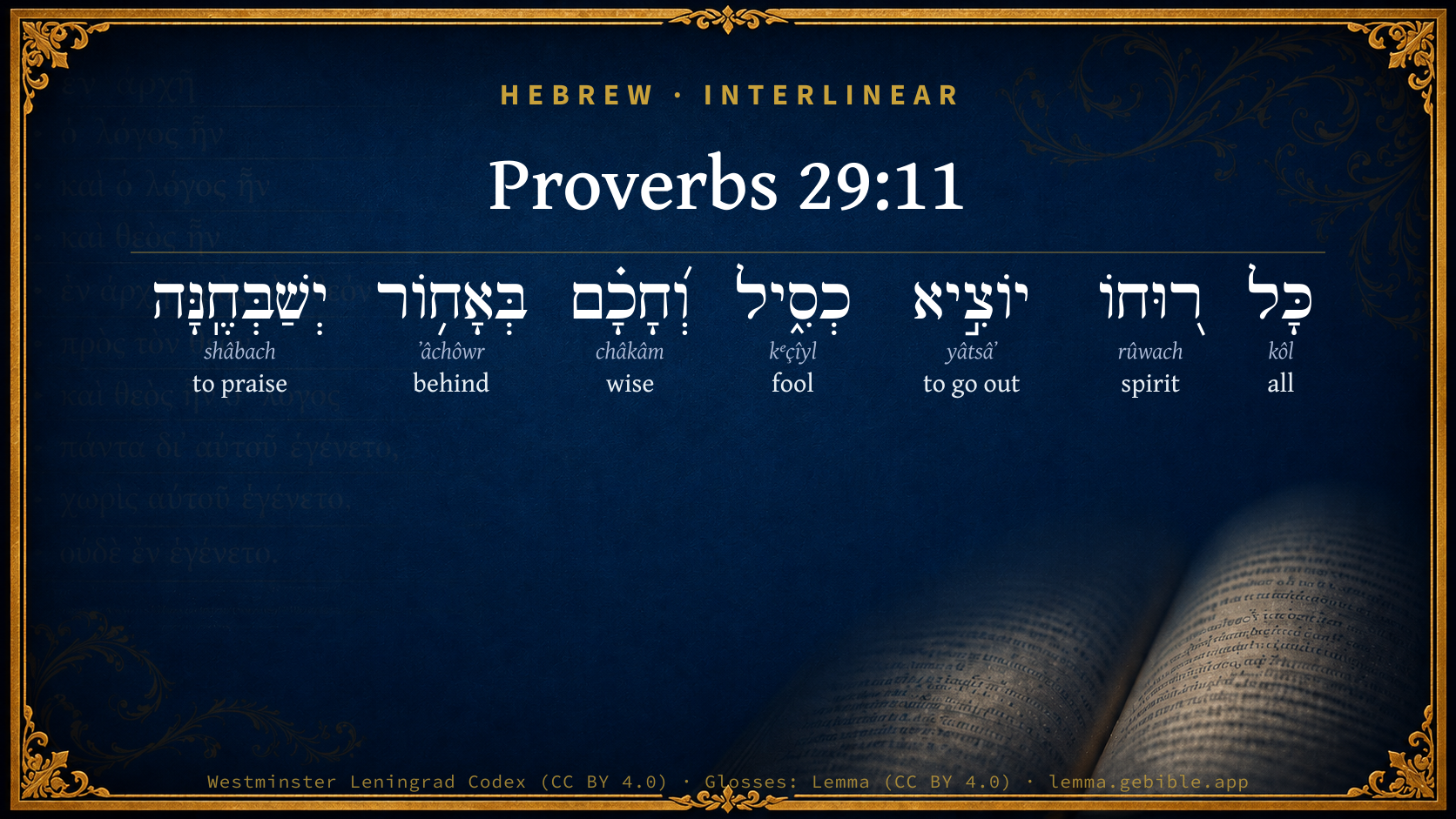
Hebrew (Westminster Leningrad Codex) Proverbs 29:11 appears in the Hebrew Old Testament. The text above is from the Westminster Leningrad Codex. Each word links to its Strong’s number, a concise gloss, and parsing drawn from the Open Scriptures Hebrew Bible morphology. Click any word for its full Brown-Driver-Briggs (BDB) entry.
Download image
Cite this verse

Proverbs 29:11 (World English Bible). Public Domain. Lemma interlinear Bible study tool, https://lemma.gebible.app/v/proverbs/29/11.

Show BibTeX & RIS
BibTeX
RIS
English Translation
A fool vents all of his anger, But a wise man brings himself under control.
World English Bible · Public Domain
Download a study sheet

One document with this verse’s original text, its word-by-word gloss line, the meaning frame, cross-references with their text, attributed commentary, and full source and license credits — printable, and it pastes into notes with its structure intact.

This verse Autodidact and up

Study sheet (.html) Plain text (.txt)

A passage Seminary Student

Up to 50 verses in one chapter. A passage sheet keeps up to 6 commentary sources and 12 cross-references per verse, in the order this page ranks them, and says so on the sheet whenever that leaves anything out. Ask for a single verse and you get the Autodidact verse sheet above.

Everything on this page stays free to read, with no account — the sheet is a download of what is already on screen, not access to it.

Want to remove ads? Support Godless Engineer
Compare translations 3

The same verse in 3 English versions, stacked beneath the original-language interlinear above. Click any original word for its lexicon entry.

Each is an independent rendering of the whole verse — the interlinear is not word-aligned to these translations.

Highlighted words mark where these versions differ — a whole-verse word diff, not a word-by-word alignment.

  • World English Bible Public Domain
    A fool vents all of his anger, But a wise man brings himself under control.
  • King James Version Public Domain
    A fool uttereth all his mind: but a wise man keepeth it in till afterwards.
  • unfoldingWord Literal Text CC BY-SA 4.0
    A stupid brings out all his spirit, but a wise soothes it backward.

unfoldingWord Literal Text — © unfoldingWord, licensed CC BY-SA 4.0. Word-aligned USFM3 via Door43 (git.door43.org/unfoldingWord/en_ult).

Versions to compare (up to 4)

3 of 4 selected

Show all 18 translations

Every available English version of this verse, each an independent rendering of the whole verse.

  • World English Bible Public Domain
    A fool vents all of his anger, But a wise man brings himself under control.
  • Berean Standard Bible Public Domain
    A fool vents all his anger, but a wise man holds it back.
  • Majority Standard Bible Public Domain
    A fool vents all his anger, but a wise man holds it back.
  • King James Version Public Domain
    A fool uttereth all his mind: but a wise man keepeth it in till afterwards.
  • American Standard Version (1901) Public Domain
    A fool uttereth all his anger; But a wise man keepeth it back and stilleth it.
  • Revised Version (1885) Public Domain
    A fool uttereth all his anger: but a wise man keepeth it back and stilleth it.
  • Geneva Bible (1599) Public Domain
    A foole powreth out all his minde: but a wise man keepeth it in till afterward.
  • Douay-Rheims (1899) Public Domain
    A fool uttereth all his mind: a wise man deferreth, and keepeth it till afterwards.
  • Young's Literal Translation Public Domain
    A fool bringeth out all his mind, And the wise till afterwards restraineth it.
  • Literal Standard Version CC BY-SA 4.0
    A fool brings out all his mind, || And the wise restrains it until afterward.
  • Unlocked Literal Bible CC BY-SA 4.0
    A fool reveals all his anger, but a wise man holds it back and calms himself down.
  • unfoldingWord Literal Text CC BY-SA 4.0
    A stupid brings out all his spirit, but a wise soothes it backward.
  • Darby Bible Public Domain
    A fool uttereth all his mind; but a wise [man] keepeth it back.
  • World Messianic Bible Public Domain
    A fool vents all of his anger, but a wise man brings himself under control.
  • Webster's Bible Public Domain
    A fool uttereth all his mind: but a wise man keepeth it in till afterwards.
  • Free Bible Version CC BY-SA 4.0
    Stupid people let all their anger out, while wise people quietly hold it in.
  • Bible in Basic English Public Domain
    A foolish man lets out all his wrath, but a wise man keeps it back quietly.
  • JPS Tanakh (1917) Public Domain
    A fool spendeth all his spirit; but a wise man stilleth it within him.

Literal Standard Version (2020), Covenant Press — licensed CC BY-SA 4.0. Text via the HelloAO Bible API (eBible.org). Unlocked Literal Bible (unfoldingWord) — licensed CC BY-SA 4.0. Text via the HelloAO Bible API (eBible.org). unfoldingWord Literal Text — © unfoldingWord, licensed CC BY-SA 4.0. Word-aligned USFM3 via Door43 (git.door43.org/unfoldingWord/en_ult). Free Bible Version, Dr. Jonathan Gallagher — licensed CC BY-SA 4.0. Text via the HelloAO Bible API (eBible.org).

Word by word

More ways to search: Search by grammar → Find every occurrence → Compare this word →

Practice this passage: Drill this verse → Learn its vocabulary →

יְשַׁבְּחֶֽנָּה
shâbach
H7623
“to praise · her”
Verb, Piel, Imperfect, 3rd Person, Masculine, Singular + Suffix, Personal, 3rd Person, Feminine, Singular
Part of Speech
Verb
Stem
Piel
Form
Imperfect
Person
3rd Person
Gender
Masculine
Number
Singular
Full BDB Definition

Origin: a primitive root

TWOT: 2312 , 2313

to soothe, still, stroke - (Piel) to soothe, still - (Hiphil) stilling (participle) - to laud, praise, commend - (Piel) - to laud, praise (God) - to commend, congratulate (the dead) - (Hithpael) to boast
  1. כָּל kôl H3605 “all of” Noun, Common, Masculine, Singular, Construct
  2. ר֭וּחוֹ rûwach H7307 “spirit · his” Noun, Common, Both, Singular, Construct + Suffix, Personal, 3rd Person, Masculine, Singular
  3. יוֹצִ֣יא yâtsâʼ H3318 “to go out” Verb, Hiphil, Imperfect, 3rd Person, Masculine, Singular
  4. כְסִ֑יל kᵉçîyl H3684 “fool” Adjective, Adjective, Masculine, Singular, Absolute
  5. וְ֝חָכָ֗ם châkâm H2450 “and · wise” Conjunction + Adjective, Adjective, Masculine, Singular, Absolute
  6. בְּאָח֥וֹר ʼâchôwr H268 “in/at · behind” Preposition + Noun, Common, Masculine, Singular, Absolute

About this verse

These counts appear in no published source. They are computed here, from the morphology-tagged text and Lemma’s own curated glosses. What Lemma adds →

7
words
7
distinct lemmas
Wisdom
section

Notable vocabulary

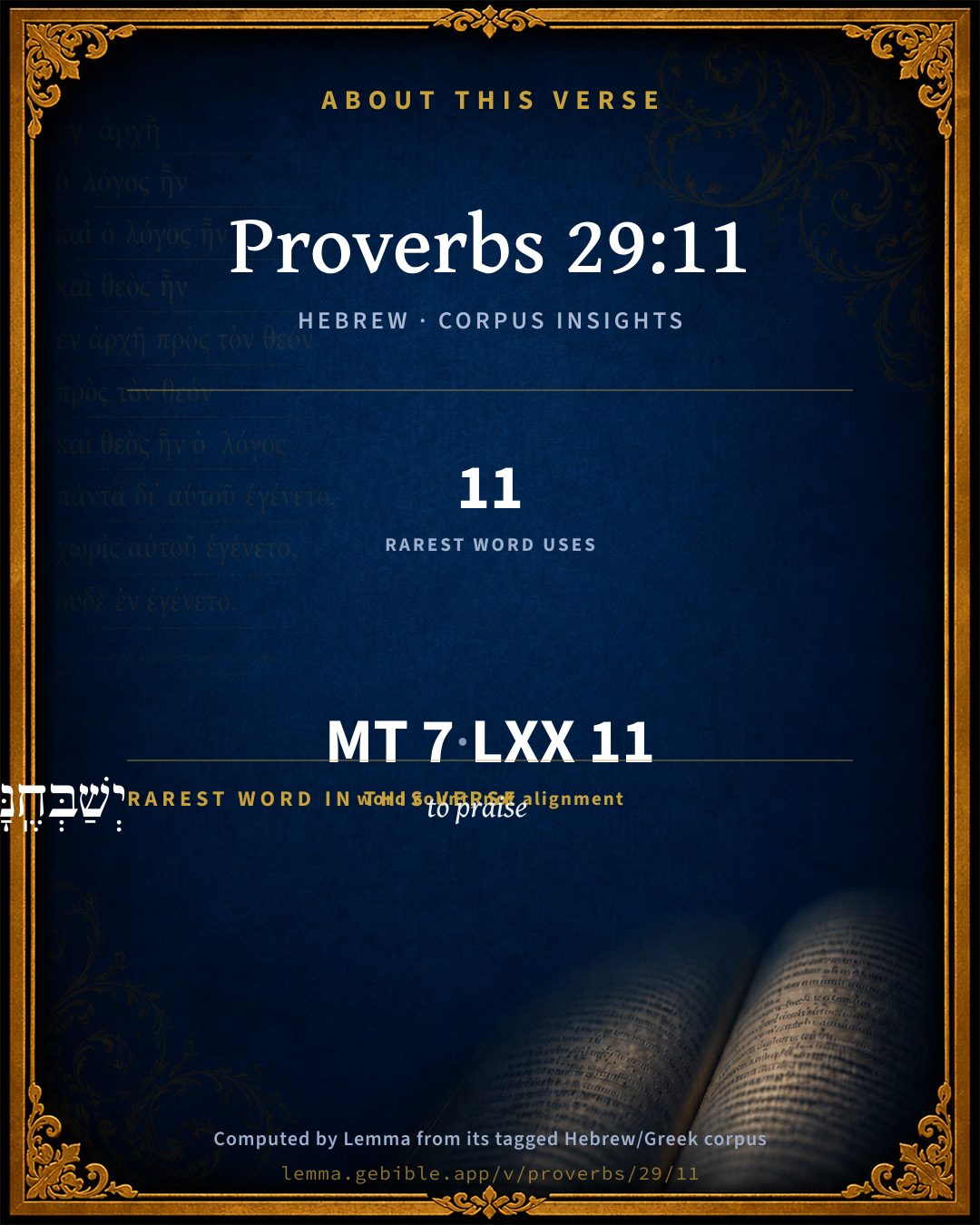
The rarest word here is יְשַׁבְּחֶֽנָּה to praise H7623 — appearing just 11 times in the whole Hebrew Bible.

Shared distinctive vocabulary

יְשַׁבְּחֶֽנָּה to praise H7623 occurs in 11 verses of the Hebrew Bible. Also found in:

Grammatical profile

  • 2 verbs
  • 3 nouns
  • 2 adjectives

Verb forms

  • יוֹצִ֣יא Hiphil · Imperfect
  • יְשַׁבְּחֶֽנָּה Piel · Imperfect

Hebrew & Septuagint length

In English translation the verse runs 15 words from the Hebrew and 13 from the Septuagint (LXX English) — closely comparable.

A rough comparison of the two English renderings, which tokenize alike — not a word-level alignment.

Word counts can differ between the Hebrew and the Greek without any difference in meaning — e.g. the Hebrew direct-object marker אֵת has no separate Greek word, and Greek often adds the article ὁ.

In the original languages it is 7 Hebrew tokens and 11 Greek tokens — but the two are counted differently (Hebrew bundles its prefixes and suffixes into one token; the Greek is in lemma form), so that isn’t a like-for-like length.

Cross-references

7

Topical passages linked to Proverbs 29:11 in the Treasury of Scripture Knowledge — connected by theme and wording, ordered by reader-vote popularity; previews shown in the World English Bible.

  • Proverbs 19:11 The discretion of a man makes him slow to anger. It is his glory to overlook an offense.
  • Proverbs 12:16 A fool shows his annoyance the same day, But one who overlooks an insult is prudent.
  • Micah 7:5 Don't trust in a neighbor. Don't put confidence in a friend. With the woman lying in your embrace, Be careful of the words of your mouth!
  • Amos 5:13 Therefore he who is prudent shall keep silence in such a time; For it is an evil time.
  • Proverbs 12:23 A prudent man keeps his knowledge, But the hearts of fools proclaim foolishness.
  • Proverbs 14:33 Wisdom rests in the heart of one who has understanding, And is even made known in the inward part of fools.
  • Judges 16:17 He told her all his heart, and said to her, "No razor has ever come on my head; for I have been a Nazirite to God from my mother's womb. If I am shaved, then my strength will go from me, and I will become weak, and be like any other man."

Cross-references courtesy of OpenBible.info (CC BY 4.0).

Hebrew and Greek witnesses Masoretic Hebrew ↔ Greek Septuagint

The same verse in the two great witnesses to the Old Testament, shown verse-for-verse.

These are two independent witnesses, not word-aligned to each other, and the Septuagint is shown in lemma (dictionary) form.

Hebrew Proverbs 29:11 Masoretic · Westminster Leningrad Codex

כָּל ר֭וּחוֹ יוֹצִ֣יא כְסִ֑יל וְ֝חָכָ֗ם בְּאָח֥וֹר יְשַׁבְּחֶֽנָּה

A fool vents all of his anger, But a wise man brings himself under control.

World English Bible · Public Domain

Greek LXX Proverbs 29:11 Septuagint · lemma form

ὅλος ὁ θυμός αὐτός ἐκφέρω ἄφρων σοφός δέ ταμιεύω κατά μέρος

A fool utters all his mind: but the wise reserves his in part.

LXX2012 (modern English Septuagint) · Public Domain

On this verse, Trapp's Complete Commentary discusses the Septuagint’s reading. Read the note in Commentary ↓

Hebrew: Westminster Leningrad Codex (CC BY 4.0). Greek: Septuagint (public domain); English from LXX2012 (modern English Septuagint) (Public Domain). How the Septuagint differs from the Hebrew →

Commentary

Notes on Proverbs 29:11 from classic Christian and Jewish commentators (each source and its license shown beneath its notes). The classic Christian expositions comment on the surrounding passage and are grouped to its opening verse, so a note may address several verses; the Jewish commentaries on the Tanakh (Rashi and others) are per-verse, so they appear only where the commentator wrote on this verse.

Lemma curates 59 commentaries, every one of them public domain or Creative Commons licensed, each selected and text-cleaned for this edition rather than reprinted as found. About our sources →

Trapp's Complete Commentary

John Trapp

Pro 29:11 A fool uttereth all his mind: but a wise [man] keepeth it in till afterwards.

Ver. 11. A fool uttereth all his mind.] He is full of chinks, and can hold nothing; his heart lies so near his mouth, that he will out suddenly. פתי, a fool, and פתאם, suddenly, are from the same root. He hath little command of himself at any time, but especially when he is angry; then he sputters and spews out all that he hath in his heart. The Septuagint here translate, A fool uttereth all his anger, θυμον; he pulls out his wooden dagger, and cares not whom he hits. Bishop Bonner, in his visitation, because the bells rang not at his coming into Hadham, nor the church dressed up as it should, called Doctor Bricket knave and heretic; and, striking at him, gave Sir Thomas Josselin, who then stood next to the bishop, a good buffet under the ear; whereat the knight, somewhat astonished at the suddenness of the quarrel, said, ‘What meaneth your lordship? have you been trained up in Will Summers’ school, to strike him that stands next you?’ The bishop, still in a rage, either heard not or would not hear. And when Mr Fecknam would have excused him by his long imprisonment in the Marshalsea, whereby he was grown testy, he replied merrily, ‘So it seems, Mr Fecknam; for now that he is come forth of the Marshalsea, he is ready to go to Bedlam.’ {a} See Pro 14:23.

But a wise man keepeth it in till afterwards.] Or, In an inner room, {b} in the bottom and bosom of his mind, till he see a fit season; as knowing well that all truths are not fit for all times, but discretion must be used, and taciturnity counted a virtue. The Rabbis have this saying among them: Masosa sepes legi, decimae divitiis, vota sanctimoniae, silentiurn sapientiae. Silence is no less a mound to wisdom than vows are to holiness, tithing to riches, or their Masorite’s pains to the law. Open heartedness is a fruit of foolhardiness. Gird up, therefore, the loins of your minds with the golden girdle of meekness, of wisdom; and "keep your mouth with a bridle while the wicked is before you." {Psa 39:1}

{a} Ibid., fol. 1340.

{b} Beachor, in interiori aliquo loco, in ulteriore animi recessu.

John Trapp, A Commentary or Exposition upon All the Books of the Old and New Testament (1647–1656) — public domain. Text from a community e-Sword module.

Joseph Benson's Commentary

Pro 29:11-12. A fool uttereth all his mind — All at once, unnecessarily, unseasonably, without reservation or caution; but a wise man keepeth it in till afterward — Till he have a fit occasion to express it. If a ruler hearken to lies — Delight in flatteries or calumnies, or any lying words, or deceitful and wicked practices; all his servants are wicked — Because, perhaps, he chooseth only such for his service: or, rather, because they are either corrupted by his example, or engaged by their place and interest to please him, and comply with his base desires and humours.

Joseph Benson's Commentary on the Old and New Testaments (1811–1818) — public domain. Text from a community e-Sword module.

Tyndale Open Study Notes

Tyndale Open Resources

29:11 Wise people learn to control their emotions; they remain calm even under stress.

Tyndale Open Study Notes — © Tyndale Open Resources, licensed CC BY-SA 4.0. Text via the HelloAO Bible API.

Matthew Henry's Commentary

Note, 1. It is a piece of weakness to be very open: He is a fool who utters all his mind, - who tells every thing he knows, and has in his mouth instantly whatever he has in his thoughts, and can keep no counsel, - who, whatever is started in discourse, quickly shoots his bolt, - who, when he is provoked, will say any thing that comes uppermost, whoever is reflected upon by it, - who, when he is to speak of any business, will say all he thinks, and yet never thinks he says enough, whether choice or refuse, corn or chaff, pertinent or impertinent, you shall have it all. 2. It is a piece of wisdom to be upon the reserve: A wise man will not utter all his mind at once, but will take time for a second thought, or reserve the present thought for a fitter time, when it will be more pertinent and likely to answer his intention; he will not deliver himself in a continued speech, or starched discourse, but with pauses, that he may hear what is to be objected and answer it. Non minus interdum oratorium est tacere quam dicere - True oratory requires an occasional pause. Plin. Ep. 7.6.

Matthew Henry's Commentary on the Whole Bible (1708–1710) — public domain (CC PDM 1.0). Text via the HelloAO Bible API.

Jamieson, Fausset & Brown

Robert Jamieson, A. R. Fausset & David Brown

(Compare Pro 12:16; Pro 16:32).

mind--or, "spirit," for anger or any ill passion which the righteous restrain.

Jamieson, Fausset & Brown — Commentary Critical and Explanatory on the Whole Bible (1871) — public domain (CC PDM 1.0). Text via the HelloAO Bible API.

Adam Clarke's Commentary

Verse 11. A fool uttereth all his mind] A man should be careful to keep his own secret, and never tell his whole mind upon any subject, while there are other opinions yet to be delivered; else, if he speak again, he must go over his old ground; and as he brings out nothing new, he injures his former argument.

Adam Clarke's Commentary on the Bible (1810–1826) — public domain. Text from a community e-Sword/MySword module.

Ellicott's Commentary for English Readers

(11) The fool (khesîl, Pro_1:22) uttereth all his mind.—Or, pours out all his wrath; but a wise man keepeth it in till afterwards, or keepeth it back.

A Bible Commentary for English Readers, edited by Charles John Ellicott (1878–1897) — public domain. Text from a community e-Sword module.

The Cambridge Bible for Schools and Colleges

gen. ed. J. J. S. Perowne

11. mind] Lit. spirit; i.e. passion, or anger, R.V., θυμόν, LXX. keepeth it in till afterwards] Rather, keepeth it back and stilleth it, R.V.; ταμιεύεται κατὰ μέρος, LXX.

The Cambridge Bible for Schools and Colleges (gen. ed. J. J. S. Perowne; Cambridge University Press, 1878–1918) — public domain. Text from a community e-Sword module.

John Gill's Exposition

A fool uttereth all his mind,.... At once; tells all he knows, all that is in his breast; whatever he thinks, and all that he intends to do; what or whom he loves or hates. Or, "a fool brings out all his wrath"; so the Targum, Septuagint, Syriac, and Arabic versions: he cannot restrain it, nor hide it; it breaks out at once, even all of it, and is soon known, as in Pro 12:16;

but a wise man keepeth it in till afterwards; reserves his mind, and thoughts, and designs, to himself; and does not discover them until a proper opportunity offers, when to disclose them is most to advantage; or he restrains his wrath and anger, defers showing it to a proper time, when it may answer a better purpose, and he may do it without sin.

John Gill's Exposition of the Whole Bible (1746–1763) — public domain (CC PDM 1.0). Text via the HelloAO Bible API.

Albert Barnes' Notes on the Bible

Mind - The Hebrew word is used sometimes for “mind” or “reason,” sometimes for “passion,” or “wrath.” The reticence commended would include both; but the verb “keepeth it in” (rendered “stilleth,” in Psa 65:7) is slightly in favor of the second of the two senses.

Albert Barnes' Notes on the Bible (1834–1885) — public domain. Text from a community e-Sword/MySword module.

Matthew Poole's English Annotations

All his mind; all at once, unnecessarily and unseasonably, without reservation or caution.

Till afterwards; till he have fit occasion to express it.

Matthew Poole's English Annotations on the Holy Bible (1683–1685) — public domain. Text from a community e-Sword/MySword module.

Whedon's Commentary on the Bible

Daniel D. Whedon

11. All his mind — רוחו, (ruhho,) his spirit. He pours out all that is in him at once — has neither reason nor self-control. But a wise man restrains his passions and his speech. Some read, a fool pours out all his passion: but a wise man afterwards soothes it, or tries to appease it.

Daniel D. Whedon (gen. ed.), Commentary on the Old and New Testaments (1874–1909) — public domain. Text from a community e-Sword module.

The Pulpit Commentary

A fool uttereth all his mind; his spirit; wOjWr, i.e. "his anger;" yumon , Septuagint. (comp. Pro_16:32) The wording of the second hemistich confirms this rendering. A fool pours out his wrath, restrained by no consideration. It is a wise maxim that says, "Command your temper, lest it command you;" and again, "When passion enters in at the foregate, wisdom goes out at the postern." So we have the word attributed to Evenus Parius Pollakiv anyrwpwn orgh noon exekaluqe Kruptomenon maniav poulu cereioteron . "Wrath often hath revealed man"s hidden mind, Than madness more pernicious.

A wise man keepeth it in till afterwards. This clause is capable of more than one explanation. The Authorized Version says that the wise man restrains his own anger till he can give it proper vent. The term rwOjaB occurs nowhere else, and is rendered "at last," "finally," and by Delitzsch, "within," i.e. in his heart. The verb rendered "keepeth in" (shabach) is rather "to calm," "to hush," as in Psa_65:7 Psa_89:10, "Which stilleth the noise of the seas." So we have the meaning: The wise man calms the auger within him; according to the proverb, Irae dilatio, mentis pacatio. Or the anger calmed may be that of the fool: The wise man appeases it after it has been exhibited; he knows how to apply soothing remedies to the angry man, and in the end renders him calm and amenable to reason. This seems the most suitable explanation. Septuagint, "A wise man husbands it (tamieuetai ) in part.

The time to be silent. (see Pro_12:16 Pro_14:33)

There is a time to keep silence as well as a time to speak. (see Ecc_3:7) According to our individual temperament we need the one injunction or the other. There are few, however, of either sex or of any disposition who do not need to be urged to guard the door of the lip. This is one of those things in which we all offend in our time and in our way. Impatience most frequently leads to transgression; but there are other provocations there are other occasions when the warning word is wanted. We should carefully command our tongue when there is in our mind

I THE IDEA OF ACHIEVEMENT. It is unwise to talk of what we are going to do as soon as it occurs to us to act. We may think ourselves capable or our circumstances favourable when, on further consideration or inquiry, we find that we are not equal to the task or that our position makes it impossible to us. We should think before we undertake.

II THE THOUGHT OF IGNORANCE. Nothing but harm can come of counsel given in ignorance of any case before us. Either we persuade our friends and colleagues to take action which is unwise and will prove to be injurious and possibly disastrous; or we are at once corrected by those who know better, and we are ashamed. Do not go to the council without learning the facts and understanding the matter, or else wait well and learn patiently before you speak at all.

III THE FEELING OF RESENTMENT. "A fool uttereth all his anger, but a wise man keepeth it back and stilleth it". (Revised Version; Pro_12:16) Nothing more distinctly marks the presence of wisdom or folly than the habit of speaking quickly or restraining speech under provocation. It is an unfailing criterion. The reasons for silence at such a time are obvious enough, and they should be strong enough.

1. Hasty speech is

(1) very likely indeed to be incorrect, imperfect, if not wholly wrong, for our judgment is sure to be disturbed and unhinged when our spirit is wounded;

(2) most likely to provoke our opponent to feel strongly and to strike severely, and thus the flood gates of strife are opened;

(3) unworthy of the wise and strong, lowering in the eyes of our best friends and in our own regard;

(4) condemned of God. (Jam_1:19, Jam_1:20)

2. Conscientious silence under provocation is

(1) an admirable victory over our lower nature; (Pro_16:32)

(2) the way of peace in the council, in the home, in the Church;

(3) the path in which we follow Christ our Lord, and gain his Divine approval. C. (Mat_27:12 Mat_6:9)

The Pulpit Commentary (1880–1919), ed. H.D.M. Spence-Jones & Joseph S. Exell — public domain. Text from a community e-Sword module.

Keil & Delitzsch

C. F. Keil & F. Delitzsch

11 All his wrath the fool poureth out;

But the wise man husheth it up in the background.

That רוּחו is not meant here of his spirit (Luther) in the sense of quaecunque in mente habet (thus e.g., Fleischer) the contrast shows, for ישׁבּחנּה does not signify cohibet, for which יחשׁכנּה (lxx ταμιεύεται) would be the proper word: רוּח thus is not here used of passionate emotion, such as at Pro 16:31; Isa 25:4; Isa 33:11. שׁבּח is not here equivalent to Arab. sabbah, αἰνεῖν (Imman., Venet., and Heidenheim), which does not supply an admissible sense, but is equivalent to Arab. sabbakh, to quiet (Ahron b. Josef: קטפיאון = καταπαύειν), the former going back to the root-idea of extending (amplificare), the latter to that of going to a distance, putting away: sabbakh, procul recessit, distitit, hence שׁבּח, Psa 89:10, and here properly to drive off into the background, synon. השׁיב (Fleischer). But בּאחור (only here with ב) is ambiguous. One might with Rashi explain: but the wise man finally, or afterwards (Symmachus, ἐπ ̓ ἐσχάτων; Venet. κατόπιν = κατόπισθε), appeaseth the anger which the fool lets loose; i.e., if the latter gives vent to his anger, the former appeases, subdues, mitigates it (cf. בּאחרנה, לאחור, Isa 42:23). But it lies still nearer to refer the antithesis to the anger of the wise man himself; he does not give to it unbridled course, but husheth it in the background, viz., in his heart. Thus Syr. and Targ. reading בּרעינא, the former, besides יחשּׁבנּה (reputat eam), so also Aben Ezra: in the heart as the background of the organ of speech. Others explain: in the background, afterward, retrorsum, e.g., Nolde, but to which compescit would be more appropriate than sedat. Hitzig's objection, that in other cases the expression would be בּקרבּו, is answered by this, that with באחור the idea of pressing back (of אחוּר) is connected. The order of the words also is in favour of the meaning in recessu (cordis). Irae dilatio mentis pacatio (according to an old proverb).

Keil & Delitzsch — Biblical Commentary on the Old Testament (1861–1891) — public domain (CC PDM 1.0). Text via the HelloAO Bible API. (Old Testament only.)

Bridges on Proverbs

Charles Bridges

"There is a time for everything" — the wise man elsewhere writes — "a time to keep silence, and a time to speak."†1 It is a mark of true wisdom to discern the times.†2 Indeed the discipline, or the want of discipline, upon the "little member," is a sound test of character. The man, who speaks hastily and with conceit, will be put to shame in his folly.†3 He might have been "counted" wise in his silence.†4 But silence is beyond his power — He uttereth all his mind — tells all he knows, thinks, or intends, and runs on, until he has "poured out all his foolishness." (Pro 15:2 .) It is sometimes thought a proof of honesty to utter all our mind. But it is rather a proof of folly. For how many things it would be far better never to speak; indeed to suppress in the very thought!†5 How much of "foolish talking and jesting;"†6 how many angry, detracting, uncharitable words do we utter, because we have neglected to watch, or rather to entreat "the LORD to set a watch upon, our lips," as the door of our hearts! (Psa 141:3 .) And what wrong judgments we often pass upon men’s actions, because we utter all our mind as it were in one breath, without pondering, or perhaps without materials to form a correct judgment!

Indeed the words of the fool — as an old Expositor remarks — ’are at the very door — so to speak — of his mind, which being always open, they readily fly abroad. But the words of the wise are buried in the inner recess of his mind, whence the coming out is more difficult.’†7 This is the wisdom to be valued and cultivated. Many things we may keep in till afterward, which will then be far better spoken than at the present moment. (1Sa 25:36 .) We may find reason afterward to suspect what at the time we were fully persuaded of. There is often a lightness of faith — the fruit of sudden impulse, breaking out in sudden profession. Beware of a loose foundation. Men under the present excitement run through all the sects and parties of the Church, everywhere uttering their whole mind; "tossed to and fro, and carried about by every wind of doctrine" — "seeking rest, and finding none." (Eph 4:14 .) How much better to take time for second thoughts, to wait, and weigh again! We should then, instead of exhibiting a changing and doubtful face, gain that "good thing — a heart established with grace." (Heb 13:9 .)

This godly prudence holds in common life. Samson fell a victim to the folly of uttering all his mind. (Jdg 16:17 .) Samuel was restrained by God from this imprudence, from a regard to his own safety. Never speak against our mind. But it is not always necessary to utter our whole mind. Take care that we speak nothing but the truth. But the whole truth (as in the instance of Samuel) may sometimes be legitimately restrained. (1Sa 16:1-2.) The Apostle was two years at Ephesus, without uttering all his mind against the worship of Diana. But was this cowardice shrinking from the truth? His weeping ministry, and unceasing efforts, proved his faithfulness.†8 His open protest kept in till afterwards was self-discipline, consistent with Christian courage and decisiveness.

Footnotes:

†1 Ecc 3:1-7.

†2 Ecc 8:5. Amo 5:13 .

†3 Pro 18:13.

†4 Pro 17:28.

†5 Pro 30:32. Mic 7:5 .

†6 Eph 5:4.

†7 Cartwright. Compare Pro 10:14 ; Pro 12:16, Pro 12:23 ; Pro 13:16 ; Pro 14:33 . Compare Sir 28:25 .

†8 Act 19:10, Act 19:23 ; Act 20:31 .

Charles Bridges, An Exposition of the Book of Proverbs (1846) — public domain. Text from a community e-Sword module.

unfoldingWord translationNotes

Door43 World Missions Community

pays attention

"listens." See how you translated this in Proverbs 17:4.

all his officials will be wicked

The actions of the ruler are spoken of by stating the result they will cause. AT: "it is as if he is teaching his officials to be wicked" (See: Metaphor)

translationWords

fool

wise

rule

evil

unfoldingWord translationNotes — © Distant Shores Media and the Door43 World Missions Community, licensed CC BY-SA 4.0. Source: git.door43.org/Door43/en_tn.

Rashi

Rabbi Shlomo Yitzchaki (Rashi)

will quiet it When the fool has let out all his wind, the wise man comes and humbles it with the reply of his mouth. Similar to this is (Ps. 65:8): “Who stills (משביח) the noise of the seas”; (ibid. 89: 10): “when its waves rise up, You still (תשבחם) them.”

Rashi on the Tanakh — English translations: “The Judaica Press complete Tanach with Rashi, translated by A. J. Rosenberg” (CC BY 4.0); “Pentateuch with Rashi's commentary by M. Rosenbaum and A.M. Silbermann, 1929-1934” (public domain); “The Metsudah Tanach series, Lakewood, N.J” (CC BY 4.0); and “The Book of Joshua, Metsudah Publications, 1997” (CC BY 4.0). Text via Sefaria.

Lesson kit

Teaching starters — assembled from the data on this page, not authored interpretation. Every prompt links to the verse data it draws on. Edit before teaching.

Proverbs, in the Wisdom, opens this verse with 7 words (7 distinct Hebrew lemmas). Its most distinctive word is shâbach (“to praise”). A historical commentator’s framing appears above. Read the whole chapter for the surrounding context.

Discussion questions

  1. What does “to praise” (shâbach) contribute to the verse as a whole?
  2. 1 Chronicles 16:35 shares the word «to praise» with this verse. How do the two illuminate each other?
  3. These translations render this verse differently; the difference is in the English rendering, not the original. What questions does that raise?
  4. The verb «יוֹצִ֣יא» is Hiphil Imperfect. How does its form color the action?
  5. Reading how Trapp's Complete Commentary and Joseph Benson's Commentary read this verse, where do the two commentators agree and where do they part?

Things to notice

Reading settings

Reading text

Shown beneath each verse's original-language words.

Old Testament
Old Testament edition

Read the OT as the Masoretic Hebrew (MT) or the Greek Septuagint (LXX).

English shown for the Greek Septuagint (in the Hebrew ↔ Greek comparison).

Comparing translations? Open the Compare panel on any verse page to stack up to four side by side.