
Job 1:19

Hebrew (Westminster Leningrad Codex) Job 1:19 appears in the Hebrew Old Testament. The text above is from the Westminster Leningrad Codex. Each word links to its Strong’s number, a concise gloss, and parsing drawn from the Open Scriptures Hebrew Bible morphology. Click any word for its full Brown-Driver-Briggs (BDB) entry.
Download image
Cite this verse

Job 1:19 (World English Bible). Public Domain. Lemma interlinear Bible study tool, https://lemma.gebible.app/v/job/1/19.

Show BibTeX & RIS
BibTeX
RIS
English Translation
and, behold, there came a great wind from the wilderness, and struck the four corners of the house, and it fell on the young men, and they are dead. I alone have escaped to tell you."
World English Bible · Public Domain
Download a study sheet

One document with this verse’s original text, its word-by-word gloss line, the meaning frame, cross-references with their text, attributed commentary, and full source and license credits — printable, and it pastes into notes with its structure intact.

This verse Autodidact and up

Study sheet (.html) Plain text (.txt)

A passage Seminary Student

Up to 50 verses in one chapter. A passage sheet keeps up to 6 commentary sources and 12 cross-references per verse, in the order this page ranks them, and says so on the sheet whenever that leaves anything out. Ask for a single verse and you get the Autodidact verse sheet above.

Everything on this page stays free to read, with no account — the sheet is a download of what is already on screen, not access to it.

Want to remove ads? Support Godless Engineer
Compare translations 3

The same verse in 3 English versions, stacked beneath the original-language interlinear above. Click any original word for its lexicon entry.

Each is an independent rendering of the whole verse — the interlinear is not word-aligned to these translations.

Highlighted words mark where these versions differ — a whole-verse word diff, not a word-by-word alignment.

  • World English Bible Public Domain
    and, behold, there came a great wind from the wilderness, and struck the four corners of the house, and it fell on the young men, and they are dead. I alone have escaped to tell you."
  • King James Version Public Domain
    And, behold, there came a great wind from the wilderness, and smote the four corners of the house, and it fell upon the young men, and they are dead; and I only am escaped alone to tell thee.
  • unfoldingWord Literal Text CC BY-SA 4.0
    And behold, a great wind came from across the desert and struck the four corners of the house, and it fell on the young people and they died, and only I alone have escaped to tell you.”

unfoldingWord Literal Text — © unfoldingWord, licensed CC BY-SA 4.0. Word-aligned USFM3 via Door43 (git.door43.org/unfoldingWord/en_ult).

Versions to compare (up to 4)

3 of 4 selected

Show all 18 translations

Every available English version of this verse, each an independent rendering of the whole verse.

  • World English Bible Public Domain
    and, behold, there came a great wind from the wilderness, and struck the four corners of the house, and it fell on the young men, and they are dead. I alone have escaped to tell you."
  • Berean Standard Bible Public Domain
    when suddenly a mighty wind swept in from the desert and struck the four corners of the house. It collapsed on the young people and they are dead, and I alone have escaped to tell you!”
  • Majority Standard Bible Public Domain
    when suddenly a mighty wind swept in from the desert and struck the four corners of the house. It collapsed on the young people and they are dead, and I alone have escaped to tell you!”
  • King James Version Public Domain
    And, behold, there came a great wind from the wilderness, and smote the four corners of the house, and it fell upon the young men, and they are dead; and I only am escaped alone to tell thee.
  • American Standard Version (1901) Public Domain
    and, behold, there came a great wind from the wilderness, and smote the four corners of the house, and it fell upon the young men, and they are dead; and I only am escaped alone to tell thee.
  • Revised Version (1885) Public Domain
    and, behold, there came a great wind from the wilderness, and smote the four corners of the house, and it fell upon the young men, and they are dead; and I only am escaped alone to tell thee.
  • Geneva Bible (1599) Public Domain
    And behold, there came a great wind from beyonde the wildernesse, and smote the foure corners of the house, which fel vpon the children, and they are dead, and I onely am escaped alone to tell thee.
  • Douay-Rheims (1899) Public Domain
    A violent wind came on a sudden from the side of the desert, and shook the four corners of the house, and it fell upon thy children and they are dead, and I alone have escaped to fell thee.
  • Young's Literal Translation Public Domain
    And lo, a great wind hath come from over the wilderness, and striketh against the four corners of the house, and it falleth on the young men, and they are dead, and I am escaped -- only I alone -- to declare `it' to thee.'
  • Literal Standard Version CC BY-SA 4.0
    And behold, a great wind has come from over the wilderness, and strikes against the four corners of the house, and it falls on the young men, and they are dead, and I have escaped—only I alone—to declare [it] to you.”
  • Unlocked Literal Bible CC BY-SA 4.0
    A strong wind came from the wilderness and struck the four corners of the house. It fell on the young people, and they died. I alone have escaped to tell you.”
  • unfoldingWord Literal Text CC BY-SA 4.0
    And behold, a great wind came from across the desert and struck the four corners of the house, and it fell on the young people and they died, and only I alone have escaped to tell you.”
  • Darby Bible Public Domain
    and behold, there came a great wind from over the wilderness, and smote the four corners of the house, and it fell upon the young men, and they died; and I only am escaped, alone, to tell thee.
  • World Messianic Bible Public Domain
    and behold, there came a great wind from the wilderness, and struck the four corners of the house, and it fell on the young men, and they are dead. I alone have escaped to tell you.”
  • Webster's Bible Public Domain
    And behold, there came a great wind from the wilderness, and smote the four corners of the house, and it fell upon the young men, and they are dead; and I only have escaped alone to tell thee.
  • Free Bible Version CC BY-SA 4.0
    when all of a sudden a tremendous wind came in from the desert. It hit the house on all four sides so that it collapsed on them and they died. Only I escaped to bring you this news.”
  • Bible in Basic English Public Domain
    When a great wind came rushing from the waste land against the four sides of the house, and it came down on the young men, and they are dead; and I was the only one who got away safe to give you the news.
  • JPS Tanakh (1917) Public Domain
    And, behold, there came a great wind from across the wilderness, and smote the four corners of the house, and it fell upon the young people, and they are dead; and I only am escaped alone to tell thee.'

Literal Standard Version (2020), Covenant Press — licensed CC BY-SA 4.0. Text via the HelloAO Bible API (eBible.org). Unlocked Literal Bible (unfoldingWord) — licensed CC BY-SA 4.0. Text via the HelloAO Bible API (eBible.org). unfoldingWord Literal Text — © unfoldingWord, licensed CC BY-SA 4.0. Word-aligned USFM3 via Door43 (git.door43.org/unfoldingWord/en_ult). Free Bible Version, Dr. Jonathan Gallagher — licensed CC BY-SA 4.0. Text via the HelloAO Bible API (eBible.org).

Word by word

More ways to search: Search by grammar → Find every occurrence → Compare this word →

Practice this passage: Drill this verse → Learn its vocabulary →

פִּנּ֣וֹת
pinnâh
H6438
“corners of”
Noun, Common, Feminine, Plural, Construct
Part of Speech
Noun
Type
Common
Gender
Feminine
Number
Plural
State
Construct
Full BDB Definition

Origin: from H6434

TWOT: 1783a

corner - corner (of square objects) - corner (of ruler or chief - figuratively)
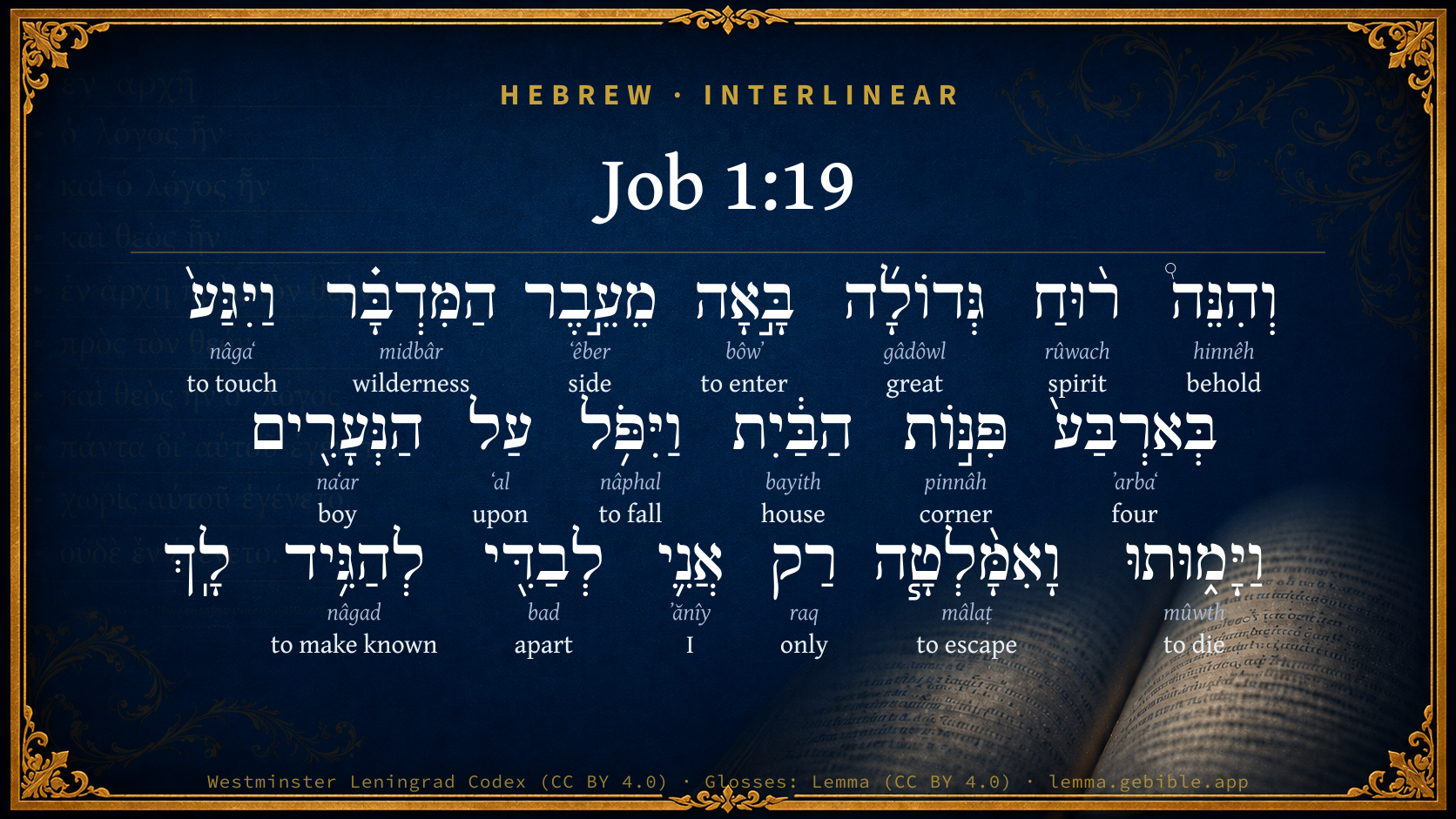
  1. וְהִנֵּה֩ hinnêh H2009 “and · behold” Conjunction + Particle, Demonstrative
  2. ר֨וּחַ rûwach H7307 “spirit” Noun, Common, Both, Singular, Absolute
  3. גְּדוֹלָ֜ה gâdôwl H1419 “great” Adjective, Adjective, Feminine, Singular, Absolute
  4. בָּ֣אָה bôwʼ H935 “to enter” Verb, Qal, Perfect, 3rd Person, Feminine, Singular
  5. מֵעֵ֣בֶר ʻêber H5676 “from · side of” Preposition + Noun, Common, Masculine, Singular, Construct
  6. הַמִּדְבָּ֗ר midbâr H4057 “the · wilderness” Particle, Definite Article + Noun, Common, Masculine, Singular, Absolute
  7. וַיִּגַּע֙ nâgaʻ H5060 “and · to touch” Conjunction + Verb, Qal, Sequential Imperfect, 3rd Person, Masculine, Singular
  8. בְּאַרְבַּע֙ ʼarbaʻ H702 “in/at · four” Preposition + Adjective, Cardinal number, Feminine, Singular, Absolute
  9. הַבַּ֔יִת bayith H1004 “the · house” Particle, Definite Article + Noun, Common, Masculine, Singular, Absolute
  10. וַיִּפֹּ֥ל nâphal H5307 “and · to fall” Conjunction + Verb, Qal, Sequential Imperfect, 3rd Person, Masculine, Singular
  11. עַל ʻal H5921 “upon” Preposition
  12. הַנְּעָרִ֖ים naʻar H5288 “the · boys” Particle, Definite Article + Noun, Common, Masculine, Plural, Absolute
  13. וַיָּמ֑וּתוּ mûwth H4191 “and · to die” Conjunction + Verb, Qal, Sequential Imperfect, 3rd Person, Masculine, Plural
  14. וָאִמָּ֨לְטָ֧ה mâlaṭ H4422 “and · to escape” Conjunction + Verb, Niphal, Sequential Imperfect, 1st Person, Common, Singular + Suffix, h
  15. רַק raq H7535 “only” Particle, Accusative
  16. אֲנִ֛י ʼănîy H589 “I” Pronoun, Personal, 1st Person, Common, Singular
  17. לְבַדִּ֖י bad H905 “to/for · apart · my” Preposition + Noun, Common, Masculine, Singular, Construct + Suffix, Personal, 1st Person, Common, Singular
  18. לְהַגִּ֥יד nâgad H5046 “to make known” Preposition + Verb, Hiphil, Infinitive Construct

About this verse

These counts appear in no published source. They are computed here, from the morphology-tagged text and Lemma’s own curated glosses. What Lemma adds →

20
words
19
distinct lemmas
Wisdom
section

Shared distinctive vocabulary

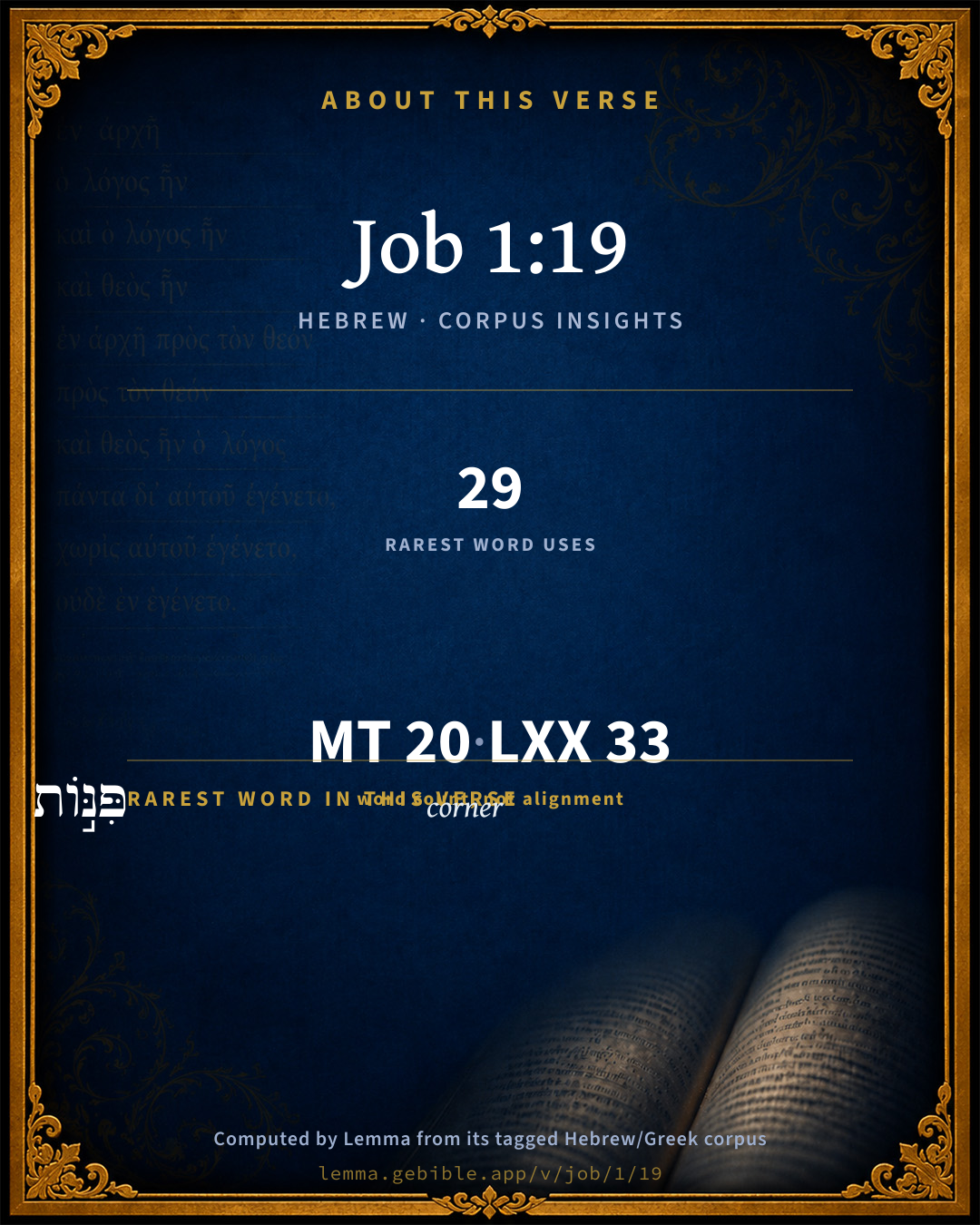
פִּנּ֣וֹת corner H6438 occurs in 29 verses of the Hebrew Bible. Also found in:

Grammatical profile

  • 6 verbs
  • 7 nouns
  • 2 adjectives
  • 1 pronoun
  • 2 prepositions
  • 2 particles

Verb forms

  • בָּ֣אָה Qal · Perfect
  • וַיִּגַּע֙ Qal · Sequential Imperfect
  • וַיִּפֹּ֥ל Qal · Sequential Imperfect
  • וַיָּמ֑וּתוּ Qal · Sequential Imperfect
  • וָאִמָּ֨לְטָ֧ה Niphal · Sequential Imperfect
  • לְהַגִּ֥יד Hiphil · Infinitive Construct

Hebrew & Septuagint length

In English translation the verse runs 36 words from the Hebrew and 39 from the Septuagint (LXX English) — closely comparable.

A rough comparison of the two English renderings, which tokenize alike — not a word-level alignment.

Word counts can differ between the Hebrew and the Greek without any difference in meaning — e.g. the Hebrew direct-object marker אֵת has no separate Greek word, and Greek often adds the article ὁ.

In the original languages it is 20 Hebrew tokens and 33 Greek tokens — but the two are counted differently (Hebrew bundles its prefixes and suffixes into one token; the Greek is in lemma form), so that isn’t a like-for-like length.

Cross-references

10

Topical passages linked to Job 1:19 in the Treasury of Scripture Knowledge — connected by theme and wording, ordered by reader-vote popularity; previews shown in the World English Bible.

  • Genesis 37:32–33 They took the coat of many colors, and they brought it to their father, and said, "We have found this. Examine it, now, whether it is your son's coat or not."
  • Genesis 42:36 Jacob, their father, said to them, "You have bereaved me of my children! Joseph is no more, Simeon is no more, and you want to take Benjamin away. All these things are against me."
  • Judges 16:30 Samson said, Let me die with the Philistines. He bowed himself with all his might; and the house fell on the lords, and on all the people who were therein. So the dead that he killed at his death were more than those who he killed in his life.
  • 2 Samuel 18:33 The king was much moved, and went up to the chamber over the gate, and wept: and as he went, thus he said, my son Absalom, my son, my son Absalom! would I had died for you, Absalom, my son, my son!
  • 1 Kings 20:30 But the rest fled to Aphek, into the city; and the wall fell on twenty-seven thousand men who were left. Ben Hadad fled, and came into the city, into an inner chamber.
  • Jeremiah 4:11–12 At that time shall it be said to this people and to Jerusalem, A hot wind from the bare heights in the wilderness toward the daughter of my people, not to winnow, nor to cleanse;
  • Luke 13:1–5 Now there were some present at the same time who told him about the Galileans, whose blood Pilate had mixed with their sacrifices.
  • Acts 28:4 When the natives saw the creature hanging from his hand, they said one to another, "No doubt this man is a murderer, whom, though he has escaped from the sea, yet Justice has not allowed to live."
  • Ephesians 2:2 in which you once walked according to the course of this world, according to the prince of the powers of the air, the spirit who now works in the children of disobedience;
  • Matthew 7:27 The rain came down, the floods came, and the winds blew, and beat on that house; and it fell--and great was its fall."

Cross-references courtesy of OpenBible.info (CC BY 4.0).

Hebrew and Greek witnesses Masoretic Hebrew ↔ Greek Septuagint

The same verse in the two great witnesses to the Old Testament, shown verse-for-verse.

These are two independent witnesses, not word-aligned to each other, and the Septuagint is shown in lemma (dictionary) form.

Hebrew Job 1:19 Masoretic · Westminster Leningrad Codex

וְהִנֵּה֩ ר֨וּחַ גְּדוֹלָ֜ה בָּ֣אָה מֵעֵ֣בֶר הַמִּדְבָּ֗ר וַיִּגַּע֙ בְּאַרְבַּע֙ פִּנּ֣וֹת הַבַּ֔יִת וַיִּפֹּ֥ל עַל הַנְּעָרִ֖ים וַיָּמ֑וּתוּ וָאִמָּ֨לְטָ֧ה רַק אֲנִ֛י לְבַדִּ֖י לְהַגִּ֥יד לָֽךְ

and, behold, there came a great wind from the wilderness, and struck the four corners of the house, and it fell on the young men, and they are dead. I alone have escaped to tell you."

World English Bible · Public Domain

Greek LXX Job 1:19 Septuagint · lemma form

ἐξαίφνης πνεῦμα μέγας ἐπιἔρχομαι ἐκ ὁ ἔρημος καί ἅπτομαι ὁ τέσσαρες γωνία ὁ οἰκία καί πίπτω ὁ οἰκία ἐπί ὁ παιδίον σύ καί τελευτάω σώζω δέ ἐγώ μόνος καί ἔρχομαι ὁ ἀποἀγγέλλω σύ

suddenly a great wind came on from the desert, and caught the four corners of the house, and the house fell upon your children, and they are dead; and I have escaped alone, and am come to tell you.

LXX2012 (modern English Septuagint) · Public Domain

Hebrew: Westminster Leningrad Codex (CC BY 4.0). Greek: Septuagint (public domain); English from LXX2012 (modern English Septuagint) (Public Domain). How the Septuagint differs from the Hebrew →

Commentary

Notes on Job 1:19 from classic Christian and Jewish commentators (each source and its license shown beneath its notes). The classic Christian expositions comment on the surrounding passage and are grouped to its opening verse, so a note may address several verses; the Jewish commentaries on the Tanakh (Rashi and others) are per-verse, so they appear only where the commentator wrote on this verse.

Lemma curates 59 commentaries, every one of them public domain or Creative Commons licensed, each selected and text-cleaned for this edition rather than reprinted as found. About our sources →

Trapp's Complete Commentary

John Trapp

Job 1:19 And, behold, there came a great wind from the wilderness, and smote the four corners of the house, and it fell upon the young men, and they are dead; and I only am escaped alone to tell thee.

Ver. 19. And behold, there came a great wind] The devil, doubtless, was in this wind (as he is, by Divine permission, "the prince of the power of the air," Eph 2:2, and can thereby do much mischief); what wonder, then, though it were a great wind, since spirited by him, and came ( ventus a veniendo), came on amain, and with a force, as being driven on by the devil. It was a wonderful wind (belike a whirlwind), and hath, therefore, a "behold" set upon it; such a wind as the relater had never known before; the Rabbis say, that he was so frightened with it, that no sooner had he made an end of his report of it to Job, but he fell down dead at his feet. Sure it is, that he relateth the matter punctually and graphically, with singular diligence, and without that moderation and making the best of things at first, as in such cases is usual, when parents are first made acquainted with the sudden death of their children, or other sad accidents that have befallen them. This messenger cluttereth out all at once, being thereunto set on and induced by Satan (as Lavater thinketh) to stir up Job’s stomach, and to make him break off that so well twisted thread of his patience.

From the wilderness] Of Idumea, or Arabia, called Deserta. The devil, who haunteth dry and desert places, was the Aeolus that sent it. Let us bless that God (the maker and master of these meteors, and of all things else) who bindeth up such an enemy and boundeth such a power.

And smote the four corners of the house] This was extraordinary, and, therefore, the more dreadful; God seeming to fulfil upon Job and his children what he threateneth in the law, Deu 28:59, I will make their plagues wonderful. But what saith Solomon, and that after long debate with himself about occurrents of this nature? "For all this I considered in mine heart, even to declare all this, that the righteous and the wise, and their works, are in the hand of God: no man knoweth either love or hatred by all that is before them," Ecc 9:1-2 by externals we cannot judge aright of eternals. Let it be our care to "lay hold on eternal life"; and then sudden death can do us no hurt; no guest cometh unawares to him who keeps a constant table.

And it fell upon the young men, and they are dead] No doubt but they were miserably mauled and dismembered by the fall, so that they were pulled forth piece-meal, and it could hardly be known which was which, as we say. The like death befell Scopas, a rich and noble man of Thessaly, together with his guests, all crushed and killed together by the ruin of that room where they were feasting, and fearing no such danger, as Cicero telleth us: Simonides was at that feast, but was at that instant happily called out by two young men that came to speak with him (Cic. lib. 2, de Orator). Luther had the like deliverance, by a special providence, as Mr Fox relateth. But so had not those Londoners, in the reign of King William II, who perished by a terrible tempest, which blew down suddenly six hundred and six houses in that chief city (Acts and Mon. fol. 787. Stowe’s Chron.). No more had those that died by the fall of part of a house in Blackfriars, where and while Drury, a Popish priest, was preaching, who, together with a hundred more Papists, his hearers, had there their passport: this happened in the year 1623. And the like we had lately at Witney, in Oxfordshire, where a scurrilous, blasphemous comedy was, by the fall of the room wherein it was noted, Feb. 3, 1652, turned into a tragedy, as ending with the deaths of six, and injuries of about sixty, who were bruised and maimed, and some, as it were, half dead, carried away by their friends. The narrative whereof, together with what was preached there in three sermons on that occasion from Rom 1:18, is set forth by Mr John Rowe, lecturer in that town, in his book called Tragicomedia.

John Trapp, A Commentary or Exposition upon All the Books of the Old and New Testament (1647–1656) — public domain. Text from a community e-Sword module.

Joseph Benson's Commentary

Job 1:19. And behold, there came a great wind from the wilderness — From the further part of, or across the wilderness, whence the fiercest winds came, as having most power in such open places: see Jer 4:11; Jer 13:24. By this it appears that Job’s situation was on the northerly side of the Arabian desert; and smote the four corners of the house — In which the chief strength of the house consisted. The wind smote these either all together, or rather successively, one corner immediately after another, being possibly a whirlwind, which came violently and suddenly whirling about in a circle; and it fell upon the young men — Upon his sons in their youth, and his daughters also, as appears from the sequel. This was the greatest of all Job’s losses, his ten children being, undoubtedly, by far the dearest and most valuable of his possessions; and it could not but go nearest to him, and, therefore, Satan reserved it to the last; that, if the other provocations failed, this might make him curse God. Our children are parts of ourselves, and it touches a good man in a most tender part to be deprived of any of them. What then must Job have felt, when he learned that he had lost his whole ten at once, and that in one moment he was written childless! It was also an aggravation of the calamity that they had been taken away so suddenly, without any previous warning. Had they died by some lingering disease, and he had had notice to expect their death, and prepare for the breach, the affliction would have been more tolerable. And that they had died when they were feasting and making merry, was another and still more distressing circumstance. Had they died suddenly when they were praying, he might have better borne it; for. in that case, he would have hoped that death had found them in a state of preparation for another world, which he had great reason to fear now it had not. They died, indeed, by a wind of the devil’s raising, but which seemed to come from the immediate hand of God, and to be sent as a judgment of God upon them for the punishment of their sins: and they were taken away when Job had most need of them to comfort him under all his other losses.

Joseph Benson's Commentary on the Old and New Testaments (1811–1818) — public domain. Text from a community e-Sword module.

Tyndale Open Study Notes

Tyndale Open Resources

1:19 That the wind . . . hit the house on all sides suggests that Job and his children were settled farmers living in houses rather than nomads living in tents.

Tyndale Open Study Notes — © Tyndale Open Resources, licensed CC BY-SA 4.0. Text via the HelloAO Bible API.

Jamieson, Fausset & Brown

Robert Jamieson, A. R. Fausset & David Brown

a great wind from the wilderness--south of Job's house. The tornado came the more violently over the desert, being uninterrupted (Isa 21:1; Hos 13:15).

the young men--rather, "the young people"; including the daughters (so in Rut 2:21).

Jamieson, Fausset & Brown — Commentary Critical and Explanatory on the Whole Bible (1871) — public domain (CC PDM 1.0). Text via the HelloAO Bible API.

Adam Clarke's Commentary

Verse 19. A great wind from the wilderness] Here was another proof of the influence of the prince of the power of the air. What mischief might he not do with this tremendous agent, were he not constantly under the control of the Almighty! He seems to have directed four different currents, which, blowing against the four corners or sides of the house, crushed it together, and involved all within in one common ruin.

Adam Clarke's Commentary on the Bible (1810–1826) — public domain. Text from a community e-Sword/MySword module.

John Gill's Exposition

And, behold, there came a great wind from the wilderness,.... Most probably from the wilderness of Arabia, winds from such places being generally very strong, Jer 4:11 as this was, and is called a "great one", a very strong and blustering one; and being so, and because of the effects of it, and being an uncommon and extraordinary one, as what follows shows, a "behold" is prefixed to the account, exciting attention and wonder:

and smote the four corners of the house; which shows it to be an unusual wind, it blowing from all parts and on all sides; and was either a whirlwind, which whirled about this house; or Satan, with his posse of devils with him, took the advantage of the sweep of it, as it came by this house, and with all their force and strength, might and main, whirled it about it; otherwise Satan has no power to raise winds, and allay them at pleasure; God only creates them, holds them in his fists, and brings them out of his treasures; and this wind blowing from the desert, the devil and his angels took the opportunity, and with such violence whirled it about the house that it fell, as follows:

and it fell upon the young men, and they are dead; not upon Job's sons only, but upon his daughters also, the word used takes in both; and Mr. Broughton renders it, "and it fell upon the young folk"; this was the sorest affliction of all, and which Satan reserved to the last, that if the others did not succeed to his wish, this might; and a very trying, grievous one it was, to lose all his children at once in such a manner, and at such a time; his children, which were parts of himself, whom he had taken so much care of in their education, who had been as olive plants about his table, and now brought up to men's and women's estates, comfortably settled in the world, and living in great peace and harmony among themselves, and not one of them left to comfort him under his other afflictions; and these taken away not by any distemper of body, which would have prepared him for the stroke, but by a violent death; and which had the appearance of the hand and judgment, wrath and vengeance of God; and while they were feasting together in mirth and gaiety, however innocent, and not in a serious frame of spirit, or having any serious turn upon their minds for death and eternity, of which they had no thought; had they been in the house of God attending religious worship, or though in their own houses, yet either in their closets praying, or else conversing about spiritual things, with one another, it would have greatly taken off of the affliction; but to be snatched into eternity at once, and in this manner, must be cutting to Job; though there is no reason to think that this was for any sin of theirs, or through any displeasure of God to them, but was permitted purely on Job's account, for the trial of his faith, patience, sincerity, and integrity; and here, as in the former instances, only one servant was spared to bring the sad tidings:

and I only am escaped alone to tell thee; so that all the servants in the house, excepting this, perished in the ruins of it, as well as Job's sons and daughters; see Gill on Job 1:15. It is a notion of some Jewish writers, as Simeon bar Tzemach observes, that each of these messengers, as soon as they had delivered their message, died, and so all that Job had was delivered into the hands of Satan, and nothing left; but this seems contrary to Job 19:16. It may be observed that Aristeas, an Heathen writer, as quoted by Alexander Polyhistor (i), another Heathen writer, gives an account of each of these calamities of Job, just in the same order in which they are here. It may be observed from all this, that no character ever so great and high can secure persons from afflictions, even grievous ones; Job had an high and honourable character given and confirmed by God himself, yet so sorely afflicted; and let men be the beloved of God, his chosen and precious, his covenant people, the redeemed of the Lamb, righteous and godly persons, the sons and heirs of God, yet neither nor all of these exempt them from afflictions; and those that befall them are many, frequent, and continued, and come from different quarters, from men good and bad, and from devils, and all by the permission and according to the will of God. And this shows us the uncertainty of all outward enjoyments, gold, silver, cattle, houses, lands, children, friends and relations, all perishing, and sometimes suddenly taken away: and it may be observed, among all Job's losses, he did not lose anything of a spiritual nature, not one spiritual blessing; though he lost all his outward mercies, yet not the God of his mercies; not his covenant interest in him, nor his share in his love, favour, and acceptance, which all still continued; he did not lose his interest in a living Redeemer; his children were all dead, but his Redeemer lived, and he knew it; he did not lose the principle of grace in him, the root of the matter was still with him; nor anyone particular grace, not his faith and confidence in God, nor his hope of eternal life, nor his love and affection to God, and desire after him; nor his patience and humility; nor his integrity, faithfulness, and honesty, which he retained and held fast; nor any of his spiritual riches, which are durable; he had riches in heaven, where thieves cannot break through and steal, a better and a more enduring substance there, an inheritance incorruptible, reserved in the heavens his conduct under all this follows.

(i) Apud. Euseb. Praepar. Evangel. l. 9. c. 25. p. 431.

John Gill's Exposition of the Whole Bible (1746–1763) — public domain (CC PDM 1.0). Text via the HelloAO Bible API.

Albert Barnes' Notes on the Bible

There came a great wind - Such tornadoes are not less common in Oriental countries than in the United States. Indeed they abound more in regions near the equator than they do in those which are more remote; in hot countries than in those of higher latitude.

From the wilderness - Margin, “From aside.” That is, from aside the wilderness. The word here rendered “from aside” in the margin (מדבר mı̂dbâr ) means properly “from across,” and is so rendered by Dr. Good. The word עבר ‛âbar means literally a region or country beyond, or on the other side, sc. of a river or a sea, which one must “pass;” Jdg 11:18; Gen 2:10-11; Deu 1:1, Deu 1:5. Then it means on the other side, or beyond; see the notes at Isa 18:1. Here it means that the tornado came sweeping across the desert. On the ample plains of Arabia it would have the opportunity of accumulating its desolating power, and would sweep everything before it. The Hebrew word here rendered “wilderness,” מדבר mı̂dbâr, does not express exactly what is denoted by our word. We mean by it usually, a region wholly uncultivated, covered with forests, and the habitation of wild beasts. The Hebrew word more properly denotes a “desert;” an uninhabited region, a sterile, sandy country, though sometimes adapted to pasture. In many places the word would be well translated by the phrases “open fields,” or “open plains;” compare Joe 2:22; Psa 65:13; Jer 23:10; Isa 42:11; Gen 14:6; Gen 16:7; Exo 3:1; Exo 13:18; Deu 11:24; compare Isa 32:15; Isa 35:1-2.

And smote the four corners of the house - Came as a tornado usually does, or like a whirlwind. It seemed to come from all points of the compass, and prostrated everything before it.

And it fell upon the young men - The word here rendered” young men” is the same which is rendered in Job 1:15, Job 1:17, servants הנערים hana‛arı̂ym. There can be no reasonable doubt, however, that the messenger by the word here refers to the children of Job. It is remarkable that his daughters are not particularly specified, but they may be included in the word used here נערים na‛arı̂ym, which may be the same in signification as our phrase “young people,” including both sexes. So it is rendered by Etchhorn: Es sturtzo tiber den jungen Leuten zusammen.

Albert Barnes' Notes on the Bible (1834–1885) — public domain. Text from a community e-Sword/MySword module.

Matthew Poole's English Annotations

From the wilderness; whence the fiercest winds came, as having most power in such open places. See Jer 4:11; 13:24.

Smote the four corners; in which the chief strength of the house did consist. It smote these either all together, or rather successively, one immediately after another, being possibly a whirlwind, which comes violently and suddenly, whirling about in a circle, and being driven about by the power of the devil, which is very great.

The young men; his sons in their youth, and his daughters also, as appears from the sequel.

Matthew Poole's English Annotations on the Holy Bible (1683–1685) — public domain. Text from a community e-Sword/MySword module.

Whedon's Commentary on the Bible

Daniel D. Whedon

19. From the wilderness — Literally, from beyond the desert. המדברwith the article as here, generally signifies the great Arabian desert, lying to the south of Palestine, and extending from Egypt as far as the Persian Gulf. The most destructive storms come from that direction. Sweeping across this desert, with no obstacle to break its force, this storm constantly increased in intensity until it became a whirlwind, (so Dillmann thinks,) and thus struck the four corners of the house at once. Mr. Buckingham thus describes a whirlwind which he encountered in the desert of Suez: “Fifty gales of wind at sea seemed to me more easy to be encountered than one among these sands. It is impossible to imagine desolation more complete; we could see neither sun, earth, nor sky; the plain at ten paces distance was absolutely imperceptible; our beasts, as well as ourselves, were so covered as to render breathing difficult; they hid their faces in the ground, and we could only uncover our own for a moment to behold this chaos of midday darkness.” Such winds, says Dr. J.L. Porter, are common in the desert. “They pass along with a roar like a cataract, and can be both seen and heard at a great distance. I have often witnessed them. Such a tornado would destroy a house exactly as here described, ‘smiting it upon the four corners.’”

Young men — נערים. An archaic form of frequent use in the Pentateuch (like the Greek παις) for either or both of the sexes.

They are dead — The climax of conceivable evils is now reached. Each additional one had been more disastrous than that which preceded. This — before which the others are dwarfed — is forcibly left to the last. Dante says of Satan that he is a master logician. The first stroke was the work of men, and entailed the loss of five hundred yoke of oxen and as many asses; in the second, the fire of God fell, and burned up the seven thousand sheep; in the third, men were again the agents, and the Chaldeans swooped up the three thousand camels; in each case their attendants being left dead on the field. But what are all these in the presence of a family of ten dead children? These diversified calamities were so ordered, that, like so many claps of thunder, the reverberation of one died not away before another broke upon the sky.

Daniel D. Whedon (gen. ed.), Commentary on the Old and New Testaments (1874–1909) — public domain. Text from a community e-Sword module.

The Pulpit Commentary

And, behold, there came a great wind from the wilderness; rather, from across the wilderness a wind which began in the region lying on the other side of the wilderness, and sweeping across it, came with full force upon the inhabited tract where Job and his sons were dwelling. The desert winds are often very violent. Generally they are Laden with heavy clouds of fine sand, which cause intolerable discomfort and thirst; but when they sweep over a rocky and gravelly region, they are simply of extreme violence, without other distressing feature. They then resemble the hurricanes or tornadoes of the West Indies. We may reasonably connect this hurricane with the thunderstorm of ver. 16. And smote the four corners of the house, and it fell. The "houses" of the East are not the solid structures of heavy timber, brick, and stone to which we of the West are accustomed, but light fabrics of planks and palisades, thatched mostly with reeds. Houses of this kind, when the rain descends, and the winds blow and beat against them, (Mat_7:6) readily fall. Upon the young men; rather, the young persons. Na"ar (rn) is of both genders in early Hebrew. (see Gen_24:14, etc.) And they are dead; and I only am escaped alone to tell thee. Again, the calamity has a completeness which marks it as supernatural. The fall of a house does not usually destroy all the inmates.

The Pulpit Commentary (1880–1919), ed. H.D.M. Spence-Jones & Joseph S. Exell — public domain. Text from a community e-Sword module.

John Wesley's Explanatory Notes

The young men - This was the greatest of Job's losses, and therefore Satan reserved it to the last, that if the other provocations failed, this might make him curse God. They died by a wind of the devils raising, but which seemed to be the immediate hand of God. And they were taken away, when he had the most need of them, to comfort him under all his other losses. Such miserable comforters are creatures: in God we have a constant and sufficient help.

John Wesley, Explanatory Notes Upon the Whole Bible (1754–1765) — public domain. Text via the GEBible commentary corpus.

Rashi

Rabbi Shlomo Yitzchaki (Rashi)

from the other side of the desert From the other side of the desert, for the house was on this side. This is the meaning of עֵבֶר, as it is found in Scriptures.

upon the youths The sons, but it is unnecessary to mention the daughters.

(to tell you He was permitted only to tell, and at that moment, he died. Not found in certain editions.)

Rashi on the Tanakh — English translations: “The Judaica Press complete Tanach with Rashi, translated by A. J. Rosenberg” (CC BY 4.0); “Pentateuch with Rashi's commentary by M. Rosenbaum and A.M. Silbermann, 1929-1934” (public domain); “The Metsudah Tanach series, Lakewood, N.J” (CC BY 4.0); and “The Book of Joshua, Metsudah Publications, 1997” (CC BY 4.0). Text via Sefaria.

Lesson kit

Teaching starters — assembled from the data on this page, not authored interpretation. Every prompt links to the verse data it draws on. Edit before teaching.

Job, in the Wisdom, opens this verse with 20 words (19 distinct Hebrew lemmas). Its most distinctive word is pinnâh (“corner”). A historical commentator’s framing appears above. Read the whole chapter for the surrounding context.

Discussion questions

  1. How does “corner” (pinnâh) shape what this verse is saying?
  2. Exodus 27:2 shares the word «corner» with this verse. How do the two illuminate each other?
  3. The translations on this page render this verse differently — a whole-verse word diff, not a word-by-word alignment. What might account for the different wordings?
  4. The verb «בָּ֣אָה» is Qal Perfect. How does its form color the action?
  5. Reading how Trapp's Complete Commentary and Joseph Benson's Commentary read this verse, where do the two commentators agree and where do they part?

Things to notice

Reading settings

Reading text

Shown beneath each verse's original-language words.

Old Testament
Old Testament edition

Read the OT as the Masoretic Hebrew (MT) or the Greek Septuagint (LXX).

English shown for the Greek Septuagint (in the Hebrew ↔ Greek comparison).

Comparing translations? Open the Compare panel on any verse page to stack up to four side by side.