
Job 6:26

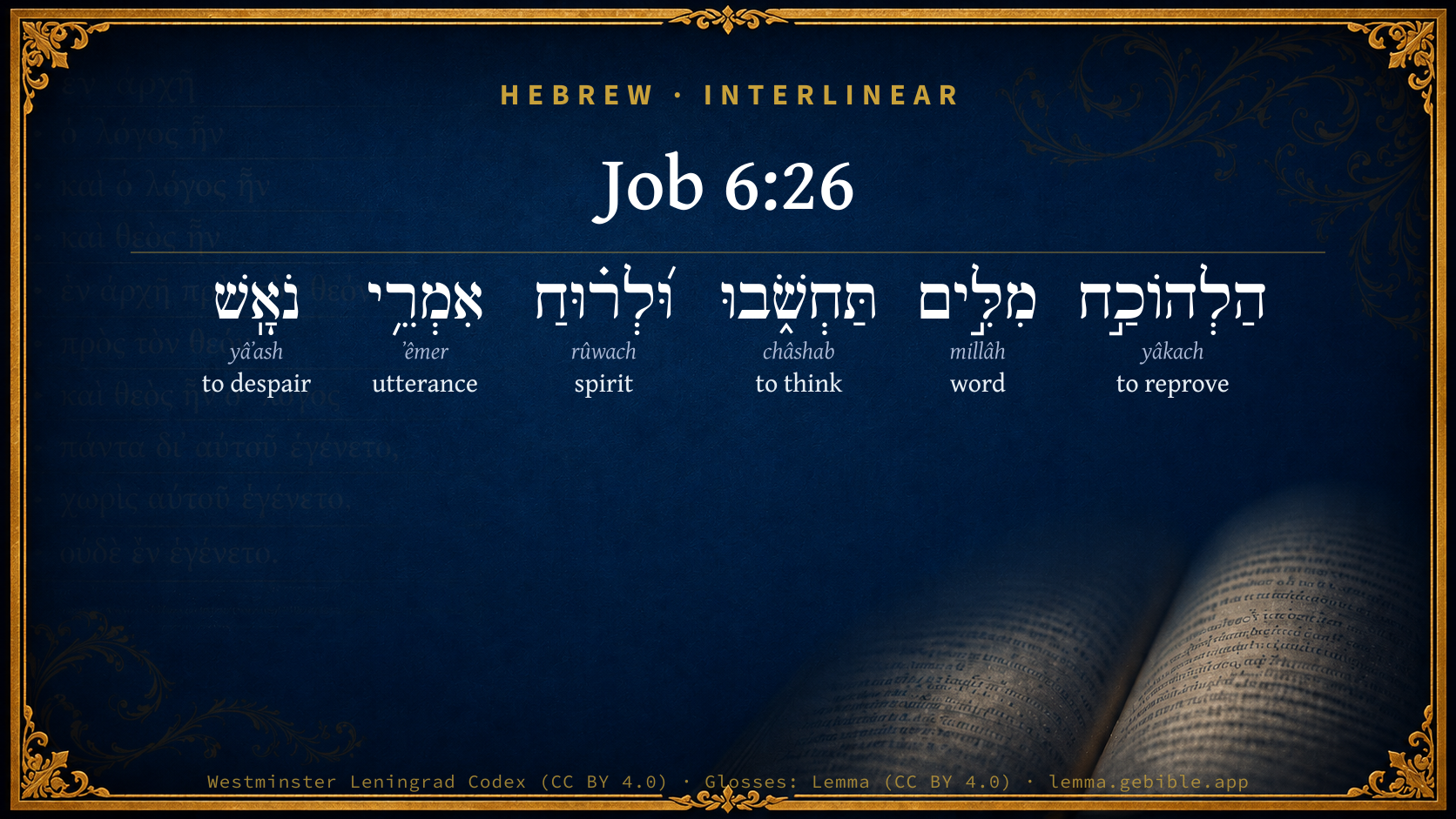
Hebrew (Westminster Leningrad Codex) Job 6:26 appears in the Hebrew Old Testament. The text above is from the Westminster Leningrad Codex. Each word links to its Strong’s number, a concise gloss, and parsing drawn from the Open Scriptures Hebrew Bible morphology. Click any word for its full Brown-Driver-Briggs (BDB) entry.
Download image
Cite this verse

Job 6:26 (World English Bible). Public Domain. Lemma interlinear Bible study tool, https://lemma.gebible.app/v/job/6/26.

Show BibTeX & RIS
BibTeX
RIS
English Translation
Do you intend to reprove words, Seeing that the speeches of one who is desperate are as wind?
World English Bible · Public Domain
Download a study sheet

One document with this verse’s original text, its word-by-word gloss line, the meaning frame, cross-references with their text, attributed commentary, and full source and license credits — printable, and it pastes into notes with its structure intact.

This verse Autodidact and up

Study sheet (.html) Plain text (.txt)

A passage Seminary Student

Up to 50 verses in one chapter. A passage sheet keeps up to 6 commentary sources and 12 cross-references per verse, in the order this page ranks them, and says so on the sheet whenever that leaves anything out. Ask for a single verse and you get the Autodidact verse sheet above.

Everything on this page stays free to read, with no account — the sheet is a download of what is already on screen, not access to it.

Want to remove ads? Support Godless Engineer
Compare translations 3

The same verse in 3 English versions, stacked beneath the original-language interlinear above. Click any original word for its lexicon entry.

Each is an independent rendering of the whole verse — the interlinear is not word-aligned to these translations.

Highlighted words mark where these versions differ — a whole-verse word diff, not a word-by-word alignment.

  • World English Bible Public Domain
    Do you intend to reprove words, Seeing that the speeches of one who is desperate are as wind?
  • King James Version Public Domain
    Do ye imagine to reprove words, and the speeches of one that is desperate, which are as wind?
  • unfoldingWord Literal Text CC BY-SA 4.0
    Do you think to correct my words, and to the wind the words of one despairing?

unfoldingWord Literal Text — © unfoldingWord, licensed CC BY-SA 4.0. Word-aligned USFM3 via Door43 (git.door43.org/unfoldingWord/en_ult).

Versions to compare (up to 4)

3 of 4 selected

Show all 18 translations

Every available English version of this verse, each an independent rendering of the whole verse.

  • World English Bible Public Domain
    Do you intend to reprove words, Seeing that the speeches of one who is desperate are as wind?
  • Berean Standard Bible Public Domain
    Do you intend to correct my words, and treat as wind my cry of despair?
  • Majority Standard Bible Public Domain
    Do you intend to correct my words, and treat as wind my cry of despair?
  • King James Version Public Domain
    Do ye imagine to reprove words, and the speeches of one that is desperate, which are as wind?
  • American Standard Version (1901) Public Domain
    Do ye think to reprove words, Seeing that the speeches of one that is desperate are as wind?
  • Revised Version (1885) Public Domain
    Do ye imagine to reprove words? seeing that the speeches of one that is desperate are as wind.
  • Geneva Bible (1599) Public Domain
    Doe ye imagine to reproue wordes, that the talke of the afflicted should be as the winde?
  • Douay-Rheims (1899) Public Domain
    You dress up speeches only to rebuke, and you utter words to the wind.
  • Young's Literal Translation Public Domain
    For reproof -- do you reckon words? And for wind -- sayings of the desperate.
  • Literal Standard Version CC BY-SA 4.0
    For reproof—do you reckon words? And for wind—sayings of the desperate?
  • Unlocked Literal Bible CC BY-SA 4.0
    Do you plan to ignore my words, treating the words of a desperate man like the wind?
  • unfoldingWord Literal Text CC BY-SA 4.0
    Do you think to correct my words, and to the wind the words of one despairing?
  • Darby Bible Public Domain
    Do ye imagine to reprove words? The speeches of one that is desperate are indeed for the wind.
  • World Messianic Bible Public Domain
    Do you intend to reprove words, since the speeches of one who is desperate are as wind?
  • Webster's Bible Public Domain
    Do ye imagine to reprove words, and the speeches of one that is desperate, which are as wind?
  • Free Bible Version CC BY-SA 4.0
    Are you going to argue over what I said, when the words of someone in despair should be left to blow away in the wind?
  • Bible in Basic English Public Domain
    My words may seem wrong to you, but the words of him who has no hope are for the wind.
  • JPS Tanakh (1917) Public Domain
    Do ye hold words to be an argument, but the speeches of one that is desperate to be wind?

Literal Standard Version (2020), Covenant Press — licensed CC BY-SA 4.0. Text via the HelloAO Bible API (eBible.org). Unlocked Literal Bible (unfoldingWord) — licensed CC BY-SA 4.0. Text via the HelloAO Bible API (eBible.org). unfoldingWord Literal Text — © unfoldingWord, licensed CC BY-SA 4.0. Word-aligned USFM3 via Door43 (git.door43.org/unfoldingWord/en_ult). Free Bible Version, Dr. Jonathan Gallagher — licensed CC BY-SA 4.0. Text via the HelloAO Bible API (eBible.org).

Word by word

More ways to search: Search by grammar → Find every occurrence → Compare this word →

Practice this passage: Drill this verse → Learn its vocabulary →

About this verse

These counts appear in no published source. They are computed here, from the morphology-tagged text and Lemma’s own curated glosses. What Lemma adds →

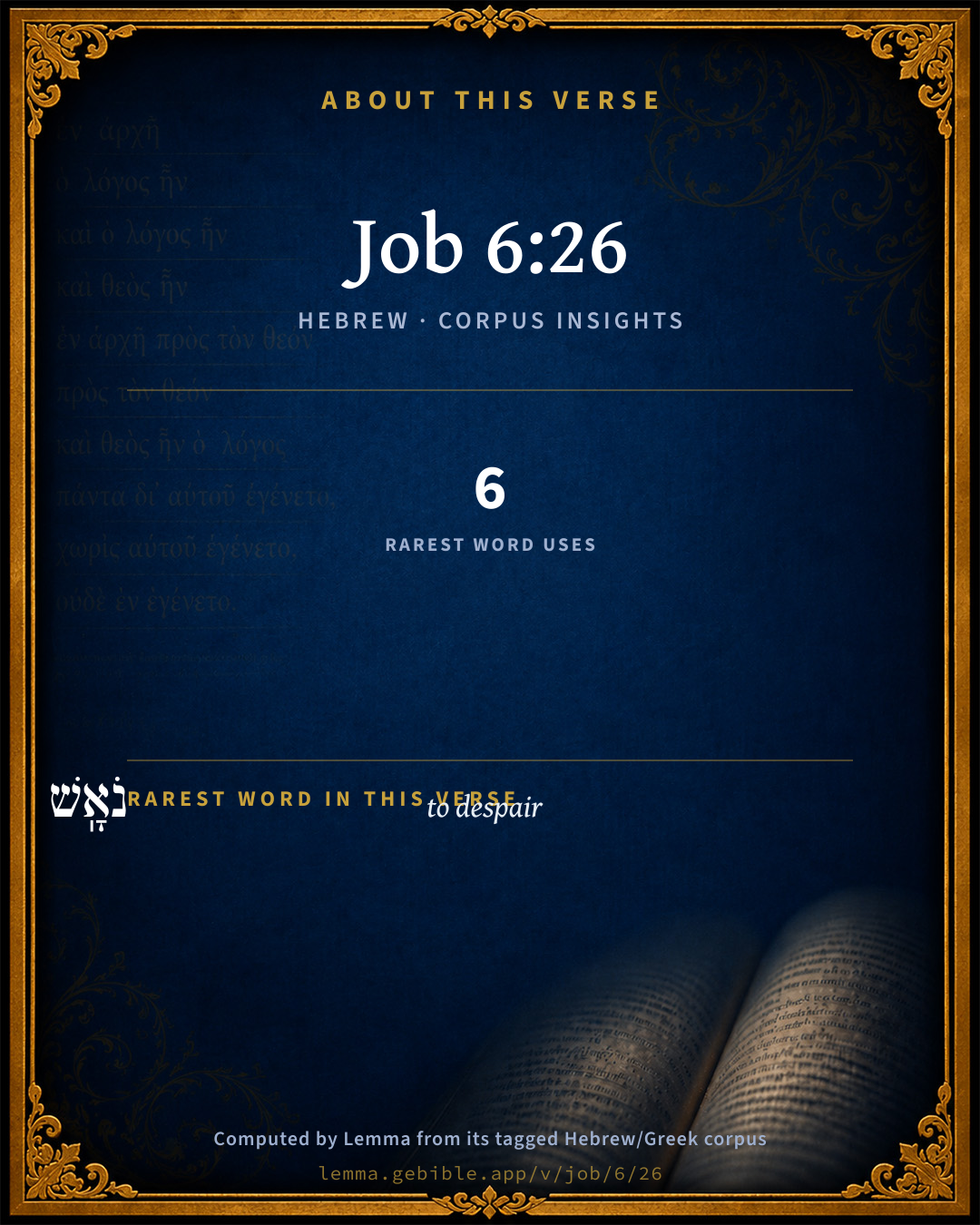
6
words
6
distinct lemmas
Wisdom
section

Notable vocabulary

The rarest word here is נֹאָֽשׁ to despair H2976 — appearing just 6 times in the whole Hebrew Bible.

Shared distinctive vocabulary

נֹאָֽשׁ to despair H2976 occurs in 6 verses of the Hebrew Bible. Also found in:

Grammatical profile

  • 3 verbs
  • 3 nouns

Verb forms

  • הַלְהוֹכַ֣ח Hiphil · Infinitive Construct
  • תַּחְשֹׁ֑בוּ Qal · Imperfect
  • נֹאָֽשׁ Niphal · Participle Active

Hebrew & Septuagint length

In English translation the verse runs 18 words from the Hebrew and 20 from the Septuagint (LXX English) — closely comparable.

A rough comparison of the two English renderings, which tokenize alike — not a word-level alignment.

Word counts can differ between the Hebrew and the Greek without any difference in meaning — e.g. the Hebrew direct-object marker אֵת has no separate Greek word, and Greek often adds the article ὁ.

Cross-references

16

Topical passages linked to Job 6:26 in the Treasury of Scripture Knowledge — connected by theme and wording, ordered by reader-vote popularity; previews shown in the World English Bible.

  • Job 8:2 "How long will you speak these things? Shall the words of your mouth be a mighty wind?
  • Matthew 12:37 For by your words you will be justified, and by your words you will be condemned."
  • Ephesians 4:14 that we may no longer be children, tossed back and forth and carried about with every wind of doctrine, by the trickery of men, in craftiness, after the wiles of error;
  • Job 2:10 But he said to her, "You speak as one of the foolish women would speak. What? Shall we receive good at the hand of God, and shall we not receive evil?" In all this Job didn't sin with his lips.
  • Job 3:3–26 "Let the day perish in which I was born, The night which said, 'There is a man-child conceived.'
  • Job 4:3–4 Behold, you have instructed many, You have strengthened the weak hands.
  • Job 6:4 For the arrows of the Almighty are within me, My spirit drinks up their poison. The terrors of God set themselves in array against me.
  • Job 6:9 Even that it would please God to crush me; That he would let loose his hand, and cut me off!
  • Job 10:1 "My soul is weary of my life; I will give free course to my complaint. I will speak in the bitterness of my soul.
  • Job 34:3–9 For the ear tries words, As the palate tastes food.
  • Job 38:2 "Who is this who darkens counsel By words without knowledge?
  • Job 40:5 I have spoken once, and I will not answer; Yes, twice, but I will proceed no further."
  • Job 40:8 Will you even annul my judgment? Will you condemn me, that you may be justified?
  • Job 42:3 You asked, 'Who is this who hides counsel without knowledge?' Therefore I have uttered that which I did not understand, Things too wonderful for me, which I didn't know.
  • Job 42:7 It was so, that after Yahweh had spoken these words to Job, Yahweh said to Eliphaz the Temanite, "My wrath is kindled against you, and against your two friends; for you have not spoken of me the thing that is right, as my servant Job has.
  • Hosea 12:1 Ephraim feeds on wind, And chases the east wind. He continually multiplies lies and desolation. They make a covenant with Assyria, And oil is carried into Egypt.

Cross-references courtesy of OpenBible.info (CC BY 4.0).

Hebrew and Greek witnesses Masoretic Hebrew ↔ Greek Septuagint

The same verse in the two great witnesses to the Old Testament, shown verse-for-verse.

These are two independent witnesses, not word-aligned to each other, and the Septuagint is shown in lemma (dictionary) form.

Hebrew Job 6:26 Masoretic · Westminster Leningrad Codex

הַלְהוֹכַ֣ח מִלִּ֣ים תַּחְשֹׁ֑בוּ וּ֝לְר֗וּחַ אִמְרֵ֥י נֹאָֽשׁ

Do you intend to reprove words, Seeing that the speeches of one who is desperate are as wind?

World English Bible · Public Domain

Greek LXX Job 6:26 Septuagint · lemma form

οὐδέ ὁ ἔλεγχος σύ ῥῆμα ἐγώ παύω οὐδέ γάρ σύ φθέγμα ῥῆμα ἀναἔχω

Neither will your reproof cause me to cease my words, for neither will I endure the sound of your speech.

LXX2012 (modern English Septuagint) · Public Domain

On this verse, John Gill's Exposition discusses the Septuagint’s reading. Read the note in Commentary ↓

Hebrew: Westminster Leningrad Codex (CC BY 4.0). Greek: Septuagint (public domain); English from LXX2012 (modern English Septuagint) (Public Domain). How the Septuagint differs from the Hebrew →

Commentary

Notes on Job 6:26 from classic Christian and Jewish commentators (each source and its license shown beneath its notes). The classic Christian expositions comment on the surrounding passage and are grouped to its opening verse, so a note may address several verses; the Jewish commentaries on the Tanakh (Rashi and others) are per-verse, so they appear only where the commentator wrote on this verse.

Lemma curates 59 commentaries, every one of them public domain or Creative Commons licensed, each selected and text-cleaned for this edition rather than reprinted as found. About our sources →

Trapp's Complete Commentary

John Trapp

Job 6:26 Do ye imagine to reprove words, and the speeches of one that is desperate, [which are] as wind?

Ver. 26. Do ye imagine to reprove words?] Idle and hasty words, which have more sound than sense? Think you that I do only make a noise, or rave like a madman, and am accordingly to be dealt with? Ye have not hitherto had vain, windy words from me, but words full of weight and matter, words of truth and soberness; wherefore then do ye speak thus? Do ye imagine to reprove words.

And the speeches of one that is desperate, which are as wind?] Do ye think I speak like one that is distracted, who knows not what he speaks? or that I have at once lost my hope and my wits? It is an easy and a compendious way of refuting all a man can say, to say he is mad, his words must needs be but wind without weight who is himself without reason. Mr Broughton readeth, Do ye hold the terms of the forlorn a wind? shall the poor man’s wisdom be despised (as Solomon asketh), and his words not be heard? Ecc 9:16. Some refer this also to Job’s friends, reading it thus, Ye frame speeches only to reprove (ye are good for little else but to find fault), and bring forth words against the wind; ye beat the empty air with your bubbles of words and senseless sayings.

John Trapp, A Commentary or Exposition upon All the Books of the Old and New Testament (1647–1656) — public domain. Text from a community e-Sword module.

Joseph Benson's Commentary

Job 6:26. Do you imagine to reprove words? — What! is all your wisdom employed for this, to catch hold of and reprove some of my words, without making allowance for human infirmity or extreme misery? and the speeches of one that is desperate? — Of a poor, miserable, helpless, and hopeless man; which are as wind — Which you esteem to be like wind, vain and light, without solidity, giving a sound, but with little sense, and to little purpose. Heath renders it, Are they as the wind? vain and empty.

Joseph Benson's Commentary on the Old and New Testaments (1811–1818) — public domain. Text from a community e-Sword module.

Geneva Bible (1599)

Geneva Bible translators

Do you cavil at my words because I should be thought to speak foolishly, which am now in misery?

Geneva Bible (1599) marginal notes — public domain. Text via Bolls.life.

Jamieson, Fausset & Brown

Robert Jamieson, A. R. Fausset & David Brown

Do you imagine--or, "mean."

to reprove words and (to reprove) the speeches of one desperate, (which are) as wind?--mere nothings, not to be so narrowly taken to task? UMBREIT not so well takes the Hebrew for "as wind," as "sentiments"; making formal "sentiments" antithetical to mere "speeches," and supplying, not the word "reprove," but "would you regard," from the first clause.

Jamieson, Fausset & Brown — Commentary Critical and Explanatory on the Whole Bible (1871) — public domain (CC PDM 1.0). Text via the HelloAO Bible API.

Adam Clarke's Commentary

Verse 26. Do ye imagine to reprove words] Is it some expressions which in my hurry, and under the pressure of unprecedented affliction, I have uttered, that ye catch at? You can find no flaw in my conduct; would ye make me an OFFENDER for a WORD? Why endeavour to take such advantage of a man who complains in the bitterness of his heart, through despair of life and happiness?

Adam Clarke's Commentary on the Bible (1810–1826) — public domain. Text from a community e-Sword/MySword module.

Ellicott's Commentary for English Readers

(26) Do ye imagine to reprove words . . .?—“It cannot be your intent to reprove mere words, as mine confessedly are (Job_6:3), and as you seem to count them (Job_6:13). If so, they are hardly worthy the trouble bestowed upon them, but might be left to answer themselves.”

A Bible Commentary for English Readers, edited by Charles John Ellicott (1878–1897) — public domain. Text from a community e-Sword module.

The Cambridge Bible for Schools and Colleges

gen. ed. J. J. S. Perowne

26. do ye imagine] that is, is it your purpose? think ye?

and the speeches … which are as wind] Rather, though the speeches of one that is desperate go into the wind.

The Cambridge Bible for Schools and Colleges (gen. ed. J. J. S. Perowne; Cambridge University Press, 1878–1918) — public domain. Text from a community e-Sword module.

John Gill's Exposition

Yea, ye overwhelm the fatherless,.... Meaning himself; who was like a fatherless child, stripped of all his mercies, of his children, his substance, and his health; and was in a most miserable, helpless, and forlorn condition; and, moreover, deprived of the gracious presence and visible protection of his heavenly Father, being given up for a while into the hands of Satan; and now it was unkind and barbarous to overwhelm such a man, who was overwhelmed with overmuch sorrow already: or, "ye cause to fall upon the fatherless"; either their wrath and anger, as the Targum and many others (d) instead of doing him justice; or a wall, or any such thing, to crush him, as Aben Ezra; or a lot, as Simeon bar Tzemach; see Joe 3:3; or rather a net, or a snare to entrap him in, seeking to entangle him in talk, so Mr. Broughton, which agrees with what follows:

and ye dig a pit for your friend; contrive mischief against him; sought to bring him to ruin; and which is aggravated by his having been their old friend, with whom they lived in strict friendship, and had professed much unto, and still pretended to have respect for; the allusion is to digging of pits for the catching of wild beasts: some render it, "ye feast upon your friend" (e); so the word is used in Kg2 6:23; this sense is taken notice of by Aben Ezra and Bar Tzemach; and then the meaning is, you rejoice at the misery of your friend; you mock him and that, and insult him in his distress, with which the Septuagint version agrees; which was cruel usage.

(d) "iram", Vatablus, Mercerus, Cocceius; so Jarchi and Sephorno. (e) "epulamini", Piscator; so Beza, Gussetius.

John Gill's Exposition of the Whole Bible (1746–1763) — public domain (CC PDM 1.0). Text via the HelloAO Bible API.

Albert Barnes' Notes on the Bible

Do ye imagine to reprove words? - A considerable variety of interpretation has occurred in regard to this verse. Dr. Good, following Schultens, supposes that the word translated wind here רוּח rûach means sighs, or groans, and renders it,

Would ye then take up words for reproof,

The mere venting the means of despair?

But Rosenmuller has well remarked that the word never has this signification. Noyes renders it,

Do ye mean to censure words?

The words of a man in despair are but wind.

In this, he has probably expressed the true sense. This explanation was proposed by Ludov. de Dieu, and is adopted by Rosenmuller. According to this, the sense is, “Do you think it reasonable to carp at mere words? Will you pass over weighty and important arguments and facts, and dwell upon the words merely that are extorted from a man in misery? Do you not know that one in a state of despair utters many expressions which ought not to be regarded as the result of his deliberate judgment? And will you spend your time in dwelling on those words rather than on the main argument involved?” This is probably the true sense of the verse; and if so it is a complaint of Job that they were disposed to make him “an offender for a word” rather than to enter into the real merits of the case, and especially that they were not disposed to make allowances for the hasty expressions of a man almost in despair.

Albert Barnes' Notes on the Bible (1834–1885) — public domain. Text from a community e-Sword/MySword module.

Haydock's Catholic Bible Commentary

Wind. Job humbles the vanity of Eliphaz. (Calmet) --- Septuagint, "nor shall your rebuke silence my words: for I will not admit the sound of your discourse. Nay, you rush," &c.

George Leo Haydock (1774–1849), Haydock's Catholic Family Bible and Commentary, 1859 edition — public domain. Excludes Psalms (Douay-Rheims chapter numbering differs from Protestant) and Deuterocanonical books (Catholic canon only).

Matthew Poole's English Annotations

Do ye imagine to reprove words? i.e. do you think that all your arguments are solid and unanswerable, and all my answers are but idle and empty words? Or do you think it is sufficient to cavil and quarrel with some of my words and expressions, without considering the merits of the cause, and the truth of my condition, or giving an allowance for human infirmity, or for my extreme misery, which may easily force from me some indecent expressions?

Of one that is desperate; of a poor miserable, hopeless, and helpless man; for the words of such persons are commonly neglected and despised, although there be truth and great weight in them. See Ecc 9:16. And such are generally thought to speak from deep passions and prejudices, more than from reason and judgment.

Which are as wind, i.e. which you esteem to be like the wind, vain and light, without solid substance, making a great noise with little sense, and to little purpose. But this last branch of the verse may be, and by many is, rendered otherwise, and do ye imagine (which is to be repeated out of the former clause, as is very usual in Scripture) the words of one that is desperate to be but wind, i.e. empty and vain? Do you take me for a desperate and distracted man, that knows not or cares not what he saith, but only speaks what comes first into his mind and mouth? The wind is oft used to express vain words, as Job 15:2; Jer 5:13; and vain things, Job 7:7; Pro 11:29. Some render the whole verse thus, Do you in your arguings think, or ought you to think, the discourses of a dejected, or desponding, or sorely afflicted man (such as I am) to be but words and wind, i.e. vain and empty? as indeed the discourses of such persons use to be esteemed by such as are in a higher and more prosperous condition. But you should judge more impartially, and more mercifully. Possibly the verse may be rendered thus, Do you think to reprove the speeches of a desperate, or dejected, or miserable man (such as I am, and you use me accordingly) with (the preposition being very frequently omitted and understood in the Hebrew tongue) words and with (for the Hebrew prefix lamed oft signifies with, as hath been formerly proved) wind? You think any words or arguments will be strong enough against one in my circumstances. So it agrees with the foregoing verse.

Matthew Poole's English Annotations on the Holy Bible (1683–1685) — public domain. Text from a community e-Sword/MySword module.

Whedon's Commentary on the Bible

Daniel D. Whedon

26. Do ye imagine, etc. — Read, Do ye think to reprove (mere) words, when the words of the despairing are as wind? Instead of displaying wisdom by forcible words, their folly is conspicuous in taking up for reproof the words of despair rather than the actions and character of a lifetime. “Certainly a dangerous expression for Job to make,” (says Dillmann,) “when he thus depreciates words.” Such a sentiment, moreover, is quite inconsistent with Job’s high tone of morals, expressed in his anxiety for his children. (Note on Job_1:5.) The view of the recent commentator Hitzig relieves the difficulty by rendering the latter clause thus: And even the HASTY speech of the despairing. The Hebrew will justify such a rendering of לרוח; literally, to (the) wind, as he satisfactorily shows.

Daniel D. Whedon (gen. ed.), Commentary on the Old and New Testaments (1874–1909) — public domain. Text from a community e-Sword module.

The Pulpit Commentary

Do ye imagine to reprove words? or, Do ye propose? "Is it your intention?" Am I to understand that you blame nothing in my conduct, but only the words that I have spoken? i.e. the words recorded in ch. 3. And the speeshes of one that is desperate, which are as wind; or, whereas the speehes of one that is desperate are but as wind; literally, for the wind spoken to the wind, for the wind to take hold of them and bear them away. Therefore not worth a reproof.

The Pulpit Commentary (1880–1919), ed. H.D.M. Spence-Jones & Joseph S. Exell — public domain. Text from a community e-Sword module.

John Wesley's Explanatory Notes

Words - Do you think it is sufficient to quarrel with some of my words, without giving allowance for human infirmity, or extreme misery. Desperate - Of a poor miserable, hopeless and helpless man. As wind - Which pass away and are forgotten.

John Wesley, Explanatory Notes Upon the Whole Bible (1754–1765) — public domain. Text via the GEBible commentary corpus.

unfoldingWord translationNotes

Door43 World Missions Community

Do you plan to ignore my words, treating the words of a desperate man like the wind?

Job uses this rhetorical question to scold his friends. He compares his words to the wind to explain that his friends act like his words are empty and useless. AT: "You ignore my words! I am a desperate man, and you treat my words as if they are as useless as the wind." (See: Rhetorical Question and Simile)

Do you

"You" is in second person plural form. (See: Forms of You)

you cast lots for a fatherless child

"you would even gamble to win an orphan"

you cast lots ... haggle over your friend

Here "you" and "your" are in second person plural form. (See: Forms of You)

haggle over your friend like merchandise

This compares how the man would sell his friend to how a person sells merchandise or wares. AT: "bargain to sell your friend for money" (See: Simile)

translationWords

word

lots

children

unfoldingWord translationNotes — © Distant Shores Media and the Door43 World Missions Community, licensed CC BY-SA 4.0. Source: git.door43.org/Door43/en_tn.

Rashi

Rabbi Shlomo Yitzchaki (Rashi)

Do you think to clarify words Heb. הלהוכח, Do you think to clarify words?

They are like wind They are likened [to wind].

words of futility which have no substance, like (Jer. 2:25), “but you said. I despair (נואש).” I am not concerned with the words of the prophets.

Rashi on the Tanakh — English translations: “The Judaica Press complete Tanach with Rashi, translated by A. J. Rosenberg” (CC BY 4.0); “Pentateuch with Rashi's commentary by M. Rosenbaum and A.M. Silbermann, 1929-1934” (public domain); “The Metsudah Tanach series, Lakewood, N.J” (CC BY 4.0); and “The Book of Joshua, Metsudah Publications, 1997” (CC BY 4.0). Text via Sefaria.

Lesson kit

Teaching starters — assembled from the data on this page, not authored interpretation. Every prompt links to the verse data it draws on. Edit before teaching.

Job, in the Wisdom, opens this verse with 6 words (6 distinct Hebrew lemmas). Its most distinctive word is yâʼash (“to despair”). A historical commentator’s framing appears above. Read the whole chapter for the surrounding context.

Discussion questions

  1. What does “to despair” (yâʼash) contribute to the verse as a whole?
  2. How does 1 Samuel 27:1, which shares the word «to despair», read alongside this verse?
  3. These translations render this verse differently. What is at stake in choosing one wording over another?
  4. «הַלְהוֹכַ֣ח» is a Hiphil Infinitive Construct verb. How does that grammatical form shape the action described?
  5. Compare how Trapp's Complete Commentary and Joseph Benson's Commentary read this verse. Where do they agree or differ?

Things to notice

Reading settings

Reading text

Shown beneath each verse's original-language words.

Old Testament
Old Testament edition

Read the OT as the Masoretic Hebrew (MT) or the Greek Septuagint (LXX).

English shown for the Greek Septuagint (in the Hebrew ↔ Greek comparison).

Comparing translations? Open the Compare panel on any verse page to stack up to four side by side.