1 Kings 22:23

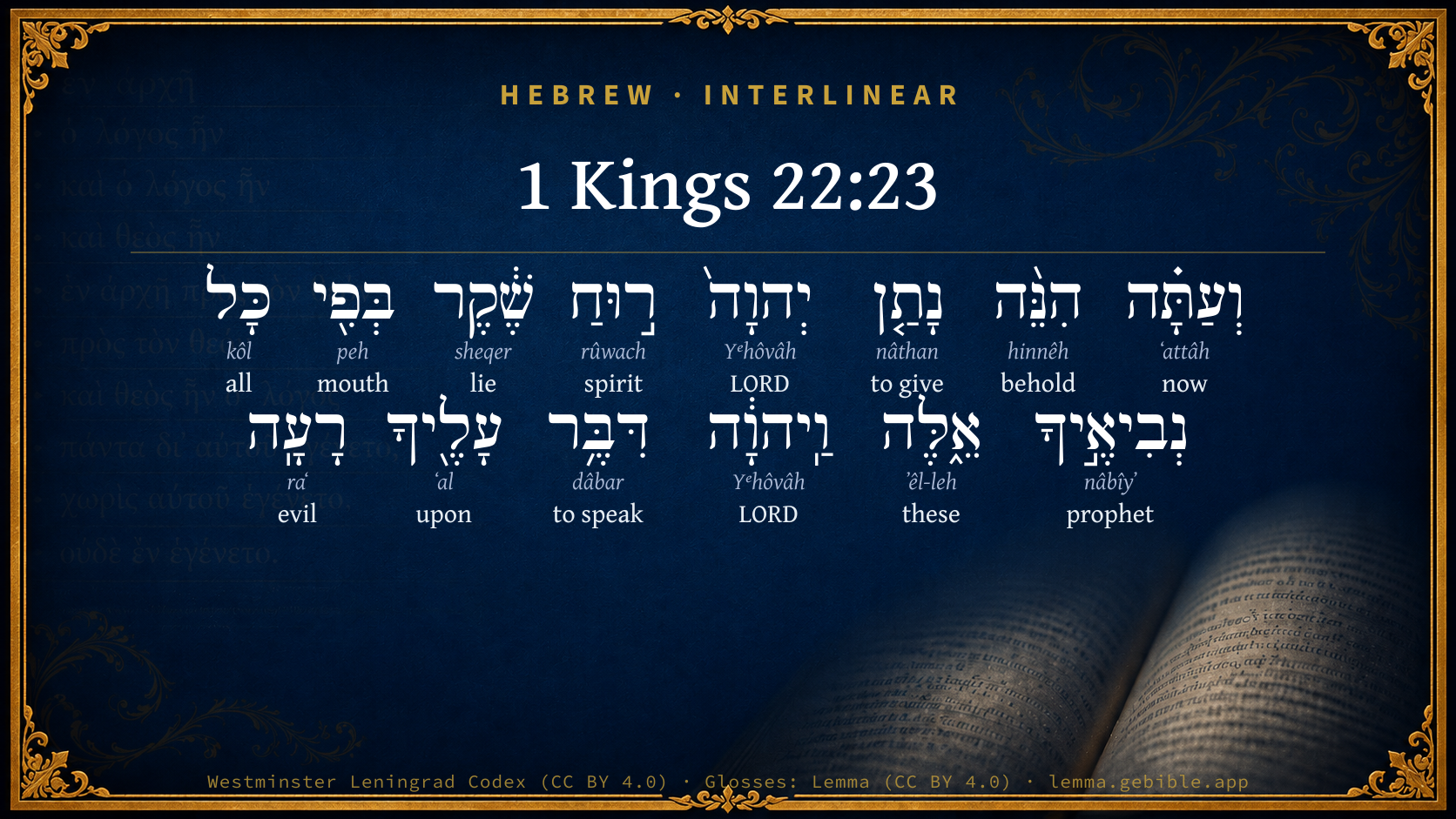
Hebrew (Westminster Leningrad Codex) 1 Kings 22:23 appears in the Hebrew Old Testament. The text above is from the Westminster Leningrad Codex. Each word links to its Strong’s number, a concise gloss, and parsing drawn from the Open Scriptures Hebrew Bible morphology. Click any word for its full Brown-Driver-Briggs (BDB) entry.
Download image
Cite this verse

1 Kings 22:23 (World English Bible). Public Domain. Lemma interlinear Bible study tool, https://lemma.gebible.app/v/1-kings/22/23.

Show BibTeX & RIS
BibTeX
RIS
English Translation
Now therefore, behold, Yahweh has put a lying spirit in the mouth of all these your prophets; and Yahweh has spoken evil concerning you.
World English Bible · Public Domain
Download a study sheet

One document with this verse’s original text, its word-by-word gloss line, the meaning frame, cross-references with their text, attributed commentary, and full source and license credits — printable, and it pastes into notes with its structure intact.

This verse Autodidact and up

Study sheet (.html) Plain text (.txt)

A passage Seminary Student

Up to 50 verses in one chapter. A passage sheet keeps up to 6 commentary sources and 12 cross-references per verse, in the order this page ranks them, and says so on the sheet whenever that leaves anything out. Ask for a single verse and you get the Autodidact verse sheet above.

Everything on this page stays free to read, with no account — the sheet is a download of what is already on screen, not access to it.

Want to remove ads? Support Godless Engineer
Compare translations 3

The same verse in 3 English versions, stacked beneath the original-language interlinear above. Click any original word for its lexicon entry.

Each is an independent rendering of the whole verse — the interlinear is not word-aligned to these translations.

Highlighted words mark where these versions differ — a whole-verse word diff, not a word-by-word alignment.

  • World English Bible Public Domain
    Now therefore, behold, Yahweh has put a lying spirit in the mouth of all these your prophets; and Yahweh has spoken evil concerning you.
  • King James Version Public Domain
    Now therefore, behold, the LORD hath put a lying spirit in the mouth of all these thy prophets, and the LORD hath spoken evil concerning thee.
  • unfoldingWord Literal Text CC BY-SA 4.0
    And now, behold, Yahweh has put a spirit of falsehood into the mouth of all of these your prophets. For Yahweh has spoken harm against you.”

unfoldingWord Literal Text — © unfoldingWord, licensed CC BY-SA 4.0. Word-aligned USFM3 via Door43 (git.door43.org/unfoldingWord/en_ult).

Versions to compare (up to 4)

3 of 4 selected

Show all 18 translations

Every available English version of this verse, each an independent rendering of the whole verse.

  • World English Bible Public Domain
    Now therefore, behold, Yahweh has put a lying spirit in the mouth of all these your prophets; and Yahweh has spoken evil concerning you.
  • Berean Standard Bible Public Domain
    So you see, the LORD has put a lying spirit in the mouths of all these prophets of yours, and the LORD has pronounced disaster against you.”
  • Majority Standard Bible Public Domain
    So you see, the LORD has put a lying spirit in the mouths of all these prophets of yours, and the LORD has pronounced disaster against you.”
  • King James Version Public Domain
    Now therefore, behold, the LORD hath put a lying spirit in the mouth of all these thy prophets, and the LORD hath spoken evil concerning thee.
  • American Standard Version (1901) Public Domain
    Now therefore, behold, Jehovah hath put a lying spirit in the mouth of all these thy prophets; and Jehovah hath spoken evil concerning thee.
  • Revised Version (1885) Public Domain
    Now therefore, behold, the LORD hath put a lying spirit in the mouth of all these thy prophets; and the LORD hath spoken evil concerning thee.
  • Geneva Bible (1599) Public Domain
    Now therefore behold, the Lord hath put a lying spirite in the mouth of all these thy prophets, and the Lord hath appoynted euill against thee.
  • Douay-Rheims (1899) Public Domain
    Now therefore behold the Lord hath given a lying spirit in the mouth of all thy prophets that are here, and the Lord hath spoken evil against thee.
  • Young's Literal Translation Public Domain
    And now, lo, Jehovah hath put a spirit of falsehood in the mouth of all these thy prophets, and Jehovah hath spoken concerning thee -- evil.'
  • Literal Standard Version CC BY-SA 4.0
    And now, behold, YHWH has put a spirit of falsehood in the mouth of all these prophets of yours, and YHWH has spoken calamity concerning you.”
  • Unlocked Literal Bible CC BY-SA 4.0
    Now see, Yahweh has put a lying spirit in the mouth of all these prophets of yours, and Yahweh has decreed disaster for you.”
  • unfoldingWord Literal Text CC BY-SA 4.0
    And now, behold, Yahweh has put a spirit of falsehood into the mouth of all of these your prophets. For Yahweh has spoken harm against you.”
  • Darby Bible Public Domain
    And now, behold, Jehovah has put a lying spirit in the mouth of all these thy prophets, and Jehovah has spoken evil concerning thee.
  • World Messianic Bible Public Domain
    Now therefore, behold, the LORD has put a lying spirit in the mouth of all these your prophets; and the LORD has spoken evil concerning you.”
  • Webster's Bible Public Domain
    Now therefore, behold, the LORD hath put a lying spirit in the mouth of all these thy prophets, and the LORD hath spoken evil concerning thee.
  • Free Bible Version CC BY-SA 4.0
    As you see, the Lord has put a lying spirit into these prophets of yours, and the Lord has pronounced your death sentence.”
  • Bible in Basic English Public Domain
    And now, see, the Lord has put a spirit of deceit in the mouth of all these your prophets; and the Lord has said evil against you.
  • JPS Tanakh (1917) Public Domain
    Now therefore, behold, the LORD hath put a lying spirit in the mouth of all these thy prophets; and the LORD hath spoken evil concerning thee.'

Literal Standard Version (2020), Covenant Press — licensed CC BY-SA 4.0. Text via the HelloAO Bible API (eBible.org). Unlocked Literal Bible (unfoldingWord) — licensed CC BY-SA 4.0. Text via the HelloAO Bible API (eBible.org). unfoldingWord Literal Text — © unfoldingWord, licensed CC BY-SA 4.0. Word-aligned USFM3 via Door43 (git.door43.org/unfoldingWord/en_ult). Free Bible Version, Dr. Jonathan Gallagher — licensed CC BY-SA 4.0. Text via the HelloAO Bible API (eBible.org).

Word by word

More ways to search: Search by grammar → Find every occurrence → Compare this word →

Practice this passage: Drill this verse → Learn its vocabulary →

שֶׁ֔קֶר
sheqer
H8267
“lie”
Noun, Common, Masculine, Singular, Absolute
Part of Speech
Noun
Type
Common
Gender
Masculine
Number
Singular
State
Absolute
Full BDB Definition

Origin: from H8266

TWOT: 2461a

lie, deception, disappointment, falsehood - deception (what deceives or disappoints or betrays one) - deceit, fraud, wrong - fraudulently, wrongfully (as adverb) - falsehood (injurious in testimony) - testify falsehood, false oath, swear falsely - falsity (of false or self-deceived prophets) - lie, falsehood (in general) - false tongue - in vain
  1. וְעַתָּ֗ה ʻattâh H6258 “and · now” Conjunction + Adverb
  2. הִנֵּ֨ה hinnêh H2009 “behold” Particle, Demonstrative
  3. נָתַ֤ן nâthan H5414 “to give” Verb, Qal, Perfect, 3rd Person, Masculine, Singular
  4. יְהוָה֙ Yᵉhôvâh H3068 “LORD” Noun, Proper
  5. ר֣וּחַ rûwach H7307 “spirit of” Noun, Common, Both, Singular, Construct
  6. בְּפִ֖י peh H6310 “in/at · mouth of” Preposition + Noun, Common, Masculine, Singular, Construct
  7. כָּל kôl H3605 “all of” Noun, Common, Masculine, Singular, Construct
  8. נְבִיאֶ֣יךָ nâbîyʼ H5030 “prophets · your” Noun, Common, Masculine, Plural, Construct + Suffix, Personal, 2nd Person, Masculine, Singular
  9. אֵ֑לֶּה ʼêl-leh H428 “these” Pronoun, Demonstrative, Common, Plural
  10. וַֽיהוָ֔ה Yᵉhôvâh H3068 “and · LORD” Conjunction + Noun, Proper
  11. דִּבֶּ֥ר dâbar H1696 “to speak” Verb, Piel, Perfect, 3rd Person, Masculine, Singular
  12. עָלֶ֖יךָ ʻal H5921 “upon · you” Preposition + Suffix, Personal, 2nd Person, Masculine, Singular
  13. רָעָֽה raʻ H7451 “evil” Noun, Common, Feminine, Singular, Absolute

About this verse

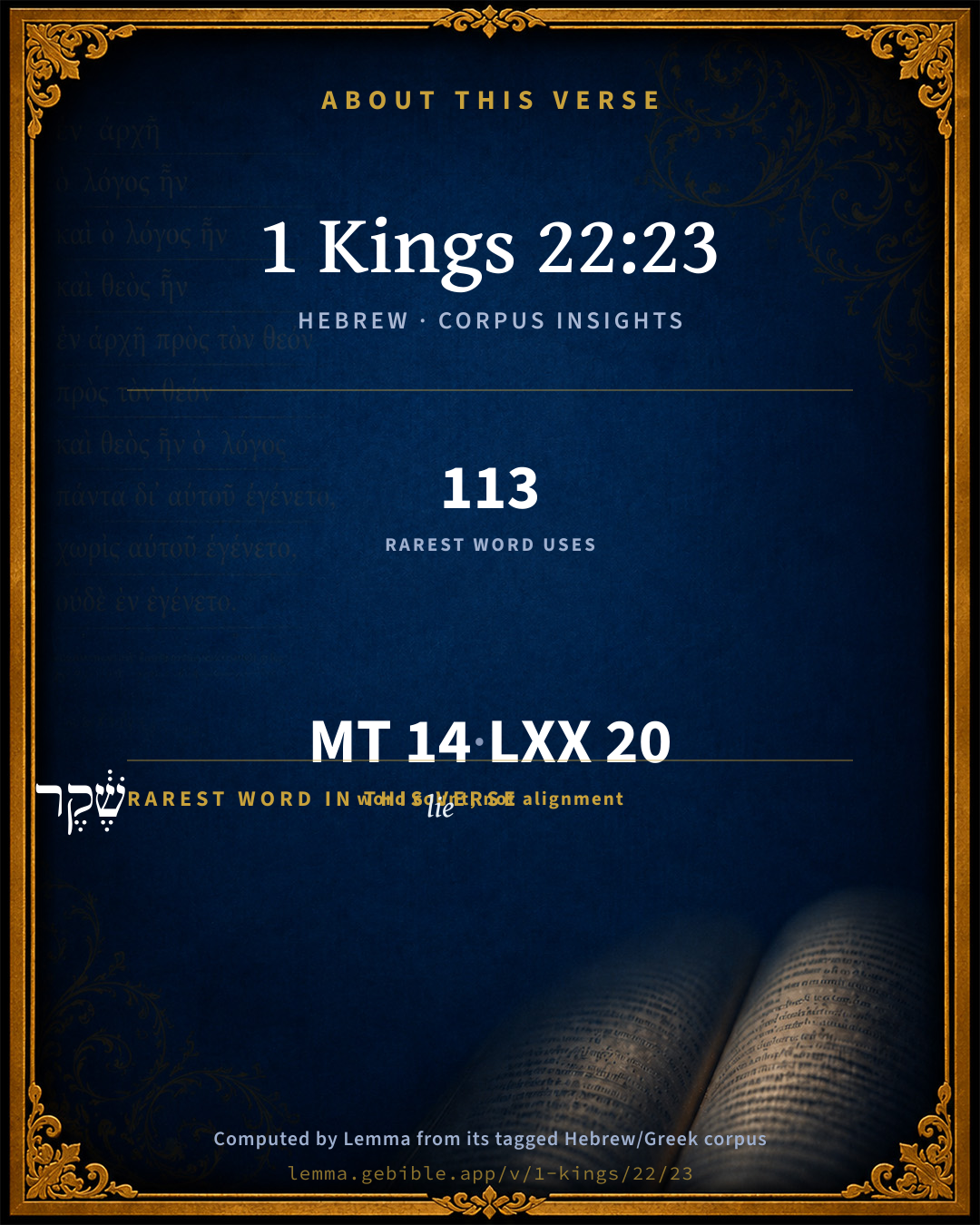
These counts appear in no published source. They are computed here, from the morphology-tagged text and Lemma’s own curated glosses. What Lemma adds →

14
words
13
distinct lemmas
Historical
section

Grammatical profile

  • 2 verbs
  • 8 nouns
  • 1 pronoun
  • 1 preposition
  • 1 adverb
  • 1 particle

Verb forms

  • נָתַ֤ן Qal · Perfect
  • דִּבֶּ֥ר Piel · Perfect

Repetition

A word recurs within this verse — often emphatic in Hebrew:

  • יְהוָה֙ LORD H3068 ×2

Hebrew & Septuagint length

In English translation the verse runs 24 words from the Hebrew and 26 from the Septuagint (LXX English) — closely comparable.

A rough comparison of the two English renderings, which tokenize alike — not a word-level alignment.

Word counts can differ between the Hebrew and the Greek without any difference in meaning — e.g. the Hebrew direct-object marker אֵת has no separate Greek word, and Greek often adds the article ὁ.

In the original languages it is 14 Hebrew tokens and 20 Greek tokens — but the two are counted differently (Hebrew bundles its prefixes and suffixes into one token; the Greek is in lemma form), so that isn’t a like-for-like length.

Cross-references

16

Topical passages linked to 1 Kings 22:23 in the Treasury of Scripture Knowledge — connected by theme and wording, ordered by reader-vote popularity; previews shown in the World English Bible.

  • Ezekiel 14:9 If the prophet be deceived and speak a word, I, Yahweh, have deceived that prophet, and I will stretch out my hand on him, and will destroy him from the midst of my people Israel.
  • Isaiah 6:9–10 He said, "Go, and tell this people, 'You hear indeed, But don't understand; And you see indeed, But don't perceive.'
  • Matthew 24:24–25 For there will arise false christs, and false prophets, and they will show great signs and wonders, so as to lead astray, if possible, even the chosen ones.
  • 2 Chronicles 25:16 It happened, as he talked with him, that [the king] said to him, Have we made you of the king's counsel? Stop! Why should you be struck down? Then the prophet stopped, and said, I know that God has determined to destroy you, because you have done this, and have not listened to my counsel.
  • Isaiah 3:11 Woe to the wicked! Disaster is upon them; For the deeds of his hands will be paid back to him.
  • Isaiah 44:20 He feeds on ashes; a deceived heart has turned him aside; and he can't deliver his soul, nor say, Is there not a lie in my right hand?
  • Deuteronomy 2:30 But Sihon king of Heshbon would not let us pass by him; for Yahweh your God hardened his spirit, and made his heart obstinate, that he might deliver him into your hand, as at this day.
  • 1 Kings 20:42 He said to him, Thus says Yahweh, Because you have let go out of your hand the man whom I had devoted to destruction, therefore your life shall go for his life, and your people for his people.
  • Numbers 23:19–20 God is not a man, that he should lie, Neither the son of man, that he should repent: Has he said, and will he not do it? Or has he spoken, and will he not make it good?
  • Numbers 24:13 If Balak would give me his house full of silver and gold, I can't go beyond the word of Yahweh, to do either good or bad of my own mind; what Yahweh speaks, that will I speak?
  • 1 Kings 22:8–11 The king of Israel said to Jehoshaphat, there is yet one man by whom we may inquire of Yahweh, Micaiah the son of Imlah: but I hate him; for he does not prophesy good concerning me, but evil. Jehoshaphat said, "Don't let the king say so."
  • Exodus 4:21 Yahweh said to Moses, "When you go back into Egypt, see that you do before Pharaoh all the wonders which I have put in your hand, but I will harden his heart and he will not let the people go.
  • Exodus 10:20 But Yahweh hardened Pharaoh's heart, and he didn't let the children of Israel go.
  • 1 Kings 21:19 You shall speak to him, saying, Thus says Yahweh, Have you killed and also taken possession? You shall speak to him, saying, Thus says Yahweh, In the place where dogs licked the blood of Naboth shall dogs lick your blood, even yours.
  • Ezekiel 14:3–5 Son of man, these men have taken their idols into their heart, and put the stumbling block of their iniquity before their face: should I be inquired of at all by them?
  • Matthew 13:13–15 Therefore I speak to them in parables, because seeing they don't see, and hearing, they don't hear, neither do they understand.

Cross-references courtesy of OpenBible.info (CC BY 4.0).

Hebrew and Greek witnesses Masoretic Hebrew ↔ Greek Septuagint

The same verse in the two great witnesses to the Old Testament, shown verse-for-verse.

These are two independent witnesses, not word-aligned to each other, and the Septuagint is shown in lemma (dictionary) form.

Hebrew 1 Kings 22:23 Masoretic · Westminster Leningrad Codex

וְעַתָּ֗ה הִנֵּ֨ה נָתַ֤ן יְהוָה֙ ר֣וּחַ שֶׁ֔קֶר בְּפִ֖י כָּל נְבִיאֶ֣יךָ אֵ֑לֶּה וַֽיהוָ֔ה דִּבֶּ֥ר עָלֶ֖יךָ רָעָֽה

Now therefore, behold, Yahweh has put a lying spirit in the mouth of all these your prophets; and Yahweh has spoken evil concerning you.

World English Bible · Public Domain

Greek LXX 1 Kings 22:23 Septuagint · lemma form

καί νῦν ἰδού δίδωμι κύριος πνεῦμα ψευδής ἐν στόμα πᾶς ὁ προφήτης σύ οὗτος καί κύριος λαλέω ἐπί σύ κακός

And now, behold, the Lord has put a false spirit in the mouth of all these your prophets, and the Lord has spoken evil against you.

LXX2012 (modern English Septuagint) · Public Domain

Hebrew: Westminster Leningrad Codex (CC BY 4.0). Greek: Septuagint (public domain); English from LXX2012 (modern English Septuagint) (Public Domain). How the Septuagint differs from the Hebrew →

Targum (Aramaic paraphrase)

1

The Targum is the ancient Jewish Aramaic paraphrase of the Hebrew Scriptures — an interpretive translation, not the Hebrew text itself. Onkelos (literal) and Pseudo-Jonathan (expansive) render the Torah, and Jonathan the Prophets. Coverage is partial: where no permissively-licensed English translation exists for a verse, only the Aramaic is shown. This is verse-level text, not a word-by-word alignment to the Hebrew.

  1. Targum Jonathan Prophets (Joshua–Malachi)
    וּכְעַן הָא יְהַב יְיָ רוּחַ שְׁקַר בְּפוּם כָּל נְבִיָךְ אִלֵין וַיָי גְזַר לְאַיְתָאָה עֲלָךְ בִּישָׁא:

    (no public-domain English translation for this verse)

    Targum Jonathan — Aramaic: “Mikraot Gedolot” (public domain). English: “Sefaria Community Translation” (CC0 1.0 (public-domain dedication)); “London "Chaldee Paraphrase," 1871” (public domain). Text via Sefaria.

Commentary

Notes on 1 Kings 22:23 from classic Christian and Jewish commentators (each source and its license shown beneath its notes). The classic Christian expositions comment on the surrounding passage and are grouped to its opening verse, so a note may address several verses; the Jewish commentaries on the Tanakh (Rashi and others) are per-verse, so they appear only where the commentator wrote on this verse.

Lemma curates 59 commentaries, every one of them public domain or Creative Commons licensed, each selected and text-cleaned for this edition rather than reprinted as found. About our sources →

Trapp's Complete Commentary

John Trapp

1Ki 22:23 Now therefore, behold, the LORD hath put a lying spirit in the mouth of all these thy prophets, and the LORD hath spoken evil concerning thee.

Ver. 23. Now, therefore, behold the Lord.] He hath not only a permissive but an active providence in the just punishment of wicked persons; turning the devil loose upon them, and leaving them to their own hearts’ lusts.

John Trapp, A Commentary or Exposition upon All the Books of the Old and New Testament (1647–1656) — public domain. Text from a community e-Sword module.

Joseph Benson's Commentary

1Ki 22:23. Now therefore, behold, the Lord hath put, &c. — It is frequent in the Holy Scriptures to call that the Lord’s doing which he only permits to be done; because he has the supreme direction of all things, and governs the event. Wicked devices proceed from wicked men and wicked spirits: but, that they prevail and take effect, is owing to the hand of God directing and ordering when and where they shall light, and what shall be the issue of them. Hath put a lying spirit into the mouth, &c. — Hath permitted a lying spirit to influence these men. Hath spoken evil concerning thee — Hath decreed that thou shalt perish in this war. It may not be amiss to observe here, that “the evil being, named Satan, was little known to the Jewish people till their captivity; and then this history was taught openly as a security against the doctrine of the two principles. The Jewish lawgiver, where he so frequently enumerates and warns the Israelites of the snares and temptations which would draw them to transgress the law of God, never mentions this capital enemy of heaven. Nay, when the form of that sacred history which Moses composed obliged him to treat of Satan’s first grand machination against mankind, he entirely hides this wicked spirit under the animal which he made his instrument; but, as the fulness of time drew near, they were made more and more acquainted with this their capital enemy. When Ahab, for the crimes and follies of the people, was suffered to be infatuated, we have the account in the words of Micaiah above. Satan is not here recorded by name; and so we must conclude the people were yet to know little of his history: however, this undertaking sufficiently declared his nature.” Div. Leg., vol. 4. p. 279.

Joseph Benson's Commentary on the Old and New Testaments (1811–1818) — public domain. Text from a community e-Sword module.

Adam Clarke's Commentary

Verse 23. The Lord hath put a lying spirit] He hath permitted or suffered a lying spirit to influence thy prophets. Is it requisite again to remind the reader that the Scriptures repeatedly represent God as doing what, in the course of his providence, he only permits or suffers to be done? Nothing can be done in heaven, in earth, or hell, but either by his immediate energy or permission. This is the reason why the Scripture speaks as above.

Adam Clarke's Commentary on the Bible (1810–1826) — public domain. Text from a community e-Sword/MySword module.

Ellicott's Commentary for English Readers

(23) The Lord . . . the Lord.—The emphatic repetition of the Name Jehovah hero is an implied answer to the insinuation of mere malice in 1Ki_22:8; 1Ki_22:18.

A Bible Commentary for English Readers, edited by Charles John Ellicott (1878–1897) — public domain. Text from a community e-Sword module.

The Cambridge Bible for Schools and Colleges

gen. ed. J. J. S. Perowne

23. The Lord hath put a lying spirit] These words bear out what has been said on 1Ki_22:21. It was a messenger from Jehovah which led these prophets astray. We are not to conclude from this that it was an evil spirit, or Satan, as some have suggested. Such spirits are not God’s agents. The spirit which here wrought the evil did but foster the false notions which a long course of previous warnings had had no effect in driving away. Now therefore Ahab is given up to them. God sends him ‘a strong delusion, that he should believe a lie’ (2Th_2:11). Cf. Psa_78:49. ‘He sent messengers of evil (not, evil angels) among them’.

The Cambridge Bible for Schools and Colleges (gen. ed. J. J. S. Perowne; Cambridge University Press, 1878–1918) — public domain. Text from a community e-Sword module.

John Gill's Exposition

And say, thus saith the king, put this fellow in prison,.... In the common prison of the city, where he had been before, as it seems; and might be now ordered into a more confined place in it, and what might be called "little ease":

and feed him with bread of affliction, and with water of affliction; with bad bread and foul water, and but little of either; just enough to keep alive, and to continue starving:

until I come in peace; which he seemed confident of, and intimates that then he would punish him more severely, even with death, as a false prophet.

John Gill's Exposition of the Whole Bible (1746–1763) — public domain (CC PDM 1.0). Text via the HelloAO Bible API.

The Pulpit Commentary

Now therefore, behold, the Lord hath put a lying spirit in the mouth Of all these thy Cf. oJ? oi=kov uJmwn, (Mat_23:38) prophets This statement, especially to those who have taken the narrative literally, and who have seen in "the spirit" either one of the angels of God, or Satan himself, has presented almost insuperable difficulties. The main difficulty lies in the fact that the Almighty and All Holy is here made to give His sanction to deceit and lying, for the purpose of tempting Ahab to his death. We have precisely the same difficulty, though, if possible, more directly expressed in Eze_14:9: "If the prophet be deceived I the Lord have deceived that prophet." Cf. Jer_20:7; 1Sa_16:15. But this difficulty vanishes if we remember that this iseuthropopathic language, and is merely meant to convey that God had "taken the house of Israel in their own heart," because they were "estranged from Him through their idols". (Eze_14:5) Ahab wished to be guided by false prophets, and the justice of God decreed that he should be guided by them to his ruin. Sin is punished by sin. "God proves His holiness most of all by this, that He punishes evil by evil, and destroys it by itself" (Bahr). Ahab had chosen lying instead of truth: by lying according to the lex talionis he should be destroyed. The difficulty, in fact, is that of the permission of evil in the world; of the use of existent evil by God to accomplish His purposes of good, and the Lord not I alone, ver. 18 hath spoken i.e., decreed evil concerning thee.

The Pulpit Commentary (1880–1919), ed. H.D.M. Spence-Jones & Joseph S. Exell — public domain. Text from a community e-Sword module.

Lesson kit

Teaching starters — assembled from the data on this page, not authored interpretation. Every prompt links to the verse data it draws on. Edit before teaching.

1 Kings, in the Historical, opens this verse with 14 words (13 distinct Hebrew lemmas). Its most distinctive word is sheqer (“lie”). A historical commentator’s framing appears above. Read the whole chapter for the surrounding context.

Discussion questions

  1. What does “lie” (sheqer) contribute to the verse as a whole?
  2. Ezekiel 14:9 shares this passage’s theme. How do the two illuminate each other?
  3. “LORD” occurs 2× in this one verse. What is the effect of the repetition?
  4. These translations render this verse differently. What is at stake in choosing one wording over another?
  5. The verb «נָתַ֤ן» is Qal Perfect. How does its form color the action?
  6. Reading how Trapp's Complete Commentary and Joseph Benson's Commentary read this verse, where do the two commentators agree and where do they part?

Things to notice

Reading settings

Reading text

Shown beneath each verse's original-language words.

Old Testament
Old Testament edition

Read the OT as the Masoretic Hebrew (MT) or the Greek Septuagint (LXX).

English shown for the Greek Septuagint (in the Hebrew ↔ Greek comparison).

Comparing translations? Open the Compare panel on any verse page to stack up to four side by side.