
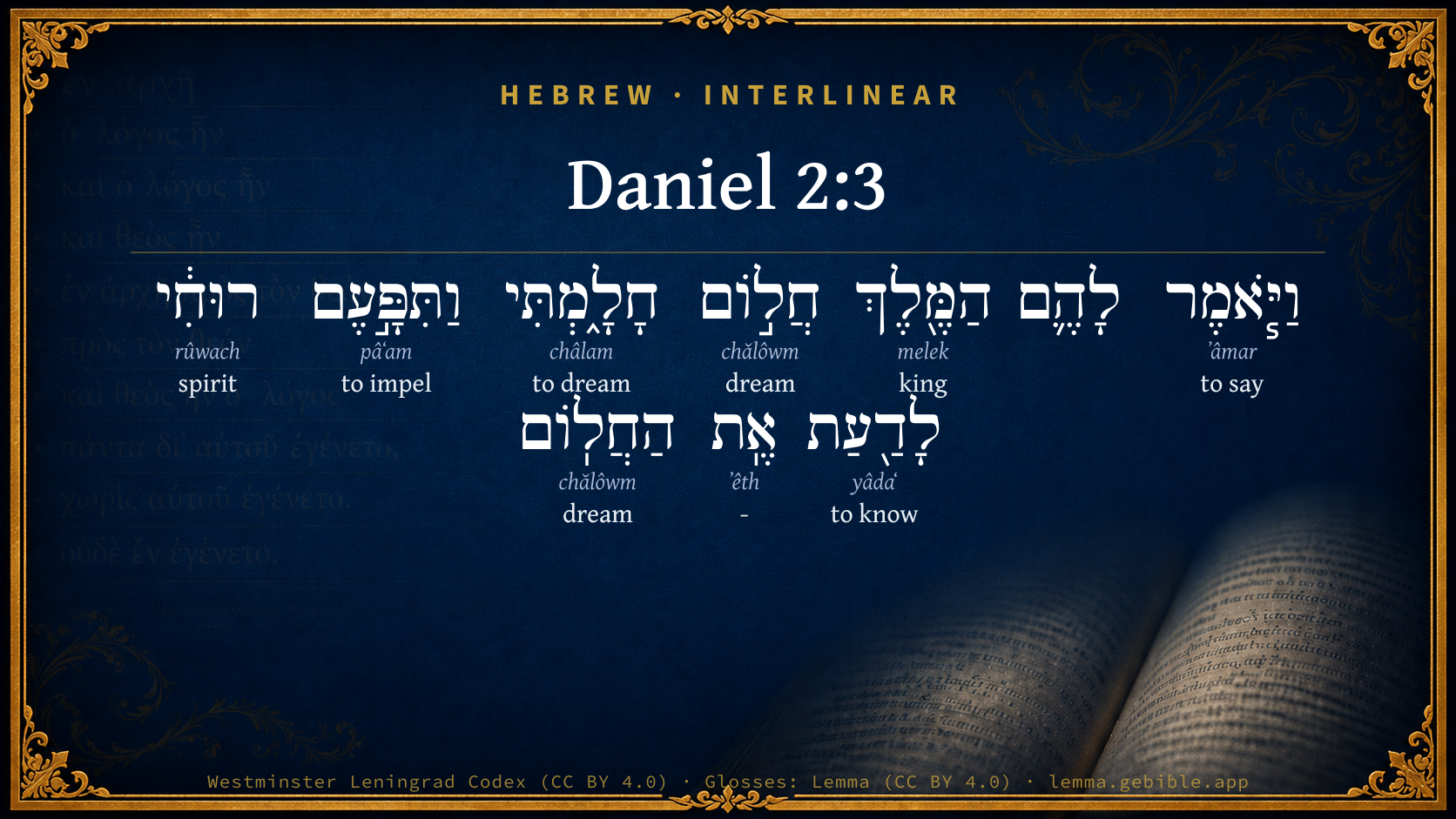
Daniel 2:3

Hebrew (Westminster Leningrad Codex) Daniel 2:3 appears in the Hebrew Old Testament. The text above is from the Westminster Leningrad Codex. Each word links to its Strong’s number, a concise gloss, and parsing drawn from the Open Scriptures Hebrew Bible morphology. Click any word for its full Brown-Driver-Briggs (BDB) entry.
Download image
Cite this verse

Daniel 2:3 (World English Bible). Public Domain. Lemma interlinear Bible study tool, https://lemma.gebible.app/v/daniel/2/3.

Show BibTeX & RIS
BibTeX
RIS
English Translation
The king said to them, I have dreamed a dream, and my spirit is troubled to know the dream.
World English Bible · Public Domain
Download a study sheet

One document with this verse’s original text, its word-by-word gloss line, the meaning frame, cross-references with their text, attributed commentary, and full source and license credits — printable, and it pastes into notes with its structure intact.

This verse Autodidact and up

Study sheet (.html) Plain text (.txt)

A passage Seminary Student

Up to 50 verses in one chapter. A passage sheet keeps up to 6 commentary sources and 12 cross-references per verse, in the order this page ranks them, and says so on the sheet whenever that leaves anything out. Ask for a single verse and you get the Autodidact verse sheet above.

Everything on this page stays free to read, with no account — the sheet is a download of what is already on screen, not access to it.

Want to remove ads? Support Godless Engineer
Compare translations 3

The same verse in 3 English versions, stacked beneath the original-language interlinear above. Click any original word for its lexicon entry.

Each is an independent rendering of the whole verse — the interlinear is not word-aligned to these translations.

Highlighted words mark where these versions differ — a whole-verse word diff, not a word-by-word alignment.

  • World English Bible Public Domain
    The king said to them, I have dreamed a dream, and my spirit is troubled to know the dream.
  • King James Version Public Domain
    And the king said unto them, I have dreamed a dream, and my spirit was troubled to know the dream.
  • unfoldingWord Literal Text CC BY-SA 4.0
    The king said to them, “I have had a dream, and my spirit is troubled to know the dream.”

unfoldingWord Literal Text — © unfoldingWord, licensed CC BY-SA 4.0. Word-aligned USFM3 via Door43 (git.door43.org/unfoldingWord/en_ult).

Versions to compare (up to 4)

3 of 4 selected

Show all 18 translations

Every available English version of this verse, each an independent rendering of the whole verse.

  • World English Bible Public Domain
    The king said to them, I have dreamed a dream, and my spirit is troubled to know the dream.
  • Berean Standard Bible Public Domain
    he said to them, “I have had a dream, and my spirit is anxious to understand it.”
  • Majority Standard Bible Public Domain
    he said to them, “I have had a dream, and my spirit is anxious to understand it.”
  • King James Version Public Domain
    And the king said unto them, I have dreamed a dream, and my spirit was troubled to know the dream.
  • American Standard Version (1901) Public Domain
    And the king said unto them, I have dreamed a dream, and my spirit is troubled to know the dream.
  • Revised Version (1885) Public Domain
    And the king said unto them, I have dreamed a dream, and my spirit is troubled to know the dream.
  • Geneva Bible (1599) Public Domain
    And the King sayde vnto them, I haue dreamed a dreame, and my spirite was troubled to knowe the dreame.
  • Douay-Rheims (1899) Public Domain
    And the king said to them: I saw a dream: and being troubled in mind I know not what I saw.
  • Young's Literal Translation Public Domain
    and the king saith to them, `A dream I have dreamed, and moved is my spirit to know the dream.'
  • Literal Standard Version CC BY-SA 4.0
    and the king says to them, “I have dreamed a dream, and my spirit is moved to know the dream.”
  • Unlocked Literal Bible CC BY-SA 4.0
    The king said to them, “I have had a dream, and my mind is anxious to know what the dream means.”
  • unfoldingWord Literal Text CC BY-SA 4.0
    The king said to them, “I have had a dream, and my spirit is troubled to know the dream.”
  • Darby Bible Public Domain
    And the king said unto them, I have dreamed a dream, and my spirit is troubled to know the dream.
  • World Messianic Bible Public Domain
    The king said to them, “I have dreamed a dream, and my spirit is troubled to know the dream.”
  • Webster's Bible Public Domain
    And the king said to them, I have dreamed a dream, and my spirit was troubled to know the dream.
  • Free Bible Version CC BY-SA 4.0
    “I've had a dream that has really upset me,” he told them. “I need to know what it means.”
  • Bible in Basic English Public Domain
    And the king said to them, I have had a dream, and my spirit is troubled by the desire to have the dream made clear to me.
  • JPS Tanakh (1917) Public Domain
    And the king said unto them: 'I have dreamed a dream, and my spirit is troubled to know the dream.'

Literal Standard Version (2020), Covenant Press — licensed CC BY-SA 4.0. Text via the HelloAO Bible API (eBible.org). Unlocked Literal Bible (unfoldingWord) — licensed CC BY-SA 4.0. Text via the HelloAO Bible API (eBible.org). unfoldingWord Literal Text — © unfoldingWord, licensed CC BY-SA 4.0. Word-aligned USFM3 via Door43 (git.door43.org/unfoldingWord/en_ult). Free Bible Version, Dr. Jonathan Gallagher — licensed CC BY-SA 4.0. Text via the HelloAO Bible API (eBible.org).

Word by word

More ways to search: Search by grammar → Find every occurrence → Compare this word →

Practice this passage: Drill this verse → Learn its vocabulary →

וַתִּפָּ֣עֶם
pâʻam
H6470
“and · to impel”
Conjunction + Verb, Niphal, Sequential Imperfect, 3rd Person, Feminine, Singular
Part of Speech
Conjunction + Verb
Stem
Niphal
Form
Sequential Imperfect
Person
3rd Person
Gender
Feminine
Number
Singular
Full BDB Definition

Origin: a primitive root

TWOT: 1793

to thrust, impel, push, beat persistently - (Qal) to impel - (Niphal) to be beaten, be disturbed - (Hithpael) to be disturbed
  1. וַיֹּ֧אמֶר ʼâmar H559 “and · to say” Conjunction + Verb, Qal, Sequential Imperfect, 3rd Person, Masculine, Singular
  2. הַמֶּ֖לֶךְ melek H4428 “the · king” Particle, Definite Article + Noun, Common, Masculine, Singular, Absolute
  3. חֲל֣וֹם chălôwm H2472 “dream” Noun, Common, Masculine, Singular, Absolute
  4. חָלָ֑מְתִּי châlam H2492 “to dream” Verb, Qal, Perfect, 1st Person, Common, Singular
  5. רוּחִ֔י rûwach H7307 “spirit · my” Noun, Common, Both, Singular, Construct + Suffix, Personal, 1st Person, Common, Singular
  6. לָדַ֖עַת yâdaʻ H3045 “to know” Preposition + Verb, Qal, Infinitive Construct
  7. אֶֽת ʼêth H853 “-” Particle, Direct Object
  8. הַחֲלֽוֹם chălôwm H2472 “the · dream” Particle, Definite Article + Noun, Common, Masculine, Singular, Absolute

About this verse

These counts appear in no published source. They are computed here, from the morphology-tagged text and Lemma’s own curated glosses. What Lemma adds →

10
words
8
distinct lemmas
Prophets
section

Notable vocabulary

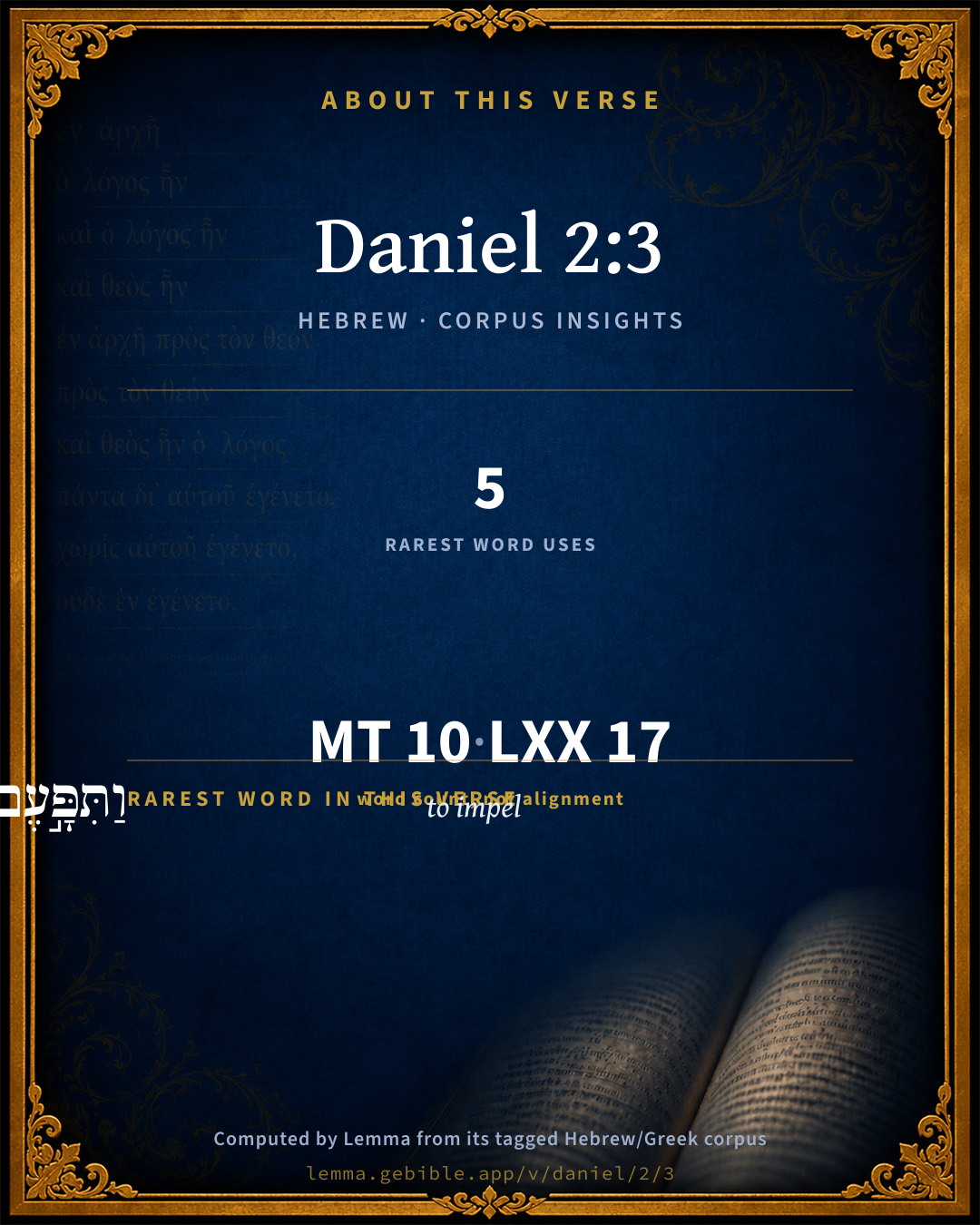
The rarest word here is וַתִּפָּ֣עֶם to impel H6470 — appearing just 5 times in the whole Hebrew Bible.

Shared distinctive vocabulary

וַתִּפָּ֣עֶם to impel H6470 occurs in 5 verses of the Hebrew Bible. Also found in:

Grammatical profile

  • 4 verbs
  • 4 nouns
  • 1 preposition
  • 1 particle

Verb forms

  • וַיֹּ֧אמֶר Qal · Sequential Imperfect
  • חָלָ֑מְתִּי Qal · Perfect
  • וַתִּפָּ֣עֶם Niphal · Sequential Imperfect
  • לָדַ֖עַת Qal · Infinitive Construct

Repetition

A word recurs within this verse — often emphatic in Hebrew:

  • חֲל֣וֹם dream H2472 ×2

Hebrew & Septuagint length

In English translation the verse runs 19 words from the Hebrew and 18 from the Septuagint (LXX English) — closely comparable.

A rough comparison of the two English renderings, which tokenize alike — not a word-level alignment.

Word counts can differ between the Hebrew and the Greek without any difference in meaning — e.g. the Hebrew direct-object marker אֵת has no separate Greek word, and Greek often adds the article ὁ.

In the original languages it is 10 Hebrew tokens and 17 Greek tokens — but the two are counted differently (Hebrew bundles its prefixes and suffixes into one token; the Greek is in lemma form), so that isn’t a like-for-like length.

Cross-references

4

Topical passages linked to Daniel 2:3 in the Treasury of Scripture Knowledge — connected by theme and wording, ordered by reader-vote popularity; previews shown in the World English Bible.

  • Genesis 40:8 They said to him, "We have dreamed a dream, and there is no one who can interpret it." Joseph said to them, "Don't interpretations belong to God? Please tell it to me."
  • Genesis 41:15 Pharaoh said to Joseph, "I have dreamed a dream, and there is no one who can interpret it. I have heard it said of you, that when you hear a dream you can interpret it."
  • Daniel 2:1 In the second year of the reign of Nebuchadnezzar, Nebuchadnezzar dreamed dreams; and his spirit was troubled, and his sleep went from him.
  • Daniel 4:5 I saw a dream which made me afraid; and the thoughts on my bed and the visions of my head troubled me.

Cross-references courtesy of OpenBible.info (CC BY 4.0).

Hebrew and Greek witnesses Masoretic Hebrew ↔ Greek Septuagint

The same verse in the two great witnesses to the Old Testament, shown verse-for-verse.

These are two independent witnesses, not word-aligned to each other, and the Septuagint is shown in lemma (dictionary) form.

Hebrew Daniel 2:3 Masoretic · Westminster Leningrad Codex

וַיֹּ֧אמֶר לָהֶ֛ם הַמֶּ֖לֶךְ חֲל֣וֹם חָלָ֑מְתִּי וַתִּפָּ֣עֶם רוּחִ֔י לָדַ֖עַת אֶֽת הַחֲלֽוֹם

The king said to them, I have dreamed a dream, and my spirit is troubled to know the dream.

World English Bible · Public Domain

Greek LXX Daniel 2:3 Septuagint · lemma form

καί εἶπον αὐτός ὁ βασιλεύς ἐνύπνιον ὁράω καί κινέω ἐγώ ὁ πνεῦμα ἐπιγιγνώσκω οὖν θέλω ὁ ἐνύπνιον

And the king said to them, I have dreamed, and my spirit was troubled to know the dream.

LXX2012 (modern English Septuagint) · Public Domain

On this verse, The Pulpit Commentary discusses the Septuagint’s reading. Read the note in Commentary ↓

Hebrew: Westminster Leningrad Codex (CC BY 4.0). Greek: Septuagint (public domain); English from LXX2012 (modern English Septuagint) (Public Domain). How the Septuagint differs from the Hebrew →

Commentary

Notes on Daniel 2:3 from classic Christian and Jewish commentators (each source and its license shown beneath its notes). The classic Christian expositions comment on the surrounding passage and are grouped to its opening verse, so a note may address several verses; the Jewish commentaries on the Tanakh (Rashi and others) are per-verse, so they appear only where the commentator wrote on this verse.

Lemma curates 59 commentaries, every one of them public domain or Creative Commons licensed, each selected and text-cleaned for this edition rather than reprinted as found. About our sources →

Trapp's Complete Commentary

John Trapp

Dan 2:3 And the king said unto them, I have dreamed a dream, and my spirit was troubled to know the dream.

Ver. 3. I have dreamed a dream.] His thoughts had been occupied belike about the issue of his kingdoms, and thereupon he had a divine vision. He that is moderately careful about the affairs of his lawful calling shall not be destitute of divine direction.

And my spirit was troubled.] Heb., Troubled itself. Jesus also troubled himself, but without sin. {Joh 11:33} {See Trapp on "Joh 11:33"}

John Trapp, A Commentary or Exposition upon All the Books of the Old and New Testament (1647–1656) — public domain. Text from a community e-Sword module.

Tyndale Open Study Notes

Tyndale Open Resources

2:3 a dream that deeply troubles me: The king had reason to fear that his throne might be in danger from other groups.

Tyndale Open Study Notes — © Tyndale Open Resources, licensed CC BY-SA 4.0. Text via the HelloAO Bible API.

Ibn Ezra

Rabbi Abraham ibn Ezra

[Daniel 2:3] Vayomer (וַיֹּאמֶר - And the king said): One of the Geonim said: that Nebuchadnezzar did know the dream and came [with this demand] to test his wise men. [The Gaon argued that] if this were not so, he would not have believed Daniel's words [later]. But behold, Scripture [the verse itself] attests: “my spirit was agitated (vatipaʿem ruchi - וַתִּפָּעֶם רוּחִי) to know the dream.” And when he [Daniel later] said to him [the king] “your thoughts came [to your mind] upon your bed” [Daniel 2:29], he [the king] immediately remembered that it was so. And when he [Daniel] mentioned the statue, then he [the king] likewise remembered it.

Ibn Ezra on the Tanakh — English translations: “Sefaria Community Translation” (CC0 1.0 (public-domain dedication)); “Yalkut, Sifsei Chachomim Chumash, Metsudah Publications, 2009” (CC BY 4.0); and “Commentary of Ibn Ezra on Isaiah - trans. by M. Friedlander, 1873” (public domain). Text via Sefaria.

Jamieson, Fausset & Brown

Robert Jamieson, A. R. Fausset & David Brown

troubled to know the dream--He awoke in alarm, remembering that something solemn had been presented to him in a dream, without being able to recall the form in which it had clothed itself. His thoughts on the unprecedented greatness to which his power had attained (Dan 2:29) made him anxious to know what the issue of all this should be. God meets this wish in the way most calculated to impress him.

Jamieson, Fausset & Brown — Commentary Critical and Explanatory on the Whole Bible (1871) — public domain (CC PDM 1.0). Text via the HelloAO Bible API.

John Calvin's Commentaries

Daniel relates first the great confidence of the Chaldeans, since they dared to promise the interpretation of a dream as yet unknown to them. The king says he was troubled through desire to understand the dream; by which he signifies that a kind of riddle was divinely set, before him. He confesses his ignorance, while the importance of the object may be gathered from his words. Since, then, the king testifies his desire to inquire concerning a matter obscure and profound, and exceeding his comprehension, and since he clearly expresses himself to be contrite in spirit, some kind of fear and anxiety ought to have touched these Chaldeans; yet they securely promise to offer the very best interpretation of the dream as soon as they understood it. When they say, O king live for ever, it is not a simple and unmeaning prayer, but they rather order the king to be cheerful and in good spirits, as they are able to remove all care and anxiety from his mind, because the explanation of the dream was at hand. We know how liberal in words those impostors always were; according to the language of an ancient poet, they enriched the ears and emptied the purses of others. And truly those who curiously court the breeze with their ears deserve to feed upon it, and to be taken in by such deceits. And all ages have proved that nothing exceeds the confidence of astrologers, who are not content with true science, but divine every one’s life and death, and conjecture all events, and profess to know everything.

We must hold generally that the art of conjecturing from dreams is rash and foolish; there is, indeed, a certain fixed interpretation of dreams, as we said yesterday, yet as we shall afterwards see, this ought not to be ascribed to a sure science, but to God’s singular gift. As, therefore, a prophet will not gather what he has to say from fixed reasonings, but will explain God’s oracles, so also he who will interpret dreams correctly, will not follow certain disthief rules; but if God has explained the meaning of the dream, he will then undertake the office of interpreting it according to his endowment with this gift. Properly speaking, these two flyings are opposite to each other and do not mutually agree, general and perpetual science, and special revelation. Since God claims this power of opening by means of a dream, what he has engraven on the minds of men, hence art and science cannot obtain it, but a revelation from the spirit must be waited for. When the Chaldeans thus boldly promise to become good interpreters of the dream, they not only betray their rashness, but become mere impostors, who pretend to be proficients in a science of which they know nothing, as if they could predict by their conjectures the meaning of the king’s dream. It now follows —

John Calvin's Commentaries (1540-1563) — public domain. Text from the Calvin Translation Society English edition (1840s-50s) via the Christian Classics Ethereal Library (ccel.org). Calvin's coverage is partial (roughly two-thirds of the Bible); uncommented books and verses are honest gaps, never fabricated. The 19th-century editor's footnotes and remarks are omitted so the notes are faithfully Calvin's own voice.

Ellicott's Commentary for English Readers

(3) I have dreamed.—It has been questioned whether the king had really forgotten his dream, or whether he only pretended to have done so in order that he might prove the skill of his wise men. The conduct of the Chaldæans (Dan_2:10) makes the latter hypothesis possible. However, it is more in accordance with what is stated about the anxious condition of the king’s mind to assume that he remembered a portion of the dream, but that he had lost the general outline of it.

A Bible Commentary for English Readers, edited by Charles John Ellicott (1878–1897) — public domain. Text from a community e-Sword module.

John Gill's Exposition

And the king said unto them, I have dreamed a dream,.... What before is called dreams is here expressed in the singular, a dream; for it was but one dream, though it contained in it various things; this the king could remember, that he had a dream; for it had left some impression on his mind, though he could not call to mind what it was about. Aben Ezra makes mention of one of their Gaons or Rabbins, that affirmed that Nebuchadnezzar knew his dream, but was willing to try the wise men; but, as he observes, he could not surely believe the words of Daniel:

and my spirit was troubled to know the dream; both that, and the meaning of it; he says nothing as yet about the interpretation of it; concluding that, if they could tell him the dream, they could explain it to him; or then it would be time enough to inquire after that.

John Gill's Exposition of the Whole Bible (1746–1763) — public domain (CC PDM 1.0). Text via the HelloAO Bible API.

Albert Barnes' Notes on the Bible

And the king said unto them, I have dreamed a dream, and my spirit was troubled to know the dream - That is, clearly, to know all about it; to recollect distinctly what it was, and to understand what it meant. He was agitated by so remarkable a dream; he probably had, as Jerome remarks, a shadowy and floating impression of what the dream was - such as we often have of a dream that has agitated out minds, but of which we cannot recal the distinct and full image; and he desired to recal that distinctly, and to know exactly what it meant. See Dan 2:1.

Albert Barnes' Notes on the Bible (1834–1885) — public domain. Text from a community e-Sword/MySword module.

Haydock's Catholic Bible Commentary

I know. Hebrew also, "to know or understand what," &c.

George Leo Haydock (1774–1849), Haydock's Catholic Family Bible and Commentary, 1859 edition — public domain. Excludes Psalms (Douay-Rheims chapter numbering differs from Protestant) and Deuterocanonical books (Catholic canon only).

Matthew Poole's English Annotations

He remembered the fact in general, but could not repeat it perfectly, much less know the meaning of it; yet it had left such an impression on him, as put him into great perplexity. The Lord hath ways to affright the greatest men in the world, in the midst of their security and jollity.

Matthew Poole's English Annotations on the Holy Bible (1683–1685) — public domain. Text from a community e-Sword/MySword module.

The Pulpit Commentary

And the king said unto them, I have dreamed a dream, and my spirit was troubled to know the dream. The Revised Version improves the English of the verse by putting the verb in the present, "My Spirit is troubled to know the dream." The Septuagint Version has the appearance of a paraphrase, "And the king said to them, I have seen a dream, and my spirit is troubled, and I desire to understand the dream." It is an unusual combination "to see a dream;" from its unusualness the reading of the Septuagint is to be preferred. In old Hebrew l (l) and z (z) are not unlike each other, nor are m (m) and y (y). Yet these two, letters are the only differences between halamti, "I have dreamed." and hazithi. "I have seen." The Peshitta has haloma hazith, which gives the same combination, and would indicate that here too the Aramaic original is shining through It is however, difficult to see how such a word as ahpatz.

wish," could drop out of the Massoretic. The must natural solution is that the translator added qelw to complete the sense. Certainly a link is awanting as it stands in the ordinary interpretation of this verse.

Theodotion agrees with the Massoretic, while the Vulgate paraphrases the last clause, "And the king said to them. I have seen a dream, and confused in mind I have forgot what I saw." The king has been perturbed by the dream, and his perturbation leads him to wish to knew the dream not necessarily what the dream actually had been, but what it meant. Thus in Dan_1:17 Daniel had understanding "in all visions and dreams;" this meant that he knew the meaning of dreams and visit us. The other versions give us no assistance to explain this. Archdeacon Rose says, "The king here plainly intimates that, though the dream had troubled and perplexed him. he could not remember what it was." It does not appear to us quite so plain It is certainly not impossible to imagine that, while the king had been strongly affected by the dream, he might not remember distinctly what it was. If, however, he had no remembrance of the dream, and only the feeling of perturbation, any grandiose vision might have been brought before him, and he would not have been able to check it, or say that was not the dream he had had. If, again, he had some fragmentary remembrance, he naturally would have told what he remembered, in order that they might reconstruct his dream for him. Nebuchadnezzar"s great purpose is not merely to see again his dream, but really to test these soothsayers that promised so much. If they could with such certainty as they professed tell what was about to happen, surely it was no great demand that they should know this dream of his. The king seems merely to have made the general statement, and left the soothsayers to tell at once the dream and interpretation. There sits the king with troubled brow, and there stand before him the principal adepts at interpretation of dreams. Some have found it a difficulty that God should reveal the future to a heathen monarch. But in the parallel case of Pharaoh this occurred; certainly the future revealed to him was the immediate future of the, land he ruled, whereas the dream of Nebuchadnezzar extended in its revelation to the very end of time. Archdeacon Rose refers to Pilate"s wife and her mysterious dream at the trial of our Lord. The revelation as given to Nebuchadnezzar served a double purpose it gave emphasis to it when, not an obscure Hebrew scholar got the vision, but the great conqueror; further, it gave an occasion for bringing Daniel into prominence, and gave thus to trim and to his companions an opportunity of showing their fidelity to God. This gave an occasion for miracles, the effect of which was to strengthen the Jews in their faith.

The Pulpit Commentary (1880–1919), ed. H.D.M. Spence-Jones & Joseph S. Exell — public domain. Text from a community e-Sword module.

John Wesley's Explanatory Notes

To know - He remembered the fact in general, but could not repeat it perfectly. Yet it had left such an impression on him, as put him in great perplexity. The Lord hath ways to affright the greatest men in the world, in the midst of their security.

John Wesley, Explanatory Notes Upon the Whole Bible (1754–1765) — public domain. Text via the GEBible commentary corpus.

unfoldingWord translationNotes

Door43 World Missions Community

my mind is anxious

Here "mind" refers to the king himself. AT: "I am anxious" (See: Synecdoche)

anxious

"troubled"

Aramaic

This is the language that people in Babylon spoke. (See: How to Translate Names)

King, live forever!

The men probably said this to show the king that they were loyal to him. AT: "King, we hope you will live forever!"

us, your servants

The men called themselves the king's servants to show him respect.

we will reveal

Here the word "we" refers to the men that the king is speaking to and does not include the king. (See: Exclusive and Inclusive "We")

translationWords

king

dream

mind

know

wise men

eternity

servant

reveal

unfoldingWord translationNotes — © Distant Shores Media and the Door43 World Missions Community, licensed CC BY-SA 4.0. Source: git.door43.org/Door43/en_tn.

Lesson kit

Teaching starters — assembled from the data on this page, not authored interpretation. Every prompt links to the verse data it draws on. Edit before teaching.

Daniel, in the Prophets, opens this verse with 10 words (8 distinct Hebrew lemmas). Its most distinctive word is pâʻam (“to impel”). A historical commentator’s framing appears above. Read the whole chapter for the surrounding context.

Discussion questions

  1. What does “to impel” (pâʻam) contribute to the verse as a whole?
  2. Genesis 41:8 shares the word «to impel» with this verse. How do the two illuminate each other?
  3. “dream” occurs 2× in this one verse. What is the effect of the repetition?
  4. The translations on this page render this verse differently — a whole-verse word diff, not a word-by-word alignment. What might account for the different wordings?
  5. The verb «וַיֹּ֧אמֶר» is Qal Sequential Imperfect. How does its form color the action?
  6. Reading how Trapp's Complete Commentary and Tyndale Open Study Notes read this verse, where do the two commentators agree and where do they part?

Things to notice

Reading settings

Reading text

Shown beneath each verse's original-language words.

Old Testament
Old Testament edition

Read the OT as the Masoretic Hebrew (MT) or the Greek Septuagint (LXX).

English shown for the Greek Septuagint (in the Hebrew ↔ Greek comparison).

Comparing translations? Open the Compare panel on any verse page to stack up to four side by side.