
Psalms 33:6

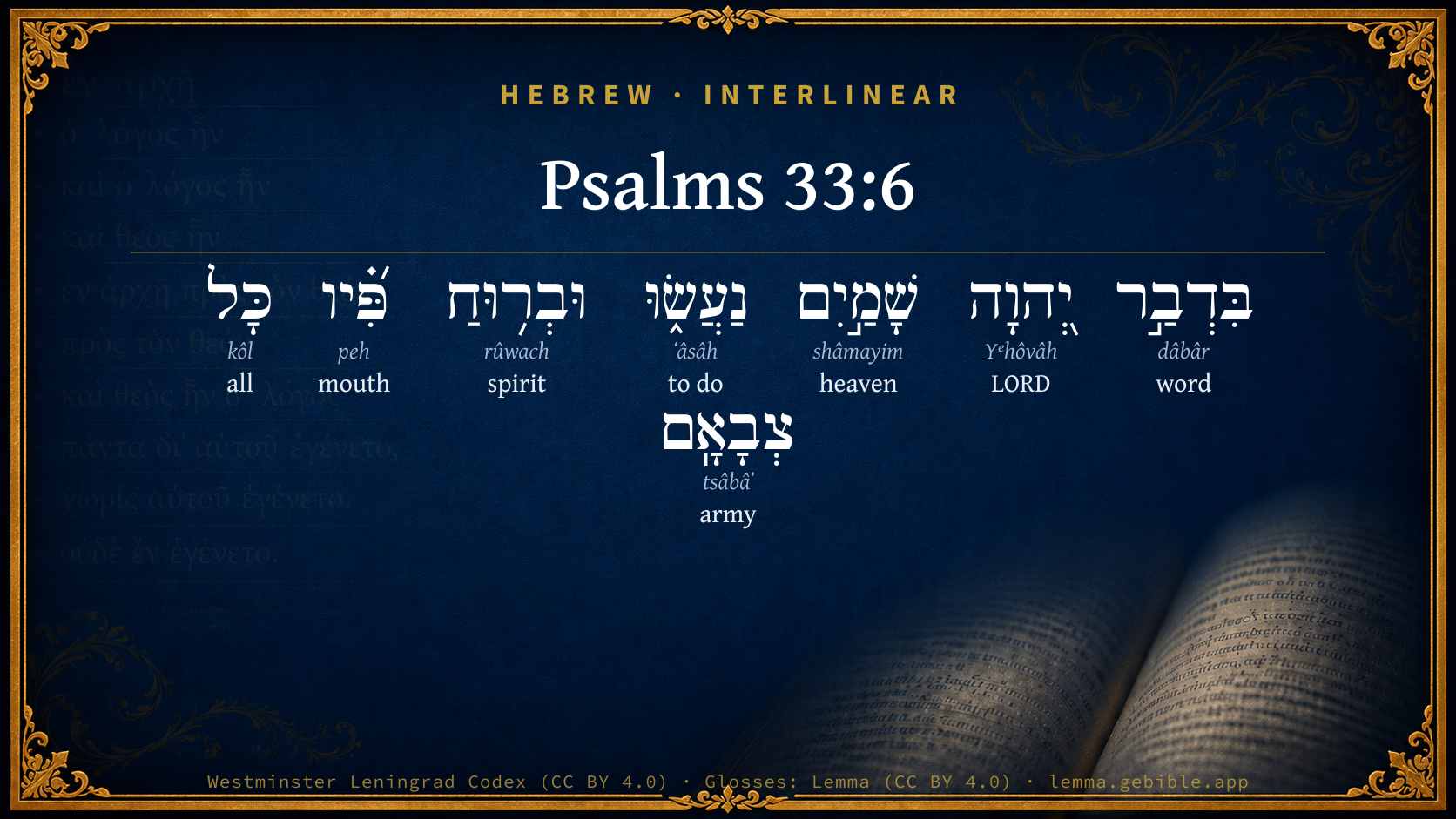
Hebrew (Westminster Leningrad Codex) Psalms 33:6 appears in the Hebrew Old Testament. The text above is from the Westminster Leningrad Codex. Each word links to its Strong’s number, a concise gloss, and parsing drawn from the Open Scriptures Hebrew Bible morphology. Click any word for its full Brown-Driver-Briggs (BDB) entry.
Download image
Cite this verse

Psalms 33:6 (World English Bible). Public Domain. Lemma interlinear Bible study tool, https://lemma.gebible.app/v/psalms/33/6.

Show BibTeX & RIS
BibTeX
RIS
English Translation
By Yahweh's word the heavens were made; All their host by the breath of his mouth.
World English Bible · Public Domain
Download a study sheet

One document with this verse’s original text, its word-by-word gloss line, the meaning frame, cross-references with their text, attributed commentary, and full source and license credits — printable, and it pastes into notes with its structure intact.

This verse Autodidact and up

Study sheet (.html) Plain text (.txt)

A passage Seminary Student

Up to 50 verses in one chapter. A passage sheet keeps up to 6 commentary sources and 12 cross-references per verse, in the order this page ranks them, and says so on the sheet whenever that leaves anything out. Ask for a single verse and you get the Autodidact verse sheet above.

Everything on this page stays free to read, with no account — the sheet is a download of what is already on screen, not access to it.

Want to remove ads? Support Godless Engineer
Compare translations 3

The same verse in 3 English versions, stacked beneath the original-language interlinear above. Click any original word for its lexicon entry.

Each is an independent rendering of the whole verse — the interlinear is not word-aligned to these translations.

Highlighted words mark where these versions differ — a whole-verse word diff, not a word-by-word alignment.

  • World English Bible Public Domain
    By Yahweh's word the heavens were made; All their host by the breath of his mouth.
  • King James Version Public Domain
    By the word of the LORD were the heavens made; and all the host of them by the breath of his mouth.
  • unfoldingWord Literal Text CC BY-SA 4.0
    By the word of Yahweh, the heavens were made, and by the breath of his mouth, all of their host.

unfoldingWord Literal Text — © unfoldingWord, licensed CC BY-SA 4.0. Word-aligned USFM3 via Door43 (git.door43.org/unfoldingWord/en_ult).

Versions to compare (up to 4)

3 of 4 selected

Show all 18 translations

Every available English version of this verse, each an independent rendering of the whole verse.

  • World English Bible Public Domain
    By Yahweh's word the heavens were made; All their host by the breath of his mouth.
  • Berean Standard Bible Public Domain
    By the word of the LORD the heavens were made, and all the stars by the breath of His mouth.
  • Majority Standard Bible Public Domain
    By the word of the LORD the heavens were made, and all the stars by the breath of His mouth.
  • King James Version Public Domain
    By the word of the LORD were the heavens made; and all the host of them by the breath of his mouth.
  • American Standard Version (1901) Public Domain
    By the word of Jehovah were the heavens made, And all the host of them by the breath of his mouth.
  • Revised Version (1885) Public Domain
    By the word of the LORD were the heavens made; and all the host of them by the breath of his mouth.
  • Geneva Bible (1599) Public Domain
    By the worde of the Lord were the heauens made, and all the hoste of them by the breath of his mouth.
  • Douay-Rheims (1899) Public Domain
    By the word of the Lord the heavens were established; and all the power of them by the spirit of his mouth:
  • Young's Literal Translation Public Domain
    By the word of Jehovah The heavens have been made, And by the breath of His mouth all their host.
  • Literal Standard Version CC BY-SA 4.0
    By the word of YHWH || The heavens have been made, || And all their host by the breath of His mouth.
  • Unlocked Literal Bible CC BY-SA 4.0
    By the word of Yahweh the heavens were made, and all the stars were made by the breath of his mouth.
  • unfoldingWord Literal Text CC BY-SA 4.0
    By the word of Yahweh, the heavens were made, and by the breath of his mouth, all of their host.
  • Darby Bible Public Domain
    By the word of Jehovah were the heavens made, and all the host of them by the breath of his mouth.
  • World Messianic Bible Public Domain
    By the LORD’s word, the heavens were made: all their army by the breath of his mouth.
  • Webster's Bible Public Domain
    By the word of the LORD were the heavens made; and all the host of them by the breath of his mouth.
  • Free Bible Version CC BY-SA 4.0
    The Lord spoke the word and the heavens were made; his mouth breathed all the stars into existence.
  • Bible in Basic English Public Domain
    By the word of the Lord were the heavens made; and all the army of heaven by the breath of his mouth.
  • JPS Tanakh (1917) Public Domain
    By the word of the LORD were the heavens made; and all the host of them by the breath of His mouth.

Literal Standard Version (2020), Covenant Press — licensed CC BY-SA 4.0. Text via the HelloAO Bible API (eBible.org). Unlocked Literal Bible (unfoldingWord) — licensed CC BY-SA 4.0. Text via the HelloAO Bible API (eBible.org). unfoldingWord Literal Text — © unfoldingWord, licensed CC BY-SA 4.0. Word-aligned USFM3 via Door43 (git.door43.org/unfoldingWord/en_ult). Free Bible Version, Dr. Jonathan Gallagher — licensed CC BY-SA 4.0. Text via the HelloAO Bible API (eBible.org).

Word by word

More ways to search: Search by grammar → Find every occurrence → Compare this word →

Practice this passage: Drill this verse → Learn its vocabulary →

וּבְר֥וּחַ
rûwach
H7307
“and · in/at · spirit of”
Conjunction + Preposition + Noun, Common, Both, Singular, Construct
Part of Speech
Conjunction + Preposition + Noun
Type
Common
Gender
Both
Number
Singular
State
Construct
Full BDB Definition

Origin: from H7306

TWOT: 2131a

wind, breath, mind, spirit - breath - wind - of heaven - quarter (of wind), side - breath of air - air, gas - vain, empty thing - spirit (as that which breathes quickly in animation or agitation) - spirit, animation, vivacity, vigour - courage - temper, anger - impatience, patience - spirit, disposition (as troubled, bitter, discontented) - disposition (of various kinds), unaccountable or uncontrollable impulse - prophetic spirit - spirit (of the living, breathing being in man and animals) - as gift, preserved by God, God's spirit, departing at death, disembodied being - spirit (as seat of emotion) - desire - sorrow, trouble - spirit - as seat or organ of mental acts - rarely of the will - as seat especially of moral character - Spirit of God, the third person of the triune God, the Holy Spirit, coequal, coeternal with the Father and the Son - as inspiring ecstatic state of prophecy - as impelling prophet to utter instruction or warning - imparting warlike energy and executive and administrative power - as endowing men with various gifts - as energy of life - as manifest in the Shekinah glory - never referred to as a depersonalized force
  1. בִּדְבַ֣ר dâbâr H1697 “in/at · word of” Preposition + Noun, Common, Masculine, Singular, Construct
  2. יְ֭הוָה Yᵉhôvâh H3068 “LORD” Noun, Proper
  3. שָׁמַ֣יִם shâmayim H8064 “heaven(s)” Noun, Common, Masculine, Plural, Absolute
  4. נַעֲשׂ֑וּ ʻâsâh H6213 “to do” Verb, Niphal, Perfect, 3rd Person, Common, Plural
  5. פִּ֝֗יו peh H6310 “mouth · his” Noun, Common, Masculine, Singular, Construct + Suffix, Personal, 3rd Person, Masculine, Singular
  6. כָּל kôl H3605 “all of” Noun, Common, Masculine, Singular, Construct
  7. צְבָאָֽם tsâbâʼ H6635 “army · their” Noun, Common, Both, Singular, Construct + Suffix, Personal, 3rd Person, Masculine, Plural

About this verse

These counts appear in no published source. They are computed here, from the morphology-tagged text and Lemma’s own curated glosses. What Lemma adds →

8
words
8
distinct lemmas
Wisdom
section

Grammatical profile

  • 1 verb
  • 7 nouns

Verb forms

  • נַעֲשׂ֑וּ Niphal · Perfect

Hebrew & Septuagint length

In English translation the verse runs 16 words from the Hebrew and 22 from the Septuagint (LXX English) — closely comparable.

A rough comparison of the two English renderings, which tokenize alike — not a word-level alignment.

Word counts can differ between the Hebrew and the Greek without any difference in meaning — e.g. the Hebrew direct-object marker אֵת has no separate Greek word, and Greek often adds the article ὁ.

Cross-references

17

Topical passages linked to Psalms 33:6 in the Treasury of Scripture Knowledge — connected by theme and wording, ordered by reader-vote popularity; previews shown in the World English Bible.

  • Hebrews 11:3 By faith, we understand that the universe has been framed by the word of God, so that what is seen has not been made out of things which are visible.
  • Job 33:4 The Spirit of God has made me, And the breath of the Almighty gives me life.
  • 2 Peter 3:5 For this they willfully forget, that there were heavens from of old, and an earth formed out of water and amid water, by the word of God;
  • John 1:1–3 In the beginning was the Word, and the Word was with God, and the Word was God.
  • Genesis 2:1 The heavens and the earth were finished, and all the host of them.
  • Psalms 33:9 For he spoke, and it was done. He commanded, and it stood firm.
  • Genesis 2:7 Yahweh God formed man from the dust of the ground, and breathed into his nostrils the breath of life; and man became a living soul.
  • Genesis 1:1 In the beginning God created the heavens and the earth.
  • Genesis 6:7 Yahweh said, "I will destroy man whom I have created from the surface of the ground; man, along with animals, creeping things, and birds of the sky; for I am sorry that I have made them."
  • John 20:22 When he had said this, he breathed on them, and said to them, "Receive the Holy Spirit!
  • Genesis 1:6 God said, "Let there be an expanse in the midst of the waters, and let it divide the waters from the waters."
  • Job 26:13 By his Spirit the heavens are garnished. His hand has pierced the swift serpent.
  • Psalms 104:30 You send forth your Spirit: they are created. You renew the face of the ground.
  • Romans 1:25 who exchanged the truth of God for a lie, and worshiped and served the creature rather than the Creator, who is blessed forever. Amen.
  • Deuteronomy 4:19 and lest you lift up your eyes to the sky, and when you see the sun and the moon and the stars, even all the host of the sky, you are drawn away and worship them, and serve them, which Yahweh your God has allotted to all the peoples under the whole sky.
  • Psalms 148:1–5 Praise Yah! Praise Yahweh from the heavens! Praise him in the heights!
  • Jeremiah 8:2 and they shall spread them before the sun, and the moon, and all the host of the sky, which they have loved, and which they have served, and after which they have walked, and which they have sought, and which they have worshiped: they shall not be gathered, nor be buried, they shall be for dung on the surface of the earth.

Cross-references courtesy of OpenBible.info (CC BY 4.0).

Hebrew and Greek witnesses Masoretic Hebrew ↔ Greek Septuagint

The same verse in the two great witnesses to the Old Testament, shown verse-for-verse.

You’re reading Greek Psalm 32 (Hebrew Psalm 33). The Septuagint counts the superscription, so verse numbers can differ from the Hebrew — chapter-level alignment, not verse-by-verse. Numbering follows Rahlfs.

These are two independent witnesses, not word-aligned to each other, and the Septuagint is shown in lemma (dictionary) form.

Hebrew Psalms 33:6 Masoretic · Westminster Leningrad Codex

בִּדְבַ֣ר יְ֭הוָה שָׁמַ֣יִם נַעֲשׂ֑וּ וּבְר֥וּחַ פִּ֝֗יו כָּל צְבָאָֽם

By Yahweh's word the heavens were made; All their host by the breath of his mouth.

World English Bible · Public Domain

Greek LXX Greek Psalm 32:6 Septuagint · lemma form

ὁ λόγος ὁ κύριος ὁ οὐρανός στερεόω καί ὁ πνεῦμα ὁ στόμα αὐτός πᾶς ὁ δύναμις αὐτός

By the word of the Lord the heavens were established; and all the host of them by the breath of his mouth.

LXX2012 (modern English Septuagint) · Public Domain

Hebrew: Westminster Leningrad Codex (CC BY 4.0). Greek: Septuagint (public domain); English from LXX2012 (modern English Septuagint) (Public Domain). How the Septuagint differs from the Hebrew →

Commentary

Notes on Psalms 33:6 from classic Christian and Jewish commentators (each source and its license shown beneath its notes). The classic Christian expositions comment on the surrounding passage and are grouped to its opening verse, so a note may address several verses; the Jewish commentaries on the Tanakh (Rashi and others) are per-verse, so they appear only where the commentator wrote on this verse.

Lemma curates 59 commentaries, every one of them public domain or Creative Commons licensed, each selected and text-cleaned for this edition rather than reprinted as found. About our sources →

Trapp's Complete Commentary

John Trapp

Psa 33:6 By the word of the LORD were the heavens made; and all the host of them by the breath of his mouth.

Ver. 6. By the word of the Lord were the heavens made] His fiat, or, Let them be, gave them a being. Or, by his essential Word, which is his Son, the second person in Trinity, Pro 8:27 Joh 1:3 Col 1:16 Heb 1:2. Solo ipsius iussuet nutu.

And all the host of them] These are first mentioned, because the most glorious of all the works of God, so Psa 19:1.

By the breath of his mouth] By his word and command. Or rather, by his Holy Spirit, the third person in Trinity, inseparable from the other two, as well in essence as in operation. See Gen 1:1-2. {See Trapp on "Gen 1:1"} {See Trapp on "Gen 1:1"} It hath been elsewhere noted, that in Thebe, a town of Egypt, they worshipped a God whom they acknowledged to be immortal. But how painted they him? In the likeness of a man blowing an egg out of his mouth; to signify, that he made the round world by his word, and by the breath of his mouth, as here. Varro addeth, that in way of thankfulness, they dedicated a sheep to him, to be offered in sacrifice (Plut. de Iside et Osiride; Varro de Re Rust. l. ii. cap. 1). This text was commonly urged by the ancients for the Trinity of persons in the Godhead; which Olympus, an Arian bishop, denying, was struck with three thunderbolts and killed in a bath.

John Trapp, A Commentary or Exposition upon All the Books of the Old and New Testament (1647–1656) — public domain. Text from a community e-Sword module.

The Biblical Illustrator

Joseph S. Exell

Psa_33:6-8

By the word of the Lord were the heavens made; and all the host of them by the breath of His mouth.

The Biblical conception of Nature

For this, see the first chapter of Genesis. There are two opposite extremes into which our conceptions may fall.

1. We may immerse God in Nature, if we treat Nature as possessed of properties strictly personal. A very great deal of common language is vitiated by this blunder. But will is an attribute of personality, and Nature has not will.

2. We may unduly isolate Nature as Gods workmanship from God the worker. We do this if we regard the universe as teaching us nothing of God, being only a whirl of material change without spiritual meaning; or as if having only a given amount of force which will run down, like a watch. But against both of these note--

I. the world is Gods creation--a separate thing, therefore, and inferior to Himself. By the word of the Lord were the heavens made. Now a word serves two functions.

1. It is the organ of command, conveying an act of will.

2. It is the reflection of the speakers self, revealing his nature. The great fact of the whole ancient world was this, that its multiform religions started from a nature basis. The sun and stars, the reproductive forces of animal and vegetable life, the decay and revival of the year, was the common fact which very early riveted the attention of primitive man, till out of it there grew up in many lands, under many shapes, a system of religious observance everywhere the same in principle. Plainly this system of religion started from the Bible truth that Nature is a revelation of God. By degrees, no doubt, the Divine idea became obscured. The sense of Natures unity grew feeble. Men came to see not so much one God speaking through all His creatures, as rather a separate morsel of divinity inherent in each separate creature. From using the sun, or the dawn, or the sky, or the spring, as a symbol only for that Invisible Being whose thoughts these objects revealed, men began to adore the symbol, and to forget the Invisible Person behind it. Easy and rapid was the downward plane to idolatry and polytheism and gross fetish-worship. Yet what is worth noting is, that such Nature-religions would have been impossible had not Nature really spoken to unsophisticated men a Divine message. This, be it remembered, was a very different thing from that cold logical argument of the modern theist, who infers a Designer from the observed facts of science. Not to the reason, so much as to the intuition, of early man did Nature address itself. It spoke poetry, not logic. We are far enough removed now from that early stage of human experience. The world is grown, and its work is not to worship Nature, but to master it. But we can only do this by observing the laws by which its Creator governs it. Thus both ancient nature worship, and modern nature study, both depend upon the fact that Nature, being Gods Word, speaks to us His thoughts.

II. Now compare the moral revelation with this of nature.

1. It starts from and builds upon the revelation of Nature.

2. It can only be understood if God be above Nature and yet present, self-revealed in Nature.

3. It agrees with the old. In absolute unity of plan. In orderly plan and obedience to fixed law. In the slowness and even laboriousness of the processes of its growth. In the stern maintenance of law, avenging all transgression.

4. But the Gospel goes on beyond and tells of redemption through our Lord Jesus Christ. (J. Oswald Dykes, D. D.)

He gathereth the waters . . . as an heap.--The old versions and interpreters read as in a bottle for as an heap, vocalizing the text differently from the present pointing; but there seems to be an allusion to the wall of waters at the passage of the Red Sea, the same word being used in Miriams song; with depths in the next clause, there as here (Exo_15:8). What is meant, however, here, is the separation of land and water at first, and possibly the continuance of the same power keeping them still apart, since the verbs in verse 7 are participles, which imply continued action. The image of an heap is probably due to the same optical delusion which has coined the expression the high seas, since, to an eye looking seawards from the beach, the level waters seem to rise as they recede; or it may merely express the gathering together in a mass. Away out there, in that ocean of which the Hebrews knew so little, were unplumbed depths in which, as in vast storehouses, the abundance of the sea was shut up, and the ever-present Word which made them at first was to them instead of bolts and bars. (A. Maclaren, D. D.)

The Biblical Illustrator, edited by Joseph S. Exell (c. 1880s–1900s) — public domain. Text from a community e-Sword module.

The Treasury of David

Charles H. Spurgeon

Ver. 6. By the word of the Lord were the heavens made. The angelic heavens, the sidereal heavens, and the firmament or terrestrial heavens, were all made to start into existence by a word; what if we say by the Word, "For without him was not anything made that is made." It is interesting to note the mention of the Spirit in the next clause, and all the host of them by the breath of his mouth; the breath is the same as is elsewhere rendered Spirit. Thus the three persons of the Godhead unite in creating all things. How easy for the Lord to make the most ponderous orbs, and the most glorious angels! A word, a breath could do it. It is as easy for God to create the universe as for a man to breathe, nay, far easier, for man breathes not independently, but borrows the breath in his nostrils from his Maker. It may be gathered from this verse that the constitution of all things is from the infinite wisdom, for his word may mean his appointment and determination. A wise and merciful Word has arranged, and a living Spirit sustains all the creation of Jehovah.

Ver. 6. By the word of the Lord were the heavens made; and all the host of them by the breath of his mouth. That the (hwd) is not spirit, but breath, is evident from the words of his mouth (compare Isa 11:4), and from the parallelism with word. Simple word is simple breath; both together, they stand in contrast to that exercise of strength, that labour, that use of means and instruments without which feeble man can bring nothing to perfection. Then there are the parallel passages, "All the while my breath is in me, and the Spirit of God is in my nostrils." Job 27:3. "The Spirit of God hath made me, and the breath of the Almighty hath given me life." Job 33:4. "Thou takest away their breath, they die, and return to their dust, thou sendest forth thy breath, they are created." Ps 104:29, 30. On the other hand, however, the exposition which would interpret (wyp xwr), without reference to the Spirit of God, cannot be a correct one. In the history of the creation, to which the verse before us, as well as verses seven and nine, generally refer, the creation is described as the work of the SPIRIT of God, and his WORD. First, the Spirit of God moved upon the face of the waters, then God said. We may also suppose that the Spirit and the power of God are here represented by the figure of breath, because that in man is the first sign of life. E. W. Hengstenberg.

Ver. 6. By the word of the Lord. May be understood of the hypostatic Word, as John teaches us. Joh 1:1. (John Cocceius), 1603-1669. This is an illustration of the old saying, that while Grotius finds Christ nowhere, Cocceius finds Christ everywhere. C. H. S.

Ver. 6. Let any make a world, and he shall be a God, saith Augustine; hence is it that the church maketh it the very first article of her Creed to believe in God the Father Almighty, maker of heaven and earth. John Weemse.

Ver. 6,9. It is all one with God to do as to say, to perform as to promise; it is as easy, he is as willing, as able, to do the one as the other. There is no such distance betwixt God's saying and doing, as amongst men. His saying is doing: He spake, and it was done; he commanded, and it stood fast. By the word of the Lord were the heavens made. "The worlds were framed by the word of God." Heb 11:3. There is omnipotence in his word, both of command and promise; therefore called, "The word of his power." Heb 1:3. One word of his can do more in an instant than the united powers of heaven and earth can do in eternity. This consideration removes at once the chief discouragements that hinder the lively actings of faith; for what is it that weakens our confidence of the promises' performance, but because we look upon the accomplishment as uncertain or difficult, or future and afar off! Now from hence faith may conclude the performance is certain, easy, and present. David Clarkson.

Ver. 6. The power of the Word and the Spirit in the old and new creations.

Psalms 33:7*

Ver. 6,9. See Psalms on "Ps 33:6" for further information.

Charles H. Spurgeon's The Treasury of David (1869–1885) — public domain. Psalms only. Text from a community e-Sword/MySword module.

Joseph Benson's Commentary

Psa 33:6. By the word of the Lord were the heavens made — Either 1st, By Christ who is often called God’s word, even by the Chaldee paraphrast; as also Joh 1:1-3, where he is said to be that Word by whom all things were made, declaring more clearly (as is also done in other parts of the New Testament) what is here only obscurely intimated. Or, 2d, By his will or command, as this phrase seems to be explained, Psa 33:9. And so understood the expression hath a great emphasis in it; namely, that God made this admirable structure of the heavens, with the sun and moon, and all its glorious stars, not with great pains and time, and the help of many artists and instruments, as men do for meaner works; but with one single word, or, with as much ease as men speak a word, merely by commanding them to be: a consideration this, which wonderfully illustrates the power and glory of the Creator. For what cannot that power do which with a word made a world? And all the host of them — The angels or the stars, by the breath, ברוחberuach, by the spirit of his mouth — By the Holy Ghost, so called Job 33:4. Thus all the persons of the Trinity are referred to here, the Father, the Word, and the Spirit, to each of which this work of creation is elsewhere ascribed: see note on Gen 1:26. Or this phrase, the breath of his mouth, may be merely a repetition of the former clause, as, the rod of his mouth, Isa 11:4; or his word, and the breath of his lips, mean the same thing: see also 2Th 2:8.

Joseph Benson's Commentary on the Old and New Testaments (1811–1818) — public domain. Text from a community e-Sword module.

J. A. Alexander on Psalms

Joseph Addison Alexander

6. (Psa 33:6) By the word of Jehovah were the heavens made, and by the breath of his mouth all their host. Having set forth the righteousness, fidelity, and mercy of Jehovah, as displayed on earth, the Psalmist now demonstrates his ability to deliver and protect his people, by exhibiting his almighty power in the creation and sustentation of the universe. There is obvious allusion to the history of the creation in Genesis. This is especially apparent in the closing words, all their host, which are borrowed from Gen. ii. 1. Breath is a poetical equivalent to word, and conveys still more strongly the idea of the ease with which a God could make a world. At the same time, it is not a mere fortuitous coincidence, that these two words are used in Scripture to designate the second and third persons of the Godhead. Compare Gen 1:2, Job 27:3; Job 33:4, Psa 104:29-30, Isa 11:4.

Joseph Addison Alexander, The Psalms Translated and Explained (1850) — public domain. Text from a community e-Sword module.

Jamieson, Fausset & Brown

Robert Jamieson, A. R. Fausset & David Brown

In "word" and "breath"--or, "spirit," there may be an allusion to the Son (Joh 1:1) and Holy Spirit.

Jamieson, Fausset & Brown — Commentary Critical and Explanatory on the Whole Bible (1871) — public domain (CC PDM 1.0). Text via the HelloAO Bible API.

Adam Clarke's Commentary

Verse 6. By the word of the Lord were the heavens made] This is illustrated in the 9th verse: "He spake, and it was done; he commanded, and it stood fast." This evidently refers to the account of the creation, as it stands in the first chapter of Genesis.

Adam Clarke's Commentary on the Bible (1810–1826) — public domain. Text from a community e-Sword/MySword module.

John Calvin's Commentaries

6. By the word of Jehovah. That he may stir us up to think more closely of God’s works, he brings before us the creation of the world itself; for until God be acknowledged as the Creator and Framer of the world, who will believe that he attends to the affairs of men, and that the state of the world is controlled by his wisdom and power? But the creation of the world leads us by direct consequence to the providence of God. Not that all men reason so justly, or are endued with so sound a judgment, as to conclude that the world is at this day maintained by the same divine power which was once put forth in creating it: on the contrary, the great majority imagine that he is an idle spectator in heaven of whatever is transacted on earth. But no man truly believes that the world was created by God unless he is also firmly persuaded that it is maintained and preserved by him. Wisely and properly, therefore, does the prophet carry us back to the very origin of the world, in order to fix in our minds the certainty of God’s providence in the continual order of nature. By the figure synecdoche, he uses the term heavens for the whole fabric of the world, because, as I have elsewhere remarked, the sight of the heavens more than all the other parts of creation transports us with admiration. He therefore immediately adds, And all the host of them, by which phraseology, according to the usual method of Scripture, he means the stars and planets; for if the heavens were destitute of this ornament, they would in a manner be empty. In saying that the heavens were created by the word of God, he greatly magnifies his power, because by his nod alone, “Par son simple vouloir et commandement.” — Fr. “Simply by his will and commandment.”

“Sans aussi y employer beaucoup de temps ou travail.” — Fr.

John Calvin's Commentaries (1540-1563) — public domain. Text from the Calvin Translation Society English edition (1840s-50s) via the Christian Classics Ethereal Library (ccel.org). Calvin's coverage is partial (roughly two-thirds of the Bible); uncommented books and verses are honest gaps, never fabricated. The 19th-century editor's footnotes and remarks are omitted so the notes are faithfully Calvin's own voice.

Ellicott's Commentary for English Readers

(6) The breath of his mouth.—This is plainly only a synonym for word. (Comp. Isa_11:4, where “breath of his lips” is used for the Divine sentence of judgment upon the heathen.)

A Bible Commentary for English Readers, edited by Charles John Ellicott (1878–1897) — public domain. Text from a community e-Sword module.

The Cambridge Bible for Schools and Colleges

gen. ed. J. J. S. Perowne

6. The breath of his mouth is synonymous with the word of the Lord: together they represent and God said in Gen_1:3 ff. The parallelism and the addition of his mouth seem to exclude a reference to the spirit of God in Gen_1:2, though the word in the original is the same. The germ of the doctrine of the Word in Joh_1:1; Joh_1:3 may be found here, though of course the Psalmist had no idea of a personal Word. Cp. Psa_107:20; and Sir_43:26, “By his word all things consist.” The host of heaven (Gen_2:1) are the sun moon and stars, marching forth like an army in ordered array at God’s command (Isa_40:26).

6–9. Jehovah’s creative omnipotence. Word is the expression of thought; command of will: He had but to think and will, and the Universe came into being.

The Cambridge Bible for Schools and Colleges (gen. ed. J. J. S. Perowne; Cambridge University Press, 1878–1918) — public domain. Text from a community e-Sword module.

John Gill's Exposition

By the word of the Lord were the heavens made,.... The aerial and starry heavens, and the heaven of heavens, the third heaven, the seat of the divine Majesty, and the habitation of angels and glorified saints; these were "made" even out of nothing, not out of any pre-existent matter, nor were they eternal; and being made are creatures, and so not to be worshipped, neither they nor their hosts after mentioned; angels, sun, moon, and stars; these were made by the Word of God, the essential Word of God, the Lord Jesus Christ, who often goes by this name, Joh 1:1; and very fitly agrees with him, who spoke for all his people in the council and covenant of grace, and undertook to be their surety; is the Word spoken of by all the holy prophets since the beginning of the world; is the interpreter of his Father's mind and will, of which he must be capable, since he lay in his bosom; and now he speaks for his saints in heaven, whose advocate he is; and especially he may be so called because he so often spake on the six days of creation, and said, let this and the other thing be, and it was so; and to him, as the Word of God, is the creation of all things frequently ascribed, Joh 1:1, Heb 11:3, and particularly the heavens, Heb 1:10. This is a proof of the deity of Christ, and of the dignity of his person; and shows how fit he is to be the Saviour of men; how safe the saints are in his hands; and that he ought to be trusted in, adored, and worshipped;

and all the host of them by the breath of his mouth: by "the host" of the heavens are meant the angels of heaven, who dwell in the third heaven, and are the militia of it; they are called the heavenly host, Luk 2:13; these are under Jehovah, as their Lord and King, and are the army among whom he does according to his will, Kg1 22:19; these attended him whenever he has made any remarkable appearance; and they have been employed by him against his enemies, and in defence of his people, about whom they encamp, Kg2 19:35. The sun, moon, and stars, are the host of the next heaven, these are ranged in their proper order by the Lord, and he keeps the muster roll of them, Isa 40:26; and these are used by him as his militia; the stars in their courses fought against Sisera, Jdg 5:20; and the winged tribe are the host of the lower heaven; and even the lower class of these, as the locusts and grasshoppers, go forth in bands and troops, and encamp in the hedges, and at the command of God pass through and devour whole countries, Pro 30:27; and all these are made by "the breath" or "spirit (z) of Jehovah's mouth"; that is, by the Spirit of God, the third Person in the Trinity; a name which is suitable to him who is breathed forth, and proceeds from the Father and the Son, and to whom creation is ascribed, Gen 1:2; and which is no inconsiderable proof of his deity; and shows that he must be equal to the work of sanctification, which he begins and carries on. Now though the creation of the heavens is attributed to the Word, and the host of them to the Spirit, yet we are not to suppose that one Person took one part, and another Person another part of the creation; but they were all, Father, Word, and Spirit, jointly concerned in the whole.

(z) "spiritu oris ejus", V. L. Gejerus, Michaelis; so Ainsworth.

John Gill's Exposition of the Whole Bible (1746–1763) — public domain (CC PDM 1.0). Text via the HelloAO Bible API.

Albert Barnes' Notes on the Bible

By the word of the Lord - By the command of God: Gen 1:3, Gen 1:6 etc. See the notes at Psa 33:9.

Were the heavens made - That is, the starry heavens; the worlds above us: Gen 1:1.

And all the host of them - All their “armies.” The stars are represented as armies or marshalled hosts, led forth at his command, and under his direction - as armies are led forth in war. See Gen 2:1; compare the notes at Isa 1:9.

By the breath of his mouth - By his word or command - as our words issue from our mouths with our breath. The idea here is, that God is the Creator of all things; and, as such, has a claim to praise; or, that as Creator he is entitled to adoration. To this he is entitled from the fact that he has made all things, and from the “manner” in which it has been done - the wisdom, power, goodness, skill, with which it has been accomplished.

Albert Barnes' Notes on the Bible (1834–1885) — public domain. Text from a community e-Sword/MySword module.

Matthew Poole's English Annotations

By the word of the Lord; either,

1. By the hypostatical Word, Christ, who is oft called God’s Word, even by the Chaldee paraphrast; as also Joh 1:1-3, where he is said to be that Word by whom all things were made. So that which is here spoken more darkly and doubtedly, according to that state of the church, is more clearly declared in the New Testament. Or,

2. By his will or command, as this very phrase is here used, Psa 33:4, and as it seems to be explained, Psa 33:9. And so it hath a great emphasis in it, that God made this admirable structure of the heavens, and all its glorious stars, not with great pains and time, and help of many artists and instruments, as men do far meaner works, but with one single word; which is much to the glory of the Creator.

All the host of them; the angels; or the stars: See Poole "Gen 2:1".

By the breath of his mouth; either,

1. By the Holy Ghost, so called Job 33:4. And so here are all the persons of the Trinity, Jehovah the Father, and the Word, and the Spirit; to each of which this work of creation is elsewhere ascribed, as was noted on Gen 1:26. Or,

2. By his word, as it was expressed in the last clause, which is so called Isa 11:4; 2Th 2:8.

Matthew Poole's English Annotations on the Holy Bible (1683–1685) — public domain. Text from a community e-Sword/MySword module.

Whedon's Commentary on the Bible

Daniel D. Whedon

6. Word of the Lord— “Word” is often a generic term for the total revelation of God, but here for the creative fiat. Genesis 1. God’s word is the representative of himself, the expression of his will. “The Scriptures distinguish between the will and the word of God. He was not content with willing, but he said, ‘Let there be light.’ Thus without the Word was not any thing made that was made,” (Joh_1:3.)—Girdlestone.

Host—The word signifies, multitude, army, the stars, (Isa_34:4,) angels, (Psa_103:21,) but here it means celestial bodies.

Breath of his mouth—Same as energy of his word. “Breath,” here, is the same word as spirit, “the spirit of God,” (Gen_1:2,) where it means, probably, some symbol of God, as the shekinah, the sign of his immediate presence.

Daniel D. Whedon (gen. ed.), Commentary on the Old and New Testaments (1874–1909) — public domain. Text from a community e-Sword module.

The Pulpit Commentary

By the word of the Lord were the heavens made. God is to be praised, not only for his goodness, but also for his greatness, and especially for his greatness in creation. (see Psa_19:1-6) The heavens were made "by his word" in a double sense by the Word, who is the Second Person of the Trinity, (Joh_1:3 Heb_1:2, Heb_1:10) and by a mere utterance, without the employment of any mechanical means, as we learn from Genesis 16-8. And all the host of them by the breath of his mouth. The "host of heaven" is here, undoubtedly, the host of heavenly bodies the sun, moon, and stars as in Gen_2:1. These were made "by the breath of God"s mouth;" i.e. by his simple utterance of the command there be lights in the firmament of the heaven, to divide the day from the night". (Gen_1:14; comp. Job_26:13)

Creation.

"By the word of the Lord," etc. The Apostle Peter, warning us against applying our hasty reckonings to God"s dealings, reminds us that "one day is with the Lord as a thousand years, and a thousand years as one day." This he puts in conjunction with the fact that "by the word of the Lord the heavens were of old, and the earth standing out of the water and in the water," and with the declaration that "the heavens and earth which are now, by the same word are kept in store, reserved unto fire against the day of judgment". (2Pe_3:5-8) In like manner St. Paul speaks of the Son of God, "by whom also he made the worlds," as upholding all things by the word of his power". (Heb_1:2, Heb_1:3) God"s creative word is no momentary fiat, but a fixed and lasting power and purpose, of which it may be said, as of his written truth, "The Word of God liveth and abideth for ever". (1Pe_1:23, 1Pe_1:24)

I THE WORD OF COMMAND; i.e. the putting forth of Divine will and power. The fact of creation stands in the forefront of Bible teaching. The existence of God is never treated in Scripture as needing argument or proof; it is assumed, as self-evident to every sane and intelligent mind. The starting-point, therefore, of Bible teaching is that all things owe their origin to his will and power. "In the hennaing," etc. (Gen_1:1) All other being has its being in him. (Act_17:24, Act_17:28) Scientific men tell us there is a perpetual dissipation of energy in the universal frame of things; q.d. that all the forces of nature are constantly tending to change into heat, and heat is constantly passing away and wasting itself in infinite space. If so, it cannot fly beyond God"s presence and control. The unfathomable fountain of all force, physical and spiritual, is with him. He who made all things "in the beginning" can, when he pleases, "make all things new". (Psa_119:89-91)

II THE WORD OF WISDOM. All man"s most laborious discoveries what he calls his science consist in slowly finding out the truths embodied in God"s works. The great astronomer Kepler, enraptured with the wonderful results his calculations revealed, exclaimed, "O God, I think thy thoughts after thee!" Mathematics, astronomy, chemistry all the sciences teach us portions of that Divine wisdom on which nature rests. Much of man"s wisdom and progress consists in finding out his mistakes. New inventions are superseded by newer. Theories which one generation regards as the most advanced truths, the next generation treats as obsolete and exploded. But the lapse of time brings to light no mistakes, no miscalculations or oversights, in God"s work. The history of the past, as far as we can decipher it, shows perpetual progress, but progress for which preparation was made at the very beginning.

III Therefore it is the WORD OF DIVINE FAITHFULNESS. (1Pe_4:19) These three commanding power, foreseeing wisdom, unchanging faithfulness make up together the great idea of law. The laws of nature are the laws of God word of the Lord." The constancy of nature is the image (because the result) of Divine unchangeableness. (Jer_31:35, 36 33:20)

INFERENCES.

1. There can be no real opposition between faith and science. Men may misunderstand Scripture or misinterpret nature; but one part of God"s truth cannot contradict another.

2. The study of God"s works is a religious and Christian duty (measured, of course, by opportunity and ability). The New Testament teaches that the glory of creation is the glory of Christ. (Joh_1:3 Col_1:16 Heb_1:2) If many students of science are atheists or sceptics, that is their fault or their calamity. Nature is full of God.

3. The more we study the revelation of God in nature, the more we are struck with its silence as to what we most need to know what only the gospel reveals. "The heavens declare the glory of God," but not his grace. Is there a God who created all things? Is he almighty, all-wise, good, bountiful, patient, just, unchangeable? Nature, with innumerable voices, cries aloud, "Yes!" But is he merciful to sinners? Will he pardon the breakers of his laws? Is there atonement for sin; forgiveness; restoration; eternal life? Nature is silent. The Bible alone answers these questions. (Exo_34:6, 7 2Co_5:19, 2Co_5:21)

The Pulpit Commentary (1880–1919), ed. H.D.M. Spence-Jones & Joseph S. Exell — public domain. Text from a community e-Sword module.

John Wesley's Explanatory Notes

The word - God made this admirable structure of the heavens, and all its glorious stars; not with great pains and time, but with one single word. Host - The angels: or the stars.

John Wesley, Explanatory Notes Upon the Whole Bible (1754–1765) — public domain. Text via the GEBible commentary corpus.

Keil & Delitzsch

C. F. Keil & F. Delitzsch

God's praiseworthiness (b) as the Creator of the world in the kingdom of Nature. Jahve's דּבר is His almighty "Let there be;" and רוח פּיו (inasmuch as the breath is here regarded as the material of which the word is formed and the bearer of the word) is the command, or in general, the operation of His commanding omnipotence (Job 15:30, cf. Job 4:9; Isa 34:16, cf. Psa 11:4). The heavens above and the waters beneath stand side by side as miracles of creation. The display of His power in the waters of the sea consists in His having confined them within fixed bounds and keeping them within these. נד is a pile, i.e., a piled up heap (Arabic nadd), and more especially an inference to harvest: like such a heap do the convex waters of the sea, being firmly held together, rise above the level of the continents. The expression is like that in Jos 3:13, Jos 3:15, cf. Exo 15:8; although there the reference is to a miracle occurring in the course of history, and in this passage to a miracle of creation. כּנס refers to the heap itself, not to the walls of the storehouses as holding together. This latter figure is not introduced until Psa 33:7: the bed of the sea and those of the rivers are, as it were, אוצרות, treasuries or storehouses, in which God has deposited the deep, foaming waves or surging mass of waters. The inhabitants (ישׁבי, not יושׁבי) of the earth have cause to fear God who is thus omnipotent (מן, in the sense of falling back from in terror); for He need only speak the word and that which He wills comes into being out of nothing, as we see from the hexameron or history of Creation, but which is also confirmed in human history (Lam 3:37). He need only command and it stands forth like an obedient servant, that appears in all haste at the call of his lord, Psa 119:91.

Keil & Delitzsch — Biblical Commentary on the Old Testament (1861–1891) — public domain (CC PDM 1.0). Text via the HelloAO Bible API. (Old Testament only.)

Lesson kit

Teaching starters — assembled from the data on this page, not authored interpretation. Every prompt links to the verse data it draws on. Edit before teaching.

Psalms, in the Wisdom, opens this verse with 8 words (8 distinct Hebrew lemmas). Its most distinctive word is rûwach (“spirit”). A historical commentator’s framing appears above. Read the whole chapter for the surrounding context.

Discussion questions

  1. What does “spirit” (rûwach) contribute to the verse as a whole?
  2. Hebrews 11:3 shares this passage’s theme. How do the two illuminate each other?
  3. The translations on this page render this verse differently — a whole-verse word diff, not a word-by-word alignment. What might account for the different wordings?
  4. The verb «נַעֲשׂ֑וּ» is Niphal Perfect. How does its form color the action?
  5. Reading how Trapp's Complete Commentary and The Biblical Illustrator read this verse, where do the two commentators agree and where do they part?

Things to notice

Reading settings

Reading text

Shown beneath each verse's original-language words.

Old Testament
Old Testament edition

Read the OT as the Masoretic Hebrew (MT) or the Greek Septuagint (LXX).

English shown for the Greek Septuagint (in the Hebrew ↔ Greek comparison).

Comparing translations? Open the Compare panel on any verse page to stack up to four side by side.