Ecclesiastes 1:17

Hebrew (Westminster Leningrad Codex) Ecclesiastes 1:17 appears in the Hebrew Old Testament. The text above is from the Westminster Leningrad Codex. Each word links to its Strong’s number, a concise gloss, and parsing drawn from the Open Scriptures Hebrew Bible morphology. Click any word for its full Brown-Driver-Briggs (BDB) entry.
Download image
Cite this verse

Ecclesiastes 1:17 (World English Bible). Public Domain. Lemma interlinear Bible study tool, https://lemma.gebible.app/v/ecclesiastes/1/17.

Show BibTeX & RIS
BibTeX
RIS
English Translation
I applied my heart to know wisdom, and to know madness and folly. I perceived that this also was a chasing after wind.
World English Bible · Public Domain
Highlights
  • 3 first appearances in the Hebrew Bible
Full analysis ↓
Download a study sheet

One document with this verse’s original text, its word-by-word gloss line, the meaning frame, cross-references with their text, attributed commentary, and full source and license credits — printable, and it pastes into notes with its structure intact.

This verse Autodidact and up

Study sheet (.html) Plain text (.txt)

A passage Seminary Student

Up to 50 verses in one chapter. A passage sheet keeps up to 6 commentary sources and 12 cross-references per verse, in the order this page ranks them, and says so on the sheet whenever that leaves anything out. Ask for a single verse and you get the Autodidact verse sheet above.

Everything on this page stays free to read, with no account — the sheet is a download of what is already on screen, not access to it.

Want to remove ads? Support Godless Engineer
Compare translations 3

The same verse in 3 English versions, stacked beneath the original-language interlinear above. Click any original word for its lexicon entry.

Each is an independent rendering of the whole verse — the interlinear is not word-aligned to these translations.

Highlighted words mark where these versions differ — a whole-verse word diff, not a word-by-word alignment.

  • World English Bible Public Domain
    I applied my heart to know wisdom, and to know madness and folly. I perceived that this also was a chasing after wind.
  • King James Version Public Domain
    And I gave my heart to know wisdom, and to know madness and folly: I perceived that this also is vexation of spirit.
  • unfoldingWord Literal Text CC BY-SA 4.0
    So, I gave my heart to know wisdom and to know madness and folly. I know that also this—it pursuit of wind.

unfoldingWord Literal Text — © unfoldingWord, licensed CC BY-SA 4.0. Word-aligned USFM3 via Door43 (git.door43.org/unfoldingWord/en_ult).

Versions to compare (up to 4)

3 of 4 selected

Show all 18 translations

Every available English version of this verse, each an independent rendering of the whole verse.

  • World English Bible Public Domain
    I applied my heart to know wisdom, and to know madness and folly. I perceived that this also was a chasing after wind.
  • Berean Standard Bible Public Domain
    So I set my mind to know wisdom and madness and folly; I learned that this, too, is a pursuit of the wind.
  • Majority Standard Bible Public Domain
    So I set my mind to know wisdom and madness and folly; I learned that this, too, is a pursuit of the wind.
  • King James Version Public Domain
    And I gave my heart to know wisdom, and to know madness and folly: I perceived that this also is vexation of spirit.
  • American Standard Version (1901) Public Domain
    And I applied my heart to know wisdom, and to know madness and folly: I perceived that this also was a striving after wind.
  • Revised Version (1885) Public Domain
    And I applied my heart to know wisdom, and to know madness and folly: I perceived that this also was a striving after wind.
  • Geneva Bible (1599) Public Domain
    And I gaue mine heart to knowe wisdome and knowledge, madnes and foolishnes: I knew also that this is a vexation of the spirit.
  • Douay-Rheims (1899) Public Domain
    And I have given my heart to know prudence, and learning, and errors, and folly: and I have perceived that in these also there was labour, and vexation of spirit,
  • Young's Literal Translation Public Domain
    And I give my heart to know wisdom, and to know madness and folly: I have known that even this `is' vexation of spirit;
  • Literal Standard Version CC BY-SA 4.0
    And I give my heart to know wisdom, and to know madness and folly: I have known that even this [is] distress of spirit;
  • Unlocked Literal Bible CC BY-SA 4.0
    So I applied my heart to know wisdom and also madness and folly. I came to understand that this also was an attempt to shepherd the wind.
  • unfoldingWord Literal Text CC BY-SA 4.0
    So, I gave my heart to know wisdom and to know madness and folly. I know that also this—it pursuit of wind.
  • Darby Bible Public Domain
    And I applied my heart to the knowledge of wisdom, and to the knowledge of madness and folly: I perceived that this also is a striving after the wind.
  • World Messianic Bible Public Domain
    I applied my heart to know wisdom, and to know madness and folly. I perceived that this also was a chasing after wind.
  • Webster's Bible Public Domain
    And I gave my heart to know wisdom, and to know madness and folly: I perceived that this also is vexation of spirit.
  • Free Bible Version CC BY-SA 4.0
    So I decided to use my mind to learn everything about wisdom, and madness and foolishness as well. But I found out that this is as hard as trying to catch hold of the wind.
  • Bible in Basic English Public Domain
    And I gave my heart to getting knowledge of wisdom, and of the ways of the foolish. And I saw that this again was desire for wind.
  • JPS Tanakh (1917) Public Domain
    And I applied my heart to know wisdom, and to know madness and folly — I perceived that this also was a striving after wind.

Literal Standard Version (2020), Covenant Press — licensed CC BY-SA 4.0. Text via the HelloAO Bible API (eBible.org). Unlocked Literal Bible (unfoldingWord) — licensed CC BY-SA 4.0. Text via the HelloAO Bible API (eBible.org). unfoldingWord Literal Text — © unfoldingWord, licensed CC BY-SA 4.0. Word-aligned USFM3 via Door43 (git.door43.org/unfoldingWord/en_ult). Free Bible Version, Dr. Jonathan Gallagher — licensed CC BY-SA 4.0. Text via the HelloAO Bible API (eBible.org).

Word by word

More ways to search: Search by grammar → Find every occurrence → Compare this word →

Practice this passage: Drill this verse → Learn its vocabulary →

רַעְי֥וֹן
raʻyôwn
H7475
“longing of”
Noun, Common, Masculine, Singular, Construct
Part of Speech
Noun
Type
Common
Gender
Masculine
Number
Singular
State
Construct
Full BDB Definition

Origin: from H7462 in the sense of H7469

TWOT: 2187c

longing, striving
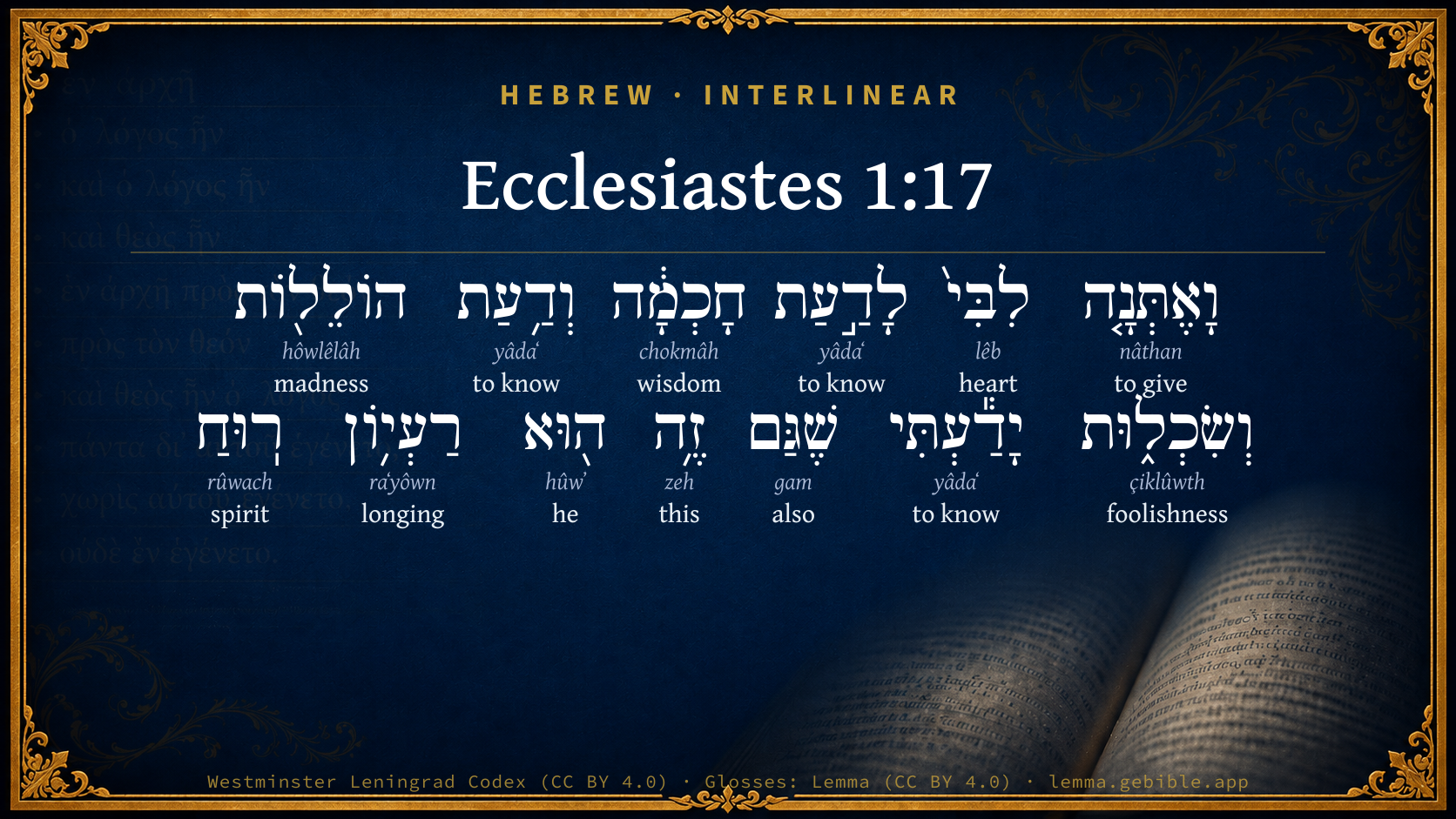
  1. וָאֶתְּנָ֤ה nâthan H5414 “and · to give” Conjunction + Verb, Qal, Sequential Imperfect, 1st Person, Common, Singular + Suffix, h
  2. לִבִּי֙ lêb H3820 “heart · my” Noun, Common, Masculine, Singular, Construct + Suffix, Personal, 1st Person, Common, Singular
  3. לָדַ֣עַת yâdaʻ H3045 “to know” Preposition + Verb, Qal, Infinitive Construct
  4. חָכְמָ֔ה chokmâh H2451 “wisdom” Noun, Common, Feminine, Singular, Absolute
  5. וְדַ֥עַת yâdaʻ H3045 “and · to know” Conjunction + Verb, Qal, Infinitive Construct
  6. הוֹלֵל֖וֹת hôwlêlâh H1947 “madness” Noun, Common, Feminine, Plural, Absolute
  7. וְשִׂכְל֑וּת çiklûwth H5531 “and · foolishness” Conjunction + Noun, Common, Feminine, Singular, Absolute
  8. יָדַ֕עְתִּי yâdaʻ H3045 “to know” Verb, Qal, Perfect, 1st Person, Common, Singular
  9. שֶׁגַּם gam H1571 “who/which · also” Particle, Relative + Adverb
  10. זֶ֥ה zeh H2088 “this” Pronoun, Demonstrative, Masculine, Singular
  11. ה֖וּא hûwʼ H1931 “he” Pronoun, Personal, 3rd Person, Masculine, Singular
  12. רֽוּחַ rûwach H7307 “spirit” Noun, Common, Both, Singular, Absolute

About this verse

These counts appear in no published source. They are computed here, from the morphology-tagged text and Lemma’s own curated glosses. What Lemma adds →

13
words
11
distinct lemmas
Wisdom
section

Notable vocabulary

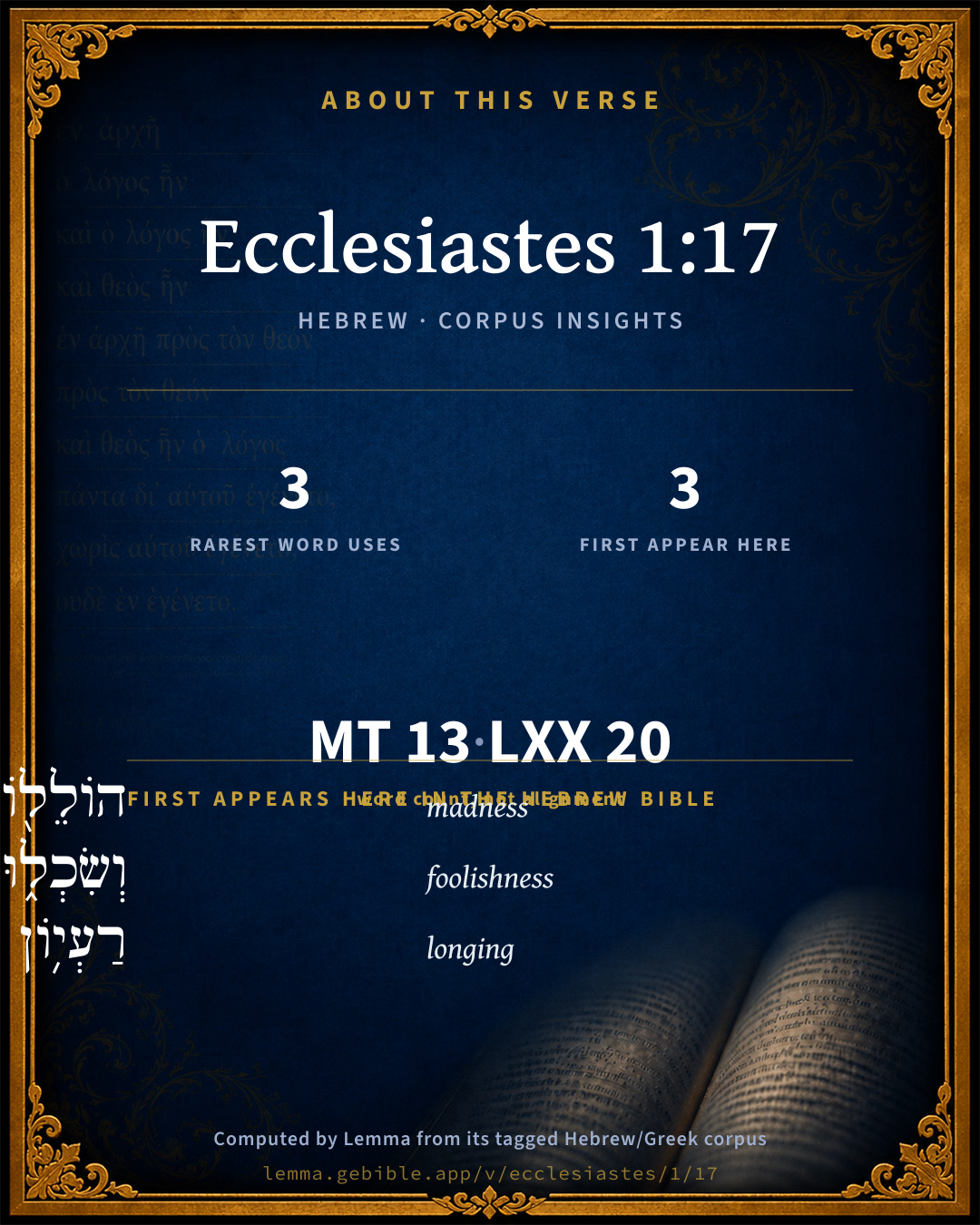
The rarest word here is רַעְי֥וֹן longing H7475 — appearing just 3 times in the whole Hebrew Bible.

First appearance in Scripture

These words make their first canonical appearance in the Hebrew Bible here:

  • הוֹלֵל֖וֹת madness H1947
  • וְשִׂכְל֑וּת foolishness H5531
  • רַעְי֥וֹן longing H7475

Shared distinctive vocabulary

רַעְי֥וֹן longing H7475 occurs in 3 verses of the Hebrew Bible. Also found in:

Grammatical profile

  • 4 verbs
  • 6 nouns
  • 2 pronouns
  • 1 adverb

Verb forms

  • וָאֶתְּנָ֤ה Qal · Sequential Imperfect
  • לָדַ֣עַת Qal · Infinitive Construct
  • וְדַ֥עַת Qal · Infinitive Construct
  • יָדַ֕עְתִּי Qal · Perfect

Repetition

A word recurs within this verse — often emphatic in Hebrew:

  • לָדַ֣עַת to know H3045 ×3

Hebrew & Septuagint length

In English translation the verse runs 23 words from the Hebrew and 19 from the Septuagint (LXX English) — closely comparable.

A rough comparison of the two English renderings, which tokenize alike — not a word-level alignment.

Word counts can differ between the Hebrew and the Greek without any difference in meaning — e.g. the Hebrew direct-object marker אֵת has no separate Greek word, and Greek often adds the article ὁ.

In the original languages it is 13 Hebrew tokens and 20 Greek tokens — but the two are counted differently (Hebrew bundles its prefixes and suffixes into one token; the Greek is in lemma form), so that isn’t a like-for-like length.

Cross-references

5

Topical passages linked to Ecclesiastes 1:17 in the Treasury of Scripture Knowledge — connected by theme and wording, ordered by reader-vote popularity; previews shown in the World English Bible.

  • Ecclesiastes 2:3 I searched in my heart how to cheer my flesh with wine, my heart yet guiding me with wisdom, and how to lay hold of folly, until I might see what it was good for the sons of men that they should do under heaven all the days of their lives.
  • 1 Thessalonians 5:21 Test all things, and hold firmly that which is good.
  • Ecclesiastes 1:13–14 I applied my heart to seek and to search out by wisdom concerning all that is done under the sky. It is a heavy burden that God has given to the sons of men to be afflicted with.
  • Ecclesiastes 2:10–12 Whatever my eyes desired, I didn't keep from them. I didn't withhold my heart from any joy, for my heart rejoiced because of all my labor, and this was my portion from all my labor.
  • Ecclesiastes 7:23–25 All this have I proved in wisdom. I said, "I will be wise;" but it was far from me.

Cross-references courtesy of OpenBible.info (CC BY 4.0).

Hebrew and Greek witnesses Masoretic Hebrew ↔ Greek Septuagint

The same verse in the two great witnesses to the Old Testament, shown verse-for-verse.

These are two independent witnesses, not word-aligned to each other, and the Septuagint is shown in lemma (dictionary) form.

Hebrew Ecclesiastes 1:17 Masoretic · Westminster Leningrad Codex

וָאֶתְּנָ֤ה לִבִּי֙ לָדַ֣עַת חָכְמָ֔ה וְדַ֥עַת הוֹלֵל֖וֹת וְשִׂכְל֑וּת יָדַ֕עְתִּי שֶׁגַּם זֶ֥ה ה֖וּא רַעְי֥וֹן רֽוּחַ

I applied my heart to know wisdom, and to know madness and folly. I perceived that this also was a chasing after wind.

World English Bible · Public Domain

Greek LXX Ecclesiastes 1:17 Septuagint · lemma form

καί δίδωμι καρδία ἐγώ ὁ γιγνώσκω σοφία καί γνῶσις παραβολή καί ἐπιστήμη γιγνώσκω ὅτι καί γέ οὗτος εἰμί προαίρεσις πνεῦμα

And my heart knew much—wisdom, and knowledge, parables and understanding: I perceived that this also is waywardness of spirit.

LXX2012 (modern English Septuagint) · Public Domain

On this verse, Adam Clarke's Commentary discusses the Septuagint’s reading. Read the note in Commentary ↓

Hebrew: Westminster Leningrad Codex (CC BY 4.0). Greek: Septuagint (public domain); English from LXX2012 (modern English Septuagint) (Public Domain). How the Septuagint differs from the Hebrew →

Commentary

Notes on Ecclesiastes 1:17 from classic Christian and Jewish commentators (each source and its license shown beneath its notes). The classic Christian expositions comment on the surrounding passage and are grouped to its opening verse, so a note may address several verses; the Jewish commentaries on the Tanakh (Rashi and others) are per-verse, so they appear only where the commentator wrote on this verse.

Lemma curates 59 commentaries, every one of them public domain or Creative Commons licensed, each selected and text-cleaned for this edition rather than reprinted as found. About our sources →

Trapp's Complete Commentary

John Trapp

Ecc 1:17 And I gave my heart to know wisdom, and to know madness and folly: I perceived that this also is vexation of spirit.

Ver. 17. And to know madness and folly.] That by comparing of contraries, I might the sooner find and fish out what I sought for. Sed frustra fui, but I disquieted myself in vain. Philosophandum igitur, sed paucis; there is a deceit in philosophy, {Col 2:8} and he who chooseth to hold fast this "lying vanity," doth by his own election "forsake his own mercy." {Jon 2:8}

John Trapp, A Commentary or Exposition upon All the Books of the Old and New Testament (1647–1656) — public domain. Text from a community e-Sword module.

Geneva Bible (1599)

Geneva Bible translators

That is, vain things, which served unto pleasure, wherein was no commodity, but grief and trouble of conscience.

Geneva Bible (1599) marginal notes — public domain. Text via Bolls.life.

Jamieson, Fausset & Brown

Robert Jamieson, A. R. Fausset & David Brown

wisdom . . . madness--that is, their effects, the works of human wisdom and folly respectively. "Madness," literally, "vaunting extravagance"; Ecc 2:12; Ecc 7:25, &c., support English Version rather than DATHE, "splendid matters." "Folly" is read by English Version with some manuscripts, instead of the present Hebrew text, "prudence." If Hebrew be retained, understand "prudence," falsely so called (Ti1 6:20), "craft" (Dan 8:25).

Jamieson, Fausset & Brown — Commentary Critical and Explanatory on the Whole Bible (1871) — public domain (CC PDM 1.0). Text via the HelloAO Bible API.

Adam Clarke's Commentary

Verse 17. To know madness and folly] הוללות ושכלות holloth vesichluth. Παραβολας και επιστημην, "Parables and science." - Septuagint. So the Syriac; nearly so the Arabic.

"What were error and foolishness." - Coverdale. Perhaps gayety and sobriety may be the better meaning for these two difficult words. I can scarcely think they are taken in that bad sense in which our translation exhibits them. "I tried pleasure in all its forms; and sobriety and self-abnegation to their utmost extent." Choheleth paraphrases, "Even fools and madmen taught me rules."

Adam Clarke's Commentary on the Bible (1810–1826) — public domain. Text from a community e-Sword/MySword module.

Ellicott's Commentary for English Readers

(17) Madness and folly are words we should not expect to find in this context, and accordingly some interpreters have attempted by variations of reading to substitute for them words of the same nature as “wisdom and knowledge,” but see Ecc_2:12; Ecc_7:25. Taking the text as it stands, it means to know wisdom and knowledge fully by a study of their contraries. The word for “madness” is peculiar to this book, but the corresponding verb occurs frequently in other books.

A Bible Commentary for English Readers, edited by Charles John Ellicott (1878–1897) — public domain. Text from a community e-Sword module.

The Cambridge Bible for Schools and Colleges

gen. ed. J. J. S. Perowne

17. And I gave my heart] The apparent iteration of the phrase of Ecc_1:13 expresses the concentration of purpose. The writer adds that his search took a yet wider range. He sought to know wisdom through its opposite, to enlarge his experience of the diseases of human thought. He had fathomed the depths of the “madness and folly;” the former word expressing in Hebrew as in English the wilder forms of unwisdom. There is, perhaps, a touch of self-mockery in the fact that the latter word in the Hebrew is all but identical in sound with a word which means “prudence.” One, the writer seems to say, has the same issue as the other. Some critics, indeed (e.g. Ginsburg), think that the present text originated in an error of transcription and that we ought to read “to know wisdom and knowledge.” It has been thought and, as stated in the Introduction (chap. ii.), with some reason, that in the use of the stronger word we have an echo of the current language of the Stoics who looked on all the weaknesses of mankind as so many forms of insanity. So Horace (Sat. ii. 3. 43),

“Quem mala stultitia et quemcunque inscitia veri

Cæcum agit, insanum Chrysippi porticus et grex

Autumat. Hæc populos, hæc magnos formula reges,

Excepto sapiente, tenet.”

“Him, whom weak folly leads in blindness on,

Unknowing of the Truth, the Porch and tribe

Who call Chrysippus Master, treat as mad.

Peoples and mighty kings, all but the wise

This formula embraces.”

So also Diog. Laert. vii. 124,

λέγουσι πάντας τοὺς ἄφρονας μαίνεσθαι.

“All that are foolish they pronounce insane.”

vexation of spirit] Better, feeding on wind, as before. See note on Ecc_1:14. The word is, however, not identical in form, but expresses a more concrete idea. By some it is rendered “meditation.” The fact that the writer uses a word not found elsewhere in the Old Testament, suggests the thought that he wanted a new word for the expression of a new thought.

The Cambridge Bible for Schools and Colleges (gen. ed. J. J. S. Perowne; Cambridge University Press, 1878–1918) — public domain. Text from a community e-Sword module.

John Gill's Exposition

And I gave my heart to know wisdom,.... Which is repeated, for the confirmation of it, from Ecc 1:13, and that it might be taken notice of how assiduous and diligent he had been in acquiring it; a circumstance not to be overlooked;

and to know madness and folly: that he might the better know wisdom, and learn the difference between the one and the other, since opposites illustrate each other; and that he might shun madness and folly, and the ways thereof, and expose the actions of mad and foolish men: so Plato (s) says, ignorance is a disease, of which there are two kinds, madness and folly. The Targum, Septuagint, and all the Oriental versions, interpret the last word, translated "folly", by understanding, knowledge, and prudence; which seems to be right, since Solomon speaks of nothing afterwards, as vexation and grief to him, but wisdom and knowledge: and I would therefore read the clause in connection with the preceding, thus, "and the knowledge of things boasted of", vain glorious knowledge; "and prudence", or what may be called craftiness and cunning; or what the apostle calls "science falsely so called", Ti1 6:20; see Pro 12:8;

I perceived that this also is vexation of spirit; See Gill on Ecc 1:14; the reason follows.

(s) In Timaeo, p. 1084.

John Gill's Exposition of the Whole Bible (1746–1763) — public domain (CC PDM 1.0). Text via the HelloAO Bible API.

Albert Barnes' Notes on the Bible

To know madness and folly - A knowledge of folly would help him to discern wisdom, and to exercise that chief function of practical wisdom - to avoid folly.

Albert Barnes' Notes on the Bible (1834–1885) — public domain. Text from a community e-Sword/MySword module.

Haydock's Catholic Bible Commentary

Errors. Septuagint, "parables and science." But to discern the mistakes of men is a part of wisdom, (Calmet) and Grabe substitutes "wanderings," instead of "parables," after Theodotion, as Hebrew ealluth (Haydock) means "errors," (Calmet) or "follies." (Montanus)

George Leo Haydock (1774–1849), Haydock's Catholic Family Bible and Commentary, 1859 edition — public domain. Excludes Psalms (Douay-Rheims chapter numbering differs from Protestant) and Deuterocanonical books (Catholic canon only).

Matthew Poole's English Annotations

I gave my heart to know wisdom, and to know madness and folly, that I might thoroughly understand the nature and difference of truth and error, of virtue and vice, all things being best understood by contraries, and might discern if there were any opinion or practice amongst men which would give him full satisfaction.

Vexation of spirit; or, feeding upon wind, as Ecc 1:14.

Matthew Poole's English Annotations on the Holy Bible (1683–1685) — public domain. Text from a community e-Sword/MySword module.

The Pulpit Commentary

And I gave my heart. He reiterates the expression in order to emphasize his earnestness and energy in the pursuit of wisdom. And knowing, as St. Jerome says, that "contrariis contraria inteiliguntur," he studies the opposite of wisdom, and learns the truth by contrasting it with error. And to know madness and folly. (Ecc_2:12) The former word, holeloth (intensive plural), by its etymology points to a confusion of thought, i.e. an unwisdom which deranges all ideas of order and propriety; and folly (hero sikluth), throughout the sapiential books, is identified with vice and wickedness, the contradictory of practical godliness. The LXX has parabolav kaimhn, "parables and knowledge," and some editors have altered the Hebrew text in accordance with this version, which they consider more suitable to the context. But Koheleth"s standpoint is quite consistent. To use the words of St. Jerome in his "Commentary," "AEqualis studii fuit Salomoni, scire sapientiam et scientiam, et e regione errores et stultitiam, ut in aliis appetendis et aliis declinandis vera ejus sapientia probaretur." On the other hand, Den-Sirs gives a much-needed warning against touching pitch (Ecc 13:1), and argues expressly that "the knowledge of wickedness is not wisdom" (Ecc 19:22). Plumptre unnecessarily sees in the use of the term" madness "an echo of the teaching of the Stoics, who regarded men"s weaknesses as forms of insanity. The moralist had no need to travel beyond his own experience in order to learn that sin was the acme of unwisdom, a declension from reason which might well be called madness. The subject is handled by Cicero, "Tusc. Disput.," 3:4, 5. We are reminded of Horace"s expression ("Carm.," 2:7. 27)

Recepto Dulce mihi furere est amico.

And Anacreon"s (31.), Qelw qelw manhnai. Thus far we have had Koheleth"s secret thoughts what he communed with his own heart (ver. 16). The result of his studies was most unsatisfying I perceived that this also is vexation of spirit; or, a striving after wind, as ver. 14 Though the word is somewhat different. As such labor is wasted, for man cannot control issues.

The Pulpit Commentary (1880–1919), ed. H.D.M. Spence-Jones & Joseph S. Exell — public domain. Text from a community e-Sword module.

John Wesley's Explanatory Notes

To know - That I might throughly understand the nature and difference of truth and error, of virtue and vice.

John Wesley, Explanatory Notes Upon the Whole Bible (1754–1765) — public domain. Text via the GEBible commentary corpus.

Rashi

Rabbi Shlomo Yitzchaki (Rashi)

And I applied my heart now to know the nature of wisdom, what its end is, and the nature of madness and folly.

madness Heb. הֹלֵלוֹת, dullness and confusion of thoughts, an expression of mixing, like (Isa. 1:22): “diluted (מָהוּל) with water.”

and folly foolishness.

I know now that also wisdom has frustration in it, for in great wisdom, a person relies on his great wisdom and does not distance himself from prohibition, and much vexation comes to the Holy One, blessed be He. I said, “I will acquire many horses, but I will not return the people to Egypt,” but ultimately, I returned [them]. I said, “I will take many wives, but they will not turn my heart away,” but it is written about me, (I Kings 11:4): “his wives turned away his heart.” And so he says, (Prov. 30:1): “The words of the man concerning, ‘God is with me’; yea, God is with me, and I will be able.”

Rashi on the Tanakh — English translations: “The Judaica Press complete Tanach with Rashi, translated by A. J. Rosenberg” (CC BY 4.0); “Pentateuch with Rashi's commentary by M. Rosenbaum and A.M. Silbermann, 1929-1934” (public domain); “The Metsudah Tanach series, Lakewood, N.J” (CC BY 4.0); and “The Book of Joshua, Metsudah Publications, 1997” (CC BY 4.0). Text via Sefaria.

Lesson kit

Teaching starters — assembled from the data on this page, not authored interpretation. Every prompt links to the verse data it draws on. Edit before teaching.

Ecclesiastes, in the Wisdom, opens this verse with 13 words (11 distinct Hebrew lemmas). Its most distinctive word is raʻyôwn (“longing”). A historical commentator’s framing appears above. Read the whole chapter for the surrounding context.

Discussion questions

  1. The word raʻyôwn carries the sense “longing.” How does it shape the verse?
  2. 3 words make their first appearance in Scripture here. What does this debut establish?
  3. How does Ecclesiastes 2:22, which shares the word «longing», read alongside this verse?
  4. What does the repetition of “to know” (3× in this one verse) do in this verse?
  5. The translations on this page render this verse differently — a whole-verse word diff, not a word-by-word alignment. What might account for the different wordings?
  6. «וָאֶתְּנָ֤ה» is a Qal Sequential Imperfect verb. How does that grammatical form shape the action described?
  7. Compare how Trapp's Complete Commentary and Geneva Bible (1599) read this verse. Where do they agree or differ?

Things to notice

Reading settings

Reading text

Shown beneath each verse's original-language words.

Old Testament
Old Testament edition

Read the OT as the Masoretic Hebrew (MT) or the Greek Septuagint (LXX).

English shown for the Greek Septuagint (in the Hebrew ↔ Greek comparison).

Comparing translations? Open the Compare panel on any verse page to stack up to four side by side.