
Proverbs 14:29

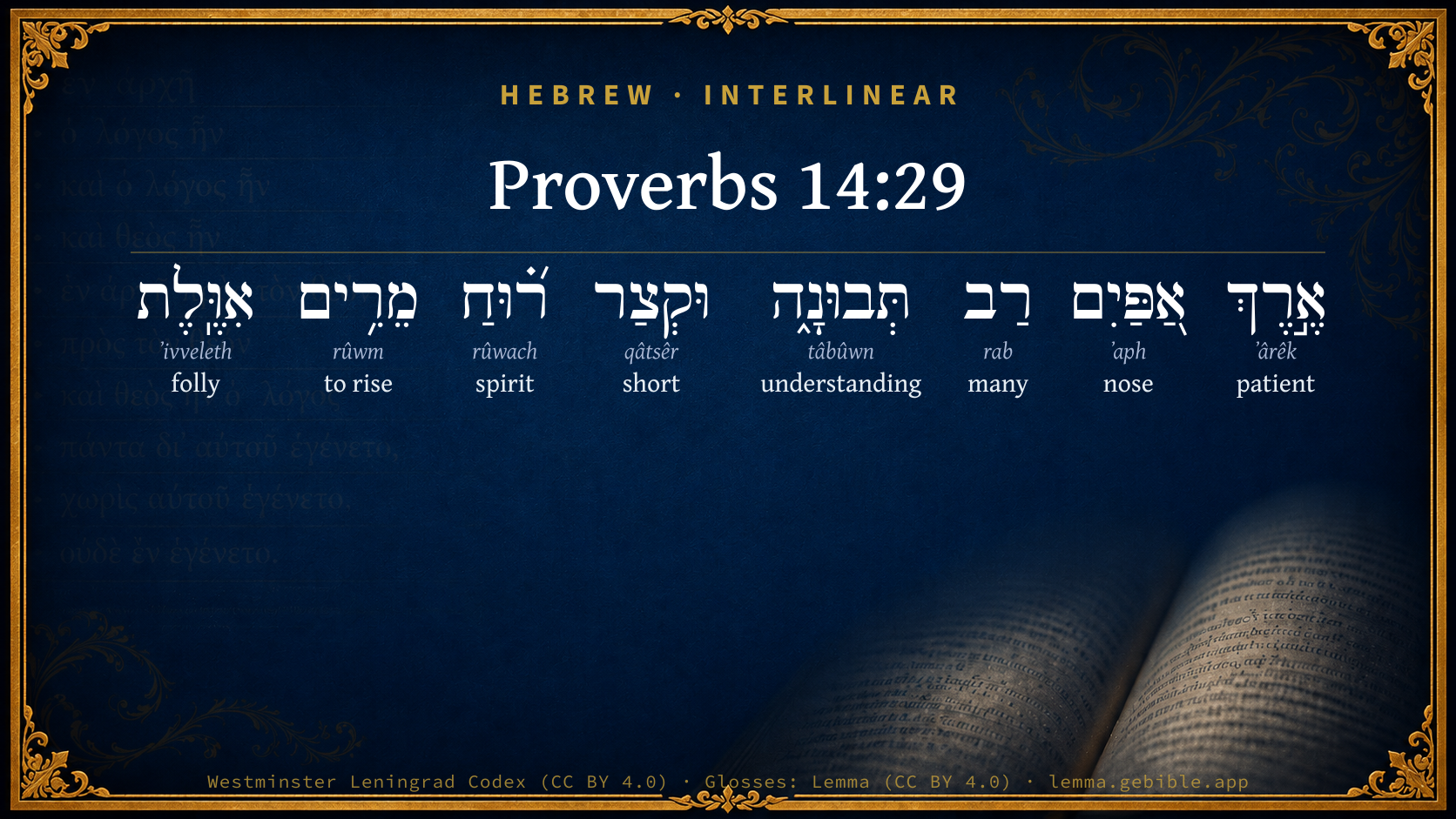
Hebrew (Westminster Leningrad Codex) Proverbs 14:29 appears in the Hebrew Old Testament. The text above is from the Westminster Leningrad Codex. Each word links to its Strong’s number, a concise gloss, and parsing drawn from the Open Scriptures Hebrew Bible morphology. Click any word for its full Brown-Driver-Briggs (BDB) entry.
Download image
Cite this verse

Proverbs 14:29 (World English Bible). Public Domain. Lemma interlinear Bible study tool, https://lemma.gebible.app/v/proverbs/14/29.

Show BibTeX & RIS
BibTeX
RIS
English Translation
He who is slow to anger has great understanding, But he who has a quick temper displays folly.
World English Bible · Public Domain
Download a study sheet

One document with this verse’s original text, its word-by-word gloss line, the meaning frame, cross-references with their text, attributed commentary, and full source and license credits — printable, and it pastes into notes with its structure intact.

This verse Autodidact and up

Study sheet (.html) Plain text (.txt)

A passage Seminary Student

Up to 50 verses in one chapter. A passage sheet keeps up to 6 commentary sources and 12 cross-references per verse, in the order this page ranks them, and says so on the sheet whenever that leaves anything out. Ask for a single verse and you get the Autodidact verse sheet above.

Everything on this page stays free to read, with no account — the sheet is a download of what is already on screen, not access to it.

Want to remove ads? Support Godless Engineer
Compare translations 3

The same verse in 3 English versions, stacked beneath the original-language interlinear above. Click any original word for its lexicon entry.

Each is an independent rendering of the whole verse — the interlinear is not word-aligned to these translations.

Highlighted words mark where these versions differ — a whole-verse word diff, not a word-by-word alignment.

  • World English Bible Public Domain
    He who is slow to anger has great understanding, But he who has a quick temper displays folly.
  • King James Version Public Domain
    He that is slow to wrath is of great understanding: but he that is hasty of spirit exalteth folly.
  • unfoldingWord Literal Text CC BY-SA 4.0
    One long of nostrils abundant understanding, but one short of spirit lifts up folly.

unfoldingWord Literal Text — © unfoldingWord, licensed CC BY-SA 4.0. Word-aligned USFM3 via Door43 (git.door43.org/unfoldingWord/en_ult).

Versions to compare (up to 4)

3 of 4 selected

Show all 18 translations

Every available English version of this verse, each an independent rendering of the whole verse.

  • World English Bible Public Domain
    He who is slow to anger has great understanding, But he who has a quick temper displays folly.
  • Berean Standard Bible Public Domain
    A patient man has great understanding, but a quick-tempered man promotes folly.
  • Majority Standard Bible Public Domain
    A patient man has great understanding, but a quick-tempered man promotes folly.
  • King James Version Public Domain
    He that is slow to wrath is of great understanding: but he that is hasty of spirit exalteth folly.
  • American Standard Version (1901) Public Domain
    He that is slow to anger is of great understanding; But he that is hasty of spirit exalteth folly.
  • Revised Version (1885) Public Domain
    He that is slow to anger is of great understanding: but he that is hasty of spirit exalteth folly.
  • Geneva Bible (1599) Public Domain
    He that is slowe to wrath, is of great wisdome: but he that is of an hastie minde, exalteth follie.
  • Douay-Rheims (1899) Public Domain
    He that is patient, is governed with much wisdom: but he that is impatient, exalteth his folly.
  • Young's Literal Translation Public Domain
    Whoso is slow to anger `is' of great understanding, And whoso is short in temper is exalting folly.
  • Literal Standard Version CC BY-SA 4.0
    Whoever is slow to anger [is] of great understanding, || And whoever is short in temper is exalting folly.
  • Unlocked Literal Bible CC BY-SA 4.0
    A patient person has great understanding, but the quick-tempered person exalts folly.
  • unfoldingWord Literal Text CC BY-SA 4.0
    One long of nostrils abundant understanding, but one short of spirit lifts up folly.
  • Darby Bible Public Domain
    He that is slow to anger is of great understanding; but he that is hasty of spirit exalteth folly.
  • World Messianic Bible Public Domain
    He who is slow to anger has great understanding, but he who has a quick temper displays folly.
  • Webster's Bible Public Domain
    He that is slow to wrath is of great understanding: but he that is hasty of spirit exalteth folly.
  • Free Bible Version CC BY-SA 4.0
    If you're slow to get angry, you're very wise; but if you have a short fuse you glorify stupidity.
  • Bible in Basic English Public Domain
    He who is slow to be angry has great good sense; but he whose spirit is over-quick gives support to what is foolish.
  • JPS Tanakh (1917) Public Domain
    He that is slow to anger is of great understanding; but he that is hasty of spirit exalteth folly.

Literal Standard Version (2020), Covenant Press — licensed CC BY-SA 4.0. Text via the HelloAO Bible API (eBible.org). Unlocked Literal Bible (unfoldingWord) — licensed CC BY-SA 4.0. Text via the HelloAO Bible API (eBible.org). unfoldingWord Literal Text — © unfoldingWord, licensed CC BY-SA 4.0. Word-aligned USFM3 via Door43 (git.door43.org/unfoldingWord/en_ult). Free Bible Version, Dr. Jonathan Gallagher — licensed CC BY-SA 4.0. Text via the HelloAO Bible API (eBible.org).

Word by word

More ways to search: Search by grammar → Find every occurrence → Compare this word →

Practice this passage: Drill this verse → Learn its vocabulary →

About this verse

These counts appear in no published source. They are computed here, from the morphology-tagged text and Lemma’s own curated glosses. What Lemma adds →

8
words
8
distinct lemmas
Wisdom
section

Notable vocabulary

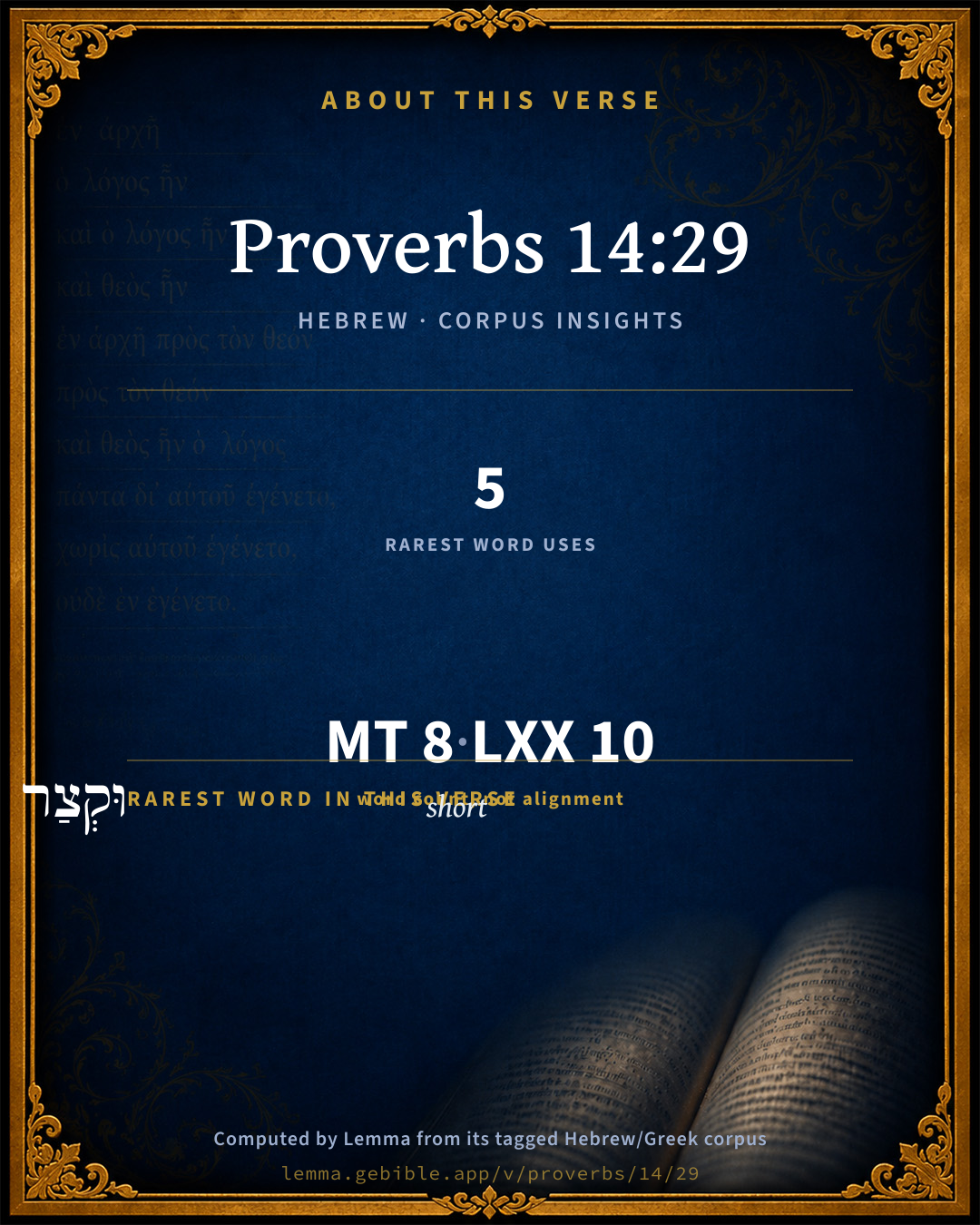
The rarest word here is וּקְצַר short H7116 — appearing just 5 times in the whole Hebrew Bible.

Shared distinctive vocabulary

וּקְצַר short H7116 occurs in 5 verses of the Hebrew Bible. Also found in:

Grammatical profile

  • 1 verb
  • 4 nouns
  • 3 adjectives

Verb forms

  • מֵרִ֥ים Hiphil · Participle Active

Hebrew & Septuagint length

In English translation the verse runs 18 words from the Hebrew and 17 from the Septuagint (LXX English) — closely comparable.

A rough comparison of the two English renderings, which tokenize alike — not a word-level alignment.

Word counts can differ between the Hebrew and the Greek without any difference in meaning — e.g. the Hebrew direct-object marker אֵת has no separate Greek word, and Greek often adds the article ὁ.

In the original languages it is 8 Hebrew tokens and 10 Greek tokens — but the two are counted differently (Hebrew bundles its prefixes and suffixes into one token; the Greek is in lemma form), so that isn’t a like-for-like length.

Cross-references

17

Topical passages linked to Proverbs 14:29 in the Treasury of Scripture Knowledge — connected by theme and wording, ordered by reader-vote popularity; previews shown in the World English Bible.

  • James 1:19 So, then, my beloved brothers, let every man be swift to hear, slow to speak, and slow to anger;
  • Ecclesiastes 7:9 Don't be hasty in your spirit to be angry, for anger rests in the bosom of fools.
  • Proverbs 14:17 He who is quick to become angry will commit folly, And a crafty man is hated.
  • Proverbs 15:18 A wrathful man stirs up contention, But one who is slow to anger appeases strife.
  • Proverbs 19:11 The discretion of a man makes him slow to anger. It is his glory to overlook an offense.
  • Proverbs 16:32 One who is slow to anger is better than the mighty; One who rules his spirit, than he who takes a city.
  • Proverbs 25:28 Like a city that is broken down and without walls Is a man whose spirit is without restraint.
  • Numbers 12:3 Now the man Moses was very humble, above all the men who were on the surface of the earth.
  • Proverbs 22:24–25 Don't befriend a hot-tempered man, And don't associate with one who harbors anger:
  • Matthew 11:29 Take my yoke upon you, and learn from me, for I am gentle and lowly in heart; and you will find rest for your souls.
  • Proverbs 4:8 Esteem her, and she will exalt you. She will bring you to honor, when you embrace her.
  • Proverbs 25:8 Don't be hasty in bringing charges to court. What will you do in the end when your neighbor shames you?
  • Ecclesiastes 10:6 Folly is set in great dignity, and the rich sit in a low place.
  • 1 Corinthians 13:4–5 Love is patient and is kind; love doesn't envy. Love doesn't brag, is not proud,
  • James 3:17–18 But the wisdom that is from above is first pure, then peaceful, gentle, reasonable, full of mercy and good fruits, without partiality, and without hypocrisy.
  • Daniel 3:19–25 Then was Nebuchadnezzar full of fury, and the form of his visage was changed against Shadrach, Meshach, and Abednego: [therefore] he spoke, and commanded that they should heat the furnace seven times more than it was wont to be heated.
  • Matthew 2:16 Then Herod, when he saw that he was mocked by the wise men, was exceedingly angry, and sent out, and killed all the male children who were in Bethlehem and in all the surrounding countryside, from two years old and under, according to the exact time which he had learned from the wise men.

Cross-references courtesy of OpenBible.info (CC BY 4.0).

Hebrew and Greek witnesses Masoretic Hebrew ↔ Greek Septuagint

The same verse in the two great witnesses to the Old Testament, shown verse-for-verse.

These are two independent witnesses, not word-aligned to each other, and the Septuagint is shown in lemma (dictionary) form.

Hebrew Proverbs 14:29 Masoretic · Westminster Leningrad Codex

אֶ֣רֶךְ אַ֭פַּיִם רַב תְּבוּנָ֑ה וּקְצַר ר֝֗וּחַ מֵרִ֥ים אִוֶּֽלֶת

He who is slow to anger has great understanding, But he who has a quick temper displays folly.

World English Bible · Public Domain

Greek LXX Proverbs 14:29 Septuagint · lemma form

μακρόθυμος ἀνήρ πολύς ἐν φρόνησις ὁ δέ ὀλιγόψυχος ἰσχυρῶς ἄφρων

A man slow to wrath abounds in wisdom: but a man of impatient spirit is very foolish.

LXX2012 (modern English Septuagint) · Public Domain

On this verse, The Pulpit Commentary discusses the Septuagint’s reading. Read the note in Commentary ↓

Hebrew: Westminster Leningrad Codex (CC BY 4.0). Greek: Septuagint (public domain); English from LXX2012 (modern English Septuagint) (Public Domain). How the Septuagint differs from the Hebrew →

Commentary

Notes on Proverbs 14:29 from classic Christian and Jewish commentators (each source and its license shown beneath its notes). The classic Christian expositions comment on the surrounding passage and are grouped to its opening verse, so a note may address several verses; the Jewish commentaries on the Tanakh (Rashi and others) are per-verse, so they appear only where the commentator wrote on this verse.

Lemma curates 59 commentaries, every one of them public domain or Creative Commons licensed, each selected and text-cleaned for this edition rather than reprinted as found. About our sources →

Trapp's Complete Commentary

John Trapp

Pro 14:29 [He that is] slow to wrath [is] of great understanding: but [he that is] hasty of spirit exalteth folly.

Ver. 29. He that is slow to anger is of great understanding.] "The wisdom from above is first pure, then peaceable," tractable. Thunder, hail, tempest, neither trouble nor hurt celestial bodies. Anger may rush into a wise man’s bosom, not rest there; {Ecc 7:9} it dwells only where it domineers, and that is only where a fool is master of the family. A wise man either receives it not or soon rids it. Be slow to wrath, is a lesson that God hath engraven, as one wittily observeth in our very nature. For the last letter that any child ordinarily speaketh is R, and that is the radical letter of all words of strife and wrath in almost all languages? {a}

But he that is hasty of spirit exalteth folly.] He sets it up upon a pole, as it were; he makes an Oh yes, and proclaims his own folly by his ireful looks, words, gestures, actions, as that furious friar Feuardensius doth in his book called Theomachia Calvinistica, where he took up his pen with as much passion and wrath as any soldier takes up his sword. Such another hasty fool was friar Alphonsus, the Spaniard, who, reasoning with Mr Bradford, martyr, was in a wonderful rage chafing with om and cho; so that if Bradford had been anything hot, one house could not have held them. {b}

{a} רוע ΰψγ; αρα, οργη; ira, horror, furor ; wrath, war, jar, strife, &c.

{b} Acts and Mon.

John Trapp, A Commentary or Exposition upon All the Books of the Old and New Testament (1647–1656) — public domain. Text from a community e-Sword module.

The Biblical Illustrator

Joseph S. Exell

Pro_14:29

He that is slow to wrath is of great understanding.

Sinful anger

The scope of these words is to beat down sinful anger, a common evil, producing much mischief. In them there is--

1. The excellency of meekness, and--

2. The mischief of passionateness, and the evil thereof.

I. The man that is slow of wrath or anger snows great wisdom and understanding in his meek and peaceable disposition and deportment.

1. The nature of wrath or anger in general. Anger or wrath is a passion which is not of itself sinful, but is either good or ill, as it is regulated; and so it differs from fretting, murmuring, and envy, which can never be good or allowable in any case. Anger is a servant to the meek, but a master to the passionate. The passion of anger is like wind to a ship. If there be a dead calm, and the winds blow not at all, or very weakly, the ship does not make way. And if men be so stupid, indolent, and unconcerned, that their spirits will not stir in them, whatever dishonour they see done to God, these are standing still in the way to heaven. If the wind is brisk enough, but yet is contrary, the ship will at best have much ado with it, and may be driven into a shore which the crew desired not to see. So if mens anger be in itself sinful, it cannot fail of an unhappy event, driving the soul into much sin. Though the wind be not contrary, yet if it be too impetuous and violent, it may dash the ship on rocks and split it. Though a mans anger may have a just ground, yet if it prove excessive and boisterous it may run men headlong into great mischiefs. The ingredients of anger are, a commotion or trouble of the spirit, which ariseth from an apprehension of an injury. Hatred, which is bent against the injury apprehended. Grief, on account of the party or parties injured. A desire for the vindication of the right and honour of the injured. Anger is a passion uneasy, to ones self, compounded of bitter ingredients and uneasy passions; in which one walks on slippery ground, where he is apt to fall headlong.

2. What is it to be slow of wrath? Being slow to take up anger in ones own cause. Managing it warily, when it is taken up, being guided by the light of reason, and not by the fire of passion, and being easy to lay it down. The more slow that anger burns the easier it is to quench.

3. He who is slow of wrath is of great understanding. Such an one thereby shows his duty to God, his sovereign lord, and to himself. He shows that he understands Satans diligence and malice against him, his real interest, and human nature. Be slow to wrath. It is a heaven-like disposition. The comfort of society depends on it. It is necessary for a mans own comfort. It helps to keep ourselves and others from the snare of sin. But there is such a thing as sinful slackness to anger, which may make us omit duties of justice and charity.

II. The passionate man proclaims his folly and naughtiness in his unbridled passion and sinful anger.

1. The nature of sinful anger. Anger is sinful when it riseth without a just ground, having no cause for it assigned by grace or right reason as just. It may rise without any cause at all; or vainly, upon some slight or trifling occasion unworthy of such notice. When it keeps no due proportion with the offence. When it is not directed to the honour of God, and the destruction of sin. When it makes no due difference between the offender and the offence. When the effects of it are sinful. When it is kept up and continued beyond due time.

2. The kinds of sinful anger. Sinful in itself; where there is no just ground. Accidentally sinful; when ill-managed. There is an open and impetuous anger called wrath. A pursuing, implacable wrath, called anger, which is set upon revenge.

3. The effects of sinful anger. Mischievous to the body. Fires the tongue in a particular manner. Disturbs society. Overclouds reason. Unfits a man for duty. The passionate man proclaims his folly. He shows himself to be a proud man, a weak man, incapable of ruling himself; an unmortified man; a rash and precipitant man; an unwatchful man. Practical improvement of this subject--Use of humiliation and conviction; of exhortation. Desire of provoking and stirring up others to passion; for Gods sake, and for your neighbours sake, as well as for your own sake. Watch and pray, that ye enter not into temptation. And if at any time you are caught, hasten out of the snare. Dallying with temptation is the fair way to entangle you further; therefore fly from it as from a serpent, lest ye be stung to death thereby. (T. Boston, D.D.)

Religion the restraint of impetuous passion

Death is at all times appalling to nature; but never so frightful as when it comes by the hands of the public executioner. To this the text provides an antidote. The man who lives in the fear of the Lord is not likely to die an untimely, much less an ignominious death. The case of martyrs is excepted.

I. Explain the nature of true religion. What is the principle, its rule, and its object.

1. Its principle is the love of God. This love to God must be supreme. And wherever love is present, it will be evidenced by a desire to comply with the wishes, and obey the commands of the person loved.

2. That the rule of true religion is the revealed will of God, as found in the Scriptures.

3. The object of true religion is the glory of God. Religion in the heart can never be satisfied with anything short of the Divine glory as the great object of life.

II. While destitute of the influence of religion, men are perpetually in danger of being overcome by the impetuosity of their passions.

1. Principles directly opposite to those of true religion exist in the human heart.

2. Circumstances are continually arising which may call these unholy principles into active operation.

3. There is grave danger, in the absence of true religion, that excited passion will prevail. Impetuosity can be effectually restrained and subdued only by the power of religious principle. (Essex Remembrancer.)

Slow to wrath

Lord Macaulay has remarked that there are some unhappy men constitutionally prone to the darker passions, men to whom bitter words are as natural as snarling and biting to a ferocious dog; and he asserts that to come into the world with this wretched mental disease is a greater calamity than to be born blind or deaf. A man, he proceeds to say, who, having such a temper, keeps it in subjection, and constrains himself to behave habitually with justice and humanity towards those who are in his power, seems worthy of the highest admiration. There have been instances of this self command; and they are among the most signal triumphs of philosophy and religion. In eulogies of the Emperor Justinian this characteristic is not to be slighted, that he was a master of the angry passions, which rage with such destructive violence in the breast of a despot. Of Mohammed we are told that he was naturally irritable, but had brought his temper under great control, so that even in the self-indulgent intercourse of domestic life he was kind and tolerant. I served him from the time I was eight years old, said his servant Anus, and he never scolded me for anything, though things were spoilt by me. Adam Smith traces from school and playground the progress and, so to speak, natural history of self-control, and shows on what grounds, and in what way, the child advances in self-command, studies to be more and more master of itself, and tries to exercise over its own feelings a discipline which the practice of the longest life is very seldom sufficient to bring to complete perfection. (W. Arnot, D.D.)

The Biblical Illustrator, edited by Joseph S. Exell (c. 1880s–1900s) — public domain. Text from a community e-Sword module.

Joseph Benson's Commentary

Pro 14:29. He that is slow to wrath, &c. — He who is not soon provoked to anger by reproaches or ill usage, shows himself to be a wise and great man; but he that is hasty of spirit exalteth folly — Exposes his folly, and makes it apparent to every body. Hebrew, מרים אולת, lifteth up folly, displays it like a banner.

Joseph Benson's Commentary on the Old and New Testaments (1811–1818) — public domain. Text from a community e-Sword module.

The Preacher's Complete Homiletical Commentary

Joseph S. Exell (gen. ed.)

MAIN HOMILETICS OF Pro_14:29

GREAT UNDERSTANDING

I. There are times and occasions when wrath is not only allowable, but right. A man who is incapable of being angry lacks an element of perfection. Anger against wrong-doing is possible without any feeling of vindictiveness or malice towards the wrong-doer. There is much in the Bible about the “wrath of God” (Rom_1:18), although He is “love” (1Jn_4:8). A child does not honour a parent the less, but the more, because he knows that parent can be angry when there is just occasion. Neither could we reverence God if He was a Being who could not be displeased.

II. But a man who is slow to wrath shows—

1. That he understands himself. Even the holy and all-perfect God is “slow to anger” (Neh_9:17). Although He could not misjudge any creature, and although He could never by any possibility allow His wrath to exceed the bounds of perfect justice and righteousness, He is not “soon angry.” The man who understands his own frailty and short-sightedness will not allow anger to take possession of his spirit in a hurry, if he is to “be angry and sin not” (Eph_4:26), he must only be angry after due reflection upon the cause of his anger.

2. That he understands others. Hasty and passionate anger never convinces the offender of his guilt, but awakens wrath in his breast also. But the displeasure which is the result of calm consideration may carry some weight with it. On this subject see also Homiletics on Pro_14:17.

OUTLINES AND SUGGESTIVE COMMENTS

“He that is hasty of spirit exalteth folly.” He gives folly for the time being the throne and sceptre of his mind, and fulfils her preposterous and mischievous dictates. And when reason, for the time deposed, resumes her vacated seat, she finds no easy task before her to repair the evils which have been done in the brief but stormy reign of passion.—Wardlaw.

I. The passion of anger is like wind to the ship: so it is to the soul called to steer its course to Immanuel’s land.

1. If there be a dead calm, and the winds blow not at all, or very weakly, the ship does not make way. And if men be so stupid, indolent, and unconcerned, that their spirits will not stir in them, whatever dishonour they see done to God, these are standing still in the way to heaven. And many there be, who are all fire in their own matters, but in those of God their hearts are dead as a stone. Such was the case of Eli: “His sons made themselves vile, and he restrained them not” (1Sa_3:13). It was not so with Paul: for “his spirit was stirred in him, when he saw the city wholly given to idolatry” (Act_17:16).

2. If the wind is brisk enough, but yet is contrary, the ship will at best have much ado with it, and may be driven into a shore which the crew desired not to see. So if men’s anger be in itself sinful, if their anger burn against what is good and just: such anger cannot fail of an unhappy event.

3. Though the wind be not contrary, yet if it be too impetuous and violent, it may dash the ship on rocks, and split it. So though men’s anger may have a just ground, yet if it prove excessive and boisterous, it may run men headlong into great mischiefs. Oft-times reason lets anger into the breast; but then anger turns out reason to the door, and carries on all precipitantly without reason or discretion: like one that brings in coal to his hearth, because of the cold, but unwarily lets it fall on tow, which sets the house on fire. II. He that is slow to wrath.

1. Is slow to take up anger in his own cause. It is wisdom indeed to be very tender of God’s honour, but more indifferent about our own personal interests, as Moses was.

2. Manages it warily when it is taken up. He finds himself on slippery ground, and is therefore slow in his motions.

3. Is easy to lay it down (Eph_4:26-27). He shuts it out when there is no more use for it. III. The passionate man proclaims his folly—he proclaims himself—

1. A proud man, and the proud man is a fool in God’s account and in the account of all who understand themselves.

2. A weak man. He is a slave to his passions.

3. An unwatchful man, who has his enemies within him, without him, round about him, and yet cannot be brought to stand on his guard (Pro_4:23-24).—Boston.

Wise anger is like fire from the flint, there is a great ado to bring it out; and when it does come, it is out again immediately.—Henry.

The intoxication of anger, like that of the grape, shows us to others, but hides us from ourselves.—Southgate’s “Many Thoughts on Many Things.”

The heaviest body is slowest in going, but his treading is the surest; in like manner, he that is slow to anger recompenses the dulness of his steps with the soundness of his proceeding; for he taketh leisure (as it were) to look to his ways. Tertullian says, “Where the injury is little, there is no need of patience; but where the injury is great, there is the help of patience more needful against it. If they be small wrongs, contemn them for their smallness; if great wrongs, by patience give way unto them in respect of their greatness.” The original of hasty, is short-winded. For as haste in going maketh the breath to be short, so the haste of the soul to anger maketh that to puff and blow on every small occasion; so that the soul is as it were climbing up a great hill, there to exalt her folly, for all to behold it.—Jermin.

The Preacher's Complete Homiletical Commentary (gen. ed. Joseph S. Exell; Funk & Wagnalls, c. 1892) — public domain (pre-1929). A full-Bible homiletical/sermon-outline anthology covering 65 of 66 books (2 John is absent from the source module). Text from a community e-Sword module.

Tyndale Open Study Notes

Tyndale Open Resources

14:29 Wise people can control their emotions and express them appropriately.

Tyndale Open Study Notes — © Tyndale Open Resources, licensed CC BY-SA 4.0. Text via the HelloAO Bible API.

Matthew Henry's Commentary

Note, 1. Meekness is wisdom. He rightly understands himself, and his duty and interest, the infirmities of human nature, and the constitution of human society, who is slow to anger, and knows how to excuse the faults of others as well as his own, how to adjourn his resentments, and moderate them, so as by no provocation to be put out of the possession of his own soul. A mild patient man is really to be accounted an intelligent man, one that learns of Christ, who is Wisdom itself. 2. Unbridled passion is folly proclaimed: He that is hasty of spirit, whose heart is tinder to every spark of provocation, that is all fire and tow, as we say, he thinks hereby to magnify himself and make those about stand in awe of him, whereas really he exalts his own folly; he makes it known, as that which is lifted up is visible to all, and he submits himself to it as to the government of one that is exalted.

Matthew Henry's Commentary on the Whole Bible (1708–1710) — public domain (CC PDM 1.0). Text via the HelloAO Bible API.

Jamieson, Fausset & Brown

Robert Jamieson, A. R. Fausset & David Brown

slow . . . understanding--(Compare Pro 14:17).

hasty--(Compare Pro 14:17).

exalteth folly--makes it conspicuous, as if delighting to honor it.

Jamieson, Fausset & Brown — Commentary Critical and Explanatory on the Whole Bible (1871) — public domain (CC PDM 1.0). Text via the HelloAO Bible API.

Adam Clarke's Commentary

Verse 29. That is hasty of spirit] קצר רוח ketsar ruach, "the short of spirit;" one that is easily irritated; and, being in a passion, he is agitated so as to be literally short of breath. Here put in opposition to ארך אפים erech appayim, long of nostrils; see on Pr 14:17; and of the same import with St. Paul's μακροθυμια, longsuffering, longmindedness. See on Eph 4:2.

Adam Clarke's Commentary on the Bible (1810–1826) — public domain. Text from a community e-Sword/MySword module.

Ellicott's Commentary for English Readers

(29) He that is hasty of spirit exalteth folly—i.e., brings it into view, or shows himself highly foolish. Or it may signify, “he takes up and carries away folly as his portion,” as Pro_3:35 may be translated, “fools receive shame for their portion.”

A Bible Commentary for English Readers, edited by Charles John Ellicott (1878–1897) — public domain. Text from a community e-Sword module.

The Cambridge Bible for Schools and Colleges

gen. ed. J. J. S. Perowne

29. slow to wrath] Comp. βραδὺς εἰς ὀργήν, Jas_1:19.

exalteth] The Heb. word may either mean, with A.V. and R.V. text, lifteth up, i.e. gives it prominence, brings it into notice; or, with R.V. marg., taketh up, and so carrieth away, as his possession. The first of these is to be preferred.

The Cambridge Bible for Schools and Colleges (gen. ed. J. J. S. Perowne; Cambridge University Press, 1878–1918) — public domain. Text from a community e-Sword module.

John Gill's Exposition

He that is slow to wrath is of great understanding,.... Or "long in wrath" (e); it is long before he is angry; he is longsuffering, bears much and long, is very patient; such an one appears to understand himself and human nature, and has a great command over his passions; which shows him to be a man of great wisdom and understanding;

but he that is hasty of spirit exalteth folly; or is "short of spirit" (f); is soon angry; presently discovers resentment in his words, looks, and gestures; such an one "exalts folly", prefers it to wisdom, sets it above himself, and makes it his master: or he "lifts" it (g) up; exposes his folly to public view, so that it is seen of all men to his disgrace.

(e) "longus iris", Vatablus; "longus naribus", Montanus; "longus narium", Schultens. (f) "brevis spiritu", Montanus, Vatblus. Cocceius, Merceus, Michaelis; "curtus spiritu", Schultens. (g) "attollit", Mercerus, Piscator; "alte proclamat", Schultens; "elevat", Baynus.

John Gill's Exposition of the Whole Bible (1746–1763) — public domain (CC PDM 1.0). Text via the HelloAO Bible API.

Albert Barnes' Notes on the Bible

Exalteth folly - Lifts it up, as it were, on high, and exposes it to the gaze of all men.

Albert Barnes' Notes on the Bible (1834–1885) — public domain. Text from a community e-Sword/MySword module.

Matthew Poole's English Annotations

Is of great understanding; showeth great and true wisdom in conquering his sinful and shameful passions.

Exalteth, Heb. lifteth up, like a banner; makes it known and visible to all men.

Matthew Poole's English Annotations on the Holy Bible (1683–1685) — public domain. Text from a community e-Sword/MySword module.

Whedon's Commentary on the Bible

Daniel D. Whedon

29. Slow to wrath — Is patient, forbearing, self-controlling.

Is of great understanding — Shows himself to be a man of sense and prudence.

Exalteth folly — Lifts it up, makes it conspicuous. “Exhibits folly.” — Speaker’s Commentary. “Enhances folly.” — Miller.

Daniel D. Whedon (gen. ed.), Commentary on the Old and New Testaments (1874–1909) — public domain. Text from a community e-Sword module.

The Pulpit Commentary

He that is slow to wrath is of great understanding. The Hebrew expression for what the Septuagint calls makroyumov , "long suffering," and the Vulgate, patiens, is "long in nostrils", (Pro_15:18) as the contrary temper, which we had in ver. 17, is "short in nostrils." That organ, into which was breathed the breath of life, (Gen_2:7) is taken as the seat of the inward spirit, and as showing by exterior signs the dominant feeling. The original is very terse, "long in nostrils, great in understanding." A man"s prudence and wisdom are displayed by his being slow to take offence and being patient under injury. He that is hasty of spirit exalteth folly; i.e. flaunts it in the eyes of all men, makes plain exposure of it. Septuagint, "He who is short in temper is a mighty fool." "Passion," says an old saw, "makes fools of the wise. and shows the folly of the foolish". (comp. Pro_12:23 Pro_13:16) The word rendered "exalteth," XXX (marim), occurs in Pro_3:35, and is taken by Delitzsch and Nowack in the sense of "carries away" as the assured result. "By anger," says St. Gregory ("Moral.," 5:78), "wisdom is parted with, so that we are left wholly in ignorance what to do, and in what order to do it.... Anger withdraws the light of understanding, while by agitating it troubles the mind."

The Pulpit Commentary (1880–1919), ed. H.D.M. Spence-Jones & Joseph S. Exell — public domain. Text from a community e-Sword module.

John Wesley's Explanatory Notes

Exalteth - Hebrew. lifteth up, like a banner, makes it known and visible to all men.

John Wesley, Explanatory Notes Upon the Whole Bible (1754–1765) — public domain. Text via the GEBible commentary corpus.

Keil & Delitzsch

C. F. Keil & F. Delitzsch

29 He that is slow to anger is rich in understanding;

But he that is easily excited carries off folly.

ארך אפּים (constr. of ארך) is he who puts off anger long, viz., the outbreak of anger, האריך, Pro 19:11, i.e., lets it not come in, but shuts it out long (μακρόθυμος = βραδὺς εἰς ὀργήν, Jam 1:19); and קצר־רוּח, he who in his spirit and temper, viz., as regards anger (for רוּח denotes also the breathing out and snorting, Isa 25:4; Isa 33:11), is short, i.e., (since shortness of time is meant) is rash and suddenly (cf. quick to anger, praeceps in iram, 17a) breaks out with it, not ὀλιγόψυχος (but here ὀξύθυμος), as the lxx translate 17a. The former, who knows how to control his affections, shows himself herein as "great in understanding" (cf. Sa2 23:20), or as a "man of great understanding" (Lat. multus prudenti); the contrary is he who suffers himself to be impelled by his affections into hasty, inconsiderate action, which is here expressed more actively by מרים אוּלת. Does this mean that he bears folly to the view (Luther, Umbreit, Bertheau, Elster, and others)? But for that idea the Mishle style has other expressions, Pro 12:23; Pro 13:16; Pro 15:2, cf. Pro 14:17. Or does it mean that he makes folly high, i.e., shows himself highly foolish (lxx, Syr., Targum, Fleischer, and others)? But that would be expressed rather by הגדּיל or הרבּה. Or is it he heightens folly (Lwenstein, Hitzig)? But the remark that the angry ebullition is itself a gradual heightening of the foolish nature of such an one is not suitable, for the choleric man, who lets the evenness of his disposition be interrupted by a breaking forth of anger, is by no means also in himself a fool. Rashi is right when he says, מפרישה לחלקו, i.e., (to which also Fleischer gives the preference) aufert pro portione sua stultitiam. The only appropriate parallel according to which it is to be explained, is Pro 3:35. But not as Ewald: he lifts up folly, which lies as it were before his feet on his life's path; but: he takes off folly, in the sense of Lev 6:8, i.e., he carries off folly, receives a portion of folly; for as to others, so also to himself, when he returns to calm blood, that which he did in his rage must appear as folly and madness.

Keil & Delitzsch — Biblical Commentary on the Old Testament (1861–1891) — public domain (CC PDM 1.0). Text via the HelloAO Bible API. (Old Testament only.)

Bridges on Proverbs

Charles Bridges

The world judge very lightly of a hasty spirit, except when it touches themselves. ’It is a fit of passion, soon over and forgotten.’ But does God judge so? See how his word stamps the native rooted principle. It is "giving place to the devil;†1 grieving the Holy Spirit;"†2 contrary to the mind and example of Christ;†3 inconsistent with the profession of the Gospel;†4 degrading human nature;†5 a work of the flesh, that shuts out from heaven,†6 and condemns to hell.†7 Surely then to be slow to wrath — such a fruitful source of sin and misery — is a proof of great understanding. (Pro 19:11 ; Pro 20:3 . Jas 3:17 .) It is as if we felt our just dignity, and high obligations. But too often, instead of being slow to wrath, the spirit is hasty, and finds a short way to wrath. It is as tinder to every spark of provocation, and at one step hurries into the midst of wrath. There is often a sourness of spirit, that sits upon men, by which they are angry at they know not what; lighting into a flame at the most trifling matters, such as in cooler moments we shall be ashamed at having contended for. Terrible flames have arisen from these trifling sparks.†8 This is indeed exalting folly on an eminence to be seen by all. (Pro 3:35 .) Yet too often passion serves instead of law and reason, and this folly is deemed high-mindedness and proper spirit. Oh! it is a mercy to be delivered from the standard of this world, and to live, act, and judge by the standard of God and his word.

But let the children of God remember that a hasty spirit condemned the meekest of men. (Psa 106:32-33 .) Never was folly more exalted, than by the fretful selfishness of a prophet of the LORD. (Jon 4:1-11 .) The gentlest spirit needs to be cast into a deep mold of lowliness and love for communion with God. (Isa 57:15 . 1Jn 4:16 .) Who can plead inability to resist? Has not God given understanding to shew the temper; reason to govern it; his Word and Spirit to crucify it? Realize our obligations to sovereign grace, as the effective discipline for this baneful propensity. (Jas 1:18-19 .)

Footnotes:

†1 Eph 4:26-27.

†2 Eph 4:30.

†3 Mat 11:29. Php 2:3-5 . 1Pe 2:23 .

†4 Col 3:8, Col 3:12-13 .

†5 Pro 17:12; Pro 25:8 ; Pro 29:20 .

†6 Gal 5:19-21.

†7 Mat 5:22.

†8 See on Pro 14:17 .

Charles Bridges, An Exposition of the Book of Proverbs (1846) — public domain. Text from a community e-Sword module.

Kretzmann's Popular Commentary

Paul E. Kretzmann

v. 29. He that is slow to wrath, he who is able to control himself, who has himself well in hand at all times, is of great understanding, he will always have a clear mind to discriminate properly; but he that is hasty of spirit, rash and quick-tempered, exalteth folly, is bound to carry foolishness to excess, to make a fool of himself.

Paul E. Kretzmann, Popular Commentary of the Bible (1921–1924) — public domain. Text from a community e-Sword module.

Rashi

Rabbi Shlomo Yitzchaki (Rashi)

selects folly Heb. מרים, he separates it for his share.

Rashi on the Tanakh — English translations: “The Judaica Press complete Tanach with Rashi, translated by A. J. Rosenberg” (CC BY 4.0); “Pentateuch with Rashi's commentary by M. Rosenbaum and A.M. Silbermann, 1929-1934” (public domain); “The Metsudah Tanach series, Lakewood, N.J” (CC BY 4.0); and “The Book of Joshua, Metsudah Publications, 1997” (CC BY 4.0). Text via Sefaria.

Lesson kit

Teaching starters — assembled from the data on this page, not authored interpretation. Every prompt links to the verse data it draws on. Edit before teaching.

Proverbs, in the Wisdom, opens this verse with 8 words (8 distinct Hebrew lemmas). Its most distinctive word is qâtsêr (“short”). A historical commentator’s framing appears above. Read the whole chapter for the surrounding context.

Discussion questions

  1. What does “short” (qâtsêr) contribute to the verse as a whole?
  2. How does 2 Kings 19:26, which shares the word «short», read alongside this verse?
  3. These translations render this verse differently. What is at stake in choosing one wording over another?
  4. «מֵרִ֥ים» is a Hiphil Participle Active verb. How does that grammatical form shape the action described?
  5. Compare how Trapp's Complete Commentary and The Biblical Illustrator read this verse. Where do they agree or differ?

Things to notice

Reading settings

Reading text

Shown beneath each verse's original-language words.

Old Testament
Old Testament edition

Read the OT as the Masoretic Hebrew (MT) or the Greek Septuagint (LXX).

English shown for the Greek Septuagint (in the Hebrew ↔ Greek comparison).

Comparing translations? Open the Compare panel on any verse page to stack up to four side by side.