

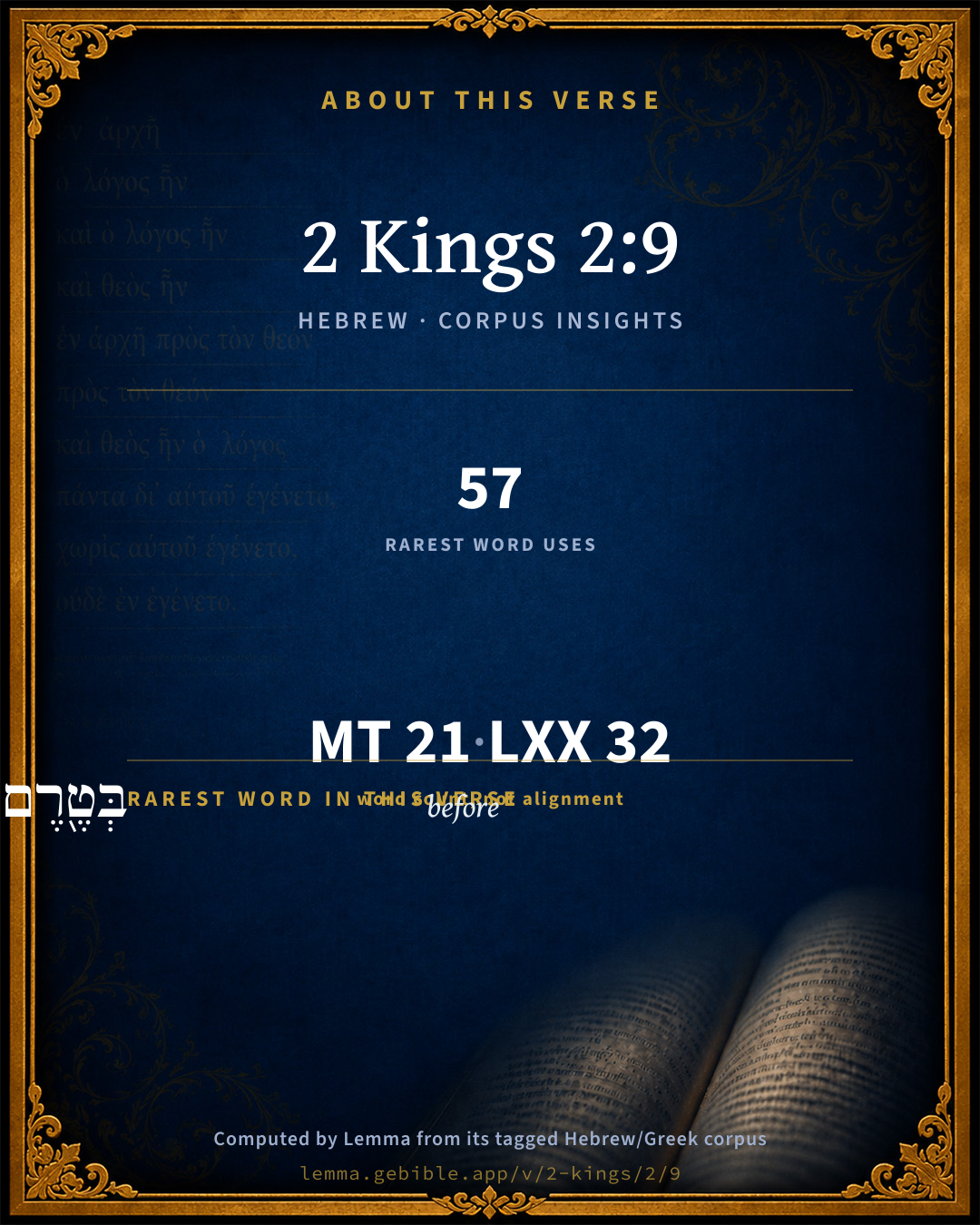
2 Kings 2:9

Hebrew (Westminster Leningrad Codex) 2 Kings 2:9 appears in the Hebrew Old Testament. The text above is from the Westminster Leningrad Codex. Each word links to its Strong’s number, a concise gloss, and parsing drawn from the Open Scriptures Hebrew Bible morphology. Click any word for its full Brown-Driver-Briggs (BDB) entry.
Download image
Cite this verse

2 Kings 2:9 (World English Bible). Public Domain. Lemma interlinear Bible study tool, https://lemma.gebible.app/v/2-kings/2/9.

Show BibTeX & RIS
BibTeX
RIS
English Translation
It happened, when they had gone over, that Elijah said to Elisha, Ask what I shall do for you, before I am taken from you. Elisha said, please let a double portion of your spirit be on me.
World English Bible · Public Domain
Download a study sheet

One document with this verse’s original text, its word-by-word gloss line, the meaning frame, cross-references with their text, attributed commentary, and full source and license credits — printable, and it pastes into notes with its structure intact.

This verse Autodidact and up

Study sheet (.html) Plain text (.txt)

A passage Seminary Student

Up to 50 verses in one chapter. A passage sheet keeps up to 6 commentary sources and 12 cross-references per verse, in the order this page ranks them, and says so on the sheet whenever that leaves anything out. Ask for a single verse and you get the Autodidact verse sheet above.

Everything on this page stays free to read, with no account — the sheet is a download of what is already on screen, not access to it.

Want to remove ads? Support Godless Engineer
Compare translations 3

The same verse in 3 English versions, stacked beneath the original-language interlinear above. Click any original word for its lexicon entry.

Each is an independent rendering of the whole verse — the interlinear is not word-aligned to these translations.

Highlighted words mark where these versions differ — a whole-verse word diff, not a word-by-word alignment.

  • World English Bible Public Domain
    It happened, when they had gone over, that Elijah said to Elisha, Ask what I shall do for you, before I am taken from you. Elisha said, please let a double portion of your spirit be on me.
  • King James Version Public Domain
    And it came to pass, when they were gone over, that Elijah said unto Elisha, Ask what I shall do for thee, before I be taken away from thee. And Elisha said, I pray thee, let a double portion of thy spirit be upon me.
  • unfoldingWord Literal Text CC BY-SA 4.0
    And it happened, when they had crossed over, that Elijah said to Elisha, “Ask what I shall do for you before I am taken from with you.” And Elisha said, “Then may a double portion of your spirit please be to me.”

unfoldingWord Literal Text — © unfoldingWord, licensed CC BY-SA 4.0. Word-aligned USFM3 via Door43 (git.door43.org/unfoldingWord/en_ult).

Versions to compare (up to 4)

3 of 4 selected

Show all 18 translations

Every available English version of this verse, each an independent rendering of the whole verse.

  • World English Bible Public Domain
    It happened, when they had gone over, that Elijah said to Elisha, Ask what I shall do for you, before I am taken from you. Elisha said, please let a double portion of your spirit be on me.
  • Berean Standard Bible Public Domain
    After they had crossed over, Elijah said to Elisha, “Tell me, what can I do for you before I am taken away from you?” “Please, let me inherit a double portion of your spirit,” Elisha replied.
  • Majority Standard Bible Public Domain
    After they had crossed over, Elijah said to Elisha, “Tell me, what can I do for you before I am taken away from you?” “Please, let me inherit a double portion of your spirit,” Elisha replied.
  • King James Version Public Domain
    And it came to pass, when they were gone over, that Elijah said unto Elisha, Ask what I shall do for thee, before I be taken away from thee. And Elisha said, I pray thee, let a double portion of thy spirit be upon me.
  • American Standard Version (1901) Public Domain
    And it came to pass, when they were gone over, that Elijah said unto Elisha, Ask what I shall do for thee, before I am taken from thee. And Elisha said, I pray thee, let a double portion of thy spirit be upon me.
  • Revised Version (1885) Public Domain
    And it came to pass, when they were gone over, that Elijah said unto Elisha, Ask what I shall do for thee, before I be taken from thee. And Elisha said, I pray thee, let a double portion of thy spirit be upon me.
  • Geneva Bible (1599) Public Domain
    Nowe when they were passed ouer, Eliiah saide vnto Elisha, Aske what I shall doe for thee before I be taken from thee. And Elisha saide, I pray thee, let thy Spirit be double vpon me.
  • Douay-Rheims (1899) Public Domain
    And when they were gone over, Elias said to Eliseus: Ask what thou wilt have me to do for thee, before I be taken away from thee. And Eliseus said: I beseech thee that in me may be thy double spirit.
  • Young's Literal Translation Public Domain
    And it cometh to pass, at their passing over, that Elijah hath said unto Elisha, `Ask, what do I do for thee before I am taken from thee?' and Elisha saith, `Then let there be, I pray thee, a double portion of thy spirit unto me;'
  • Literal Standard Version CC BY-SA 4.0
    And it comes to pass, at their passing over, that Elijah has said to Elisha, “Ask what I do for you before I am taken from you.” And Elisha says, “Indeed, please let there be a double portion of your spirit to me”;
  • Unlocked Literal Bible CC BY-SA 4.0
    It came about, after they had crossed over, that Elijah said to Elisha, “Ask me what I should do for you before I am taken from you.” Elisha replied, “Please let a double portion of your spirit come on me.”
  • unfoldingWord Literal Text CC BY-SA 4.0
    And it happened, when they had crossed over, that Elijah said to Elisha, “Ask what I shall do for you before I am taken from with you.” And Elisha said, “Then may a double portion of your spirit please be to me.”
  • Darby Bible Public Domain
    And it came to pass when they had gone over, that Elijah said to Elisha, Ask what I shall do for thee, before I am taken away from thee. And Elisha said, I pray thee, let a double portion of thy spirit be upon me.
  • World Messianic Bible Public Domain
    When they had gone over, Elijah said to Elisha, “Ask what I shall do for you, before I am taken from you.” Elisha said, “Please let a double portion of your spirit be on me.”
  • Webster's Bible Public Domain
    And it came to pass, when they had gone over, that Elijah said to Elisha, Ask what I shall do for thee, before I am taken away from thee. And Elisha said, I pray thee, let a double portion of thy spirit be upon me.
  • Free Bible Version CC BY-SA 4.0
    When they arrived on the other side, Elijah asked Elisha, “What can I do for you before I'm taken from you?” “Please let me have a double amount of your spirit,” Elisha replied.
  • Bible in Basic English Public Domain
    And when they had come to the other side, Elijah said to Elisha, Say what you would have me do for you before I am taken from you. And Elisha said, Be pleased to let a special measure of your spirit be on me.
  • JPS Tanakh (1917) Public Domain
    And it came to pass, when they were gone over, that Elijah said unto Elisha: 'Ask what I shall do for thee, before I am taken from thee.' And Elisha said: 'I pray thee, let a double portion of thy spirit be upon me.'

Literal Standard Version (2020), Covenant Press — licensed CC BY-SA 4.0. Text via the HelloAO Bible API (eBible.org). Unlocked Literal Bible (unfoldingWord) — licensed CC BY-SA 4.0. Text via the HelloAO Bible API (eBible.org). unfoldingWord Literal Text — © unfoldingWord, licensed CC BY-SA 4.0. Word-aligned USFM3 via Door43 (git.door43.org/unfoldingWord/en_ult). Free Bible Version, Dr. Jonathan Gallagher — licensed CC BY-SA 4.0. Text via the HelloAO Bible API (eBible.org).

Word by word

More ways to search: Search by grammar → Find every occurrence → Compare this word →

Practice this passage: Drill this verse → Learn its vocabulary →

בְּטֶ֖רֶם
ṭerem
H2962
“in/at · before”
Preposition + Adverb
Part of Speech
Preposition + Adverb
Full BDB Definition

Origin: from an unused root apparently meaning to interrupt or suspend

TWOT: 826

before, not yet, before that
  1. וַיְהִ֣י hâyâh H1961 “and · to be” Conjunction + Verb, Qal, Sequential Imperfect, 3rd Person, Masculine, Singular
  2. כְעָבְרָ֗ם ʻâbar H5674 “like/as · to pass over · them” Preposition + Verb, Qal, Infinitive Construct + Suffix, Personal, 3rd Person, Masculine, Plural
  3. וְאֵ֨לִיָּ֜הוּ ʼÊlîyâh H452 “and · Elijah” Conjunction + Noun, Proper
  4. אָמַ֤ר ʼâmar H559 “to say” Verb, Qal, Perfect, 3rd Person, Masculine, Singular
  5. אֶל ʼêl H413 “to” Preposition
  6. אֱלִישָׁע֙ ʼĔlîyshâʻ H477 “Elisha” Noun, Proper
  7. שְׁאַל֙ shâʼal H7592 “ask” Verb, Qal, Imperative, 2nd Person, Masculine, Singular
  8. מָ֣ה mâh H4100 “what” Particle, Interrogative
  9. אֶֽעֱשֶׂה ʻâsâh H6213 “to do” Verb, Qal, Imperfect, 1st Person, Common, Singular
  10. אֶלָּקַ֣ח lâqach H3947 “to take” Verb, Niphal, Imperfect, 1st Person, Common, Singular
  11. מֵעִמָּ֑ךְ ʻim H5973 “from · with · you” Preposition + Preposition + Suffix, Personal, 2nd Person, Feminine, Singular
  12. וַיֹּ֣אמֶר ʼâmar H559 “and · to say” Conjunction + Verb, Qal, Sequential Imperfect, 3rd Person, Masculine, Singular
  13. אֱלִישָׁ֔ע ʼĔlîyshâʻ H477 “Elisha” Noun, Proper
  14. וִֽיהִי hâyâh H1961 “and · to be” Conjunction + Verb, Qal, Jussive, 3rd Person, Masculine, Singular
  15. נָ֛א nâʼ H4994 “please” Particle, Exhortation
  16. פִּֽי peh H6310 “mouth of” Noun, Common, Masculine, Singular, Construct
  17. שְׁנַ֥יִם shᵉnayim H8147 “two” Adjective, Cardinal number, Masculine, Dual, Absolute
  18. בְּרוּחֲךָ֖ rûwach H7307 “in/at · spirit · your” Preposition + Noun, Common, Both, Singular, Construct + Suffix, Personal, 2nd Person, Masculine, Singular
  19. אֵלָֽי ʼêl H413 “to · me” Preposition + Suffix, Personal, 1st Person, Common, Singular

About this verse

These counts appear in no published source. They are computed here, from the morphology-tagged text and Lemma’s own curated glosses. What Lemma adds →

21
words
16
distinct lemmas
Historical
section

Shared distinctive vocabulary

בְּטֶ֖רֶם before H2962 occurs in 50 verses of the Hebrew Bible. Also found in:

Grammatical profile

  • 8 verbs
  • 5 nouns
  • 1 adjective
  • 4 prepositions
  • 1 adverb
  • 2 particles

Verb forms

  • וַיְהִ֣י Qal · Sequential Imperfect
  • כְעָבְרָ֗ם Qal · Infinitive Construct
  • אָמַ֤ר Qal · Perfect
  • שְׁאַל֙ Qal · Imperative
  • אֶֽעֱשֶׂה Qal · Imperfect
  • אֶלָּקַ֣ח Niphal · Imperfect
  • וַיֹּ֣אמֶר Qal · Sequential Imperfect
  • וִֽיהִי Qal · Jussive

Repetition

Words recur within this verse — often emphatic in Hebrew:

  • וַיְהִ֣י to be H1961 ×2
  • אָמַ֤ר to say H559 ×2
  • אֱלִישָׁע֙ Elisha H477 ×2
  • אֶל to H413 ×2

Hebrew & Septuagint length

In English translation the verse runs 38 words from the Hebrew and 46 from the Septuagint (LXX English) — closely comparable.

A rough comparison of the two English renderings, which tokenize alike — not a word-level alignment.

Word counts can differ between the Hebrew and the Greek without any difference in meaning — e.g. the Hebrew direct-object marker אֵת has no separate Greek word, and Greek often adds the article ὁ.

In the original languages it is 21 Hebrew tokens and 32 Greek tokens — but the two are counted differently (Hebrew bundles its prefixes and suffixes into one token; the Greek is in lemma form), so that isn’t a like-for-like length.

Cross-references

22

Topical passages linked to 2 Kings 2:9 in the Treasury of Scripture Knowledge — connected by theme and wording, ordered by reader-vote popularity; previews shown in the World English Bible.

  • Numbers 11:17 I will come down and talk with you there: and I will take of the Spirit which is on you, and will put it on them; and they shall bear the burden of the people with you, that you not bear it yourself alone.
  • Deuteronomy 21:17 but he shall acknowledge the firstborn, the son of the hated, by giving him a double portion of all that he has; for he is the beginning of his strength; the right of the firstborn is his.
  • John 16:7 Nevertheless I tell you the truth: It is to your advantage that I go away, for if I don't go away, the Counselor won't come to you. But if I go, I will send him to you.
  • Acts 20:25–36 Now, behold, I know that you all, among whom I went about preaching the Kingdom of God, will see my face no more.
  • Numbers 11:25 Yahweh came down in the cloud, and spoke to him, and took of the Spirit that was on him, and put it on the seventy elders: and it happened that when the Spirit rested on them, they prophesied, but they did so no more.
  • Zechariah 12:8 In that day Yahweh will defend the inhabitants of Jerusalem. He who is feeble among them at that day will be like David, and the house of David will be like God, like the angel of Yahweh before them.
  • Acts 1:8 But you will receive power when the Holy Spirit has come upon you. You will be witnesses to me in Jerusalem, in all Judea and Samaria, and to the uttermost parts of the earth."
  • Acts 8:17 Then they laid their hands on them, and they received the Holy Spirit.
  • Deuteronomy 34:9 Joshua the son of Nun was full of the spirit of wisdom; for Moses had laid his hands on him: and the children of Israel listened to him, and did as Yahweh commanded Moses.
  • 1 Kings 3:9 Give your servant therefore an understanding heart to judge your people, that I may discern between good and evil; for who is able to judge this your great people?
  • 2 Kings 13:14–19 Now Elisha was fallen sick of his sickness of which he died: and Joash the king of Israel came down to him, and wept over him, and said, My father, my father, the chariots of Israel and the horsemen of it!
  • 2 Chronicles 1:9–10 Now, Yahweh God, let your promise to David my father be established; for you have made me king over a people like the dust of the earth in multitude.
  • Psalms 72:20 This ends the prayers by David, the son of Jesse.
  • Zechariah 9:12 Turn to the stronghold, you prisoners of hope! Even today I declare that I will restore double to you.
  • Luke 24:45–51 Then he opened their minds, that they might understand the Scriptures.
  • John 14:12–14 Most assuredly I tell you, he who believes in me, the works that I do, he will do also; and greater works than these will he do; because I am going to my Father.
  • John 17:9–13 I pray for them. I don't pray for the world, but for those whom you have given me, for they are yours.
  • 1 Corinthians 12:31 But earnestly desire the best gifts. Moreover, I show a most excellent way to you.
  • 1 Timothy 5:17 Let the elders who rule well be counted worthy of double honor, especially those who labor in the word and in teaching.
  • Numbers 27:16–23 Let Yahweh, the God of the spirits of all flesh, appoint a man over the congregation,
  • 1 Chronicles 29:18–19 Yahweh, the God of Abraham, of Isaac, and of Israel, our fathers, keep this forever in the imagination of the thoughts of the heart of your people, and prepare their heart to you;
  • Psalms 72:1 God, give the king your justice; Your righteousness to the royal son.

Cross-references courtesy of OpenBible.info (CC BY 4.0).

Hebrew and Greek witnesses Masoretic Hebrew ↔ Greek Septuagint

The same verse in the two great witnesses to the Old Testament, shown verse-for-verse.

These are two independent witnesses, not word-aligned to each other, and the Septuagint is shown in lemma (dictionary) form.

Hebrew 2 Kings 2:9 Masoretic · Westminster Leningrad Codex

וַיְהִ֣י כְעָבְרָ֗ם וְאֵ֨לִיָּ֜הוּ אָמַ֤ר אֶל אֱלִישָׁע֙ שְׁאַל֙ מָ֣ה אֶֽעֱשֶׂה לָּ֔ךְ בְּטֶ֖רֶם אֶלָּקַ֣ח מֵעִמָּ֑ךְ וַיֹּ֣אמֶר אֱלִישָׁ֔ע וִֽיהִי נָ֛א פִּֽי שְׁנַ֥יִם בְּרוּחֲךָ֖ אֵלָֽי

It happened, when they had gone over, that Elijah said to Elisha, Ask what I shall do for you, before I am taken from you. Elisha said, please let a double portion of your spirit be on me.

World English Bible · Public Domain

Greek LXX 2 Kings 2:9 Septuagint · lemma form

καί γίγνομαι ἐν ὁ διαβαίνω αὐτός καί ηλιου εἶπον πρός ελισαιε αἰτέω τίς ποιέω σύ πρίν ἤ ἀναλαμβάνω ἐγώ ἀπό σύ καί εἶπον ελισαιε γίγνομαι δή διπλοῦς ἐν πνεῦμα σύ ἐπί ἐγώ

And it came to pass while they were crossing over, that Eliu said to Elisaie, Ask what I shall do for you before I am taken up from you. And Elisaie said, Let there be, I pray you, a double portion of your spirit upon me.

LXX2012 (modern English Septuagint) · Public Domain

Hebrew: Westminster Leningrad Codex (CC BY 4.0). Greek: Septuagint (public domain); English from LXX2012 (modern English Septuagint) (Public Domain). How the Septuagint differs from the Hebrew →

Targum (Aramaic paraphrase)

1

The Targum is the ancient Jewish Aramaic paraphrase of the Hebrew Scriptures — an interpretive translation, not the Hebrew text itself. Onkelos (literal) and Pseudo-Jonathan (expansive) render the Torah, and Jonathan the Prophets. Coverage is partial: where no permissively-licensed English translation exists for a verse, only the Aramaic is shown. This is verse-level text, not a word-by-word alignment to the Hebrew.

  1. Targum Jonathan Prophets (Joshua–Malachi)
    וַהֲוָה כְמֶעְבַּרְהוֹן וְאֵלִיָהוּ אֲמַר לֶאֱלִישָׁע שְׁאַל מָה אַעְבֵּיד לָךְ עַד דְלָא אִידַבַּר מִלְוָתָךְ וַאֲמַר אֱלִישָׁע וִיהֵי כְעַן עַל חַד תְּרֵין בְּרוּחַ נְבוּאֲתָךְ עִמִי:

    (no public-domain English translation for this verse)

    Targum Jonathan — Aramaic: “Mikraot Gedolot” (public domain). English: “Sefaria Community Translation” (CC0 1.0 (public-domain dedication)); “London "Chaldee Paraphrase," 1871” (public domain). Text via Sefaria.

Commentary

Notes on 2 Kings 2:9 from classic Christian and Jewish commentators (each source and its license shown beneath its notes). The classic Christian expositions comment on the surrounding passage and are grouped to its opening verse, so a note may address several verses; the Jewish commentaries on the Tanakh (Rashi and others) are per-verse, so they appear only where the commentator wrote on this verse.

Lemma curates 59 commentaries, every one of them public domain or Creative Commons licensed, each selected and text-cleaned for this edition rather than reprinted as found. About our sources →

Trapp's Complete Commentary

John Trapp

2Ki 2:9 And it came to pass, when they were gone over, that Elijah said unto Elisha, Ask what I shall do for thee, before I be taken away from thee. And Elisha said, I pray thee, let a double portion of thy spirit be upon me.

Ver. 9. Ask what I shall do for thee before.] Not after I am gone, but before I go up. We have a communion with the saints departed, not a commerce.

Let a double portion,] i.e., Two parts of three, saith Vatablus: the portion of the firstborn, say others, which was double to his brethren; so would Elijah have a larger measure of the gifts of the Spirit, than any ordinary prophets inasmuch as he was to succeed his master. {1Ki 19:16} Some read it thus, Let the double portion of thy spirit be upon me: and then he wisheth no more than to be like his master Elijah. Thus Irenaeus proved very like Polycarp, John the Evangelist’s disciple. Thus Paraeus succeeding his master Ursinus in the College of Wisdom at Heidelberg, expressed him to the life: whence Paulus Melissus, the poet,

“ Sacra docente Pareo,

Vividus Ursini spiritus ora movet. ”

John Trapp, A Commentary or Exposition upon All the Books of the Old and New Testament (1647–1656) — public domain. Text from a community e-Sword module.

The Biblical Illustrator

Joseph S. Exell

2Ki_2:9

Ask what I shall do for thee, before I be taken away from thee.

A final interview between good men

The two names here mentioned represent two of the most remarkable men in the history of the world. Both stood faithful in a faithless age. Through both, heavenly wisdom announced its truths, and Almighty energy wrought its marvels. Both were valiant for truth. In this final interview of these illustrious men, we find something to lament, something to admire, something to study, and something to imitate.

I. Here is something to lament. The departure of a great and good man from this world is a subject for lamentation. There are two things that show this to be a lamentable occurrence,

1. The event involves a positive decrease in the amount of means for the worlds improvement. Heavens plan to raise the world is by the ministry of the good. Good men are Gods agents to improve the world.

2. The event involves a positive increase in the amount of the worlds responsibilities. The worlds responsibilities are proportioned to its means of improvement;--Unto whomsoever much is given, cf him shall be much required. The life of a good man adds to the worlds responsibility. Thus its mighty sum of accountability daily augments. The more good the life, the greater the addition to the amount. Christs life was the best, and hence He said, If I had not come and spoken unto them, they had not had sin.

II. Here is something to admire. What do we see here to admire?

1. Sublime calmness in the most solemn crisis. Truly solemn was the position Elijah now occupied, for he stands on the line that separates time from eternity. On one side of the line there were many scenes on earth dear to memory, many persons precious to his heart, many works that he had wrought, and much that he had left unfinished. On the other side there was eternity.

2. A generous interest in friends in the last hour of earthly life. Ask me, he says, what I shall do for thee before I be taken from thee? Though in close approximation to eternity, his affection for his friend was unimpaired. Death does not quench our love.

3. A consciousness of power to confer benefit in the last hour, Ask what I shall do for thee, implying a consciousness of power to confer good. A good man has power at all times to confer good, even on his deathbed; on his expiring couch he can exhibit fortitude under suffering, resignation to the Divine will, intercessory sympathies for the living. Deathbeds have often proved signally useful to attendant friends.

III. Here is something to study. There are two important principles suggested in this text which demand our attention:--

1. That men can only benefit their race while they are living upon earth. Before I am taken away from thee, said Elijah; implying I shall do nothing for thee when I am gone. I shall be where I cannot communicate thought, or render one act of service. Our work on earth is done when we leave it. When we die we cannot return to discharge any neglected duty.

2. That our power to benefit men will depend upon their consent. Ask what I shall do for thee. If men resist we are powerless; our instrumentality is moral, our best thoughts, our purest sympathies, our devoted efforts will all go for nothing, if men will not consent to our influence.

IV. Here is something to imitate. In the conduct of Elisha we see two things worthy of imitation.

1. A perception of real worth. I pray thee let a double portion of thy spirit be upon me.

2. An aspiration after real worth. I pray thee let a double portion. Here is coveting earnestly the best gift. (Homilist.)

I pray thee, let a double portion of thy spirit be upon me.

Elishas request

I. Its meaning.

1. A double portion.

(1) Not twice as much as thou. That might have been the prayer not of ambition to excel Elijah, but of humility. In myself so inferior that I need double portion to succeed thee.

(2) Better: the portion of first-born (Deu_21:17); twice as much as any other son of the prophets. All claim a portion. My work and responsibility greatest; to be head of the family in thy place. Give me right of the first-born-a double portion.

2. Thy spirit. Gods Spirit: who came upon Samson, Saul, David, Elijah himself (2Ki_2:16). But still Elijahs spirit (2Ki_2:15). In three senses his:--

(1) His own. Not separable, as property, friends, means of grace, etc. In him (Joh_4:14). Not hand without upholding, but cordial within, strengthening.

(2) His characteristically. One Spirit, but manifold gifts. Natural character remains, etc.

(3) His in its influence. Elishas request granted. Character moulded by Elijahs spirit, yet not obliterated. Still Elisha, not Elijah. Marked contrast between them. Elijah type of John Baptist, Elisha of Christ.

II. Its application.

1. To intercourse of friends. Elijah friend of Elisha.

2. To official relations. Elisha pupil of Elijah. Conclusion. Our intercourse with friends, our relations as teachers, parents, ministers, etc., are they such as, when the parting comes, to warrant the request, I pray thee, etc.? (Archdeacon Perowne.)

The spirit of Elijah

Elijah, with his clear-eyed vision, saw that Elisha and not himself was the man to be considered at this hour; the parting meant more to Elisha than it did to himself. Elijah knew that all was right between him and God. He had no doubts about his future. I do not suppose he had the slightest intimation as to the peculiar manner in which he would leave the earth, although his words indicate a premonition that he was not to die in the natural, usual way. But in whatever way God called him, Elijah was safe. His work was done. His record was made up. Heaven and immortal glory, with the crown of eternal life, remained for him. Elisha, however, was in the midst of the struggle of life. He was to remain in the warring and striving world. He was to stand before wicked kings and ungodly men as the messenger of God. He would need every possible help and blessing that he might not fall or faint by the day. Ah, it is not death that the good man needs to fear. Living is infinitely more serious than dying. If we live well, we shall die well. We are not for a moment to suppose that there was anything selfish or ambitious in the request of Elisha. He was not asking that he might be twice as great as Elijah. He was thinking of the great need of the people and how much the loss of Elijah would mean, and he felt how small were his own powers and gifts compared to those of the great man whom he had loved and followed. He is asking that upon his own gifts and powers, which seem to him so small, a double portion of the spirit that had made Elijah so great may rest and make him strong to do the work of God which was now to fall upon his shoulders. The response of Elijah was significant. He answered, Thou hast asked a hard thing: nevertheless, if thou see me when I am taken from thee, it shall be so unto thee; but if not, it shall not be so. Dr. William M. Taylor sees in this answer of Elijah this meaning: The sight of Elijahs ascension gave to Elisha a firmer and more vivid faith in the reality of the unseen life than he had ever had before and greater than even Elijah had ever known. It remains for us to find our message in considering what constituted this spirit of Elijah, a double portion of which Elisha desired as the greatest boon that could come to him. For every one of us who is striving to live the good life to-day will find it as valuable a possession as it was to Elisha.

1. It was a vital faith in the presence and power of God in the world. There was Elijahs power. He believed God. God was real to him. God was not lost to Elijahs sight by the creation which He had made. Elijah saw God present in the midst of His world with unlimited power and control. This gave him all his courage. It was the same force that made John Knox a greater terror to a wicked queen than all the armies of Scotland. It was the same force that made Luther the greatest man of Ms day.

2. The spirit of Elijah was the spirit of obedience. He obeyed God promptly, without questioning; we never should have heard of him but for that. He kept his ear open, listening to God, and he went swiftly to do the Divine bidding. That was what gave value to Elijahs conduct. Think of the millions of Christians in the world to-day. If they all had Elijahs spirit of obedience, what revolutions would come about. The gambling hell would be abolished for ever. War would die out of the earth, and the Gospel would speedily be preached to every creature, if only all the men and women who bear the name of Jesus Christ had Elijahs spirit of implicit obedience to God.

3. Elijahs spirit was a spirit of supreme courage born of this faith and obedience. (L. A. Banks, D. D.)

The noblest legacy of the departed good

I. The greatest need, the most solemn position, is not with those who are leaving the world, but with those who remain. Not Elijah, but Elisha requires strength and help. It was a perception of Elishas greater need that prompted the invitation.

II. Our power to bless others is limited by our lives. Before I be taken away from thee. Elijah cannot pledge himself to anything after his departure. While yet he lingers upon me earth he may help and mess his successor. We can only bless the world while we are present in it.

III. The noblest legacy of the departed good, and the measure in which we should ask to possess it. Let a double portion of thy spirit be upon me. This was the wisest request Elisha could have presented. What are we to understand by thy spirit? We think he must mean that which was the animating principle of Elijahs character, the master passion of his soul--his fidelity to God, and zeal for His name. This spirit of the great and good is their noblest legacy, our richest inheritance.

1. The spirit of Elijah was the secret of Elishas power. We are prone to place a mans power in natural gifts and external advantages. But all experience proves that, in the work of the Lord, a simple, earnest, soul-possessing faithfulness is superior to all beside. He who has it, whatever else he may have or have not, is a true Elijah, who shall bring down the sacred fire, not upon a slaughtered bullock, but upon the souls of men.

2. The spirit of the great and good alone can compensate for their departure and loss.

3. The spirit of the great and good is alone unchanging in its character, and meets the requirements of every age.

4. To catch and inherit the spirit of the good and great is to attain the deepest and truest resemblance to them. (W. Perkins.)

What is the best service I can render my fellows

The giving fact of life is a fact permanent and wonderful. Steadily each of us is giving his fellows somewhat.

I. Volitionally we may give--e.g., money, place, knowledge. Better than these, we may volitionally give a helping sympathy.

II. But unvolitionally, unconsciously, we are giving to our fellows; St. Peters shadow (Act_5:15). Every one of us is streaming upon his fellows an unconscious influence Our practical question is--What is the best gift any one can yield his fellows? I find the answer in our Scripture.

1. The best gift one can yield his fellows is character--the double portion of a noble spirit.

2. This fact, that the best gift we can yield our fellows is character, that the best service we can render them is the imparting of a noble spirit, has important applications--

(1) To our friendships--noble friendships, as Elisha did with Elijah, we shall get nobleness.

(2) To marriage. For the associations of marriage are the closest possible. And if each were noble, what nobleness has not each to each imparted?

(3) To parenthood. The character of the parent is reproduced in the child.

(4) The great character-giver is Jesus Christ. There is no failure in Him, as there was, to some extent, in Elijah. (Homiletic Review.)

The Biblical Illustrator, edited by Joseph S. Exell (c. 1880s–1900s) — public domain. Text from a community e-Sword module.

Joseph Benson's Commentary

2Ki 2:9. Ask what I shall do for thee, before I be taken away from thee — Elijah, undoubtedly, had an inward assurance that God would grant him his last request that he should make; but we may observe here, that he expressly confines it to its being made before he was taken away, and gives no manner of hope to his disciple, that his asking any thing of him after he was removed would be of any avail, or that he could then render him any service. I pray, let a double portion of thy spirit be upon me — Double to what the rest of the sons of the prophets receive at thy request. He alludes to the double portion of the firstborn, Deu 21:17. But though Elisha desired no more, yet God gave him more than he desired or expected; and he seems to have had a greater portion of the gifts of God’s Spirit than even Elijah had.

Joseph Benson's Commentary on the Old and New Testaments (1811–1818) — public domain. Text from a community e-Sword module.

Tyndale Open Study Notes

Tyndale Open Resources

2:9-10 A firstborn son, as the primary heir, inherited a double share of his father’s estate (Deut 21:17); Elisha asked that Elijah’s God-given spiritual abilities and privileges might continue to live through him.

Tyndale Open Study Notes — © Tyndale Open Resources, licensed CC BY-SA 4.0. Text via the HelloAO Bible API.

Geneva Bible (1599)

Geneva Bible translators

Let thy Spirit have double force in me, because of these dangerous times: or let me have twice so much as the rest of the Prophets: or thy spirit being divided into three parts, let me have two.

Geneva Bible (1599) marginal notes — public domain. Text via Bolls.life.

Matthew Henry's Commentary

Here, I. Elijah makes his will, and leaves Elisha his heir, now anointing him to be prophet in his room, more than when he cast his mantle upon him, Kg1 19:19.

1. Elijah, being greatly pleased with the constancy of Elisha's affection and attendance, bade him ask what he should do for him, what blessing he should leave him at parting; he does not say (as bishop Hall observes), "Ask of me when I am gone, in heaven I shall be better able to befriend thee," but, "Ask before I go." Our friends on earth may be spoken to, and can give us an answer, but we know not that we can have access to any friend in heaven but Christ, and God in him. Abraham is ignorant of us.

2. Elisha, having this fair opportunity to enrich himself with the best riches, prays for a double portion of his spirit. He asks not for wealth, nor honour, nor exemption from trouble, but to be qualified for the service of God and his generation, he asks, (1.) For the Spirit, not that the gifts and graces of the Spirit were in Elijah's power to give, therefore he says not, "Give me the Spirit" (he knew very well it was God's gift), but "Let it be upon me, intercede with God for this for me." Christ bade his disciples ask what they would, not one, but all, and promised to send the Spirit, with much more authority and assurance than Elijah could. (2.) For his spirit, because he was to be a prophet in his room, to carry on his work, to father the sons of the prophets and face their enemies, because he had the same perverse generation to deal with that he had, so that, if he have not his spirit, he has not strength according to the day. (3.) For a double portion of his spirit; he does not mean double to what Elijah had, but double to what the rest of the prophets had, from whom so much would not be expected as from Elisha, who had been brought up under Elijah. It is a holy ambition to covet earnestly the best gifts, and those which will render us most serviceable to God and our brethren. Note, We all ought, both ministers and people, to set before us the example of our predecessors, to labour after their spirit, and to be earnest with God for that grace which carried them through their work and enabled them to finish well.

3. Elijah promised him that which he asked, but under two provisos, Kg2 2:10. (1.) Provided he put a due value upon it and esteem it highly: this he teaches him to do by calling it a hard thing, not too hard for God to do, but too great for him to expect. Those are best prepared for spiritual blessings that are most sensible of their worth and their own unworthiness to receive them. (2.) Provided he kept close to his master, even to the last, and was observant of him: If thou see me when I am taken from thee, it shall be so, otherwise not. A diligent attendance upon his master's instructions, and a careful observance of his example, particularly now in his last scene, were the condition and would be a proper means of obtaining much of his spirit. Taking strict notice of the manner of his ascension would likewise be of great use to him. The comforts of departing saints, and their experiences, will mightily help both to gild our comforts and to steel our resolutions. Or, perhaps, this was intended only as a sign: "If God favour thee so far as to give thee a sight of me when I ascend, take that for a token that he will do this for thee, and depend upon it." Christ's disciples saw him ascend, and were thereupon assured that they should, in a little time, be filled with his Spirit, Act 1:8. Elisha, we may suppose, hereupon prayed earnestly, Lord, show me this token for good.

II. Elijah is carried up to heaven in a fiery chariot, Kg2 2:11. Like Enoch, he was translated, that he should not see death; and was (as Mr. Cowley expresses it) the second man that leaped the ditch where all the rest of mankind fell, and went not downward to the sky. Many curious questions might be asked about this matter, which could not be answered. Let it suffice that we are here told,

1. What his Lord, when he came, found him doing. He was talking with Elisha, instructing and encouraging him, directing him in his work, and quickening him to it, for the good of those whom he left behind. He was not meditating nor praying, as one wholly taken up with the world he was going to, but engaged in edifying discourse, as one concerned about the kingdom of God among men. We mistake if we think our preparation for heaven is carried on only by contemplation and the acts of devotion. Usefulness to others will pass as well in our account as any thing. Thinking of divine things is good, but talking of them (if it come from the heart) is better, because for edification, Co1 14:4. Christ ascended as he was blessing his disciples.

2. What convoy his Lord sent for him - a chariot of fire and horses of fire, which appeared either descending upon them from the clouds or (as bishop Patrick thinks) running towards them upon the ground: in this form the angels appeared. The souls of all the faithful are carried by an invisible guard of angels into the bosom of Abraham; but, Elijah being to carry his body with him, this heavenly guard was visible, not in a human shape, as usual, though they might so have borne him up in their arms, or carried him as on eagles' wings, but that would have been to carry him like a child, like a lamp (Isa 40:11, Isa 40:31); they appear in the form of a chariot and horses, that he may ride in state, may ride in triumph, like a prince, like a conqueror, yea, more than a conqueror. The angels are called in scripture cherubim and seraphim, and their appearance here, though it may seem below their dignity, answers to both those names; for (1.) Seraphim signifies fiery, and God is said to make them a flame of fire, Psa 104:4. (2.) Cherubim (as many think) signifies chariots, and they are called the chariots of God (Psa 68:17), and he is said to ride upon a cherub (Psa 18:10), to which perhaps there is an allusion in Ezekiel's vision of four living creatures, and wheels, like horses and chariots; in Zechariah's vision, they are so represented, Zac 1:8; Zac 6:1. Compare Rev 6:2, etc. See the readiness of the angels to do the will go God, even in the meanest services, for the good of those that shall be heirs of salvation. Elijah must remove to the world of angels, and therefore, to show how desirous they were of his company, some of them would come to fetch him. The chariot and horses appeared like fire, not for burning, but brightness, not to torture or consume him, but to render his ascension conspicuous and illustrious in the eyes of those that stood afar off to view it. Elijah had burned with holy zeal for God and his honour, and now with a heavenly fire he was refined and translated.

3. How he was separated from Elisha. This chariot parted them both asunder. Note, The dearest friends must part. Elisha had protested he would not leave him, yet now is left behind by him.

4. Whither he was carried. He went up by a whirlwind into heaven. The fire tends upward; the whirlwind helped to carry him through the atmosphere, out of the reach of the magnetic virtue of this earth, and then how swiftly he ascended through the pure ether to the world of holy and blessed spirits we cannot conceive.

"But where he stopped will ne'er be known,

'Till Phenix-nature, aged grown,

To a better being shall aspire,

Mounting herself, like him, to eternity in fire."

- Cowley

Elijah had once, in a passion, wished he might die; yet God was so gracious to him as not only not to take him at his word then, but to honour him with this singular privilege, that he should never see death; and by this instance, and that of Enoch, (1.) God showed how men should have left the world if they had not sinned, not by death, but by a translation. (2.) He gave a glimpse of that life and immortality which are brought to light by the gospel, of the glory reserved for the bodies of the saints, and the opening of the kingdom of heaven to all believers, as then to Elijah. It was also a figure of Christ's ascension.

III. Elisha pathetically laments the loss of that great prophet, but attends him with an ecomium, Kg2 2:12. 1. He saw it; thus he received the sign by which he was assured of the grant of his request for a double portion of Elijah's spirit. He looked stedfastly towards heaven, whence he was to expect that gift, as the disciples did, Act 1:10. he saw it awhile, but the vision was presently out of his sight; and he saw him no more. 2. He rent his own clothes, in token of the sense he had of his own and the public loss. Though Elijah had gone triumphantly to heaven, yet this world could ill spare him, and therefore his removal ought to be much regretted by the survivors. Surely their hearts are hard whose eyes are dry when God, by taking away faithful useful men, calls for weeping and mourning. Though Elijah's departure made way for Elisha's eminency, especially since he was now sure of a double portion of his spirit, yet he lamented the loss of him, for he loved him, and could have served him for ever. 3. He gave him a very honourable character, as the reason why he thus lamented the loss of him. (1.) He himself had lost the guide of his youth: My father, my father. He saw his own condition like that of a fatherless child thrown upon the world, and lamented it accordingly. Christ, when he left his disciples, did not leave them orphans (Joh 14:15), but Elijah must. (2.) The public had lost its best guard; he was the chariot of Israel, and the horsemen thereof. He would have brought them all to heaven, as in this chariot, if it had not been their own fault; they used not chariots and horses in their wars, but Elijah was to them, by his counsels, reproofs, and prayers, better than the strongest force of chariot and horse, and kept off the judgments of God. His departure was like the routing of an army, an irreparable loss. "Better have lost all our men of war than this man of God."

Matthew Henry's Commentary on the Whole Bible (1708–1710) — public domain (CC PDM 1.0). Text via the HelloAO Bible API.

Jamieson, Fausset & Brown

Robert Jamieson, A. R. Fausset & David Brown

Elijah said unto Elisha, Ask what I shall do for thee--trusting either that it would be in his power to bequeath it, or that God, at his entreaty, would grant it.

let a double portion of thy spirit be upon me--This request was not, as is commonly supposed, for the power of working miracles exceeding the magnitude and number of his master's, nor does it mean a higher endowment of the prophetic spirit; for Elisha was neither superior to, nor perhaps equally great with, his predecessor. But the phrase, "a double portion," was applied to the first-born [Deu 21:17], and therefore Elisha's request was, simply, to be heir to the prophetic office and gifts of his master.

Jamieson, Fausset & Brown — Commentary Critical and Explanatory on the Whole Bible (1871) — public domain (CC PDM 1.0). Text via the HelloAO Bible API.

Adam Clarke's Commentary

Verse 9. A double portion of thy spirit be upon me.] This in reference to the law, De 21:17: He shall acknowledge the first-born, by giving him a DOUBLE PORTION of all that he hath - the right of the first-born is his. Elisha considered himself the only child or first-born of Elijah, as the disciples of eminent teachers were called their children; so here he claims a double portion of his spiritual influence, any other disciples coming in for a single share only. Sons of the prophets means no more than the disciples or scholars of the prophets. The original words פי שנים pi shenayim, mean rather two parts, than double the quantity.

Adam Clarke's Commentary on the Bible (1810–1826) — public domain. Text from a community e-Sword/MySword module.

Ellicott's Commentary for English Readers

(9) I pray thee, let . . .—Literally, And (i.e., well, then) let there fall, I pray thee, a portion of two in thy spirit, unto me.

A double portion.—The expression used in Deu_21:7 of the share of the firstborn son, who by the Mosaic law inherited two parts of his father’s property.

Elisha asks to be treated as the firstborn among “the sons of the prophets,” and so to receive twice as great a share of “the spirit and power” of his master as any of the rest. “Let me be the firstborn among thy spiritual sons;” “Make me thy true spiritual heir;” not “Give me twice as great a share of the spirit of prophecy as thou possessest thyself,” as many have wrongly interpreted. The phrase, “a mouth of two,” seems to be a metaphor derived from the custom of serving honoured guests with double, and even greater, messes (Gen_43:34).

Ask what I shall do for thee . . . from thee.—As a dying father, Elijah might wish to bless his spiritual son ere his departure (Gen_27:4). (Comp. 2Ki_2:12 infra, “My father, my father.”)

A Bible Commentary for English Readers, edited by Charles John Ellicott (1878–1897) — public domain. Text from a community e-Sword module.

The Cambridge Bible for Schools and Colleges

gen. ed. J. J. S. Perowne

9. when they were gone over] Or, with margin of R.V., ‘as they went over’. There was now no other place to visit, and the end was felt to be close at hand. Both probably thought how near they were coming to the spot where the earlier prophet Moses had been taken from the earth. In crossing the Jordan Elijah stood again on the slopes of his native Gilead. Was he impelled by that strong desire which so often makes men wish to die among the scenes of their childhood?

before I be taken away from thee] R.V. omits ‘away’, rather inconsistently, for ‘take away’ is kept as the rendering of the same verb in verses 3 and 5.

The subject which had been filling both their hearts, the approaching separation, is at last mentioned. The master would help in whatever way he could the disciple who has been chosen to fill his place; and the question tests the character of Elisha. It shews that he felt that he must act with the same undaunted courage and boldness, and that he knew the needs of the times.

let a double portion of thy spirit be upon me] The request is not, as some have thought, for twice the spirit of the departing master. And the attempts which have been made to shew that in some ways Elisha went beyond Elijah are utterly pointless. What Elisha wants is what a father may rightly give to a firstborn son. In Deu_21:17 it is prescribed that to the firstborn shall be given a double portion of all which the father possesses, so that he may have twice as much as each of the other sons. But we are not to think here of the whole of the schools of the prophets as sharing in the gift which Elijah was to bestow. Such slavery to the letter is absurd. What Elisha longs for is such a blessing as will shew that he is esteemed as the dearest member of that band whom Elijah had most trusted.

The Cambridge Bible for Schools and Colleges (gen. ed. J. J. S. Perowne; Cambridge University Press, 1878–1918) — public domain. Text from a community e-Sword module.

John Gill's Exposition

And he said, thou hast asked a hard thing,.... Not a common privilege, but what is rarely enjoyed, and difficult to obtain, few are so favoured of God:

nevertheless, if thou see me when I am taken from thee, it shall be so unto thee, but if not, it shall not be so; meaning, that if his rapture was visible to Elisha, and he was favoured with a sight of his assumption, and be an eyewitness of it, this would be a token both to Elijah that it was agreeable to the Lord to ask of him this favour for him, and to Elisha to expect it, otherwise not.

John Gill's Exposition of the Whole Bible (1746–1763) — public domain (CC PDM 1.0). Text via the HelloAO Bible API.

Albert Barnes' Notes on the Bible

Let a double portion of thy spirit be upon me - Like Solomon, Elisha asks for no worldly advantage, but for spiritual power to discharge his office aright. The “double portion” is that which denotes the proportion of a father’s property which was the right of an eldest son Deu 21:17. Elisha therefore asked for twice as much of Elijah’s spirit as should be inherited by any other of the “sons of the prophets.” He simply claimed, i. e., to be acknowledged as Elijah’s firstborn spiritual son.

Albert Barnes' Notes on the Bible (1834–1885) — public domain. Text from a community e-Sword/MySword module.

Haydock's Catholic Bible Commentary

Double spirit. A double portion of thy spirit, as thy eldest son and heir: or thy spirit, which is double, in comparison of that which God usually imparteth to his prophets; (Challoner) or the power of working miracles, as well as of prophesying. (Worthington) --- He wishes to excel his fellow disciples, rather than his master. (Tirinus) (Cajetan) (Amama) --- Double often means, great and perfect, Jeremias xvii. 18. If Eliseus even begged that he might perform more and greater wonders than his master, (as Christ enabled his disciples to surpass himself, in this particular, John xiv. 12.; Haydock) he might do it without pride, purely for the glory of God. He certainly shone forth with peculiar splendour; and some have enumerated sixteen or twenty-four of his miracles, while they can only find eight (Lyranus) or twelve recorded of Elias. See Cornelius a Lapide, in Ecclesiasticus xlviii. 13. (Calmet) --- We read a similar expression in Pindar, (Olym. vi.) where Neptune gave his son Jamus (Greek: Thesauron didumon mantosunas) "the double treasure of divination," p. 50. Ed. Step. (Haydock)

George Leo Haydock (1774–1849), Haydock's Catholic Family Bible and Commentary, 1859 edition — public domain. Excludes Psalms (Douay-Rheims chapter numbering differs from Protestant) and Deuterocanonical books (Catholic canon only).

Matthew Poole's English Annotations

Either,

1. Double to what is in thee; which it seems not probable that he had confidence either to ask, or to expect. Or rather,

2. Double to what the rest of the sons of the prophets may receive at thy request upon this occasion. He alludes to the double portion of the firstborn, Deu 21:17. But though Elisha desired no more, yet God gave him more than he desired or expected; and he seems to have had a greater portion of the prophetical and miraculous gifts of God’s Spirit than Elijah had.

Matthew Poole's English Annotations on the Holy Bible (1683–1685) — public domain. Text from a community e-Sword/MySword module.

Whedon's Commentary on the Bible

Daniel D. Whedon

9. Ask what I shall do for thee — One last request Elisha is permitted to make, and at a moment when his emotions might have made it a difficult thing for him to present an appropriate request.

Before I be taken away — The departing Elijah consciously carries with him into heaven the sympathies and memories of earth. After his departure he will be no less Elijah than before, and he will remember and think of Elisha no less than Elisha will of him; but there will be no more personal communion between them; and so what Elisha has to ask must be asked before Elijah departs, for there may be no requests made of the saints after they are gone from earth.

A double portion of thy spirit — This is the sense of the Hebrew, which literally reads, A mouth of two in thy spirit; that is, a mouthful for two persons, a twofold portion. It has an allusion to the law of Deu_21:17, which provides that a double portion of an inheritance shall be given to the firstborn son; that is, a portion double that given to any other heir. Elisha, as the first and chief spiritual son of Elijah, wisely asks, not that he may become greater than his spiritual father, but that an unusually large endowment of the same spirit that dwelt in Elijah may also rest on him, and thus qualify him to be at least a somewhat worthy successor of Elijah. He wished that he might have more of Elijah’s spirit than any other of the sons of the prophets, and thus be honoured as the first one among them.

Daniel D. Whedon (gen. ed.), Commentary on the Old and New Testaments (1874–1909) — public domain. Text from a community e-Sword module.

The Pulpit Commentary

And it came to pass, when they were gone over, that Elijah said unto Elisha, Ask what I shall do for thee, before I be taken away from thee. Elijah knows that the time is growing now very short. He will soon have left the earth. A yearning comes over him, before he goes, to leave his faithful follower, his trusty, persevering adherent, some parting gift, some token of his appreciation, some sign of his love. What does his "minister" desire? Let him ask what he will, and his master will, if it be possible, grant it. And Elisha said, I pray thee, let a double portion of thy spirit be upon me. Elisha"s request has been variously explained. The older commentators regarded him as having asked for twice as much spiritual and prophetical power as Elijah had possessed; and this interpretation is certainly favored by the reply of Elijah, as recorded in the next verse. But it is objected

(1) that Elisha"s modesty would prevent him from asking so much; and

(2) that double the spirit and power of Elijah certainly did not rest upon him.

This latter fact is quite undeniable. As Keil says, "It is only a quite external and superficial view of the career of Elisha that can see in it a proof that double the spirit of Elijah rested upon him" ("Commentary on Kings," ad loc.). To one who looks beneath the surface, and regards something besides length of life and number of miracles, Elisha is a very faint and feeble replica of Elijah. Ewald"s judgment is here correct: "Elisha is great only so far as he continues and carries out with more force than any other man of his time the work which Elijah had begun with new and wonderful power he did not possess any such intensity of inward power as his master" ("History of Israel," vol. 4. p. 82, Eng. trans.). Accordingly, Ewald, rejecting the old explanation, suggests one of his own that Elisha asked for "two thirds of Elijah"s spirit" (ibid., p. 81); but this would be a very strange and unusual request, even if the Hebrew could be made to mean it. Who ever asks for two-thirds of a thing? The third explanation, to which most modern commentators incline (Keil, Thenius, Patrick, Clarke, Pool, Bottcher), is that Elisha merely requested that he might receive twice as much of Elijah"s spirit as should be received by any other of the "sons of the prophets." He made a reference to Deu_21:17, and asked for the "double portion" (literally, "double mouthful which was the right of an eldest son. The only objection to this view is Elijah"s answer (see the next verse). Desire for spiritual exaltation.

The Apostle Paul exhorts his converts to "covet earnestly the best gifts". (1Co_12:31) Selfishness can intrude everywhere; and no doubt there may be a selfish desire for high spiritual gifts and powers, merely to promote our individual glorification. We must be on our guard, not only against the more vulgar forms of selfishness, but also against those rarer and more recondite forms of it which constitute the special temptations of minds not accessible to low motives of the ordinary kind. It is, perhaps, difficult for us, in all eases, to discern our own motives; but an honest wish to discern them will go a long way towards enabling us to arrive at the truth. Desire for spiritual exaltation is noble, pure, and right

I WHEN OUR MOTIVE IS TO BE OF GREATER USE TO OTHERS. In this case our wish will be for the gifts which tend most to the good of others for the power to edify, for the power to console, for the power to convert the wicked, for the power to strengthen the upright. We shall not desire to be clever, or eloquent, or logical, or deeply learned; but to be able to win souls to Christ. We shall not be concerned about other persons" estimates of us; we shall not want their admiration, or their praise, or even their good opinion; but we shall want to see some fruit of our ministerial labors, some increase of earnestness and spiritual-mindedness amongst those who are committed to our charge, some improvement in their habits, some greater zeal, some warmer devotion, some higher spirit of self-sacrifice.

II WHEN OUR MOTIVE IS THE GREATER GLORY OF GOD. God is glorified in the perfection of his creatures; and desire of spiritual exaltation is right when we really and truly desire it for this end. But it is hard to know when this is the case. Great saints, no doubt, have attained to such a condition, and have longed to reach nearer and nearer to spiritual perfectness, not from any selfish motive, but purely to do more honor to God, to glorify him in their souls and spirits, which are God"s. But so few attain to this spiritual height, that a man can scarcely be justified in assuming to himself that he has reached it. We shall do well to suspect our own motives; to keep strict watch upon ourselves, to be on our guard against the insidiousness of self-seeking. Ascetics in all ages, and some in the present age who do not affect any remarkable strictness or severity of life, but call themselves searchers after occult science, or after the higher wisdom, or esoteric Buddhists, or by some other similar outlandish name, and profess to be seeking high spiritual perfection as their own highest good, do not for the most part seek to conceal the selfishness of their aims, or pretend to be actuated either by the wish to benefit others or the desire to promote the glory of God. Their self-training and self-culture begin and end in self, and have nothing noble, or grand, or admirable about them; but, if they are insincere, are a cloak for ordinary vulgar self-seeking, and, if they are sincere, are the result of a delusion cast on them by Satan.

A parting request.

After visiting the schools of the prophets at Bethel and Jericho, which were both on the west side of Jordan the side nearest Jerusalem, the side nearest Europe Elijah, accompanied by Elisha, crossed over to the other side, that is, the east side of Jordan, the side nearest the center of Asia. Why was this? Elijah was a Tishbite, of the inhabitants of Gilead, on this east side of Jordan. Like the mountaineer of Switzerland, or the Highlander of Scotland, he was brought up amid the mountains of Gilead. Like them, he was fearless and brave. And he would seem also to have had all the love of the Swiss or the Highlander for his native hills. He wishes to end his earthly life where it had first begun. Perhaps in the dim distance he can see the spot where nestles the home of his childhood. His life has been a stormy one, and now, ere he leaves it for the peaceful life of heaven, he takes one last fond, lingering look at the quiet home of earth. The friends of his youth are gone. Those whom he knew in childhood have forgotten him. But by his side there is a faithful friend who forsook home and friends for his sake and the sake of the truth of God. Elijah was not a rich man. Silver and gold he had none. But he was one of those who could say, "As sorrowful, yet always rejoicing; as poor, yet making many rich." Such as he had, he wanted to give to his friend. "And it came to pass, when they were gone over, that Elijah said to Elisha, Ask what I shall do for thee, before I be taken away from thee. And Elisha said, I pray thee, let a double portion of thy spirit be upon me." As Solomon, when he came to the throne, asked not for riches, or honor, or long life, but for a wise and understanding heart, so Elisha also realized what was of most importance for a minister of God, for a teacher of others. Character is the best gift. You may give your children a good education, you may store up a fortune for them, but if they have not a good character, all else is useless and worse than useless. The spirit of Elijah that was just what a minister of God needed then, and what the minister of the gospel needs still. The spirit of Elijah was a spirit of fidelity to duty, a spirit of faithfulness in rebuking sin, a spirit of fearlessness and courage in the presence of opposition and danger, and at the same time also a spirit of tenderness and love. Such a spirit every Christian worker should seek to possess. And just as Elisha sought to obtain a double portion of it to qualify him for his responsible and prominent position, so also, the minister of Christ needs to be doubly endowed with the Spirit of God. He who would lead and teach others must be doubly spiritual, doubly wise, doubly careful, doubly holy, doubly zealous and scrupulous for the honor and cause of Christ. The spirit of Elijah was needed then, and it is needed still. The sins of his time are the sins of our own time. There are the same immorality, the same covetousness, the same forgetfulness of God, the same absorption in the concerns and pleasures of the present world. We need more men with the spirit of Elijah, who will be faithful to God and conscience at any cost, who will rebuke sin in high places and in any place the sins of royalty and rank as well as the sins of the poor. How much indecision and worldliness and timidity and timeserving there are on the part of many professing Christians! We need more men with the spirit of Elijah, to ask, Who is on the Lord"s side?" and to cry aloud to the faltering, weak-kneed, halfhearted Christians, "How long halt ye between two opinions? If the Lord Be God, follow him; but if the world Be your god, follow it." Elisha"s parting request is a request which we might all appropriately make in prayer to God, that a double portion of Elijah"s spirit may rest upon us. C.H.I.

The Pulpit Commentary (1880–1919), ed. H.D.M. Spence-Jones & Joseph S. Exell — public domain. Text from a community e-Sword module.

John Wesley's Explanatory Notes

A double portion - Or, rather double to what the rest of the sons of the prophets receive at thy request. He alludes to the double portion of the first-born, Deut. xxi, 17. But though Elisha desired no more, yet God gave him more than he desired or expected; and he seems to have had a greater portion of the gifts of God's Spirit, than even Elijah had.

John Wesley, Explanatory Notes Upon the Whole Bible (1754–1765) — public domain. Text via the GEBible commentary corpus.

Keil & Delitzsch

C. F. Keil & F. Delitzsch

After crossing the Jordan, Elijah allowed his servant and companion to make one more request before he was taken away, in the full confidence that the Lord would fulfil it in answer to his prayer; and Elisha asked, "Let בּרוּחך פּי־שׁנים, διπλᾶ ἐν πνεύματί σου, i.e., a double portion in (of) thy spirit be granted to me." This request has been misunderstood by many translators, from Ephraem Syrus down to Kster and F. W. Krummacher, who have supposed that Elisha wished to have a double measure of Elijah's spirit ("that thy spirit may be twofold in me:" Luther after the Vulgate, "ut fiat in me duplex spiritus tuus"); and some have taken it as referring to the fact that Elisha performed many more miracles and much greater ones than Elijah (Cler., Pfeiffer, dub. vex. p. 442), others to the gift of prophecy and miracles (Kster, die Proph. p. 82), whilst others, like Krummacher, have understood by it that the spirit of Elisha, as an evangelical spirit, was twice as great as the legal spirit of Elijah. But there is no such meaning implied in the words, nor can it be inferred from the answer of Elijah; whilst it is impossible to show that there was any such measure of the Spirit in the life and works of Elisha in comparison with the spirit of Elisha, although his request was fulfilled. The request of Elisha is evidently based upon Deu 21:17, where בּ פּי־שׁנים denotes the double portion which the first-born received in (of) the father's inheritance, as R. Levi b. Gers., Seb. Mnst., Vatabl., Grot., and others have perceived, and as Hengstenberg (Beitrr. ii. p. 133f.) in our days has once more proved. Elisha, resting his foot upon this law, requested of Elijah as a first-born son the double portion of his spirit for his inheritance. Elisha looked upon himself as the first-born son of Elijah in relation to the other "sons of the prophets," inasmuch as Elijah by the command of God had called him to be his successor and to carry on his work. The answer of Elijah agrees with this: "Thou hast asked a hard thing," he said, because the granting of this request was not in his power, but in the power of God. He therefore made its fulfilment dependent upon a condition, which did not rest with himself, but was under the control of God: "if thou shalt see me taken from thee (לקּח, partic. Pual with the מ dropped, see Ges. 52, Anm. b; Ewald, 169, d.), let it be so to thee; but if not, it will not be so." From his own personal inclination Elijah did not wish to have Elisha, who was so closely related to him, as an eye-witness of his translation from the earth; but from his persistent refusal to leave him he could already see that he would not be able to send him away. He therefore left the matter to the Lord, and made the guidance of God the sign for Elisha whether the Lord would fulfil his request or not. Moreover, the request itself even on the part of the petitioner presupposes a certain dependence, and for this reason Elisha could not possibly desire that the double measure of Elijah's spirit should be bestowed upon him. A dying man cannot leave to his heir more than he has himself. And, lastly, even the ministry of Elisha, when compared with that of Elijah, has all the appearance of being subordinate to it. He lives and labours merely as the continuer of the work already begun by Elijah, both outwardly in relation to the worshippers of idols, and inwardly in relation to the disciples of the prophets. Elisha performs the anointing of Jehu and Hazael, with which Elijah was charged, and thereby prepares the way for the realization of that destruction of Ahab's house which Elijah predicted to the king; and he merely receives and fosters those schools of the prophets which Elijah had already founded. And again, it is not Elisha but Elijah who appears as the Coryphaeus of prophecy along with Moses, the representative of the law, upon the mount of transfiguration (Mat 17:3). - It is only a thoroughly external mode of observation that can discover in the fact that Elisha performed a greater number of miracles than Elijah, a proof that the spirit of Elijah rested doubly upon him.

Keil & Delitzsch — Biblical Commentary on the Old Testament (1861–1891) — public domain (CC PDM 1.0). Text via the HelloAO Bible API. (Old Testament only.)

unfoldingWord translationNotes

Door43 World Missions Community

It came about

"it happened"

crossed over

This refers to crossing the Jordan River. AT: "crossed over the Jordan River" (See: Assumed Knowledge and Implicit Information)

before I am taken from you

This can be stated in active form. AT: "before Yahweh takes me from you" (See: Active or Passive)

a double portion of your spirit

Here Elijah's spirit refers to his spiritual power. AT: "twice as much of your spiritual power" (See: Metonymy)

translationWords

spirit

unfoldingWord translationNotes — © Distant Shores Media and the Door43 World Missions Community, licensed CC BY-SA 4.0. Source: git.door43.org/Door43/en_tn.

Lesson kit

Teaching starters — assembled from the data on this page, not authored interpretation. Every prompt links to the verse data it draws on. Edit before teaching.

2 Kings, in the Historical, opens this verse with 21 words (16 distinct Hebrew lemmas). Its most distinctive word is ṭerem (“before”). A historical commentator’s framing appears above. Read the whole chapter for the surrounding context.

Discussion questions

  1. The word ṭerem carries the sense “before.” How does it shape the verse?
  2. How does Genesis 2:5, which shares the word «before», read alongside this verse?
  3. What does the repetition of “to be” (2× in this one verse) do in this verse?
  4. These translations render this verse differently. What is at stake in choosing one wording over another?
  5. «וַיְהִ֣י» is a Qal Sequential Imperfect verb. How does that grammatical form shape the action described?
  6. Compare how Trapp's Complete Commentary and The Biblical Illustrator read this verse. Where do they agree or differ?

Things to notice

Reading settings

Reading text

Shown beneath each verse's original-language words.

Old Testament
Old Testament edition

Read the OT as the Masoretic Hebrew (MT) or the Greek Septuagint (LXX).

English shown for the Greek Septuagint (in the Hebrew ↔ Greek comparison).

Comparing translations? Open the Compare panel on any verse page to stack up to four side by side.