Jeremiah 14:6

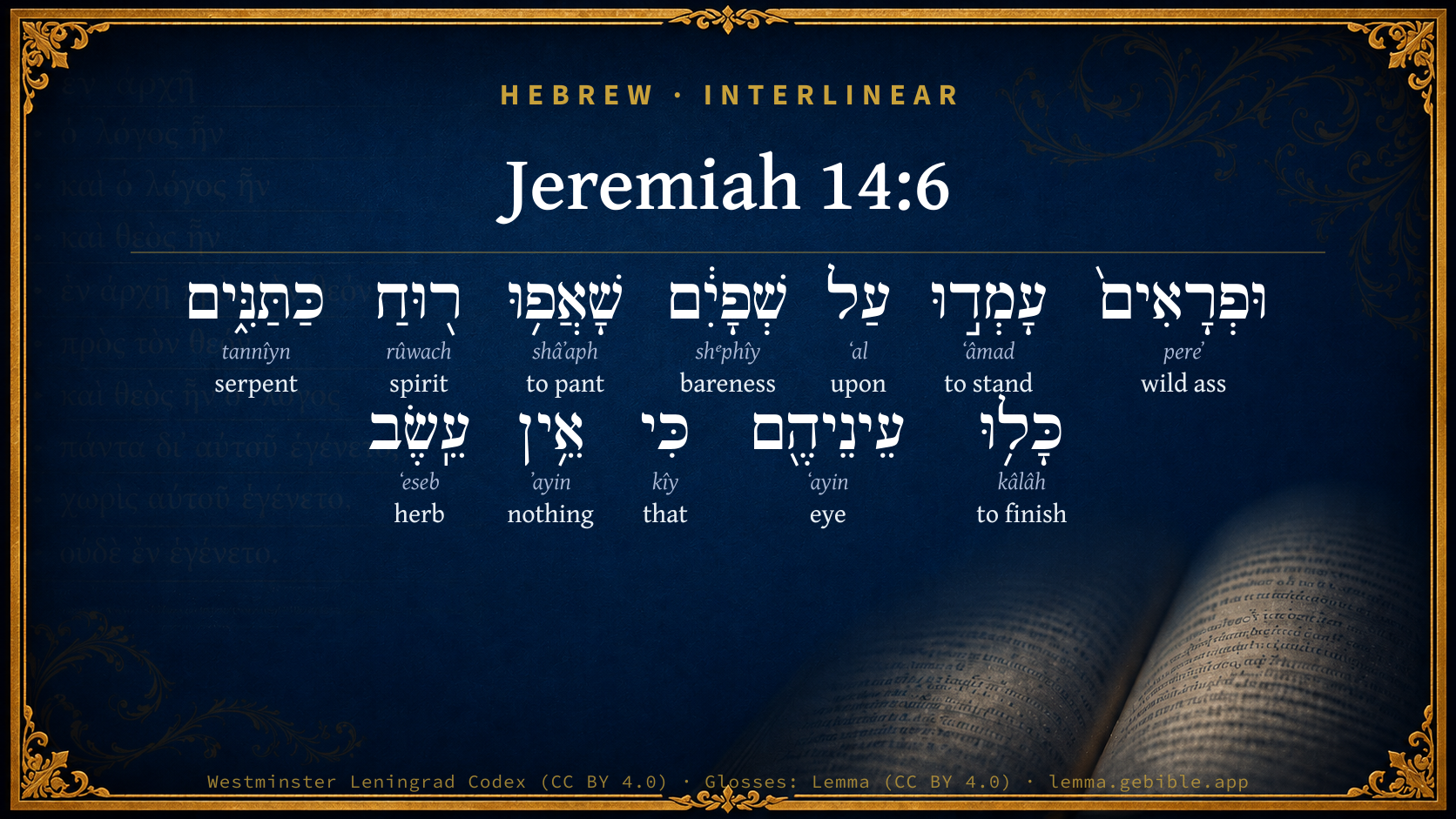
Hebrew (Westminster Leningrad Codex) Jeremiah 14:6 appears in the Hebrew Old Testament. The text above is from the Westminster Leningrad Codex. Each word links to its Strong’s number, a concise gloss, and parsing drawn from the Open Scriptures Hebrew Bible morphology. Click any word for its full Brown-Driver-Briggs (BDB) entry.
Download image
Cite this verse

Jeremiah 14:6 (World English Bible). Public Domain. Lemma interlinear Bible study tool, https://lemma.gebible.app/v/jeremiah/14/6.

Show BibTeX & RIS
BibTeX
RIS
English Translation
The wild donkeys stand on the bare heights, they pant for air like jackals; their eyes fail, because there is no herbage.
World English Bible · Public Domain
Download a study sheet

One document with this verse’s original text, its word-by-word gloss line, the meaning frame, cross-references with their text, attributed commentary, and full source and license credits — printable, and it pastes into notes with its structure intact.

This verse Autodidact and up

Study sheet (.html) Plain text (.txt)

A passage Seminary Student

Up to 50 verses in one chapter. A passage sheet keeps up to 6 commentary sources and 12 cross-references per verse, in the order this page ranks them, and says so on the sheet whenever that leaves anything out. Ask for a single verse and you get the Autodidact verse sheet above.

Everything on this page stays free to read, with no account — the sheet is a download of what is already on screen, not access to it.

Want to remove ads? Support Godless Engineer
Compare translations 3

The same verse in 3 English versions, stacked beneath the original-language interlinear above. Click any original word for its lexicon entry.

Each is an independent rendering of the whole verse — the interlinear is not word-aligned to these translations.

Highlighted words mark where these versions differ — a whole-verse word diff, not a word-by-word alignment.

  • World English Bible Public Domain
    The wild donkeys stand on the bare heights, they pant for air like jackals; their eyes fail, because there is no herbage.
  • King James Version Public Domain
    And the wild asses did stand in the high places, they snuffed up the wind like dragons; their eyes did fail, because there was no grass.
  • unfoldingWord Literal Text CC BY-SA 4.0
    And the wild donkeys stand on bare heights and they gasp for air like jackals. Their eyes fail because no herbage.”

unfoldingWord Literal Text — © unfoldingWord, licensed CC BY-SA 4.0. Word-aligned USFM3 via Door43 (git.door43.org/unfoldingWord/en_ult).

Versions to compare (up to 4)

3 of 4 selected

Show all 18 translations

Every available English version of this verse, each an independent rendering of the whole verse.

  • World English Bible Public Domain
    The wild donkeys stand on the bare heights, they pant for air like jackals; their eyes fail, because there is no herbage.
  • Berean Standard Bible Public Domain
    Wild donkeys stand on barren heights; they pant for air like jackals; their eyes fail for lack of pasture.”
  • Majority Standard Bible Public Domain
    Wild donkeys stand on barren heights; they pant for air like jackals; their eyes fail for lack of pasture.”
  • King James Version Public Domain
    And the wild asses did stand in the high places, they snuffed up the wind like dragons; their eyes did fail, because there was no grass.
  • American Standard Version (1901) Public Domain
    And the wild asses stand on the bare heights, they pant for air like jackals; their eyes fail, because there is no herbage.
  • Revised Version (1885) Public Domain
    And the wild asses stand on the bare heights, they pant for air like jackals; their eyes fail, because there is no herbage.
  • Geneva Bible (1599) Public Domain
    And the wilde asses did stande in the hygh places, and drew in their winde like dragons their eyes did faile, because there was no grasse.
  • Douay-Rheims (1899) Public Domain
    And the wild asses stood upon the rocks, they snuffed up the wind like dragons, their eyes failed, because there was no grass.
  • Young's Literal Translation Public Domain
    And wild asses have stood on high places, They have swallowed up wind like dragons, Consumed have been their eyes, for there is no herb.
  • Literal Standard Version CC BY-SA 4.0
    And wild donkeys have stood on high places, || They have swallowed up wind like dragons, || Their eyes have been consumed, for there is no herb.”
  • Unlocked Literal Bible CC BY-SA 4.0
    The wild donkeys stand on the bare plains and they pant in the wind like jackals. Their eyes fail to work, for there is no vegetation.”
  • unfoldingWord Literal Text CC BY-SA 4.0
    And the wild donkeys stand on bare heights and they gasp for air like jackals. Their eyes fail because no herbage.”
  • Darby Bible Public Domain
    And the wild asses stand on the heights, they snuff up the wind like jackals; their eyes fail, because there is no herbage.
  • World Messianic Bible Public Domain
    The wild donkeys stand on the bare heights. They pant for air like jackals. Their eyes fail, because there is no vegetation.
  • Webster's Bible Public Domain
    And the wild asses stood in the high places, they snuffed up the wind like dragons; their eyes failed, because there was no grass.
  • Free Bible Version CC BY-SA 4.0
    Wild donkeys stand on the bare hills, panting like jackals. Their eyesight fails because they have nothing to eat.
  • Bible in Basic English Public Domain
    And the asses of the field on the open hilltops are opening their mouths wide like jackals to get air; their eyes are hollow because there is no grass.
  • JPS Tanakh (1917) Public Domain
    And the wild asses stand on the high hills, they gasp for air like jackals; their eyes fail, because there is no herbage.

Literal Standard Version (2020), Covenant Press — licensed CC BY-SA 4.0. Text via the HelloAO Bible API (eBible.org). Unlocked Literal Bible (unfoldingWord) — licensed CC BY-SA 4.0. Text via the HelloAO Bible API (eBible.org). unfoldingWord Literal Text — © unfoldingWord, licensed CC BY-SA 4.0. Word-aligned USFM3 via Door43 (git.door43.org/unfoldingWord/en_ult). Free Bible Version, Dr. Jonathan Gallagher — licensed CC BY-SA 4.0. Text via the HelloAO Bible API (eBible.org).

Word by word

More ways to search: Search by grammar → Find every occurrence → Compare this word →

Practice this passage: Drill this verse → Learn its vocabulary →

וּפְרָאִים֙
pereʼ
H6501
“and · wild asses”
Conjunction + Noun, Common, Masculine, Plural, Absolute
Part of Speech
Conjunction + Noun
Type
Common
Gender
Masculine
Number
Plural
State
Absolute
Full BDB Definition

Origin: from H6500

TWOT: 1805a

wild ass
  1. עָמְד֣וּ ʻâmad H5975 “to stand” Verb, Qal, Perfect, 3rd Person, Common, Plural
  2. עַל ʻal H5921 “upon” Preposition
  3. שְׁפָיִ֔ם shᵉphîy H8205 “bare heights” Noun, Common, Masculine, Plural, Absolute
  4. שָׁאֲפ֥וּ shâʼaph H7602 “to pant” Verb, Qal, Perfect, 3rd Person, Common, Plural
  5. ר֖וּחַ rûwach H7307 “spirit” Noun, Common, Both, Singular, Absolute
  6. כַּתַּנִּ֑ים tannîyn H8577 “like/as the · serpents” Preposition, Determined + Noun, Common, Masculine, Plural, Absolute
  7. כָּל֥וּ kâlâh H3615 “to finish” Verb, Qal, Perfect, 3rd Person, Common, Plural
  8. עֵינֵיהֶ֖ם ʻayin H5869 “eyes · their” Noun, Common, Both, Dual, Construct + Suffix, Personal, 3rd Person, Masculine, Plural
  9. כִּי kîy H3588 “that” Conjunction
  10. אֵ֥ין ʼayin H369 “nothing” Particle, Negative
  11. עֵֽשֶׂב ʻeseb H6212 “herb” Noun, Common, Masculine, Singular, Absolute

About this verse

These counts appear in no published source. They are computed here, from the morphology-tagged text and Lemma’s own curated glosses. What Lemma adds →

12
words
12
distinct lemmas
Prophets
section

Notable vocabulary

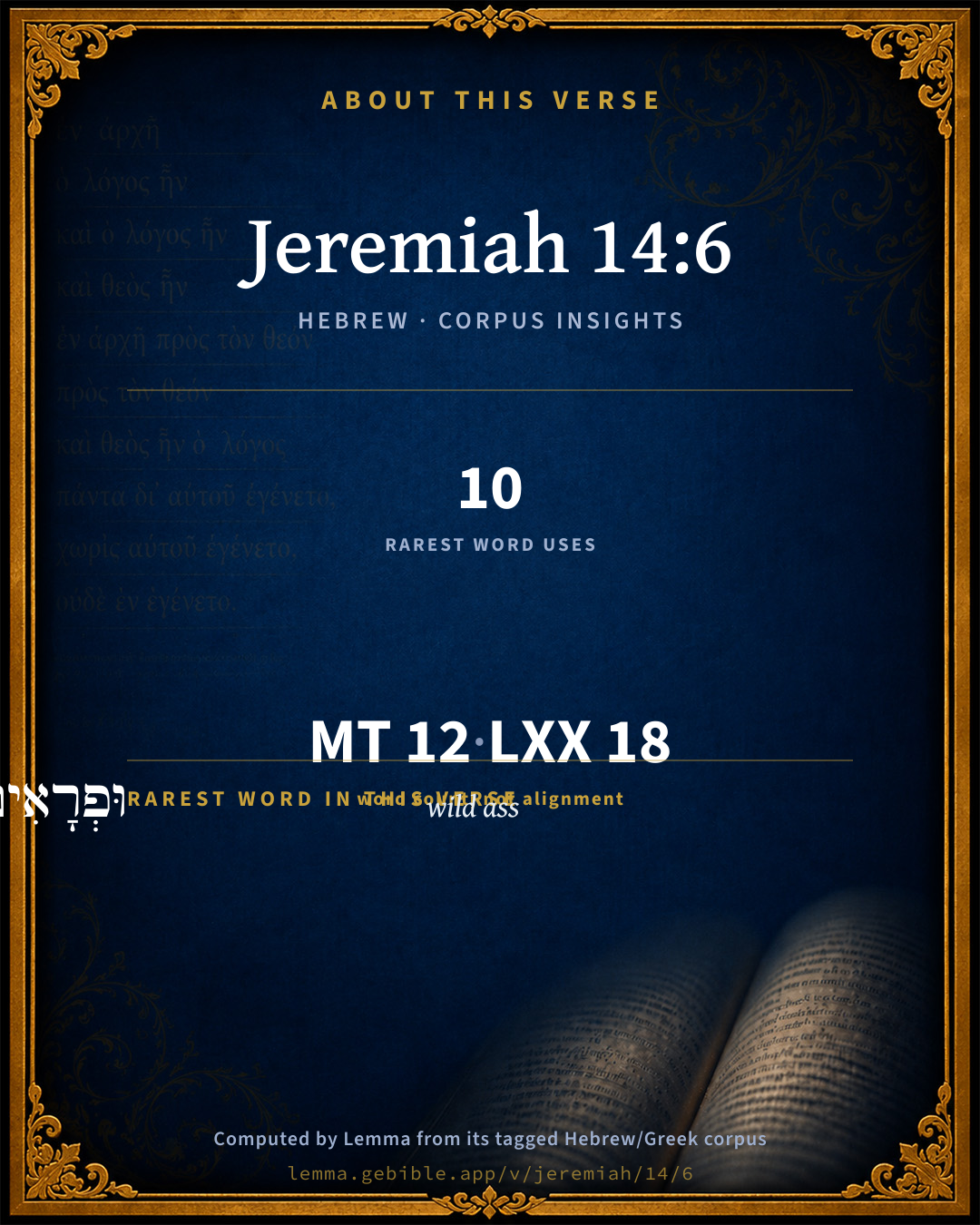
The rarest word here is וּפְרָאִים֙ wild ass H6501 — appearing just 10 times in the whole Hebrew Bible.

Shared distinctive vocabulary

וּפְרָאִים֙ wild ass H6501 occurs in 10 verses of the Hebrew Bible. Also found in:

Grammatical profile

  • 3 verbs
  • 6 nouns
  • 1 preposition
  • 1 conjunction
  • 1 particle

Verb forms

  • עָמְד֣וּ Qal · Perfect
  • שָׁאֲפ֥וּ Qal · Perfect
  • כָּל֥וּ Qal · Perfect

Hebrew & Septuagint length

In the original languages it is 12 Hebrew tokens and 18 Greek tokens — but the two are counted differently (Hebrew bundles its prefixes and suffixes into one token; the Greek is in lemma form), so that isn’t a like-for-like length.

Cross-references

6

Topical passages linked to Jeremiah 14:6 in the Treasury of Scripture Knowledge — connected by theme and wording, ordered by reader-vote popularity; previews shown in the World English Bible.

  • Jeremiah 2:24 a wild donkey used to the wilderness, that snuffs up the wind in her desire; in her occasion who can turn her away? all those who seek her will not weary themselves; in her month they shall find her.
  • Job 39:5–6 "Who has set the wild donkey free? Or who has loosened the bonds of the swift donkey,
  • Joel 1:18 How the animals groan! The herds of cattle are perplexed, because they have no pasture. Yes, the flocks of sheep are made desolate.
  • 1 Samuel 14:29 Then said Jonathan, My father has troubled the land. Please look how my eyes have been enlightened, because I tasted a little of this honey.
  • Lamentations 4:17 Our eyes do yet fail [in looking] for our vain help: In our watching we have watched for a nation that could not save.
  • Lamentations 5:17 For this our heart is faint; For these things our eyes are dim;

Cross-references courtesy of OpenBible.info (CC BY 4.0).

Hebrew and Greek witnesses Masoretic Hebrew ↔ Greek Septuagint

The same verse in the two great witnesses to the Old Testament, shown verse-for-verse.

These are two independent witnesses, not word-aligned to each other, and the Septuagint is shown in lemma (dictionary) form.

Hebrew Jeremiah 14:6 Masoretic · Westminster Leningrad Codex

וּפְרָאִים֙ עָמְד֣וּ עַל שְׁפָיִ֔ם שָׁאֲפ֥וּ ר֖וּחַ כַּתַּנִּ֑ים כָּל֥וּ עֵינֵיהֶ֖ם כִּי אֵ֥ין עֵֽשֶׂב

The wild donkeys stand on the bare heights, they pant for air like jackals; their eyes fail, because there is no herbage.

World English Bible · Public Domain

Greek LXX Structure differs

In the Septuagint, Jeremiah is about an eighth shorter than the Hebrew and arranges its material differently — the Oracles Against the Nations (Hebrew chapters 46–51) appear in the middle of the Greek book, after 25:13. Because the chapter and verse boundaries do not line up, a verse-for-verse comparison with the Hebrew is not shown.

A verse-for-verse comparison isn’t shown here because the chapters and verses don’t line up. Switch to the LXX edition with the MT / LXX toggle above to read the Greek directly.

Hebrew: Westminster Leningrad Codex (CC BY 4.0). Greek: Septuagint (public domain); English from a public-domain English Septuagint. How the Septuagint differs from the Hebrew →

Targum (Aramaic paraphrase)

1

The Targum is the ancient Jewish Aramaic paraphrase of the Hebrew Scriptures — an interpretive translation, not the Hebrew text itself. Onkelos (literal) and Pseudo-Jonathan (expansive) render the Torah, and Jonathan the Prophets. Coverage is partial: where no permissively-licensed English translation exists for a verse, only the Aramaic is shown. This is verse-level text, not a word-by-word alignment to the Hebrew.

  1. Targum Jonathan Prophets (Joshua–Malachi)
    וַעֲרָדִין קָמוּ עַל נַגְדִין שֶׁתֶן רוּחָא כְּיָרוֹדִין קָמָא עֵינֵיהוֹן אֲרֵי לֵית עִשְׂבָּא:

    (no public-domain English translation for this verse)

    Targum Jonathan — Aramaic: “Mikraot Gedolot” (public domain). English: “Sefaria Community Translation” (CC0 1.0 (public-domain dedication)); “London "Chaldee Paraphrase," 1871” (public domain). Text via Sefaria.

Commentary

Notes on Jeremiah 14:6 from classic Christian and Jewish commentators (each source and its license shown beneath its notes). The classic Christian expositions comment on the surrounding passage and are grouped to its opening verse, so a note may address several verses; the Jewish commentaries on the Tanakh (Rashi and others) are per-verse, so they appear only where the commentator wrote on this verse.

Lemma curates 59 commentaries, every one of them public domain or Creative Commons licensed, each selected and text-cleaned for this edition rather than reprinted as found. About our sources →

Trapp's Complete Commentary

John Trapp

Jer 14:6 And the wild asses did stand in the high places, they snuffed up the wind like dragons; their eyes did fail, because [there was] no grass.

Ver. 6. And the wild asses.] Secretes alias vagae libidinis in silvis, that usually course up and down the woods, and can bear hunger and thirst a long while together. {a}

Snuffed up the wind like dragons.] Quorum est vehementissima spiratio ac sorbitio; who, in defect of water, can continue long by drawing in the air, as Aristotle {b} likewise testifieth of the goats in Cephalonia, that they drink not for various days together, but instead thereof gape and suck in the fresh air.

{a} Plin., lib. x. cap. 72.

{b} Lib. De mirab auscult.

John Trapp, A Commentary or Exposition upon All the Books of the Old and New Testament (1647–1656) — public domain. Text from a community e-Sword module.

Geneva Bible (1599)

Geneva Bible translators

Which are so hot of nature, that they cannot be cooled with drinking of water, but still gape for the air to resisteth them.

Geneva Bible (1599) marginal notes — public domain. Text via Bolls.life.

Jamieson, Fausset & Brown

Robert Jamieson, A. R. Fausset & David Brown

wild asses--They repair to "the high places" most exposed to the winds, which they "snuff in" to relieve their thirst.

dragons--jackals [HENDERSON].

eyes--which are usually most keen in detecting grass or water from the "heights," so much so that the traveller guesses from their presence that there must be herbage and water near; but now "their eyes fail." Rather the reference is to the great boas and python serpents which raise a large portion of their body up in a vertical column ten or twelve feet high, to survey the neighborhood above the surrounding bushes, while with open jaws they drink in the air. These giant serpents originated the widely spread notions which typified the deluge and all destructive agents under the form of a dragon or monster serpent; hence, the dragon temples always near water, in Asia, Africa, and Britain; for example, at Abury, in Wiltshire; a symbol of the ark is often associated with the dragon as the preserver from the waters [KITTO, Biblical Cyclopædia].

Jamieson, Fausset & Brown — Commentary Critical and Explanatory on the Whole Bible (1871) — public domain (CC PDM 1.0). Text via the HelloAO Bible API.

Adam Clarke's Commentary

Verse 6. Snuffed up the wind like dragons] תנים tannim here probably means the hippopotamus, who, after feeding under the water, is obliged to come to the surface in order to take in fresh draughts of air; or it may mean the wild asses.

Adam Clarke's Commentary on the Bible (1810–1826) — public domain. Text from a community e-Sword/MySword module.

John Calvin's Commentaries

The same thing is said of the wild asses, And the wild asses, he says, stood on the rocks: and yet this animal, we know, can endure want for a long Lime. But the Prophet, as I have said, intended to shew that there would be in this scarcity some remarkable evidences of God’s vengeance. Stood then did the wild asses on the rocks, and thence drew in wind like serpents: for great is the heat of serpents; on account of inward burning they are constrained to draw in wind to allay the heat within. The Prophet says, that wild asses were like serpents, for they were burning with long famine, so that they were seeking food in the wind itself, or by respiration. He then adds, Failed have their eyes, for there was no grass

We now understand the object of this prediction: It was God’s purpose not only to foretell the Jews what was soon to be, but also to point out, as it were, by the finger, his vengeance, that they might not have recourse, as usual, to secondary causes, but that they might know that they suffered punishment for their sins; for the scarcity would be so extraordinary as far to exceed what was usual. It now follows —

John Calvin's Commentaries (1540-1563) — public domain. Text from the Calvin Translation Society English edition (1840s-50s) via the Christian Classics Ethereal Library (ccel.org). Calvin's coverage is partial (roughly two-thirds of the Bible); uncommented books and verses are honest gaps, never fabricated. The 19th-century editor's footnotes and remarks are omitted so the notes are faithfully Calvin's own voice.

Ellicott's Commentary for English Readers

(6) The wild asses.—From the field the prophet’s eye turns to the bare hill-tops of the “high places,” and sees a scene of like distress. The “wild asses” seem turned to beasts of prey, and stand gaping for thirst, as the jackals (not “dragons”—comp. Jer_9:11) stand panting for their prey. By some scholars the word is taken as meaning, like a kindred word in Eze_29:3; Eze_32:2, “crocodiles,” with their wide gaping jaws.

There was no grass.—The word is not the same as that in Jer_14:5, and implies a larger and ranker herbage than that on which the hind fed.

A Bible Commentary for English Readers, edited by Charles John Ellicott (1878–1897) — public domain. Text from a community e-Sword module.

The Cambridge Bible for Schools and Colleges

gen. ed. J. J. S. Perowne

6. bare heights] See on ch. Jer_3:2.

pant for air] oppressed by heat and thirst.

jackals] See on Jer_9:11, but mg. (by the change of one Heb. letter) the crocodile (coming out of the water to breathe).

their eyes fail] in place of their sharpness of sight. Cp. Job_11:20; Psa_69:3; Lam_4:17, and contrast Jonathan’s case in 1Sa_14:27.

The Cambridge Bible for Schools and Colleges (gen. ed. J. J. S. Perowne; Cambridge University Press, 1878–1918) — public domain. Text from a community e-Sword module.

John Gill's Exposition

And the wild asses did stand in the high places,.... To see where any grass was to be had, or where the wind blows more freely and cooly, to draw it in; as follows. The Targum renders it, "by the brooks"; and so Jarchi interprets it brooks of water; whither they came as usual to drink, and found them now dried up; and where they stood distressed and languishing, not knowing where to go for any:

they snuffed up the wind like dragons: which, being of a hot nature, open their mouths, and draw in the wind and air to cool them. Aelianus (b) reports of the dragons in Phrygia, that they open their mouths, and not only draw in the air, but even birds flying. The word used for dragons signifies large fishes, great whales; and some understand it of crocodiles, who will lift up their heads above water to refresh themselves with the air:

their eyes did fail; in looking about for grass; or for want of food, being quite starved and famished:

because there was no grass; for their food and nourishment. With great propriety is the herb or grass mentioned, this being the proper food of asses, as Aristotle (c) observes; and with which agrees the Scripture; which represents them as content when they have it; and as ranging about the mountains for it when they have none; being creatures very impatient of hunger and thirst; see Job 6:5 wherefore the Greek writers surname this animal dry and thirsty; and hence the lying story of Tacitus (d), concerning Moses and the children of Israel; who, he says, being ready to perish for want of water, Moses observed a flock of wild asses going from their pasture to a rock covered with trees, and followed them, taking it for herbage, and found large fountains of water. And very pertinently are their eyes said to fail for want of food, and the sight of them grow dim, which is more or less the case of all creatures in such circumstances; but the rather is this observed of the wild ass, because, as an Arabic writer (e) suggests, it is naturally very sharp and clear sighted.

(b) De Animal. l. 2. c. 21. (c) Hist. Animal. l. 8. c. 8. (d) Histor. l. 5. c. 3. (e) Damir apud Bochart. Hierozoic. par. 1. l. 3. c. 16. col. 878.

John Gill's Exposition of the Whole Bible (1746–1763) — public domain (CC PDM 1.0). Text via the HelloAO Bible API.

Albert Barnes' Notes on the Bible

Like dragons - “Like jackals” Jer 9:11.

No grass - The keen sight of the wild donkey is well known, but they look around in vain for herb.

Albert Barnes' Notes on the Bible (1834–1885) — public domain. Text from a community e-Sword/MySword module.

Haydock's Catholic Bible Commentary

Wind, for refreshment. --- Failed, through want, though they be very piercing.

George Leo Haydock (1774–1849), Haydock's Catholic Family Bible and Commentary, 1859 edition — public domain. Excludes Psalms (Douay-Rheims chapter numbering differs from Protestant) and Deuterocanonical books (Catholic canon only).

Matthew Poole's English Annotations

The wild asses, wanting water, got upon

high places, where was the freest and coolest air, and sucked in the wind, and this it is said they did

like dragons, of whom Aristotle and Pliny report, that by reason of the great heat of their bodies, they ordinarily stand upon high places sucking in the cool air, and they tell us those creatures will live upon it for some time. The prophet describing this great drought, tells us the wild asses did the like. But for want of grass their eyes were either almost sunk in their heads, they being almost starved; or else the phrase signifies the frustration of their expectation, which this phrase also sometimes signifies in Scripture, Psa 69:3.

Matthew Poole's English Annotations on the Holy Bible (1683–1685) — public domain. Text from a community e-Sword/MySword module.

Whedon's Commentary on the Bible

Daniel D. Whedon

6. The wild asses stand upon the high places where they dwell, and gasp for air like the jackals, not dragons. These keen-sighted animals look for any green herb in vain.

Daniel D. Whedon (gen. ed.), Commentary on the Old and New Testaments (1874–1909) — public domain. Text from a community e-Sword module.

The Pulpit Commentary

The wild asses... in the high places; rather, on the bare heights. The wild asses," says a traveler cited by Rosenm are especially fond of treeless mountains." Like dragons; render rather, like jackals. (as Jer_9:11 Jer_10:22) The allusion is to the way jackals hold their head as they howl. We are told that even the keen eyes of the wild asses fail, because there was is no grass; rather, herbage. They grow dim first with seeking it so long in vain, and then from lack of nourishment.

The Pulpit Commentary (1880–1919), ed. H.D.M. Spence-Jones & Joseph S. Exell — public domain. Text from a community e-Sword module.

John Wesley's Explanatory Notes

The wild asses - The wild asses wanting water, got upon high places, where was the coolest air, and sucked in the wind; and this it is said they did like dragons, of whom Aristotle and Pliny report, that they ordinarily stand upon high places sucking in the cool air.

John Wesley, Explanatory Notes Upon the Whole Bible (1754–1765) — public domain. Text via the GEBible commentary corpus.

Rashi

Rabbi Shlomo Yitzchaki (Rashi)

by the rivulets rivulets of water (riveyres in O. F.).

Rashi on the Tanakh — English translations: “The Judaica Press complete Tanach with Rashi, translated by A. J. Rosenberg” (CC BY 4.0); “Pentateuch with Rashi's commentary by M. Rosenbaum and A.M. Silbermann, 1929-1934” (public domain); “The Metsudah Tanach series, Lakewood, N.J” (CC BY 4.0); and “The Book of Joshua, Metsudah Publications, 1997” (CC BY 4.0). Text via Sefaria.

Lesson kit

Teaching starters — assembled from the data on this page, not authored interpretation. Every prompt links to the verse data it draws on. Edit before teaching.

Jeremiah, in the Prophets, opens this verse with 12 words (12 distinct Hebrew lemmas). Its most distinctive word is pereʼ (“wild ass”). A historical commentator’s framing appears above. Read the whole chapter for the surrounding context.

Discussion questions

  1. The word pereʼ carries the sense “wild ass.” How does it shape the verse?
  2. Genesis 16:12 shares the word «wild ass» with this verse. How do the two illuminate each other?
  3. The translations on this page render this verse differently — a whole-verse word diff, not a word-by-word alignment. What might account for the different wordings?
  4. The verb «עָמְד֣וּ» is Qal Perfect. How does its form color the action?
  5. Reading how Trapp's Complete Commentary and Geneva Bible (1599) read this verse, where do the two commentators agree and where do they part?

Things to notice

Reading settings

Reading text

Shown beneath each verse's original-language words.

Old Testament
Old Testament edition

Read the OT as the Masoretic Hebrew (MT) or the Greek Septuagint (LXX).

English shown for the Greek Septuagint (in the Hebrew ↔ Greek comparison).

Comparing translations? Open the Compare panel on any verse page to stack up to four side by side.