
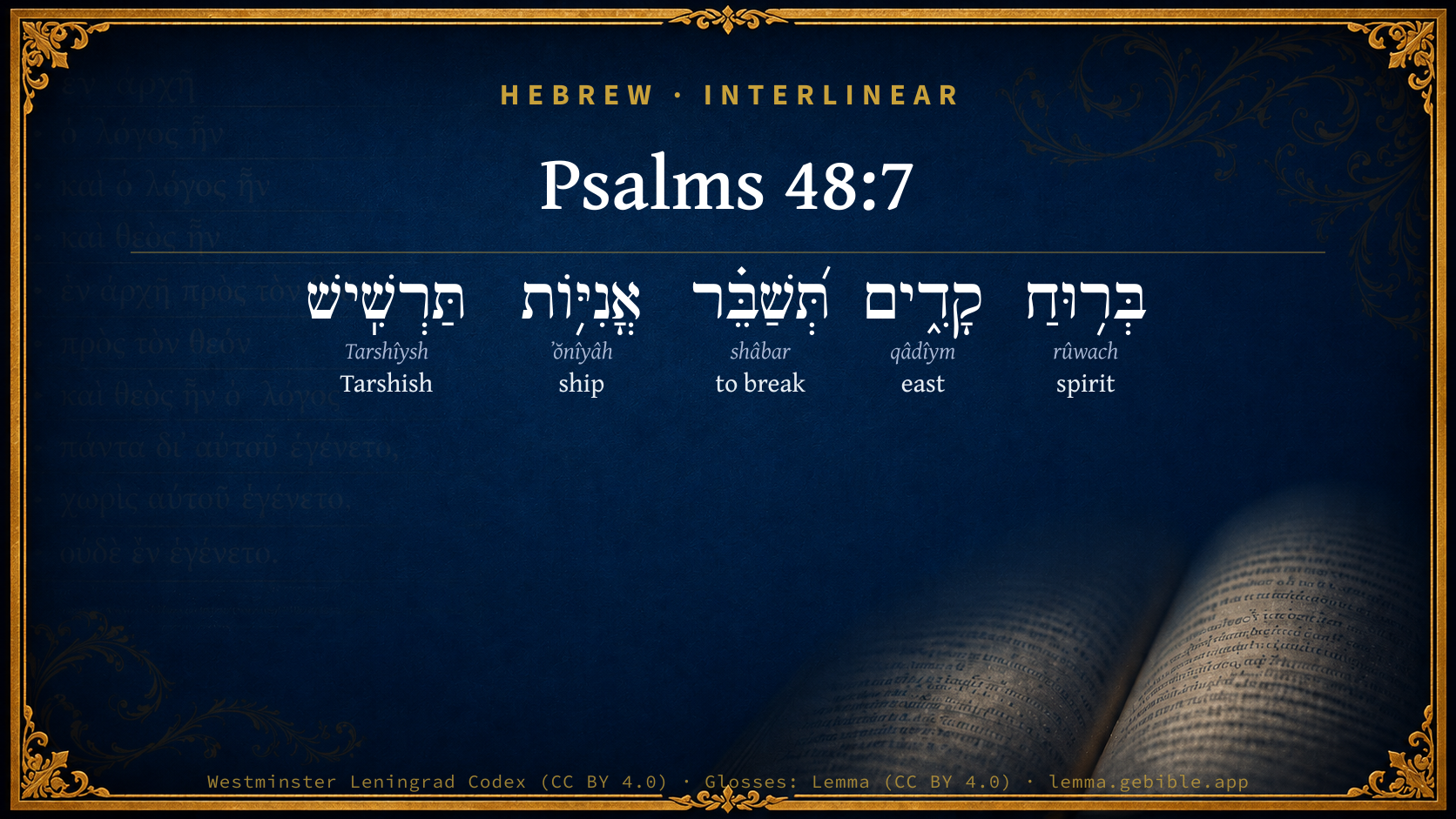
Psalms 48:7

Hebrew (Westminster Leningrad Codex) Psalms 48:7 appears in the Hebrew Old Testament. The text above is from the Westminster Leningrad Codex. Each word links to its Strong’s number, a concise gloss, and parsing drawn from the Open Scriptures Hebrew Bible morphology. Click any word for its full Brown-Driver-Briggs (BDB) entry.
Download image
Cite this verse

Psalms 48:7 (World English Bible). Public Domain. Lemma interlinear Bible study tool, https://lemma.gebible.app/v/psalms/48/7.

Show BibTeX & RIS
BibTeX
RIS
English Translation
With the east wind, you break the ships of Tarshish.
World English Bible · Public Domain
Download a study sheet

One document with this verse’s original text, its word-by-word gloss line, the meaning frame, cross-references with their text, attributed commentary, and full source and license credits — printable, and it pastes into notes with its structure intact.

This verse Autodidact and up

Study sheet (.html) Plain text (.txt)

A passage Seminary Student

Up to 50 verses in one chapter. A passage sheet keeps up to 6 commentary sources and 12 cross-references per verse, in the order this page ranks them, and says so on the sheet whenever that leaves anything out. Ask for a single verse and you get the Autodidact verse sheet above.

Everything on this page stays free to read, with no account — the sheet is a download of what is already on screen, not access to it.

Want to remove ads? Support Godless Engineer
Compare translations 3

The same verse in 3 English versions, stacked beneath the original-language interlinear above. Click any original word for its lexicon entry.

Each is an independent rendering of the whole verse — the interlinear is not word-aligned to these translations.

Highlighted words mark where these versions differ — a whole-verse word diff, not a word-by-word alignment.

  • World English Bible Public Domain
    With the east wind, you break the ships of Tarshish.
  • King James Version Public Domain
    Thou breakest the ships of Tarshish with an east wind.
  • unfoldingWord Literal Text CC BY-SA 4.0
    With the wind of the east, you shatter ships of Tarshish.

unfoldingWord Literal Text — © unfoldingWord, licensed CC BY-SA 4.0. Word-aligned USFM3 via Door43 (git.door43.org/unfoldingWord/en_ult).

Versions to compare (up to 4)

3 of 4 selected

Show all 18 translations

Every available English version of this verse, each an independent rendering of the whole verse.

  • World English Bible Public Domain
    With the east wind, you break the ships of Tarshish.
  • Berean Standard Bible Public Domain
    With a wind from the east You wrecked the ships of Tarshish.
  • Majority Standard Bible Public Domain
    With a wind from the east You wrecked the ships of Tarshish.
  • King James Version Public Domain
    Thou breakest the ships of Tarshish with an east wind.
  • American Standard Version (1901) Public Domain
    With the east wind Thou breakest the ships of Tarshish.
  • Revised Version (1885) Public Domain
    With the east wind thou breakest the ships of Tarshish.
  • Geneva Bible (1599) Public Domain
    As with an East winde thou breakest the shippes of Tarshish, so were they destroyed.
  • Douay-Rheims (1899) Public Domain
    trembling took hold of them. There were pains as of a woman in labour.
  • Young's Literal Translation Public Domain
    By an east wind Thou shiverest ships of Tarshish.
  • Literal Standard Version CC BY-SA 4.0
    By an east wind You shatter ships of Tarshish.
  • Unlocked Literal Bible CC BY-SA 4.0
    With the east wind you break the ships of Tarshish.
  • unfoldingWord Literal Text CC BY-SA 4.0
    With the wind of the east, you shatter ships of Tarshish.
  • Darby Bible Public Domain
    With an east wind thou hast broken the ships of Tarshish.
  • World Messianic Bible Public Domain
    With the east wind, you break the ships of Tarshish.
  • Webster's Bible Public Domain
    \\48:6\\Fear took hold upon them there, and pain, as of a woman in travail.
  • Free Bible Version CC BY-SA 4.0
    just as the strong east wind wrecks the ships from Tarshish.
  • Bible in Basic English Public Domain
    By you the ships of Tarshish are broken as by an east wind.
  • JPS Tanakh (1917) Public Domain
    (48-8) With the east wind Thou breakest the ships of Tarshish.

Literal Standard Version (2020), Covenant Press — licensed CC BY-SA 4.0. Text via the HelloAO Bible API (eBible.org). Unlocked Literal Bible (unfoldingWord) — licensed CC BY-SA 4.0. Text via the HelloAO Bible API (eBible.org). unfoldingWord Literal Text — © unfoldingWord, licensed CC BY-SA 4.0. Word-aligned USFM3 via Door43 (git.door43.org/unfoldingWord/en_ult). Free Bible Version, Dr. Jonathan Gallagher — licensed CC BY-SA 4.0. Text via the HelloAO Bible API (eBible.org).

Word by word

More ways to search: Search by grammar → Find every occurrence → Compare this word →

Practice this passage: Drill this verse → Learn its vocabulary →

תַּרְשִֽׁישׁ
Tarshîysh
H8659
“Tarshish”
Noun, Proper
Part of Speech
Noun
Type
Proper
Full BDB Definition

Origin: probably the same as H8658 (as the region of the stone, or the reverse)

TWOT: 2547

Tarshish or Tharshish = "yellow jasper" - son of Javan (noun proper masculine) - a Benjamite, son of Bilhan (noun proper masculine) - one of the wise men close to king Ahasuerus of Persia (noun proper masculine) - a city of the Phoenicians in a distant part of the Mediterranean Sea to which the prophet Jonah was trying to flee (noun proper locative) - site unknown but perhaps in Cyprus or Spain - a city somewhere near and accessible to the Red Sea to which ships constructed at Ezion-geber on the Elanitic Gulf on the Red Sea were to sail (noun proper locative)
  1. בְּר֥וּחַ rûwach H7307 “in/at · spirit of” Preposition + Noun, Common, Both, Singular, Construct
  2. קָדִ֑ים qâdîym H6921 “east” Noun, Common, Masculine, Singular, Absolute
  3. תְּ֝שַׁבֵּ֗ר shâbar H7665 “to break” Verb, Piel, Imperfect, 2nd Person, Masculine, Singular
  4. אֳנִיּ֥וֹת ʼŏnîyâh H591 “ships of” Noun, Common, Feminine, Plural, Construct

About this verse

These counts appear in no published source. They are computed here, from the morphology-tagged text and Lemma’s own curated glosses. What Lemma adds →

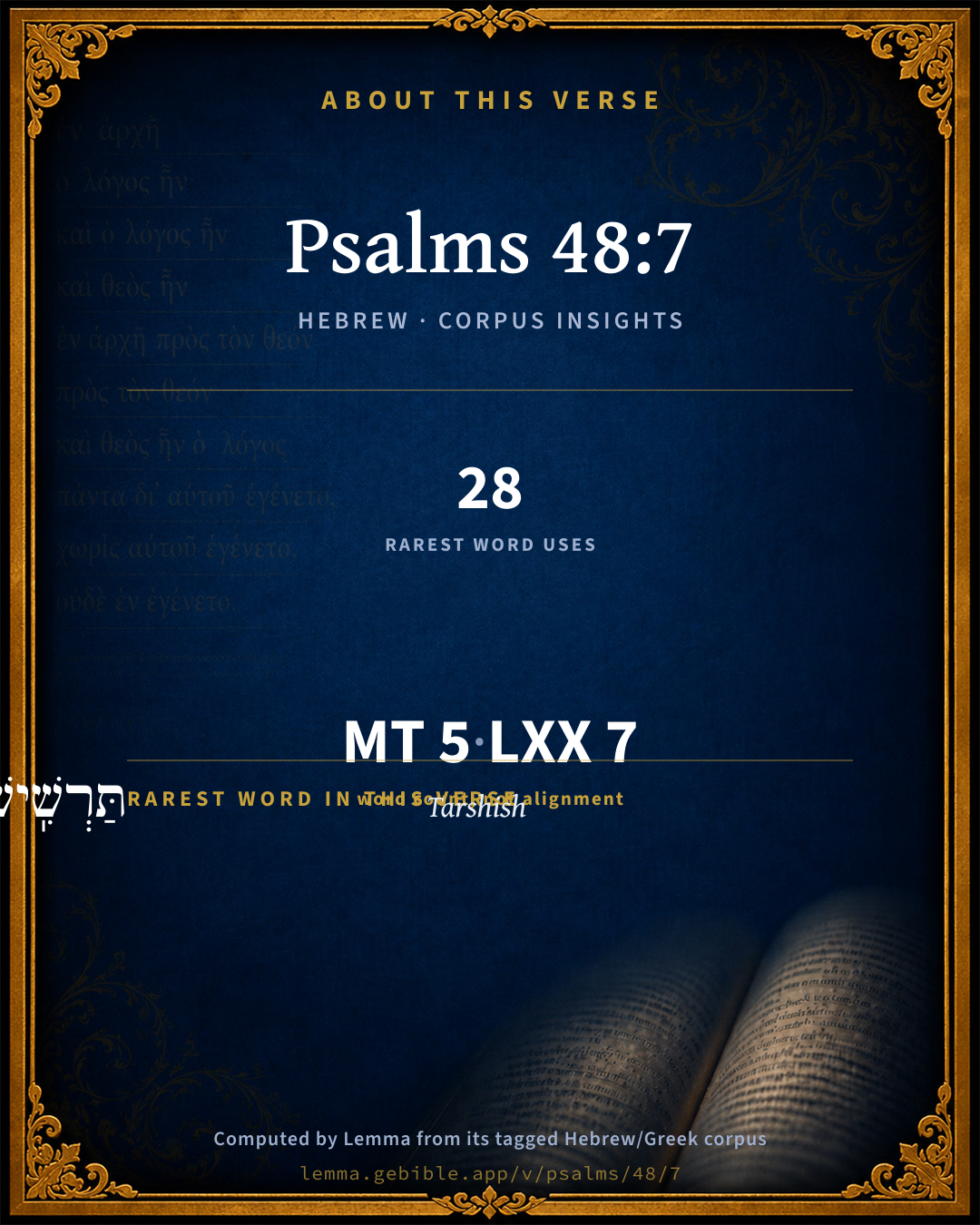
5
words
5
distinct lemmas
Wisdom
section

Shared distinctive vocabulary

תַּרְשִֽׁישׁ Tarshish H8659 occurs in 24 verses of the Hebrew Bible. Also found in:

Grammatical profile

  • 1 verb
  • 4 nouns

Verb forms

  • תְּ֝שַׁבֵּ֗ר Piel · Imperfect

Hebrew & Septuagint length

In English translation the verse runs 10 words from the Hebrew and 11 from the Septuagint (LXX English) — closely comparable.

A rough comparison of the two English renderings, which tokenize alike — not a word-level alignment.

Word counts can differ between the Hebrew and the Greek without any difference in meaning — e.g. the Hebrew direct-object marker אֵת has no separate Greek word, and Greek often adds the article ὁ.

In the original languages it is 5 Hebrew tokens and 7 Greek tokens — but the two are counted differently (Hebrew bundles its prefixes and suffixes into one token; the Greek is in lemma form), so that isn’t a like-for-like length.

Cross-references

5

Topical passages linked to Psalms 48:7 in the Treasury of Scripture Knowledge — connected by theme and wording, ordered by reader-vote popularity; previews shown in the World English Bible.

  • Jeremiah 18:17 I will scatter them as with an east wind before the enemy; I will show them the back, and not the face, in the day of their calamity.
  • 1 Kings 22:48 Jehoshaphat made ships of Tarshish to go to Ophir for gold: but they didn't go; for the ships were broken at Ezion Geber.
  • Ezekiel 27:25–26 The ships of Tarshish were your caravans for your merchandise: and you were replenished, and made very glorious in the heart of the seas.
  • 1 Kings 10:22 For the king had at sea a navy of Tarshish with the navy of Hiram: once every three years came the navy of Tarshish, bringing gold, and silver, ivory, and apes, and peacocks.
  • Isaiah 2:16 For all the ships of Tarshish, And for all pleasant imagery.

Cross-references courtesy of OpenBible.info (CC BY 4.0).

Hebrew and Greek witnesses Masoretic Hebrew ↔ Greek Septuagint

The same verse in the two great witnesses to the Old Testament, shown verse-for-verse.

You’re reading Greek Psalm 47 (Hebrew Psalm 48). The Septuagint counts the superscription, so verse numbers can differ from the Hebrew — chapter-level alignment, not verse-by-verse. Numbering follows Rahlfs.

These are two independent witnesses, not word-aligned to each other, and the Septuagint is shown in lemma (dictionary) form.

Hebrew Psalms 48:7 Masoretic · Westminster Leningrad Codex

בְּר֥וּחַ קָדִ֑ים תְּ֝שַׁבֵּ֗ר אֳנִיּ֥וֹת תַּרְשִֽׁישׁ

With the east wind, you break the ships of Tarshish.

World English Bible · Public Domain

Greek LXX Greek Psalm 47:7 Septuagint · lemma form

τρόμος ἐπιλαμβάνω αὐτός ἐκεῖ ὠδίν ὡς τίκτω

You will break the ships of Tharsis with a vehement wind.

LXX2012 (modern English Septuagint) · Public Domain

Hebrew: Westminster Leningrad Codex (CC BY 4.0). Greek: Septuagint (public domain); English from LXX2012 (modern English Septuagint) (Public Domain). How the Septuagint differs from the Hebrew →

Commentary

Notes on Psalms 48:7 from classic Christian and Jewish commentators (each source and its license shown beneath its notes). The classic Christian expositions comment on the surrounding passage and are grouped to its opening verse, so a note may address several verses; the Jewish commentaries on the Tanakh (Rashi and others) are per-verse, so they appear only where the commentator wrote on this verse.

Lemma curates 59 commentaries, every one of them public domain or Creative Commons licensed, each selected and text-cleaned for this edition rather than reprinted as found. About our sources →

Trapp's Complete Commentary

John Trapp

Psa 48:7 Thou breakest the ships of Tarshish with an east wind.

Ver. 7. Thou breakest the ships of Tarshish] i.e. Of the ocean, or of the Mediterranean Sea, Isa 2:16; Isa 23:1; Isa 23:6; Isa 23:10; Isa 23:14. The meaning is, Like as thou, O God, with thine east wind, that Euroclydon especially, which Pliny calleth Navigantium pestem (the mariner’s mischief), art wont to dash and drown the tallest ships at thy pleasure; so thou both canst and wilt deal by thy Church’s enemies. To whom, therefore, this text should be as those knuckles of a man’s hand were to Belshazzar, to write them their destiny; or as Daniel was to him, to read it unto them.

John Trapp, A Commentary or Exposition upon All the Books of the Old and New Testament (1647–1656) — public domain. Text from a community e-Sword module.

Joseph Benson's Commentary

Psa 48:7. Thou breakest the ships of Tarshish, &c. — Thou didst no less violently and suddenly destroy these raging enemies of Jerusalem, than sometimes thou destroyest the ships at sea with a fierce and vehement wind, such as the eastern winds were in those parts.

Joseph Benson's Commentary on the Old and New Testaments (1811–1818) — public domain. Text from a community e-Sword module.

J. A. Alexander on Psalms

Joseph Addison Alexander

8. (Psa 48:7). With an east wind thou wilt break ships of Tarshish. It is an interesting coincidence that such a disaster did befall the navy of Jehoshaphat himself. See 1Ki 22:49 (48), 2Ch 20:36-37. Some suppose this to be specifically meant in the case before us, while others understand it as a figurative description of God's sovereign control over all inferior agents. The east wind seems to be mentioned as the one most to be dreaded in the neighbouring seas. The trade to Tarshish and Ophir was almost the only maritime commerce known to the contemporary Hebrews. See 2Ch 9:21, and compare Isa 2:16; Isa 23:1; Isa 23:14; Isa 60:9.

Joseph Addison Alexander, The Psalms Translated and Explained (1850) — public domain. Text from a community e-Sword module.

Tyndale Open Study Notes

Tyndale Open Resources

48:7 The ships of Tarshish, built for long voyages, represent human accomplishment (see also 2 Chr 9:21; Isa 2:16). Their destruction might be the event mentioned in 1 Kgs 22:48.

Tyndale Open Study Notes — © Tyndale Open Resources, licensed CC BY-SA 4.0. Text via the HelloAO Bible API.

Geneva Bible (1599)

Geneva Bible translators

That is, of Cilicia, or of the sea called Mediterranean.

Geneva Bible (1599) marginal notes — public domain. Text via Bolls.life.

Jamieson, Fausset & Brown

Robert Jamieson, A. R. Fausset & David Brown

ships of Tarshish--as engaged in a distant and lucrative trade, the most valuable. The phrase may illustrate God's control over all material agencies, whether their literal destruction be meant or not.

Jamieson, Fausset & Brown — Commentary Critical and Explanatory on the Whole Bible (1871) — public domain (CC PDM 1.0). Text via the HelloAO Bible API.

Adam Clarke's Commentary

Verse 7. Thou breakest the ships of Tarshish] Calmet thinks this may refer to the discomfiture of Cambyses, who came to destroy the land of Judea. "This is apparently," says he, "the same tempest which struck dismay into the land-forces of Cambyses, and wrecked his fleet which was on the coasts of the Mediterranean sea, opposite to his army near the port of Acco, or the Ptolemais; for Cambyses had his quarters at Ecbatana, at the foot of Mount Carmel; and his army was encamped in the valley of Jezreel." Ships of Tarshish he conjectures to have been large stout vessels, capable of making the voyage of Tarsus, in Cilicia.

Adam Clarke's Commentary on the Bible (1810–1826) — public domain. Text from a community e-Sword/MySword module.

John Calvin's Commentaries

7. By the east wind thou breakest in pieces the ships of Tarshish Commentators are divided in their view of this passage. But let us rest contented with the natural sense, which is simply this, that the enemies of the Church were overthrown and plunged into destruction, just as God by suddenly raising storms sinks the ships of Cilicia to the bottom of the sea. The Psalmist celebrates the power which God is accustomed to display in great and violent storms; and his language implies that it is not to be wondered at if God, who breaks by the violence of the winds the strongest ships, had also overthrown his enemies, who were inflated with the presumptuous confidence which they reposed in their own strength. By the sea of Tarshish the Hebrews mean the Mediterranean Sea, because of the country of Cilicia, which in ancient times was called Tarshish, as Josephus informs us, although in process of time this name came to be restricted to one city of the country. But as the chief part of the naval traffic of the Jews was with Cilicia, there is here attributed to that country by synecdoche what was common to other countries which were at a greater distance and less known.

John Calvin's Commentaries (1540-1563) — public domain. Text from the Calvin Translation Society English edition (1840s-50s) via the Christian Classics Ethereal Library (ccel.org). Calvin's coverage is partial (roughly two-thirds of the Bible); uncommented books and verses are honest gaps, never fabricated. The 19th-century editor's footnotes and remarks are omitted so the notes are faithfully Calvin's own voice.

Ellicott's Commentary for English Readers

(7) Breakest.—It is natural at first sight to connect this verse immediately with the disaster which happened to the fleet of Jehoshaphat (1Ki_22:48-49; 2Ch_20:36). And that event may indeed have supplied the figure, but a figure for the dispersal of a land army. We may render:

With a blast from the east

Thou breakest (them as) Tarshish ships.

Or,

With a blast from the east

(Which) breaketh Tarshish ships (thou breakest them),

according as we take the verb, second person masculine, or third person feminine.

Shakespeare, in King John, compares the rout of an army to the dispersion of a fleet—

“So, by a roaring tempest on the flood,

A whole Armada of convicted sail

Is scattered and disjoined from fellowship.”

This is preferable to the suggestion that the seaboard tribes were in the alliance, whose break-up the psalm seems to commemorate, and that the sudden dispersion of their Armada ruined the enterprise. Tarshish ships, a common term for large merchantmen (comp. East Indiamen), from their use in the Tarshish trade, are here symbols of a powerful empire. Isaiah, in Isaiah 33, compares Assyria to a gallant ship. For the “east wind,” proverbially destructive and injurious, and so a ready weapon of chastisement in the Divine hand, see Job_27:21; Isa_27:8; and Eze_27:26, where its harm to shipping is especially mentioned.

A Bible Commentary for English Readers, edited by Charles John Ellicott (1878–1897) — public domain. Text from a community e-Sword module.

The Cambridge Bible for Schools and Colleges

gen. ed. J. J. S. Perowne

7. With an east wind

Thou shatterest ships of Tarshish.

As he gazes upon the wreck of the Assyrian enterprise, the poet apostrophises God with mingled awe and thankfulness. The language is plainly metaphorical. God’s might is irresistible. He shatters the stately ships of Tarshish with a sudden storm: with equal ease He annihilates the vast Assyrian army. Cp. Isa_14:24-27, noting the phrase, “I will break the Assyrian in my land.” For the metaphor comp. Eze_27:26, where the fall of Tyre is described as a wreck; and Isa_33:23, where Jerusalem in her extremity (or, according to some commentators, the Assyrian power) is represented as a disabled ship.

The east wind, notorious for its destructiveness, is often employed as a symbol of judgement (Job_27:21; Isa_27:8; Jer_18:17); and ships of Tarshish,—the largest vessels, such as were employed for the voyage to Tartessus in the S.W. of Spain (cp. ‘East Indiamen’)—were emblems of all that was strong and stately (Isa_2:16). The alternative rendering of R.V. marg., ‘As with the east wind that breaketh the ships of Tarshish,’ is grammatically possible, but less suitable.

The Cambridge Bible for Schools and Colleges (gen. ed. J. J. S. Perowne; Cambridge University Press, 1878–1918) — public domain. Text from a community e-Sword module.

John Gill's Exposition

We have thought of thy lovingkindness, O God,.... Jarchi interprets it, "we have waited for thy lovingkindness"; to see thy salvation; and some, as Ben Melech observes, explain it of hope and expectation; as if the sense was, "we have hoped for thy lovingkindness"; so the Syriac version renders it, and the word used has the signification of tarrying, Sa1 14:9. God has his set time to favour his Zion, and till that time comes it is right in them to be hoping, expecting, and waiting for it. The Chaldee paraphrase is, "we have esteemed thy goodness"; it being very excellent, exceeding valuable, and better than life itself; but other Jewish writers, as Menachem, Aben Ezra, Kimchi, and Ben Melech, render it as we do, "we have thought", &c. The lovingkindness of God towards his people in Christ is a very delightful and profitable subject to dwell in meditation upon, to consider the objects, instances, cause, and nature of it; and serves greatly to encourage faith and hope, to draw out love to God, and engage to a ready and cheerful obedience to his will; and this is sometimes done in public, as well as in private conversation, and in the closet; as follows;

in the midst of thy temple; the church of Christ, which is of his building, where he dwells, and grants his presence, and is often called the temple of God in the New Testament, in allusion to Solomon's temple; see Co1 3:16; here the word of God is preached, his ordinances administered, and his presence granted; which are instances of his lovingkindness, and lead his people to think of it; and particularly when the faithful ministers of the Gospel make mention of it, and the ordinance of the supper is administering, which is intended to bring to remembrance the love of God and Christ: moreover, in the latter day, to which this psalm belongs, the temple of God will be opened, Rev 11:19; that is, the true worship of God will be restored, and pure and undefiled religion freely exercised; the Gospel will be clearly and fully preached; and the ordinances administered as they were first delivered, which will lead the saints to think of the lovingkindness of God unto them; and particularly when they shall see the angels with the seven vials the executioners of God's wrath on the antichristian states, go forth from the temple to pour them out upon them, Rev 15:6.

John Gill's Exposition of the Whole Bible (1746–1763) — public domain (CC PDM 1.0). Text via the HelloAO Bible API.

Albert Barnes' Notes on the Bible

Thou breakest the ships of Tarshish - On the ships of Tarshish, see the notes on Isa 2:16. The allusion to these ships here may have been to illustrate the power of God; the ease with which he destroys that which man has made. The ships so strong - the ships made to navigate distant seas, and to encounter waves and storms - are broken to pieces with infinite ease when God causes the wind to sweep over the ocean. With so much ease God overthrows the most mighty armies, and scatters them. His power in the one case is strikingly illustrated by the other. It is not necessary, therefore, to suppose that there was any actual occurrence of this kind particularly in the eye of the psalmist; but it is an interesting fact that such a disaster did befall the navy of Jehoshaphat himself, 1Ki 22:48 : “Jehoshaphat made “ships of Tarshish” to go to Ophir for gold; but they went not: “for the ships were broken” at Ezion-geber.” Compare 2Ch 20:36-37. This coincidence would seem to render it not improbable that the discomfiture of the enemies of Jehoshaphat was particularly referred to in this psalm, and that the overthrow of his enemies when Jerusalem was threatened called to remembrance an important event in his own history, when the power of God was illustrated in a manner not less unexpected and remarkable. If this was the allusion, may not the reference to the “breaking of the ships of Tarshish” have been designed to show to Jehoshaphat, and to the dwellers in Zion, that they should not be proud and self-confident, by reminding them of the ease with which God had scattered and broken their own mighty navy, and by showing them that what he had done to their enemies he could do to them also, notwithstanding the strength of their city, and that their “real” defense was not in walls and bulwarks reared by human hand, anymore than it could be in the natural strength of their position only, but in God.

Albert Barnes' Notes on the Bible (1834–1885) — public domain. Text from a community e-Sword/MySword module.

Matthew Poole's English Annotations

This is not reported as a matter of fact, for we read of no ships in those expeditions to which this Psalm relates, nor did any ships come near Jerusalem, because that was at a great distance from the sea, and from any navigable river running into the sea; but only added by way of illustration or allusion. The sense is, Thou didst no less violently and suddenly destroy these proud and raging enemies of Jerusalem, than sometimes thou destroyest the ships at sea with a fierce and vehement wind, such as the eastern winds were in those parts, Exo 14:21; Job 27:21; Jer 18:17; Eze 27:26. The words are and may be rendered thus, Thou didst break them as (such ellipses of the pronoun, and of the note of similitude, being very frequent; as I have again and again showed) the ships of the sea (for Tarshish, though properly the name of a maritime place in Cilicia, Eze 27:25; Jon 1:3, is usually put for the sea, as 1Ki 10:22; 2Ch 9:21; Psa 72:10; Isa 2:16; Jer 10:9) are broken

with an east wind. Albeit the enemies of Jerusalem, which are compared to the raging waters of the sea in Psa 46:2,3, may as fitly be compared to ships upon the sea.

Matthew Poole's English Annotations on the Holy Bible (1683–1685) — public domain. Text from a community e-Sword/MySword module.

The Treasury of David

Charles H. Spurgeon

Ver. 7. Thou breakest the ships of Tarshish with an east wind. As easily as vessels are driven to shipwreck, dost thou overturn the most powerful adversaries; or it may mean the strength of some nations lies in their ships, whose wooden walls are soon broken; but our strength is in our God, and therefore, it fails not; or there may be another meaning, though thou art our defence, yet thou takest vengeance on our inventions, and while thou dost preserve us, yet our ships, our comforts, our earthly ambitions, are taken from us that we may look alone to thee. God is seen at sea, but he is equally present on land. Speculative heresies, pretending to bring us wealth from afar, are constantly assailing the church, but the breath of the Lord soon drives them to destruction. The church too often relies on the wisdom of men, and these human helps are soon shipwrecked; yet the church itself is safe beneath the care of her God and King.

Ver. 7. Thou breakest the ships of Tarshish with an east wind. It is only by her Lord that the church gained "the true riches; "when she enters into traffick with the world, she takes the means of the world for her resources; and when she trusts in her wealth, in her political power, in earthly cunning, to make merchandise, the instruments she adopts come to nothing in her hands, and leave her helpless and poor. From "A Plain Commentary on the Book of Psalms (The Prayer Book Version), chiefly founded on the Fathers, "1859.

Ver. 7. With an east wind, which, in Judea, is a very violent and destructive wind. Kennicot renders the verse thus, As the east wind dasheth in pieces the ships of Tarshish; founding his conjecture upon the similarity in form of two Hebrew letters, signifying the one in, and the other as. Daniel Cresswell.

Charles H. Spurgeon's The Treasury of David (1869–1885) — public domain. Psalms only. Text from a community e-Sword/MySword module.

The Pulpit Commentary

Thou breakest the ships of Tarshish with an east wind. The literal exposition is wholly out of place, since history does not speak of any co-operation of a fleet with a land army in any attack upon Pales. fine. The expression must be used metaphorically of a great and violent destruction wrought by the arm of God upon Israel"s foes. Still, the imagery would scarcely have been used, unless there had been something in the circumstances of the time to suggest it, as there certainly was in Jehoshaphat"s time, whose fleet of "ships of Tamhish" was "broken" at Ezion-geber. (2Ki_22:4-8) The poet may have witnessed the catastrophe.

The Pulpit Commentary (1880–1919), ed. H.D.M. Spence-Jones & Joseph S. Exell — public domain. Text from a community e-Sword module.

John Wesley's Explanatory Notes

Breakest - Thou didst no less violently and suddenly destroy these raging enemies of Jerusalem, than sometimes thou destroyest the ships at sea with a fierce and vehement wind, such as the eastern winds were in those parts.

John Wesley, Explanatory Notes Upon the Whole Bible (1754–1765) — public domain. Text via the GEBible commentary corpus.

unfoldingWord translationNotes

Door43 World Missions Community

With the east wind you break the ships of Tarshish

Possible meanings are 1) this is a metaphor in which the author describes the kings being afraid as if they were ships that shake because God destroys them with a strong wind. AT: "They shook with fear, as the ships of Tarshish shake when you break them with the east wind" or 2) this is an apostrophe in which the author describes God's great power. (See: Metaphor and Apostrophe)

the east wind

Possible meanings are 1) "a wind blowing from the east" or 2) "a strong wind."

the ships of Tarshish

Possible meanings are that this refers to 1) ships that sail to or are built in the city of Tarshish or 2) any large ocean-going ship.

As we have heard

It is implied that what they have heard is the great things that God has done in the past. AT: "As we have heard about the great things that God has done" (See: Assumed Knowledge and Implicit Information)

so have we seen

This means that they have seen the proof that the things that they have heard are true. AT: "so we have seen God do great things now" (See: Assumed Knowledge and Implicit Information)

in the city of Yahweh of hosts, in the city of our God

Both of these phrases refer to Jerusalem. AT: "in the city of our God, Yahweh of hosts" (See: Parallelism)

establish it

"make it secure." Here the word "establish means to preserve and make something secure.

translationWords

Tarshish

Yahweh of hosts

eternity

unfoldingWord translationNotes — © Distant Shores Media and the Door43 World Missions Community, licensed CC BY-SA 4.0. Source: git.door43.org/Door43/en_tn.

Lesson kit

Teaching starters — assembled from the data on this page, not authored interpretation. Every prompt links to the verse data it draws on. Edit before teaching.

Psalms, in the Wisdom, opens this verse with 5 words (5 distinct Hebrew lemmas). Its most distinctive word is Tarshîysh (“Tarshish”). A historical commentator’s framing appears above. Read the whole chapter for the surrounding context.

Discussion questions

  1. How does “Tarshish” (Tarshîysh) shape what this verse is saying?
  2. How does Genesis 10:4, which shares the word «Tarshish», read alongside this verse?
  3. The translations on this page render this verse differently — a whole-verse word diff, not a word-by-word alignment. What might account for the different wordings?
  4. «תְּ֝שַׁבֵּ֗ר» is a Piel Imperfect verb. How does that grammatical form shape the action described?
  5. Compare how Trapp's Complete Commentary and Joseph Benson's Commentary read this verse. Where do they agree or differ?

Things to notice

Reading settings

Reading text

Shown beneath each verse's original-language words.

Old Testament
Old Testament edition

Read the OT as the Masoretic Hebrew (MT) or the Greek Septuagint (LXX).

English shown for the Greek Septuagint (in the Hebrew ↔ Greek comparison).

Comparing translations? Open the Compare panel on any verse page to stack up to four side by side.