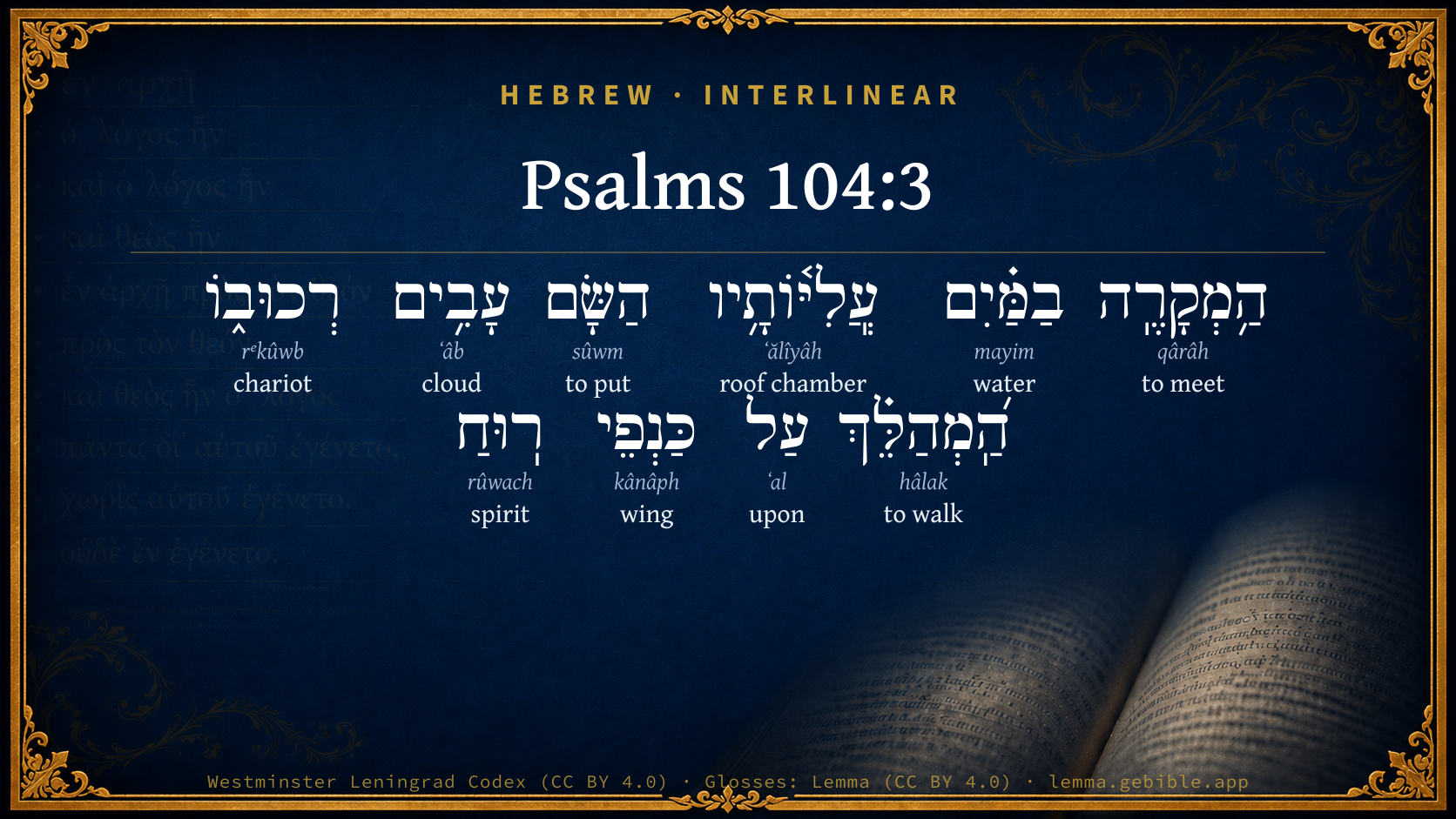
Psalms 104:3

Hebrew (Westminster Leningrad Codex) Psalms 104:3 appears in the Hebrew Old Testament. The text above is from the Westminster Leningrad Codex. Each word links to its Strong’s number, a concise gloss, and parsing drawn from the Open Scriptures Hebrew Bible morphology. Click any word for its full Brown-Driver-Briggs (BDB) entry.
Download image
Cite this verse

Psalms 104:3 (World English Bible). Public Domain. Lemma interlinear Bible study tool, https://lemma.gebible.app/v/psalms/104/3.

Show BibTeX & RIS
BibTeX
RIS
English Translation
He lays the beams of his chambers in the waters. He makes the clouds his chariot. He walks on the wings of the wind.
World English Bible · Public Domain
Highlights
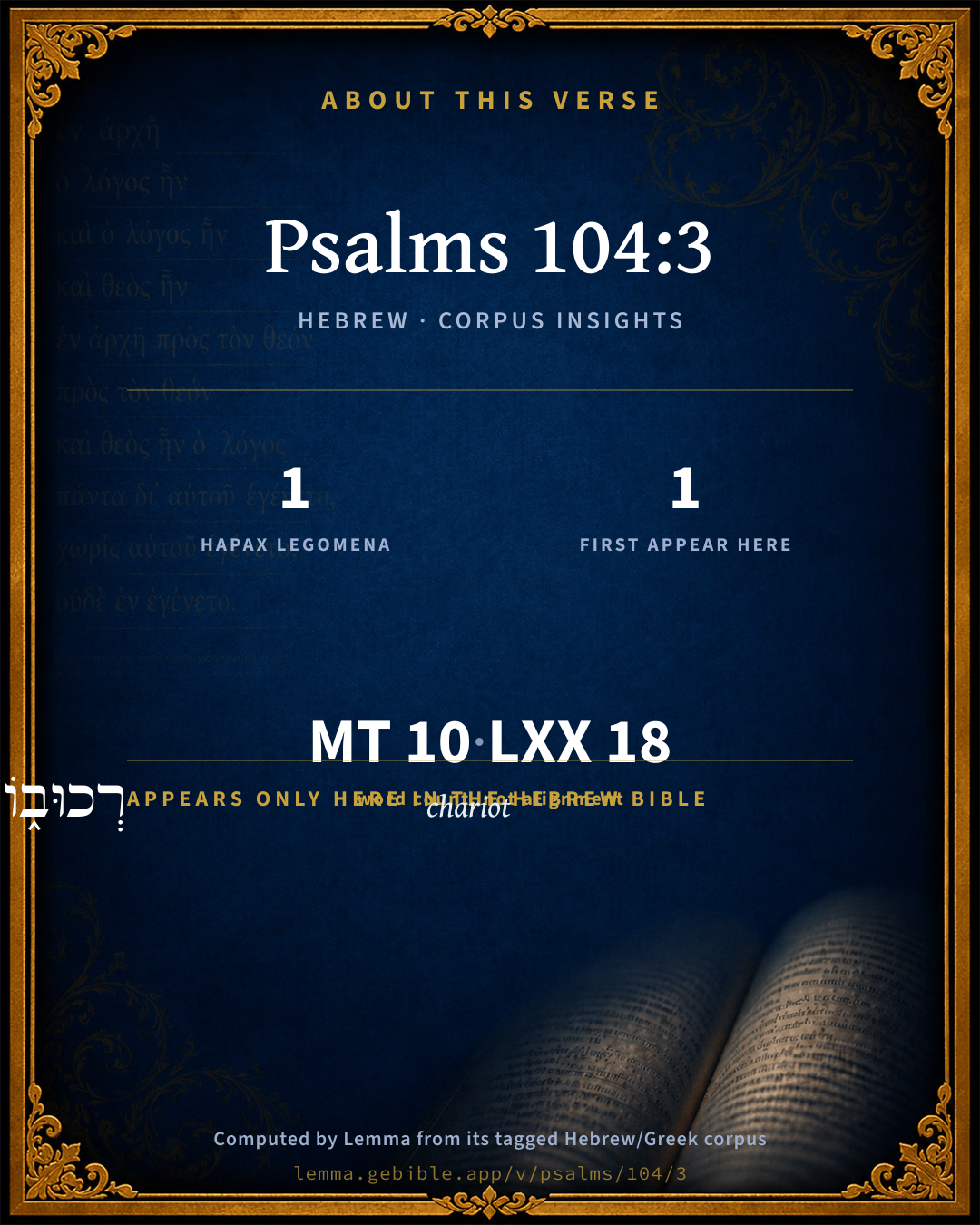
  • 1 hapax legomenon — only here in the Hebrew Bible
  • 1 first appearance in the Hebrew Bible
Full analysis ↓
Download a study sheet

One document with this verse’s original text, its word-by-word gloss line, the meaning frame, cross-references with their text, attributed commentary, and full source and license credits — printable, and it pastes into notes with its structure intact.

This verse Autodidact and up

Study sheet (.html) Plain text (.txt)

A passage Seminary Student

Up to 50 verses in one chapter. A passage sheet keeps up to 6 commentary sources and 12 cross-references per verse, in the order this page ranks them, and says so on the sheet whenever that leaves anything out. Ask for a single verse and you get the Autodidact verse sheet above.

Everything on this page stays free to read, with no account — the sheet is a download of what is already on screen, not access to it.

Want to remove ads? Support Godless Engineer
Compare translations 3

The same verse in 3 English versions, stacked beneath the original-language interlinear above. Click any original word for its lexicon entry.

Each is an independent rendering of the whole verse — the interlinear is not word-aligned to these translations.

Highlighted words mark where these versions differ — a whole-verse word diff, not a word-by-word alignment.

  • World English Bible Public Domain
    He lays the beams of his chambers in the waters. He makes the clouds his chariot. He walks on the wings of the wind.
  • King James Version Public Domain
    Who layeth the beams of his chambers in the waters: who maketh the clouds his chariot: who walketh upon the wings of the wind:
  • unfoldingWord Literal Text CC BY-SA 4.0
    the one setting his upper chambers on the waters; the one appointing the clouds his chariot; the one walking on the wings of the wind;

unfoldingWord Literal Text — © unfoldingWord, licensed CC BY-SA 4.0. Word-aligned USFM3 via Door43 (git.door43.org/unfoldingWord/en_ult).

Versions to compare (up to 4)

3 of 4 selected

Show all 18 translations

Every available English version of this verse, each an independent rendering of the whole verse.

  • World English Bible Public Domain
    He lays the beams of his chambers in the waters. He makes the clouds his chariot. He walks on the wings of the wind.
  • Berean Standard Bible Public Domain
    laying the beams of His chambers in the waters above, making the clouds His chariot, walking on the wings of the wind.
  • Majority Standard Bible Public Domain
    laying the beams of His chambers in the waters above, making the clouds His chariot, walking on the wings of the wind.
  • King James Version Public Domain
    Who layeth the beams of his chambers in the waters: who maketh the clouds his chariot: who walketh upon the wings of the wind:
  • American Standard Version (1901) Public Domain
    Who layeth the beams of his chambers in the waters; Who maketh the clouds his chariot; Who walketh upon the wings of the wind;
  • Revised Version (1885) Public Domain
    Who layeth the beams of his chambers in the waters; who maketh the clouds his chariot; who walketh upon the wings of the wind:
  • Geneva Bible (1599) Public Domain
    Which layeth the beames of his chambers in the waters, and maketh the cloudes his chariot, and walketh vpon the wings of the winde.
  • Douay-Rheims (1899) Public Domain
    who coverest the higher rooms thereof with water. Who makest the clouds thy chariot: who walkest upon the wings of the winds.
  • Young's Literal Translation Public Domain
    Who is laying the beam of His upper chambers in the waters, Who is making thick clouds His chariot, Who is walking on wings of wind,
  • Literal Standard Version CC BY-SA 4.0
    Who is laying the beam of His upper chambers in the waters, || Who is making thick clouds His chariot, || Who is walking on wings of wind,
  • Unlocked Literal Bible CC BY-SA 4.0
    You lay the beams of your chambers on the clouds; you make the clouds your chariot; you walk on the wings of the wind.
  • unfoldingWord Literal Text CC BY-SA 4.0
    the one setting his upper chambers on the waters; the one appointing the clouds his chariot; the one walking on the wings of the wind;
  • Darby Bible Public Domain
    Who layeth the beams of his upper chambers in the waters, who maketh clouds his chariot, who walketh upon the wings of the wind;
  • World Messianic Bible Public Domain
    He lays the beams of his rooms in the waters. He makes the clouds his chariot. He walks on the wings of the wind.
  • Webster's Bible Public Domain
    Who layeth the beams of his chambers in the waters: who maketh the clouds his chariot: who walketh upon the wings of the wind:
  • Free Bible Version CC BY-SA 4.0
    You place the roof-beams of your house in the rainclouds. You make the clouds your chariots. You ride on the wings of the wind.
  • Bible in Basic English Public Domain
    The arch of your house is based on the waters; you make the clouds your carriage; you go on the wings of the wind:
  • JPS Tanakh (1917) Public Domain
    Who layest the beams of Thine upper chambers in the waters, who makest the clouds Thy chariot, who walkest upon the wings of the wind;

Literal Standard Version (2020), Covenant Press — licensed CC BY-SA 4.0. Text via the HelloAO Bible API (eBible.org). Unlocked Literal Bible (unfoldingWord) — licensed CC BY-SA 4.0. Text via the HelloAO Bible API (eBible.org). unfoldingWord Literal Text — © unfoldingWord, licensed CC BY-SA 4.0. Word-aligned USFM3 via Door43 (git.door43.org/unfoldingWord/en_ult). Free Bible Version, Dr. Jonathan Gallagher — licensed CC BY-SA 4.0. Text via the HelloAO Bible API (eBible.org).

Word by word

More ways to search: Search by grammar → Find every occurrence → Compare this word →

Practice this passage: Drill this verse → Learn its vocabulary →

רְכוּב֑וֹ
rᵉkûwb
H7398
“chariot · his”
Noun, Common, Masculine, Singular, Construct + Suffix, Personal, 3rd Person, Masculine, Singular
Part of Speech
Noun
Type
Common
Gender
Masculine
Number
Singular
State
Construct
Full BDB Definition

Origin: from pass part of H7392

TWOT: 2163d

chariot
  1. הַ֥מְקָרֶֽה qârâh H7136 “the · meeting” Particle, Definite Article + Verb, Piel, Participle Active, Masculine, Singular, Absolute
  2. בַמַּ֗יִם mayim H4325 “in/at the · water(s)” Preposition, Determined + Noun, Common, Masculine, Plural, Absolute
  3. עֲֽלִיּ֫וֹתָ֥יו ʻălîyâh H5944 “roof chambers · his” Noun, Common, Feminine, Plural, Construct + Suffix, Personal, 3rd Person, Masculine, Singular
  4. הַשָּׂם sûwm H7760 “the · putting” Particle, Definite Article + Verb, Qal, Participle Active, Masculine, Singular, Absolute
  5. עָבִ֥ים ʻâb H5645 “clouds” Noun, Common, Both, Plural, Absolute
  6. הַֽ֝מְהַלֵּ֗ךְ hâlak H1980 “the · walking” Particle, Definite Article + Verb, Piel, Participle Active, Masculine, Singular, Absolute
  7. עַל ʻal H5921 “upon” Preposition
  8. כַּנְפֵי kânâph H3671 “wings of” Noun, Common, Feminine, Dual, Construct
  9. רֽוּחַ rûwach H7307 “spirit” Noun, Common, Both, Singular, Absolute

About this verse

These counts appear in no published source. They are computed here, from the morphology-tagged text and Lemma’s own curated glosses. What Lemma adds →

10
words
10
distinct lemmas
Wisdom
section

Notable vocabulary

1 hapax legomenon — a word that appears only here in the entire Hebrew Bible:

  • רְכוּב֑וֹ chariot H7398

First appearance in Scripture

This word makes its first canonical appearance in the Hebrew Bible here:

  • רְכוּב֑וֹ chariot H7398

Shared distinctive vocabulary

עֲֽלִיּ֫וֹתָ֥יו roof chamber H5944 occurs in 20 verses of the Hebrew Bible. Also found in:

Grammatical profile

  • 3 verbs
  • 6 nouns
  • 1 preposition

Verb forms

  • הַ֥מְקָרֶֽה Piel · Participle Active
  • הַשָּׂם Qal · Participle Active
  • הַֽ֝מְהַלֵּ֗ךְ Piel · Participle Active

Hebrew & Septuagint length

In English translation the verse runs 24 words from the Hebrew and 20 from the Septuagint (LXX English) — closely comparable.

A rough comparison of the two English renderings, which tokenize alike — not a word-level alignment.

Word counts can differ between the Hebrew and the Greek without any difference in meaning — e.g. the Hebrew direct-object marker אֵת has no separate Greek word, and Greek often adds the article ὁ.

In the original languages it is 10 Hebrew tokens and 18 Greek tokens — but the two are counted differently (Hebrew bundles its prefixes and suffixes into one token; the Greek is in lemma form), so that isn’t a like-for-like length.

Cross-references

8

Topical passages linked to Psalms 104:3 in the Treasury of Scripture Knowledge — connected by theme and wording, ordered by reader-vote popularity; previews shown in the World English Bible.

  • Amos 9:6 It is he who builds his chambers in the heavens, and has founded his vault on the earth; he who calls for the waters of the sea, and pours them out on the surface of the earth; Yahweh is his name.
  • 2 Samuel 22:11 He rode on a cherub, and did fly; Yes, he was seen on the wings of the wind.
  • Psalms 18:10–11 He rode on a cherub, and flew. Yes, he soared on the wings of the wind.
  • Isaiah 19:1 The burden of Egypt. Behold, Yahweh rides on a swift cloud, and comes to Egypt: and the idols of Egypt shall tremble at his presence; and the heart of Egypt shall melt in the midst of it.
  • Nahum 1:3 Yahweh is slow to anger, and great in power, and will by no means leave the guilty unpunished. Yahweh has his way in the whirlwind and in the storm, and the clouds are the dust of his feet.
  • Psalms 139:9 If I take the wings of the dawn, And settle in the uttermost parts of the sea;
  • Matthew 26:64 Jesus said to him, "You have said it. Nevertheless, I tell you, henceforth you will see the Son of Man sitting at the right hand of Power, and coming on the clouds of the sky."
  • Revelation 1:7 Behold, he is coming with the clouds, and every eye will see him, including those who pierced him. All the tribes of the earth will mourn over him. Even so, Amen.

Cross-references courtesy of OpenBible.info (CC BY 4.0).

Hebrew and Greek witnesses Masoretic Hebrew ↔ Greek Septuagint

The same verse in the two great witnesses to the Old Testament, shown verse-for-verse.

You’re reading Greek Psalm 103 (Hebrew Psalm 104). The Septuagint counts the superscription, so verse numbers can differ from the Hebrew — chapter-level alignment, not verse-by-verse. Numbering follows Rahlfs.

These are two independent witnesses, not word-aligned to each other, and the Septuagint is shown in lemma (dictionary) form.

Hebrew Psalms 104:3 Masoretic · Westminster Leningrad Codex

הַ֥מְקָרֶֽה בַמַּ֗יִם עֲֽלִיּ֫וֹתָ֥יו הַשָּׂם עָבִ֥ים רְכוּב֑וֹ הַֽ֝מְהַלֵּ֗ךְ עַל כַּנְפֵי רֽוּחַ

He lays the beams of his chambers in the waters. He makes the clouds his chariot. He walks on the wings of the wind.

World English Bible · Public Domain

Greek LXX Greek Psalm 103:3 Septuagint · lemma form

ὁ στεγάζω ἐν ὕδωρ ὁ ὑπερῷον αὐτός ὁ τίθημι νέφος ὁ ἐπίβασις αὐτός ὁ περιπατέω ἐπί πτέρυξ ἄνεμος

Who covers his chambers with waters; who makes the clouds his chariot; who walks on the wings of the wind.

LXX2012 (modern English Septuagint) · Public Domain

On this verse, Whedon's Commentary on the Bible discusses the Septuagint’s reading. Read the note in Commentary ↓

Hebrew: Westminster Leningrad Codex (CC BY 4.0). Greek: Septuagint (public domain); English from LXX2012 (modern English Septuagint) (Public Domain). How the Septuagint differs from the Hebrew →

Commentary

Notes on Psalms 104:3 from classic Christian and Jewish commentators (each source and its license shown beneath its notes). The classic Christian expositions comment on the surrounding passage and are grouped to its opening verse, so a note may address several verses; the Jewish commentaries on the Tanakh (Rashi and others) are per-verse, so they appear only where the commentator wrote on this verse.

Lemma curates 59 commentaries, every one of them public domain or Creative Commons licensed, each selected and text-cleaned for this edition rather than reprinted as found. About our sources →

Trapp's Complete Commentary

John Trapp

Psa 104:3 Who layeth the beams of his chambers in the waters: who maketh the clouds his chariot: who walketh upon the wings of the wind:

Ver. 3. Who layest the beams of his chambers in the waters] God, as he hath founded the solid earth upon the fluid waters, Psa 26:9; so the highest heaven upon those waters above the firmament, Gen 1:7 Psa 17:11. This notably sets forth the wisdom and power of this Almighty architect, since artists say, In solido extruendam, The foundation of a building should be hard and rocky, and experience sealeth to it.

Who maketh the clouds, &c.] These are his chariot royal, drawn (or rather driven) by the winds, as his chariot horses.

John Trapp, A Commentary or Exposition upon All the Books of the Old and New Testament (1647–1656) — public domain. Text from a community e-Sword module.

The Biblical Illustrator

Joseph S. Exell

Psa_104:3

Who maketh the clouds His chariot.

The cloudy equipage

To understand the psalmists meaning, you must know that the chariot of old was sometimes a sculptured brilliancy, made out of ivory, sometimes of solid silver, and rolled on two wheels, which were fastened to the axle by stout pins, and the defeat of OEnomaus by Pelops was caused by the fact that a traitorous charioteer had inserted a linch-pin of wax instead of a linch-pin of iron. All of the six hundred chariots of Pharaoh lost their linch-pins in the Red Sea: The Lord took off their wheels. Look at the long flash of Solomons fourteen hundred chariots, and the thirty thousand chariots of the Philistines. But my text puts all such occasions into insignificance, as it represents the King of the Universe coming to the door of His palace, and the gilded vapours of heaven rolling up to His feet, and He, stepping in and taking the reins of the galloping winds in His hand, starts in triumphal ride under the arches of sapphire, and over the atmospheric highways of opal and chrysolite, the clouds His chariot. He has His morning-cloud chariot and His evening-cloud chariot--the cloud chariot in which He rode down to Sinai to open the law, and the cloud chariot in which He rode down to Tabor to honour the Gospel, and the cloud chariot in which He will come to judgment. When He rides out in His morning chariot at this season, He puts golden coronets on the dome of cities, and silvers the rivers, and out of the dew makes a diamond ring for the fingers of every grass blade, and bids good cheer to invalids who in the night said, Would God it were morning! From this morning-cloud chariot He distributes light--light for the earth and light for the heavens, light for the land and light for the sea, great bars of it, great wreaths of it, great columns of it, a world full of it. What a mighty thing the King throws from His chariot when He throws us the morning! Yea; He has also His evening-cloud chariot. It is made out of the saffron and the gold and the purple and the orange and the vermilion and upshot flame of the sunset. That is the place where the splendours that have marched through the day, having ended the procession, throw down their torches and set the heavens on fire. Oh, what a rich God we have that He can put on one evening sky pictures that excel Michael Angelos Last Judgment, and Ghirlandajos Adoration of the Magi, and whole galleries of Madonnas, and for only an hour, and throw them away, and the next evening put on the same sky something that excels all that the Raphaels and Titians and Rembrandts ever executed, and then draw a curtain of mist over them never again to be exhibited! How rich God must be to have a new chariot of clouds every evening! But the Bible tells us that our King also has His black chariot, for we are told that Clouds and darkness are round about Him. That chariot is cloven out of night, and that night is trouble. When He rides forth in that black chariot, pesitilence and earthquake and famine and hurricane and woe attend Him. Then let the earth tremble. Then let nations pray. Mark you, the ancient chariot which David uses as a symbol in my text, had only two wheels, and that was that they might turn quickly, two wheels taking less than half the time to turn than four wheels would have taken. And our Lords chariot has only two wheels, and that means instant reversal, and instant help, and instant deliverance. While the combined forces of the universe in battle array could not stop His black chariot a second, or diverge it an inch, the driver of that chariot says, Call upon Me in the day of trouble, and I will deliver thee. While they are yet speaking I will hear. His two-wheeled chariot, one wheel justice, and the other wheel mercy. Aye, they are swift wheels. A cloud, whether it belongs to the cirrhus, the clouds that float the highest; or belongs to the stratus, the central ranges; or to the cumulus, the lowest ranges--seems to move slowly along the sky if it moves at all. But many of the clouds go at such a speed that even a limited lightning express train would seem lethargic, so swift is the chariot of our God; yea, swifter than the storm, swifter than the light. Yet a child ten years old has been known to reach up, and with the hand of prayer take the courser of that chariot by the bit and slow it up, or stop it, or turn it aside, or turn it back. Notice that these old-time chariots, which nay text uses for symbol, had what we would call a high dashboard at the front, but were open behind. And the king would stand at the dashboard and drive with his own hands. And I am glad that He whose chariot the clouds are, drives Himself. He does not let natural law drive, for natural law is deaf. He does not let fate drive, for fate is merciless. But our Father King Himself drives, and He puts His loving hand on the reins of the flying coursers, and He has a loving ear open to the cry of all who want to catch His attention. But there are clouds that touch the earth and discharge their rain; and, though the clouds out of which Gods chariot is made may sometimes be far away, often they are close by, and they touch our shoulders, and our homes, and they touch us all over. I have read of two rides that the Lord took in two different chariots of clouds, and of another that He will take. One day, in a chariot of clouds that were a mingling of fog and smoke and fire, God drove down to the top of a terrible crag fifteen hundred feet high, now called Jebel-Musa, then called Mount Sinai, and He stepped out of His chariot among the split shelvings of rock. The mountain shook as with an ague, and there were ten volleys of thunder, each of the ten emphasizing a tremendous Thou shalt or Thou shalt not. Then the Lord resumed His chariot of cloud, and drove up the hills of heaven. They were dark and portentous clouds that made that chariot at the giving of the law. But one day He took another ride, and this time down to Mount Tabor; the clouds out of which His chariot was made, bright clouds, roseate clouds, illumined clouds, and music rained from all of them, and the music was a mingling of carol and chant and triumphal march: This is My beloved Son, in whom I am well pleased. Transfiguration chariot! Oh, say you, I wish I could have seen those chariots--the black one that brought the Lord to Jebel-Musa, at the giving of the law, and the white one that brought Him down to Tabor! Never mind, you will see something grander than that, and it will be a mightier mingling of the sombre and the radiant, and the pomp of it will be such that the chariots in which Trajan and Diocletian and Zenobia and Caesar and Alexander and all the conquerors of all the ages rode will be unworthy of mention; and what stirs me most is, that when He comes in that chariot of cloud and goes back, He will ask you and me to ride with Him both ways. How do I know that the judgment chariot will be made out of clouds? Read Rev_1:7. (T. De Witt Talmage.)

Who maketh His angels spirits.--

The powers of Nature

1. What a number of beautiful and wonderful objects does Nature present on every side of us! and how little we know concerning them! In some indeed we see symptoms of intelligence, and we get to form some idea of what they are. For instance, about brute animals we know little, but still we see they have sense, and we understand that their bodily form which meets the eye is but the index, the outside token of something we do not see. Much more in the case of men: we see them move, speak, and act, and we know that all we see takes place in consequence of their will, because they have a spirit within them, though we do not see it. But why do rivers flow? Why does rain fall? Why does the sun warm us? And the wind, why does it blow? Here our natural reason is at fault; we know, I say, that it is the spirit in man and in beast that makes man and beast move, but reason tells us of no spirit abiding in what is commonly called the natural world, to make it perform its ordinary duties. Of course, it is Gods will which sustains it all; so does Gods will enable us to move also, yet this does not hinder, but, in one sense, we may be truly said to move ourselves: but how do the wind and water, earth and fire, move? Now, here Scripture interposes, and seems to tell us that all this wonderful harmony is the work of angels. Those events which we ascribe to chance as the weather, or to nature as the seasons, are duties done to that God who maketh His angels to be winds, and His ministers a flame of fire (Joh_5:4; Exo_19:16-18; Gal_3:19; Act_7:53; Rev_7:1; Gen_19:13; 2Ki_19:35; 2Sa_24:15-17; Mat_28:2; Rev_8:1-13; Rev_9:1-21; Rev_16:1-21). Thus, whenever we look abroad, we are reminded of those most gracious and holy beings, the servants of the Holiest, who deign to minister to the heirs of salvation. Every breath of air and ray of light and heat, every beautiful prospect, is, as it were, the skirts of their garments, the waving of the robes of those whose faces see God in heaven. And I put it to any one, whether it is not as philosophical, and as full of intellectual enjoyment, to refer the movements of the natural world to them, as to attempt to explain them by certain theories of science, useful as these theories certainly are for particular purposes, and capable (in subordination to that higher view) of a religious application.

2. Vain man would be wise, and he curiously examines the works of Nature, as if they were lifeless and senseless; as if he alone had intelligence, and they were base inert matter, however curiously contrived at the first. So he goes on, tracing the order of things, seeking for causes in that order, giving names to the wonders he meets with, and thinking he understands what he has given a name to. At length he forms a theory, and recommends it in writing, and calls himself a philosopher. Now, all these theories of science, which I speak of, are useful, as classifying, and so assisting us to recollect, the works and ways of God and of His ministering angels. And again, they are ever most useful, in enabling us to apply the course of His providence, and the ordinances of His will, to the benefit of man. Thus we are enabled to enjoy Gods gifts; and let us thank Him for the knowledge which enables us to do so, and honour those who are His instruments in communicating it. When then we walk abroad, and meditate in the field at the eventide, how much has every herb and flower in it to surprise and overwhelm us! For, even did we know as much about them as the wisest of men, yet there are those around us, though unseen, to whom our greatest knowledge is as ignorance; and, when we converse on subjects of nature scientifically, repeating the names of plants and earths, and describing their properties, we should do so religiously, as in the hearing of the great servants of God, with the sort of diffidence which we always feel when speaking before the learned and wise of our own mortal race, as poor beginners in intellectual knowledge, as well as in moral attainments.

3. Lastly, it is a motive to our exertions in doing the will of God, to think that, if we attain to heaven, we shall become the fellows of the blessed angels. Indeed, what do we know of the courts of heaven, but as peopled by them? and therefore doubtless they are revealed to us, that we may have something to fix our thoughts on, when we look heavenwards. (J. H. Newman, B.D.)

Spiritual ministries

The author of this psalm is deeply impressed with the manifestation of Gods presence in nature. Everything reminds him of God. And the wonderful fact about his language is, that it not only conceives of material things in spiritual phraseology, but that it ascends higher than this, and describes spiritual things in the wording of material symbols.

I. The truest ministries in Gods service are the spiritual ones. We, in our earthliness and sense-satisfied lives, wrapped about continually with the demands of the flesh, crave creaturely ministries; we want prosperity, success, and pleasure; we want material food, and physical delights, and social honour; we run after the trumpet-blare of fame, and bite at the dangling hook of influence and power. And who can wonder, when nerves and brain, and soul itself, are all enwrapped in matter, so that the touch of the senses is over all that we do? Yet right in the face of all this material and creaturely drift of our natures, we need to hear these far-off words of inspiration and command, He maketh His angels spirits. Who does not know and feel the power and the truthfulness of this thought?

II. Gods truest servants are those whose characters are an inspiration to others. This it is which gives to history its interest and its highest meaning; it is the charm which always comes from bringing forward new men and new issues to take the place of worn-out men and times. This touch of Gods inspiration is like a new incarnation of Divine power in every strong, brave, true life. Then we feel that we can conquer, because others have conquered; then we feel that we, too, can rise above self and those miserable infirmities of our existence which seem, at times, to hedge our lives into a land-locked inland sea of mediocrity of living, simply because others have threaded their way through similar narrow places, and have escaped from their moral captivity altogether. This is what makes a good piece of honest biography such attractive reading: we get birds-eye views of this common life of ours; we get an insight into the secret working of causes which have their home in the souls of us all. (W. W. Newton.)

Ardency required of ministers

It is true that a man may hold out a light to others who himself does not see it. It is true that, as a concave speculum cut from a block of ice, by its power of concentrating the rays of the sun, may kindle touchwood or explode gunpowder, so a preacher may set others on fire, when his own heart is cold as frost. It is true that he may stand like a lifeless finger-post, pointing the way along the road where he neither leads nor follows. It is true that God in His sovereign mercy may thus bless others by one who is himself unblessed. Yet commonly it happens, that it is that which proceeds from the heart of preachers that penetrates and affects the hearts of hearers, like a ball red-hot from the cannons mouth, he must burn himself who would set others on fire. (T. Guthrie, D.D.)

The Biblical Illustrator, edited by Joseph S. Exell (c. 1880s–1900s) — public domain. Text from a community e-Sword module.

Joseph Benson's Commentary

Psa 104:3. Who layeth the beams of his chambers — His upper rooms, (so the word עליותיו signifies,) in the waters — The waters that are above the firmament, (Psa 104:3,) as he has founded the earth upon the seas and floods, the waters beneath the firmament. The Almighty is elsewhere said to make those dark waters, compacted in the thick clouds of the skies, the secret place, or chamber, of his residence, and a kind of footstool to his throne: see Psa 18:9; Psa 18:11. Though air and water are fluid bodies, yet, by the divine power, they are kept as tight and as firm in the place assigned them, as a chamber is with beams and rafters. How great a God is he whose presence-chamber is thus reared, thus fixed! Who maketh the clouds his chariot — In which he rides strongly, swiftly, and far above, out of the reach of opposition, when at any time it is his will to make use of uncommon providences in his government of the world. He descended in a cloud, as in a chariot, to mount Sinai, to give the law, and to mount Tabor, to proclaim the gospel; and he still frequently rides upon the clouds, or heavens, to the help of his people, Deu 33:26. Who walketh upon the wings of the wind — “There is an unequalled elegance,” says Mr. Hervey, “in these words. It is not said he flieth, he runneth, but he walketh; and that, on the very wings of the wind; on the most impetuous element, raised into the utmost rage, and sweeping along with incredible rapidity. We cannot have a more sublime idea of the Deity; serenely walking on an element of inconceivable swiftness, and, as it seems to us, uncontrollable impetuosity.” “How astonishingly magnificent and tremendous is the idea which these words convey to us of the great King, riding upon the heavens, encompassed with clouds and darkness, attended by the lightnings, those ready executioners of his vengeance, and causing the world to resound and tremble at the thunder of his power and the noise of his chariot-wheels. By these ensigns of royalty, these emblems of omnipotence, and instruments of his displeasure, doth Jehovah manifest his presence, when he visiteth rebellious man, to make him own and adore his neglected and insulted Lord.” — Horne.

Joseph Benson's Commentary on the Old and New Testaments (1811–1818) — public domain. Text from a community e-Sword module.

J. A. Alexander on Psalms

Joseph Addison Alexander

3. (Psa 104:3) Framing with water his halls; making clouds his conveyance; moving on wings of the wind. The first word means laying beams or rafters. The next phrase may either mean in or with water. The first is more obvious, the last more striking; as it represents a solid building, made of a liquid or fluid material. In the other case the waters meant are those above the firmament. See Gen 1:6-7, Psa 18:11, where the clouds and the wings of the wind are also mentioned in the same connection. The word translated halls denotes the highest room of an oriental house, which is frequently the largest. Hence the frequent mention, in the New Testament, of the place of assembly. Making, literally setting, placing. Chariot is too specific a translation of the Hebrew word, which means anything on which a person rides. The preposterous figure of walking on wings belongs entirely to the versions, ancient and modern. The Hebrew word, though often so applied, is a generic one, denoting all progressive movement, and nearly equivalent to our word going, which is not so agreeable, however, in this place, to English usage, as the more general and poetical term moving. See above on Psa 18:10.

Joseph Addison Alexander, The Psalms Translated and Explained (1850) — public domain. Text from a community e-Sword module.

Tyndale Open Study Notes

Tyndale Open Resources

104:3 This poetic portrayal envisions the clouds as beams that support heaven.

Tyndale Open Study Notes — © Tyndale Open Resources, licensed CC BY-SA 4.0. Text via the HelloAO Bible API.

Adam Clarke's Commentary

Verse 3. המקרה במים עליותיו hamekareh bammayim aliyothaiv.

"Laying the beams of his chambers in the waters."

The sacred writer expresses the wonderful nature of the air aptly, and regularly constructed, from various and flux elements, into one continued and stable series, by a metaphor drawn from the singular formation of the tabernacle, which, consisting of many and different parts, and easily reparable when there was need, was kept together by a perpetual juncture and contignation of them all together. The poet goes on: -

השם עבים רכובו hassem abim rechubo,

המהלך על כנפי רוה hamehallech al canphey ruach.

"Making the clouds his chariot,

Walking upon the wings of the wind."

He had first expressed an image of the Divine Majesty, such as it resided in the holy of holies, discernible by a certain investiture of the most splendid light; he now denotes the same from that light of itself which the Divine Majesty exhibited, when it moved together with the ark, sitting on a circumambient cloud, and carried on high through the air. That seat of the Divine Presence is even called by the sacred historians, as its proper name, המרכבה hammercabah, THE CHARIOT.

Adam Clarke's Commentary on the Bible (1810–1826) — public domain. Text from a community e-Sword/MySword module.

John Calvin's Commentaries

3. Laying the beams of his chambers in the waters David now proceeds to explain at greater length what he had briefly stated under the figure of God’s raiment. The scope of the passage is shortly this, that we need not pierce our way above the clouds for the purpose of finding God, since he meets us in the fabric of the world, and is everywhere exhibiting to our view scenes of the most vivid description. That we may not imagine that there is any thing in Him derived, as if, by the creation of the world, he received any addition to his essential perfection and glory, we must remember that he clothes himself with this robe for our sake. The metaphorical representation of God, as laying the beams of his chambers in the waters, seems somewhat difficult to understand; but it was the design of the prophet, from a thing incomprehensible to us, to ravish us with the greater admiration. Unless beams be substantial and strong, they will not be able to sustain even the weight of an ordinary house. When, therefore, God makes the waters the foundation of his heavenly palace, who can fail to be astonished at a miracle so wonderful? When we take into account our slowness of apprehension, such hyperbolical expressions are by no means superfluous; for it is with difficulty that they awaken and enable us to attain even a slight knowledge of God.

What is meant by his walking upon the wings of the wind, is rendered more obvious from the following verse, where it is said, that the winds are his messengers God rides on the clouds, and is carried upon the wings of the wind, inasmuch as he drives about the winds and clouds at his pleasure, and by sending them hither and thither as swiftly as he pleases, shows thereby the signs of his presence. By these words we are taught that the winds do not blow by chance, nor the lightnings flash by a fortuitous impulse, but that God, in the exercise of his sovereign power, rules and controls all the agitations and disturbances of the atmosphere. From this doctrine a twofold advantage may be reaped. In the first place, if at any time noxious winds arise, if the south wind corrupt the air, or if the north wind scorch the corn, and not only tear up trees by the root, but overthrow houses, and if other winds destroy the fruits of the earth, we ought to tremble under these scourges of Providence. In the second place, if, on the other hand, God moderate the excessive heat by a gentle cooling breeze, if he purify the polluted atmosphere by the north wind, or if he moisten the parched ground by south winds; in this we ought to contemplate his goodness.

As the apostle, who writes to the Hebrews, (Hebrews 1:7) quotes this passage, and applies it to the angels, both the Greek and Latin expositors have almost unanimously considered David as here speaking allegorically. In like manner, because Paul, in quoting Psalm 19:4, in his Epistle to the Romans, (Romans 10:18) seems to apply to the apostles what is there stated concerning the heavens, the whole psalm has been injudiciously expounded as if it were an allegory. The design of the apostle, in that part of the Epistle to the Hebrews referred to, was not simply to explain the mind of the prophet in this place; but since God is exhibited to us, as it were, visibly in a mirror, the apostle very properly lays down the analogy between the obedience which the winds manifestly and perceptibly yield to God, and that obedience which he receives from the angels. In short, the meaning is, that as God makes use of the winds as his messengers, turns them hither and thither, calms and raises them whenever he pleases, that by their ministry he may declare his power, so the angels were created to execute his commands. And certainly we profit little in the contemplation of universal nature, if we do not behold with the eyes of faith that spiritual glory of which an image is presented to us in the world.

John Calvin's Commentaries (1540-1563) — public domain. Text from the Calvin Translation Society English edition (1840s-50s) via the Christian Classics Ethereal Library (ccel.org). Calvin's coverage is partial (roughly two-thirds of the Bible); uncommented books and verses are honest gaps, never fabricated. The 19th-century editor's footnotes and remarks are omitted so the notes are faithfully Calvin's own voice.

Ellicott's Commentary for English Readers

(3) Layeth the beams.—Literally, maketh to meet The meaning of the Hebrew word, which is an exact equivalent of the Latin contignare, is clear from Neh_2:8; Neh_3:3; Neh_3:6, and from the meaning of the derived noun (2Ki_6:2; 2Ki_6:5; Son_1:17).

Chambers.—Literally, lofts or upper stories. (See 2Ki_4:10; Jer_22:13-14.)

In the waters.—The manner of this ethereal architecture is necessarily somewhat difficult to picture. The pavilion which God rears for His own abode appears to rest on a floor of rain-clouds, like a tent spread on a flat eastern roof. (See Psa_18:11; Amo_9:6-7.) Southey’s description of the Palace of Indra may perhaps help the imagination:—

“Built on the lake, the waters were its floor;

And here its walls were water arched with fire,

And here were fire with water vaulted o’er;

And spires and pinnacles of fire

Round watery cupolas aspire,

And domes of rainbow rest on fiery towers.”

Curse of Kehama.

Who maketh the clouds His chariot.—See Psa_18:10, probably the original of this verse; chariot (rekhûb) here taking the place of cherub.

Walketh upon the wings of the wind.—Doubtless the metaphor is taken from the clouds, which, in a wind-swept sky, float along like “the drifted wings of many companies of angels.” The clause is thus in direct parallelism with the description of the cloud chariot. The figure has passed into modern song:

“Every gust of rugged wings

That blows from off each beaked promontory.”

MILTON: Lycidas.

“No wing of wind the region swept.”

TENNYSON: In Memoriam.

A Bible Commentary for English Readers, edited by Charles John Ellicott (1878–1897) — public domain. Text from a community e-Sword module.

The Cambridge Bible for Schools and Colleges

gen. ed. J. J. S. Perowne

3. By a bold paradox the Creator is described as laying the beams of his upper chambers in the waters. On the mysterious reservoir of waters, which was imagined by the ancient Hebrews to exist above the ‘firmament’ (Gen_1:7; Psa_29:3; Psa_148:4), He constructs His secret dwelling, as a man builds “upper chambers” on the roof of his house for air and privacy. The line is an echo of Amo_9:6, “he that buildeth his upper chambers in the heavens.”

who maketh the clouds &c.] The stormcloud and the tempest are the symbols of His Advent. Cp. Psa_18:10; Isa_19:1; Dan_7:13; Mat_24:30.

The Cambridge Bible for Schools and Colleges (gen. ed. J. J. S. Perowne; Cambridge University Press, 1878–1918) — public domain. Text from a community e-Sword module.

John Gill's Exposition

Who layeth the beams of his chambers in the waters,.... Or "his upper rooms" (i); one story over another being built by him in the heavens, Amo 9:6, the chambers where he resides; his courts, as the Targum; his palace and apartments, his presence chamber particularly, the floor and beams of them are the waters bound up in the thick clouds; or the region of the air, from whence the rain descends to water the hills, as in Psa 104:13.

Who maketh the clouds his chariot; to ride in; in these sometimes Jehovah rides to execute judgment on his enemies, Isa 19:1 and in these sometimes he appears in a way of grace and mercy to his people, Exo 13:21, in these, as in chariots, Christ went up to heaven; and in these will he come a second time; and into these will the saints be caught up to meet the Lord in the air at his coming, Act 1:9.

Who walketh upon the wings of the wind; see Psa 18:10 which is expressive of his swiftness in coming to help and assist his people in time of need; who helps, and that right early; and may very well be applied both to the first and second coming of Christ, who came leaping upon the mountains, and skipping upon the hills, when he first came; and, when he comes a second time, will be as a roe or a young hart upon the mountains of spices, Sol 2:8. The Targum is,

"upon the swift clouds, like the wings of an eagle;''

hence, perhaps, it is, the Heathens have a notion of Jupiter's being carried in a chariot through the air, when it thunders and lightens (k).

(i) Sept. "coenacula sua superiora", Gejerus; so Michaelis. (k) Vid. Horat. Camin. l. 1. Ode 34. v. 5. "Namque diespiter", &c. Et. Ode 12. v. 58. "Tu gravi curru quaties Olympum".

John Gill's Exposition of the Whole Bible (1746–1763) — public domain (CC PDM 1.0). Text via the HelloAO Bible API.

Albert Barnes' Notes on the Bible

Who layeth the beams of his chambers in the waters - The word here rendered “layeth” - from קרה qârâh - means properly to meet; then, in Hiphil, to cause to meet, or to fit into each other, as beams or joists do in a dwelling. It is a word which would be properly applied to the construction of a house, and to the right adjustment of the different materials employed in building it. The word rendered “beams” - עליה ‛ălı̂yâh - means “an upper chamber, a loft,” such as rises, in Oriental houses, above the flat roof; in the New Testament, the ὑπερῷον huperōon, rendered “upper room,” Act 1:13; Act 9:37, Act 9:39; Act 20:8. It refers here to the chamber - the exalted abode of God - as if raised above all other edifices, or above the world. The word “waters” here refers to the description of the creation in Gen 1:6-7 - the waters “above the firmament,” and the waters “below the firmament.” The allusion here is to the waters above the firmament; and the meaning is, that God had constructed the place of his own abode - the room where he dwelt - in those waters; that is, in the most exalted place in the universe. It does not mean that he made it of the waters, but that his home - his dwelling-place - was in or above those waters, as if he had built his dwelling not on solid earth or rock, but in the waters, giving stability to that which seems to have no stability, and making the very waters a foundation for the structure of his abode.

Who maketh the clouds his chariot - Who rides on the clouds as in a chariot. See the notes at Isa 19:1. Compare the notes at Psa 18:11.

Who walketh upon the wings of the wind - See the notes at Psa 18:10.

Albert Barnes' Notes on the Bible (1834–1885) — public domain. Text from a community e-Sword/MySword module.

Matthew Poole's English Annotations

In the waters; in the waters above the heavens, as they are called, Gen 1:7; or, in the clouds, as it is explained in the next clause, in which he many times resides and rides, and manifests his presence. Who manageth and employeth the clouds and winds in his service.

Matthew Poole's English Annotations on the Holy Bible (1683–1685) — public domain. Text from a community e-Sword/MySword module.

The Treasury of David

Charles H. Spurgeon

Ver. 3. Who layeth the beams of his chambers in the water's. His lofty halls are framed with the waters which are above the firmament. The upper rooms of God's great house, the secret stories far above our ken, the palatial chambers wherein he resides, are based upon the floods which form the upper ocean. To the unsubstantial he lends stability; he needs no joists and rafters, for his palace is sustained by his own power. We are not to interpret literally where the language is poetical, it would be simple absurdity to do so.

Who maketh the clouds his chariot. When he comes forth from his secret pavilion it is thus he makes his royal progress. "It is chariot of wrath deep thunder clouds form, "and his chariot of mercy drops plenty as it traverses the celestial road.

Who walketh or rather goes upon the wings of the wind. With the clouds for a car, and the winds for winged steeds, the Great King hastens on his movements whether for mercy or for judgment. Thus we have the idea of a king still further elaboratedhis lofty palace, his chariot, and his coursers are before us; but what a palace must we imagine, whose beams are of crystal, and whose base is consolidated vapour! What a stately car is that which is fashioned out of the flying clouds, whose gorgeous colours Solomon in all his glory could not rival; and what a Godlike progress is that in which spirit wings and breath of winds bear up the moving throne. "O Lord, my God, thou art very great!"

Ver. 3. The metaphorical representation of God, as laying the beams of his chambers in the waters, seems somewhat difficult to understand; but it was the design of the prophet, from a thing incomprehensible to us, to ravish us with the greater admiration. Unless beams be substantial and strong, they will not be able to sustain even the weight of an ordinary house. When, therefore, God makes the waters the foundation of his heavenly palace, who can fail to be astonished at a miracle so wonderful? When we take into account our slowness of apprehension, such hyperbolical expressions are by no means superfluous; for it is with difficulty that they awaken and enable us to attain even a slight knowledge of God. John Calvin.

Ver. 3. Who layeth the beams of his chambers in the waters; or, "who layeth his upper chambers above the waters." His upper chamber (people in the East used to retire to the upper chamber when they wished for solitude) is reared up in bright other on the slender foundation of rainy clouds. A.F. Tholuck.

Ver. 3. Who layeth the beams, etc. "He floodeth his chambers with waters, "i.e., the clouds make the flooring of his heavens. Zachary Mudge.

Ver. 3. Who walketh upon the wings of the wind; see Ps 18:10; which is expressive of his swiftness in coming to helped assist his people in time of need; who helps, and that right early; and may very well be applied both to the first and second coming of Christ, who came leaping Upon the mountains, and skipping upon the hills, when he first came; and, when he comes a second time will be as a roe or a young hart upon the mountains of spices, So 2:8 8:14 The Targum is, "upon the swift clouds, like the wings of an eagle"; hence, perhaps, it is the heathens have a notion that Jupiter is being carried in a chariot through the air when it thunders and lightens. John Gill.

Ver. 3. Who walketh upon the wings of the wind. In these words there is an unequalled elegance; not, he fleeth he runneth, buthe walketh;and that on the very wings of the wind;on the most impetuous element raised into the utmost rage, and sweeping along with incredible rapidity. We cannot have a more sublime idea of the deity; serenely walking on an element of inconceivable swiftness, and, as it seems to us, uncontrollable impetuosity! James Hervey, 1713-141758.

Ver. 3 (last clause).

1. God is leisurely in his haste: "he walketh, "etc.

2. God is swift even in his slackness: "he walketh on the wings of the wind."

3. The practical conclusions are that there is time enough for the divine purposes but none for our trifling; and that we should both wait with patience for the victory of his cause and hasten it by holy activity.

Psalms 104:4*

Charles H. Spurgeon's The Treasury of David (1869–1885) — public domain. Psalms only. Text from a community e-Sword/MySword module.

Whedon's Commentary on the Bible

Daniel D. Whedon

3. Layeth the beams of his chambers in the waters—The idea of a celestial reservoir, or ocean, whether as a poetic image or a fact, is alluded to, grounded on Gen_1:6-7. The region of the rain clouds is intended. See on Psa_104:2. The figure is taken from architecture. To lay “the beams” is to frame them solidly together. Neh_3:3; Neh_3:6, “Chambers,” here, do not mean the supreme heavens, the blissful abode of God, but literally the upper rooms, (so Septuagint and Jerome,) that is, the upper regions of the atmosphere in general. The “beams” of these “chambers” seemed to rest upon the region of the rain clouds. From these same “chambers” God waters the hills. Psa_104:13. Here, upon the clouds, he builds his superior, though not his supreme, apartments. From these regions proceed the more sensible tokens of God, as rain, hail, snow, lightning, and thunder; and they were looked upon with awe as the temporary abode of God, an idea which a tropical thunderstorm is well suited to suggest. See Psa_18:11.

The clouds his chariot—The figure is changed, but fixes the location of the “chambers,” just noticed, and of the “heavens,” Psa_104:2. See Isa_19:1. And thus when God would send rain, he is said to “bow the heavens” (clouds) and come down; a beautiful expression of a fact in nature. Psa_18:9.

Wings of the wind—See Psa_18:10. The allusion in this verse, also, is to the work of the second day.

Daniel D. Whedon (gen. ed.), Commentary on the Old and New Testaments (1874–1909) — public domain. Text from a community e-Sword module.

The Pulpit Commentary

Who layeth the beams of his chambers in the waters. God forms himself an upper chamber, as a dwelling place, in "the waters that are above the firmament", (Gen_1:7) as a man builds himself an upper chamber with beams and rafters. Who maketh the clouds his chariot. (comp. Isa_19:1, "Behold, the Lord rideth upon a thick cloud Who walketh upon the wings of the wind. (comp. Psa_18:10) The anthropomorphism will be pardoned for the sake of the beauty of the imagery.

The Pulpit Commentary (1880–1919), ed. H.D.M. Spence-Jones & Joseph S. Exell — public domain. Text from a community e-Sword module.

John Wesley's Explanatory Notes

Waters - In the waters above the heavens, as they are called, Gen. i, 7.

John Wesley, Explanatory Notes Upon the Whole Bible (1754–1765) — public domain. Text via the GEBible commentary corpus.

Lesson kit

Teaching starters — assembled from the data on this page, not authored interpretation. Every prompt links to the verse data it draws on. Edit before teaching.

Psalms, in the Wisdom, opens this verse with 10 words (10 distinct Hebrew lemmas). Its most distinctive word is rᵉkûwb (“chariot”). A historical commentator’s framing appears above. Read the whole chapter for the surrounding context.

Discussion questions

  1. How does “chariot” (rᵉkûwb) shape what this verse is saying?
  2. This verse holds 1 word here found nowhere else in the Hebrew Bible. What might the rare word draw attention to?
  3. The word “chariot” first appears here in Scripture. What is being introduced at this debut?
  4. Judges 3:20 shares the word «roof chamber» with this verse. How do the two illuminate each other?
  5. These translations render this verse differently. What is at stake in choosing one wording over another?
  6. The verb «הַ֥מְקָרֶֽה» is Piel Participle Active. How does its form color the action?
  7. Reading how Trapp's Complete Commentary and The Biblical Illustrator read this verse, where do the two commentators agree and where do they part?

Things to notice

Reading settings

Reading text

Shown beneath each verse's original-language words.

Old Testament
Old Testament edition

Read the OT as the Masoretic Hebrew (MT) or the Greek Septuagint (LXX).

English shown for the Greek Septuagint (in the Hebrew ↔ Greek comparison).

Comparing translations? Open the Compare panel on any verse page to stack up to four side by side.