
Psalms 77:6

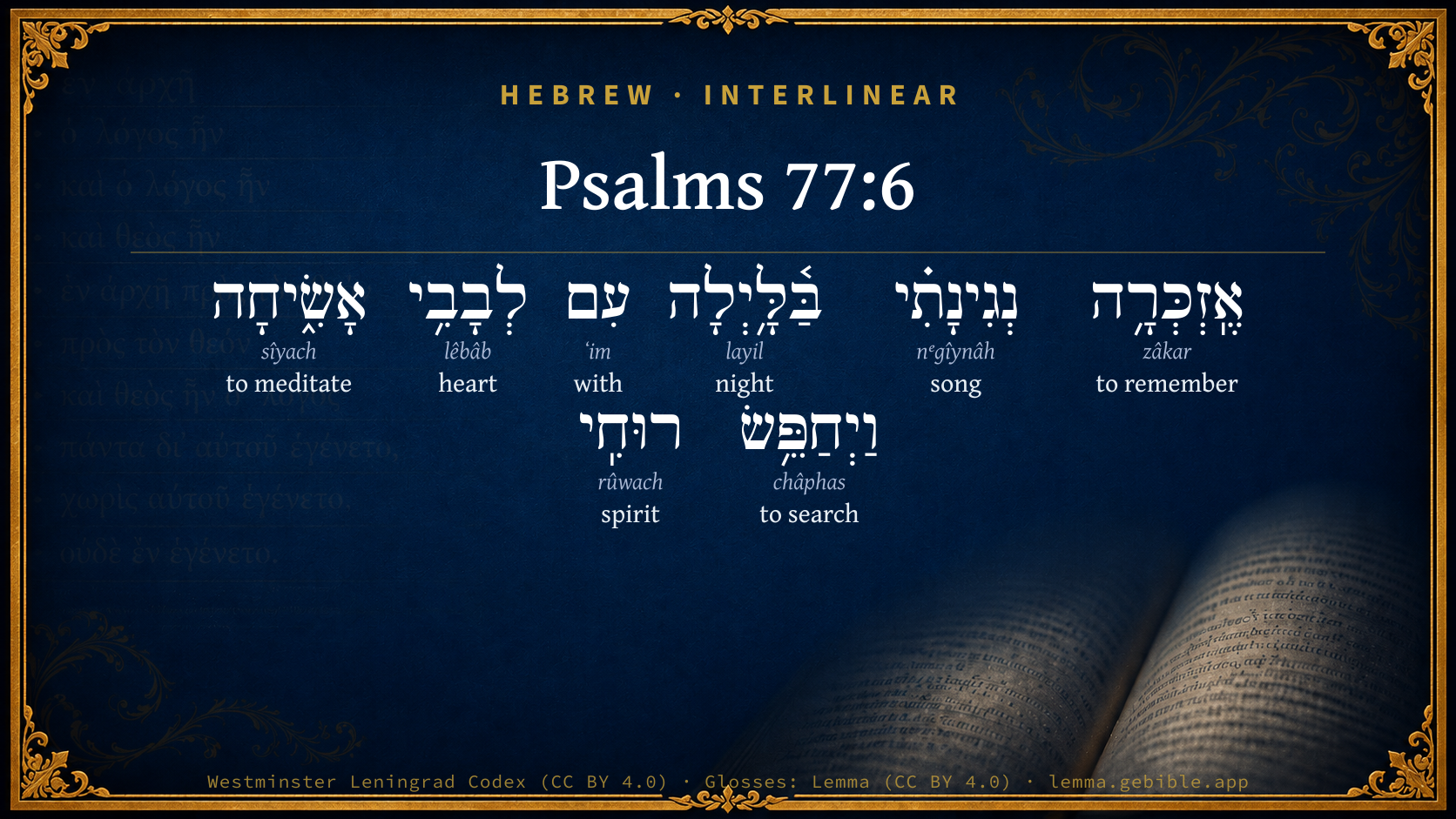
Hebrew (Westminster Leningrad Codex) Psalms 77:6 appears in the Hebrew Old Testament. The text above is from the Westminster Leningrad Codex. Each word links to its Strong’s number, a concise gloss, and parsing drawn from the Open Scriptures Hebrew Bible morphology. Click any word for its full Brown-Driver-Briggs (BDB) entry.
Download image
Cite this verse

Psalms 77:6 (World English Bible). Public Domain. Lemma interlinear Bible study tool, https://lemma.gebible.app/v/psalms/77/6.

Show BibTeX & RIS
BibTeX
RIS
English Translation
I remember my song in the night. I consider in my own heart; My spirit diligently inquires:
World English Bible · Public Domain
Download a study sheet

One document with this verse’s original text, its word-by-word gloss line, the meaning frame, cross-references with their text, attributed commentary, and full source and license credits — printable, and it pastes into notes with its structure intact.

This verse Autodidact and up

Study sheet (.html) Plain text (.txt)

A passage Seminary Student

Up to 50 verses in one chapter. A passage sheet keeps up to 6 commentary sources and 12 cross-references per verse, in the order this page ranks them, and says so on the sheet whenever that leaves anything out. Ask for a single verse and you get the Autodidact verse sheet above.

Everything on this page stays free to read, with no account — the sheet is a download of what is already on screen, not access to it.

Want to remove ads? Support Godless Engineer
Compare translations 3

The same verse in 3 English versions, stacked beneath the original-language interlinear above. Click any original word for its lexicon entry.

Each is an independent rendering of the whole verse — the interlinear is not word-aligned to these translations.

Highlighted words mark where these versions differ — a whole-verse word diff, not a word-by-word alignment.

  • World English Bible Public Domain
    I remember my song in the night. I consider in my own heart; My spirit diligently inquires:
  • King James Version Public Domain
    I call to remembrance my song in the night: I commune with mine own heart: and my spirit made diligent search.
  • unfoldingWord Literal Text CC BY-SA 4.0
    I will remember my song in the night; with my heart I will meditate, and my spirit searches.

unfoldingWord Literal Text — © unfoldingWord, licensed CC BY-SA 4.0. Word-aligned USFM3 via Door43 (git.door43.org/unfoldingWord/en_ult).

Versions to compare (up to 4)

3 of 4 selected

Show all 18 translations

Every available English version of this verse, each an independent rendering of the whole verse.

  • World English Bible Public Domain
    I remember my song in the night. I consider in my own heart; My spirit diligently inquires:
  • Berean Standard Bible Public Domain
    At night I remembered my song; in my heart I mused, and my spirit pondered:
  • Majority Standard Bible Public Domain
    At night I remembered my song; in my heart I mused, and my spirit pondered:
  • King James Version Public Domain
    I call to remembrance my song in the night: I commune with mine own heart: and my spirit made diligent search.
  • American Standard Version (1901) Public Domain
    I call to remembrance my song in the night: I commune with mine own heart; And my spirit maketh diligent search.
  • Revised Version (1885) Public Domain
    I call to remembrance my song in the night: I commune with mine own heart; and my spirit made diligent search.
  • Geneva Bible (1599) Public Domain
    I called to remembrance my song in the night: I communed with mine owne heart, and my spirit searched diligently.
  • Douay-Rheims (1899) Public Domain
    I thought upon the days of old: and I had in my mind the eternal years.
  • Young's Literal Translation Public Domain
    I remember my music in the night, With my heart I meditate, and my spirit doth search diligently:
  • Literal Standard Version CC BY-SA 4.0
    I remember my music in the night, || I meditate with my heart, and my spirit searches diligently:
  • Unlocked Literal Bible CC BY-SA 4.0
    During the night I called to mind the song I once sang. I thought carefully and tried to understand what had happened.
  • unfoldingWord Literal Text CC BY-SA 4.0
    I will remember my song in the night; with my heart I will meditate, and my spirit searches.
  • Darby Bible Public Domain
    I remember my song in the night; I muse in mine own heart, and my spirit maketh diligent search.
  • World Messianic Bible Public Domain
    I remember my song in the night. I consider in my own heart; my spirit diligently inquires:
  • Webster's Bible Public Domain
    \\77:5\\I have considered the days of old, the years of ancient times.
  • Free Bible Version CC BY-SA 4.0
    I remember the songs I sang in the night. I meditate and ask myself:
  • Bible in Basic English Public Domain
    The memory of my song comes back to me in the night; my thoughts are moving in my heart; my spirit is searching with care.
  • JPS Tanakh (1917) Public Domain
    (77-7) In the night I will call to remembrance my song; I will commune with mine own heart; and my spirit maketh diligent search:

Literal Standard Version (2020), Covenant Press — licensed CC BY-SA 4.0. Text via the HelloAO Bible API (eBible.org). Unlocked Literal Bible (unfoldingWord) — licensed CC BY-SA 4.0. Text via the HelloAO Bible API (eBible.org). unfoldingWord Literal Text — © unfoldingWord, licensed CC BY-SA 4.0. Word-aligned USFM3 via Door43 (git.door43.org/unfoldingWord/en_ult). Free Bible Version, Dr. Jonathan Gallagher — licensed CC BY-SA 4.0. Text via the HelloAO Bible API (eBible.org).

Word by word

More ways to search: Search by grammar → Find every occurrence → Compare this word →

Practice this passage: Drill this verse → Learn its vocabulary →

נְגִינָתִ֗י
nᵉgîynâh
H5058
“song · my”
Noun, Common, Feminine, Singular, Construct + Suffix, Personal, 1st Person, Common, Singular
Part of Speech
Noun
Type
Common
Gender
Feminine
Number
Singular
State
Construct
Full BDB Definition

Origin: from H5059

TWOT: 1292 . 1a

music, song, taunt song - music (of stringed instrument) - song - taunting or mocking song
  1. אֶֽזְכְּרָ֥ה zâkar H2142 “to remember” Verb, Qal, Cohortative, 1st Person, Common, Singular
  2. בַּ֫לָּ֥יְלָה layil H3915 “in/at the · night” Preposition, Determined + Noun, Common, Masculine, Singular, Absolute
  3. עִם ʻim H5973 “with” Preposition
  4. לְבָבִ֥י lêbâb H3824 “heart · my” Noun, Common, Masculine, Singular, Construct + Suffix, Personal, 1st Person, Common, Singular
  5. אָשִׂ֑יחָה sîyach H7878 “to meditate” Verb, Qal, Cohortative, 1st Person, Common, Singular
  6. וַיְחַפֵּ֥שׂ châphas H2664 “and · to search” Conjunction + Verb, Piel, Sequential Imperfect, 3rd Person, Masculine, Singular
  7. רוּחִֽי rûwach H7307 “spirit · my” Noun, Common, Both, Singular, Construct + Suffix, Personal, 1st Person, Common, Singular

About this verse

These counts appear in no published source. They are computed here, from the morphology-tagged text and Lemma’s own curated glosses. What Lemma adds →

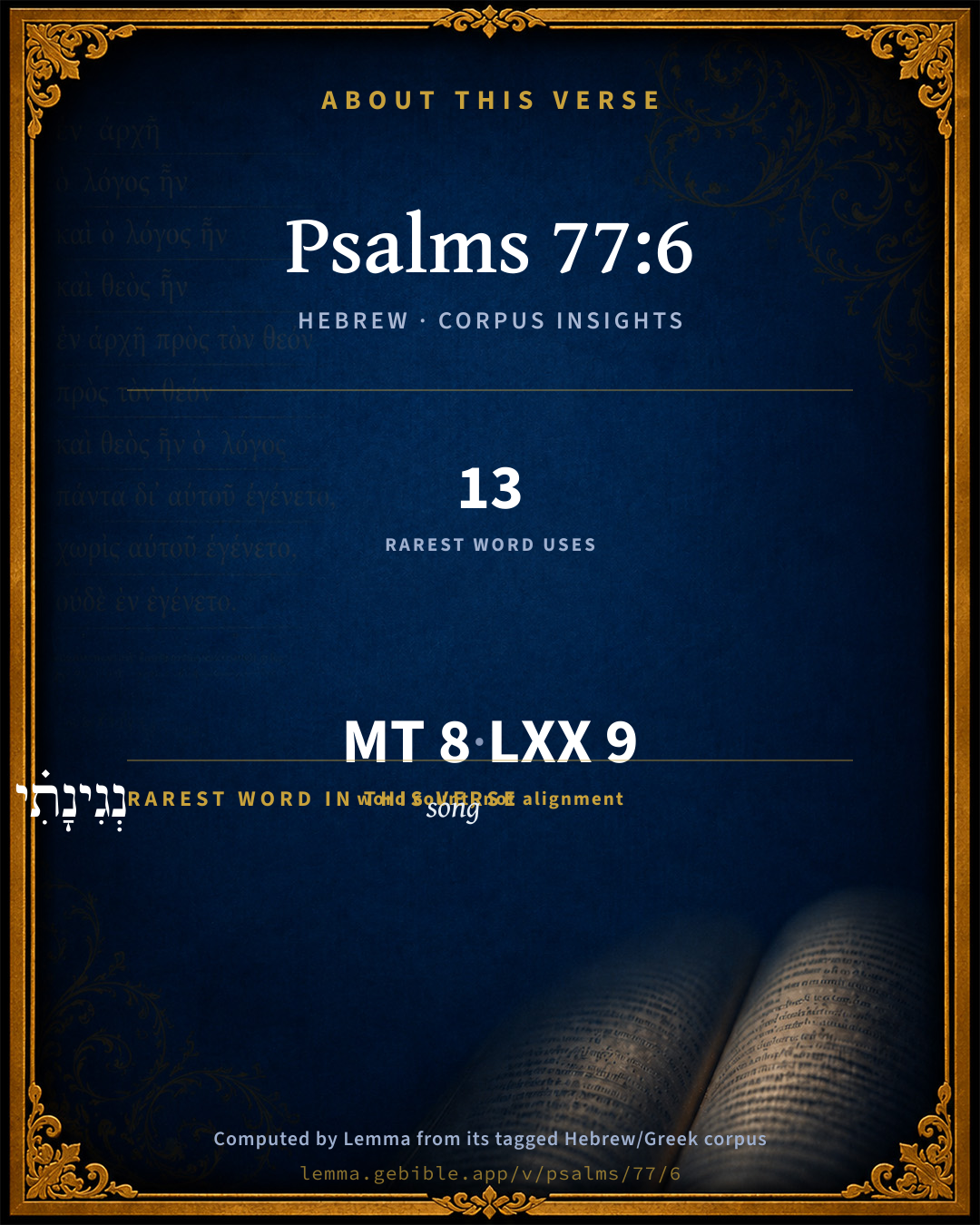
8
words
8
distinct lemmas
Wisdom
section

Notable vocabulary

The rarest word here is נְגִינָתִ֗י song H5058 — appearing just 13 times in the whole Hebrew Bible.

Shared distinctive vocabulary

נְגִינָתִ֗י song H5058 occurs in 13 verses of the Hebrew Bible. Also found in:

Grammatical profile

  • 3 verbs
  • 4 nouns
  • 1 preposition

Verb forms

  • אֶֽזְכְּרָ֥ה Qal · Cohortative
  • אָשִׂ֑יחָה Qal · Cohortative
  • וַיְחַפֵּ֥שׂ Piel · Sequential Imperfect

Hebrew & Septuagint length

In English translation the verse runs 17 words from the Hebrew and 16 from the Septuagint (LXX English) — closely comparable.

A rough comparison of the two English renderings, which tokenize alike — not a word-level alignment.

Word counts can differ between the Hebrew and the Greek without any difference in meaning — e.g. the Hebrew direct-object marker אֵת has no separate Greek word, and Greek often adds the article ὁ.

In the original languages it is 8 Hebrew tokens and 9 Greek tokens — but the two are counted differently (Hebrew bundles its prefixes and suffixes into one token; the Greek is in lemma form), so that isn’t a like-for-like length.

Cross-references

11

Topical passages linked to Psalms 77:6 in the Treasury of Scripture Knowledge — connected by theme and wording, ordered by reader-vote popularity; previews shown in the World English Bible.

  • Psalms 42:8 Yahweh will command his loving kindness in the daytime. In the night his song shall be with me: A prayer to the God of my life.
  • Psalms 4:4 Stand in awe, and don't sin. Search your own heart on your bed, and be still. Selah.
  • Psalms 139:23–24 Search me, God, and know my heart. Try me, and know my thoughts.
  • Lamentations 3:40 Let us search and try our ways, and turn again to Yahweh.
  • Job 10:2 I will tell God, 'Do not condemn me, Show me why you contend with me.
  • Ecclesiastes 1:16 I said to myself, "Behold, I have obtained for myself great wisdom above all who were before me in Jerusalem. Yes, my heart has had great experience of wisdom and knowledge."
  • Acts 16:25 But about midnight Paul and Silas were praying and singing hymns to God, and the prisoners were listening to them.
  • Job 35:10 But none says, 'Where is God my Maker, Who gives songs in the night,
  • Jonah 1:2 "Arise, go to Nineveh, that great city, and preach against it, for their wickedness has come up before me."
  • 1 Corinthians 11:28–32 But let a man examine himself, and so let him eat of the bread, and drink of the cup.
  • Habakkuk 3:17–18 For though the fig tree doesn't flourish, Nor fruit be in the vines; The labor of the olive fails, The fields yield no food; The flocks are cut off from the fold, And there is no herd in the stalls:

Cross-references courtesy of OpenBible.info (CC BY 4.0).

Hebrew and Greek witnesses Masoretic Hebrew ↔ Greek Septuagint

The same verse in the two great witnesses to the Old Testament, shown verse-for-verse.

You’re reading Greek Psalm 76 (Hebrew Psalm 77). The Septuagint counts the superscription, so verse numbers can differ from the Hebrew — chapter-level alignment, not verse-by-verse. Numbering follows Rahlfs.

These are two independent witnesses, not word-aligned to each other, and the Septuagint is shown in lemma (dictionary) form.

Hebrew Psalms 77:6 Masoretic · Westminster Leningrad Codex

אֶֽזְכְּרָ֥ה נְגִינָתִ֗י בַּ֫לָּ֥יְלָה עִם לְבָבִ֥י אָשִׂ֑יחָה וַיְחַפֵּ֥שׂ רוּחִֽי

I remember my song in the night. I consider in my own heart; My spirit diligently inquires:

World English Bible · Public Domain

Greek LXX Greek Psalm 76:6 Septuagint · lemma form

διαλογίζομαι ἡμέρα ἀρχαῖος καί ἔτος αἰώνιος μιμνήσκω καί μελετάω

And I meditated; I communed with my heart by night, and diligently searched my spirit, saying,

LXX2012 (modern English Septuagint) · Public Domain

On this verse, The Cambridge Bible for Schools and Colleges discusses the Septuagint’s reading. Read the note in Commentary ↓

Hebrew: Westminster Leningrad Codex (CC BY 4.0). Greek: Septuagint (public domain); English from LXX2012 (modern English Septuagint) (Public Domain). How the Septuagint differs from the Hebrew →

Commentary

Notes on Psalms 77:6 from classic Christian and Jewish commentators (each source and its license shown beneath its notes). The classic Christian expositions comment on the surrounding passage and are grouped to its opening verse, so a note may address several verses; the Jewish commentaries on the Tanakh (Rashi and others) are per-verse, so they appear only where the commentator wrote on this verse.

Lemma curates 59 commentaries, every one of them public domain or Creative Commons licensed, each selected and text-cleaned for this edition rather than reprinted as found. About our sources →

Trapp's Complete Commentary

John Trapp

Psa 77:6 I call to remembrance my song in the night: I commune with mine own heart: and my spirit made diligent search.

Ver. 6. I call to remembrance my song in the night] i.e. My former feelings and experiments, being glad, in this scarcity of comfort, to live upon the old store, as bees do in winter.

I commune with mine own heart] Psa 4:4, see there.

And my spirit made diligent search] For the cause and cure of my present distempers.

John Trapp, A Commentary or Exposition upon All the Books of the Old and New Testament (1647–1656) — public domain. Text from a community e-Sword module.

The Biblical Illustrator

Joseph S. Exell

Psa_77:6

I call to remembrance my song in the night.

The song in the night

Among all those pains and pleasures which make up so large a part of every human lot, none are more real and more vivid than the pains and the pleasures of memory. Much that is sad, and tragic, and lamentable in the past would die but that it is kept alive in the memory, and much that is joyful and inspiring would perish out of life altogether but that it has become a property of the memory. There is not a little courage implied in this testimony of the psalmist: I call to remembrance my song in the night--for you cannot recall the song without recalling the night. And the song seems so slight a thing--some poor, thin, quavering notes that perhaps aimed to be melody and were not. But the night--that was vast and awful. Its gloom was absolute; its darkness a darkness that could be felt. It wrapped the spirit round until heaven and earth alike were lost, beauty a dream, and light a legend. That was the night upon which that trembling song broke; and into the depths of which it wandered. And to recall the song is to remember the night. It needs some courage deliberately to do that. There is something in this well worthy of our thought. There should be nothing in life we are afraid to recall. Even our sins should be so associated with memories of penitence and Gods pardoning mercy that there is room for the note of praise even out of so desolate a night as that. We are not really more than conquerors until we can dare to look steadily at the darkest dispensations of earth. The suggestion with some people is that they can only continue to believe by hiding some of their trials out of sight, and resolutely refusing to think of them. If this be so, the victory is surely against, them. Will you now take yet another point in our meditation? It was the night that made the song. Not entirely, of course, for have we not already seen that the song had been impossible but for a communication of the reality of the Divine love. But the fact remains that but for the night the song had not been what it was. He whose love-song is the eternal inspiration and solace of our race was the Man of Sorrows, and His life was a song in the night. (C. S. Horne, M. A.)

The song remembered in the night

He looked out of the bars of his window of darkness, and thought of the old light of bygone times. For there are times when the soul cannot sing, the heart cannot be glad. Yet even then the old days may be thought of. A man may get lap out of the darkness unto the light of another mans window, and take comfort from that. So this is what this wise soul did. He goes to the window, he knows where it is, and looking out through the great darkness, he says--I call to remembrance the days of old, the years of ancient times. For, thank God, to-days darkness blots not out yesterdays light, and in the depth of winter it is oftentimes pleasant to remember the summer glory: so the uses of darkness are sometimes to make men value the light. Now, this is the remedy. He called to mind olden days, and so by degrees the light came. He speaks most pathetic words. It is so dark, I cannot sing, I have nothing to say to Thee, O God, but I will call to remembrance the song I did sing once. And so the memory does what the heart could not do at the time; and even from this little beginning victory commences: I call to remembrance my song in the night. And the tongue, toe dumb to sing, still perhaps whispers to itself the old song; and there mark amongst many other things the uses of learning, and singing when you are glad, teaching songs; they get into the memory, and lie there till they are wanted. Now, in calling to remembrance the old song, he called to mind that he had once sung it. What had been may be; yesterday is as to-morrow; old summers foretell future summers; and therefore he says, No light now; but there was light once, I will call that to remembrance. But some of you may say that the very fact that you have known better days and know them not now, is a source of deeper trouble. Not at all. A thing that hath been may be. It is the very fact of the fickleness of the weather that gives us hope. It is now night, I call to remembrance the song I have sung in summer days I have seen sweet times of peace; they are gone now, they will come again. Ask me about next years swallows, I call to remembrance the swallows of the past. They have been, they are not now, but they will come again. Their being gone is the, warrant of their coming again. A man sometimes is disappointed, disheartened; somebody who has been a friend has deceived him, and he says, There is no such thing as honesty, and the man turns cynical, scornful, and denounces his fellows as being false. Think of the utter gloom that comes when a man has been thoroughly deceived. How hard it is to believe in the eleven, when the twelfth is a rogue. That is a terrible night for a man. But call to remembrance the song of the souls we have known that have loved us truly, purely, honestly, even to the end. Open the great book as the king did who could not sleep. Read of those who were true, think of all those you have known (now gone to rest), who were staunch, honest, and faithful; and though there is no song possible just now, yet I call to remembrance my song in the night, and the men that were a comfort are amongst the men that are. So, far away from the!and of his birth, a man, perhaps in exile, sits down in a foreign land, it may be Babylon, but he cannot sing there, his heart is sad, and his harp hangs on the willows; though it is all night, he can call to remembrance the song he used to sing at home. Though unable to sing (for it needs a glad heart to make a very merry tongue), he can do as those Jews did, who opened their windows and looked towards Jerusalem, that even if they could not see the wreath of the smoking sacrifice ascending upward, they could remember the time that had been, and so take comfort from that. It is good to sing, but the next best thing is to think of the time when you have sung; for through the words which the heart utters it will become quiet and calm. (G. Dawson, M. A.)

I commune with mine own heart; and my spirit made diligent search.

Man, know thyself!

Communion with ourselves! that is surely something very wonderful; and evidence enough of a sublime nature. I commune with my own heart: and my spirit diligently explores her own hidden world. Why, nothing in the whole compass of nature can do that. A wise man will surely say, I am not going to analyze creatures who are lower than myself to know myself; but I must commune with myself, and make inquiry of the measureless capacities involved in my personal spirit. Now, whoever thus searches into himself is constrained to search after the living God. Unless a man is under the influence and control of his inner and diviner nature he inevitably leads a life and acts a part which degrades and ruins him. God, the Father of his spirit, is infinitely averse to this, which He has most affectingly shown and proved by that great mystery of Love, God manifest in mans flesh. Bethlehem, Calvary, and Mount Olivet simply mean Gods infinite concern for mans redemption. If Christs Ascension does not signify the possibility of mans ascension to God and the angel world, it signifies nothing. To be destitute of self-knowledge is, strictly speaking, to be destitute of all true and right knowledge. If we know not ourselves, nor the end of our being, we shall fall into many foolish and hurtful snares, and mistake the value of everything. We shall take appearances and sophistries for truth, and regard Gods truth as dreams. And worse than all, we shall misuse ourselves; thinking that we are wise when we are foolish, and that we are doing well when we are perishing. For we may take every possible care of the corruptible body of our flesh, while we are destroying the health and happiness of the precious inner man. Self-knowledge will inspire more than dignity and self-respect; it will inspire awe and a sublime hope. There will be no self-adulation in this knowledge; on the contrary, self-knowledge is always associated with sweet, restful, childlike humility. For right self-knowledge recognizes the Infinite Father-Spirit to be alone great and worshipful. We all share in Divinity; that is the one great human inheritance. To claim direct relationship to the Infinite Spirit is not presumptuous: Our Father, which art in heaven. And the one tremendous thought is that our Divine birthright is for eternity. The Everlasting Christ, as the ideal of our own humanity, is not only revealed to us; but the breath of His power is within us all. (John Pulsford, D. D.)

Self-companionship

Often reflect upon thyself, and observe what company is with thy heart. We may know by the noise in the school that the master is not there; much of the misrule in our bosom arises from the neglect of visiting our hearts. (W. Gurnall.)

The Biblical Illustrator, edited by Joseph S. Exell (c. 1880s–1900s) — public domain. Text from a community e-Sword module.

J. A. Alexander on Psalms

Joseph Addison Alexander

7. (Psa 77:6). I will remember my song in the night, with my heart will I muse, and my spirit inquires. The futures of the first clause have reference to the time of actual suffering. The word translated song means strictly a stringed instrument, or that kind of music, but is here used more generally to denote the musical expression of thanksgiving. In the night qualifies the words immediately preceding (my song), not the remoter antecedent (I remember). With my heart, i.e. in communion with it, with myself. My spirit inquires, i.e. I, from the bottom of my heart, ask the questions recorded in the following verses.

Joseph Addison Alexander, The Psalms Translated and Explained (1850) — public domain. Text from a community e-Sword module.

Geneva Bible (1599)

Geneva Bible translators

Of thanksgiving, which I was accustomed to sing in my prosperity.

Both the causes why I was chastened, and when my sorrows should have an end.

Geneva Bible (1599) marginal notes — public domain. Text via Bolls.life.

Adam Clarke's Commentary

Verse 6. I call to remembrance my song in the night] I do not think that נגינתי neginathi means my song. We know that neginath signifies some stringed musical instrument that was struck with a plectrum; but here it possibly might be applied to the Psalm that was played on it. But it appears to me rather that the psalmist here speaks of the circumstances of composing the short ode contained in the seventh, eighth, and ninth verses; which it is probable he sung to his harp as a kind of dirge, if indeed he had a harp in that distressful captivity.

My spirit made diligent search.] The verb חפש chaphas signifies such an investigation as a man makes who is obliged to strip himself in order to do it; or, to lift up coverings, to search fold by fold, or in our phrase, to leave no stone unturned. The Vulgate translates: "Et scopebam spiritum meum." As scopebam is no pure Latin word, it may probably be taken from the Greek σκοπεω scopeo, "to look about, to consider attentively." It is however used by no author but St. Jerome; and by him only here and in Isa 14:23: And I will sweep it with the besom of destruction; scopabo eam in scopa terens. Hence we see that he has formed a verb from a noun scopae, a sweeping brush or besom; and this sense my old Psalter follows in this place, translating the passage thus: And I sweped my gast: which is thus paraphrased: "And swa I sweped my gaste, (I swept my soul,) that is, I purged it of all fylth."

Adam Clarke's Commentary on the Bible (1810–1826) — public domain. Text from a community e-Sword/MySword module.

John Calvin's Commentaries

6. I will call to remembrance my song in the night. By his song he denotes the exercise of thanksgiving in which he had engaged during the time of his prosperity. There is no remedy better adapted for healing our sorrows, as I have just now observed, than this; but Satan often craftily suggests to our thoughts the benefits of God, that the very feeling of the want of them may inflict upon our minds a deeper wound. It is, therefore, highly probable, that the prophet was pierced with bitter pangs when he compared the joy experienced by him in time past with the calamities which he was presently suffering. He expressly mentions the night; because, when we are then alone by ourselves, and withdrawn from the society and presence of men, it engenders in the mind more cares and thoughts than are experienced during the day. What is added immediately after with respect to communing with his own heart, is to the same effect. Solitude has an influence in leading men to retire within their own minds, to examine themselves thoroughly, and to speak to themselves freely and in good earnest, when no created being is with them to impose a restraint by his presence.

The last clause of the verse, And my spirit will search diligently, admits of a twofold exposition. The word חפש, chaphas, for search diligently, being in the masculine gender, and the word רוה, ruach, for spirit, being sometimes feminine, some commentators suppose that the name of God is to be understood, and explain the sentence as if the Psalmist had said, There is nothing, O Lord! so hidden in my heart into which thou hast not penetrated. And God is with the highest propriety said to search the spirit of the man whom he awakens from his indolence or torpor, and whom he examines by acute afflictions. Then all hiding — places and retreats, however obscure, are explored, and affections before unknown are brought into the light. As, however, the gender of the noun in the Hebrew language is ambiguous, others more freely translate, MY spirit hath searched diligently. This being the sense which is most generally embraced, and being, at the same time, the most natural, I readily adopt it. In that debate, of which the inspired writer makes mention, he searched for the causes on account of which he was so severely afflicted, and also into what. his calamities would ultimately issue. It is surely highly profitable to meditate on these subjects, and it is the design of God to stir us up to do this when any adversity presses upon us. There is nothing more perverse than the stupidity of those who harden themselves under the scourges of God. Only we must keep within due bounds, in order that we may not be swallowed up of over much sorrow, and that the unfathomable depth of the Divine judgments may not overwhelm us by our attempting to search them out thoroughly. The prophet’s meaning is, that when he sought for comfort in all directions, he could find none to assuage the bitterness of his grief.

John Calvin's Commentaries (1540-1563) — public domain. Text from the Calvin Translation Society English edition (1840s-50s) via the Christian Classics Ethereal Library (ccel.org). Calvin's coverage is partial (roughly two-thirds of the Bible); uncommented books and verses are honest gaps, never fabricated. The 19th-century editor's footnotes and remarks are omitted so the notes are faithfully Calvin's own voice.

Ellicott's Commentary for English Readers

(6) I call to remembrance.—Better,

“Let me recall my harpings in the night;

Let me complain in my own heart,

And my spirit questions and questions.”

A Bible Commentary for English Readers, edited by Charles John Ellicott (1878–1897) — public domain. Text from a community e-Sword module.

The Cambridge Bible for Schools and Colleges

gen. ed. J. J. S. Perowne

6. “Let me remember my song in the night:

Let me muse in my heart;”

And my spirit inquired, (saying),

6. In the first two lines he tells us how he bade himself recall the songs of thanksgiving which he had once been able to sing in the night, the quiet time of meditation and thanksgiving (Psa_42:8; Psa_92:2; Job_35:10), in contrast to his present cries of anguish or silence of despair.

Song means literally ‘song to the accompaniment of stringed instruments.’ P.B.V. ‘and search out my spirits,’ follows the reading of the LXX and some other Ancient Versions.

The Cambridge Bible for Schools and Colleges (gen. ed. J. J. S. Perowne; Cambridge University Press, 1878–1918) — public domain. Text from a community e-Sword module.

John Gill's Exposition

I call to remembrance my song in the night,.... What had been an occasion of praising the Lord with a song, and which he had sung in the night seasons, when he was at leisure, his thoughts free, and he retired from company; or it now being night with him, he endeavoured to recollect what had been matter of praise and thankfulness to him, and tried to sing one of those songs now, in order to remove his melancholy thoughts and fears, but all to no purpose:

I commune with mine own heart; or "meditate" (o) with it; looked into his own heart, put questions to it, and conversed with himself, in order to find out the reason of the present dispensation:

and my spirit made diligent search; into the causes of his troubles, and ways and means of deliverance out of them, and what would be the issue and consequence of them; the result of all which was as follows.

(o) "meditabor", Montanus; meditatus sum, V. L. "meditor", Junius & Tremellius; "meditabar", Piscator, Cocceius.

John Gill's Exposition of the Whole Bible (1746–1763) — public domain (CC PDM 1.0). Text via the HelloAO Bible API.

Albert Barnes' Notes on the Bible

I call to remembrance my song in the night - Compare Job 35:10, note; Psa 42:8, note. The word here rendered “song” - נגינה negı̂ynâh - means properly the music of stringed instruments, Lam 5:14; Isa 38:20; then, a stringed instrument. It is the word which we have so often in the titles to the psalms (Psa 4:1-8; Psa 6:1-10; Psa 54:1-7; Ps. 55; Psa 67:1-7; Psa 76:1-12); and it is used here in the sense of song or psalm. The idea is, that there had been times in his life when, even in darkness and sorrow, he could sing; when he could find things for which to praise God; when he could find something that would cheer him; when he could take some bright views of God adapted to calm down his feelings, and to give peace to his soul. He recalls those times and scenes to his remembrance, with a desire to have those cheerful impressions renewed; and he asks himself what it was which then comforted and sustained him. He endeavors to bring those things back again, for if he found comfort then, he thinks that he might find comfort from the same considerations now.

I commune with mine own heart - I think over the matter. See the notes at Psa 4:4.

And my spirit made diligent search - In reference

(a) to the grounds of my former support and comfort; and

(b) in reference to the whole matter as it lies before me now.

Albert Barnes' Notes on the Bible (1834–1885) — public domain. Text from a community e-Sword/MySword module.

Matthew Poole's English Annotations

I call to remembrance my song in the night, the many and great mercies and favours of God vouchsafed by him to me, and to his people, which have obliged me to adore him, and sing his praises not only in the day, the time appointed for that work. but also by night, as oft as they come into my mind.

My spirit made diligent search, what should be the cause of this strange and vast alteration, and how these sore calamities could come from the hand of so gracious and merciful a God as ours is, and what might be expected as to their continuance or removal.

Matthew Poole's English Annotations on the Holy Bible (1683–1685) — public domain. Text from a community e-Sword/MySword module.

The Treasury of David

Charles H. Spurgeon

Ver. 6. I call to remembrance my song in the night. At other times his spirit had a song for the darkest hour, but now he could only recall the strain as a departed memory. Where is the harp which once thrilled sympathetically to the touch of those joyful fingers? My tongue, hast thou forgotten to praise? Hast thou no skill except in mournful ditties? Ah me, how sadly fallen am I! How lamentable that I, who like the nightingale could charm the night, am now fit comrade for the hooting owl.

I commune with mine own heart. He did not cease from introspection, for he was resolved to find the bottom of his sorrow, and trace it to its fountain head. He made sure work of it by talking not with his mind only, but with his inmost heart; it was heart work with him. He was no idler, no melancholy trifler; he was up and at it, resolutely resolved that he would not tamely die of despair, but would fight for his hope to the last moment of life.

And my spirit made diligent search. He ransacked his experience, his memory, his intellect, his whole nature, his entire self, either to find comfort or to discover the reason why it was denied him. That man will not die by the hand of the enemy who has enough force of soul remaining to struggle in this fashion.

Whole Psalm. Whenever, and by whomsoever, the Psalm may have been written, it clearly is individual, not national. It utterly destroys all the beauty, all the tenderness and depth of feeling in the opening portion, if we suppose that the people are introduced speaking in the first person. The allusions to the national history may indeed show that the season was a season of national distress, and that the sweet singer was himself bowed down by the burden of the time, and oppressed by woes which he had no power to alleviate; but it is his own sorrow, not the sorrow of others under which he sighs, and of which he has left the pathetic record. J. J. Stewart Perowne.

Ver. 6. I call to remembrance my song in the night. Either (1) "I will now, in the present night of affliction, remember my former songs." "Though this is a time of distress, and my present circumstances are gloomy, yet I have known brighter days. He that lifted me up, has cast me down, and he can raise me up again." Sometimes this reflection, indeed, adds a poignancy to our distress, as it did to David's trouble, Ps 42:4. Yet it will bear a better improvement, which he seems to make of it; Ps 77:11, and so Job, (Job 2:10.) "Shall we receive good at the hand of God, and shall we not receive evil?" And his case shows that after the most sweeping calamities the Lord can again give things a turn in favour of them that hope in him. Therefore, present troubles should not make us forget former comforts, especially as the former so much exceeded our deserts, and the present afflictions fall so short of our demerits. Or (2) the text may mean, "I will remember how I have been enabled to sing in the former nights of affliction." And surely it is especially seasonable to remember supports and consolations granted under preceding distresses. Elihu complained (Job 35:10), "There is none that saith, Where is God my maker, who giveth songs on the night." David comforted himself with the thought, "Though deep calleth unto deep, yet the Lord will command his lovingkindness in the daytime, and in the night his song shall be with me." Ps 42:8. And the Lord promised by Isaiah (Isa 30:29), "Ye shall have a song, as in the night when a holy solemnity is kept." No doubt Paul and Silas remembered their song in the night, when imprisoned at Philippi; and it afforded them encouragement under subsequent trials. And cannot many of you, my brethren, in like manner, remember the supports and consolations you have enjoyed in former difficulties, and how the Lord turned the shadow of death into morning? And ought you not to trust to him that hath delivered, that he will yet deliver? He that hath delivered in six troubles, will not forsake you in seven. The "clouds may return after the rain, "but not a drop can fail without the leave of him, who rides on the heavens for your help, and in his excellency on the sky. Did you not forbode at first a very different termination of the former troubles? and did the Lord disappoint your fears, and put a new song into your mouth; and will you not now begin to trust him, and triumph in him? Surely you have found that the Lord can clear the darkest skies. "Light is sown for the righteous, "and ere long you shall see an eternal day. If such songs are given to the pilgrims of the night, how shall they sing in that world where the sun shall set no more! There will be no night there. John Ryland. 1753-1825.

Ver. 6. I call to remembrance: being glad in this scarcity of comfort, to live upon the old store, as bees do in winter. John Trapp.

Ver. 6. My song in the night. The "songs of the night" is as favourite a word of the Old Testament as "glory in tribulation" is of the New, and it is one of those which prove that both Testaments have the self same root and spirit. John Kerr.

Ver. 6. My spirit made diligent search. He falls upon self examination, and searcheth his spirit, to consider why the hand of God was so against him, and why the face of God was so hid from him. Some read it, "I digged into my spirit; "as Ezekiel digged into the wall, to search for and find out the abomination, that made the Lord thus leave him in the dark, and hide his face from him. He searcheth the wound of his spirit; that was another way to cure it. It is a notable way to cure the wounds of the soul, for the soul to search them. John Collings.

Ver. 6 My spirit made diligent search. The verb vbx, chaphas, signifies such an investigation as a man makes who is obliged to strip himself in order to do it; or to lift up coverings, to search fold by fold, or in our own phrase, to leave no stone unturned. Adam Clarke.

Ver. 6. My spirit made diligent search. As Ahasuerus, when he could not sleep, called for the records and chronicles of his kingdom, so the doubting soul betakes himself to the records of heaven, the word of God in the Scriptures, and one while he is reading there, another while looking into his heart, if he can find there anything that answers the characters of Scripture faith, as the face in the glass doth the face of man. David, when he was at a loss what to think of himself, and many doubts did clog his faith, insomuch that the thinking of God increased his trouble, he did not sit down and let the ship drive, as we say, not regarding whether God loved him or no, but communes with his own heart, and his spirit makes diligent search. Thus it is with every sincere soul under doubting: he dares no more sit down contented in that unresolved condition, than one who thinks he smells fire in his house dares settle himself to sleep till he hath looked in every room and corner, and satisfied himself that all is safe, lest he should be waked with the fire about his ears in the night: and the poor doubting soul is much more afraid, lest it should wake with hell fire about it: whereas a soul in a state and under the power of unbelief is secure and careless. William Gurnall.

Ver. 6. Diligent search. Thus duty requires diligence. External acts of religion are facile; to lift up the eye to heaven, to bow the knee, to read a prayer, this requires no more labour than for a papist to tell over his beads; but to examine a man's self, to take the heart all in pieces as a watch, and see what is defective, this is not easy. Reflective acts are hardest. The eye can see everything but itself. It is easy to spy the faults of others, but hard to find out our own. Thomas Watson.

Ver. 6. Remembrance. A good memory is very helpful and useful.

1. It is a great means of knowledge: for what signifies your reading or hearing, if you remember nothing?

2. It is a means of faith: 1Co 15:2.

3. It is a means of comfort. If a poor Christian in distress could remember God's promises they would inspire him with new life; but when they are forgotten, his spirits sink.

4. It is a means of thankfulness.

5. It is a means of hope; for "experience worketh hope" (Ro 5:4), and the memory is the storehouse of experience.

6. It is a means of repentance; for, how can we repent or mourn for that which we have forgotten?

7. It is a means of usefulness. When one spark of grace is truly kindled in the heart, it will quickly endeavour to heat others also. R. Steele.

Psalms 77:7*

Charles H. Spurgeon's The Treasury of David (1869–1885) — public domain. Psalms only. Text from a community e-Sword/MySword module.

Whedon's Commentary on the Bible

Daniel D. Whedon

6. My song in the night—In my happier days my nights were often spent in praise and thanksgiving, now in mourning or silent grief. This applied to the nation in comparing their earlier history with their present state. These meditations lead the psalmist to the earnest inquiries of Psa_77:7-9, to ascertain if the known ways of God with his people offer any hope in the present distress.

Daniel D. Whedon (gen. ed.), Commentary on the Old and New Testaments (1874–1909) — public domain. Text from a community e-Sword module.

The Pulpit Commentary

I call to remembrance my song in the night. He bethought himself of the songs of thanksgiving which he used to sing to God in the night (comp. Job_35:10) on account of mercies received; but this did not comfort him. "Nessun maggior dolore che ricordarsi di tempo felice nella miseria." I commune with mine own heart, and my spirit made diligent search; or, "and I diligently searched out my spirit" (Cheyne). The results of the searchings out seem to be given in vers. 7-10.

The cheer of hallowed memories.

"I call to remembrance my song in the night." This expression recalls the appeal of Elihu, (Job_35:10) "But none saith, Where is God my Maker, who giveth songs in the night?" But the mood of the psalmist here is peculiar. To him the memories of past joys do but intensify present distress. "When I remember how near God once was, the present seems more bitter, and the thought brings increase of sadness." Some, however, render this clause, "I will give my mind to my song in the night; I will muse with my heart while my spirit makes search;" and understand the psalmist to mean, that he resolves to compose the present poem that very night.

I ALL MEN HAVE PRECIOUS AND CHERISHED MEMORIES. However sad and anxious and burdened later life may become, every man"s early life childhood, youth, young manhood is more or less pleasant to look back on. Partly because of what it actually was, partly because of the sunshine which the spirit of youth put on it, and partly because memory keeps the pleasant, and easily drops the painful. Then there are memories of events that have happened. And, for the Christian man, memories of special times of Divine guidance, rescue, restoration. And for many, dearest memories of sanctified human love. The term, "song in the night," suggests special memories of ways in which our hearts were kept trustful and cheerful, even in times of darkest trouble and most painful distress. With the waves and billows going over us, we yet could sing in our souls, "Yet the Lord will command his loving kindness...in the night his song shall be with me.

II THE PLEASANTNESS OR PAINFULNESS OF OUR MEMORIES DEPENDS ON OUR OWN CONDITIONS OF MIND AND FEELING. The memories never change. They are always full of God and of his grace. We change our relation to them, and make them depressing or inspiriting according to our moods. According to bodily states, anxious circumstances, or mental and spiritual conditions, we read our past. So the cause for anxiety is that "singleness," clearness of vision, which enables us to see the past as it was, and read aright its relation to the present. So often when memories depress us, we need to see that the fault lies in our way of recalling them; and we should say, "This is my infirmity.

III IF OUR MEMORIES TELL US WE WERE ONCE GLAD IN GOD, THEY REMIND US THAT WE MAY WISELY BE GLAD IN GOD STILL. For "he is the same yesterday, today, and forever." No matter what may seem to be the present, it is the sphere of the same Divine love and care. R.T.

The Pulpit Commentary (1880–1919), ed. H.D.M. Spence-Jones & Joseph S. Exell — public domain. Text from a community e-Sword module.

John Wesley's Explanatory Notes

My song - The mercies of God vouchsafed to me, and to his people, which have obliged me to sing his praises, not only in the day, but also by night.

John Wesley, Explanatory Notes Upon the Whole Bible (1754–1765) — public domain. Text via the GEBible commentary corpus.

unfoldingWord translationNotes

Door43 World Missions Community

I called to mind

This is an idiom for remembering. AT: "I remembered" (See: Idiom)

what had happened

Another possible meaning is "what was happening."

Will the Lord reject me forever? Will he never again show me favor?

These two phrases express feeling rejection from the Lord. (See: Doublet)

show me favor

"do things that show that he is pleased with me"

translationWords

call

mind

understand

lord

reject

eternity

favor

unfoldingWord translationNotes — © Distant Shores Media and the Door43 World Missions Community, licensed CC BY-SA 4.0. Source: git.door43.org/Door43/en_tn.

Rashi

Rabbi Shlomo Yitzchaki (Rashi)

I think of the days of yore to remember the kind acts that You performed for our forefathers.

Rashi on the Tanakh — English translations: “The Judaica Press complete Tanach with Rashi, translated by A. J. Rosenberg” (CC BY 4.0); “Pentateuch with Rashi's commentary by M. Rosenbaum and A.M. Silbermann, 1929-1934” (public domain); “The Metsudah Tanach series, Lakewood, N.J” (CC BY 4.0); and “The Book of Joshua, Metsudah Publications, 1997” (CC BY 4.0). Text via Sefaria.

Lesson kit

Teaching starters — assembled from the data on this page, not authored interpretation. Every prompt links to the verse data it draws on. Edit before teaching.

Psalms, in the Wisdom, opens this verse with 8 words (8 distinct Hebrew lemmas). Its most distinctive word is nᵉgîynâh (“song”). A historical commentator’s framing appears above. Read the whole chapter for the surrounding context.

Discussion questions

  1. The word nᵉgîynâh carries the sense “song.” How does it shape the verse?
  2. Job 30:9 shares the word «song» with this verse. How do the two illuminate each other?
  3. These translations render this verse differently; the difference is in the English rendering, not the original. What questions does that raise?
  4. The verb «אֶֽזְכְּרָ֥ה» is Qal Cohortative. How does its form color the action?
  5. Reading how Trapp's Complete Commentary and The Biblical Illustrator read this verse, where do the two commentators agree and where do they part?

Things to notice

Reading settings

Reading text

Shown beneath each verse's original-language words.

Old Testament
Old Testament edition

Read the OT as the Masoretic Hebrew (MT) or the Greek Septuagint (LXX).

English shown for the Greek Septuagint (in the Hebrew ↔ Greek comparison).

Comparing translations? Open the Compare panel on any verse page to stack up to four side by side.