
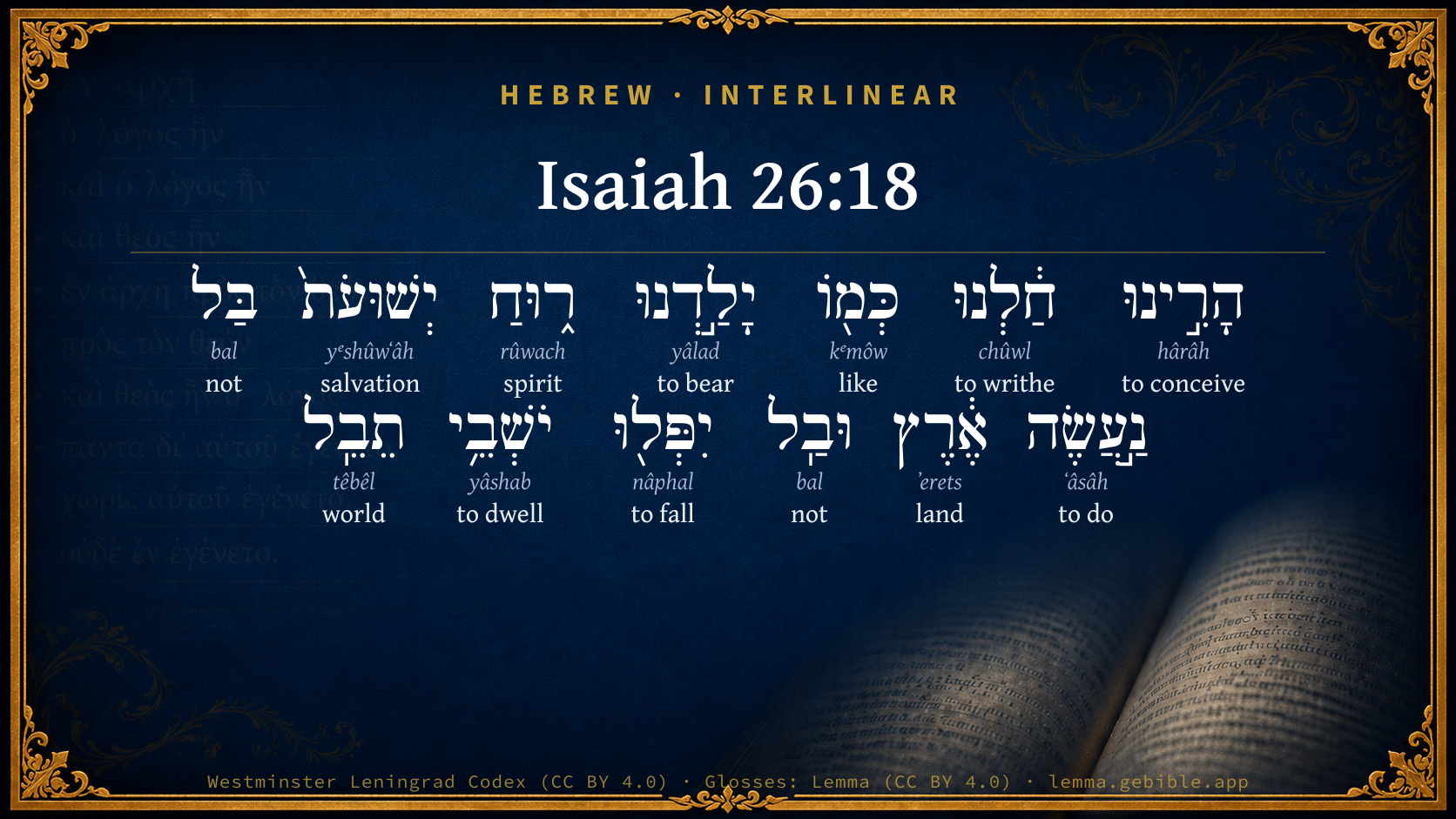
Isaiah 26:18

Hebrew (Westminster Leningrad Codex) Isaiah 26:18 appears in the Hebrew Old Testament. The text above is from the Westminster Leningrad Codex. Each word links to its Strong’s number, a concise gloss, and parsing drawn from the Open Scriptures Hebrew Bible morphology. Click any word for its full Brown-Driver-Briggs (BDB) entry.
Download image
Cite this verse

Isaiah 26:18 (World English Bible). Public Domain. Lemma interlinear Bible study tool, https://lemma.gebible.app/v/isaiah/26/18.

Show BibTeX & RIS
BibTeX
RIS
English Translation
We have been with child, we have been in pain, we have as it were brought forth wind; we have not worked any deliverance in the earth; neither have the inhabitants of the world fallen.
World English Bible · Public Domain
Download a study sheet

One document with this verse’s original text, its word-by-word gloss line, the meaning frame, cross-references with their text, attributed commentary, and full source and license credits — printable, and it pastes into notes with its structure intact.

This verse Autodidact and up

Study sheet (.html) Plain text (.txt)

A passage Seminary Student

Up to 50 verses in one chapter. A passage sheet keeps up to 6 commentary sources and 12 cross-references per verse, in the order this page ranks them, and says so on the sheet whenever that leaves anything out. Ask for a single verse and you get the Autodidact verse sheet above.

Everything on this page stays free to read, with no account — the sheet is a download of what is already on screen, not access to it.

Want to remove ads? Support Godless Engineer
Compare translations 3

The same verse in 3 English versions, stacked beneath the original-language interlinear above. Click any original word for its lexicon entry.

Each is an independent rendering of the whole verse — the interlinear is not word-aligned to these translations.

Highlighted words mark where these versions differ — a whole-verse word diff, not a word-by-word alignment.

  • World English Bible Public Domain
    We have been with child, we have been in pain, we have as it were brought forth wind; we have not worked any deliverance in the earth; neither have the inhabitants of the world fallen.
  • King James Version Public Domain
    We have been with child, we have been in pain, we have as it were brought forth wind; we have not wrought any deliverance in the earth; neither have the inhabitants of the world fallen.
  • unfoldingWord Literal Text CC BY-SA 4.0
    We have been pregnant, we have writhed, as if we had birthed wind. We have not made salvation the earth, and dwellers of the world have not fallen. q1

unfoldingWord Literal Text — © unfoldingWord, licensed CC BY-SA 4.0. Word-aligned USFM3 via Door43 (git.door43.org/unfoldingWord/en_ult).

Versions to compare (up to 4)

3 of 4 selected

Show all 18 translations

Every available English version of this verse, each an independent rendering of the whole verse.

  • World English Bible Public Domain
    We have been with child, we have been in pain, we have as it were brought forth wind; we have not worked any deliverance in the earth; neither have the inhabitants of the world fallen.
  • Berean Standard Bible Public Domain
    We were with child; we writhed in pain; but we gave birth to wind. We have given no salvation to the earth, nor brought any life into the world.
  • Majority Standard Bible Public Domain
    We were with child; we writhed in pain; but we gave birth to wind. We have given no salvation to the earth, nor brought any life into the world.
  • King James Version Public Domain
    We have been with child, we have been in pain, we have as it were brought forth wind; we have not wrought any deliverance in the earth; neither have the inhabitants of the world fallen.
  • American Standard Version (1901) Public Domain
    We have been with child, we have been in pain, we have as it were brought forth wind; we have not wrought any deliverance in the earth; neither have the inhabitants of the world fallen.
  • Revised Version (1885) Public Domain
    We have been with child, we have been in pain, we have as it were brought forth wind; we have not wrought any deliverance in the earth; neither have the inhabitants of the world fallen.
  • Geneva Bible (1599) Public Domain
    We haue coceiued, we haue borne in paine, as though we should haue brought forth winde: there was no helpe in the earth, neither did the inhabitants of the world fall.
  • Douay-Rheims (1899) Public Domain
    We have conceived, and been as it were in labour, and have brought forth wind: we have not wrought salvation on the earth, therefore the inhabitants of the earth have not fallen.
  • Young's Literal Translation Public Domain
    We have conceived, we have been pained. We have brought forth as it were wind, Salvation we do not work in the earth, Nor do the inhabitants of the world fall.
  • Literal Standard Version CC BY-SA 4.0
    We have conceived, we have been pained. We have brought forth, as it were, wind, || We do not work salvation in the earth, || Nor do the inhabitants of the world fall.
  • Unlocked Literal Bible CC BY-SA 4.0
    We have been pregnant, we have been in labor, but it is as if we have only given birth to wind. We have not brought salvation to the earth, and the inhabitants of the world have not fallen.
  • unfoldingWord Literal Text CC BY-SA 4.0
    We have been pregnant, we have writhed, as if we had birthed wind. We have not made salvation the earth, and dwellers of the world have not fallen. q1
  • Darby Bible Public Domain
    We have been with child, we have been in travail, we have as it were brought forth wind; we have not wrought the deliverance of the land, neither have the inhabitants of the world fallen.
  • World Messianic Bible Public Domain
    We have been with child. We have been in pain. We gave birth, it seems, only to wind. We have not worked any deliverance in the earth; neither have the inhabitants of the world fallen.
  • Webster's Bible Public Domain
    We have been with child, we have been in pain, we have as it were brought forth wind; we have not wrought any deliverance on the earth; neither have the inhabitants of the world fallen.
  • Free Bible Version CC BY-SA 4.0
    However, even though we became pregnant and we tossed about in pain, we gave birth to nothing but air. We did not bring about the salvation of the earth, and the people of the world have not become alive.
  • Bible in Basic English Public Domain
    We have been with child, we have been in pain, we have given birth to wind; no salvation has come to the earth through us, and no children have come into the world.
  • JPS Tanakh (1917) Public Domain
    We have been with child, we have been in pain, we have as it were brought forth wind; we have not wrought any deliverance in the land; neither are the inhabitants of the world come to life.

Literal Standard Version (2020), Covenant Press — licensed CC BY-SA 4.0. Text via the HelloAO Bible API (eBible.org). Unlocked Literal Bible (unfoldingWord) — licensed CC BY-SA 4.0. Text via the HelloAO Bible API (eBible.org). unfoldingWord Literal Text — © unfoldingWord, licensed CC BY-SA 4.0. Word-aligned USFM3 via Door43 (git.door43.org/unfoldingWord/en_ult). Free Bible Version, Dr. Jonathan Gallagher — licensed CC BY-SA 4.0. Text via the HelloAO Bible API (eBible.org).

Word by word

More ways to search: Search by grammar → Find every occurrence → Compare this word →

Practice this passage: Drill this verse → Learn its vocabulary →

תֵבֵֽל
têbêl
H8398
“world”
Noun, Common, Feminine, Singular, Absolute
Part of Speech
Noun
Type
Common
Gender
Feminine
Number
Singular
State
Absolute
Full BDB Definition

Origin: from H2986

TWOT: 835h

world
  1. הָרִ֣ינוּ hârâh H2029 “to conceive” Verb, Qal, Perfect, 1st Person, Common, Plural
  2. חַ֔לְנוּ chûwl H2342 “to writhe” Verb, Qal, Perfect, 1st Person, Common, Plural
  3. כְּמ֖וֹ kᵉmôw H3644 “like” Preposition
  4. יָלַ֣דְנוּ yâlad H3205 “to bear” Verb, Qal, Perfect, 1st Person, Common, Plural
  5. ר֑וּחַ rûwach H7307 “spirit” Noun, Common, Both, Singular, Absolute
  6. יְשׁוּעֹת֙ yᵉshûwʻâh H3444 “deliverances” Noun, Common, Feminine, Plural, Absolute
  7. בַּל bal H1077 “not” Particle, Negative
  8. נַ֣עֲשֶׂה ʻâsâh H6213 “to do” Verb, Qal, Imperfect, 1st Person, Common, Plural
  9. אֶ֔רֶץ ʼerets H776 “land” Noun, Common, Both, Singular, Absolute
  10. וּבַֽל bal H1077 “and · not” Conjunction + Particle, Negative
  11. יִפְּל֖וּ nâphal H5307 “to fall” Verb, Qal, Imperfect, 3rd Person, Masculine, Plural
  12. יֹשְׁבֵ֥י yâshab H3427 “dwelling” Verb, Qal, Participle Active, Masculine, Plural, Construct

About this verse

These counts appear in no published source. They are computed here, from the morphology-tagged text and Lemma’s own curated glosses. What Lemma adds →

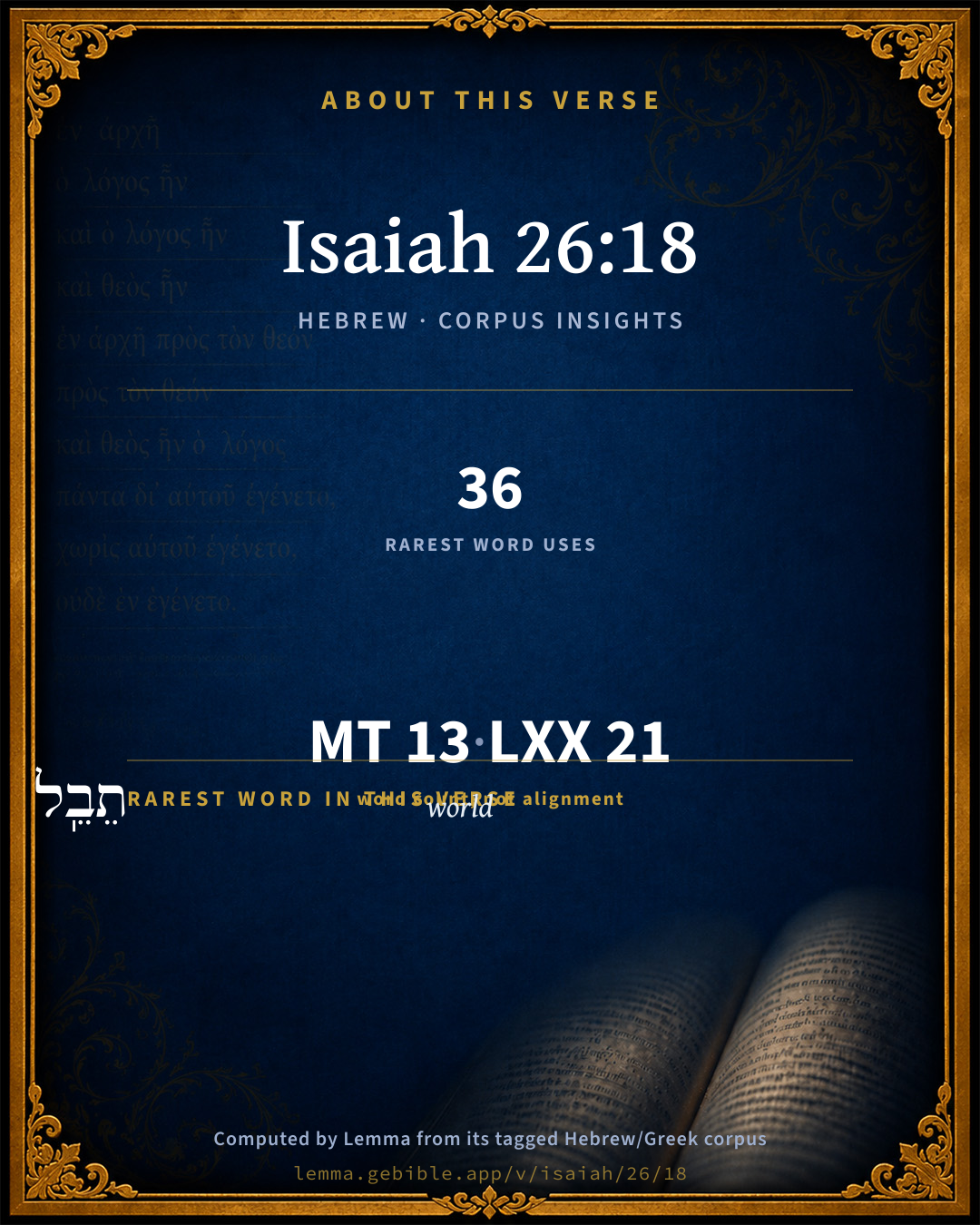
13
words
12
distinct lemmas
Prophets
section

Shared distinctive vocabulary

תֵבֵֽל world H8398 occurs in 36 verses of the Hebrew Bible. Also found in:

Grammatical profile

  • 6 verbs
  • 4 nouns
  • 1 preposition
  • 2 particles

Verb forms

  • הָרִ֣ינוּ Qal · Perfect
  • חַ֔לְנוּ Qal · Perfect
  • יָלַ֣דְנוּ Qal · Perfect
  • נַ֣עֲשֶׂה Qal · Imperfect
  • יִפְּל֖וּ Qal · Imperfect
  • יֹשְׁבֵ֥י Qal · Participle Active

Repetition

A word recurs within this verse — often emphatic in Hebrew:

Hebrew & Septuagint length

In English translation the verse runs 35 words from the Hebrew and 43 from the Septuagint (LXX English) — closely comparable.

A rough comparison of the two English renderings, which tokenize alike — not a word-level alignment.

Word counts can differ between the Hebrew and the Greek without any difference in meaning — e.g. the Hebrew direct-object marker אֵת has no separate Greek word, and Greek often adds the article ὁ.

In the original languages it is 13 Hebrew tokens and 21 Greek tokens — but the two are counted differently (Hebrew bundles its prefixes and suffixes into one token; the Greek is in lemma form), so that isn’t a like-for-like length.

Cross-references

12

Topical passages linked to Isaiah 26:18 in the Treasury of Scripture Knowledge — connected by theme and wording, ordered by reader-vote popularity; previews shown in the World English Bible.

  • Psalms 17:14 From men by your hand, Yahweh, From men of the world, whose portion is in this life. You fill the belly of your cherished ones. Your sons have plenty, And they store up wealth for their children.
  • Hosea 13:13 The sorrows of a travailing woman will come on him. He is an unwise son; For when it is time, he doesn't come to the opening of the womb.
  • 2 Kings 19:3 They said to him, Thus says Hezekiah, This day is a day of trouble, and of rebuke, and of rejection; for the children are come to the birth, and there is not strength to bring forth.
  • Isaiah 37:3 They said to him, Thus says Hezekiah, This day is a day of trouble, and of rebuke, and of rejection; for the children have come to the birth, and there is no strength to bring forth.
  • Isaiah 59:4 None sues in righteousness, and none pleads in truth: they trust in vanity, and speak lies; they conceive mischief, and bring forth iniquity.
  • Isaiah 33:11 You shall conceive chaff, you shall bring forth stubble: your breath is a fire that shall devour you.
  • Exodus 5:22–23 Moses returned to Yahweh, and said, "Lord, why have you brought trouble on this people? Why is it that you have sent me?
  • Joshua 7:7–9 Joshua said, Alas, Lord Yahweh, why have you at all brought this people over the Jordan, to deliver us into the hand of the Amorites, to cause us to perish? would that we had been content and lived beyond the Jordan!
  • 1 Samuel 11:13 Saul said, There shall not a man be put to death this day; for today Yahweh has worked deliverance in Israel.
  • 1 Samuel 14:45 The people said to Saul, Shall Jonathan die, who has worked this great salvation in Israel? Far from it: as Yahweh lives, there shall not one hair of his head fall to the ground; for he has worked with God this day. So the people rescued Jonathan, that he didn't die.
  • John 7:7 The world can't hate you, but it hates me, because I testify about it, that its works are evil.
  • 1 John 5:19 We know that we are of God, and the whole world lies in the power of the evil one.

Cross-references courtesy of OpenBible.info (CC BY 4.0).

Hebrew and Greek witnesses Masoretic Hebrew ↔ Greek Septuagint

The same verse in the two great witnesses to the Old Testament, shown verse-for-verse.

These are two independent witnesses, not word-aligned to each other, and the Septuagint is shown in lemma (dictionary) form.

Hebrew Isaiah 26:18 Masoretic · Westminster Leningrad Codex

הָרִ֣ינוּ חַ֔לְנוּ כְּמ֖וֹ יָלַ֣דְנוּ ר֑וּחַ יְשׁוּעֹת֙ בַּל נַ֣עֲשֶׂה אֶ֔רֶץ וּבַֽל יִפְּל֖וּ יֹשְׁבֵ֥י תֵבֵֽל

We have been with child, we have been in pain, we have as it were brought forth wind; we have not worked any deliverance in the earth; neither have the inhabitants of the world fallen.

World English Bible · Public Domain

Greek LXX Isaiah 26:18 Septuagint · lemma form

ἐν γαστήρ λαμβάνω καί ὠδίνω καί τίκτω πνεῦμα σωτηρία σύ ποιέω ἐπί ὁ γῆ ἀλλά πίπτω ὁ ἐνοἰκέω ἐπί ὁ γῆ

We have conceived, O Lord, because of your fear, and have been in pain, and have brought forth the breath of your salvation, which we have wrought upon the earth: we shall not fall, but all that dwell upon the land shall fall.

LXX2012 (modern English Septuagint) · Public Domain

On this verse, Adam Clarke's Commentary discusses the Septuagint’s reading. Read the note in Commentary ↓

Hebrew: Westminster Leningrad Codex (CC BY 4.0). Greek: Septuagint (public domain); English from LXX2012 (modern English Septuagint) (Public Domain). How the Septuagint differs from the Hebrew →

Targum (Aramaic paraphrase)

1

The Targum is the ancient Jewish Aramaic paraphrase of the Hebrew Scriptures — an interpretive translation, not the Hebrew text itself. Onkelos (literal) and Pseudo-Jonathan (expansive) render the Torah, and Jonathan the Prophets. Coverage is partial: where no permissively-licensed English translation exists for a verse, only the Aramaic is shown. This is verse-level text, not a word-by-word alignment to the Hebrew.

  1. Targum Jonathan Prophets (Joshua–Malachi)
    אֲחַדְתָּנָא עָקָא כִּמְעַדְיָא דִמְטָת עִדָן מֵילְדָהּ קַלִיל כְּרוּחָא פּוּרְקַן לָא אַיְתִיאוּ אַרְעָא לָא עֲבַדוּ אַף פְּרִישָׁן לָא יָכְלִין לְמֶעְבַּד דְדָיְרִין בְּתֵבֵל:

    Distress swift as the wind hath seized us, like a woman with child, who draweth near the time of her delivery; the inhabitants of the world have not brought deliverance: they have not tilled the earth, neither have they been able to perform any miracles.

    Targum Jonathan — Aramaic: “Mikraot Gedolot” (public domain). English: “Sefaria Community Translation” (CC0 1.0 (public-domain dedication)); “London "Chaldee Paraphrase," 1871” (public domain). Text via Sefaria.

Commentary

Notes on Isaiah 26:18 from classic Christian and Jewish commentators (each source and its license shown beneath its notes). The classic Christian expositions comment on the surrounding passage and are grouped to its opening verse, so a note may address several verses; the Jewish commentaries on the Tanakh (Rashi and others) are per-verse, so they appear only where the commentator wrote on this verse.

Lemma curates 59 commentaries, every one of them public domain or Creative Commons licensed, each selected and text-cleaned for this edition rather than reprinted as found. About our sources →

Trapp's Complete Commentary

John Trapp

Isa 26:18 We have been with child, we have been in pain, we have as it were brought forth wind; we have not wrought any deliverance in the earth; neither have the inhabitants of the world fallen.

Ver. 18. We have been with child.] With various devices and hopes, which yet have miscarried and run aslope. See Job 15:35. {See Trapp on "Job 15:35"}

We have as it were brought forth wind.] As did Queen Mary, to her own great grief and the disappointment of her expectauts, - Dale, the promoter, for instance. Well, quoth he, at the apprehending of Julian living, you hope and hope, but your hope shall be aslope; for although the queen’s conceptions should still fail, as they did, yet she that you hope for shall never come at it: for there is my lord cardinal’s grace and many more between her and it. {a} But my lord cardinal’s grace departed the very next day after Queen Mary, having taken, as it is thought, some Italian medicine, and Queen Elizabeth succeeded in the throne, to the great joy of all good men. {b}

{a} Acts and Mon, fol. 1871.

{b} Ibid., 1905.

John Trapp, A Commentary or Exposition upon All the Books of the Old and New Testament (1647–1656) — public domain. Text from a community e-Sword module.

Tyndale Open Study Notes

Tyndale Open Resources

26:18 Only God can give salvation and bring life (see 59:9-15).

Tyndale Open Study Notes — © Tyndale Open Resources, licensed CC BY-SA 4.0. Text via the HelloAO Bible API.

Geneva Bible (1599)

Geneva Bible translators

The wicked and men without religion were not destroyed.

Our sorrows had none end, neither did we enjoy the comfort that we looked for.

Geneva Bible (1599) marginal notes — public domain. Text via Bolls.life.

Jamieson, Fausset & Brown

Robert Jamieson, A. R. Fausset & David Brown

brought forth wind--MICHAELIS explains this of the disease empneumatosis. Rather, "wind" is a figure for that which proves an abortive effort. The "we" is in antithesis to "Thy," "my" (Isa 26:19), what we vainly attempt, God will accomplish.

not wrought . . . deliverance in . . . earth--literally, "the land (Judea) is not made security," that is, is not become a place of security from our enemies.

neither . . . world fallen--The "world" at large, is in antithesis to "the earth," that is, Judea. The world at enmity with the city of God has not been subdued. But MAURER explains "fallen," according to Arabic idiom, of the birth of a child, which is said to fall when being born; "inhabitants of the world (Israel, Isa 24:4; not the world in general) are not yet born"; that is, the country as yet lies desolate, and is not yet populated.

Jamieson, Fausset & Brown — Commentary Critical and Explanatory on the Whole Bible (1871) — public domain (CC PDM 1.0). Text via the HelloAO Bible API.

Adam Clarke's Commentary

Verse 18. We have - brought forth wind] The learned Professor Michaelis explains this image in the following manner: "Rariorem morbum describi, empneumatosin, aut ventosam molam, dictum; quo quae laborant diu et sibi et peritis medicis gravidae videntur,tandemque post omnes verae graviditatis molestias et labored ventum ex utero emittunt: quem morbum passim describunt medici." Syntagma Comment., vol. ii., p. 165. The empneumatosis, or windy inflation of the womb, is a disorder to which females are liable. Some have had this in such wise, for a long time together, that they have appeared to themselves, and even to very skilful medical men, to be pregnant; and after having endured much pain, and even the throes of apparent childbearing, they have been eased and restored to health by the emission of a great quantity of wind from the uterus. This disorder is well known to medical men." The Syriac translator seems to have understood it in this manner: Enixi sumus, ut illae quae ventos pariunt. "We have brought forth as they who bring forth wind."

In the earth - "In the land"] בארץ bearets; so a MS., the Septuagint, Syriac, and Vulgate.

Adam Clarke's Commentary on the Bible (1810–1826) — public domain. Text from a community e-Sword/MySword module.

Ellicott's Commentary for English Readers

(18) We have as it were brought forth wind.—Left to themselves, the longing expectations of Israel had been frustrated. It was, “as it were” (the words imply the prophet’s consciousness of the boldness of the figure), like a false pregnancy, a disease with no birth as its outcome.

Neither have the inhabitants of the world fallen.—Better, Neither were the inhabitants of the world brought to birth, the verb to “fall” being used, as in Wis_7:3; Hom., II., xix. 10, of the delivery of a woman with child. The words continue the picture of the fruitlessness of mere human strivings and expectations. The LXX., “They that are in the tombs shall rise,” connects itself with Joh_5:28-29. (Comp. the like imagery in Isa_37:3.) The “creation” was “subject unto vanity,” as in Rom_8:20-22.

A Bible Commentary for English Readers, edited by Charles John Ellicott (1878–1897) — public domain. Text from a community e-Sword module.

The Cambridge Bible for Schools and Colleges

gen. ed. J. J. S. Perowne

18. Retaining the figure the prophet dwells on the abortive issue of the nation’s prayers and sufferings. In the last clause he seems even to give the figure a closer application. For that sentence is no doubt to be read as in R.V. marg., neither have inhabitants of the world been born; i.e. the mother-nation has brought forth no children to people the world. This sense of the verb “fall” is not found elsewhere in Hebr., but it occurs in Arabic (cf. also the Greek πίπτειν and Latin cadere); and here it is demanded by the last clause of Isa_26:19. The complaint (of an insufficient population) seems at first inconsistent with Isa_26:15, but the discrepancy belongs to the conflict of feeling which runs through the poem; a certain degree of prosperity has been attained, but not complete and final salvation. It is certainly difficult to imagine such a complaint projected on the ideal horizon of the future. A disappointment so peculiar must be begotten of actual experience. Comp. ch. Isa_66:7-9.

we have not wrought any deliverance in the earth] Lit. “we do not make the land salvations”; i.e. we cannot with all our exertions bring about a condition of freedom, prosperity, peace, &c.

The Cambridge Bible for Schools and Colleges (gen. ed. J. J. S. Perowne; Cambridge University Press, 1878–1918) — public domain. Text from a community e-Sword module.

John Gill's Exposition

We have been with child,.... Like women with child; we have been full of hopes and expectations of great things, of deliverance from our enemies, and of the kingdom of Christ being at hand:

we have been in pain; in great distress and anxiety, and in fervent and frequent prayer, travailing in birth, which we looked upon as forerunners of a happy issue of things:

we have as it were brought forth wind; all our hopes have proved abortive, and we have been disappointed in our expectations:

we have not wrought any deliverance in the earth: or, "salvations" have "not been wrought in the earth" (f); this explains what is meant by bringing forth wind; salvation and deliverance out of the hand of the enemy not being wrought, as was expected:

neither have the inhabitants of the world fallen; worldly men, the great men, the kings of the earth; particularly such as commit fornication with the whore of Rome, Popish persecuting princes; these as yet are not fallen, though they shall in the battle of Armageddon.

(f) "res salutum non est facta", Vatablus; "salates non fit terra", Montanus; "salutes non factae sunt terrae", Tigurine version; "non sunt factae in terra", Pagninus.

John Gill's Exposition of the Whole Bible (1746–1763) — public domain (CC PDM 1.0). Text via the HelloAO Bible API.

Albert Barnes' Notes on the Bible

We have been ... - This refers to sorrows and calamities which they had experienced in former times, when they had made great efforts for deliverance, and when those efforts had proved abortive. Perhaps it refers to the efforts of this kind which they had made during their painful captivity of seventy years. There is no direct proof indeed, that during that time they attempted to revolt, or that they organized themselves for resistance to the Babylonian power; but there can be no doubt that they earnestly desired deliverance, and that their condition was one of extreme pain and anguish - a condition that is strikingly represented here by the pains of childbirth. Nay, it is not improbable that during that long period there may have been abortive efforts made at deliverance, and that here they refer to those efforts as having accomplished nothing.

We have as it were brought forth wind - Our efforts have availed nothing. Michaelis, as quoted by Lowth, explains this figure in the following manner: ‘Rariorem morbum describi, empneumatosin, aut ventosam molam dictum; quo quae laborant diu et sibi, et peritis medicis gravidae videntur, tandemque post omnes verae gravitatis molestias et labores ventum ex utero emittant; quem morbum passim describunt medici.’ (Syntagma Comment. vol. ii. p. 165.) Grotius thinks that the reference is to birds, ‘Quae edunt ova subventanea,’ and refers to Pliny x. 58. But the correct reference is, doubtless, that which is mentioned by Michaelis.

Neither have the inhabitants of the world fallen - We had no power to subdue them; and notwithstanding all our exertions their dominion was unbroken. This refers to the Babylonians who had dominion over the captive Jews.

Albert Barnes' Notes on the Bible (1834–1885) — public domain. Text from a community e-Sword/MySword module.

Haydock's Catholic Bible Commentary

Wind. Our expectation of aid from others has been disappointed. (Calmet) --- Septuagint, "the spirit of thy salvation, which thou hast wrought on the earth. We shall not fall, but the inhabitants of the earth shall fall." (Haydock) --- Their copies must have been different from ours. --- Fallen. The Chanaanites are left for our trial and punishment. (Calmet)

George Leo Haydock (1774–1849), Haydock's Catholic Family Bible and Commentary, 1859 edition — public domain. Excludes Psalms (Douay-Rheims chapter numbering differs from Protestant) and Deuterocanonical books (Catholic canon only).

Matthew Poole's English Annotations

We have been with child, we have been in pain, we have as it were brought forth wind; we have had the torment of a woman in child-bearing, but not the comfort of a living child, Joh 16:21, for we have brought forth nothing but wind; all our labours and hopes were vain and unsuccessful. The prophet here represents their deplorable and desperate condition before God appeared so eminently to deliver them.

We have not wrought any deliverance; we found that we were utterly unable to deliver ourselves.

In the earth; or, in the land, in our own country, where yet we had far greater advantages than we could have had elsewhere.

The inhabitants of the world; the Assyrians, or our other enemies; for they are here opposed to God’s people.

Matthew Poole's English Annotations on the Holy Bible (1683–1685) — public domain. Text from a community e-Sword/MySword module.

The Pulpit Commentary

We have as it were brought forth wind. Our pains have been idle, futile have effected nothing. We have not given deliverance (literally, "salvation") to our land; we have not effected the downfall of our heathen enemies. That downfall was God"s work. (Isa_24:16-20)

The Pulpit Commentary (1880–1919), ed. H.D.M. Spence-Jones & Joseph S. Exell — public domain. Text from a community e-Sword module.

John Wesley's Explanatory Notes

We - We have had the torment of a woman in child-bearing, but not the comfort of a living child, for we have brought forth nothing but wind; all our labours and hopes were unsuccessful. The world - The Assyrians, or our other enemies.

John Wesley, Explanatory Notes Upon the Whole Bible (1754–1765) — public domain. Text via the GEBible commentary corpus.

J. A. Alexander on Isaiah

Joseph Addison Alexander

“We were in travail, we were in pain, as it were we brought forth wind. Deliverances we could not make the land, nor would the inhabitants of the world fall.” The figure introduced in the preceding verse is here carried out and applied. The second clause admits of several different constructions. The simplest supplies a preposition before land, in or for the land. The one now commonly adopted is, we could not make the land safety, (i.e., could not make it safe or save it). The future form of the verb has respect to the period described. As the people then might have said, we shall not save the land, so the same expression is here put into their mouths retrospectively. The best equivalent in English is the potential or subjunctive form, we could not. The foregoing context, as we have seen, relates to the period of captivity itself. Those who suppose the exile itself to be the time in question, understand by world the Babylonian empire as in Isa 13:11.

Joseph Addison Alexander, The Prophecies of Isaiah (1846–1847; New York: Scribner, 1870–1878) — public domain. Text from a community e-Sword module.

unfoldingWord translationNotes

Door43 World Missions Community

General Information:

Isaiah continues to compare the suffering of the people of Judah to a woman giving birth. (See: Metaphor)

but it is as if we have only given birth to wind

"but it is as if we have only given birth to air" or "it is like we gave birth to nothing." This is a simile that emphasizes that the people's suffering resulted in nothing. AT: "but nothing good resulted from it" (See: Simile)

We have not brought salvation to the earth, and the inhabitants of the world have not fallen

Here "earth" represents the people who live on the earth. The meaning is unclear, but it seems to mean that the people of Israel have not been able to save themselves or other people by defeating their enemy in battle. (See: Metonymy and Assumed Knowledge and Implicit Information)

We have not brought salvation to the earth

This can be reworded so that the abstract noun "salvation" is expressed as the verb "save." AT: "We have not saved the inhabitants of the earth" (See: Abstract Nouns)

and the inhabitants of the world have not fallen

"nor have we caused the wicked people of the world to fall in battle"

translationWords

labor

earth

world

unfoldingWord translationNotes — © Distant Shores Media and the Door43 World Missions Community, licensed CC BY-SA 4.0. Source: git.door43.org/Door43/en_tn.

Rashi

Rabbi Shlomo Yitzchaki (Rashi)

We conceived, we shuddered a shudder like a woman giving birth, as though we had given birth, as though we were close to being redeemed, yet it was wind and no salvation.

we wreak no salvation [in] the land We have suffered everything, and our troubles (sic) we do not understand for ourselves a salvation.[Rashi in Nach Lublin] ([Warsaw edition reads:] With all our suffering and our trouble, we do not prepare salvation for ourselves.) ([K’li Paz reads:] with all our pains and our troubles, we do not bring salvation for ourselves.) ([Some manuscripts read:] Throughout our troubles we do not see any salvation.) ([Others read:] We do not recognize any salvation.) ([Others read:] We cannot prepare for ourselves any salvation.)

neither do the inhabitants of the world fall The nations (var. the children of Esau), who are the inhabitants of the world, since they conquered and filled the earth, do not fall. And Jonathan rendered יִפְּלוּ as an expression related to (Ex. 33:16): “And wonders shall be wrought (וְנִפְלִינוּ) for me and Your people.” The inhabitants of the world cannot perform a wonder.

Rashi on the Tanakh — English translations: “The Judaica Press complete Tanach with Rashi, translated by A. J. Rosenberg” (CC BY 4.0); “Pentateuch with Rashi's commentary by M. Rosenbaum and A.M. Silbermann, 1929-1934” (public domain); “The Metsudah Tanach series, Lakewood, N.J” (CC BY 4.0); and “The Book of Joshua, Metsudah Publications, 1997” (CC BY 4.0). Text via Sefaria.

Ibn Ezra

Rabbi Abraham ibn Ezra

We have conceived, we have been in pain with, as we have brought forth, wind. We have conceived, and we have been in pain with wind, and so we have also brought forth wind. We had no strength to deliver ourselves; this is the meaning of the following ישועות בל נעשה we have not wrought any deliverance. We were not able to bring any deliverance.

ארץ In the earth. Supply ב; comp. בששת═ששת (Ex. 20:11).

ובל יפלו Some say, that א is omitted, as in ויפלו (Neh. 6:16); but the latter has its usual meaning (and they fell), as will be explained by me. I explain בל יפלו we could not help their falling.

Ibn Ezra on the Tanakh — English translations: “Sefaria Community Translation” (CC0 1.0 (public-domain dedication)); “Yalkut, Sifsei Chachomim Chumash, Metsudah Publications, 2009” (CC BY 4.0); and “Commentary of Ibn Ezra on Isaiah - trans. by M. Friedlander, 1873” (public domain). Text via Sefaria.

Lesson kit

Teaching starters — assembled from the data on this page, not authored interpretation. Every prompt links to the verse data it draws on. Edit before teaching.

Isaiah, in the Prophets, opens this verse with 13 words (12 distinct Hebrew lemmas). Its most distinctive word is têbêl (“world”). A historical commentator’s framing appears above. Read the whole chapter for the surrounding context.

Discussion questions

  1. What does “world” (têbêl) contribute to the verse as a whole?
  2. 1 Samuel 2:8 shares the word «world» with this verse. How do the two illuminate each other?
  3. “not” occurs 2× in this one verse. What is the effect of the repetition?
  4. These translations render this verse differently. What is at stake in choosing one wording over another?
  5. The verb «הָרִ֣ינוּ» is Qal Perfect. How does its form color the action?
  6. Reading how Trapp's Complete Commentary and Tyndale Open Study Notes read this verse, where do the two commentators agree and where do they part?

Things to notice

Reading settings

Reading text

Shown beneath each verse's original-language words.

Old Testament
Old Testament edition

Read the OT as the Masoretic Hebrew (MT) or the Greek Septuagint (LXX).

English shown for the Greek Septuagint (in the Hebrew ↔ Greek comparison).

Comparing translations? Open the Compare panel on any verse page to stack up to four side by side.