
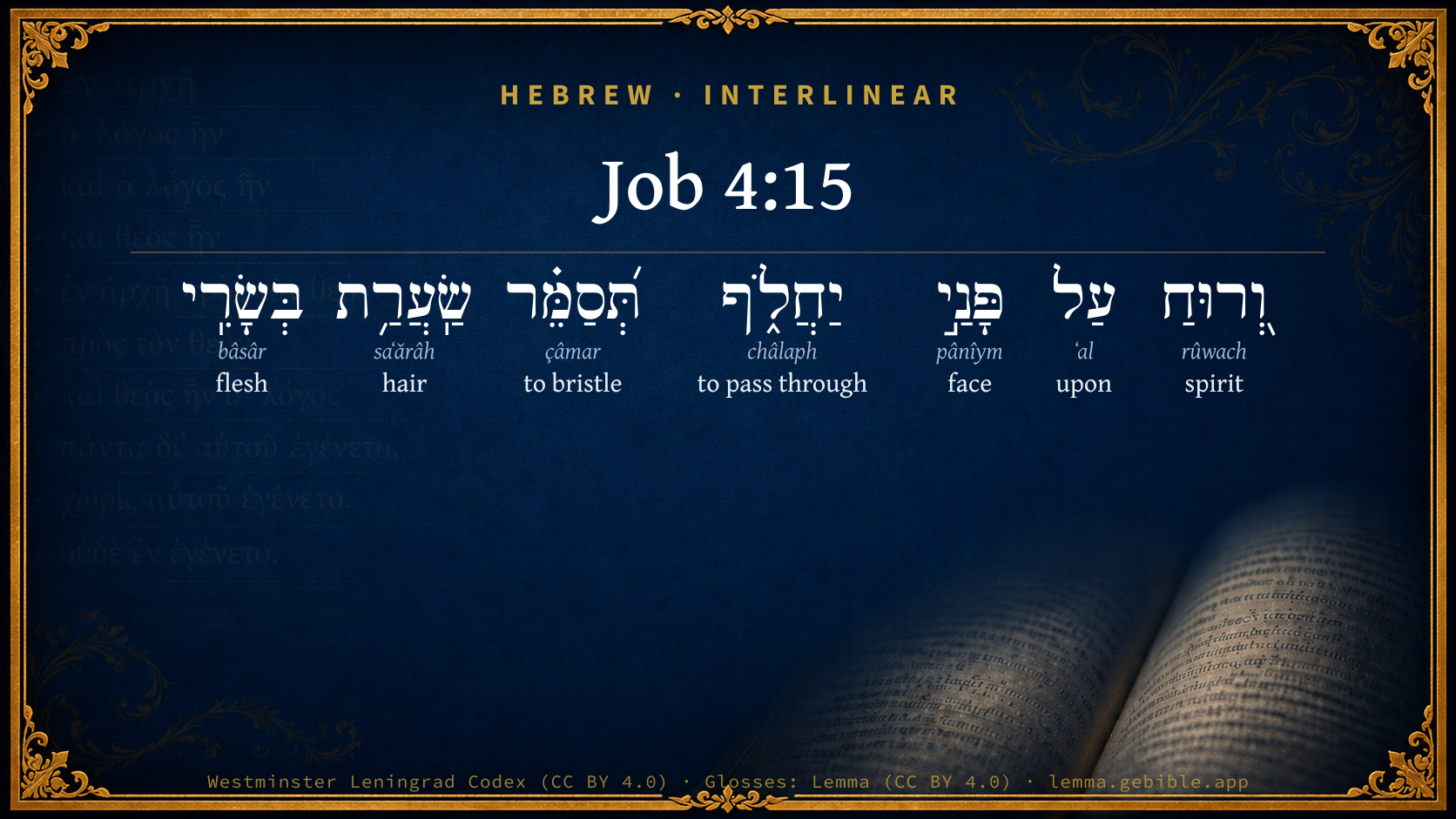
Job 4:15

Hebrew (Westminster Leningrad Codex) Job 4:15 appears in the Hebrew Old Testament. The text above is from the Westminster Leningrad Codex. Each word links to its Strong’s number, a concise gloss, and parsing drawn from the Open Scriptures Hebrew Bible morphology. Click any word for its full Brown-Driver-Briggs (BDB) entry.
Download image
Cite this verse

Job 4:15 (World English Bible). Public Domain. Lemma interlinear Bible study tool, https://lemma.gebible.app/v/job/4/15.

Show BibTeX & RIS
BibTeX
RIS
English Translation
Then a spirit passed before my face; The hair of my flesh stood up.
World English Bible · Public Domain
Highlights
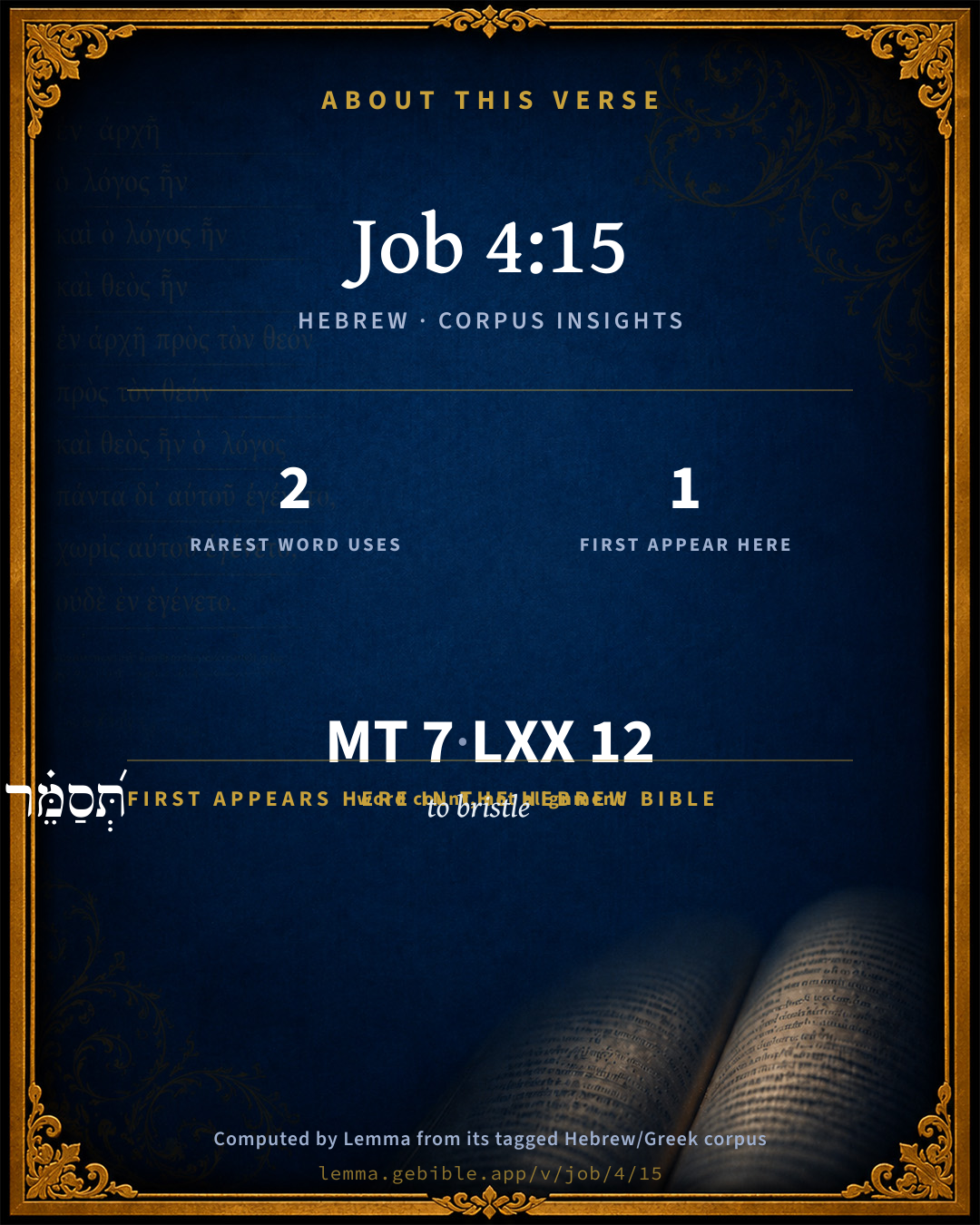
  • 1 first appearance in the Hebrew Bible
Full analysis ↓
Download a study sheet

One document with this verse’s original text, its word-by-word gloss line, the meaning frame, cross-references with their text, attributed commentary, and full source and license credits — printable, and it pastes into notes with its structure intact.

This verse Autodidact and up

Study sheet (.html) Plain text (.txt)

A passage Seminary Student

Up to 50 verses in one chapter. A passage sheet keeps up to 6 commentary sources and 12 cross-references per verse, in the order this page ranks them, and says so on the sheet whenever that leaves anything out. Ask for a single verse and you get the Autodidact verse sheet above.

Everything on this page stays free to read, with no account — the sheet is a download of what is already on screen, not access to it.

Want to remove ads? Support Godless Engineer
Compare translations 3

The same verse in 3 English versions, stacked beneath the original-language interlinear above. Click any original word for its lexicon entry.

Each is an independent rendering of the whole verse — the interlinear is not word-aligned to these translations.

Highlighted words mark where these versions differ — a whole-verse word diff, not a word-by-word alignment.

  • World English Bible Public Domain
    Then a spirit passed before my face; The hair of my flesh stood up.
  • King James Version Public Domain
    Then a spirit passed before my face; the hair of my flesh stood up:
  • unfoldingWord Literal Text CC BY-SA 4.0
    And a spirit was gliding before my face; the hair of my flesh was bristling.

unfoldingWord Literal Text — © unfoldingWord, licensed CC BY-SA 4.0. Word-aligned USFM3 via Door43 (git.door43.org/unfoldingWord/en_ult).

Versions to compare (up to 4)

3 of 4 selected

Show all 18 translations

Every available English version of this verse, each an independent rendering of the whole verse.

  • World English Bible Public Domain
    Then a spirit passed before my face; The hair of my flesh stood up.
  • Berean Standard Bible Public Domain
    Then a spirit glided past my face, and the hair on my body bristled.
  • Majority Standard Bible Public Domain
    Then a spirit glided past my face, and the hair on my body bristled.
  • King James Version Public Domain
    Then a spirit passed before my face; the hair of my flesh stood up:
  • American Standard Version (1901) Public Domain
    Then a spirit passed before my face; The hair of my flesh stood up.
  • Revised Version (1885) Public Domain
    Then a spirit passed before my face; the hair of my flesh stood up.
  • Geneva Bible (1599) Public Domain
    And the wind passed before me, and made the heares of my flesh to stande vp.
  • Douay-Rheims (1899) Public Domain
    And when a spirit passed before me, the hair of my flesh stood up.
  • Young's Literal Translation Public Domain
    And a spirit before my face doth pass, Stand up doth the hair of my flesh;
  • Literal Standard Version CC BY-SA 4.0
    And a spirit passes before my face, || The hair of my flesh stands up;
  • Unlocked Literal Bible CC BY-SA 4.0
    Then a spirit passed before my face, and the hair of my flesh stood up.
  • unfoldingWord Literal Text CC BY-SA 4.0
    And a spirit was gliding before my face; the hair of my flesh was bristling.
  • Darby Bible Public Domain
    And a spirit passed before my face -- the hair of my flesh stood up --
  • World Messianic Bible Public Domain
    Then a spirit passed before my face. The hair of my flesh stood up.
  • Webster's Bible Public Domain
    Then a spirit passed before my face; the hair of my flesh stood up:
  • Free Bible Version CC BY-SA 4.0
    Then a breath brushed my face and gave me goose-pimples.
  • Bible in Basic English Public Domain
    And a breath was moving over my face; the hair of my flesh became stiff:
  • JPS Tanakh (1917) Public Domain
    Then a spirit passed before my face, that made the hair of my flesh to stand up.

Literal Standard Version (2020), Covenant Press — licensed CC BY-SA 4.0. Text via the HelloAO Bible API (eBible.org). Unlocked Literal Bible (unfoldingWord) — licensed CC BY-SA 4.0. Text via the HelloAO Bible API (eBible.org). unfoldingWord Literal Text — © unfoldingWord, licensed CC BY-SA 4.0. Word-aligned USFM3 via Door43 (git.door43.org/unfoldingWord/en_ult). Free Bible Version, Dr. Jonathan Gallagher — licensed CC BY-SA 4.0. Text via the HelloAO Bible API (eBible.org).

Word by word

More ways to search: Search by grammar → Find every occurrence → Compare this word →

Practice this passage: Drill this verse → Learn its vocabulary →

About this verse

These counts appear in no published source. They are computed here, from the morphology-tagged text and Lemma’s own curated glosses. What Lemma adds →

7
words
7
distinct lemmas
Wisdom
section

Notable vocabulary

The rarest word here is תְּ֝סַמֵּ֗ר to bristle H5568 — appearing just 2 times in the whole Hebrew Bible.

First appearance in Scripture

This word makes its first canonical appearance in the Hebrew Bible here:

  • תְּ֝סַמֵּ֗ר to bristle H5568

Shared distinctive vocabulary

תְּ֝סַמֵּ֗ר to bristle H5568 occurs in 2 verses of the Hebrew Bible. Also found in:

Grammatical profile

  • 2 verbs
  • 4 nouns
  • 1 preposition

Verb forms

  • יַחֲלֹ֑ף Qal · Imperfect
  • תְּ֝סַמֵּ֗ר Piel · Imperfect

Hebrew & Septuagint length

In English translation the verse runs 14 words from the Hebrew and 13 from the Septuagint (LXX English) — closely comparable.

A rough comparison of the two English renderings, which tokenize alike — not a word-level alignment.

Word counts can differ between the Hebrew and the Greek without any difference in meaning — e.g. the Hebrew direct-object marker אֵת has no separate Greek word, and Greek often adds the article ὁ.

In the original languages it is 7 Hebrew tokens and 12 Greek tokens — but the two are counted differently (Hebrew bundles its prefixes and suffixes into one token; the Greek is in lemma form), so that isn’t a like-for-like length.

Cross-references

8

Topical passages linked to Job 4:15 in the Treasury of Scripture Knowledge — connected by theme and wording, ordered by reader-vote popularity; previews shown in the World English Bible.

  • Hebrews 1:7 Of the angels he says, "Who makes his angels winds, And his servants a flame of fire."
  • Psalms 104:4 He makes his messengers winds; His servants flames of fire.
  • Daniel 5:6 Then the king's face was changed in him, and his thoughts troubled him; and the joints of his loins were loosened, and his knees struck one against another.
  • Luke 24:37–39 But they were terrified and filled with fear, and supposed that they had seen a spirit.
  • Isaiah 13:8 and they shall be dismayed; pangs and sorrows shall take hold [of them]; they shall be in pain as a woman in travail: they shall look in amazement one at another; their faces [shall be] faces of flame.
  • Isaiah 21:3–4 Therefore are my loins filled with anguish; pangs have taken hold on me, as the pangs of a woman in travail: I am pained so that I can't hear; I am dismayed so that I can't see.
  • Matthew 14:26 When the disciples saw him walking on the sea, they were troubled, saying, "It's a ghost!" and they cried out for fear.
  • Hebrews 1:14 Aren't they all ministering spirits, sent out to do service for the sake of those who will inherit salvation?

Cross-references courtesy of OpenBible.info (CC BY 4.0).

Hebrew and Greek witnesses Masoretic Hebrew ↔ Greek Septuagint

The same verse in the two great witnesses to the Old Testament, shown verse-for-verse.

These are two independent witnesses, not word-aligned to each other, and the Septuagint is shown in lemma (dictionary) form.

Hebrew Job 4:15 Masoretic · Westminster Leningrad Codex

וְ֭רוּחַ עַל פָּנַ֣י יַחֲלֹ֑ף תְּ֝סַמֵּ֗ר שַֽׂעֲרַ֥ת בְּשָׂרִֽי

Then a spirit passed before my face; The hair of my flesh stood up.

World English Bible · Public Domain

Greek LXX Job 4:15 Septuagint · lemma form

καί πνεῦμα ἐπί πρόσωπον ἐγώ ἐπιἔρχομαι φρίττω δέ ἐγώ θρίξ καί σάρξ

And a spirit came before my face; and my hair and flesh quivered.

LXX2012 (modern English Septuagint) · Public Domain

Hebrew: Westminster Leningrad Codex (CC BY 4.0). Greek: Septuagint (public domain); English from LXX2012 (modern English Septuagint) (Public Domain). How the Septuagint differs from the Hebrew →

Commentary

Notes on Job 4:15 from classic Christian and Jewish commentators (each source and its license shown beneath its notes). The classic Christian expositions comment on the surrounding passage and are grouped to its opening verse, so a note may address several verses; the Jewish commentaries on the Tanakh (Rashi and others) are per-verse, so they appear only where the commentator wrote on this verse.

Lemma curates 59 commentaries, every one of them public domain or Creative Commons licensed, each selected and text-cleaned for this edition rather than reprinted as found. About our sources →

Trapp's Complete Commentary

John Trapp

Job 4:15 Then a spirit passed before my face; the hair of my flesh stood up:

Ver. 15. Then a spirit passed before my face] Some render it a wind, as a messenger or forerunner of God near at hand, as 1Ki 19:11. But better, a good angel in some bodily shape, Psa 104:4 Luk 24:37; for else how could he be seen of Eliphaz, gliding rather than going, as a ship upon the face of the waters?

The hair of my flesh stood up] Horripilatus sum. In a fright the heart falleth down, the hair standeth up; the blood hastening to the heart to relieve it, as soldiers do to the castle when all is likely to be lost.

Dirigui, steteruntque comae -

John Trapp, A Commentary or Exposition upon All the Books of the Old and New Testament (1647–1656) — public domain. Text from a community e-Sword module.

Joseph Benson's Commentary

Job 4:15. Then — Hebrew, And, as the particle ו, vau, generally signifies. A spirit passed before my face — An angel in a visible shape, otherwise he could not have discerned it, nor would have been affrighted by it. The hair of my flesh stood up — Through that excessive consternation and horror, which seized me at the sight of so glorious and unusual an appearance.

Joseph Benson's Commentary on the Old and New Testaments (1811–1818) — public domain. Text from a community e-Sword module.

Tyndale Open Study Notes

Tyndale Open Resources

4:15 A spirit (or wind) swept past my face: Wind is a physical display of God’s powerful presence (38:1; Nah 1:3; Acts 2:2; cp. 1 Kgs 19:11).

Tyndale Open Study Notes — © Tyndale Open Resources, licensed CC BY-SA 4.0. Text via the HelloAO Bible API.

Ellicott's Commentary for English Readers

(15) A spirit passed before my face.—It is vain to argue from this passage that spiritual essences are capable of being seen by the bodily eye, because, first of all, the language is highly figurative and poetical, and because, secondly, every one understands that a spiritual manifestation can be made only to the spirit. The notion, therefore, of seeing a spirit is absurd in itself, because it involves the idea of seeing the invisible; but it is conceivable that the perceptions of the inner spirit may be so vivid as to assume the character of outward manifestations.

A Bible Commentary for English Readers, edited by Charles John Ellicott (1878–1897) — public domain. Text from a community e-Sword module.

The Cambridge Bible for Schools and Colleges

gen. ed. J. J. S. Perowne

15. then a spirit] Rather, a breath. It was something which he felt; that which he saw follows in Job_4:16. The word spirit does not seem used in the Old Testament in the sense of an apparition.

The Cambridge Bible for Schools and Colleges (gen. ed. J. J. S. Perowne; Cambridge University Press, 1878–1918) — public domain. Text from a community e-Sword module.

John Gill's Exposition

It stood still,.... That is, the spirit, or the angel in a visible form; it was before going to and fro, but now it stood still right against Eliphaz, as if it had something to say to him, and so preparing him to attend to it; which he might do the better, it standing before him while speaking to him, that he might have the opportunity of taking more notice of it:

but, notwithstanding this advantageous position of it:

I could not discern the form thereof; what it was, whether human or any other:

an image was before mine eyes; he saw something, some appearance and likeness, but could not tell what it was; perhaps the fear and surprise he was in hindered him from taking in any distinct idea of it, or that particular notice of it, so as to be able to form in his own mind any suitable notion of it, or to describe it to others:

there was silence both in the spirit or image, which, standing still, made no rushing noise, and in Eliphaz himself, who kept in his breath, and listened with all the attention he could to it; or a small low voice, as Ben Melech interprets it: so it follows:

and I heard a voice; a distinct articulate voice or sound of words, very audibly delivered by the spirit or image that stood before him:

saying; as follows.

John Gill's Exposition of the Whole Bible (1746–1763) — public domain (CC PDM 1.0). Text via the HelloAO Bible API.

Albert Barnes' Notes on the Bible

Then a spirit passed before my face - He does not intimate whether it was the spirit of a man, or an angel who thus appeared. The belief in such apparitions was common in the early ages, and indeed has prevailed at all times. No one can demonstrate that God could not communicate his will in such a manner as this, or by a messenger deputed from his immediate presence to impart valuable truth to people.

The hair of my flesh stood up - This is an effect which is known often to be produced by fear. Sometimes the hair is made to turn white almost in an instant, as an effect of sudden alarm; but usually the effect is to make it stand on end. Seneca uses language remarkably similar to this in describing the effect of fear, in Hercule Oetoeo:

Vagus per artus errat excussos tremor;

Erectus horret crinis. Impulsis adhuc

Star terror animis. et cor attonitum salit,

Pavidumque trepidis palpitat venis jecur.

So Virgil,

Steteruntque comae, et vox faucibus haesit.

Aeneid ii. 774.

See also Aeneid iii. 48, iv. 289. So also Aeneid xii. 868:

Arrectaeque horrore comae.

A similar description of the effect of fear is given in the Ghost’s speech to Hamlet:

“But that I am forbid

To tell the secrets of my prison-house,

I could a tale unfold, whose lightest word

Would harrow up thy soul, freeze thy young blood.

Make thy two eyes like stars, start from their spheres,

Thy knotty and combined locks to part,

And each particular hair to stand on end,

Like quills upon the fretful porcupine.”

The fact here referred to - that fear or fright; causes the hair to stand on end - is too well established, and too common to admit a doubt. The cause may be, that sudden fear has the effect to drive the blood to the heart, as the seat of vitality, and the extremities are left cold, and the skin thus contracts, and the effect is to raise the hair.

Albert Barnes' Notes on the Bible (1834–1885) — public domain. Text from a community e-Sword/MySword module.

Haydock's Catholic Bible Commentary

Spirit: angel, or gentle breeze. (Calmet)

George Leo Haydock (1774–1849), Haydock's Catholic Family Bible and Commentary, 1859 edition — public domain. Excludes Psalms (Douay-Rheims chapter numbering differs from Protestant) and Deuterocanonical books (Catholic canon only).

Matthew Poole's English Annotations

Then, Heb. and, or for, as this particle is oft used. So this was the reason of the foregoing thoughts and fear.

A spirit; an angel in some visible shape, otherwise he could not have discerned it, nor would have been affrighted at it.

The hair of my flesh, i.e. of my body, as flesh is taken, Gen 2:24; Psa 16:9; 119:120.

Stood up, through that excessive horror caused by so glorious, unusual, and terrible a presence; which God used to excite in men upon such occasions, to convince them that it was not a vain imagination or illusion, but a real vision and revelation, and that from God.

Matthew Poole's English Annotations on the Holy Bible (1683–1685) — public domain. Text from a community e-Sword/MySword module.

Whedon's Commentary on the Bible

Daniel D. Whedon

15. A spirit — רוח, rouahh, as a verb, signifies to breathe or to blow, and as a noun, bears the meaning of breath or spirit, according as the associated thought shall determine. Locke early announced the principle, “I doubt not but if we could trace them to their source we should find, in all languages, the names which stand for things that fall not under our senses to have had their first rise from sensible ideas.” The use of a kindred word for spirit may have been developed in, or transmitted to, all these different languages through the reflection that breath and spirit are alike invisible, that they are so intimately associated together that, with the extinction of life, they both disappear from the knowledge of men. Or, as Delitzsch (Bib. Psych., p. 273) more profoundly suggests, “that the breathing… is that form of life, wherewith life begins to become self-life… and to evidence itself outwardly.” Thus, in the Latin, we have animus, the mind, which Cicero says is so called from anima, air or breath. The Greek word πνευμα, pneuma; the Sanscrit, atman; the Aztec, checatl; the Mohawk, atonritz; and our own word, spirit, (Latin, spiritus,) as well as similar words in other languages, primarily bore the meaning of breath or wind, as well as of spirit. The word rouahh belongs to the same class. With significance it appears here, as in 1Ki_22:21, (a rare construction,) in agreement with the masculine form of the verb. Its spiritual meaning was evidently just as fixed in the days of Job, (Job_32:8,) as that of spirit is in ours. In our text the word must mean spirit, as in 1Ki_22:21, and in the Targum, since acts of moral consciousness and spiritual intelligence are attributed to it. It speaks, reasons, (uses the argumentum a fortiori,) and communicates the sublimest thoughts upon the relations of man to God. This passage is of great interest, as it unquestionably shows that unembodied existence was taken for granted in the days of Job. This is the first time on scripture page that spirit, other than God, sundered from bodily restrictions, is personified. Subsequently evil spirits appear on their dark missions, as in 1Sa_16:15; 1Sa_16:23, etc. Whether this being was human or of some other order of spiritual intelligences, does not appear from the vision. Commentators in general have been of the opinion that it was an angel. We have an important datum, in the free and natural assumption of Eliphaz, that spirit can live without a body. This datum will materially help us to a proper conception of the knowledge that Job possessed in those early ages, and will shed light upon the controverted passages in this book, as to the condition of the dead.

Passed — יחל, glided by. The same word is used in Job_9:11, of deity. The employment of this verb thus in connexion with conscious existence, disposes of the reasoning Hitzig bases upon the verb, for rendering its subject rouahh, wind, (hauch.)

The hair of my flesh — In like manner the ghost of Hamlet could tell a tale that would make: —

Thy knotted and combined locks to part, And each particular hair to stand on end,

Like quills upon the fretful porcupine. Ibid.

Arrectae que horrore comae, et vox faucibus haesit. The hair stood up with horror, etc. — AEneid, 12:868.

Daniel D. Whedon (gen. ed.), Commentary on the Old and New Testaments (1874–1909) — public domain. Text from a community e-Sword module.

The Pulpit Commentary

Then a spirit passed before my face. It has been argued (Rosenmuller) that "a breath of air," and not "a spirit," is intended; but, in that ease, how are we to understand the expressions in the following verse: "it stood still," "the form thereof," "an image"? A breath of air, the very essence of which is to be in motion, cannot stand still, nor has it any "form," "appearance," or "image." Granted that the Hebrew ruakh (jwr) may mean like the Greek pneuma , and the Latin spiritus either an actual spirit, or a breath, a wind, it follows that, in every place where it occurs, we must judge by the context which is meant. Here certainly the context points to an actual living spirit, as what Eliphaz intended. Whether a spirit really appeared to him is a separate question. The whole may have been a vision; but certainly the impression left on Eliphaz was that he had had a communication from the spirit-world. The hair of my flesh stood up. Not the hair of his head only, but every hair on his whole body, stiffened, bristled, and rose up on end in horror (see the comment on ver. 14).

The Pulpit Commentary (1880–1919), ed. H.D.M. Spence-Jones & Joseph S. Exell — public domain. Text from a community e-Sword module.

John Wesley's Explanatory Notes

A spirit - An angel in visible shape, otherwise he could not have discerned it. Stood up - Through that excessive horror caused by so glorious, unusual, and terrible a presence.

John Wesley, Explanatory Notes Upon the Whole Bible (1754–1765) — public domain. Text via the GEBible commentary corpus.

Rashi

Rabbi Shlomo Yitzchaki (Rashi)

it made stand on end The spirit made the hair of my flesh (stand on end].

תסמר. That is an expression of a man whose hair stood on end.

Rashi on the Tanakh — English translations: “The Judaica Press complete Tanach with Rashi, translated by A. J. Rosenberg” (CC BY 4.0); “Pentateuch with Rashi's commentary by M. Rosenbaum and A.M. Silbermann, 1929-1934” (public domain); “The Metsudah Tanach series, Lakewood, N.J” (CC BY 4.0); and “The Book of Joshua, Metsudah Publications, 1997” (CC BY 4.0). Text via Sefaria.

Lesson kit

Teaching starters — assembled from the data on this page, not authored interpretation. Every prompt links to the verse data it draws on. Edit before teaching.

Job, in the Wisdom, opens this verse with 7 words (7 distinct Hebrew lemmas). Its most distinctive word is çâmar (“to bristle”). A historical commentator’s framing appears above. Read the whole chapter for the surrounding context.

Discussion questions

  1. What does “to bristle” (çâmar) contribute to the verse as a whole?
  2. This is the first place “to bristle” appears in Scripture (first appears here). What does its debut here establish?
  3. How does Psalms 119:120, which shares the word «to bristle», read alongside this verse?
  4. These translations render this verse differently. What is at stake in choosing one wording over another?
  5. «יַחֲלֹ֑ף» is a Qal Imperfect verb. How does that grammatical form shape the action described?
  6. Compare how Trapp's Complete Commentary and Joseph Benson's Commentary read this verse. Where do they agree or differ?

Things to notice

Reading settings

Reading text

Shown beneath each verse's original-language words.

Old Testament
Old Testament edition

Read the OT as the Masoretic Hebrew (MT) or the Greek Septuagint (LXX).

English shown for the Greek Septuagint (in the Hebrew ↔ Greek comparison).

Comparing translations? Open the Compare panel on any verse page to stack up to four side by side.