
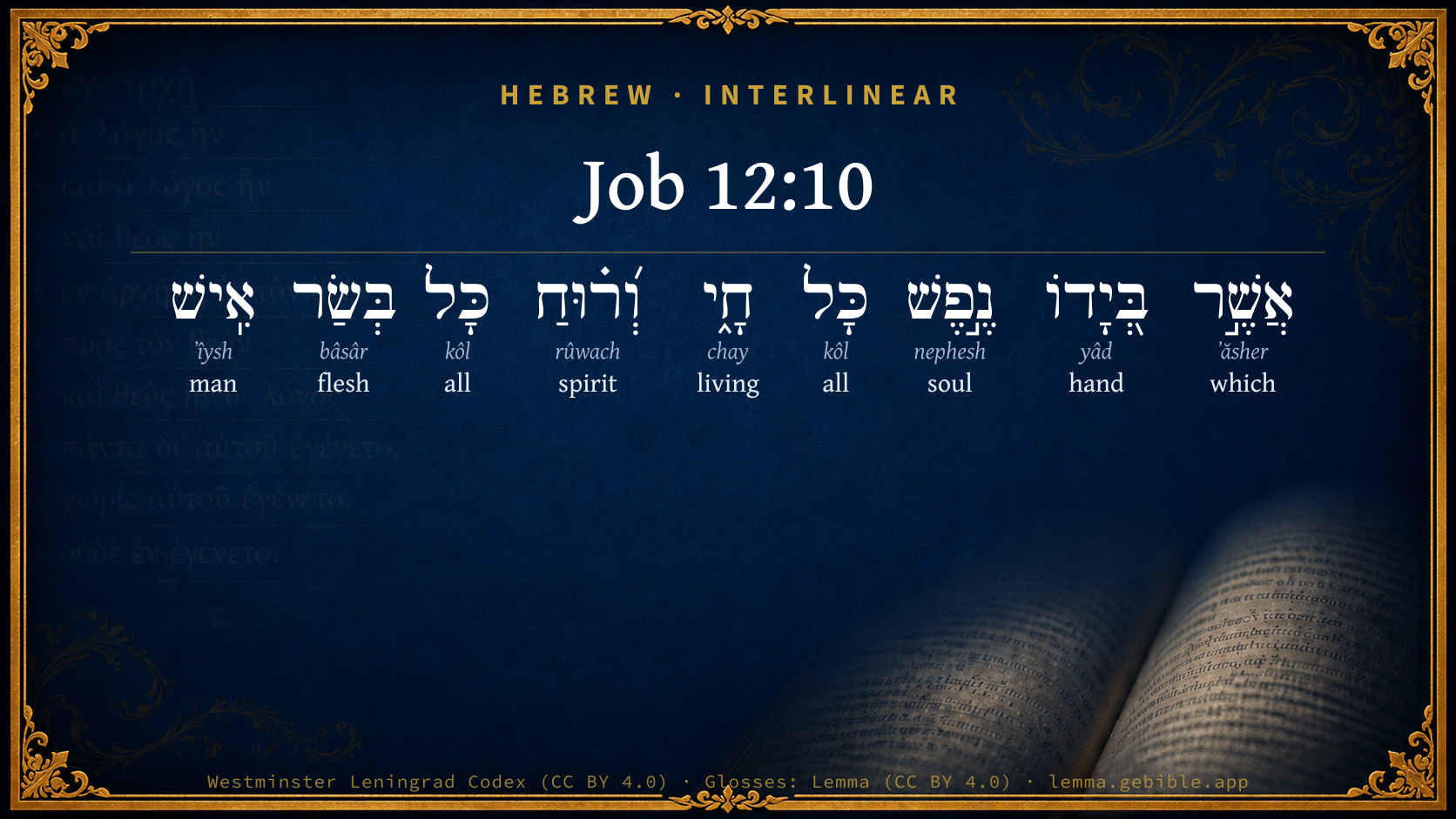
Job 12:10

Hebrew (Westminster Leningrad Codex) Job 12:10 appears in the Hebrew Old Testament. The text above is from the Westminster Leningrad Codex. Each word links to its Strong’s number, a concise gloss, and parsing drawn from the Open Scriptures Hebrew Bible morphology. Click any word for its full Brown-Driver-Briggs (BDB) entry.
Download image
Cite this verse

Job 12:10 (World English Bible). Public Domain. Lemma interlinear Bible study tool, https://lemma.gebible.app/v/job/12/10.

Show BibTeX & RIS
BibTeX
RIS
English Translation
In whose hand is the life of every living thing, The breath of all mankind?
World English Bible · Public Domain
Download a study sheet

One document with this verse’s original text, its word-by-word gloss line, the meaning frame, cross-references with their text, attributed commentary, and full source and license credits — printable, and it pastes into notes with its structure intact.

This verse Autodidact and up

Study sheet (.html) Plain text (.txt)

A passage Seminary Student

Up to 50 verses in one chapter. A passage sheet keeps up to 6 commentary sources and 12 cross-references per verse, in the order this page ranks them, and says so on the sheet whenever that leaves anything out. Ask for a single verse and you get the Autodidact verse sheet above.

Everything on this page stays free to read, with no account — the sheet is a download of what is already on screen, not access to it.

Want to remove ads? Support Godless Engineer
Compare translations 3

The same verse in 3 English versions, stacked beneath the original-language interlinear above. Click any original word for its lexicon entry.

Each is an independent rendering of the whole verse — the interlinear is not word-aligned to these translations.

Highlighted words mark where these versions differ — a whole-verse word diff, not a word-by-word alignment.

  • World English Bible Public Domain
    In whose hand is the life of every living thing, The breath of all mankind?
  • King James Version Public Domain
    In whose hand is the soul of every living thing, and the breath of all mankind.
  • unfoldingWord Literal Text CC BY-SA 4.0
    in whose hand the life of every living thing and the breath of all flesh of man.

unfoldingWord Literal Text — © unfoldingWord, licensed CC BY-SA 4.0. Word-aligned USFM3 via Door43 (git.door43.org/unfoldingWord/en_ult).

Versions to compare (up to 4)

3 of 4 selected

Show all 18 translations

Every available English version of this verse, each an independent rendering of the whole verse.

  • World English Bible Public Domain
    In whose hand is the life of every living thing, The breath of all mankind?
  • Berean Standard Bible Public Domain
    The life of every living thing is in His hand, as well as the breath of all mankind.
  • Majority Standard Bible Public Domain
    The life of every living thing is in His hand, as well as the breath of all mankind.
  • King James Version Public Domain
    In whose hand is the soul of every living thing, and the breath of all mankind.
  • American Standard Version (1901) Public Domain
    In whose hand is the soul of every living thing, And the breath of all mankind?
  • Revised Version (1885) Public Domain
    In whose hand is the soul of every living thing, and the breath of all mankind.
  • Geneva Bible (1599) Public Domain
    In whose hande is the soule of euery liuing thing, and the breath of all mankinde.
  • Douay-Rheims (1899) Public Domain
    In whose hand is the soul of every living thing, and the spirit of all flesh of man.
  • Young's Literal Translation Public Domain
    In whose hand `is' the breath of every living thing, And the spirit of all flesh of man.'
  • Literal Standard Version CC BY-SA 4.0
    In whose hand [is] the breath of every living thing, || And the spirit of all flesh of man.
  • Unlocked Literal Bible CC BY-SA 4.0
    In his hand is the life of every living thing and the breath of all mankind.
  • unfoldingWord Literal Text CC BY-SA 4.0
    in whose hand the life of every living thing and the breath of all flesh of man.
  • Darby Bible Public Domain
    In whose hand is the soul of every living thing, and the spirit of all flesh of man.
  • World Messianic Bible Public Domain
    in whose hand is the life of every living thing, and the breath of all mankind?
  • Webster's Bible Public Domain
    In whose hand is the soul of every living thing, and the breath of all mankind.
  • Free Bible Version CC BY-SA 4.0
    He gives life to every living thing, life to all humankind.
  • Bible in Basic English Public Domain
    In whose hand is the soul of every living thing, and the breath of all flesh of man.
  • JPS Tanakh (1917) Public Domain
    In whose hand is the soul of every living thing, and the breath of all mankind. —

Literal Standard Version (2020), Covenant Press — licensed CC BY-SA 4.0. Text via the HelloAO Bible API (eBible.org). Unlocked Literal Bible (unfoldingWord) — licensed CC BY-SA 4.0. Text via the HelloAO Bible API (eBible.org). unfoldingWord Literal Text — © unfoldingWord, licensed CC BY-SA 4.0. Word-aligned USFM3 via Door43 (git.door43.org/unfoldingWord/en_ult). Free Bible Version, Dr. Jonathan Gallagher — licensed CC BY-SA 4.0. Text via the HelloAO Bible API (eBible.org).

Word by word

More ways to search: Search by grammar → Find every occurrence → Compare this word →

Practice this passage: Drill this verse → Learn its vocabulary →

About this verse

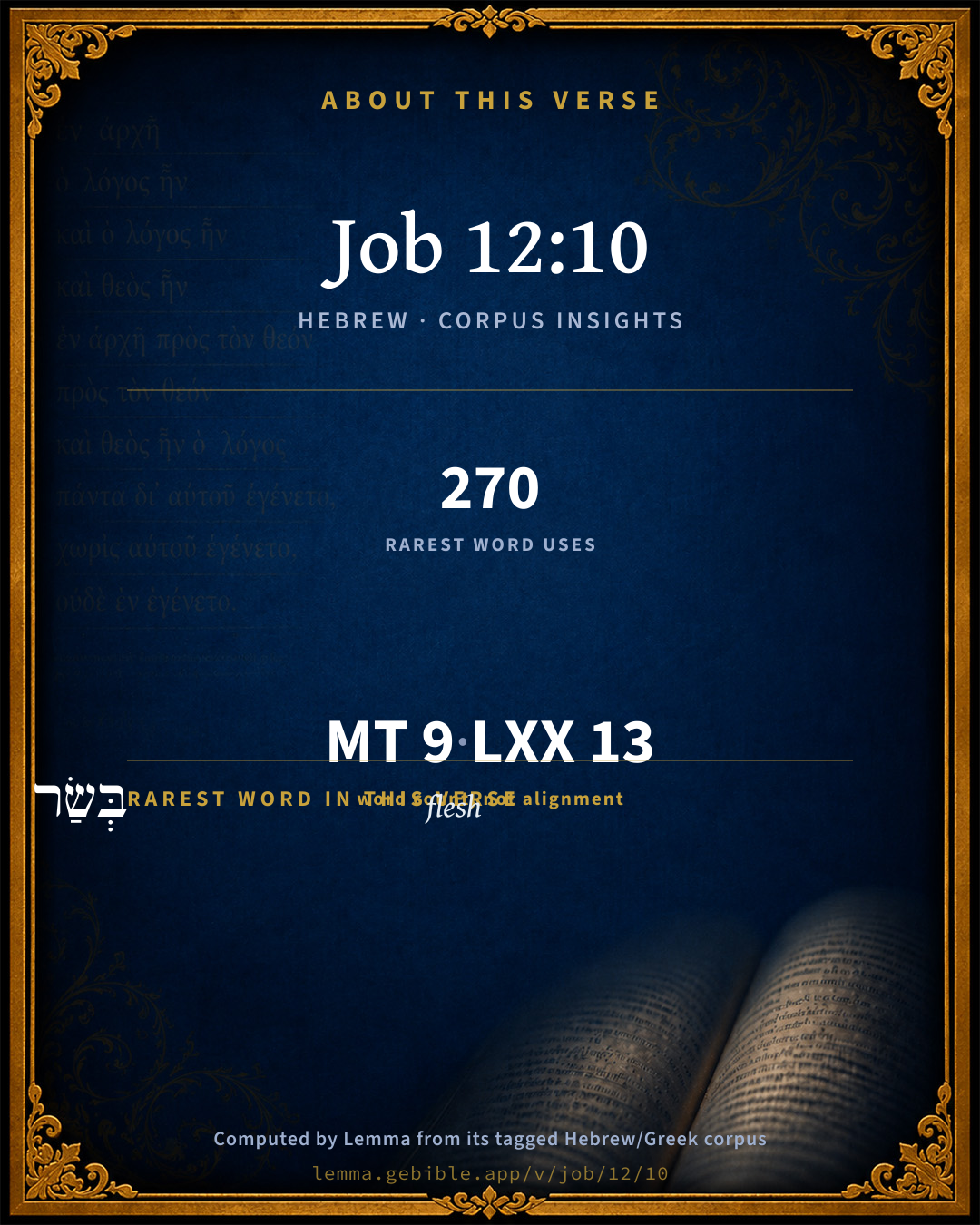
These counts appear in no published source. They are computed here, from the morphology-tagged text and Lemma’s own curated glosses. What Lemma adds →

9
words
8
distinct lemmas
Wisdom
section

Grammatical profile

  • 7 nouns
  • 1 adjective
  • 1 particle

Repetition

A word recurs within this verse — often emphatic in Hebrew:

Hebrew & Septuagint length

In English translation the verse runs 15 words from the Hebrew and 17 from the Septuagint (LXX English) — closely comparable.

A rough comparison of the two English renderings, which tokenize alike — not a word-level alignment.

Word counts can differ between the Hebrew and the Greek without any difference in meaning — e.g. the Hebrew direct-object marker אֵת has no separate Greek word, and Greek often adds the article ὁ.

In the original languages it is 9 Hebrew tokens and 13 Greek tokens — but the two are counted differently (Hebrew bundles its prefixes and suffixes into one token; the Greek is in lemma form), so that isn’t a like-for-like length.

Cross-references

12

Topical passages linked to Job 12:10 in the Treasury of Scripture Knowledge — connected by theme and wording, ordered by reader-vote popularity; previews shown in the World English Bible.

  • Acts 17:28 'For in him we live, and move, and have our being.' As some of your own poets have said, 'For we are also his offspring.'
  • Job 33:4 The Spirit of God has made me, And the breath of the Almighty gives me life.
  • Acts 17:25 neither is he served by men's hands, as though he needed anything, seeing he himself gives to all life and breath, and all things.
  • Numbers 16:22 They fell on their faces, and said, God, the God of the spirits of all flesh, shall one man sin, and will you be angry with all the congregation?
  • Job 27:3 (For the length of my life is still in me, And the spirit of God is in my nostrils);
  • Daniel 5:23 but have lifted up yourself against the Lord of heaven; and they have brought the vessels of his house before you, and you and your lords, your wives and your concubines, have drunk wine from them; and you have praised the gods of silver and gold, of brass, iron, wood, and stone, which don't see, nor hear, nor know; and the God in whose hand your breath is, and whose are all your ways, you have not glorified.
  • Psalms 146:3–4 Don't put your trust in princes, Each a son of man in whom there is no help.
  • Psalms 104:29 You hide your face: they are troubled; You take away their breath: they die, and return to the dust.
  • John 3:6 That which is born of the flesh is flesh. That which is born of the Spirit is spirit.
  • Job 34:14–15 If he set his heart on himself, If he gathered to himself his spirit and his breath;
  • Genesis 2:7 Yahweh God formed man from the dust of the ground, and breathed into his nostrils the breath of life; and man became a living soul.
  • Genesis 6:17 I, even, I do bring the flood of waters on this earth, to destroy all flesh having the breath of life from under the sky. Everything that is in the earth will die.

Cross-references courtesy of OpenBible.info (CC BY 4.0).

Hebrew and Greek witnesses Masoretic Hebrew ↔ Greek Septuagint

The same verse in the two great witnesses to the Old Testament, shown verse-for-verse.

These are two independent witnesses, not word-aligned to each other, and the Septuagint is shown in lemma (dictionary) form.

Hebrew Job 12:10 Masoretic · Westminster Leningrad Codex

אֲשֶׁ֣ר בְּ֭יָדוֹ נֶ֣פֶשׁ כָּל חָ֑י וְ֝ר֗וּחַ כָּל בְּשַׂר אִֽישׁ

In whose hand is the life of every living thing, The breath of all mankind?

World English Bible · Public Domain

Greek LXX Job 12:10 Septuagint · lemma form

εἰ μή ἐν χείρ αὐτός ψυχή πᾶς ὁ ζάω καί πνεῦμα πᾶς ἄνθρωπος

Whereas the life of all living things is in his hand, and the breath of every man.

LXX2012 (modern English Septuagint) · Public Domain

Hebrew: Westminster Leningrad Codex (CC BY 4.0). Greek: Septuagint (public domain); English from LXX2012 (modern English Septuagint) (Public Domain). How the Septuagint differs from the Hebrew →

Commentary

Notes on Job 12:10 from classic Christian and Jewish commentators (each source and its license shown beneath its notes). The classic Christian expositions comment on the surrounding passage and are grouped to its opening verse, so a note may address several verses; the Jewish commentaries on the Tanakh (Rashi and others) are per-verse, so they appear only where the commentator wrote on this verse.

Lemma curates 59 commentaries, every one of them public domain or Creative Commons licensed, each selected and text-cleaned for this edition rather than reprinted as found. About our sources →

Trapp's Complete Commentary

John Trapp

Job 12:10 In whose hand [is] the soul of every living thing, and the breath of all mankind.

Ver. 10. In whose hand is the soul of every living thing] That is, the life of every beast, flowing from a sensitive soul, Lev 17:10-11. This, God both giveth to the creature and conserveth it; he suffereth it not to be taken away from little sparrows, or the like, without order from him; much less befalleth any such thing to man without his singular providence, since our very hairs also are numbered, Mat 9:30 Luk 12:7. The Jewish doctors do therefore offer manifest injury to Job when they say, that he held indeed that God created, and doth preserve, the several kinds of things, but permitteth the particulars and individuals to be hap hazard; whereas here he delivereth his judgment plainly to the contrary, when he saith,

And the breath of all mankind] Heb. The spirit of all man’s flesh (and so Broughton readeth it), that is, of every man’s body: hence God is called the God of the spirits of all flesh, Num 16:22, and the Father of spirits, Heb 12:9, and the former of the spirit of man within him, Zec 12:1. "My times are in thy hand," saith David, Psa 31:15. God preserves our lives as a light in a lantern, and we may be glad it is in so safe a hand; we should therefore honour him, as Daniel telleth Belshazzar, Dan 5:23; yea, "let everything that hath breath praise the Lord," Psa 150:6; or, as the Hebrew hath it, Let every breath praise the Lord: as oft as we breathe we are to breathe out the praise of God, and to make our breath like the smoke of the tabernacle; this we should do the rather because our breath is in our nostrils, Isa 2:22, every moment ready to puff out, and the grave cannot praise God, death cannot celebrate him, Isa 38:18.

John Trapp, A Commentary or Exposition upon All the Books of the Old and New Testament (1647–1656) — public domain. Text from a community e-Sword module.

Joseph Benson's Commentary

Job 12:10. In whose hand is the soul — That is, the life, or the principle of life; of every living thing — That is, of all irrational animals, of which he spake, Job 12:7, opposed to man in the last words of this verse. He means, in whose absolute power it is to give life or to take it away, when and how it seemeth good to him; and the breath of all mankind — Or, the spirit, as the word רוח, ruach, here used, commonly means; that is, the immortal soul, which is no less a creature, and in God’s power to dispose of it, than the animal soul or life of brutes.

Joseph Benson's Commentary on the Old and New Testaments (1811–1818) — public domain. Text from a community e-Sword module.

Geneva Bible (1599)

Geneva Bible translators

Or, flesh.

Geneva Bible (1599) marginal notes — public domain. Text via Bolls.life.

Jamieson, Fausset & Brown

Robert Jamieson, A. R. Fausset & David Brown

the soul--that is, the animal life. Man, reasons Job, is subjected to the same laws as the lower animals.

Jamieson, Fausset & Brown — Commentary Critical and Explanatory on the Whole Bible (1871) — public domain (CC PDM 1.0). Text via the HelloAO Bible API.

Adam Clarke's Commentary

Verse 10. In whose hand is the soul of every living thing] נפש כל חי nephesh col chai, "the soul of all life."

And the breath of all mankind.] ורוח כל בשר veruach col besar, "and the spirit or breath of all flesh." Does not the first refer to the immortal soul, the principle of all intellectual life; and the latter to the breath, respiration, the grand means by which animal existence is continued? See Job 10:1.

Adam Clarke's Commentary on the Bible (1810–1826) — public domain. Text from a community e-Sword/MySword module.

The Cambridge Bible for Schools and Colleges

gen. ed. J. J. S. Perowne

10. This verse rounds off the statement in Job_12:7 seq. that God moves among the living creatures upon the earth, dispensing life and death, in a way absolute and uncontrolled.

The Cambridge Bible for Schools and Colleges (gen. ed. J. J. S. Perowne; Cambridge University Press, 1878–1918) — public domain. Text from a community e-Sword module.

John Gill's Exposition

Doth not the ear try words?.... Articulate sounds; and the mind by them judges whether what is expressed and designed by them is right or wrong, true or false, to be received or rejected; so such that have spiritual ears to hear, try the words of God and men, the wholesome words of Christ, and those of false teachers, which eat as a canker; and by their spiritual judgment can distinguish between the one and the other, discern those that differ, and approve those that are excellent, by bringing them to the standard of the word, the balance of the sanctuary, the Scriptures of truth:

and the mouth taste his meat? and judge of it, whether good or bad, or savoury or unsavoury, and so receive or reject it: thus such who have their taste changed, and relish spiritual things, can distinguish between the meat that perishes, and that which endures to everlasting life, even Christ, whose flesh is meat indeed; and those that have tasted that the Lord is gracious, and to whose taste the fruits of Christ and the doctrines of grace are sweet; these will desire the sincere milk of the word, and that strong meat in it, which belongs to discerning and experienced souls; and will feed by faith upon the pure word of the Gospel, and mix it with it, and reject all others. Job by this would signify, that the things his friends had been discoursing of, and which they thought were such deep and wonderful things, were as easy to be searched and found out, tried and judged of, as sounds by the ear, or food by the taste; and it may be also that hereby he suggests, that his doctrine, if it was impartially examined and tried by proper judges, it would appear as plain as anything tried by the ear, or tasted by the mouth. Some think that Job intends by this, that from the senses of hearing and tasting in men might be inferred the omniscience of God, his knowledge of all things, and his quick discernment of men, and their actions, since "he that planted the ear, shall he not hear? he that formed the eye, shall not he see?" Psa 94:9. Some versions read the whole, "doth not the ear try words, as the mouth tastes his meat" (q)? as in Job 34:3. Saadiah Gaon connects these words "as the ear tries words", &c. with Job 12:12, "so with the ancient is wisdom".

(q) Vatablus, Drusius, Junius et Tremellius, Piscator, Mercerus, Cocceius, Schultens; so Broughton.

John Gill's Exposition of the Whole Bible (1746–1763) — public domain (CC PDM 1.0). Text via the HelloAO Bible API.

Albert Barnes' Notes on the Bible

In whose hand is the soul of every living thing - Margin, “Life.” The margin is the more correct rendering. The idea is, that all are under the control of God. He gives life, and health, and happiness when he pleases, and when he chooses he takes them away. His sovereignty is manifested, says Job, in the inferior creation, or among the beasts of the field, the fishes of the sea, and the fowls of heaven.

And the breath of all mankind - Margin, “Flesh of man.” The margin is in accordance with the Hebrew. The meaning is, that man is subjected to the same laws as the rest of the creation. God is a sovereign, and the same great principles of administration may be seen in all his works.

Albert Barnes' Notes on the Bible (1834–1885) — public domain. Text from a community e-Sword/MySword module.

Matthew Poole's English Annotations

In whose hand, i.e. at whose absolute disposal, it is to give it, or take it away, when and how it seemeth good to him.

The soul; the life, or the soul the principle of life.

Of every living thing, i.e. of all unreasonable creatures, of which he spoke Job 12:7, opposed to man in the last words.

The breath, or, the spirit, as that word is commonly used, i.e. the immortal soul; which is no less a creature, and in God’s power to dispose of it, than the animal soul of unreasonable creatures.

Matthew Poole's English Annotations on the Holy Bible (1683–1685) — public domain. Text from a community e-Sword/MySword module.

Whedon's Commentary on the Bible

Daniel D. Whedon

10. The breath of all mankind — Literally, the spirit of all the flesh of man. The soul (nephesh) is the principle of natural life which man shares with the inferior creation; while the spirit (rouahh) is that higher endowment belonging, among animals, exclusively to man, by which he is allied to angels and to God.

Daniel D. Whedon (gen. ed.), Commentary on the Old and New Testaments (1874–1909) — public domain. Text from a community e-Sword module.

The Pulpit Commentary

In whose hand is the soul of every living thing. A brief summary of what had been said in vers. 7, 8, to which is now appended the further statement, that in God"s hand wholly dependent on him is the entire race of mankind also. And the breath of all mankind; literally, and the spirit of all flesh of man.

The Pulpit Commentary (1880–1919), ed. H.D.M. Spence-Jones & Joseph S. Exell — public domain. Text from a community e-Sword module.

Lesson kit

Teaching starters — assembled from the data on this page, not authored interpretation. Every prompt links to the verse data it draws on. Edit before teaching.

Job, in the Wisdom, opens this verse with 9 words (8 distinct Hebrew lemmas). Its most distinctive word is bâsâr (“flesh”). A historical commentator’s framing appears above. Read the whole chapter for the surrounding context.

Discussion questions

  1. What does “flesh” (bâsâr) contribute to the verse as a whole?
  2. How does Acts 17:28, which shares this passage’s theme, read alongside this verse?
  3. What does the repetition of “all” (2× in this one verse) do in this verse?
  4. These translations render this verse differently. What is at stake in choosing one wording over another?
  5. Compare how Trapp's Complete Commentary and Joseph Benson's Commentary read this verse. Where do they agree or differ?

Things to notice

Reading settings

Reading text

Shown beneath each verse's original-language words.

Old Testament
Old Testament edition

Read the OT as the Masoretic Hebrew (MT) or the Greek Septuagint (LXX).

English shown for the Greek Septuagint (in the Hebrew ↔ Greek comparison).

Comparing translations? Open the Compare panel on any verse page to stack up to four side by side.