Ezekiel 12:14

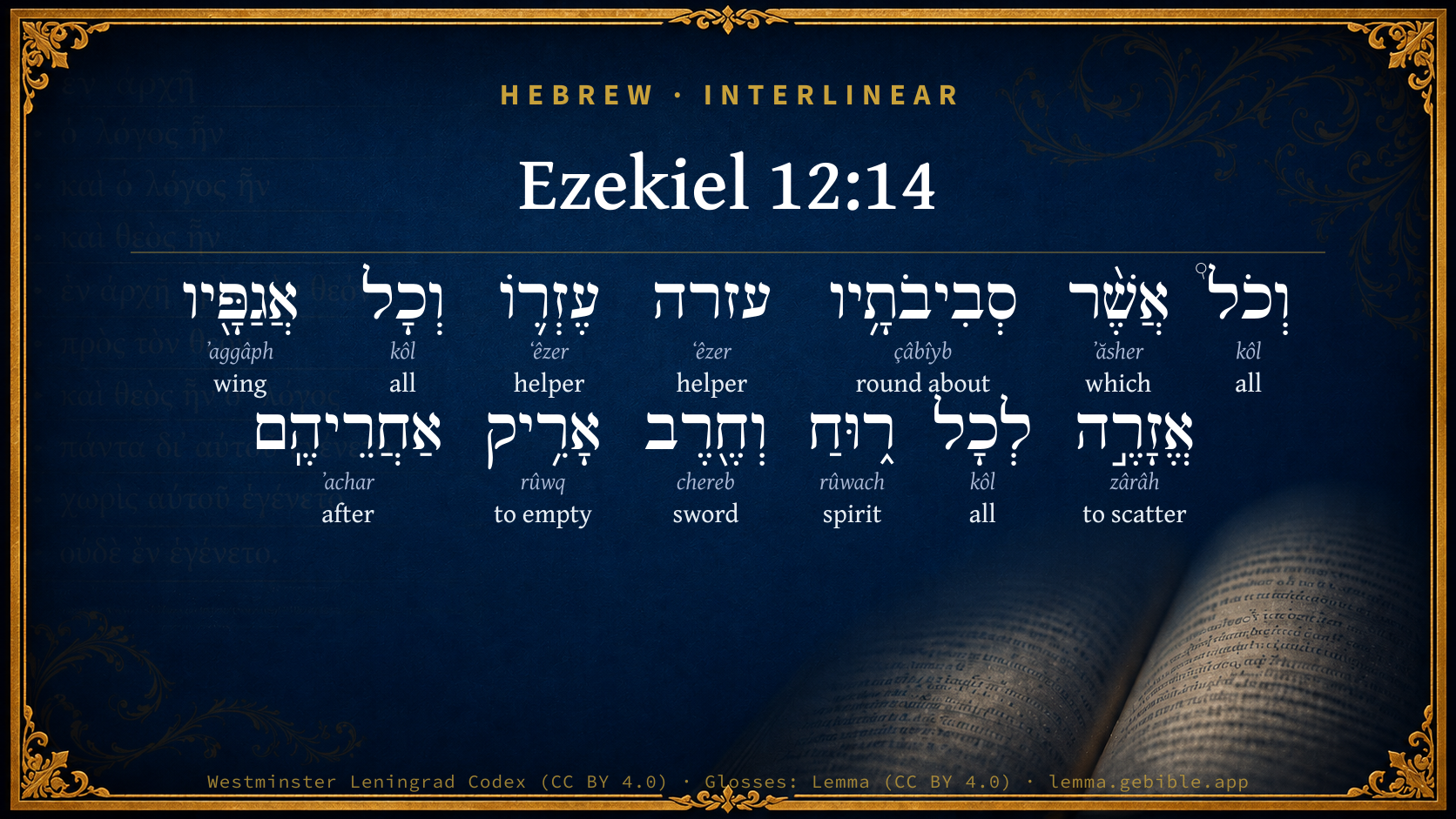
Hebrew (Westminster Leningrad Codex) Ezekiel 12:14 appears in the Hebrew Old Testament. The text above is from the Westminster Leningrad Codex. Each word links to its Strong’s number, a concise gloss, and parsing drawn from the Open Scriptures Hebrew Bible morphology. Click any word for its full Brown-Driver-Briggs (BDB) entry.
Download image
Cite this verse

Ezekiel 12:14 (World English Bible). Public Domain. Lemma interlinear Bible study tool, https://lemma.gebible.app/v/ezekiel/12/14.

Show BibTeX & RIS
BibTeX
RIS
English Translation
I will scatter toward every wind all who are round about him to help him, and all his bands; and I will draw out the sword after them.
World English Bible · Public Domain
Highlights
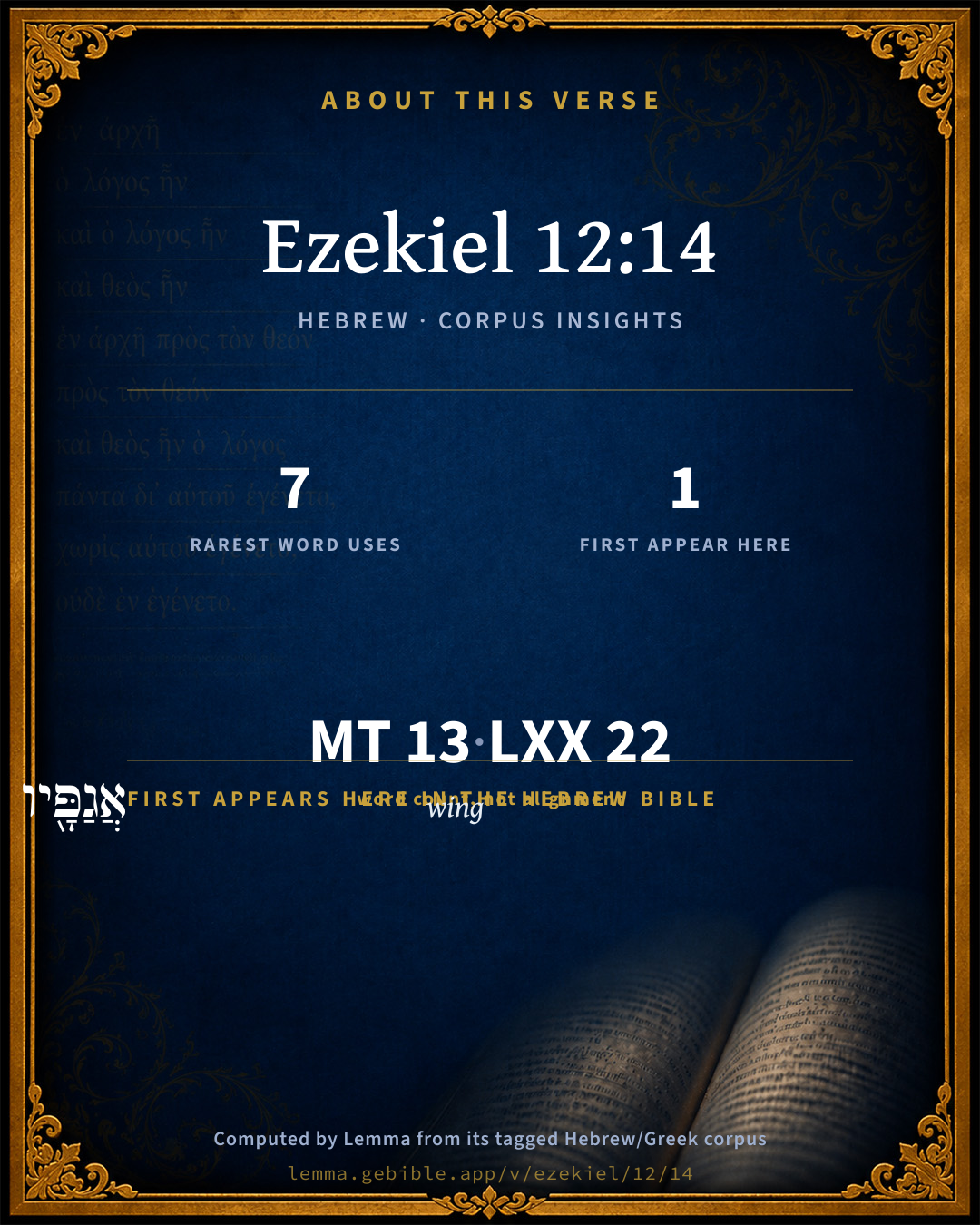
  • 1 first appearance in the Hebrew Bible
Full analysis ↓
Download a study sheet

One document with this verse’s original text, its word-by-word gloss line, the meaning frame, cross-references with their text, attributed commentary, and full source and license credits — printable, and it pastes into notes with its structure intact.

This verse Autodidact and up

Study sheet (.html) Plain text (.txt)

A passage Seminary Student

Up to 50 verses in one chapter. A passage sheet keeps up to 6 commentary sources and 12 cross-references per verse, in the order this page ranks them, and says so on the sheet whenever that leaves anything out. Ask for a single verse and you get the Autodidact verse sheet above.

Everything on this page stays free to read, with no account — the sheet is a download of what is already on screen, not access to it.

Want to remove ads? Support Godless Engineer
Compare translations 3

The same verse in 3 English versions, stacked beneath the original-language interlinear above. Click any original word for its lexicon entry.

Each is an independent rendering of the whole verse — the interlinear is not word-aligned to these translations.

Highlighted words mark where these versions differ — a whole-verse word diff, not a word-by-word alignment.

  • World English Bible Public Domain
    I will scatter toward every wind all who are round about him to help him, and all his bands; and I will draw out the sword after them.
  • King James Version Public Domain
    And I will scatter toward every wind all that are about him to help him, and all his bands; and I will draw out the sword after them.
  • unfoldingWord Literal Text CC BY-SA 4.0
    I will also scatter in every direction all of those around him who were to assist him and his entire army, and I will send out a sword after them.

unfoldingWord Literal Text — © unfoldingWord, licensed CC BY-SA 4.0. Word-aligned USFM3 via Door43 (git.door43.org/unfoldingWord/en_ult).

Versions to compare (up to 4)

3 of 4 selected

Show all 18 translations

Every available English version of this verse, each an independent rendering of the whole verse.

  • World English Bible Public Domain
    I will scatter toward every wind all who are round about him to help him, and all his bands; and I will draw out the sword after them.
  • Berean Standard Bible Public Domain
    And I will scatter to every wind all the attendants around him and all his troops, and I will draw a sword to chase after them.
  • Majority Standard Bible Public Domain
    And I will scatter to every wind all the attendants around him and all his troops, and I will draw a sword to chase after them.
  • King James Version Public Domain
    And I will scatter toward every wind all that are about him to help him, and all his bands; and I will draw out the sword after them.
  • American Standard Version (1901) Public Domain
    And I will scatter toward every wind all that are round about him to help him, and all his bands; and I will draw out the sword after them.
  • Revised Version (1885) Public Domain
    And I will scatter toward every wind all that are round about him to help him, and all his bands; and I will draw out the sword after them.
  • Geneva Bible (1599) Public Domain
    And I will scatter toward euerie winde all that are about him to helpe him, and all his garisons, and I will drawe out the sworde after them.
  • Douay-Rheims (1899) Public Domain
    And all that are about him, his guards, and his troops I will scatter into every wind: and I will draw out the sword after them.
  • Young's Literal Translation Public Domain
    `And all who are round about him to help him, and all his bands, I do scatter to every wind, and a sword I draw out after them.
  • Literal Standard Version CC BY-SA 4.0
    And all who are around him to help him, and all his bands, I scatter to every wind, and I draw out a sword after them.
  • Unlocked Literal Bible CC BY-SA 4.0
    I will also scatter in every direction all of those around him who were to assist him and his entire army, and I will send out a sword after them.
  • unfoldingWord Literal Text CC BY-SA 4.0
    I will also scatter in every direction all of those around him who were to assist him and his entire army, and I will send out a sword after them.
  • Darby Bible Public Domain
    And I will scatter toward every wind all that are about him to help him, and all his troops; and I will draw out the sword after them.
  • World Messianic Bible Public Domain
    I will scatter toward every wind all who are around him to help him, and all his bands. I will draw out the sword after them.
  • Webster's Bible Public Domain
    And I will scatter towards every wind all that are about him to help him, and all his bands; and I will draw out the sword after them.
  • Free Bible Version CC BY-SA 4.0
    I'm going to scatter all his attendants and all his troops in every direction, and I will chase after them with a drawn sword.
  • Bible in Basic English Public Domain
    And all his helpers round about him and all his armies I will send in flight to every wind; and I will let loose a sword after them.
  • JPS Tanakh (1917) Public Domain
    And I will disperse toward every wind all that are round about him to help him, and all his troops; and I will draw out the sword after them.

Literal Standard Version (2020), Covenant Press — licensed CC BY-SA 4.0. Text via the HelloAO Bible API (eBible.org). Unlocked Literal Bible (unfoldingWord) — licensed CC BY-SA 4.0. Text via the HelloAO Bible API (eBible.org). unfoldingWord Literal Text — © unfoldingWord, licensed CC BY-SA 4.0. Word-aligned USFM3 via Door43 (git.door43.org/unfoldingWord/en_ult). Free Bible Version, Dr. Jonathan Gallagher — licensed CC BY-SA 4.0. Text via the HelloAO Bible API (eBible.org).

Word by word

More ways to search: Search by grammar → Find every occurrence → Compare this word →

Practice this passage: Drill this verse → Learn its vocabulary →

אֲגַפָּ֖יו
ʼaggâph
H102
“wings · his”
Noun, Common, Masculine, Plural, Construct + Suffix, Personal, 3rd Person, Masculine, Singular
Part of Speech
Noun
Type
Common
Gender
Masculine
Number
Plural
State
Construct
Full BDB Definition

Origin: probably from H5062 (through the idea of impending)

TWOT: 21a

wing (of an army), band, army, hordes
  1. וְכֹל֩ kôl H3605 “and · all” Conjunction + Noun, Common, Masculine, Singular, Absolute
  2. אֲשֶׁ֨ר ʼăsher H834 “which” Particle, Relative
  3. סְבִיבֹתָ֥יו çâbîyb H5439 “surroundings · his” Noun, Common, Both, Plural, Construct + Suffix, Personal, 3rd Person, Masculine, Singular
  4. עזרה ʻêzer H5828 “helper · her” Noun, Common, Masculine, Singular, Construct + Suffix, Personal, 3rd Person, Feminine, Singular
  5. עֶזְר֛וֹ ʻêzer H5828 “helper · his” Noun, Common, Masculine, Singular, Construct + Suffix, Personal, 3rd Person, Masculine, Singular
  6. וְכָל kôl H3605 “and · all of” Conjunction + Noun, Common, Masculine, Singular, Construct
  7. אֱזָרֶ֣ה zârâh H2219 “to scatter” Verb, Piel, Imperfect, 1st Person, Common, Singular
  8. לְכָל kôl H3605 “to/for · all of” Preposition + Noun, Common, Masculine, Singular, Construct
  9. ר֑וּחַ rûwach H7307 “spirit” Noun, Common, Both, Singular, Absolute
  10. וְחֶ֖רֶב chereb H2719 “and · sword” Conjunction + Noun, Common, Feminine, Singular, Absolute
  11. אָרִ֥יק rûwq H7324 “to empty” Verb, Hiphil, Imperfect, 1st Person, Common, Singular
  12. אַחֲרֵיהֶֽם ʼachar H310 “after · them” Preposition + Suffix, Personal, 3rd Person, Masculine, Plural

About this verse

These counts appear in no published source. They are computed here, from the morphology-tagged text and Lemma’s own curated glosses. What Lemma adds →

13
words
10
distinct lemmas
Prophets
section

Notable vocabulary

The rarest word here is אֲגַפָּ֖יו wing H102 — appearing just 7 times in the whole Hebrew Bible.

First appearance in Scripture

This word makes its first canonical appearance in the Hebrew Bible here:

  • אֲגַפָּ֖יו wing H102

Shared distinctive vocabulary

אֲגַפָּ֖יו wing H102 occurs in 6 verses of the Hebrew Bible. Also found in:

Grammatical profile

  • 2 verbs
  • 9 nouns
  • 1 preposition
  • 1 particle

Verb forms

  • אֱזָרֶ֣ה Piel · Imperfect
  • אָרִ֥יק Hiphil · Imperfect

Repetition

Words recur within this verse — often emphatic in Hebrew:

  • וְכֹל֩ all H3605 ×3
  • עזרה helper H5828 ×2

Hebrew & Septuagint length

In English translation the verse runs 28 words from the Hebrew and 27 from the Septuagint (LXX English) — closely comparable.

A rough comparison of the two English renderings, which tokenize alike — not a word-level alignment.

Word counts can differ between the Hebrew and the Greek without any difference in meaning — e.g. the Hebrew direct-object marker אֵת has no separate Greek word, and Greek often adds the article ὁ.

In the original languages it is 13 Hebrew tokens and 22 Greek tokens — but the two are counted differently (Hebrew bundles its prefixes and suffixes into one token; the Greek is in lemma form), so that isn’t a like-for-like length.

Cross-references

9

Topical passages linked to Ezekiel 12:14 in the Treasury of Scripture Knowledge — connected by theme and wording, ordered by reader-vote popularity; previews shown in the World English Bible.

  • Ezekiel 5:2 A third part shall you burn in the fire in the midst of the city, when the days of the siege are fulfilled; and you shall take a third part, and strike with the sword round about it; and a third part you shall scatter to the wind, and I will draw out a sword after them.
  • 2 Kings 25:4–5 Then a breach was made in the city, and all the men of war [fled] by night by the way of the gate between the two walls, which was by the king's garden (now the Chaldeans were against the city round about); and [the king] went by the way of the Arabah.
  • Ezekiel 17:21 All his fugitives in all his bands shall fall by the sword, and those who remain shall be scattered toward every wind: and you shall know that I, Yahweh, have spoken it.
  • Leviticus 26:33 I will scatter you among the nations, and I will draw out the sword after you: and your land will be a desolation, and your cities shall be a waste.
  • Jeremiah 42:16 then it shall happen, that the sword, which you fear, shall overtake you there in the land of Egypt; and the famine, about which you are afraid, shall follow hard after you there in Egypt; and there you shall die.
  • Jeremiah 42:22 Now therefore know certainly that you shall die by the sword, by the famine, and by the pestilence, in the place where you desire to go to sojourn there.
  • Ezekiel 5:10–12 Therefore the fathers shall eat the sons in the midst of you, and the sons shall eat their fathers; and I will execute judgments on you; and the whole remnant of you will I scatter to all the winds.
  • Ezekiel 14:17 Or if I bring a sword on that land, and say, Sword, go through the land; so that I cut off from it man and animal;
  • Ezekiel 14:21 For thus says the Lord Yahweh: How much more when I send my four sore judgments on Jerusalem, the sword, and the famine, and the evil animals, and the pestilence, to cut off from it man and animal!

Cross-references courtesy of OpenBible.info (CC BY 4.0).

Hebrew and Greek witnesses Masoretic Hebrew ↔ Greek Septuagint

The same verse in the two great witnesses to the Old Testament, shown verse-for-verse.

These are two independent witnesses, not word-aligned to each other, and the Septuagint is shown in lemma (dictionary) form.

Hebrew Ezekiel 12:14 Masoretic · Westminster Leningrad Codex

וְכֹל֩ אֲשֶׁ֨ר סְבִיבֹתָ֥יו עזרה עֶזְר֛וֹ וְכָל אֲגַפָּ֖יו אֱזָרֶ֣ה לְכָל ר֑וּחַ וְחֶ֖רֶב אָרִ֥יק אַחֲרֵיהֶֽם

I will scatter toward every wind all who are round about him to help him, and all his bands; and I will draw out the sword after them.

World English Bible · Public Domain

Greek LXX Ezekiel 12:14 Septuagint · lemma form

καί πᾶς ὁ κύκλος αὐτός ὁ βοηθός αὐτός καί πᾶς ὁ ἀντιλαμβάνω αὐτός διασπείρω εἰς πᾶς ἄνεμος καί ῥομφαία ἐκκενόω ὀπίσω αὐτός

And I will scatter to every wind all his assistants round about him, and all that help him; and I will draw out a sword after them;

LXX2012 (modern English Septuagint) · Public Domain

Hebrew: Westminster Leningrad Codex (CC BY 4.0). Greek: Septuagint (public domain); English from LXX2012 (modern English Septuagint) (Public Domain). How the Septuagint differs from the Hebrew →

Targum (Aramaic paraphrase)

1

The Targum is the ancient Jewish Aramaic paraphrase of the Hebrew Scriptures — an interpretive translation, not the Hebrew text itself. Onkelos (literal) and Pseudo-Jonathan (expansive) render the Torah, and Jonathan the Prophets. Coverage is partial: where no permissively-licensed English translation exists for a verse, only the Aramaic is shown. This is verse-level text, not a word-by-word alignment to the Hebrew.

  1. Targum Jonathan Prophets (Joshua–Malachi)
    וְכֹל דִי בְּסָחֳרָנוֹהִי סַעֲדוֹהִי וְכָל מַשִׁרְיָתֵיהּ אֲבַדֵר לְכָל רוּחָא וּדְקַטְלִין בְּחַרְבָּא אֲגָרֵי בַתְרֵיהוֹן:

    (no public-domain English translation for this verse)

    Targum Jonathan — Aramaic: “Mikraot Gedolot” (public domain). English: “Sefaria Community Translation” (CC0 1.0 (public-domain dedication)); “London "Chaldee Paraphrase," 1871” (public domain). Text via Sefaria.

Commentary

Notes on Ezekiel 12:14 from classic Christian and Jewish commentators (each source and its license shown beneath its notes). The classic Christian expositions comment on the surrounding passage and are grouped to its opening verse, so a note may address several verses; the Jewish commentaries on the Tanakh (Rashi and others) are per-verse, so they appear only where the commentator wrote on this verse.

Lemma curates 59 commentaries, every one of them public domain or Creative Commons licensed, each selected and text-cleaned for this edition rather than reprinted as found. About our sources →

Trapp's Complete Commentary

John Trapp

Eze 12:14 And I will scatter toward every wind all that [are] about him to help him, and all his bands; and I will draw out the sword after them.

Ver. 14. And I will scatter toward every wind.] His bodyguard, σοματοφυλακες. Esquires of his body, auxiliaries. I will put him into a helpless condition. {Psa 146:3} If the Lord do not help thee, whence shall I help thee? said that king to her that cried to him for help. {2Ki 6:27}

John Trapp, A Commentary or Exposition upon All the Books of the Old and New Testament (1647–1656) — public domain. Text from a community e-Sword module.

Jamieson, Fausset & Brown

Robert Jamieson, A. R. Fausset & David Brown

all . . . about him--his satellites: his bodyguard.

bands--literally, "the wings" of an army (Isa 8:8).

draw out . . . sword after them--(See on Eze 5:2; Eze 5:12).

Jamieson, Fausset & Brown — Commentary Critical and Explanatory on the Whole Bible (1871) — public domain (CC PDM 1.0). Text via the HelloAO Bible API.

John Calvin's Commentaries

He confirms the verse above, and says, that although Zedekiah had many soldiers as a garrison, and accustomed the people to bear arms, yet all this would not profit him, since God would disperse all the guards in whom he trusted. He says then, that he would scatter to every wind all who were around Zedekiah For unbelievers were deceived when they saw the king surrounded by auxiliaries, and the people of the city trained to warfare: and since Zedekiah was so armed for the defense of the city, they thought it could never be taken by the Chaldeans. God, therefore, here first of all teaches that the war was carried on under his auspices, and then that there was no doubt of his taking the city. He does not speak of the Chaldeans, lest unbelievers should institute a comparison — “it is true indeed that the Chaldeans are besieging the city with a strong and numerous army, but the city is impregnable, and besides it is defended with great spirit, and the king has forces sufficiently strong for his defense.” Lest this opinion should foolishly deceive the disbelievers, God comes into the field and turns their attention away from the Chaldeans. For this reason he ascribes to himself the conduct of the enemy: hence we gather that profane nations are in God’s hands, since he not only governs them by the spirit of regeneration, but compels even the impious, who desire to abolish his authority, to obey his commands. God does not draw his sword from heaven, nor do angels openly appear with drawn swords; the Chaldeans do that; but as it is said in Isaiah, (Isaiah 10:15,) Shall the ax boast itself against its owner? Since thus the vigor of the Chaldeans was nothing in itself, God armed them and then afforded them the success which he wished. It follows —

John Calvin's Commentaries (1540-1563) — public domain. Text from the Calvin Translation Society English edition (1840s-50s) via the Christian Classics Ethereal Library (ccel.org). Calvin's coverage is partial (roughly two-thirds of the Bible); uncommented books and verses are honest gaps, never fabricated. The 19th-century editor's footnotes and remarks are omitted so the notes are faithfully Calvin's own voice.

Ellicott's Commentary for English Readers

(14) I will scatter toward every wind.—The people of Judah were not carried captive to Babylon only, but many of them were scattered wherever they could find refuge; and, finally, the remnant left in the land by Nebuchadnezzar, after the murder of his governor Gedaliah, escaped into Egypt (Jeremiah 41-43).

A Bible Commentary for English Readers, edited by Charles John Ellicott (1878–1897) — public domain. Text from a community e-Sword module.

The Cambridge Bible for Schools and Colleges

gen. ed. J. J. S. Perowne

14–16. All the armies and aids of the king shall be dispersed and pursued with the sword. They shall be scattered among the nations, and their history shall bring to their knowledge what Jehovah, their God, truly is. A remnant of them shall be spared among the nations that they make known to them their abominations, and these also shall learn what the God of Israel is. Jerusalem and Israel is set in the midst of the nations round about (ch. Eze_5:5), its history is a drama enacted before the eyes of mankind, and the drama when finished will reveal, not only to Israel but the nations of the world, Jehovah in his fulness. Cf. ch. Eze_14:22-23, Eze_17:24, Eze_20:9, Eze_38:23, Eze_39:23; Isa_5:16; Jer_22:8.

The Cambridge Bible for Schools and Colleges (gen. ed. J. J. S. Perowne; Cambridge University Press, 1878–1918) — public domain. Text from a community e-Sword module.

John Gill's Exposition

But I will leave a few men of them,.... Or, "men of number" (x); of a small number, such as are easily reckoned up; which will require no great skill in numbers, nor trouble to count them:

from the sword, from the famine, and from the pestilence; during the siege of Jerusalem, and at the breaking of it up; but then they should be carried captive into other countries:

that they may declare all their abominations among the Heathen whither they come; who, observing their calamities, and distresses, would read their sin in their punishment; and conclude they must have been guilty of great enormities, who were punished in such a manner; so that their punishment was a visible and standing declaration to the Heathens of the abominable sins they had been guilty of: or else the end of reserving a few of them from the above capital judgments was, that they being brought to a sense of their sins by their afflictions, might freely confess them, express their repentance for them, and justify God in his proceedings towards them:

and they shall know that I am the Lord; not the Heathens, among whom this declaration would be made; but the Jews, brought under a conviction of their sin, and of the justice of God in his dealings with them.

(x) "viros numeri", Montanus, Vatablus; "homines numero", Starckius.

John Gill's Exposition of the Whole Bible (1746–1763) — public domain (CC PDM 1.0). Text via the HelloAO Bible API.

Haydock's Catholic Bible Commentary

Them. Many joined Godolias, chap. v. 2. (Haydock)

George Leo Haydock (1774–1849), Haydock's Catholic Family Bible and Commentary, 1859 edition — public domain. Excludes Psalms (Douay-Rheims chapter numbering differs from Protestant) and Deuterocanonical books (Catholic canon only).

Matthew Poole's English Annotations

All that are about him; either the Egyptians who came to help him; or rather, those that did flee with him, as the choice and flower of his valiant and trusty servants, who would guard him through all dangers in the flight, till he might rest some where in safety. This was verified, 2Ki 25:4,5; Jer 39:5.

All his bands; whether auxiliaries or his own trained soldiers.

Draw out the sword after them; send the enemy after them with drawn swords, wherewith they shall be slain, Jer 42:22; 43:10,11.

Matthew Poole's English Annotations on the Holy Bible (1683–1685) — public domain. Text from a community e-Sword/MySword module.

Whedon's Commentary on the Bible

Daniel D. Whedon

14, 15. See notes Eze_5:1-13. To Ezekiel Jehovah (Lord) was the equivalent of justice and holiness; and when he said, “They shall know Jehovah,” he meant that the divine justice and holiness would then be demonstrated.

Daniel D. Whedon (gen. ed.), Commentary on the Old and New Testaments (1874–1909) — public domain. Text from a community e-Sword module.

The Pulpit Commentary

Vers. 14, 15. And I will scatter. The capture of the king would naturally be followed by the dispersion of his adherents, some of whom would fall by the sword, while a few (Hebrew, men of number, i.e. easily counted) would escape to some neighbouring country, where they might hope to find a refuge. There they would have to tell their tale of shame, and to let the heathen know that Jehovah was thus punishing their abominations. (comp. Eze_14:22, Eze_14:23) The prophecy ends with the familiar formula, They shall knew that I am the Lord.

The Pulpit Commentary (1880–1919), ed. H.D.M. Spence-Jones & Joseph S. Exell — public domain. Text from a community e-Sword module.

unfoldingWord translationNotes

Door43 World Missions Community

I will send out a sword after them

The word "sword" is a metonym for enemy armies who will attack with their swords. AT: "I will send armies to pursue them with swords" (See: Metonymy)

know that I am Yahweh

When Yahweh says that people will know that he is Yahweh, he is implying that they will know that he is the one true God who has supreme authority and power. See how you translated this in Ezekiel 6:7. AT: "understand that I am Yahweh, the one true God" or "realize that I, Yahweh, have supreme power and authority" (See: Assumed Knowledge and Implicit Information)

when I scatter them among the nations and disperse them throughout the lands

These two phrases mean basically the same thing. AT: "when I cause them to separate from each other and live in different nations" (See: Parallelism)

I will spare ... from the sword, famine, and plague

The word "sword" is a metonym for soldiers who kill people using swords. You may need to make explicit that they will not die from famine or plague. AT: "I will keep ... from dying in battle, from starving to death, and from dying of disease" (See: Metonymy and Assumed Knowledge and Implicit Information)

translationWords

sword

Yahweh

nation

disperse

famine

plague

abomination

know

unfoldingWord translationNotes — © Distant Shores Media and the Door43 World Missions Community, licensed CC BY-SA 4.0. Source: git.door43.org/Door43/en_tn.

Rashi

Rabbi Shlomo Yitzchaki (Rashi)

and all his officers Heb. אֲגַפָּיו, his officers, and Menachem (p. 15) interpreted it as an expression of wings (גף).

I will scatter to every direction Heb. אֱזָרֶה, epandre in Old French, to disperse, and they are Johanan the son of Kareah and the officers of the armies, who were exiled to Egypt, where the sword of Nebuchadnezzar overtook them when he destroyed Egypt.

Rashi on the Tanakh — English translations: “The Judaica Press complete Tanach with Rashi, translated by A. J. Rosenberg” (CC BY 4.0); “Pentateuch with Rashi's commentary by M. Rosenbaum and A.M. Silbermann, 1929-1934” (public domain); “The Metsudah Tanach series, Lakewood, N.J” (CC BY 4.0); and “The Book of Joshua, Metsudah Publications, 1997” (CC BY 4.0). Text via Sefaria.

Lesson kit

Teaching starters — assembled from the data on this page, not authored interpretation. Every prompt links to the verse data it draws on. Edit before teaching.

Ezekiel, in the Prophets, opens this verse with 13 words (10 distinct Hebrew lemmas). Its most distinctive word is ʼaggâph (“wing”). A historical commentator’s framing appears above. Read the whole chapter for the surrounding context.

Discussion questions

  1. The word ʼaggâph carries the sense “wing.” How does it shape the verse?
  2. This is the first place “wing” appears in Scripture (first appears here). What does its debut here establish?
  3. How does Ezekiel 17:21, which shares the word «wing», read alongside this verse?
  4. What does the repetition of “all” (3× in this one verse) do in this verse?
  5. These translations render this verse differently. What is at stake in choosing one wording over another?
  6. «אֱזָרֶ֣ה» is a Piel Imperfect verb. How does that grammatical form shape the action described?
  7. Compare how Trapp's Complete Commentary and Jamieson, Fausset & Brown read this verse. Where do they agree or differ?

Things to notice

Reading settings

Reading text

Shown beneath each verse's original-language words.

Old Testament
Old Testament edition

Read the OT as the Masoretic Hebrew (MT) or the Greek Septuagint (LXX).

English shown for the Greek Septuagint (in the Hebrew ↔ Greek comparison).

Comparing translations? Open the Compare panel on any verse page to stack up to four side by side.