
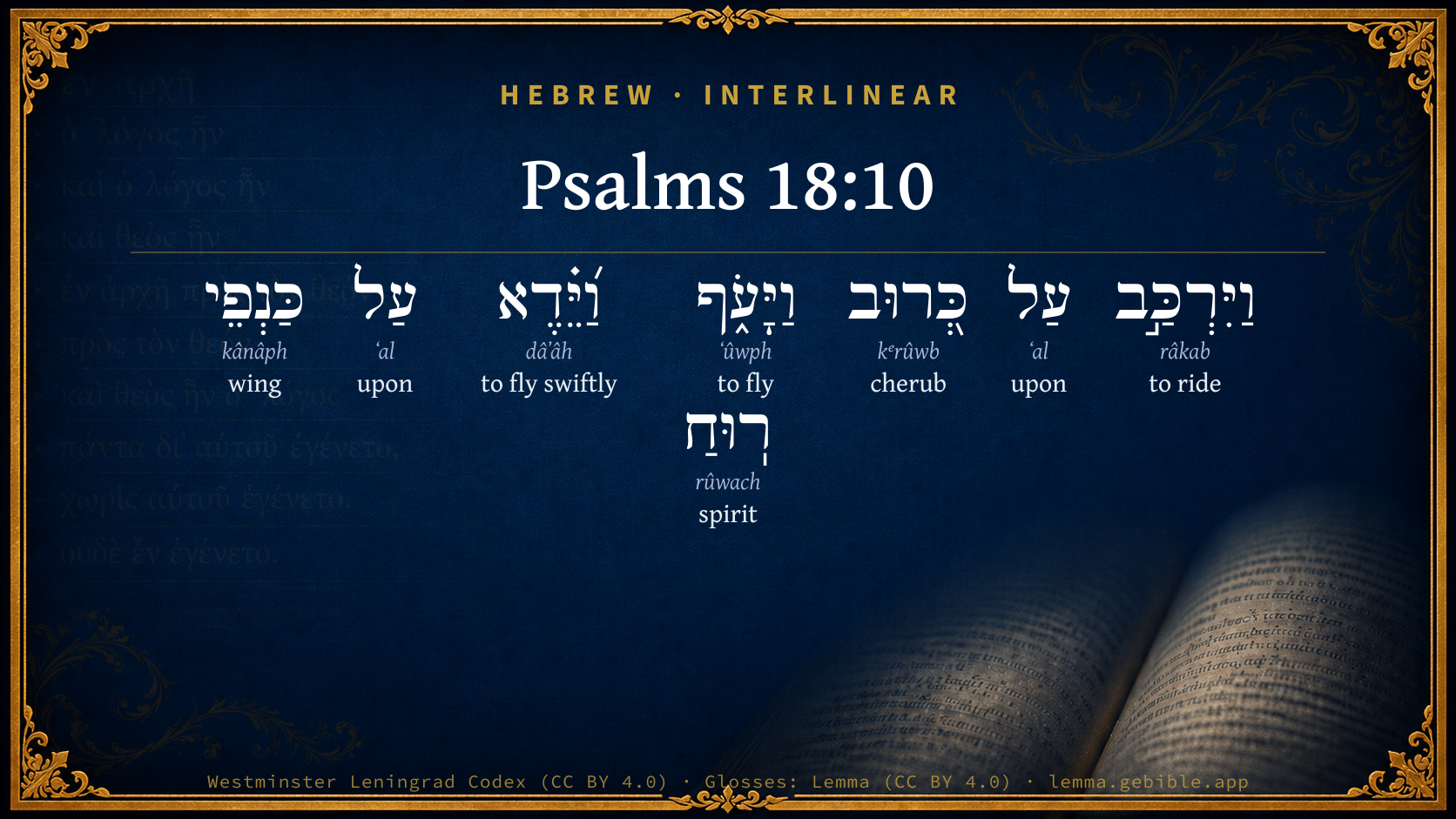
Psalms 18:10

Hebrew (Westminster Leningrad Codex) Psalms 18:10 appears in the Hebrew Old Testament. The text above is from the Westminster Leningrad Codex. Each word links to its Strong’s number, a concise gloss, and parsing drawn from the Open Scriptures Hebrew Bible morphology. Click any word for its full Brown-Driver-Briggs (BDB) entry.
Download image
Cite this verse

Psalms 18:10 (World English Bible). Public Domain. Lemma interlinear Bible study tool, https://lemma.gebible.app/v/psalms/18/10.

Show BibTeX & RIS
BibTeX
RIS
English Translation
He rode on a cherub, and flew. Yes, he soared on the wings of the wind.
World English Bible · Public Domain
Download a study sheet

One document with this verse’s original text, its word-by-word gloss line, the meaning frame, cross-references with their text, attributed commentary, and full source and license credits — printable, and it pastes into notes with its structure intact.

This verse Autodidact and up

Study sheet (.html) Plain text (.txt)

A passage Seminary Student

Up to 50 verses in one chapter. A passage sheet keeps up to 6 commentary sources and 12 cross-references per verse, in the order this page ranks them, and says so on the sheet whenever that leaves anything out. Ask for a single verse and you get the Autodidact verse sheet above.

Everything on this page stays free to read, with no account — the sheet is a download of what is already on screen, not access to it.

Want to remove ads? Support Godless Engineer
Compare translations 3

The same verse in 3 English versions, stacked beneath the original-language interlinear above. Click any original word for its lexicon entry.

Each is an independent rendering of the whole verse — the interlinear is not word-aligned to these translations.

Highlighted words mark where these versions differ — a whole-verse word diff, not a word-by-word alignment.

  • World English Bible Public Domain
    He rode on a cherub, and flew. Yes, he soared on the wings of the wind.
  • King James Version Public Domain
    And he rode upon a cherub, and did fly: yea, he did fly upon the wings of the wind.
  • unfoldingWord Literal Text CC BY-SA 4.0
    And he rode on a cherub, and he flew, and he flew swiftly on the wings of the wind.

unfoldingWord Literal Text — © unfoldingWord, licensed CC BY-SA 4.0. Word-aligned USFM3 via Door43 (git.door43.org/unfoldingWord/en_ult).

Versions to compare (up to 4)

3 of 4 selected

Show all 18 translations

Every available English version of this verse, each an independent rendering of the whole verse.

  • World English Bible Public Domain
    He rode on a cherub, and flew. Yes, he soared on the wings of the wind.
  • Berean Standard Bible Public Domain
    He mounted a cherub and flew; He soared on the wings of the wind.
  • Majority Standard Bible Public Domain
    He mounted a cherub and flew; He soared on the wings of the wind.
  • King James Version Public Domain
    And he rode upon a cherub, and did fly: yea, he did fly upon the wings of the wind.
  • American Standard Version (1901) Public Domain
    And he rode upon a cherub, and did fly; Yea, he soared upon the wings of the wind.
  • Revised Version (1885) Public Domain
    And he rode upon a cherub, and did fly, yea, he flew swiftly upon the wings of the wind.
  • Geneva Bible (1599) Public Domain
    And he rode vpon Cherub and did flie, and he came flying vpon the wings of the winde.
  • Douay-Rheims (1899) Public Domain
    He bowed the heavens, and came down: and darkness was under his feet.
  • Young's Literal Translation Public Domain
    And He rideth on a cherub, and doth fly, And He flieth on wings of wind.
  • Literal Standard Version CC BY-SA 4.0
    And He rides on a cherub, and flies, || And He flies on wings of wind.
  • Unlocked Literal Bible CC BY-SA 4.0
    He rode on a cherub and flew; he glided on the wings of the wind.
  • unfoldingWord Literal Text CC BY-SA 4.0
    And he rode on a cherub, and he flew, and he flew swiftly on the wings of the wind.
  • Darby Bible Public Domain
    And he rode upon a cherub and did fly; yea, he flew fast upon the wings of the wind.
  • World Messianic Bible Public Domain
    He rode on a cherub, and flew. Yes, he soared on the wings of the wind.
  • Webster's Bible Public Domain
    \\18:9\\He bowed the heavens also, and came down: and darkness was under his feet.
  • Free Bible Version CC BY-SA 4.0
    Riding on an angel he flew, swooping on the wings of the wind.
  • Bible in Basic English Public Domain
    And he went in flight through the air, seated on a storm-cloud: going quickly on the wings of the wind.
  • JPS Tanakh (1917) Public Domain
    (18-11) And He rode upon a cherub, and did fly; yea, He did swoop down upon the wings of the wind.

Literal Standard Version (2020), Covenant Press — licensed CC BY-SA 4.0. Text via the HelloAO Bible API (eBible.org). Unlocked Literal Bible (unfoldingWord) — licensed CC BY-SA 4.0. Text via the HelloAO Bible API (eBible.org). unfoldingWord Literal Text — © unfoldingWord, licensed CC BY-SA 4.0. Word-aligned USFM3 via Door43 (git.door43.org/unfoldingWord/en_ult). Free Bible Version, Dr. Jonathan Gallagher — licensed CC BY-SA 4.0. Text via the HelloAO Bible API (eBible.org).

Word by word

More ways to search: Search by grammar → Find every occurrence → Compare this word →

Practice this passage: Drill this verse → Learn its vocabulary →

About this verse

These counts appear in no published source. They are computed here, from the morphology-tagged text and Lemma’s own curated glosses. What Lemma adds →

8
words
7
distinct lemmas
Wisdom
section

Notable vocabulary

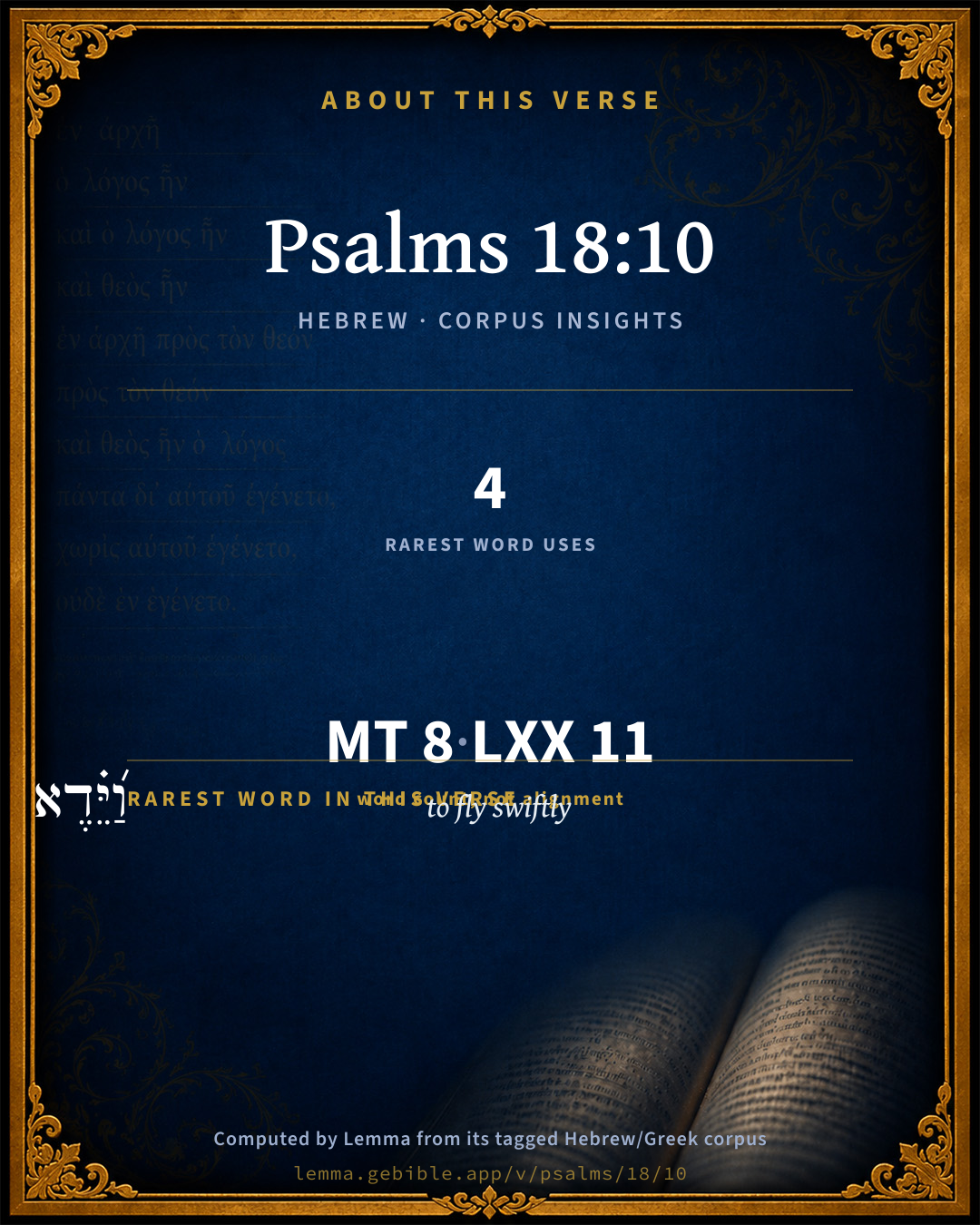
The rarest word here is וַ֝יֵּ֗דֶא to fly swiftly H1675 — appearing just 4 times in the whole Hebrew Bible.

Shared distinctive vocabulary

וַ֝יֵּ֗דֶא to fly swiftly H1675 occurs in 4 verses of the Hebrew Bible. Also found in:

Grammatical profile

  • 3 verbs
  • 3 nouns
  • 2 prepositions

Verb forms

  • וַיִּרְכַּ֣ב Qal · Sequential Imperfect
  • וַיָּעֹ֑ף Qal · Sequential Imperfect
  • וַ֝יֵּ֗דֶא Qal · Sequential Imperfect

Repetition

A word recurs within this verse — often emphatic in Hebrew:

Hebrew & Septuagint length

In English translation the verse runs 16 words from the Hebrew and 14 from the Septuagint (LXX English) — closely comparable.

A rough comparison of the two English renderings, which tokenize alike — not a word-level alignment.

Word counts can differ between the Hebrew and the Greek without any difference in meaning — e.g. the Hebrew direct-object marker אֵת has no separate Greek word, and Greek often adds the article ὁ.

In the original languages it is 8 Hebrew tokens and 11 Greek tokens — but the two are counted differently (Hebrew bundles its prefixes and suffixes into one token; the Greek is in lemma form), so that isn’t a like-for-like length.

Cross-references

6

Topical passages linked to Psalms 18:10 in the Treasury of Scripture Knowledge — connected by theme and wording, ordered by reader-vote popularity; previews shown in the World English Bible.

  • Psalms 104:3 He lays the beams of his chambers in the waters. He makes the clouds his chariot. He walks on the wings of the wind.
  • 2 Samuel 22:11–12 He rode on a cherub, and did fly; Yes, he was seen on the wings of the wind.
  • Psalms 99:1 Yahweh reigns! Let the peoples tremble. He sits enthroned among the cherubim. Let the earth be moved.
  • Psalms 80:1 Hear us, Shepherd of Israel, You who lead Joseph like a flock, You who sit above the cherubim, shine forth.
  • Ezekiel 1:5–14 Out of the midst of it came the likeness of four living creatures. This was their appearance: they had the likeness of a man.
  • Ezekiel 10:20–22 This is the living creature that I saw under the God of Israel by the river Chebar; and I knew that they were cherubim.

Cross-references courtesy of OpenBible.info (CC BY 4.0).

Hebrew and Greek witnesses Masoretic Hebrew ↔ Greek Septuagint

The same verse in the two great witnesses to the Old Testament, shown verse-for-verse.

You’re reading Greek Psalm 17 (Hebrew Psalm 18). The Septuagint counts the superscription, so verse numbers can differ from the Hebrew — chapter-level alignment, not verse-by-verse. Numbering follows Rahlfs.

These are two independent witnesses, not word-aligned to each other, and the Septuagint is shown in lemma (dictionary) form.

Hebrew Psalms 18:10 Masoretic · Westminster Leningrad Codex

וַיִּרְכַּ֣ב עַל כְּ֭רוּב וַיָּעֹ֑ף וַ֝יֵּ֗דֶא עַל כַּנְפֵי רֽוּחַ

He rode on a cherub, and flew. Yes, he soared on the wings of the wind.

World English Bible · Public Domain

Greek LXX Greek Psalm 17:10 Septuagint · lemma form

καί κλίνω οὐρανός καί καταβαίνω καί γνόφος ὑπό ὁ πούς αὐτός

And he mounted on cherubs and flew: he flew on the wings of winds.

LXX2012 (modern English Septuagint) · Public Domain

Hebrew: Westminster Leningrad Codex (CC BY 4.0). Greek: Septuagint (public domain); English from LXX2012 (modern English Septuagint) (Public Domain). How the Septuagint differs from the Hebrew →

Commentary

Notes on Psalms 18:10 from classic Christian and Jewish commentators (each source and its license shown beneath its notes). The classic Christian expositions comment on the surrounding passage and are grouped to its opening verse, so a note may address several verses; the Jewish commentaries on the Tanakh (Rashi and others) are per-verse, so they appear only where the commentator wrote on this verse.

Lemma curates 59 commentaries, every one of them public domain or Creative Commons licensed, each selected and text-cleaned for this edition rather than reprinted as found. About our sources →

Trapp's Complete Commentary

John Trapp

Psa 18:10 And he rode upon a cherub, and did fly: yea, he did fly upon the wings of the wind.

Ver. 10. And he rode upon a cherub] Which word hath affinity with rechub, a chariot. Hereby is noted God’s swiftness in coming to succour David. He waits to be gracious, and when it is a fit season he comes leaping and skipping over the mountains of Bether or division, all lets and impediments. Gabriel came to Daniel with weariness of flight, Dan 9:21.

He did fly upon the wings of the wind] For, by the ministry of angels, God raiseth and stilleth the winds (Vatablus).

John Trapp, A Commentary or Exposition upon All the Books of the Old and New Testament (1647–1656) — public domain. Text from a community e-Sword module.

Joseph Benson's Commentary

Psa 18:10. He rode upon a cherub, and did fly — Or, upon the cherubim, upon the angels who are so called, (Gen 3:24,) and who are also termed God’s chariots, (Psa 68:17,) upon which he is said to sit and ride, which is not to be understood literally and grossly, but only figuratively, to denote God’s using the ministry of angels in raising such storms and tempests as are here described, whether they be interpreted literally or figuratively, and especially in effecting many of those great events which take place in the administration of his providence; and particularly such as manifest his immediate interposition in the extraordinary judgments by which he punishes sinful nations, or in the remarkable deliverances which he works out for his people. Yea, he did fly upon the wings of the wind — As swiftly as the wind. He came to my rescue with all speed.

Joseph Benson's Commentary on the Old and New Testaments (1811–1818) — public domain. Text from a community e-Sword module.

J. A. Alexander on Psalms

Joseph Addison Alexander

11. (Psa 18:10). And he rode on a cherub and flew, and soared on the wings of a wind. The cherubim of the Mosaic system were visible representations of the whole class of creatures superior to man. The singular form cherub seems to be used here to convey the indefinite idea of a superhuman but created being. The whole verse is a poetical description of God's intervention, as a scene presented to the senses. As earthly kings are carried by inferior animals, so the heavenly king is here described as borne through the air in his descent by beings intermediate between himself and man. The word soared, in the second clause, is used to represent a poetical term in the original borrowed from Deu 28:49. With the whole verse compare Psa 68:18 (17), and Psa 104:3.

Joseph Addison Alexander, The Psalms Translated and Explained (1850) — public domain. Text from a community e-Sword module.

Tyndale Open Study Notes

Tyndale Open Resources

18:10 a mighty angelic being (Hebrew a cherub): See study notes on 1 Chr 28:18; 2 Chr 3:10-13.

Tyndale Open Study Notes — © Tyndale Open Resources, licensed CC BY-SA 4.0. Text via the HelloAO Bible API.

Geneva Bible (1599)

Geneva Bible translators

This is described at large, Ps. 104.

Geneva Bible (1599) marginal notes — public domain. Text via Bolls.life.

Jamieson, Fausset & Brown

Robert Jamieson, A. R. Fausset & David Brown

cherub--angelic agents (compare Gen 3:24), the figures of which were placed over the ark (Sa1 4:4), representing God's dwelling; used here to enhance the majesty of the divine advent. Angels and winds may represent all rational and irrational agencies of God's providence (compare Psa 104:3-4).

did fly--Rapidity of motion adds to the grandeur of the scene.

Jamieson, Fausset & Brown — Commentary Critical and Explanatory on the Whole Bible (1871) — public domain (CC PDM 1.0). Text via the HelloAO Bible API.

Adam Clarke's Commentary

Verse 10. He rode upon a cherub, and did fly] - That is, as it is immediately explained, Yea, he did fly upon the wings of the wind. God was in the storm, and by the ministry of angels guided the course of it, and drove it on with such an impetuous force as nothing could withstand. He 'rides in the whirlwind and directs the storm.' Angels are in a peculiar sense the attendants and messengers of the Almighty, whom he employs as his ministers in effecting many of those great events which take place in the administration of his providence; and particularly such as manifest his immediate interposition in the extraordinary judgments which he inflicts for the punishment of sinful nations. See Ps 103:20; Ps 104:4. The cherub is particularly mentioned as an emblem of the Divine presence, and especially as employed in supporting and conveying the chariot of the Almighty, when he is represented as riding in his majesty through the firmament of heaven: -

-Forth rush'd with whirlwind sound

The chariot of paternal Deity;

Flashing thick flames, wheel within wheel undrawn,

Itself instinct with spirit, but convey'd

By four cherubic shapes.

Par. Lost, lib. vi.

This seems to be the image intended to be conveyed in the place before us. "He rode upon a cherub, and did fly; he flew on the wings of the wind," i.e., the cherub supported and led on the tempest, in which the Almighty rode as in his chariot. This is agreeable to the office elsewhere ascribed to the cherubim. Thus they supported the mercy-seat, which was peculiarly the throne of God under the Jewish economy. God is expressly said to "make the clouds his chariot," Ps 104:3; and to "ride upon a swift cloud," Isa 19:1: so that "riding upon a cherub," and "riding upon a swift cloud," is riding in the cloud as his chariot, supported and guided by the ministry of the cherubim. The next clause in the parallel place of Samuel is, "He was seen on the wings of the wind;" ירא yera, he was seen, being used for ידא yede, he flew, ד daleth being changed into ר resh. Either of them may be the true reading, for the MSS. are greatly divided on these places; but on the whole וירא vaiyera appears to be the better reading: "And he was seen on the wings of the wind."

As the original has been supposed by adequate judges to exhibit a fine specimen of that poetry which, in the choice of its terms, conveys both sense and sound, I will again lay it before the reader, as I have done in the parallel place, 2Sa 22:2. The words in italic Hebrew to be read from right to left.

ויעף כרוב על וירכב

vaiyaoph kerub al vayirkab

And he rode upon a cherub, and did fly!

רוח כנפי על וידא

ruach canphey al waiyede

Yea, he flew on the wings of the wind!

The word רוח ruach, in the last line, should be pronounced, not ruak, which is no Hebrew word: but as a Scottish man would pronounce it, were it written ruagh. With this observation, how astonishingly is the rushing of the wind heard in the last word of each hemistich! Sternhold and Hopkins have succeeded in their version of this place, not only beyond all they ever did, but beyond every ancient and modern poet on a similar subject: -

"On cherub and on cherubin

Full royally he rode;

And on the wings of mighty winds

Came flying all abroad."

Even the old Anglo-Scottish Psalter has not done amiss: -

And he steygh aboven cherubyn and he flow;

He flow aboven the fethers of wyndes.

Adam Clarke's Commentary on the Bible (1810–1826) — public domain. Text from a community e-Sword/MySword module.

John Calvin's Commentaries

10. He rode also upon a cherub. The Psalmist having exhibited to us a sign of the wrath of God in the clouds, and in the darkening of the air, representing him as if he breathed out smoke, “Tout ainsi que s’il jettoit une fureur par les narines.” — Fr. “As if he cast forth fury from his nostrils.”

“C’est comme s’il tendoit un voile espes entre luy et les hommes, afin de leur oster le regard de sa face.” — Fr.

John Calvin's Commentaries (1540-1563) — public domain. Text from the Calvin Translation Society English edition (1840s-50s) via the Christian Classics Ethereal Library (ccel.org). Calvin's coverage is partial (roughly two-thirds of the Bible); uncommented books and verses are honest gaps, never fabricated. The 19th-century editor's footnotes and remarks are omitted so the notes are faithfully Calvin's own voice.

Ellicott's Commentary for English Readers

(10) Cherub.—See Exo_25:19. This passage alone would show how naturally the idea of winged attendants on the Divine Being grew out of the phenomena of cloud and storm. No doubt many features of the developed conception were derived from contact with Assyrian art, but for the poetry of this passage we have only to think of those giant pinions into which cloud so often shapes itself, this clause being in close parallelism with “wings of the wind.” The variation in Samuel, “appeared” for “did fly,” is, no doubt, a transcriber’s error. For the picture we may compare Oceanus’ approach in Prometheus Vinctus:—

“On the back of the quick-winged bird I glode,

And I bridled him in

With the will of a God.”

MRS. BROWNING’S translation.

It has been, however, conjectured that for kherûb we should read rekhûb, “chariot,” as in Psa_104:3. Comp.

“And rushed forth on my chariot of wings manifold.”—ibid.

A Bible Commentary for English Readers, edited by Charles John Ellicott (1878–1897) — public domain. Text from a community e-Sword module.

The Cambridge Bible for Schools and Colleges

gen. ed. J. J. S. Perowne

10. As the Shechinah, or mystic Presence of Jehovah in the cloud of glory, rested over the cherubim which were upon the “Mercy-seat” or covering of the ark (2Sa_6:2; Psa_80:1; Heb_9:5), so here Jehovah is represented “riding upon a cherub,” as the living throne on which He traverses space.

The Cherubim appear in Scripture (a) as the guardians of Paradise (Gen_3:24): (b) as sculptured or wrought figures in the Tabernacle and Temple (Exo_25:17-22; Exo_26:1; 1Ki_6:23 ff; 1Ki_7:29; 1Ki_7:36): (c) in prophetic visions as the attendants of God (Eze_10:1 ff.; cp. Ezekiel 1; Isaiah 6; Revelation 4). The Cherubim of the Tabernacle and Temple seem to have been winged human figures, representing the angelic attendants who minister in God’s Presence: those of Ezekiel’s vision appear as composite figures (Eze_10:20-21), symbolical perhaps of all the powers of nature, which wait upon God and fulfil His Will.

yea, he did fly] R.V. yea, he flew swiftly. The Heb. word is a peculiar one, used of the swooping of birds of prey (Deu_28:49; Jer_48:40; Jer_49:22). The reading “yea, he was seen” in 2 Sam. is an obvious corruption. The consonants of the two words are so nearly alike (וירא—וידא), that the rarer word would easily be altered into the more common one. For “the wings of the wind” cp. Psa_104:3.

The Cambridge Bible for Schools and Colleges (gen. ed. J. J. S. Perowne; Cambridge University Press, 1878–1918) — public domain. Text from a community e-Sword module.

John Gill's Exposition

He made darkness his secret place,.... Which, and the dark waters in the next clause, are the same with the thick clouds in the last, in which Jehovah is represented as wrapping himself, and in which he lies hid as in a secret place; not so as that he cannot see others, as wicked men imagine, Job 22:13; but as that he cannot be beheld by others; the Targum interprets it,

"he caused his Shechinah to dwell in darkness;''

his pavilion round about him were dark waters, and thick clouds of the skies; these were as a tent or tabernacle, in which he dwelt unseen by men; see Job 36:29; all this may design the dark dispensation of the Jews, after their rejection and crucifixion of Christ; when God departed from them, left their house desolate, and them without his presence and protection; when the light of the Gospel was taken away from them, and blindness happened unto them, and they had eyes that they should not see, and were given up to a judicial darkness of mind and hardness of heart; which were some of the dark, deep, and mysterious methods of divine Providence, with respect to which God may be said to be surrounded with darkness, dark waters, and thick clouds; see Rom 11:7.

John Gill's Exposition of the Whole Bible (1746–1763) — public domain (CC PDM 1.0). Text via the HelloAO Bible API.

Albert Barnes' Notes on the Bible

And he rode upon a cherub - Compare Isa 14:13, note; Isa 37:16, note. The cherub in the theology of the Hebrews was a figurative representation of power and majesty, under the image of a being of a high and celestial nature, “whose form is represented as composed from the figures of a man, ox, lion, and eagle,” Ezek. 1; 10. Cherubs are first mentioned as guarding the gates of Paradise, Gen 3:24; then as bearing the throne of God upon their wings through the clouds, Ezek. 1; 10; and also as statues or images made of wood and overlaid with gold, over the cover of the ark, in the inner sanctuary of the tabernacle, and of the temple, Exo 25:18 ff; 1Ki 6:23-28. Between the two cherubim in the temple, the Shechinah, or visible symbol of the presence of God, rested; and hence, God is represented as “dwelling between the cherubim,” Exo 25:22; Num 7:89; Psa 80:1; Psa 99:1. The cherubim are not to be regarded as real existences, or as an order of angels like the seraphim Isa 6:2-3, but as an imaginary representation of majesty, as emblematic of the power and glory of God. Here God is represented as “riding on a cherub;” that is, as coming forth on the clouds regarded as a cherub (compare Ezek. 1), as if, seated on his throne, he was borne along in majesty and power amidst the storm and tempest.

And did fly - He seemed to move rapidly on the flying clouds.

Yea, he did fly upon the wings of the wind - Rapidly as the clouds driven along by the wind. The “wings of the wind” are designed to represent the rapidity with which the wind sweeps along. Rapid motion is represented by the flight of birds; hence, the term wings is applied to winds to denote the rapidity of their movement. The whole figure here is designed to represent; the majesty with which God seemed to be borne along on the tempest. Herder renders it, “He flew on the wings of the storm.”

Albert Barnes' Notes on the Bible (1834–1885) — public domain. Text from a community e-Sword/MySword module.

Matthew Poole's English Annotations

Upon a cherub; or, upon the cherubims, by an enallage of number; that is, upon the angels, who are so called, Gen 3:24; Heb 9:5, who are also called God’s chariots, Psa 68:17, upon which he is said to sit and ride; all which is not to be understood grossly, but only to note God’s using of the ministry of angels in raising such storms and tempests as are here described.

Upon the wings of the wind; as swiftly as the wind. He came to my rescue with all speed.

Matthew Poole's English Annotations on the Holy Bible (1683–1685) — public domain. Text from a community e-Sword/MySword module.

The Treasury of David

Charles H. Spurgeon

Ver. 10. There is inimitable grandeur in this verse. Under the Mosaic system the cherubim are frequently represented as the chariot of God; hence Milton, in "Paradise Lost, "writes of the Great Father,

"He on the wings of cherubim Uplifted, in paternal glory rode

Far into chaos."

Without speculating upon the mysterious and much disputed subject of the cherubim, it may be enough to remark that angels are doubtless our guards and ministering friends, and all their powers are enlisted to expedite the rescue of the afflicted.

He rode upon a cherub, and did fly. Nature also yields all her agents to be our helpers, and even the powers of the air are subservient:

yea, he did fly upon the wings of the wind. The Lord comes flying when mercy is his errand, but he lingers long when sinners are being wooed to repent. The flight here pictured is as majestic as it is swift; "flying all abroad" is Sternhold's word, and he is not far from correct. As the eagle soars in easy grandeur with wings outspread, without violent flapping and exertion, so comes the Lord with majesty of omnipotence to aid his own.

Ver. 10. Cherub. The Hebrew name hath affinity with Rechub, a chariot, used in Ps 104:3, almost in like sense as "cherub" is here; and the cherubims are called a chariot, 1Ch 28:18; and God's angels are his chariots, Ps 68:18, and they seem to be meant in this place; for as angels are said to fly, Da 9:21; so the cherubims had wings, Ex 25:20, and are by the apostle called "cherubims of glory, "Heb 9:5. In Ps 80:2, God is said "to sit on the cherubims, "as here, to ride; and "a cherub" may be put for many, or all the cherubims, as chariot for chariots, Ps 68:18. Henry Ainsworth.

Ver. 10. Cherubs. The "cherub" with the countenances of man, the lion, the bull, and the eagle (combining in itself, as it were, the intelligence, majesty, strength, and life of nature), was a symbol of the powers of nature. When powerful elements, as in a storm, are serving God, he is said to "ride on a cherub." Augustus F. Tholuck.

Ver. 10. Cherub.

"He on the wings of cherub rode sublime On the crystalline sky."

John Milton.

Ver. 10. When God comes to punish his foes and rescue his people, nothing has ever surprised his friends or foes more than the admirable swiftness with which he moves and acts: He flies upon the wings of the wind. William S. Plumer.

Ver. 10. Every circumstance that can add to the splendour of Jehovah's descent upon his enemies is thrown into the narrative by the inspired poet. It is not enough that the heavens should bend beneath him, and that clouds of darkness should be seen rolling, in terrible majesty, under his feet; cherubic legions also are the willing supporters of his throne, and swift as air, he flies upon the wings of the wind. Into this amazing scene the awful appendages of the mercyseat are introduced; on the bending heavens, the cloudy chariot rides sublime, and the winds of heaven bear it majestically along. J. Morison.

Ver. 10. Celestial and terrestrial agencies subservient to the divine purposes.

Psalms 18:11*

Charles H. Spurgeon's The Treasury of David (1869–1885) — public domain. Psalms only. Text from a community e-Sword/MySword module.

Whedon's Commentary on the Bible

Daniel D. Whedon

10. He rode upon a cherub—The plural is cherubim, and the word commonly occurs in this form. The name is given to those beings which are supposed to symbolize the direct agencies employed to execute the divine will, and who thus stand as the immediate representatives of God, (Gen_3:24,) answering to the τεσσαρα ζωα (four living creatures) of the apocalypse, (Rev_4:6, et al.,) and unfortunately translated beasts in our English Bible. The same are the כרובים(cherubim) of Ezekiel 10, and the four חיות(living creatures) of Ezekiel 1. The cherubim seem to represent the beneficent and avenging attributes of God.

See note on Psa_80:1. In 1Ch_28:18, compare “chariot of the cherubim” with Psa_68:17.

Yea, he did fly—Literally, he flew swiftly. The verb denotes the rapid flight of birds of prey, as in Deu_28:49; Jer_48:10. Ainsworth supposes it means the glancing of those swift-winged birds which fly with a swing, as when they swoop for their prey.

Daniel D. Whedon (gen. ed.), Commentary on the Old and New Testaments (1874–1909) — public domain. Text from a community e-Sword module.

The Pulpit Commentary

And he rode upon a cherub, and did fly. The imagery here transcends all experience, and scarcely admits of comment or explanation. God is represented as borne through the heavens, as he proceeds to execute his purposes, by the highest of his creatures, the cherubim. Elsewhere (Psa_104:3) he sails through the sky supported on clouds. Yea, he did fly upon the wings of the wind; rather, he sped swiftly (Kay). The verb used is different from that translated "did fly" in the preceding verse. It is applied elsewhere especially to the eagle. (Deu_28:49 Jer_48:40 Jer_49:22)

The Pulpit Commentary (1880–1919), ed. H.D.M. Spence-Jones & Joseph S. Exell — public domain. Text from a community e-Sword module.

John Wesley's Explanatory Notes

Cherub - Or, upon the cherubim, upon the angels, who are also called God's chariots, chap. lxviii, 17, upon which he is said to sit and ride. All which is not to be understood grossly, but only to denote God's using the ministry of angels, in raising such storms and tempests. Fly - As swiftly as the wind.

John Wesley, Explanatory Notes Upon the Whole Bible (1754–1765) — public domain. Text via the GEBible commentary corpus.

Keil & Delitzsch

C. F. Keil & F. Delitzsch

(Heb.: 18:11-13) The storm, announcing the approaching outburst of the thunderstorm, was also the forerunner of the Avenger and Deliverer. If we compare Psa 18:11 with Psa 104:3, it is natural to regard כּרוּב as a transposition of רכוּב (a chariot, Ew. 153, a). But assuming a relationship between the biblical Cherub and (according to Ctesias) the Indo-Persian griffin, the word (from the Zend grab, garew, garefsh, to seize) signifies a creature seizing and holding irrecoverably fast whatever it seizes upon; perhaps in Semitic language the strong creature, from כּרב = Arab. krb, torquere, constringere, whence mukrab, tight, strong). It is a passive form like גּבוּל, יסד, לבוּשׁ. The cherubim are mentioned in Gen 3:24 as the guards of Paradise (this alone is enough to refute the interpretation recently revived in the Evang. Kirchen-Zeit., 1866, No. 46, that they are a symbol of the unity of the living One, כרוב = כּרוב "like a multitude!"), and elsewhere, as it were, as the living mighty rampart and vehicle of the approach of the inaccessible majesty of God; and they are not merely in general the medium of God's personal presence in the world, but more especially of the present of God as turning the fiery side of His doxa towards the world. As in the Prometheus of Aeschylus, Oceanus comes flying τὸν πτερυγωκῆ τόνδ ̓ οἰωνόν γνώμῃ στομίων ἄτερ εὐθύνων, so in the present passage Jahve rides upon the cherub, of which the heathenish griffin is a distortion; or, if by a comparison of passages like Psa 104:3; Isa 66:15, we understand David according to Ezekiel, He rides upon the cherub as upon His living throne-chariot (מרכּבה). The throne floats upon the cherubim, and this cherub-throne flies upon the wings of the wind; or, as we can also say: the cherub is the celestial spirit working in this vehicle formed of the spirit-like elements. The Manager of the chariot is Himself hidden behind the thick thunder-clouds. ישׁת is an aorist without the consecutive ו (cf. יך Hos 6:1). חשׁך is the accusative of the object to it; and the accusative of the predicate is doubled: His covering, His pavilion round about Him. In Job 36:29 also the thunder-clouds are called God's סכּה, and also in Psa 97:2 they are סביביו, concealing Him on all sides and announcing only His presence when He is wroth. In Psa 18:12 the accusative of the object, חשׁך, is expanded into "darkness of waters," i.e., swelling with waters

(Note: Rab Dimi, B. Taanth 10a, for the elucidation of the passage quotes a Palestine proverb: נהור ענני זעירין מוהי חשׁוך ענני סגיין מוהי i.e., if the clouds are transparent they will yield but little water, if they are dark they will yield a quantity.)

and billows of thick vapour, thick, and therefore dark, masses (עב in its primary meaning of denseness, or a thicket, Exo 19:9, cf. Jer 4:29) of שׁחקים, which is here a poetical name for fleecy clouds. The dispersion and discharge, according to Psa 18:13, proceeded from נגהּ גגדּו. Such is the expression for the doxa of God as being a mirroring forth of His nature, as it were, over against Him, as being therefore His brightness, or the reflection of His glory. The doxa is fire and light. On this occasion the forces of wrath issue from it, and therefore it is the fiery forces: heavy and destructive hail (cf. Exo 9:23., Isa 30:30) and fiery glowing coals, i.e., flashing and kindling lightning. The object עביו stands first, because the idea of clouds, behind which, according to Psa 18:11, the doxa in concealed, is prominently connected with the doxa. It might be rendered: before His brightness His clouds turn into hail..., a rendering which would be more in accordance with the structure of the stichs, and is possible according to Ges. 138, rem. 2. Nevertheless, in connection with the combination of עבר with clouds, the idea of breaking through (Lam 3:44) is very natural. If עביו is removed, then עברו signifies "thence came forth hail..." But the mention of the clouds as the medium, is both natural and appropriate.

Keil & Delitzsch — Biblical Commentary on the Old Testament (1861–1891) — public domain (CC PDM 1.0). Text via the HelloAO Bible API. (Old Testament only.)

Rashi

Rabbi Shlomo Yitzchaki (Rashi)

And He bent the heavens, and He came down to pass through the land of Egypt. “He came down” is to be understood in its simple meaning. Another explanation is “i atonvit” in Old French, to flatten, as (in Exod. 39:3), and the radical is רדד.

Rashi on the Tanakh — English translations: “The Judaica Press complete Tanach with Rashi, translated by A. J. Rosenberg” (CC BY 4.0); “Pentateuch with Rashi's commentary by M. Rosenbaum and A.M. Silbermann, 1929-1934” (public domain); “The Metsudah Tanach series, Lakewood, N.J” (CC BY 4.0); and “The Book of Joshua, Metsudah Publications, 1997” (CC BY 4.0). Text via Sefaria.

Lesson kit

Teaching starters — assembled from the data on this page, not authored interpretation. Every prompt links to the verse data it draws on. Edit before teaching.

Psalms, in the Wisdom, opens this verse with 8 words (7 distinct Hebrew lemmas). Its most distinctive word is dâʼâh (“to fly swiftly”). A historical commentator’s framing appears above. Read the whole chapter for the surrounding context.

Discussion questions

  1. What does “to fly swiftly” (dâʼâh) contribute to the verse as a whole?
  2. Deuteronomy 28:49 shares the word «to fly swiftly» with this verse. How do the two illuminate each other?
  3. “upon” occurs 2× in this one verse. What is the effect of the repetition?
  4. These translations render this verse differently; the difference is in the English rendering, not the original. What questions does that raise?
  5. The verb «וַיִּרְכַּ֣ב» is Qal Sequential Imperfect. How does its form color the action?
  6. Reading how Trapp's Complete Commentary and Joseph Benson's Commentary read this verse, where do the two commentators agree and where do they part?

Things to notice

Reading settings

Reading text

Shown beneath each verse's original-language words.

Old Testament
Old Testament edition

Read the OT as the Masoretic Hebrew (MT) or the Greek Septuagint (LXX).

English shown for the Greek Septuagint (in the Hebrew ↔ Greek comparison).

Comparing translations? Open the Compare panel on any verse page to stack up to four side by side.