
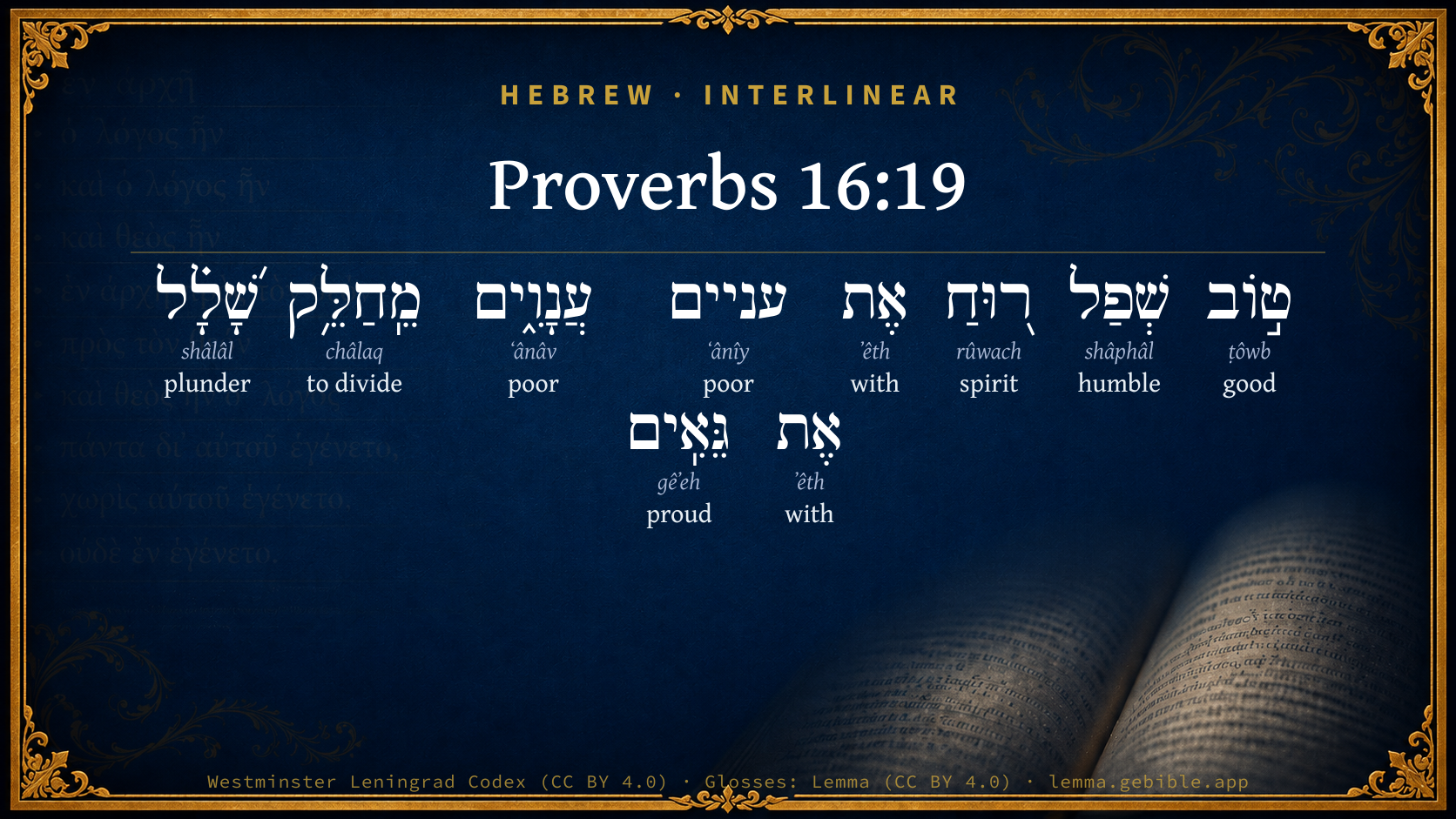
Proverbs 16:19

Hebrew (Westminster Leningrad Codex) Proverbs 16:19 appears in the Hebrew Old Testament. The text above is from the Westminster Leningrad Codex. Each word links to its Strong’s number, a concise gloss, and parsing drawn from the Open Scriptures Hebrew Bible morphology. Click any word for its full Brown-Driver-Briggs (BDB) entry.
Download image
Cite this verse

Proverbs 16:19 (World English Bible). Public Domain. Lemma interlinear Bible study tool, https://lemma.gebible.app/v/proverbs/16/19.

Show BibTeX & RIS
BibTeX
RIS
English Translation
It is better to be of a lowly spirit with the poor, Than to divide the plunder with the proud.
World English Bible · Public Domain
Download a study sheet

One document with this verse’s original text, its word-by-word gloss line, the meaning frame, cross-references with their text, attributed commentary, and full source and license credits — printable, and it pastes into notes with its structure intact.

This verse Autodidact and up

Study sheet (.html) Plain text (.txt)

A passage Seminary Student

Up to 50 verses in one chapter. A passage sheet keeps up to 6 commentary sources and 12 cross-references per verse, in the order this page ranks them, and says so on the sheet whenever that leaves anything out. Ask for a single verse and you get the Autodidact verse sheet above.

Everything on this page stays free to read, with no account — the sheet is a download of what is already on screen, not access to it.

Want to remove ads? Support Godless Engineer
Compare translations 3

The same verse in 3 English versions, stacked beneath the original-language interlinear above. Click any original word for its lexicon entry.

Each is an independent rendering of the whole verse — the interlinear is not word-aligned to these translations.

Highlighted words mark where these versions differ — a whole-verse word diff, not a word-by-word alignment.

  • World English Bible Public Domain
    It is better to be of a lowly spirit with the poor, Than to divide the plunder with the proud.
  • King James Version Public Domain
    Better it is to be of an humble spirit with the lowly, than to divide the spoil with the proud.
  • unfoldingWord Literal Text CC BY-SA 4.0
    Better to be lowly of spirit afflicted ones than to share a portion spoil proud ones.

unfoldingWord Literal Text — © unfoldingWord, licensed CC BY-SA 4.0. Word-aligned USFM3 via Door43 (git.door43.org/unfoldingWord/en_ult).

Versions to compare (up to 4)

3 of 4 selected

Show all 18 translations

Every available English version of this verse, each an independent rendering of the whole verse.

  • World English Bible Public Domain
    It is better to be of a lowly spirit with the poor, Than to divide the plunder with the proud.
  • Berean Standard Bible Public Domain
    It is better to be lowly in spirit among the humble than to divide the spoil with the proud.
  • Majority Standard Bible Public Domain
    It is better to be lowly in spirit among the humble than to divide the spoil with the proud.
  • King James Version Public Domain
    Better it is to be of an humble spirit with the lowly, than to divide the spoil with the proud.
  • American Standard Version (1901) Public Domain
    Better it is to be of a lowly spirit with the poor, Than to divide the spoil with the proud.
  • Revised Version (1885) Public Domain
    Better it is to be of a lowly spirit with the poor, than to divide the spoil with the proud.
  • Geneva Bible (1599) Public Domain
    Better it is to be of humble minde with the lowly, then to deuide the spoyles with the proude.
  • Douay-Rheims (1899) Public Domain
    It is better to be humbled with the meek, than to divide spoils with the proud.
  • Young's Literal Translation Public Domain
    Better is humility of spirit with the poor, Than to apportion spoil with the proud.
  • Literal Standard Version CC BY-SA 4.0
    Better is humility of spirit with the poor, || Than to apportion spoil with the proud.
  • Unlocked Literal Bible CC BY-SA 4.0
    It is better to be humble among poor people than to divide the spoil with proud people.
  • unfoldingWord Literal Text CC BY-SA 4.0
    Better to be lowly of spirit afflicted ones than to share a portion spoil proud ones.
  • Darby Bible Public Domain
    Better is it to be of a humble spirit with the meek, than to divide the spoil with the proud.
  • World Messianic Bible Public Domain
    It is better to be of a lowly spirit with the poor, than to divide the plunder with the proud.
  • Webster's Bible Public Domain
    Better it is to be of a humble spirit with the lowly, than to divide the spoil with the proud.
  • Free Bible Version CC BY-SA 4.0
    Better to have a humble spirit and live with the poor than to share plunder with the proud.
  • Bible in Basic English Public Domain
    Better it is to have a gentle spirit with the poor, than to take part in the rewards of war with men of pride.
  • JPS Tanakh (1917) Public Domain
    Better it is to be of a lowly spirit with the humble, than to divide the spoil with the proud.

Literal Standard Version (2020), Covenant Press — licensed CC BY-SA 4.0. Text via the HelloAO Bible API (eBible.org). Unlocked Literal Bible (unfoldingWord) — licensed CC BY-SA 4.0. Text via the HelloAO Bible API (eBible.org). unfoldingWord Literal Text — © unfoldingWord, licensed CC BY-SA 4.0. Word-aligned USFM3 via Door43 (git.door43.org/unfoldingWord/en_ult). Free Bible Version, Dr. Jonathan Gallagher — licensed CC BY-SA 4.0. Text via the HelloAO Bible API (eBible.org).

Word by word

More ways to search: Search by grammar → Find every occurrence → Compare this word →

Practice this passage: Drill this verse → Learn its vocabulary →

About this verse

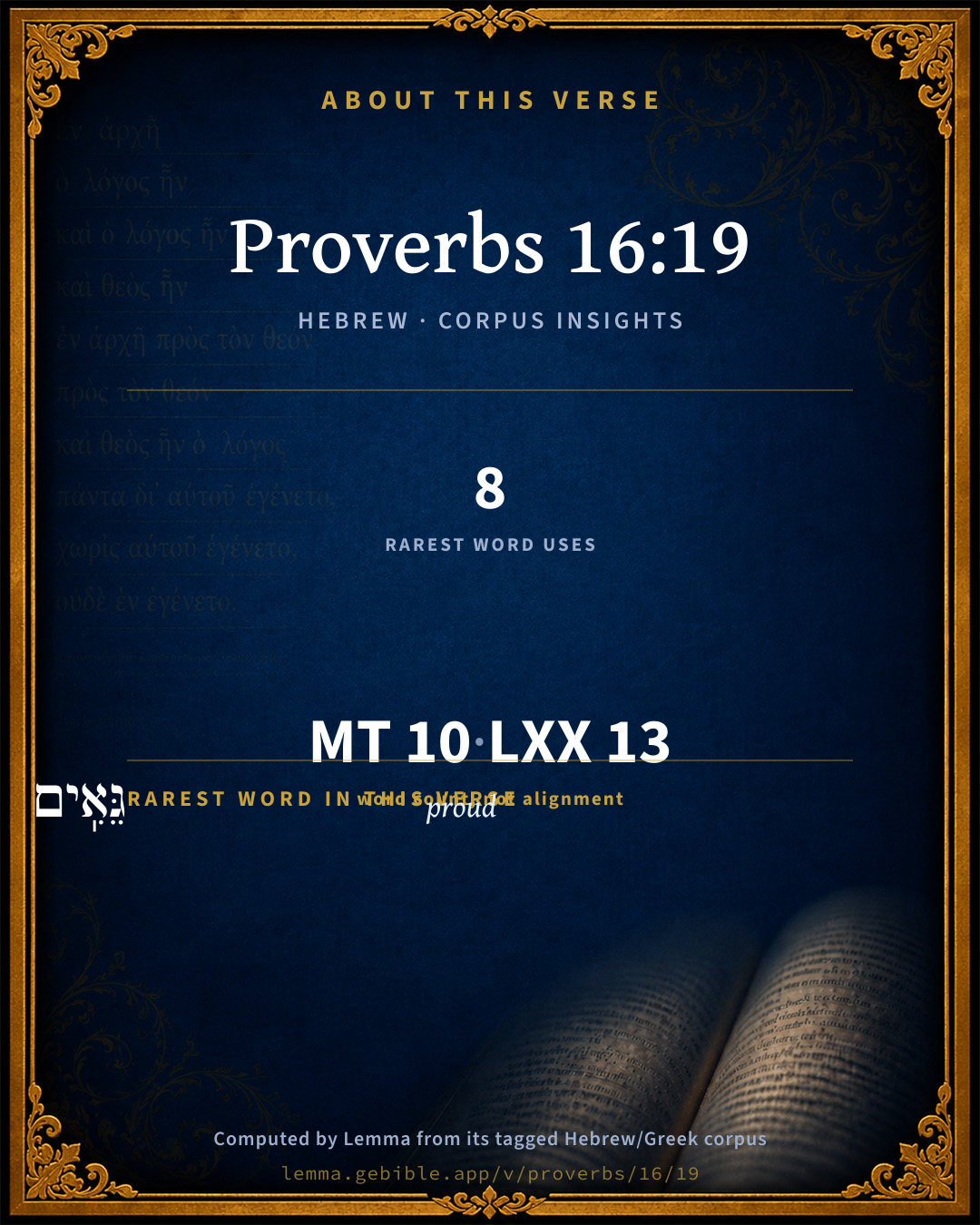
These counts appear in no published source. They are computed here, from the morphology-tagged text and Lemma’s own curated glosses. What Lemma adds →

10
words
9
distinct lemmas
Wisdom
section

Notable vocabulary

The rarest word here is גֵּאִֽים proud H1343 — appearing just 8 times in the whole Hebrew Bible.

Shared distinctive vocabulary

גֵּאִֽים proud H1343 occurs in 8 verses of the Hebrew Bible. Also found in:

Grammatical profile

  • 2 verbs
  • 2 nouns
  • 4 adjectives
  • 2 prepositions

Verb forms

  • שְׁפַל Qal · Infinitive Construct
  • מֵֽחַלֵּ֥ק Piel · Infinitive Construct

Repetition

A word recurs within this verse — often emphatic in Hebrew:

  • אֶת with H854 ×2

Hebrew & Septuagint length

In English translation the verse runs 20 words from the Hebrew and 15 from the Septuagint (LXX English) — closely comparable.

A rough comparison of the two English renderings, which tokenize alike — not a word-level alignment.

Word counts can differ between the Hebrew and the Greek without any difference in meaning — e.g. the Hebrew direct-object marker אֵת has no separate Greek word, and Greek often adds the article ὁ.

In the original languages it is 10 Hebrew tokens and 13 Greek tokens — but the two are counted differently (Hebrew bundles its prefixes and suffixes into one token; the Greek is in lemma form), so that isn’t a like-for-like length.

Cross-references

12

Topical passages linked to Proverbs 16:19 in the Treasury of Scripture Knowledge — connected by theme and wording, ordered by reader-vote popularity; previews shown in the World English Bible.

  • Matthew 5:3 "Blessed are the poor in spirit, For theirs is the Kingdom of Heaven.
  • Psalms 138:6 For though Yahweh is high, yet he looks after the lowly; But the proud, he knows from afar.
  • Isaiah 57:15 For thus says the high and lofty One who inhabits eternity, whose name is Holy: I dwell in the high and holy place, with him also who is of a contrite and humble spirit, to revive the spirit of the humble, and to revive the heart of the contrite.
  • Exodus 15:9 The enemy said, 'I will pursue, I will overtake, I will divide the spoil. My desire shall be satisfied on them. I will draw my sword, my hand shall destroy them.'
  • Psalms 34:18 Yahweh is near to those who have a broken heart, And saves those who have a crushed spirit.
  • Proverbs 29:23 A man's pride brings him low, But one of lowly spirit gains honor.
  • Isaiah 9:3 You have multiplied the nation, you have increased their joy: they joy before you according to the joy in harvest, as men rejoice when they divide the spoil.
  • Isaiah 10:6 I will send him against a profane nation, and against the people of my wrath will I give him a charge, to take the spoil, and to take the prey, and to tread them down like the mire of the streets.
  • Isaiah 10:13–15 For he has said, By the strength of my hand I have done it, and by my wisdom; for I have understanding: and I have removed the bounds of the peoples, and have robbed their treasures, and like a valiant man I have brought down those who sit [on thrones]:
  • Isaiah 53:12 Therefore will I divide him a portion with the great, and he shall divide the spoil with the strong; because he poured out his soul to death, and was numbered with the transgressors: yet he bore the sin of many, and made intercession for the transgressors.
  • Luke 1:51–53 He has shown strength with his arm. He has scattered the proud in the imagination of their heart.
  • Luke 18:13–14 But the tax collector, standing far away, wouldn't even lift up his eyes to heaven, but beat his breast, saying, 'God, be merciful to me, a sinner!'

Cross-references courtesy of OpenBible.info (CC BY 4.0).

Hebrew and Greek witnesses Masoretic Hebrew ↔ Greek Septuagint

The same verse in the two great witnesses to the Old Testament, shown verse-for-verse.

These are two independent witnesses, not word-aligned to each other, and the Septuagint is shown in lemma (dictionary) form.

Hebrew Proverbs 16:19 Masoretic · Westminster Leningrad Codex

ט֣וֹב שְׁפַל ר֭וּחַ אֶת עניים עֲנָוִ֑ים מֵֽחַלֵּ֥ק שָׁ֝לָ֗ל אֶת גֵּאִֽים

It is better to be of a lowly spirit with the poor, Than to divide the plunder with the proud.

World English Bible · Public Domain

Greek LXX Proverbs 16:19 Septuagint · lemma form

καρδία σοφός νοέω ὁ ἀπό ὁ ἴδιος στόμα ἐπί δέ χεῖλος φορέω ἐπιγνωμοσύνη

Better is a meek-spirited man with lowliness, than one who divides spoils with the proud.

LXX2012 (modern English Septuagint) · Public Domain

On this verse, The Pulpit Commentary discusses the Septuagint’s reading. Read the note in Commentary ↓

Hebrew: Westminster Leningrad Codex (CC BY 4.0). Greek: Septuagint (public domain); English from LXX2012 (modern English Septuagint) (Public Domain). How the Septuagint differs from the Hebrew →

Commentary

Notes on Proverbs 16:19 from classic Christian and Jewish commentators (each source and its license shown beneath its notes). The classic Christian expositions comment on the surrounding passage and are grouped to its opening verse, so a note may address several verses; the Jewish commentaries on the Tanakh (Rashi and others) are per-verse, so they appear only where the commentator wrote on this verse.

Lemma curates 59 commentaries, every one of them public domain or Creative Commons licensed, each selected and text-cleaned for this edition rather than reprinted as found. About our sources →

Trapp's Complete Commentary

John Trapp

Pro 16:19 Better [it is to be] of an humble spirit with the lowly, than to divide the spoil with the proud.

Ver. 19. Better it is to be of a humble spirit.] A humble man is worth his weight in gold; he hath far more comfort in his losses than proud giants have in their rapines and robberies. Truth it is, that meekness of spirit commonly draws on injuries. A crow will pull wool from a sheep’s side; she durst not do so to a wolf or mastiff. Howbeit, it is much better to suffer wrong than to do it; to be patient than to be insolent; to be lowly in heart and low of port than to enjoy "the pleasures," or treasures, "of sin for a season."

John Trapp, A Commentary or Exposition upon All the Books of the Old and New Testament (1647–1656) — public domain. Text from a community e-Sword module.

The Biblical Illustrator

Joseph S. Exell

Pro_16:19

Better it is to be of an humble spirit with the lowly, than to divide the spoil with the proud.

The character and conduct of the lowly under affliction

There is a generation of lowly afflicted ones, having their spirit lowered and brought down to their lot, whose case, in that respect, is better than that of the proud getting their will, and carrying all to their mind.

1. There is a generation of lowly afflicted ones in the world, as bad as the world is. They are in this world, where the state of trial is.

2. If it were not so, Christ, as He was in the world, would have no followers in it.

3. Nevertheless, they are very rare in this world. Many a high-bonded spirit keeps on the bend in spite of lowering circumstances.

4. They can be no more in number than the truly godly. To bring the spirit truly to a low and crossed lot must be the effect of humbling grace.

5. A lowly disposition of soul, and habitual aim and bent of the heart that way, has a very favourable construction put upon it in heaven. Enter into particulars of the character of the lowly. There is a yoke of affliction, of one kind or other, oftentimes upon them. There is a particular yoke of affliction, which God has chosen for them, that hangs about them, and is seldom, if ever, off them. That is their special trial, the crook in their lot. They think soberly and meanly of themselves, but highly and honourably of God. They think favourably of others, as far as in justice they may. They are sunk down into a state of subordination to Gods will. They are not bent on high things, but disposed to stoop to low things. They are apt to magnify mercies bestowed on them.

Consider the generation of the proud, getting their will, and carrying all to their mind.

1. There are crosses in their lot. Sin has turned the world from a paradise to a thicket; there is no getting through without being scratched. The pride of the heart exposes them particularly to crosses. They have an over-value for themselves. Men are bigger in their own conceit than they are indeed. They have an unmortified self-will. They have a crowd of unsubdued passions taking part with the self-will. But a holy God crosses the self-will of the proud creatures by His providence, over-ruling and disposing of things contrary to their inclination. Getting their will, and carrying all to their mind, tells of holy Providence yielding to the mans unmortified self-will, and letting it go according to his mind; it tells also of the lust remaining in its strength and vigour; of the cross removed; and of the mans pleasure in having carried his point.

Confirm the doctrine of the text, that the case of the former is better than that of the latter.

1. Humility is a piece of the image of God. Pride is the masterpiece of the image of the devil.

2. Humility and lowliness of spirit qualify us for friendly communion and intercourse with God in Christ. Pride makes God our enemy.

3. Humility is a duty pleasing to God, pride a sin pleasing to the devil. Those whose spirits are brought down to their afflicted lot have quiet and repose of mind. This is a great blessing, upon which the comfort of life depends. Our whole trouble in our lot ariseth from the disagreement of our mind therewith. The proud can but make a better condition in outward things; but humility makes a better man; and the man is more valuable than all external conveniences that attend him. (T. Boston.)

The Biblical Illustrator, edited by Joseph S. Exell (c. 1880s–1900s) — public domain. Text from a community e-Sword module.

Matthew Henry's Commentary

This is a paradox which the children of this world cannot understand and will not subscribe to, that it is better to be poor and humble than to be rich and proud. 1. Those that divide the spoil are commonly proud; they value themselves and despise others, and their mind rises with their condition; those therefore that are rich in this world have need to be charged that they be not high-minded, Ti1 6:17. Those that are proud and will put forth themselves, that thrust, and shove, and scramble, for preferment, are the men that commonly divide the spoil and share it among them; they have the world at will and the ball at their foot. 2. It is upon all accounts better to take our lot with those whose condition is low, and their minds brought to it, than to covet and aim to make a figure and a bustle in the world. Humility, though it should expose us to contempt in the world, yet while it recommends us to the favour of God, qualifies us for his gracious visits, prepares us for his glory, secures us from many temptations, and preserves the quiet and repose of our own souls, is much better than that high-spiritedness which, though it carry away the honour and wealth of the world, makes God a man's enemy and the devil his master.

Matthew Henry's Commentary on the Whole Bible (1708–1710) — public domain (CC PDM 1.0). Text via the HelloAO Bible API.

Jamieson, Fausset & Brown

Robert Jamieson, A. R. Fausset & David Brown

divide the spoil--that is, conquer. Avoid the society of the proud (Jam 4:6).

Jamieson, Fausset & Brown — Commentary Critical and Explanatory on the Whole Bible (1871) — public domain (CC PDM 1.0). Text via the HelloAO Bible API.

The Cambridge Bible for Schools and Colleges

gen. ed. J. J. S. Perowne

19. the lowly] Rather, poor, R.V. Better humble and poor than proud and rich.

The Cambridge Bible for Schools and Colleges (gen. ed. J. J. S. Perowne; Cambridge University Press, 1878–1918) — public domain. Text from a community e-Sword module.

John Gill's Exposition

Better it is to be of an humble spirit with the lowly,.... The followers of the meek and lowly Jesus, whose spirits are humbled under a sense of sin; have mean thoughts of themselves and their own righteousness, and submit to the righteousness of the Son of God, and wholly trust in him for salvation; and ascribe all they have and are to the free grace of God; humble themselves under the mighty hand of God; are resigned to his will, and patiently bear all afflictions without murmuring, and think better of others than themselves: these are not in so much danger of falling as the proud and haughty, and are more grateful to men, and acceptable to God; with these he vouchsafes to dwell; to these he gives more grace, and they shall inherit the earth. Wherefore it is better to be of such a spirit, and be ranked among and keep company with the meek and lowly,

than to divide the spoil with the proud; the spoils of the poor with proud oppressors; or spoils gotten in war with proud and ambitious princes; or the spoils of kingdoms and states with antichrist, divided by him among his proud followers: it is better to be the followers of Christ, and have but little, than to be his, and have ever so much.

John Gill's Exposition of the Whole Bible (1746–1763) — public domain (CC PDM 1.0). Text via the HelloAO Bible API.

Matthew Poole's English Annotations

Who will spoil and rob others to maintain their own pomp and luxury.

Matthew Poole's English Annotations on the Holy Bible (1683–1685) — public domain. Text from a community e-Sword/MySword module.

The Pulpit Commentary

This verse is connected in thought, as well as verbally, with the preceding. Better it is to be of a humble spirit with the lowly. The Revised Version has, with the poor; but "meek" or "lowly" better contrasts with "proud" of the second clause. Psa_84:10, "I had rather be a doorkeeper in the house of my God, than to dwell in the tents of wickedness." Than to divide the spoil with the proud. To share in the fruits of the operations and pursuits of the proud, and to enjoy their pleasures, a man must cast in his lot with them, uudergo their risks and anxieties, and participate in the crimes by which they gain their wealth. The result of such association was told in ver. 18. The Germans express the connection between abundance and folly by the terse apothegm, "Voll, toll;" "Full, fool." Septuagint, "Better is the man of gentle mind with humility, than he who divideth spoil with the violent."

The Pulpit Commentary (1880–1919), ed. H.D.M. Spence-Jones & Joseph S. Exell — public domain. Text from a community e-Sword module.

Keil & Delitzsch

C. F. Keil & F. Delitzsch

19 Better in humility to dwell among sufferers,

Than to divide spoil among the proud.

The form שׁפל is here not adj. as Pro 29:23 (from שׁפל, like חסר, Pro 6:32, from חסר), but inf. (like Ecc 12:14, and חסר, defectio, 10:21). There existed here also no proper reason for changing עניּים (Chethı̂b) into ענוים; Hitzig is right in saying that עני may also be taken in the sense of ענו [the idea "sufferer" is that which mediates], and that here the inward fact of humility and the outward of dividing spoil, stand opposed to one another. It is better to live lowly, i.e., with a mind devoid of earthly pride (Demut [humility] comes from do with the deep e, diu, servant), among men who have experience of the vanity of earthly joys, than, intoxicated with pride, to enjoy oneself amid worldly wealth and greatness (cf. Isa 9:2).

Keil & Delitzsch — Biblical Commentary on the Old Testament (1861–1891) — public domain (CC PDM 1.0). Text via the HelloAO Bible API. (Old Testament only.)

Kretzmann's Popular Commentary

Paul E. Kretzmann

v. 19. Better it is to be of an humble spirit with the lowly, to abide with those who are in trouble, content to lead a life of obscurity, than to divide the spoil with the proud, enjoying the ill-gotten gains of false ambition.

Paul E. Kretzmann, Popular Commentary of the Bible (1921–1924) — public domain. Text from a community e-Sword module.

unfoldingWord translationNotes

Door43 World Missions Community

spoil

goods taken in battle

what they are taught

This can be stated in active form. AT: "what someone has taught them" or "what they have learned" (See: Active or Passive)

translationWords

humble

proud

good

trust

Yahweh

unfoldingWord translationNotes — © Distant Shores Media and the Door43 World Missions Community, licensed CC BY-SA 4.0. Source: git.door43.org/Door43/en_tn.

Rashi

Rabbi Shlomo Yitzchaki (Rashi)

It is better to be of humble spirit It is better to join the lowly and to be of humble spirit with them than to divide spoils with the haughty.

Rashi on the Tanakh — English translations: “The Judaica Press complete Tanach with Rashi, translated by A. J. Rosenberg” (CC BY 4.0); “Pentateuch with Rashi's commentary by M. Rosenbaum and A.M. Silbermann, 1929-1934” (public domain); “The Metsudah Tanach series, Lakewood, N.J” (CC BY 4.0); and “The Book of Joshua, Metsudah Publications, 1997” (CC BY 4.0). Text via Sefaria.

Lesson kit

Teaching starters — assembled from the data on this page, not authored interpretation. Every prompt links to the verse data it draws on. Edit before teaching.

Proverbs, in the Wisdom, opens this verse with 10 words (9 distinct Hebrew lemmas). Its most distinctive word is gêʼeh (“proud”). A historical commentator’s framing appears above. Read the whole chapter for the surrounding context.

Discussion questions

  1. How does “proud” (gêʼeh) shape what this verse is saying?
  2. Job 40:11 shares the word «proud» with this verse. How do the two illuminate each other?
  3. “with” occurs 2× in this one verse. What is the effect of the repetition?
  4. The translations on this page render this verse differently — a whole-verse word diff, not a word-by-word alignment. What might account for the different wordings?
  5. The verb «שְׁפַל» is Qal Infinitive Construct. How does its form color the action?
  6. Reading how Trapp's Complete Commentary and The Biblical Illustrator read this verse, where do the two commentators agree and where do they part?

Things to notice

Reading settings

Reading text

Shown beneath each verse's original-language words.

Old Testament
Old Testament edition

Read the OT as the Masoretic Hebrew (MT) or the Greek Septuagint (LXX).

English shown for the Greek Septuagint (in the Hebrew ↔ Greek comparison).

Comparing translations? Open the Compare panel on any verse page to stack up to four side by side.