
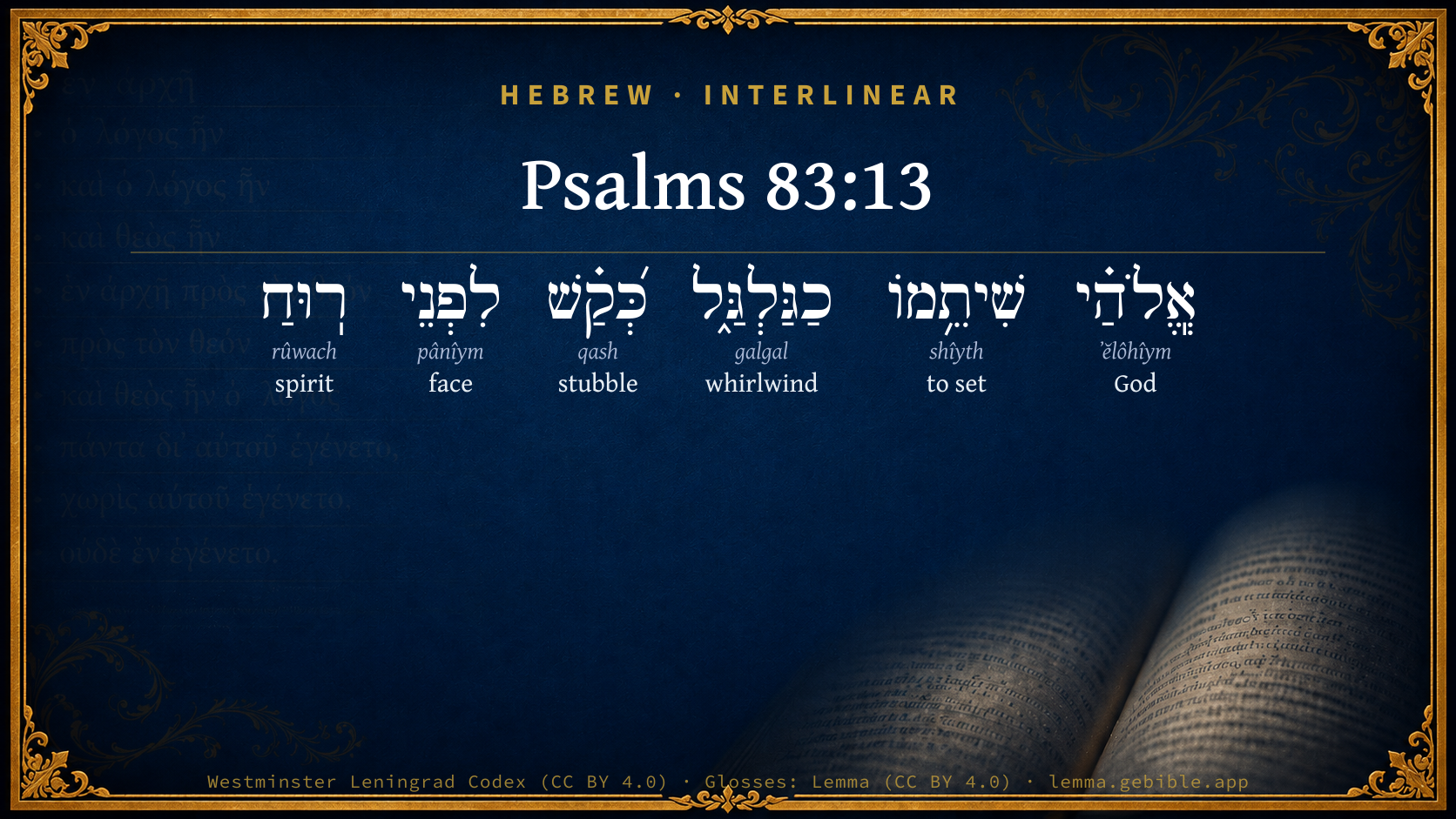
Psalms 83:13

Hebrew (Westminster Leningrad Codex) Psalms 83:13 appears in the Hebrew Old Testament. The text above is from the Westminster Leningrad Codex. Each word links to its Strong’s number, a concise gloss, and parsing drawn from the Open Scriptures Hebrew Bible morphology. Click any word for its full Brown-Driver-Briggs (BDB) entry.
Download image
Cite this verse

Psalms 83:13 (World English Bible). Public Domain. Lemma interlinear Bible study tool, https://lemma.gebible.app/v/psalms/83/13.

Show BibTeX & RIS
BibTeX
RIS
English Translation
My God, make them like tumbleweed; Like chaff before the wind.
World English Bible · Public Domain
Download a study sheet

One document with this verse’s original text, its word-by-word gloss line, the meaning frame, cross-references with their text, attributed commentary, and full source and license credits — printable, and it pastes into notes with its structure intact.

This verse Autodidact and up

Study sheet (.html) Plain text (.txt)

A passage Seminary Student

Up to 50 verses in one chapter. A passage sheet keeps up to 6 commentary sources and 12 cross-references per verse, in the order this page ranks them, and says so on the sheet whenever that leaves anything out. Ask for a single verse and you get the Autodidact verse sheet above.

Everything on this page stays free to read, with no account — the sheet is a download of what is already on screen, not access to it.

Want to remove ads? Support Godless Engineer
Compare translations 3

The same verse in 3 English versions, stacked beneath the original-language interlinear above. Click any original word for its lexicon entry.

Each is an independent rendering of the whole verse — the interlinear is not word-aligned to these translations.

Highlighted words mark where these versions differ — a whole-verse word diff, not a word-by-word alignment.

  • World English Bible Public Domain
    My God, make them like tumbleweed; Like chaff before the wind.
  • King James Version Public Domain
    O my God, make them like a wheel; as the stubble before the wind.
  • unfoldingWord Literal Text CC BY-SA 4.0
    My God, make them like tumbleweed, like chaff to the face of the wind.

unfoldingWord Literal Text — © unfoldingWord, licensed CC BY-SA 4.0. Word-aligned USFM3 via Door43 (git.door43.org/unfoldingWord/en_ult).

Versions to compare (up to 4)

3 of 4 selected

Show all 18 translations

Every available English version of this verse, each an independent rendering of the whole verse.

  • World English Bible Public Domain
    My God, make them like tumbleweed; Like chaff before the wind.
  • Berean Standard Bible Public Domain
    Make them like tumbleweed, O my God, like chaff before the wind.
  • Majority Standard Bible Public Domain
    Make them like tumbleweed, O my God, like chaff before the wind.
  • King James Version Public Domain
    O my God, make them like a wheel; as the stubble before the wind.
  • American Standard Version (1901) Public Domain
    O my God, make them like the whirling dust; As stubble before the wind.
  • Revised Version (1885) Public Domain
    O my God, make them like the whirling dust; as stubble before the wind.
  • Geneva Bible (1599) Public Domain
    O my God, make them like vnto a wheele, and as the stubble before the winde.
  • Douay-Rheims (1899) Public Domain
    who have said: Let us possess the sanctuary of God for an inheritance.
  • Young's Literal Translation Public Domain
    O my God, make them as a rolling thing, As stubble before wind.
  • Literal Standard Version CC BY-SA 4.0
    O my God, make them as a rolling thing, || As stubble before wind.
  • Unlocked Literal Bible CC BY-SA 4.0
    My God, make them like the whirling dust, like chaff before the wind,
  • unfoldingWord Literal Text CC BY-SA 4.0
    My God, make them like tumbleweed, like chaff to the face of the wind.
  • Darby Bible Public Domain
    O my God, make them like a whirling thing, like stubble before the wind.
  • World Messianic Bible Public Domain
    My God, make them like tumbleweed, like chaff before the wind.
  • Webster's Bible Public Domain
    \\83:12\\Who said, Let us take to ourselves the houses of God in possession.
  • Free Bible Version CC BY-SA 4.0
    My God, make them like whirling tumbleweeds, chaff blown away by the wind.
  • Bible in Basic English Public Domain
    O my God, make them like the rolling dust; like dry stems before the wind.
  • JPS Tanakh (1917) Public Domain
    (83-14) O my God, make them like the whirling dust; as stubble before the wind.

Literal Standard Version (2020), Covenant Press — licensed CC BY-SA 4.0. Text via the HelloAO Bible API (eBible.org). Unlocked Literal Bible (unfoldingWord) — licensed CC BY-SA 4.0. Text via the HelloAO Bible API (eBible.org). unfoldingWord Literal Text — © unfoldingWord, licensed CC BY-SA 4.0. Word-aligned USFM3 via Door43 (git.door43.org/unfoldingWord/en_ult). Free Bible Version, Dr. Jonathan Gallagher — licensed CC BY-SA 4.0. Text via the HelloAO Bible API (eBible.org).

Word by word

More ways to search: Search by grammar → Find every occurrence → Compare this word →

Practice this passage: Drill this verse → Learn its vocabulary →

About this verse

These counts appear in no published source. They are computed here, from the morphology-tagged text and Lemma’s own curated glosses. What Lemma adds →

6
words
6
distinct lemmas
Wisdom
section

Notable vocabulary

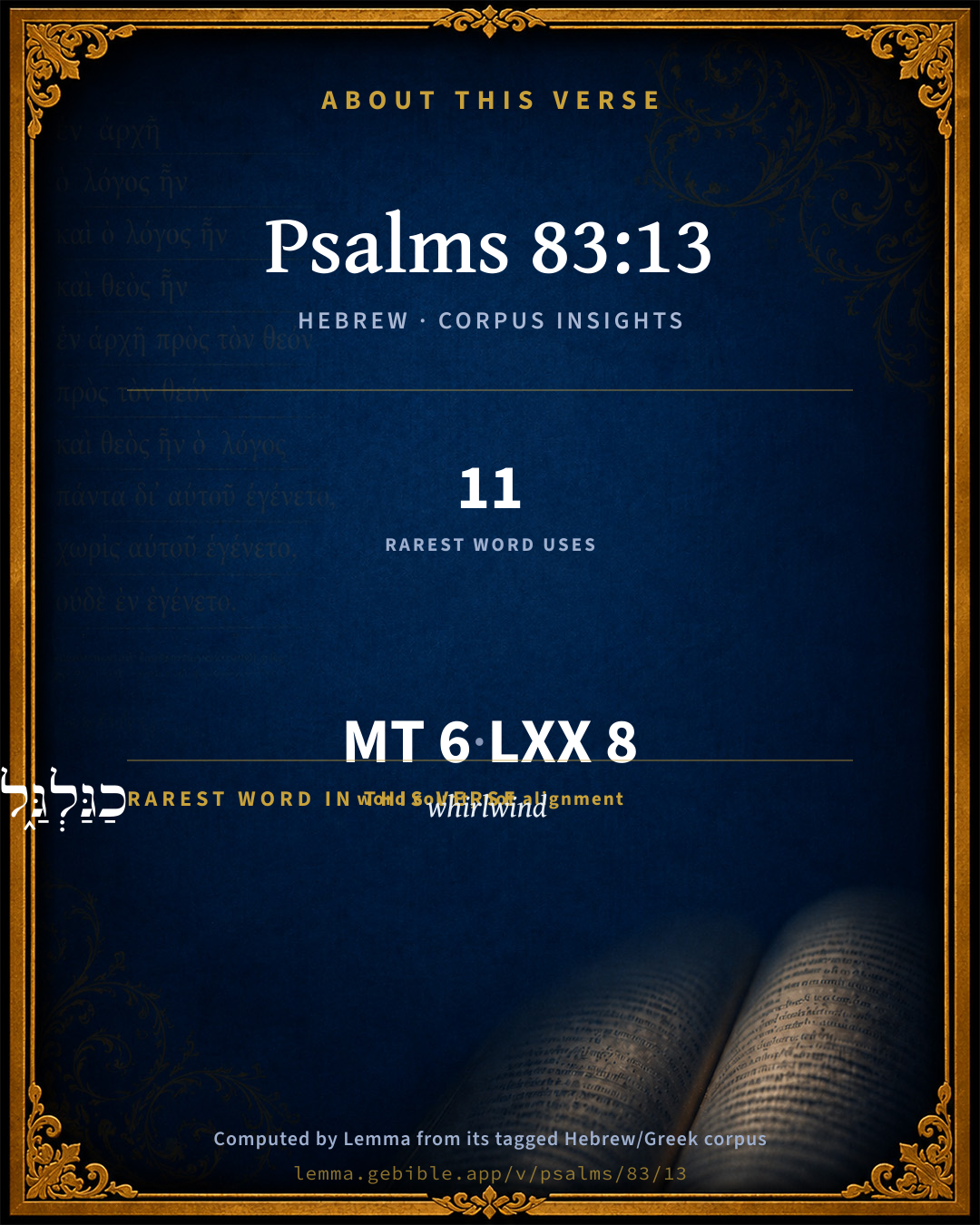
The rarest word here is כַגַּלְגַּ֑ל whirlwind H1534 — appearing just 11 times in the whole Hebrew Bible.

Shared distinctive vocabulary

כַגַּלְגַּ֑ל whirlwind H1534 occurs in 11 verses of the Hebrew Bible. Also found in:

Grammatical profile

  • 1 verb
  • 5 nouns

Verb forms

  • שִׁיתֵ֥מוֹ Qal · Imperative

Hebrew & Septuagint length

In English translation the verse runs 11 words from the Hebrew and 16 from the Septuagint (LXX English) — closely comparable.

A rough comparison of the two English renderings, which tokenize alike — not a word-level alignment.

Word counts can differ between the Hebrew and the Greek without any difference in meaning — e.g. the Hebrew direct-object marker אֵת has no separate Greek word, and Greek often adds the article ὁ.

In the original languages it is 6 Hebrew tokens and 8 Greek tokens — but the two are counted differently (Hebrew bundles its prefixes and suffixes into one token; the Greek is in lemma form), so that isn’t a like-for-like length.

Cross-references

13

Topical passages linked to Psalms 83:13 in the Treasury of Scripture Knowledge — connected by theme and wording, ordered by reader-vote popularity; previews shown in the World English Bible.

  • Job 21:18 That they are as stubble before the wind, As chaff that the storm carries away?
  • Psalms 35:5 Let them be as chaff before the wind, Yahweh's angel driving them on.
  • Isaiah 40:24 Yes, they have not been planted; yes, they have not been sown; yes, their stock has not taken root in the earth: moreover he blows on them, and they wither, and the whirlwind takes them away as stubble.
  • Job 13:25 Will you harass a driven leaf? Will you pursue the dry stubble?
  • Psalms 74:11–12 Why do you draw back your hand, even your right hand? Take it out of your pocket and consume them!
  • Jeremiah 13:24 Therefore will I scatter them, as the stubble that passes away, by the wind of the wilderness.
  • Exodus 15:7 In the greatness of your excellency, you overthrow those who rise up against you: You send forth your wrath. It consumes them as stubble.
  • Psalms 22:1 My God, my God, why have you forsaken me? Why are you so far from helping me, and from the words of my groaning?
  • Psalms 44:4 You are my King, God. Command victories for Jacob!
  • Psalms 68:1–2 Let God arise! Let his enemies be scattered! Let them who hate him also flee before him.
  • Isaiah 17:12–14 Ah, the uproar of many peoples, who roar like the roaring of the seas; and the rushing of nations, that rush like the rushing of mighty waters!
  • Isaiah 41:2 Who has raised up one from the east, whom he calls in righteousness to his foot? he gives nations before him, and makes him rule over kings; he gives them as the dust to his sword, as the driven stubble to his bow.
  • Matthew 3:12 His winnowing fork is in his hand, and he will thoroughly cleanse his threshing floor. He will gather his wheat into the barn, but the chaff he will burn up with unquenchable fire."

Cross-references courtesy of OpenBible.info (CC BY 4.0).

Hebrew and Greek witnesses Masoretic Hebrew ↔ Greek Septuagint

The same verse in the two great witnesses to the Old Testament, shown verse-for-verse.

You’re reading Greek Psalm 82 (Hebrew Psalm 83). The Septuagint counts the superscription, so verse numbers can differ from the Hebrew — chapter-level alignment, not verse-by-verse. Numbering follows Rahlfs.

These are two independent witnesses, not word-aligned to each other, and the Septuagint is shown in lemma (dictionary) form.

Hebrew Psalms 83:13 Masoretic · Westminster Leningrad Codex

אֱֽלֹהַ֗י שִׁיתֵ֥מוֹ כַגַּלְגַּ֑ל כְּ֝קַ֗שׁ לִפְנֵי רֽוּחַ

My God, make them like tumbleweed; Like chaff before the wind.

World English Bible · Public Domain

Greek LXX Greek Psalm 82:13 Septuagint · lemma form

ὅστις εἶπον κληρονομέω ἑαυτοῦ ὁ ἁγιαστήριον ὁ θεός

O my God, make them as a wheel; as stubble before the face of the wind.

LXX2012 (modern English Septuagint) · Public Domain

On this verse, Ellicott's Commentary for English Readers discusses the Septuagint’s reading. Read the note in Commentary ↓

Hebrew: Westminster Leningrad Codex (CC BY 4.0). Greek: Septuagint (public domain); English from LXX2012 (modern English Septuagint) (Public Domain). How the Septuagint differs from the Hebrew →

Commentary

Notes on Psalms 83:13 from classic Christian and Jewish commentators (each source and its license shown beneath its notes). The classic Christian expositions comment on the surrounding passage and are grouped to its opening verse, so a note may address several verses; the Jewish commentaries on the Tanakh (Rashi and others) are per-verse, so they appear only where the commentator wrote on this verse.

Lemma curates 59 commentaries, every one of them public domain or Creative Commons licensed, each selected and text-cleaned for this edition rather than reprinted as found. About our sources →

Trapp's Complete Commentary

John Trapp

Psa 83:13 O my God, make them like a wheel; as the stubble before the wind.

Ver. 13. O my God, make them like a wheel] Heb. Like a rolling thing, such as is thistle down, saith R. Solomon, Capita carduorum. Gr. like a top, Torque illos in modum trochi, whirl them about as boys do their tops.

As the stubble] As before he had brought examples, so here similitudes, to show what he would have done to the enemy.

John Trapp, A Commentary or Exposition upon All the Books of the Old and New Testament (1647–1656) — public domain. Text from a community e-Sword module.

The Treasury of David

Charles H. Spurgeon

Ver. 13. O my God, make them like a wheel; like a rolling thing which cannot rest, but is made to move with every breath. Let them have no quiet. May their minds eternally revolve and never come to peace. Blow them away like thistle down,

as the stubble before the wind. Scatter them, chase them, drive them to destruction. Every patriot prays thus against the enemies of his country, he would be no better than a traitor if he did not.

Ver. 13. A wheel. What sort of vegetable is this whose stems our muleteers are cutting up and chewing with so much relish? It is a wild artichoke. We can amuse ourselves with it and its behaviour for a while, and may possibly extract something more valuable than the insipid juice of which our men are so fond. You observe than in growing it throws out numerous branches of equal size and length in all directions, forming a sort of sphere or globe a foot or more in diameter. When ripe and dry in autumn, these branches become rigid and light as a feather, the parent stem breaks off at the ground, and the wind carries these vegetable globes whithersoever it pleaseth. At the proper season thousands of them come scudding over the plain rolling, leaping, bounding with vast racket, to the dismay both of the horse and his rider. Once, on the plain north of Hamath, my horse became quite unmanageable among them. They charged down upon us on the wings of the wind, which broke them from their moorings, and sent them careening over the desert in countless numbers. Our excellent native itinerant, A-F-, had a similar encounter with them on the eastern desert beyond the Hauran, and his horse was so terrified that he was obliged to alight and lead him. I have long suspected that this wild artichoke is the gulgal, which, in Ps 83:13, is rendered wheel, and in Isa 17:13, a rolling thing. Evidently our translators knew not what to call it. The first passage reads thus: O my God, make them like a wheel

second, Rebuke them, and they shall flee far off, and shall be

chased as the chaff of the mountains before the wind, and like a

rolling thinggulgal before the whirlwind. Now, from the

nature of the parallelism, the gulgal cannot be a wheel, but

something corresponding to chaff. It must also be something that does

not fly like the chaff, but in a striking manner rolls before the

wind. The signification of gulgal in Hebrew and its equivalent in

other Shemitic dialects, requires this, and this rolling artichoke

meets the case most emphatically, and especially when it rolls before

the whirlwind. In the encounter referred to north of Hamath, my eyes

were half blinded with the stubble and chaff which filled the air; but

it was the extraordinary behaviour of this rolling thing that

riveted my attention. Hundreds of these globes, all bounding like

gazelles in one direction over the desert, would suddenly wheel short

round at the bidding of a counter blast, and dash away with equal

speed on their new course. An Arab proverb addresses this "rolling

thing" thus: "Ho! akkub, where do you put up tonight?" to which it

answers as it flies, "Where the wind puts up." They also derive one

of their many forms of cursing from this plant: "May you be whirled,

like the akkub, before the wind, until you are caught in the thorns,

or plunged into the sea." If this is not the wheel of David,

and the rolling thing of Isaiah, from which they also borrowed

their imprecations upon the wicked, I have seen nothing in the country

to suggest the comparison.

W. M. Thomson, in "The Land and the Book."

Ver. 13. Make them like a wheel. That is, cause them to fall

into such great calamities that they can find no counsel or remedy for

their misfortunes, and that they may run hither and thither like a

wheel or a ball, and yet see not where they ought to stop, ot whither

they ought to escape. Such are the minds of wicked men in calamities,

wherever they turn they find no harbour wherein to rest, no certain

consolation can they discover. They are tossed with perpetual

disquietude; by running hither and thither and seeking various

remedies they but weary themselves the more and plunge themselves the

more deeply in their woes. This must necessarily happen to those who

seek to cure evil with evil. Therefore Isaiah also says, the wicked

are like the troubled sea.

Mollerus.

Ver. 13. Like a wheel. Mortals, like cylinders, are rolled

hither and thither, oppressed with innumerable ills.

Aurea Carmina. Pythagoras

Ver. 13. There is no greater evidence against error, than that it

is not constant to itself, no greater argument against these pretended

great spirits, than that they cannot sit, know not where to fix, are

always moving, as if the psalmist's curse had taken hold of them, as

if God had made them like a wheel and as stubble before the

wind, that can sit nowhere, rest at nothing, but turn about from

one uncertainty to another. The Holy Spirit is a spirit that will sit

still, and be at peace, continue and abide.

Mark Frank.

Ver. 13-14. In imagery both obvious and vivid to every native of

the gusty hills and plains of Palestine, though to us comparatively

unintelligible, the psalmist describes them as driven over the uplands

of Gilead like the clouds of chaff blown from the threshing floors;

chased away like the spherical masses of dry weeds which course over

the plains of Esdraelon and Philistiaflying with the dreadful

hurry and confusion of the flames, that rush and leap from tree and

hill to hill when the wooded mountains of a tropical country are by

chance ignited.

William Smith, in "A Dictionary of the Bible." 1863.

Ver. 13-15. The instability, restlessness and impotence of the

wicked; their horror when God deals with them in justice.

Psalms 83:14*

Ver. 13-14. See Psalms on "Ps 83:13" for further information.

Ver. 13-15. The instability, restlessness and impotence of the wicked; their horror when God deals with them in justice.

Psalms 83:15*

Ver. 13-15. The instability, restlessness and impotence of the wicked; their horror when God deals with them in justice.

Psalms 83:16*

Charles H. Spurgeon's The Treasury of David (1869–1885) — public domain. Psalms only. Text from a community e-Sword/MySword module.

Joseph Benson's Commentary

Psa 83:13-14. O my God, make them like a wheel — Whereas they promise themselves a sure possession, let them be like a wheel, or a round ball, which is very unstable, and soon removed, and which, when once tumbled down from the top of a hill, runs with great force and swiftness, and stays not till it comes to the bottom. Bishop Patrick interprets the clause thus: “Let them not be able to stand their ground, but put them to flight, and make them run as swiftly as a ball down a hill.” As the stubble before the wind — “Disperse all their forces like the chaff when it is blown about with a furious wind.” Some think that in this and the following verse the psalmist alludes to the manner of thrashing in Judea; which was generally performed on a mountain, where the corn was thrashed by means of a wheel which run over the stalks. The chaff, on account of this situation, was easily blown about by the wind; and, it being customary likewise to burn what remained, it is with great propriety that the psalmist concludes the description with these words, As the flame setteth the mountains on fire, Psa 83:14. Where Dr. Waterland, instead of a wood, reads a forest. And it must be observed, that the woods or forests upon the mountains, in those hot countries, when they have once taken fire, either by lightning, or by the design of men, or by any accident, are wont to burn with great swiftness and irresistible violence.

Joseph Benson's Commentary on the Old and New Testaments (1811–1818) — public domain. Text from a community e-Sword module.

J. A. Alexander on Psalms

Joseph Addison Alexander

14. (Psa 83:13). My God, make them like the whirling chaff before the wind. Make them, literally place them, as in ver. 11. Like the whirling chaff, literally like the whirl (or whirlwind), like the chaff. See above, on Psa 77:18, and compare Isa 17:13.

Joseph Addison Alexander, The Psalms Translated and Explained (1850) — public domain. Text from a community e-Sword module.

Tyndale Open Study Notes

Tyndale Open Resources

83:13 tumbleweed . . . chaff: This dry plant material easily blows away (see Isa 17:13).

Tyndale Open Study Notes — © Tyndale Open Resources, licensed CC BY-SA 4.0. Text via the HelloAO Bible API.

Geneva Bible (1599)

Geneva Bible translators

Because the reprobate could by no means be amended, he prayeth that they may utterly be destroyed, be unstable, and led with all winds.

Geneva Bible (1599) marginal notes — public domain. Text via Bolls.life.

Adam Clarke's Commentary

Verse 13. O my God, make them like a wheel] Alluding to the manner of threshing corn in the east. A large broad wheel was rolled over the grain on a threshing-floor, which was generally in the open air; and the grain being thrown up by a shovel against the wind the chaff was thus separated from it, in the place where it was threshed.

Adam Clarke's Commentary on the Bible (1810–1826) — public domain. Text from a community e-Sword/MySword module.

John Calvin's Commentaries

13. O my God! make them like a whirling ball. As the ungodly, when they gird and prepare themselves for destroying the Church, are usually inflated with intolerable pride, the inspired bard beseeches God to put them to shame, it being impossible to abate their pride until they are laid prostrate, confounded, and shamefully disappointed. When he declares (verse 16) that, as the result of this, they will seek the name of God, he is not to be understood as speaking of their being brought to true repentance, or of their genuine conversion. I indeed admit that the first step to genuine repentance is when men, brought low by affliction, willingly humble themselves. But what is here meant is nothing more than a forced and slavish submission like that of Pharaoh, king of Egypt. It is a case of frequent occurrence for the wicked, when subdued by adversity, to give glory to God, for a short period. But they are soon again carried away with a frantic madness, which clearly discovers their hypocrisy, and brings to light the pride and rebellion which lurked in their hearts. What the prophet desires is, that the wicked may be compelled by stripes to acknowledge God, whether they will or no, in order that their fury, which breaks forth because they escape with impunity, may at least be kept under restraint. This is more clearly apparent from the 17th verse, where he distinctly prays that they may be destroyed for ever; which would not at all correspond with his previous statement, were it regarded as a prayer for their being brought to repentance. Nor does he needlessly heap together such a multiplicity of words. He does this partly because the reprobate, though often chastised, are nevertheless so incorrigible that ever and anon they are mustering up new strength and courage; and partly because there is nothing which it is more difficult to be persuaded of than that such as wallow at ease in great outward prosperity will soon perish. The cause to which this is to be attributed is just our not sufficiently apprehending the dreadful character of the vengeance of God which awaits the oppressors of the Church.

John Calvin's Commentaries (1540-1563) — public domain. Text from the Calvin Translation Society English edition (1840s-50s) via the Christian Classics Ethereal Library (ccel.org). Calvin's coverage is partial (roughly two-thirds of the Bible); uncommented books and verses are honest gaps, never fabricated. The 19th-century editor's footnotes and remarks are omitted so the notes are faithfully Calvin's own voice.

Ellicott's Commentary for English Readers

(13) A wheel.—Heb., galgal. (See Note, Psa_77:18, and comp. Isa_17:13, where the Authorised Ver sion has literally rolling thing, the margin “thistle down,” and the LXX., “dust of a wheel.”) Sir G. Grove (Smith’s Bibl. Dict., art. Oreb) says, “like the spherical masses of dry weeds which course over the plains of Esdraelon and Philistia.” He possibly refers to the wild artichoke, which struck Mr. Thomson so forcibly as the origin of the psalmist’s figure. He describes them as vegetable globes, light as a feather, which, when the parent stem breaks, become the sport of the wind. “At the proper season thousands of them come suddenly over the plain, rolling, leaping, bounding with vast racket, to the dismay both of the horse and rider.” To this day the Arabs, who call it ‘akhûb, employ it in the same figurative way:—

“May you be whirled like ‘akhûb before the wind!”

THOMSON: Land and Book, 563.

A Bible Commentary for English Readers, edited by Charles John Ellicott (1878–1897) — public domain. Text from a community e-Sword module.

The Cambridge Bible for Schools and Colleges

gen. ed. J. J. S. Perowne

13. make them like a wheel] Rather, like whirling dust or chaff. Anything whirled away before the wind may be meant. Thomson (Land and Book, p. 563) thinks that the globular heads of the wild artichoke may be meant. They are light as a feather, and in the autumn when they break off from the parent stem “thousands of them come scudding over the plain, rolling, leaping, bounding with vast racket, to the dismay both of the horse and rider.” The Arabs, who call it ’akkûb, “derive one of their many forms of cursing from this plant: ‘May you be whirled like the’ akkûb before the wind.’ ”

as the stubble] As stubble. Dry, light, broken straw, whirled away from the threshing floor, which was usually in an exposed situation to catch the wind, is meant. Cp. Isa_17:13; Isa_29:5; Jer_13:24; Psa_1:4.

13–18. Renewed prayer for the dispersion and destruction of the enemy expressed by figures from nature. The final end and object of all is that they may acknowledge Jehovah to be supreme.

The Cambridge Bible for Schools and Colleges (gen. ed. J. J. S. Perowne; Cambridge University Press, 1878–1918) — public domain. Text from a community e-Sword module.

John Gill's Exposition

O my God, make them like a wheel,.... Which, as the Targum adds, is rolled, and goes on, and rests not in a declivity; let them be as fickle and inconstant as a wheel; being in high, let them be in slippery places, and brought down to desolation in a moment; like a wheel set running down hill, so let them swiftly and suddenly come to ruin; or be in all kind of calamities, and continual troubles (k) as the wheel is always turning: some think there is an allusion to the wheel by which bread corn was bruised; see Isa 28:28, but the word (l) signifies a rolling thing before the wind, as a wisp of straw or stubble, which is easily carried away with it: Jarchi interprets it of the tops or down of thistles, which fly off from them, and roll up, and are scattered by the wind; see Isa 17:13, and which agrees with what follows:

as the stubble before the wind; which cannot stand before it, but is driven about by it here and there; and so wicked men are, as chaff and stubble, driven away in their wickedness, with the stormy wind of divine wrath and vengeance, and chased out of the world, which is here imprecated.

(k) "Vide Suidam in voce" (l) "rem in levem quae turbine circumagitur", some in Amama; "pappos", i.e. "lanuginem carduorum", so some in Grotius; "as a rolling thing", Ainsworth.

John Gill's Exposition of the Whole Bible (1746–1763) — public domain (CC PDM 1.0). Text via the HelloAO Bible API.

Albert Barnes' Notes on the Bible

O my God, make them like a wheel ... - Or rather, like a rolling thing - something that the wind rolls along. The word גלגל galgal - means properly a wheel, as of a chariot, Eze 10:2, Eze 10:6; or a wheel for drawing water from a well, Ecc 12:6; then, a whirlwind, Psa 77:19; and then, anything driven before a whirlwind, as chaff, or stubble, Isa 17:13. Compare the notes at Isa 22:18. The prayer here is, that they might be utterly destroyed, or driven away.

Albert Barnes' Notes on the Bible (1834–1885) — public domain. Text from a community e-Sword/MySword module.

Matthew Poole's English Annotations

Whereas they promise to themselves a sure and firm possession in our land, let them be like

a wheel, or a round ball, which being once tumbled down from the top of a hill, runs down with great force and swiftness, and stays not till it comes to the bottom, and there also is very unstable, and soon removed.

Matthew Poole's English Annotations on the Holy Bible (1683–1685) — public domain. Text from a community e-Sword/MySword module.

Whedon's Commentary on the Bible

Daniel D. Whedon

13. Like a wheel—Like a rolling thing, parallel to Isa_17:13. The whirlwind seems alluded to. “A whirlwind is the most curious of all the visitations [of the Sinai desert] to which one is exposed. It is as violent as the most awful storm, tearing up every thing in its path, but it is so partial that you may stand a yard or so off and watch its progress undisturbed.”— Palmer. See note on Psa_58:9

Daniel D. Whedon (gen. ed.), Commentary on the Old and New Testaments (1874–1909) — public domain. Text from a community e-Sword module.

The Pulpit Commentary

O my God, make them like a wheel; rather, like whirling dust the dust that is caught up by an eddy of wind, and twisted round and round. (see Isa_17:13) As the stubble before the wind. Both the "whirling dust" and the "stubble" are images of what is lightest, most shifting, and of least account. (see Job_13:25 Job_15:7 Job_21:18 Job_41:29 Isa_40:24 Isa_41:2 Jer_13:24 Mal_4:1)

The figure of the "rolling thing.

"O my God, make them as a rolling thing." A striking poetical figure, effective if applied to any light substance that is rolled over, whirled round, and driven forward with a high wind. Dickens has a very elaborate picture of wind-driven leaves in the opening part of "Martin Chuzzlewit." The figure may be that of the whirlwind, which catches up the sand and hurls it helplessly along; and this would be a good figure for the fight of a panic-stricken army. But Thomson, in his "Land and the Book," gives point to the poet"s figure by his description of a very curious plant, known as the "gulgal," or "rolling thing." "It is a wild artichoke. In growing it throws out numerous branches of equal size and length in all directions, forming a sort of sphere or globe a foot or more in diameter. When ripe and dry in autumn, these branches become rigid and light as a feather, the parent stem breaks off at the ground, and the wind carries these vegetable globes whithersoever it pleaseth. At the proper season, thousands of them come scudding over the plain, rolling, leaping, bounding, with vast racket, to the dismay both of the horse and his rider. An Arab proverb addresses this rolling thing thus: "Ho, "akkub, where do you put up tonight?" To which it answers as it flies, "Where the wind puts up." They also derive one of their many forms of cursing from this plant. "May you be whirled, like the "akkub, before the wind, until you are caught in the thorns, or plunged into the sea!" If this is not the "wheel" of David, I have seen nothing in the country to suggest the comparison." This "rolling thing" is wholly helpless in the strong hand of the wind. And the poet feels that even as helpless his enemies would be, if the hand of God were upon them. The idea of their helplessness interests him, because he is so full of fear concerning their numbers and apparent strength. A good illustration may be found in the case of the Syrians who came to take Elisha, and were helpless in his hands, and actually led by him into the capital city of their foes.

I MAN CAN NEVER ACT AGAINST GOD"S PEOPLE, SAVE ON DIVINE PERMISSION.

II MAN MAY RAVE IN HELPLESSNESS, IF THAT PERMISSION IS WITHHELD.

III MAN WILL HAVE MISERABLY TO FEEL HIS HELPLESSNESS, IF HE ATTEMPTS TO ACT WITHOUT PERMISSION. That which affrights God"s people before God arises to help them becomes pitiable in its helplessness when God has arisen. R.T.

The Pulpit Commentary (1880–1919), ed. H.D.M. Spence-Jones & Joseph S. Exell — public domain. Text from a community e-Sword module.

John Wesley's Explanatory Notes

A wheel - Whereas they promise to themselves a sure possession, let them be like a wheel, which is very unstable, and soon removed.

John Wesley, Explanatory Notes Upon the Whole Bible (1754–1765) — public domain. Text via the GEBible commentary corpus.

Keil & Delitzsch

C. F. Keil & F. Delitzsch

With the אלהי, which constrains God in faith, the "thundering down" begins afresh. גּלגּל signifies a wheel and a whirling motion, such as usually arises when the wind changes suddenly, then also whatever is driven about in the whirling, Isa 17:13.

(Note: Saadia, who renders the גּלגּל in Psa 77:19 as an astronomical expression with Arab. 'l-frk, the sphere of the heavens, here has professedly Arab. kâlgrâblt, which would be a plural from expanded out of Arab. grâbı̂l, "sieves" or "tambourines;" it is, however, to be read, as in Isa 17:13, Codex Oxon., Arab. kâlgirbâlt. The verb Arab. garbala, "to sift," is transferred to the wind, e.g., in Mutanabbi (edited with Wahidi's commentary by Dieterici), p. 29, l. 5 and 6: "it is as though the dust of this region, when the winds chase one another therein, were sifted," Arab. mugarbalu (i.e., caught up and whirled round); and with other notional and constructional applications in Makkarı̂, i. p. 102, l. 18: "it is as though its soil had been cleansed from dust by sifting," Arab. gurbilat (i.e., the dust thereof swept away by a whirlwind). Accordingly Arab. girbâlat signifies first, as a nom. vicis, a whirling about (of dust by the wind), then in a concrete sense a whirlwind, as Saadia uses it, inasmuch as he makes use of it twice for גּלגּל. So Fleischer in opposition to Ewald, who renders "like the sweepings or rubbish.")

קשׁ (from קשׁשׁ, Arab. qšš, aridum esse) is the cry corn-talks, whether as left standing or, as in this instance, as straw upon the threshing-floor or upon the field. Like a fire that spreads rapidly, laying hold of everything, which burns up the forest and singes off the wooded mountain so that only a bare cone is left standing, so is God to drive them before Him in the raging tempest of His wrath and take them unawares. The figure in Psa 83:15 is fully worked up by Isaiah, Isa 10:16-19; לחט as in Deu 32:22. In the apodosis, Psa 83:16, the figure is changed into a kindred one: wrath is a glowing heat (חרון) and a breath (נשׁמה, Isa 30:33) at the same time. In Psa 83:17 it becomes clear what is the final purpose towards which this language of cursing tends: to the end that all, whether willingly or reluctantly, may give the glory to the God of revelation. Directed towards this end the earnest prayer is repeated once more in the tetrastichic closing strain.

Keil & Delitzsch — Biblical Commentary on the Old Testament (1861–1891) — public domain (CC PDM 1.0). Text via the HelloAO Bible API. (Old Testament only.)

unfoldingWord translationNotes

Door43 World Missions Community

General Information:

The writer uses similes to describe God's total destruction of Israel's enemies. (See: Simile)

make them like the whirling dust, like chaff before the wind

Both statements speak of God destroying his enemies as if he were a strong wind easily blowing them away. (See: Simile and Parallelism)

like the fire that burns the forest, and like the flame that sets the mountains on fire

Both statements speak of God's punishment as if it were a fire, and the enemies of God are things that burn in the fire. (See: Simile and Parallelism)

Chase them with your strong wind, and terrify them with your windstorm

Both statements ask God to destroy the enemies with storms. (See: Simile and Parallelism)

translationWords

chaff

fire

terror

unfoldingWord translationNotes — © Distant Shores Media and the Door43 World Missions Community, licensed CC BY-SA 4.0. Source: git.door43.org/Door43/en_tn.

Rashi

Rabbi Shlomo Yitzchaki (Rashi)

Who said These nations mentioned above: Edom, Ishmael, and all their allies.

“Let us inherit for ourselves the dwellings of God” The dwelling of the house of God.

Rashi on the Tanakh — English translations: “The Judaica Press complete Tanach with Rashi, translated by A. J. Rosenberg” (CC BY 4.0); “Pentateuch with Rashi's commentary by M. Rosenbaum and A.M. Silbermann, 1929-1934” (public domain); “The Metsudah Tanach series, Lakewood, N.J” (CC BY 4.0); and “The Book of Joshua, Metsudah Publications, 1997” (CC BY 4.0). Text via Sefaria.

Lesson kit

Teaching starters — assembled from the data on this page, not authored interpretation. Every prompt links to the verse data it draws on. Edit before teaching.

Psalms, in the Wisdom, opens this verse with 6 words (6 distinct Hebrew lemmas). Its most distinctive word is galgal (“whirlwind”). A historical commentator’s framing appears above. Read the whole chapter for the surrounding context.

Discussion questions

  1. What does “whirlwind” (galgal) contribute to the verse as a whole?
  2. How does Psalms 77:18, which shares the word «whirlwind», read alongside this verse?
  3. The translations on this page render this verse differently — a whole-verse word diff, not a word-by-word alignment. What might account for the different wordings?
  4. «שִׁיתֵ֥מוֹ» is a Qal Imperative verb. How does that grammatical form shape the action described?
  5. Compare how Trapp's Complete Commentary and The Treasury of David read this verse. Where do they agree or differ?

Things to notice

Reading settings

Reading text

Shown beneath each verse's original-language words.

Old Testament
Old Testament edition

Read the OT as the Masoretic Hebrew (MT) or the Greek Septuagint (LXX).

English shown for the Greek Septuagint (in the Hebrew ↔ Greek comparison).

Comparing translations? Open the Compare panel on any verse page to stack up to four side by side.