
Deuteronomy 2:30

Hebrew (Westminster Leningrad Codex) Deuteronomy 2:30 appears in the Hebrew Old Testament. The text above is from the Westminster Leningrad Codex. Each word links to its Strong’s number, a concise gloss, and parsing drawn from the Open Scriptures Hebrew Bible morphology. Click any word for its full Brown-Driver-Briggs (BDB) entry.
Download image
Cite this verse

Deuteronomy 2:30 (World English Bible). Public Domain. Lemma interlinear Bible study tool, https://lemma.gebible.app/v/deuteronomy/2/30.

Show BibTeX & RIS
BibTeX
RIS
English Translation
But Sihon king of Heshbon would not let us pass by him; for Yahweh your God hardened his spirit, and made his heart obstinate, that he might deliver him into your hand, as at this day.
World English Bible · Public Domain
Download a study sheet

One document with this verse’s original text, its word-by-word gloss line, the meaning frame, cross-references with their text, attributed commentary, and full source and license credits — printable, and it pastes into notes with its structure intact.

This verse Autodidact and up

Study sheet (.html) Plain text (.txt)

A passage Seminary Student

Up to 50 verses in one chapter. A passage sheet keeps up to 6 commentary sources and 12 cross-references per verse, in the order this page ranks them, and says so on the sheet whenever that leaves anything out. Ask for a single verse and you get the Autodidact verse sheet above.

Everything on this page stays free to read, with no account — the sheet is a download of what is already on screen, not access to it.

Want to remove ads? Support Godless Engineer
Compare translations 3

The same verse in 3 English versions, stacked beneath the original-language interlinear above. Click any original word for its lexicon entry.

Each is an independent rendering of the whole verse — the interlinear is not word-aligned to these translations.

Highlighted words mark where these versions differ — a whole-verse word diff, not a word-by-word alignment.

  • World English Bible Public Domain
    But Sihon king of Heshbon would not let us pass by him; for Yahweh your God hardened his spirit, and made his heart obstinate, that he might deliver him into your hand, as at this day.
  • King James Version Public Domain
    But Sihon king of Heshbon would not let us pass by him: for the LORD thy God hardened his spirit, and made his heart obstinate, that he might deliver him into thy hand, as appeareth this day.
  • unfoldingWord Literal Text CC BY-SA 4.0
    But Sihon, king of Heshbon, was not willing to let us pass by him, for Yahweh your God had hardened his spirit and strengthened his heart in order to give him into your hand, as this day.

unfoldingWord Literal Text — © unfoldingWord, licensed CC BY-SA 4.0. Word-aligned USFM3 via Door43 (git.door43.org/unfoldingWord/en_ult).

Versions to compare (up to 4)

3 of 4 selected

Show all 18 translations

Every available English version of this verse, each an independent rendering of the whole verse.

  • World English Bible Public Domain
    But Sihon king of Heshbon would not let us pass by him; for Yahweh your God hardened his spirit, and made his heart obstinate, that he might deliver him into your hand, as at this day.
  • Berean Standard Bible Public Domain
    But Sihon king of Heshbon would not let us pass through, for the LORD your God had made his spirit stubborn and his heart obstinate, that He might deliver him into your hand, as is the case this day.
  • Majority Standard Bible Public Domain
    But Sihon king of Heshbon would not let us pass through, for the LORD your God had made his spirit stubborn and his heart obstinate, that He might deliver him into your hand, as is the case this day.
  • King James Version Public Domain
    But Sihon king of Heshbon would not let us pass by him: for the LORD thy God hardened his spirit, and made his heart obstinate, that he might deliver him into thy hand, as appeareth this day.
  • American Standard Version (1901) Public Domain
    But Sihon king of Heshbon would not let us pass by him; for Jehovah thy God hardened his spirit, and made his heart obstinate, that he might deliver him into thy hand, as at this day.
  • Revised Version (1885) Public Domain
    But Sihon king of Heshbon would not let us pass by him: for the LORD thy God hardened his spirit, and made his heart obstinate, that he might deliver him into thy hand, as at this day.
  • Geneva Bible (1599) Public Domain
    But Sihon the King of Heshbon would not let vs passe by him: for the Lord thy God had hardened his spirit, and made his heart obstinate, because hee would deliuer him into thine hand, as appeareth this day.
  • Douay-Rheims (1899) Public Domain
    And Sehon the king of Hesebon would not let us pass: because the Lord thy God had hardened his spirit, and fixed his heart, that he might be delivered into thy hands, as now thou seest.
  • Young's Literal Translation Public Domain
    `And Sihon king of Heshbon hath not been willing to let us pass over by him, for Jehovah thy God hath hardened his spirit, and strengthened his heart, so as to give him into thy hand as at this day.
  • Literal Standard Version CC BY-SA 4.0
    And Sihon king of Heshbon has not been willing to let us pass over by him, for your God YHWH has hardened his spirit and strengthened his heart, so as to give him into your hand as at this day.
  • Unlocked Literal Bible CC BY-SA 4.0
    But Sihon, king of Heshbon, would not let us pass by him; for Yahweh your God had hardened his mind and made his heart obstinate, that he might defeat him by your might, which he has now done today.
  • unfoldingWord Literal Text CC BY-SA 4.0
    But Sihon, king of Heshbon, was not willing to let us pass by him, for Yahweh your God had hardened his spirit and strengthened his heart in order to give him into your hand, as this day.
  • Darby Bible Public Domain
    But Sihon the king of Heshbon would not let us pass by him; for Jehovah thy God hardened his spirit, and made his heart obdurate, that he might give him into thy hand, as it is this day.
  • World Messianic Bible Public Domain
    But Sihon king of Heshbon would not let us pass by him, for the LORD your God hardened his spirit and made his heart obstinate, that he might deliver him into your hand, as it is today.
  • Webster's Bible Public Domain
    But Sihon king of Heshbon would not let us pass by him: for the LORD thy God hardened his spirit, and made his heart obstinate, that he might deliver him into thy hand, as appeareth this day.
  • Free Bible Version CC BY-SA 4.0
    But Sihon king of Heshbon refused to let us pass through, for the Lord your God gave him a stubborn spirit and an obstinate attitude, so the Lord could hand him over to you, as he has now done.
  • Bible in Basic English Public Domain
    But Sihon, king of Heshbon, would not let us go through; for the Lord your God made his spirit hard and his heart strong, so that he might give him up into your hands as at this day.
  • JPS Tanakh (1917) Public Domain
    But Sihon king of Heshbon would not let us pass by him; for the LORD thy God hardened his spirit, and made his heart obstinate, that He might deliver him into thy hand, as appeareth this day.

Literal Standard Version (2020), Covenant Press — licensed CC BY-SA 4.0. Text via the HelloAO Bible API (eBible.org). Unlocked Literal Bible (unfoldingWord) — licensed CC BY-SA 4.0. Text via the HelloAO Bible API (eBible.org). unfoldingWord Literal Text — © unfoldingWord, licensed CC BY-SA 4.0. Word-aligned USFM3 via Door43 (git.door43.org/unfoldingWord/en_ult). Free Bible Version, Dr. Jonathan Gallagher — licensed CC BY-SA 4.0. Text via the HelloAO Bible API (eBible.org).

Word by word

More ways to search: Search by grammar → Find every occurrence → Compare this word →

Practice this passage: Drill this verse → Learn its vocabulary →

הִקְשָׁה֩
qâshâh
H7185
“to be hard”
Verb, Hiphil, Perfect, 3rd Person, Masculine, Singular
Part of Speech
Verb
Stem
Hiphil
Form
Perfect
Person
3rd Person
Gender
Masculine
Number
Singular
Full BDB Definition

Origin: a primitive root

TWOT: 2085

to be hard, be severe, be fierce, be harsh - (Qal) - to be hard, be difficult - to be hard, be severe - (Niphal) - to be ill-treated - to be hard pressed - (Piel) to have severe labour (of women) - (Hiphil) - to make difficult, make difficulty - to make severe, make burdensome - to make hard, make stiff, make stubborn - of obstinacy (figuratively) - to show stubbornness
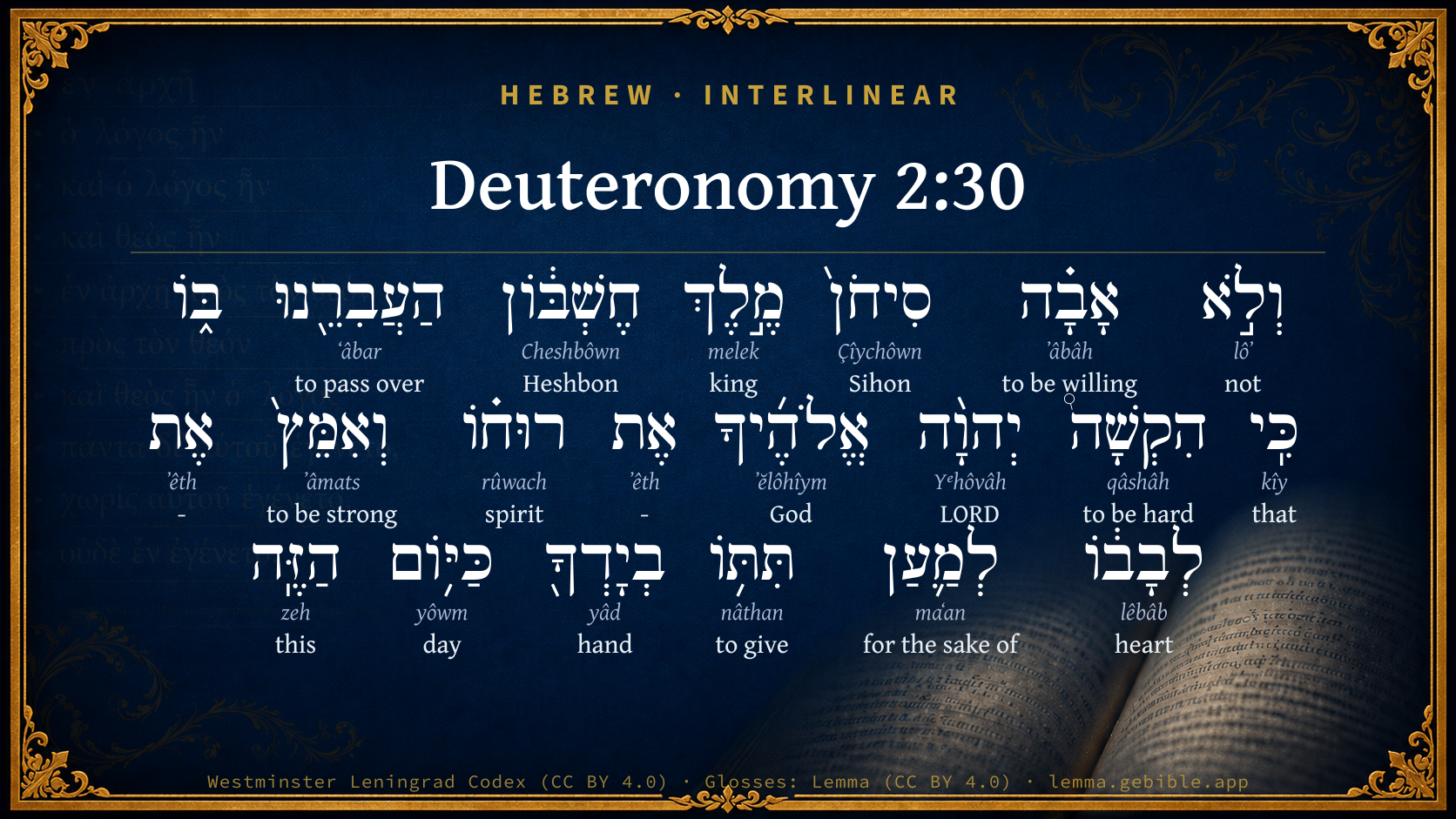
  1. וְלֹ֣א lôʼ H3808 “and · not” Conjunction + Particle, Negative
  2. אָבָ֗ה ʼâbâh H14 “to be willing” Verb, Qal, Perfect, 3rd Person, Masculine, Singular
  3. סִיחֹן֙ Çîychôwn H5511 “Sihon” Noun, Proper
  4. מֶ֣לֶךְ melek H4428 “king of” Noun, Common, Masculine, Singular, Construct
  5. חֶשְׁבּ֔וֹן Cheshbôwn H2809 “Heshbon” Noun, Proper
  6. הַעֲבִרֵ֖נוּ ʻâbar H5674 “to pass over · us” Verb, Hiphil, Infinitive Construct + Suffix, Personal, 1st Person, Common, Plural
  7. כִּֽי kîy H3588 “that” Conjunction
  8. יְהוָ֨ה Yᵉhôvâh H3068 “LORD” Noun, Proper
  9. אֱלֹהֶ֜יךָ ʼĕlôhîym H430 “God(s) · your” Noun, Common, Masculine, Plural, Construct + Suffix, Personal, 2nd Person, Masculine, Singular
  10. אֶת ʼêth H853 “-” Particle, Direct Object
  11. רוּח֗וֹ rûwach H7307 “spirit · his” Noun, Common, Both, Singular, Construct + Suffix, Personal, 3rd Person, Masculine, Singular
  12. וְאִמֵּץ֙ ʼâmats H553 “and · to be strong” Conjunction + Verb, Piel, Perfect, 3rd Person, Masculine, Singular
  13. אֶת ʼêth H853 “-” Particle, Direct Object
  14. לְבָב֔וֹ lêbâb H3824 “heart · his” Noun, Common, Masculine, Singular, Construct + Suffix, Personal, 3rd Person, Masculine, Singular
  15. לְמַ֛עַן maʻan H4616 “for the sake of” Preposition
  16. תִּתּ֥וֹ nâthan H5414 “to give · him” Verb, Qal, Infinitive Construct + Suffix, Personal, 3rd Person, Masculine, Singular
  17. בְיָדְךָ֖ yâd H3027 “in/at · hand · your” Preposition + Noun, Common, Both, Singular, Construct + Suffix, Personal, 2nd Person, Masculine, Singular
  18. כַּיּ֥וֹם yôwm H3117 “like/as the · day” Preposition, Determined + Noun, Common, Masculine, Singular, Absolute
  19. הַזֶּֽה zeh H2088 “the · this” Particle, Definite Article + Pronoun, Demonstrative, Masculine, Singular

About this verse

These counts appear in no published source. They are computed here, from the morphology-tagged text and Lemma’s own curated glosses. What Lemma adds →

21
words
19
distinct lemmas
Pentateuch
section

Shared distinctive vocabulary

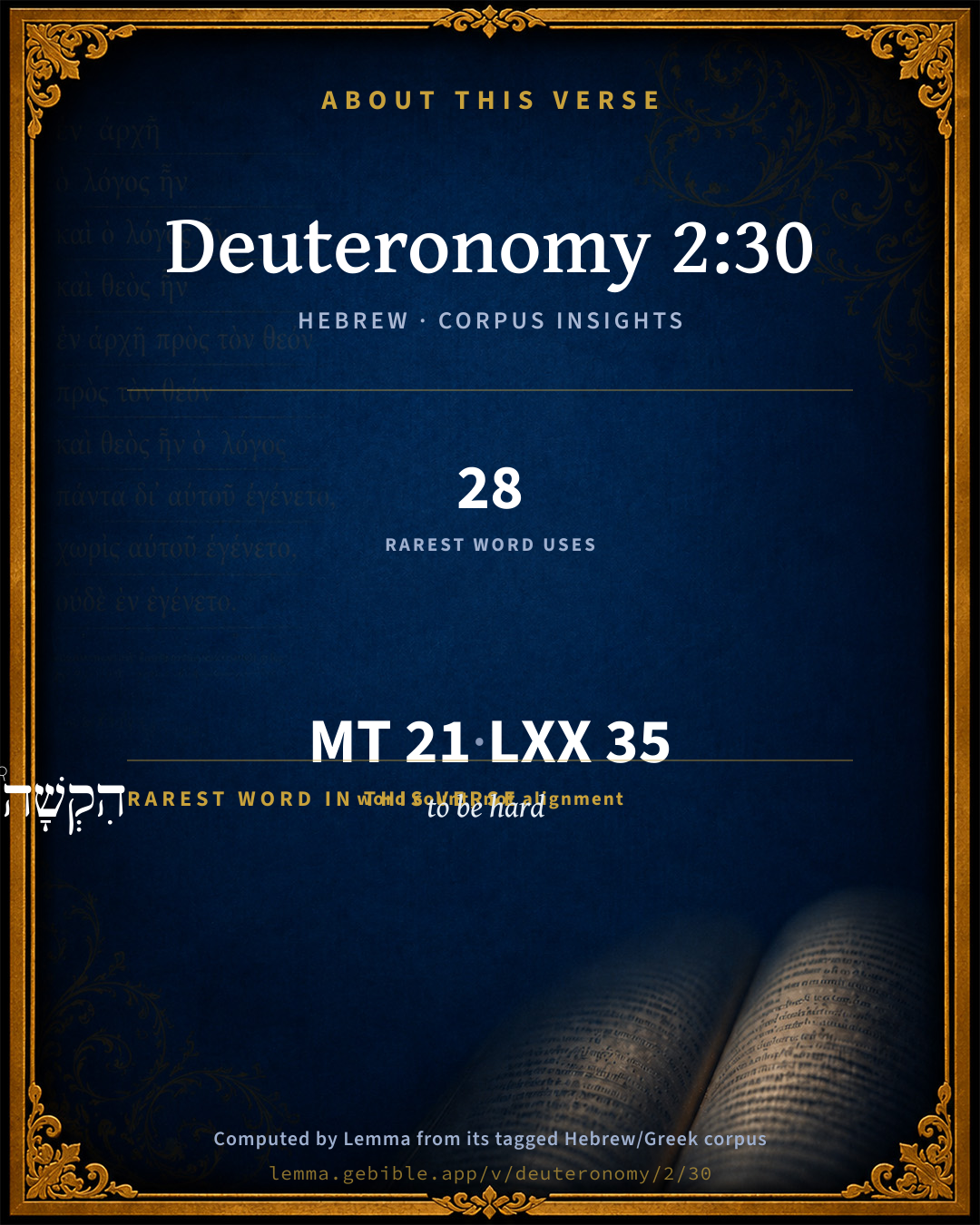
הִקְשָׁה֩ to be hard H7185 occurs in 28 verses of the Hebrew Bible. Also found in:

Grammatical profile

  • 5 verbs
  • 9 nouns
  • 1 pronoun
  • 2 prepositions
  • 1 conjunction
  • 3 particles

Verb forms

  • אָבָ֗ה Qal · Perfect
  • הַעֲבִרֵ֖נוּ Hiphil · Infinitive Construct
  • הִקְשָׁה֩ Hiphil · Perfect
  • וְאִמֵּץ֙ Piel · Perfect
  • תִּתּ֥וֹ Qal · Infinitive Construct

Hebrew & Septuagint length

In English translation the verse runs 36 words from the Hebrew and 38 from the Septuagint (LXX English) — closely comparable.

A rough comparison of the two English renderings, which tokenize alike — not a word-level alignment.

Word counts can differ between the Hebrew and the Greek without any difference in meaning — e.g. the Hebrew direct-object marker אֵת has no separate Greek word, and Greek often adds the article ὁ.

In the original languages it is 21 Hebrew tokens and 35 Greek tokens — but the two are counted differently (Hebrew bundles its prefixes and suffixes into one token; the Greek is in lemma form), so that isn’t a like-for-like length.

Cross-references

7

Topical passages linked to Deuteronomy 2:30 in the Treasury of Scripture Knowledge — connected by theme and wording, ordered by reader-vote popularity; previews shown in the World English Bible.

  • Numbers 21:23 Sihon would not allow Israel to pass through his border: but Sihon gathered all his people together, and went out against Israel into the wilderness, and came to Jahaz; and he fought against Israel.
  • Exodus 4:21 Yahweh said to Moses, "When you go back into Egypt, see that you do before Pharaoh all the wonders which I have put in your hand, but I will harden his heart and he will not let the people go.
  • Exodus 11:10 Moses and Aaron did all these wonders before Pharaoh, and Yahweh hardened Pharaoh's heart, and he didn't let the children of Israel go out of his land.
  • Joshua 11:19–20 There was not a city that made peace with the children of Israel, save the Hivites the inhabitants of Gibeon: they took all in battle.
  • Judges 11:20 But Sihon didn't trust Israel to pass through his border; but Sihon gathered all his people together, and encamped in Jahaz, and fought against Israel.
  • Isaiah 48:4 Because I knew that you are obstinate, and your neck is an iron sinew, and your brow brass;
  • Romans 9:17–23 For the Scripture says to Pharaoh, "For this very purpose I caused you to be raised up, that I might show in you my power, and that my name might be published abroad in all the earth."

Cross-references courtesy of OpenBible.info (CC BY 4.0).

Hebrew and Greek witnesses Masoretic Hebrew ↔ Greek Septuagint

The same verse in the two great witnesses to the Old Testament, shown verse-for-verse.

These are two independent witnesses, not word-aligned to each other, and the Septuagint is shown in lemma (dictionary) form.

Hebrew Deuteronomy 2:30 Masoretic · Westminster Leningrad Codex

וְלֹ֣א אָבָ֗ה סִיחֹן֙ מֶ֣לֶךְ חֶשְׁבּ֔וֹן הַעֲבִרֵ֖נוּ בּ֑וֹ כִּֽי הִקְשָׁה֩ יְהוָ֨ה אֱלֹהֶ֜יךָ אֶת רוּח֗וֹ וְאִמֵּץ֙ אֶת לְבָב֔וֹ לְמַ֛עַן תִּתּ֥וֹ בְיָדְךָ֖ כַּיּ֥וֹם הַזֶּֽה

But Sihon king of Heshbon would not let us pass by him; for Yahweh your God hardened his spirit, and made his heart obstinate, that he might deliver him into your hand, as at this day.

World English Bible · Public Domain

Greek LXX Deuteronomy 2:30 Septuagint · lemma form

καί οὐ θέλω σηων βασιλεύς εσεβων παραἔρχομαι ἐγώ διά αὐτός ὅτι σκληρύνω κύριος ὁ θεός ἐγώ ὁ πνεῦμα αὐτός καί καταἰσχύω ὁ καρδία αὐτός ἵνα παραδίδωμι εἰς ὁ χείρ σύ ὡς ἐν ὁ ἡμέρα οὗτος

And Seon king of Esebon would not that we should pass by him, because the Lord our God hardened his spirit, and made his heart stubborn, that he might be delivered into your hands, as on this day.

LXX2012 (modern English Septuagint) · Public Domain

Hebrew: Westminster Leningrad Codex (CC BY 4.0). Greek: Septuagint (public domain); English from LXX2012 (modern English Septuagint) (Public Domain). How the Septuagint differs from the Hebrew →

Targum (Aramaic paraphrase)

2

The Targum is the ancient Jewish Aramaic paraphrase of the Hebrew Scriptures — an interpretive translation, not the Hebrew text itself. Onkelos (literal) and Pseudo-Jonathan (expansive) render the Torah, and Jonathan the Prophets. Coverage is partial: where no permissively-licensed English translation exists for a verse, only the Aramaic is shown. This is verse-level text, not a word-by-word alignment to the Hebrew.

  1. Targum Onkelos Torah (Genesis–Deuteronomy)
    וְלָא אָבֵי סִיחֹן מַלְכָּא דְחֶשְׁבּוֹן לְמִשְׁבְּקָנָא לְמֶעְבַּר בִּתְחוּמֵהּ אֲרֵי אַקְשִׁי יְיָ אֱלָהָךְ יָת רוּחֵהּ וְתַקִיף יָת לִבֵּהּ בְּדִיל לְמִמְסְרֵהּ בִּידָךְ כְּיוֹמָא הָדֵין

    (no public-domain English translation for this verse)

    Targum Onkelos — Aramaic: “Onkelos Genesis” (public domain); “Onkelos Exodus” (public domain); “Onkelos Leviticus” (public domain); “Onkelos Numbers” (public domain); “Onkelos Deuteronomy” (public domain). English: “Sefaria Community Translation” (CC0 1.0 (public-domain dedication)); “J.W. Etheridge. The Targums of Onkelos and Jonathan Ben Uzziel on the Pentateuch. London: Longmans, Green, 1862” (public domain). Text via Sefaria.

  2. Targum Pseudo-Jonathan Torah (Genesis–Deuteronomy)
    וְלָא צָבָא סִיחוֹן מַלְכָּא דְחֶשְׁבּוֹן לְאַעֲבְּרוּתָנָא בְּגוֹ תְחוּמֵיהּ אֲרוּם אַקְשֵׁי יְיָ אֱלָהָךְ יַת יִצְרָא דְרוּחֵיהּ וְאִיתְקַף יַת לִיבְּבֵיהּ מִן בִּגְלַל לְמִמְסְרֵיהּ בִּידָךְ כְּיוֹמָא הָדֵין

    But Sihon the king of Heshbon was not willing to allow us to pass through his borders; for the Lord our God had hardened the form of his spirit, and made his heart obstinate, to deliver him into thy hand as at this day.

    Targum Pseudo-Jonathan — Aramaic: “Targum Jonathan on Genesis” (public domain); “Targum Jonathan on Exodus” (public domain); “Targum Jonathan on Leviticus” (public domain); “Targum Jonathan on Numbers” (public domain); “Targum Jonathan on Deuteronomy” (public domain). English: “The Targum of Jonathan ben Uzziel, trans. J. W. Etheridge, London, 1862” (public domain). Text via Sefaria.

Commentary

Notes on Deuteronomy 2:30 from classic Christian and Jewish commentators (each source and its license shown beneath its notes). The classic Christian expositions comment on the surrounding passage and are grouped to its opening verse, so a note may address several verses; the Jewish commentaries on the Tanakh (Rashi and others) are per-verse, so they appear only where the commentator wrote on this verse.

Lemma curates 59 commentaries, every one of them public domain or Creative Commons licensed, each selected and text-cleaned for this edition rather than reprinted as found. About our sources →

Trapp's Complete Commentary

John Trapp

Deu 2:30 But Sihon king of Heshbon would not let us pass by him: for the LORD thy God hardened his spirit, and made his heart obstinate, that he might deliver him into thy hand, as [appeareth] this day.

Ver. 30. Had hardened his spirit.] Deus quem destruit, dementat. God makes fools of those whom he intends to destroy.

John Trapp, A Commentary or Exposition upon All the Books of the Old and New Testament (1647–1656) — public domain. Text from a community e-Sword module.

Tyndale Open Study Notes

Tyndale Open Resources

2:30 made Sihon stubborn and defiant (literally had hardened his spirit and strengthened his heart): Like Pharaoh (see Exod 7:13), Sihon was incorrigibly unrepentant and thus experienced God’s wrath. God knew that any further extension of grace to these rulers would be useless. Mystery surrounds the relationship between statements that people harden their own hearts (e.g., Exod 7:13, 22; 8:15) and statements that God hardens people’s hearts (e.g., Exod 4:21; 7:3; 9:12). What is clear is that God appeals for repentance and is ready to forgive, but when people continually ignore or reject his appeals, they can become incapable of hearing and obeying God (see “Hardened Hearts” Theme Note; Rom 1:21-28; 9:17-24).

Tyndale Open Study Notes — © Tyndale Open Resources, licensed CC BY-SA 4.0. Text via the HelloAO Bible API.

Geneva Bible (1599)

Geneva Bible translators

God in his election and reprobation doth not only appoint the ends, but the means tending to the same.

Geneva Bible (1599) marginal notes — public domain. Text via Bolls.life.

Adam Clarke's Commentary

Verse 30. The Lord - hardened his spirit] See Clarke on Ex 4:21, and "Ex 9:15", &c.

Adam Clarke's Commentary on the Bible (1810–1826) — public domain. Text from a community e-Sword/MySword module.

Ellicott's Commentary for English Readers

(30) The Lord thy God hardened his spirit, and made his heart obstinate.—Jehovah gave the strength to Sihon, as He had done to Pharaoh, and as He does to all. Sihon was responsible for using the strength which God gave him in opposition to the Divine purposes. To “harden” a man’s spirit is not necessarily a moral process any more than the hardening of steel. “Made obstinate” is the same verb used in Jos_1:6, for “Be of a good courage.” An unyielding spirit and a courageous heart are good or bad according to the use made of them. Sihon used them badly, Joshua used them well. God’s gifts were the same to both. (See also Jos_11:20.)

A Bible Commentary for English Readers, edited by Charles John Ellicott (1878–1897) — public domain. Text from a community e-Sword module.

The Cambridge Bible for Schools and Colleges

gen. ed. J. J. S. Perowne

30. But Sihon … would not let us pass by him) E, Num_21:23 : S. would not allow (another verb) Israel to cross his territory.

for the Lord thy God hardened his spirit] Sg. address; it is at least remarkable that the change coincides with a religious explanation of Sîḥôn’s resistance, for which E has here no parallel. The phrase is found elsewhere in P, Exo_7:3, but with heart for spirit.

made his heart obstinate] Heb. strong, usually in a good sense, in a bad only here, Deu_15:7 and 2Ch_36:13. In E, Exo_4:21, the same meaning with another verb.

as at this day] Another deuteronomic formula: Deu_4:20; Deu_4:38, Deu_6:24, Deu_8:18, Deu_10:15, Deu_29:28; 1Ki_3:6; 1Ki_8:24, etc. Here its appropriateness is not obvious; these formulas tend to creep in where they are not required.

The Cambridge Bible for Schools and Colleges (gen. ed. J. J. S. Perowne; Cambridge University Press, 1878–1918) — public domain. Text from a community e-Sword module.

John Gill's Exposition

But Sihon king of Heshbon would not let us pass by him,.... Or through his country, as was desired:

for the Lord had hardened his spirit, and made his heart obstinate; as he did Pharaoh's, for whom he will he hardens; so that he would not listen to the proposals made to him, nor grant the requests asked of him, but with pride and haughtiness of spirit despised and disdained Israel:

that he might deliver him into thine hand; that so an opportunity might offer of fighting with him, and taking his country from him; whereas, had he been peaceable and flexible, he had continued in the enjoyment of his land, and Israel would not have had that advantage against him; but God, who has the hearts of kings and of all men in his hands, so wrought upon him that he should take the steps he did, which made way for the delivery of him and his country into the hands of the Israelites:

as appeareth this day: for when Moses made this speech, the kingdom of Sihon was possessed by the Israelites, Num 21:24.

John Gill's Exposition of the Whole Bible (1746–1763) — public domain (CC PDM 1.0). Text via the HelloAO Bible API.

Haydock's Catholic Bible Commentary

Hardened, &c. That is, in punishment of his past sins, he left him to his own stubborn and perverse disposition, which drew him to his ruin. See the note on Exodus vii. 3. (Challoner) --- God did not soften his heart, (Menochius) nor make him see the danger to which he was exposing his dominions, by provoking such an army. (Haydock)

George Leo Haydock (1774–1849), Haydock's Catholic Family Bible and Commentary, 1859 edition — public domain. Excludes Psalms (Douay-Rheims chapter numbering differs from Protestant) and Deuterocanonical books (Catholic canon only).

Matthew Poole's English Annotations

By him, i.e. by his borders. Obstinate; unmovable and inexorable to our desires.

Matthew Poole's English Annotations on the Holy Bible (1683–1685) — public domain. Text from a community e-Sword/MySword module.

Whedon's Commentary on the Bible

Daniel D. Whedon

30. As appeareth this day — That is, as the result has shown.

Daniel D. Whedon (gen. ed.), Commentary on the Old and New Testaments (1874–1909) — public domain. Text from a community e-Sword module.

The Pulpit Commentary

Heshbon, the chief city of the Amorite king, Sihon. Some ruins on a hill east of the upper end of the Dead Sea, and bearing the name Chesban, mark the site of this once large and important city. Sihon rejected Moses" overtures of peace, because God had hardened his spirit, and made his heart obstinate; literally, had sharpened his heart, had made his determination keen. It is not to be supposed that any influence was directly exerted on him, to make him obdurate and persistent in his hostility to the people of God; the expression "he would not" indicates that it was of his own will that Sihon acted; but it was the will and purpose of God that Sihon should be destroyed, and his country taken by the Israelites, and so he was placed in circumstances by which, "given over to a reprobate mind," he was confirmed and strengthened m his determination to pursue a course which led to his destruction; like Pharaoh, by the circumstances in which God placed him, he found scope for the display and for the confirmation of a stubborn, pertinacious pride of spirit, which led ultimately to his ruin. Nothing so hardens the heart as resistance to God"s overtures of peace. As appeareth this day; i.e. as present experience shows; in Sihon"s refusing to let them pass, there was already an actual beginning of the fulfillment of God"s purpose to deliver him into the hand of the Israelites.

The Pulpit Commentary (1880–1919), ed. H.D.M. Spence-Jones & Joseph S. Exell — public domain. Text from a community e-Sword module.

John Wesley's Explanatory Notes

Hardened his spirit - That is, suffered it to be hardened.

John Wesley, Explanatory Notes Upon the Whole Bible (1754–1765) — public domain. Text via the GEBible commentary corpus.

unfoldingWord translationNotes

Door43 World Missions Community

General Information:

Moses continues to remind the people of what happened in the past.

Sihon ... Heshbon

These are the names of a man and a place. See how you translated them in Deuteronomy 1:4. (See: How to Translate Names)

your God ... your might

Moses speaks to the Israelites as if they were one man, so all instances of "your" are singular. (See: Forms of You)

hardened his mind and made his heart obstinate

Both of these phrases mean the same thing and emphasize that Yahweh "caused him to become very stubborn." (See: Parallelism)

to deliver up Sihon and his land before you

"to give Sihon and his land over to you"

begin to possess it, in order that you may inherit his land

"take possession of his land, so that you may inherit it"

translationWords

king

Yahweh

God

mind

heart

might

deliver

possess

inherit

unfoldingWord translationNotes — © Distant Shores Media and the Door43 World Missions Community, licensed CC BY-SA 4.0. Source: git.door43.org/Door43/en_tn.

Lesson kit

Teaching starters — assembled from the data on this page, not authored interpretation. Every prompt links to the verse data it draws on. Edit before teaching.

Deuteronomy, in the Pentateuch, opens this verse with 21 words (19 distinct Hebrew lemmas). Its most distinctive word is qâshâh (“to be hard”). A historical commentator’s framing appears above. Read the whole chapter for the surrounding context.

Discussion questions

  1. What does “to be hard” (qâshâh) contribute to the verse as a whole?
  2. Genesis 35:16 shares the word «to be hard» with this verse. How do the two illuminate each other?
  3. These translations render this verse differently. What is at stake in choosing one wording over another?
  4. The verb «אָבָ֗ה» is Qal Perfect. How does its form color the action?
  5. Reading how Trapp's Complete Commentary and Tyndale Open Study Notes read this verse, where do the two commentators agree and where do they part?

Things to notice

Reading settings

Reading text

Shown beneath each verse's original-language words.

Old Testament
Old Testament edition

Read the OT as the Masoretic Hebrew (MT) or the Greek Septuagint (LXX).

English shown for the Greek Septuagint (in the Hebrew ↔ Greek comparison).

Comparing translations? Open the Compare panel on any verse page to stack up to four side by side.