
Exodus 35:21

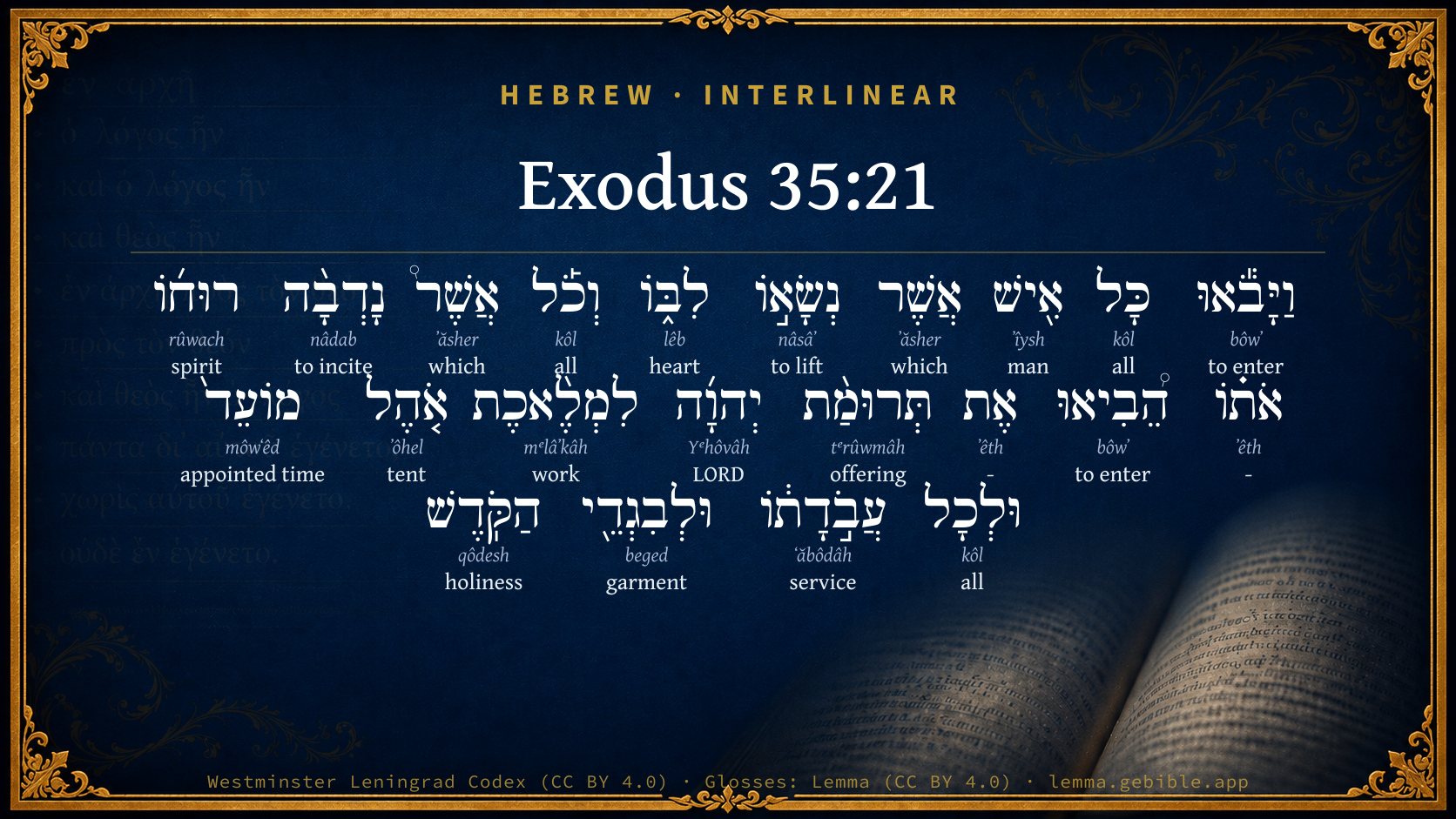
Hebrew (Westminster Leningrad Codex) Exodus 35:21 appears in the Hebrew Old Testament. The text above is from the Westminster Leningrad Codex. Each word links to its Strong’s number, a concise gloss, and parsing drawn from the Open Scriptures Hebrew Bible morphology. Click any word for its full Brown-Driver-Briggs (BDB) entry.
Download image
Cite this verse

Exodus 35:21 (World English Bible). Public Domain. Lemma interlinear Bible study tool, https://lemma.gebible.app/v/exodus/35/21.

Show BibTeX & RIS
BibTeX
RIS
English Translation
They came, everyone whose heart stirred him up, and everyone whom his spirit made willing, and brought Yahweh's offering, for the work of the tent of meeting, and for all of its service, and for the holy garments.
World English Bible · Public Domain
Download a study sheet

One document with this verse’s original text, its word-by-word gloss line, the meaning frame, cross-references with their text, attributed commentary, and full source and license credits — printable, and it pastes into notes with its structure intact.

This verse Autodidact and up

Study sheet (.html) Plain text (.txt)

A passage Seminary Student

Up to 50 verses in one chapter. A passage sheet keeps up to 6 commentary sources and 12 cross-references per verse, in the order this page ranks them, and says so on the sheet whenever that leaves anything out. Ask for a single verse and you get the Autodidact verse sheet above.

Everything on this page stays free to read, with no account — the sheet is a download of what is already on screen, not access to it.

Want to remove ads? Support Godless Engineer
Compare translations 3

The same verse in 3 English versions, stacked beneath the original-language interlinear above. Click any original word for its lexicon entry.

Each is an independent rendering of the whole verse — the interlinear is not word-aligned to these translations.

Highlighted words mark where these versions differ — a whole-verse word diff, not a word-by-word alignment.

  • World English Bible Public Domain
    They came, everyone whose heart stirred him up, and everyone whom his spirit made willing, and brought Yahweh's offering, for the work of the tent of meeting, and for all of its service, and for the holy garments.
  • King James Version Public Domain
    And they came, every one whose heart stirred him up, and every one whom his spirit made willing, and they brought the LORD's offering to the work of the tabernacle of the congregation, and for all his service, and for the holy garments.
  • unfoldingWord Literal Text CC BY-SA 4.0
    And every man whose heart lifted him came. And all whose spirit impelled him brought the contribution of Yahweh for the work of the tent of meeting and for all of its service and for the clothing of holiness.

unfoldingWord Literal Text — © unfoldingWord, licensed CC BY-SA 4.0. Word-aligned USFM3 via Door43 (git.door43.org/unfoldingWord/en_ult).

Versions to compare (up to 4)

3 of 4 selected

Show all 18 translations

Every available English version of this verse, each an independent rendering of the whole verse.

  • World English Bible Public Domain
    They came, everyone whose heart stirred him up, and everyone whom his spirit made willing, and brought Yahweh's offering, for the work of the tent of meeting, and for all of its service, and for the holy garments.
  • Berean Standard Bible Public Domain
    And everyone whose heart stirred him and whose spirit prompted him came and brought an offering to the LORD for the work on the Tent of Meeting, for all its services, and for the holy garments.
  • Majority Standard Bible Public Domain
    And everyone whose heart stirred him and whose spirit prompted him came and brought an offering to the LORD for the work on the Tent of Meeting, for all its services, and for the holy garments.
  • King James Version Public Domain
    And they came, every one whose heart stirred him up, and every one whom his spirit made willing, and they brought the LORD's offering to the work of the tabernacle of the congregation, and for all his service, and for the holy garments.
  • American Standard Version (1901) Public Domain
    And they came, every one whose heart stirred him up, and every one whom his spirit made willing, `and' brought Jehovah's offering, for the work of the tent of meeting, and for all the service thereof, and for the holy garments.
  • Revised Version (1885) Public Domain
    And they came, every one whose heart stirred him up, and every one whom his spirit made willing, and brought the LORD’S offering, for the work of the tent of meeting, and for all the service thereof, and for the holy garments.
  • Geneva Bible (1599) Public Domain
    And euery one, whose heart encouraged him, and euery one, whose spirit made him willing, came and brought an offring to the Lord, for the worke of the Tabernacle of the Congregation, and for all his vses, and for the holy garments.
  • Douay-Rheims (1899) Public Domain
    Offered firstfruits to the Lord with a most ready and devout mind, to make the work of the tabernacle of the testimony. Whatsoever was necessary to the service, and to the holy vestments,
  • Young's Literal Translation Public Domain
    and they come in -- every man whom his heart hath lifted up, and every one whom his spirit hath made willing -- they have brought in the heave-offering of Jehovah for the work of the tent of meeting, and for all its service, and for the holy garments.
  • Literal Standard Version CC BY-SA 4.0
    and they come in—every man whom his heart has lifted up, and everyone whom his spirit has made willing—they have brought in the raised-offering of YHWH for the work of the Tent of Meeting, and for all its service, and for the holy garments.
  • Unlocked Literal Bible CC BY-SA 4.0
    Everyone whose heart stirred him up and whom his spirit made willing came and brought an offering to Yahweh for the construction of the tabernacle, for all the items of service in it, and for the holy garments.
  • unfoldingWord Literal Text CC BY-SA 4.0
    And every man whose heart lifted him came. And all whose spirit impelled him brought the contribution of Yahweh for the work of the tent of meeting and for all of its service and for the clothing of holiness.
  • Darby Bible Public Domain
    And they came, every one whose heart moved him, and every one whose spirit prompted him; they brought Jehovah's heave-offering for the work of the tent of meeting, and for all its service, and for the holy garments.
  • World Messianic Bible Public Domain
    They came, everyone whose heart stirred him up, and everyone whom his spirit made willing, and brought the LORD’s offering for the work of the Tent of Meeting, and for all of its service, and for the holy garments.
  • Webster's Bible Public Domain
    And they came, every one whose heart excited him, and every one whom his spirit made willing, and they brought the LORD'S offering to the work of the tabernacle of the congregation, and for all his service, and for the holy garments.
  • Free Bible Version CC BY-SA 4.0
    and all those who felt moved to do so and who had a willing spirit came and brought an offering to the Lord for the work making the Tent of Meeting, for everything required for its services, and for the sacred clothing.
  • Bible in Basic English Public Domain
    And everyone whose heart was moved, everyone who was guided by the impulse of his spirit, came with his offering for the Lord, for whatever was needed for the Tent of meeting and its work and for the holy robes.
  • JPS Tanakh (1917) Public Domain
    And they came, every one whose heart stirred him up, and every one whom his spirit made willing, and brought the LORD'S offering, for the work of the tent of meeting, and for all the service thereof, and for the holy garments.

Literal Standard Version (2020), Covenant Press — licensed CC BY-SA 4.0. Text via the HelloAO Bible API (eBible.org). Unlocked Literal Bible (unfoldingWord) — licensed CC BY-SA 4.0. Text via the HelloAO Bible API (eBible.org). unfoldingWord Literal Text — © unfoldingWord, licensed CC BY-SA 4.0. Word-aligned USFM3 via Door43 (git.door43.org/unfoldingWord/en_ult). Free Bible Version, Dr. Jonathan Gallagher — licensed CC BY-SA 4.0. Text via the HelloAO Bible API (eBible.org).

Word by word

More ways to search: Search by grammar → Find every occurrence → Compare this word →

Practice this passage: Drill this verse → Learn its vocabulary →

נָדְבָ֨ה
nâdab
H5068
“to incite”
Verb, Qal, Perfect, 3rd Person, Feminine, Singular
Part of Speech
Verb
Stem
Qal
Form
Perfect
Person
3rd Person
Gender
Feminine
Number
Singular
Full BDB Definition

Origin: a primitive root

TWOT: 1299

to incite, impel, make willing - (Qal) to incite, impel - (Hithpael) - to volunteer - to offer free-will offerings
  1. וַיָּבֹ֕אוּ bôwʼ H935 “and · to enter” Conjunction + Verb, Qal, Sequential Imperfect, 3rd Person, Masculine, Plural
  2. כָּל kôl H3605 “all of” Noun, Common, Masculine, Singular, Construct
  3. אִ֖ישׁ ʼîysh H376 “man” Noun, Common, Masculine, Singular, Absolute
  4. אֲשֶׁר ʼăsher H834 “which” Particle, Relative
  5. נְשָׂא֣וֹ nâsâʼ H5375 “to lift · him” Verb, Qal, Perfect, 3rd Person, Masculine, Singular + Suffix, Personal, 3rd Person, Masculine, Singular
  6. לִבּ֑וֹ lêb H3820 “heart · his” Noun, Common, Masculine, Singular, Construct + Suffix, Personal, 3rd Person, Masculine, Singular
  7. וְכֹ֡ל kôl H3605 “and · all” Conjunction + Noun, Common, Masculine, Singular, Absolute
  8. אֲשֶׁר֩ ʼăsher H834 “which” Particle, Relative
  9. רוּח֜וֹ rûwach H7307 “spirit · his” Noun, Common, Both, Singular, Construct + Suffix, Personal, 3rd Person, Masculine, Singular
  10. אֹת֗וֹ ʼêth H853 “- · him” Particle, Direct Object + Suffix, Personal, 3rd Person, Masculine, Singular
  11. הֵ֠בִיאוּ bôwʼ H935 “to enter” Verb, Hiphil, Perfect, 3rd Person, Common, Plural
  12. אֶת ʼêth H853 “-” Particle, Direct Object
  13. תְּרוּמַ֨ת tᵉrûwmâh H8641 “offering of” Noun, Common, Feminine, Singular, Construct
  14. יְהוָ֜ה Yᵉhôvâh H3068 “LORD” Noun, Proper
  15. לִמְלֶ֨אכֶת mᵉlâʼkâh H4399 “to/for · work of” Preposition + Noun, Common, Feminine, Singular, Construct
  16. אֹ֤הֶל ʼôhel H168 “tent of” Noun, Common, Masculine, Singular, Construct
  17. מוֹעֵד֙ môwʻêd H4150 “appointed time” Noun, Common, Masculine, Singular, Absolute
  18. וּלְכָל kôl H3605 “and · to/for · all of” Conjunction + Preposition + Noun, Common, Masculine, Singular, Construct
  19. עֲבֹ֣דָת֔וֹ ʻăbôdâh H5656 “service · his” Noun, Common, Feminine, Singular, Construct + Suffix, Personal, 3rd Person, Masculine, Singular
  20. וּלְבִגְדֵ֖י beged H899 “and · to/for · garments of” Conjunction + Preposition + Noun, Common, Masculine, Plural, Construct
  21. הַקֹּֽדֶשׁ qôdesh H6944 “the · holiness” Particle, Definite Article + Noun, Common, Masculine, Singular, Absolute

About this verse

These counts appear in no published source. They are computed here, from the morphology-tagged text and Lemma’s own curated glosses. What Lemma adds →

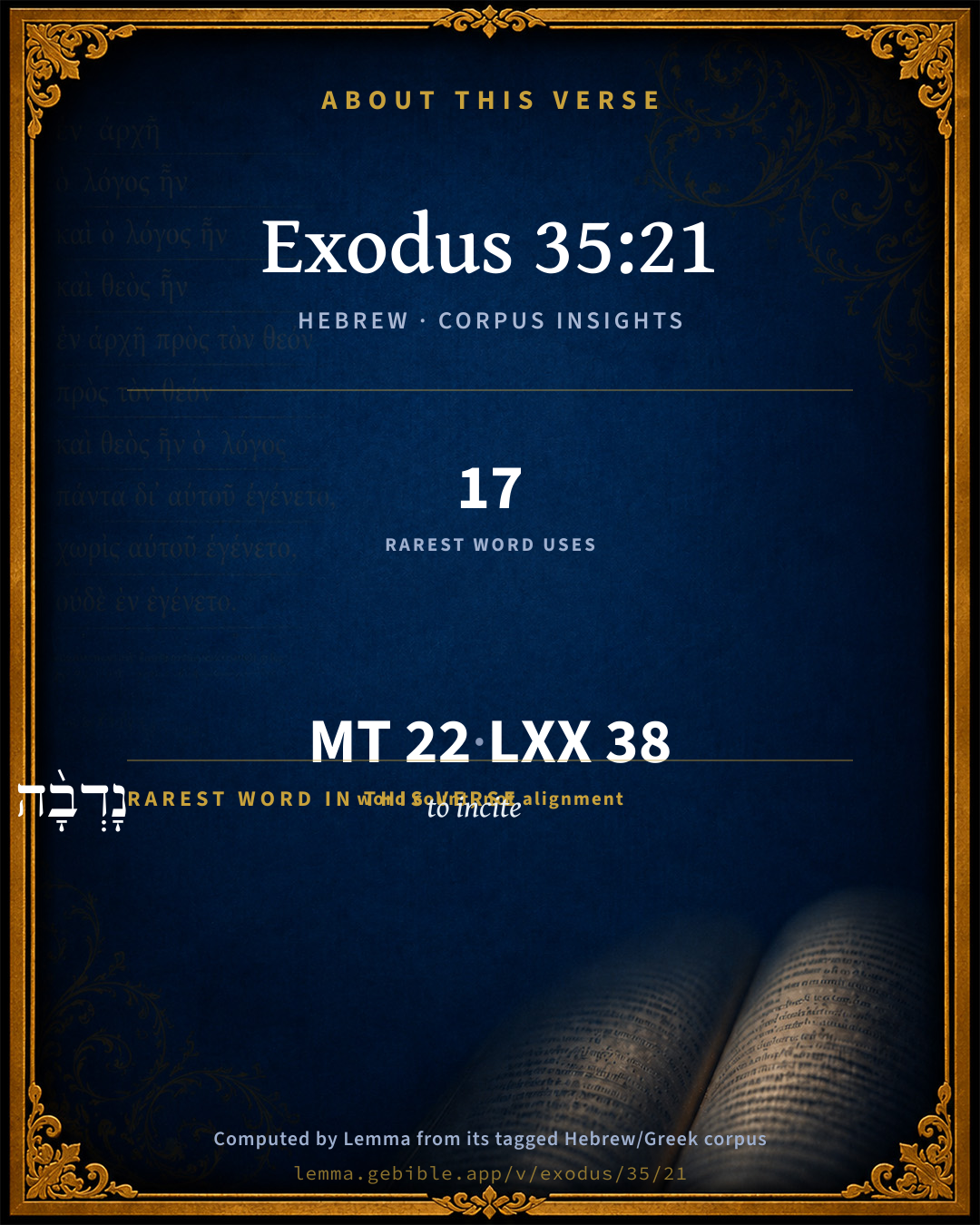
22
words
17
distinct lemmas
Pentateuch
section

Notable vocabulary

The rarest word here is נָדְבָ֨ה to incite H5068 — appearing just 17 times in the whole Hebrew Bible.

Shared distinctive vocabulary

נָדְבָ֨ה to incite H5068 occurs in 15 verses of the Hebrew Bible. Also found in:

Grammatical profile

  • 4 verbs
  • 14 nouns
  • 4 particles

Verb forms

  • וַיָּבֹ֕אוּ Qal · Sequential Imperfect
  • נְשָׂא֣וֹ Qal · Perfect
  • נָדְבָ֨ה Qal · Perfect
  • הֵ֠בִיאוּ Hiphil · Perfect

Repetition

Words recur within this verse — often emphatic in Hebrew:

  • כָּל all H3605 ×3
  • וַיָּבֹ֕אוּ to enter H935 ×2
  • אֲשֶׁר which H834 ×2

Hebrew & Septuagint length

In English translation the verse runs 38 words from the Hebrew and 29 from the Septuagint (LXX English) — closely comparable.

A rough comparison of the two English renderings, which tokenize alike — not a word-level alignment.

Word counts can differ between the Hebrew and the Greek without any difference in meaning — e.g. the Hebrew direct-object marker אֵת has no separate Greek word, and Greek often adds the article ὁ.

In the original languages it is 22 Hebrew tokens and 38 Greek tokens — but the two are counted differently (Hebrew bundles its prefixes and suffixes into one token; the Greek is in lemma form), so that isn’t a like-for-like length.

Cross-references

25

Topical passages linked to Exodus 35:21 in the Treasury of Scripture Knowledge — connected by theme and wording, ordered by reader-vote popularity; previews shown in the World English Bible.

  • Exodus 25:2 "Speak to the children of Israel, that they take an offering for me. From everyone whose heart makes him willing you shall take my offering.
  • Exodus 35:26 All the women whose heart stirred them up in wisdom spun the goats' hair.
  • Exodus 35:29 The children of Israel brought a freewill offering to Yahweh; every man and woman, whose heart made them willing to bring for all the work, which Yahweh had commanded to be made by Moses.
  • 1 Chronicles 29:14 But who am I, and what is my people, that we should be able to offer so willingly as this? For all things come of you, and of your own have we given you.
  • Exodus 35:5 'Take from among you an offering to Yahweh. Whoever is of a willing heart, let him bring it, Yahweh's offering: gold, silver, brass,
  • Exodus 35:22 They came, both men and women, as many as were willing-hearted, and brought brooches, ear-rings, signet-rings, and armlets, all jewels of gold; even every man who offered an offering of gold to Yahweh.
  • Exodus 36:2 Moses called Bezalel and Oholiab, and every wise-hearted man, in whose heart Yahweh had put wisdom, even everyone whose heart stirred him up to come to the work to do it:
  • Judges 5:3 Hear, you kings; give ear, you princes; I, [even] I, will sing to Yahweh; I will sing praise to Yahweh, the God of Israel.
  • Judges 5:9 My heart is toward the governors of Israel, Who offered themselves willingly among the people: Bless you Yahweh.
  • Judges 5:12 Awake, awake, Deborah; Awake, awake, utter a song: Arise, Barak, and lead away your captives, you son of Abinoam.
  • 2 Samuel 7:27 For you, Yahweh of Hosts, the God of Israel, have revealed to your servant, saying, I will build you a house: therefore has your servant found in his heart to pray this prayer to you.
  • 1 Chronicles 28:2 Then David the king stood up on his feet, and said, Hear me, my brothers, and my people: as for me, it was in my heart to build a house of rest for the ark of the covenant of Yahweh, and for the footstool of our God; and I had made ready for the building.
  • 1 Chronicles 28:9 You, Solomon my son, know the God of your father, and serve him with a perfect heart and with a willing mind; for Yahweh searches all hearts, and understands all the imaginations of the thoughts: if you seek him, he will be found of you; but if you forsake him, he will cast you off forever.
  • 1 Chronicles 29:3 In addition, because I have set my affection on the house of my God, seeing that I have a treasure of my own of gold and silver, I give it to the house of my God, over and above all that I have prepared for the holy house,
  • 1 Chronicles 29:5–6 of gold for the [things of] gold, and of silver for the [things of] silver, and for all manner of work [to be made] by the hands of artificers. Who then offers willingly to consecrate himself this day to Yahweh?
  • 1 Chronicles 29:9 Then the people rejoiced, because they offered willingly, because with a perfect heart they offered willingly to Yahweh: and David the king also rejoiced with great joy.
  • 1 Chronicles 29:17–18 I know also, my God, that you try the heart, and have pleasure in uprightness. As for me, in the uprightness of my heart I have willingly offered all these things: and now have I seen with joy your people, that are present here, offer willingly to you.
  • Ezra 1:5–6 Then rose up the heads of fathers' [houses] of Judah and Benjamin, and the priests, and the Levites, even all whose spirit God had stirred to go up to build the house of Yahweh which is in Jerusalem.
  • Ezra 7:27 Blessed be Yahweh, the God of our fathers, who has put such a thing as this in the king's heart, to beautify the house of Yahweh which is in Jerusalem;
  • Psalms 110:3 Your people offer themselves willingly in the day of your power, in holy array. Out of the womb of the morning, you have the dew of your youth.
  • Proverbs 4:23 Keep your heart with all diligence, For out of it is the wellspring of life.
  • Jeremiah 30:21 Their prince shall be of themselves, and their ruler shall proceed from the midst of them; and I will cause him to draw near, and he shall approach to me: for who is he who has had boldness to approach to me? says Yahweh.
  • Matthew 12:34 You offspring of vipers, how can you, being evil, speak good things? For out of the abundance of the heart, the mouth speaks.
  • 2 Corinthians 8:12 For if the readiness is there, it is acceptable according to what you have, not according to what you don't have.
  • 2 Corinthians 9:7 Let each man give according as he has determined in his heart; not grudgingly, or under compulsion; for God loves a cheerful giver.

Cross-references courtesy of OpenBible.info (CC BY 4.0).

Hebrew and Greek witnesses Masoretic Hebrew ↔ Greek Septuagint

The same verse in the two great witnesses to the Old Testament, shown verse-for-verse.

These are two independent witnesses, not word-aligned to each other, and the Septuagint is shown in lemma (dictionary) form.

Hebrew Exodus 35:21 Masoretic · Westminster Leningrad Codex

וַיָּבֹ֕אוּ כָּל אִ֖ישׁ אֲשֶׁר נְשָׂא֣וֹ לִבּ֑וֹ וְכֹ֡ל אֲשֶׁר֩ נָדְבָ֨ה רוּח֜וֹ אֹת֗וֹ הֵ֠בִיאוּ אֶת תְּרוּמַ֨ת יְהוָ֜ה לִמְלֶ֨אכֶת אֹ֤הֶל מוֹעֵד֙ וּלְכָל עֲבֹ֣דָת֔וֹ וּלְבִגְדֵ֖י הַקֹּֽדֶשׁ

They came, everyone whose heart stirred him up, and everyone whom his spirit made willing, and brought Yahweh's offering, for the work of the tent of meeting, and for all of its service, and for the holy garments.

World English Bible · Public Domain

Greek LXX Exodus 35:21 Septuagint · lemma form

καί φέρω ἕκαστος ὅς φέρω αὐτός ὁ καρδία καί ὅσος δοκέω ὁ ψυχή αὐτός φέρω ἀφαίρεμα κύριος εἰς πᾶς ὁ ἔργον ὁ σκηνή ὁ μαρτύριον καί εἰς πᾶς ὁ κάτεργον αὐτός καί εἰς πᾶς ὁ στολή ὁ ἅγιος

and they brought an offering to the Lord for all the works of the tabernacle of witness, and all its services, and for all the robes of the sanctuary.

LXX2012 (modern English Septuagint) · Public Domain

Hebrew: Westminster Leningrad Codex (CC BY 4.0). Greek: Septuagint (public domain); English from LXX2012 (modern English Septuagint) (Public Domain). How the Septuagint differs from the Hebrew →

Targum (Aramaic paraphrase)

2

The Targum is the ancient Jewish Aramaic paraphrase of the Hebrew Scriptures — an interpretive translation, not the Hebrew text itself. Onkelos (literal) and Pseudo-Jonathan (expansive) render the Torah, and Jonathan the Prophets. Coverage is partial: where no permissively-licensed English translation exists for a verse, only the Aramaic is shown. This is verse-level text, not a word-by-word alignment to the Hebrew.

  1. Targum Onkelos Torah (Genesis–Deuteronomy)
    וַאֲתוֹ כָּל גְבַר דְאִתְרְעֵי לִבֵּהּ וְכֹל דִי אַשְׁלֵמַת רוּחֵהּ יָתֵהּ אַיְתִיאוּ יָת אַפְרָשׁוּתָא קֳדָם יְיָ לַעֲבִידַת מַשְׁכַּן זִמְנָא וּלְכָל פֻּלְחָנֵהּ וְלִלְבוּשֵׁי קוּדְשָׁא:

    (no public-domain English translation for this verse)

    Targum Onkelos — Aramaic: “Onkelos Genesis” (public domain); “Onkelos Exodus” (public domain); “Onkelos Leviticus” (public domain); “Onkelos Numbers” (public domain); “Onkelos Deuteronomy” (public domain). English: “Sefaria Community Translation” (CC0 1.0 (public-domain dedication)); “J.W. Etheridge. The Targums of Onkelos and Jonathan Ben Uzziel on the Pentateuch. London: Longmans, Green, 1862” (public domain). Text via Sefaria.

  2. Targum Pseudo-Jonathan Torah (Genesis–Deuteronomy)
    וְאָתוֹ כָּל גְּבַר דְּאִתְרְעֵי לִבֵּיהּ וְכָל דְּאַשְׁלֵמִית רוּחֵיהּ בִּנְבוּאָתָא דְעִמֵּיהּ הַיְתִיוּ יַת אַפְרָשׁוּתָא לִקְדָם יְיָ לְעִיבִידַת מַשְׁכַּן זִימְנָא וּלְכָל פּוּלְחָנֵיהּ וְלִלְבוּשֵׁיהּ קוּדְשָׁא

    And every man whose heart moved him, and every one who was filled with the Spirit of prophecy, came, and brought what he had for a separation before the Lord for the work of the tabernacle of ordinance, and for all its service, and for the holy vestments.

    Targum Pseudo-Jonathan — Aramaic: “Targum Jonathan on Genesis” (public domain); “Targum Jonathan on Exodus” (public domain); “Targum Jonathan on Leviticus” (public domain); “Targum Jonathan on Numbers” (public domain); “Targum Jonathan on Deuteronomy” (public domain). English: “The Targum of Jonathan ben Uzziel, trans. J. W. Etheridge, London, 1862” (public domain). Text via Sefaria.

Commentary

Notes on Exodus 35:21 from classic Christian and Jewish commentators (each source and its license shown beneath its notes). The classic Christian expositions comment on the surrounding passage and are grouped to its opening verse, so a note may address several verses; the Jewish commentaries on the Tanakh (Rashi and others) are per-verse, so they appear only where the commentator wrote on this verse.

Lemma curates 59 commentaries, every one of them public domain or Creative Commons licensed, each selected and text-cleaned for this edition rather than reprinted as found. About our sources →

Joseph Benson's Commentary

Exo 35:21-22. Every one whom his spirit made willing — What they did they did cheerfully. They were willing; and it was not any external inducement that made them so, but their spirits. It was from a principle of love to God and his service; a desire of his presence with them by his ordinances, gratitude for the great things he had done for them, and faith in his promises of what he would do further.

Joseph Benson's Commentary on the Old and New Testaments (1811–1818) — public domain. Text from a community e-Sword module.

MacLaren's Expositions of Holy Scripture

Alexander MacLaren

Exodus

AN OLD SUBSCRIPTION LIST

Exo 35:21.

This is the beginning of the catalogue of contributions towards the erection of the Tabernacle in the wilderness. It emphasises the purely spontaneous and voluntary character of the gifts. There was plenty of compulsory work, of statutory contribution, in the Old Testament system of worship. Sacrifices and tithes and other things were imperative, but the Tabernacle was constructed by means of undemanded offerings, and there were parts of the standing ritual which were left to the promptings of the worshipper’s own spirit. There was always a door through which the impulses of devout hearts could come in, to animate what else would have become dead, mechanical compliance with prescribed obligations. That spontaneous surrender of precious things, not because a man must give them, but because he delights in letting his love come to the surface and find utterance in giving which is still more blessed than receiving, had but a narrow and subordinate sphere of action assigned to it in the legal system of the Old Covenant, but it fills the whole sphere of Christianity, and becomes the only kind of offering which corresponds to its genius and is acceptable to Christ. We may look, then, not merely at the words of our text, but at the whole section of which they form the introduction, and find large lessons for ourselves, not only in regard to the one form of Christian service which is pecuniary liberality, but in reference to all which we have to do for Jesus Christ, in the picture which it gives us of that eager crowd of willing givers, flocking to the presence of the lawgiver, with hands laden with gifts so various in kind and value, but all precious because freely and delightedly brought, and all needed for the structure of God’s house.

I. We have set forth here the true motive of acceptable service.

‘They came, every one whose heart stirred him up, and every one whom his spirit made willing.’ There is a striking metaphor in that last word. Wherever the spirit is touched with the sweet influences of God’s love, and loves and gives back again, that spirit is buoyant, lifted, raised above the low, flat levels where selfishness feeds fat and then rots. The spirit is raised by any great and unselfish emotion. There is buoyancy and glad consciousness of elevation in all the self-sacrifice of love, which dilates and lifts the spirit as the light gas smoothes out the limp folds of silk in a balloon, and sends it heavenwards, a full sphere. Only service or surrender, which is thus cheerful because it is the natural expression of love, is true service in God’s sight. Whosoever, then, had his spirit raised and made buoyant by a great glad resolve to give up some precious thing for God’s sanctuary, came with his gift in his hand, and he and it were accepted. That trusting of men’s giving to spontaneous liberality was exceptional under the law. It is normal under the Gospel, and has filled the whole field, and driven out the other principle of statutory and constrained service and sacrifice altogether. We have its feeble beginnings in this incident. It is sovereign in Christ’s Church. There are no pressed men on board Christ’s ship. None but volunteers make up His army. ‘Thy people shall be willing in the day of Thy might.’ He cares nothing for any service but such as it would be pain to keep back; nothing for any service which is not given with a smile of glad thankfulness that we are able to give it.

And for the true acceptableness of Christian service, that motive of thankful love must be actually present in each deed. It is not enough that we should determine on and begin a course of sacrifice or work under the influence of that great motive, unless we renew it at each step. We cannot hallow a row of actions in that wholesale fashion by baptizing the first of them with the cleansing waters of true consecration, while the rest are done from lower motives. Each deed must be sanctified by the presence of the true motive, if it is to be worthy of Christ’s acceptance. But there is a constant tendency in all Christian work to slide off its only right foundation, and having been begun ‘in the spirit,’ to be carried on ‘in the flesh.’ Constant watchfulness is needed to resist this tendency, which, if yielded to, destroys the worth and power, and changes the inmost nature, of apparently devoted and earnest service.

Not the least subtle and dangerous of these spurious motives which steal in surreptitiously to mar our work for Christ is habit. Service done from custom, and representing no present impulse of thankful devotion, may pass muster with us, but does it do so with God? No doubt a habit of godly service is, in some aspects, a good, and it is well to enlist that tremendous power of custom which sways so much of our lives, on the side of godliness. But it is not good, but, on the contrary, pure loss, when habit becomes mechanical, and, instead of making it easier to call up the true motive, excludes that motive, and makes it easy to do the deed without it. I am afraid that if such thoughts were applied as a sieve to sift the abundant so-called Christian work of the present day, there would be an alarming and, to the workers, astonishing quantity of refuse that would not pass the meshes.

Let us, then, try to bring every act of service nominally done for Christ into conscious relation with the motive which ought to be its parent; for only the work that is done because our spirits lift us up, and our hearts are willing, is work that is accepted by Him, and is blessed to us.

And how is that to be secured? How is that glad temper of spontaneous and cheerful consecration to be attained and maintained? I know of but one way. ‘Brethren,’ said the Apostle, when he was talking about a very little matter-some small collection for a handful of poor people-’ye know the grace of our Lord Jesus Christ, how that, though He was rich, yet for our sakes He became poor, that we, through His poverty, might become rich.’ Let us keep our eyes fixed upon that great pattern of and motive for surrender; and our hearts will become willing, touched with the fire that flamed in His. There is only one method of securing the gladness and spontaneousness of devotion and of service, and that is, living very near to Jesus Christ, and drinking in for ourselves, as the very wine that turns to blood and life in our veins, the spirit of that dear Master. Every one whose heart is lifted up will have it lifted up because it holds on by Him who hath ascended up, and who, being ‘lifted up, draws all men to Him.’ The secret of consecration is communion with Jesus Christ.

The appeal to lower motives is often tempting, but always a mistake. Continual contact with Jesus Christ, and realisation of what He has done for us, are sure to open the deep fountains of the heart, and to secure abundant streams. If we can tap these perennial reservoirs they will yield like artesian wells, and need no creaking machinery to pump a scanty and intermittent supply. We cannot trust this deepest motive too much, nor appeal to it too exclusively.

Let me remind you, too, that Christ’s appeal to this motive leaves no loophole for selfishness or laziness. Responsibility is all the greater because we are left to assess ourselves. The blank form is sent to us, and He leaves it to our honour to fill it up. Do not tamper with the paper, for remember there is a Returning Officer that will examine your schedule, who knows all about your possessions. So, when He says, ‘Give as you like; and I do not want anything that you do not like,’ remember that ‘Give as you like’ ought to mean, ‘Give as you, who have received everything from Me, are bound to give.’

II. We get here the measure of acceptable work.

We have a long catalogue, very interesting in many respects, of the various gifts that the people brought. Such sentences as these occur over and over again-’And every man with whom was found’ so-and-so ‘brought it’; ‘And all the women did spin with their hands, and brought that which they had spun’; ‘And the rulers brought’ so-and-so. Such statements embody the very plain truism that what we have settles what we are bound to give. Or, to put it into grander words, capacity is the measure of duty. Our work is cut out for us by the faculties and opportunities that God has given us.

That is a very easy thing to say, but it is an uncommonly hard thing honestly to apply. For there are plenty of people that are smitten with very unusual humility whenever you begin to talk to them about work. ‘It is not in my way,’ ‘I am not capable of that kind of service,’ and so on, and so on. One would believe in the genuineness of the excuse more readily if there were anything about which such people said, ‘Well, I can do that, at all events’; but such an all-round modesty, which is mostly observable when service is called for, is suspicious. It might be well for some of these retiring and idle Christians to remember the homely wisdom of ‘You never know what you can do till you try.’ On the other hand, there are many Christians who, for want of honest looking into their own power, for want of what I call sanctified originality, are content to run in the ruts that other people’s vehicles have made, without asking themselves whether that is the gauge that their wheels are fit for. Both these sets of people flagrantly neglect the plain law that what we have settles what we should give.

The form as well as the measure of our service is determined thereby. ‘She hath done what she could,’ said Jesus Christ about Mary. We often read that, as if it were a kind of apology for a sentimental and useless gift, because it was the best that she could bestow. I do not hear that tone in the words at all. I hear, rather, this, that duty is settled by faculty, and that nobody else has any business to interfere with that which a Christian soul, all aflame with the love of God, finds to be the spontaneous and natural expression of its devotion to the Master. The words are the vindication of the form of loving service; but let us not forget that they are also a very stringent requirement as to its measure, if it is to please Christ. ‘What she could’; the engine must be worked up to the last ounce of pressure that it will stand. All must be got out of it that can be got out of it. Is that the case about us? We talk about hard work for Christ. Have any of us ever, worked up to the edge of our capacity? I am afraid that if the principles that lie in this catalogue were applied to us, whether about our gold and silver, or about our more precious spiritual and mental possessions, we could not say, ‘Every man with whom was found’ this, that, and the other, ‘brought it for the work.’

III. Notice, again, how in this list of offerings there comes out the great thought of the infinite variety of forms of service and offering, which are all equally needful and equally acceptable.

The list begins with ‘bracelets, and earrings, and rings, and tablets, all jewels of gold.’ And then it goes on to ‘blue, and purple, and scarlet, and fine linen, and red skins of rams, and badgers’ skins, and shittim wood.’ And then we read that the ‘women did spin with their hands, and brought that which they had spun’-namely, the same things as have been already catalogued, ‘the blue, and purple, and scarlet, and fine linen.’ That looks as if the richer gave the raw material, and the women gave the labour. Poor women! they could not give, but they could spin. They had no stores, but they had ten fingers and a distaff, and if some neighbour found the stuff, the ten fingers joyfully set the distaff twirling, and spun the yarn for the weavers. Then there were others who willingly undertook the rougher work of spinning, not dainty thread for the rich soft stuffs whose colours were to glow in the sanctuary, but the coarse black goat’s hair which was to be made into the heavy covering of the roof of the tabernacle. No doubt it was less pleasant labour than the other, but it got done by willing hands. And then, at the end of the whole enumeration, there comes, ‘And the rulers brought precious stones, and spices, and oil,’ and all the expensive things that were needed. The large subscriptions are at the bottom of the list, and the smaller ones are in the place of honour. All this just teaches us this-what a host of things of all degrees of preciousness in men’s eyes go to make God’s great building!

So various were the requirements of the work on hand. Each man’s gift was needed, and each in its place was equally necessary. The jewels on the high-priest’s breastplate were no more nor less essential than the wood that made some peg for a curtain, or than the cheap goat’ s-hair yarn that was woven into the coarse cloth flung over the roof of the Tabernacle to keep the wet out. All had equal consecration, because all made one whole. All was equally precious, if all was given with the same spirit. So there is room for all sorts of work in Christ’s great house, where there are not only ‘vessels of gold and of silver, but also of wood and of earth,’ and all ‘unto honour . . .meet for the Master’s use.’ The smallest deed that co-operates to a great end is great. ‘The more feeble are necessary.’ Every one may find a corner where his special possession will work into the general design. If I have no jewels to give, I can perhaps find some shittim wood, or, if I cannot manage even that, I can at least spin some other person’s yarn, even though I have only a distaff, and not a loom to weave it in. Many of us can do work only when associated with others, and can render best service by helping some more highly endowed. But all are needed, and welcomed, and honoured, and rewarded. The owner of all the slaves sets one to be a water-carrier, and another to be his steward. It is of little consequence whether the servant be Paul or Timothy, the Apostle or the Apostle’s helper. ‘He worketh the work of the Lord, as I also do,’ said the former about the latter. All who are associated in the same service are on one level.

I remember once being in the treasury of a royal palace. There was a long gallery in which the Crown valuables were stored. In one compartment there was a great display of emeralds, and diamonds, and rubies, and I know not what, that had been looted from some Indian rajah or other. And in the next case there lay a common quill pen, and beside it a little bit of discoloured coarse serge. The pen had signed some important treaty, and the serge was a fragment of a flag that had been borne triumphant from a field where a nation’s destinies had been sealed. The two together were worth a farthing at the outside, but they held their own among the jewels, because they spoke of brain-work and bloodshed in the service of the king. Many strangely conjoined things lie side by side in God’s jewel-cases. Things which people vulgarly call large and valuable, and what people still more vulgarly call small and worthless, have a way of getting together there. For in that place the arrangement is not according to what the thing would fetch if it were sold, but what was the thought in the mind and the emotion in the heart which gave it. Jewels and camel’s hair yarn and gold and silver are all massed together. Wood is wanted for the Temple quite as much as gold and silver and precious stones.

So, whatever we have, let us bring that; and whatever we are, let us bring that. If we be poor and our work small, and our natures limited, and our faculties confined, it does not matter. A man is accepted ‘according to that he hath, and not according to that he hath not.’ God does not ask how much we have given or done, if we have given or done what we could. But He does ask how much we have kept back, and takes strict account of the unsurrendered possessions, the unimproved opportunities, the unused powers. He gives much who gives all, though his all be little; he gives little who gives a part, though the part be much. The motive sanctifies the act, and the completeness of the consecration magnifies it. ‘Great’ and ‘small’ are not words for God’s Kingdom, in which the standard is not quantity but quality, and quality is settled by the purity of the love which prompts the deed, and the consequent thoroughness of self-surrender which it expresses. Whoever serves God with a whole heart will render to Him a whole strength, and will thus bring Him the gifts which He most desires.

Alexander MacLaren, Expositions of Holy Scripture (1904–1910) — public domain. Text from a community e-Sword module.

Geneva Bible (1599)

Geneva Bible translators

Hebrew, lifted him up.

Geneva Bible (1599) marginal notes — public domain. Text via Bolls.life.

Jamieson, Fausset & Brown

Robert Jamieson, A. R. Fausset & David Brown

they came, every one whose heart stirred him up--One powerful element doubtless of this extraordinary open-hearted liberality was the remembrance of their recent transgression, which made them "zealous of good works" (compare Co2 7:11). But along with this motive, there were others of a higher and nobler kind--a principle of love to God and devotedness to His service, an anxious desire to secure the benefit of His presence, and gratitude for the tokens of His divine favor: it was under the combined influence of these considerations that the people were so willing and ready to pour their contributions into that exchequer of the sanctuary.

every one whom his spirit made willing--Human nature is always the same, and it is implied that while an extraordinary spirit of pious liberality reigned in the bosoms of the people at large, there were exceptions--some who were too fond of the world, who loved their possessions more than their God, and who could not part with these; no, not for the service of the tabernacle.

Jamieson, Fausset & Brown — Commentary Critical and Explanatory on the Whole Bible (1871) — public domain (CC PDM 1.0). Text via the HelloAO Bible API.

Adam Clarke's Commentary

Verse 21. Every one whose heart stirred him up] Literally, whose heart was lifted up - whose affections were set on the work, being cordially engaged in the service of God.

Adam Clarke's Commentary on the Bible (1810–1826) — public domain. Text from a community e-Sword/MySword module.

Ellicott's Commentary for English Readers

THE ZEAL OF THE PEOPLE IN OFFERING AND ASSISTING IN THE WORK.

(21) They came, every one whose heart stirred him up.—All classes came, “men and women” (Exo_35:22), rich and poor, “rulers” (Exo_35:27), and those whose only skill was to “spin with their hands” (Exo_35:25). And the great majority gave freely—to the utmost of their power. Still it is implied, both here and in Exo_35:22; Exo_35:29, that there were some whose hearts did not stir them up. Enough and to spare, was, however, contributed, and at last the people had to be “restrained from bringing” (Exo_36:8).

The Lord’s offering—i.e., “their offering to Jehovah.”

A Bible Commentary for English Readers, edited by Charles John Ellicott (1878–1897) — public domain. Text from a community e-Sword module.

The Cambridge Bible for Schools and Colleges

gen. ed. J. J. S. Perowne

21. stirred … up] lit. lifted up: so v. 26, Exo_36:2.

made willing] cf. on Exo_25:2.

offering] contribution: see on Exo_25:2.

all the service thereof] i.e., as Exo_30:16, the daily worship, especially for the candlestick and the Altar of incense, the materials for which are mentioned in v. 28. ‘All’ must not be pressed; materials for the morning and evening daily burnt-offering, and for the Presence-bread (Exo_29:38 ff.; Exo_25:30), not being included in the sequel.

The Cambridge Bible for Schools and Colleges (gen. ed. J. J. S. Perowne; Cambridge University Press, 1878–1918) — public domain. Text from a community e-Sword module.

John Gill's Exposition

And they came both men and women, as many as were willing hearted,.... And none else were asked to come; and this supposes, that as there were many of both sexes that were quite cordial, and heartily willing to contribute to the uttermost of what they had for this service, so there were others that were not:

and brought bracelets, and earrings, and rings, and tablets; the first of these, according to our version, seem to be ornaments, not about the neck, but the hands and arms, or wrists, see Gen 24:22 though the word seems to have the signification of an hook, and may mean buckles or clasps, with which some part of their garments were coupled and fastened; so Kimchi says (b), that in his opinion it was an ornament somewhat like a needle, with which they pierced and joined the two parts of the collar of a shirt under the throat: the next are such ornaments as were worn in the ears, and though many had been given for the making of the golden calf, yet not all; there were many that did not give their earrings for this service, especially the women, perhaps only the men, see Exo 32:2 the "rings" were such as were worn on the finger, as all seem to agree; but what the "tablets" were is hard to say, the word being only used in this place and Num 31:50, some take them for ornaments worn on the right arm; others for the covering of another part, not to be named; others for girdles or aprons; Aben Ezra gives a different account of most of them; he says the first design ornaments in the ear, or earrings; the second such as were worn in the nose, or nose jewels; and the third indeed such as were put on the finger; and the fourth, that were upon the arm: however, they were all

jewels of gold; or were all such ornaments as were made of gold; and these are first mentioned, as being probably first brought, and were what were asked for in the first place, gold being wanted for several things:

and every man that offered offered an offering of gold unto the Lord; that is, everyone of the first company that came, their offering was of gold, or something made of gold.

(b) Sepher Shorash. rad.

John Gill's Exposition of the Whole Bible (1746–1763) — public domain (CC PDM 1.0). Text via the HelloAO Bible API.

Matthew Poole's English Annotations

Whose heart stirred him up, i.e. whose heart being desirous and ready to serve God, engaged his hand to offer what he had to his service.

Matthew Poole's English Annotations on the Holy Bible (1683–1685) — public domain. Text from a community e-Sword/MySword module.

Whedon's Commentary on the Bible

Daniel D. Whedon

21. Every one whom his spirit made willing — Were there, then, some who failed to assist in thus providing for the work of the tabernacle? So one may naturally infer from the form of statement here recorded. This would only accord with what is noticeable in all periods of the history of God’s people. In times of highest enthusiasm and self-consecration, there will be found some heartless hangers on.

89504e470d0a1a0a0000000d494844520000009600000084080300000045c1224000000300504c54450000000101010202020303030404040505050606060707070808080909090a0a0a0b0b0b0c0c0c0d0d0d0e0e0e0f0f0f1010101111111212121313131414141515151616161717171818181919191a1a1a1b1b1b1c1c1c1d1d1d1e1e1e1f1f1f2020202020202222222323232424242424242626262727272828282828282a2a2a2b2b2b2c2c2c2c2c2c2e2e2e2f2f2f3030303030303232323333333434343434343636363737373838383838383a3a3a3b3b3b3c3c3c3c3c3c3e3e3e3f3f3f4040404141414141414343434444444545454646464747474848484949494949494b4b4b4c4c4c4d4d4d4e4e4e4f4f4f5050505151515151515353535454545555555656565757575858585959595959595b5b5b5c5c5c5d5d5d5e5e5e5f5f5f6060606161616161616363636464646565656666666767676868686969696969696b6b6b6c6c6c6d6d6d6e6e6e6f6f6f7070707171717171717373737474747575757676767777777878787979797979797b7b7b7c7c7c7d7d7d7e7e7e7f7f7f8080808181818282828383838383838585858686868787878888888989898a8a8a8b8b8b8c8c8c8d8d8d8e8e8e8f8f8f9090909191919292929393939393939595959696969797979898989999999a9a9a9b9b9b9c9c9c9d9d9d9e9e9e9f9f9fa0a0a0a1a1a1a2a2a2a3a3a3a3a3a3a5a5a5a6a6a6a7a7a7a8a8a8a9a9a9aaaaaaabababacacacadadadaeaeaeafafafb0b0b0b1b1b1b2b2b2b3b3b3b3b3b3b5b5b5b6b6b6b7b7b7b8b8b8b9b9b9babababbbbbbbcbcbcbdbdbdbebebebfbfbfc0c0c0c1c1c1c2c2c2c3c3c3c3c3c3c5c5c5c6c6c6c7c7c7c8c8c8c9c9c9cacacacbcbcbcccccccdcdcdcecececfcfcfd0d0d0d1d1d1d2d2d2d3d3d3d3d3d3d5d5d5d6d6d6d7d7d7d8d8d8d9d9d9dadadadbdbdbdcdcdcdddddddedededfdfdfe0e0e0e1e1e1e2e2e2e3e3e3e3e3e3e5e5e5e6e6e6e7e7e7e8e8e8e9e9e9eaeaeaebebebecececedededeeeeeeefefeff0f0f0f1f1f1f2f2f2f3f3f3f3f3f3f5f5f5f6f6f6f7f7f7f8f8f8f9f9f9fafafafbfbfbfcfcfcfdfdfdfefefeffffff0e79e2e400000001624b47440088051d48000000097048597300000ec400000ec401952b0e1b0000200049444154789ccd7c77605455f6ff9d99f45e489b4921754248ef85964242122040424784d0435154d065519a0a0ae85a0041056c80820b7e45590b6b5f155756d1d555d6d5a5d9514181ccbc7bcfef9c7bdf64de84eaef9feff7259979e596733fe7dcd3ee7d61e03a449580ff0387000e5a1fe6beeca7befe2f1ca5cc7d6e078dffef51e23eb8806306b2ea08a9ff7db490027ec64d96a8c03ba27b01a03f016e18398de6ff937a941ad9acd0d425d77b816319c9258978534864f0d3805689ab9eab0dd582867418a970e26da7d087a0fd0efab8aca2da129a20a29ca046bd203cbe64a92c24140006b2fa13125d5742a2e246cc7d5fb52bd4dddf411616d5f04750d7c2d5240ed001703c343fad85ce55d34218c82a16c6fe5dfdd2883cba47da71a0423e77637b2544c9e25cfc06d089978a44f5db999852984e859c7a39836c157b7624543589a0a17bde23b904f8f739c725fa573e779d928befc545f80579f925574d3a2d1b97f284e8051417d879a72664a300ef18c8eae7c1444d47e8a78dc3577d601c75ef94777f138db6444d18797bf9a313eb7e1ee3cfccccc4f037a2879223d5677c6affb40d15a972dc9a10af1bd469b142c8752d24f732e27cbda3e2431f7513b02a12ca61f09a4c29b1e28a092341386b0f208af030e35faca6b0d1b09da8b17fb3b6bc319b4a11738eb8d1e265c24341c812563fe6cffc9825b4c54d7eb876370c9a994f3c71fe0eb4b06c4d6c3021250963a6c0145d689dc0637e829ccf671de37acf0f1b447e18377285c03d95ec136ef2f5f5623e2616ef6231af1eed1c34ae79ef3f7ea749c041871348164993f7bacf72730abbb8585489462603747ef16906b48a15186e58c0eeedc5942484faf9f4d31f3acf45c3913baa4ed7d2c595eb2d94e6dfbc24556624ce1b4e1e396307704daabce0fee54898140ce46c9901ad3e827b92b519a942a22c269305876797774991a64e12bbb32045fc0e9d25c93aa54b3b1eaf64f78876d49d504fb0dbc1e6ef018a5d0041ae41e40b3d74233693e1c7707c0498f71fdee6735aa511c236f605fd70c31851867073fe7b3497166c526499024f5a6d470186722ed11245e0bd9f4319b54e9a8bdb0d6455413791b79318d0e0e238accc5af0f370d0257479f2994ad1fad5ef014bd68c2092a8d1e1da5c80425b66aa3277077f7e3e2d838b7497b48a5e06260e260619018bf7f62551605e583c2cc9212d19a1550265d39f0128905af97750c503a5b433b365070d7b7dd1d452a9b1612e7c07b6b7208d44446a8d680f0fc2c3c4711e6726fd82bfd7c3da8135484f957c30e165782df8b19550e0e4bf439f92820ad2d18f90f25419276f3b9d7d60245f10df572b941c75e24f9201ad8158d868faa03004c122dce3a5e19a9353465fa54b41ac7d35669376b2e0f77a38d17e28a8decc6c53062d9f4b6c6c9fcc440e8c2d81825b40770ce20c680dd43ce04279f236d36c0e633d7e22b1db77e7fd787bf2303c6f85f4a704afbb92b9285d20a12c6b320e1279c892955ec891580f9d0e5f8318794d0b1f92ac29a327d2dd222fcaa1fbe003bc50c7333f6f164f0d2c7d2d5f88c30dc4fb0f4571ee9d706af79580a5b93e0524994da4505934c0fc2d7b4a1ac18186a7ccd98a4fd7b72c1287ab41b92dbccac0c4662e0cc34778b581489505958d4f084a9ae03f0c42fb4154892f607bda12a7c8be3c51206db4a67cad061f255bb90ee8ccac3fa0ecdbc9574ee2d7bb25a8309284f229c0c04412688fc163a57829a32666c1195794873cacf852cee87f710882db80a75e1e2d2e7d6449d6037121667fb289290848bdf8ea4f8bd73861eae9f7a5f3967a04449e64383a094506b2cabab587548e6752ba5812ce8624004711a840ae13b45ece651ad41cb9bc3a953e14b90ab6b488c66d252b51a57ae1ad86d666d08e8f6c8309b294339e4875756c9c89359eb183f4e5f3989789f905acc3f3de204a0f7582cb97ee5882189cbd02b8a46510f06d49c46b88d89327734d663fd48107c54802f1d772e9d81c85f49f35d8bf587029f5690691cff360a292862232179632bc3a57b27e205ae75b3afab5a3f78d6aaf18da006a2f4b96a646c8c3639e923d6e0d460ee0f5407891a6e38ea7eba8b347b48c9f406a683949138ca6dac3a993fafc699a37e128444bd6407ad4cd73e47cffb089f40524f2cfb1c2c4cb82a5d89c1eeb9046593455985810561f0c6708c77680111f036f81f4dd28ee7d84e258a2416f950b4f3718c53c0bdd87183df8aa89fc513cad14ce0d3bf1cbf694380422edcac29f2f72b6c9b88ec355eb117fa475e2090d9ef87220551f7d529b2cf2afc162d2e3c23b3683a92ef2685efa9ee116e6d3287d2a3ee45422a0b78c510a89ca400ed34aa0ca09430578044ce71db24d5e9a0c67d565f34f38b1a9d2d5c2f954fe5139b19f1f9ff7737e390d5586b4c220f20206896e03e7bfa2ce2a07fe19883f3e09d107d1f7f9b7123a011f4d844c8e68bd7493b84c984d18cd8bda8db5feb60947ba47b332bf376128a01bbececf7bb832d67020bd0e45bff03b35901883775a0560f42090c627bdbcd97e016be1f461f83413e13b57c09d4405468a5a4bda3bce6a02b02ba4bd085af82cf96ad247a514b77f2f22189be29c0bef3ac0de3222a8588f0c792b7ed51e50caa4b781acfe9e54e17987d9824e0daf7b70393a5fdf50ed4142bc97f5b21aa1a3031a00725c9eeec50ef4ebcec6c9ce36140f209ec59bc3fa8b732b048cec0078313e71a71c28295267df636ad6251bc86a717aba5b1acc30337f3807fb462328bdc1816dfea395dbb3ac25a047daff7952d4f1cb39f402b26b74ad6b7b6c5651668a35aca0b0b2607011f2116b964567c9e94a3335fb1d85bbcd40560d78c08567d3fc7cfcf1ce28284a4f27cf0849a97936033eac8bcb384ec470510f596f6383fc1284a110477e41bc1c2ba0bc4966208815e26ba82213a8f16f323247aa9250fe9d64a2b3a28b2c0dc6798285b5a7f99a92c92889ab2bf5540987fc87f0e39e9830bb24fcd8890ab41a0eb8b88b830f46444a03340644a70df4dc81786becd90e579982245b9b9c9211fadc31327184870aa2f3a5be2c036a3ec3331b2869835762a9fa47706f9a75100dccf69f8927b8b8846861a1f428aaec98868c0a380a72220bb40f152a6091f37f648c35e89a3e7109aa136e3590350abacbd6ca48968ace8c4340c68faae3e3797544d62f586e626aa8b52cd7ce7926e8098d0bf31025a5941ed753b22d67b2b2b56294e0c3951cc8e4c830f86d7a6f5b9fc77519343a36d58a16437b8730c0f80b81ce278ca30083c3e068e266ce7d524dfcd8b3b69ccf85d2dd9754f4da87690bd1a6f029a4f07ae711705c2cfb55836a218dab4ce19553b0f24f87ab9d283759daec6e1923100e66f2172a062b26d3cea12905c9c9de714855ef834da28e48d72e4516fc29e01c7e364ac9acef2b7bd83b18bbaad31384a41af28944d78c161066d0f22bc0e9e142e0a098c5f214a524516d49241d4d155828a6ef0c95f8fc6cb1801fdee18d7fbb44fe8d434be4697cde0834ba970ba8a6b38a5cc3d13a4f44a780b2e79591d22d46888189af81676a04ffd0058c558987c13b2805086f90e1ccbd7f8e4c6070311c39da2278f9256dcfb6d4755875aad44c904d3587d3196f967d48a4457ed47e70a506f188309035574ffdbad073c27f7dbc03fc300a4785f55831cd07e7cfc9389ecc65fb65224f909b0bbf023ce0b88493ca2125193b1facae28362c3b25033134829d8a7048b92335050ca9e35883de5aaa425ad74106257148accc2061dd5a65f8c8cd896d79412555b9685c07e2268e885d822ad13f033f274b111176b8eeea12959aac935e929c2eb12746ad10a06b022c156ff0b736423707028ebe2b6079749974bd6a55b63a0dcbc4d46ed265405cfd661b1f2c4473a7504aef82ea7e5a048d6296148c5c086c4a5785ca55369048894d08132af1a2527f5683c86ff568955aea8b7f1bee8dd9443aaf64355e740a440be2c756d378494072eec568a51d44d9a5bc2e51b70b3b6b90bc487b2feaa35cbac779037765680f6507242cc4ce35172946c7e63de139a15013a3b51b049972e96ce8c6ab2863134231efea6aa54079e73721f583385ab405cd5d93fb3c2e0af8231a63145d7a98df2b2aea4695a0ce50394ed458bdac70ccae0fcc414dc71bd05ac78dcda252e84f573be164f41f69e5e21c9ccad9846481b6c2365da319418a307e313ff3cb224a60704fd1f4387a385186ee25d929dcdd1e76422daa14c96c2e71b1e87af4beab840af5e9a17b854c38977bb281037a8ef01be767fc6c8bb12e21b977b08d601aa3f403d55a10f6ca6a3154836dc79d17b38c486f41118e028d1b3f5923262fd9496691f35235f5f03774fd31c84c5364d0e4d40c21c677f7793426601a8dae04fde3acf1718f93e5a05e073d4b7a96cc3da5f9f1734c92633645c5a5c412c7f98449463d11818a7e12561ae0841b6bd5ba08541c06e996028f5a7844e4fdd3e9428583818967745f483f34d14817d5e07c22f36d5374fa522977fce5e6d48f40ceef6f3f531ef1c4a83ba0c9092d3faac15c802e74b44bf265db4e54bc1821aa85b2a642b598227072be481699a093a200c638b1c8b34db199e89e09707d39b43d3a3d3e6b8deaf5950afe684bc3bc757b3ffafba3536adee750937f37ea08c815ae65338f438e467c148d9f0700d0fb6cbe5967dd76ca8f49a728bdd7f56fc60a3d178edf8ec22eb2502485d267fa1a510535486e6d4da5063ddf842d15a9f6b927a9da17393b0f1fd8f5c0f6e709ce7182cf4e079cde332a1c17444b355e83faa1193ec00e9e05a5a2840cc965926892bda34f83aa2ba4cac831a0f5a5c685db87e86ca372e4a9575483f857dc7f712893d37ae5cffe37f5f223b6f6711289ec5b68cc56a052125a3eb5799e7069cacffb37ce959902edf530a1326bf891a5af82f07bad138bcf82ca0d4a64ca0d8ecd3fa42744d94b9a671b9710c29497c069c4a135530edab9b977412f5bcf56ec6b40fc9d72d4add4cbd9d900ede917d30f64c7fae4c237285a0fbb0175562a2ab0d3b08936a110744af3916d488dbcea94b680eca713643a1cd6dc8d150be611db33f749ba28dd249c2be3a650bcfb29dd9a2e25a28df22c20cef770845a7475be997b842f8fdb99c9950451e276de7e5062a6c5d4daba941385f37d0d4cbc17c0b03e584f3e828cebd21b658e2ef620b1c3d18bfc1307fcda98d6be657a110ee11949eeded7d14e5d30d0500b9aa09592cd81b084dc5e19f6349b7c305c25603408b9ca2ea4cfa29bd612035a7b551247122c5aee2443504243cb9f8ef71dbca84a36bfad2b7f72e6f5eb39a87c147282a655c5856c4f979d8ddecb61f7d3e3a4df952c57d74a845a2ed072ef1e2659e4c2bada80d6a7cacd56caab44b697275335ad4e398eec8788a08ab4c9ebb6bff4c11b3be7d728170a89a529d8700678d3e10b2b2e7052649c1e7974ff607890849df75a87053bcba48d43e53c71e2408de606578b4ad0dbe06f7d005d7009ad91be6f7e96e4a0d82ed3b8302e9243338bad1f16d52b35bf7842ebb29875429714acb1a6101b1d7f0126ba7caaa27d3bec9b71d67e4c1576e712ced386abb5420c706539700568b906b41e502b4d72965610e3642c8428d9956ff5537c516840ee179a2212cb1514495efeaa42ac4afc78b51dba96b8dd874c1e421f58b3091930fe2cf520522503728492791ee0298d0906b494f449cab4125ae4d0a40b019529cabf13a9e6b4195d1134164e2b44c8f98927d4e564b4b5e806e944bbfb100a00f49a4b088ec66392e478f9b0dcd5799a70d38134a41afcadefc1cdc57a994491cbc462688d2eb6a36cfa6074091a9922bf48ade1d0bf1a82d378e70e656c34a3a270120b667ccdcb88bc179bc924f3980dd451b5a62f05141a588e3f46b254d420fb7cf551c2ecad6c19badd9aaac0fcc73ba55c6d31904190e0f3532473db94ab05e8d73bc95a791a46aecc098ce4a2849498e8256bf74a200db9ed27859028ed62ba1c8f3b7ce5ce6f5d0f306c3b426d8f592ff9fe45ee77aafcd92ae5a7684a30c5f72912dc210a400d06e2c396bf2a780c991fc5f362f8d84a6247360abf33fde9eef7c9a0d6e167b87714d063635efe4bc90b697e72244cfdf5d6c3bf92f2a2bd56c10d5cc4823ebf51643b1d402d2c0e26c9acd03c153d7100d9500b7ce04db4c701c59cec883d7605e5a532d4b28b3132a1be520c4cfc165cdd1d2c968fd1e81347b448b9c225fe3665057256c592b26b674a3581d4f9843e0756127fdb5f82ee9b49488a2b05147e2db188a1b25ade5539328770b7de5657050a5c0cc13ec0cf2e61160d33e8ebe37ea0e2a59e3a46293a50727291f8e6874b5b3b5c577630941852a1eb9f2ea6d0ef2f2be08d1c9923122987e8610db0f4fcc2cc900035ff8d68d11c37781007ba2c6de10754b87a89a65c23b5cac979ada7cd13f079640509156ddd90a4569c422178659f873ba8ac1cda96d23aa5d24ba54a1c0056abf39793ffea798b0ad00de53df49680166954f197abd59fc12795ddec4ca7b5273cbfca832812c27e11d45e9dda5a24e08d6134da2263311d0c74942bcea81b4dc574b3446c4926820a6334230bf52a861083bfab9e720a06a8b7629263fcde9626d581f8b9ad9b538c9a356e34b2a55ac784431d49e6c44d1e19299a073b26a1d6934504dc5748fa0463d7b097f0e9afc15daeb2ab385e18f4967847824f4d36c8a205fa83f7acea7bf6974619a040d309c34880f3944462cd8ea92e9b652847591d10c7178072aa7f49e61252114ba190e82d5584618700f98cee456127fc1340b980c3ef24a27f28e7727dd2b12b51f92efdd468dd5c278723220f1ca3cf29d9c0f9574837c7ade9ee488c0467c90900a93bbe4e24edf31088c84252b459b22dcf2403141b8d8f26f5003a58d485b8639472bae1fd38220e654f79b406e620b125617f113fbc2194e612244338b02aa3ea420efc7c1421e47aad83c1f875004b64f6a4cb2c213cf74412befd0c4cec8a2fca294b0ac35f57e08afd3699fa7ea4c309d06d54c229f251c287ca9a723ed5d154d8611062e26d1de25e49339f3b807fd7072d501e125b6aa32a196765d76eb228acde649889ca25e114cbd365aa4bc08fc6ca6a55e061ee84fe519e4a0eb6becd8f43a5bc59e18116ce04701ce52a04821d5881f7c1bb95c9243119e03911a592326c94fa56c7407cb9582ee39668a0cfa8b01fe96c18527ca1b59d1810850a6daa7c4b3b71b7cda94780b2c268b4ad4d5ddd2e43f78d226b3ec9971a1bded98d2c1adcbb6e7f4bb90528547203a8a60dc16e349a2122844cf5b1733412c779548954e19ca363486348931caf9352a8d611b46a6c7a405785468a5a5bd157dae783bd69c39f2373ebb1a823e04d375a47d710cad8f26ae5b695a99c0cceb6d85d78a34e7a2f17d8ea933590844b45795866d6a744dec477854b4d6a275bb1afae4d7c903d59d01601a423aa9e8849e93e4efcf9bb9bac975fd247dca412a3727951d2e14f623554d9e3f342087e2842c0969c95a0d2e7820f916b13e5a0a8c48baa63823f3bafab4261070709de395f5adda079efe82e5ec7dd64bdfa9b9279ad416e88fab1d429f4e03b3a97c3c23de0da03dbedf89232718f8e6ad47745828a95eb5549aa9329f46ddcaacf8ab948463915b5cab5c80addf5eca28926b85b9d3e0c3aeabd2590ebfb4acc5037713ff4d0f3f945d6754476886aad76931af1e1c7a5feaf95eb7c58e5956652ea6eb22a318ee3f92480fd0269675ac910b9edd748977197eedb2aca103fd6ca38f2a639ea127f623f12527dc305b799dad37463f7c8356aa3b1946e41269077225815c4a47c77f9fc662c5e4addbf123706293a90a179aa537ae446eb457dafdb55a74820b486cf7457493b970a52ff2915701e5ad5a61119852985d761e5c93270a2b5590d3eccd7d1cd25bf6698bb42663e162a921e936f080d358b83e754c236dc68ed93531a153f276b200648b048c41fcd419472cf2748276b89d5273cbdaa3a21fe2e385a791c2b55b64a7e37fca038421415ec750b40511ec84df008540e2d2f8a9ce31e0d92d274efd2153bf5258032f9881643f4dc4edf26a5bd2f7e1088e78ad343b77ffb4cf83d52c75376354b4a4c1b356388b7e0e7388dd279d2b18cca41065f7b9f47b044e786cdc30be5da19f0be3254e4a54a60b1463ea5a0fb5e142da97365ab0f8587c6556d035e708f5478723980a7d1f4ee6f94e9c8f7b1759213c11ff03b039dbcc8630d9e3a35bc8bb14cff2e56bb754ac0f56e42268506462b7701b8b84c469cd4abf49528c3663aef8f7f7f9d622c9ab11160bc32b85a203a4d900edd66b970eb2db15ead156d6956925eee2443437c8c23f4465f94a4ae8443d7b6164dcd3bc700bc9eb1156d5ebe47f1e2a1dae987d40b10901576189cf59e4a1a2f8ebad1ba4e6546e6ec57d93bb2adaa38ad6f69f517274b806b654b6a103cdfd221c572e3439d400e9856605400ce3e09f0f29b42a58dbe0f47b876ccf788e0b0ee6137591315c4f5c7b18226ced60b3d5da22590f494c3450ed7f291cc29a95d42a0952983808ab999c86d3458782e4e876b7bded46181640b0a59ba012d09e221375923d45a877298c4c9d1a03b8dc27e1a6346b7a9ed7eb837fe08a1af7881fd13d948df876e22b5336196079378283cd6a57d44cc471c6c9e4ade68aa45876a517920dabb376b4a56d0aa6c007ecb73fa7adf45a933c0e78437faca11392b3208f3a1678d122d4482a65985a6a7ae5e8847855a28f36af2cd115972a71badf1d273130394ca7d4d2d7a7229a29c3c71b5547741bbe88185fcc9536140f9109a9bfdba1509c2b9faa4ca8309712eb613be8ef9c215742939dded466ba42a3854394a8bee53ee0662361123b3912ef7e9f2705149c70b95aa6414f671432e18eb698e5014c4014167fe5b4208387a680ef82829f37370bd3385275bdd640d57b6b85531fdae8da0bf0ec40fe6a2fb244b8b2b7899409f294324211d79b76b10f7b867b6fe137239b40fec51cc7e029ce3b3a53c4e8ef1ba4d2a61d9c0076e26d6abb59efbe5c89c9bde0257f87614fdbc0cdd25bc02d952c791a3045b09e5c44b3c7565e7067fb98a03df1c7b1783df1e6f4b6290b697a20e81feb6d35e375a43d464ff4ec8c4dbb57f55738528b381a354cfaa5ec9219740355ab73ffa0454d23e5acf575ce6b39080b0d0682faff040b3bfc59451569c949913111b15678acad04565873b1b38896883bfc87cbc803e1402ab08c199a041af5f5c2cbd1c51aefcc318c41a9dede74775c480c7c6339e99673197367a9bad01358302ad4db9d17ee61aaf08f34d73fc5904970bf362bd9b893365043a14543263d029e5f7511f56107baa52e65e315c72e3d8db569a280035a987e53d37d9458bfc7c928adac2fcc27cd26267aefdc3281fcb6c66624b0acc8c9d5103bbca4dd66059394f5ff7a978411a39b91293249f9f5b527c9feb05ad4bed51741df9308f14cadfed2a1dd875683101032da121d3c3c282992da47ed45d3566f30c53c064939985323279d8c954031325ffe52e3e5a84facafd5263fcf2273fdcffd8337bf6af9f3f2a28a1ff158236f1c7069964b6728f649f783b86dd600bb32434259074ddd27aab85b15a139b1ec0d888c21c8989f63f6eb4288fedd06d0fba371fbbd41407afa8306fff988028ffd8e0441f6b165cd8a7ef760898d44e61c9c6ff49f79cc2198358cc6d7ecc74574b10f3f69a9a3d5fbe6413946b627979de72914588f7dc64d54859aad3212a7edbd5187726170695b4552d7aeec99ed6fcd8881c0778e4482e7270182f49a91385ffe3910f8fdbe16f1a1a1be6376569beafd9679a3d8d5932ccac9d31d6e66bf13a2dc7ec56a7504e8b2a3044b5a065bfa090c2ab276bdafaaeda3effe12d5be2fb4e8d6a9db85c6eedba2c5c90435b0279192a3d611c866d92bf85b5a6b184855399992d4bf332b359a6a469169699e0cfd85372f6cf7793d52cf541bd1ea1e73e2bcd08f94d758b6f5d7bdbe607376fbf3b7be686a15b539bb52b308d008be70f44267e3385f3d21f8cd92b4b603ab32c9a61f11eb5d0dbe235d99ff9242f6493d359e41c7a77275ea624dbdcea54eef2fa96625cd25c757f957e304dc582f4ab16d44d7d7ef6cb9bc76fd9b133ce12e3f2fb2e7d94c2c3a8a1937f0578aec4984bb5b10d592c6fb91f2b5de56b32cff463e69c7e962961962183cc96bc024a88a2197693452fcac09e4ab518c6cb1f06b54f9d4368b43d21357fcda0793b564fef33ba478f817005a205a711f7211c0a480eb20dfae1ee455e93a633bfdc0cc69684314610ad8d300d30317f139bd2cebca53bb9d2cdc409d4d7e8b7749534be4dbdaa4c41b57f4c6858446bee8ce56b1aa21358fbd0afbb47c1dd0f7a5cf00b1af9b140bb7b075b5f39bd0374a391389e858dc2b93786591ac2fcd922540fd5f4f65c38337915a53193cc436d70ebad5958cfd9eb51505bbc6b254f29f9b23d6d587a4858508f82f1eb37f50a4c88dc10dc782992a42fa425d9e388f0bac79672a87de7ad8cfb1f0e55188b38df50e65fc84c8f32166e656c2a6309cdf40ec362668af1465d7198badfe6466b1c7d14085d2d8c4a55312587b23fecba3630dd27a647ef557be3fd43cbb382931c1ebb08cf3b34fe5aa6b06dc1b3c5999dc043fc83b686455ad7293684040c359b0758d87c8b29aac5cb74bdc9ab3d984531cb58131b8dfa2b45ae957de4266b2a314d994424f840ba5c0ac1f3b2bbfef854de94b0d4a8ea0ddbc37dc21e090ac9b8946ca1b19a33bbd7b49498fa0e8d1210a2f79a879abd5f2f8d2cb7528ee46d2b5be4cd5051f50c65312318bb9ab15966d30293bfc96c2ef2f6ae610994b3362888065207f5a0f64075c57602a27bf59eb56657424654dc3d0ff8f9a53e1564ef587e49897f2bbffd91ac83612d91583951035b74d341df2fa2be7878230db87d92a93099997a3153a2c9778ec9d46eb2dc6e62cb598989215ede158cd1f4dfeece9dde44f40c11bae7cf8be4fb5948606c7078e48e9dfd23d3d3776db344cc89f57e3cb941689720cbdac1ea82a6f8af0bff16ee9a7b905e26600116d3681f2f1290cc7b58c0722fb62c988df136cff7623398e956662a37ddc3d80ac62678b3f02fb0d446375aeba6a764f40ecd4fcece2b4e4d8cb3865a6d31f968d067b78626fa0e597a6f787ac4e679a6c83f5b8267fad92f3113394ff2f309611613b34489ecfb9345600bcbdd12baa7ce3b1c9f3a63a2d32c4342d8d83476bb1f7bd0c7349f5986d17bba23d8242f5375064a5709ce99f7dd7aebcef782fd06b0fe99ccfef8a0f4c9210f8deed85552023cf72f19769f49b98f5973add7cf66b54bcd8d8181393f5d022c9117ec1d6ef3bec1121ffad3e054b30000069c4944415496ff711f740cd8d0b9ec8e4126720721c06ba529704c60e8127617332d43a7c1c40ae8b5536f761db3205e45a57138e45fdc68edd682435607cd2c314f866f9a6cd157fbf86e4ed8a241fc8c8d3786fa87ee8948b2ed68f4bac96e7ada3774ed2c8f3499d07ff57d657b7d026299f7ad2cc0e4db14f78caf7f0f36c3ca965e979b8105d6c5b35bcce68526f694f9a604763363134d2c9a05b01833cb6101455e6caeaf0f36639889f741e4a0f5a6158bd8c3a02587f5ea1d9478db5894b690f41777dac202162546b1b5797e5b33bce6f825c4e51a12f42482a047204ad785c6ce32f9acf362d5613141fba2bfdc515015ceaebd6fd6f47388648739a4dcabc8dfeb06534bb319056b2e0b8b35d5210f4dcc5cc058462863e8177fee26eb13d1736c165b7faff9460e8d3d5e88367b576f4161c88918d7de12645fb0202cf2860c766f7042cff0dde129e78b96228dd6c04471cf6b58cced1596c8c8a9e9d3867991e8f8af5c54f62e164a9e6036dfcad86056c6e2ee6603a3d9ed0c9dd4b5e6d59666b379a08566239be9e07f7593f53cd4fb5b2d1bee0bc905fecd754fc7dbfc6c2bb093ad91f155cf58599fc5713eeb6dfed7fb8f0e8d7d2a78847115139cae8c8d5393c1ebc2c058ffd4e9b7b11396edb9e97f7e1582bd2c019b6624220ad03328d892cf4c7f625e26cb3a16ef6d6e3785f8f9ac647f6477a0d667be3e8cd5a13ff4899bac43da2e5b5cf0c679c16836447a5e8c9f7f643e680fbe9e1415fa4e6978ec9e20af6bc3a3f2cdcff9de1def75f3adee1530d789c375c1213c2ab0bce27eff88c2d74cf690c63816e413bacc2afff14b28ab64cc975d633605fa3cc47cfd4c834d7e8c4d6659e6fe2cd6c4e29197956816dde12bb5181818f5c03d41d9d8418ff4b81ec101491a548e1c1f1cb2f69aa8f8b723fcc7c58585f8bcefb3df966a4df4609fbe5791b20372d35f527468b9bdbd9de5b2d01d6d57c504055a7b6f4994af328e634ffa59e27cacde2cd8770e8bb19887303b0b2ac0f0c26c5962f65e65f19a4eaf097e63d870a0095b7cfa636b7329bddfd49c9091dbb30220386a6f7468f24b49fe077a46b685667b872df56bf5de1699218cc3719da9f9291c1342c60f8a881d5cbbb4c2cafcbf5be11b724b435638360bad9b595e0d3ac8fe3e885a318b0c622d2cc49280ce8d0ff399c006a6d1bf07307f72ea2be33227cf8849eec85d5d890c3a36a7d59a6f5b0c3c226055abd5ba3b31ec5082575348b95f44aa77accfcec0fc8fddc3e9fcf4ab17fefce4273b9e7be6fe7dfb8efee989b9ab8684c4144467861655d546a4a624a44687db537a67e716d7960e2acee93fa0a2a0a4282bdb9e92959c161f92161ae8131ac87a323392ea678af20ef78e4ec93864440b72fa35dc186ba55db85acad2946ba7ff43ecaacab16fcb4cd85c167fbb3db3b2a426293f6d6841516551f5c8daa1b36f5c75ffd6c79f79fef5bffcf3c0d7270935a7be83ccf52f437426f3aec9012e4f4dcffd707d47c079deae61097defec6b67ae5a38a57d7ec73577ad7a64db8b074ffc724a45c86a93aaf8444d3a79c95dfff7055c9bde5dd614d4e643f9d0e9da1022f47dae42aea3bbe6b16ad8f0ef63ce274b5f6ed64bc93dd36a73ab7afd98ea1f7181a081706dcd5477e8c2a1b4837ec729f30e4211cf5df94ed71a1bb92972579746cbd770feeaa961b79becc7b56aaa07e85c0fcbf4785539ac6ae150a614e59e3dd786360167049c700ae7bfc179e204ecfff454eb7372c960e70a585e7cc352d1365cd87756973b9ba67d5ad159540003f39ec9f861cfe1e7dee94e95f1ffd870ae30971bdfeb38ecaa71fce136f1f49b33a0a8928f9a37e6f6e569b0f850ed1d95c365449e737cbbf8fed9fd8ba1a2f4e79b31be9cfa72c9c20747889e42a5cced1f1c139530485aa6b9ff390e893c46cc5f0d2363e06ff0a1f5cf0be0ef0ddabf8b5f6e152942eeeeb908597ab2d8c5a7e9f773e76c5acb2aa35cfd9bb0e3ae7feee5af66a1046af9120151b0fc0d110162ab0619e340cc5855eef869d956a00d01bb6ef90631ecd50283634aa4d8b4c54e80e03fddc4afb95d1bfc5bf82bfc63b0cee16fdc05fb45cf9990747afb0de7c59d46b21c6ad6508ab9716c8e8055386cdad50c93d7c1a6bd1fce12a7ff954e9b05d47c1b84e573f97fd15d9cd0e454f99e8ec5428b0758c053817f25e2b47e20cb3ae74139a05b23eaab45a963cc7a98f381a31a065440d9f527ecbced50e35bceba8bcd448f3d124fdf089b3f7c78f5f324a44b41acbe45fbf43f478e9f1a42509e95aea99a4cfc57c749506ffc70d72e09f75e54fde52f7d1d05b89ee9774d5c2e5343aefb9ec7ff03fa5bf8c0960991cc0000000049454e44ae426082

Daniel D. Whedon (gen. ed.), Commentary on the Old and New Testaments (1874–1909) — public domain. Text from a community e-Sword module.

The Pulpit Commentary

Vers. 21-29. THE ZEAL OF THE PEOPLE IN OFFERING. Moses dismissed the people; but they soon began to return, bringing their offerings with them. There was a general, if not a universal, willingness Men and women alike "brought bracelets (brooches?), and earrings, and rings, and armlets all articles of gold," and offered them to the Lord (ver. 22). Others brought blue and purple and scalier and fine linen, and goats" hair and rams" skins dyed red, and badger (or rather, seal) skins (ver. 23). Silver and bronze and shittimwood were contributed by others (ver. 24). The women, who were the only spinners, brought their spun yarn of blue and purple and scarlet and fine linen, and their yarn of goats" hair (vers. 25, 26); while the richest class of all rulers gave, as their contribution, the onyx stones for the ephod, the jewels for the high-priest"s breastplate, and the oil needed for the light, together with rare spices for the anointing ointment and the incense (vers. 27, 28). Subsequently, we are told that what was contributed was "much more than enough", (Exo_36:5) and that the people had to be "restrained from bringing" (ibid. 6).

The Lord"s offeringi.e. , "their offering to Jehovah." For all his service. The use of "his" for "its" causes an unfortunate ambiguity here. The antecedent to the pronoun is not the Lord, but the tabernacle.

Vers. 21-29. Zeal in offering.

Appeals are made to men, in all parts of the world, and in all ages, for material contributions towards the erection of structures in which God is to be worshipped. The spirit in which such appeals are met varies.

(1) Occasionally, they are met in a scoffing spirit. "What, your God needs a house, and cannot build one for himself! He must beg contributions, put out a subscription list! And for what? To make a huge building, which will be of no practical use not a school, not a hospital, not a corn-exchange, but a Church! Catch us giving anything!" Or

(2) it is met in a grudging spirit. "Why is so much required? What need is there for so large a building, or for such rich ornament, or for such architectural display?" And the general inclination, is to give as little as it is" decent to give. Or

(3) it is met in a fussy spirit. Let the matter be well considered let meetings be held let a committee be formed let our advice be taken. If we give, we must be consulted we must have a voice in the arrangements we must examine the plans and express our opinion upon them. Then Perhaps we may bead the subscription-list with something handsome." Very different was the spirit which now animated the Israelites, and which is here held up for our imitation. Their response to the appeal made to them by Moses was

I DEVOUT. None objected. None asked why a tabernacle was wanted, or why the tent which Moses had made a place of worship would not suffice. None scoffed at the idea of a "House of God." All seemed to see the propriety of it. All felt that what they brought was "the Lord"s offering" (vers. 21, 24) a real gift to Jehovah. All longed to have a place of worship of a worthy character.

II UNGRUDGING AND SPONTANEOUS. Their "hearts stirred them up," their "spirits made them willing" (ver. 21). They "brought a willing offering unto the Lord" (ver. 29). The rich brought jewels and precious spices; the men and women of the middle class brought their personal ornaments; the poor men gave brass, or silver, or a ram"s skin, or a piece of acacia wood; the poor women gave the labour of their hands, and spun thread for the hangings. There was no murmuring, no complaining, no fabrication of excuses so far as appears, no open refusing to give, though there was some abstention.

III IMMEDIATE. In one verse we read "they departed" (ver, 20), in the next (ver. 21) "they came." There was no delay, no considering, no discussing one with another, no asking "How much do you intend to give?" Each man seemed to be well persuaded of the truth of the adage dat qui cito dat," and brought his offering at once.

IV UNSELFISH AND UNCONDITIONAL. NO one wanted to have a quid pro quo as the condition of his giving. No one asked to "see the plans." All were willing to leave the ordering of the work to Moses, and put their contributions absolutely in his bands. A spirit of enthusiasm was stirred up, and none thought of anything but how much he could possibly spare for the grand work which they understood Moses to contemplate. The wealth of Easterns is stored chiefly in the form of ornaments, and to denude themselves of these was a great effort of self-sacrifice.

The Pulpit Commentary (1880–1919), ed. H.D.M. Spence-Jones & Joseph S. Exell — public domain. Text from a community e-Sword module.

John Wesley's Explanatory Notes

Everyone whom his spirit made willing - What they did they did cheerfully. They were willing; and it was not any external inducement that made them so, but their spirits. It was from a principle of love to God, and his service; a desire of his presence with them by his ordinances; gratitude for the great things he had done for them; and faith in his promises of what he would do further.

John Wesley, Explanatory Notes Upon the Whole Bible (1754–1765) — public domain. Text via the GEBible commentary corpus.

Ramban (Nachmanides)

Rabbi Moshe ben Nachman (Ramban / Nachmanides)

AND THEY CAME, EVERY ONE WHOSE HEART STIRRED HIM UP. This is said with reference to the wise men who did the work, for we do not find the use of this phrase, “the stirring up of the heart,” in connection with those who merely brought the donations; Scripture rather mentions “generosity of heart” with reference to them. Now the reason for using such a phrase, whose heart stirred him up, is because they undertook to do the work, although there was no one amongst them who had learned these crafts from an instructor, or had trained his hands at all to do them. Rather, a person who felt in his nature that he knew how to do such skills, his heart was lifted up in the ways of the Eternal to come before Moses and say to him, “I will do all that my lord speaks.” I have already mentioned this in another section. Thus Scripture is stating that there came before Moses every one whose heart stirred him up to undertake the work, and every one whom his spirit made willing brought the offering. Then Moses said to all of them that G-d had called by name Bezalel, and Oholiab., Verse 34. Afterwards Moses called them and every wise-hearted man, 36:2. to come before him, and he gave them the whole donation [brought by the people so that they could proceed to do the work].

Ramban (Nachmanides) on the Tanakh — English translation: “Commentary on the Torah by Ramban (Nachmanides). Translated and annotated by Charles B. Chavel. New York, Shilo Pub. House, 1971-1976” (CC BY 4.0). Text via Sefaria.

Lesson kit

Teaching starters — assembled from the data on this page, not authored interpretation. Every prompt links to the verse data it draws on. Edit before teaching.

Exodus, in the Pentateuch, opens this verse with 22 words (17 distinct Hebrew lemmas). Its most distinctive word is nâdab (“to incite”). A historical commentator’s framing appears above. Read the whole chapter for the surrounding context.

Discussion questions

  1. The word nâdab carries the sense “to incite.” How does it shape the verse?
  2. How does Exodus 25:2, which shares the word «to incite», read alongside this verse?
  3. What does the repetition of “all” (3× in this one verse) do in this verse?
  4. These translations render this verse differently; the difference is in the English rendering, not the original. What questions does that raise?
  5. «וַיָּבֹ֕אוּ» is a Qal Sequential Imperfect verb. How does that grammatical form shape the action described?
  6. Compare how Joseph Benson's Commentary and MacLaren's Expositions of Holy Scripture read this verse. Where do they agree or differ?

Things to notice

Reading settings

Reading text

Shown beneath each verse's original-language words.

Old Testament
Old Testament edition

Read the OT as the Masoretic Hebrew (MT) or the Greek Septuagint (LXX).

English shown for the Greek Septuagint (in the Hebrew ↔ Greek comparison).

Comparing translations? Open the Compare panel on any verse page to stack up to four side by side.