Ezekiel 1:12

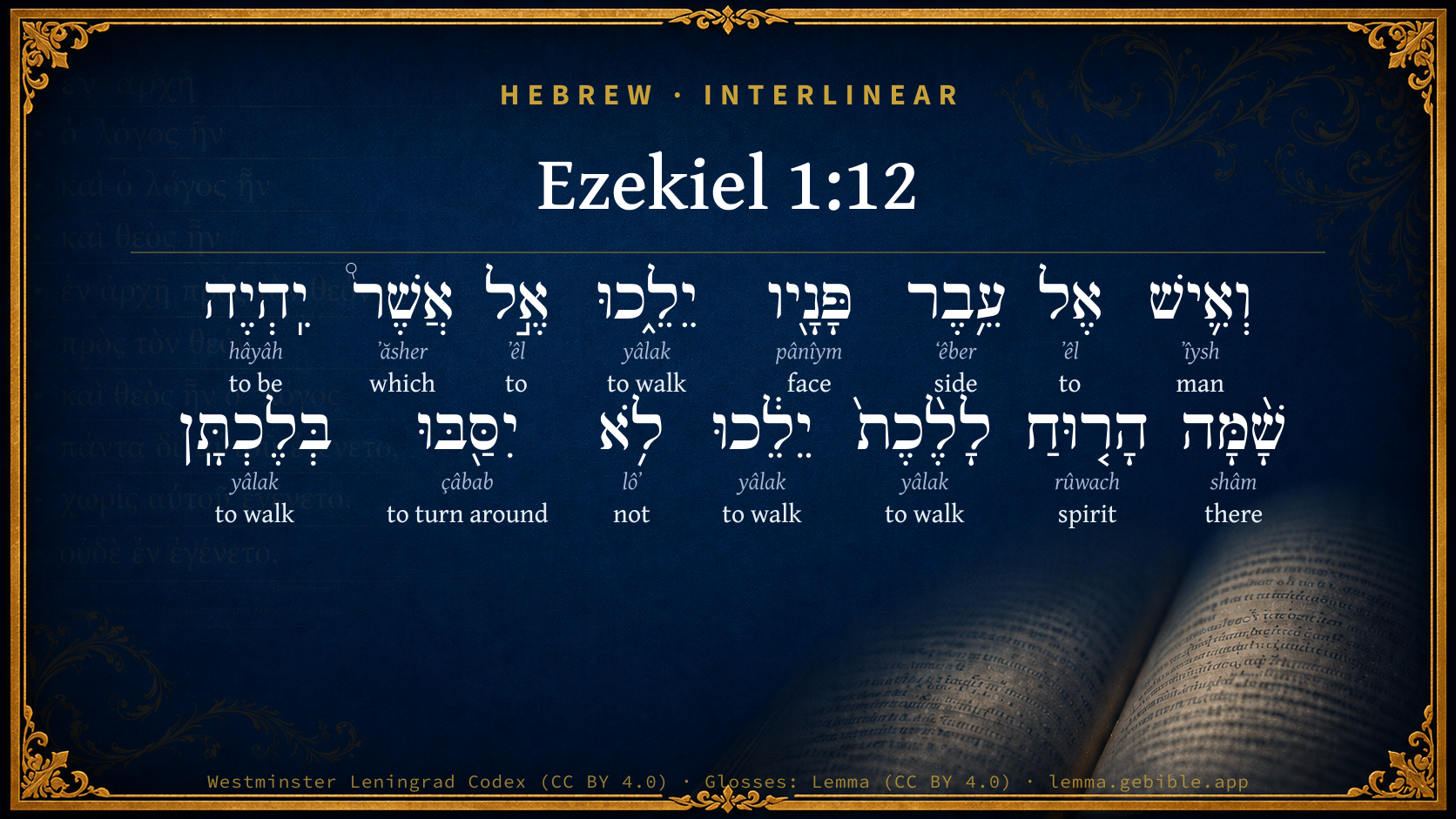
Hebrew (Westminster Leningrad Codex) Ezekiel 1:12 appears in the Hebrew Old Testament. The text above is from the Westminster Leningrad Codex. Each word links to its Strong’s number, a concise gloss, and parsing drawn from the Open Scriptures Hebrew Bible morphology. Click any word for its full Brown-Driver-Briggs (BDB) entry.
Download image
Cite this verse

Ezekiel 1:12 (World English Bible). Public Domain. Lemma interlinear Bible study tool, https://lemma.gebible.app/v/ezekiel/1/12.

Show BibTeX & RIS
BibTeX
RIS
English Translation
They went everyone straight forward: where the spirit was to go, they went; they didn't turn when they went.
World English Bible · Public Domain
Download a study sheet

One document with this verse’s original text, its word-by-word gloss line, the meaning frame, cross-references with their text, attributed commentary, and full source and license credits — printable, and it pastes into notes with its structure intact.

This verse Autodidact and up

Study sheet (.html) Plain text (.txt)

A passage Seminary Student

Up to 50 verses in one chapter. A passage sheet keeps up to 6 commentary sources and 12 cross-references per verse, in the order this page ranks them, and says so on the sheet whenever that leaves anything out. Ask for a single verse and you get the Autodidact verse sheet above.

Everything on this page stays free to read, with no account — the sheet is a download of what is already on screen, not access to it.

Want to remove ads? Support Godless Engineer
Compare translations 3

The same verse in 3 English versions, stacked beneath the original-language interlinear above. Click any original word for its lexicon entry.

Each is an independent rendering of the whole verse — the interlinear is not word-aligned to these translations.

Highlighted words mark where these versions differ — a whole-verse word diff, not a word-by-word alignment.

  • World English Bible Public Domain
    They went everyone straight forward: where the spirit was to go, they went; they didn't turn when they went.
  • King James Version Public Domain
    And they went every one straight forward: whither the spirit was to go, they went; and they turned not when they went.
  • unfoldingWord Literal Text CC BY-SA 4.0
    Each went straight forward, so that wherever the Spirit directed them to go, they went without turning.

unfoldingWord Literal Text — © unfoldingWord, licensed CC BY-SA 4.0. Word-aligned USFM3 via Door43 (git.door43.org/unfoldingWord/en_ult).

Versions to compare (up to 4)

3 of 4 selected

Show all 18 translations

Every available English version of this verse, each an independent rendering of the whole verse.

  • World English Bible Public Domain
    They went everyone straight forward: where the spirit was to go, they went; they didn't turn when they went.
  • Berean Standard Bible Public Domain
    Each creature went straight ahead. Wherever the spirit would go, they would go, without turning as they moved.
  • Majority Standard Bible Public Domain
    Each creature went straight ahead. Wherever the spirit would go, they would go, without turning as they moved.
  • King James Version Public Domain
    And they went every one straight forward: whither the spirit was to go, they went; and they turned not when they went.
  • American Standard Version (1901) Public Domain
    And they went every one straight forward: whither the spirit was to go, they went; they turned not when they went.
  • Revised Version (1885) Public Domain
    And they went every one straight forward: whither the spirit was to go, they went; they turned not when they went.
  • Geneva Bible (1599) Public Domain
    And euery one went streight forward: they went whither their spirit led them, and they returned not when they went forth.
  • Douay-Rheims (1899) Public Domain
    And every one of them went straight forward: whither the impulse of the spirit was to go, thither they went: and they turned not when they went.
  • Young's Literal Translation Public Domain
    And each straight forward they go, whither the spirit is to go, they go, they turn not round in their going.
  • Literal Standard Version CC BY-SA 4.0
    And they each go straight forward, to where the Spirit is to go, they go, they do not turn around in their going.
  • Unlocked Literal Bible CC BY-SA 4.0
    Each went straight forward, so that wherever the Spirit directed them to go, they went without turning.
  • unfoldingWord Literal Text CC BY-SA 4.0
    Each went straight forward, so that wherever the Spirit directed them to go, they went without turning.
  • Darby Bible Public Domain
    And they went every one straight forward: whither the Spirit was to go, they went; they turned not when they went.
  • World Messianic Bible Public Domain
    Each one went straight forward. Where the spirit was to go, they went. They didn’t turn when they went.
  • Webster's Bible Public Domain
    And they went every one straight forward: whither the spirit was to go, they went; and they turned not when they went.
  • Free Bible Version CC BY-SA 4.0
    Each of them went together in whatever direction the Spirit wished them to go, moving without turning.
  • Bible in Basic English Public Domain
    Every one of them went straight forward; wherever the spirit was to go they went; they went on without turning.
  • JPS Tanakh (1917) Public Domain
    And they went every one straight forward; whither the spirit was to go, they went; they turned not when they went.

Literal Standard Version (2020), Covenant Press — licensed CC BY-SA 4.0. Text via the HelloAO Bible API (eBible.org). Unlocked Literal Bible (unfoldingWord) — licensed CC BY-SA 4.0. Text via the HelloAO Bible API (eBible.org). unfoldingWord Literal Text — © unfoldingWord, licensed CC BY-SA 4.0. Word-aligned USFM3 via Door43 (git.door43.org/unfoldingWord/en_ult). Free Bible Version, Dr. Jonathan Gallagher — licensed CC BY-SA 4.0. Text via the HelloAO Bible API (eBible.org).

Word by word

More ways to search: Search by grammar → Find every occurrence → Compare this word →

Practice this passage: Drill this verse → Learn its vocabulary →

עֵ֥בֶר
ʻêber
H5676
“side of”
Noun, Common, Masculine, Singular, Construct
Part of Speech
Noun
Type
Common
Gender
Masculine
Number
Singular
State
Construct
Full BDB Definition

Origin: from H5674

TWOT: 1556a

region beyond or across, side - region across or beyond - side, opposite side
  1. וְאִ֛ישׁ ʼîysh H376 “and · man” Conjunction + Noun, Common, Masculine, Singular, Absolute
  2. אֶל ʼêl H413 “to” Preposition
  3. פָּנָ֖יו pânîym H6440 “face(s) · his” Noun, Common, Both, Plural, Construct + Suffix, Personal, 3rd Person, Masculine, Singular
  4. יֵלֵ֑כוּ yâlak H3212 “to walk” Verb, Qal, Imperfect, 3rd Person, Masculine, Plural
  5. אֶ֣ל ʼêl H413 “to” Preposition
  6. אֲשֶׁר֩ ʼăsher H834 “which” Particle, Relative
  7. יִֽהְיֶה hâyâh H1961 “to be” Verb, Qal, Imperfect, 3rd Person, Masculine, Singular
  8. שָׁ֨מָּה shâm H8033 “there · toward” Adverb + Suffix, Demonstrative
  9. הָר֤וּחַ rûwach H7307 “the · spirit” Particle, Definite Article + Noun, Common, Both, Singular, Absolute
  10. לָלֶ֨כֶת֙ yâlak H3212 “to walk” Preposition + Verb, Qal, Infinitive Construct
  11. יֵלֵ֔כוּ yâlak H3212 “to walk” Verb, Qal, Imperfect, 3rd Person, Masculine, Plural
  12. לֹ֥א lôʼ H3808 “not” Particle, Negative
  13. יִסַּ֖בּוּ çâbab H5437 “to turn around” Verb, Niphal, Imperfect, 3rd Person, Masculine, Plural
  14. בְּלֶכְתָּֽן yâlak H3212 “in/at · to walk · them” Preposition + Verb, Qal, Infinitive Construct + Suffix, Personal, 3rd Person, Feminine, Plural

About this verse

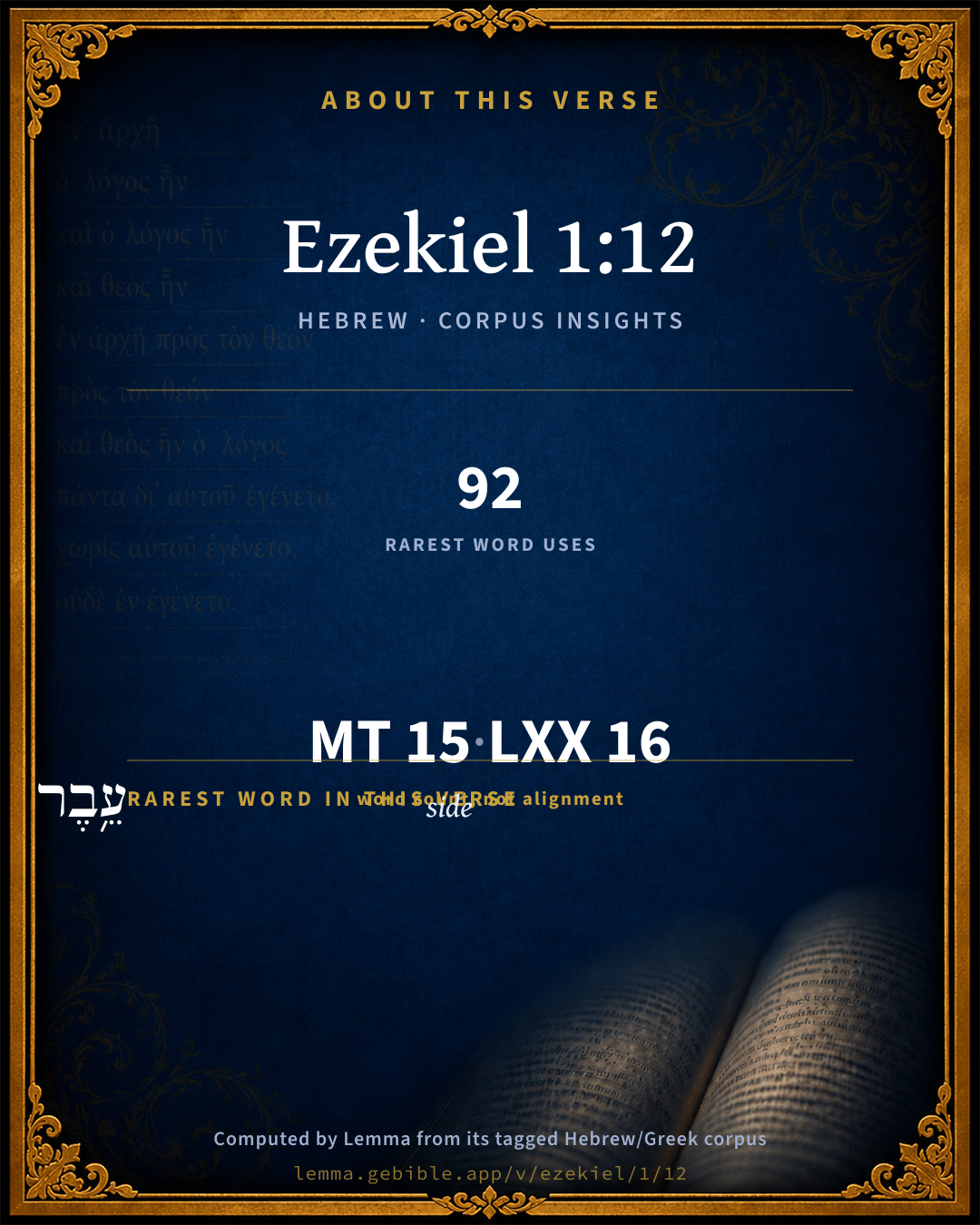
These counts appear in no published source. They are computed here, from the morphology-tagged text and Lemma’s own curated glosses. What Lemma adds →

15
words
11
distinct lemmas
Prophets
section

Grammatical profile

  • 6 verbs
  • 4 nouns
  • 2 prepositions
  • 1 adverb
  • 2 particles

Verb forms

  • יֵלֵ֑כוּ Qal · Imperfect
  • יִֽהְיֶה Qal · Imperfect
  • לָלֶ֨כֶת֙ Qal · Infinitive Construct
  • יֵלֵ֔כוּ Qal · Imperfect
  • יִסַּ֖בּוּ Niphal · Imperfect
  • בְּלֶכְתָּֽן Qal · Infinitive Construct

Repetition

Words recur within this verse — often emphatic in Hebrew:

  • יֵלֵ֑כוּ to walk H3212 ×4
  • אֶל to H413 ×2

Hebrew & Septuagint length

In English translation the verse runs 19 words from the Hebrew and 17 from the Septuagint (LXX English) — closely comparable.

A rough comparison of the two English renderings, which tokenize alike — not a word-level alignment.

Word counts can differ between the Hebrew and the Greek without any difference in meaning — e.g. the Hebrew direct-object marker אֵת has no separate Greek word, and Greek often adds the article ὁ.

In the original languages it is 15 Hebrew tokens and 16 Greek tokens — but the two are counted differently (Hebrew bundles its prefixes and suffixes into one token; the Greek is in lemma form), so that isn’t a like-for-like length.

Cross-references

5

Topical passages linked to Ezekiel 1:12 in the Treasury of Scripture Knowledge — connected by theme and wording, ordered by reader-vote popularity; previews shown in the World English Bible.

  • Ezekiel 1:9 their wings were joined one to another; they didn't turn when they went; they went everyone straight forward.
  • Ezekiel 1:17 When they went, they went in their four directions: they didn't turn when they went.
  • Ezekiel 1:20–21 Wherever the spirit was to go, they went; there was the spirit to go: and the wheels were lifted up beside them; for the spirit of the living creature was in the wheels.
  • Ezekiel 10:22 As for the likeness of their faces, they were the faces which I saw by the river Chebar, their appearances and themselves; they went every one straight forward.
  • Hebrews 1:14 Aren't they all ministering spirits, sent out to do service for the sake of those who will inherit salvation?

Cross-references courtesy of OpenBible.info (CC BY 4.0).

Hebrew and Greek witnesses Masoretic Hebrew ↔ Greek Septuagint

The same verse in the two great witnesses to the Old Testament, shown verse-for-verse.

These are two independent witnesses, not word-aligned to each other, and the Septuagint is shown in lemma (dictionary) form.

Hebrew Ezekiel 1:12 Masoretic · Westminster Leningrad Codex

וְאִ֛ישׁ אֶל עֵ֥בֶר פָּנָ֖יו יֵלֵ֑כוּ אֶ֣ל אֲשֶׁר֩ יִֽהְיֶה שָׁ֨מָּה הָר֤וּחַ לָלֶ֨כֶת֙ יֵלֵ֔כוּ לֹ֥א יִסַּ֖בּוּ בְּלֶכְתָּֽן

They went everyone straight forward: where the spirit was to go, they went; they didn't turn when they went.

World English Bible · Public Domain

Greek LXX Ezekiel 1:12 Septuagint · lemma form

καί ἑκάτερος κατά πρόσωπον αὐτός πορεύομαι ὅς ἄν εἰμί ὁ πνεῦμα πορεύομαι πορεύομαι καί οὐ ἐπιστρέφω

And each one went straight forward: wherever the spirit was going they went, and turned not back.

LXX2012 (modern English Septuagint) · Public Domain

Hebrew: Westminster Leningrad Codex (CC BY 4.0). Greek: Septuagint (public domain); English from LXX2012 (modern English Septuagint) (Public Domain). How the Septuagint differs from the Hebrew →

Targum (Aramaic paraphrase)

1

The Targum is the ancient Jewish Aramaic paraphrase of the Hebrew Scriptures — an interpretive translation, not the Hebrew text itself. Onkelos (literal) and Pseudo-Jonathan (expansive) render the Torah, and Jonathan the Prophets. Coverage is partial: where no permissively-licensed English translation exists for a verse, only the Aramaic is shown. This is verse-level text, not a word-by-word alignment to the Hebrew.

  1. Targum Jonathan Prophets (Joshua–Malachi)
    וּבִרְיָא לִקְבֵל אַפָּהָא אַזְלָא לַאֲתַר דְתֶהֱוֵי תַמָן רַעֲוָא לְמֵיזַל אָזְלָל לָא מִתְחַזְרָן בְּמֵיזַלְהֵן:

    (no public-domain English translation for this verse)

    Targum Jonathan — Aramaic: “Mikraot Gedolot” (public domain). English: “Sefaria Community Translation” (CC0 1.0 (public-domain dedication)); “London "Chaldee Paraphrase," 1871” (public domain). Text via Sefaria.

Commentary

Notes on Ezekiel 1:12 from classic Christian and Jewish commentators (each source and its license shown beneath its notes). The classic Christian expositions comment on the surrounding passage and are grouped to its opening verse, so a note may address several verses; the Jewish commentaries on the Tanakh (Rashi and others) are per-verse, so they appear only where the commentator wrote on this verse.

Lemma curates 59 commentaries, every one of them public domain or Creative Commons licensed, each selected and text-cleaned for this edition rather than reprinted as found. About our sources →

Trapp's Complete Commentary

John Trapp

Eze 1:12 And they went every one straight forward: whither the spirit was to go, they went; [and] they turned not when they went.

Ver. 12. And they went every one straight forward.] See on Eze 1:9.

Whither the Spirit was to go, they went.] That is, the Spirit of God, by whose direction and conduct the angels do all things; he is the great agent that setteth angels to work. Let us also be "led by the Spirit of God," so shall we approve ourselves "sons of God." {Rom 8:14}

John Trapp, A Commentary or Exposition upon All the Books of the Old and New Testament (1647–1656) — public domain. Text from a community e-Sword module.

The Biblical Illustrator

Joseph S. Exell

Eze_1:12

Whither the Spirit was to go, they went.

Led by the Spirit

By spirit, we are to understand, neither the will of angels, nor winds, nor the soul of man (for spirit in Scripture doth signify all these), but the essential and eternal Spirit of God. This is evident by Eze_1:20.

1. Angels, although exceeding wise, full of knowledge, active, and able to do great service, yet are not at their own disposal, they move not at their own pleasure, they went not where they listed. Let the abilities of the creature be never so excellent, they must be under the power of a superior, they must be ordered and directed by a higher cause.

2. It is the Spirit of God who is the great agent that sets angels to work; they perform nothing by their own virtue and strength, but at the command and impulse of the Spirit they act, they set out, proceed, finish, and return. As in a ship at sea, there are the winds without to drive it, and the pilot within to guide it to what place he pleaseth; so here is the command of the Spirit ab extra, externally, and the impetus intra, the inward influence, to carry out and order these. The great things angels have done, have been done by the Spirit of God: if they suggest good thoughts; if an angel strengthen Christ in His agony; if they reveal mysteries and things to come to Daniel and others; if they contend against princes, and agitate the great affairs of the kingdom, it is by virtue of the Spirit of God, that works efficaciously in them, and in good men, that are employed for the glory of God and the public good of Church or State.

3. Angels are led and easily led by the Spirit. They went--without dispute or delay--whither the Spirit would have them go. Offer up yourselves, freely and fully, to the conduct of the Spirit, and that will lead you into all truth and into the land of uprightness. (W. Greenhill, M. A.)

Spiritual activity

The poets tell us of a firefly in southern climates, said to be the most brilliant of all fireflies, which has this peculiarity, that it never shines at all except when going rapidly upon the wing, and then its brilliancy, can be seen afar. So it is with our immortal souls. When we are upon the wing, active and advancing, going forward in the Christian race toward God and toward heaven, our light shines out and all men see it; but when we stand still, it dies. (Christian Age.)

The Biblical Illustrator, edited by Joseph S. Exell (c. 1880s–1900s) — public domain. Text from a community e-Sword module.

Geneva Bible (1599)

Geneva Bible translators

Hebrew, whither their spirit or w[ings] was to go.

Geneva Bible (1599) marginal notes — public domain. Text via Bolls.life.

Jamieson, Fausset & Brown

Robert Jamieson, A. R. Fausset & David Brown

The same idea as in Eze 1:9. The repetition is because we men are so hard to be brought to acknowledge the wisdom of God's doings; they seem tortuous and confused to us, but they are all tending steadily to one aim.

the spirit--the secret impulse whereby God moves His angels to the end designed. They do not turn back or aside till they have fulfilled the office assigned them.

Jamieson, Fausset & Brown — Commentary Critical and Explanatory on the Whole Bible (1871) — public domain (CC PDM 1.0). Text via the HelloAO Bible API.

Adam Clarke's Commentary

Verse 12. They went every one straight forward] Not by progressive stepping, but by gliding.

Whither the spirit was to go] Whither that whirlwind blew, they went, being borne on by the wind, see Eze 1:4.

Adam Clarke's Commentary on the Bible (1810–1826) — public domain. Text from a community e-Sword/MySword module.

John Calvin's Commentaries

Here the Prophet repeats, that the movement of the living creatures was in each case directed towards, or in the direction of its face: and he will say the same again: nor is this repetition superfluous, since, as we said yesterday and must repeat again, mankind can scarcely’ be induced to ascribe glory to the wisdom of God. For we are so stupid, that we think that God mingles all things inconsiderately, as if he were in the dark. Since, therefore, the actions of God appear to us distorted, it is needful to repeat this clause, viz., that angels proceed straight forward, that is, are constrained to obedience. For the son who wishes to imitate his father, and the servant his master, is often agitated and at a loss what to do. Since then, something always appears confused in creatures, the Prophet diligently enforces that angels proceed in the direction of their face, that is, they tend at once to their goal, and decline neither to one side or the other. What he announces with regard to angels, ought to be referred to God himself; because his intention was not to extol angelic wisdom, but he sets them before us as God’s ministers, that we may perceive here one of the fundamental principles of our faith, viz., that God so regulates his actions, that nothing is with him either distorted or uncontrolled.

He adds, wheresoever there was spirit for proceeding, they proceeded Spirit is here used in the sense of mind or will: we know that it is often put metaphorically for wind, and also for the human soul, but here the will ought to be understood, and so the Prophet alludes to that very motion by which angels are borne along when God uses their assistance. Since, therefore, the vigor and swiftness of angels is so great that they fly like the wind, the Prophet seems to allude to this likeness. And what David says in the 104th Psalm, “God makes the winds his ministers,” the Apostle, in the first chapter of the Hebrews, aptly applies to the angels themselves. This analogy then, will stand very well, viz., that the angels proceeded wherever their will bore them; and yet by this word the Prophet points out that secret motion by which God bends his angels as he pleases. In the meantime, he confirms what we have lately seen, that angels are not rashly driven in every direction, but have a definite end, because God, who is the fountain of all wisdom, works through their means. He says again, they so proceed as not to return, that is, that they do not deviate from their course, for he afterwards says, they do turn backwards. But it is easy to reconcile these statements, because it only signifies that their course was not abrupt. While, therefore, they are proceeding in one direction, they go forward until they finish their allotted space, and then they return like lightning. For God does not so fit his angels for one single work, and that they should rest ever afterwards, but daily, nay, every moment, he exercises them in obedience. Since, then, the angels are continually occupied, it is not wonderful that the Prophet says, that they go and return, and yet not return, which is explained by their not receding until they have discharged their duty. Lastly, this vision has no other meaning than to inform the Prophet that God does not desert his works in the middle of their course, as he says in Psalm 138:8. Since, therefore, in the works of God, there is nothing unfinished or mutilated, the angels go forward, and finish their allotted space till the goal: they afterwards return like lightning, as he will shortly say. It follows: —

John Calvin's Commentaries (1540-1563) — public domain. Text from the Calvin Translation Society English edition (1840s-50s) via the Christian Classics Ethereal Library (ccel.org). Calvin's coverage is partial (roughly two-thirds of the Bible); uncommented books and verses are honest gaps, never fabricated. The 19th-century editor's footnotes and remarks are omitted so the notes are faithfully Calvin's own voice.

Ellicott's Commentary for English Readers

(12) Whither the spirit was to go.—The one informing spirit which animated all the living creatures alike, and in accordance with which all their movements were ordered.

A Bible Commentary for English Readers, edited by Charles John Ellicott (1878–1897) — public domain. Text from a community e-Sword module.

The Cambridge Bible for Schools and Colleges

gen. ed. J. J. S. Perowne

12. went straightforward] i.e. in the direction to which the living creature’s face was turned. The chariot had four sides facing the four quarters of the heavens; on each side of the chariot was a living creature whose principal face, the human, looked in the same direction as the side of the chariot on which it stood. Thus the whole, the chariot and living creatures, presented exactly the same front to each of the four directions, and there was no need to “turn.” See what is said of the wheels, Eze_1:15 seq.

whither the spirit was to go] The “spirit” is the directing impulse. It did not belong to the individual living creatures but to the whole manifestation composed of living creatures, wheels, and the like.

The Cambridge Bible for Schools and Colleges (gen. ed. J. J. S. Perowne; Cambridge University Press, 1878–1918) — public domain. Text from a community e-Sword module.

John Gill's Exposition

And they went everyone straight forward,.... Or, "over against his face" (q); for, which way soever they went, whether forward or backward, or on either side, they had a face to go before them, to direct the way, and steer their course; so the ministers of the Gospel have a face to go by and follow after, the word of God, to look to and direct them, which way soever they go, or whatsoever service they are called unto;

whither the spirit was to go they went; which may be meant of their own spirit, will, and inclination; so the Targum,

"to the place where it was their good pleasure to go they went;''

so Jarchi and Kimchi; but this is not always the case, see Act 16:6; rather the Holy Spirit of God is intended, by whom holy men of God were moved, and spoke formerly; and by whom Gospel ministers are led into the truth, as it is in Jesus; and by whom they are directed where to go, and what to do; and they are sent, and go where the Spirit of God is designed to go, in order to work upon the hearts of men and effectually call them by his grace, which is usually done by the ministry of the word; and therefore Gospel ministers must go, and they do go where the Spirit of God has work to do by them; see Act 16:6;

and they turned not when they went; they had no occasion to turn their bodies, because, which way soever they went, they had a face to go before them, and direct the way; See Gill on Eze 1:9.

(q) "coram facie sua", V. L. "in tractam faciei suae", objectum, Junius & Tremellius, Piscator, Polanus; "ante faciem suam", Starckius.

John Gill's Exposition of the Whole Bible (1746–1763) — public domain (CC PDM 1.0). Text via the HelloAO Bible API.

Albert Barnes' Notes on the Bible

The “chariot,” though composed of distinct parts, was to be considered as a whole. There was one spirit expressive of one conscious life pervading the whole, and guiding the motions of the whole in perfect harmony.

Albert Barnes' Notes on the Bible (1834–1885) — public domain. Text from a community e-Sword/MySword module.

Matthew Poole's English Annotations

They went every one straightforward: see Eze 1:9. Which way soever they went, each living creature had one face looking straight forwards, and their other faces looking toward other coasts of the world; if the fore right were to the south, the other faces looked one to the east, one to the west, and the other to the north. Thus with rectitude, constancy, wisdom, and universal care Providence rules and guides affairs of the world, and especially of the church, to the glory of God.

Whither the spirit was to go; the wind moved, say some; but if there were a gale of wind, which blowing gently on these living creatures stirred them in the sight of the prophet, it was emblematical, and represented to his view the power and influence of the Spirit of God, which moved and acted these admirable creatures. The will, command, and breathing of the Spirit of God both gave and guided their motions to ends he himself designed. Going is attributed here to the Spirit of God by allusion, and not properly, for who is ever in every place cannot properly be said to go from or to any place.

They went; the living creatures readily observed the impressions of the Spirit of God, and obeyed.

They turned not when they went: see Eze 1:9. They looked not back as unwilling, they turned not out of the way as froward, they gave not over till they had completed their course.

Matthew Poole's English Annotations on the Holy Bible (1683–1685) — public domain. Text from a community e-Sword/MySword module.

Whedon's Commentary on the Bible

Daniel D. Whedon

12. The reason of their orderly movements is now given: there was a controlling spirit according to which they moved.

All are but parts of one stupendous whole

Whose body Nature is, and God the soul.

They turned not — They did not need to turn. As each side was alike, each could be front, as willed by the spirit, and they could move “straight forward” to any point of the compass without turning.

Daniel D. Whedon (gen. ed.), Commentary on the Old and New Testaments (1874–1909) — public domain. Text from a community e-Sword module.

The Pulpit Commentary

Whither the spirit was to go, etc. The description passes on to the originating force of the movement of the mysterious forms. The Hebrew noun may mean "breath," "wind," or "spirit," the meanings often overlapping one another. Here the higher meaning is probably the true one. The "Spirit" (as in Gen_1:1 Gen_6:3; Psa_104:30 Psa_139:7; Isa_40:7, Isa_40:13; and in Ezekiel himself, passim) is the Divine Source of life in all its forms, especially in its highest form, moral, intellectual, spiritual. It is this which gave unity and harmony to the movements of the "living creatures," as it gives a life, harmony, and unity to all the manifold manifestations of the might of God of which they were the symbols. (On "they turned not," see note on ver. 9.)

Straightforwardness.

Ezekiel seems to have been particularly struck with the direct movement of the four living creatures which he beheld in his vision, for he refers to this several times. "Their feet were straight" (ver. 7). Twice the prophet tells us that "they went every one straight forward" (vers. 9, 12), and on the second occasion he emphasizes his assertion by adding that "they turned not when they went a remark which he subsequently repeated in describing the motion of the wheels (ver. 17).

I HEAVENLY CONDUCT IS STRAIGHTFORWARD. Here is the contrast between the heavenly, the ideal, the perfect, and the too common course of human conduct on earth. The lanes and alleys of earth are crooked; the golden streets of the new Jerusalem are all straight. Our conduct is commonly marked by uncertainty, indecision, and variability, and sometimes by duplicity and shameful inconsistency. We walk with halting gait. We put our hand to the plough, and then look back. Like Christian on the Hill Difficulty, we turn aside from the steep path of duty to some bower of ease; or, like the same pilgrim in later life, we forsake the narrow way for Bye-path Meadow the road to Giant Despair"s castle. In order to realize the ideal of heavenly conduct certain characteristics must be formed.

1. Truth. We must really go the way we profess to be in. If we walk only to be seen of men, we shall take different paths according as their eyes are upon us, or as we are left to ourselves. Eve-service is always variable service. The path of the hypocrite is crooked.

2. Singleness of aim. Many men turn first to the right and then to the left, while they are drawn hither and thither by counter attractions. Their thoughts are like the compasses of ships that are sailing between magnetic rocks. Let them beware of the danger of making shipwreck. "Ye cannot serve God and mammon." The divided life is a broken life. The single eye is the only safe vision.

3. Perseverance. It is easier to start straight than to keep straight. Yet it is vain to begin well and turn aside later to paths of error. Bad men sometimes do goad deeds. It is the good man who lives a good life throughout, or at least in the main.

II STRAIGHTFORWARD CONDUCT DEPENDS ON HEAVENLY CHARACTERISTICS. It is never easily attained, and it is quite unattainable without the conditions on which it depends. These must be considered.

1. A right aim. Each of the living creatures is said to go, as the words may be rendered literally, "in the direction of his face." If he faced an impassable barrier, a huge cliff, or a yawning chasm, straightforward progress would be impossible. If he laced a wrong way it would be undesirable. Don Quixote rides straightforward in tilting at a windmill, and only gets an ignominious fall. The youth in "Excelsior" goes straightforward in his alpine climbing, and is rewarded in the useless death of a fanatic. Heavenly conduct can be continuously direct, because in heaven there is no need of repentance. The first step for us on earth is to face about to the right. Conversion must precede consistency.

2. A fixed gaze. This is implied in the reference to the direction of the face. The look ahead precedes the movement forward. The blind man falls into the ditch. If any one walks blindfolded he is sure to move circuitously. The ploughman who would cut a straight furrow must not notice the daisies by his side or the lark overhead; he must fix his eyes on the end of his course. The Christian must run straight, by "looking unto Jesus, the Author and Finisher of the faith.

3. Harmony of powers and energies. The living creatures of Ezekiel"s vision are strangely composite various faces, calves" feet, birds" wings. Yet faces, feet, and wings all turn in one direction. There is no "schism in the body." The schism in our nature between flesh and spirit, and the consequent contradiction of our aims, accounts for the crooked paths we take. The internal harmony of a life at peace is necessary for a straightforward course.

4. Spiritual direction. The movement is "whither the spirit was to go." The higher nature must conquer, command, and direct the lower. Conscience must be supreme. Spiritual thought and feeling must be paramount. The Spirit of God must be sought and yielded to as the guide and impulse of all the life"s course.

The Pulpit Commentary (1880–1919), ed. H.D.M. Spence-Jones & Joseph S. Exell — public domain. Text from a community e-Sword module.

John Wesley's Explanatory Notes

Straight - Which way soever they went, each living creature had one face looking straight forward. The spirit - The will, command, and breathing of the Spirit of God, both gave and guided their motions. Was to go - Going is attributed here to the Spirit of God, by allusion, for he who is in every place cannot properly be said to go from or to any place. Turned not - They looked not back, they turned not out of the way, they gave not over, 'till they had compleated their course.

John Wesley, Explanatory Notes Upon the Whole Bible (1754–1765) — public domain. Text via the GEBible commentary corpus.

Rashi

Rabbi Shlomo Yitzchaki (Rashi)

wherever would be the will Heb. רוּחַ, usually spirit, here means will: the will to go.

Rashi on the Tanakh — English translations: “The Judaica Press complete Tanach with Rashi, translated by A. J. Rosenberg” (CC BY 4.0); “Pentateuch with Rashi's commentary by M. Rosenbaum and A.M. Silbermann, 1929-1934” (public domain); “The Metsudah Tanach series, Lakewood, N.J” (CC BY 4.0); and “The Book of Joshua, Metsudah Publications, 1997” (CC BY 4.0). Text via Sefaria.

Lesson kit

Teaching starters — assembled from the data on this page, not authored interpretation. Every prompt links to the verse data it draws on. Edit before teaching.

Ezekiel, in the Prophets, opens this verse with 15 words (11 distinct Hebrew lemmas). Its most distinctive word is ʻêber (“side”). A historical commentator’s framing appears above. Read the whole chapter for the surrounding context.

Discussion questions

  1. What does “side” (ʻêber) contribute to the verse as a whole?
  2. How does Ezekiel 1:9, which shares this passage’s theme, read alongside this verse?
  3. What does the repetition of “to walk” (4× in this one verse) do in this verse?
  4. These translations render this verse differently. What is at stake in choosing one wording over another?
  5. «יֵלֵ֑כוּ» is a Qal Imperfect verb. How does that grammatical form shape the action described?
  6. Compare how Trapp's Complete Commentary and The Biblical Illustrator read this verse. Where do they agree or differ?

Things to notice

Reading settings

Reading text

Shown beneath each verse's original-language words.

Old Testament
Old Testament edition

Read the OT as the Masoretic Hebrew (MT) or the Greek Septuagint (LXX).

English shown for the Greek Septuagint (in the Hebrew ↔ Greek comparison).

Comparing translations? Open the Compare panel on any verse page to stack up to four side by side.