
1 Chronicles 5:26

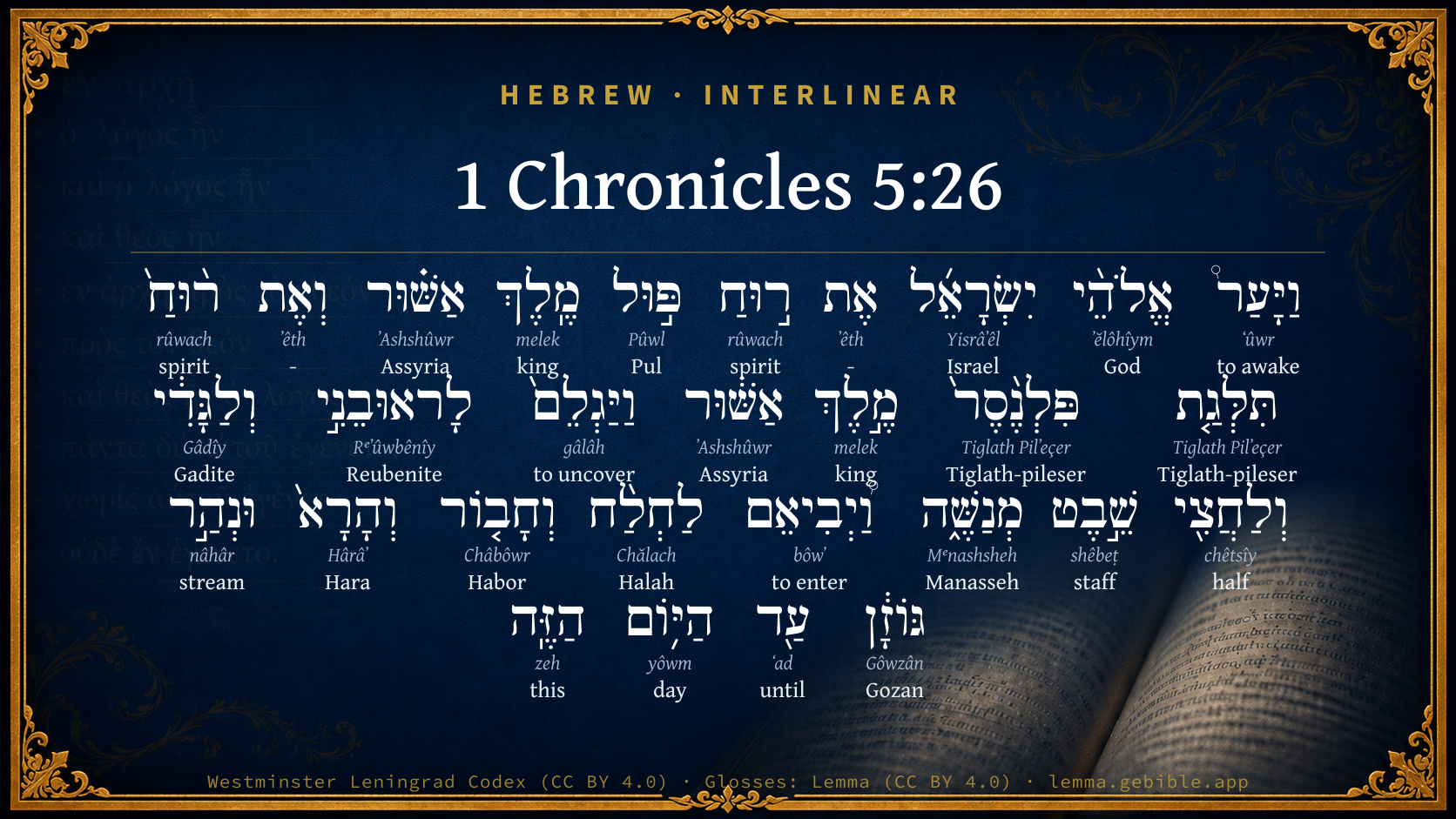
Hebrew (Westminster Leningrad Codex) 1 Chronicles 5:26 appears in the Hebrew Old Testament. The text above is from the Westminster Leningrad Codex. Each word links to its Strong’s number, a concise gloss, and parsing drawn from the Open Scriptures Hebrew Bible morphology. Click any word for its full Brown-Driver-Briggs (BDB) entry.
Download image
Cite this verse

1 Chronicles 5:26 (World English Bible). Public Domain. Lemma interlinear Bible study tool, https://lemma.gebible.app/v/1-chronicles/5/26.

Show BibTeX & RIS
BibTeX
RIS
English Translation
The God of Israel stirred up the spirit of Pul king of Assyria, and the spirit of Tilgath Pilneser king of Assyria, and he carried them away, even the Reubenites, and the Gadites, and the half-tribe of Manasseh, and brought them to Halah, and Habor, and Hara, and to the river of Gozan, to this day.
World English Bible · Public Domain
Highlights
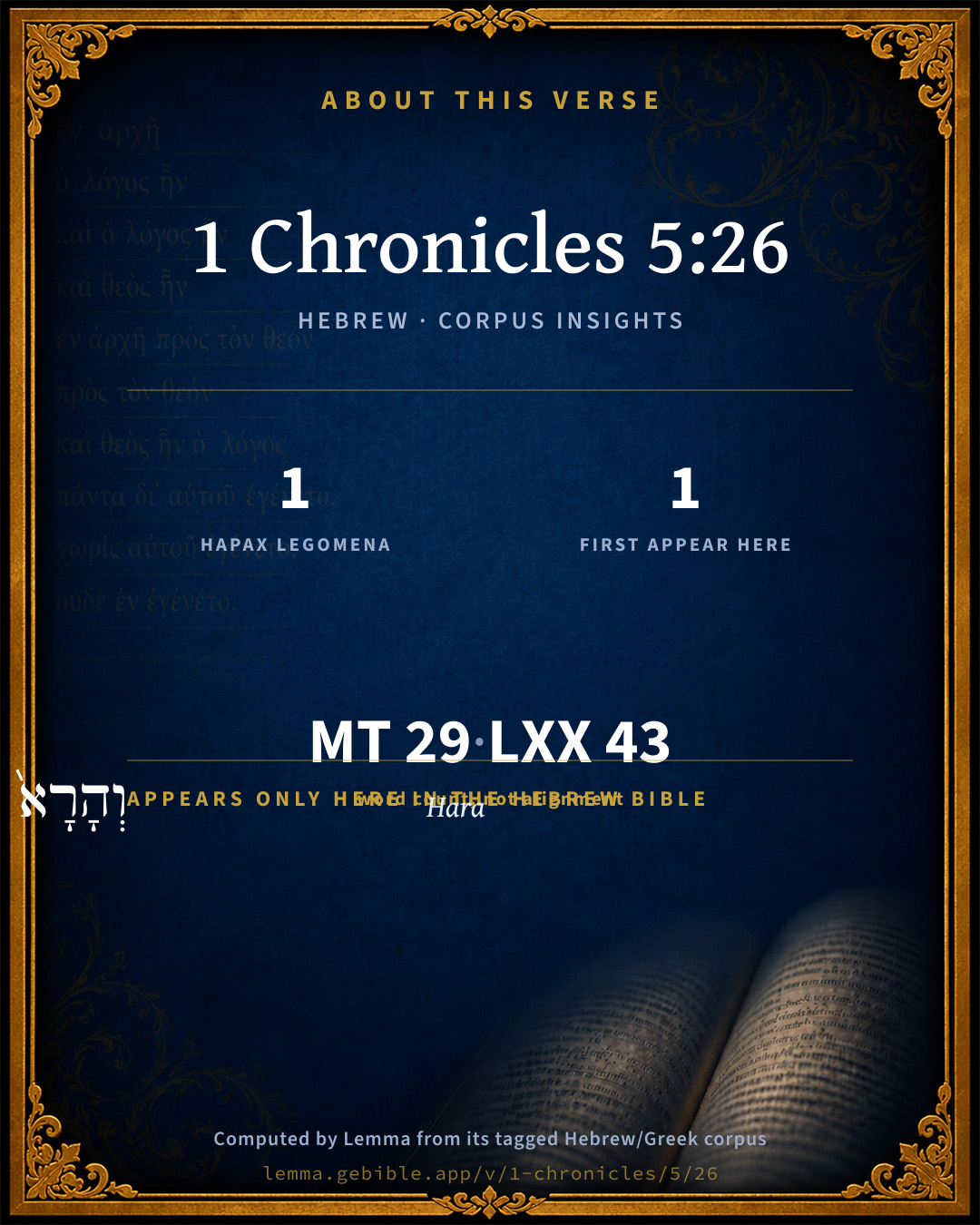
  • 1 hapax legomenon — only here in the Hebrew Bible
  • 1 first appearance in the Hebrew Bible
Full analysis ↓
Download a study sheet

One document with this verse’s original text, its word-by-word gloss line, the meaning frame, cross-references with their text, attributed commentary, and full source and license credits — printable, and it pastes into notes with its structure intact.

This verse Autodidact and up

Study sheet (.html) Plain text (.txt)

A passage Seminary Student

Up to 50 verses in one chapter. A passage sheet keeps up to 6 commentary sources and 12 cross-references per verse, in the order this page ranks them, and says so on the sheet whenever that leaves anything out. Ask for a single verse and you get the Autodidact verse sheet above.

Everything on this page stays free to read, with no account — the sheet is a download of what is already on screen, not access to it.

Want to remove ads? Support Godless Engineer
Compare translations 3

The same verse in 3 English versions, stacked beneath the original-language interlinear above. Click any original word for its lexicon entry.

Each is an independent rendering of the whole verse — the interlinear is not word-aligned to these translations.

Highlighted words mark where these versions differ — a whole-verse word diff, not a word-by-word alignment.

  • World English Bible Public Domain
    The God of Israel stirred up the spirit of Pul king of Assyria, and the spirit of Tilgath Pilneser king of Assyria, and he carried them away, even the Reubenites, and the Gadites, and the half-tribe of Manasseh, and brought them to Halah, and Habor, and Hara, and to the river of Gozan, to this day.
  • King James Version Public Domain
    And the God of Israel stirred up the spirit of Pul king of Assyria, and the spirit of Tilgathpilneser king of Assyria, and he carried them away, even the Reubenites, and the Gadites, and the half tribe of Manasseh, and brought them unto Halah, and Habor, and Hara, and to the river Gozan, unto this day.
  • unfoldingWord Literal Text CC BY-SA 4.0
    So the God of Israel awakened the spirit of Pul, the king of Assyria and the spirit of Tilgath Pileser, the king of Assyria. And he exiled them, namely the Reubenite and the Gadite and half of the tribe of Manasseh. And he brought them to Halah and Habor and Hara and the river of Gozan unto this day.

unfoldingWord Literal Text — © unfoldingWord, licensed CC BY-SA 4.0. Word-aligned USFM3 via Door43 (git.door43.org/unfoldingWord/en_ult).

Versions to compare (up to 4)

3 of 4 selected

Show all 18 translations

Every available English version of this verse, each an independent rendering of the whole verse.

  • World English Bible Public Domain
    The God of Israel stirred up the spirit of Pul king of Assyria, and the spirit of Tilgath Pilneser king of Assyria, and he carried them away, even the Reubenites, and the Gadites, and the half-tribe of Manasseh, and brought them to Halah, and Habor, and Hara, and to the river of Gozan, to this day.
  • Berean Standard Bible Public Domain
    So the God of Israel stirred up the spirit of Pul king of Assyria (that is, Tiglath-pileser king of Assyria) to take the Reubenites, the Gadites, and the half-tribe of Manasseh into exile. And he brought them to Halah, Habor, Hara, and the river of Gozan, where they remain to this day.
  • Majority Standard Bible Public Domain
    So the God of Israel stirred up the spirit of Pul king of Assyria (that is, Tiglath-pileser king of Assyria) to take the Reubenites, the Gadites, and the half-tribe of Manasseh into exile. And he brought them to Halah, Habor, Hara, and the river of Gozan, where they remain to this day.
  • King James Version Public Domain
    And the God of Israel stirred up the spirit of Pul king of Assyria, and the spirit of Tilgathpilneser king of Assyria, and he carried them away, even the Reubenites, and the Gadites, and the half tribe of Manasseh, and brought them unto Halah, and Habor, and Hara, and to the river Gozan, unto this day.
  • American Standard Version (1901) Public Domain
    And the God of Israel stirred up the spirit of Pul king of Assyria, and the spirit of Tilgath-pilneser king of Assyria, and he carried them away, even the Reubenites, and the Gadites, and the half-tribe of Manasseh, and brought them unto Halah, and Habor, and Hara, and to the river of Gozan, unto this day.
  • Revised Version (1885) Public Domain
    And the God of Israel stirred up the spirit of Pul king of Assyria, and the spirit of Tilgath-pilneser king of Assyria, and he carried them away, even the Reubenites, and the Gadites, and the half tribe of Manasseh, and brought them unto Halah, and Habor, and Hara, and to the river of Gozan, unto this day.
  • Geneva Bible (1599) Public Domain
    And the God of Israel stirred vp the spirit of Pul king of Asshur, and the spirite of Tilgath Pilneeser king of Asshur, and he caryed them away: euen the Reubenites and the Gadites, and the halfe tribe of Manasseh, and brought them vnto Halah and Habor, and Hara, and to the riuer Gozan, vnto this day.
  • Douay-Rheims (1899) Public Domain
    And the God of Israel stirred up the spirit of Phul king of the Assyrians, and the spirit of Thelgathphalnasar king of Assur: and he carried away Ruben, and Gad, and the half tribe of Manasses, and brought them to Lahela, and to Habor, and to Ara, and to the river of Gozan, unto this day.
  • Young's Literal Translation Public Domain
    and stir up doth the God of Israel the spirit of Pul king of Asshur, and the spirit of Tilgath-Pilneser king of Asshur, and he removeth them -- even the Reubenite, and the Gadite, and the half of the tribe of Manasseh -- and bringeth them in to Halah, and Habor, and Hara, and the river of Gozan unto this day.
  • Literal Standard Version CC BY-SA 4.0
    and the God of Israel stirs up the spirit of Pul king of Asshur, and the spirit of Tilgath-Pilneser king of Asshur, and he removes them—even the Reubenite, and the Gadite, and the half of the tribe of Manasseh—and brings them to Halah, and Habor, and Hara, and the River of Gozan to this day.
  • Unlocked Literal Bible CC BY-SA 4.0
    The God of Israel stirred up Pul king of Assyria (also called Tiglath-Pileser, king of Assyria). He took into exile the Reubenites, Gadites, and the half tribe of Manasseh. He brought them to Halah, Habor, Hara, and to the river of Gozan, where they remain to this day.
  • unfoldingWord Literal Text CC BY-SA 4.0
    So the God of Israel awakened the spirit of Pul, the king of Assyria and the spirit of Tilgath Pileser, the king of Assyria. And he exiled them, namely the Reubenite and the Gadite and half of the tribe of Manasseh. And he brought them to Halah and Habor and Hara and the river of Gozan unto this day.
  • Darby Bible Public Domain
    And the God of Israel stirred up the spirit of Pul king of Assyria, and the spirit of Tilgath-Pilneser king of Assyria, and he carried them away, the Reubenites, and the Gadites, and the half tribe of Manasseh, and brought them to Halah, and Habor, and Hara, and to the river Gozan, -- unto this day.
  • World Messianic Bible Public Domain
    So the God of Israel stirred up the spirit of Pul king of Assyria, and the spirit of Tilgath Pilneser king of Assyria, and he carried away the Reubenites, the Gadites, and the half-tribe of Manasseh, and brought them to Halah, Habor, Hara, and to the river of Gozan, to this day.
  • Webster's Bible Public Domain
    And the God of Israel stirred up the spirit of Pul king of Assyria, and the spirit of Tilgath-pilneser king of Assyria, and he carried them away, even the Reubenites, and the Gadites, and the half tribe of Manasseh, and brought them to Halah, and Habor, and Hara, and to the river Gozan, to this day.
  • Free Bible Version CC BY-SA 4.0
    So the God of Israel encouraged Pul, king of Assyria (otherwise known as Tiglath-Pileser king of Assyria), to invade the land. He took into exile the Reubenites, the Gadites and the half-tribe of Manasseh. He brought them to Halah, Habor, Hara, and the river of Gozan, where they remain to this very day.
  • Bible in Basic English Public Domain
    And the God of Israel put an impulse into the heart of Pul, king of Assyria, and of Tiglath-pileser, king of Assyria, who took them away as prisoners, all the Reubenites and the Gadites and the half-tribe of Manasseh, to Halah and Habor and Hara and to the river of Gozan, to this day.
  • JPS Tanakh (1917) Public Domain
    And the God of Israel stirred up the spirit of Pul king of Assyria, and the spirit of Tillegath-pilneser king of Assyria, and he carried them away, even the Reubenites, and the Gadites, and the half-tribe of Manasseh, and brought them unto Halah, and Habor, and Hara, and to the river of Gozan, unto this day.

Literal Standard Version (2020), Covenant Press — licensed CC BY-SA 4.0. Text via the HelloAO Bible API (eBible.org). Unlocked Literal Bible (unfoldingWord) — licensed CC BY-SA 4.0. Text via the HelloAO Bible API (eBible.org). unfoldingWord Literal Text — © unfoldingWord, licensed CC BY-SA 4.0. Word-aligned USFM3 via Door43 (git.door43.org/unfoldingWord/en_ult). Free Bible Version, Dr. Jonathan Gallagher — licensed CC BY-SA 4.0. Text via the HelloAO Bible API (eBible.org).

Word by word

More ways to search: Search by grammar → Find every occurrence → Compare this word →

Practice this passage: Drill this verse → Learn its vocabulary →

וְהָרָא֙
Hârâʼ
H2024
“and · Hara”
Conjunction + Noun, Proper
Part of Speech
Conjunction + Noun
Type
Proper
Full BDB Definition

Origin: perhaps from H2022

TWOT: None

Hara = "mountain land" - a place of exile in Assyria
  1. וַיָּעַר֩ ʻûwr H5782 “and · to awake” Conjunction + Verb, Hiphil, Sequential Imperfect, 3rd Person, Masculine, Singular
  2. אֱלֹהֵ֨י ʼĕlôhîym H430 “God(s) of” Noun, Common, Masculine, Plural, Construct
  3. יִשְׂרָאֵ֜ל Yisrâʼêl H3478 “Israel” Noun, Proper
  4. אֶת ʼêth H853 “-” Particle, Direct Object
  5. ר֣וּחַ rûwach H7307 “spirit of” Noun, Common, Both, Singular, Construct
  6. פּ֣וּל Pûwl H6322 “Pul” Noun, Proper
  7. מֶֽלֶךְ melek H4428 “king of” Noun, Common, Masculine, Singular, Construct
  8. אַשּׁ֗וּר ʼAshshûwr H804 “Assyria” Noun, Proper
  9. וְאֶת ʼêth H853 “and · -” Conjunction + Particle, Direct Object
  10. ר֨וּחַ֙ rûwach H7307 “spirit of” Noun, Common, Both, Singular, Construct
  11. תִּלְּגַ֤ת Tiglath Pilʼeçer H8407 “Tiglath-pileser” Noun, Proper
  12. פִּלְנֶ֨סֶר֙ Tiglath Pilʼeçer H8407 “Tiglath-pileser” Noun, Proper
  13. מֶ֣לֶךְ melek H4428 “king of” Noun, Common, Masculine, Singular, Construct
  14. אַשּׁ֔וּר ʼAshshûwr H804 “Assyria” Noun, Proper
  15. וַיַּגְלֵם֙ gâlâh H1540 “and · to uncover · them” Conjunction + Verb, Hiphil, Sequential Imperfect, 3rd Person, Masculine, Singular + Suffix, Personal, 3rd Person, Masculine, Plural
  16. לָראוּבֵנִ֣י Rᵉʼûwbênîy H7206 “to/for the · Reubenite” Preposition, Determined + Noun, Gentilic, Masculine, Singular, Absolute
  17. וְלַגָּדִ֔י Gâdîy H1425 “and · to/for the · Gadite” Conjunction + Preposition, Determined + Noun, Gentilic, Masculine, Singular, Absolute
  18. וְלַחֲצִ֖י chêtsîy H2677 “and · to/for · half of” Conjunction + Preposition + Noun, Common, Masculine, Singular, Construct
  19. שֵׁ֣בֶט shêbeṭ H7626 “staff of” Noun, Common, Masculine, Singular, Construct
  20. מְנַשֶּׁ֑ה Mᵉnashsheh H4519 “Manasseh” Noun, Proper
  21. וַ֠יְבִיאֵם bôwʼ H935 “and · to enter · them” Conjunction + Verb, Hiphil, Sequential Imperfect, 3rd Person, Masculine, Singular + Suffix, Personal, 3rd Person, Masculine, Plural
  22. לַחְלַ֨ח Chălach H2477 “to/for · Halah” Preposition + Noun, Proper
  23. וְחָב֤וֹר Châbôwr H2249 “and · Habor” Conjunction + Noun, Proper
  24. וּנְהַ֣ר nâhâr H5104 “and · stream of” Conjunction + Noun, Common, Masculine, Singular, Construct
  25. גּוֹזָ֔ן Gôwzân H1470 “Gozan” Noun, Proper
  26. עַ֖ד ʻad H5704 “until” Preposition
  27. הַיּ֥וֹם yôwm H3117 “the · day” Particle, Definite Article + Noun, Common, Masculine, Singular, Absolute
  28. הַזֶּֽה zeh H2088 “the · this” Particle, Definite Article + Pronoun, Demonstrative, Masculine, Singular

About this verse

These counts appear in no published source. They are computed here, from the morphology-tagged text and Lemma’s own curated glosses. What Lemma adds →

29
words
24
distinct lemmas
Historical
section

Notable vocabulary

1 hapax legomenon — a word that appears only here in the entire Hebrew Bible:

  • וְהָרָא֙ Hara H2024

First appearance in Scripture

This word makes its first canonical appearance in the Hebrew Bible here:

  • וְהָרָא֙ Hara H2024

Shared distinctive vocabulary

לַחְלַ֨ח Halah H2477 occurs in 3 verses of the Hebrew Bible. Also found in:

Grammatical profile

  • 3 verbs
  • 22 nouns
  • 1 pronoun
  • 1 preposition
  • 2 particles

Verb forms

  • וַיָּעַר֩ Hiphil · Sequential Imperfect
  • וַיַּגְלֵם֙ Hiphil · Sequential Imperfect
  • וַ֠יְבִיאֵם Hiphil · Sequential Imperfect

Repetition

Words recur within this verse — often emphatic in Hebrew:

  • ר֣וּחַ spirit H7307 ×2
  • מֶֽלֶךְ king H4428 ×2
  • אַשּׁ֗וּר Assyria H804 ×2
  • תִּלְּגַ֤ת Tiglath-pileser H8407 ×2

Hebrew & Septuagint length

In English translation the verse runs 56 words from the Hebrew and 48 from the Septuagint (LXX English) — closely comparable.

A rough comparison of the two English renderings, which tokenize alike — not a word-level alignment.

Word counts can differ between the Hebrew and the Greek without any difference in meaning — e.g. the Hebrew direct-object marker אֵת has no separate Greek word, and Greek often adds the article ὁ.

In the original languages it is 29 Hebrew tokens and 43 Greek tokens — but the two are counted differently (Hebrew bundles its prefixes and suffixes into one token; the Greek is in lemma form), so that isn’t a like-for-like length.

Cross-references

13

Topical passages linked to 1 Chronicles 5:26 in the Treasury of Scripture Knowledge — connected by theme and wording, ordered by reader-vote popularity; previews shown in the World English Bible.

  • 2 Kings 15:19 There came against the land Pul the king of Assyria; and Menahem gave Pul one thousand talents of silver, that his hand might be with him to confirm the kingdom in his hand.
  • 2 Kings 15:29 In the days of Pekah king of Israel came Tiglath Pileser king of Assyria, and took Ijon, and Abel Beth Maacah, and Janoah, and Kedesh, and Hazor, and Gilead, and Galilee, all the land of Naphtali; and he carried them captive to Assyria.
  • 2 Kings 17:6 In the ninth year of Hoshea the king of Assyria took Samaria, and carried Israel away to Assyria, and placed them in Halah, and on the Habor, the river of Gozan, and in the cities of the Medes.
  • 2 Kings 18:11 The king of Assyria carried Israel away to Assyria, and put them in Halah, and on the Habor, the river of Gozan, and in the cities of the Medes,
  • 1 Chronicles 5:6 Beerah his son, whom Tilgath Pilneser king of Assyria carried away captive: he was prince of the Reubenites.
  • 2 Chronicles 33:11 Therefore Yahweh brought on them the captains of the host of the king of Assyria, who took Manasseh in chains, and bound him with fetters, and carried him to Babylon.
  • 2 Samuel 24:1 Again the anger of Yahweh was kindled against Israel, and he moved David against them, saying, Go, number Israel and Judah.
  • 2 Kings 16:7 So Ahaz sent messengers to Tiglath Pileser king of Assyria, saying, I am your servant and your son: come up, and save me out of the hand of the king of Syria, and out of the hand of the king of Israel, who rise up against me.
  • 2 Kings 19:12 Have the gods of the nations delivered them, which my fathers have destroyed, Gozan, and Haran, and Rezeph, and the children of Eden that were in Telassar?
  • Isaiah 10:5–6 Ho Assyrian, the rod of my anger, the staff in whose hand is my indignation!
  • Isaiah 13:2–5 Set up an ensign on the bare mountain, lift up the voice to them, wave the hand, that they may go into the gates of the nobles.
  • Isaiah 37:12 Have the gods of the nations delivered them, which my fathers have destroyed, Gozan, and Haran, and Rezeph, and the children of Eden who were in Telassar?
  • Ezra 1:5 Then rose up the heads of fathers' [houses] of Judah and Benjamin, and the priests, and the Levites, even all whose spirit God had stirred to go up to build the house of Yahweh which is in Jerusalem.

Cross-references courtesy of OpenBible.info (CC BY 4.0).

Hebrew and Greek witnesses Masoretic Hebrew ↔ Greek Septuagint

The same verse in the two great witnesses to the Old Testament, shown verse-for-verse.

These are two independent witnesses, not word-aligned to each other, and the Septuagint is shown in lemma (dictionary) form.

Hebrew 1 Chronicles 5:26 Masoretic · Westminster Leningrad Codex

וַיָּעַר֩ אֱלֹהֵ֨י יִשְׂרָאֵ֜ל אֶת ר֣וּחַ פּ֣וּל מֶֽלֶךְ אַשּׁ֗וּר וְאֶת ר֨וּחַ֙ תִּלְּגַ֤ת פִּלְנֶ֨סֶר֙ מֶ֣לֶךְ אַשּׁ֔וּר וַיַּגְלֵם֙ לָראוּבֵנִ֣י וְלַגָּדִ֔י וְלַחֲצִ֖י שֵׁ֣בֶט מְנַשֶּׁ֑ה וַ֠יְבִיאֵם לַחְלַ֨ח וְחָב֤וֹר וְהָרָא֙ וּנְהַ֣ר גּוֹזָ֔ן עַ֖ד הַיּ֥וֹם הַזֶּֽה

The God of Israel stirred up the spirit of Pul king of Assyria, and the spirit of Tilgath Pilneser king of Assyria, and he carried them away, even the Reubenites, and the Gadites, and the half-tribe of Manasseh, and brought them to Halah, and Habor, and Hara, and to the river of Gozan, to this day.

World English Bible · Public Domain

Greek LXX 1 Chronicles 5:26 Septuagint · lemma form

καί ἐπιἀγείρω ὁ θεός ἰσραήλ ὁ πνεῦμα φαλωχ βασιλεύς ασσουρ καί ὁ πνεῦμα θαγλαθφαλνασαρ βασιλεύς ασσουρ καί μεταοἰκίζω ὁ ρουβην καί ὁ γαδδι καί ὁ ἥμισυς φυλή μανασσή καί ἄγω αὐτός εἰς χαλαχ καί χαβωρ καί ἐπί ποταμός γωζαν ἕως ὁ ἡμέρα οὗτος

And the God of Israel stirred up the spirit of Phaloch king of Assyria, and the spirit of Thagla-phallasar king of Assyria, and carried away Ruben and Gaddi, and the half-tribe of Manasse, and brought them to Chaach, and Chabor, and to the river Gozan, until this day.

LXX2012 (modern English Septuagint) · Public Domain

On this verse, Adam Clarke's Commentary discusses the Septuagint’s reading. Read the note in Commentary ↓

Hebrew: Westminster Leningrad Codex (CC BY 4.0). Greek: Septuagint (public domain); English from LXX2012 (modern English Septuagint) (Public Domain). How the Septuagint differs from the Hebrew →

Commentary

Notes on 1 Chronicles 5:26 from classic Christian and Jewish commentators (each source and its license shown beneath its notes). The classic Christian expositions comment on the surrounding passage and are grouped to its opening verse, so a note may address several verses; the Jewish commentaries on the Tanakh (Rashi and others) are per-verse, so they appear only where the commentator wrote on this verse.

Lemma curates 59 commentaries, every one of them public domain or Creative Commons licensed, each selected and text-cleaned for this edition rather than reprinted as found. About our sources →

Trapp's Complete Commentary

John Trapp

1Ch 5:26 And the God of Israel stirred up the spirit of Pul king of Assyria, and the spirit of Tilgathpilneser king of Assyria, and he carried them away, even the Reubenites, and the Gadites, and the half tribe of Manasseh, and brought them unto Halah, and Habor, and Hara, and to the river Gozan, unto this day.

Ver. 26. And the God of Israel stirred up the spirit of Pul.] "Howbeit he meant not so, neither was it in his heart to think so," - viz., that God set him on, - "but it was in his heart to destroy and cut off nations not a few." {Isa 10:7}

King of Assyria.] Though the Assyrians took their names from Ashur, son of Shem, {Gen 10:22 1Ch 1:17} yet the kingdom seemeth, saith one, to be raised amongst them by the prosperity of Cush, the son of Ham. {Gen 10:6-11}

John Trapp, A Commentary or Exposition upon All the Books of the Old and New Testament (1647–1656) — public domain. Text from a community e-Sword module.

Joseph Benson's Commentary

1Ch 5:26. The God of Israel — Who had been a husband to Israel, and whose jealousy burned like fire, when Israel went a whoring after other gods. Stirred up the spirit of Pul, king of Assyria, &c. — That is, so governed his counsels and affections, that he brought his forces against this people rather than others. God served his own purposes by the designs of those ambitious monarchs, employed them first to chastise those revolters, and when that did not reduce them, wholly to root them out. These tribes were first placed, and they were first displaced. They would have the best land, not considering that it lay most exposed. They who are governed more by sense than by reason or faith in their inclinations and choices, may expect to fare accordingly.

Joseph Benson's Commentary on the Old and New Testaments (1811–1818) — public domain. Text from a community e-Sword module.

Geneva Bible (1599)

Geneva Bible translators

Thus God stirred up the wicked, and used them as instruments to execute his just judgment against sinners, although they were led with malice and ambition.

Geneva Bible (1599) marginal notes — public domain. Text via Bolls.life.

Jamieson, Fausset & Brown

Robert Jamieson, A. R. Fausset & David Brown

the God of Israel stirred up the spirit of Pul--the Phalluka of the Ninevite monuments (see on Kg2 15:19).

and the spirit of Tilgath-pilneser--the son of the former. By them the trans-jordanic tribes, including the other half of Manasseh, settled in Galilee, were removed to Upper Media. This was the first captivity (Kg2 15:29).

Next: 1 Chronicles Chapter 6

Jamieson, Fausset & Brown — Commentary Critical and Explanatory on the Whole Bible (1871) — public domain (CC PDM 1.0). Text via the HelloAO Bible API.

Adam Clarke's Commentary

Verse 26. Tilgath-pilneser] Many MSS. have תגלת Tiglath instead of תלגת Tilgath. The Syriac, the Septuagint, and the Chaldee, have the same reading as in 2Kg 15:29, &c.

Brought them unto Halah] See the notes on the parallel places marked in the margin [2Kg 17:6 (note), and 2Kg 18:11 (note)], for many particulars of these wars, and consequent captivity. It is a pity that some method were not found out to harmonize the books of Kings with the books of Chronicles, that the variations might be seen at one view.

Adam Clarke's Commentary on the Bible (1810–1826) — public domain. Text from a community e-Sword/MySword module.

Ellicott's Commentary for English Readers

(26) Stirred up (or woke) the spirit.—So 2Ch_21:16, and Ezr_1:1; Ezr_1:5. For the thought, Isa_44:28; Isa_45:1-13.

Pul king of Assyria, and . . . Tilgath-pilneser king of Assyria.—No trace of Pûl as distinct from Tiglath-pileser has been found in the Assyrian monuments, which, it must be remembered, are contemporary. In 2Ki_15:19 we read that, “Pul king of Assyria came against the land,” in the reign of Menahem, who recognised the Assyrian monarch as his suzerain, and paid a tribute of 1,000 talents of silver. Now Tiglath-pileser II. actually claims to have received tribute of Menahem (Menahimmu). Pûl appears to have been the original name of Tiglath-pileser, which, upon his accession to the throne of Assyria (745 B.C.), he discarded for that of the great king who had ruled the country four centuries before his time. The name Pûl has been identified by Dr. Schrader with the Porus of Ptolemy’s Canon, Pôr being the Persian pronunciation of Pûl. The Syriac here omits “Pûl king of Assyria.” The LXX. (Vat.) has Χαλαχ, and the Arabic Bãlaq. Perhaps the chronicler meant to indicate the identity of Pûl and Tiglath: “The spirit of Pul and (= that is) the spirit of Tiglath, and he carried them away.”

And he carried them away.—Tiglath-pileser is meant. (See 2Ki_15:29 : “In the days of Pekah king of Israel, came Tiglath-pileser king of Assyria, and took Ijon, and Abel-beth-maachah . . . and Gilead, and Galilee . . . and carried them captive to Assyria.”) From the Assyrian records we learn that (circ. 734–732 B.C.) Tiglath-pileser received the homage of Ahaz (Yahu-haçi, Jeho-ahaz), king of Judah, slew Rezin (Raçunni) of Damascus, and reduced Pekah (Paqahú), king of Samaria, to vassalage. This supplements the Biblical account. Gilead, in 2Ki_15:29, represents the trans-Jordanic tribes. (See 1Ch_5:10; 1Ch_5:16 above.) The transportation of entire populations was a common practice with the Assyrian kings. Assurbanipal (Sardanapalus) removed the men of Karbit from the mountains east of Assyria, and settled them in Egypt.

Brought them unto Halah, and Habor . . .—The same localities are mentioned (2Ki_17:6) as those to which Shalmaneser IV., or rather his successor Sargon, transported the other tribes of the northern kingdom (circ. 721 B.C.). There is nothing unlikely in the statement of either text. Sargon might have thought fit to strengthen the Israelite settlements in Northern Assyria by sending thither the new bodies of compulsory colonists. It is arbitrary to suppose that two different events have been confounded by the sacred annalists.

Halah.—See Note on 2Ki_17:6.

Habor.—Probably a district of North Assyria, not far from Halah, named after the river Habûr which rises near the upper Zab and falls into the Tigris.

Hara.—Kings, l.c., “cities of Media.” Hara here is perhaps an Aramaic name for the Median high lands, but more probably the reading is a relic of “the mountains of Media” [hârê Mâdai); comp.the LXX. at 2Ki_17:6. The Syriac here has “cities of Media;” the LXX. omits the word.

The river Gozan.—Rather, the river of Gozan. Shalmaneser mentions the country Guzana in Mesopotamia, the Greek Gauzanitis. An Assyrian list connects it with Naçibina (Nisibis). The “river of Gozan” is the Habur.

A Bible Commentary for English Readers, edited by Charles John Ellicott (1878–1897) — public domain. Text from a community e-Sword module.

The Cambridge Bible for Schools and Colleges

gen. ed. J. J. S. Perowne

26. stirred up the spirit] Cp. 2Ch_21:16; 2Ch_36:22.

Pul … and … Tilgath-pilneser] Both here and in 2Ki_15:19; 2Ki_15:29 (Pul … Tiglath-pileser) the two names are used as though two different persons were meant, but there is no doubt that Pul is the earlier and Tiglath-pileser the royal name of the same king. See note on 1Ch_5:6.

unto Halah, etc.] In 2Ki_15:29 it is said only, to Assyria; in 2Ki_17:6 it is said that the Western tribes (“Samaria”) were carried away and placed in Halah and in Habor by the river of Gozan and in the cities of the Medes.

Halah] probably a district of Mesopotamia, but it has been proposed to identify it with Cilicia which was known to the Assyrians and was under their influence in the later days of their empire.

Habor] a river flowing into the Euphrates from the E., known to the Greeks as Χαβώρας or Ἀβόρρας.

and Hara] No place of this name is known; the reading may be corrupt for and in the cities of the Medes (2Ki_17:6; 2Ki_18:11).

the river Gozan] R.V. the river of Gozan. Gozan was a province of Mesopotamia.

The Cambridge Bible for Schools and Colleges (gen. ed. J. J. S. Perowne; Cambridge University Press, 1878–1918) — public domain. Text from a community e-Sword module.

Albert Barnes' Notes on the Bible

“Habor” here seems to be a city or a district, and not a river, as in marginal reference There is some reason to believe that districts among the Assyrians were occasionally named from streams.

Hara is probably the same as “Haran” Gen 11:31; 2Ki 19:12; Eze 27:23, being a softening down of the rugged original “Kharan.”

Albert Barnes' Notes on the Bible (1834–1885) — public domain. Text from a community e-Sword/MySword module.

Haydock's Catholic Bible Commentary

Assur. These princes were scourges in the hand of God, to punish the guilty. (Haydock) --- The former forced Israel to pay tribute; the latter carried many into captivity, 4 Kings xv. 19, 29., and xvi. 7. (Calmet) --- Lahela, or Hala and Haber, cities watered by the river Gozan. --- Ara; perhaps Rages, Tobias i. 16, &c. (Du Hamel)

George Leo Haydock (1774–1849), Haydock's Catholic Family Bible and Commentary, 1859 edition — public domain. Excludes Psalms (Douay-Rheims chapter numbering differs from Protestant) and Deuterocanonical books (Catholic canon only).

Matthew Poole's English Annotations

Stirred up the spirit; he so governed his counsels and affections, that he should bring his forces against this people rather than others. Of Halah, Habor, &c., see 2Ki 17:6; 18:11.

Matthew Poole's English Annotations on the Holy Bible (1683–1685) — public domain. Text from a community e-Sword/MySword module.

Whedon's Commentary on the Bible

Daniel D. Whedon

26. Pul — See on 2Ki_15:19-20.

Carried… away — That is, the latter, Tilgath-pilneser, carried them away. According to the account in Kings, Pul was hired by Menahem to withdraw his forces and confirm him in the kingdom, but it is not impossible that on his return through the eastern deserts he also carried off a number of exiles from the exposed eastern tribes. On Halah… Habor… Gozan, see 2Ki_17:6, note. Hara is mentioned only here. Some think it is the same as Haran, mentioned in Genesis 2:31, and 2Ki_19:12. Others regard it as the Aramaic form for הר, mountain, and refer it to some mountainous tract near Gozan.

Daniel D. Whedon (gen. ed.), Commentary on the Old and New Testaments (1874–1909) — public domain. Text from a community e-Sword module.

The Pulpit Commentary

Pul and Tilgath-pilneser. These two were chosen ministers of God"s will, if not ministers of himself. We can identify the date of this punishment which befell the transgressing Israelites east of the Jordan. The visit of the former, in the reign of Menahem, (2Ki_15:15-20) may be interpreted and might have operated as a lesson and a warning. He was bought off with a thousand talents of silver. It seems to be said with significance," So the king of Assyria turned back, and stayed not there in the land." It was in the reign of Pekah, the usurping successor of Menahem"s son Pekahiah, that the completer punishment fell, and Tilgathpilneser effected the captivity spoken of here and in, 2Ki_15:27-29. The name Pul cannot, it would appear, be a pure Assyrian name, and there is reason to think it may be identified with Vul-lush (grandson of the Shalmaneser who warred with Benhadad, etc.) a name found on Assyrian monuments, and belonging to a king who reigned at Calah, B.C. 4750 (see art. "Pul," Smith"s "Bible Dictionary"). Tilqath-pilneser (see notes on ver. 6) was probably the founder of the lower dynasty of Assyria, and first king of the new empire. His first invasion was one chiefly of Israel and Samaria (2Ki_15:29; Isa_9:1) His second was of a much more significant character. Called in to aid Judah under Ahaz against Pekah of Israel and Rezin of Syria in alliance, he both conquered these latter and brought into vassalage Judah itself (2Ki_15:37 2Ki_16:9, 2Ki_16:10; 2Ch_28:6-8; Isa_9:1) Halah; Habor Hara; Gozan. This enumeration exceeds that of 2Ki_17:6 by the addition of Hara, important as helping with consistent witness to the antiquity of the region described. Halah (not the "Calah" of Gen_10:11) is believed to be identifiable with Chalcitis, its verbal resemblance to which comes out a little more evidently in its Hebrew form (jlj) A trace of it possibly remains in the name of a hill, Gla, on the Khabour, i.q. Habor of this passage, an important tributary of the Euphrates, and not the "Chebar" of Ezekiel. This name Khabour is found in an Assyrian inscription dating upwards of eight centuries before Christ. The mention of Habor in 2Ki_17:6 and 18:11 is, in the Authorized Version, made to convey the impression of a place "by" the "river of Gozan," instead of being, what the Hebrew says, "the river of Gozan." Here, on the other hand, Gozan is, in the Authorized Version, incorrectly translated as a river itself, instead of the region of a river. It is, according to the testimony of Layard ("Nineveh and Babylon," pp. 270-312), a remarkably fertile tract, being the Gauzanitis of Ptolemy, and substantially the Mygdonia of Polybius and Strabo. Hara; hrj with little doubt, the same as rj Haran, or Charran, (Gen_11:31) the ancient adopted home of Abraham, in Padan-aram, in Mesopotamia, on the Belik, a small tributary of the Euphrates. It is the Greek Carrhae of Strabo and Polybius. These four names purport to give us, probably in brief, the information that those of the Captivity here alluded to were divided some to settle at Halab on one river, some in Hara on another, and the rest in the district called Gauzanitis. The region called Halah and that called Gau-zanitis, however, were both watered by the Khabour, and therefore the insertion of the name Haran where it is inserted occasions some difficulty.

The Pulpit Commentary (1880–1919), ed. H.D.M. Spence-Jones & Joseph S. Exell — public domain. Text from a community e-Sword module.

Lesson kit

Teaching starters — assembled from the data on this page, not authored interpretation. Every prompt links to the verse data it draws on. Edit before teaching.

1 Chronicles, in the Historical, opens this verse with 29 words (24 distinct Hebrew lemmas). Its most distinctive word is Hârâʼ (“Hara”). A historical commentator’s framing appears above. Read the whole chapter for the surrounding context.

Discussion questions

  1. How does “Hara” (Hârâʼ) shape what this verse is saying?
  2. This verse holds 1 word here found nowhere else in the Hebrew Bible. What might the rare word draw attention to?
  3. The word “Hara” first appears here in Scripture. What is being introduced at this debut?
  4. 2 Kings 17:6 shares the word «Halah» with this verse. How do the two illuminate each other?
  5. “spirit” occurs 2× in this one verse. What is the effect of the repetition?
  6. The translations on this page render this verse differently — a whole-verse word diff, not a word-by-word alignment. What might account for the different wordings?
  7. The verb «וַיָּעַר֩» is Hiphil Sequential Imperfect. How does its form color the action?
  8. Reading how Trapp's Complete Commentary and Joseph Benson's Commentary read this verse, where do the two commentators agree and where do they part?

Things to notice

  • 1 word in this verse appears nowhere else in the Hebrew Bible.
  • 1 word makes its first canonical appearance in Scripture here.
  • This verse counts 29 Hebrew ↔ 43 Greek words.
  • These translations choose different wording for 19 words in this verse.
  • “spirit” occurs 2× in this single verse.

Reading settings

Reading text

Shown beneath each verse's original-language words.

Old Testament
Old Testament edition

Read the OT as the Masoretic Hebrew (MT) or the Greek Septuagint (LXX).

English shown for the Greek Septuagint (in the Hebrew ↔ Greek comparison).

Comparing translations? Open the Compare panel on any verse page to stack up to four side by side.