
Proverbs 15:13

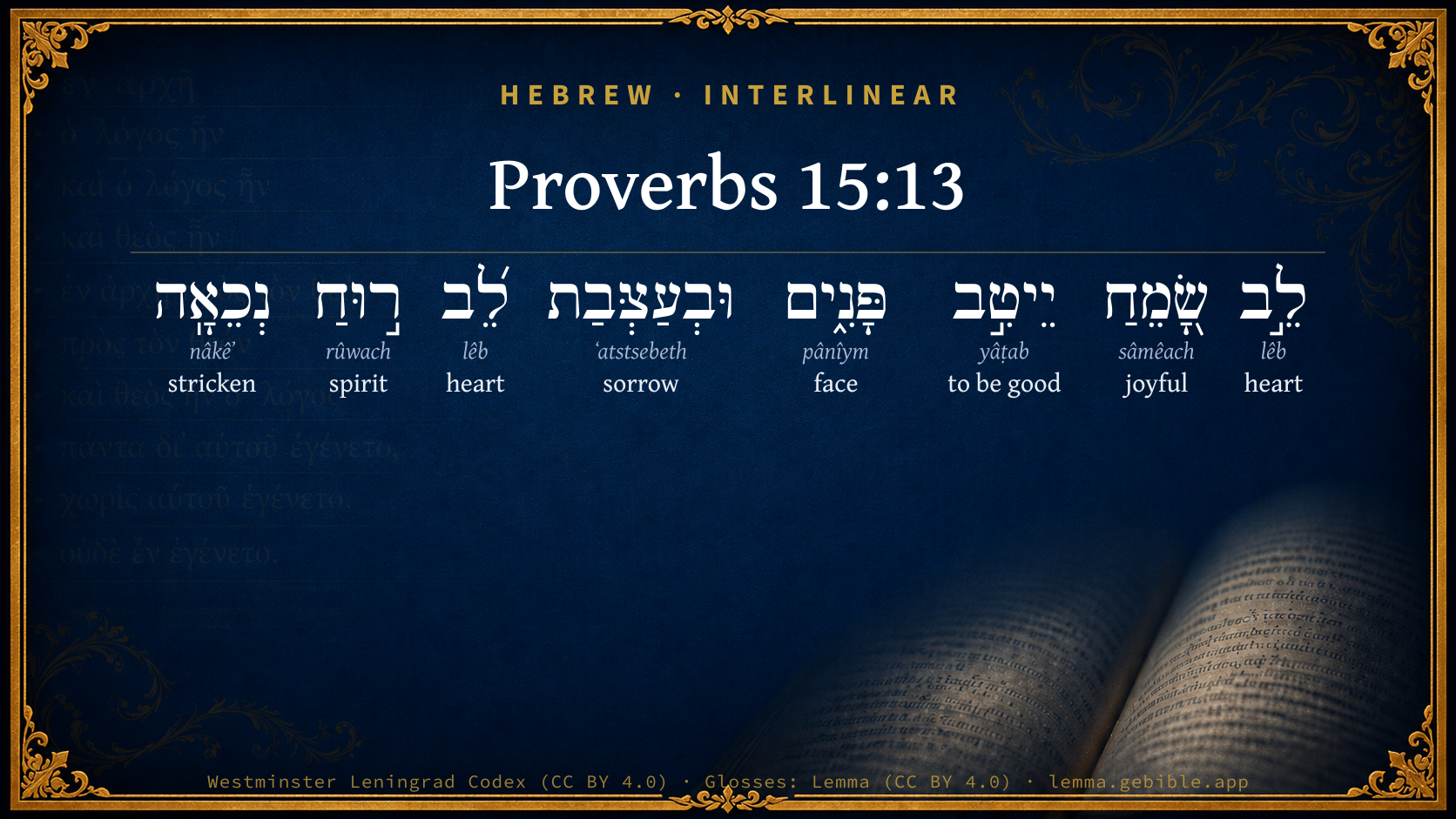
Hebrew (Westminster Leningrad Codex) Proverbs 15:13 appears in the Hebrew Old Testament. The text above is from the Westminster Leningrad Codex. Each word links to its Strong’s number, a concise gloss, and parsing drawn from the Open Scriptures Hebrew Bible morphology. Click any word for its full Brown-Driver-Briggs (BDB) entry.
Download image
Cite this verse

Proverbs 15:13 (World English Bible). Public Domain. Lemma interlinear Bible study tool, https://lemma.gebible.app/v/proverbs/15/13.

Show BibTeX & RIS
BibTeX
RIS
English Translation
A glad heart makes a cheerful face; But an aching heart breaks the spirit.
World English Bible · Public Domain
Highlights
  • 1 first appearance in the Hebrew Bible
Full analysis ↓
Download a study sheet

One document with this verse’s original text, its word-by-word gloss line, the meaning frame, cross-references with their text, attributed commentary, and full source and license credits — printable, and it pastes into notes with its structure intact.

This verse Autodidact and up

Study sheet (.html) Plain text (.txt)

A passage Seminary Student

Up to 50 verses in one chapter. A passage sheet keeps up to 6 commentary sources and 12 cross-references per verse, in the order this page ranks them, and says so on the sheet whenever that leaves anything out. Ask for a single verse and you get the Autodidact verse sheet above.

Everything on this page stays free to read, with no account — the sheet is a download of what is already on screen, not access to it.

Want to remove ads? Support Godless Engineer
Compare translations 3

The same verse in 3 English versions, stacked beneath the original-language interlinear above. Click any original word for its lexicon entry.

Each is an independent rendering of the whole verse — the interlinear is not word-aligned to these translations.

Highlighted words mark where these versions differ — a whole-verse word diff, not a word-by-word alignment.

  • World English Bible Public Domain
    A glad heart makes a cheerful face; But an aching heart breaks the spirit.
  • King James Version Public Domain
    A merry heart maketh a cheerful countenance: but by sorrow of the heart the spirit is broken.
  • unfoldingWord Literal Text CC BY-SA 4.0
    A joyful heart makes a face glad, but by pain of heart, a spirit stricken.

unfoldingWord Literal Text — © unfoldingWord, licensed CC BY-SA 4.0. Word-aligned USFM3 via Door43 (git.door43.org/unfoldingWord/en_ult).

Versions to compare (up to 4)

3 of 4 selected

Show all 18 translations

Every available English version of this verse, each an independent rendering of the whole verse.

  • World English Bible Public Domain
    A glad heart makes a cheerful face; But an aching heart breaks the spirit.
  • Berean Standard Bible Public Domain
    A joyful heart makes a cheerful countenance, but sorrow of the heart crushes the spirit.
  • Majority Standard Bible Public Domain
    A joyful heart makes a cheerful countenance, but sorrow of the heart crushes the spirit.
  • King James Version Public Domain
    A merry heart maketh a cheerful countenance: but by sorrow of the heart the spirit is broken.
  • American Standard Version (1901) Public Domain
    A glad heart maketh a cheerful countenance; But by sorrow of heart the spirit is broken.
  • Revised Version (1885) Public Domain
    A merry heart maketh a cheerful countenance: but by sorrow of heart the spirit is broken.
  • Geneva Bible (1599) Public Domain
    A ioyfull heart maketh a chearefull countenance: but by the sorow of the heart the minde is heauie.
  • Douay-Rheims (1899) Public Domain
    A glad heart maketh a cheerful countenance: but by grief of mind the spirit is cast down.
  • Young's Literal Translation Public Domain
    A joyful heart maketh glad the face, And by grief of heart is the spirit smitten.
  • Literal Standard Version CC BY-SA 4.0
    A joyful heart makes the face glad, || And the spirit is struck by grief of heart.
  • Unlocked Literal Bible CC BY-SA 4.0
    A joyful heart makes the face cheerful, but heartache crushes the spirit.
  • unfoldingWord Literal Text CC BY-SA 4.0
    A joyful heart makes a face glad, but by pain of heart, a spirit stricken.
  • Darby Bible Public Domain
    A joyful heart maketh a cheerful countenance; but by sorrow of heart the spirit is broken.
  • World Messianic Bible Public Domain
    A glad heart makes a cheerful face, but an aching heart breaks the spirit.
  • Webster's Bible Public Domain
    A merry heart maketh a cheerful countenance: but by sorrow of the heart the spirit is broken.
  • Free Bible Version CC BY-SA 4.0
    If you're happy inside, you'll have a cheerful face, but if you're sad, you look crushed.
  • Bible in Basic English Public Domain
    A glad heart makes a shining face, but by the sorrow of the heart the spirit is broken.
  • JPS Tanakh (1917) Public Domain
    A merry heart maketh a cheerful countenance; but by sorrow of heart the spirit is broken.

Literal Standard Version (2020), Covenant Press — licensed CC BY-SA 4.0. Text via the HelloAO Bible API (eBible.org). Unlocked Literal Bible (unfoldingWord) — licensed CC BY-SA 4.0. Text via the HelloAO Bible API (eBible.org). unfoldingWord Literal Text — © unfoldingWord, licensed CC BY-SA 4.0. Word-aligned USFM3 via Door43 (git.door43.org/unfoldingWord/en_ult). Free Bible Version, Dr. Jonathan Gallagher — licensed CC BY-SA 4.0. Text via the HelloAO Bible API (eBible.org).

Word by word

More ways to search: Search by grammar → Find every occurrence → Compare this word →

Practice this passage: Drill this verse → Learn its vocabulary →

About this verse

These counts appear in no published source. They are computed here, from the morphology-tagged text and Lemma’s own curated glosses. What Lemma adds →

8
words
7
distinct lemmas
Wisdom
section

Notable vocabulary

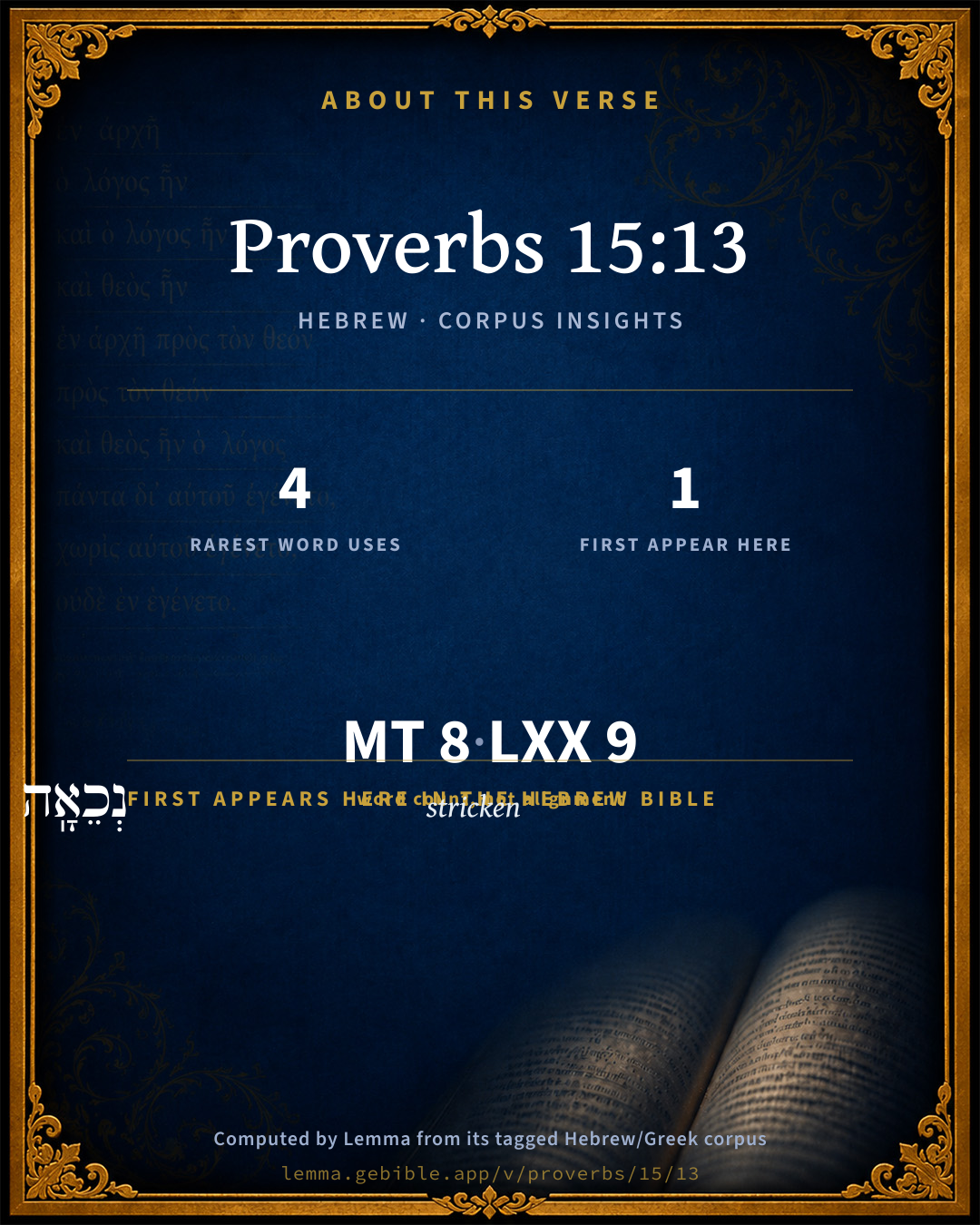
The rarest word here is נְכֵאָֽה stricken H5218 — appearing just 4 times in the whole Hebrew Bible.

First appearance in Scripture

This word makes its first canonical appearance in the Hebrew Bible here:

  • נְכֵאָֽה stricken H5218

Shared distinctive vocabulary

נְכֵאָֽה stricken H5218 occurs in 4 verses of the Hebrew Bible. Also found in:

Grammatical profile

  • 1 verb
  • 5 nouns
  • 2 adjectives

Verb forms

  • יֵיטִ֣ב Hiphil · Imperfect

Repetition

A word recurs within this verse — often emphatic in Hebrew:

  • לֵ֣ב heart H3820 ×2

Hebrew & Septuagint length

In English translation the verse runs 14 words from the Hebrew and 18 from the Septuagint (LXX English) — closely comparable.

A rough comparison of the two English renderings, which tokenize alike — not a word-level alignment.

Word counts can differ between the Hebrew and the Greek without any difference in meaning — e.g. the Hebrew direct-object marker אֵת has no separate Greek word, and Greek often adds the article ὁ.

In the original languages it is 8 Hebrew tokens and 9 Greek tokens — but the two are counted differently (Hebrew bundles its prefixes and suffixes into one token; the Greek is in lemma form), so that isn’t a like-for-like length.

Cross-references

9

Topical passages linked to Proverbs 15:13 in the Treasury of Scripture Knowledge — connected by theme and wording, ordered by reader-vote popularity; previews shown in the World English Bible.

  • Proverbs 17:22 A cheerful heart makes good medicine, But a crushed spirit dries up the bones.
  • John 14:1 "Don't let your heart be troubled. Believe in God. Believe also in me.
  • Proverbs 12:25 Anxiety in a man's heart weighs it down, But a kind word makes it glad.
  • Proverbs 18:14 A man's spirit will sustain him in sickness, But a crushed spirit, who can bear?
  • Proverbs 15:15 All the days of the afflicted are wretched, But one who has a cheerful heart enjoys a continual feast.
  • 2 Corinthians 7:10 For godly sorrow works repentance to salvation, which brings no regret. But the sorrow of the world works death.
  • 2 Corinthians 2:7 so that on the contrary you should rather forgive him and comfort him, lest by any means such a one should be swallowed up with his excessive sorrow.
  • Nehemiah 2:2 The king said to me, Why is your face sad, seeing you are not sick? this is nothing else but sorrow of heart. Then I was very sore afraid.
  • 2 Corinthians 1:12 For our boasting is this: the testimony of our conscience, that in holiness and sincerity of God, not in fleshly wisdom but in the grace of God we behaved ourselves in the world, and more abundantly toward you.

Cross-references courtesy of OpenBible.info (CC BY 4.0).

Hebrew and Greek witnesses Masoretic Hebrew ↔ Greek Septuagint

The same verse in the two great witnesses to the Old Testament, shown verse-for-verse.

These are two independent witnesses, not word-aligned to each other, and the Septuagint is shown in lemma (dictionary) form.

Hebrew Proverbs 15:13 Masoretic · Westminster Leningrad Codex

לֵ֣ב שָׂ֭מֵחַ יֵיטִ֣ב פָּנִ֑ים וּבְעַצְּבַת לֵ֝ב ר֣וּחַ נְכֵאָֽה

A glad heart makes a cheerful face; But an aching heart breaks the spirit.

World English Bible · Public Domain

Greek LXX Proverbs 15:13 Septuagint · lemma form

καρδία εὐφραίνω πρόσωπον θάλλω ἐν δέ λύπη εἰμί σκυθρωπάζω

When the heart rejoices the countenance is cheerful; but when it is in sorrow, the countenance is sad.

LXX2012 (modern English Septuagint) · Public Domain

On this verse, The Pulpit Commentary discusses the Septuagint’s reading. Read the note in Commentary ↓

Hebrew: Westminster Leningrad Codex (CC BY 4.0). Greek: Septuagint (public domain); English from LXX2012 (modern English Septuagint) (Public Domain). How the Septuagint differs from the Hebrew →

Commentary

Notes on Proverbs 15:13 from classic Christian and Jewish commentators (each source and its license shown beneath its notes). The classic Christian expositions comment on the surrounding passage and are grouped to its opening verse, so a note may address several verses; the Jewish commentaries on the Tanakh (Rashi and others) are per-verse, so they appear only where the commentator wrote on this verse.

Lemma curates 59 commentaries, every one of them public domain or Creative Commons licensed, each selected and text-cleaned for this edition rather than reprinted as found. About our sources →

Trapp's Complete Commentary

John Trapp

Pro 15:13 A merry heart maketh a cheerful countenance: but by sorrow of the heart the spirit is broken.

Ver. 13. A merry heart makes a cheerful countenance.] It sits smiling in the face, and looks merrily out of the windows of the eyes. This is not till faith have healed the conscience, and till grace have hushed the affections, and composed all within. Saint Stephen looked like an angel when he stood before the council; {Act 6:15} and the apostles went away rejoicing. {Act 5:41} There are that rejoice in the face only, and not in the heart; {2Co 5:12} this is but the hypocrisy of mirth, and we may be sure that many a man’s heart bleeds within him when his face counterfeits a smile. It is for an Abraham only to laugh for joy of the promise, and for a David "to rejoice at the word as one that findeth great spoil," {Psa 119:162} wherein the pleasure is usually as much as the profit. Christ’s chariot, wherein he carries his people up and down in the world, and brings them at length to himself, is "paved with love"; {Son 3:9-10} he brings them also into his wine cellar, {Son 2:4} where he cheers up their hearts, and clears up their countenances; and this is praemium ante praemium, Heaven aforehand. These are some few clusters of the grapes of the celestial Canaan.

But by the sorrow of the heart the spirit is broken.] As the looks are marred, so the spirits are dulled and disabled, as a limb out of joint can do nothing without deformity or pain. Dejection takes off the wheels of the soul, hinders comfortable intercourse with God, and that spiritual composedness, that habitual cheerfulness, that sabbath of spirit that every man should strive to enjoy. Afflictions, saith one, are the wind of the soul, passions the storm. The soul is well carried, when neither so becalmed that it moves not when it should, nor yet tossed with tempests of wrath, grief, fear, care, &c., to move disorderly. Of these we must be careful to crush the very first insurrections; storms rise out of little gusts, but the top of those mountains above the middle region are so quiet that ashes, lightest things, are not moved out of place.

John Trapp, A Commentary or Exposition upon All the Books of the Old and New Testament (1647–1656) — public domain. Text from a community e-Sword module.

Joseph Benson's Commentary

Pro 15:13-15. A merry heart maketh a cheerful countenance; &c. — “When the mind of a man is inwardly satisfied, and full of joy, it does good to his body too, as appears in his cheerful countenance: but when grief seizes on the heart, it detects, enfeebles, and breaks the most courageous spirit.” All the days of the afflicted — Of those troubled in mind, as the meaning of this general expression may be very fitly restrained from the following clause; are evil — Tedious and uncomfortable; he takes no satisfaction in any person, place, or thing; but he that is of a merry heart — Hebrew, of a good heart, that is, composed, quiet, and contented, conscious of intending God’s glory in all things, and of being devoted to his service in love and obedience; hath a continual feast — Hath constant satisfaction and delight in all conditions, yea, even in affliction.

Joseph Benson's Commentary on the Old and New Testaments (1811–1818) — public domain. Text from a community e-Sword module.

The Preacher's Complete Homiletical Commentary

Joseph S. Exell (gen. ed.)

CRITICAL NOTES.—

Pro_15:14. Mouth, or “the countenance.”

MAIN HOMILETICS OF Pro_15:13

A CHEERFUL FACE AND A BROKEN SPIRIT

I. The outer man is to a large extent an index of the inner life. The joy of the heart is made visible upon the countenance. This is one of the infinitely kind and wise arrangements of God which minister so much to human happiness. We have but to consider the influence of a cheerful face to know how great a blessing it is that a merry heart maketh a cheerful countenance. “How blank would be the aspect of the world,” says Dr. Arnot, “if no image of a man’s thought could ever be seen glancing through his countenance! Our walk through life would be like a solitary walk through a gallery of statues—as cold as marble, and not nearly so beautiful.

II. The effect of sorrow upon the human spirit. It “breaks” it. When a vessel’s timbers are shivered by the fury of the storm she may not go to pieces altogether. But she is no longer able to hold her own against the elements, which she could once use as forces to convey her from land to land. If she were now to put to sea, instead of riding over the waves and making them her servants, she would be a passive thing in their hands, a mere helpless bundle of timbers to be tossed whithersoever they pleased, instead of “walking the waters like a thing of life.” So it is with the human spirit when the cross seas and angry winds of adverse circumstances have quenched the hope and paralysed the energy that once governed and inspired the man. He is no longer able to face the storms of life, and outride them, or even make them advance his interests. He is passive amid the changes and chances of mortal life, and they drift him on wheresoever they will. But this can never be the case unless a man has lost faith in the character of God and his own high and immortal destiny. Then, indeed, the elements which he was built to rule will rule him, and he will fail to fulfil the end for which God launched him on the sea of life.

OUTLINES AND SUGGESTIVE COMMENTS

I have always preferred cheerfulness to mirth. The latter I consider as an act, the former as a habit, of the mind.—Addison.

The “sorrow of heart” here spoken of, we may consider as that which arises from an evil conscience, from envy, discontent, and other similar sources.—Wardlaw.

A “merry” or “glad” heart is one of the attributes of piety. It (literally) “does good to the countenance,” improves it, as we say in our idiom, “Come with us, and we will do thee good” (Num_10:29).—Miller.

This word merriment is of frequent use among our old writers. It is Foxe’s favourite description of the holy joy of the martyrs.—Bridges.

It sits smiling in the face, and looks merrily out of the windows of the eyes. But this is not till faith has healed the conscience, and till grace has hushed the affections, and composed all within. Stephen looked like an angel when he stood before the council (Act_6:15); and the apostles went away rejoicing (Act_5:41). There are that rejoice in the face only, and not in the heart (2Co_5:12); this is but the hypocrisy of mirth, and we may be sure that many a man’s heart bleeds within him when his face counterfeits a smile. It is for an Abraham only to laugh for joy of the promise, and for a David to “rejoice at the word as one that findeth great spoil” (Psa_119:162), wherein the pleasure is usually as much as the profit. Christ’s chariot, wherein he carries people up and down in the world, and brings them at length to Himself, is “paved with love” (Son_3:9-10); He brings them also into His wine cellar (Son_2:4), where He cheers up their hearts, and clears up their countenances, and this is Heaven beforehand. These are some few clusters of the grapes of the celestial Canaan. But as the looks are marred, so the spirits are dulled and disabled by sorrow, as a limb out of joint can do nothing without deformity or pain. Dejection takes off the wheels of the soul, hinders comfortable intercourse with God, and that habitual cheerfulness, that Sabbath of the spirit, that every man should strive to enjoy. Afflictions, saith one, are the wind of the soul, passions the storm. The soul is well carried when neither so becalmed that it moves not when it should, nor yet tossed with tempests of wrath, grief, fear, etc., to move disorderly. Of these we must be careful to crush the very first insurrections; storms rise out of little gusts, but the top of those mountains above the middle region are so quiet that ashes, lightest things, are not moved out of place.—Trapp.

Mirth and cheerfulness make a man not only fitter for the occasions of this world, but even for spiritual affairs also. Wherefore Elisha calleth for a minstrel that, being angry with the king of Israel, by the melody of the music a more soft and sweet disposition might possess him.… “Joy,” saith Aquinas, “is, as it were, a juice spreading itself over the whole man, dispersing the comfort of itself to all the faculties of the soul, and all parts of the body. But, now, what is it that maketh a merry heart? Surely not the things of this world. They only do besot the heart with a dream of mirth, they do only make the heart drunken with some flushings of joy. A merry heart indeed is that which the assurance of God’s favour rejoiceth, and that will make the countenance cheerful in any trouble, even in death itself. It is true also that by sorrow of heart the spirit is broken, the heart and the spirit being but one string of life. But what is it by which the heart should be made sorrowful? Surely not the things of this life, seeing the life of the heart is so far above them. For it is a shameful folly to hurt a better thing for that which is farworse. No; nothing should make the heart sorrowful but repentance for sin, and as that casteth down the spirit, so will it raise it up again. Wherefore Augustine saith, “Let the penitent always be grieved, and let him rejoice for his grief.” Nothing should make the heart sad but the fear of God’s displeasure, and if that break the spirit, it will heal it again with endless consolation.—Jermin.

The principal thought of Pro_15:14 is a repetition in a slightly varied form of a truth that has been considered before. (See on chap. Pro_12:1, Pro_13:18, etc.)

OUTLINES AND SUGGESTIVE COMMENTS

They are the wisest men that are most sensible of the imperfection of their wisdom.—Lawson.

“The mouth of fools feed,” etc., literally, pastures, like a brute. A thing fed takes the texture of its nourishment. The “mouth” or “face” (see Critical Notes) of the fool grows more and more inane and brutal.—Miller.

As a hungry man seeks meat, or a covetous man gold, the more he hath the more he desires. Moses was no sooner off the mount where he had seen God face to face, but he cries, “Lord, show me Thy glory!” David, that knew more than his teachers, cries ever and anon, “Teach me Thy statutes.” Job prefers knowledge before his necessary food (chap. Pro_23:12). The wise man finds no such sweetness in the most delicate and dainty dishes, as in the search after Divine knowledge (Psa_119:103). Even Aristotle saith that a little knowledge, though conjectural, about heavenly things is to be preferred above knowledge, though certain, about earthly things. And Agur saith it is to ascend into heaven (Pro_30:4).—Trapp.

First, because the one sort is after the spirit, and therefore they favour the things of the spirit; and the other sort is after the flesh, and therefore they favour the things of the flesh. Secondly, because the one sort is guided by judgment, and choose that which will comfort their consciences; and the other is altogether led by lust, and seek only that which will satisfy their senses. Thirdly, faith makes the one sort to cast an eye to that which will follow hereafter; and sensuality causeth the other (like brute beasts, made to be destroyed) only to look to that which is present.—Dod.

Knowledge is necessary for us, not only to manage the affairs of this life, but also to perform the service of our Maker. Conscience may dictate to us that things are right or wrong, but conscience may be mistaken in her decisions, unless she call in reason to her assistance, for a clear knowledge of the revealed will of God cannot be understood without application of mind.… The desire of knowledge is in some sense natural to us all and is manifested very soon. We see how early curiosity exerts itself in lively children. But this natural desire may be misused.

1. It may be too little. Some persons do not desire knowledge so much as they ought, especially they are negligent in acquiring religious knowledge. This negligence may proceed from too warm a pursuit of other things. But what will this world avail us, if we are excluded from an inheritance in the next? It may proceed from mere sloth. But the unprofitable servant, who suffers his talents to lie useless, is to be cast into outer darkness.

2. It may be too much. Some things there are which we ought not to know, and a vain curiosity after them is an abuse of our natural desire of knowledge. This curiosity brought on the fall of our first parents, and still reigns among their posterity. Sin should only be known, as the rocks at sea, that they may be avoided. It becomes us also to be contented with such a knowledge of the Divine nature, and the Divine administration, as we are capable of acquiring, and of future events so far as God hath seen fit to reveal them.—Jortin.

The mouth of fools—the mouth of their souls and understandings—feedeth upon anything; even foolishness itself is good food unto them. Their distempered palate judgeth not the worth of things. They have a mouth to receive knowledge, but they have not a heart to consider and discern what they do receive. None is so ill a feeder as fools. Such fools are they in the prophet Isaiah who say, “Prophecy not unto us, right things speak unto us,” as the original word is, bland things, pleasing things; but the word signifieth in the first place scattered things, such as coming from a shattered brain have no order and aim at no material point. Or else scattered things which may strike at none, which may hurt none, do no good to any. And, indeed, too many such there are. The world is full of speakers and talkers, that speak things they know not, and teach things they have not learned.—Jermin.

The Queen of Sheba, “coming from the utmost parts of the earth;” Nicodemus and Mary “sitting at the feet of Jesus;” the Eunuch, journeying to Jerusalem; Cornelius and his company drinking in the precious message of salvation; the Bereans, carefully “searching the Scriptures,” all these show “the understanding heart seeking a larger interest in the blessing.”—Bridges.

That in “seeking knowledge” the idea of feasting on it is included, is evident from the terms of the antithesis. It is a feast of “knowledge” above all, of divine knowledge. He who has “understanding,”—who is enlightened of God, and discerns the excellency and glory of divine truth—“seeketh” such knowledge. From experience of the joy already imparted by it, he seeks more and still more—the appetite growing by gratification, delighted with every new discovery, yet never tiring of the old (1Pe_2:1-3). “But the mouth of fools feedeth on foolishness.” That is what they like; that is therefore what they seek, and from which they have their own poor and pitiful enjoyment. In regard to religion itself they are taken with, everthing that serves the present purpose of keeping all quiet within; that lets conscience alone; that dispenses with serious thought, and, preventing inward disturbance, allows them to go on easily and comfortably. They have a relish for all doctrines of this unannoying description—that “prick not their hearts; that embitter not present sweets by any forebodings of the future; that “prophecy smooth things, and cause the Holy One of Israel to cease from before them”—the scarer of their thoughtless mirth and sinful gratification. They have an appetite for every thing of that kind.—Wardlaw.

The Preacher's Complete Homiletical Commentary (gen. ed. Joseph S. Exell; Funk & Wagnalls, c. 1892) — public domain (pre-1929). A full-Bible homiletical/sermon-outline anthology covering 65 of 66 books (2 John is absent from the source module). Text from a community e-Sword module.

Tyndale Open Study Notes

Tyndale Open Resources

15:13 What people feel affects how they present themselves (cp. 15:30).

Tyndale Open Study Notes — © Tyndale Open Resources, licensed CC BY-SA 4.0. Text via the HelloAO Bible API.

Matthew Henry's Commentary

Here, 1. Harmless mirth is recommended to us, as that which contributes to the health of the body, making men lively and fit for business, and to the acceptableness of the conversation, making the face to shine and rendering us pleasant one to another. A cheerful spirit, under the government of wisdom and grace, is a great ornament to religion, puts a further lustre upon the beauty of holiness, and makes men the more capable of doing good. 2. Hurtful melancholy is what we are cautioned against, as a great enemy to us, both in our devotion and in our conversation: By sorrow of the heart, when it has got dominion and plays the tyrant, as it will be apt to do it if be indulged awhile, the spirit is broken and sunk, and becomes unfit for the service of God. The sorrow of the world works death. Let us therefore weep as though we wept not, in justice to ourselves, as well as in conformity to God and his providence.

Matthew Henry's Commentary on the Whole Bible (1708–1710) — public domain (CC PDM 1.0). Text via the HelloAO Bible API.

Jamieson, Fausset & Brown

Robert Jamieson, A. R. Fausset & David Brown

maketh . . . countenance--or, "benefits the countenance."

spirit is broken--and so the countenance is sad.

Jamieson, Fausset & Brown — Commentary Critical and Explanatory on the Whole Bible (1871) — public domain (CC PDM 1.0). Text via the HelloAO Bible API.

Adam Clarke's Commentary

Verse 13. By sorrow of the heart the spirit is broken.] Every kind of sorrow worketh death, but that which is the offspring of true repentance. This alone is healthful to the soul. The indulgence of a disposition to sighing tends to destroy life. Every deep sigh throws off a portion of the vital energy.

Adam Clarke's Commentary on the Bible (1810–1826) — public domain. Text from a community e-Sword/MySword module.

Ellicott's Commentary for English Readers

(13) By sorrow of heart the spirit is broken.—See above on Pro_12:25.

A Bible Commentary for English Readers, edited by Charles John Ellicott (1878–1897) — public domain. Text from a community e-Sword module.

John Gill's Exposition

A merry heart maketh a cheerful countenance,.... Or, a "joyful heart" (c); that is joyful in the God of its salvation; that rejoices in Christ Jesus; is filled with joy and peace through believing in him, in his person, blood, righteousness, and sacrifice; that has a comfortable view of his justification by his righteousness, of peace and pardon by his blood, of the atonement of his sins by his sacrifice; to whom he has said, "be of good cheer, thy sins are forgiven thee", Mat 9:2; who has peace in him, though tribulation in the world: as such a man's heart must be made glad, this will make his countenance cheerful, or cause him to lift up his head with joy; as it is in natural things, so it is in spiritual ones;

but by sorrow of the heart the spirit is broken; a man is dejected, his spirits sink, and it is seen in his countenance: there is a great sympathy between the body and mind, the one is much affected by the other; when the heart is full of sorrow, the animal spirits are low, the nerves are loosened, the whole frame, of nature is enfeebled, and the body emaciated; this is often the case through outward troubles (d): physicians say (e) that grief weakens the strength, and destroys the spirits, more than labour does. "The sorrow of the world worketh death", Co2 7:10; and sometimes, through spiritual troubles, a sense of sin and guilt of it, a legal sorrow, which produces a legal contrition of spirit; and such "a wounded spirit who can bear?" Pro 18:14. This is the effect of a mere work of the law upon the conscience; and stands opposed to the spiritual joy, and the effects of it, the Gospel brings.

(c) "cor gaudens", V. L. Baynus. (d) "Frangit fortia corda dolor", Tibullus, l. 3. Eleg. 2. v. 6. (e) Fernel. Method. Medendi, l. 7. c. 9. p. 54.

John Gill's Exposition of the Whole Bible (1746–1763) — public domain (CC PDM 1.0). Text via the HelloAO Bible API.

Albert Barnes' Notes on the Bible

Some prefer to render the last clause, “In sorrow of heart the breath is oppressed.”

Albert Barnes' Notes on the Bible (1834–1885) — public domain. Text from a community e-Sword/MySword module.

Haydock's Catholic Bible Commentary

Down. Compunction is salutary, but worldly grief blameable, chap. xxv. 20., and 2 Corinthians vii. 10. (St. Gregory, past. ii. 10.)

George Leo Haydock (1774–1849), Haydock's Catholic Family Bible and Commentary, 1859 edition — public domain. Excludes Psalms (Douay-Rheims chapter numbering differs from Protestant) and Deuterocanonical books (Catholic canon only).

Matthew Poole's English Annotations

The spirit; either,

1. His vital spirits. Or rather,

2. His courage and rigour, the decay whereof showeth itself in his countenance, as is implied from the former clause.

Matthew Poole's English Annotations on the Holy Bible (1683–1685) — public domain. Text from a community e-Sword/MySword module.

Whedon's Commentary on the Bible

Daniel D. Whedon

13. A merry (or joyful) heart maketh a cheerful countenance — Literally, does good to the face; makes it comely.

Spirit is broken — Or, dejected. Grief, also, will show itself in a corresponding expression. Emotions of joy and sorrow show themselves in the external appearance.

Comp. Pro_19:22. “The breath is oppressed.” — Speaker’s Commentary.

Daniel D. Whedon (gen. ed.), Commentary on the Old and New Testaments (1874–1909) — public domain. Text from a community e-Sword module.

The Pulpit Commentary

A merry heart maketh a cheerful countenance. The face is the index of the condition of the mind. "In the forehead and the eye The lecture of the mind doth lie.

And, again, "A blithe heart makes a blooming visage" (comp. Ecc 13:25, etc.). Septuagint, "When the heart is glad, the face bloometh (yallei )." But by sorrow of heart the spirit is broken. (Pro_12:25) Happiness is shown in the outward look, but sorrow has a deeper and more abiding influence; it touches the inner life, destroys the natural elasticity, creates despondency and despair. (comp. Pro_16:24 Pro_17:22) Corn. a Lapide quotes St. Gregory Nazianzen"s definition"Laetitia quidnam? Mentis est diffusio. Tristitia? Cordis morsus et turbatio.

Hitzig and others translate the second clause, "But in sorrow of heart is the breath oppressed." It is doubtful if the words can be so rendered, and certainly the parallelism is not improved thereby.

Vers. 13, 15-17. The source of satisfaction.

We learn

I THAT THERE SOMETIMES RESTS A LONG AND DEEP SHADOW ON THE PATH OF HUMAN LIFE.

1. Sometimes a long one. "All the days of the afflicted are evil." They are not a few who have to make up their minds for many months or years of separation or pain, or even for a lifelong trouble. They know that they will carry their burden to the grave.

2. Sometimes a deep one. "By sorrow of heart the spirit is broken." The burden is greater than the spirit can bear, it breaks beneath it; the heart is simply overwhelmed; all hope has died out, all gladness is gone from the life, all light from the countenance, all elasticity from the step; the hear; is fairly broken.

II THAT FAVOURABLE CIRCUMSTANCES CANNOT COMMAND SATISFACTION TO THE SPIRIT.

1. Wealth will not do it. Great treasure often means great trouble (ver. 16); shares and stocks often bring as much burden as blessing with them; he who piles gold on his counter may be heaping anxiety upon his heart.

2. Sumptuous fare will fail (ver. 17). All the delicacies that can be spread upon the fable will not give enjoyment to him that has a restless spirit, or a secret that he knows he cannot hide, or a debt he knows he cannot meet, or a bounden duty he knows he has neglected.

III THAT HAPPINESS MUST BE HEART DEEP, OR IT IS NOTHING. (Ver. 13) If it is not the merry heart that produces the cheerful countenance, the smile can very well be spared, both by him who smiles and by those who are in his presence. Few things are sadder to hear then hollow laughter, or to see than a forced and weary smile.

IV THAT A CHEERFUL SPIRIT IS A VALUABLE BESTOWMENT. (Ver. 15) Better than the large estate or the high position, or the influential circle, is the buoyant spirit which "Ever with a frolic welcome lakes The thunder and the sunshine.

V THAT A LOVING SPIRIT IS A STILL GREATER GIFT OF GOD. "Where love is," there is peace and there is joy, however mean the home or slight the fare. He who carries with him to every table and every hearth a loving spirit is a friend of God"s own sending; he is "the welcome guest;" he has a treasure in his breast which no coffers will supply.

VI THAT PIETY IS THE ALL-COMPENSATING GOOD.

1. It makes the poor man rich in faith," "rich toward God," rich with a wealth which "no thief can steal.

2. It brings comfort to the sorrowful, and introduces that Divine Physician who can bind up the broken heart, and heal its wounds.

3. It speaks of a heavenly portion to those who have no hope of deliverance here; there may be "affliction all the days" of life (ver. 15), but "the righteous hath hope in his death". (Pro_14:32) Blessed, then, is he in whose heart is "the fear of the Lord. C.

A joyous heart or a broken spirit.

These are the two extremes. The less we have of the one the more we tend towards the other. The first is encouraged that it may save us from the disasters of the second condition.

I THE CONDITION OF THE HEART IS OF VITAL IMPORTANCE. "Out of it are the issues of life". (Pro_4:23) The first essential for one whose life has been wrong is the creation of "a clean heart". (Psa_51:10) According as we think and feel in our hearts, so do we truly live. Now, it is the merit of Christianity that it works directly on the heart, and only touches the outer life through this primary inward operation. We must set little store on the external signs of prosperity if the heart is wrong. When that is right the rest is likely to follow satisfactorily.

II THE JOY OR SORROW OF THE HEART ARE NOT MATTERS OF INDIFFERENCE. The religion of the Bible is not Stoicism. It is nowhere represented to us in this book that it matters not whether men grieve or are joyous. On the contrary, the Bible contains valuable recipes against heart pangs. God"s pity for his children would lead to his concerning himself with such matters. Christ"s human sympathy, which led to his being frequently "moved with compassion," made him alleviate suffering and seek to give his joy to his disciples. The special mission of sorrow and the large healing and strengthening influence of the highest kind of joy make these experiences to be of real interest to the spiritual life.

III THE OUTER LIFE IS BRIGHTENED BY JOY OF HEART. It is possible for the actor to assume a smiling countenance when his heart is bursting with agony, but that is just because he is an actor. It is not intended by Providence that the face should be a mask to bide the soul. In the long run the set expression of the countenance must correspond to the prevalent condition of the spirit within. The sad heart will be revealed by a clouded countenance, the heart of care by the fretted lines of a worn lace, the peaceful heart by a serene expression, and the glad heart by unconscious smiles. Thus we shed gloom or sunshine by our very presence. "The joy of the Lord is your strength". (Neh_8:10) With the brightened countenance there comes revived energy. Moreover, the cheerful expression of a Christian is a winning invitation to others. It makes the gospel attractive.

IV THE SPIRIT IS BROKEN BY SORROW OF HEART. It must be confessed that we have here only a partial view of sorrow. The richer revelation which the New Testament makes of the Divine gospel of sorrow gives it a new meaning and a higher blessedness. Since Christ suffered, suffering has been sanctified, and the Via Dolorosa has become the road to victory. Nevertheless, mere sorrow is still trying, wearing, grinding to the soul. To bear the cross for Christ"s sake is to render noble service, but simply to groan under the load of pain is not to be inspired with strength. Jesus was not only "a Man of sorrows, and acquainted with grief;" he could speak of his joy just before feeling his deepest agony. A life of utter sorrow must be one of utter weariness.

1. Therefore we should seek the grace of Christ to conquer sorrow in our own hearts. There is no virtue in yielding to it with self-made martyrdom.

2. It is a good work to lessen the world"s sorrow.

The Pulpit Commentary (1880–1919), ed. H.D.M. Spence-Jones & Joseph S. Exell — public domain. Text from a community e-Sword module.

Bridges on Proverbs

Charles Bridges

How close is the sympathy between the body and soul, though framed of such opposite elements! A man’s countenance is the index of his spirit. In the sensation of joy ’the heart sits smiling in the face, and looks merrily out of the windows of the eyes.’†1 Yet too often this high exhilaration, this countenance lighted up, is a matter of sadness rather than of pleasurable contemplation; as connected with a happiness, that estranges the heart from God. Who has a true right to a merry heart, but he that is walking in the joy of Divine acceptance? (Psa 32:1-2, Psa 32:11 .) This spring of joy lighted up Hannah’s sorrowful countenance into godly cheerfulness. (1Sa 1:18 .) Stephen stood before his judge, with his heavenly prospects beaming in his "angel face." (Act 6:15 ; Act 7:55 .) Everywhere does the hearty reception of the gospel "give beauty for ashes," sunshine for gloom. (Isa 61:3 .)

Sad, indeed, is the contrast of a heart broken by worldly sorrow. (1Sa 28:16 . 2Co 7:10 .) Too often does a mischievous gloom worm itself into the vitals of the child of God. (Pro 18:14 .) The melancholy victim drags on a weary, heavy-laden existence, clouding a distinct feature of his character (Php 3:3 ), and one of the most attractive ornaments of his profession. (Psa 33:1 . Php 4:4 .) His hands slacken; his whole energies are paralyzed for the work of God; and he sinks into desponding apathy and indolence, as if he had taken leave of life and the sun. (Pro 17:22 .)

Every effort should be made to sweep away this black hovering cloud. Let sense and feeling be kept within their bounds; and the Savior’s voice, encouraging confidence, will be practically regarded. (Isa 50:10 .) Even our very "sighing and crying for the abominations of the land" (Eze 9:4 ) must not issue in heartless complaints, but rather stimulate to the diligent improvement of present opportunities. Did we realize, as we ought, our present privilege, and grasp our eternal prospects; no sorrow of the heart would break our spirit. ’I wonder many times’ — says Rutherford — ’that ever a child of God should have a sad heart, considering what his Lord is preparing for him.’ The gleam of the present sunshine is the earnest of what it will be, when — as he again beautifully observes — ’we shall be on the sunny side of the Brae.’†2 Meanwhile the first step in religion is, not only beginning to be serious, but to be happy. To maintain our Christian balance, even "godly sorrow" must be disciplined; lest it break the heart which it was intended only to humble; lest it give advantage to the enemy, and bring hindrance to the Church. (2Co 2:7 .)

Footnotes:

†1 Trapp in loco. This merriment, however, widely differs from the noisy mirth of the ungodly. (Pro 14:13 .) The word is of frequent use among our old writers. It is Foxe’s favorite description of the holy joys of the martyrs. Compare Ecc 9:7 .

†2 Rutherford’s Letters.

Charles Bridges, An Exposition of the Book of Proverbs (1846) — public domain. Text from a community e-Sword module.

Kretzmann's Popular Commentary

Paul E. Kretzmann

v. 13. A merry heart maketh a cheerful countenance, for when the spirit is joyous, it brightens the face; but by sorrow of the heart the spirit is broken, if grief has taken possession of the heart, the powers of the mind are also influenced, clearness of thought is gone, and the shock proves generally disastrous to the whole spiritual life.

Paul E. Kretzmann, Popular Commentary of the Bible (1921–1924) — public domain. Text from a community e-Sword module.

unfoldingWord translationNotes

Door43 World Missions Community

A joyful heart makes the face cheerful

Here the word "heart" represents the person. AT: "When a person is joyful, his face is cheerful" (See: Synecdoche)

crushes the spirit

The writer speaks of a person being discouraged as if that person's spirit were an object that is crushed. See how you translated this in Proverbs 15:4. AT: "makes a person discouraged" (See: Metaphor)

The heart of the discerning

Here the word "heart" represents the mind and thoughts. AT: "The mind of the discerning person" or "The discerning person" (See: Metonymy and Synecdoche)

the mouth of fools feeds on folly

Here the word "mouth" represents the person. The writer speaks of fools desiring foolish things as if they ate foolish things. AT: "foolish people desire folly as if it were the food that they eat" (See: Synecdoche and Metaphor)

translationWords

joy

heart

spirit

discern

know

fool

unfoldingWord translationNotes — © Distant Shores Media and the Door43 World Missions Community, licensed CC BY-SA 4.0. Source: git.door43.org/Door43/en_tn.

Rashi

Rabbi Shlomo Yitzchaki (Rashi)

A merry heart makes a cheerful face If you cheer up the heart of the Holy One, blessed be He, by following His ways, He will show you a cheerful face to do your will, but if you sadden Him, He will show you a breaking spirit, as it is stated (Gen. 6:6f): “And He became saddened to His heart. And the Lord said, ‘I will erase man, etc.’“ a breaking spirit (Talant in Old French, explained in Ecc. 1:6) a spirit of fury.

Rashi on the Tanakh — English translations: “The Judaica Press complete Tanach with Rashi, translated by A. J. Rosenberg” (CC BY 4.0); “Pentateuch with Rashi's commentary by M. Rosenbaum and A.M. Silbermann, 1929-1934” (public domain); “The Metsudah Tanach series, Lakewood, N.J” (CC BY 4.0); and “The Book of Joshua, Metsudah Publications, 1997” (CC BY 4.0). Text via Sefaria.

Lesson kit

Teaching starters — assembled from the data on this page, not authored interpretation. Every prompt links to the verse data it draws on. Edit before teaching.

Proverbs, in the Wisdom, opens this verse with 8 words (7 distinct Hebrew lemmas). Its most distinctive word is nâkêʼ (“stricken”). A historical commentator’s framing appears above. Read the whole chapter for the surrounding context.

Discussion questions

  1. How does “stricken” (nâkêʼ) shape what this verse is saying?
  2. This is the first place “stricken” appears in Scripture (first appears here). What does its debut here establish?
  3. How does Proverbs 17:22, which shares the word «stricken», read alongside this verse?
  4. What does the repetition of “heart” (2× in this one verse) do in this verse?
  5. The translations on this page render this verse differently — a whole-verse word diff, not a word-by-word alignment. What might account for the different wordings?
  6. «יֵיטִ֣ב» is a Hiphil Imperfect verb. How does that grammatical form shape the action described?
  7. Compare how Trapp's Complete Commentary and Joseph Benson's Commentary read this verse. Where do they agree or differ?

Things to notice

Reading settings

Reading text

Shown beneath each verse's original-language words.

Old Testament
Old Testament edition

Read the OT as the Masoretic Hebrew (MT) or the Greek Septuagint (LXX).

English shown for the Greek Septuagint (in the Hebrew ↔ Greek comparison).

Comparing translations? Open the Compare panel on any verse page to stack up to four side by side.