
Numbers 5:14

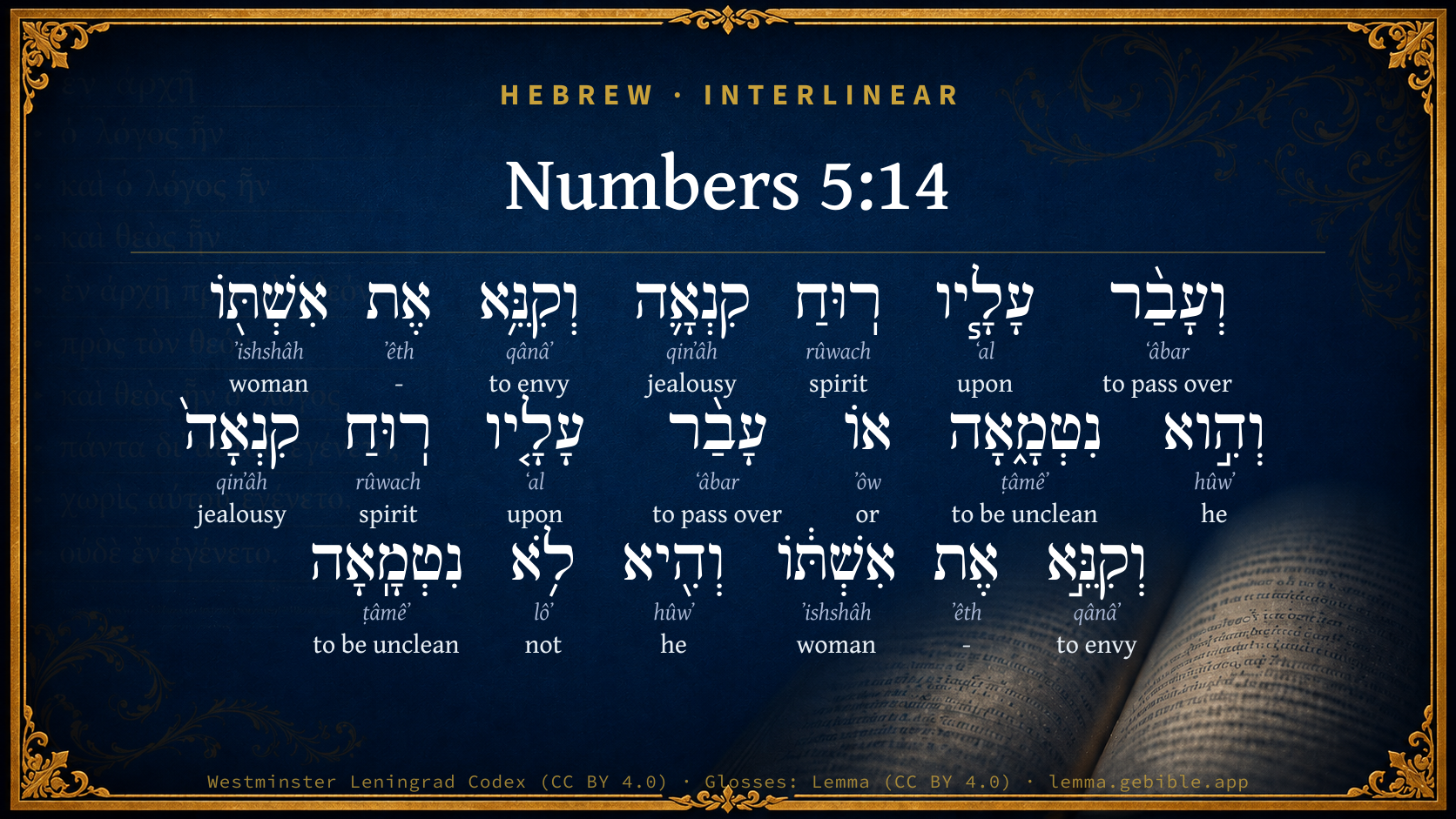
Hebrew (Westminster Leningrad Codex) Numbers 5:14 appears in the Hebrew Old Testament. The text above is from the Westminster Leningrad Codex. Each word links to its Strong’s number, a concise gloss, and parsing drawn from the Open Scriptures Hebrew Bible morphology. Click any word for its full Brown-Driver-Briggs (BDB) entry.
Download image
Cite this verse

Numbers 5:14 (World English Bible). Public Domain. Lemma interlinear Bible study tool, https://lemma.gebible.app/v/numbers/5/14.

Show BibTeX & RIS
BibTeX
RIS
English Translation
and the spirit of jealousy comes on him, and he is jealous of his wife, and she is defiled: or if the spirit of jealousy comes on him, and he is jealous of his wife, and she isn't defiled:
World English Bible · Public Domain
Highlights
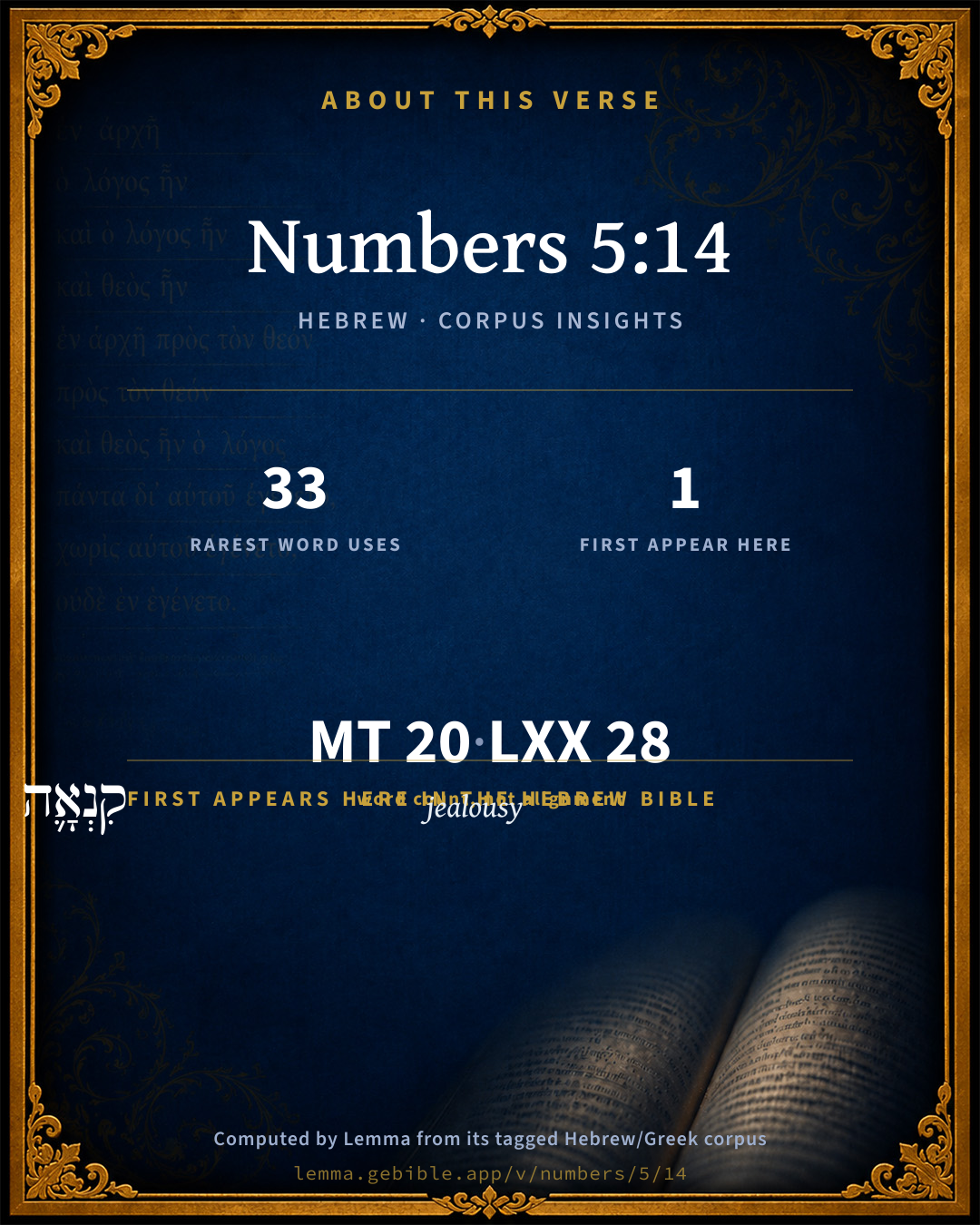
  • 1 first appearance in the Hebrew Bible
Full analysis ↓
Download a study sheet

One document with this verse’s original text, its word-by-word gloss line, the meaning frame, cross-references with their text, attributed commentary, and full source and license credits — printable, and it pastes into notes with its structure intact.

This verse Autodidact and up

Study sheet (.html) Plain text (.txt)

A passage Seminary Student

Up to 50 verses in one chapter. A passage sheet keeps up to 6 commentary sources and 12 cross-references per verse, in the order this page ranks them, and says so on the sheet whenever that leaves anything out. Ask for a single verse and you get the Autodidact verse sheet above.

Everything on this page stays free to read, with no account — the sheet is a download of what is already on screen, not access to it.

Want to remove ads? Support Godless Engineer
Compare translations 3

The same verse in 3 English versions, stacked beneath the original-language interlinear above. Click any original word for its lexicon entry.

Each is an independent rendering of the whole verse — the interlinear is not word-aligned to these translations.

Highlighted words mark where these versions differ — a whole-verse word diff, not a word-by-word alignment.

  • World English Bible Public Domain
    and the spirit of jealousy comes on him, and he is jealous of his wife, and she is defiled: or if the spirit of jealousy comes on him, and he is jealous of his wife, and she isn't defiled:
  • King James Version Public Domain
    And the spirit of jealousy come upon him, and he be jealous of his wife, and she be defiled: or if the spirit of jealousy come upon him, and he be jealous of his wife, and she be not defiled:
  • unfoldingWord Literal Text CC BY-SA 4.0
    and a spirit of jealousy passes over on him and he is jealous of his wife and she, she is made unclean, or a spirit of jealousy passes over on him and he is jealous of his wife and she, she is not made unclean,

unfoldingWord Literal Text — © unfoldingWord, licensed CC BY-SA 4.0. Word-aligned USFM3 via Door43 (git.door43.org/unfoldingWord/en_ult).

Versions to compare (up to 4)

3 of 4 selected

Show all 18 translations

Every available English version of this verse, each an independent rendering of the whole verse.

  • World English Bible Public Domain
    and the spirit of jealousy comes on him, and he is jealous of his wife, and she is defiled: or if the spirit of jealousy comes on him, and he is jealous of his wife, and she isn't defiled:
  • Berean Standard Bible Public Domain
    and if a feeling of jealousy comes over her husband and he suspects his wife who has defiled herself—or if a feeling of jealousy comes over him and he suspects her even though she has not defiled herself—
  • Majority Standard Bible Public Domain
    and if a feeling of jealousy comes over her husband and he suspects his wife who has defiled herself—or if a feeling of jealousy comes over him and he suspects her even though she has not defiled herself—
  • King James Version Public Domain
    And the spirit of jealousy come upon him, and he be jealous of his wife, and she be defiled: or if the spirit of jealousy come upon him, and he be jealous of his wife, and she be not defiled:
  • American Standard Version (1901) Public Domain
    and the spirit of jealousy come upon him, and he be jealous of his wife, and she be defiled: or if the spirit of jealousy come upon him, and he be jealous of his wife, and she be not defiled:
  • Revised Version (1885) Public Domain
    and the spirit of jealousy come upon him, and he be jealous of his wife, and she be defiled: or if the spirit of jealousy come upon him, and he be jealous of his wife, and she be not defiled:
  • Geneva Bible (1599) Public Domain
    If he be moued with a ielous minde, so that he is ielous ouer his wife, which is defiled, or if he haue a ielous minde, so that he is ielous ouer his wife, which is not defiled,
  • Douay-Rheims (1899) Public Domain
    If the spirit of jealousy stir up the husband against his wife, who either is defiled, or is charged with false suspicion,
  • Young's Literal Translation Public Domain
    and a spirit of jealousy hath passed over him, and he hath been jealous of his wife, and she hath been defiled; -- or, a spirit of jealousy hath passed over him, and he hath been jealous of his wife, and she hath not been defiled --
  • Literal Standard Version CC BY-SA 4.0
    and a spirit of jealousy has passed over him, and he has been jealous [for] his wife, and she has been defiled—or a spirit of jealousy has passed over him, and he has been jealous [for] his wife, and she has not been defiled—
  • Unlocked Literal Bible CC BY-SA 4.0
    nevertheless, a spirit of jealousy might still inform the husband that his wife is defiled. However, a spirit of jealousy might falsely come on a man when his wife is not defiled.
  • unfoldingWord Literal Text CC BY-SA 4.0
    and a spirit of jealousy passes over on him and he is jealous of his wife and she, she is made unclean, or a spirit of jealousy passes over on him and he is jealous of his wife and she, she is not made unclean,
  • Darby Bible Public Domain
    and the spirit of jealousy come upon him, and he be jealous of his wife, and she have been defiled, -- or if the spirit of jealousy come upon him, and he be jealous of his wife, and she have not been defiled,
  • World Messianic Bible Public Domain
    and the spirit of jealousy comes on him, and he is jealous of his wife and she is defiled; or if the spirit of jealousy comes on him, and he is jealous of his wife and she isn’t defiled;
  • Webster's Bible Public Domain
    And the spirit of jealousy shall come upon him, and he be jealous of his wife, and she be defiled: or if the spirit of jealousy shall come upon him, and he be jealous of his wife, and she be not defiled:
  • Free Bible Version CC BY-SA 4.0
    But if her husband becomes jealous and suspicious of his wife, whether she's guilty or not,
  • Bible in Basic English Public Domain
    If the spirit of doubt comes into her husband's heart, and he has doubts of his wife, with good cause; or if he has doubts of her without cause:
  • JPS Tanakh (1917) Public Domain
    and the spirit of jealousy come upon him, and he be jealous of his wife, and she be defiled; or if the spirit of jealousy come upon him, and he be jealous of his wife, and she be not defiled;

Literal Standard Version (2020), Covenant Press — licensed CC BY-SA 4.0. Text via the HelloAO Bible API (eBible.org). Unlocked Literal Bible (unfoldingWord) — licensed CC BY-SA 4.0. Text via the HelloAO Bible API (eBible.org). unfoldingWord Literal Text — © unfoldingWord, licensed CC BY-SA 4.0. Word-aligned USFM3 via Door43 (git.door43.org/unfoldingWord/en_ult). Free Bible Version, Dr. Jonathan Gallagher — licensed CC BY-SA 4.0. Text via the HelloAO Bible API (eBible.org).

Word by word

More ways to search: Search by grammar → Find every occurrence → Compare this word →

Practice this passage: Drill this verse → Learn its vocabulary →

וְקִנֵּ֥א
qânâʼ
H7065
“and · to envy”
Conjunction + Verb, Piel, Perfect, 3rd Person, Masculine, Singular
Part of Speech
Conjunction + Verb
Stem
Piel
Form
Perfect
Person
3rd Person
Gender
Masculine
Number
Singular
Full BDB Definition

Origin: a primitive root

TWOT: 2038

to envy, be jealous, be envious, be zealous - (Piel) - to be jealous of - to be envious of - to be zealous for - to excite to jealous anger - (Hiphil) to provoke to jealous anger, cause jealousy
  1. וְעָבַ֨ר ʻâbar H5674 “and · to pass over” Conjunction + Verb, Qal, Perfect, 3rd Person, Masculine, Singular
  2. עָלָ֧יו ʻal H5921 “upon · him” Preposition + Suffix, Personal, 3rd Person, Masculine, Singular
  3. רֽוּחַ rûwach H7307 “spirit of” Noun, Common, Both, Singular, Construct
  4. קִנְאָ֛ה qinʼâh H7068 “jealousy” Noun, Common, Feminine, Singular, Absolute
  5. אֶת ʼêth H853 “-” Particle, Direct Object
  6. אִשְׁתּ֖וֹ ʼishshâh H802 “woman · his” Noun, Common, Feminine, Singular, Construct + Suffix, Personal, 3rd Person, Masculine, Singular
  7. וְהִ֣וא hûwʼ H1931 “and · he” Conjunction + Pronoun, Personal, 3rd Person, Feminine, Singular
  8. נִטְמָ֑אָה ṭâmêʼ H2930 “to be unclean” Verb, Niphal, Perfect, 3rd Person, Feminine, Singular
  9. אוֹ ʼôw H176 “or” Conjunction
  10. עָבַ֨ר ʻâbar H5674 “to pass over” Verb, Qal, Perfect, 3rd Person, Masculine, Singular
  11. עָלָ֤יו ʻal H5921 “upon · him” Preposition + Suffix, Personal, 3rd Person, Masculine, Singular
  12. רֽוּחַ rûwach H7307 “spirit of” Noun, Common, Both, Singular, Construct
  13. קִנְאָה֙ qinʼâh H7068 “jealousy” Noun, Common, Feminine, Singular, Absolute
  14. וְקִנֵּ֣א qânâʼ H7065 “and · to envy” Conjunction + Verb, Piel, Perfect, 3rd Person, Masculine, Singular
  15. אֶת ʼêth H853 “-” Particle, Direct Object
  16. אִשְׁתּ֔וֹ ʼishshâh H802 “woman · his” Noun, Common, Feminine, Singular, Construct + Suffix, Personal, 3rd Person, Masculine, Singular
  17. וְהִ֖יא hûwʼ H1931 “and · he” Conjunction + Pronoun, Personal, 3rd Person, Feminine, Singular
  18. לֹ֥א lôʼ H3808 “not” Particle, Negative
  19. נִטְמָֽאָה ṭâmêʼ H2930 “to be unclean” Verb, Niphal, Perfect, 3rd Person, Feminine, Singular

About this verse

These counts appear in no published source. They are computed here, from the morphology-tagged text and Lemma’s own curated glosses. What Lemma adds →

20
words
11
distinct lemmas
Pentateuch
section

First appearance in Scripture

This word makes its first canonical appearance in the Hebrew Bible here:

  • קִנְאָ֛ה jealousy H7068

Shared distinctive vocabulary

וְקִנֵּ֥א to envy H7065 occurs in 28 verses of the Hebrew Bible. Also found in:

Grammatical profile

  • 6 verbs
  • 6 nouns
  • 2 pronouns
  • 2 prepositions
  • 1 conjunction
  • 3 particles

Verb forms

  • וְעָבַ֨ר Qal · Perfect
  • וְקִנֵּ֥א Piel · Perfect
  • נִטְמָ֑אָה Niphal · Perfect
  • עָבַ֨ר Qal · Perfect
  • וְקִנֵּ֣א Piel · Perfect
  • נִטְמָֽאָה Niphal · Perfect

Repetition

Words recur within this verse — often emphatic in Hebrew:

  • וְעָבַ֨ר to pass over H5674 ×2
  • עָלָ֧יו upon H5921 ×2
  • רֽוּחַ spirit H7307 ×2
  • קִנְאָ֛ה jealousy H7068 ×2
  • וְקִנֵּ֥א to envy H7065 ×2
  • אִשְׁתּ֖וֹ woman H802 ×2
  • נִטְמָ֑אָה to be unclean H2930 ×2
  • וְהִ֣וא he H1931 ×2

Hebrew & Septuagint length

In English translation the verse runs 39 words from the Hebrew and 46 from the Septuagint (LXX English) — closely comparable.

A rough comparison of the two English renderings, which tokenize alike — not a word-level alignment.

Word counts can differ between the Hebrew and the Greek without any difference in meaning — e.g. the Hebrew direct-object marker אֵת has no separate Greek word, and Greek often adds the article ὁ.

In the original languages it is 20 Hebrew tokens and 28 Greek tokens — but the two are counted differently (Hebrew bundles its prefixes and suffixes into one token; the Greek is in lemma form), so that isn’t a like-for-like length.

Cross-references

5

Topical passages linked to Numbers 5:14 in the Treasury of Scripture Knowledge — connected by theme and wording, ordered by reader-vote popularity; previews shown in the World English Bible.

  • Proverbs 6:34 For jealousy arouses the fury of the husband. He won't spare in the day of vengeance.
  • Song of Solomon 8:6 Set me as a seal on your heart, As a seal on your arm; For love is strong as death. Jealousy is as cruel as Sheol; Its flashes are flashes of fire, A very flame of Yahweh.
  • Numbers 5:30 or when the spirit of jealousy comes on a man, and he is jealous of his wife; then he shall set the woman before Yahweh, and the priest shall execute on her all this law.
  • Zephaniah 3:8 "Therefore wait for me," says Yahweh, "until the day that I rise up to the prey, for my determination is to gather the nations, that I may assemble the kingdoms, to pour on them my indignation, even all my fierce anger, for all the earth will be devoured with the fire of my jealousy.
  • 1 Corinthians 10:22 Or do we provoke the Lord to jealousy? Are we stronger than he?

Cross-references courtesy of OpenBible.info (CC BY 4.0).

Hebrew and Greek witnesses Masoretic Hebrew ↔ Greek Septuagint

The same verse in the two great witnesses to the Old Testament, shown verse-for-verse.

These are two independent witnesses, not word-aligned to each other, and the Septuagint is shown in lemma (dictionary) form.

Hebrew Numbers 5:14 Masoretic · Westminster Leningrad Codex

וְעָבַ֨ר עָלָ֧יו רֽוּחַ קִנְאָ֛ה וְקִנֵּ֥א אֶת אִשְׁתּ֖וֹ וְהִ֣וא נִטְמָ֑אָה אוֹ עָבַ֨ר עָלָ֤יו רֽוּחַ קִנְאָה֙ וְקִנֵּ֣א אֶת אִשְׁתּ֔וֹ וְהִ֖יא לֹ֥א נִטְמָֽאָה

and the spirit of jealousy comes on him, and he is jealous of his wife, and she is defiled: or if the spirit of jealousy comes on him, and he is jealous of his wife, and she isn't defiled:

World English Bible · Public Domain

Greek LXX Numbers 5:14 Septuagint · lemma form

καί ἐπιἔρχομαι αὐτός πνεῦμα ζήλωσις καί ζηλόω ὁ γυνή αὐτός αὐτός δέ μιαίνω ἤ ἐπιἔρχομαι αὐτός πνεῦμα ζήλωσις καί ζηλόω ὁ γυνή αὐτός αὐτός δέ μή εἰμί μιαίνω

and there should come upon him a spirit of jealousy, and he should be jealous of his wife, and she be defiled; or there should come upon him a spirit of jealousy, and he should be jealous of his wife, and she should not be defiled;

LXX2012 (modern English Septuagint) · Public Domain

Hebrew: Westminster Leningrad Codex (CC BY 4.0). Greek: Septuagint (public domain); English from LXX2012 (modern English Septuagint) (Public Domain). How the Septuagint differs from the Hebrew →

Targum (Aramaic paraphrase)

2

The Targum is the ancient Jewish Aramaic paraphrase of the Hebrew Scriptures — an interpretive translation, not the Hebrew text itself. Onkelos (literal) and Pseudo-Jonathan (expansive) render the Torah, and Jonathan the Prophets. Coverage is partial: where no permissively-licensed English translation exists for a verse, only the Aramaic is shown. This is verse-level text, not a word-by-word alignment to the Hebrew.

  1. Targum Onkelos Torah (Genesis–Deuteronomy)
    וְיֶעְבַּר עֲלוֹהִי רוּחַ קִנְאָה וִיקַנֵי יָת אִתְּתֵהּ וְהִיא מְסָאֲבָא אוֹ עֲבַר עֲלוֹהִי רוּחַ קִנְאָה וִיקַנֵי יָת אִתְּתֵהּ וְהִיא לָא מְסָאֲבָא

    (no public-domain English translation for this verse)

    Targum Onkelos — Aramaic: “Onkelos Genesis” (public domain); “Onkelos Exodus” (public domain); “Onkelos Leviticus” (public domain); “Onkelos Numbers” (public domain); “Onkelos Deuteronomy” (public domain). English: “Sefaria Community Translation” (CC0 1.0 (public-domain dedication)); “J.W. Etheridge. The Targums of Onkelos and Jonathan Ben Uzziel on the Pentateuch. London: Longmans, Green, 1862” (public domain). Text via Sefaria.

  2. Targum Pseudo-Jonathan Torah (Genesis–Deuteronomy)
    וִיעִבַּר עֲלוֹי רוּחַ קִנְאָתָא וִיקַנֵי יַת אִתְּתֵיהּ וְהִיא אִסְתְּאָבַת אוֹ עָבַר עֲלוֹי רוּחַ קִנְאֵיתָא וִיקַנֵא יַת אִתְּתֵיהּ וְהִיא לָא אִסְתְּאָבָת

    or, if the spirit of jealousy come upon him, and he be jealous of his wife, that she hath been defiled, or the spirit of jealousy come upon him, and he be jealous of his wife, though she hath not been defiled;

    Targum Pseudo-Jonathan — Aramaic: “Targum Jonathan on Genesis” (public domain); “Targum Jonathan on Exodus” (public domain); “Targum Jonathan on Leviticus” (public domain); “Targum Jonathan on Numbers” (public domain); “Targum Jonathan on Deuteronomy” (public domain). English: “The Targum of Jonathan ben Uzziel, trans. J. W. Etheridge, London, 1862” (public domain). Text via Sefaria.

Commentary

Notes on Numbers 5:14 from classic Christian and Jewish commentators (each source and its license shown beneath its notes). The classic Christian expositions comment on the surrounding passage and are grouped to its opening verse, so a note may address several verses; the Jewish commentaries on the Tanakh (Rashi and others) are per-verse, so they appear only where the commentator wrote on this verse.

Lemma curates 59 commentaries, every one of them public domain or Creative Commons licensed, each selected and text-cleaned for this edition rather than reprinted as found. About our sources →

Trapp's Complete Commentary

John Trapp

Num 5:14 And the spirit of jealousy come upon him, and he be jealous of his wife, and she be defiled: or if the spirit of jealousy come upon him, and he be jealous of his wife, and she be not defiled:

Ver. 14. And the spirit of jealousy come upon him.] In the baths at Upper Baden in Helvetia, cernunt viri uxores tractari, cernunt cum alienis loqui, et quidem solam cum solo, saith Munster, and yet are not jealous. But the Italians are so jealous, that how many husbands, so many jailers. And the Turks as far exceed the Italians herein, as the Italians do us. Therefore their women go muffled, all but the eyes: nor are they suffered to go to church, or so much as look out at their own windows. {a} In Barbary it is death for any man to see one of the Shereef’s concubines: and for them too, if, when they see a man, though but through a casement, they do not suddenly scream out.

{a} Blunt’s Voyage into Levant.

John Trapp, A Commentary or Exposition upon All the Books of the Old and New Testament (1647–1656) — public domain. Text from a community e-Sword module.

Tyndale Open Study Notes

Tyndale Open Resources

5:14-15 The husband presented his case before the priest, and the “ritual law for dealing with suspicion” (5:29) took the husband’s jealousy and suspicion to a higher court.

Tyndale Open Study Notes — © Tyndale Open Resources, licensed CC BY-SA 4.0. Text via the HelloAO Bible API.

Geneva Bible (1599)

Geneva Bible translators

Hebrew, If the spirit of jealousy come upon him.

Geneva Bible (1599) marginal notes — public domain. Text via Bolls.life.

Adam Clarke's Commentary

Verse 14. The spirit of jealousy] רוח קנאה ruach kinah, either a supernatural diabolic influence, exciting him to jealousy, or the passion or affection of jealousy, for so the words may be understood.

Adam Clarke's Commentary on the Bible (1810–1826) — public domain. Text from a community e-Sword/MySword module.

John Gill's Exposition

And the spirit of jealousy come upon him,.... A thought rises up in his mind, a strong suspicion works in him, which he cannot resist and throw off, but it remains with him, and makes him very uneasy, that his wife has defiled his bed, as it follows:

and he be jealous of his wife, and she be defiled; that his wife is defiled by a man; and which is the real case, as it afterwards appears, though at present he is not certain, only has a suspicion of it:

or if the spirit of jealousy come upon him, and he be jealous of his wife, and she be not defiled; it is mere jealousy and suspicion, without any foundation for it; and his wife proved a chaste and virtuous woman; yet be it which it would, he being jealous, the following law was to take place, and the following rules to be observed.

John Gill's Exposition of the Whole Bible (1746–1763) — public domain (CC PDM 1.0). Text via the HelloAO Bible API.

Haydock's Catholic Bible Commentary

The spirit of jealousy, &c. This ordinance was designed to clear the innocent, and to prevent jealous husbands from doing mischief to their wives: as likewise to give all a horror of adultery, by punishing it in so remarkable a manner. (Challoner) --- The spirit of jealousy, of fear, &c., denotes those passions of the soul. This very remarkable law of Moses suited the genius of his people, (Calmet) and tended greatly to restrain the infidelity of the married couple, and the fury of suspicious husbands. (Theodoret, q. 10.) God was pleased, by a continual miracle, to manifest the truth, on this occasion, provided the husband were not also guilty: for in that case, the Rabbins assert, the waters had no effect. They relate many particularities, which seem contrary to Philo and Josephus, who inform us that the trial was still made in their time, though the former writers pretend that it was disused, on account of the many adulteries which were committed, in the age preceding the destruction of the temple by Titus. They say that the person who had committed the crime with the woman, died at the same time that the bitter waters put an end to her existence. When the suspected person was brought before the Sanhedrim, they tried, by all means, to extort a confession from her. But if she persisted in maintaining her innocence, they made her stand in black, before the eastern gate of the court, denouncing to her what she had to expect. If she answered Amen, the priest wrote the imprecations (ver. 19-22,) on vellum, with ink, which had no mixture of vitriol in it; and taking water from the laver, and dust from the court, with something bitter, like wormwood, effaced the writing in a new earthen vessel; while another priest tore her garments as far as the breast, and tied them up with an Egyptian cord, to remind her of the miracles wrought by God. If she confessed the crime before the writing was effaced, she was to be repudiated, without any dowry; or, if she kept company with a suspected person, contrary to her husband’s admonition, after she had come off victorious from drinking the bitter waters, she was subjected to the same punishment, and could not demand to be admitted any more to make the miraculous experiment. See Selden, Uxor. iii. 13.

George Leo Haydock (1774–1849), Haydock's Catholic Family Bible and Commentary, 1859 edition — public domain. Excludes Psalms (Douay-Rheims chapter numbering differs from Protestant) and Deuterocanonical books (Catholic canon only).

Matthew Poole's English Annotations

The spirit of jealousy, i.e. a strong opinion or suggestion or inward motion of that kind, whether from a good or evil spirit. Thus we read of the spirit of wisdom, Isa 11:2, of perverseness, Isa 19:14, of fornication, Hos 4:12, of fear, 2Ti 1:7, of slumber, Rom 11:8.

Matthew Poole's English Annotations on the Holy Bible (1683–1685) — public domain. Text from a community e-Sword/MySword module.

The Pulpit Commentary

And she be not defiled. As far as the mischief here dealt with was concerned, it was almost equally great whether the woman was guilty or not.

The Pulpit Commentary (1880–1919), ed. H.D.M. Spence-Jones & Joseph S. Exell — public domain. Text from a community e-Sword module.

Rashi

Rabbi Shlomo Yitzchaki (Rashi)

ועבר עליו AND [THE SPIRIT OF JEALOUSY] COME UPON HIM — i.e., had come upon him before her seclusion with the man.

רוח קנאה וקנא [AND] THE SPIRIT OF JEALOUSY [COME UPON HIM] וקנא — Our Rabbis said that it is an expression denoting warning — that he warns her: do not be aside privily with that man (Sotah 3a.)

והוא נטמאה או עבר עליו וגו׳ AND SHE BE DEFILED, OR IF [THE SPIRIT OF JEALOUSY] COME UPON HIM [AND SHE WAS NOT DEFILED] — that is to say, he warned her but she disregarded his warning, and it is uncertain whether she has been defiled or not (Sifrei Bamidbar 8).

Rashi on the Tanakh — English translations: “The Judaica Press complete Tanach with Rashi, translated by A. J. Rosenberg” (CC BY 4.0); “Pentateuch with Rashi's commentary by M. Rosenbaum and A.M. Silbermann, 1929-1934” (public domain); “The Metsudah Tanach series, Lakewood, N.J” (CC BY 4.0); and “The Book of Joshua, Metsudah Publications, 1997” (CC BY 4.0). Text via Sefaria.

Sforno

Rabbi Ovadia Sforno

[When] a spirit of jealousy comes upon him. This is a pure spirit that causes him to warn her, since he knows that she strayed from the ways of modesty.

And he is jealous of his wife. He warned her and told her not to go into seclusion with a certain man.

Or, a spirit of jealousy comes upon him. This refers to a spirit of folly, for there was no suitable reason for him to be jealous.

And she was not defiled. However, if she ignored his warning and went into seclusion, then even though she was not defiled, “that man shall bring his wife to the kohein”.

Sforno on the Tanakh — English translation: “Yalkut, Sifsei Chachomim Chumash, Metsudah Publications, 2009” (CC BY 4.0). Text via Sefaria.

Lesson kit

Teaching starters — assembled from the data on this page, not authored interpretation. Every prompt links to the verse data it draws on. Edit before teaching.

Numbers, in the Pentateuch, opens this verse with 20 words (11 distinct Hebrew lemmas). Its most distinctive word is qânâʼ (“to envy”). A historical commentator’s framing appears above. Read the whole chapter for the surrounding context.

Discussion questions

  1. What does “to envy” (qânâʼ) contribute to the verse as a whole?
  2. The word “jealousy” first appears here in Scripture. What is being introduced at this debut?
  3. Genesis 26:14 shares the word «to envy» with this verse. How do the two illuminate each other?
  4. “to pass over” occurs 2× in this one verse. What is the effect of the repetition?
  5. These translations render this verse differently; the difference is in the English rendering, not the original. What questions does that raise?
  6. The verb «וְעָבַ֨ר» is Qal Perfect. How does its form color the action?
  7. Reading how Trapp's Complete Commentary and Tyndale Open Study Notes read this verse, where do the two commentators agree and where do they part?

Things to notice

Reading settings

Reading text

Shown beneath each verse's original-language words.

Old Testament
Old Testament edition

Read the OT as the Masoretic Hebrew (MT) or the Greek Septuagint (LXX).

English shown for the Greek Septuagint (in the Hebrew ↔ Greek comparison).

Comparing translations? Open the Compare panel on any verse page to stack up to four side by side.