Ecclesiastes 1:14

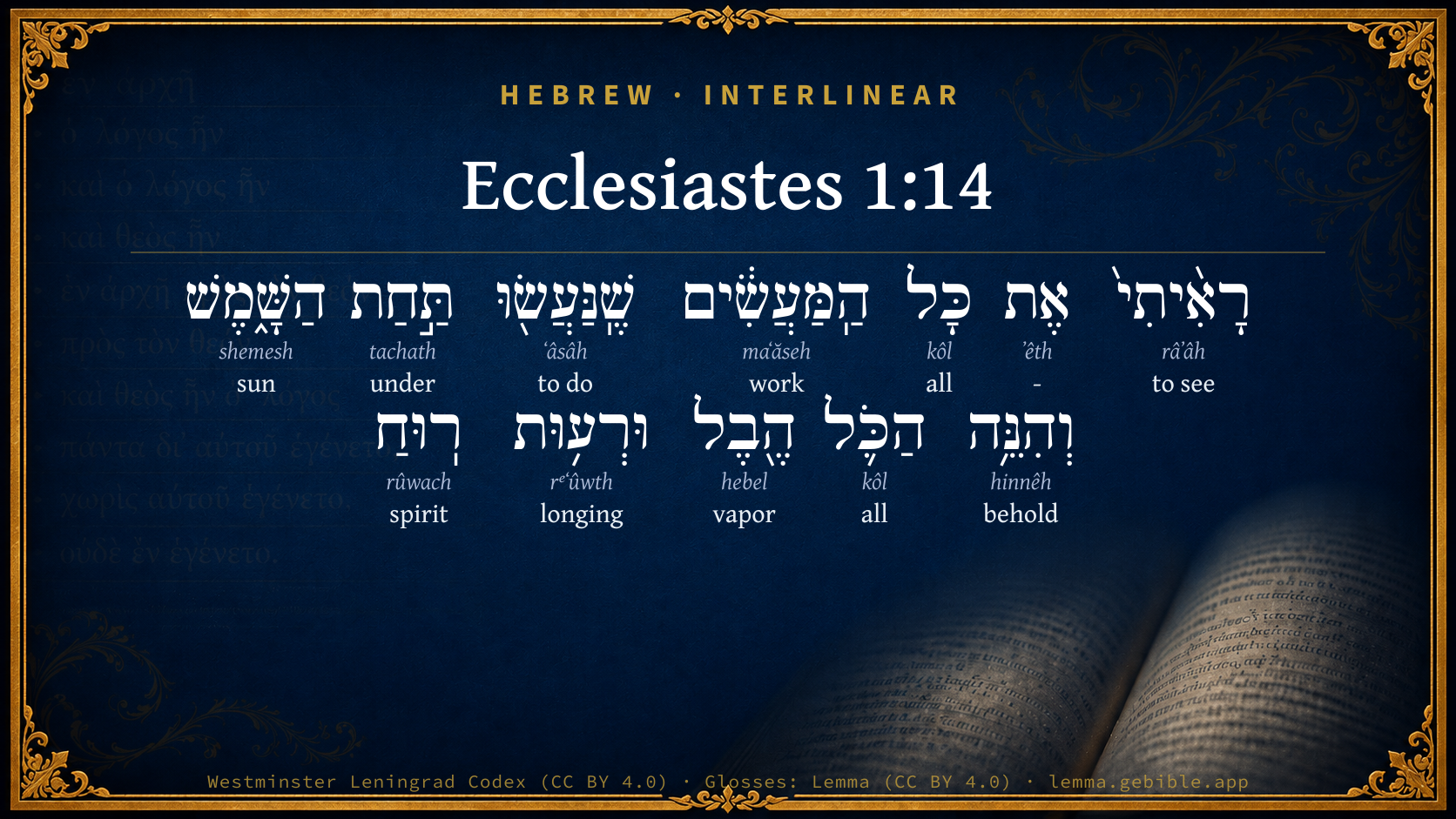
Hebrew (Westminster Leningrad Codex) Ecclesiastes 1:14 appears in the Hebrew Old Testament. The text above is from the Westminster Leningrad Codex. Each word links to its Strong’s number, a concise gloss, and parsing drawn from the Open Scriptures Hebrew Bible morphology. Click any word for its full Brown-Driver-Briggs (BDB) entry.
Download image
Cite this verse

Ecclesiastes 1:14 (World English Bible). Public Domain. Lemma interlinear Bible study tool, https://lemma.gebible.app/v/ecclesiastes/1/14.

Show BibTeX & RIS
BibTeX
RIS
English Translation
I have seen all the works that are done under the sun; and, behold, all is vanity and a chasing after wind.
World English Bible · Public Domain
Highlights
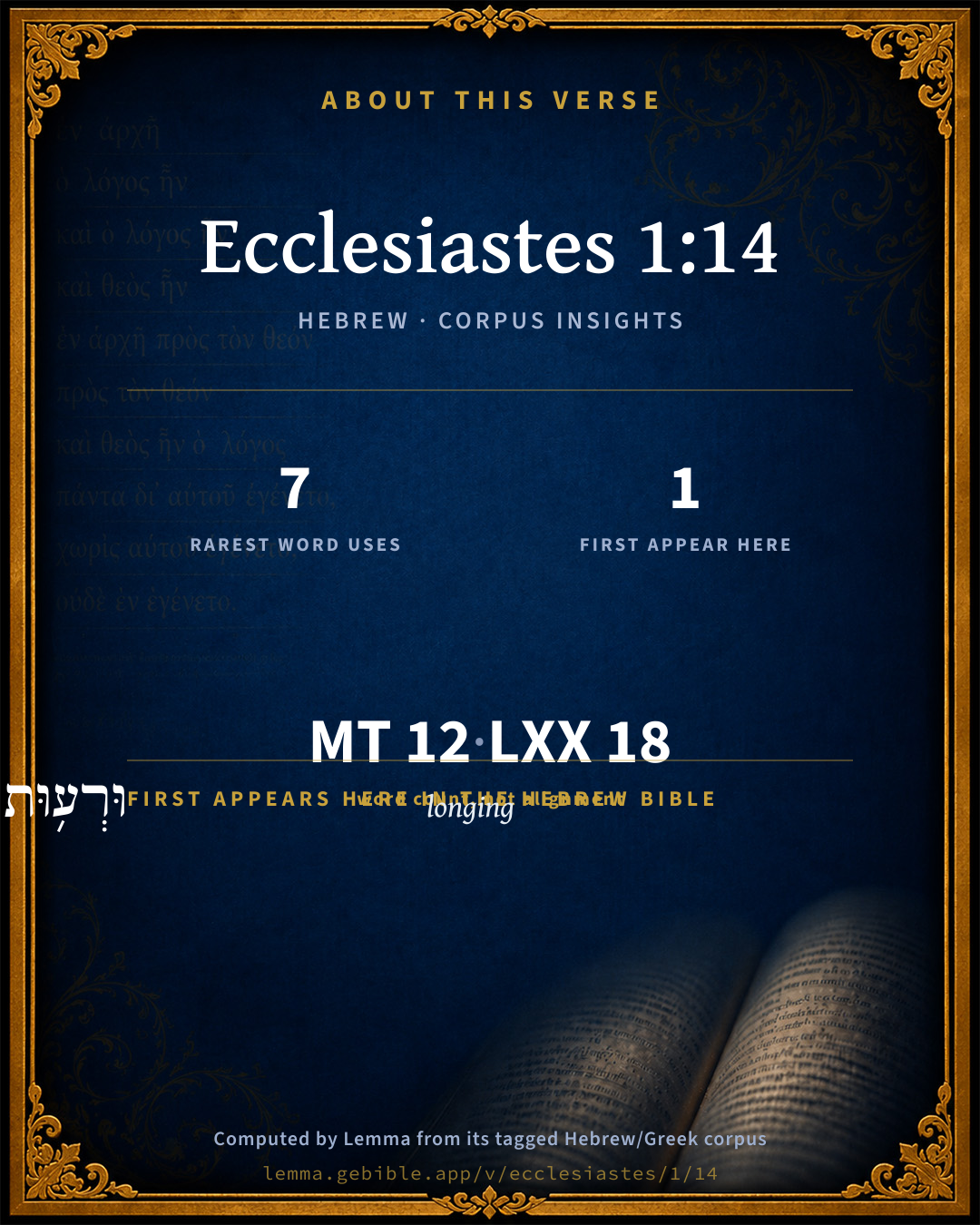
  • 1 first appearance in the Hebrew Bible
Full analysis ↓
Download a study sheet

One document with this verse’s original text, its word-by-word gloss line, the meaning frame, cross-references with their text, attributed commentary, and full source and license credits — printable, and it pastes into notes with its structure intact.

This verse Autodidact and up

Study sheet (.html) Plain text (.txt)

A passage Seminary Student

Up to 50 verses in one chapter. A passage sheet keeps up to 6 commentary sources and 12 cross-references per verse, in the order this page ranks them, and says so on the sheet whenever that leaves anything out. Ask for a single verse and you get the Autodidact verse sheet above.

Everything on this page stays free to read, with no account — the sheet is a download of what is already on screen, not access to it.

Want to remove ads? Support Godless Engineer
Compare translations 3

The same verse in 3 English versions, stacked beneath the original-language interlinear above. Click any original word for its lexicon entry.

Each is an independent rendering of the whole verse — the interlinear is not word-aligned to these translations.

Highlighted words mark where these versions differ — a whole-verse word diff, not a word-by-word alignment.

  • World English Bible Public Domain
    I have seen all the works that are done under the sun; and, behold, all is vanity and a chasing after wind.
  • King James Version Public Domain
    I have seen all the works that are done under the sun; and, behold, all is vanity and vexation of spirit.
  • unfoldingWord Literal Text CC BY-SA 4.0
    I saw all the deeds that are done under the sun, and—look—everything vapor and pursuit of wind.

unfoldingWord Literal Text — © unfoldingWord, licensed CC BY-SA 4.0. Word-aligned USFM3 via Door43 (git.door43.org/unfoldingWord/en_ult).

Versions to compare (up to 4)

3 of 4 selected

Show all 18 translations

Every available English version of this verse, each an independent rendering of the whole verse.

  • World English Bible Public Domain
    I have seen all the works that are done under the sun; and, behold, all is vanity and a chasing after wind.
  • Berean Standard Bible Public Domain
    I have seen all the things that are done under the sun, and have found them all to be futile, a pursuit of the wind.
  • Majority Standard Bible Public Domain
    I have seen all the things that are done under the sun, and have found them all to be futile, a pursuit of the wind.
  • King James Version Public Domain
    I have seen all the works that are done under the sun; and, behold, all is vanity and vexation of spirit.
  • American Standard Version (1901) Public Domain
    I have seen all the works that are done under the sun; and, behold, all is vanity and a striving after wind.
  • Revised Version (1885) Public Domain
    I have seen all the works that are done under the sun; and, behold, all is vanity and a striving after wind.
  • Geneva Bible (1599) Public Domain
    I haue considered all the workes that are done vnder the sunne, and beholde, all is vanitie, and vexation of the spirit.
  • Douay-Rheims (1899) Public Domain
    I have seen all things that are done under the sun, and behold all is vanity, and vexation of spirit.
  • Young's Literal Translation Public Domain
    I have seen all the works that have been done under the sun, and lo, the whole `is' vanity and vexation of spirit!
  • Literal Standard Version CC BY-SA 4.0
    I have seen all the works that have been done under the sun, and behold, the whole [is] vanity and distress of spirit!
  • Unlocked Literal Bible CC BY-SA 4.0
    I have seen all the deeds that are done under the sun, and look, they all amount to vapor and chasing the wind.
  • unfoldingWord Literal Text CC BY-SA 4.0
    I saw all the deeds that are done under the sun, and—look—everything vapor and pursuit of wind.
  • Darby Bible Public Domain
    I have seen all the works that are done under the sun, and behold, all is vanity and pursuit of the wind.
  • World Messianic Bible Public Domain
    I have seen all the works that are done under the sun; and behold, all is vanity and a chasing after wind.
  • Webster's Bible Public Domain
    I have seen all the works that are done under the sun; and behold, all is vanity and vexation of spirit.
  • Free Bible Version CC BY-SA 4.0
    I examined everything people do here on earth, and discovered that it's all so temporary—trying to understand it is like trying to pin down the wind!
  • Bible in Basic English Public Domain
    I have seen all the works which are done under the sun; all is to no purpose, and desire for wind.
  • JPS Tanakh (1917) Public Domain
    I have seen all the works that are done under the sun; and, behold, all is vanity and a striving after wind.

Literal Standard Version (2020), Covenant Press — licensed CC BY-SA 4.0. Text via the HelloAO Bible API (eBible.org). Unlocked Literal Bible (unfoldingWord) — licensed CC BY-SA 4.0. Text via the HelloAO Bible API (eBible.org). unfoldingWord Literal Text — © unfoldingWord, licensed CC BY-SA 4.0. Word-aligned USFM3 via Door43 (git.door43.org/unfoldingWord/en_ult). Free Bible Version, Dr. Jonathan Gallagher — licensed CC BY-SA 4.0. Text via the HelloAO Bible API (eBible.org).

Word by word

More ways to search: Search by grammar → Find every occurrence → Compare this word →

Practice this passage: Drill this verse → Learn its vocabulary →

וּרְע֥וּת
rᵉʻûwth
H7469
“and · longing of”
Conjunction + Noun, Common, Feminine, Singular, Construct
Part of Speech
Conjunction + Noun
Type
Common
Gender
Feminine
Number
Singular
State
Construct
Full BDB Definition

Origin: probably from H7462

TWOT: 2187b

longing, striving
  1. רָאִ֨יתִי֙ râʼâh H7200 “to see” Verb, Qal, Perfect, 1st Person, Common, Singular
  2. אֶת ʼêth H853 “-” Particle, Direct Object
  3. כָּל kôl H3605 “all of” Noun, Common, Masculine, Singular, Construct
  4. הַֽמַּעֲשִׂ֔ים maʻăseh H4639 “the · works” Particle, Definite Article + Noun, Common, Masculine, Plural, Absolute
  5. שֶֽׁנַּעֲשׂ֖וּ ʻâsâh H6213 “who/which · to do” Particle, Relative + Verb, Niphal, Perfect, 3rd Person, Common, Plural
  6. תַּ֣חַת tachath H8478 “under” Preposition
  7. הַשָּׁ֑מֶשׁ shemesh H8121 “the · sun” Particle, Definite Article + Noun, Common, Both, Singular, Absolute
  8. וְהִנֵּ֥ה hinnêh H2009 “and · behold” Conjunction + Particle, Demonstrative
  9. הַכֹּ֛ל kôl H3605 “the · all” Particle, Definite Article + Noun, Common, Masculine, Singular, Absolute
  10. הֶ֖בֶל hebel H1892 “vapor” Noun, Common, Masculine, Singular, Absolute
  11. רֽוּחַ rûwach H7307 “spirit” Noun, Common, Both, Singular, Absolute

About this verse

These counts appear in no published source. They are computed here, from the morphology-tagged text and Lemma’s own curated glosses. What Lemma adds →

12
words
11
distinct lemmas
Wisdom
section

Notable vocabulary

The rarest word here is וּרְע֥וּת longing H7469 — appearing just 7 times in the whole Hebrew Bible.

First appearance in Scripture

This word makes its first canonical appearance in the Hebrew Bible here:

  • וּרְע֥וּת longing H7469

Shared distinctive vocabulary

וּרְע֥וּת longing H7469 occurs in 7 verses of the Hebrew Bible. Also found in:

Grammatical profile

  • 2 verbs
  • 7 nouns
  • 1 preposition
  • 2 particles

Verb forms

  • רָאִ֨יתִי֙ Qal · Perfect
  • שֶֽׁנַּעֲשׂ֖וּ Niphal · Perfect

Repetition

A word recurs within this verse — often emphatic in Hebrew:

Hebrew & Septuagint length

In English translation the verse runs 22 words from the Hebrew and 20 from the Septuagint (LXX English) — closely comparable.

A rough comparison of the two English renderings, which tokenize alike — not a word-level alignment.

Word counts can differ between the Hebrew and the Greek without any difference in meaning — e.g. the Hebrew direct-object marker אֵת has no separate Greek word, and Greek often adds the article ὁ.

In the original languages it is 12 Hebrew tokens and 18 Greek tokens — but the two are counted differently (Hebrew bundles its prefixes and suffixes into one token; the Greek is in lemma form), so that isn’t a like-for-like length.

Cross-references

8

Topical passages linked to Ecclesiastes 1:14 in the Treasury of Scripture Knowledge — connected by theme and wording, ordered by reader-vote popularity; previews shown in the World English Bible.

  • Ecclesiastes 2:11 Then I looked at all the works that my hands had worked, and at the labor that I had labored to do; and, behold, all was vanity and a chasing after wind, and there was no profit under the sun.
  • Ecclesiastes 2:17 So I hated life, because the work that is worked under the sun was grievous to me; for all is vanity and a chasing after wind.
  • Ecclesiastes 2:26 For to the man who pleases him, God gives wisdom, knowledge, and joy; but to the sinner he gives travail, to gather and to heap up, that he may give to him who pleases God. This also is vanity and a chasing after wind.
  • Ecclesiastes 6:9 Better is the sight of the eyes than the wandering of the desire. This also is vanity and a chasing after wind.
  • Psalms 39:5–6 Behold, you have made my days handbreadths. My lifetime is as nothing before you. Surely every man stands as a breath." Selah.
  • Ecclesiastes 1:17–18 I applied my heart to know wisdom, and to know madness and folly. I perceived that this also was a chasing after wind.
  • Ecclesiastes 4:4 Then I saw all the labor and achievement that is the envy of a man's neighbor. This also is vanity and a striving after wind.
  • 1 Kings 4:30–32 Solomon's wisdom excelled the wisdom of all the children of the east, and all the wisdom of Egypt.

Cross-references courtesy of OpenBible.info (CC BY 4.0).

Hebrew and Greek witnesses Masoretic Hebrew ↔ Greek Septuagint

The same verse in the two great witnesses to the Old Testament, shown verse-for-verse.

These are two independent witnesses, not word-aligned to each other, and the Septuagint is shown in lemma (dictionary) form.

Hebrew Ecclesiastes 1:14 Masoretic · Westminster Leningrad Codex

רָאִ֨יתִי֙ אֶת כָּל הַֽמַּעֲשִׂ֔ים שֶֽׁנַּעֲשׂ֖וּ תַּ֣חַת הַשָּׁ֑מֶשׁ וְהִנֵּ֥ה הַכֹּ֛ל הֶ֖בֶל וּרְע֥וּת רֽוּחַ

I have seen all the works that are done under the sun; and, behold, all is vanity and a chasing after wind.

World English Bible · Public Domain

Greek LXX Ecclesiastes 1:14 Septuagint · lemma form

ὁράω σύν πᾶς ὁ ποίημα ὁ ποιέω ὑπό ὁ ἥλιος καί ἰδού ὁ πᾶς ματαιότης καί προαίρεσις πνεῦμα

I saw all the works that were done under the sun; and, behold, all were vanity and waywardness of spirit.

LXX2012 (modern English Septuagint) · Public Domain

On this verse, Keil & Delitzsch discusses the Septuagint’s reading. Read the note in Commentary ↓

Hebrew: Westminster Leningrad Codex (CC BY 4.0). Greek: Septuagint (public domain); English from LXX2012 (modern English Septuagint) (Public Domain). How the Septuagint differs from the Hebrew →

Commentary

Notes on Ecclesiastes 1:14 from classic Christian and Jewish commentators (each source and its license shown beneath its notes). The classic Christian expositions comment on the surrounding passage and are grouped to its opening verse, so a note may address several verses; the Jewish commentaries on the Tanakh (Rashi and others) are per-verse, so they appear only where the commentator wrote on this verse.

Lemma curates 59 commentaries, every one of them public domain or Creative Commons licensed, each selected and text-cleaned for this edition rather than reprinted as found. About our sources →

Trapp's Complete Commentary

John Trapp

Ecc 1:14 I have seen all the works that are done under the sun; and, behold, all [is] vanity and vexation of spirit.

Ver. 14. I have seen all the works that are done.] I have seen them, and set down mine observations of them. {1Ki 4:33} Pliny did somewhat like unto this in his Natural History; which work of his, saith Erasmus, Non minus varium est quam ipsa rerum natura: imo non opus, sed thesaurus, sed vere mundus rerum cognitu dignissimarum, it hath as much variety in it as nature herself hath. To speak truth, it is not a work but a treasury; nay, a world of things most worthy to be known of all men.

And behold all is vanity and vexation of spirit.] Nothing in themselves, and yet of sufficient activity to inflict vengeance and vexation upon the spirit of a man; so far are they from making him truly happy. They do but "feed the soul with wind," as the text may be rendered. Wind gotten into the veins is a sore "vexation."

John Trapp, A Commentary or Exposition upon All the Books of the Old and New Testament (1647–1656) — public domain. Text from a community e-Sword module.

The Biblical Illustrator

Joseph S. Exell

Ecc_1:14

All is vanity and vexation of spirit.

The vanity of a worldly life

The tone of these words is intensely sad, and perhaps some of us are inclined to think that they embody a morbid conception of human life, for they seem to lack the healthy inspiration of hope. However, we shall understand this declaration by considering it, not as a Divine assertion, but as the expression of a particular human experience. God does not condemn all earthly good as vanity, but man in one of his moods utters this bitter cry,--it is the wail of disappointment. Life is a very different thing to different persons in different positions, just as our view of the landscape changes with our standpoint and the varying state of the elements. The hills and valleys, how different is their appearance when veiled in dim twilight or mantled in thick darkness to what it is when flooded with the glorious sunlight. So is our view of life affected by our fluctuating feelings and changeful circumstances. To the boy life is a promise, a beautiful flower in the bud; to the old man it is a closing day, a solemn sunset; to the man in prosperity it is a quiet lake, with only the gentlest zephyrs rippling its surface; to the man in adverse circumstances it is a stormy sea kept in perpetual disquiet by the rude and boisterous breezes; to the satiated pleasure-seeker, the worn-out sensualist, the disappointed voluptuary, all is vanity and vexation of spirit. But while human life has many phases corresponding to the many moods of the soul, each life is developing into something real, and what that something shall be depends upon how the life is lived. In changing circumstances we are forming a permanent character, transitory experiences are creating in us settled dispositions; and we must decide whether our life shall culminate in the joy of satisfaction or the agony of despair.

I. A life spending itself in search of pleasure is a vexatious experience. Here we have the representation of a man seeking everywhere for pleasure; yet, completely baffled in his search, the phantom constantly eludes his grasp. This man was not limited to a very narrow sphere in his endeavours after happiness; he had a kingdom at his command; he made its vast resources subservient to his amusement. He ransacked the treasures of earth to find some new source of delight, and was determined, if possible, to discover pleasurable excitements. He seems almost to have exhausted the science of pleasure, and he sums up the result of his experiments in these words, I have seen all the works that are done under the sun, and behold, all is vanity and vexation of spirit. From this we learn that pleasure sought for itself has no reality; it is a vain imagination, a deceitful fancy. Selfishness defeats and torments itself until it becomes the victim of a perpetual discontent. Or, in other words, to seek happiness for its own sake is not the way to find it; it comes constantly to pure and healthful activity; it dwells ever in the hearts of the good; but it does not reveal itself to the mere devotee of pleasure. This is true of every kind of pleasure of which our nature is capable.

1. The natural and moderate gratification of our appetites yields satisfaction, and so God has ordained that a healthy human life shall be sweet and enjoyable. But when a man makes this sensuous gratification his god, and hopes to find in it an unfailing source of joy, he deceives himself. Even natural indulgence exalted so as to become the chief end of life soon loses its power to please. The sensibilities are dulled, the palate fails to relish luxuries which once ravished it with delight, the eye tires of splendid artificial sights, and the ear grows weary of sound in its most pleasing combinations. The system is thrown out of tune, and that which should produce sweet harmony makes only annoying discord.

2. We are susceptible of still purer and deeper delights through the medium of the intellect. The arts and sciences may contribute largely to our enjoyment if we possess the power to appreciate them. The man who seeks pleasure in philosophy will find more problems to perplex than ideas to amuse; whereas the man who strives after truth will always discern some heavenly thoughts capable of stimulating him amid the uncertainties of his investigation. The man who ransacks the treasures of literature with no higher aim than entertainment will have no continuity of joy, for he will be the victim of inclination, the sport of passion; he will not see the beauties which have charmed men of nobler motive. When we learn that life is not a selfish search, but an unselfish service; not the sacrifice of everything to self, but the subordination of self to God; then we receive a spiritual joy. The man who has spent his life like a butterfly flitting from flower to flower in search of sweets at last whines out the melancholy cry, All is vanity and vexation of spirit. But the noble soul who has used himself in the service of God and humanity goes to his heaven exclaiming, I am now ready to be offered, and the time of my departure is at hand, etc.

II. An earthly life separated from the future is a perplexing mystery. To the mind of the disappointed pleasure-seeker all is vanity, because the future is left completely out of sight. This view of life is secularistic. It regards only one world, and in this world seeks the highest good, but does not find it. This worldly view of human existence transforms our life into a dark mystery, and shuts out every ray of Divine light. This world is incomplete, it needs another to explain it; this life requires another for its interpretation. The first paradox that meets us is--

1. If this be the only world, earthly enjoyment is the highest good, but the struggle for it brings vexation. Banish the belief in an eternal future, and the first reflection is, Let us eat and drink, for to-morrow we die. Let us regulate our life so as to secure the largest share of earthly good, even though we thus destroy our finer feelings. Being convinced that there is no future life, we must value things by their power to fill up our measure of present gratification. Why should thoughts of morality or retribution be allowed to bridle our inclinations if morality is a delusion, and judgment simply a dream? But this conception of human life is a glaring contradiction. The life which it sets before us leads to sorrow, and ends in pain. Indulgence induces weariness, selfishness creates disquietude, and passionate pleasures bring forth death.

2. When the future is left out of sight the godly life loses one of its most powerful motives. The culture of manhood is at a discount in a world where men are estimated by what they have, and not by what they are. The devout and thoughtful man finds himself in possession of truths which the world is not prepared to receive, the utterance of which will call forth the opposition of prejudice and pride. The honest man must suitor if he will carry his convictions into the realm of daily business life. True, some modern teachers say that we should be strong enough to live a Christly life without the hope of personal immortality, consoling ourselves with the sublime idea that we shall live on in the influences which we transmit to posterity. This doctrine may possess charms for the select few, it is scarcely suited to the multitude of disciples.

III. A life which does not acknowledge God is a hopeless disappointment. This is the root of the matter: man is restless and dissatisfied so long as he puts selfish pleasure in the place of God. It is taught in the Bible, engraven on our constitution, and attested by experience that every attempt to find a substitute for God is vain. We owe our supreme love to Him, and can only be really happy when we render it cheerfully.

1. Faith in God reveals an inexhaustible source of bliss. Of every other fountain Christ has said, He that drinketh of this water shall thirst again, but he that drinketh of the water that I shall give him shall never thirst, but it shall be in him a well of water springing up into eternal life. Here we have an unfailing spring of joy, a sun always shining.

2. Faith in God exerts its highest influence when earthly joys are fading. In sorrow, when worldly joys are distasteful, faith illumines the darkness and gently dissipates our fear. In pain, when pleasures have fled and human consolations are feeble, God is manifest as the God of all comfort. Oppressed by the thought of having grieved our God, Christ appears as the Pardoner of our sins and the Healer of broken hearts. And at last, when this world is passing from our gaze and we enter the thick gloom of death, we shall hear the Divine Voice saying, Fear not, for I am with thee. Then, when we tremble before the portals of the mysterious future, and pass through the last trying storm, inspired by heavenly love, we may cry, not All is vanity and vexation of spirit! but O grave, where is thy victory? O death, where is thy sting? (W. G. Jordan, B. A.)

Pessimism

(with Gen_1:31):--What could be more different than the tempers of mind which uttered sayings like these? Creation and life very good. Creation and life, vanity, delusion, hollowness, and vexation of spirit. Both cannot be right. But statements so diverse are easily enough explained if we remember that in the Bible we are dealing, not with a book, but with a library; not with a literary work, but with a nations literature. It is not a pure revelation we have, but the strange eventful history of one. We may expect, therefore, to find in it great variety, and almost hopeless difference of view. The present form of that chapter of Genesis may be regarded roughly as bearing the impress of the eighth or ninth century me., the sanguine stamp of a great prophetic time. The Book of Ecclesiastes, on the other hand, is not earlier than the third century, when the disruption of the two kingdoms, the insecurity of an absolute and semipagan monarchy, the captivity of the nation, the setting up of the hierarchy, and the conquest by both Greek thought and Greek arms had deeply changed and saddened the spirit of Hebrew dream. Our own generation find a special attraction in this Book of Ecclesiastes. We too have fallen on an age when the first free fearless vigour of our Elizabethan time has gone by, when even the John Bull view of England is collapsing, when the condition and prospers of our crowded society are raising questions which only the stupid can face with a light heart, or treat with the old answers. The old pharmacopoeia of politics has no medicine for the new disease. We in England doubt and fear. Abroad they deny and destroy. In this country we are not as yet seriously troubled with the more thoroughgoing forms of pessimism; but I do not think we have escaped it, for the reason that we have not yet come to it. We are as yet only in the Agnostic stage, but we are fairly well through that, and are beginning to get dissatisfied with it. From that stage we must go either up or down. We may go up. A truer philosophy (not even now without a witness) may restore the vigour of a nobler faith. Or we may go down. We may descend to the next level of unbelief, to the lower cycle in the minds inferno. The next level is pessimism. To deal with pessimism and to prevent pessimism we must have an ideal which is something more than an idea of ours, something more than an ambition of ours. We must have an ideal which is the fountain head of our ideas and ambitions, one which is working incessantly to bring us to its own image; one in whose presence we feel inspiration and attainment; one last and surely blended; one that is gradually filling up the abyss of pessimism by drawing together its edges and reconciling what we are with what we long to be. We must have a God, in brief, who is at once our Mighty One and our Redeemer. The solution of life is not to be found in grappling with pain, but in the conflict with sin. The strongest soul that ever lived was crushed by sins rather than pains, by sins not His own, not by the pains which were. Here lies the centre and secret of Christianity, not in the miracles of healing, but in the miracles of forgiveness, and in the Cross, the greatest of them all. And here lies the key and reason why Christianity, with all its melancholy, with all its Divine sadness, can never be pessimist. It is not simply and generally that, being a religion of faith and hope, it cannot give way to despair. But it is here, in this principle, viz. that in Christianity we never become aware of the worst till we are in possession of the best. The deepest sense of evil is possible only to a believer in redemption--not a redemption that shall be one day, but that is now going on. How could we bear to see the worst and utmost evil and sorrow, but for the sense and certainty that it has in it the sentence of its own death? How could we, as a race, face death successfully--death, the great ravager of love--except in the loving faith that death itself is wounded unto death? The best, in revealing to us the worst, abolishes it, and the light of God, which maketh all things manifest, brings sin out only that it may die in the great and terrible daylight of the Lord. (P. T. Forsyth, M. A.)

Insatisfaction

Various explanations have been offered of this strange restlessness and insatisfaction.

1. One set of observers see in this the mainspring of activity, progress, and improvement. If man, say they, found happiness at any point of his life, he would cease to aim at a higher state. The most contented people are ever the most barbarous, and the beast of the field is more contented than the lowest classes of men. With animals and men of the lowest grade there is stagnation. Not until you produce insatisfaction, not, rather, till you give the mind ability to conceive the higher state, and aim at elevation from the lower, will the world be improved. Without insatisfaction the arts would be impossible, and all higher enjoyments unknown.

2. A second and higher view is that which, while admitting that insatisfaction is the mainspring of activity and progress, still further affirms that it is indicative of a nature in man to be satisfied, not with the terrestrial, but with the heavenly,--not with the things of sense, but with the things of faith,--not with the creature, but with God. This is surely the true explanation of that unrest of the soul which still, after each new conquest, whether of truth or means of enioyment, feels unsatisfied. It is the higher nature in us that is still ungratified. We want to know truth and beauty--all truth and beauty; not merely their outward shadows, but themselves.

3. But, further, we have to take into account the fact of depravity and sinfulness. I rather think that this fact, however, is not to be considered as explanatory of our insatisfaction so much as of dissatisfaction. Insatisfaction is right; dissatisfaction is wrong. God intended that the soul should not be satisfied; but He wants that we shall not be dissatisfied. Much light is yours, which Solomon, wise as he was, had not. He probably had glimpses of the depravity of his own heart, and generally of the human heart, yet hardly with the demonstrative clearness with which it comes home to our convictions; and he seems to have been greatly in the dark relative to that future life which hath been brought to light through Christ, to which is reserved the full enjoyment of the soul. He said, All is vanity, because he did not know the all. His eye ranged only over time. Eternity was all darkness.

4. And this summons before us another view explanatory of the insatisfaction of man. We are here preparing, conning our lesson, forming our character--a character which is to last with us for ever. We were not sent here that we might enjoy, but that we might learn, that we might grow up strong men fit to live through the everlasting ages. The Christian life is a race, a battle, a work, a crucifixion. Through the portals of death alone we gain the Elysian fields. (J. Bennet.)

The Biblical Illustrator, edited by Joseph S. Exell (c. 1880s–1900s) — public domain. Text from a community e-Sword module.

Joseph Benson's Commentary

Ecc 1:14-15. I have seen all the works, &c. — Diligently observed, and, in a great measure, understood them; and behold, all is vanity and vexation of spirit — Not only unsatisfying, but also an affliction or breaking to a man’s spirit. That which is crooked, &c. — All our knowledge serves only to discover our miseries, but is utterly insufficient to remove them; it cannot rectify those disorders which are either in our own hearts and lives, or in the men and things of the world. That which is wanting — In our knowledge, and in order to man’s complete satisfaction and happiness; cannot be numbered — Or, counted out to us from the treasures of human learning, but what is wanting will be so still; all our enjoyments here, when we have done our utmost to bring them to perfection, are still defective: and that which is wanting in our own knowledge is so much, that it cannot be numbered. The more we know, the more we see of our own ignorance.

Joseph Benson's Commentary on the Old and New Testaments (1811–1818) — public domain. Text from a community e-Sword module.

Keil & Delitzsch

C. F. Keil & F. Delitzsch

"Is there anything whereof it may be said: See, this is new? - it was long ago through the ages (aeons) which have been before us." The Semit. substantive verb ישׁ (Assyr. isu) has here the force of a hypothetical antecedent: supposing that there is a thing of which one might say, etc. The זה, with Makkeph, belongs as subject, as at Ecc 7:27, Ecc 7:29 as object, to that which follows. כּבר (vid., List, p. 193) properly denotes length or greatness of time (as כּברה, length of way). The ל of לע is that of measure: this "long ago" measured (Hitz.) after infinitely long periods of time. מלּ, ante nos, follows the usage of מלּף, Isa 41:26, and lpaa', Jdg 1:10, etc.; the past time is spoken of as that which was before, for it is thought of as the beginning of the succession of time (vid., Orelli, Synon. der Zeit u. Ewigkeit, p. 14f.). The singular היה may also be viewed as pred. of a plur. inhumanus in order; but in connection, Ecc 2:7, Ecc 2:9 (Gesen. 147, An. 2), it is more probable that it is taken as a neut. verb. That which newly appears has already been, but had been forgotten; for generations come and generations go, and the one forgets the other.

Ecclesiastes 1:11

ecc 1:11

"There is no remembrance of ancestors; and also of the later ones who shall come into existence, there will be no remembrance for them with those who shall come into existence after them." With זכּרון (with Kametz) there is also זכרון, the more common form by our author, in accordance with the usage of his age; Gesen., Elst., and others regard it here and at Ecc 2:16 as constr., and thus לרא as virtually object-gen. (Jerome, non est priorum memoria); but such refinements of the old syntaxis ornata are not to be expected in our author: he changes (according to the traditional punctuation) here the initial sound, as at Ecc 1:17 the final sound, to oth and uth. אין ל is the contrast of היה ל: to attribute to one, to become partaker of. The use of the expression, "for them," gives emphasis to the statement. "With those who shall come after," points from the generation that is future to a remoter future, cf. Gen 33:2. The Kametz of the prep. is that of the recompens. art.; cf. Num 2:31, where it denotes "the last" among the four hosts; for there הא is meant of the last in order, as here it is meant of the remotely future time.

Ecclesiastes 1:12

ecc 1:12

"I, Koheleth, have been king over Israel in Jerusalem." That of the two possible interpretations of הייתי, "I have become" and "I have been," not the former (Grtz), but the latter, is to be here adopted, has been already shown. We translate better by "I have been" - for the verb here used is a pure perfect - than by "I was" (Ew., Elst., Hengst., Zck.), with which Bullock (Speaker's Comm., vol. IV, 1873) compares the expression Quand j'tois roi ! which was often used by Louis XIV towards the end of his life. But here the expression is not a cry of complaint, like the "fuimus Troes," but a simple historical statement, by which the Preacher of the vanity of all earthly things here introduces himself, - it is Solomon, resuscitated by the author of the book, who here looks back on his life as king. "Israel" is the whole of Israel, and points to a period before the division of the kingdom; a king over Judah alone would not so describe himself. Instead of "king על (over) Israel," the old form of the language uses frequently simply "king of Israel," although also the former expression is sometimes found; cf. Sa1 15:26; Sa2 19:23; Kg1 11:37. He has been king, - king over a great, peaceful, united people; king in Jerusalem, the celebrated, populous, highly-cultivated city, - and thus placed on an elevation having the widest survey, and having at his disposal whatever can make a man happy; endowed, in particular, with all the means of gaining knowledge, which accorded with the disposition of his heart searching after wisdom (cf. Kg1 3:9-11; Kg1 5:9).

But in his search after worldly knowledge he found no satisfaction.

Ecclesiastes 1:13

ecc 1:13

"And I gave my heart to seek and to hold survey with wisdom over all that is done under the sun: a sore trouble it is which God has given to the children of men to be exercised therewith." The synonyms דּרשׁ(to seek) and תּוּר (to hold survey over) do not represent a lower and a higher degree of search (Zck.), but two kinds of searching: one penetrating in depth, the other going out in extent; for the former of these verbs (from the root-idea of grinding, testing) signifies to investigate an object which one already has in hand, to penetrate into it, to search into it thoroughly; and the latter verb (from the root-idea of moving round about)

(Note: Vid., the investigation of these roots (Assyr. utîr, he brought back) in Eth's Schlafgemach der Phantasie, pp. 86-89.)

signifies to hold a survey, - look round in order to bring that which is unknown, or not comprehensively known, within the sphere of knowledge, and thus has the meaning of bǎkkēsh, one going the rounds. It is the usual word for the exploring of a country, i.e., the acquiring personal knowledge of its as yet unknown condition; the passing over to an intellectual search is peculiar to the Book of Koheleth, as it has the phrase ל לב נתן, animum advertere, or applicare ad aliquid, in common only with Dan 10:12. The beth of bahhochemah is that of the instrument; wisdom must be the means (organon) of knowledge in this searching and inquiry. With על is introduced the sphere into which it extends. Grotius paraphrases: Historiam animalium et satorum diligentissime inquisivi. But נעשׂה does not refer to the world of nature, but to the world of men; only within this can anything be said of actions, only this has a proper history. But that which offers itself for research and observation there, brings neither joy nor contentment. Hitzig refers הוּא to human activity; but it relates to the research which has this activity as its object, and is here, on that account, called "a sore trouble," because the attainment and result gained by the laborious effort are of so unsatisfactory a nature. Regarding ענין, which here goes back to ענה ב, to fatigue oneself, to trouble oneself with anything, and then to be engaged with it. The words ענין רע would mean trouble of an evil nature (vid., at Psa 78:49; Pro 6:24); but better attested is the reading ענין רע "a sore trouble." הוּא is the subj., as at Ecc 2:1 and elsewhere; the author uses it also in expressions where it is pred. And as frequently as he uses asher and שׁ, so also, when form and matter commend it, he uses the scheme of the attributive clause (elliptical relative clause), as here (cf. Ecc 3:16), where certainly, in conformity with the old style, נתנו was to be used.

Ecclesiastes 1:14

ecc 1:14

He adduces proof of the wearisomeness of this work of research: "I saw all the works that are done under the sun; and, behold, all is vanity and striving after the wind." The point of the sentence lies in והנּה = וארא וה, so that thus rathi is the expression of the parallel fact (circumst. perfect). The result of his seeing, and that, as he has said Ecc 1:13, of a by no means superficial and limited seeing, was a discovery of the fleeting, unsubstantial, fruitless nature of all human actions and endeavours. They had, as hevel expresses, not reality in them; and also, as denoted by reuth ruahh (the lxx render well by προαίρεσις πνεύματος), they had no actual consequences, no real issue. Hos 12:1 also says: "Ephraim feedeth on wind," i.e., follows after, as the result of effort obtains, the wind, roěh ruahh; but only in the Book of Koheleth is this sentence transformed into an abstract terminus technicus (vid., under Reth).

Ecclesiastes 1:15

ecc 1:15

The judgment contained in the words, "vanity and a striving after the wind," is confirmed: "That which is crooked cannot become straight; and a deficit cannot be numerable," i.e., cannot be taken into account (thus Theod., after the Syro-Hex.), as if as much were present as is actually wanting; for, according to the proverb, "Where there is nothing, nothing further is to be counted." Hitzig thinks, by that which is crooked and wanting, according to Ecc 7:13, of the divine order of the world: that which is unjust in it, man cannot alter; its wants he cannot complete. But the preceding statement refers only to labour under the sun, and to philosophical research and observation directed thereto. This places before the eyes of the observer irregularities and wants, brings such irregularities and wants to his consciousness, - which are certainly partly brought about and destined by God, but for the most part are due to the transgressions of man himself, - and what avails the observer the discovery and investigation? - he has only lamentation over it, for with all his wisdom he can bring no help. Instead of לתקן (vid., under תקן), לתקן was to be expected. However, the old language also formed intransitive infinitives with transitive modification of the final vowels, e.g., יבשׁ, etc. (cf. ישׁון, Ecc 5:11).

Having now gained such a result in his investigation and research by means of wisdom, he reaches the conclusion that wisdom itself is nothing.

Ecclesiastes 1:16

ecc 1:16

"I have communed with mine own heart, saying: Lo, I have gained great and always greater wisdom above all who were before me over Jerusalem; and my heart hath seen wisdom and knowledge in fulness. And I gave my heart to know what was in wisdom and knowledge, madness and folly - I have perceived that this also is a grasping after the wind." The evidence in which he bears witness to himself that striving after wisdom and knowledge brings with it no true satisfaction, reaches down to the close of Ecc 1:17; ידעתּי is the conclusion which is aimed at. The manner of expression is certainly so far involved, as he speaks of his heart to his heart what it had experienced, and to what he had purposely directed it. The אני leads us to think that a king speaks, for whom it is appropriate to write a capital I, or to multiply it into we; vid., regarding this "I," more pleonastic than emphatic, subordinated to its verb.

It is a question whether עם־לבּי, after the phrase (את) עם דּבּר, is meant of speaking with any one, colloqui, or of the place of speaking, as in "thou shalt consider in thine heart," Deu 8:5, it is used of the place of consciousness; cf. Job 15:9, (עמּדי) עמּי היה = σύνοιδα ἐμαυτῷ, and what is said in my Psychol. p. 134, regarding συνείδησις, consciousness, and συμμαρτυρεῖν. בּלבּי, interchanging with עם־לבּי, Ecc 2:1, Ecc 2:15, commends the latter meaning: in my heart (lxx, Targ., Jerome, Luther); but the cogn. expressions, medabběrěth ǎl-libbah, Sa1 1:13, and ledabbēr ěl-libbi, Gen 24:45, suggest as more natural the former rendering, viz., as of a dialogue, which is expressed by the Gr. Venet. (more distinctly than by Aquila, Symm., and Syr.): διείλεγμαι ἐγὼ ξὺν τῇ καρδίᾳ μου. Also לאמר, occurring only here in the Book of Koheleth, brings it near that the following oratio directa is directed to the heart, as it also directly assumes the form of an address, Ecc 2:1, after בלבי. The expression, הג הך, "to make one's wisdom great," i.e., "to gain great wisdom," is without a parallel; for the words, הג תו, Isa 28:29, quoted by Hitzig, signify to show and attest truly useful (beneficial) knowledge in a noble way. The annexed והו refers to the continued increase made to the great treasure already possessed (cf. Ecc 2:9 and Kg1 10:7). The al connected therewith signifies, "above" (Gen 49:26) all those who were over Jerusalem before me. This is like the sarrâni âlik maḥrija, "the kings who were my predecessors," which was frequently used by the Assyrian kings. The Targumist seeks to accommodate the words to the actual Solomon by thus distorting them: "above all the wise men who have been in Jerusalem before me," as if the word in the text were בירושלם,

(Note: In F. the following note is added: "Several Codd. have, erroneously, birushalam instead of al-jerushalam." Kennicott counts about 60 such Codd. It stands thus also in J; and at first it thus stood in H, but was afterwards corrected to al-yerushalam. Cf. Elias Levita's Masoreth hamasoreth, II 8, at the end.)

as it is indeed found in several Codd., and according to which also the lxx, Syr., Jerome, and the Venet. translate. Rather than think of the wise (הכּימיּא), we are led to think of all those who from of old stood at the head of the Israelitish community. But there must have been well-known great men with whom Solomon measures himself, and these could not be such dissimilarly great men as the Canaanitish kings to the time of Melchizedek; and since the Jebusites, even under Saul, were in possession of Zion, and Jerusalem was for the first time completely subdued by David (Sa2 5:7, cf. Jos 15:63), it is evident that only one predecessor of Solomon in the office of ruler over Jerusalem can be spoken of, and that here an anachronism lies before us, occasioned by the circumstance that the Salomo revivivus, who has behind him the long list of kings whom in truth he had before him, here speaks.

Regarding היה אשׁר, qu'il y uet, for היו אשׁר, qui furent, vid., at Ecc 1:10. The seeing here ascribed to the heart (here = νοῦς, Psychol. p. 249) is meant of intellectual observation and apprehension; for "all perception, whether it be mediated by the organs of sense or not (as prophetic observing and contemplating), comprehends all, from mental discernment down to suffering, which veils itself in unconsciousness, and the Scripture designates it as a seeing" (Psychol. 234); the Book of Koheleth also uses the word ראה of every kind of human experience, bodily or mental, Ecc 2:24; Ecc 5:17; Ecc 6:6; Ecc 9:9. It is commonly translated: "My heart saw much wisdom and knowledge" (thus e.g., Ewald); but that is contrary to the gram. structure of the sentence (Ew. 287c). The adject. harbēh

(Note: Regarding the form הרבה, which occurs once (Jer 42:2), vid., Ew. 240c.)

is always, and by Koheleth also, Ecc 2:7; Ecc 5:6, Ecc 5:16; Ecc 6:11; Ecc 9:18; Ecc 11:8; Ecc 12:9, Ecc 12:12, placed after its subst.; thus it is here adv., as at Ecc 5:19; Ecc 7:16. Rightly the Venet.: ἡ καρδία μου τεθέαται κατὰ πολὺ σοφίαν καί γνῶσιν Chokma signifies, properly, solidity, compactness; and then, like πυκνότης, mental ability, secular wisdom; and, generally, solid knowledge of the true and the right. Dǎǎth is connected with chokma here and at Isa 33:6, as at Rom 11:33, γνῶσις is with σοφία. Baumggarten-Crusius there remarks that σοφία refers to the general ordering of things, γνῶσις to the determination of individual things; and Harless, that σοφία is knowledge which proposes the right aim, and γνῶσις that which finds the right means thereto. In general, we may say that chokma is the fact of a powerful knowledge of the true and the right, and the property which arises out of this intellectual possession; but dǎǎth is knowledge penetrating into the depth of the essence of things, by which wisdom is acquired and in which wisdom establishes itself.

Ecc 1:17

By the consecutive modus ואתּנה (aor. with ah, like Gen 32:6; Gen 41:11, and particularly in more modern writings; vid., p. 198, regarding the rare occurrence of the aorist form in the Book of Koheleth) he bears evidence to himself as to the end which, thus equipped with wisdom and knowledge, he gave his heart to attain unto (cf. 13a), i.e., toward which he directed the concentration of his intellectual strength. He wished to be clear regarding the real worth of wisdom and knowledge in their contrasts; he wished to become conscious of this, and to have joy in knowing what he had in wisdom and knowledge as distinguished from madness and folly. After the statement of the object lādǎǎth, stands vedaath, briefly for ולדעת. Ginsburg wishes to get rid of the words holēloth vesikluth, or at least would read in their stead תּבוּנית ושׂכלוּת (rendering them "intelligence and prudence"); Grtz, after the lxx παραβολὰς καὶ ἐπιστήμην, reads משׁלות ושׂכלות. But the text can remain as it is: the object of Koheleth is, on the one hand, to become acquainted with wisdom and knowledge; and, on the other, with their contraries, and to hold these opposite to each other in their operations and consequences. The lxx, Targ., Venet., and Luther err when they render sikluth here by ἐπιστήμη, etc. As sikluth, insight, intelligence, is in the Aram. written with the letter samek (instead of sin), so here, according to the Masora סכלות, madness is for once written with ס, being everywhere else in the book written with שׂ; the word is an ἐναντιόφωνον,

(Note: Vid., Th. M. Redslob's Die Arab. Wrter, u.s.w. (1873).)

and has, whether written in the one way or in the other, a verb, sakal (שׂכל, סכל), which signifies "to twist together," as its root, and is referred partly to a complication and partly to a confusion of ideas. הללות, from הלל, in the sense of "to cry out," "to rage," always in this book terminates in th, and only at Ecc 10:13 in th; the termination th is that of the abstr. sing.; but th, as we think we have shown at Pro 1:20, is that of a fem. plur., meant intensively, like bogdoth, Zep 2:4; binoth, chokmoth, cf. bogdim, Pro 23:28; hhovlim, Zac 11:7, Zac 11:14; toqim, Pro 11:15 (Bttch. 700g E). Twice vesikluth presents what, speaking to his own heart, he bears testimony to before himself. By yādǎ'ti, which is connected with dibbarti (Ecc 1:16) in the same rank, he shows the facit. זה refers to the striving to become conscious of the superiority of secular wisdom and science to the love of pleasure and to ignorance. He perceived that this striving also was a grasping after the wind; with רעוּת, 14b, is here interchanged רעיון. He proves to himself that nothing showed itself to be real, i.e., firm and enduring, unimpeachable and imperishable. And why not?

Ecc 1:18

"For in much wisdom is much grief; and he that increaseth knowledge increaseth sorrow." The German proverb: "Much wisdom causeth headache," is compared, Ecc 12:12, but not here, where כּעס and מכאוב express not merely bodily suffering, but also mental grief. Spinoza hits one side of the matter in his Ethics, IV 17, where he remarks: "Veram boni et mali cognitionem saepe non satis valere ad cupiditates coercendas, quo facto homo imbecillitatem suam animadvertens cogitur exclamare: Video meliora proboque, deteriora sequor." In every reference, not merely in that which is moral, there is connected with knowledge the shadow of a sorrowful consciousness, in spite of every effort to drive it away. The wise man gains an insight into the thousand-fold woes of the natural world, and of the world of human beings, and this reflects itself in him without his being able to change it; hence the more numerous the observed forms of evil, suffering, and discord, so much greater the sadness (כּעס, R. כס, cogn. הס, perstringere) and the heart-sorrow (מכאוב, crve-cour) which the inutility of knowledge occasions. The form of 18a is like Ecc 5:6, and that of 18b like e.g., Pro 18:22. We change the clause veyosiph daath into an antecedent, but in reality the two clauses stand together as the two members of a comparison: if one increaseth knowledge, he increaseth (at the same time) sorrow. "יוסיף, Isa 29:14; Isa 38:5; Ecc 2:18," says Ewald, 169a, "stands alone as a part. act., from the stem reverting from Hiph. to Kal with י instead of ." But this is not unparalleled; in הן יוסיף the verb יוסף is fin., in the same manner as יסּד, Isa 28:16; תּומיך, Psa 16:5, is Hiph., in the sense of amplificas, from ימך; יפיח, Pro 6:19 (vid., l.c.), is an attribut. clause, qui efflat, used as an adj.; and, at least, we need to suppose in the passage before us the confusion that the ē of kātēl (from kātil, originally kātal), which is only long, has somehow passed over into î. Bttcher's remark to the contrary, "An impersonal fiens thus repeated is elsewhere altogether without a parallel," is set aside by the proverb formed exactly thus: "He that breathes the love of truth says what is right," Pro 12:17.

Next: Ecclesiastes Chapter 2

Keil & Delitzsch — Biblical Commentary on the Old Testament (1861–1891) — public domain (CC PDM 1.0). Text via the HelloAO Bible API. (Old Testament only.)

Tyndale Open Study Notes

Tyndale Open Resources

1:14 like chasing the wind: Just as the wind quickly comes and goes, so does life.

Tyndale Open Study Notes — © Tyndale Open Resources, licensed CC BY-SA 4.0. Text via the HelloAO Bible API.

Jamieson, Fausset & Brown

Robert Jamieson, A. R. Fausset & David Brown

The reason is here given why investigation into man's "works" is only "sore travail" (Ecc 1:13); namely, because all man's ways are vain (Ecc 1:18) and cannot be mended (Ecc 1:15).

vexation of--"a preying upon"

the Spirit--MAURER translates; "the pursuit of wind," as in Ecc 5:16; Hos 12:1, "Ephraim feedeth on wind." But old versions support the English Version.

Jamieson, Fausset & Brown — Commentary Critical and Explanatory on the Whole Bible (1871) — public domain (CC PDM 1.0). Text via the HelloAO Bible API.

Adam Clarke's Commentary

Verse 14. Behold, all is vanity] After all these discussions and experiments, when even the results have been the most successful, I have found only rational satisfaction; but not that supreme good by which alone the soul can be made happy.

O curas hominum! O quantum est in rebus inane!

"How anxious are our cares, and yet how vain

The bent of our desires!"

PERS. Sat. i., v. 1.

Adam Clarke's Commentary on the Bible (1810–1826) — public domain. Text from a community e-Sword/MySword module.

Ellicott's Commentary for English Readers

(14) Vexation.—The word occurs only in this book (Ecc_2:11; Ecc_2:17; Ecc_2:26; Ecc_4:4; Ecc_4:6; Ecc_6:9). The A. V. translation, “vexation of spirit,” is difficult to justify. Very nearly the same phrase occurs in Hos_12:1, and is there translated “feeding on wind,” for in Hebrew, as in some other languages, the name for “spirit” primarily denotes breath or wind. Accordingly many interpreters understand the phrase of the text “feeding on wind” (see Isa_44:20). The same root, however, which means to “feast on a thing,” has the secondary meaning to “delight in a thing,” and so the corresponding noun in Chaldee comes to mean “pleasure” or “will.” (Comp. Ezr_5:17; Ezr_7:18.) Accordingly the LXX. and many modern interpreters understand the phrase of the text “effort after wind.”

A Bible Commentary for English Readers, edited by Charles John Ellicott (1878–1897) — public domain. Text from a community e-Sword module.

The Cambridge Bible for Schools and Colleges

gen. ed. J. J. S. Perowne

14. all is vanity and vexation of spirit] The familiar words, though they fall in with the Debater’s tone and have the support of the Vulg. “afflictio spiritus,” hardly express the meaning of the Hebrew and we must read “vanity and feeding upon wind.” The phrase has its parallel in Hos_12:2 (“Ephraim feedeth on wind”) and Isa_44:20 (“feedeth on ashes”) and expresses, with a bold vividness, the sense of emptiness which accompanies unsatisfied desire. Most commentators, however, prefer the rendering “striving after the wind” or “windy effort,” but “feeding” expresses, it is believed, the meaning of the Hebrew more closely. The LXX. gives προαίρεσις πνεύματος (= resolve of wind, i.e. fleeting and unsubstantial). Symmachus gives βόσκησις and Aquila νομή (= feeding). The word in question occurs seven times in Ecclesiastes but is not found elsewhere. The rendering “vexation” rests apparently on a false etymology.

The Cambridge Bible for Schools and Colleges (gen. ed. J. J. S. Perowne; Cambridge University Press, 1878–1918) — public domain. Text from a community e-Sword module.

John Gill's Exposition

I have seen all the works that are done under the sun,.... All things done by the Lord, that were on the earth, and in it, and in the sea; he considered them, and endeavoured to search into the nature of them; and did attain to a very great knowledge of them, so that he could speak of them to the instruction of others; see Kg1 4:33; and all that were done by men, by their head, or by their hands; all that were written or wrought by them; all their philosophical works and experiments, and all their mechanic operations; as well as all their good and bad works, in a moral sense; so the Targum,

"I saw all the deeds of the children of men, which are done under the sun in this world;''

and, behold, all is vanity and vexation of spirit; not only the things known, but the knowledge of them; it is mere vanity, there is nothing solid and substantial in it, or that can make a man happy; yea, on the contrary, it is vexatious and distressing; it is not only a weariness to the flesh to obtain it, but, in the reflection of it, gives pain and uneasiness to the mind: it is a "breaking of the spirit" (n) of the man, as the Targum, Jarchi, and Alshech, interpret the phrase; it wastes and consumes his spirit, as well as his time, and all to no purpose; it is, as some ancient Greek versions and others render it, and not amiss, a "feeding on wind" (o); what is useless and unprofitable, and like labouring for that; see Hos 12:1, Ecc 5:16; and so Aben Ezra.

(n) "affiictio spiritus", V. L. Junius & Tremellius; "contritio spiritus", so some in Vatablus. (o) , Aquila; "pastio venti", Mercerus, Piscator, Gejerus, Amama.

John Gill's Exposition of the Whole Bible (1746–1763) — public domain (CC PDM 1.0). Text via the HelloAO Bible API.

Albert Barnes' Notes on the Bible

Vexation of spirit - A phrase which occurs 7 times, and may be otherwise translated, “feeding on wind.” Modern Hebrew grammarians assert that the word rendered “vexation” must be derived from a root signifying “to feed,” “follow,” “strive after.” This being admitted, it remains to choose between two translations:

(1) “striving after wind,” or “windy effort;” adopted by the Septuagint and the majority of modern interpreters; or

(2) feeding on wind. Compare Hos 12:1 : and similar phrases in Pro 15:14; Isa 44:20; Psa 37:3.

Albert Barnes' Notes on the Bible (1834–1885) — public domain. Text from a community e-Sword/MySword module.

Haydock's Catholic Bible Commentary

Vexation. Hebrew also, "food of wind;" (Symmachus) or "choice of the spirit." (Septuagint) People are eager to become learned, and yet find no satisfaction. (Haydock) --- All natural things are insufficient to procure felicity. (Worthington) O Curas hominum! O quantum est in rebus inane! (Persius.)

George Leo Haydock (1774–1849), Haydock's Catholic Family Bible and Commentary, 1859 edition — public domain. Excludes Psalms (Douay-Rheims chapter numbering differs from Protestant) and Deuterocanonical books (Catholic canon only).

Matthew Poole's English Annotations

I have seen, i.e. diligently observed, and in great measure understood.

Behold; for it was a great surprise to me, and therefore may seem strange to you.

All is vanity and vexation of spirit; and not only unsatisfying, but also troublesome, and an affliction or breaking to a man’s spirit or mind. Or, as others, both ancient and modern translators, render it, a feeding upon wind, as these very words, save only that there is the verb from which this noun seems most probably deduced, are rendered, Hos 12:1, where also it signifies a fruitless or lost labour, and a disappointment of their hopes and desires of satisfaction. And so this is a repetition of the same thing in other words, according to the manner of these books.

Matthew Poole's English Annotations on the Holy Bible (1683–1685) — public domain. Text from a community e-Sword/MySword module.

Whedon's Commentary on the Bible

Daniel D. Whedon

14. I have seen — Meaning, “I have looked at, or considered.” The author is conscious of having done his work.

Behold, all is vanity — Koheleth states the result before he gives us the process by which he reached it. The phrase vexation of spirit is strangely inaccurate. It should be, a grasping after wind. So it is properly rendered in Hos_12:1, “feedeth on wind.”

Daniel D. Whedon (gen. ed.), Commentary on the Old and New Testaments (1874–1909) — public domain. Text from a community e-Sword module.

The Pulpit Commentary

Here is the result of this examination of human actions. I have seen all the works that are done under the sun. In his varied experience nothing had escaped his notice. And behold, all is vanity and vexation of spirit; reuth ruach; afflictio spiritus (Vulgate); proairesiv pneumatov, "choice of spirit," or, "wind" (Septuagint); nomhmou (Aquila and Theodotion); boskhsiv ajnemou, "feeding on wind" (Symmachus). This last translation, or "striving after wind," seems to be most agreeable to the etymology of the word tWr, which, except in this book, (Ecc_2:11, Ecc_2:17, Ecc_2:26, etc.) occurs elsewhere only in the Chaldee portion of Ezra. (Ezr_5:17 Ezr_7:18) Whichever sense is taken, the import is much the same. What is implied is the unsubstantial and unsatisfying nature of human labors and endeavors. Many compare Hos_12:2, "Ephraim feedeth on wind," and Isa_44:20, "He feedeth on ashes." In contrast, perhaps, to this constantly recurring complaint, the author of the Book of Wisdom teaches that murmuring is unprofitable and blasphemous. (RAPC Wis 1:11) Bailey, in "Festus," sings

Of all life"s aims, what"s worth the thought we waste on"t? How mean, how miserable, seems every care! How doubtful, too, the system of the mind! And then the ceaseless, changeless, hopeless round Of weariness, dud heartlessness, and woe, And vice, and vanity! Yet these make life The life, at least, I witness, if not feel No matter, we are immortal.

The Pulpit Commentary (1880–1919), ed. H.D.M. Spence-Jones & Joseph S. Exell — public domain. Text from a community e-Sword module.

John Wesley's Explanatory Notes

Seen - Diligently observed. Vanity - Not only unsatisfying, but also an affliction or breaking to a man's spirit.

John Wesley, Explanatory Notes Upon the Whole Bible (1754–1765) — public domain. Text via the GEBible commentary corpus.

Rashi

Rabbi Shlomo Yitzchaki (Rashi)

and frustration Heb. וּרְעוּת רוּח, the breaking of the will, like (Isa. 8:9): “Shatter (רֹעוּ), O peoples, and be broken.” רוּחַ is synonymous with talant in Old French, will. The end of the deed is that he comes to heartache.

Rashi on the Tanakh — English translations: “The Judaica Press complete Tanach with Rashi, translated by A. J. Rosenberg” (CC BY 4.0); “Pentateuch with Rashi's commentary by M. Rosenbaum and A.M. Silbermann, 1929-1934” (public domain); “The Metsudah Tanach series, Lakewood, N.J” (CC BY 4.0); and “The Book of Joshua, Metsudah Publications, 1997” (CC BY 4.0). Text via Sefaria.

Lesson kit

Teaching starters — assembled from the data on this page, not authored interpretation. Every prompt links to the verse data it draws on. Edit before teaching.

Ecclesiastes, in the Wisdom, opens this verse with 12 words (11 distinct Hebrew lemmas). Its most distinctive word is rᵉʻûwth (“longing”). A historical commentator’s framing appears above. Read the whole chapter for the surrounding context.

Discussion questions

  1. What does “longing” (rᵉʻûwth) contribute to the verse as a whole?
  2. The word “longing” first appears here in Scripture. What is being introduced at this debut?
  3. Ecclesiastes 2:11 shares the word «longing» with this verse. How do the two illuminate each other?
  4. “all” occurs 2× in this one verse. What is the effect of the repetition?
  5. These translations render this verse differently; the difference is in the English rendering, not the original. What questions does that raise?
  6. The verb «רָאִ֨יתִי֙» is Qal Perfect. How does its form color the action?
  7. Reading how Trapp's Complete Commentary and The Biblical Illustrator read this verse, where do the two commentators agree and where do they part?

Things to notice

Reading settings

Reading text

Shown beneath each verse's original-language words.

Old Testament
Old Testament edition

Read the OT as the Masoretic Hebrew (MT) or the Greek Septuagint (LXX).

English shown for the Greek Septuagint (in the Hebrew ↔ Greek comparison).

Comparing translations? Open the Compare panel on any verse page to stack up to four side by side.