
Ezekiel 37:14

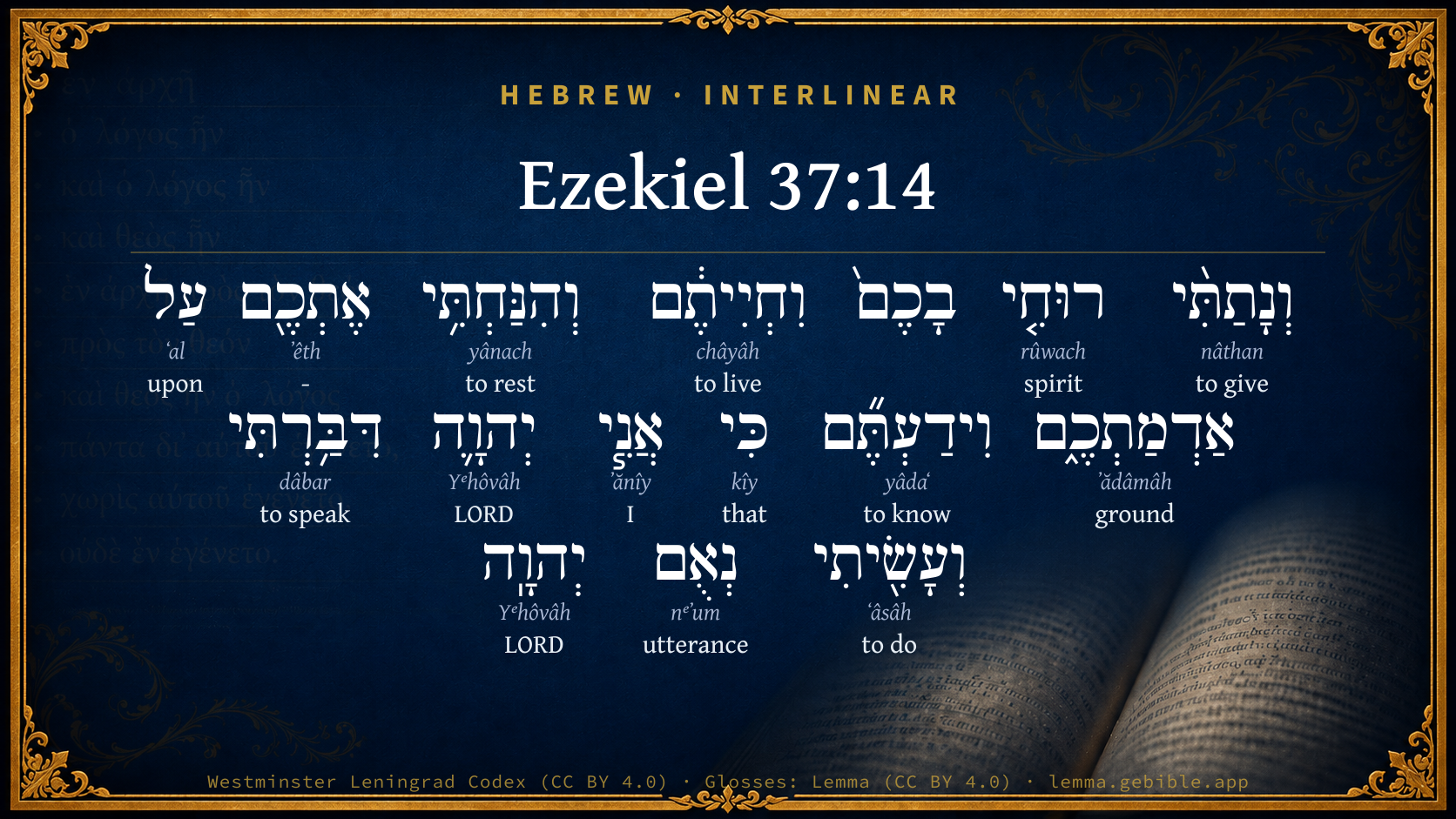
Hebrew (Westminster Leningrad Codex) Ezekiel 37:14 appears in the Hebrew Old Testament. The text above is from the Westminster Leningrad Codex. Each word links to its Strong’s number, a concise gloss, and parsing drawn from the Open Scriptures Hebrew Bible morphology. Click any word for its full Brown-Driver-Briggs (BDB) entry.
Download image
Cite this verse

Ezekiel 37:14 (World English Bible). Public Domain. Lemma interlinear Bible study tool, https://lemma.gebible.app/v/ezekiel/37/14.

Show BibTeX & RIS
BibTeX
RIS
English Translation
I will put my Spirit in you, and you shall live, and I will place you in your own land: and you shall know that I, Yahweh, have spoken it and performed it, says Yahweh.
World English Bible · Public Domain
Download a study sheet

One document with this verse’s original text, its word-by-word gloss line, the meaning frame, cross-references with their text, attributed commentary, and full source and license credits — printable, and it pastes into notes with its structure intact.

This verse Autodidact and up

Study sheet (.html) Plain text (.txt)

A passage Seminary Student

Up to 50 verses in one chapter. A passage sheet keeps up to 6 commentary sources and 12 cross-references per verse, in the order this page ranks them, and says so on the sheet whenever that leaves anything out. Ask for a single verse and you get the Autodidact verse sheet above.

Everything on this page stays free to read, with no account — the sheet is a download of what is already on screen, not access to it.

Want to remove ads? Support Godless Engineer
Compare translations 3

The same verse in 3 English versions, stacked beneath the original-language interlinear above. Click any original word for its lexicon entry.

Each is an independent rendering of the whole verse — the interlinear is not word-aligned to these translations.

Highlighted words mark where these versions differ — a whole-verse word diff, not a word-by-word alignment.

  • World English Bible Public Domain
    I will put my Spirit in you, and you shall live, and I will place you in your own land: and you shall know that I, Yahweh, have spoken it and performed it, says Yahweh.
  • King James Version Public Domain
    And shall put my spirit in you, and ye shall live, and I shall place you in your own land: then shall ye know that I the LORD have spoken it, and performed it, saith the LORD.
  • unfoldingWord Literal Text CC BY-SA 4.0
    I will place my Spirit within you so you will live, and I will cause you to rest in your land when you know that I am Yahweh. I declare and will do it—this is Yahweh’s declaration.’”

unfoldingWord Literal Text — © unfoldingWord, licensed CC BY-SA 4.0. Word-aligned USFM3 via Door43 (git.door43.org/unfoldingWord/en_ult).

Versions to compare (up to 4)

3 of 4 selected

Show all 18 translations

Every available English version of this verse, each an independent rendering of the whole verse.

  • World English Bible Public Domain
    I will put my Spirit in you, and you shall live, and I will place you in your own land: and you shall know that I, Yahweh, have spoken it and performed it, says Yahweh.
  • Berean Standard Bible Public Domain
    I will put My Spirit in you and you will live, and I will settle you in your own land. Then you will know that I, the LORD, have spoken, and I will do it, declares the LORD.’”
  • Majority Standard Bible Public Domain
    I will put My Spirit in you and you will live, and I will settle you in your own land. Then you will know that I, the LORD, have spoken, and I will do it, declares the LORD.’”
  • King James Version Public Domain
    And shall put my spirit in you, and ye shall live, and I shall place you in your own land: then shall ye know that I the LORD have spoken it, and performed it, saith the LORD.
  • American Standard Version (1901) Public Domain
    And I will put my Spirit in you, and ye shall live, and I will place you in your own land: and ye shall know that I, Jehovah, have spoken it and performed it, saith Jehovah.
  • Revised Version (1885) Public Domain
    And I will put my spirit in you, and ye shall live, and I will place you in your own land: and ye shall know that I the LORD have spoken it, and performed it, saith the LORD.
  • Geneva Bible (1599) Public Domain
    And shall put my Spirit in you, and ye shall liue, and I shall place you in your owne land: then yee shall knowe that I the Lord haue spoken it, and performed it, sayth the Lord.
  • Douay-Rheims (1899) Public Domain
    And shall have put my spirit in you, and you shall live, and I shall make you rest upon your own land: and you shall know that I the Lord have spoken, and done it, saith the Lord God:
  • Young's Literal Translation Public Domain
    And I have given My Spirit in you, and ye have lived, And I have caused you to rest on your land, And ye have known that I Jehovah, I have spoken, and I have done `it', An affirmation of Jehovah.'
  • Literal Standard Version CC BY-SA 4.0
    And I have given My Spirit in you, and you have lived, || And I have caused you to rest on your land, || And you have known that I, YHWH, have spoken, and I have done [it], || A declaration of YHWH.”
  • Unlocked Literal Bible CC BY-SA 4.0
    I will place my Spirit within you so you will live, and I will cause you to rest in your land when you know that I am Yahweh. I declare and will do it—this is Yahweh's declaration.'”
  • unfoldingWord Literal Text CC BY-SA 4.0
    I will place my Spirit within you so you will live, and I will cause you to rest in your land when you know that I am Yahweh. I declare and will do it—this is Yahweh’s declaration.’”
  • Darby Bible Public Domain
    And I will put my Spirit in you, and ye shall live, and I will place you in your own land: and ye shall know that I Jehovah have spoken, and have done [it], saith Jehovah.
  • World Messianic Bible Public Domain
    I will put my Spirit in you, and you will live. Then I will place you in your own land; and you will know that I, the LORD, have spoken it and performed it,” says the LORD.’”
  • Webster's Bible Public Domain
    And shall put my spirit in you, and ye shall live, and I shall place you in your own land: then shall ye know that I the LORD have spoken it, and performed it, saith the LORD.
  • Free Bible Version CC BY-SA 4.0
    I will put my Spirit in you and you will live again, and I will take you back to your own country. Then you will know that I, the Lord, have spoken, and I will carry it out, declares the Lord.”
  • Bible in Basic English Public Domain
    And I will put my spirit in you, so that you may come to life, and I will give you a rest in your land: and you will be certain that I the Lord have said it and have done it, says the Lord.
  • JPS Tanakh (1917) Public Domain
    And I will put My spirit in you, and ye shall live, and I will place you in your own land; and ye shall know that I the LORD have spoken, and performed it, saith the LORD.'

Literal Standard Version (2020), Covenant Press — licensed CC BY-SA 4.0. Text via the HelloAO Bible API (eBible.org). Unlocked Literal Bible (unfoldingWord) — licensed CC BY-SA 4.0. Text via the HelloAO Bible API (eBible.org). unfoldingWord Literal Text — © unfoldingWord, licensed CC BY-SA 4.0. Word-aligned USFM3 via Door43 (git.door43.org/unfoldingWord/en_ult). Free Bible Version, Dr. Jonathan Gallagher — licensed CC BY-SA 4.0. Text via the HelloAO Bible API (eBible.org).

Word by word

More ways to search: Search by grammar → Find every occurrence → Compare this word →

Practice this passage: Drill this verse → Learn its vocabulary →

וְהִנַּחְתִּ֥י
yânach
H3240
“and · to rest”
Conjunction + Verb, Hiphil, Sequential Perfect, 1st Person, Common, Singular
Part of Speech
Conjunction + Verb
Stem
Hiphil
Form
Sequential Perfect
Person
1st Person
Gender
Common
Number
Singular
Full BDB Definition

Origin: a primitive root

TWOT: 1323

to rest - (Qal) - to rest, settle down and remain - to repose, have rest, be quiet - (Hiphil) - to cause to rest, give rest to, make quiet - to cause to rest, cause to alight, set down - to lay or set down, deposit, let lie, place - to let remain, leave - to leave, depart from - to abandon - to permit - (Hophal) - to obtain rest, be granted rest - to be left, be placed - open space (substantive)
  1. וְנָתַתִּ֨י nâthan H5414 “and · to give” Conjunction + Verb, Qal, Sequential Perfect, 1st Person, Common, Singular
  2. רוּחִ֤י rûwach H7307 “spirit · my” Noun, Common, Both, Singular, Construct + Suffix, Personal, 1st Person, Common, Singular
  3. וִחְיִיתֶ֔ם châyâh H2421 “and · to live” Conjunction + Verb, Qal, Sequential Perfect, 2nd Person, Masculine, Plural
  4. אֶתְכֶ֖ם ʼêth H853 “- · you” Particle, Direct Object + Suffix, Personal, 2nd Person, Masculine, Plural
  5. עַל ʻal H5921 “upon” Preposition
  6. אַדְמַתְכֶ֑ם ʼădâmâh H127 “ground · your” Noun, Common, Feminine, Singular, Construct + Suffix, Personal, 2nd Person, Masculine, Plural
  7. וִידַעְתֶּ֞ם yâdaʻ H3045 “and · to know” Conjunction + Verb, Qal, Sequential Perfect, 2nd Person, Masculine, Plural
  8. כִּי kîy H3588 “that” Conjunction
  9. אֲנִ֧י ʼănîy H589 “I” Pronoun, Personal, 1st Person, Common, Singular
  10. יְהוָ֛ה Yᵉhôvâh H3068 “LORD” Noun, Proper
  11. דִּבַּ֥רְתִּי dâbar H1696 “to speak” Verb, Piel, Perfect, 1st Person, Common, Singular
  12. וְעָשִׂ֖יתִי ʻâsâh H6213 “and · to do” Conjunction + Verb, Qal, Perfect, 1st Person, Common, Singular
  13. נְאֻם nᵉʼum H5002 “utterance of” Noun, Common, Masculine, Singular, Construct
  14. יְהוָֽה Yᵉhôvâh H3068 “LORD” Noun, Proper

About this verse

These counts appear in no published source. They are computed here, from the morphology-tagged text and Lemma’s own curated glosses. What Lemma adds →

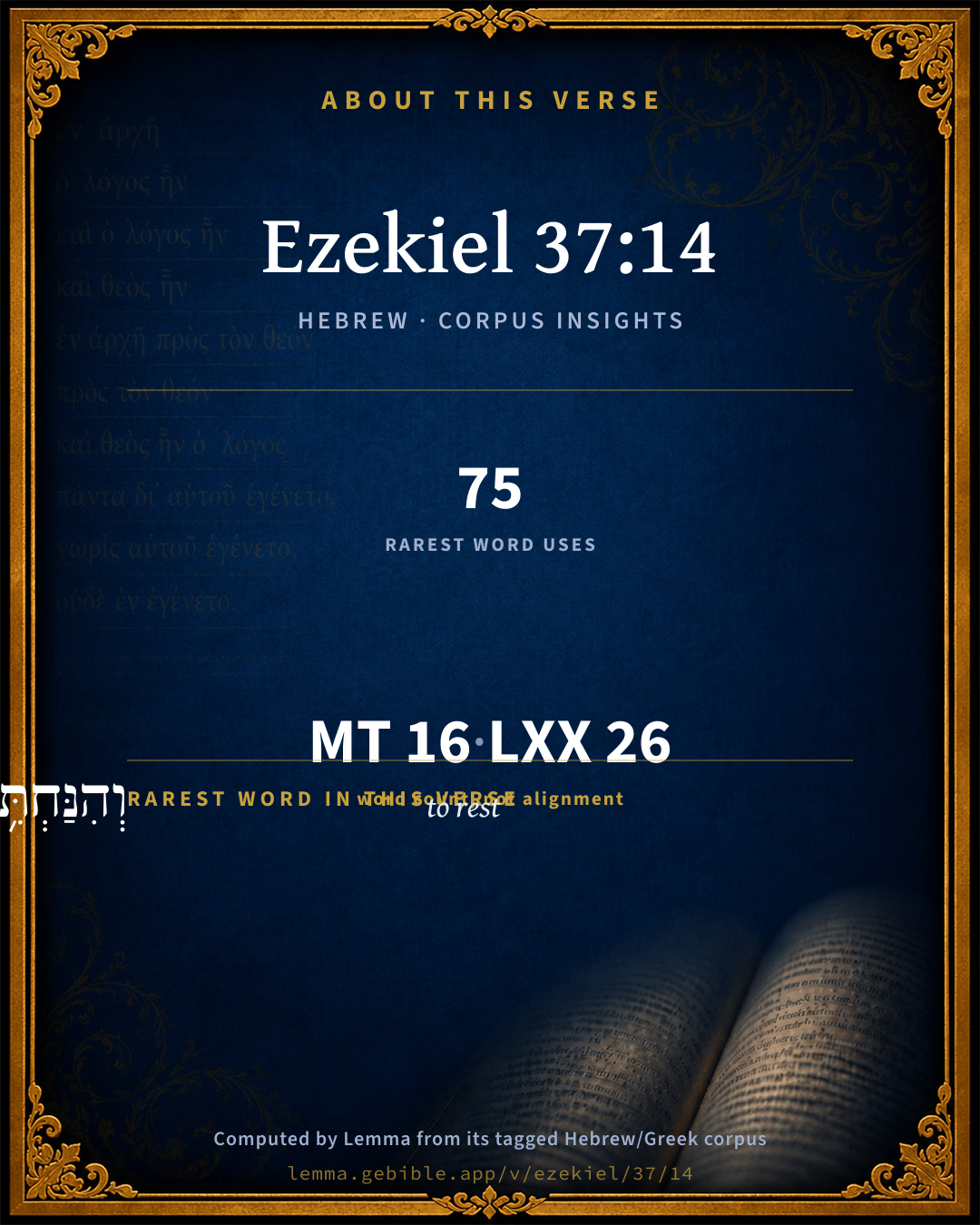
16
words
14
distinct lemmas
Prophets
section

Grammatical profile

  • 6 verbs
  • 5 nouns
  • 1 pronoun
  • 2 prepositions
  • 1 conjunction
  • 1 particle

Verb forms

  • וְנָתַתִּ֨י Qal · Sequential Perfect
  • וִחְיִיתֶ֔ם Qal · Sequential Perfect
  • וְהִנַּחְתִּ֥י Hiphil · Sequential Perfect
  • וִידַעְתֶּ֞ם Qal · Sequential Perfect
  • דִּבַּ֥רְתִּי Piel · Perfect
  • וְעָשִׂ֖יתִי Qal · Perfect

Repetition

A word recurs within this verse — often emphatic in Hebrew:

  • יְהוָ֛ה LORD H3068 ×2

Hebrew & Septuagint length

In English translation the verse runs 35 words from the Hebrew and 40 from the Septuagint (LXX English) — closely comparable.

A rough comparison of the two English renderings, which tokenize alike — not a word-level alignment.

Word counts can differ between the Hebrew and the Greek without any difference in meaning — e.g. the Hebrew direct-object marker אֵת has no separate Greek word, and Greek often adds the article ὁ.

In the original languages it is 16 Hebrew tokens and 26 Greek tokens — but the two are counted differently (Hebrew bundles its prefixes and suffixes into one token; the Greek is in lemma form), so that isn’t a like-for-like length.

Cross-references

15

Topical passages linked to Ezekiel 37:14 in the Treasury of Scripture Knowledge — connected by theme and wording, ordered by reader-vote popularity; previews shown in the World English Bible.

  • Ezekiel 36:27 I will put my Spirit within you, and cause you to walk in my statutes, and you shall keep my ordinances, and do them.
  • Joel 2:28–29 "It will happen afterward, that I will pour out my Spirit on all flesh; And your sons and your daughters will prophesy. Your old men will dream dreams. Your young men will see visions.
  • Ezekiel 11:19 I will give them one heart, and I will put a new spirit within you; and I will take the stony heart out of their flesh, and will give them a heart of flesh;
  • Ezekiel 36:36 Then the nations that are left round about you shall know that I, Yahweh, have built the ruined places, and planted that which was desolate: I, Yahweh, have spoken it, and I will do it.
  • Ezekiel 39:29 neither will I hide my face any more from them; for I have poured out my Spirit on the house of Israel, says the Lord Yahweh.
  • 1 Corinthians 15:45 So also it is written, "The first man, Adam, became a living soul." The last Adam became a life-giving spirit.
  • Ezekiel 17:24 All the trees of the field shall know that I, Yahweh, have brought down the high tree, have exalted the low tree, have dried up the green tree, and have made the dry tree to flourish; I, Yahweh, have spoken and have done it.
  • Ezekiel 37:9 Then said he to me, Prophesy to the wind, prophesy, son of man, and tell the wind, Thus says the Lord Yahweh: Come from the four winds, breath, and breathe on these slain, that they may live.
  • Titus 3:5–6 not by works of righteousness, which we did ourselves, but according to his mercy, he saved us, through the washing of regeneration and renewing by the Holy Spirit,
  • Romans 8:2 For the law of the Spirit of life in Christ Jesus made me free from the law of sin and of death.
  • Romans 8:11 But if the Spirit of him who raised up Jesus from the dead dwells in you, he who raised up Christ Jesus from the dead will also give life to your mortal bodies through his Spirit who dwells in you.
  • Isaiah 32:15 until the Spirit be poured on us from on high, and the wilderness become a fruitful field, and the fruitful field be esteemed as a forest.
  • Ezekiel 22:14 Can your heart endure, or can your hands be strong, in the days that I shall deal with you? I, Yahweh, have spoken it, and will do it.
  • Zechariah 12:10 I will pour on the house of David, and on the inhabitants of Jerusalem, the spirit of grace and of supplication; and they will look to me whom they have pierced; and they shall mourn for him, as one mourns for his only son, and will grieve bitterly for him, as one grieves for his firstborn.
  • Acts 2:16–17 But this is what has been spoken through the prophet Joel:

Cross-references courtesy of OpenBible.info (CC BY 4.0).

Hebrew and Greek witnesses Masoretic Hebrew ↔ Greek Septuagint

The same verse in the two great witnesses to the Old Testament, shown verse-for-verse.

These are two independent witnesses, not word-aligned to each other, and the Septuagint is shown in lemma (dictionary) form.

Hebrew Ezekiel 37:14 Masoretic · Westminster Leningrad Codex

וְנָתַתִּ֨י רוּחִ֤י בָכֶם֙ וִחְיִיתֶ֔ם וְהִנַּחְתִּ֥י אֶתְכֶ֖ם עַל אַדְמַתְכֶ֑ם וִידַעְתֶּ֞ם כִּי אֲנִ֧י יְהוָ֛ה דִּבַּ֥רְתִּי וְעָשִׂ֖יתִי נְאֻם יְהוָֽה

I will put my Spirit in you, and you shall live, and I will place you in your own land: and you shall know that I, Yahweh, have spoken it and performed it, says Yahweh.

World English Bible · Public Domain

Greek LXX Ezekiel 37:14 Septuagint · lemma form

καί δίδωμι ὁ πνεῦμα ἐγώ εἰς σύ καί ζάω καί τίθημι σύ ἐπί ὁ γῆ σύ καί γιγνώσκω ὅτι ἐγώ κύριος λαλέω καί ποιέω λέγω κύριος

And I will put my Spirit within you, and you⌃ shall live, and I will place you upon your own land: and you⌃ shall know that I am the Lord; I have spoken, and will do it, says the Lord.

LXX2012 (modern English Septuagint) · Public Domain

Hebrew: Westminster Leningrad Codex (CC BY 4.0). Greek: Septuagint (public domain); English from LXX2012 (modern English Septuagint) (Public Domain). How the Septuagint differs from the Hebrew →

Targum (Aramaic paraphrase)

1

The Targum is the ancient Jewish Aramaic paraphrase of the Hebrew Scriptures — an interpretive translation, not the Hebrew text itself. Onkelos (literal) and Pseudo-Jonathan (expansive) render the Torah, and Jonathan the Prophets. Coverage is partial: where no permissively-licensed English translation exists for a verse, only the Aramaic is shown. This is verse-level text, not a word-by-word alignment to the Hebrew.

  1. Targum Jonathan Prophets (Joshua–Malachi)
    וְאֶתֵּן רוּחִי בְכוֹן וְתֵיחוּן וְאַשְׁרֵי יַתְכוֹן עַל אַרְעֲכוֹן וְתֵידְעוּן אֲרֵי אֲנָא יְיָ גְזָרִית בְּמֵימְרִי וַאֲקַיֵם אֲמַר יְיָ:

    (no public-domain English translation for this verse)

    Targum Jonathan — Aramaic: “Mikraot Gedolot” (public domain). English: “Sefaria Community Translation” (CC0 1.0 (public-domain dedication)); “London "Chaldee Paraphrase," 1871” (public domain). Text via Sefaria.

Commentary

Notes on Ezekiel 37:14 from classic Christian and Jewish commentators (each source and its license shown beneath its notes). The classic Christian expositions comment on the surrounding passage and are grouped to its opening verse, so a note may address several verses; the Jewish commentaries on the Tanakh (Rashi and others) are per-verse, so they appear only where the commentator wrote on this verse.

Lemma curates 59 commentaries, every one of them public domain or Creative Commons licensed, each selected and text-cleaned for this edition rather than reprinted as found. About our sources →

Trapp's Complete Commentary

John Trapp

Eze 37:14 And shall put my spirit in you, and ye shall live, and I shall place you in your own land: then shall ye know that I the LORD have spoken [it], and performed [it], saith the LORD.

Ver. 14. And shall put my Spirit in you.] Even my "spirit of adoption," that soul of the soul: this was more than all the rest. Thrice happy are they that are thus spirited; they shall live, and live comfortably.

John Trapp, A Commentary or Exposition upon All the Books of the Old and New Testament (1647–1656) — public domain. Text from a community e-Sword module.

Tyndale Open Study Notes

Tyndale Open Resources

37:14 The Lord would put his life-giving Spirit within his people. If the sovereign Lord had determined to raise them, no dryness on their part would hold him back.

Tyndale Open Study Notes — © Tyndale Open Resources, licensed CC BY-SA 4.0. Text via the HelloAO Bible API.

Adam Clarke's Commentary

Verse 14. And shall put my Spirit] רוחי ruchi. Here רוח ruach is taken for the Holy Ghost. They were living souls, animal and intellectual beings, when they had received their souls, as mentioned above: but they could only become spiritual, holy, and obedient creatures by the Spirit of God actuating their spirits. See the notes on Eze 36:25-27.

THREE degrees or processes have been remarked in this mystic vision. When the prophet was commanded to prophesy-to foretell, on the authority of God, that there should be a restoration to their own land,-

1. There was a noise, which was followed by a general shaking, during which the bones became arranged and united.

2. The flesh and skin came upon them, so that the dry bones were no longer seen.

3. The spirit or soul came into them, and they stood up perfectly vivified.

Perhaps these might be illustrated by three periods of time, which marked the regeneration of the Jewish polity.

1. The publication of the edict of Cyrus in behalf of the Jews, which caused a general shaking or stir among the people, so that the several families began to approach each other. and prepare for their return to Judea, Ezr 1:2-3. But though partially restored, they were obliged to discontinue the rebuilding of their temple.

2. The edict published by Darius in the second year of his reign, Ezr 4:23-24, which removed the impediments thrown in the way of the Jews. Ezr 6:6-7, c.

3. The mission of Nehemiah, with orders from Artaxerxes to complete the building of the temple and the city, Ne 2:7, &c. Then the Jews became a great army, and found themselves in sufficient force to defend themselves and city against all their enemies.

As to the spiritual uses of this curious vision, I must leave them to preachers. I have given the literal meaning, and what the different parts refer to and if they found their observations on these, they may profit their hearers.

Adam Clarke's Commentary on the Bible (1810–1826) — public domain. Text from a community e-Sword/MySword module.

Ellicott's Commentary for English Readers

(14) Put my spirit in you.—Here, as throughout this series of prophecies, the moral resurrection of the people and their restoration to their own land are intimately associated together. The former was at once the necessary condition of the latter, and would also be its consequence in a still higher development. Compare a similar association of the spiritual with the literal resurrection in Joh_5:21-29.

Eze_37:15-28 constitute another prophecy, which probably was given very soon after the former, since there is a close connection between the two. In the former, under the figure of the revival of the dry bones, God had set forth His power to accomplish the promise He made of the spiritual resurrection of Israel; in the latter. He adds to this the specific declaration of what had been before only implied, that the two long-severed nations of Israel shall be re-united and prosperous under the rule of the future David, while He Himself will dwell among them, and they shall be obedient to Him. These promises prepare the way for the prophecy of the great and final attack of the enemies of the Church (Ezekiel 38, 39) and their overthrow by the power of God. The promise of this prophecy is first set forth by a symbolic action (Eze_37:15-17), which is then to be explained to the people (Eze_37:18-20), as in the case of the vision (Eze_37:11), and then the promises of blessing follow.

A Bible Commentary for English Readers, edited by Charles John Ellicott (1878–1897) — public domain. Text from a community e-Sword module.

The Cambridge Bible for Schools and Colleges

gen. ed. J. J. S. Perowne

14. The symbol of the wind breathing into the slain is here explained: it is the spirit of Jehovah that gives life, Psa_104:30. The connexion shews that the spirit of the Lord here is merely the life-giving spirit, and not the regenerating spirit, as in Eze_36:27—though the distinction is merely part of the figure. The resuscitation of the dead nation could come about only through their moral regeneration, and hence in Isaiah 40-56 this is part of the work of the Servant of the Lord (Isa_49:8-12; Isa_61:1).

The passage is of great interest, apart from its own beauty, as casting light upon the condition of the people’s mind. The prophet is fond of quoting expressions from the mouth of the people (e.g. Eze_11:3, Eze_12:22; Eze_12:27, Eze_16:44, Eze_18:2; Eze_18:25; Eze_18:29, cf. Eze_33:17; Eze_33:20, Eze_20:49, Eze_36:20 &c.), and probably the words here used were actually heard. They shew a state of despondency quite natural and one no doubt greatly prevalent. Indeed in all the prophets of this age the hope that exists is hope only in Jehovah, which believes that in spite of past disasters their God will yet save the people. It is only by giving moral significance to Israel’s calamities on the one hand, and on the other by animating the revolutions and commotions among the nations with Jehovah’s purpose, that the faith of the prophets themselves is sustained. The prophetic hopes of this period are based on dogmatic presuppositions, e.g. that Jehovah is the true and living God and that there is none else; that Israel is his people and has his true revelation among them, which is imperishable and which must accomplish the purpose for which it was given and become effectual in making a true people of the Lord (Isaiah 55); and that the purpose of the one God must embrace all the nations of the earth, between whom and Jehovah Israel is the link of communication. The prophetic views as to how Jehovah shall use Israel to give the nations the knowledge of himself differ. In Isaiah 40 seq. Israel becomes the light of the nations—having the true knowledge of God it imparts it to the heathen. In Ezekiel it is their own observation and reflection on Israel’s history that reveals to the nations Jehovah’s true nature. In all, however, the work of redemption is the work of Jehovah. Here his restoration of Israel is reanimation of the dead through his life-giving spirit.

The Cambridge Bible for Schools and Colleges (gen. ed. J. J. S. Perowne; Cambridge University Press, 1878–1918) — public domain. Text from a community e-Sword module.

John Gill's Exposition

And shall put my spirit in you, and ye shall live,.... Not only a spirit of courage to go up into their own land, and live a civil and comfortable life there; but the Spirit of God, as a spirit of grace and supplication, of truth and holiness, of faith and adoption; and as a spirit of life, having produced a principle of life in them, and so should live spiritually and soberly, righteously and godly; see Eze 36:27,

and I shall place you in your own land; settle them there in peace and quietness, in safety and security and in enjoyment of all mercies and privileges, temporal and spiritual:

then shall ye know that I the Lord have spoken it, and performed it, saith the Lord; that all this was a promise of his, foretold by him, notified to them by his prophets, and now fully accomplished exactly; which they would observe with wonder and thankfulness, and give him the glory of it.

John Gill's Exposition of the Whole Bible (1746–1763) — public domain (CC PDM 1.0). Text via the HelloAO Bible API.

Matthew Poole's English Annotations

My spirit: see Eze 11:19; 36:27.

Ye shall live, joyful in, thankful for, and contented with the blessings I give.

I shall place you; quietly and in rest settle you in your own habitations, and in your ancient possessions.

I the Lord have spoken it: this shall demonstrate the truth of my promises. the fullness and punctualness of my performances.

Matthew Poole's English Annotations on the Holy Bible (1683–1685) — public domain. Text from a community e-Sword/MySword module.

Lesson kit

Teaching starters — assembled from the data on this page, not authored interpretation. Every prompt links to the verse data it draws on. Edit before teaching.

Ezekiel, in the Prophets, opens this verse with 16 words (14 distinct Hebrew lemmas). Its most distinctive word is yânach (“to rest”). A historical commentator’s framing appears above. Read the whole chapter for the surrounding context.

Discussion questions

  1. What does “to rest” (yânach) contribute to the verse as a whole?
  2. Ezekiel 36:27 shares this passage’s theme. How do the two illuminate each other?
  3. “LORD” occurs 2× in this one verse. What is the effect of the repetition?
  4. The translations on this page render this verse differently — a whole-verse word diff, not a word-by-word alignment. What might account for the different wordings?
  5. The verb «וְנָתַתִּ֨י» is Qal Sequential Perfect. How does its form color the action?
  6. Reading how Trapp's Complete Commentary and Tyndale Open Study Notes read this verse, where do the two commentators agree and where do they part?

Things to notice

Reading settings

Reading text

Shown beneath each verse's original-language words.

Old Testament
Old Testament edition

Read the OT as the Masoretic Hebrew (MT) or the Greek Septuagint (LXX).

English shown for the Greek Septuagint (in the Hebrew ↔ Greek comparison).

Comparing translations? Open the Compare panel on any verse page to stack up to four side by side.