
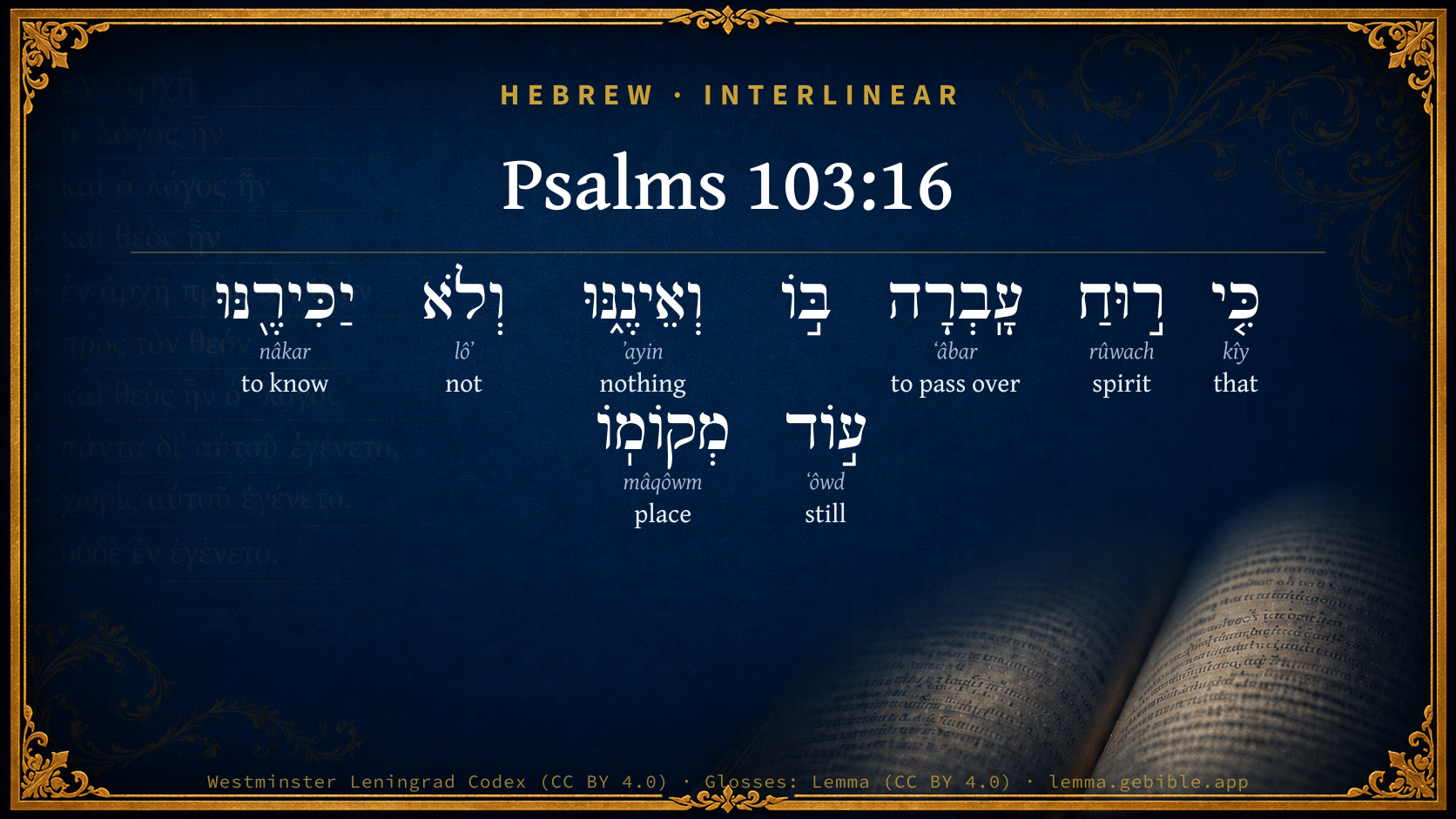
Psalms 103:16

Hebrew (Westminster Leningrad Codex) Psalms 103:16 appears in the Hebrew Old Testament. The text above is from the Westminster Leningrad Codex. Each word links to its Strong’s number, a concise gloss, and parsing drawn from the Open Scriptures Hebrew Bible morphology. Click any word for its full Brown-Driver-Briggs (BDB) entry.
Download image
Cite this verse

Psalms 103:16 (World English Bible). Public Domain. Lemma interlinear Bible study tool, https://lemma.gebible.app/v/psalms/103/16.

Show BibTeX & RIS
BibTeX
RIS
English Translation
For the wind passes over it, and it is gone. Its place remembers it no more.
World English Bible · Public Domain
Download a study sheet

One document with this verse’s original text, its word-by-word gloss line, the meaning frame, cross-references with their text, attributed commentary, and full source and license credits — printable, and it pastes into notes with its structure intact.

This verse Autodidact and up

Study sheet (.html) Plain text (.txt)

A passage Seminary Student

Up to 50 verses in one chapter. A passage sheet keeps up to 6 commentary sources and 12 cross-references per verse, in the order this page ranks them, and says so on the sheet whenever that leaves anything out. Ask for a single verse and you get the Autodidact verse sheet above.

Everything on this page stays free to read, with no account — the sheet is a download of what is already on screen, not access to it.

Want to remove ads? Support Godless Engineer
Compare translations 3

The same verse in 3 English versions, stacked beneath the original-language interlinear above. Click any original word for its lexicon entry.

Each is an independent rendering of the whole verse — the interlinear is not word-aligned to these translations.

Highlighted words mark where these versions differ — a whole-verse word diff, not a word-by-word alignment.

  • World English Bible Public Domain
    For the wind passes over it, and it is gone. Its place remembers it no more.
  • King James Version Public Domain
    For the wind passeth over it, and it is gone; and the place thereof shall know it no more.
  • unfoldingWord Literal Text CC BY-SA 4.0
    For the wind passes over it, and it is no more, and its place does not acknowledge it again.

unfoldingWord Literal Text — © unfoldingWord, licensed CC BY-SA 4.0. Word-aligned USFM3 via Door43 (git.door43.org/unfoldingWord/en_ult).

Versions to compare (up to 4)

3 of 4 selected

Show all 18 translations

Every available English version of this verse, each an independent rendering of the whole verse.

  • World English Bible Public Domain
    For the wind passes over it, and it is gone. Its place remembers it no more.
  • Berean Standard Bible Public Domain
    when the wind passes over, it vanishes, and its place remembers it no more.
  • Majority Standard Bible Public Domain
    when the wind passes over, it vanishes, and its place remembers it no more.
  • King James Version Public Domain
    For the wind passeth over it, and it is gone; and the place thereof shall know it no more.
  • American Standard Version (1901) Public Domain
    For the wind passeth over it, and it is gone; And the place thereof shall know it no more.
  • Revised Version (1885) Public Domain
    For the wind passeth over it, and it is gone; and the place thereof shall know it no more.
  • Geneva Bible (1599) Public Domain
    For the winde goeth ouer it, and it is gone, and the place thereof shall knowe it no more.
  • Douay-Rheims (1899) Public Domain
    For the spirit shall pass in him, and he shall not be: and he shall know his place no more.
  • Young's Literal Translation Public Domain
    For a wind hath passed over it, and it is not, And its place doth not discern it any more.
  • Literal Standard Version CC BY-SA 4.0
    For a wind has passed over it, and it is not, || And its place does not discern it anymore.
  • Unlocked Literal Bible CC BY-SA 4.0
    The wind blows over it, and it disappears, and no one can even tell where it once grew.
  • unfoldingWord Literal Text CC BY-SA 4.0
    For the wind passes over it, and it is no more, and its place does not acknowledge it again.
  • Darby Bible Public Domain
    For the wind passeth over it, and it is gone, and the place thereof knoweth it no more.
  • World Messianic Bible Public Domain
    For the wind passes over it, and it is gone. Its place remembers it no more.
  • Webster's Bible Public Domain
    For the wind passeth over it, and it is gone; and its place shall know it no more.
  • Free Bible Version CC BY-SA 4.0
    but then the wind blows and we are gone, disappearing without a trace.
  • Bible in Basic English Public Domain
    The wind goes over it and it is gone; and its place sees it no longer.
  • JPS Tanakh (1917) Public Domain
    For the wind passeth over it, and it is gone; and the place thereof knoweth it no more.

Literal Standard Version (2020), Covenant Press — licensed CC BY-SA 4.0. Text via the HelloAO Bible API (eBible.org). Unlocked Literal Bible (unfoldingWord) — licensed CC BY-SA 4.0. Text via the HelloAO Bible API (eBible.org). unfoldingWord Literal Text — © unfoldingWord, licensed CC BY-SA 4.0. Word-aligned USFM3 via Door43 (git.door43.org/unfoldingWord/en_ult). Free Bible Version, Dr. Jonathan Gallagher — licensed CC BY-SA 4.0. Text via the HelloAO Bible API (eBible.org).

Word by word

More ways to search: Search by grammar → Find every occurrence → Compare this word →

Practice this passage: Drill this verse → Learn its vocabulary →

יַכִּירֶ֖נּוּ
nâkar
H5234
“to know · him”
Verb, Hiphil, Imperfect, 3rd Person, Masculine, Singular + Suffix, Personal, 3rd Person, Masculine, Singular
Part of Speech
Verb
Stem
Hiphil
Form
Imperfect
Person
3rd Person
Gender
Masculine
Number
Singular
Full BDB Definition

Origin: a primitive root

TWOT: 1368

to recognise, acknowledge, know, respect, discern, regard - (Niphal) to be recognised - (Piel) to regard - (Hiphil) - to regard, observe, pay attention to, pay regard to, notice - to recognise (as formerly known), perceive - to be willing to recognise or acknowledge, acknowledge with honour - to be acquainted with - to distinguish, understand - (Hithpael) to make oneself known - to act or treat as foreign or strange, disguise, misconstrue - (Niphal) to disguise oneself - (Piel) - to treat as foreign (profane) - to misconstrue - (Hithpael) - to act as alien - to disguise oneself
  1. כִּ֤י kîy H3588 “that” Conjunction
  2. ר֣וּחַ rûwach H7307 “spirit” Noun, Common, Both, Singular, Absolute
  3. עָֽבְרָה ʻâbar H5674 “to pass over” Verb, Qal, Perfect, 3rd Person, Feminine, Singular
  4. וְאֵינֶ֑נּוּ ʼayin H369 “and · nothing · him” Conjunction + Particle, Negative + Suffix, Personal, 3rd Person, Masculine, Singular
  5. וְלֹא lôʼ H3808 “and · not” Conjunction + Particle, Negative
  6. ע֣וֹד ʻôwd H5750 “still” Adverb
  7. מְקוֹמֽוֹ mâqôwm H4725 “place · his” Noun, Common, Masculine, Singular, Construct + Suffix, Personal, 3rd Person, Masculine, Singular

About this verse

These counts appear in no published source. They are computed here, from the morphology-tagged text and Lemma’s own curated glosses. What Lemma adds →

9
words
8
distinct lemmas
Wisdom
section

Shared distinctive vocabulary

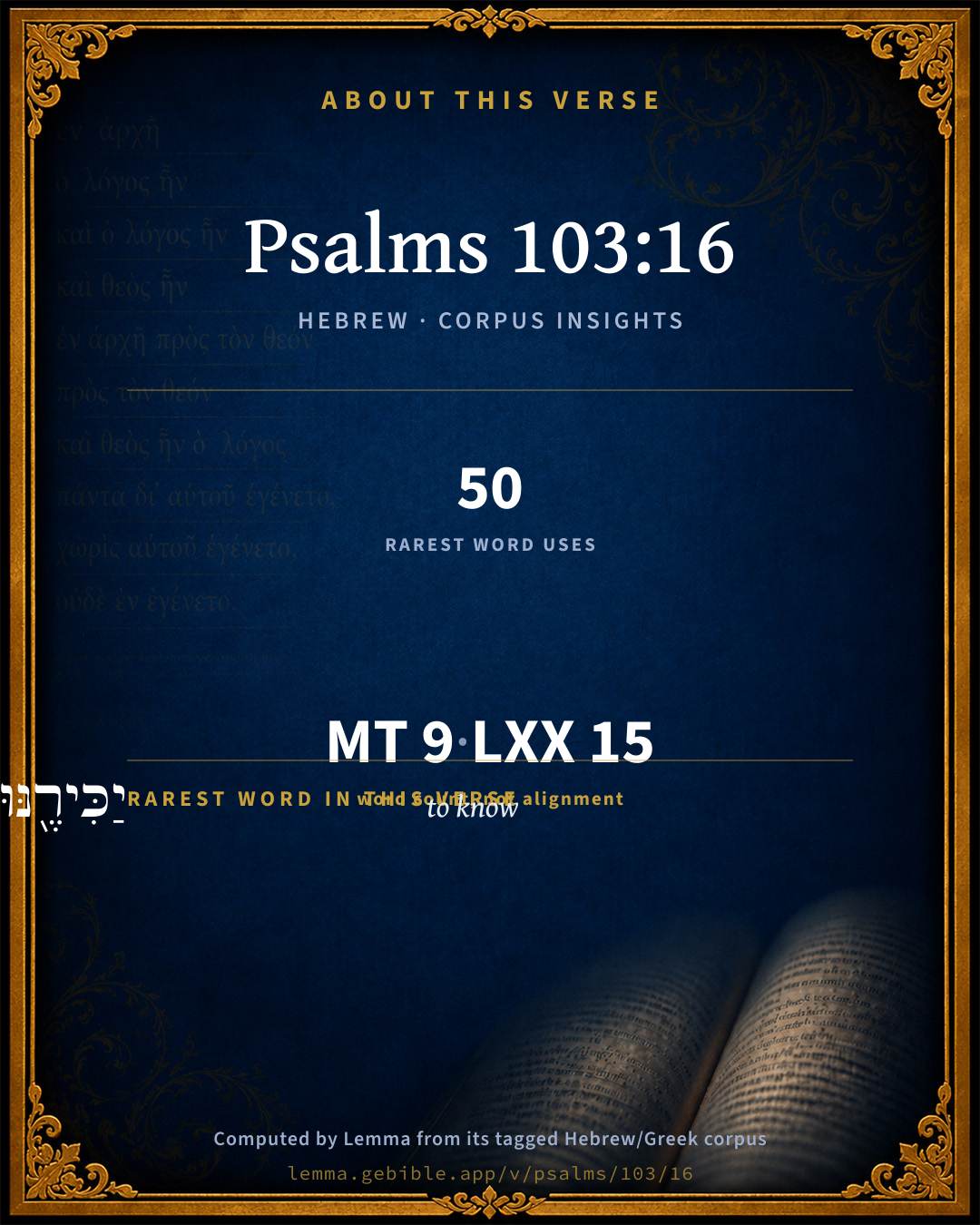
יַכִּירֶ֖נּוּ to know H5234 occurs in 47 verses of the Hebrew Bible. Also found in:

Grammatical profile

  • 2 verbs
  • 2 nouns
  • 1 preposition
  • 1 conjunction
  • 1 adverb
  • 2 particles

Verb forms

  • עָֽבְרָה Qal · Perfect
  • יַכִּירֶ֖נּוּ Hiphil · Imperfect

Hebrew & Septuagint length

In English translation the verse runs 16 words from the Hebrew and 19 from the Septuagint (LXX English) — closely comparable.

A rough comparison of the two English renderings, which tokenize alike — not a word-level alignment.

Word counts can differ between the Hebrew and the Greek without any difference in meaning — e.g. the Hebrew direct-object marker אֵת has no separate Greek word, and Greek often adds the article ὁ.

In the original languages it is 9 Hebrew tokens and 15 Greek tokens — but the two are counted differently (Hebrew bundles its prefixes and suffixes into one token; the Greek is in lemma form), so that isn’t a like-for-like length.

Cross-references

7

Topical passages linked to Psalms 103:16 in the Treasury of Scripture Knowledge — connected by theme and wording, ordered by reader-vote popularity; previews shown in the World English Bible.

  • Isaiah 40:7 The grass withers, the flower fades, because the breath of Yahweh blows on it; surely the people is grass.
  • Job 20:9 The eye which saw him shall see him no more, Neither shall his place any more see him.
  • Job 14:10 But man dies, and is laid low. Yes, man gives up the spirit, and where is he?
  • Genesis 5:24 Enoch walked with God, and he was not, for God took him.
  • Job 7:6–10 My days are swifter than a weaver's shuttle, And are spent without hope.
  • Job 8:18–19 If he is destroyed from his place, Then it shall deny him, saying, 'I have not seen you.'
  • Job 27:20–21 Terrors overtake him like waters; A tempest steals him away in the night.

Cross-references courtesy of OpenBible.info (CC BY 4.0).

Hebrew and Greek witnesses Masoretic Hebrew ↔ Greek Septuagint

The same verse in the two great witnesses to the Old Testament, shown verse-for-verse.

You’re reading Greek Psalm 102 (Hebrew Psalm 103). The Septuagint counts the superscription, so verse numbers can differ from the Hebrew — chapter-level alignment, not verse-by-verse. Numbering follows Rahlfs.

These are two independent witnesses, not word-aligned to each other, and the Septuagint is shown in lemma (dictionary) form.

Hebrew Psalms 103:16 Masoretic · Westminster Leningrad Codex

כִּ֤י ר֣וּחַ עָֽבְרָה בּ֣וֹ וְאֵינֶ֑נּוּ וְלֹא יַכִּירֶ֖נּוּ ע֣וֹד מְקוֹמֽוֹ

For the wind passes over it, and it is gone. Its place remembers it no more.

World English Bible · Public Domain

Greek LXX Greek Psalm 102:16 Septuagint · lemma form

ὅτι πνεῦμα διαἔρχομαι ἐν αὐτός καί οὐ ὑποἄρχω καί οὐ ἐπιγιγνώσκω ἔτι ὁ τόπος αὐτός

For the wind passes over it, and it shall not be; and it shall know its place no more.

LXX2012 (modern English Septuagint) · Public Domain

Hebrew: Westminster Leningrad Codex (CC BY 4.0). Greek: Septuagint (public domain); English from LXX2012 (modern English Septuagint) (Public Domain). How the Septuagint differs from the Hebrew →

Commentary

Notes on Psalms 103:16 from classic Christian and Jewish commentators (each source and its license shown beneath its notes). The classic Christian expositions comment on the surrounding passage and are grouped to its opening verse, so a note may address several verses; the Jewish commentaries on the Tanakh (Rashi and others) are per-verse, so they appear only where the commentator wrote on this verse.

Lemma curates 59 commentaries, every one of them public domain or Creative Commons licensed, each selected and text-cleaned for this edition rather than reprinted as found. About our sources →

Trapp's Complete Commentary

John Trapp

Psa 103:16 For the wind passeth over it, and it is gone; and the place thereof shall know it no more.

Ver. 16. For the wind passeth over it, and it is gone] Heb. it is not; that is, it neither continues any longer in being nor returns any more into being: so here, Job 14:7-12.

And the place thereof shall know it no more] Though, while it stood and flourished, the place of it seemed as it were to know nothing but it, the glory and beauty of it drew all eyes to it, &c. Think the same of men in their flourish, soon forgotten, as dead men out of mind, Psa 31:12.

John Trapp, A Commentary or Exposition upon All the Books of the Old and New Testament (1647–1656) — public domain. Text from a community e-Sword module.

The Biblical Illustrator

Joseph S. Exell

Psa_103:16

For the wind passeth over it, and it is gone; and the place thereof shall know it no more.

The autumn wind: an emblem of death

I. The autumn wind works gradually. Blade by blade, the herbs wither under its influence; and leaf by leaf, the tree is stripped of its foliage. Thus on gradually until all is dust. So death works gradually. We die daily.

II. The autumn wind works universally. It is on all herbage, in all forests, it withers all, sows death everywhere. All are dying, individuals, families, nations, the whole generation.

III. The autumn wind works insidiously. Only occasionally does it come with the rush of violence, and scatter the leaves. Quietly, invisibly, insidiously it works. So does death. It is working in their systems when men are utterly unconscious of it. The wind passeth over it and it is gone. And when the wind of death passeth over us, we are gone, gone for ever. (Homilist.)

Soon forgotten

We shall sleep none the less sweetly, though none be talking about us over our heads. The world has a short memory, and, as the years go on the list that it has to remember grows so crowded that it is harder and harder to find room to write a new name on it, or to read the old. The letters on the tombstones are soon erased by the feet that tramp across the churchyard. (A. Maclaren, D.D.)

The Biblical Illustrator, edited by Joseph S. Exell (c. 1880s–1900s) — public domain. Text from a community e-Sword module.

J. A. Alexander on Psalms

Joseph Addison Alexander

16. (Psa 103:16) For a breath passes over him and he is not, and no more shall his place know him. The pronouns may with equal grammatical correctness, be referred to the grass and rendered it, its. The primary meaning of the first noun (breath) is, in this connection, stronger than the secondary (wind). The wind may be a whirlwind; but to say that a mere breath is sufficient to destroy one is the strongest possible expression of fragility. That the wind is called the breath of God, as the thunder is his voice, is a striking and poetical but needless supposition. He is not or no more, there is none of him, no such thing or person. See above, on Psa 37:10. With the first clause compare Isa 40:7; with the second, Job 7:10. The last verb means to recognise or know again, as in Psa 142:4, and the whole clause, that death makes men strangers to the objects with which they have been most familiar.

Joseph Addison Alexander, The Psalms Translated and Explained (1850) — public domain. Text from a community e-Sword module.

Adam Clarke's Commentary

Verse 16. The wind passeth over it] Referring perhaps to some blasting pestilential wind.

Adam Clarke's Commentary on the Bible (1810–1826) — public domain. Text from a community e-Sword/MySword module.

Ellicott's Commentary for English Readers

(16) The wind—i.e., the hot, scorching blast, as in Isa_40:7. Even in our humid climate, it may be said of a flower—

“If one sharp wind sweep o’er the field,

It withers in an hour.”

But the pestilential winds of the East are described as bringing a heat like that of an oven, which immediately blasts every green thing.

Know it no more.—Comp. Job_7:10. Man vanishes away without leaving a trace behind. The pathos of the verse has been well caught in the well-known lines of Gray:—

“One morn I missed him on the accustomed hill,

Along the heath, and near his favourite tree:

Another came, nor yet beside the rill,

Nor up the lawn, nor at the wood was he.”

A Bible Commentary for English Readers, edited by Charles John Ellicott (1878–1897) — public domain. Text from a community e-Sword module.

The Cambridge Bible for Schools and Colleges

gen. ed. J. J. S. Perowne

16. The verse may refer to the withering of the flower (A.V.), but it is more poetical to understand it metaphorically of the disappearance of the man.

For a wind passeth over him, and he is not,

And his place shall know him no more.

“The east wind, blowing over the desert in summer, is dry and parching, and withers up all vegetation.” Tristram, Nat. Hist. p. 34. Cp. Hos_13:15. The second line is from Job_7:10; cp. Job_8:18, Job_20:9.

The Cambridge Bible for Schools and Colleges (gen. ed. J. J. S. Perowne; Cambridge University Press, 1878–1918) — public domain. Text from a community e-Sword module.

John Gill's Exposition

To such as keep his covenant,.... The covenant of grace, which is peculiarly the Lord's covenant, as distinct from man's; and which he keeps himself, and is ever mindful of it. This he makes known to his people at conversion; his secret is with them, and he shows them his covenant; the blessings and promises of it; their interest in them, and in himself, as their covenant God: which they "observe" (c), as the word here used signifies; and observing it, they lay hold upon it by faith, as belonging to them; and laying hold upon it, they "keep" it as their own, and keep it fast, and will not part with their interest in it for all the world.

And to those that remember his commandments to do them; some read them and hear them, but forget them, at least to do them: these are like a man that beholds his face in a glass, and forgets what manner of man he is; so James compares one that is a forgetful hearer, and not a doer of the word, Jam 1:23. The commandments of God are best remembered, so as to be done, when he puts his laws into the minds of men, and writes them in their hearts, and puts his Spirit within them, to cause them to walk in his statutes, and do them, Jer 31:34.

(c) "observantes", Junius & Tremellius; so Piscator, Gejerus.

John Gill's Exposition of the Whole Bible (1746–1763) — public domain (CC PDM 1.0). Text via the HelloAO Bible API.

Albert Barnes' Notes on the Bible

For the wind passeth over it, and it is gone - Margin, as in Hebrew, “it is not.” The reference is either to a hot and burning wind, that dries up the flower; or to a furious wind that tears it from its stem; or to a gentle breeze that takes off its petals as they loosen their hold, and are ready to fall. So man falls - as if a breath - a breeze - came over him, and he is gone. How easily is man swept off! How little force, apparently, does it require to remove the most beautiful and blooming youth of either sex from the earth! How speedily does beauty vanish; how soon, like a fading flower, does such a one pass away!

And the place thereof shall know it no more - That is, It shall no more appear in the place where it was seen and known. The “place” is here personified as if capable of recognizing the objects which are present, and as if it missed the things which were once there. They are gone. So it will soon be in all the places where we have been; where we have been seen; where we have been known. In our dwellings; at our tables; in our places of business; in our offices, counting-rooms, studies, laboratories; in the streets where we have walked from day to day; in the pulpit, the court-room, the legislation-hall; in the place of revelry or festivity; in the prayer-room, the Sabbath-school, the sanctuary - we shall be seen no longer. We shall be gone: and the impression on those who are there, and with whom we have been associated, will be best expressed by the language, “he is gone!” Gone; - where? No one that survives can tell. All that they whom we leave will know will be that we are absent - that we are “gone.” But to us now, how momentous the inquiry, “Where shall we be, when we are gone from among the living?” Other places will “know” us; will it be in heaven, or hell?

Albert Barnes' Notes on the Bible (1834–1885) — public domain. Text from a community e-Sword/MySword module.

Matthew Poole's English Annotations

A blasting or stormy wind bloweth upon it, and there is no more any appearance nor remembrance of it in the place where it stood and flourished.

Matthew Poole's English Annotations on the Holy Bible (1683–1685) — public domain. Text from a community e-Sword/MySword module.

The Treasury of David

Charles H. Spurgeon

Ver. 16. For the wind passeth over it, and it is gone. Only a little wind is needed, not even a scythe is demanded, a breath can do it, for the flower is so frail.

"If one sharp wind sweep over the field,

It withers in an hour."

How small a portion of deleterious gas suffices to create a deadly fever, which no art of man can stay. No need of sword or bullet, a puff of foul air is deadlier far, and fails not to lay low the healthiest and most stalwart son of man.

And the place thereof shall know it no more. The flower blooms no more. It may have a successor, but as for itself its leaves are scattered, and its perfume will never again sweeten the evening air. Man also dies and is gone, gone from his old haunts, his dear home, and his daily labours, never to return. As far as this world is concerned, he is as though he never had been; the sun rises, the moon increases or wanes, summer and winter run their round, the rivers flow, and all things continue in their courses as though they missed him not, so little a figure does he make in the affairs of nature. Perhaps a friend will note that he is gone, and say,

"One morn. I missed him on the accustomed hill,

Along the heath, and near his favourite tree;

Another came, nor yet beside the rill,

Nor up the lawn, nor at the wood was he."

But when the "dirges due" are silent, beyond a mound of earth, and perhaps a crumbling stone, how small will be the memorial of our existence upon this busy scene! True there are more enduring memories, and an existence of another kind coeval with eternity, but these belong, not to our flesh, which is but grass, but to a higher life, in which we rise to close fellowship with the Eternal.

Ver. 16. The wind passeth over it, and it is gone, etc. A breath of air, a gentle wind (xwr) passes over him and he is gone. It would not be so strange if a tempest, a whirlwind, passing over should sweep him away. The Psalmist means much more than this. The gentlest touch, the whispering breeze, bears him off. He soon becomes a stranger, no more known in the little space he once filled, going out and coming in. Henry Cowles.

Ver. 16. The wind passeth over it, and it is gone. It is well known that a hot wind in the east destroys at once every green thing. Nor is this to be wondered at, if, as Dr. Russell says, the winds sometimes "bring with them a degree and kind of heat, which one would imagine came out of an oven, and which, when it blows hard, will affect metals within the houses, such as locks of room doors, nearly as much as if they had been exposed to the rays of the sun." The blasting effect which seems to be here alluded to, of certain pestilential winds upon the animal frame, is by no means exaggerated by the comparison to the sudden fading of a flower. Maillet describes hundreds of persons in a caravan as stifled on the spot by the fire and dust, of which the deadly wind, that sometimes prevails in the eastern deserts, seems to be composed. And Sir John Chardin describes this wind "as making a great hissing noise, "and says that "it appears red and fiery, and kills those whom it strikes by a kind of stifling them, especially when it happens in the day time." Richard Mant.

Ver. 16. The place thereof shall know him no more, &c. Man, once turned to dust, is blown about by every wind, from place to place; and what knows the place, when dust falls upon it; whether it be the dust of a prince, or of a peasant; whether of a man, or of a beast? And must not man then needs be very miserable, when time and place, the two best helps of life, do both forsake him? for what help can he have of time, when his days are but as grass? What help of place, when his place denies him, and will not know him? Sir R. Baker.

Psalms 103:17*

Charles H. Spurgeon's The Treasury of David (1869–1885) — public domain. Psalms only. Text from a community e-Sword/MySword module.

Whedon's Commentary on the Bible

Daniel D. Whedon

16. The wind passeth over it—The allusion is to the east and southeast winds, which, coming from the hot desert of Arabia, pass over Palestine with vehemence, destroying life, withering grass and herbage, and exhausting the strength of men and animals. See Eze_17:10; Eze_19:12; Hos_13:15.

It is gone—Hebrew, It is not. Such is our transient, mortal life. But the language applies specially to wicked and worldly men who have their portion in this life and forget God. See Job_20:9; Psa_37:10; Psa_73:19-20.

The place thereof shall know it no more— Taken almost literally from Job_7:8

Daniel D. Whedon (gen. ed.), Commentary on the Old and New Testaments (1874–1909) — public domain. Text from a community e-Sword module.

The Pulpit Commentary

For the wind passeth over it, and it is gone; literally, it is not. The burning sirocco, the wind of the desert, variously named in various places, blows upon the flower, and almost immediately scorches it up. So man, when he flourishes most, is for the most part brought low by the wind of suffering, trouble, sickness, calamity, and sinks out of sight. And the place thereof shall know it no more; rather, knows it no more. Seeing it not, forgets it, as if it had never been. So with the greatest men they pass away and are forgotten. (comp. Job_7:10)

The Pulpit Commentary (1880–1919), ed. H.D.M. Spence-Jones & Joseph S. Exell — public domain. Text from a community e-Sword module.

Rashi

Rabbi Shlomo Yitzchaki (Rashi)

For a wind passes over him If mortal illness passes over him.

Rashi on the Tanakh — English translations: “The Judaica Press complete Tanach with Rashi, translated by A. J. Rosenberg” (CC BY 4.0); “Pentateuch with Rashi's commentary by M. Rosenbaum and A.M. Silbermann, 1929-1934” (public domain); “The Metsudah Tanach series, Lakewood, N.J” (CC BY 4.0); and “The Book of Joshua, Metsudah Publications, 1997” (CC BY 4.0). Text via Sefaria.

Lesson kit

Teaching starters — assembled from the data on this page, not authored interpretation. Every prompt links to the verse data it draws on. Edit before teaching.

Psalms, in the Wisdom, opens this verse with 9 words (8 distinct Hebrew lemmas). Its most distinctive word is nâkar (“to know”). A historical commentator’s framing appears above. Read the whole chapter for the surrounding context.

Discussion questions

  1. How does “to know” (nâkar) shape what this verse is saying?
  2. How does Genesis 27:23, which shares the word «to know», read alongside this verse?
  3. These translations render this verse differently; the difference is in the English rendering, not the original. What questions does that raise?
  4. «עָֽבְרָה» is a Qal Perfect verb. How does that grammatical form shape the action described?
  5. Compare how Trapp's Complete Commentary and The Biblical Illustrator read this verse. Where do they agree or differ?

Things to notice

Reading settings

Reading text

Shown beneath each verse's original-language words.

Old Testament
Old Testament edition

Read the OT as the Masoretic Hebrew (MT) or the Greek Septuagint (LXX).

English shown for the Greek Septuagint (in the Hebrew ↔ Greek comparison).

Comparing translations? Open the Compare panel on any verse page to stack up to four side by side.