
Numbers 11:25

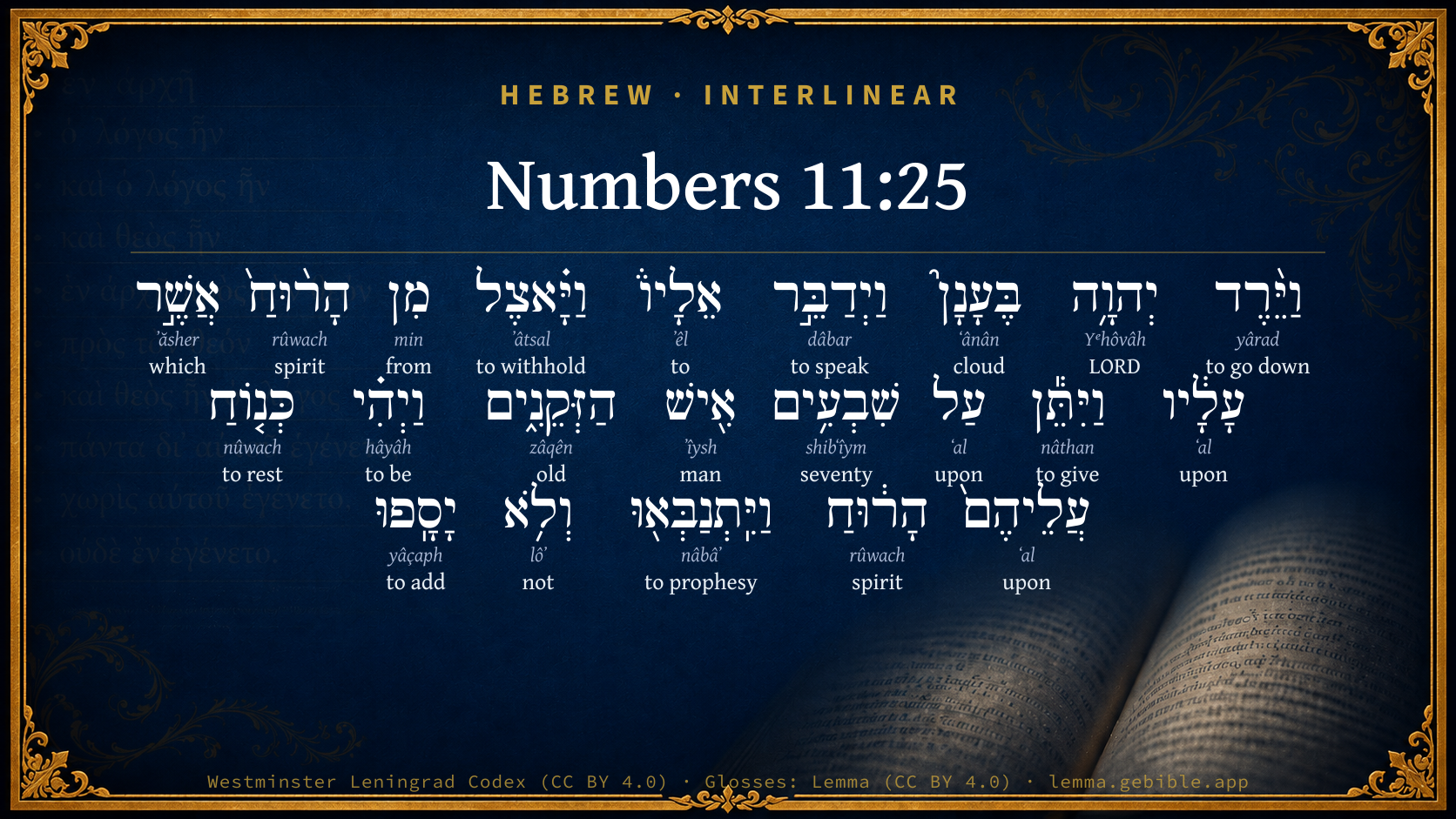
Hebrew (Westminster Leningrad Codex) Numbers 11:25 appears in the Hebrew Old Testament. The text above is from the Westminster Leningrad Codex. Each word links to its Strong’s number, a concise gloss, and parsing drawn from the Open Scriptures Hebrew Bible morphology. Click any word for its full Brown-Driver-Briggs (BDB) entry.
Download image
Cite this verse

Numbers 11:25 (World English Bible). Public Domain. Lemma interlinear Bible study tool, https://lemma.gebible.app/v/numbers/11/25.

Show BibTeX & RIS
BibTeX
RIS
English Translation
Yahweh came down in the cloud, and spoke to him, and took of the Spirit that was on him, and put it on the seventy elders: and it happened that when the Spirit rested on them, they prophesied, but they did so no more.
World English Bible · Public Domain
Highlights
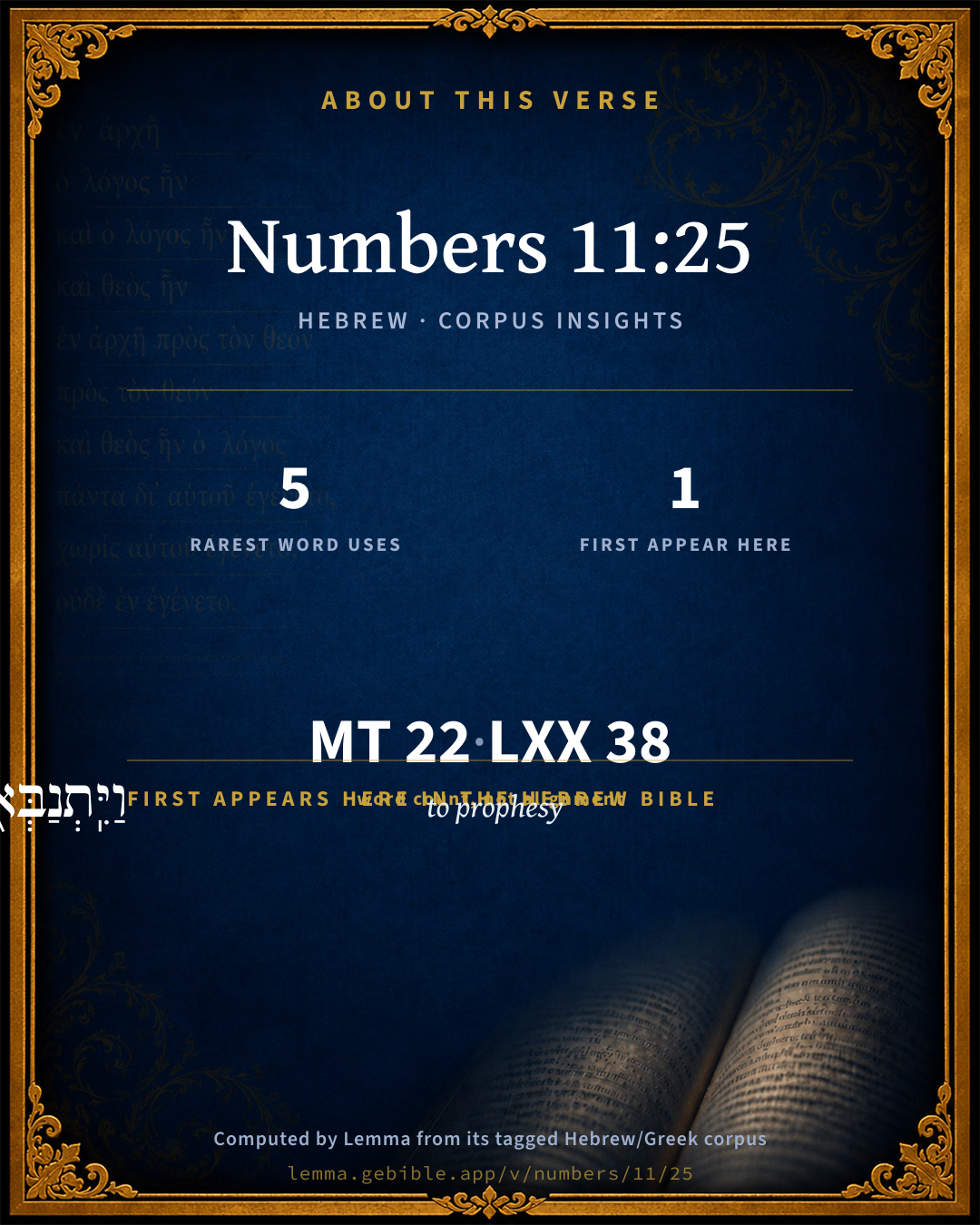
  • 1 first appearance in the Hebrew Bible
Full analysis ↓
Download a study sheet

One document with this verse’s original text, its word-by-word gloss line, the meaning frame, cross-references with their text, attributed commentary, and full source and license credits — printable, and it pastes into notes with its structure intact.

This verse Autodidact and up

Study sheet (.html) Plain text (.txt)

A passage Seminary Student

Up to 50 verses in one chapter. A passage sheet keeps up to 6 commentary sources and 12 cross-references per verse, in the order this page ranks them, and says so on the sheet whenever that leaves anything out. Ask for a single verse and you get the Autodidact verse sheet above.

Everything on this page stays free to read, with no account — the sheet is a download of what is already on screen, not access to it.

Want to remove ads? Support Godless Engineer
Compare translations 3

The same verse in 3 English versions, stacked beneath the original-language interlinear above. Click any original word for its lexicon entry.

Each is an independent rendering of the whole verse — the interlinear is not word-aligned to these translations.

Highlighted words mark where these versions differ — a whole-verse word diff, not a word-by-word alignment.

  • World English Bible Public Domain
    Yahweh came down in the cloud, and spoke to him, and took of the Spirit that was on him, and put it on the seventy elders: and it happened that when the Spirit rested on them, they prophesied, but they did so no more.
  • King James Version Public Domain
    And the LORD came down in a cloud, and spake unto him, and took of the spirit that was upon him, and gave it unto the seventy elders: and it came to pass, that, when the spirit rested upon them, they prophesied, and did not cease.
  • unfoldingWord Literal Text CC BY-SA 4.0
    And Yahweh came down in the cloud, and he spoke to him, and he took away from the Spirit that on him, and he gave on 70 men, the elders. And it happened, as the Spirit rested on them, that they prophesied, and they did not add.

unfoldingWord Literal Text — © unfoldingWord, licensed CC BY-SA 4.0. Word-aligned USFM3 via Door43 (git.door43.org/unfoldingWord/en_ult).

Versions to compare (up to 4)

3 of 4 selected

Show all 18 translations

Every available English version of this verse, each an independent rendering of the whole verse.

  • World English Bible Public Domain
    Yahweh came down in the cloud, and spoke to him, and took of the Spirit that was on him, and put it on the seventy elders: and it happened that when the Spirit rested on them, they prophesied, but they did so no more.
  • Berean Standard Bible Public Domain
    Then the LORD came down in the cloud and spoke to him, and He took some of the Spirit that was on Moses and placed that Spirit on the seventy elders. As the Spirit rested on them, they prophesied—but they never did so again.
  • Majority Standard Bible Public Domain
    Then the LORD came down in the cloud and spoke to him, and He took some of the Spirit that was on Moses and placed that Spirit on the seventy elders. As the Spirit rested on them, they prophesied—but they never did so again.
  • King James Version Public Domain
    And the LORD came down in a cloud, and spake unto him, and took of the spirit that was upon him, and gave it unto the seventy elders: and it came to pass, that, when the spirit rested upon them, they prophesied, and did not cease.
  • American Standard Version (1901) Public Domain
    And Jehovah came down in the cloud, and spake unto him, and took of the Spirit that was upon him, and put it upon the seventy elders: and it came to pass, that, when the Spirit rested upon them, they prophesied, but they did so no more.
  • Revised Version (1885) Public Domain
    And the LORD came down in the cloud, and spake unto him, and took of the spirit that was upon him, and put it upon the seventy elders: and it came to pass, that, when the spirit rested upon them, they prophesied, but they did so no more.
  • Geneva Bible (1599) Public Domain
    Then the Lord came downe in a cloude, and spake vnto him, and tooke of the Spirit that was vpon him, and put it vpon the seuentie Ancient men: and when the Spirit rested vpon them, then they prophecied, and did not cease.
  • Douay-Rheims (1899) Public Domain
    And the Lord came down in a cloud, and spoke to him, taking away of the spirit that was in Moses, and giving to the seventy men. And when the spirit had rested on them they prophesied, nor did they cease afterwards.
  • Young's Literal Translation Public Domain
    and Jehovah cometh down in the cloud, and speaketh unto him, and keepeth back of the Spirit which `is' on him, and putteth on the seventy men of the elders; and it cometh to pass at the resting of the Spirit on them, that they prophesy, and do not cease.
  • Literal Standard Version CC BY-SA 4.0
    and YHWH comes down in the cloud, and speaks to him, and keeps back of the Spirit which [is] on him, and puts [that One] on the seventy elderly men; and it comes to pass at the resting of the Spirit on them, that they prophesy, and they have never done [so] again.
  • Unlocked Literal Bible CC BY-SA 4.0
    Yahweh came down in the cloud and spoke to Moses. Yahweh took some of the Spirit that was on Moses and put it on the seventy elders. When the Spirit rested on them, they prophesied, but only on that occasion and not again.
  • unfoldingWord Literal Text CC BY-SA 4.0
    And Yahweh came down in the cloud, and he spoke to him, and he took away from the Spirit that on him, and he gave on 70 men, the elders. And it happened, as the Spirit rested on them, that they prophesied, and they did not add.
  • Darby Bible Public Domain
    And Jehovah came down in a cloud, and spoke to him, and took of the Spirit that was upon him, and put it upon the seventy men, the elders; and it came to pass, that when the Spirit rested on them, they prophesied, but they did not repeat [it].
  • World Messianic Bible Public Domain
    The LORD came down in the cloud, and spoke to him, and took of the Spirit that was on him, and put it on the seventy elders. When the Spirit rested on them, they prophesied, but they did so no more.
  • Webster's Bible Public Domain
    And the LORD came down in a cloud, and spoke to him, and took of the spirit that was upon him, and gave it to the seventy elders: and it came to pass, that when the spirit rested upon them; they prophesied, and did not cease.
  • Free Bible Version CC BY-SA 4.0
    Then the Lord came down and talked to him. The Lord took some of the Spirit Moses had and gave it to them. They prophesied, but this didn't ever happen again.
  • Bible in Basic English Public Domain
    Then the Lord came down in the cloud and had talk with him, and put on the seventy men some of the spirit which was on him: now when the spirit came to rest on them, they were like prophets, but only at that time.
  • JPS Tanakh (1917) Public Domain
    And the LORD came down in the cloud, and spoke unto him, and took of the spirit that was upon him, and put it upon the seventy elders; and it came to pass, that, when the spirit rested upon them, they prophesied, but they did so no more.

Literal Standard Version (2020), Covenant Press — licensed CC BY-SA 4.0. Text via the HelloAO Bible API (eBible.org). Unlocked Literal Bible (unfoldingWord) — licensed CC BY-SA 4.0. Text via the HelloAO Bible API (eBible.org). unfoldingWord Literal Text — © unfoldingWord, licensed CC BY-SA 4.0. Word-aligned USFM3 via Door43 (git.door43.org/unfoldingWord/en_ult). Free Bible Version, Dr. Jonathan Gallagher — licensed CC BY-SA 4.0. Text via the HelloAO Bible API (eBible.org).

Word by word

More ways to search: Search by grammar → Find every occurrence → Compare this word →

Practice this passage: Drill this verse → Learn its vocabulary →

וַיָּ֗אצֶל
ʼâtsal
H680
“and · to withhold”
Conjunction + Verb, Qal, Sequential Imperfect, 3rd Person, Masculine, Singular
Part of Speech
Conjunction + Verb
Stem
Qal
Form
Sequential Imperfect
Person
3rd Person
Gender
Masculine
Number
Singular
Full BDB Definition

Origin: a primitive root

TWOT: 153

to lay aside, reserve, withdraw, withhold - (Qal) to reserve, set apart, withhold - (Niphal) to be withdrawn - (Hiphil) to withdraw
  1. וַיֵּ֨רֶד yârad H3381 “and · to go down” Conjunction + Verb, Qal, Sequential Imperfect, 3rd Person, Masculine, Singular
  2. יְהוָ֥ה Yᵉhôvâh H3068 “LORD” Noun, Proper
  3. בֶּעָנָן֮ ʻânân H6051 “in/at the · cloud” Preposition, Determined + Noun, Common, Masculine, Singular, Absolute
  4. וַיְדַבֵּ֣ר dâbar H1696 “and · to speak” Conjunction + Verb, Piel, Sequential Imperfect, 3rd Person, Masculine, Singular
  5. אֵלָיו֒ ʼêl H413 “to · him” Preposition + Suffix, Personal, 3rd Person, Masculine, Singular
  6. מִן min H4480 “from” Preposition
  7. הָר֨וּחַ֙ rûwach H7307 “the · spirit” Particle, Definite Article + Noun, Common, Both, Singular, Absolute
  8. אֲשֶׁ֣ר ʼăsher H834 “which” Particle, Relative
  9. עָלָ֔יו ʻal H5921 “upon · him” Preposition + Suffix, Personal, 3rd Person, Masculine, Singular
  10. וַיִּתֵּ֕ן nâthan H5414 “and · to give” Conjunction + Verb, Qal, Sequential Imperfect, 3rd Person, Masculine, Singular
  11. עַל ʻal H5921 “upon” Preposition
  12. שִׁבְעִ֥ים shibʻîym H7657 “seventy” Adjective, Cardinal number, Both, Plural, Absolute
  13. אִ֖ישׁ ʼîysh H376 “man” Noun, Common, Masculine, Singular, Absolute
  14. הַזְּקֵנִ֑ים zâqên H2205 “the · old” Particle, Definite Article + Adjective, Adjective, Masculine, Plural, Absolute
  15. וַיְהִ֗י hâyâh H1961 “and · to be” Conjunction + Verb, Qal, Sequential Imperfect, 3rd Person, Masculine, Singular
  16. כְּנ֤וֹחַ nûwach H5117 “like/as · to rest” Preposition + Verb, Qal, Infinitive Construct
  17. עֲלֵיהֶם֙ ʻal H5921 “upon · them” Preposition + Suffix, Personal, 3rd Person, Masculine, Plural
  18. הָר֔וּחַ rûwach H7307 “the · spirit” Particle, Definite Article + Noun, Common, Both, Singular, Absolute
  19. וַיִּֽתְנַבְּא֖וּ nâbâʼ H5012 “and · to prophesy” Conjunction + Verb, Hithpael, Sequential Imperfect, 3rd Person, Masculine, Plural
  20. וְלֹ֥א lôʼ H3808 “and · not” Conjunction + Particle, Negative
  21. יָסָֽפוּ yâçaph H3254 “to add” Verb, Qal, Perfect, 3rd Person, Common, Plural

About this verse

These counts appear in no published source. They are computed here, from the morphology-tagged text and Lemma’s own curated glosses. What Lemma adds →

22
words
19
distinct lemmas
Pentateuch
section

Notable vocabulary

The rarest word here is וַיָּ֗אצֶל to withhold H680 — appearing just 5 times in the whole Hebrew Bible.

First appearance in Scripture

This word makes its first canonical appearance in the Hebrew Bible here:

  • וַיִּֽתְנַבְּא֖וּ to prophesy H5012

Shared distinctive vocabulary

וַיָּ֗אצֶל to withhold H680 occurs in 5 verses of the Hebrew Bible. Also found in:

Grammatical profile

  • 8 verbs
  • 5 nouns
  • 2 adjectives
  • 5 prepositions
  • 2 particles

Verb forms

  • וַיֵּ֨רֶד Qal · Sequential Imperfect
  • וַיְדַבֵּ֣ר Piel · Sequential Imperfect
  • וַיָּ֗אצֶל Qal · Sequential Imperfect
  • וַיִּתֵּ֕ן Qal · Sequential Imperfect
  • וַיְהִ֗י Qal · Sequential Imperfect
  • כְּנ֤וֹחַ Qal · Infinitive Construct
  • וַיִּֽתְנַבְּא֖וּ Hithpael · Sequential Imperfect
  • יָסָֽפוּ Qal · Perfect

Repetition

Words recur within this verse — often emphatic in Hebrew:

  • עָלָ֔יו upon H5921 ×3
  • הָר֨וּחַ֙ spirit H7307 ×2

Hebrew & Septuagint length

In English translation the verse runs 44 words from the Hebrew and 42 from the Septuagint (LXX English) — closely comparable.

A rough comparison of the two English renderings, which tokenize alike — not a word-level alignment.

Word counts can differ between the Hebrew and the Greek without any difference in meaning — e.g. the Hebrew direct-object marker אֵת has no separate Greek word, and Greek often adds the article ὁ.

In the original languages it is 22 Hebrew tokens and 38 Greek tokens — but the two are counted differently (Hebrew bundles its prefixes and suffixes into one token; the Greek is in lemma form), so that isn’t a like-for-like length.

Cross-references

20

Topical passages linked to Numbers 11:25 in the Treasury of Scripture Knowledge — connected by theme and wording, ordered by reader-vote popularity; previews shown in the World English Bible.

  • Numbers 11:17 I will come down and talk with you there: and I will take of the Spirit which is on you, and will put it on them; and they shall bear the burden of the people with you, that you not bear it yourself alone.
  • Joel 2:28–29 "It will happen afterward, that I will pour out my Spirit on all flesh; And your sons and your daughters will prophesy. Your old men will dream dreams. Your young men will see visions.
  • Numbers 12:5 Yahweh came down in a pillar of cloud, and stood at the door of the Tent, and called Aaron and Miriam; and they both came forth.
  • 1 Samuel 10:10 When they came there to the hill, behold, a band of prophets met him; and the Spirit of God came mightily on him, and he prophesied among them.
  • 1 Corinthians 14:1–3 Follow after love, and earnestly desire spiritual gifts, but especially that you may prophesy.
  • 2 Peter 1:21 For no prophecy ever came by the will of man: but holy men of God spoke, being moved by the Holy Spirit.
  • 1 Samuel 10:5–6 After that you shall come to the hill of God, where is the garrison of the Philistines: and it shall happen, when you are come there to the city, that you shall meet a band of prophets coming down from the high place with a psaltery, and a tambourine, and a pipe, and a harp, before them; and they will be prophesying:
  • 1 Samuel 19:20–24 Saul sent messengers to take David: and when they saw the company of the prophets prophesying, and Samuel standing as head over them, the Spirit of God came on the messengers of Saul, and they also prophesied.
  • 2 Kings 2:15 When the sons of the prophets who were at Jericho over against him saw him, they said, The spirit of Elijah does rest on Elisha. They came to meet him, and bowed themselves to the ground before him.
  • Acts 2:17–18 'It will be in the last days, says God, That I will pour out my Spirit on all flesh. Your sons and your daughters will prophesy. Your young men will see visions. Your old men will dream dreams.
  • Exodus 34:5 Yahweh descended in the cloud, and stood with him there, and proclaimed the name of Yahweh.
  • Exodus 40:38 For the cloud of Yahweh was on the tent by day, and there was fire in the cloud by night, in the sight of all the house of Israel, throughout all their journeys.
  • Psalms 99:7 He spoke to them in the pillar of cloud. They kept his testimonies, The statute that he gave them.
  • Jeremiah 36:5–6 Jeremiah commanded Baruch, saying, I am shut up; I can't go into the house of Yahweh:
  • Luke 9:34–35 While he said these things, a cloud came and overshadowed them, and they were afraid as they entered into the cloud.
  • Acts 11:28 One of them named Agabus stood up, and indicated by the Spirit that there should be a great famine all over the world, which also happened in the days of Claudius.
  • Acts 21:9–11 Now this man had four virgin daughters who prophesied.
  • 1 Corinthians 11:4–5 Every man praying or prophesying, having his head covered, dishonors his head.
  • 1 Corinthians 14:32 The spirits of the prophets are subject to the prophets,
  • James 1:17 Every good gift and every perfect gift is from above, coming down from the Father of lights, with whom can be no variation, nor turning shadow.

Cross-references courtesy of OpenBible.info (CC BY 4.0).

Hebrew and Greek witnesses Masoretic Hebrew ↔ Greek Septuagint

The same verse in the two great witnesses to the Old Testament, shown verse-for-verse.

These are two independent witnesses, not word-aligned to each other, and the Septuagint is shown in lemma (dictionary) form.

Hebrew Numbers 11:25 Masoretic · Westminster Leningrad Codex

וַיֵּ֨רֶד יְהוָ֥ה בֶּעָנָן֮ וַיְדַבֵּ֣ר אֵלָיו֒ וַיָּ֗אצֶל מִן הָר֨וּחַ֙ אֲשֶׁ֣ר עָלָ֔יו וַיִּתֵּ֕ן עַל שִׁבְעִ֥ים אִ֖ישׁ הַזְּקֵנִ֑ים וַיְהִ֗י כְּנ֤וֹחַ עֲלֵיהֶם֙ הָר֔וּחַ וַיִּֽתְנַבְּא֖וּ וְלֹ֥א יָסָֽפוּ

Yahweh came down in the cloud, and spoke to him, and took of the Spirit that was on him, and put it on the seventy elders: and it happened that when the Spirit rested on them, they prophesied, but they did so no more.

World English Bible · Public Domain

Greek LXX Numbers 11:25 Septuagint · lemma form

καί καταβαίνω κύριος ἐν νεφέλη καί λαλέω πρός αὐτός καί παρααἱρέω ἀπό ὁ πνεῦμα ὁ ἐπί αὐτός καί ἐπιτίθημι ἐπί ὁ ἑβδομήκοντα ἀνήρ ὁ πρεσβύτερος ὡς δέ ἐπι ἀναπαύω ὁ πνεῦμα ἐπί αὐτός καί προφητεύω καί οὐκέτι προςτίθημι

And the Lord came down in a cloud, and spoke to him, and took of the spirit that was upon him, and put it upon the seventy men that were elders; and when the spirit rested upon them, they prophesied and ceased.

LXX2012 (modern English Septuagint) · Public Domain

On this verse, Ellicott's Commentary for English Readers discusses the Septuagint’s reading. Read the note in Commentary ↓

Hebrew: Westminster Leningrad Codex (CC BY 4.0). Greek: Septuagint (public domain); English from LXX2012 (modern English Septuagint) (Public Domain). How the Septuagint differs from the Hebrew →

Targum (Aramaic paraphrase)

2

The Targum is the ancient Jewish Aramaic paraphrase of the Hebrew Scriptures — an interpretive translation, not the Hebrew text itself. Onkelos (literal) and Pseudo-Jonathan (expansive) render the Torah, and Jonathan the Prophets. Coverage is partial: where no permissively-licensed English translation exists for a verse, only the Aramaic is shown. This is verse-level text, not a word-by-word alignment to the Hebrew.

  1. Targum Onkelos Torah (Genesis–Deuteronomy)
    וְאִתְגְלִי יְיָ בַּעֲנָנָא וּמַלִיל עִמֵהּ וְרַבֵּי מִן רוּחָא דִי עֲלוֹהִי וִיהַב עַל שַׁבְעִין גַבְרָא סָבַיָא וַהֲוָה כַּד שְׁרַת עֲלֵיהוֹן רוּחַ נְבוּאָה וּמִתְנַבְּאִין וְלָא פָסְקִין

    (no public-domain English translation for this verse)

    Targum Onkelos — Aramaic: “Onkelos Genesis” (public domain); “Onkelos Exodus” (public domain); “Onkelos Leviticus” (public domain); “Onkelos Numbers” (public domain); “Onkelos Deuteronomy” (public domain). English: “Sefaria Community Translation” (CC0 1.0 (public-domain dedication)); “J.W. Etheridge. The Targums of Onkelos and Jonathan Ben Uzziel on the Pentateuch. London: Longmans, Green, 1862” (public domain). Text via Sefaria.

  2. Targum Pseudo-Jonathan Torah (Genesis–Deuteronomy)
    וְאִתְגְלֵי יְיָ בַּעֲנַן אִיקַר שְׁכִינְתָּא וּמַלֵיל עִמֵיהּ וְרַבֵּי מִן נְבוּאָה דַעֲלוֹי וּמשֶׁה לָא חָסַר מִדַעַם וִיהַב עַל שׁוּבְעִין גוּבְרִין סָבַיָא וַהֲוָה כַּד שְׁרַת עֲלֵיהוֹן רוּחַ נְבוּאָה וּמִתְנַבָּן וְלָא פָּסְקִין

    And the Lord was revealed in the glorious Cloud of the Shekinah, and spake with him. And He made enlargement of the (Spirit of) prophecy that was upon him, so that Mosheh lost nothing thereof, but He gave unto the seventy men, the elders: and it was that when the Spirit of prophecy rested upon them, they prophesied, and ceased not.

    Targum Pseudo-Jonathan — Aramaic: “Targum Jonathan on Genesis” (public domain); “Targum Jonathan on Exodus” (public domain); “Targum Jonathan on Leviticus” (public domain); “Targum Jonathan on Numbers” (public domain); “Targum Jonathan on Deuteronomy” (public domain). English: “The Targum of Jonathan ben Uzziel, trans. J. W. Etheridge, London, 1862” (public domain). Text via Sefaria.

Commentary

Notes on Numbers 11:25 from classic Christian and Jewish commentators (each source and its license shown beneath its notes). The classic Christian expositions comment on the surrounding passage and are grouped to its opening verse, so a note may address several verses; the Jewish commentaries on the Tanakh (Rashi and others) are per-verse, so they appear only where the commentator wrote on this verse.

Lemma curates 59 commentaries, every one of them public domain or Creative Commons licensed, each selected and text-cleaned for this edition rather than reprinted as found. About our sources →

Trapp's Complete Commentary

John Trapp

Num 11:25 And the LORD came down in a cloud, and spake unto him, and took of the spirit that [was] upon him, and gave [it] unto the seventy elders: and it came to pass, [that], when the spirit rested upon them, they prophesied, and did not cease.

Ver. 25. Took of the spirit.] {See Trapp on "Num 11:17"}

They prophesied.] Nec praedicendo, nec praedicando; but by uttering grave and wise sentences, apothegms, or counsels, as Moses did, concerning the public affairs of Israel; by political and prudential speaking of things appertaining to government.

John Trapp, A Commentary or Exposition upon All the Books of the Old and New Testament (1647–1656) — public domain. Text from a community e-Sword module.

Joseph Benson's Commentary

Num 11:25. Rested on them — Not only moved them for a time, but took up his settled abode with them, because the use and end of this gift were perpetual. They prophesied — Discoursed of the word and works of God in a marvellous manner, as the prophets did. So this word is used, 1Sa 10:5-6; Joe 2:28; 1Co 14:3. Yet were they not hereby constituted teachers, but civil magistrates, who, together with the spirit of government, received also the spirit of prophecy, as a sign and seal, both to themselves and to the people, that God had called them to that employment. They did not cease — Either for that day, continuing in that exercise all that day, and, it may be, all the night too, as it is said of Saul, 1Sa 19:24; or, afterward also. For this was a continued gift, conferred upon them to enable them the better to discharge their magistracy; which was more expedient for them than for the rulers of other people, because the Jews were under a theocracy, or the government of God, and even their civil controversies were decided out of that word of God which the prophets expounded.

Joseph Benson's Commentary on the Old and New Testaments (1811–1818) — public domain. Text from a community e-Sword module.

Tyndale Open Study Notes

Tyndale Open Resources

11:25 We are not told what happened when the Spirit rested upon them and they prophesied. Whatever happened (possibly ecstatic utterances; cp. Acts 2:4; 1 Cor 14:2), it was a unique occurrence.

Tyndale Open Study Notes — © Tyndale Open Resources, licensed CC BY-SA 4.0. Text via the HelloAO Bible API.

Geneva Bible (1599)

Geneva Bible translators

Or, separated, verse 17.

From that day the spirit of prophecy did not fail them.

Geneva Bible (1599) marginal notes — public domain. Text via Bolls.life.

Jamieson, Fausset & Brown

Robert Jamieson, A. R. Fausset & David Brown

when the spirit rested upon them, they prophesied, and did not cease--As those elders were constituted civil governors, their "prophesying" must be understood as meaning the performance of their civil and sacred duties by the help of those extraordinary endowments they had received; and by their not "ceasing" we understand, either that they continued to exercise their gifts uninterruptedly the first day (see Sa1 19:24), or that these were permanent gifts, which qualified them in an eminent degree for discharging the duty of public magistrates.

Jamieson, Fausset & Brown — Commentary Critical and Explanatory on the Whole Bible (1871) — public domain (CC PDM 1.0). Text via the HelloAO Bible API.

Adam Clarke's Commentary

Verse 25. When the spirit rested upon them, they prophesied] By prophesying here we are to understand their performing those civil and sacred functions for which they were qualified; exhorting the people to quiet and peaceable submission, to trust and confidence in the goodness and providence of God, would make no small part of the duties of their new office. The ideal meaning of the word נבא naba is to pray, entreat, c. The prophet is called נביא nabi, because he prays, supplicates, in reference to God exhorts, entreats, in reference to man. See Clarke on Ge 20:7.

Adam Clarke's Commentary on the Bible (1810–1826) — public domain. Text from a community e-Sword/MySword module.

Ellicott's Commentary for English Readers

(25) In a cloud.—Hebrew, In the cloud.

And gave it unto . . . —Better, and put it upon, as in Lev_2:15.

They prophesied, and did not cease.—Better, they prophesied, but did so no more. Comp. Gen_8:12; Exo_11:6; 2Sa_2:28; so the LXX. The word prophesy does not necessarily denote the prediction of future events. It is elsewhere employed to denote the celebration of the praises of God, either with the voice or with instruments of music. (Comp. 1Sa_10:6; 1Ki_18:29; 1Ch_25:1-3; Jer_29:26.)

A Bible Commentary for English Readers, edited by Charles John Ellicott (1878–1897) — public domain. Text from a community e-Sword module.

The Cambridge Bible for Schools and Colleges

gen. ed. J. J. S. Perowne

25. in the cloud] See on Num_9:15-23.

they prophesied] They were flung into an ecstatic condition of frenzy. Other instances are recorded in the case of Saul (1Sa_10:10-12; 1Sa_18:10; 1Sa_19:23 f.) and his messengers with the prophets at Naioth (id. Num_19:20 f.). Probably also in the case of Elisha (2Ki_3:15). At an early stage of thought in Israel such sudden and mysterious attacks were reverently ascribed to divine action; but in process of time they were considered rather as madness, Hos_9:7, 2Ki_9:11, Jer_29:26. The true prophet was realised to be one who, by a deep spiritual insight and conversance with God, was able to declare the divine will with regard to matters both present and future.

but they did so no more] The effect was purely temporary. It was not an imparting of wisdom and influence for the purpose of permanently helping Moses.

The Cambridge Bible for Schools and Colleges (gen. ed. J. J. S. Perowne; Cambridge University Press, 1878–1918) — public domain. Text from a community e-Sword module.

John Gill's Exposition

And the Lord came down in a cloud,.... In a cloud of glory, or a glorious one, as the Targums; either in the same that went before the people in the wilderness, or in one distinct from it, and only used on this occasion, as a visible token of the presence of God:

and spake unto him; to Moses, talked with him, as he said he would, Num 11:17,

and took of the Spirit which was upon him, and gave it unto the seventy elders; See Gill on Num 11:17,

and it came to pass that when the Spirit rested upon them they prophesied; either they sung the praises of God, which is sometimes the sense of prophesying, Ch1 25:1; blessing God for the honour done them, and the gift bestowed on them; or they opened and explained the laws of God, in virtue of the gifts they had received, according to which they were to assist Moses in the government of the people, or they foretold things come: the Jews say they prophesied of the quails, but that is not very likely:

and did not cease; from prophesying; the spirit of prophecy continued with them, which, in some cases, might be necessary: or, they ceased not to prophesy all that day, though they afterwards did: and in the Hebrew text it is, "they added not" (q), that is, to prophesy, and Jarchi says they only prophesied that day, as it is interpreted in an ancient book of theirs, called Siphre: wherefore this spirit of prophecy is thought only to be given them as a temporary thing, for the confirmation of their having received the spirit of government, or gifts qualifying them for that, and to make them respectable among the people, and to show that they were appointed it by divine authority, and that this was not a device of Moses to ease himself.

(q) "et non addiderunt", Pagninus, Montanus, Drusius; "et non am lin", Junius & Tremellius, Piscator.

John Gill's Exposition of the Whole Bible (1746–1763) — public domain (CC PDM 1.0). Text via the HelloAO Bible API.

Haydock's Catholic Bible Commentary

Afterwards. Some give a contrary meaning to the Hebrew, with the Septuagint, Syriac, &c.: "They prophesied, (on that occasion) but they did not continue" to do so; except when they were favoured with the influence of the spirit. When it was requisite, they were enabled to declare God’s will and his praise to the people. (Calmet) --- Saul is said to have prophesied when he praised God, 1 Kings x. 5, 10. (Menochius)

George Leo Haydock (1774–1849), Haydock's Catholic Family Bible and Commentary, 1859 edition — public domain. Excludes Psalms (Douay-Rheims chapter numbering differs from Protestant) and Deuterocanonical books (Catholic canon only).

Matthew Poole's English Annotations

Rested upon them, i.e. not only moved them for a time, but took up his settled abode with them, because the use and end of this gift was not temporary, but perpetual; they prophesied, i.e. discoursed of the word and works of God in a singular and marvellous manner, as the prophets did. So this word is used 1Sa 10:5,6; Joe 2:28; Act 2:17 1Co 14:3. Yet were they not hereby constituted prophets or teachers, but civil magistrates and rulers, who together with the Spirit of government, which is here sufficiently implied, received also the Spirit of prophecy, as a sign and seal, both to themselves and to the people, that God had called them to that employment, and would be with them in it, as it was with Saul upon the same occasion, 1Sa 10:10.

Did not cease, either for that day; they continued in that exercise all that day, and, it may be, all the night too, as it is said of Saul, 1Sa 19:24; or afterwards also, to note that this was a continued gift conferred upon them, to enable them the better to discharge their magistracy; which was more expedient for them than for the rulers of other people, because the Jews were under a theocracy, or the government of God, and even their civil controversies were decided out of that word of God which the prophets expounded; and in their wilderness condition they had frequent occasions of seeking counsel from God, which was the work of prophets, and they were to determine all things agreeably to the mind and will of God, which therefore they were obliged to study. Others translate the words, and they added not; so the sense is, They prophesied only this day for an assurance of vocation to and due qualification for their work, but afterwards they prophesied no more; the gift of prophecy ceased in them, and only the Spirit of government rested upon them.

Matthew Poole's English Annotations on the Holy Bible (1683–1685) — public domain. Text from a community e-Sword/MySword module.

Whedon's Commentary on the Bible

Daniel D. Whedon

25. In a cloud — Literally, in the cloud. This visible symbol of Jehovah’s presence, which stood above the tabernacle, descended and encompassed it and the seventy elders, and thus was the vehicle of the Spirit to them as the breath of Jesus was to the disciples. Joh_20:22.

And spake unto him — The communication is not recorded, perhaps because it was private.

They prophesied — The word נבא, to bubble up, occurs here the first time in the Bible. Its most common use is of inspired human discourse. It is chiefly in the passive voice, implying that the prophet is not so much the speaker as the one through whom the divine afflatus, which possesses his faculties, speaks. Thus in the Greek we have the passive form of the verb μαντευεσθαι, to divine, like μαινεσθαι, to be mad, and in the Latin vaticinari, to foretell. Hence prophecy has been regarded by all these peoples as beyond the range of the human mind, and as the work of God subsidizing human organs. This extraordinary utterance may not be limited to the prediction of future events: it may be employed in rebuke, testimony, instruction, exhortation, or comforting, 1Co_14:3. The Holy Spirit always loosens the tongue. It is fitting that the gift of speech, the crowning faculty of man as distinguished from the brutes, should be monopolized by its Giver when he takes exclusive possession of the body and soul as his temple. See 1Sa_10:6; 1Sa_19:20-23, notes; Act_2:18; Act_19:6. Under the Christian dispensation one in possession of the fulness of the Spirit naturally expresses himself in elevated language, or song. Eph_5:18-19. For the difference between the operations of the Spirit before the day of Pentecost and afterward, see Num_27:18, note.

And did not cease — The Septuagint literally and correctly translates this by και ουκ ετι προσεθεντο, and they did not add, (to prophecy.) They prophesied one day and ceased. Thus the R.V. This was sufficient to impress the people with their divine vocation to an office in which administration and not prophecy was the great function. The Targums, the Vulgate, and the Chaldee all read, they ceased not. This is explained by stone as a perpetual prophetic endowment, and by Patrick and others as covering only the time in which the elders surrounded the tabernacle.

Daniel D. Whedon (gen. ed.), Commentary on the Old and New Testaments (1874–1909) — public domain. Text from a community e-Sword module.

The Pulpit Commentary

The Lord came down in a cloud, i.e., in the cloud which was the symbol of his perpetual presence with. them. At other times this cloud dwelt (kv) above the tabernacle, soaring steadily above it in the clear air; but on certain occasions, for greater impressiveness, the cloud came down and filled the tabernacle, or at any rate the entrance of it, while Moses stood without. (cf. Num_12:5 and Exo_33:9 Exo_40:35) Took of the spirit which was upon him. Not certainly in anger, or by way of diminishing the fullness of the spirit which was in Moses, but in order that the seventy might participate, and be known to participate, in a gift originally and specially given to Moses. The whole intention of the ceremonial was to declare in the most unmistakable way that the gifts of the seventy were to be exercised only in union with and in subordination to the mediator of Israel. The Targums are substantially correct in their paraphrase: "The Lord made enlargement of the spirit that was upon him, and imparted to the seventy men, the eiders." Theodoret very happily observes on this passage, "Just as a man who kindles a thousand flames from one does not lessen the first in communicating light to the others, so God did not diminish the grace imparted to Moses by the fact that he communicated of it to the seventy." They prophesied. The phenomenon here mentioned for the first time was no doubt an ecstatic utterance, not exactly beyond the control, but certainly beyond the origination, of those who prophesied. It must not be confounded with that state of calm, spiritual exaltation in which such men as Isaac and Jacob spake concerning things to come. (Heb_11:20; cf. Gen_27:29 Gen_49:28) The Hebrew WaBntyi means literally "were caused to pour forth," and the fundamental idea is that those affected became for the time being vents for the audible utterance of thoughts and expressions which were not theirs, but the Holy Ghost"s. Compare the thought in Job_32:18-20, and the case of Saul and his messengers, as above. As to the matter of these prophesyings, we may probably conclude that they were of the same nature as the ecstatic utterances of the tongues on the day of Pentecost and afterwards; not "prophecy" in the ordinary sense, but inspired glorification of God, and declaration of his wonderful works. (Act_2:4, Act_2:11) And did not cease. Rather, "did not add," or "repeat." Wpsy alow. Septuagint, kai ouk eti proseyento . The ecstatic utterance did not continue or reappear. The New Testament history no doubt supplies us with the explanation of this. The supernatural sign thus accorded was of little use in itself, and was of much danger, because it attracted to its exhibition an attention which was rather due to more inward and spiritual things. As a sign it was sufficient that it should be once unmistakably manifested before all the people. (cf. 1Co_14:22 1Co_13:8) The permanent charisma of the Holy Spirit which the seventy received and retained from this time forth was no doubt the antilhqiv or kubernhsiv of 1Co_12:28; the gift of "help" or "governance," not in temporal matters, but in the religious education and direction of the people.

The Pulpit Commentary (1880–1919), ed. H.D.M. Spence-Jones & Joseph S. Exell — public domain. Text from a community e-Sword module.

John Wesley's Explanatory Notes

Rested on them - Not only moved them for a time, but took up his settled abode with them, because the use and end of this gift was perpetual. They prophesied - Discoursed of the word and works of God in a marvelous manner, as the prophets did. So this word is used, 1 Sam. x, 5, 6 Joel ii, 28; 1 Cor. xiv, 3. Yet were they not hereby constituted teachers, but civil magistrates, who together with the spirit of government, received also the spirit of prophesy, as a sign and seal both to themselves and to the people, that God had called them to that employment. They did not cease - Either for that day, they continued in that exercise all that day, and, it may be, all the night too, as it is said of Saul, 1 Sam. xix, 24, or, afterwards also, to note that this was a continued gift conferred upon them to enable them the better to discharge their magistracy; which was more expedient for them than for the rulers of other people, because the Jews were under a theocracy or the government of God, and even their civil controversies were decided out of that word of God which the prophets expounded.

John Wesley, Explanatory Notes Upon the Whole Bible (1754–1765) — public domain. Text via the GEBible commentary corpus.

Scofield Reference Notes

C. I. Scofield

spirit that was upon him

There was no more power than before--only more machinery. Moses had murmured (Num 5:11) because of the burden that God had laid upon him. God, in distributing the burden, shows that Moses’ power had, all along, been in proportion to his burden.

The Scofield Reference Bible (1917 edition), notes by C. I. Scofield — public domain. Text from a community e-Sword module.

Rashi

Rabbi Shlomo Yitzchaki (Rashi)

ולא יספו [AND THEY PROPHESIED] BUT DID NOT CONTINUE (to prophesy) — i. e. they prophesied only that day alone. Thus is the phrase explained in Siphre. Onkelos, however, rendered renders it ולא פסקין “and they did not cease”, meaning that the gift of prophecy never again departed from them (cf. Sanhedrin 17a and Rashi on Deuteronomy 5:19).

Rashi on the Tanakh — English translations: “The Judaica Press complete Tanach with Rashi, translated by A. J. Rosenberg” (CC BY 4.0); “Pentateuch with Rashi's commentary by M. Rosenbaum and A.M. Silbermann, 1929-1934” (public domain); “The Metsudah Tanach series, Lakewood, N.J” (CC BY 4.0); and “The Book of Joshua, Metsudah Publications, 1997” (CC BY 4.0). Text via Sefaria.

Lesson kit

Teaching starters — assembled from the data on this page, not authored interpretation. Every prompt links to the verse data it draws on. Edit before teaching.

Numbers, in the Pentateuch, opens this verse with 22 words (19 distinct Hebrew lemmas). Its most distinctive word is ʼâtsal (“to withhold”). A historical commentator’s framing appears above. Read the whole chapter for the surrounding context.

Discussion questions

  1. The word ʼâtsal carries the sense “to withhold.” How does it shape the verse?
  2. This is the first place “to prophesy” appears in Scripture (first appears here). What does its debut here establish?
  3. How does Genesis 27:36, which shares the word «to withhold», read alongside this verse?
  4. What does the repetition of “upon” (3× in this one verse) do in this verse?
  5. These translations render this verse differently. What is at stake in choosing one wording over another?
  6. «וַיֵּ֨רֶד» is a Qal Sequential Imperfect verb. How does that grammatical form shape the action described?
  7. Compare how Trapp's Complete Commentary and Joseph Benson's Commentary read this verse. Where do they agree or differ?

Things to notice

Reading settings

Reading text

Shown beneath each verse's original-language words.

Old Testament
Old Testament edition

Read the OT as the Masoretic Hebrew (MT) or the Greek Septuagint (LXX).

English shown for the Greek Septuagint (in the Hebrew ↔ Greek comparison).

Comparing translations? Open the Compare panel on any verse page to stack up to four side by side.