
2 Samuel 23:2

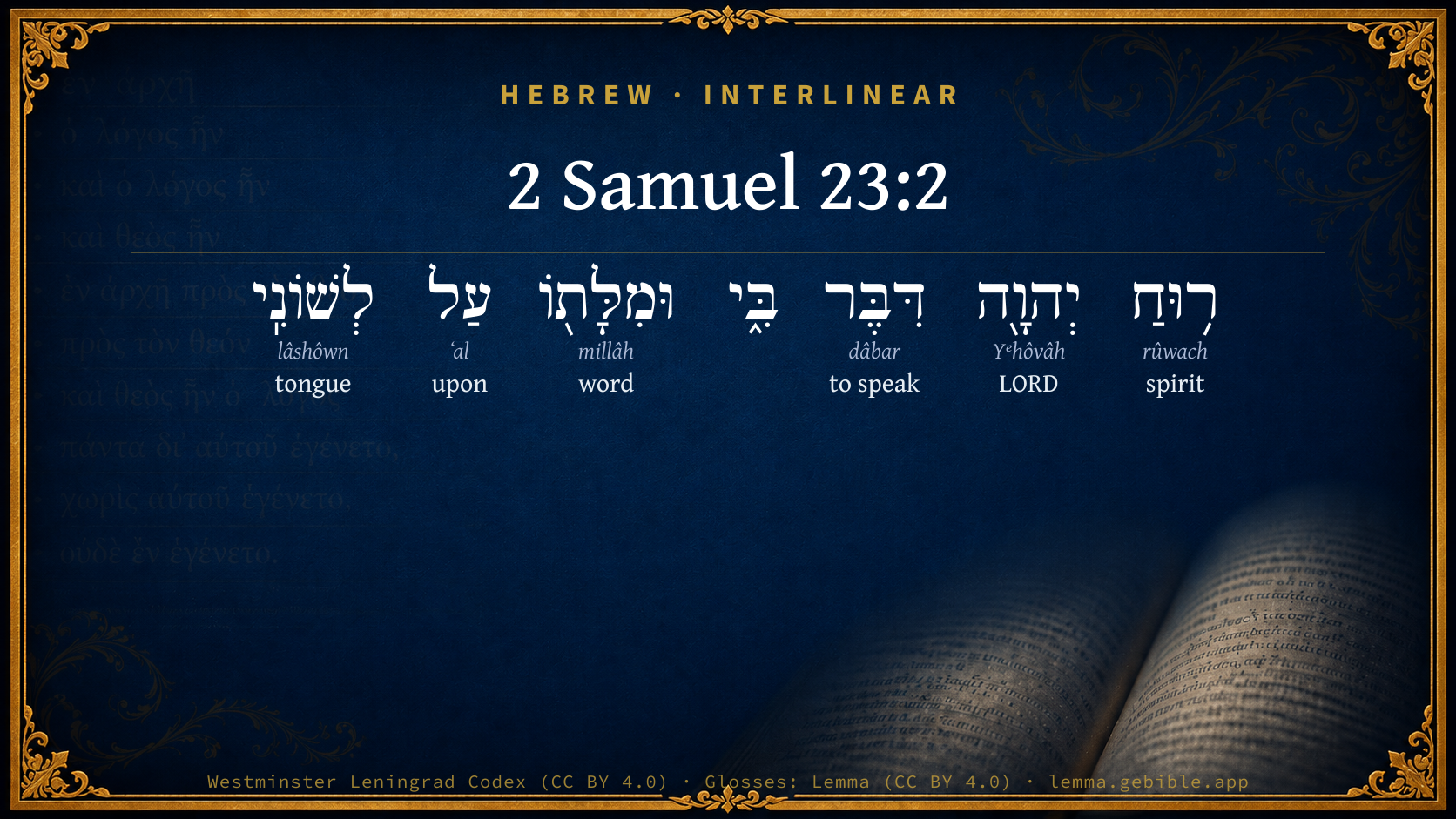
Hebrew (Westminster Leningrad Codex) 2 Samuel 23:2 appears in the Hebrew Old Testament. The text above is from the Westminster Leningrad Codex. Each word links to its Strong’s number, a concise gloss, and parsing drawn from the Open Scriptures Hebrew Bible morphology. Click any word for its full Brown-Driver-Briggs (BDB) entry.
Download image
Cite this verse

2 Samuel 23:2 (World English Bible). Public Domain. Lemma interlinear Bible study tool, https://lemma.gebible.app/v/2-samuel/23/2.

Show BibTeX & RIS
BibTeX
RIS
English Translation
The Spirit of Yahweh spoke by me, His word was on my tongue.
World English Bible · Public Domain
Highlights
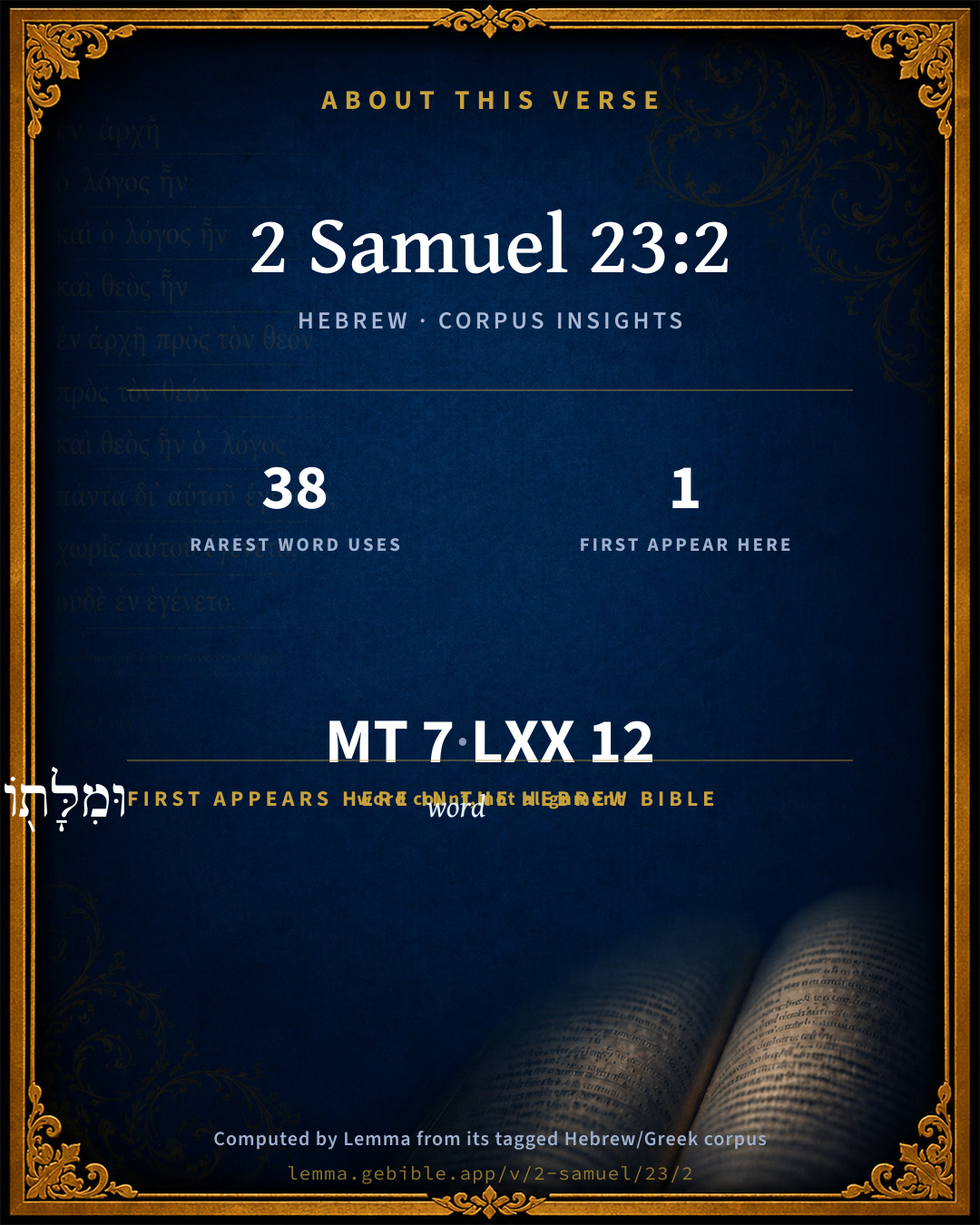
  • 1 first appearance in the Hebrew Bible
Full analysis ↓
Download a study sheet

One document with this verse’s original text, its word-by-word gloss line, the meaning frame, cross-references with their text, attributed commentary, and full source and license credits — printable, and it pastes into notes with its structure intact.

This verse Autodidact and up

Study sheet (.html) Plain text (.txt)

A passage Seminary Student

Up to 50 verses in one chapter. A passage sheet keeps up to 6 commentary sources and 12 cross-references per verse, in the order this page ranks them, and says so on the sheet whenever that leaves anything out. Ask for a single verse and you get the Autodidact verse sheet above.

Everything on this page stays free to read, with no account — the sheet is a download of what is already on screen, not access to it.

Want to remove ads? Support Godless Engineer
Compare translations 3

The same verse in 3 English versions, stacked beneath the original-language interlinear above. Click any original word for its lexicon entry.

Each is an independent rendering of the whole verse — the interlinear is not word-aligned to these translations.

Highlighted words mark where these versions differ — a whole-verse word diff, not a word-by-word alignment.

  • World English Bible Public Domain
    The Spirit of Yahweh spoke by me, His word was on my tongue.
  • King James Version Public Domain
    The Spirit of the LORD spake by me, and his word was in my tongue.
  • unfoldingWord Literal Text CC BY-SA 4.0
    “The Spirit of Yahweh spoke by me, and his word on my tongue.

unfoldingWord Literal Text — © unfoldingWord, licensed CC BY-SA 4.0. Word-aligned USFM3 via Door43 (git.door43.org/unfoldingWord/en_ult).

Versions to compare (up to 4)

3 of 4 selected

Show all 18 translations

Every available English version of this verse, each an independent rendering of the whole verse.

  • World English Bible Public Domain
    The Spirit of Yahweh spoke by me, His word was on my tongue.
  • Berean Standard Bible Public Domain
    The Spirit of the LORD spoke through me; His word was on my tongue.
  • Majority Standard Bible Public Domain
    The Spirit of the LORD spoke through me; His word was on my tongue.
  • King James Version Public Domain
    The Spirit of the LORD spake by me, and his word was in my tongue.
  • American Standard Version (1901) Public Domain
    The Spirit of Jehovah spake by me, And his word was upon my tongue.
  • Revised Version (1885) Public Domain
    The spirit of the LORD spake by me, and his word was upon my tongue.
  • Geneva Bible (1599) Public Domain
    The Spirit of the Lord spake by me, and his worde was in my tongue.
  • Douay-Rheims (1899) Public Domain
    The spirit of the Lord hath spoken by me and his word by my tongue.
  • Young's Literal Translation Public Domain
    The Spirit of Jehovah hath spoken by me, And His word `is' on my tongue.
  • Literal Standard Version CC BY-SA 4.0
    The Spirit of YHWH has spoken by me, || And His word [is] on my tongue.
  • Unlocked Literal Bible CC BY-SA 4.0
    “The Spirit of Yahweh spoke by me, and his word was on my tongue.
  • unfoldingWord Literal Text CC BY-SA 4.0
    “The Spirit of Yahweh spoke by me, and his word on my tongue.
  • Darby Bible Public Domain
    The Spirit of Jehovah spoke by me, And his word was on my tongue.
  • World Messianic Bible Public Domain
    “The LORD’s Spirit spoke by me. His word was on my tongue.
  • Webster's Bible Public Domain
    The Spirit of the LORD spoke by me, and his word was on my tongue.
  • Free Bible Version CC BY-SA 4.0
    “The Spirit of the Lord spoke through me; my tongue gave his message.
  • Bible in Basic English Public Domain
    The spirit of the Lord had voice through me, his word was on my tongue.
  • JPS Tanakh (1917) Public Domain
    The spirit of the LORD spoke by me, and His word was upon my tongue.

Literal Standard Version (2020), Covenant Press — licensed CC BY-SA 4.0. Text via the HelloAO Bible API (eBible.org). Unlocked Literal Bible (unfoldingWord) — licensed CC BY-SA 4.0. Text via the HelloAO Bible API (eBible.org). unfoldingWord Literal Text — © unfoldingWord, licensed CC BY-SA 4.0. Word-aligned USFM3 via Door43 (git.door43.org/unfoldingWord/en_ult). Free Bible Version, Dr. Jonathan Gallagher — licensed CC BY-SA 4.0. Text via the HelloAO Bible API (eBible.org).

Word by word

More ways to search: Search by grammar → Find every occurrence → Compare this word →

Practice this passage: Drill this verse → Learn its vocabulary →

About this verse

These counts appear in no published source. They are computed here, from the morphology-tagged text and Lemma’s own curated glosses. What Lemma adds →

7
words
6
distinct lemmas
Historical
section

First appearance in Scripture

This word makes its first canonical appearance in the Hebrew Bible here:

  • וּמִלָּת֖וֹ word H4405

Shared distinctive vocabulary

וּמִלָּת֖וֹ word H4405 occurs in 38 verses of the Hebrew Bible. Also found in:

Grammatical profile

  • 1 verb
  • 4 nouns
  • 2 prepositions

Verb forms

  • דִּבֶּר Piel · Perfect

Hebrew & Septuagint length

In English translation the verse runs 13 words from the Hebrew and 15 from the Septuagint (LXX English) — closely comparable.

A rough comparison of the two English renderings, which tokenize alike — not a word-level alignment.

Word counts can differ between the Hebrew and the Greek without any difference in meaning — e.g. the Hebrew direct-object marker אֵת has no separate Greek word, and Greek often adds the article ὁ.

In the original languages it is 7 Hebrew tokens and 12 Greek tokens — but the two are counted differently (Hebrew bundles its prefixes and suffixes into one token; the Greek is in lemma form), so that isn’t a like-for-like length.

Cross-references

5

Topical passages linked to 2 Samuel 23:2 in the Treasury of Scripture Knowledge — connected by theme and wording, ordered by reader-vote popularity; previews shown in the World English Bible.

  • 2 Peter 1:21 For no prophecy ever came by the will of man: but holy men of God spoke, being moved by the Holy Spirit.
  • Matthew 22:43 He said to them, "How then does David in the Spirit call him Lord, saying,
  • Mark 12:36 For David himself said in the Holy Spirit, 'The Lord said to my Lord, Sit at my right hand, Until I make your enemies the footstool of your feet.'
  • Acts 2:25–31 For David says concerning him, 'I saw the Lord always before my face, For he is on my right hand, that I should not be moved.
  • Hebrews 3:7–8 Therefore, even as the Holy Spirit says, "Today if you will hear his voice,

Cross-references courtesy of OpenBible.info (CC BY 4.0).

Hebrew and Greek witnesses Masoretic Hebrew ↔ Greek Septuagint

The same verse in the two great witnesses to the Old Testament, shown verse-for-verse.

These are two independent witnesses, not word-aligned to each other, and the Septuagint is shown in lemma (dictionary) form.

Hebrew 2 Samuel 23:2 Masoretic · Westminster Leningrad Codex

ר֥וּחַ יְהוָ֖ה דִּבֶּר בִּ֑י וּמִלָּת֖וֹ עַל לְשׁוֹנִֽי

The Spirit of Yahweh spoke by me, His word was on my tongue.

World English Bible · Public Domain

Greek LXX 2 Samuel 23:2 Septuagint · lemma form

πνεῦμα κύριος λαλέω ἐν ἐγώ καί ὁ λόγος αὐτός ἐπί γλῶσσα ἐγώ

The Spirit of the Lord spoke by me, and his word was upon my tongue.

LXX2012 (modern English Septuagint) · Public Domain

Hebrew: Westminster Leningrad Codex (CC BY 4.0). Greek: Septuagint (public domain); English from LXX2012 (modern English Septuagint) (Public Domain). How the Septuagint differs from the Hebrew →

Targum (Aramaic paraphrase)

1

The Targum is the ancient Jewish Aramaic paraphrase of the Hebrew Scriptures — an interpretive translation, not the Hebrew text itself. Onkelos (literal) and Pseudo-Jonathan (expansive) render the Torah, and Jonathan the Prophets. Coverage is partial: where no permissively-licensed English translation exists for a verse, only the Aramaic is shown. This is verse-level text, not a word-by-word alignment to the Hebrew.

  1. Targum Jonathan Prophets (Joshua–Malachi)
    אֲמַר דָוִד בְּרוּחַ נְבוּאָה דַייָ אֲנָא מְמַלֵיל אִלֵין וּפִתְגָמֵי קוּדְשֵׁיהּ בְּפוּמֵי אֲנָא סָדַר:

    (no public-domain English translation for this verse)

    Targum Jonathan — Aramaic: “Mikraot Gedolot” (public domain). English: “Sefaria Community Translation” (CC0 1.0 (public-domain dedication)); “London "Chaldee Paraphrase," 1871” (public domain). Text via Sefaria.

Commentary

Notes on 2 Samuel 23:2 from classic Christian and Jewish commentators (each source and its license shown beneath its notes). The classic Christian expositions comment on the surrounding passage and are grouped to its opening verse, so a note may address several verses; the Jewish commentaries on the Tanakh (Rashi and others) are per-verse, so they appear only where the commentator wrote on this verse.

Lemma curates 59 commentaries, every one of them public domain or Creative Commons licensed, each selected and text-cleaned for this edition rather than reprinted as found. About our sources →

Trapp's Complete Commentary

John Trapp

2Sa 23:2 The Spirit of the LORD spake by me, and his word [was] in my tongue.

Ver. 2. The Spirit of the Lord spake by me.] Both here and in other psalms composed by me; I had from the Holy Ghost both matter and words. See Act 4:25 Luk 24:44.

John Trapp, A Commentary or Exposition upon All the Books of the Old and New Testament (1647–1656) — public domain. Text from a community e-Sword module.

The Biblical Illustrator

Joseph S. Exell

2Sa_23:2

The Spirit of the Lord spake by me.

The inspiration of the Scriptures

I. The Inspiration Of The Scriptures. This may be shown by the combined testimony of Moses, the Psalmist, the Prophets of our Lord, and also of the Apostles and Evangelists. Consider:

1. The language of Moses. Now what does Moses say of his own writings? Thou shalt hearken unto the voice of the Lord thy God, to keep His statutes and His commandments, which are written in this book of the law.

2. The language of the Psalmist. David, the sweet Psalmist of Israel, claims inspiration for those psalms which are of his own composition. The Spirit of the Lord, he says, spake by me. And what are his other testimonies respecting the word of God at large? Very wonderful, he says, are its properties. It is the grand instrument, he tells us, in the sinners conversion. The law of the Lord is perfect, converting the soul.

3. The language of the prophets. What does Jeremiah say concerning his own writings? The Lord commanded Jeremiah to set down in a book certain prophecies. Those prophecies Baruch read in the audience of the king and the princes. And what is said respecting Baruchs reading? Then read he in the book the words of the Lord in the house of the Lord. He read in the book the words of the Lord.

4. The language of Christ. He met His adversaries with the Scripture.

5. The language of the Evangelists and Apostles. Our Lord, before His departure, promised to send to His disciples the Holy Ghost. And when He is come, He will bring all things to your remembrance whatsoever I have spoken unto you. The Evangelists and Apostles, therefore, wrote under the controlling power of the Holy Ghost. All Scripture, wrote St. Peter, is given by inspiration of God, or, is God-breathed. That Scripture Timothy had known from a child; arid that Scripture was able to make Timothy wise unto salvation through faith in Christ Jesus. By that term Scripture, which was able to make its readers savingly acquainted with Christ, was meant the Old Testament writings. Now, these Old Testament books are directly quoted or alluded to in the New Testament several hundreds of times. There are more than eighty such references in St. Matthew; more than thirty in St. Mark; more than fifty in St. Luke; forty in St. John; more than fifty in the Acts of the Apostles; more than seventy in the Romans.

II. Words of counsel.

1. Beware of the sin of unbelief. God has given us-a revelation. The mighty God, even the Lord, hath spoken. That revelation contains difficulties and mysteries. Our Lord was satisfied with the Old Testament, and we, therefore, should surely be satisfied. But we have, in addition, a most clear commentary on the Old Testament. We have the New Testament.

2. Cultivate a childlike spirit. Our Lord has plainly told us that, except we be converted and become as little children, we shall not enter the kingdom of heaven.

3. Receive all that the Bible reveals. In the Bible, as St Peter tells us, there are many things hard to be understood. This is no more than we ought to expect, when the infinite God reveals Himself to a finite being like man. Those things, however, which are necessary for our salvation--sin, death, hell, heaven, the general resurrection, the atonement of Christ, the work of the Spirit--are written so plainly that he may run that reads. (C. Clayton, M. A.)

God the Author of Scripture

Who built St. Pauls Cathedral? So many masons, carpenters, iron-workers, carvers, painters--and then there was Wren. Yes, there was Christopher Wren. He was not a mason, nor a carpenter, nor an ironworker. He never laid a single stone, drove a nail, or forged a railing. What did he do? He did it all. He planned the splendid edifice: inspired with his thought and purpose all their toil, and wrought through every worker. They were his hands, and people flock to-day in their thousands from all over the world to see Christopher Wrens masterpiece. Who wrote the Bible? Moses, David, Isaiah, John, Paul? Yes. But the Holy Spirit did it all. Holy men of old spake as they were borne along by the Holy Ghost.

Plenary inspiration of Scripture

In an interesting little pamphlet, written by the late Dr. A. J. Gordon, and called Three weeks with Joseph Rabinowitz, there are several striking expressions uttered by the Russian Jew. What is your view of inspiration? we asked him, in order to draw him out concerning certain much-mooted questions Of our time. My view is, he said, holding up his Hebrew Bible, that this is the Word of God; the Spirit of God dwells in it; when I read it, I know that God is speaking to me; and when I preach it, I say to the people, Be silent, and hear what Jehovah will say to you. As for comparing the inspiration of Scripture with that of Homer or Shakespeare, he continued, it is not a question of degree, but of kind.. Electricity will pass through an iron bar, but it will not go through a rod of glass, however beautiful and transparent, because it has no affinity for it. So the Spirit of God dwells in the Word of God, the Holy Scriptures, because these are His proper medium, but not in Homer or Shakespeare, because He has no affinity with these writings.

The Biblical Illustrator, edited by Joseph S. Exell (c. 1880s–1900s) — public domain. Text from a community e-Sword module.

Joseph Benson's Commentary

2Sa 23:2-3. His word was in my tongue — The following words, and consequently the other words and psalms composed and uttered by me upon the like solemn occasions, are not to be looked upon as human inventions, but both the matter and the words of them were suggested by God’s Spirit, the great teacher of the church. The Rock of Israel — He who is the strength, and defence, and protector of his people; which he manifests by directing kings and rulers so to manage their power, as may most conduce to their comfort and benefit. He that ruleth over men — Here are the two principal parts of a king’s duty, answerable to the tables of God’s law, justice toward men, and piety toward God, both which he is to maintain and promote among his people.

Joseph Benson's Commentary on the Old and New Testaments (1811–1818) — public domain. Text from a community e-Sword module.

Tyndale Open Study Notes

Tyndale Open Resources

23:2 The Spirit of the Lord speaks through me: David spoke of God, and in the process, God spoke through David.

Tyndale Open Study Notes — © Tyndale Open Resources, licensed CC BY-SA 4.0. Text via the HelloAO Bible API.

Geneva Bible (1599)

Geneva Bible translators

Meaning, he spake nothing but by the motion of God’s Spirit.

Geneva Bible (1599) marginal notes — public domain. Text via Bolls.life.

Adam Clarke's Commentary

Verse 2. The Spirit of the Lord spake by me] Hence the matter of his writing came by direct and immediate inspiration.

His word was in my tongue.] Hence the words of this writing were as directly inspired as the matter.

Adam Clarke's Commentary on the Bible (1810–1826) — public domain. Text from a community e-Sword/MySword module.

Ellicott's Commentary for English Readers

(2) The Spirit of the Lord spake by me.—In accordance with 2Sa_23:1, there is here, and also in the next clause, most explicit assertion that this was spoken under the prompting and guidance of the Divine Spirit.

A Bible Commentary for English Readers, edited by Charles John Ellicott (1878–1897) — public domain. Text from a community e-Sword module.

The Cambridge Bible for Schools and Colleges

gen. ed. J. J. S. Perowne

2. the Spirit of the Lord] A direct claim of inspiration, to which Christ Himself bears witness (Mat_22:43).

Observe the parallelisms, which constitute Hebrew poetry.

The Cambridge Bible for Schools and Colleges (gen. ed. J. J. S. Perowne; Cambridge University Press, 1878–1918) — public domain. Text from a community e-Sword module.

John Gill's Exposition

The Spirit of the Lord spake by me,.... The psalms and songs he composed were not the fruits of his own genius, but were written by him under the inspiration of the Spirit of God; by whom holy men of God, the penmen of the Scriptures, spoke, even as they were moved by the Holy Ghost, of whom David was one, being a prophet; see Act 1:16 Act 2:30; so the Targum here,"David spoke by the spirit of prophecy of the Lord:''or spake "in me" (h); what he spoke was first internally impressed upon his mind by the Spirit of God, and then he expressed it with his tongue, as follows:

and his word was in my tongue; not only the matter of his psalms was indited by the Spirit of God, and suggested to his mind; but the very words in which they are delivered were given to him, and he was directed to make use of them, and did.

(h) "in me", Montanus, Junius & Tremellius.

John Gill's Exposition of the Whole Bible (1746–1763) — public domain (CC PDM 1.0). Text via the HelloAO Bible API.

Haydock's Catholic Bible Commentary

Tongue. Nothing could more decisively prove the inspiration of the sacred books.

George Leo Haydock (1774–1849), Haydock's Catholic Family Bible and Commentary, 1859 edition — public domain. Excludes Psalms (Douay-Rheims chapter numbering differs from Protestant) and Deuterocanonical books (Catholic canon only).

Matthew Poole's English Annotations

The following words, and consequently the other words and Psalms composed and uttered by me upon the like solemn occasions, are not to be looked upon as my private fancies or human inventions, but both the matter and the words of them are suggested and governed by God’s Spirit, which is the great Teacher of the church.

Matthew Poole's English Annotations on the Holy Bible (1683–1685) — public domain. Text from a community e-Sword/MySword module.

Whedon's Commentary on the Bible

Daniel D. Whedon

2. His word is on my tongue — He was conscious of divine inspiration.

Daniel D. Whedon (gen. ed.), Commentary on the Old and New Testaments (1874–1909) — public domain. Text from a community e-Sword module.

John Wesley's Explanatory Notes

His word - The following words, and consequently the other words and Psalms composed and uttered by me upon the like solemn occasions, are not to be looked upon as human inventions, but both the matter and the words of them are suggested by God's spirit, the great teacher of the church.

John Wesley, Explanatory Notes Upon the Whole Bible (1754–1765) — public domain. Text via the GEBible commentary corpus.

Rashi

Rabbi Shlomo Yitzchaki (Rashi)

Speaks through me. He bestowed His holy spirit on me and spoke through me. Whenever [the verse refers] to prophecy, the word דִּבֵּר is appropriate as [we find] "Did [Adonoy] only speak to Moshe, He also spoke to us." "I will speak through him." The reason for it is because the spirit enters into the prophet and speaks through him.

Rashi on the Tanakh — English translations: “The Judaica Press complete Tanach with Rashi, translated by A. J. Rosenberg” (CC BY 4.0); “Pentateuch with Rashi's commentary by M. Rosenbaum and A.M. Silbermann, 1929-1934” (public domain); “The Metsudah Tanach series, Lakewood, N.J” (CC BY 4.0); and “The Book of Joshua, Metsudah Publications, 1997” (CC BY 4.0). Text via Sefaria.

Lesson kit

Teaching starters — assembled from the data on this page, not authored interpretation. Every prompt links to the verse data it draws on. Edit before teaching.

2 Samuel, in the Historical, opens this verse with 7 words (6 distinct Hebrew lemmas). Its most distinctive word is millâh (“word”). A historical commentator’s framing appears above. Read the whole chapter for the surrounding context.

Discussion questions

  1. How does “word” (millâh) shape what this verse is saying?
  2. The word “word” first appears here in Scripture. What is being introduced at this debut?
  3. Job 4:2 shares the word «word» with this verse. How do the two illuminate each other?
  4. The translations on this page render this verse differently — a whole-verse word diff, not a word-by-word alignment. What might account for the different wordings?
  5. The verb «דִּבֶּר» is Piel Perfect. How does its form color the action?
  6. Reading how Trapp's Complete Commentary and The Biblical Illustrator read this verse, where do the two commentators agree and where do they part?

Things to notice

Reading settings

Reading text

Shown beneath each verse's original-language words.

Old Testament
Old Testament edition

Read the OT as the Masoretic Hebrew (MT) or the Greek Septuagint (LXX).

English shown for the Greek Septuagint (in the Hebrew ↔ Greek comparison).

Comparing translations? Open the Compare panel on any verse page to stack up to four side by side.