Numbers 27:18

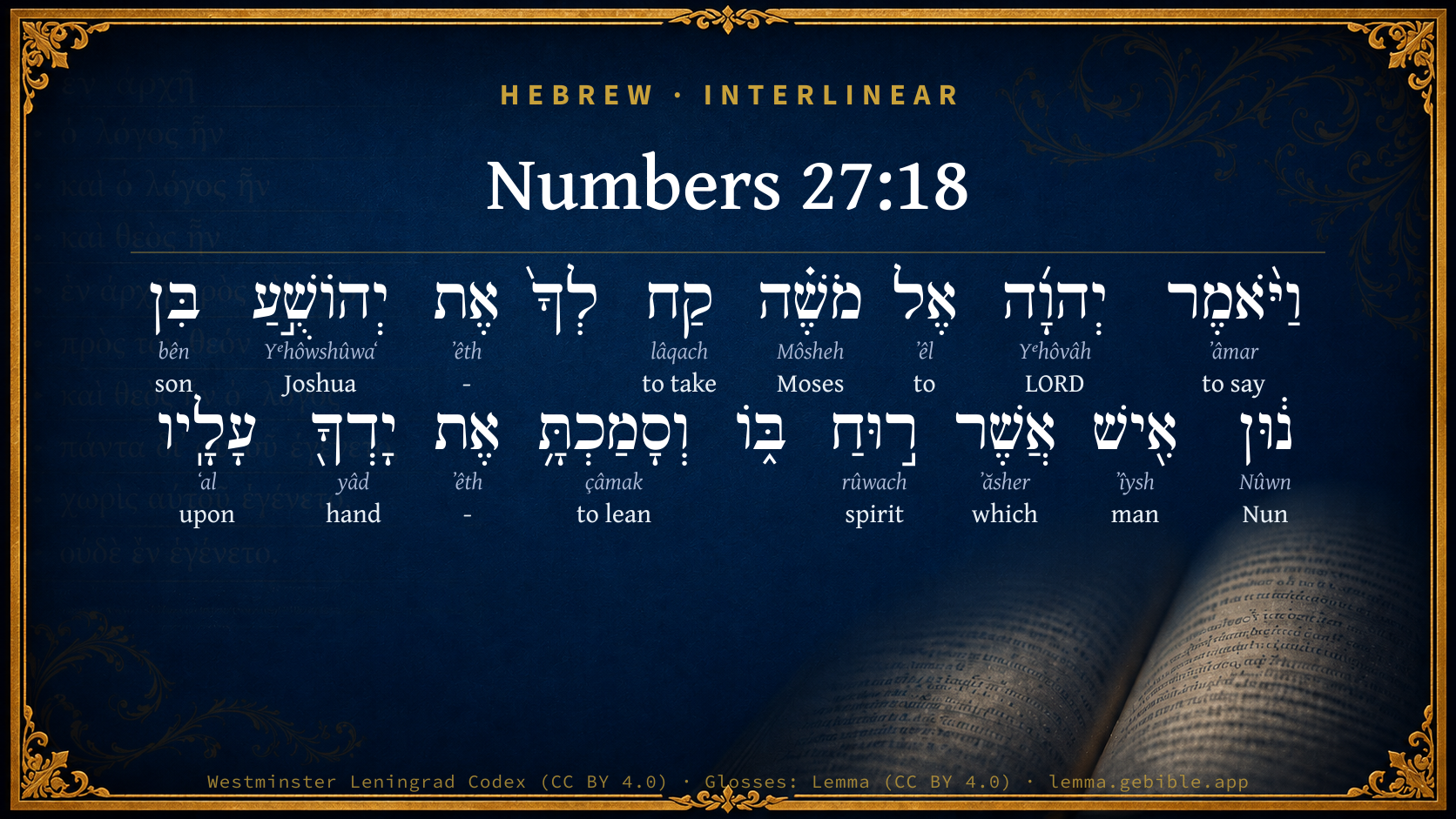
Hebrew (Westminster Leningrad Codex) Numbers 27:18 appears in the Hebrew Old Testament. The text above is from the Westminster Leningrad Codex. Each word links to its Strong’s number, a concise gloss, and parsing drawn from the Open Scriptures Hebrew Bible morphology. Click any word for its full Brown-Driver-Briggs (BDB) entry.
Download image
Cite this verse

Numbers 27:18 (World English Bible). Public Domain. Lemma interlinear Bible study tool, https://lemma.gebible.app/v/numbers/27/18.

Show BibTeX & RIS
BibTeX
RIS
English Translation
Yahweh said to Moses, Take Joshua the son of Nun, a man in whom is the Spirit, and lay your hand on him;
World English Bible · Public Domain
Download a study sheet

One document with this verse’s original text, its word-by-word gloss line, the meaning frame, cross-references with their text, attributed commentary, and full source and license credits — printable, and it pastes into notes with its structure intact.

This verse Autodidact and up

Study sheet (.html) Plain text (.txt)

A passage Seminary Student

Up to 50 verses in one chapter. A passage sheet keeps up to 6 commentary sources and 12 cross-references per verse, in the order this page ranks them, and says so on the sheet whenever that leaves anything out. Ask for a single verse and you get the Autodidact verse sheet above.

Everything on this page stays free to read, with no account — the sheet is a download of what is already on screen, not access to it.

Want to remove ads? Support Godless Engineer
Compare translations 3

The same verse in 3 English versions, stacked beneath the original-language interlinear above. Click any original word for its lexicon entry.

Each is an independent rendering of the whole verse — the interlinear is not word-aligned to these translations.

Highlighted words mark where these versions differ — a whole-verse word diff, not a word-by-word alignment.

  • World English Bible Public Domain
    Yahweh said to Moses, Take Joshua the son of Nun, a man in whom is the Spirit, and lay your hand on him;
  • King James Version Public Domain
    And the LORD said unto Moses, Take thee Joshua the son of Nun, a man in whom is the spirit, and lay thine hand upon him;
  • unfoldingWord Literal Text CC BY-SA 4.0
    And Yahweh said to Moses, “Take for yourself Joshua the son of Nun, a man in whom is a spirit, and lay your hand on him.

unfoldingWord Literal Text — © unfoldingWord, licensed CC BY-SA 4.0. Word-aligned USFM3 via Door43 (git.door43.org/unfoldingWord/en_ult).

Versions to compare (up to 4)

3 of 4 selected

Show all 18 translations

Every available English version of this verse, each an independent rendering of the whole verse.

  • World English Bible Public Domain
    Yahweh said to Moses, Take Joshua the son of Nun, a man in whom is the Spirit, and lay your hand on him;
  • Berean Standard Bible Public Domain
    And the LORD replied to Moses, “Take Joshua son of Nun, a man with the Spirit in him, and lay your hands on him.
  • Majority Standard Bible Public Domain
    And the LORD replied to Moses, “Take Joshua son of Nun, a man with the Spirit in him, and lay your hands on him.
  • King James Version Public Domain
    And the LORD said unto Moses, Take thee Joshua the son of Nun, a man in whom is the spirit, and lay thine hand upon him;
  • American Standard Version (1901) Public Domain
    And Jehovah said unto Moses, Take thee Joshua the son of Nun, a man in whom is the Spirit, and lay thy hand upon him;
  • Revised Version (1885) Public Domain
    And the LORD said unto Moses, Take thee Joshua the son of Nun, a man in whom is the spirit, and lay thine hand upon him;
  • Geneva Bible (1599) Public Domain
    And the Lord said vnto Moses, Take thee Ioshua the sonne of Nun, in whom is the Spirite, and put thine handes vpon him,
  • Douay-Rheims (1899) Public Domain
    And the Lord said to him: Take Josue the son of Nun, a man in whom is the Spirit, and put thy hand upon him.
  • Young's Literal Translation Public Domain
    And Jehovah saith unto Moses, `Take to thee Joshua son of Nun, a man in whom `is' the Spirit, and thou hast laid thine hand upon him,
  • Literal Standard Version CC BY-SA 4.0
    And YHWH says to Moses, “Take Joshua son of Nun to yourself, a man in whom [is] the Spirit, and you have laid your hand on him,
  • Unlocked Literal Bible CC BY-SA 4.0
    Yahweh said to Moses, “Take Joshua son of Nun, a man in whom my Spirit lives, and lay your hand on him.
  • unfoldingWord Literal Text CC BY-SA 4.0
    And Yahweh said to Moses, “Take for yourself Joshua the son of Nun, a man in whom is a spirit, and lay your hand on him.
  • Darby Bible Public Domain
    And Jehovah said to Moses, Take Joshua the son of Nun, a man in whom is the Spirit, and thou shalt lay thy hand upon him;
  • World Messianic Bible Public Domain
    The LORD said to Moses, “Take Joshua the son of Nun, a man in whom is the Spirit, and lay your hand on him.
  • Webster's Bible Public Domain
    And the LORD said to Moses, Take to thee Joshua the son of Nun, a man in whom is the spirit, and lay thy hand upon him;
  • Free Bible Version CC BY-SA 4.0
    The Lord told Moses, “Call for Joshua, son of Nun, a man who has the Spirit in him, and place your hands on him.
  • Bible in Basic English Public Domain
    And the Lord said to Moses, Take Joshua, the son of Nun, a man in whom is the spirit, and put your hand on him;
  • JPS Tanakh (1917) Public Domain
    And the LORD said unto Moses: 'Take thee Joshua the son of Nun, a man in whom is spirit, and lay thy hand upon him;

Literal Standard Version (2020), Covenant Press — licensed CC BY-SA 4.0. Text via the HelloAO Bible API (eBible.org). Unlocked Literal Bible (unfoldingWord) — licensed CC BY-SA 4.0. Text via the HelloAO Bible API (eBible.org). unfoldingWord Literal Text — © unfoldingWord, licensed CC BY-SA 4.0. Word-aligned USFM3 via Door43 (git.door43.org/unfoldingWord/en_ult). Free Bible Version, Dr. Jonathan Gallagher — licensed CC BY-SA 4.0. Text via the HelloAO Bible API (eBible.org).

Word by word

More ways to search: Search by grammar → Find every occurrence → Compare this word →

Practice this passage: Drill this verse → Learn its vocabulary →

נ֔וּן
Nûwn
H5126
“Nun”
Noun, Proper
Part of Speech
Noun
Type
Proper
Full BDB Definition

Origin: from H5125

TWOT: None

Nun = "fish" or " posterity" - father of Joshua the successor of Moses
  1. וַיֹּ֨אמֶר ʼâmar H559 “and · to say” Conjunction + Verb, Qal, Sequential Imperfect, 3rd Person, Masculine, Singular
  2. יְהוָ֜ה Yᵉhôvâh H3068 “LORD” Noun, Proper
  3. אֶל ʼêl H413 “to” Preposition
  4. מֹשֶׁ֗ה Môsheh H4872 “Moses” Noun, Proper
  5. קַח lâqach H3947 “take” Verb, Qal, Imperative, 2nd Person, Masculine, Singular
  6. אֶת ʼêth H853 “-” Particle, Direct Object
  7. יְהוֹשֻׁ֣עַ Yᵉhôwshûwaʻ H3091 “Joshua” Noun, Proper
  8. בִּן bên H1121 “son of” Noun, Common, Masculine, Singular, Construct
  9. אִ֖ישׁ ʼîysh H376 “man” Noun, Common, Masculine, Singular, Absolute
  10. אֲשֶׁר ʼăsher H834 “which” Particle, Relative
  11. ר֣וּחַ rûwach H7307 “spirit” Noun, Common, Both, Singular, Absolute
  12. וְסָמַכְתָּ֥ çâmak H5564 “and · to lean” Conjunction + Verb, Qal, Sequential Perfect, 2nd Person, Masculine, Singular
  13. אֶת ʼêth H853 “-” Particle, Direct Object
  14. יָדְךָ֖ yâd H3027 “hand · your” Noun, Common, Both, Singular, Construct + Suffix, Personal, 2nd Person, Masculine, Singular
  15. עָלָֽיו ʻal H5921 “upon · him” Preposition + Suffix, Personal, 3rd Person, Masculine, Singular

About this verse

These counts appear in no published source. They are computed here, from the morphology-tagged text and Lemma’s own curated glosses. What Lemma adds →

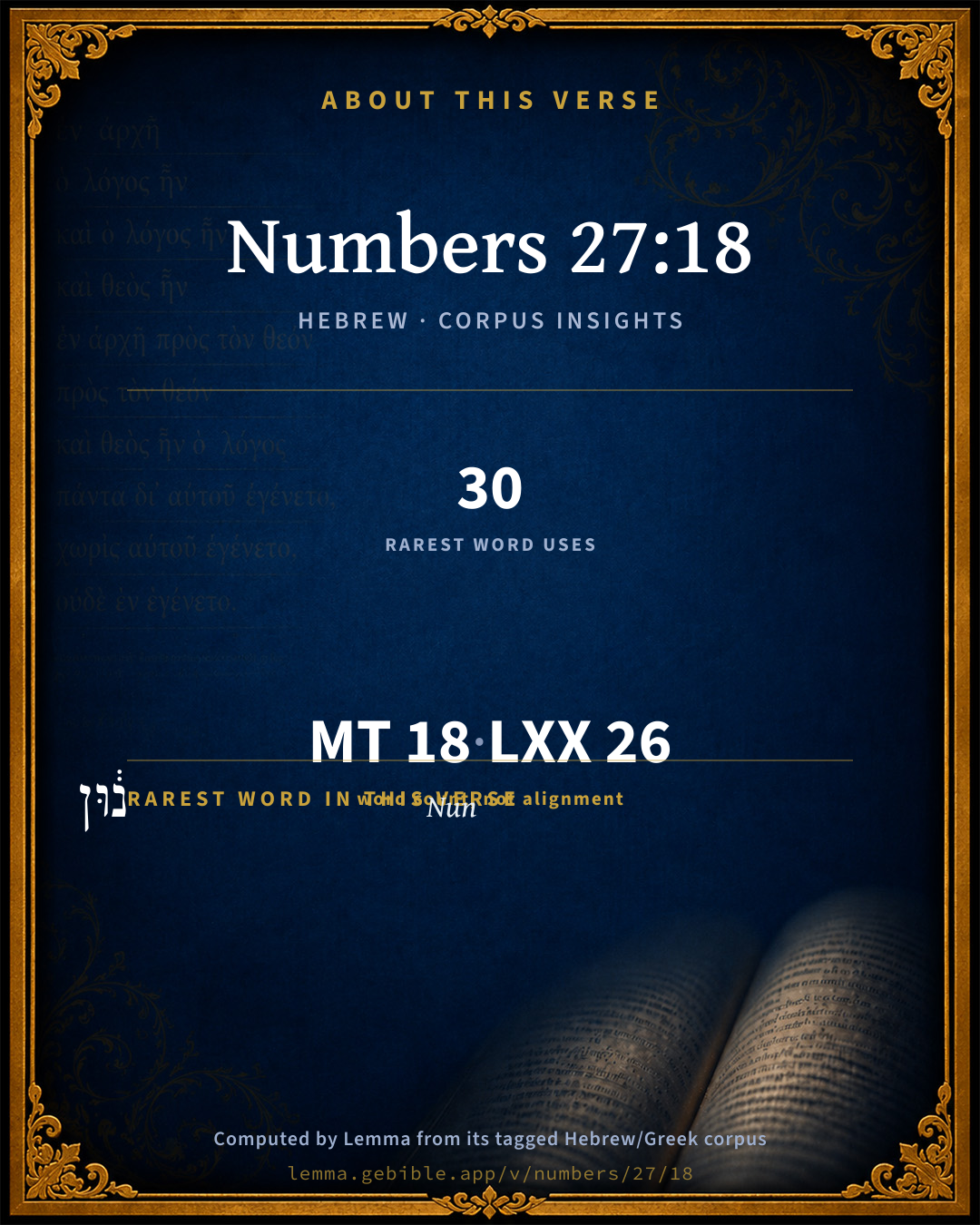
18
words
15
distinct lemmas
Pentateuch
section

Shared distinctive vocabulary

נ֔וּן Nun H5126 occurs in 30 verses of the Hebrew Bible. Also found in:

Grammatical profile

  • 3 verbs
  • 8 nouns
  • 4 prepositions
  • 3 particles

Verb forms

  • וַיֹּ֨אמֶר Qal · Sequential Imperfect
  • קַח Qal · Imperative
  • וְסָמַכְתָּ֥ Qal · Sequential Perfect

Hebrew & Septuagint length

In English translation the verse runs 23 words from the Hebrew and 31 from the Septuagint (LXX English) — closely comparable.

A rough comparison of the two English renderings, which tokenize alike — not a word-level alignment.

Word counts can differ between the Hebrew and the Greek without any difference in meaning — e.g. the Hebrew direct-object marker אֵת has no separate Greek word, and Greek often adds the article ὁ.

In the original languages it is 18 Hebrew tokens and 26 Greek tokens — but the two are counted differently (Hebrew bundles its prefixes and suffixes into one token; the Greek is in lemma form), so that isn’t a like-for-like length.

Cross-references

26

Topical passages linked to Numbers 27:18 in the Treasury of Scripture Knowledge — connected by theme and wording, ordered by reader-vote popularity; previews shown in the World English Bible.

  • Deuteronomy 34:9 Joshua the son of Nun was full of the spirit of wisdom; for Moses had laid his hands on him: and the children of Israel listened to him, and did as Yahweh commanded Moses.
  • Genesis 41:38 Pharaoh said to his servants, "Can we find such a one as this, a man in whom is the Spirit of God?"
  • Numbers 27:23 and he laid his hands on him, and gave him a charge, as Yahweh spoke by Moses.
  • Deuteronomy 3:28 But charge Joshua, and encourage him, and strengthen him; for he shall go over before this people, and he shall cause them to inherit the land which you shall see.
  • Deuteronomy 31:7–8 Moses called to Joshua, and said to him in the sight of all Israel, Be strong and of good courage: for you shall go with this people into the land which Yahweh has sworn to their fathers to give them; and you shall cause them to inherit it.
  • Deuteronomy 31:23 He gave Joshua the son of Nun a charge, and said, Be strong and of good courage; for you shall bring the children of Israel into the land which I swore to them: and I will be with you.
  • Judges 3:10 The Spirit of Yahweh came on him, and he judged Israel; and he went out to war, and Yahweh delivered Cushan Rishathaim king of Mesopotamia into his hand: and his hand prevailed against Cushan Rishathaim.
  • Acts 19:6 When Paul had laid his hands on them, the Holy Spirit came on them, and they spoke with other languages and prophesied.
  • Numbers 11:25–29 Yahweh came down in the cloud, and spoke to him, and took of the Spirit that was on him, and put it on the seventy elders: and it happened that when the Spirit rested on them, they prophesied, but they did so no more.
  • Judges 11:29 Then the Spirit of Yahweh came on Jephthah, and he passed over Gilead and Manasseh, and passed over Mizpeh of Gilead, and from Mizpeh of Gilead he passed over to the children of Ammon.
  • Daniel 5:14 I have heard of you, that the spirit of the gods is in you, and that light and understanding and excellent wisdom are found in you.
  • John 3:34 For he whom God has sent speaks the words of God; for God gives the Spirit without measure.
  • 1 Samuel 16:13–14 Then Samuel took the horn of oil, and anointed him in the midst of his brothers: and the Spirit of Yahweh came mightily on David from that day forward. So Samuel rose up, and went to Ramah.
  • Acts 6:3 Therefore select from among you, brothers, seven men of good report, full of the Holy Spirit and of wisdom, whom we may appoint over this business.
  • Acts 6:6 whom they set before the apostles. When they had prayed, they laid their hands on them.
  • Acts 13:3 Then, when they had fasted and prayed and laid their hands on them, they sent them away.
  • 1 Timothy 4:14 Don't neglect the gift that is in you, which was given to you by prophecy, with the laying on of the hands of the elders.
  • 1 Timothy 5:22 Lay hands hastily on no one, neither be a participant in other men's sins. Keep yourself pure.
  • Hebrews 6:2 of the teaching of baptisms, of laying on of hands, of resurrection of the dead, and of eternal judgment.
  • Numbers 11:17 I will come down and talk with you there: and I will take of the Spirit which is on you, and will put it on them; and they shall bear the burden of the people with you, that you not bear it yourself alone.
  • Numbers 13:8 Of the tribe of Ephraim, Hoshea the son of Nun.
  • Numbers 13:16 These are the names of the men who Moses sent to spy out the land. Moses called Hoshea the son of Nun Joshua.
  • 1 Samuel 16:18 Then answered one of the young men, and said, Behold, I have seen a son of Jesse the Bethlehemite, who is skillful in playing, and a mighty man of valor, and a man of war, and prudent in speech, and a comely person; and Yahweh is with him.
  • Exodus 17:9 Moses said to Joshua, "Choose men for us, and go out, fight with Amalek. Tomorrow I will stand on the top of the hill with God's rod in my hand."
  • Acts 8:15–19 who, when they had come down, prayed for them, that they might receive the Holy Spirit;
  • 1 Corinthians 12:4–11 Now there are various kinds of gifts, but the same Spirit.

Cross-references courtesy of OpenBible.info (CC BY 4.0).

Hebrew and Greek witnesses Masoretic Hebrew ↔ Greek Septuagint

The same verse in the two great witnesses to the Old Testament, shown verse-for-verse.

These are two independent witnesses, not word-aligned to each other, and the Septuagint is shown in lemma (dictionary) form.

Hebrew Numbers 27:18 Masoretic · Westminster Leningrad Codex

וַיֹּ֨אמֶר יְהוָ֜ה אֶל מֹשֶׁ֗ה קַח לְךָ֙ אֶת יְהוֹשֻׁ֣עַ בִּן נ֔וּן אִ֖ישׁ אֲשֶׁר ר֣וּחַ בּ֑וֹ וְסָמַכְתָּ֥ אֶת יָדְךָ֖ עָלָֽיו

Yahweh said to Moses, Take Joshua the son of Nun, a man in whom is the Spirit, and lay your hand on him;

World English Bible · Public Domain

Greek LXX Numbers 27:18 Septuagint · lemma form

καί λαλέω κύριος πρός μωυσῆς λέγω λαμβάνω πρός σεαυτοῦ ὁ ἰησοῦς υἱός ναυη ἄνθρωπος ὅς ἔχω πνεῦμα ἐν ἑαυτοῦ καί ἐπιτίθημι ὁ χείρ σύ ἐπί αὐτός

And the Lord spoke to Moses, saying, Take to yourself Joshua the son of Naue, a man who has the Spirit in him, and you shall lay your hands upon him.

LXX2012 (modern English Septuagint) · Public Domain

Hebrew: Westminster Leningrad Codex (CC BY 4.0). Greek: Septuagint (public domain); English from LXX2012 (modern English Septuagint) (Public Domain). How the Septuagint differs from the Hebrew →

Targum (Aramaic paraphrase)

2

The Targum is the ancient Jewish Aramaic paraphrase of the Hebrew Scriptures — an interpretive translation, not the Hebrew text itself. Onkelos (literal) and Pseudo-Jonathan (expansive) render the Torah, and Jonathan the Prophets. Coverage is partial: where no permissively-licensed English translation exists for a verse, only the Aramaic is shown. This is verse-level text, not a word-by-word alignment to the Hebrew.

  1. Targum Onkelos Torah (Genesis–Deuteronomy)
    וַאֲמַר יְיָ לְמשֶׁה דְבַר לָךְ יָת יְהוֹשֻׁעַ בַּר נוּן גְבַר דִי רוּחַ נְבוּאָה בֵּיהּ וְתִסְמוֹךְ יָת יְדָךְ עֲלוֹהִי

    (no public-domain English translation for this verse)

    Targum Onkelos — Aramaic: “Onkelos Genesis” (public domain); “Onkelos Exodus” (public domain); “Onkelos Leviticus” (public domain); “Onkelos Numbers” (public domain); “Onkelos Deuteronomy” (public domain). English: “Sefaria Community Translation” (CC0 1.0 (public-domain dedication)); “J.W. Etheridge. The Targums of Onkelos and Jonathan Ben Uzziel on the Pentateuch. London: Longmans, Green, 1862” (public domain). Text via Sefaria.

  2. Targum Pseudo-Jonathan Torah (Genesis–Deuteronomy)
    וַאֲמַר יְיָ לְמשֶׁה דַבַּר לָךְ יַת יְהוֹשֻׁעַ בַּר נוּן גְבַר דְרוּחַ נְבוּאָה מִן קֳדָם יְיָ שַׁרְיָא עֲלוֹי וְתִסְמוֹךְ יַת יְדָךְ עֲלוֹי

    And the Lord said to Mosheh, Take to thee Jehoshua bar Nun, a man upon whom abideth the Spirit of prophecy from before the Lord, and lay thy hand upon him,

    Targum Pseudo-Jonathan — Aramaic: “Targum Jonathan on Genesis” (public domain); “Targum Jonathan on Exodus” (public domain); “Targum Jonathan on Leviticus” (public domain); “Targum Jonathan on Numbers” (public domain); “Targum Jonathan on Deuteronomy” (public domain). English: “The Targum of Jonathan ben Uzziel, trans. J. W. Etheridge, London, 1862” (public domain). Text via Sefaria.

Commentary

Notes on Numbers 27:18 from classic Christian and Jewish commentators (each source and its license shown beneath its notes). The classic Christian expositions comment on the surrounding passage and are grouped to its opening verse, so a note may address several verses; the Jewish commentaries on the Tanakh (Rashi and others) are per-verse, so they appear only where the commentator wrote on this verse.

Lemma curates 59 commentaries, every one of them public domain or Creative Commons licensed, each selected and text-cleaned for this edition rather than reprinted as found. About our sources →

Jamieson, Fausset & Brown

Robert Jamieson, A. R. Fausset & David Brown

JOSHUA APPOINTED TO SUCCEED HIM. (Num 27:18-23)

Take thee Joshua . . . a man in whom is the spirit, and lay thine hand upon him--A strong testimony is here borne to the personality of the divine Spirit--the imposition of hands was an ancient ceremony. (See Gen 48:14; Lev 1:4; Ti1 4:14).

Jamieson, Fausset & Brown — Commentary Critical and Explanatory on the Whole Bible (1871) — public domain (CC PDM 1.0). Text via the HelloAO Bible API.

Joseph Benson's Commentary

Num 27:18. In whom is the spirit — Or spiritual endowments from the Holy Ghost; for it is by the influence of the Spirit of God that all good gifts are communicated to the sons of men. It particularly means here, the spirit of wisdom, courage, and the fear of God, with other gifts necessary for a well-qualified governor. Hence Joshua is said to have been full of the spirit of wisdom, Deu 34:9. Lay thy hand upon him — By which ceremony Moses did both design the person and confer the power, and by his prayers, which accompanied that rite, obtain from God all the spiritual gifts and graces necessary for his future employment.

Joseph Benson's Commentary on the Old and New Testaments (1811–1818) — public domain. Text from a community e-Sword module.

Tyndale Open Study Notes

Tyndale Open Resources

27:18-19 Joshua had a solid background for the role (cp. Exod 17:8-16). He had been Moses’ assistant for a long time (Num 11:28; cp. Exod 33:11). He was also one of the faithful spies (Num 13–14) who knew the people of Israel well. Joshua possessed the Spirit and recognized the special presence of God in his life (cp. 11:25-29). His relationship with God also gave him wisdom for the tasks ahead (e.g., Deut 34:9). • lay your hands on him: This act symbolized the transfer of authority from an elder statesman to his assistant (cp. Num 8:10-14). Moses did this publicly so that Joshua’s leadership would be incontestable.

Tyndale Open Study Notes — © Tyndale Open Resources, licensed CC BY-SA 4.0. Text via the HelloAO Bible API.

Geneva Bible (1599)

Geneva Bible translators

And so appoint him governor.

Geneva Bible (1599) marginal notes — public domain. Text via Bolls.life.

Adam Clarke's Commentary

Verse 18. In whom is the spirit] This must certainly mean the Spirit of God; and because he was endued with this Spirit, therefore he was capable of leading the people. How miserably qualified is that man for the work of God who is not guided and influenced by the Holy Ghost! God never chooses a man to accomplish his designs but that one whom he himself has qualified for the work.

Adam Clarke's Commentary on the Bible (1810–1826) — public domain. Text from a community e-Sword/MySword module.

Ellicott's Commentary for English Readers

(18) In whom is the spirit . . . —The definite article is not used in the original. The word translated “spirit” appears to denote spiritual endowment and qualifications.

And lay thine hand upon him.—It is to be observed that the spiritual qualifications of Joshua did not supersede the necessity of an outward consecration to his office. Nay, more; it seems that special qualifications for the office were bestowed in connection with the imposition of the hands of Moses, for it is written in Deu_34:9 that “Joshua the son of Nun was full of the spirit of wisdom; for Moses had laid his hands upon him.”

A Bible Commentary for English Readers, edited by Charles John Ellicott (1878–1897) — public domain. Text from a community e-Sword module.

The Cambridge Bible for Schools and Colleges

gen. ed. J. J. S. Perowne

18. a man in whom is (om. ‘the’) spirit] An influence proceeding from God already dwells in him. This was not the frenzied spirit of prophecy (Num_11:25 f.) but as in Deu_34:9 ‘the spirit of wisdom,’ prudence, capacity.

and lay thine hand upon him] This action has more than one significance in the O.T. For the meaning in Num_8:10 see note there. In Gen_48:14 it accompanies a solemn blessing; here it symbolizes the handing on of Moses’ office to Joshua. In later Jewish times it was employed in admitting a person to the position of Rabbi. And in the Christian Church it remains to this day as the apostolic rite of ordination (cf. Act_6:6; Act_13:3; 1Ti_3:14; 2Ti_1:6), in which all three meanings—blessing, succession to office, and authority to teach—are combined.

The Cambridge Bible for Schools and Colleges (gen. ed. J. J. S. Perowne; Cambridge University Press, 1878–1918) — public domain. Text from a community e-Sword module.

John Gill's Exposition

And set him before Eleazar the priest, and before all the congregation,.... Declaring before them all that he was his successor, and that they might be witnesses of what was said and done unto him, and receive and acknowledge him as such, and as having power and authority over them, which it became them to submit unto:

and give him a charge in their sight: to take care of the people committed to him; to rule them in the fear of God, and according to his laws; and to be of good courage, and go before the people and introduce them into the land of Canaan; assuring him of the divine Presence and help, so that he need not fear any enemy whatever; of this charge, and as confirmed by the Lord himself, see Deu 31:7.

John Gill's Exposition of the Whole Bible (1746–1763) — public domain (CC PDM 1.0). Text via the HelloAO Bible API.

Albert Barnes' Notes on the Bible

In whom is the spirit Compare Gen 41:38. Joshua was endowed by God with the requisite spiritual qualifications for the office. Moses howerer, was to lay his hands upon him, both in order to confer formal and public appointment, and also (compare Deu 34:9) to confirm and strengthen the spiritual gifts already bestowed. The previous reception of the inner grace did not dispense with that of the outward sign; compare the case of Cornelius Act 10:44-48; and Paul’s baptism after his miraculous conversion Act 9:18.

Albert Barnes' Notes on the Bible (1834–1885) — public domain. Text from a community e-Sword/MySword module.

Haydock's Catholic Bible Commentary

Spirit of God, which was given to him, when he was appointed a judge; (chap. xi. 17,) the spirit of prophesy, (Onkelos,) and of wisdom, (Deuteronomy xxxiv. 9,) of which he received a fresh increase, by the imposition of the hands of Moses. By the like ceremony people are confirmed, and ministers of religion are still ordained, Acts vi. 6., and 1 Timothy iv. 14. (Calmet) --- God endues Josue with all the necessary qualifications for his high office. He makes choice of him, and not of any of the relations of Moses, that the people might not be offended at the supreme power being in a manner engrossed by one family; and he appoints one 93 year old, that the success of war might not be attributed to Josue, though he had been long at the head of the armies, and a man of greatest authority, even the vice-gerent of Moses. He declares his election before all the multitude, with the high priest at their head, that there might be no dispute about the matter; and, on this account, he requires various external ceremonies to be observed. (Salien)

George Leo Haydock (1774–1849), Haydock's Catholic Family Bible and Commentary, 1859 edition — public domain. Excludes Psalms (Douay-Rheims chapter numbering differs from Protestant) and Deuterocanonical books (Catholic canon only).

Matthew Poole's English Annotations

The spirit; the spirit of government, of wisdom, and of the fear of the Lord, &c.

Lay thine hand upon him; by which ceremony Moses did both design the person and confer the power, and by his prayers, which accompanied that rite, obtain from God all the spiritual gifts and graces necessary for his future employment, as appears from Deu 34:9. See of this custom Gen 48:14; Lev 1:4; Num 8:10; 1Ti 4:14.

Matthew Poole's English Annotations on the Holy Bible (1683–1685) — public domain. Text from a community e-Sword/MySword module.

Whedon's Commentary on the Bible

Daniel D. Whedon

18. Joshua — Num_11:28, note.

In whom is the spirit — Not mere “insight and wisdom,” (Knobel,) but the endowment of the divine Spirit requisite for the high office to which he was called. The difference between the operations of the Holy Spirit on the human soul before and after the day of Pentecost is a question of vital interest. (1.) In the Old Testament the agency of the Spirit in the outward world is recognised more fully than in the New Testament. Gen_1:2; Gen_2:7; Job_27:3; Job_33:4. (2.) The fulness and abiding of the Spirit in the soul of the believer, sanctifying, assuring, and adorning it with the constellation of Christian graces, is peculiar to the New Testament, especially after the Pentecostal effusion. In this sense Dean Alford insists that the office and work of the Paraclete is TOTALLY DISTINCT from his operations under the Old Testament dispensation, which were outward rather than inward: such as bestowing skill upon Bezaleel, (Exo_31:3,) strength upon Samson, (Jdg_14:6,) and prophecy and kingcraft upon Saul, (1Sa_10:6,) and, in general, intellectual and physical excellencies rather than gracious dispositions and spiritual perceptions and joys. Comp. Deu_34:9; Dan_6:3; and Rom_5:5; Rom_14:17; Gal_5:22.

Lay thine hand upon him — The imposition of hands is a natural form by which benediction has been expressed in all ages and nations. It is an act of a superior in age or office toward an inferior, and by its very form it appears to bestow some good gift, or to manifest a desire for its bestowal, (Gen_48:14,) or to cure some disease. 2Ki_5:11; Mat_19:13. For its sacrificial meaning see Lev_1:4, note.

Daniel D. Whedon (gen. ed.), Commentary on the Old and New Testaments (1874–1909) — public domain. Text from a community e-Sword module.

The Pulpit Commentary

Take thee Joshua. Joshua was now for the first time designated at the request of Moses as his successor; he had, however, been clearly marked out for that office by his position as one of the two favoured survivors of the elder generation, and as the "minister" and confidant of Moses. In regard of the first he had no equal but Caleb, in regard of the second he stood quite alone. A man in whom is the spirit. jWr here, although without the definite article, can only mean the Holy Spirit, as in Num_11:25 sq. Lay thine hand upon him. According to Deu_34:9 this was to be done in order that Joshua might receive with the imposition of hands a spiritual gift (charisma) of wisdom for the discharge of his high office. It would appear also from the next paragraph that it was done as an outward and public token of the committal of authority to Joshua as the successor of Moses.

Vers. 18-20. The appointment of Joshua to be Moses" successor.

Moses, after having been the leader of his people for forty years, is at length to get his discharge. Nothing has yet been determined regarding a successor. The point is, on every account, too important to be left open till the present leader has passed away. A change of leadership, always hazardous, is especially hazardous when the army is in the field and the enemy is on the watch. If the Divine wisdom judged it necessary that Eleazar should be invested with the high priesthood before Aaron died, much more is it necessary that, before Moses lays down the scepter, a successor should be appointed and placed in command. We are now to see how this was done. The story, besides its intrinsic interest, which is not small, is interesting, moreover, on this account, that the mode of procedure prescribed and followed in this case furnished precedents which continue to be observed amongst us down to the present day. Three topics claim notice.

I AT WHOSE INSTANCE THIS APPOINTMENT TOOK PLACE. It was Moses who sued for a successor. It was not the people who urged on the business, nor was it necessary to overcome the reluctance of the present leader by a Divine command. No sooner does Moses receive notice to demit than he prays for a successor, and begs that his eyes may see him before he dies. His experience of the government makes him dread the dangers of an interregnum. "Sheep without a shepherd," such would the tribes be without a leader; unable to keep order among themselves, and exposed to every enemy. It betokened great nobility of soul in Moses that this was the thought uppermost in his mind on hearing that his hour was come. The paramount feeling of his heart was concern for the honour of the Lord and the good of Israel after his decease. Some men cannot endure the sight of a successor; Moses earnestly desired to see his successor before he died. Such being his desire, see where he carries it. "Let the Lord set a man over the congregation. From the Lord he had received his commission at the bush; from the Lord he sues for a successor. Moses was emphatically the "servant of the Lord;" and none but the Lord has authority to nominate the heir to so high an office. Moses has another reason for turning God-wards at this time. None but the Lord knows the fittest man, or can furnish him with the wisdom and valour the office will crave. He is "the God of the spirits of all flesh. He made men"s souls, and he knows them. He admits them into intimacy with himself. He is their Saviour and Portion. When the Church, or any part of it, finds itself in want of a man fit to be intrusted with some office of high responsibility, or to be sent forth on some peculiarly difficult mission, this is the quarter to which it must turn. The God of the spirits of all flesh can furnish them with the man they want; He, and no other.

II ON WHOM THE APPOINTMENT WAS BESTOWED. "Joshua the son of Nun, a man in whom is the spirit." Joshua was no stranger to Moses; he had been "Moses" minister from his youth", (Num_11:28) and known to him as a man every way fitted to be his successor. He must have thought of him; yet he did not presume to suggest his name; he waited to hear what the Lord would speak. N.B. When Moses was about to die and a successor was sought, it turned out that the Lord had anticipated the want. The successor of Moses was in training for forty years before Moses died. This happens oftener than many suppose.

III THE MANNER OF THE INVESTITURE.

1. Joshua was presented to the congregation in a public assembly. To be sure, he owed his appointment to Divine nomination, not to popular election. He was, like Moses, the Lord"s vicegerent. Nevertheless, the people were acknowledged in the appointment. They were to be Joshua"s subjects, but not his slaves. Accordingly, it was judged only fair and right that they should be informed publicly of the appointment; that they should witness the investiture and hear the charge. (cf. Num_20:27)

2. Moses laid his hands upon him. This is the earliest example in Scripture of a rite of investiture which was afterwards much in use, which was transferred by the apostles to the New Testament Church, and is the familiar custom of the Churches of Christ still. The terms in which it is here enjoined place the intention of it in a clear light.

(1) It denoted the investiture of Joshua with the office of leader and commander in succession to Moses. "Thou shalt put some of thine honour upon him, that all the congregation may be obedient" (verse 20). Not all his honour; for Moses was set over all God"s house, and in that respect had no successor; but part of his honour, particularly that part in virtue of which he was captain of the host of Israel. (cf. Act_6:6 Act_13:3)

(2) It denoted also the bestowment on Joshua of the gifts appropriate to his new office. Not that Joshua was, till now, without valour or wisdom. During his long apprenticeship of forty years he had given abundant evidence of a rich dowry of these virtues. But the laying on of the hands of Moses by Divine command was a token and pledge that a double portion of his master"s spirit would be thenceforward bestowed, to strengthen him to take up his master"s task and carry it forward to completion. The pledge was redeemed. "Joshua was full of the spirit of wisdom, for Moses had laid his hands upon him". (Deu_34:9; cf. 1Ti_4:14)

3. Moses gave him a charge. The scope and substance of the charge are recorded in Deu_3:28 and Deu_31:7.

4. The design of this part of the service was twofold. On the one hand. Moses faithfully expounded the duties belonging to the office with which he was now invested. He certified him that it was no idle dignity he was now entering upon, but an arduous work. And this was done not within a tent, or in some solitary place, but publicly, and before all the congregation, that they as well as Joshua might hear. On the other hand, Moses laboured to strengthen his successor"s heart. No man was so well able to comfort Joshua as Moses was. The Lord in calling Moses at the bush had given him the promise, "Surely I will be with thee." He had kept the promise. Moses was able to testify that when God calls a man to any duty, he will be with him in the discharge of the duty; so that the most timid man may well be strong and of a good courage in the work the Lord has given him to do. B.

Vers. 18-21. The qualifications for the public service of God.

Some of these are illustrated in the case of Joshua.

I THE INDWELLING OF THE SPIRIT OF GOD (verse 18). This obvious from the past history of Joshua, especially at Kadesh (chapters 13, 14). Union with Christ through faith, attested by his Holy Spirit, essential for us.

II A CLEAR CONVICTION OF DUTY. We need the assurance of a mission, "a charge" (verse 19), whether addressed from without or heard in the secret of the soul.

III A PROVIDENTIAL APPOINTMENT. "Lay thine hand upon him." Not every impulse is to be taken for a Divine "charge," lest we should run without being sent. (cf. Psa_25:4, 5 143:8)

IV THE CONFIDENCE OF THE PEOPLE OF GOD (verse 20; cf. 1Ti_3:7). In carrying on our work we may need the cheerful cooperation, or even "obedience" (verse 20), which confidence in our character and commission inspires.

V CEASELESS COMMUNION WITH AND DIRECTION FROM GOD (verse 21). For the welfare of a "congregation" or of a nation may depend on the instructions given, or assumed to be given, in God"s name. P.

Vers. 18-23. The solicitude relieved by the appointment of Joshua.

God makes an immediate, gracious, and full compliance with the request of Moses. It is a welcome sight when the will of God runs forward as it were to meet the wishes of man. God has so often to reveal himself refusing and thwarting the wishes of men, or at all events complying with them only in part. This request must have been expected, and the command to go up into Abarim prepared the way for it to be made.

I THE QUALIFICATION OF JOSHUA. "A man in whom is the spirit;" a spirit doubtless such as was bestowed on the seventy elders, of whom, in all probability, Joshua was one (chapter 11). Having the spirit was the one indispensable thing. Nothing of such work as Joshua had to do could be done without it. There are diversities of operations, but they are all the operations of those in whom there are special and necessary endowments for the work they have to do. Others beside Joshua had some of the qualifications he possessed, but, lacking the spirit, they might as well have lacked everything. What, for instance, was there to prevent Caleb from being leader? Like Joshua, he had been one of the spies, and seen Canaan before. He strikes us as being even a bolder and more resolute man than Joshua; but courage, fidelity, the following of God rather than man, while these are the qualities that make martyrs, they are not enough to make leaders. A Christian might make an excellent figure at the stake who would be nowhere as the guide of the flock. It is beautiful to feel that Caleb continued his simple-hearted devotion to the cause of Israel. Joshua and he seem to have continued the best of friends (Joshua 14). Whether a man is a leader or not should not affect our judgment of him in his whole humanity. Let us esteem most those who are best. It is a foolish question to ask who is greatest in the kingdom of heaven, for every one may conceivably have such excellence of spiritual qualities as may put him in the first place. We may conclude then that, good and true man as Caleb was, he lacked the particular spirit which Joshua possessed. Notice, again, that some who certainly had the spirit as well as Joshua lacked other qualifications. For one thing, Joshua had been long and intimately connected with Moses. It is interesting to notice how many things were done to give Moses pleasure in this departing hour. His death before crossing Jordan is a necessity; there is no way to obviate it; but really as we read of it we have hard work to connect the usual gloom of death with the event. The view that he gets, the compliance with his request, and the choice of one who had been long his faithful and affectionate companion, all these things made the cup of the dying Moses run over. It was euthanasia indeed. The friendship of Joshua with Moses may have had a very great deal to do with the appointment. Those who choose the company of the good and remain steadfast in it are likely to gain such positions as may enable them to transmit the influence of the good. Passing over the immediate circumstances of the appointment, which were such as to impress deeply both the shepherd and the sheep, and remain in the shepherd"s mind, at all events, till his latest hour, we notice

II THE GREAT RULE FOR THE SHEPHERD"S GUIDANCE. God was not about to visit Joshua as he did Moses. Moses stood in lonely and awful eminence as the prophet with whom God spoke face to face. (Num_12:8 Deu_34:10) Such a mode of revelation was needed for the work Moses was called to do. The work in the wilderness was a peculiarly critical one. In one sense we may say it was even more important than the work in Canaan. Given your foundation, which may require great toil and great destruction of existing things if you are to get down to the rock; given your materials, which have to be accumulated with much searching, discernment, and exactitude; given, above all things, your design, in which even the least thing is to have vital connection with the great principles given all these, and then the chief thing required is a competent, honest, and industrious builder. Moses was the man who gets to the foundation, gathers the material, and furnishes the design; Joshua, the subordinate, to come in afterwards and by simple-hearted, plodding, tenacious fidelity to complete the construction of what was intrusted to him. There was no need for God to visit Joshua as he did Moses. The signs of the Urim were quite sufficient, and therefore nothing more was given. Notice also that the priest became thus associated with the leader, to confirm his position when right, and to check him in case he showed signs of going wrong. If Joshua had gone anywhere else than to the intimations of Urim, the resort itself would have been sufficient to condemn him. God took care of Moses in all the directions he had to give by immediately and most abundantly strengthening and supporting him. And so Joshua here was wonderfully helped by the Urim. Any one who refused obedience to him must have been resolutely opposed to truth, for who could deny intimations plainly palpable to the senses? Thus we are helped by the thought of what the Urim was to Joshua in our consideration as to the authority of the New Testament Scriptures over Christians. It is sometimes asked why inspiration should be held to stop with the canon of Scripture. An equally pertinent question is to ask why it should continue. God alone is the judge as to the modes of revelation, and the duration of those modes. It is out of the sovereignty and wisdom of him whose ways are unsearchable that he dealt with Moses after one fashion, and with Joshua after another. And it is by a practical reference to the same sovereignty and wisdom that we shall account for the difference between the New Testament Scriptures and even the most copious and esteemed of the earlier post-apostolic writings. We have our Urim in the great principles of the New Testament.

III THE CHOICE WAS JUSTIFIED BY THE RESULT. The Book of Joshua is a very remarkable one for this peculiarity, which it shares with the Book of Daniel, that there is no record of any stumbling on the part of its leading character. Joshua is always alert, obedient to God, jealous of God"s honour, and keeping the great end in view. There is sin recorded in the Book and a dilatory spirit, but Joshua himself appears in striking contrast to this. And so it always has been and always will be; he whom God chooses will justify the choice. The successful leaders whom God has given his people in the past are an ample assurance that he will continue to provide them. Y.

The Pulpit Commentary (1880–1919), ed. H.D.M. Spence-Jones & Joseph S. Exell — public domain. Text from a community e-Sword module.

John Wesley's Explanatory Notes

The spirit - The spirit of government, of wisdom, and of the fear of the Lord. Lay thy hand - By which ceremony Moses did both design the person and confer the power, and by his prayers, which accompanied that rite, obtain from God all the spiritual gifts and graces necessary for his future employment.

John Wesley, Explanatory Notes Upon the Whole Bible (1754–1765) — public domain. Text via the GEBible commentary corpus.

Keil & Delitzsch

C. F. Keil & F. Delitzsch

The Lord then appointed Joshua to this office as a man "who had spirit." רוּה (spirit) does not mean "insight and wisdom" (Knobel), but the higher power inspired by God into the soul, which quickens the moral and religious life, and determines its development; in this case, therefore, it was the spiritual endowment requisite for the office he was called to fill. Moses was to consecrate him for entering upon this office by the laying on of hands, or, as is more fully explained in Num 27:19 and Num 27:20, he was to set him before Eleazar the high priest and the congregation, to command (צוּה) him, i.e., instruct him with regard to his office before their eyes, and to lay of his eminence (הוד) upon him, i.e., to transfer a portion of his own dignity and majesty to him by the imposition of hands, that the whole congregation might hearken to him, or trust to his guidance. The object to ישׁמעוּ (hearken) must be supplied from the context, viz., אליו (to him), as Deu 34:9 clearly shows. The מן (of) in Num 27:20 is partitive, as in Gen 4:4, etc. The eminence and authority of Moses were not to be entirely transferred to Joshua, for they were bound up with his own person alone (cf. Num 12:6-8), but only so much of it as he needed for the discharge of the duties of his office. Joshua was to be neither the lawgiver nor the absolute governor of Israel, but to be placed under the judgment of the Urim, with which Eleazar was entrusted, so far as the supreme decision of the affairs of Israel was concerned. This is the meaning of Num 27:21 : "Eleazar shall ask to him (for him) the judgment of the Urim before Jehovah." Urim is an abbreviation for Urim and Thummim (Exo 28:30), and denotes the means with which the high priest was entrusted of ascertaining the divine will and counsel in all the important business of the congregation. "After his mouth" (i.e., according to the decision of the high priest, by virtue of the right of Urim and Thummim entrusted to him), Joshua and the whole congregation were to go out and in, i.e., to regulate their conduct and decide upon their undertakings. "All the congregation," in distinction from 'all the children of Israel," denotes the whole body of heads of the people, or the college of elders, which represented the congregation and administered its affairs.

Keil & Delitzsch — Biblical Commentary on the Old Testament (1861–1891) — public domain (CC PDM 1.0). Text via the HelloAO Bible API. (Old Testament only.)

Kretzmann's Popular Commentary

Paul E. Kretzmann

Joshua appointed leader of the people

v. 18. And the Lord said unto Moses, Take thee Joshua, the son of Nun, a man in whom is the Spirit, he had shown the intelligence, the executive ability, and the spirituality needed for the difficult office, and lay thine hand upon him;

v. 19. and set him before Eleazar, the priest, and before all the congregation, in a form of ordination or consecration for his work; and give him a charge in their sight, formally transmit the office of leader to him.

v. 20. And thou shall put some of thine honor upon him, as much as Joshua needed for the effective administration of his leadership, that all the congregation of the children of Israel may be obedient, giving him the same deference in word and deed which they had owed and usually showed to Moses.

v. 21. And he shall stand before Eleazar, the priest, who shall ask counsel for him after the judgment of Urim before the Lord; he was dependent upon the counsel of the high priest as given by means of the mysterious Urim, for he had no direct access to God, as Moses had, Exo 28:30. At his word, in accordance with the utterance which the high priest would make by means of the Urim and Thummim entrusted to him, shall they go out, and at his word they shall come in, both he and all the children of Israel with him, even all the congregation.

v. 22. And Moses did as the Lord commanded him; and he took Joshua and set him before Eleazar, the priest, and before all the congregation, Deu 31:7-8;

v. 23. and he laid his hands upon him, and gave him a charge, as the Lord commanded by the hand of Moses. That was the formal installation and induction of Joshua into the duties of his high office. Although we have no command of God to that effect, we also install the officers of the church with due solemnity, in order to remind them of the great responsibility resting upon them.

Paul E. Kretzmann, Popular Commentary of the Bible (1921–1924) — public domain. Text from a community e-Sword module.

unfoldingWord translationNotes

Door43 World Missions Community

Take Joshua son of Nun, a man in whom my Spirit lives

Yahweh's Spirit is in Joshua, meaning that Joshua obeys Yahweh and follows his commands.

lay your hand on him

This is a sign of dedicating someone to God's service. AT: "lay your hand on him to appoint him" (See: Symbolic Action)

command him before their eyes to lead them

Here the people are represented by their "eyes" to emphasize what they see. AT: "in front of all of them command Joshua to lead the people of Israel" (See: Synecdoche)

translationWords

Joshua

Holy Spirit

hand

priest

unfoldingWord translationNotes — © Distant Shores Media and the Door43 World Missions Community, licensed CC BY-SA 4.0. Source: git.door43.org/Door43/en_tn.

Rashi

Rabbi Shlomo Yitzchaki (Rashi)

קח לך TAKE TO THEE [JOSHUA] — take him through fine words, saying,“Fortunate are you that you have merited to lead the children of the Omnipresent!” (cf. Sifrei Bamidbar 92 on 11:16).

לך [TAKE] TO THEE — take one who has been examined by you, the one with whom you are familiar.

אשר רוח בו [A MAN] IN WHOM THERE IS SPIRIT — As you requested; someone able to deal with the character of each one. (Sifrei Bamidbar 140:1).

וסמכת את ידך עליו AND LAY THY HAND UPON HIM — Give him an interpreter, so that he will hold Halachic discourses during your life-time, — in order that people may not say about him if he does this only after your death: he dared not raise his head during Moses days but did so only at his death (cf. Sifrei Bamidbar 140:1).

Rashi on the Tanakh — English translations: “The Judaica Press complete Tanach with Rashi, translated by A. J. Rosenberg” (CC BY 4.0); “Pentateuch with Rashi's commentary by M. Rosenbaum and A.M. Silbermann, 1929-1934” (public domain); “The Metsudah Tanach series, Lakewood, N.J” (CC BY 4.0); and “The Book of Joshua, Metsudah Publications, 1997” (CC BY 4.0). Text via Sefaria.

Lesson kit

Teaching starters — assembled from the data on this page, not authored interpretation. Every prompt links to the verse data it draws on. Edit before teaching.

Numbers, in the Pentateuch, opens this verse with 18 words (15 distinct Hebrew lemmas). Its most distinctive word is Nûwn (“Nun”). A historical commentator’s framing appears above. Read the whole chapter for the surrounding context.

Discussion questions

  1. The word Nûwn carries the sense “Nun.” How does it shape the verse?
  2. Exodus 33:11 shares the word «Nun» with this verse. How do the two illuminate each other?
  3. These translations render this verse differently. What is at stake in choosing one wording over another?
  4. The verb «וַיֹּ֨אמֶר» is Qal Sequential Imperfect. How does its form color the action?
  5. Reading how Jamieson, Fausset & Brown and Joseph Benson's Commentary read this verse, where do the two commentators agree and where do they part?

Things to notice

Reading settings

Reading text

Shown beneath each verse's original-language words.

Old Testament
Old Testament edition

Read the OT as the Masoretic Hebrew (MT) or the Greek Septuagint (LXX).

English shown for the Greek Septuagint (in the Hebrew ↔ Greek comparison).

Comparing translations? Open the Compare panel on any verse page to stack up to four side by side.