
Proverbs 1:23

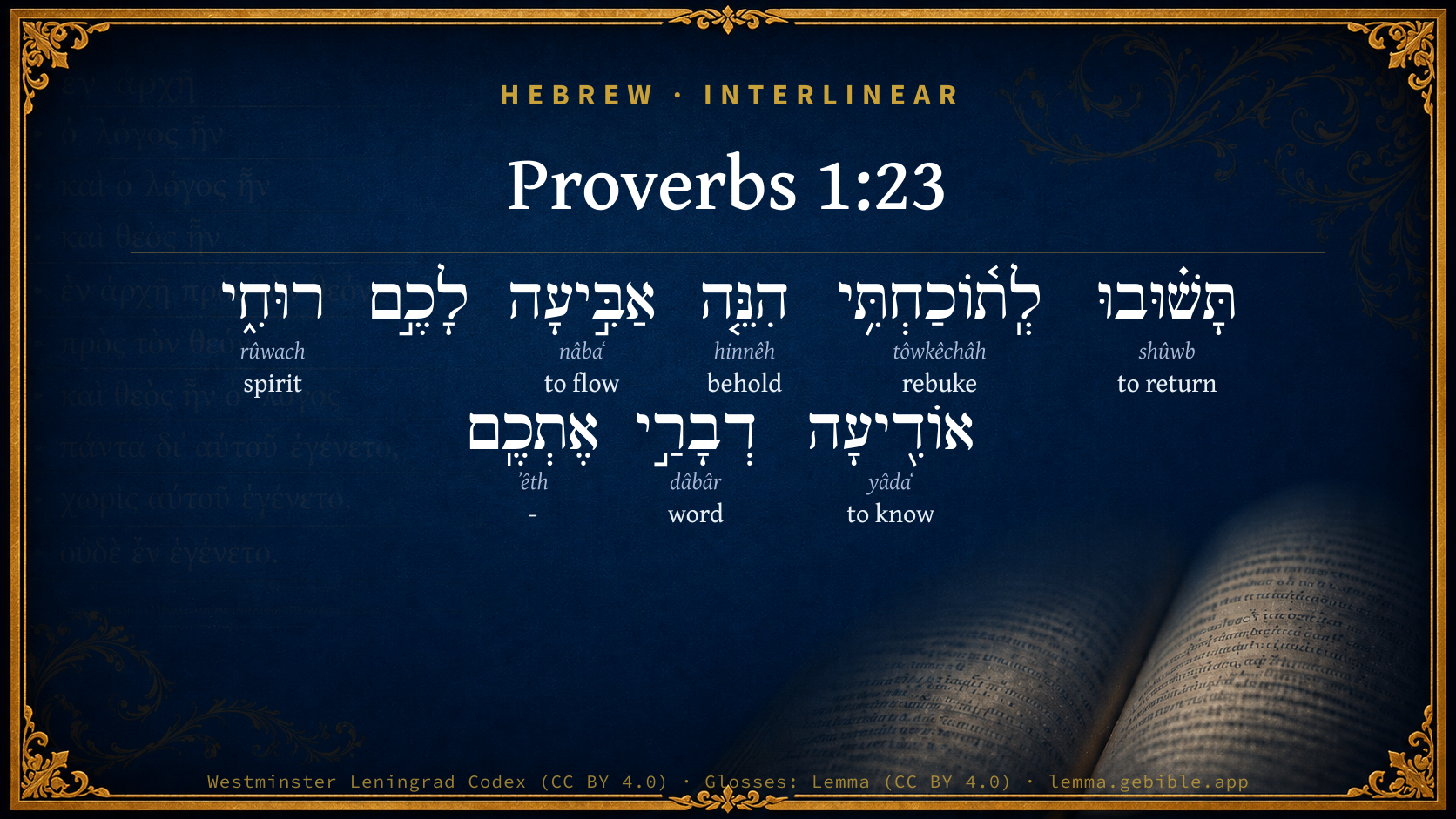
Hebrew (Westminster Leningrad Codex) Proverbs 1:23 appears in the Hebrew Old Testament. The text above is from the Westminster Leningrad Codex. Each word links to its Strong’s number, a concise gloss, and parsing drawn from the Open Scriptures Hebrew Bible morphology. Click any word for its full Brown-Driver-Briggs (BDB) entry.
Download image
Cite this verse

Proverbs 1:23 (World English Bible). Public Domain. Lemma interlinear Bible study tool, https://lemma.gebible.app/v/proverbs/1/23.

Show BibTeX & RIS
BibTeX
RIS
English Translation
Turn at my reproof. Behold, I will pour out my spirit on you. I will make known my words to you.
World English Bible · Public Domain
Download a study sheet

One document with this verse’s original text, its word-by-word gloss line, the meaning frame, cross-references with their text, attributed commentary, and full source and license credits — printable, and it pastes into notes with its structure intact.

This verse Autodidact and up

Study sheet (.html) Plain text (.txt)

A passage Seminary Student

Up to 50 verses in one chapter. A passage sheet keeps up to 6 commentary sources and 12 cross-references per verse, in the order this page ranks them, and says so on the sheet whenever that leaves anything out. Ask for a single verse and you get the Autodidact verse sheet above.

Everything on this page stays free to read, with no account — the sheet is a download of what is already on screen, not access to it.

Want to remove ads? Support Godless Engineer
Compare translations 3

The same verse in 3 English versions, stacked beneath the original-language interlinear above. Click any original word for its lexicon entry.

Each is an independent rendering of the whole verse — the interlinear is not word-aligned to these translations.

Highlighted words mark where these versions differ — a whole-verse word diff, not a word-by-word alignment.

  • World English Bible Public Domain
    Turn at my reproof. Behold, I will pour out my spirit on you. I will make known my words to you.
  • King James Version Public Domain
    Turn you at my reproof: behold, I will pour out my spirit unto you, I will make known my words unto you.
  • unfoldingWord Literal Text CC BY-SA 4.0
    Turn to my rebuke. Behold, I shall allow my spirit to gush forth to you, I shall cause you to know my words.

unfoldingWord Literal Text — © unfoldingWord, licensed CC BY-SA 4.0. Word-aligned USFM3 via Door43 (git.door43.org/unfoldingWord/en_ult).

Versions to compare (up to 4)

3 of 4 selected

Show all 18 translations

Every available English version of this verse, each an independent rendering of the whole verse.

  • World English Bible Public Domain
    Turn at my reproof. Behold, I will pour out my spirit on you. I will make known my words to you.
  • Berean Standard Bible Public Domain
    If you had repented at my rebuke, then surely I would have poured out my spirit on you; I would have made my words known to you.
  • Majority Standard Bible Public Domain
    If you had repented at my rebuke, then surely I would have poured out my spirit on you; I would have made my words known to you.
  • King James Version Public Domain
    Turn you at my reproof: behold, I will pour out my spirit unto you, I will make known my words unto you.
  • American Standard Version (1901) Public Domain
    Turn you at my reproof: Behold, I will pour out my spirit upon you; I will make known my words unto you.
  • Revised Version (1885) Public Domain
    Turn you at my reproof: behold, I will pour out my spirit unto you, I will make known my words unto you.
  • Geneva Bible (1599) Public Domain
    (Turne you at my correction: loe, I will powre out my mind vnto you, and make you vnderstand my wordes)
  • Douay-Rheims (1899) Public Domain
    Turn ye at my reproof: behold I will utter my spirit to you, and will shew you my words.
  • Young's Literal Translation Public Domain
    Turn back at my reproof, lo, I pour forth to you my spirit, I make known my words with you.
  • Literal Standard Version CC BY-SA 4.0
    Turn back at my reproof, behold, || I pour forth my spirit to you, || I make known my words with you.
  • Unlocked Literal Bible CC BY-SA 4.0
    Pay attention to my correction; I will pour out my thoughts to you; I will make my words known to you.
  • unfoldingWord Literal Text CC BY-SA 4.0
    Turn to my rebuke. Behold, I shall allow my spirit to gush forth to you, I shall cause you to know my words.
  • Darby Bible Public Domain
    Turn you at my reproof: behold, I will pour forth my spirit unto you, I will make known to you my words.
  • World Messianic Bible Public Domain
    Turn at my reproof. Behold, I will pour out my spirit on you. I will make known my words to you.
  • Webster's Bible Public Domain
    Turn you at my reproof: behold, I will pour out my spirit to you, I will make known to you my words.
  • Free Bible Version CC BY-SA 4.0
    Pay attention to my warnings, and I'll pour out my deepest thoughts to you—I'll explain what I know to you.
  • Bible in Basic English Public Domain
    Be turned again by my sharp words: see, I will send the flow of my spirit on you, and make my words clear to you.
  • JPS Tanakh (1917) Public Domain
    Turn you at my reproof; behold, I will pour out my spirit unto you, I will make known my words unto you.

Literal Standard Version (2020), Covenant Press — licensed CC BY-SA 4.0. Text via the HelloAO Bible API (eBible.org). Unlocked Literal Bible (unfoldingWord) — licensed CC BY-SA 4.0. Text via the HelloAO Bible API (eBible.org). unfoldingWord Literal Text — © unfoldingWord, licensed CC BY-SA 4.0. Word-aligned USFM3 via Door43 (git.door43.org/unfoldingWord/en_ult). Free Bible Version, Dr. Jonathan Gallagher — licensed CC BY-SA 4.0. Text via the HelloAO Bible API (eBible.org).

Word by word

More ways to search: Search by grammar → Find every occurrence → Compare this word →

Practice this passage: Drill this verse → Learn its vocabulary →

אַבִּ֣יעָה
nâbaʻ
H5042
“to flow”
Verb, Hiphil, Cohortative, 1st Person, Common, Singular
Part of Speech
Verb
Stem
Hiphil
Form
Cohortative
Person
1st Person
Gender
Common
Number
Singular
Full BDB Definition

Origin: a primitive root

TWOT: 1287

to flow, pour out, pour, gush forth, spring, bubble up, ferment - (Qal) to flow - (Hiphil) to pour out, emit, cause to bubble, belch forth - to pour out - to cause to bubble, ferment - to pour forth, emit, belch forth
  1. תָּשׁ֗וּבוּ shûwb H7725 “to return” Verb, Qal, Imperfect, 2nd Person, Masculine, Plural
  2. לְֽת֫וֹכַחְתִּ֥י tôwkêchâh H8433 “to/for · rebuke · my” Preposition + Noun, Common, Feminine, Singular, Construct + Suffix, Personal, 1st Person, Common, Singular
  3. הִנֵּ֤ה hinnêh H2009 “behold” Particle, Demonstrative
  4. רוּחִ֑י rûwach H7307 “spirit · my” Noun, Common, Both, Singular, Construct + Suffix, Personal, 1st Person, Common, Singular
  5. אוֹדִ֖יעָה yâdaʻ H3045 “to know” Verb, Hiphil, Cohortative, 1st Person, Common, Singular
  6. דְבָרַ֣י dâbâr H1697 “words · my” Noun, Common, Masculine, Plural, Construct + Suffix, Personal, 1st Person, Common, Singular
  7. אֶתְכֶֽם ʼêth H853 “- · you” Particle, Direct Object + Suffix, Personal, 2nd Person, Masculine, Plural

About this verse

These counts appear in no published source. They are computed here, from the morphology-tagged text and Lemma’s own curated glosses. What Lemma adds →

9
words
8
distinct lemmas
Wisdom
section

Notable vocabulary

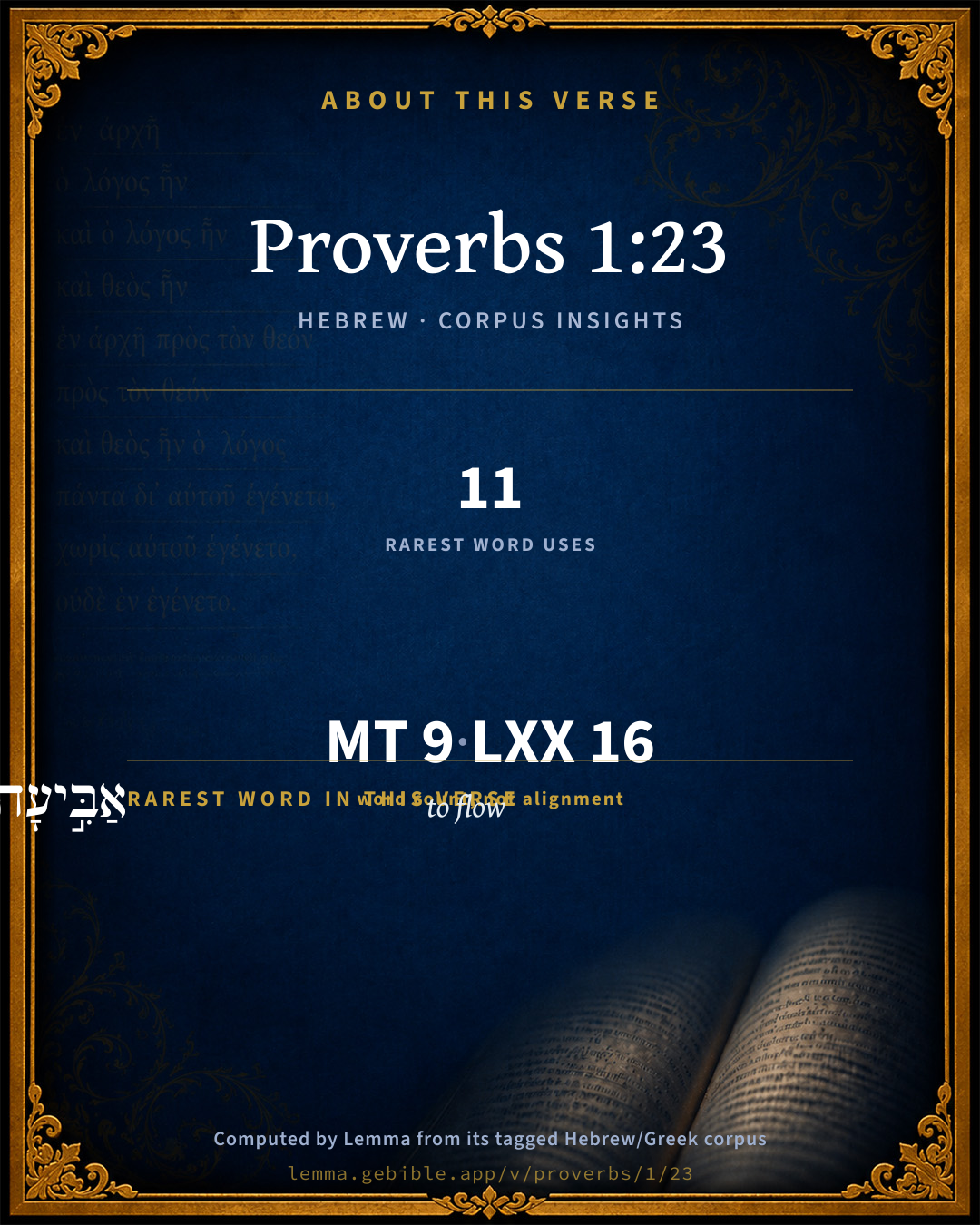
The rarest word here is אַבִּ֣יעָה to flow H5042 — appearing just 11 times in the whole Hebrew Bible.

Shared distinctive vocabulary

אַבִּ֣יעָה to flow H5042 occurs in 11 verses of the Hebrew Bible. Also found in:

Grammatical profile

  • 3 verbs
  • 3 nouns
  • 1 preposition
  • 2 particles

Verb forms

  • תָּשׁ֗וּבוּ Qal · Imperfect
  • אַבִּ֣יעָה Hiphil · Cohortative
  • אוֹדִ֖יעָה Hiphil · Cohortative

Hebrew & Septuagint length

In English translation the verse runs 21 words from the Hebrew and 20 from the Septuagint (LXX English) — closely comparable.

A rough comparison of the two English renderings, which tokenize alike — not a word-level alignment.

Word counts can differ between the Hebrew and the Greek without any difference in meaning — e.g. the Hebrew direct-object marker אֵת has no separate Greek word, and Greek often adds the article ὁ.

In the original languages it is 9 Hebrew tokens and 16 Greek tokens — but the two are counted differently (Hebrew bundles its prefixes and suffixes into one token; the Greek is in lemma form), so that isn’t a like-for-like length.

Cross-references

23

Topical passages linked to Proverbs 1:23 in the Treasury of Scripture Knowledge — connected by theme and wording, ordered by reader-vote popularity; previews shown in the World English Bible.

  • Ezekiel 33:11 Tell them, As I live, says the Lord Yahweh, I have no pleasure in the death of the wicked; but that the wicked turn from his way and live: turn you, turn you from your evil ways; for why will you die, house of Israel?
  • Acts 3:19 "Repent therefore, and turn again, that your sins may be blotted out, so that there may come times of refreshing from the presence of the Lord,
  • Ezekiel 18:27–30 Again, when the wicked man turns away from his wickedness that he has committed, and does that which is lawful and right, he shall save his soul alive.
  • Acts 2:36–38 "Let all the house of Israel therefore know assuredly that God has made him both Lord and Christ, this Jesus whom you crucified."
  • Joel 2:28 "It will happen afterward, that I will pour out my Spirit on all flesh; And your sons and your daughters will prophesy. Your old men will dream dreams. Your young men will see visions.
  • Isaiah 32:15 until the Spirit be poured on us from on high, and the wilderness become a fruitful field, and the fruitful field be esteemed as a forest.
  • Isaiah 55:6–7 Seek you Yahweh while he may be found; call you on him while he is near:
  • Proverbs 12:1 Whoever loves correction loves knowledge, But he who hates reproof is stupid.
  • Isaiah 55:1–3 Ho, everyone who thirsts, come you to the waters, and he who has no money; come you, buy, and eat; yes, come, buy wine and milk without money and without price.
  • Zechariah 12:10 I will pour on the house of David, and on the inhabitants of Jerusalem, the spirit of grace and of supplication; and they will look to me whom they have pierced; and they shall mourn for him, as one mourns for his only son, and will grieve bitterly for him, as one grieves for his firstborn.
  • Luke 11:13 If you then, being evil, know how to give good gifts to your children, how much more will your heavenly Father give the Holy Spirit to those who ask him?"
  • Acts 26:20 but declared first to them of Damascus, at Jerusalem, and throughout all the country of Judea, and also to the Gentiles, that they should repent and turn to God, doing works worthy of repentance.
  • Revelation 3:16–19 So, because you are lukewarm, and neither hot nor cold, I will vomit you out of my mouth.
  • Proverbs 10:17 He is in the way of life who heeds correction, But he who forsakes reproof leads others astray.
  • John 7:36–37 What is this word that he said, 'You will seek me, and won't find me; and where I am, you can't come?'"
  • Psalms 145:1 I will exalt you, my God, the King. I will praise your name forever and ever.
  • Proverbs 29:1 He who is often rebuked and stiffens his neck Will be destroyed suddenly, with no remedy.
  • Isaiah 45:8 Distil, you heavens, from above, and let the skies pour down righteousness: let the earth open, that it may bring forth salvation, and let it cause righteousness to spring up together; I, Yahweh, have created it.
  • Proverbs 1:30 They wanted none of my counsel. They despised all my reproof.
  • Jeremiah 3:14 Return, backsliding children, says Yahweh; for I am a husband to you: and I will take you one of a city, and two of a family, and I will bring you to Zion:
  • Hosea 14:1 Israel, return to Yahweh your God; For you have fallen because of your sin.
  • Proverbs 1:25 But you have ignored all my counsel, And wanted none of my reproof;
  • Proverbs 6:23 For the commandment is a lamp, And the law is light. Reproofs of instruction are the way of life,

Cross-references courtesy of OpenBible.info (CC BY 4.0).

Hebrew and Greek witnesses Masoretic Hebrew ↔ Greek Septuagint

The same verse in the two great witnesses to the Old Testament, shown verse-for-verse.

These are two independent witnesses, not word-aligned to each other, and the Septuagint is shown in lemma (dictionary) form.

Hebrew Proverbs 1:23 Masoretic · Westminster Leningrad Codex

תָּשׁ֗וּבוּ לְֽת֫וֹכַחְתִּ֥י הִנֵּ֤ה אַבִּ֣יעָה לָכֶ֣ם רוּחִ֑י אוֹדִ֖יעָה דְבָרַ֣י אֶתְכֶֽם

Turn at my reproof. Behold, I will pour out my spirit on you. I will make known my words to you.

World English Bible · Public Domain

Greek LXX Proverbs 1:23 Septuagint · lemma form

καί ὑπεύθυνος γίγνομαι ἔλεγχος ἰδού προἵημι σύ ἐμός πνοή ῥῆσις διδάσκω δέ σύ ὁ ἐμός λόγος

Behold, I will bring forth to you the utterance of my breath, and I will instruct you in my speech.

LXX2012 (modern English Septuagint) · Public Domain

On this verse, The Pulpit Commentary discusses the Septuagint’s reading. Read the note in Commentary ↓

Hebrew: Westminster Leningrad Codex (CC BY 4.0). Greek: Septuagint (public domain); English from LXX2012 (modern English Septuagint) (Public Domain). How the Septuagint differs from the Hebrew →

Commentary

Notes on Proverbs 1:23 from classic Christian and Jewish commentators (each source and its license shown beneath its notes). The classic Christian expositions comment on the surrounding passage and are grouped to its opening verse, so a note may address several verses; the Jewish commentaries on the Tanakh (Rashi and others) are per-verse, so they appear only where the commentator wrote on this verse.

Lemma curates 59 commentaries, every one of them public domain or Creative Commons licensed, each selected and text-cleaned for this edition rather than reprinted as found. About our sources →

Trapp's Complete Commentary

John Trapp

Pro 1:23 Turn you at my reproof: behold, I will pour out my spirit unto you, I will make known my words unto you.

Ver. 23. Turn you at my reproof.] He that reproves, and then directs not how to do better, is as he that snuffs a lamp, but pours not in oil to maintain it.

Behold, I will pour out my Spirit.] Now, if men make their hearts as an adamant, lest they should hear, &c., and wilfully withstand the Spirit, let them read their neck-verse in the following words, and in that parallel text. {Zec 7:11-13} Resisting the Spirit is a step to the unpardonable sin.

John Trapp, A Commentary or Exposition upon All the Books of the Old and New Testament (1647–1656) — public domain. Text from a community e-Sword module.

Tyndale Open Study Notes

Tyndale Open Resources

1:23 Wisdom invites all three groups (1:22) to come so she can make them wise. An intimate relationship with Wisdom means entering an intimate relationship with God, the foundation of true knowledge (1:7; see Job 28).

Tyndale Open Study Notes — © Tyndale Open Resources, licensed CC BY-SA 4.0. Text via the HelloAO Bible API.

Jamieson, Fausset & Brown

Robert Jamieson, A. R. Fausset & David Brown

reproof--implying conviction deserving it (compare Joh 16:8, Margin).

pour out--abundantly impart.

my spirit--whether of wisdom personified, or of Christ, a divine agent.

Jamieson, Fausset & Brown — Commentary Critical and Explanatory on the Whole Bible (1871) — public domain (CC PDM 1.0). Text via the HelloAO Bible API.

Adam Clarke's Commentary

Verse 23. Turn you at my reproof] לתוכחתי lethochachti, at my convincing mode of arguing; attend to my demonstrations. This is properly the meaning of the original word.

I will pour out my spirit unto you] "I wil expresse my mynde unto you;" COVERDALE. Loo I shall bryngen to you my Spirit; Old MS. Bible. If you will hear, ye shall have ample instruction.

Adam Clarke's Commentary on the Bible (1810–1826) — public domain. Text from a community e-Sword/MySword module.

Ellicott's Commentary for English Readers

(23) I will pour out my spirit unto you.—Comp. the prophecy of Joe_2:28, promised by our Lord (Joh_7:38-39), and fulfilled at Pentecost (Act_2:17).

I will make known my words unto you.—For a similar promise that God’s will shall be revealed to those who fear and follow Him, comp. Psa_25:14 : “The secret of the Lord is with them that fear him;” and Christ’s promise: “If any man will do God’s will, he shall know of the doctrine,” &c. (Joh_7:17).

A Bible Commentary for English Readers, edited by Charles John Ellicott (1878–1897) — public domain. Text from a community e-Sword module.

The Cambridge Bible for Schools and Colleges

gen. ed. J. J. S. Perowne

23. We have here the germ both of later prophecies (Isa_44:3; Joe_2:28 [Heb_3:1]), and of their fulfilment in Christ (Joh_7:37-39; Act_2:33; Joh_7:17).

The Cambridge Bible for Schools and Colleges (gen. ed. J. J. S. Perowne; Cambridge University Press, 1878–1918) — public domain. Text from a community e-Sword module.

John Gill's Exposition

Turn ye at my reproof,.... Or rather "to my reproof", for the words are not an exhortation to the conversion of the heart, or to him repentance; but to an attendance to the external ministry of the word preached, which reproves of sin, righteousness, and judgment; and does not design the turning of the heart to it, which is God's work, but the turning of the face and ears to hear it; and so the Targum,

"turn your face to my reproof,''

and not your backs, as they did, showing a dislike of it; or, as Aben Ezra,

"turn ye to hear my reproof;''

turn your ears and listen to it, and do not pull away the shoulder, or stop your ears that you may not hear it;

behold, I will pour out my spirit unto you; not "upon you", but "unto you": for the Holy Spirit of God is not here designed, and the effusion of his gifts, ordinary and extraordinary, or of his special grace; but the mind of Wisdom, or Christ, as the word is used in Pro 29:11. Some interpret it, "here, my will" (d); the external revelation of his will made in the ministry of the word, by whom "grace and truth", the doctrines of grace and truth, "came" in their full extent, Joh 1:17; for as the doctrines of "grace were poured into his lips", Psa 45:2, so they were poured out by them again, out of his heart, as out of a fountain or well, as the word (e) here used signifies; which denotes the large and abundant revelation of the Gospel by Christ, and is mentioned as an encouragement to men to attend unto it; which sense is confirmed by what follows;

I will make known my words unto you; the doctrines of the Gospel, words of grace and wisdom, and such as never man spake as Christ did, his enemies being witnesses; the words of peace and reconciliation, of life and righteousness, and of eternal salvation, which were made known in a ministerial way by Christ and his apostles; but the Jews were such fools as to hate and despise the knowledge of these things; wherefore it follows:

(d) So some in Ben Melech. (e) "fluere, vel scaturire faciam", Baynus; "scatebrae instar effundam", Cocceius, Michaelis; "scaturiam", Gussetius; "ebulliam", Schultens; so Ben Melech.

John Gill's Exposition of the Whole Bible (1746–1763) — public domain (CC PDM 1.0). Text via the HelloAO Bible API.

Albert Barnes' Notes on the Bible

The teaching of Divine Wisdom is essentially the same as that of the Divine Word Joh 7:38-39. “Turning,” repentance and conversion, this is what she calls the simple to. The promise of the Spirit is also like His Joh 14:26. And with the spirit there are to be also the “words” of Wisdom. Not the “spirit” alone, nor “words” alone, but both together, each doing its appointed work - this is the divine instrumentality for the education of such as will receive it.

Albert Barnes' Notes on the Bible (1834–1885) — public domain. Text from a community e-Sword/MySword module.

Matthew Poole's English Annotations

Turn ye from your evil courses unto me.

At my reproof; upon this admonition here given to you. I will pour out; if you will do so, I will freely and abundantly impart unto you.

My spirit; either my mind, as spirit is taken, Psa 77:6; Pro 29:11; or the gifts and graces of my Spirit, which he hath promised to such persons, Luk 11:13; Joh 4:14; 7:39.

I will make known my words unto you; by my Spirit I will cause you truly and savingly to understand my word, which is hid from others, 2Co 4:3

Matthew Poole's English Annotations on the Holy Bible (1683–1685) — public domain. Text from a community e-Sword/MySword module.

Whedon's Commentary on the Bible

Daniel D. Whedon

23. Turn — Or, Would ye turn? a wish expressed interrogatively. You are going the wrong way, turn — the New Testament idea — be converted, turned about.

Reproof — Admonition, argument, or correction.

Pour out — Would cause my spirit to well up to you or within you, that is, the spirit or disposition of wisdom. “I will communicate my whole mind to you, and explain things in the clearest manner.” — Orton. The Speaker’s Com. thinks this anticipates Joe_2:28, and our Lord’s promise, Joh_14:26; Joh_15:26. The teacher seems to represent Wisdom as here pausing and waiting for the effect of her appeal. But, on the supposition that no response is given, no effect produced, then come the terrible denunciations of the following verses.

Daniel D. Whedon (gen. ed.), Commentary on the Old and New Testaments (1874–1909) — public domain. Text from a community e-Sword module.

The Pulpit Commentary

Turn you at my reproof. A call is here made to repentance. The meaning seems to be "return to my reproof," i.e. place yourselves under my reproof (as Gejerus, Delitzsch), the l Being represented by ad, as in the Vulgate: convertimini ad correptionem meam. It is susceptible, however, of a different reading, i.e. "in consequence of, or because of (propter), my reproof," the prefix l being found in Num_16:34, "They fled at the cry," i.e. because of the cry. Reproof (tjkwOt, thochakhath); i.e. rebuke, or correction, by words. The LXX elegcov conveys the argumentative conviction which will be present in the reproof.

The word occurs again in vers. 23, 25, and 30 of this chapter, and also in Pro_3:11 Pro_5:12 Pro_6:23 Pro_27:5 Pro_29:15. Behold, I will pour out my Spirit unto you. The promise consequent upon, and the encouragement to, repentance. The promise is conditioned if those addressed will heed the reproof of Wisdom, then she will pour forth her Spirit upon them, and cause them to know her words The verb hibbia (yBihi), "to stream forth, or gush out," is here used figuratively. The outflow of the Spirit of Wisdom will be like the abundant and continuous gushing forth of water from the spring or fountain. The verb unites in it the figures of abundant fulness and refreshing invigoration (Umbreit, Elster); comp. Pro_15:2, 28 Psa_59:7 Psa_119:171 Ecc_10:1. We have here striking anticipation of the prophecy of Joel. (Joe_2:28) The Spirit is that of Wisdom "and understanding, the Spirit of counsel and godly strength, the Spirit of knowledge and true godliness" (see Confirmation Office). The explanation of Beda, that it signifies her anger, is clearly inadmissible. I will make known my words unto you; i.e. as the LXX, "I will teach you my word" (didaxw ), or as the Vulgate "show" (ostendam), "expound, or make clear." My words (dvari); i.e. precepts, or doctrine, or secrets. An intimate relation subsists between the "Spirit" of Wisdom and her "words," with which it is parallel. The former is the illuminating, invigorating principle which infuses life and power into the "words" of Wisdom, which she has already given, and which are already in our possession. Wisdom stands in the same relation to her words as the Divine Logos does to his utterances, into which he infuses himself. "It is the Spirit that quickeneth; the flesh profiteth nothing: the words that I speak unto you, they are spirit, and they are life". (Joh_6:63. See Delitzsch,wardlaw, in loc. )

The Pulpit Commentary (1880–1919), ed. H.D.M. Spence-Jones & Joseph S. Exell — public domain. Text from a community e-Sword module.

John Wesley's Explanatory Notes

My words - By my spirit I will cause you to understand my word.

John Wesley, Explanatory Notes Upon the Whole Bible (1754–1765) — public domain. Text via the GEBible commentary corpus.

Keil & Delitzsch

C. F. Keil & F. Delitzsch

To the call to thoughtfulness which lies in the complaint "How long?" there follows the entreaty:

Turn ye at my reproof!

Behold! I would pour out my Spirit upon you,

I would make you to know my words.

23a is not a clause expressive of a wish, which with the particle expressive of a wish, which is wanting, would be תּשׁוּבוּ־נא, or according to Pro 23:1 and Pro 27:23 would be שׁוב תּשׁוּבוּ. The הנּה, introducing the principal clause, stamps 23a as the conditional clause; the relation of the expressions is as Isa 26:10; Job 20:24. תּשׁוּבוּ

(Note: In the Hagiographa everywhere written plene, with exception of Job 17:10.)

is not equivalent to si convertamini, which would require תּפנוּ, but to si revertamini; but לתוכהתּי

(Note: The Metheg belongs to the ת, under which it should be placed (and not to the ל), as the commencing sound of the second syllable before the tone-syllable; cf. Pro 1:25.)

does not therefore mean at my reproof, i.e., in consequence of it (Hitzig, after Num 16:34), but it is a constructio praegnans: turning and placing yourselves under my reproof. With תוכחת there is supposed an ἔλεγχος (lxx, Symm.): bringing proof, conviction, punishment. If they, leaving their hitherto accustomed way, permit themselves to be warned against their wickedness, then would Wisdom cause her words to flow forth to them, i.e., would without reserve disclose and communicate to them her spirit, cause them to know (namely by experience) her words. הבּיע (from נבע, R. נב; vid., Genesis, p. 635) is a common figurative word, expressive of the free pouring forth of thoughts and words, for the mouth is conceived of as a fountain (cf. Pro 18:4 with Mat 12:34), and the ῥῆσις (vid., lxx) as ῥεῦσις; only here it has the Spirit as object, but parallel with דּברי, thus the Spirit as the active power of the words, which, if the Spirit expresses Himself in them, are πνεῦμα καὶ ζωή, Joh 6:63. The addresses of Wisdom in the Book of Proverbs touch closely upon the discourses of the Lord in the Logos-Gospel. Wisdom appears here as the fountain of the words of salvation for men; and these words of salvation are related to her, just as the λόγοι to the divine λόγος expressing Himself therein.

Keil & Delitzsch — Biblical Commentary on the Old Testament (1861–1891) — public domain (CC PDM 1.0). Text via the HelloAO Bible API. (Old Testament only.)

unfoldingWord translationNotes

Door43 World Missions Community

General Information:

Wisdom continues to speak. (See: Personification)

Pay attention

"Listen carefully"

I will pour out my thoughts to you

Wisdom telling the people everything she thinks about them is spoken of as if her thoughts were a liquid that she would pour out. (See: Metaphor)

I will make my words known to you

"I will tell you what I think"

I reached out with my hand

This phrase is an idiom that means to beckon someone or to invite a person to come. AT: "I invited you to come to me" (See: Idiom)

translationWords

rebuke

word

know

call

instruct

unfoldingWord translationNotes — © Distant Shores Media and the Door43 World Missions Community, licensed CC BY-SA 4.0. Source: git.door43.org/Door43/en_tn.

Lesson kit

Teaching starters — assembled from the data on this page, not authored interpretation. Every prompt links to the verse data it draws on. Edit before teaching.

Proverbs, in the Wisdom, opens this verse with 9 words (8 distinct Hebrew lemmas). Its most distinctive word is nâbaʻ (“to flow”). A historical commentator’s framing appears above. Read the whole chapter for the surrounding context.

Discussion questions

  1. How does “to flow” (nâbaʻ) shape what this verse is saying?
  2. How does Psalms 19:2, which shares the word «to flow», read alongside this verse?
  3. These translations render this verse differently. What is at stake in choosing one wording over another?
  4. «תָּשׁ֗וּבוּ» is a Qal Imperfect verb. How does that grammatical form shape the action described?
  5. Compare how Trapp's Complete Commentary and Tyndale Open Study Notes read this verse. Where do they agree or differ?

Things to notice

Reading settings

Reading text

Shown beneath each verse's original-language words.

Old Testament
Old Testament edition

Read the OT as the Masoretic Hebrew (MT) or the Greek Septuagint (LXX).

English shown for the Greek Septuagint (in the Hebrew ↔ Greek comparison).

Comparing translations? Open the Compare panel on any verse page to stack up to four side by side.