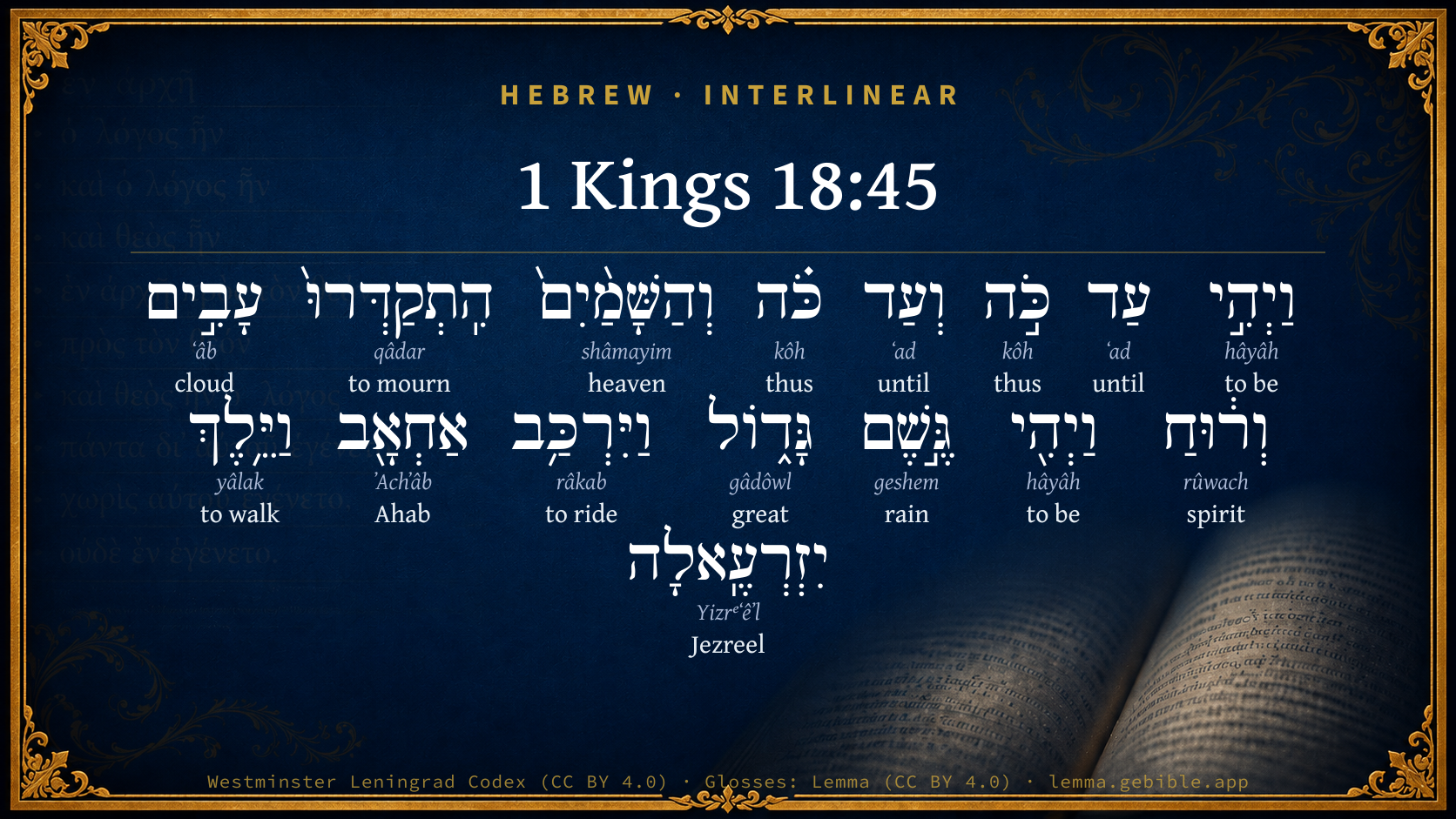
1 Kings 18:45

Hebrew (Westminster Leningrad Codex) 1 Kings 18:45 appears in the Hebrew Old Testament. The text above is from the Westminster Leningrad Codex. Each word links to its Strong’s number, a concise gloss, and parsing drawn from the Open Scriptures Hebrew Bible morphology. Click any word for its full Brown-Driver-Briggs (BDB) entry.
Download image
Cite this verse

1 Kings 18:45 (World English Bible). Public Domain. Lemma interlinear Bible study tool, https://lemma.gebible.app/v/1-kings/18/45.

Show BibTeX & RIS
BibTeX
RIS
English Translation
It happened in a little while, that the sky grew black with clouds and wind, and there was a great rain. Ahab rode, and went to Jezreel:
World English Bible · Public Domain
Highlights
  • 1 first appearance in the Hebrew Bible
Full analysis ↓
Download a study sheet

One document with this verse’s original text, its word-by-word gloss line, the meaning frame, cross-references with their text, attributed commentary, and full source and license credits — printable, and it pastes into notes with its structure intact.

This verse Autodidact and up

Study sheet (.html) Plain text (.txt)

A passage Seminary Student

Up to 50 verses in one chapter. A passage sheet keeps up to 6 commentary sources and 12 cross-references per verse, in the order this page ranks them, and says so on the sheet whenever that leaves anything out. Ask for a single verse and you get the Autodidact verse sheet above.

Everything on this page stays free to read, with no account — the sheet is a download of what is already on screen, not access to it.

Want to remove ads? Support Godless Engineer
Compare translations 3

The same verse in 3 English versions, stacked beneath the original-language interlinear above. Click any original word for its lexicon entry.

Each is an independent rendering of the whole verse — the interlinear is not word-aligned to these translations.

Highlighted words mark where these versions differ — a whole-verse word diff, not a word-by-word alignment.

  • World English Bible Public Domain
    It happened in a little while, that the sky grew black with clouds and wind, and there was a great rain. Ahab rode, and went to Jezreel:
  • King James Version Public Domain
    And it came to pass in the mean while, that the heaven was black with clouds and wind, and there was a great rain. And Ahab rode, and went to Jezreel.
  • unfoldingWord Literal Text CC BY-SA 4.0
    And it happened to thus and to thus that the heavens darkened clouds and wind, and was a great shower. And Ahab rode and went to Jezreel.

unfoldingWord Literal Text — © unfoldingWord, licensed CC BY-SA 4.0. Word-aligned USFM3 via Door43 (git.door43.org/unfoldingWord/en_ult).

Versions to compare (up to 4)

3 of 4 selected

Show all 18 translations

Every available English version of this verse, each an independent rendering of the whole verse.

  • World English Bible Public Domain
    It happened in a little while, that the sky grew black with clouds and wind, and there was a great rain. Ahab rode, and went to Jezreel:
  • Berean Standard Bible Public Domain
    Meanwhile, the sky grew dark with clouds and wind, and a heavy rain began to fall. So Ahab rode away and went to Jezreel.
  • Majority Standard Bible Public Domain
    Meanwhile, the sky grew dark with clouds and wind, and a heavy rain began to fall. So Ahab rode away and went to Jezreel.
  • King James Version Public Domain
    And it came to pass in the mean while, that the heaven was black with clouds and wind, and there was a great rain. And Ahab rode, and went to Jezreel.
  • American Standard Version (1901) Public Domain
    And it came to pass in a little while, that the heavens grew black with clouds and wind, and there was a great rain. And Ahab rode, and went to Jezreel:
  • Revised Version (1885) Public Domain
    And it came to pass in a little while, that the heaven grew black with clouds and wind, and there was a great rain. And Ahab rode, and went to Jezreel.
  • Geneva Bible (1599) Public Domain
    And in the meane while the heauen was blacke with cloudes and winde, and there was a great rayne. Then Ahab went vp and came to Izreel.
  • Douay-Rheims (1899) Public Domain
    And while he turned himself this way and that way, behold the heavens grew dark, with clouds, and wind, and there fell a great rain. And Achab getting up went away to Jezrahel:
  • Young's Literal Translation Public Domain
    And it cometh to pass, in the meantime, that the heavens have become black -- thick clouds and wind -- and the shower is great; and Ahab rideth, and goeth to Jezreel,
  • Literal Standard Version CC BY-SA 4.0
    And it comes to pass, in the meantime, that the heavens have become black—thick clouds and wind—and the shower is great; and Ahab rides, and goes to Jezreel,
  • Unlocked Literal Bible CC BY-SA 4.0
    It happened that in a little while the heavens grew black with clouds and wind, and there was a great rain. Ahab rode and went to Jezreel,
  • unfoldingWord Literal Text CC BY-SA 4.0
    And it happened to thus and to thus that the heavens darkened clouds and wind, and was a great shower. And Ahab rode and went to Jezreel.
  • Darby Bible Public Domain
    And it came to pass in the mean while, that the heavens became black [with] clouds and wind, and there was a great pour of rain. And Ahab got on the chariot, and went to Jizreel.
  • World Messianic Bible Public Domain
    In a little while, the sky grew black with clouds and wind, and there was a great rain. Ahab rode, and went to Jezreel.
  • Webster's Bible Public Domain
    And it came to pass in the mean while, that the heaven was black with clouds and wind, and there was a great rain. And Ahab rode, and went to Jezreel.
  • Free Bible Version CC BY-SA 4.0
    Very quickly the sky grew dark with clouds, the wind blew, heavy rain started falling, and Ahab rode down to Jezreel.
  • Bible in Basic English Public Domain
    And after a very little time, the heaven became black with clouds and wind, and there was a great rain. And Ahab went in his carriage to Jezreel.
  • JPS Tanakh (1917) Public Domain
    And it came to pass in a little while, that the heaven grew black with clouds and wind, and there was a great rain. And Ahab rode, and went to Jezreel.

Literal Standard Version (2020), Covenant Press — licensed CC BY-SA 4.0. Text via the HelloAO Bible API (eBible.org). Unlocked Literal Bible (unfoldingWord) — licensed CC BY-SA 4.0. Text via the HelloAO Bible API (eBible.org). unfoldingWord Literal Text — © unfoldingWord, licensed CC BY-SA 4.0. Word-aligned USFM3 via Door43 (git.door43.org/unfoldingWord/en_ult). Free Bible Version, Dr. Jonathan Gallagher — licensed CC BY-SA 4.0. Text via the HelloAO Bible API (eBible.org).

Word by word

More ways to search: Search by grammar → Find every occurrence → Compare this word →

Practice this passage: Drill this verse → Learn its vocabulary →

הִֽתְקַדְּרוּ֙
qâdar
H6937
“to mourn”
Verb, Hithpael, Perfect, 3rd Person, Common, Plural
Part of Speech
Verb
Stem
Hithpael
Form
Perfect
Person
3rd Person
Gender
Common
Number
Plural
Full BDB Definition

Origin: a primitive root

TWOT: 1989

to mourn, be dark - (Qal) to be dark - (Hiphil) - to darken - to cause to mourn - (Hithpael) to grow dark
  1. וַיְהִ֣י hâyâh H1961 “and · to be” Conjunction + Verb, Qal, Sequential Imperfect, 3rd Person, Masculine, Singular
  2. עַד ʻad H5704 “until” Preposition
  3. כֹּ֣ה kôh H3541 “thus” Adverb
  4. וְעַד ʻad H5704 “and · until” Conjunction + Preposition
  5. כֹּ֗ה kôh H3541 “thus” Adverb
  6. וְהַשָּׁמַ֨יִם֙ shâmayim H8064 “and · the · heaven(s)” Conjunction + Particle, Definite Article + Noun, Common, Masculine, Plural, Absolute
  7. עָבִ֣ים ʻâb H5645 “clouds” Noun, Common, Both, Plural, Absolute
  8. וְר֔וּחַ rûwach H7307 “and · spirit” Conjunction + Noun, Common, Both, Singular, Absolute
  9. וַיְהִ֖י hâyâh H1961 “and · to be” Conjunction + Verb, Qal, Sequential Imperfect, 3rd Person, Masculine, Singular
  10. גֶּ֣שֶׁם geshem H1653 “rain” Noun, Common, Masculine, Singular, Absolute
  11. גָּד֑וֹל gâdôwl H1419 “great” Adjective, Adjective, Masculine, Singular, Absolute
  12. וַיִּרְכַּ֥ב râkab H7392 “and · to ride” Conjunction + Verb, Qal, Sequential Imperfect, 3rd Person, Masculine, Singular
  13. אַחְאָ֖ב ʼAchʼâb H256 “Ahab” Noun, Proper
  14. וַיֵּ֥לֶךְ yâlak H3212 “and · to walk” Conjunction + Verb, Qal, Sequential Imperfect, 3rd Person, Masculine, Singular
  15. יִזְרְעֶֽאלָה Yizrᵉʻêʼl H3157 “Jezreel · toward” Noun, Proper + Suffix, Demonstrative

About this verse

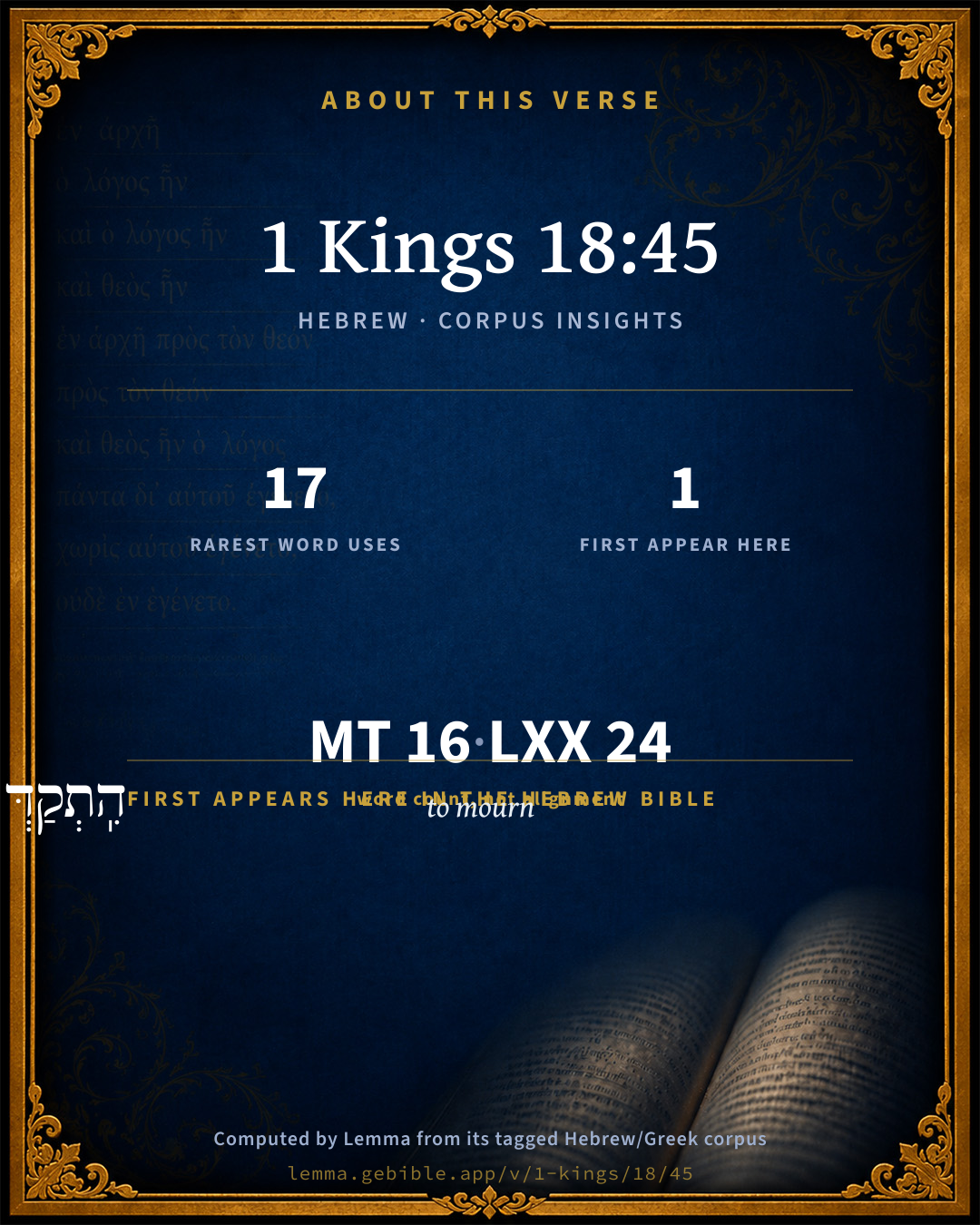
These counts appear in no published source. They are computed here, from the morphology-tagged text and Lemma’s own curated glosses. What Lemma adds →

16
words
13
distinct lemmas
Historical
section

Notable vocabulary

The rarest word here is הִֽתְקַדְּרוּ֙ to mourn H6937 — appearing just 17 times in the whole Hebrew Bible.

First appearance in Scripture

This word makes its first canonical appearance in the Hebrew Bible here:

  • הִֽתְקַדְּרוּ֙ to mourn H6937

Shared distinctive vocabulary

הִֽתְקַדְּרוּ֙ to mourn H6937 occurs in 17 verses of the Hebrew Bible. Also found in:

Grammatical profile

  • 5 verbs
  • 6 nouns
  • 1 adjective
  • 2 prepositions
  • 2 adverbs

Verb forms

  • וַיְהִ֣י Qal · Sequential Imperfect
  • הִֽתְקַדְּרוּ֙ Hithpael · Perfect
  • וַיְהִ֖י Qal · Sequential Imperfect
  • וַיִּרְכַּ֥ב Qal · Sequential Imperfect
  • וַיֵּ֥לֶךְ Qal · Sequential Imperfect

Repetition

Words recur within this verse — often emphatic in Hebrew:

  • וַיְהִ֣י to be H1961 ×2
  • עַד until H5704 ×2
  • כֹּ֣ה thus H3541 ×2

Hebrew & Septuagint length

In English translation the verse runs 27 words from the Hebrew and 30 from the Septuagint (LXX English) — closely comparable.

A rough comparison of the two English renderings, which tokenize alike — not a word-level alignment.

Word counts can differ between the Hebrew and the Greek without any difference in meaning — e.g. the Hebrew direct-object marker אֵת has no separate Greek word, and Greek often adds the article ὁ.

In the original languages it is 16 Hebrew tokens and 24 Greek tokens — but the two are counted differently (Hebrew bundles its prefixes and suffixes into one token; the Greek is in lemma form), so that isn’t a like-for-like length.

Cross-references

8

Topical passages linked to 1 Kings 18:45 in the Treasury of Scripture Knowledge — connected by theme and wording, ordered by reader-vote popularity; previews shown in the World English Bible.

  • Numbers 25:8 and he went after the man of Israel into the pavilion, and thrust both of them through, the man of Israel, and the woman through her body. So the plague was stayed from the children of Israel.
  • Joshua 17:16 The children of Joseph said, The hill-country is not enough for us: and all the Canaanites who dwell in the land of the valley have chariots of iron, both they who are in Beth-shean and its towns, and they who are in the valley of Jezreel.
  • Joshua 19:18 Their border was to Jezreel, and Chesulloth, and Shunem,
  • 2 Samuel 21:14 They buried the bones of Saul and Jonathan his son in the country of Benjamin in Zela, in the tomb of Kish his father: and they performed all that the king commanded. After that God was entreated for the land.
  • 1 Kings 18:39–40 When all the people saw it, they fell on their faces: and they said, Yahweh, he is God; Yahweh, he is God.
  • 1 Kings 21:1 It happened after these things, that Naboth the Jezreelite had a vineyard, which was in Jezreel, hard by the palace of Ahab king of Samaria.
  • 1 Kings 21:23 Of Jezebel also spoke Yahweh, saying, The dogs shall eat Jezebel by the rampart of Jezreel.
  • 2 Kings 9:16 So Jehu rode in a chariot, and went to Jezreel; for Joram lay there. Ahaziah king of Judah was come down to see Joram.

Cross-references courtesy of OpenBible.info (CC BY 4.0).

Hebrew and Greek witnesses Masoretic Hebrew ↔ Greek Septuagint

The same verse in the two great witnesses to the Old Testament, shown verse-for-verse.

These are two independent witnesses, not word-aligned to each other, and the Septuagint is shown in lemma (dictionary) form.

Hebrew 1 Kings 18:45 Masoretic · Westminster Leningrad Codex

וַיְהִ֣י עַד כֹּ֣ה וְעַד כֹּ֗ה וְהַשָּׁמַ֨יִם֙ הִֽתְקַדְּרוּ֙ עָבִ֣ים וְר֔וּחַ וַיְהִ֖י גֶּ֣שֶׁם גָּד֑וֹל וַיִּרְכַּ֥ב אַחְאָ֖ב וַיֵּ֥לֶךְ יִזְרְעֶֽאלָה

It happened in a little while, that the sky grew black with clouds and wind, and there was a great rain. Ahab rode, and went to Jezreel:

World English Bible · Public Domain

Greek LXX 1 Kings 18:45 Septuagint · lemma form

καί γίγνομαι ἕως ὧδε καί ὧδε καί ὁ οὐρανός συνσκοτίζω νεφέλη καί πνεῦμα καί γίγνομαι ὑετός μέγας καί κλαίω καί πορεύομαι αχααβ εἰς ιεζραελ

And it came to pass in the meanwhile, that the heaven grew black with clouds and wind, and there was a great rain. And Achaab wept, and went to Jezrael.

LXX2012 (modern English Septuagint) · Public Domain

On this verse, The Cambridge Bible for Schools and Colleges discusses the Septuagint’s reading. Read the note in Commentary ↓

Hebrew: Westminster Leningrad Codex (CC BY 4.0). Greek: Septuagint (public domain); English from LXX2012 (modern English Septuagint) (Public Domain). How the Septuagint differs from the Hebrew →

Targum (Aramaic paraphrase)

1

The Targum is the ancient Jewish Aramaic paraphrase of the Hebrew Scriptures — an interpretive translation, not the Hebrew text itself. Onkelos (literal) and Pseudo-Jonathan (expansive) render the Torah, and Jonathan the Prophets. Coverage is partial: where no permissively-licensed English translation exists for a verse, only the Aramaic is shown. This is verse-level text, not a word-by-word alignment to the Hebrew.

  1. Targum Jonathan Prophets (Joshua–Malachi)
    וַהֲוָה עַד דְמִזְדָרַז וְנָחִית וּשְׁמַיָא אִתְחַפִּיאוּ עַנָנָא וְרוּחָא וַהֲוָה מְטַר סַגִי וּרְכִיב אַחְאָב וַאֲזַל לְיִזְרְעֶאל:

    (no public-domain English translation for this verse)

    Targum Jonathan — Aramaic: “Mikraot Gedolot” (public domain). English: “Sefaria Community Translation” (CC0 1.0 (public-domain dedication)); “London "Chaldee Paraphrase," 1871” (public domain). Text via Sefaria.

Commentary

Notes on 1 Kings 18:45 from classic Christian and Jewish commentators (each source and its license shown beneath its notes). The classic Christian expositions comment on the surrounding passage and are grouped to its opening verse, so a note may address several verses; the Jewish commentaries on the Tanakh (Rashi and others) are per-verse, so they appear only where the commentator wrote on this verse.

Lemma curates 59 commentaries, every one of them public domain or Creative Commons licensed, each selected and text-cleaned for this edition rather than reprinted as found. About our sources →

Trapp's Complete Commentary

John Trapp

1Ki 18:45 And it came to pass in the mean while, that the heaven was black with clouds and wind, and there was a great rain. And Ahab rode, and went to Jezreel.

Ver. 45. And there was a great rain,] sc., Upon the prayer of Elias. And the like was done for the thundering legion, as they called them, the Christians in M. Aurelius’ army.

John Trapp, A Commentary or Exposition upon All the Books of the Old and New Testament (1647–1656) — public domain. Text from a community e-Sword module.

Geneva Bible (1599)

Geneva Bible translators

Or, here and there.

Geneva Bible (1599) marginal notes — public domain. Text via Bolls.life.

Jamieson, Fausset & Brown

Robert Jamieson, A. R. Fausset & David Brown

Ahab rode, and went to Jezreel--now Zerin, a distance of about ten miles. This race was performed in the midst of a tempest of rain. But all rejoiced at it, as diffusing a sudden refreshment over all the land of Jezreel.

Jamieson, Fausset & Brown — Commentary Critical and Explanatory on the Whole Bible (1871) — public domain (CC PDM 1.0). Text via the HelloAO Bible API.

Ellicott's Commentary for English Readers

(45) Jezreel.—This is the first mention of the city Jezreel, a city of Issachar (Jos_19:18), as a royal city. The name (signifying “Jehovah hath sown”) was applied to the whole of the rich plain, the garden and battlefield of northern Palestine. (See Jdg_6:33 : 1Sa_29:1; 2Sa_2:9.) The city was made a royal residence by Ahab, as Samaria by Omri. It stands in a position of some strength and great beauty, supplied by unfailing springs of water, visible from Carmel, and commanding views east and west far over the plain.

A Bible Commentary for English Readers, edited by Charles John Ellicott (1878–1897) — public domain. Text from a community e-Sword module.

The Cambridge Bible for Schools and Colleges

gen. ed. J. J. S. Perowne

45. in the mean while] [R.V. in a little while] The literal sense is ‘until so and until so.’ The expression is probably borrowed from a waving of the hand backward and forward, and means ‘before you could do that.’ Hence ‘in a little while’ seems to be the better rendering.

And Ahab rode] The LXX. says ‘Ahab wept.’ Ahab made his way to his palace (see 1Ki_21:2) at Jezreel, that he might report to Jezebel what had happened. Jezreel stood in the plain of Jezreel, in the tribe of Issachar, and became one of the most famous of the royal residences of the kings of Israel.

The Cambridge Bible for Schools and Colleges (gen. ed. J. J. S. Perowne; Cambridge University Press, 1878–1918) — public domain. Text from a community e-Sword module.

Haydock's Catholic Bible Commentary

Jezrahel, where Achab had a palace, chap. xxi. 1. (Calmet) --- He stopped for shelter, as he had not time to reach Samaria. (Menochius)

George Leo Haydock (1774–1849), Haydock's Catholic Family Bible and Commentary, 1859 edition — public domain. Excludes Psalms (Douay-Rheims chapter numbering differs from Protestant) and Deuterocanonical books (Catholic canon only).

Matthew Poole's English Annotations

Not that in Judah, Jos 15:56, but another city in the border of Issachar and Manasseh, Jos 19:18.

Matthew Poole's English Annotations on the Holy Bible (1683–1685) — public domain. Text from a community e-Sword/MySword module.

Whedon's Commentary on the Bible

Daniel D. Whedon

45. Ahab rode, and went to Jezreel — A distance of about twelve miles. The site of Jezreel is preserved in the modern village Zerin, which occupies a noble site on the western point of Mount Gilboa, about one hundred feet above the plain, and commands a wide view of the surrounding country. It is first mentioned in Jos_19:18, as belonging to the tribe of Issachar, but its chief fame is in its association with Ahab, who made it his royal residence. It did not supersede Samaria, but here Ahab built a palace, (1Ki_21:1,) and it was the summer residence of his dynasty for three successive reigns.

Daniel D. Whedon (gen. ed.), Commentary on the Old and New Testaments (1874–1909) — public domain. Text from a community e-Sword module.

The Pulpit Commentary

And it came to pass in the meanwhile Heb. unto thus and unto thus, i.e., till now and then (cf. Exo_7:16; Jos_17:14) Gesen., Bahr, al. support the rendering of the A.V Ewald, Keil, al. understand "while the hand is being moved hither and thither," i.e., very speedily. The practical difference is not great, that the heaven was black with clouds and wind, and there was a great rain. "The cry of the boy from his mountain watch had hardly been uttered when the storm broke upon the plain" (Stanley). "The storm" over "the dark slate-coloured ridge of Carmel," witnessed by Conder in 1872 "burst suddenly, the rain descending with violence, hissing on the ground, as if not able to come down fast enough, and accompanied with gusts of wind, thunder, and lightning." And Ahab rode, and went to Jezreel.

The Pulpit Commentary (1880–1919), ed. H.D.M. Spence-Jones & Joseph S. Exell — public domain. Text from a community e-Sword module.

unfoldingWord translationNotes

Door43 World Missions Community

It happened

This phrase is used here to mark where a new step in the action starts. If your language has a way for doing this, you could consider using it here.

the hand of Yahweh was on Elijah

Here the word "hand" is a metonym for strength. AT: "Yahweh gave his power to Elijah" (See: Metonymy)

tucked his robe in his belt

Elijah wrapped his long robe around his waist so that his legs would be free for running.

translationWords

heaven

Ahab

Jezreel

hand

Yahweh

robe

unfoldingWord translationNotes — © Distant Shores Media and the Door43 World Missions Community, licensed CC BY-SA 4.0. Source: git.door43.org/Door43/en_tn.

Rashi

Rabbi Shlomo Yitzchaki (Rashi)

In the meantime. While the messenger went, and while he harnessed [he horses to] the chariot, the sky grew dark.

Rashi on the Tanakh — English translations: “The Judaica Press complete Tanach with Rashi, translated by A. J. Rosenberg” (CC BY 4.0); “Pentateuch with Rashi's commentary by M. Rosenbaum and A.M. Silbermann, 1929-1934” (public domain); “The Metsudah Tanach series, Lakewood, N.J” (CC BY 4.0); and “The Book of Joshua, Metsudah Publications, 1997” (CC BY 4.0). Text via Sefaria.

Lesson kit

Teaching starters — assembled from the data on this page, not authored interpretation. Every prompt links to the verse data it draws on. Edit before teaching.

1 Kings, in the Historical, opens this verse with 16 words (13 distinct Hebrew lemmas). Its most distinctive word is qâdar (“to mourn”). A historical commentator’s framing appears above. Read the whole chapter for the surrounding context.

Discussion questions

  1. How does “to mourn” (qâdar) shape what this verse is saying?
  2. This is the first place “to mourn” appears in Scripture (first appears here). What does its debut here establish?
  3. How does Job 5:11, which shares the word «to mourn», read alongside this verse?
  4. What does the repetition of “to be” (2× in this one verse) do in this verse?
  5. These translations render this verse differently; the difference is in the English rendering, not the original. What questions does that raise?
  6. «וַיְהִ֣י» is a Qal Sequential Imperfect verb. How does that grammatical form shape the action described?
  7. Compare how Trapp's Complete Commentary and Geneva Bible (1599) read this verse. Where do they agree or differ?

Things to notice

Reading settings

Reading text

Shown beneath each verse's original-language words.

Old Testament
Old Testament edition

Read the OT as the Masoretic Hebrew (MT) or the Greek Septuagint (LXX).

English shown for the Greek Septuagint (in the Hebrew ↔ Greek comparison).

Comparing translations? Open the Compare panel on any verse page to stack up to four side by side.