
Exodus 28:3

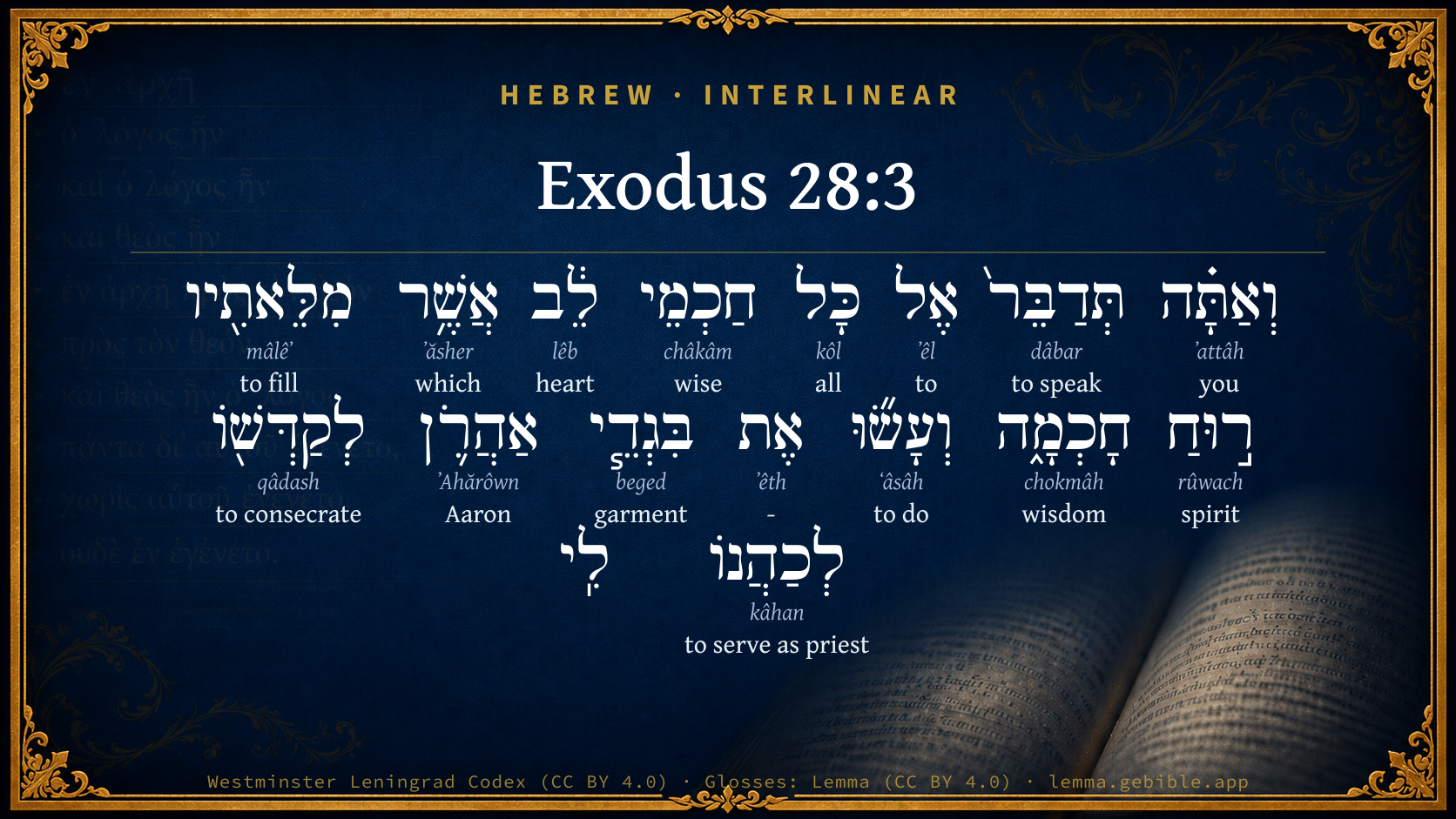
Hebrew (Westminster Leningrad Codex) Exodus 28:3 appears in the Hebrew Old Testament. The text above is from the Westminster Leningrad Codex. Each word links to its Strong’s number, a concise gloss, and parsing drawn from the Open Scriptures Hebrew Bible morphology. Click any word for its full Brown-Driver-Briggs (BDB) entry.
Download image
Cite this verse

Exodus 28:3 (World English Bible). Public Domain. Lemma interlinear Bible study tool, https://lemma.gebible.app/v/exodus/28/3.

Show BibTeX & RIS
BibTeX
RIS
English Translation
You shall speak to all who are wise-hearted, whom I have filled with the spirit of wisdom, that they make Aaron's garments to sanctify him, that he may minister to me in the priest's office.
World English Bible · Public Domain
Highlights
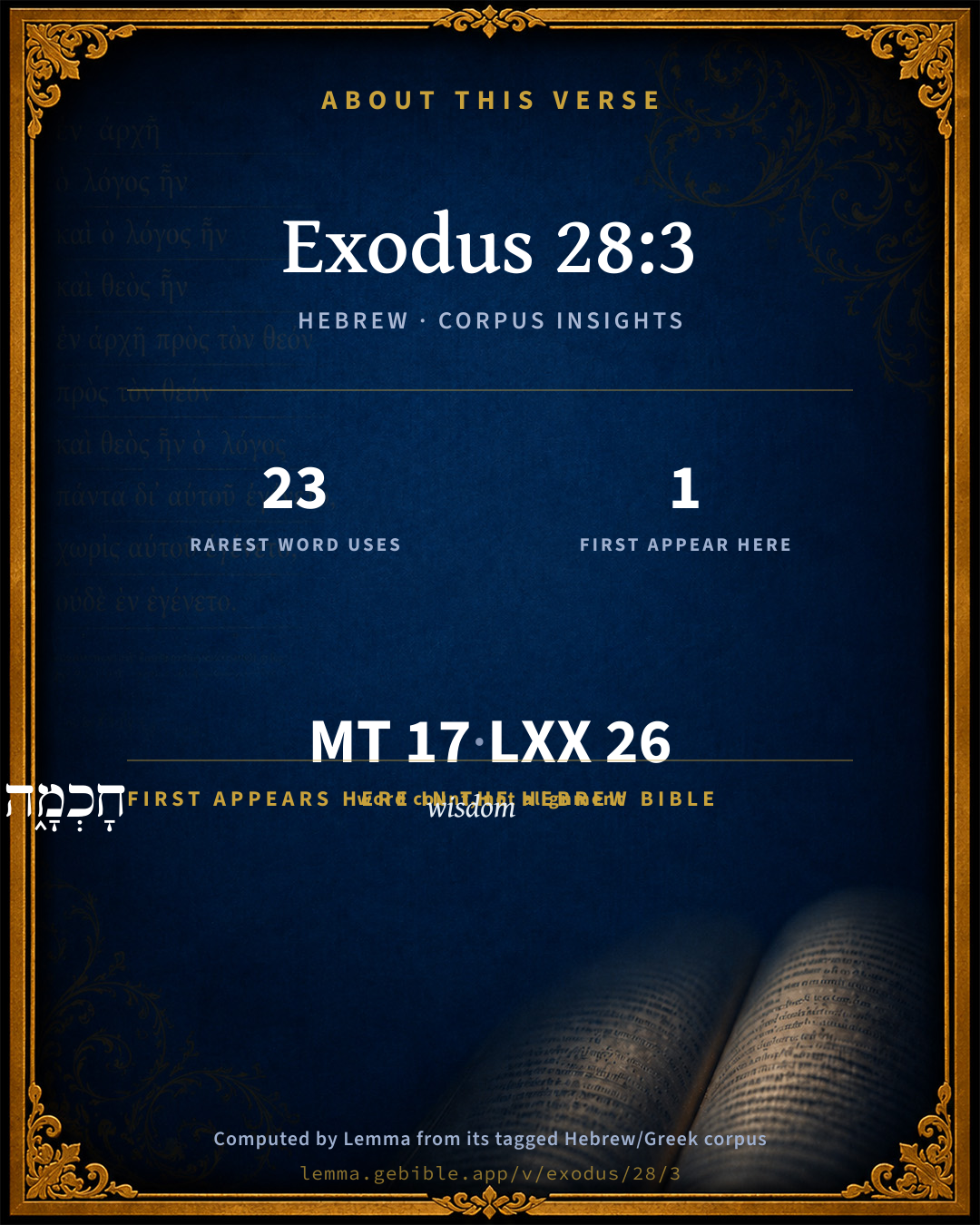
  • 1 first appearance in the Hebrew Bible
Full analysis ↓
Download a study sheet

One document with this verse’s original text, its word-by-word gloss line, the meaning frame, cross-references with their text, attributed commentary, and full source and license credits — printable, and it pastes into notes with its structure intact.

This verse Autodidact and up

Study sheet (.html) Plain text (.txt)

A passage Seminary Student

Up to 50 verses in one chapter. A passage sheet keeps up to 6 commentary sources and 12 cross-references per verse, in the order this page ranks them, and says so on the sheet whenever that leaves anything out. Ask for a single verse and you get the Autodidact verse sheet above.

Everything on this page stays free to read, with no account — the sheet is a download of what is already on screen, not access to it.

Want to remove ads? Support Godless Engineer
Compare translations 3

The same verse in 3 English versions, stacked beneath the original-language interlinear above. Click any original word for its lexicon entry.

Each is an independent rendering of the whole verse — the interlinear is not word-aligned to these translations.

Highlighted words mark where these versions differ — a whole-verse word diff, not a word-by-word alignment.

  • World English Bible Public Domain
    You shall speak to all who are wise-hearted, whom I have filled with the spirit of wisdom, that they make Aaron's garments to sanctify him, that he may minister to me in the priest's office.
  • King James Version Public Domain
    And thou shalt speak unto all that are wise hearted, whom I have filled with the spirit of wisdom, that they may make Aaron's garments to consecrate him, that he may minister unto me in the priest's office.
  • unfoldingWord Literal Text CC BY-SA 4.0
    And you, you shall speak to all of the wise of heart, whom I have filled with the spirit of wisdom, and they shall make the clothes of Aaron to set him apart to be a priest for me.

unfoldingWord Literal Text — © unfoldingWord, licensed CC BY-SA 4.0. Word-aligned USFM3 via Door43 (git.door43.org/unfoldingWord/en_ult).

Versions to compare (up to 4)

3 of 4 selected

Show all 18 translations

Every available English version of this verse, each an independent rendering of the whole verse.

  • World English Bible Public Domain
    You shall speak to all who are wise-hearted, whom I have filled with the spirit of wisdom, that they make Aaron's garments to sanctify him, that he may minister to me in the priest's office.
  • Berean Standard Bible Public Domain
    You are to instruct all the skilled craftsmen, whom I have filled with a spirit of wisdom, to make garments for Aaron’s consecration, so that he may serve Me as priest.
  • Majority Standard Bible Public Domain
    You are to instruct all the skilled craftsmen, whom I have filled with a spirit of wisdom, to make garments for Aaron’s consecration, so that he may serve Me as priest.
  • King James Version Public Domain
    And thou shalt speak unto all that are wise hearted, whom I have filled with the spirit of wisdom, that they may make Aaron's garments to consecrate him, that he may minister unto me in the priest's office.
  • American Standard Version (1901) Public Domain
    And thou shalt speak unto all that are wise-hearted, whom I have filled with the spirit of wisdom, that they make Aaron's garments to sanctify him, that he may minister unto me in the priest's office.
  • Revised Version (1885) Public Domain
    And thou shalt speak unto all that are wise hearted, whom I have filled with the spirit of wisdom, that they make Aaron’s garments to sanctify him, that he may minister unto me in the priest’s office.
  • Geneva Bible (1599) Public Domain
    Therefore thou shalt speake vnto al cunning men, whome I haue filled with the spirite of wisedome, that they make Aarons garments to consecrate him, that he may serue me in the Priestes office.
  • Douay-Rheims (1899) Public Domain
    And thou shalt speak to all the wise of heart, whom I have filled with the spirit of wisdom, that they may make Aaron's vestments, in which he being consecrated may minister to me.
  • Young's Literal Translation Public Domain
    and thou -- thou dost speak unto all the wise of heart, whom I have filled `with' a spirit of wisdom, and they have made the garments of Aaron to sanctify him for his being priest to Me.
  • Literal Standard Version CC BY-SA 4.0
    and you speak to all the wise of heart, whom I have filled [with] a spirit of wisdom, and they have made the garments of Aaron to sanctify him for his being priest to Me.
  • Unlocked Literal Bible CC BY-SA 4.0
    You must speak to all people who are wise in heart, those whom I have filled with the spirit of wisdom, so that they may make Aaron's garments to set him apart to serve me as my priest.
  • unfoldingWord Literal Text CC BY-SA 4.0
    And you, you shall speak to all of the wise of heart, whom I have filled with the spirit of wisdom, and they shall make the clothes of Aaron to set him apart to be a priest for me.
  • Darby Bible Public Domain
    And thou shalt speak with all [that are] wise-hearted, whom I have filled with the spirit of wisdom, that they may make Aaron's garments to hallow him, that he may serve me as priest.
  • World Messianic Bible Public Domain
    You shall speak to all who are wise-hearted, whom I have filled with the spirit of wisdom, that they make Aaron’s garments to sanctify him, that he may minister to me in the priest’s office.
  • Webster's Bible Public Domain
    And thou shalt speak to all that are wise in heart, whom I have filled with the spirit of wisdom, that they may make Aaron's garments to consecrate him, that he may minister to me in the priest's office.
  • Free Bible Version CC BY-SA 4.0
    You are to give instructions to all the skilful workers, to those who have received from me their abilities, as to how to make clothing for Aaron's dedication, so that he can serve me as priest.
  • Bible in Basic English Public Domain
    Give orders to all the wise-hearted workmen, whom I have made full of the spirit of wisdom, to make robes for Aaron, so that he may be made holy as my priest.
  • JPS Tanakh (1917) Public Domain
    And thou shalt speak unto all that are wise-hearted, whom I have filled with the spirit of wisdom, that they make Aaron's garments to sanctify him, that he may minister unto Me in the priest's office.

Literal Standard Version (2020), Covenant Press — licensed CC BY-SA 4.0. Text via the HelloAO Bible API (eBible.org). Unlocked Literal Bible (unfoldingWord) — licensed CC BY-SA 4.0. Text via the HelloAO Bible API (eBible.org). unfoldingWord Literal Text — © unfoldingWord, licensed CC BY-SA 4.0. Word-aligned USFM3 via Door43 (git.door43.org/unfoldingWord/en_ult). Free Bible Version, Dr. Jonathan Gallagher — licensed CC BY-SA 4.0. Text via the HelloAO Bible API (eBible.org).

Word by word

More ways to search: Search by grammar → Find every occurrence → Compare this word →

Practice this passage: Drill this verse → Learn its vocabulary →

לְכַהֲנוֹ
kâhan
H3547
“to serve as priest · him”
Preposition + Verb, Piel, Infinitive Construct + Suffix, Personal, 3rd Person, Masculine, Singular
Part of Speech
Preposition + Verb
Stem
Piel
Form
Infinitive Construct
Full BDB Definition

Origin: a primitive root, apparently meaning to mediate in religious services

TWOT: 959

to act as a priest, minister in a priest's office - (Piel) - to minister as a priest, serve as a priest - to be or become a priest - to play the priest
  1. וְאַתָּ֗ה ʼattâh H859 “and · you” Conjunction + Pronoun, Personal, 2nd Person, Masculine, Singular
  2. תְּדַבֵּר֙ dâbar H1696 “to speak” Verb, Piel, Imperfect, 2nd Person, Masculine, Singular
  3. אֶל ʼêl H413 “to” Preposition
  4. כָּל kôl H3605 “all of” Noun, Common, Masculine, Singular, Construct
  5. חַכְמֵי châkâm H2450 “wise of” Adjective, Adjective, Masculine, Plural, Construct
  6. לֵ֔ב lêb H3820 “heart” Noun, Common, Masculine, Singular, Absolute
  7. אֲשֶׁ֥ר ʼăsher H834 “which” Particle, Relative
  8. מִלֵּאתִ֖יו mâlêʼ H4390 “to fill · him” Verb, Piel, Perfect, 1st Person, Common, Singular + Suffix, Personal, 3rd Person, Masculine, Singular
  9. ר֣וּחַ rûwach H7307 “spirit of” Noun, Common, Both, Singular, Construct
  10. חָכְמָ֑ה chokmâh H2451 “wisdom” Noun, Common, Feminine, Singular, Absolute
  11. וְעָשׂ֞וּ ʻâsâh H6213 “and · to do” Conjunction + Verb, Qal, Sequential Perfect, 3rd Person, Common, Plural
  12. אֶת ʼêth H853 “-” Particle, Direct Object
  13. בִּגְדֵ֧י beged H899 “garments of” Noun, Common, Masculine, Plural, Construct
  14. אַהֲרֹ֛ן ʼAhărôwn H175 “Aaron” Noun, Proper
  15. לְקַדְּשׁ֖וֹ qâdash H6942 “to consecrate · him” Preposition + Verb, Piel, Infinitive Construct + Suffix, Personal, 3rd Person, Masculine, Singular

About this verse

These counts appear in no published source. They are computed here, from the morphology-tagged text and Lemma’s own curated glosses. What Lemma adds →

17
words
16
distinct lemmas
Pentateuch
section

Notable vocabulary

The rarest word here is לְכַהֲנוֹ to serve as priest H3547 — appearing just 23 times in the whole Hebrew Bible.

First appearance in Scripture

This word makes its first canonical appearance in the Hebrew Bible here:

  • חָכְמָ֑ה wisdom H2451

Shared distinctive vocabulary

לְכַהֲנוֹ to serve as priest H3547 occurs in 23 verses of the Hebrew Bible. Also found in:

Grammatical profile

  • 5 verbs
  • 6 nouns
  • 1 adjective
  • 1 pronoun
  • 2 prepositions
  • 2 particles

Verb forms

  • תְּדַבֵּר֙ Piel · Imperfect
  • מִלֵּאתִ֖יו Piel · Perfect
  • וְעָשׂ֞וּ Qal · Sequential Perfect
  • לְקַדְּשׁ֖וֹ Piel · Infinitive Construct
  • לְכַהֲנוֹ Piel · Infinitive Construct

Hebrew & Septuagint length

In English translation the verse runs 35 words from the Hebrew and 44 from the Septuagint (LXX English) — closely comparable.

A rough comparison of the two English renderings, which tokenize alike — not a word-level alignment.

Word counts can differ between the Hebrew and the Greek without any difference in meaning — e.g. the Hebrew direct-object marker אֵת has no separate Greek word, and Greek often adds the article ὁ.

In the original languages it is 17 Hebrew tokens and 26 Greek tokens — but the two are counted differently (Hebrew bundles its prefixes and suffixes into one token; the Greek is in lemma form), so that isn’t a like-for-like length.

Cross-references

11

Topical passages linked to Exodus 28:3 in the Treasury of Scripture Knowledge — connected by theme and wording, ordered by reader-vote popularity; previews shown in the World English Bible.

  • Ephesians 1:17 that the God of our Lord Jesus Christ, the Father of glory, may give to you a spirit of wisdom and revelation in the knowledge of him;
  • 1 Corinthians 12:7–11 But to each one is given the manifestation of the Spirit for the profit of all.
  • Exodus 31:3–6 and I have filled him with the Spirit of God, in wisdom, and in understanding, and in knowledge, and in all manner of workmanship,
  • Exodus 35:35–36:2 He has filled them with wisdom of heart, to work all manner of workmanship, of the engraver, of the skillful workman, and of the embroiderer, in blue, in purple, in scarlet, and in fine linen, and of the weaver, even of those who do any workmanship, and of those who make skillful works.
  • Isaiah 11:2 The Spirit of Yahweh shall rest on him, the spirit of wisdom and understanding, the spirit of counsel and might, the spirit of knowledge and of the fear of Yahweh.
  • James 1:17 Every good gift and every perfect gift is from above, coming down from the Father of lights, with whom can be no variation, nor turning shadow.
  • Exodus 35:30 Moses said to the children of Israel, "Behold, Yahweh has called by name Bezalel the son of Uri, the son of Hur, of the tribe of Judah.
  • Deuteronomy 34:9 Joshua the son of Nun was full of the spirit of wisdom; for Moses had laid his hands on him: and the children of Israel listened to him, and did as Yahweh commanded Moses.
  • Exodus 35:25 All the women who were wise-hearted spun with their hands, and brought that which they had spun, the blue, the purple, the scarlet, and the fine linen.
  • Proverbs 2:6 For Yahweh gives wisdom. Out of his mouth comes knowledge and understanding.
  • Isaiah 28:24–26 Does he who plows to sow plow continually? does he [continually] open and harrow his ground?

Cross-references courtesy of OpenBible.info (CC BY 4.0).

Hebrew and Greek witnesses Masoretic Hebrew ↔ Greek Septuagint

The same verse in the two great witnesses to the Old Testament, shown verse-for-verse.

These are two independent witnesses, not word-aligned to each other, and the Septuagint is shown in lemma (dictionary) form.

Hebrew Exodus 28:3 Masoretic · Westminster Leningrad Codex

וְאַתָּ֗ה תְּדַבֵּר֙ אֶל כָּל חַכְמֵי לֵ֔ב אֲשֶׁ֥ר מִלֵּאתִ֖יו ר֣וּחַ חָכְמָ֑ה וְעָשׂ֞וּ אֶת בִּגְדֵ֧י אַהֲרֹ֛ן לְקַדְּשׁ֖וֹ לְכַהֲנוֹ לִֽי

You shall speak to all who are wise-hearted, whom I have filled with the spirit of wisdom, that they make Aaron's garments to sanctify him, that he may minister to me in the priest's office.

World English Bible · Public Domain

Greek LXX Exodus 28:3 Septuagint · lemma form

καί σύ λαλέω πᾶς ὁ σοφός ὁ διάνοια ὅς ἐνπίμπλημι πνεῦμα αἴσθησις καί ποιέω ὁ στολή ὁ ἅγιος ααρων εἰς ὁ ἅγιος ἐν ὅς ἱερατεύω ἐγώ

And speak you to all those who are wise in understanding, whom I have filled with the spirit of wisdom and perception; and they shall make the holy apparel of Aaron for the sanctuary, in which apparel he shall minister to me as priest.

LXX2012 (modern English Septuagint) · Public Domain

Hebrew: Westminster Leningrad Codex (CC BY 4.0). Greek: Septuagint (public domain); English from LXX2012 (modern English Septuagint) (Public Domain). How the Septuagint differs from the Hebrew →

Targum (Aramaic paraphrase)

2

The Targum is the ancient Jewish Aramaic paraphrase of the Hebrew Scriptures — an interpretive translation, not the Hebrew text itself. Onkelos (literal) and Pseudo-Jonathan (expansive) render the Torah, and Jonathan the Prophets. Coverage is partial: where no permissively-licensed English translation exists for a verse, only the Aramaic is shown. This is verse-level text, not a word-by-word alignment to the Hebrew.

  1. Targum Onkelos Torah (Genesis–Deuteronomy)
    וְאַתְּ תְּמַלֵל עִם כָּל חַכִּימֵי לִבָּא דְאַשְׁלֵמִית עִמֵהּ רוּחַ חָכְמְתָא וְיַעְבְּדוּן יָת לְבוּשֵׁי אַהֲרֹן לְקַדָשׁוּתֵהּ לְשַׁמָשָׁא קֳדָמַי:

    (no public-domain English translation for this verse)

    Targum Onkelos — Aramaic: “Onkelos Genesis” (public domain); “Onkelos Exodus” (public domain); “Onkelos Leviticus” (public domain); “Onkelos Numbers” (public domain); “Onkelos Deuteronomy” (public domain). English: “Sefaria Community Translation” (CC0 1.0 (public-domain dedication)); “J.W. Etheridge. The Targums of Onkelos and Jonathan Ben Uzziel on the Pentateuch. London: Longmans, Green, 1862” (public domain). Text via Sefaria.

  2. Targum Pseudo-Jonathan Torah (Genesis–Deuteronomy)
    וְאַנְתְּ תְּמַלֵּיל עִם כָּל חַכִּימֵי לִבָּא דְאַשְׁלֵימִית עִמְהוֹן רוּחָא דְחָכְמְתָא וְעָבָדוּ יַת לְבוּשֵׁי אַהֲרן לְקַדְשׁוּתֵיהּ לְשַׁמָּשָׁא קֳדָמַי

    And thou shalt speak with all who are wise of heart, and whom I have filled with the spirit of wisdom, that they make the vestments of Aharon to consecrate him to minister before Me.

    Targum Pseudo-Jonathan — Aramaic: “Targum Jonathan on Genesis” (public domain); “Targum Jonathan on Exodus” (public domain); “Targum Jonathan on Leviticus” (public domain); “Targum Jonathan on Numbers” (public domain); “Targum Jonathan on Deuteronomy” (public domain). English: “The Targum of Jonathan ben Uzziel, trans. J. W. Etheridge, London, 1862” (public domain). Text via Sefaria.

Commentary

Notes on Exodus 28:3 from classic Christian and Jewish commentators (each source and its license shown beneath its notes). The classic Christian expositions comment on the surrounding passage and are grouped to its opening verse, so a note may address several verses; the Jewish commentaries on the Tanakh (Rashi and others) are per-verse, so they appear only where the commentator wrote on this verse.

Lemma curates 59 commentaries, every one of them public domain or Creative Commons licensed, each selected and text-cleaned for this edition rather than reprinted as found. About our sources →

Trapp's Complete Commentary

John Trapp

Exo 28:3 And thou shalt speak unto all [that are] wise hearted, whom I have filled with the spirit of wisdom, that they may make Aaron’s garments to consecrate him, that he may minister unto me in the priest’s office.

Ver. 3. That they may make, &c] Vides, in sacerdotibus nil plebeium reperiri, nil populare, saith Ambrose. Nothing in the priests but what was above the ordinary. The very workmen are to be filled with the Spirit of wisdom, to make their attire.

John Trapp, A Commentary or Exposition upon All the Books of the Old and New Testament (1647–1656) — public domain. Text from a community e-Sword module.

Scofield Reference Notes

C. I. Scofield

consecrate

Heb. qodesh= "set apart" for God. Trans. "holy," Exo 28:2; "consecrate," Exo 28:3. Often trans. "sanctify." See summary, (See Scofield "Zec 8:3"). This is always the fundamental idea of a holy, consecrated, separated, or sanctified person or thing--something set apart for God. Infinite confusion would have been spared the reader if qodesh had been uniformly trans. "set apart."

The Scofield Reference Bible (1917 edition), notes by C. I. Scofield — public domain. Text from a community e-Sword module.

Geneva Bible (1599)

Geneva Bible translators

Which is to separate him from the rest.

Hebrew, wise in heart.

Geneva Bible (1599) marginal notes — public domain. Text via Bolls.life.

Adam Clarke's Commentary

Verse 3. Whom I have filled with the spirit of wisdom] So we find that ingenuity in arts and sciences, even those of the ornamental kind, comes from God. It is not intimated here that these persons were filled with the spirit of wisdom for this purpose only; for the direction to Moses is, to select those whom he found to be expert artists, and those who were such, God shows by these words, had derived their knowledge from himself. Every man should be permitted as far as possible to follow the bent or direction of his own genius, when it evidently leads him to new inventions, and improvements on old plans. How much has both the labour of men and cattle been lessened by improvements in machinery! And can we say that the wisdom which found out these improvements did not come from God? No man, by course of reading or study, ever acquired a genius of this kind: we call it natural, and say it was born with the man. Moses teaches us to consider it as Divine. Who taught NEWTON to ascertain the laws by which God governs the universe, through which discovery a new source of profit and pleasure has been opened to mankind through every part of the civilized world? No reading, no study, no example, formed his genius. God, who made him, gave him that compass and bent of mind by which he made those discoveries, and for which his name is celebrated in the earth. When I see NAPIER inventing the logarithms; COPERNICUS, DES CARTES, and KEPLER contributing to pull down the false systems of the universe, and NEWTON demonstrating the true one; and when I see the long list of PATENTEES of useful inventions, by whose industry and skill long and tedious processes in the necessary arts of life have been shortened, labour greatly lessened, and much time and expense saved; I then see, with Moses, men who are wise-hearted, whom God has filled with the spirit of wisdom for these very purposes; that he might help man by man, and that, as time rolls on, he might give to his intelligent creatures such proofs of his Being, infinitely varied wisdom, and gracious providence, as should cause them to depend on him, and give him that glory which is due to his name.

How pointedly does the Prophet Isaiah refer to this sort of teaching as coming from God, even in the most common and less difficult arts of life! The whole passage is worthy of the reader's most serious attention.

"Doth the ploughman plough all day to sow? doth he open and break the clods of his ground? When he hath made plain the face thereof, doth he not cast abroad the fitches, and scatter the cummin, and cast in the principal wheat, and the appointed barley, and the rye, in their place? For HIS GOD DOTH INSTRUCT HIM to discretion, and doth teach him. For the fitches are not threshed with a threshing-instrument, neither is a cart-wheel turned about upon the cummin; but the fitches are beaten out with a staff, and the cummin with a rod. Bread corn is bruised; because he will not ever be threshing it, nor break it with the wheel of his cart, nor bruise it with his horsemen. This also cometh forth from the LORD of hosts, who is wonderful in counsel, and excellent in working," Isa 28:24-29.

But let us take heed not to run into extremes here; machinery is to help man, not to render him useless. The human hand is the great and most perfect machine, let it not be laid aside. In our zeal for machinery we are rendering all the lower classes useless; filling the land with beggary and vice, and the workhouses with paupers; and ruining the husbandmen with oppressive poor-rates. Keep machinery as a help to the human hand, and to lighten the labour, but never let it supersede either.

This principle, that God is the author of all arts and sciences, is too little regarded: Every good gift, and every perfect gift, says St. James, comes from above, from the FATHER of LIGHTS. Why has God constructed every part of nature with such a profusion of economy and skill, if he intended this skill should never be discovered by man, or that man should not attempt to examine his works in order to find them out? From the works of CREATION what proofs, astonishing and overwhelming proofs, both to believers and infidels, have been drawn both of the nature, being, attributes, and providence of God! What demonstrations of all these have the Archbishop of Cambray, Dr. Nieuwentyt, Dr. Derham, and Mr. Charles Bonnet, given in their philosophical works! And who gave those men this wisdom? GOD, from whom alone MIND, and all its attributes, proceed. While we see Count de Buffon and Swammerdam examining and tracing out all the curious relations, connections, and laws of the ANIMAL kingdom; - Tournefort, Ray, and Linne, those of the VEGETABLE; - Theophrastus, Werner, Klaproth, Cronstedt, Morveau, Reamur, Kirwan, and a host of philosophical chemists, Boerhaave, Boyle, Stahl, Priestley, Lavoisier, Fourcroy, Black, and Davy, those of the MINERAL; the discoveries they have made, the latent and important properties of vegetables and minerals which they have developed, the powerful machines which, through their discoveries, have been constructed, by the operations of which the human slave is restored to his own place in society, the brute saved from his destructive toil in our manufactories, and inanimate, unfeeling NATURE caused to perform the work of all these better, more expeditiously, and to much more profit; shall we not say that the hand of GOD is in all this? Only I again say, let machinery aid man, and not render him useless. The nations of Europe are pushing mechanical power to a destructive extreme. He alone girded those eminent men, though many of them knew him not; he inspired them with wisdom and understanding; by his all-pervading and all-informing spirit he opened to them the entrance of the paths of the depths of science, guided them in their researches, opened to them successively more and more of his astonishing treasures, crowned their persevering industry with his blessing and made them his ministers for good to mankind. The antiquary and the medalist are also his agents; their discernment and penetration come from him alone. By them, how many dark ages of the world have been brought to light; how many names of men and places, how many customs and arts, that were lost, restored! And by their means a few busts, images, stones, bricks, coins, rings, and culinary utensils, the remaining wrecks of long-past numerous centuries have supplied the place of written documents, and cast a profusion of light on the history of man, and the history of providence. And let me add, that the providence which preserved these materials, and raised up men to decipher and explain them, is itself gloriously illustrated by them.

Of all those men (and the noble list might be greatly swelled) we may say the same that Moses said of Bezaleel and Aholiab: "GOD hath filled them with the Spirit of God, in wisdom, and in understanding, and in knowledge; and in all manner of workmanship, to devise cunning works; to work in gold and in silver, and in brass, in cutting of stones, carving of timber, and in all manner of workmanship;" Ex 31:3-6. "The works of the Lord are great, sought out of all them that have pleasure therein;" Ps 111:2.

Adam Clarke's Commentary on the Bible (1810–1826) — public domain. Text from a community e-Sword/MySword module.

Ellicott's Commentary for English Readers

(3) Thou shalt speak unto all that are wise hearted.—By “all that are wise hearted” we must understand all that had the special knowledge which would enable them to give effectual aid in the production of such garments as were about to be commanded. The Hebrews regarded the heart as the seat of knowledge, with perhaps neither more nor less scientific accuracy than underlies our own current modes of speech whereby the heart is made the seat of the affections.

Whom I have filled with the spirit of wisdom.—Few passages in the Bible are more antagonistic than this to the general current of modern thought. God speaks of Himself as having infused His Spirit into the hearts of men, in order to enable them to produce satisfactory priestly garments. Moderns suppose such things to be quite beneath the notice of the Creator of the universe. But it has to be remembered, on the other hand, (1) that God is the fountain whence all knowledge is derived; (2) that He alone knows what is beneath Him and what is not beneath Him; and (3) that dress is not a wholly insignificant matter, or so much would not have been said in Scripture about it (Gen_3:21; Gen_37:3; Gen_41:42; Lev_8:7-9; Lev_16:4; Num_15:38, &c.). Garments intended “for glory and for beauty” (Exo_28:2) required artistic power in those who were to make them; and artistic power, like all other intellectual excellence, is the gift of God.

To consecrate him.—Investiture in the holy garments was a part of the ceremony of consecration. (See Lev_8:7-9; Lev_8:13.)

A Bible Commentary for English Readers, edited by Charles John Ellicott (1878–1897) — public domain. Text from a community e-Sword module.

The Cambridge Bible for Schools and Colleges

gen. ed. J. J. S. Perowne

3. And thou] the pron. is emphatic.

wise … wisdom] of artistic cleverness or skill: cf. Exo_31:3; Exo_31:6, Exo_35:10; Exo_35:25-26; Exo_35:31, Exo_36:1-2; Exo_36:4; Exo_36:8; Jer_10:9 (‘cunning’: Heb. wise). The heart is with the Hebrews the seat not of feeling, as with us, but of understanding: Jer_5:21 RVm., Hos_4:11 RVm., Job_12:24, &c.

the spirit of wisdom] i.e. an impulse and activity, instinct with wisdom (i.e., here, artistic skill): cf. Deu_34:9 (P), Isa_11:2; Isa_28:6; and (in a bad sense) Isa_19:14; Isa_29:10, Hos_4:12. Comp. on Exo_31:3.

to sanctify him] the investiture is a part of the consecration, Exo_29:5 ff.

The Cambridge Bible for Schools and Colleges (gen. ed. J. J. S. Perowne; Cambridge University Press, 1878–1918) — public domain. Text from a community e-Sword module.

John Gill's Exposition

And thou shall speak unto all that are wise hearted,.... That have knowledge and understanding in mechanic arts, particularly in making garments; and it required men of more than ordinary skill to be employed in making these, because they were uncommon ones, and required a good deal of thought and judgment, and care and application, to make them exactly as they should be:

whom I have filled with the spirit of wisdom; for besides a common understanding of things, these required a peculiar gift from God, which some men, as Bezaleel and Aholiab had:

that they may make Aaron's garments, to consecrate him to put upon him at the time of his consecration; and indeed this was one way, by which, as well as by sacrifices, that he was consecrated, see Exo 29:1,

that he may minister unto me in the priest's office for the priests, without having these garments on, might not minister in their office; for when these garments were off, as they were when they were out of their service, they were as other men, as laymen; see Gill on Eze 42:14.

John Gill's Exposition of the Whole Bible (1746–1763) — public domain (CC PDM 1.0). Text via the HelloAO Bible API.

Haydock's Catholic Bible Commentary

Heart. The Hebrews generally attributed to the heart, what we give to the head. --- Wisdom. All good, both inthe order of grace and of nature, proceeds from God. --- Consecrated, as if they imparted a sort of virtue. (Calmet)

George Leo Haydock (1774–1849), Haydock's Catholic Family Bible and Commentary, 1859 edition — public domain. Excludes Psalms (Douay-Rheims chapter numbering differs from Protestant) and Deuterocanonical books (Catholic canon only).

Matthew Poole's English Annotations

All that are wise-hearted, i.e. skilful artists. The Hebrews make the heart, not the brain, the seat of wisdom See Job 9:4.

Whom I have filled; either,

1. By my ordinary providence and assistance, giving them both ability and opportunity to learn the arts; or rather,

2. By extraordinary inspiration, which was necessary for the Israelites, whose base and laborious drudgery took off their minds and hands from all ingenious studies and arts. To consecrate him, i.e. to be an outward sign of my calling and consecration of him to my holy service. A metonymical expression.

Matthew Poole's English Annotations on the Holy Bible (1683–1685) — public domain. Text from a community e-Sword/MySword module.

Whedon's Commentary on the Bible

Daniel D. Whedon

3. Wise hearted — Those gifted with the genius and skill for such artistic work as is here contemplated. The spirit of wisdom is here and in Exo_31:3, shown to be a gift of God, and those who possessed the tact and knowledge for making appropriate garments for the priestly office were to be regarded as divinely qualified for just such kind of service.

Daniel D. Whedon (gen. ed.), Commentary on the Old and New Testaments (1874–1909) — public domain. Text from a community e-Sword module.

The Pulpit Commentary

Wise-hearted. In modern parlance the heart is made the seat of the affections and emotions, the brain of the intellect. But the Hebrew idiom was different. There the heart was constantly spoken of as the seat of wisdom. (See below, Exo_31:6 Exo_35:10, 25 36:1, 2; Job_9:4; Pro_11:29, etc.) The spirit of wisdom might seem to be scarcely necessary for the work of constructing a set of priestly garments; but where "glory and beauty" are required, high artistic power is needed; and this power is regarded by the sacred writers, as indeed it is by most of those who have written on the human understanding notably Plato and Aristotle as a very important part of the intellect. Techne, says Aristotle, involves theoria, as well as aesthesis and genesis, requires, i.e. , a knowledge of high abstract truths, as well as the perceptive faculty which we commonly call "taste," and the constructive one known as "power of execution." (See Eth. Nic. 6:4, It is, with him, one of the five chief intellectual excellences. To consecrate him. Investiture in the holy garments was made a part of the ceremony of consecration (Exo_29:5-9; Lev_8:7-9, Lev_8:13) as it is in the English Ordinal in the consecration of a bishop.

The Pulpit Commentary (1880–1919), ed. H.D.M. Spence-Jones & Joseph S. Exell — public domain. Text from a community e-Sword module.

Rashi

Rabbi Shlomo Yitzchaki (Rashi)

לקדשו לכהנו לי TO SANCTIFY HIM, TO APPOINT HIM AS PRIEST TO ME — to sanctify him, i. e. to instal him into the priesthood by means of the garments here specified, so that he may become priest unto Me. The expression of כהונה denotes service — serventrie in old French

Rashi on the Tanakh — English translations: “The Judaica Press complete Tanach with Rashi, translated by A. J. Rosenberg” (CC BY 4.0); “Pentateuch with Rashi's commentary by M. Rosenbaum and A.M. Silbermann, 1929-1934” (public domain); “The Metsudah Tanach series, Lakewood, N.J” (CC BY 4.0); and “The Book of Joshua, Metsudah Publications, 1997” (CC BY 4.0). Text via Sefaria.

Lesson kit

Teaching starters — assembled from the data on this page, not authored interpretation. Every prompt links to the verse data it draws on. Edit before teaching.

Exodus, in the Pentateuch, opens this verse with 17 words (16 distinct Hebrew lemmas). Its most distinctive word is kâhan (“to serve as priest”). A historical commentator’s framing appears above. Read the whole chapter for the surrounding context.

Discussion questions

  1. The word kâhan carries the sense “to serve as priest.” How does it shape the verse?
  2. This is the first place “wisdom” appears in Scripture (first appears here). What does its debut here establish?
  3. How does Exodus 28:1, which shares the word «to serve as priest», read alongside this verse?
  4. These translations render this verse differently. What is at stake in choosing one wording over another?
  5. «תְּדַבֵּר֙» is a Piel Imperfect verb. How does that grammatical form shape the action described?
  6. Compare how Trapp's Complete Commentary and Scofield Reference Notes read this verse. Where do they agree or differ?

Things to notice

Reading settings

Reading text

Shown beneath each verse's original-language words.

Old Testament
Old Testament edition

Read the OT as the Masoretic Hebrew (MT) or the Greek Septuagint (LXX).

English shown for the Greek Septuagint (in the Hebrew ↔ Greek comparison).

Comparing translations? Open the Compare panel on any verse page to stack up to four side by side.