
Deuteronomy 34:9

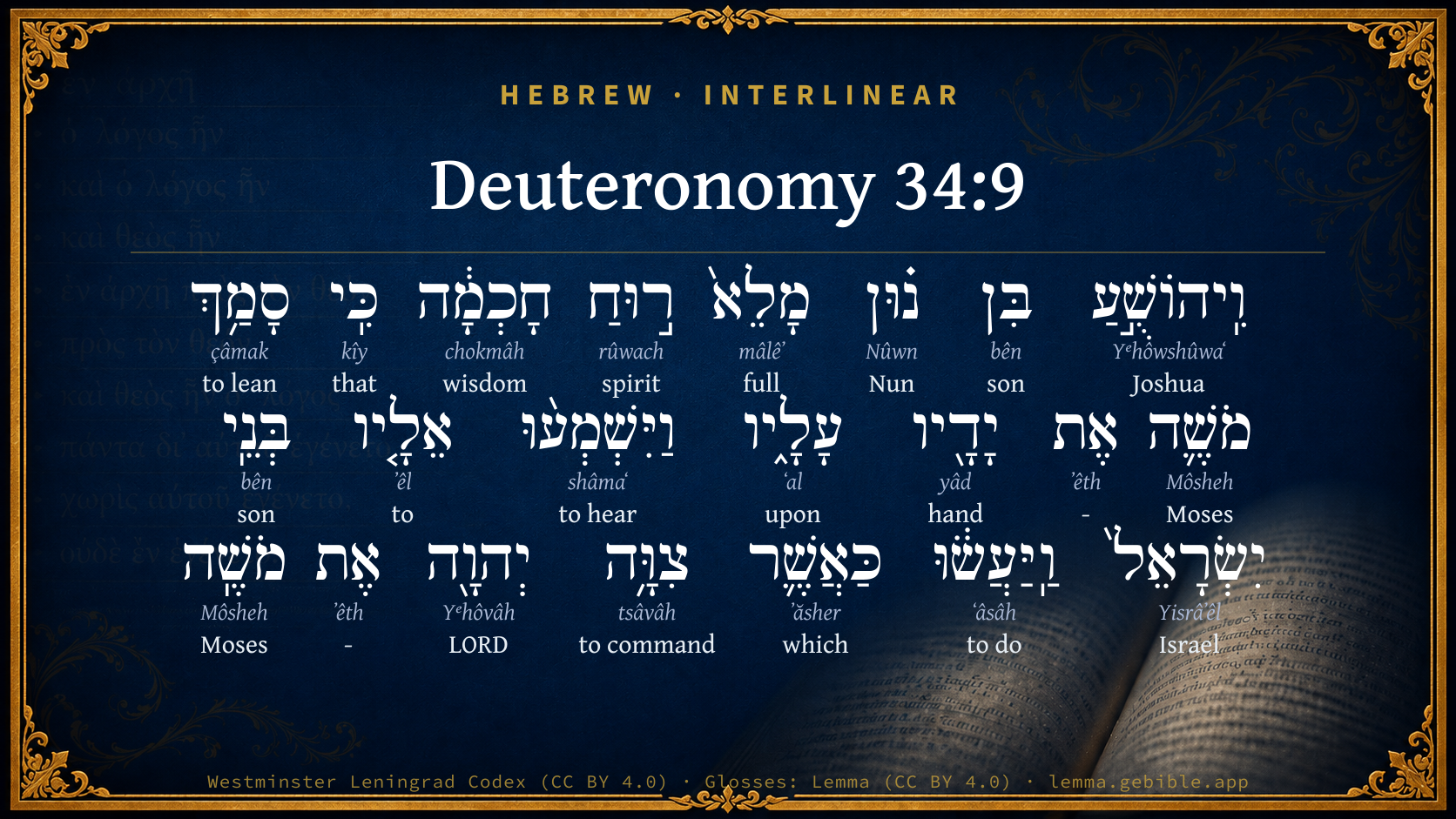
Hebrew (Westminster Leningrad Codex) Deuteronomy 34:9 appears in the Hebrew Old Testament. The text above is from the Westminster Leningrad Codex. Each word links to its Strong’s number, a concise gloss, and parsing drawn from the Open Scriptures Hebrew Bible morphology. Click any word for its full Brown-Driver-Briggs (BDB) entry.
Download image
Cite this verse

Deuteronomy 34:9 (World English Bible). Public Domain. Lemma interlinear Bible study tool, https://lemma.gebible.app/v/deuteronomy/34/9.

Show BibTeX & RIS
BibTeX
RIS
English Translation
Joshua the son of Nun was full of the spirit of wisdom; for Moses had laid his hands on him: and the children of Israel listened to him, and did as Yahweh commanded Moses.
World English Bible · Public Domain
Download a study sheet

One document with this verse’s original text, its word-by-word gloss line, the meaning frame, cross-references with their text, attributed commentary, and full source and license credits — printable, and it pastes into notes with its structure intact.

This verse Autodidact and up

Study sheet (.html) Plain text (.txt)

A passage Seminary Student

Up to 50 verses in one chapter. A passage sheet keeps up to 6 commentary sources and 12 cross-references per verse, in the order this page ranks them, and says so on the sheet whenever that leaves anything out. Ask for a single verse and you get the Autodidact verse sheet above.

Everything on this page stays free to read, with no account — the sheet is a download of what is already on screen, not access to it.

Want to remove ads? Support Godless Engineer
Compare translations 3

The same verse in 3 English versions, stacked beneath the original-language interlinear above. Click any original word for its lexicon entry.

Each is an independent rendering of the whole verse — the interlinear is not word-aligned to these translations.

Highlighted words mark where these versions differ — a whole-verse word diff, not a word-by-word alignment.

  • World English Bible Public Domain
    Joshua the son of Nun was full of the spirit of wisdom; for Moses had laid his hands on him: and the children of Israel listened to him, and did as Yahweh commanded Moses.
  • King James Version Public Domain
    And Joshua the son of Nun was full of the spirit of wisdom; for Moses had laid his hands upon him: and the children of Israel hearkened unto him, and did as the LORD commanded Moses.
  • unfoldingWord Literal Text CC BY-SA 4.0
    And Joshua, the son of Nun, full of the spirit of wisdom, for Moses had laid his hands on him. And the sons of Israel listened to him and did what Yahweh had commanded Moses.

unfoldingWord Literal Text — © unfoldingWord, licensed CC BY-SA 4.0. Word-aligned USFM3 via Door43 (git.door43.org/unfoldingWord/en_ult).

Versions to compare (up to 4)

3 of 4 selected

Show all 18 translations

Every available English version of this verse, each an independent rendering of the whole verse.

  • World English Bible Public Domain
    Joshua the son of Nun was full of the spirit of wisdom; for Moses had laid his hands on him: and the children of Israel listened to him, and did as Yahweh commanded Moses.
  • Berean Standard Bible Public Domain
    Now Joshua son of Nun was filled with the spirit of wisdom because Moses had laid his hands on him. So the Israelites obeyed him and did as the LORD had commanded Moses.
  • Majority Standard Bible Public Domain
    Now Joshua son of Nun was filled with the spirit of wisdom because Moses had laid his hands on him. So the Israelites obeyed him and did as the LORD had commanded Moses.
  • King James Version Public Domain
    And Joshua the son of Nun was full of the spirit of wisdom; for Moses had laid his hands upon him: and the children of Israel hearkened unto him, and did as the LORD commanded Moses.
  • American Standard Version (1901) Public Domain
    And Joshua the son of Nun was full of the spirit of wisdom; for Moses had laid his hands upon him: and the children of Israel hearkened unto him, and did as Jehovah commanded Moses.
  • Revised Version (1885) Public Domain
    And Joshua the son of Nun was full of the spirit of wisdom; for Moses had laid his hands upon him: and the children of Israel hearkened unto him, and did as the LORD commanded Moses.
  • Geneva Bible (1599) Public Domain
    And Ioshua the sonne of Nun was full of ye spirit of wisedome: for Moses had put his hands vpon him. And the children of Israel were obedient vnto him, and did as the Lord had commanded Moses.
  • Douay-Rheims (1899) Public Domain
    And Josue the son of Nun was filled with the spirit of wisdom, because Moses had laid his hands upon him. And the children of Israel obeyed him, and did as the Lord commanded Moses.
  • Young's Literal Translation Public Domain
    And Joshua son of Nun is full of the spirit of wisdom, for Moses had laid his hands upon him, and the sons of Israel hearken unto him, and do as Jehovah commanded Moses.
  • Literal Standard Version CC BY-SA 4.0
    And Joshua son of Nun is full of the spirit of wisdom, for Moses had laid his hands on him, and the sons of Israel listen to him, and do as YHWH commanded Moses.
  • Unlocked Literal Bible CC BY-SA 4.0
    Joshua son of Nun was full of the spirit of wisdom, for Moses had laid his hands on him. The people of Israel listened to him and did what Yahweh had commanded Moses.
  • unfoldingWord Literal Text CC BY-SA 4.0
    And Joshua, the son of Nun, full of the spirit of wisdom, for Moses had laid his hands on him. And the sons of Israel listened to him and did what Yahweh had commanded Moses.
  • Darby Bible Public Domain
    And Joshua the son of Nun was filled with the spirit of wisdom, for Moses had laid his hands upon him; and the children of Israel hearkened unto him, and did as Jehovah had commanded Moses.
  • World Messianic Bible Public Domain
    Joshua the son of Nun was full of the spirit of wisdom, for Moses had laid his hands on him. The children of Israel listened to him, and did as the LORD commanded Moses.
  • Webster's Bible Public Domain
    And Joshua the son of Nun was full of the spirit of wisdom; for Moses had laid his hands upon him: and the children of Israel hearkened to him, and did as the LORD commanded Moses.
  • Free Bible Version CC BY-SA 4.0
    Joshua, son of Nun, was filled with the spirit of wisdom because Moses had placed his hands on him to dedicate him. The Israelites paid attention to him, and followed the instructions the Lord had given to Moses.
  • Bible in Basic English Public Domain
    And Joshua, the son of Nun, was full of the spirit of wisdom; for Moses had put his hands on him: and the children of Israel gave ear to him, and did as the Lord had given orders to Moses.
  • JPS Tanakh (1917) Public Domain
    And Joshua the son of Nun was full of the spirit of wisdom; for Moses had laid his hands upon him; and the children of Israel hearkened unto him, and did as the LORD commanded Moses.

Literal Standard Version (2020), Covenant Press — licensed CC BY-SA 4.0. Text via the HelloAO Bible API (eBible.org). Unlocked Literal Bible (unfoldingWord) — licensed CC BY-SA 4.0. Text via the HelloAO Bible API (eBible.org). unfoldingWord Literal Text — © unfoldingWord, licensed CC BY-SA 4.0. Word-aligned USFM3 via Door43 (git.door43.org/unfoldingWord/en_ult). Free Bible Version, Dr. Jonathan Gallagher — licensed CC BY-SA 4.0. Text via the HelloAO Bible API (eBible.org).

Word by word

More ways to search: Search by grammar → Find every occurrence → Compare this word →

Practice this passage: Drill this verse → Learn its vocabulary →

נ֗וּן
Nûwn
H5126
“Nun”
Noun, Proper
Part of Speech
Noun
Type
Proper
Full BDB Definition

Origin: from H5125

TWOT: None

Nun = "fish" or " posterity" - father of Joshua the successor of Moses
  1. וִֽיהוֹשֻׁ֣עַ Yᵉhôwshûwaʻ H3091 “and · Joshua” Conjunction + Noun, Proper
  2. בִּן bên H1121 “son of” Noun, Common, Masculine, Singular, Construct
  3. מָלֵא֙ mâlêʼ H4392 “full” Adjective, Adjective, Masculine, Singular, Absolute
  4. ר֣וּחַ rûwach H7307 “spirit of” Noun, Common, Both, Singular, Construct
  5. חָכְמָ֔ה chokmâh H2451 “wisdom” Noun, Common, Feminine, Singular, Absolute
  6. כִּֽי kîy H3588 “that” Conjunction
  7. סָמַ֥ךְ çâmak H5564 “to lean” Verb, Qal, Perfect, 3rd Person, Masculine, Singular
  8. מֹשֶׁ֛ה Môsheh H4872 “Moses” Noun, Proper
  9. אֶת ʼêth H853 “-” Particle, Direct Object
  10. יָדָ֖יו yâd H3027 “hands · his” Noun, Common, Both, Dual, Construct + Suffix, Personal, 3rd Person, Masculine, Singular
  11. עָלָ֑יו ʻal H5921 “upon · him” Preposition + Suffix, Personal, 3rd Person, Masculine, Singular
  12. וַיִּשְׁמְע֨וּ shâmaʻ H8085 “and · to hear” Conjunction + Verb, Qal, Sequential Imperfect, 3rd Person, Masculine, Plural
  13. אֵלָ֤יו ʼêl H413 “to · him” Preposition + Suffix, Personal, 3rd Person, Masculine, Singular
  14. בְּנֵֽי bên H1121 “sons of” Noun, Common, Masculine, Plural, Construct
  15. יִשְׂרָאֵל֙ Yisrâʼêl H3478 “Israel” Noun, Proper
  16. וַֽיַּעֲשׂ֔וּ ʻâsâh H6213 “and · to do” Conjunction + Verb, Qal, Sequential Imperfect, 3rd Person, Masculine, Plural
  17. כַּאֲשֶׁ֛ר ʼăsher H834 “like/as · which” Preposition + Particle, Relative
  18. צִוָּ֥ה tsâvâh H6680 “to command” Verb, Piel, Perfect, 3rd Person, Masculine, Singular
  19. יְהוָ֖ה Yᵉhôvâh H3068 “LORD” Noun, Proper
  20. אֶת ʼêth H853 “-” Particle, Direct Object
  21. מֹשֶֽׁה Môsheh H4872 “Moses” Noun, Proper

About this verse

These counts appear in no published source. They are computed here, from the morphology-tagged text and Lemma’s own curated glosses. What Lemma adds →

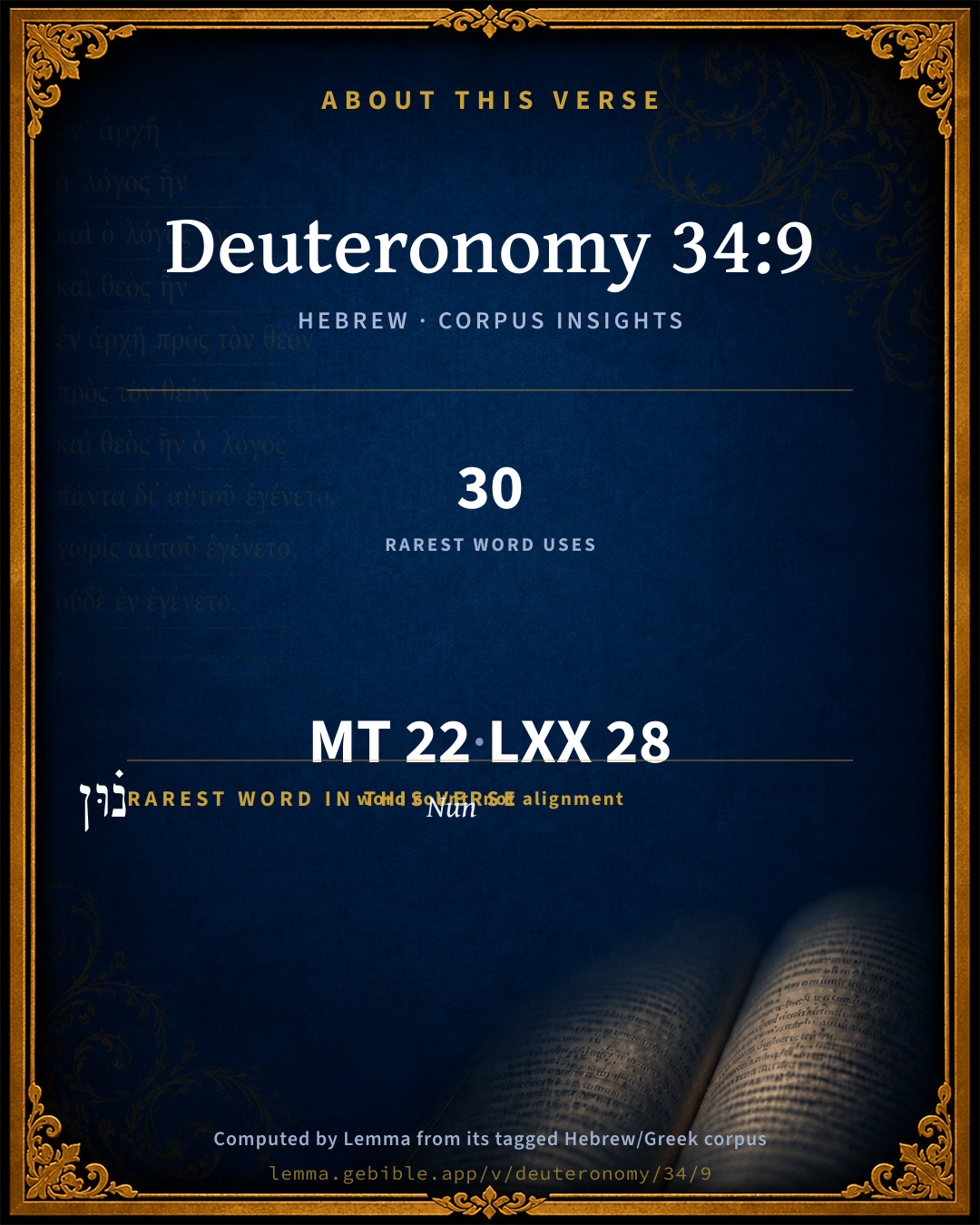
22
words
19
distinct lemmas
Pentateuch
section

Shared distinctive vocabulary

נ֗וּן Nun H5126 occurs in 30 verses of the Hebrew Bible. Also found in:

Grammatical profile

  • 4 verbs
  • 11 nouns
  • 1 adjective
  • 2 prepositions
  • 1 conjunction
  • 3 particles

Verb forms

  • סָמַ֥ךְ Qal · Perfect
  • וַיִּשְׁמְע֨וּ Qal · Sequential Imperfect
  • וַֽיַּעֲשׂ֔וּ Qal · Sequential Imperfect
  • צִוָּ֥ה Piel · Perfect

Repetition

Words recur within this verse — often emphatic in Hebrew:

  • בִּן son H1121 ×2
  • מֹשֶׁ֛ה Moses H4872 ×2

Hebrew & Septuagint length

In English translation the verse runs 34 words from the Hebrew and 37 from the Septuagint (LXX English) — closely comparable.

A rough comparison of the two English renderings, which tokenize alike — not a word-level alignment.

Word counts can differ between the Hebrew and the Greek without any difference in meaning — e.g. the Hebrew direct-object marker אֵת has no separate Greek word, and Greek often adds the article ὁ.

In the original languages it is 22 Hebrew tokens and 28 Greek tokens — but the two are counted differently (Hebrew bundles its prefixes and suffixes into one token; the Greek is in lemma form), so that isn’t a like-for-like length.

Cross-references

16

Topical passages linked to Deuteronomy 34:9 in the Treasury of Scripture Knowledge — connected by theme and wording, ordered by reader-vote popularity; previews shown in the World English Bible.

  • Isaiah 11:2 The Spirit of Yahweh shall rest on him, the spirit of wisdom and understanding, the spirit of counsel and might, the spirit of knowledge and of the fear of Yahweh.
  • Daniel 6:3 Then this Daniel was distinguished above the presidents and the satraps, because an excellent spirit was in him; and the king thought to set him over the whole realm.
  • John 3:34 For he whom God has sent speaks the words of God; for God gives the Spirit without measure.
  • Acts 6:6 whom they set before the apostles. When they had prayed, they laid their hands on them.
  • Acts 8:17–19 Then they laid their hands on them, and they received the Holy Spirit.
  • 1 Kings 3:9 Give your servant therefore an understanding heart to judge your people, that I may discern between good and evil; for who is able to judge this your great people?
  • 1 Kings 3:12 behold, I have done according to your word: behold, I have given you a wise and an understanding heart; so that there has been none like you before you, neither after you shall any arise like you.
  • 2 Kings 2:9 It happened, when they had gone over, that Elijah said to Elisha, Ask what I shall do for you, before I am taken from you. Elisha said, please let a double portion of your spirit be on me.
  • 2 Kings 2:15 When the sons of the prophets who were at Jericho over against him saw him, they said, The spirit of Elijah does rest on Elisha. They came to meet him, and bowed themselves to the ground before him.
  • Exodus 31:3 and I have filled him with the Spirit of God, in wisdom, and in understanding, and in knowledge, and in all manner of workmanship,
  • Numbers 11:17 I will come down and talk with you there: and I will take of the Spirit which is on you, and will put it on them; and they shall bear the burden of the people with you, that you not bear it yourself alone.
  • Numbers 27:18–23 Yahweh said to Moses, Take Joshua the son of Nun, a man in whom is the Spirit, and lay your hand on him;
  • Joshua 1:16–18 They answered Joshua, saying, All that you have commanded us we will do, and wherever you send us we will go.
  • Colossians 2:3 in whom are all the treasures of wisdom and knowledge hidden.
  • 1 Timothy 4:14 Don't neglect the gift that is in you, which was given to you by prophecy, with the laying on of the hands of the elders.
  • 1 Timothy 5:22 Lay hands hastily on no one, neither be a participant in other men's sins. Keep yourself pure.

Cross-references courtesy of OpenBible.info (CC BY 4.0).

Hebrew and Greek witnesses Masoretic Hebrew ↔ Greek Septuagint

The same verse in the two great witnesses to the Old Testament, shown verse-for-verse.

These are two independent witnesses, not word-aligned to each other, and the Septuagint is shown in lemma (dictionary) form.

Hebrew Deuteronomy 34:9 Masoretic · Westminster Leningrad Codex

וִֽיהוֹשֻׁ֣עַ בִּן נ֗וּן מָלֵא֙ ר֣וּחַ חָכְמָ֔ה כִּֽי סָמַ֥ךְ מֹשֶׁ֛ה אֶת יָדָ֖יו עָלָ֑יו וַיִּשְׁמְע֨וּ אֵלָ֤יו בְּנֵֽי יִשְׂרָאֵל֙ וַֽיַּעֲשׂ֔וּ כַּאֲשֶׁ֛ר צִוָּ֥ה יְהוָ֖ה אֶת מֹשֶֽׁה

Joshua the son of Nun was full of the spirit of wisdom; for Moses had laid his hands on him: and the children of Israel listened to him, and did as Yahweh commanded Moses.

World English Bible · Public Domain

Greek LXX Deuteronomy 34:9 Septuagint · lemma form

καί ἰησοῦς υἱός ναυη ἐνπίμπλημι πνεῦμα σύνεσις ἐπιτίθημι γάρ μωυσῆς ὁ χείρ αὐτός ἐπί αὐτός καί εἰςἀκούω αὐτός ὁ υἱός ἰσραήλ καί ποιέω καθότι ἐντέλλομαι κύριος ὁ μωυσῆς

And Joshua the son of Naue was filled with the spirit of knowledge, for Moses had laid his hands upon him; and the children of Israel listened to him; and they did as the Lord commanded Moses.

LXX2012 (modern English Septuagint) · Public Domain

Hebrew: Westminster Leningrad Codex (CC BY 4.0). Greek: Septuagint (public domain); English from LXX2012 (modern English Septuagint) (Public Domain). How the Septuagint differs from the Hebrew →

Targum (Aramaic paraphrase)

2

The Targum is the ancient Jewish Aramaic paraphrase of the Hebrew Scriptures — an interpretive translation, not the Hebrew text itself. Onkelos (literal) and Pseudo-Jonathan (expansive) render the Torah, and Jonathan the Prophets. Coverage is partial: where no permissively-licensed English translation exists for a verse, only the Aramaic is shown. This is verse-level text, not a word-by-word alignment to the Hebrew.

  1. Targum Onkelos Torah (Genesis–Deuteronomy)
    וִיהוֹשֻׁעַ בַּר נוּן מְלֵי רוּחַ חָכְמְתָא אֲרֵי סְמַךְ מֹשֶׁה יָת יְדוֹהִי עֲלוֹהִי וְקַבִּילוּ מִנֵהּ בְּנֵי יִשְׂרָאֵל וַעֲבָדוּ כְּמָא דִי פַּקִיד יְיָ יָת מֹשֶׁה

    (no public-domain English translation for this verse)

    Targum Onkelos — Aramaic: “Onkelos Genesis” (public domain); “Onkelos Exodus” (public domain); “Onkelos Leviticus” (public domain); “Onkelos Numbers” (public domain); “Onkelos Deuteronomy” (public domain). English: “Sefaria Community Translation” (CC0 1.0 (public-domain dedication)); “J.W. Etheridge. The Targums of Onkelos and Jonathan Ben Uzziel on the Pentateuch. London: Longmans, Green, 1862” (public domain). Text via Sefaria.

  2. Targum Pseudo-Jonathan Torah (Genesis–Deuteronomy)
    וִיהוֹשֻׁעַ בַּר נוּן אִתְמְלֵי רוּחַ חָכְמְתָא אֲרוּם סְמַךְ משֶׁה יַת יְדוֹי עֲלוֹי וְקַבִּילוּ אוּלְפַן מִנֵיהּ בְּנֵי יִשְרָאֵל וַעֲבָדוּ הֵיכְמָא דְפַקֵיד יְיָ יַת משֶׁה

    But Jehoshua bar Nun was filled with the Spirit of wisdom; for Mosheh had laid his hands upon him; and the children of Israel received instruction from him, and did as the Lord had commanded (by) Mosheh.

    Targum Pseudo-Jonathan — Aramaic: “Targum Jonathan on Genesis” (public domain); “Targum Jonathan on Exodus” (public domain); “Targum Jonathan on Leviticus” (public domain); “Targum Jonathan on Numbers” (public domain); “Targum Jonathan on Deuteronomy” (public domain). English: “The Targum of Jonathan ben Uzziel, trans. J. W. Etheridge, London, 1862” (public domain). Text via Sefaria.

Commentary

Notes on Deuteronomy 34:9 from classic Christian and Jewish commentators (each source and its license shown beneath its notes). The classic Christian expositions comment on the surrounding passage and are grouped to its opening verse, so a note may address several verses; the Jewish commentaries on the Tanakh (Rashi and others) are per-verse, so they appear only where the commentator wrote on this verse.

Lemma curates 59 commentaries, every one of them public domain or Creative Commons licensed, each selected and text-cleaned for this edition rather than reprinted as found. About our sources →

Trapp's Complete Commentary

John Trapp

Deu 34:9 And Joshua the son of Nun was full of the spirit of wisdom; for Moses had laid his hands upon him: and the children of Israel hearkened unto him, and did as the LORD commanded Moses.

Ver. 9. And Joshua the son of Nun.] Sic uno avulso, non deficit alter Aureus. The Duke of Florence gave for his ensign, a great tree, with many spreading boughs, one of them being cut off, with this above said motto, As one is broke off another riseth up in the room. {a}

{a} Pintus in Dan. iv.

John Trapp, A Commentary or Exposition upon All the Books of the Old and New Testament (1647–1656) — public domain. Text from a community e-Sword module.

Joseph Benson's Commentary

Deu 34:9. Joshua was full of the Spirit of wisdom — And other gifts and graces also, but wisdom is mentioned as being most necessary for the government to which he was now called. For Moses had laid his hands upon him — Whereby he committed to him the supreme authority after his departure, and implored the gifts of the Divine Spirit, to qualify him for it. In like manner the laying on of hands, as a sign of dedicating persons to offices, was accompanied with prayer in the times of the apostles, Act 6:6; 1Ti 4:14; 2Ti 1:6. And the children of Israel hearkened unto him — That is, they submitted themselves respectfully to Joshua, as to the supreme governor, whom God had appointed them instead, and by the hands of Moses.

Joseph Benson's Commentary on the Old and New Testaments (1811–1818) — public domain. Text from a community e-Sword module.

Whedon's Commentary on the Bible

Daniel D. Whedon

JOSHUA THE NEW LEADER — THE GREATNESS OF MOSES, Deu_34:9-12.

Joshua (in the Greek, ‘Ιησους, Jesus) now takes the place of Moses. His name first appears in Exo_17:9, as leader of the forces of Israel against Amalek at Rephidim. When Moses ascended Sinai the first time to receive the two tables of the law Joshua accompanied him part of the way, and was the first to meet him when he came down from the mountain.

Comp. Exo_24:13; Exo_33:11; and Exo_32:17. He was one of the twelve sent to explore the Promised Land, and one of the two who brought back a favourable report. After it had been announced to Moses that he was not to lead the people into their promised possession, but was to die on the borders of the land, he prayed to Jehovah to promote a successor. He was directed to invest Joshua with authority. Num_27:18. In Deu_31:7-8, Moses gives him a brief and impressive charge. The great leader and lawgiver had in Joshua a worthy successor.

Daniel D. Whedon (gen. ed.), Commentary on the Old and New Testaments (1874–1909) — public domain. Text from a community e-Sword module.

Tyndale Open Study Notes

Tyndale Open Resources

34:9 full of the spirit of wisdom: When Joshua was selected as Moses’ successor, he had to be invested with the Spirit of God to fill the office (Num 27:15-23; cp. Num 11:16-30). Now that Moses had died, God showed that Joshua was Moses’ divinely appointed successor by giving continuing evidence of the Spirit’s power and blessing.

Tyndale Open Study Notes — © Tyndale Open Resources, licensed CC BY-SA 4.0. Text via the HelloAO Bible API.

Geneva Bible (1599)

Geneva Bible translators

Hereby appeareth the favor of God, that leaveth not his Church destitute of a governor.

Geneva Bible (1599) marginal notes — public domain. Text via Bolls.life.

Matthew Henry's Commentary

We have here a very honourable encomium passed both on Moses and Joshua; each has his praise, and should have. It is ungrateful so to magnify our living friends as to forget the merits of those that are gone, to whose memories there is a debt of honour due: all the respect must not be paid to the rising sun; and, on the other hand, it is unjust so to cry up the merits of those that are gone as to despise the benefit we have in those that survive and succeed them. Let God be glorified in both, as here.

I. Joshua is praised as a man admirably qualified for the work to which he was called, v. 9. Moses brought Israel to the borders of Canaan and then died and left them, to signify that the law made nothing perfect, Heb 7:19. It brings men into a wilderness of conviction, but not into the Canaan of rest and settled peace. It is an honour reserved for Joshua (our Lord Jesus, of whom Joshua was a type) to do that for us which the law could not do, in that it was weak through the flesh, Rom 8:3. Through him we enter into rest, the spiritual rest of conscience and eternal rest in heaven. Three things concurred to clear Joshua's call to this great undertaking: - 1. God fitted him for it: He was full of the spirit of wisdom; and so he had need who had such a peevish people to rule, and such a politic people to conquer. conduct is as requisite in a general as courage. Herein Joshua was a type of Christ, in whom are hidden the treasures of wisdom. 2. Moses, by the divine appointment, had ordained him to it: He had laid his hands upon him, so substituting him to be his successor, and praying to God to qualify him for the service to which he had called him; and this comes in as a reason why God gave him a more than ordinary spirit of wisdom, because his designation to the government was God's own act (those whom God employs he will in some measure make fit for the employment) and because this was the thing that Moses had asked of God for him when he laid his hands on him. When the bodily presence of Christ withdrew from his church, he prayed the Father to send another Comforter, and obtained what he prayed for. 3. The people cheerfully owned him and submitted to him. Note, An interest in the affections of people is a great advantage, and a great encouragement to those that are called to public trusts of what kind soever. It was also a great mercy to the people that when Moses was dead they were not as sheep having no shepherd, but had one ready among them in whom they did unanimously, and might with the highest satisfaction, acquiesce.

II. Moses is praised (Deu 34:10-12), and with good reason.

1. He was indeed a very great man, especially upon two accounts: - (1.) His intimacy with the God of nature: God knew him face to face, and so he knew God. See Num 12:8. He saw more of the glory of God than any (at least of the Old Testament saints) ever did. He had more free and frequent access to God, and was spoken to not in dreams, and visions, and slumberings on the bed, but when he was awake and standing before the cherubim. Other prophets, when God appeared and spoke to them, were struck with terror (Dan 10:7), but Moses, whenever he received a divine revelation, preserved his tranquillity. (2.) His interest and power in the kingdom of nature. The miracles of judgment he wrought in Egypt before Pharaoh, and the miracles of mercy he wrought in the wilderness before Israel, served to demonstrate that he was a particular favourite of Heaven, and had an extra-ordinary commission to act as he did on this earth. Never was there any man whom Israel had more reason to love, or whom the enemies of Israel had more reason to fear. Observe, The historian calls the miracles Moses wrought signs and wonders, done with a mighty hand and great terror, which may refer to the terrors of Mount Sinai, by which God fully ratified Moses's commission and demonstrated it beyond exception to be divine, and this in the sight of all Israel.

2. He was greater than any other of the prophets of the Old Testament. Though they were men of great interest in heaven and great influence upon earth, yet they were none of them to be compared with this great man; none of them either so evidenced or executed a commission from heaven as Moses did. This encomium of Moses seems to have been written long after his death, yet then there had not arisen any prophet like unto Moses, nor did there arise any such between that period and the sealing up of the vision and prophecy. by Moses God gave the law, and moulded and formed the Jewish church; by the other prophets he only sent particular reproofs, directions, and predictions. The last of the prophets concludes with a charge to remember the law of Moses, Mal 4:4. Christ himself often appealed to the writings of Moses, and vouched him for a witness, as one that saw his day at a distance and spoke of him. But, as far as the other prophets came short of him, our Lord Jesus went beyond him. His doctrine was more excellent, his miracles were more illustrious, and his communion with his Father was more intimate, for he had lain in his bosom from eternity, and by him God does now in these last days speak to us. Moses was faithful as a servant, but Christ as a Son. The history of Moses leaves him buried in the plains of Moab, and concludes with the period of his government; but the history of our Saviour leaves him sitting at the right hand of the Majesty on high, and we are assured that of the increase of his government and peace there shall be no end. The apostle, in his epistle to the Hebrews, largely proves the pre-eminence of Christ above Moses, as a good reason why we that are Christians should be obedient, faithful, and constant, to that holy religion which we make profession of. God, by his grace, make us all so!

Matthew Henry's Commentary on the Whole Bible (1708–1710) — public domain (CC PDM 1.0). Text via the HelloAO Bible API.

Jamieson, Fausset & Brown

Robert Jamieson, A. R. Fausset & David Brown

Joshua . . . was full of the spirit of wisdom--He was appointed to a peculiar and extraordinary office. He was not the successor of Moses, for he was not a prophet or civil ruler, but the general or leader, called to head the people in the war of invasion and the subsequent allocation of the tribes.

Jamieson, Fausset & Brown — Commentary Critical and Explanatory on the Whole Bible (1871) — public domain (CC PDM 1.0). Text via the HelloAO Bible API.

Adam Clarke's Commentary

Verse 9. Laid his hands upon him] See on Nu 27:18-23.

Adam Clarke's Commentary on the Bible (1810–1826) — public domain. Text from a community e-Sword/MySword module.

Ellicott's Commentary for English Readers

(9) And Joshua the son of Nun was full of the spirit of wisdom.—Probably we should connect this with the preceding verse, “The days of mourning for Moses were ended,” and ended more naturally because Joshua proved so well able to meet the wants of the people.

Moses had laid his hands upon him.—See Num_27:18; Num_27:23. It is the first example of “ordination” in Holy Scripture.

And did as the Lord commanded Moses.—Not “commanded Joshua.” Joshua would not separate himself from the law given by his Master. Is it not true that when the Israel of God hearken to the true Joshua, they must needs do as the Lord commanded Moses?[11]

[11] It may be worth while to remark that nowhere does this phrase occur so often as in the record of the setting up of the tabernacle in the last chapter of Exodus. Seven times it is written there that all was done as the Lord commanded Moses. Is it not a figure of the “true tabernacle which the Lord pitched, and not man”—the temple of His Body, which was prepared “to do Thy will, O God”?

A Bible Commentary for English Readers, edited by Charles John Ellicott (1878–1897) — public domain. Text from a community e-Sword module.

The Cambridge Bible for Schools and Colleges

gen. ed. J. J. S. Perowne

9. was full of the spirit of wisdom] Cp. P in Exo_28:3, where the wisdom is of a different kind.

laid his hands upon him] So P, Num_27:18-23.

The Cambridge Bible for Schools and Colleges (gen. ed. J. J. S. Perowne; Cambridge University Press, 1878–1918) — public domain. Text from a community e-Sword module.

John Gill's Exposition

And Joshua the son of Nun was full of the spirit of wisdom,.... The successor of Moses, and who, by the spirit of wisdom on him, was abundantly qualified for the government of the people of Israel; in which he was a type of Christ, on whom the spirit of wisdom and understanding is said to rest, Isa 11:2,

for Moses had laid his hands upon him; which was a symbol of the government being committed to him, and devolving upon him after his death, and expressive of prayer for him, that he might be fitted for it, of which action see Num 27:23,

and the children of Israel hearkened unto him, and did as the Lord commanded Moses; or by the hand of Moses; they received him and owned him as their supreme governor under God, and yielded a cheerful obedience to his commands, as the Lord by Moses commanded them to do, and as they promised; see Jos 1:16.

John Gill's Exposition of the Whole Bible (1746–1763) — public domain (CC PDM 1.0). Text via the HelloAO Bible API.

Albert Barnes' Notes on the Bible

Spirit of wisdom - The practical wisdom of the ruler is especially meant.

Albert Barnes' Notes on the Bible (1834–1885) — public domain. Text from a community e-Sword/MySword module.

Haydock's Catholic Bible Commentary

Because. God was pleased to accompany this exterior sign with his blessing. (Haydock)

George Leo Haydock (1774–1849), Haydock's Catholic Family Bible and Commentary, 1859 edition — public domain. Excludes Psalms (Douay-Rheims chapter numbering differs from Protestant) and Deuterocanonical books (Catholic canon only).

Matthew Poole's English Annotations

The spirit of wisdom; and other gifts and graces too, as appears from the history; but wisdom is mentioned as being most necessary for the government, to which he was now called.

Moses had laid his hands upon him; which God had appointed as a sign to Moses, and Joshua, and the Israelites, that this was the person whom he had appointed and qualified for his great work. See Num 27:18, &c. Compare Gen 48:10; Num 8:10.

Matthew Poole's English Annotations on the Holy Bible (1683–1685) — public domain. Text from a community e-Sword/MySword module.

The Pulpit Commentary

Posthumous influence.

Although dead, Moses still ruled. His spirit reappeared in his successor. The principles of Moses had been planted in the nature of Joshua: these had flourished and come to maturity. The memory of Moses was still a mighty power in Israel, and they "did," all through the days of Joshua, "as the Lord commanded Moses." The legislator had molded and trained the warrior. Moses was promoted to higher honor, because Joshua was better qualified for this new work the realization of Israel"s destiny.

I NOTE THE HIGH QUALIFICATION OF JOSHUA. He was "full of the spirit of wisdom." This is a rare gift. By nature he had been endowed with strength and fearless courage, so that he had been military lieutenant to Moses all through the desert. He was illustrious also for diligence and fidelity in a long career of service. Among the spies dispatched to Canaan, he (in company with Caleb) had been "faithful among the faithless found." Now to courage and unbending loyalty there was added another endowment, and this in amplest measure: he was "filled with the spirit of wisdom." "To him that hath, it shall be given.

II OBSERVE THE METHOD BY WHICH THIS WISDOM WAS ACQUIRED. "Moses had laid his hands upon him." We need not limit our thoughts to a solitary act, even though it might be a solemn and religious act. We may rather think of the plastic, formative influence which Moses had exerted over the growing character of this young man. It is astonishing what immense power God has entrusted to our hands for fashioning and embellishing the spiritual nature of men. By a wise employment of spiritual energy, we can direct into right channels the lives of many; by implanting right principles into youth, and by awakening into vigorous activity the latent forces of character, we may elevate a city we may influence the destinies of the world.

III MARK THE BENEFICIAL EFFECT. "The children of Israel hearkened unto him." Moses influenced for good his servant Joshua. Joshua influenced for good the nation of Israel. The twelve tribes felt the force of Joshua"s character, and yielded to the wisdom which he displayed. They were a different people as the consequence of Joshua"s leadership. He touched, through Israel, the fortunes of the world. The high example of Joshua provoked the imitation of the tribes. His combined wisdom and energy led them on to triumph. By virtue of his superlative wisdom he became, in God"s hands, a Savior, and remains, in name and office, the type of the world"s Redeemer. D.

The Pulpit Commentary (1880–1919), ed. H.D.M. Spence-Jones & Joseph S. Exell — public domain. Text from a community e-Sword module.

John Wesley's Explanatory Notes

Wisdom - And other gifts and graces too, but wisdom is mentioned as being most necessary for the government to which he was now called. Upon him - And this was the thing which Moses at that time asked of God for him.

John Wesley, Explanatory Notes Upon the Whole Bible (1754–1765) — public domain. Text via the GEBible commentary corpus.

Keil & Delitzsch

C. F. Keil & F. Delitzsch

Joshua now took Moses' place as the leader of the people, filled with the spirit of wisdom (practical wisdom, manifesting itself in action), because Moses had ordained him to his office by the laying on of hands (Num 27:18). And the people obeyed him; but he was not like Moses. "There arose no more a prophet in Israel like unto Moses, whom the Lord knew face to face," i.e., so far as the miracles and signs were concerned which Moses did, by virtue of his divine mission, upon Pharaoh, his servants, and his land, and the terrible acts which he performed before the eyes of Israel (Deu 34:11 and Deu 34:12; vid., Deu 26:8, and Deu 4:34). "Whom Jehovah knew:" not who knew Him, the Lord. "To know," like γινώσκειν in Co1 8:3, relates to the divine knowledge, which not only involves a careful observance (Deu 2:7), but is also a manifestation of Himself to man, a penetration of man with the spiritual power of God. Because he was thus known by the Lord, Moses was able to perform signs and wonders, and mighty, terrible acts, such as no other performed either before or after him. In this respect Joshua stood far below Moses, and no prophet arose in Israel like unto Moses. - This remark concerning Moses does not presuppose that a long series of prophets had already risen up since the time of Moses. When Joshua had defeated the Canaanites, and conquered their land with the powerful help of the Lord, which was still manifested in signs and wonders, and had divided it among the children of Israel, and when the tribes had settled down in their inheritance, so that the different portions of the land began to be called by the names of Naphtali, Ephraim, Manasseh, and Judah, as is the case in Deu 34:2; the conviction might already have become established in Israel, that no other prophet would arise like Moses, to whom the Lord had manifested Himself with such signs and wonders before the Egyptians and the eyes of Israel. The position occupied by Joshua in relation to this his predecessor, as the continuer of his work, would necessarily awaken and confirm this conviction, in connection with what the Lord had said as to the superiority of Moses to all the prophets (Num 12:6.). Moses was the founder and mediator of the old covenant. As long as this covenant was to last, no prophet could arise in Israel like unto Moses. There is but One who is worthy of greater honour than Moses, namely, the Apostle and High Priest of our profession, who is placed as the Son over all the house of God, in which Moses was found faithful as a servant (compare Heb 3:2-6 with Num 12:7), Jesus Christ, the founder and mediator of the new and everlasting covenant.

Keil & Delitzsch — Biblical Commentary on the Old Testament (1861–1891) — public domain (CC PDM 1.0). Text via the HelloAO Bible API. (Old Testament only.)

unfoldingWord translationNotes

Door43 World Missions Community

son of Nun

See how you translated this in Deuteronomy 1:38.

Joshua ... was full of the spirit of wisdom

The writer speaks as if Joshua were a container and the spirit were a physical object that could be put into a container. AT: "Yahweh enabled Joshua ... to be very wise" (See: Metaphor)

Moses had laid his hands on him

The full meaning of this statement can be made clear. AT: "Moses had laid his hands on him to set Joshua apart so Joshua would serve Yahweh" (See: Assumed Knowledge and Implicit Information)

translationWords

Joshua

spirit

wise

hand

command

unfoldingWord translationNotes — © Distant Shores Media and the Door43 World Missions Community, licensed CC BY-SA 4.0. Source: git.door43.org/Door43/en_tn.

Lesson kit

Teaching starters — assembled from the data on this page, not authored interpretation. Every prompt links to the verse data it draws on. Edit before teaching.

Deuteronomy, in the Pentateuch, opens this verse with 22 words (19 distinct Hebrew lemmas). Its most distinctive word is Nûwn (“Nun”). A historical commentator’s framing appears above. Read the whole chapter for the surrounding context.

Discussion questions

  1. The word Nûwn carries the sense “Nun.” How does it shape the verse?
  2. How does Exodus 33:11, which shares the word «Nun», read alongside this verse?
  3. What does the repetition of “son” (2× in this one verse) do in this verse?
  4. The translations on this page render this verse differently — a whole-verse word diff, not a word-by-word alignment. What might account for the different wordings?
  5. «סָמַ֥ךְ» is a Qal Perfect verb. How does that grammatical form shape the action described?
  6. Compare how Trapp's Complete Commentary and Joseph Benson's Commentary read this verse. Where do they agree or differ?

Things to notice

Reading settings

Reading text

Shown beneath each verse's original-language words.

Old Testament
Old Testament edition

Read the OT as the Masoretic Hebrew (MT) or the Greek Septuagint (LXX).

English shown for the Greek Septuagint (in the Hebrew ↔ Greek comparison).

Comparing translations? Open the Compare panel on any verse page to stack up to four side by side.