
Psalms 51:11

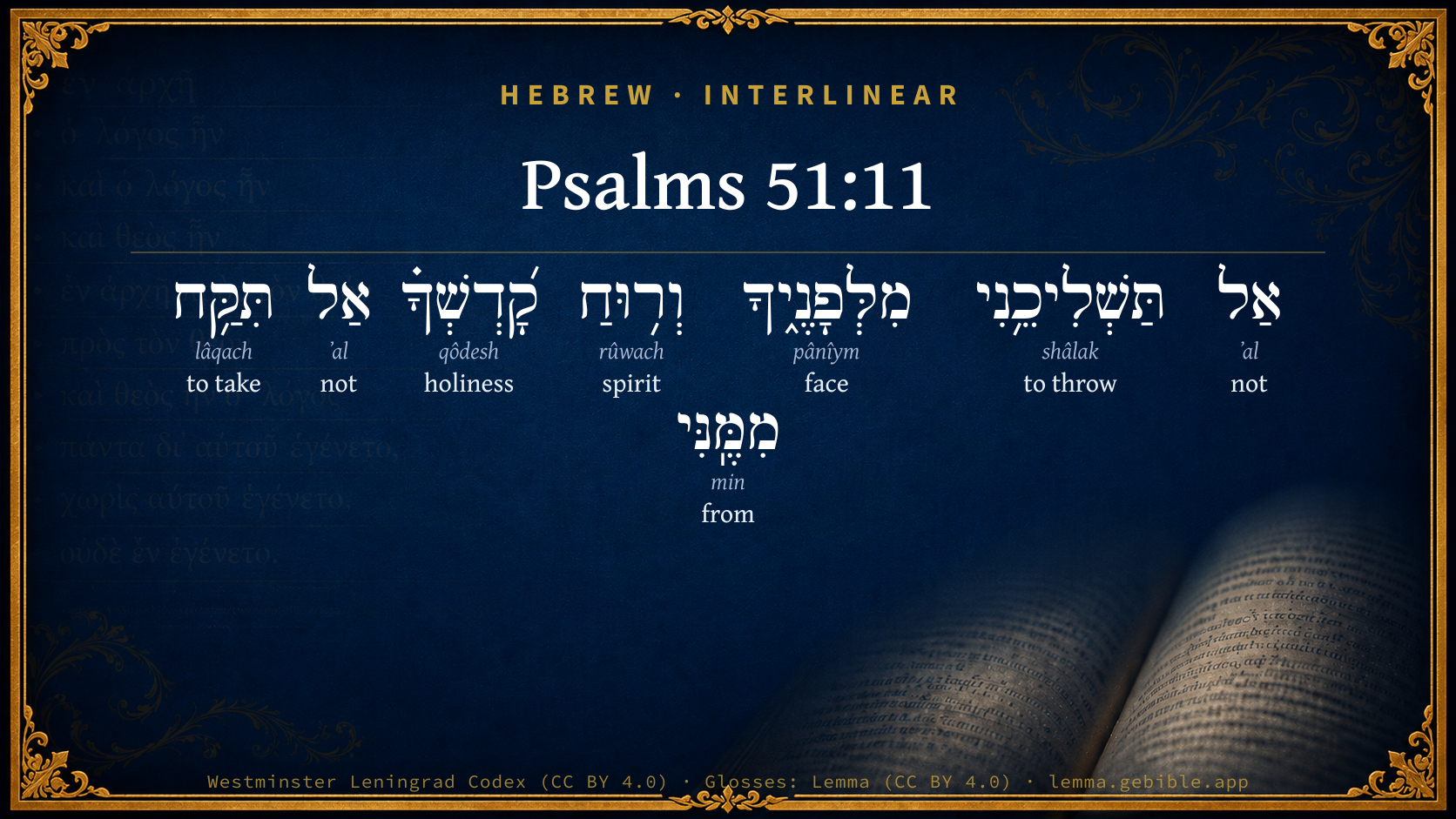
Hebrew (Westminster Leningrad Codex) Psalms 51:11 appears in the Hebrew Old Testament. The text above is from the Westminster Leningrad Codex. Each word links to its Strong’s number, a concise gloss, and parsing drawn from the Open Scriptures Hebrew Bible morphology. Click any word for its full Brown-Driver-Briggs (BDB) entry.
Download image
Cite this verse

Psalms 51:11 (World English Bible). Public Domain. Lemma interlinear Bible study tool, https://lemma.gebible.app/v/psalms/51/11.

Show BibTeX & RIS
BibTeX
RIS
English Translation
Don't throw me from your presence, And don't take your holy Spirit from me.
World English Bible · Public Domain
Download a study sheet

One document with this verse’s original text, its word-by-word gloss line, the meaning frame, cross-references with their text, attributed commentary, and full source and license credits — printable, and it pastes into notes with its structure intact.

This verse Autodidact and up

Study sheet (.html) Plain text (.txt)

A passage Seminary Student

Up to 50 verses in one chapter. A passage sheet keeps up to 6 commentary sources and 12 cross-references per verse, in the order this page ranks them, and says so on the sheet whenever that leaves anything out. Ask for a single verse and you get the Autodidact verse sheet above.

Everything on this page stays free to read, with no account — the sheet is a download of what is already on screen, not access to it.

Want to remove ads? Support Godless Engineer
Compare translations 3

The same verse in 3 English versions, stacked beneath the original-language interlinear above. Click any original word for its lexicon entry.

Each is an independent rendering of the whole verse — the interlinear is not word-aligned to these translations.

Highlighted words mark where these versions differ — a whole-verse word diff, not a word-by-word alignment.

  • World English Bible Public Domain
    Don't throw me from your presence, And don't take your holy Spirit from me.
  • King James Version Public Domain
    Cast me not away from thy presence; and take not thy holy spirit from me.
  • unfoldingWord Literal Text CC BY-SA 4.0
    May you not cast me away from your face, and may you not take the Spirit of your holiness from me.

unfoldingWord Literal Text — © unfoldingWord, licensed CC BY-SA 4.0. Word-aligned USFM3 via Door43 (git.door43.org/unfoldingWord/en_ult).

Versions to compare (up to 4)

3 of 4 selected

Show all 18 translations

Every available English version of this verse, each an independent rendering of the whole verse.

  • World English Bible Public Domain
    Don't throw me from your presence, And don't take your holy Spirit from me.
  • Berean Standard Bible Public Domain
    Cast me not away from Your presence; take not Your Holy Spirit from me.
  • Majority Standard Bible Public Domain
    Cast me not away from Your presence; take not Your Holy Spirit from me.
  • King James Version Public Domain
    Cast me not away from thy presence; and take not thy holy spirit from me.
  • American Standard Version (1901) Public Domain
    Cast me not away from thy presence; And take not thy holy Spirit from me.
  • Revised Version (1885) Public Domain
    Cast me not away from thy presence; and take not thy holy spirit from me.
  • Geneva Bible (1599) Public Domain
    Cast mee not away from thy presence, and take not thine holy Spirit from me.
  • Douay-Rheims (1899) Public Domain
    Turn away thy face from my sins, and blot out all my iniquities.
  • Young's Literal Translation Public Domain
    Cast me not forth from Thy presence, And Thy Holy Spirit take not from me.
  • Literal Standard Version CC BY-SA 4.0
    Do not cast me forth from Your presence, || And do not take Your Holy Spirit from me.
  • Unlocked Literal Bible CC BY-SA 4.0
    Do not drive me away from your presence, and do not take your holy Spirit from me.
  • unfoldingWord Literal Text CC BY-SA 4.0
    May you not cast me away from your face, and may you not take the Spirit of your holiness from me.
  • Darby Bible Public Domain
    Cast me not away from thy presence, and take not the spirit of thy holiness from me.
  • World Messianic Bible Public Domain
    Don’t throw me from your presence, and don’t take your Holy Spirit from me.
  • Webster's Bible Public Domain
    \\51:9\\Hide thy face from my sins, and blot out all my iniquities.
  • Free Bible Version CC BY-SA 4.0
    Don't expel me from your presence; don't take away your Holy Spirit from me.
  • Bible in Basic English Public Domain
    Do not put me away from before you, or take your holy spirit from me.
  • JPS Tanakh (1917) Public Domain
    (51-13) Cast me not away from Thy presence; and take not Thy holy spirit from me.

Literal Standard Version (2020), Covenant Press — licensed CC BY-SA 4.0. Text via the HelloAO Bible API (eBible.org). Unlocked Literal Bible (unfoldingWord) — licensed CC BY-SA 4.0. Text via the HelloAO Bible API (eBible.org). unfoldingWord Literal Text — © unfoldingWord, licensed CC BY-SA 4.0. Word-aligned USFM3 via Door43 (git.door43.org/unfoldingWord/en_ult). Free Bible Version, Dr. Jonathan Gallagher — licensed CC BY-SA 4.0. Text via the HelloAO Bible API (eBible.org).

Word by word

More ways to search: Search by grammar → Find every occurrence → Compare this word →

Practice this passage: Drill this verse → Learn its vocabulary →

תַּשְׁלִיכֵ֥נִי
shâlak
H7993
“to throw · me”
Verb, Hiphil, Jussive, 2nd Person, Masculine, Singular + Suffix, Personal, 1st Person, Common, Singular
Part of Speech
Verb
Stem
Hiphil
Form
Jussive
Person
2nd Person
Gender
Masculine
Number
Singular
Full BDB Definition

Origin: a primitive root

TWOT: 2398

to throw, cast, hurl, fling - (Hiphil) - to throw, cast, throw away, cast off, shed, cast down - to cast (lots) (figuratively) - (Hophal) - to be thrown, be cast - to be cast forth or out - to be cast down - to be cast (metaphorically)
  1. אַל ʼal H408 “not” Particle, Negative
  2. מִלְּפָנֶ֑יךָ pânîym H6440 “from · to/for · face(s) · your” Preposition + Preposition + Noun, Common, Both, Plural, Construct + Suffix, Personal, 2nd Person, Masculine, Singular
  3. וְר֥וּחַ rûwach H7307 “and · spirit of” Conjunction + Noun, Common, Both, Singular, Construct
  4. קָ֝דְשְׁךָ֗ qôdesh H6944 “holiness · your” Noun, Common, Masculine, Singular, Construct + Suffix, Personal, 2nd Person, Masculine, Singular
  5. אַל ʼal H408 “not” Particle, Negative
  6. תִּקַּ֥ח lâqach H3947 “to take” Verb, Qal, Jussive, 2nd Person, Masculine, Singular
  7. מִמֶּֽנִּי min H4480 “from · me” Preposition + Suffix, Personal, 1st Person, Common, Singular

About this verse

These counts appear in no published source. They are computed here, from the morphology-tagged text and Lemma’s own curated glosses. What Lemma adds →

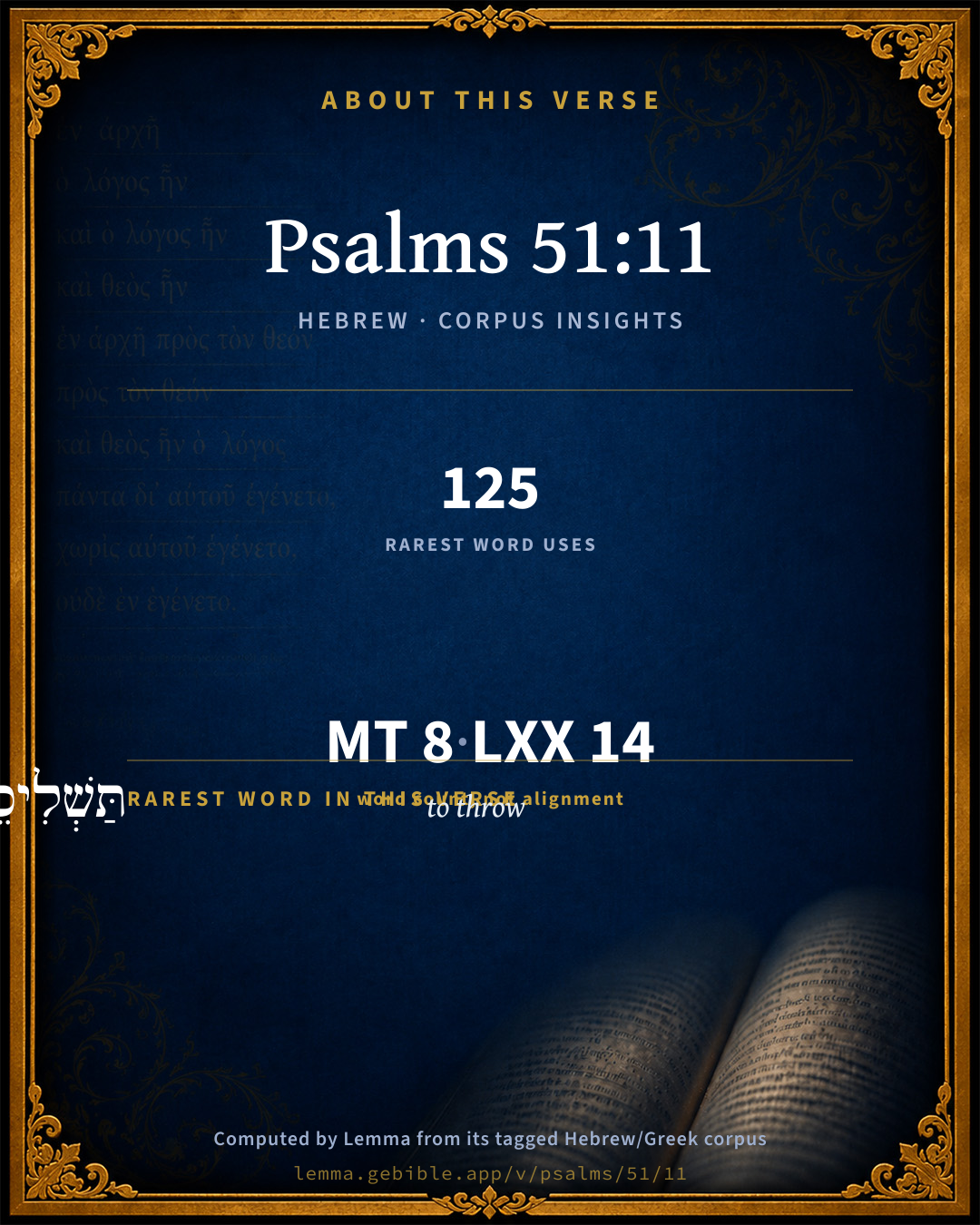
8
words
7
distinct lemmas
Wisdom
section

Grammatical profile

  • 2 verbs
  • 3 nouns
  • 1 preposition
  • 2 particles

Verb forms

  • תַּשְׁלִיכֵ֥נִי Hiphil · Jussive
  • תִּקַּ֥ח Qal · Jussive

Repetition

A word recurs within this verse — often emphatic in Hebrew:

  • אַל not H408 ×2

Hebrew & Septuagint length

In English translation the verse runs 14 words from the Hebrew and 15 from the Septuagint (LXX English) — closely comparable.

A rough comparison of the two English renderings, which tokenize alike — not a word-level alignment.

Word counts can differ between the Hebrew and the Greek without any difference in meaning — e.g. the Hebrew direct-object marker אֵת has no separate Greek word, and Greek often adds the article ὁ.

In the original languages it is 8 Hebrew tokens and 14 Greek tokens — but the two are counted differently (Hebrew bundles its prefixes and suffixes into one token; the Greek is in lemma form), so that isn’t a like-for-like length.

Cross-references

23

Topical passages linked to Psalms 51:11 in the Treasury of Scripture Knowledge — connected by theme and wording, ordered by reader-vote popularity; previews shown in the World English Bible.

  • Ephesians 4:30 Don't grieve the Holy Spirit of God, in whom you were sealed for the day of redemption.
  • 2 Kings 13:23 But Yahweh was gracious to them, and had compassion on them, and had respect to them, because of his covenant with Abraham, Isaac, and Jacob, and would not destroy them, neither cast he them from his presence as yet.
  • Isaiah 63:10–11 But they rebelled, and grieved his holy Spirit: therefore he was turned to be their enemy, [and] himself fought against them.
  • Romans 8:9 But you are not in the flesh but in the Spirit, if it is so that the Spirit of God dwells in you. But if any man doesn't have the Spirit of Christ, he is not his.
  • Genesis 6:3 Yahweh said, "My Spirit will not strive with man forever, because he also is flesh; yet will his days be one hundred twenty years."
  • John 14:26 But the Counselor, the Holy Spirit, whom the Father will send in my name, he will teach you all things, and will remind you of all that I said to you.
  • Psalms 71:18 Yes, even when I am old and gray-haired, God, don't forsake me, Until I have declared your strength to the next generation, Your might to everyone who is to come.
  • Luke 11:13 If you then, being evil, know how to give good gifts to your children, how much more will your heavenly Father give the Holy Spirit to those who ask him?"
  • 1 Samuel 10:10 When they came there to the hill, behold, a band of prophets met him; and the Spirit of God came mightily on him, and he prophesied among them.
  • 1 Samuel 16:14 Now the Spirit of Yahweh departed from Saul, and an evil spirit from Yahweh troubled him.
  • Judges 16:20 She said, The Philistines are on you, Samson. He awoke out of his sleep, and said, I will go out as at other times, and shake myself free. But he didn't know that Yahweh had departed from him.
  • Psalms 71:9 Don't reject me in my old age. Don't forsake me when my strength fails.
  • 2 Thessalonians 1:9 who will pay the penalty: eternal destruction from the face of the Lord and from the glory of his might,
  • Judges 15:14 When he came to Lehi, the Philistines shouted as they met him: and the Spirit of Yahweh came mightily on him, and the ropes that were on his arms became as flax that was burnt with fire, and his bands dropped from off his hands.
  • 2 Samuel 7:15 but my loving kindness shall not depart from him, as I took it from Saul, whom I put away before you.
  • 2 Kings 24:20 For through the anger of Yahweh did it happen in Jerusalem and Judah, until he had cast them out from his presence. Zedekiah rebelled against the king of Babylon.
  • Psalms 43:2 For you are the God of my strength. Why have you rejected me? Why do I go mourning because of the oppression of the enemy?
  • Genesis 4:14 Behold, you have driven me out this day from the surface of the ground. I will be hidden from your face, and I will be a fugitive and a wanderer in the earth. It will happen that whoever finds me will kill me."
  • Judges 13:25 The Spirit of Yahweh began to move him in Mahaneh-dan, between Zorah and Eshtaol.
  • 2 Kings 17:18–23 Therefore Yahweh was very angry with Israel, and removed them out of his sight: there was none left but the tribe of Judah only.
  • Jeremiah 7:15 I will cast you out of my sight, as I have cast out all your brothers, even the whole seed of Ephraim.
  • 2 Kings 23:27 Yahweh said, I will remove Judah also out of my sight, as I have removed Israel, and I will cast off this city which I have chosen, even Jerusalem, and the house of which I said, My name shall be there.
  • Romans 1:4 who was declared to be the Son of God with power, according to the Spirit of holiness, by the resurrection from the dead, Jesus Christ our Lord,

Cross-references courtesy of OpenBible.info (CC BY 4.0).

Hebrew and Greek witnesses Masoretic Hebrew ↔ Greek Septuagint

The same verse in the two great witnesses to the Old Testament, shown verse-for-verse.

You’re reading Greek Psalm 50 (Hebrew Psalm 51). The Septuagint counts the superscription, so verse numbers can differ from the Hebrew — chapter-level alignment, not verse-by-verse. Numbering follows Rahlfs.

These are two independent witnesses, not word-aligned to each other, and the Septuagint is shown in lemma (dictionary) form.

Hebrew Psalms 51:11 Masoretic · Westminster Leningrad Codex

אַל תַּשְׁלִיכֵ֥נִי מִלְּפָנֶ֑יךָ וְר֥וּחַ קָ֝דְשְׁךָ֗ אַל תִּקַּ֥ח מִמֶּֽנִּי

Don't throw me from your presence, And don't take your holy Spirit from me.

World English Bible · Public Domain

Greek LXX Greek Psalm 50:11 Septuagint · lemma form

ἀποστρέφω ὁ πρόσωπον σύ ἀπό ὁ ἁμαρτία ἐγώ καί πᾶς ὁ ἀνομία ἐγώ ἐκἀλείφω

Cast me not away from your presence; and remove not your holy Spirit from me.

LXX2012 (modern English Septuagint) · Public Domain

Hebrew: Westminster Leningrad Codex (CC BY 4.0). Greek: Septuagint (public domain); English from LXX2012 (modern English Septuagint) (Public Domain). How the Septuagint differs from the Hebrew →

Commentary

Notes on Psalms 51:11 from classic Christian and Jewish commentators (each source and its license shown beneath its notes). The classic Christian expositions comment on the surrounding passage and are grouped to its opening verse, so a note may address several verses; the Jewish commentaries on the Tanakh (Rashi and others) are per-verse, so they appear only where the commentator wrote on this verse.

Lemma curates 59 commentaries, every one of them public domain or Creative Commons licensed, each selected and text-cleaned for this edition rather than reprinted as found. About our sources →

Trapp's Complete Commentary

John Trapp

Psa 51:11 Cast me not away from thy presence; and take not thy holy spirit from me.

Ver. 11. Cast me not away from thy presence] Deprive me not of communion with thee and comfort from thee; for that is a piece of hell torments, 2Th 1:9. Cain’s punishment, which possibly David might here mind, as being guilty of murder; and Saul’s loss of the kingly spirit, 1Sa 15:15, might make him pray on.

And take not thine holy Spirit from me] David knew that he had done enough to make the Holy Spirit loathe his lodging; he might also think that the Spirit had utterly withdrawn himself, and others might think as much, beholding his crosses, Jer 30:17. But the gifts and callings of God are without repentance; and where the Spirit once inhabiteth, there he abideth for ever, Joh 14:16 : an interruption there may be of his work, but not an intercision; and a saint falling into a gross sin may lose his ius aptitudinale ad caelum, but not his ius haereditarium; his fitness, but not his right to heaven, that holy place.

John Trapp, A Commentary or Exposition upon All the Books of the Old and New Testament (1647–1656) — public domain. Text from a community e-Sword module.

The Biblical Illustrator

Joseph S. Exell

Psa_51:11

Cast me not away from Thy presence; and take not Thy Holy Spirit from me.

A most needful prayer concerning the Holy Spirit

This psalm is, beyond all others, a photograph of penitent David. You may have seen that interesting slab of stone which bears on its surface indications of the fall of raindrops in a primeval shower; this psalm preserves the mark of Davids tear-drops, for the inspection and instruction of succeeding generations. Take our text--

I. As the cry of a penitent child of God. This is its largest, widest and most primitive sense. It is certainly fit language for any child of God who has fallen into gross sin. Backslider, you may yet return; there are pardons for sins of deepest dye. But more, probably, will equally need this prayer on account of gradual backsliding. One great sin startles the soul into repentance, but a continuation of sin will be found to be oven more dangerous. White ants will devour a carcase as surely and as speedily as a lion. Many threads of silk twisted together may hold a man as fast as one band of iron. But the soul that can thus pray has still true spiritual life struggling within. An ungodly man would not care at all, but here is life which sighs after God. How many are the reasons for such a prayer as this! Gods presence is our comfort amid affliction. It was the Holy Spirit who regenerated us, and into His name we were baptized. And He is the Spirit of adoption. Let anything come between us and our distinct recognition of our sonship towards God, and we are undone. Further, it is by the Holy Spirit that we have access to God. Praying in the Holy Spirit is the only true praying. And He is our great instructor; He leads us into all truth. And we need His aid as our Comforter and Sanctifier, and as our power for practical service. And remember, too, that when a man has sinned as David had, he cannot always pray in language which would be precisely suitable for a well-assured saint. When assurance is gone, and faith is weak, it is a great comfort that we may pray a sinners prayer.

II. As the voice of an anxious Church. Remember, there have been Churches from which God has removed His Spirit. The Churches of Asia, and many more recent instances. Therefore remember that the power of a Church does not consist in her organizations; nor her gifts; nor her wealth; nor her doctrines. I know not that Laodicea held false doctrines, yet she was nauseous to the Lord. Nor is a Churchs strength her numbers. What is a large Church without the Lords presence, but a mass of chaff to be scattered by the wind! And the fall of such Church may be sudden. Therefore how needful for all Churches is this prayer. Take it--

III. As the cry of an awakened sinner. Not accurately, but still instinctively we may thus use it. Oh, unconverted man! if thou art anxious about thy soul, pray this prayer. (C. H. Spurgeon.)

Deprecation of Gods judgments

The people of God they understand the nature of spiritual judgments, that they are the greatest and saddest of any; which they are in a twofold respect; first, as considered in themselves, and that mischief which is contained in them; and, secondly, in regard of their influence and extent. First, as for themselves, they are the greatest, as depriving of the greatest good, and carrying the greatest smart with them. Every one prizes any loss according as he is any way sensible of the gain which is lost by it. What is the reason that worldly men make so much of worldly losses, of friends, and honours, and estates, and such things as these? It is because they understand what they mean. Why now thus it is also in spirituals: Gods children, because they know what it is to enjoy Gods presence, therefore they are so afraid of being deprived of it. And then in regard of their influence; they know that such judgments as these have other judgments attending upon them; and so they have: first, as to temporal judgments, they are oftentimes forerunners of them: as the Gospel comes not alone, so it goes not alone, nor the comforts which belong unto it. When God afflicts men with spiritual judgments, which it may be they do not regard, He has other judgments for them, following Of them, which they are more sensible of; when David was cast out of Gods presence, he was in danger of somewhat else with it; and so are others with him. And then especially as to judgment to come. Spiritual judgments, where they are not prevented, end in eternal judgments, and in their own nature tend unto them. Temporary casting out of Gods presence tends to final and absolute rejection: and the loss of Gods Spirit for a time tends to the loss of it for ever: this it does in its own nature, however through the goodness of God it does not always take effect; as the firing but of one room in a house speaks the firing of the whole building; and the firing of but one house in particular the destruction of the whole city, though God does graciously come between.:Now the children of God they consider things in themselves, and the nature and tendency of them, as it becomes wise men to do, and accordingly judge of them; and hence are so much afraid of spiritual judgments. (Thomas Horton, D. D.)

And take not Thy Holy Spirit from me.--

The withdrawal of Gods Spirit deprecated as the worst of evils

1. The best of saints may fall into the worst of sins.

2. As the best of saints cannot keep themselves from falling, so neither can they raise themselves up again when they are fallen (Psa_23:3).

3. Where repentance is sincere, a believer matters not what shame he takes, provided by his confession glory may redound to God.

I. What it is for God to take away His Holy Spirit. For God to take away His Holy Spirit is for Him to withdraw His sensible gracious influences from the soul.

II. For what reasons, or on what accounts it is, that God acts thus towards His own people.

1. Pride and self-confidence in the performance of any duty. The apostle seems to be most afraid of that little boasting pronoun I (1Co_15:1). Grace prepared him for service, grace assisted him in it, grace gave success to it, grace therefore has all the praise.

2. Another reason why God withdraws His Spirit is negligence and sloth in the discharge of duty (Son_5:2). Oh! those formal, lukewarm frames of spirit, our beloved loathes them. Give Christ your whole heart, or give Him nothing.

3. Unimproved mercies is another cause of the removal of Gods Spirit (1Ki_11:9).

4. Present sins are another cause of Gods withdrawing of His Spirit: Samson and David both failed here.

III. Why gracious souls cannot bear the loss of Gods spirit without putting in their plea against it.

1. Because He is the Spirit of truth, and without His gracious teachings all the knowledge that we have of God and of Christ will do us no real good. Light in the head will be of little efficacy if there be not life and heat in the heart.

2. He is the Spirit of grace and of supplication, and without His aid we shall be indifferent to duty, and lifeless in it (Zec_12:10).

3. The Spirit is a Spirit of holiness, and without His presence all our endeavours after sanctification in heart and life are fruitless, and in vain.

4. The Spirit is the author of all consolation and joy, and without His gracious influences the believer will be ever sorrowing and cast down (Joh_16:7).

Uses.

1. If the loss of Gods presence here be so dreadful, how sad is it ever to be separated from it in the other world? (Psa_90:11).

2. God has other ways to punish His own people for sin, than casting them into hell for it (Psa_99:8).

3. Have a care how you grieve the Spirit (Eph_4:30). Do not that which is contrary to His nature and will. Embrace His counsels; submit to His government; walk in all the ways of His appointment. (J. Hill.)

Withdrawal of the Holy Spirit from the soul

There came upon Davids soul, like a veritable horror, the consciousness that it was possible to go from bad to worse; that, unless God interposed, this might last for ever--this momentary withdrawal of the spiritual power might be permanent. So he seems to say with an awful pathos in his voice, Take not Thy Holy Spirit from me. As I thought of this I wondered whether there rose before the eyes of David the memory of what he himself had seen in the years that were gone. There was his predecessor on the throne--Saul--a man on whom the Spirit of God rested for a while, but who was bereft of the Spirit. When the Spirit had left him, what an awful condition he got into 1 David seems to say within himself, O God, have mercy upon me. Do not let me become a Saul, lest I forget Thy judgments and disobey Thy statutes; lest in my hot anger I raise my hand against a just man, and seek to pin him to the wall with my javelin, as Saul did even unto me. (Thomas Spurgeon.)

The Biblical Illustrator, edited by Joseph S. Exell (c. 1880s–1900s) — public domain. Text from a community e-Sword module.

Joseph Benson's Commentary

Psa 51:11-12. Cast me not away from thy presence — That is, from thy favour and care. Take not thy Holy Spirit from me — Thy sanctifying Spirit, by which alone I can have acquaintance and fellowship with thee. Restore unto me the joy of thy salvation — The comfortable sense of thy saving grace, promised and vouchsafed to me, both for my present and everlasting salvation. And uphold me — A weak and frail creature, not able to stand against temptation and the corruption of my nature, without thy powerful and gracious succours; with thy free Spirit — Or ingenuous, liberal, or princely, which he seems to oppose to this own base, illiberal, disingenuous, and servile spirit, which he had discovered in his wicked and unworthy practices. And he now desires a better spirit of God, which might free him from the bondage of sin, and incline and enable him freely, cheerfully, and constantly to run the way of God’s precepts.

Joseph Benson's Commentary on the Old and New Testaments (1811–1818) — public domain. Text from a community e-Sword module.

J. A. Alexander on Psalms

Joseph Addison Alexander

13. (Psa 51:11). Cast me not away from thy presence, and thy Holy Spirit take not from me. As indispensable prerequisites and means to the possession of such a heart and spirit as he had just prayed for, he recognises intimate communion with God, and the active influences of his Spirit. This prayer, unless we arbitrarily supply again or for ever, seems to imply that David was in actual possession of these blessings and afraid of losing them. There may be an intentional allusion to his own reception of the Spirit and to Saul's privation of it, as recorded in 1Sa 16:1; 1Sa 16:7; 1Sa 16:13. Compare 1Sa 10:6; 1Sa 10:10, Isa 11:2.

Joseph Addison Alexander, The Psalms Translated and Explained (1850) — public domain. Text from a community e-Sword module.

Tyndale Open Study Notes

Tyndale Open Resources

51:11 your Holy Spirit: Only the power of the Holy Spirit can change the human will to make it “loyal” (51:10) and “willing to obey” (51:12).

Tyndale Open Study Notes — © Tyndale Open Resources, licensed CC BY-SA 4.0. Text via the HelloAO Bible API.

Adam Clarke's Commentary

Verse 11. Cast me not away from thy presence] Banish me not from thy house and ordinances.

Take not thy Holy Spirit from me.] I know I have sufficiently grieved it to justify its departure for ever, in consequence of which I should be consigned to the blackness of darkness, - either to utter despair, or to a hard heart and seared conscience; and so work iniquity with greediness, till I fell into the pit of perdition. While the Spirit stays, painfully convincing of sin, righteousness, and judgment, there is hope of salvation; when it departs, then the hope of redemption is gone. But while there his any godly sorrow, any feeling of regret for having sinned against God, any desire to seek mercy, then the case is not hopeless; for these things prove that the light of the Spirit is not withdrawn.

Adam Clarke's Commentary on the Bible (1810–1826) — public domain. Text from a community e-Sword/MySword module.

Ellicott's Commentary for English Readers

(11) Cast me not away.—This phrase is used of the formal rejection of Israel by the God of the covenant (2Ki_13:23; 2Ki_17:20; 2Ki_24:20; Jer_7:15). Its use here not only confirms the explanation of the notes above, but makes in favour of understanding the whole psalm of the community.

Take not thy holy spirit.—Commentators have discussed whether this means the spirit of office given to the king on his anointing (1Sa_16:13), or of grace, and Calvinists and Lutherans have made the text a battle-ground of controversy. Plainly, as the parallelism shows, the petition is equivalent to a prayer against rejection from the Divine favour, and is not to be pressed into any doctrinal discussion.

A Bible Commentary for English Readers, edited by Charles John Ellicott (1878–1897) — public domain. Text from a community e-Sword module.

The Cambridge Bible for Schools and Colleges

gen. ed. J. J. S. Perowne

11. The upright “behold God’s face” (Psa_11:7): He admits them to His presence for ever (Psa_41:12). The spirit of Jehovah came upon David, as it departed from Saul (1Sa_16:13-14). Did David fear that he might share the fate of Saul, banished from God’s presence and deprived of His favour, deserted by that Spirit which is the source of all right desire and action?

It is pointed out by the advocates of the national interpretation of the Psalm that the phrase of the first line is always used of the rejection of the nation and its banishment from the holy land (2Ki_13:23; 2Ki_17:20; 2Ki_24:20; Jer_7:15): and that the phrase ‘God’s holy spirit’ is found elsewhere in the O.T. only in Isa_63:10-11, where it is mentioned (along with ‘the angel of His presence’ Psa_51:9) as the mediator of His presence in the midst of the nation of Israel. But both phrases are equally applicable to the individual.

Although the doctrine of the personality of the Holy Spirit is not taught in the O.T., passages like these, which imply that in the spirit Jehovah personally acts, prepare the way for the N.T. revelation concerning Him, and can be used in the fullest Christian sense. See Oehler’s O.T. Theol., §65.

The Cambridge Bible for Schools and Colleges (gen. ed. J. J. S. Perowne; Cambridge University Press, 1878–1918) — public domain. Text from a community e-Sword module.

John Gill's Exposition

Cast me not away from thy presence,.... As abominable; as a vessel in which he had no pleasure; with indignation and wrath; as one that is angry with another, cannot bear him in his sight, but bids him be gone from him. Nothing is more desirable to a child of God than the presence of God; and nothing gives him more sensible pain than his absence; and even to be deprived of or denied the means of enjoying his presence the word and ordinances, makes them very uneasy: to be utterly, and for ever deprived of it, is the case of the damned in hell, and is the punishment of loss they sustain; and, on the other hand, the happiness of the saints in heaven is to enjoy it without interruption. The people of God are never cast away from his favour, or out of his heart's love; but they may for a while be without his gracious presence, or not see his face, nor have the light of his countenance, nor sensible communion with him, which is here deprecated. David might call to mind the case of Cain, Gen 4:14; or rather the more recent one of Saul, whom the Lord rejected, and from whom he departed upon his sinning, and which he might fear would be his case, Sa1 28:15;

and take not thy Holy Spirit from me; or "the Spirit of thine holiness"; the third Person in the Trinity; so called, not because this epithet of "holy" is peculiar to him; for it is used also of the Father, and of the Son, Joh 17:11; but because he is equally holy with them, and is the author of holiness in his people, which is therefore called the sanctification of the Spirit, Pe1 1:2; and without whom David knew that purity and holiness of heart and spirit he had desired could not be renewed and increased in him; and therefore deprecates the taking of him away; which shows that he was not as yet removed from him, not with standing he had fallen into great sins; and his sense of sin, and confession of it, and his fervent application for pardoning grace, and purity of heart, abundantly prove it. The Spirit of God is a gift of his, which is without repentance, and where he once is as a spirit of regeneration and sanctification, he ever abides: his external gifts may be taken away; but internal grace is an incorruptible seed, and always continues. By sin the Spirit of God may be grieved, so as to withdraw his gracious influences, and his powerful operations may not be felt; and this is what is here deprecated. The Targum interprets this of the spirit of prophecy which David had, by which he composed psalms and songs prophetic of Christ, and of Gospel times, and which was not taken away from him; see Sa2 23:1.

John Gill's Exposition of the Whole Bible (1746–1763) — public domain (CC PDM 1.0). Text via the HelloAO Bible API.

Albert Barnes' Notes on the Bible

Cast me not away from thy presence - That is, Do not reject me, or cast me off entirely; do not abandon me; do not leave me in my sin and sorrow. The language is derived from the idea that true happiness is to be found in the “presence” of God, and that to be exiled from him is misery. Compare Psa 16:11, note; Psa 31:20, note. See also Psa 140:13.

And take not thy holy Spirit from me - It is not certain that David understood by the phrase “thy Holy Spirit” precisely what is now denoted by it as referring to the third person of the Trinity. The language, as used by him, would denote some influence coming from God producing holiness, “as if” God breathed his own spirit, or his own self, into the soul. The language, however, is appropriate to be used in the higher and more definite sense in which it is now employed, as denoting that sacred Spirit - the Holy Spirit - by whom the heart is renewed, and by whom comfort is imparted to the soul. It is not necessary to suppose that the inspired writers of the Old Testament had a full and complete comprehension of the meaning of the words which they employed, or that they appreciated all that their words might properly convey, or the fullness of signification in which they might be properly used in the times of the Gospel. Compare the notes at 1Pe 1:10-12. The language used here by David - “take not” - implies that he had been formerly in possession of that which he now sought. There was still in his heart that which might be regarded as the work of the Spirit of God; and he earnestly prayed that that might not be wholly taken away on account of his sin, or that he might not be entirely abandoned to despair.

Albert Barnes' Notes on the Bible (1834–1885) — public domain. Text from a community e-Sword/MySword module.

Matthew Poole's English Annotations

From thy presence, i.e. from thy favour, and care, and gracious communion with thee.

Thy Holy Spirit; thy sanctifying Spirit, by which alone I can have acquaintance and fellowship with thee.

Matthew Poole's English Annotations on the Holy Bible (1683–1685) — public domain. Text from a community e-Sword/MySword module.

The Treasury of David

Charles H. Spurgeon

Ver. 11. Cast me not away from thy presence. Throw me not away as worthless; banish me not, like Cain, from thy face and favour. Permit me to sit among those who share thy love, though I only be suffered to keep the door. I deserve to be forever denied admission to thy courts; but, O good Lord, permit me still the privilege which is dear as life itself to me. Take not thy Holy Spirit from me. Withdraw not his comforts, counsels, assistances, quickenings, else I am indeed as a dead man. Do not leave me as thou didst Saul, when neither by Urim, nor by prophet, nor by dream, thou wouldst answer him. Thy Spirit is my wisdom, leave me not to my folly; he is my strength, O desert me not to my own weakness. Drive me not away from thee, neither do thou go away from me. Keep up the union between us, which is my only hope of salvation. It will be a great wonder if so pure a spirit deigns to stay in so base a heart as mine; but then, Lord, it is all wonder together, therefore do this, for thy mercy's sake, I earnestly entreat thee.

Ver. 11. Cast me not away from thy presence. David lamented before that sin had slain him, and made him like a dead man, wanting a heart or quickening spirit; and now he fears lest, as the dead are abhorred by the living, so the Lord should cast him as a dead and abominable thing out of his presence. Whereof we learn this is one of the just punishments of sin; it procures the casting out of a man from the face of God; and it may let us see how dear bought are the pleasures of sin when a man to enjoy the face of the creature deprives himself of the comfortable face of the Creator; as David here, for the carnal love of the face of Bathsheba, puts himself in danger to be cast out forever from the presence of the Lord his God. If a man could remember this in all Satan's temptations, what it is that the deceiver offers, and what it is again that he seeks, he would be loath to buy the perishing pleasures of sin upon such a price as Satan selleth them, but would answer him as the apostle did Simon Magus, "Thy money, with thyself, go into perdition; "thy gain, thy glory, thy pleasure, and whatever thou wouldst give me to offend the Lord my God, go with thyself into perdition, for what canst thou offer me comparable to that which thou wouldst steal from me? But how is it that he prays, Cast me not out from thy presence? May a man be cast any way from it? Saith he not himself, "What way can I flee from thy presence?" This is soon answered by distinguishing his twofold presence--one in mercy, wherewith he refresheth and comforteth his own, and this without intermission they enjoy who are in heaven; another, in wrath, whereby he terrifies and torments without intermission the damned in hell. As to them who are upon the earth, certain it is he is displeased with many, who, because they see not his angry face, regard it not, borne out with temporal recreations of the creature, which will fail them; and there are many, again, to whom he looks as a loving father in Christ, and yet they see not his merciful face by reason of many interjected veils; but to them who once have felt the sweetness of his favourable face it is death to want it. William Cowper.

Ver. 11. Cast me not away from thy presence. Like the leper who is banished from society till cleansed, or as Saul was rejected from being king, because he obeyed not the word of the Lord. 1Sa 15:23. David could not but feel that his transgression would have deserved a similar rejection. W. Wilson.

Ver. 11. Cast me not away. Lord, though I, alas! have cast thee from me, yet cast me not away: hide not thy face from me, although I so often have refused to look at thee; leave me not without help, to perish in my sins, though I have aforetime left thee. Fra Thomé de Jesu.

Ver. 11. Take not thy Holy Spirit from me. The words of this verse imply that the Spirit had not altogether been taken away from him, however much his gifts had been temporarily obscured...Upon one point he had fallen into a deadly lethargy, but he was not "given over to a reprobate mind; "and it is scarcely conceivable that the rebuke of Nathan the prophet should have operated so easily and suddenly in arousing him had there been no latent spark of godliness still remaining...The truth on which we are now insisting is an important one, as many learned men have been inconsiderately drawn into the opinion that the elect, by falling into mortal sin, may lose the Spirit altogether, and be alienated from God. The contrary is clearly declared by Peter, who tells us that the word by which we are born again is an incorruptible seed 1Pe 1:23; and John is equally explicit in informing us that the elect are preserved from falling away altogether. 1Jo 3:9. However much they may appear for a time to have been cast off by God, it is afterwards seen that grace must have been alive in their breasts even during that interval when it seemed to be extinct. Nor is there any force in the objection that David speaks as if he feared that he might be deprived of the Spirit. It is natural that the saints, when they have fallen into sin, and have thus done what they could to expel the grace of God, should feel an anxiety upon this point; but it is their duty to hold fast the truth, that grace is the incorruptible seed of God, which never can perish in any heart where it has been deposited. This is the spirit displayed by David. Reflecting upon his offence, he is agitated with fears, and yet rests in the persuasion that, being a child of God, he would not be deprived of what, indeed, he had justly forfeited. John Calvin.

Ver. 11. (first clause). I am not cast away, and would be thankful. I deserve to be cast away, and ought to be penitential. I am afraid of being cast away, and must be prayerful. "Cast me not away." 1. From thy protecting presence into danger. 2. From thy loving presence into wrath. 3. From thy joyous presence into distress. 4. From thy affluent presence into destitution. 5. From thy gracious presence into despair. Sin hurries us away from God; grace hastens us into his embrace: the former severs, and the latter unites, God and the soul. W. Jackson.

Ver. 11.

1. There is often much comfort in much grief. "Cast me not, "etc. A consciousness of still having the divine presence, and a dread of losing it, prompts the prayer.

2. There is often much faith in much fear. "Take not, " etc. Faith in the spirit works within him while he fears.

Psalms 51:12*

Charles H. Spurgeon's The Treasury of David (1869–1885) — public domain. Psalms only. Text from a community e-Sword/MySword module.

Whedon's Commentary on the Bible

Daniel D. Whedon

11. Take not thy Holy Spirit from me—That Spirit which came upon David at his anointing as king, (1Sa_16:13,) and by which he had achieved all his victories, he had now forfeited, and he deprecates the justice which would take back the forfeiture. With the divine rejection, as with Saul, would follow that by the people of Israel. 1Sa_16:14; 2 Kings 24:24. The order follows in moral sequence no less than in judicial judgment—loss of the favour of God, loss of providential rank and honour, loss of the soul. “They that despise me shall be lightly esteemed.” 1Sa_2:30

Daniel D. Whedon (gen. ed.), Commentary on the Old and New Testaments (1874–1909) — public domain. Text from a community e-Sword module.

The Pulpit Commentary

Cast me not away from thy presence. To he "cast away from God"s presence" is to be altogether cast out of his covenant, made an alien from him, deprived of his favour and the light of his countenance. (see Gen_4:14 2Ki_13:23) The psalmist deprecates so terrible a punishment, although he feels that he has deserved it. And take not thy Holy Spirit from me. God"s Holy Spirit had been poured upon David when he was first anointed by Samuel to the kingly office. (1Sa_16:13) His great sins had undoubtedly "grieved" and vexed the Spirit; and, had they been continued or not repented of, would have caused him to withdraw himself; but they had not "wholly quenched the Spirit". (1Th_5:19) David was therefore able to pray, as he does, that the Holy Spirit of God might still be vouchsafed to him, and not be "taken away," as from one wholly unworthy.

Vers. 11, 12. A great evil deprecated, and a great good desired.

I A GREAT EVIL DEPRECATED. The evil is twofold (ver. 11). It is felt that this judgment is deserved. God might justly do this. His presence had been outraged; his Spirit had been not only resisted and grieved, but for a time quenched. But such judgment would be utter ruin and woe, and it is shrunk from with horror. To be "cast away" was ruin, but to have "the Spirit taken away" was to have that ruin made complete and irremediable. It is only those who have the Spirit, and who know something of the joys of God"s presence, that can truly utter this prayer.

II A GREAT GOOD DESIRED. The good is also twofold, meeting and matching the evil. "Salvation," with its joys, is the remedy for the dreaded casting away. God"s free Spirit, with his loving and gracious upholding, is the sure deliverance from the woes of desertion. This prayer is very bold. At the very time when hanging on the verge of the precipice, the cry is made, not for arrestment, not for delay, not for mere mercy, but for complete restoration. The prayer is also far-reaching. It looks on. It sees dangers ahead. It contemplates the possibility of further sins and falls. But it also sees how all trials can be met and all temptation vanquished. The believer stands, as it were, on the Delectable Mountains, and sees the path clear before him; with the heavenly city gleaming bright in the distance. The prayer is urged with childlike trust and confidence. There is the consciousness of willingness, and, if the soul is willing, God must be willing also. What we desire, he who kindled the desire is able to accomplish. It is as when a child, with a sense of weakness, but with clinging love and trust, says to its father, "I am afraid. Take my hand. Guide me in the dark. Uphold me lest I fall. I cannot walk alone." Thus peace and joy are brought to the heart. The believer, committing himself to the fatherly care of God, can tread with a free soul and a joyous step the way set before him, knowing that it leads to glory, honour, and immortality. In this great prayer there is hope for the chief of sinners, and comfort for the most troubled of saints. W.F.

The Pulpit Commentary (1880–1919), ed. H.D.M. Spence-Jones & Joseph S. Exell — public domain. Text from a community e-Sword module.

Scofield Reference Notes

C. I. Scofield

Take not

No believer of this dispensation, aware of the promise of His abiding Joh 14:16 should pray, "Take not Thy Holy Spirit from me." Eph 4:30 but while Christian position is not found here, Christian experience in essence is.

The Scofield Reference Bible (1917 edition), notes by C. I. Scofield — public domain. Text from a community e-Sword module.

Lesson kit

Teaching starters — assembled from the data on this page, not authored interpretation. Every prompt links to the verse data it draws on. Edit before teaching.

Psalms, in the Wisdom, opens this verse with 8 words (7 distinct Hebrew lemmas). Its most distinctive word is shâlak (“to throw”). A historical commentator’s framing appears above. Read the whole chapter for the surrounding context.

Discussion questions

  1. The word shâlak carries the sense “to throw.” How does it shape the verse?
  2. Ephesians 4:30 shares this passage’s theme. How do the two illuminate each other?
  3. “not” occurs 2× in this one verse. What is the effect of the repetition?
  4. These translations render this verse differently; the difference is in the English rendering, not the original. What questions does that raise?
  5. The verb «תַּשְׁלִיכֵ֥נִי» is Hiphil Jussive. How does its form color the action?
  6. Reading how Trapp's Complete Commentary and The Biblical Illustrator read this verse, where do the two commentators agree and where do they part?

Things to notice

Reading settings

Reading text

Shown beneath each verse's original-language words.

Old Testament
Old Testament edition

Read the OT as the Masoretic Hebrew (MT) or the Greek Septuagint (LXX).

English shown for the Greek Septuagint (in the Hebrew ↔ Greek comparison).

Comparing translations? Open the Compare panel on any verse page to stack up to four side by side.