
1 Samuel 19:23

Hebrew (Westminster Leningrad Codex) 1 Samuel 19:23 appears in the Hebrew Old Testament. The text above is from the Westminster Leningrad Codex. Each word links to its Strong’s number, a concise gloss, and parsing drawn from the Open Scriptures Hebrew Bible morphology. Click any word for its full Brown-Driver-Briggs (BDB) entry.
Download image
Cite this verse

1 Samuel 19:23 (World English Bible). Public Domain. Lemma interlinear Bible study tool, https://lemma.gebible.app/v/1-samuel/19/23.

Show BibTeX & RIS
BibTeX
RIS
English Translation
He went there to Naioth in Ramah: and the Spirit of God came on him also, and he went on, and prophesied, until he came to Naioth in Ramah.
World English Bible · Public Domain
Download a study sheet

One document with this verse’s original text, its word-by-word gloss line, the meaning frame, cross-references with their text, attributed commentary, and full source and license credits — printable, and it pastes into notes with its structure intact.

This verse Autodidact and up

Study sheet (.html) Plain text (.txt)

A passage Seminary Student

Up to 50 verses in one chapter. A passage sheet keeps up to 6 commentary sources and 12 cross-references per verse, in the order this page ranks them, and says so on the sheet whenever that leaves anything out. Ask for a single verse and you get the Autodidact verse sheet above.

Everything on this page stays free to read, with no account — the sheet is a download of what is already on screen, not access to it.

Want to remove ads? Support Godless Engineer
Compare translations 3

The same verse in 3 English versions, stacked beneath the original-language interlinear above. Click any original word for its lexicon entry.

Each is an independent rendering of the whole verse — the interlinear is not word-aligned to these translations.

Highlighted words mark where these versions differ — a whole-verse word diff, not a word-by-word alignment.

  • World English Bible Public Domain
    He went there to Naioth in Ramah: and the Spirit of God came on him also, and he went on, and prophesied, until he came to Naioth in Ramah.
  • King James Version Public Domain
    And he went thither to Naioth in Ramah: and the Spirit of God was upon him also, and he went on, and prophesied, until he came to Naioth in Ramah.
  • unfoldingWord Literal Text CC BY-SA 4.0
    So he went thence, to Naioth in Ramah, and the Spirit of God came upon him, him also, and going, he went, and he prophesied until he entered into Naioth in Ramah.

unfoldingWord Literal Text — © unfoldingWord, licensed CC BY-SA 4.0. Word-aligned USFM3 via Door43 (git.door43.org/unfoldingWord/en_ult).

Versions to compare (up to 4)

3 of 4 selected

Show all 18 translations

Every available English version of this verse, each an independent rendering of the whole verse.

  • World English Bible Public Domain
    He went there to Naioth in Ramah: and the Spirit of God came on him also, and he went on, and prophesied, until he came to Naioth in Ramah.
  • Berean Standard Bible Public Domain
    So Saul went to Naioth in Ramah. But the Spirit of God came upon even Saul, and he walked along prophesying until he came to Naioth in Ramah.
  • Majority Standard Bible Public Domain
    So Saul went to Naioth in Ramah. But the Spirit of God came upon even Saul, and he walked along prophesying until he came to Naioth in Ramah.
  • King James Version Public Domain
    And he went thither to Naioth in Ramah: and the Spirit of God was upon him also, and he went on, and prophesied, until he came to Naioth in Ramah.
  • American Standard Version (1901) Public Domain
    And he went thither to Naioth in Ramah: and the Spirit of God came upon him also, and he went on, and prophesied, until he came to Naioth in Ramah.
  • Revised Version (1885) Public Domain
    And he went thither to Naioth in Ramah: and the spirit of God came upon him also, and he went on, and prophesied, until he came to Naioth in Ramah.
  • Geneva Bible (1599) Public Domain
    And he went thither, euen to Naioth in Ramah, and the Spirit of God came vpon him also, and he went prophecying vntill hee came to Naioth in Ramah.
  • Douay-Rheims (1899) Public Domain
    And he went to Najoth in Ramatha, and the spirit of the Lord came upon him also, and he went on, and prophesied till he came to Najoth in Ramatha.
  • Young's Literal Translation Public Domain
    And he goeth thither -- unto Naioth in Ramah, and the Spirit of God is upon him -- him also; and he goeth, going on, and he prophesyeth till his coming in to Naioth in Ramah,
  • Literal Standard Version CC BY-SA 4.0
    And he goes there—to Naioth in Ramah, and the Spirit of God is on him also; and he goes, going on, and he prophesies until his coming to Naioth in Ramah,
  • Unlocked Literal Bible CC BY-SA 4.0
    Saul went to Naioth in Ramah. Then the Spirit of God came upon him, and as he went he prophesied until he came to Naioth in Ramah.
  • unfoldingWord Literal Text CC BY-SA 4.0
    So he went thence, to Naioth in Ramah, and the Spirit of God came upon him, him also, and going, he went, and he prophesied until he entered into Naioth in Ramah.
  • Darby Bible Public Domain
    And he went thither to Naioth by Ramah; and the Spirit of God came upon him also, and he went on, and prophesied, until he came to Naioth by Ramah.
  • World Messianic Bible Public Domain
    He went there to Naioth in Ramah. Then God’s Spirit came on him also, and he went on, and prophesied, until he came to Naioth in Ramah.
  • Webster's Bible Public Domain
    And he went thither to Naioth in Ramah: and the Spirit of God was upon him also, and he went on, and prophesied, until he came to Naioth in Ramah.
  • Free Bible Version CC BY-SA 4.0
    In the end Saul went himself to Ramah and arrived at the large cistern at Secu. “Where are Samuel and David?” he asked. “At Naioth in Ramah,” someone told him. So Saul went on to Naioth at Ramah, but the Spirit of God even came on him, and he was prophesying as he walked along until he arrived in Naioth.
  • Bible in Basic English Public Domain
    And he went on from there to Naioth in Ramah: and the spirit of God came on him, and he went on, acting like a prophet, till he came to Naioth in Ramah.
  • JPS Tanakh (1917) Public Domain
    And he went thither to Naioth in Ramah; and the spirit of God came upon him also, and he went on, and prophesied, until he came to Naioth in Ramah.

Literal Standard Version (2020), Covenant Press — licensed CC BY-SA 4.0. Text via the HelloAO Bible API (eBible.org). Unlocked Literal Bible (unfoldingWord) — licensed CC BY-SA 4.0. Text via the HelloAO Bible API (eBible.org). unfoldingWord Literal Text — © unfoldingWord, licensed CC BY-SA 4.0. Word-aligned USFM3 via Door43 (git.door43.org/unfoldingWord/en_ult). Free Bible Version, Dr. Jonathan Gallagher — licensed CC BY-SA 4.0. Text via the HelloAO Bible API (eBible.org).

Word by word

More ways to search: Search by grammar → Find every occurrence → Compare this word →

Practice this passage: Drill this verse → Learn its vocabulary →

נוית
Nâvîyth
H5121
“Naioth”
Noun, Proper
Part of Speech
Noun
Type
Proper
Full BDB Definition

Origin: from H5115

TWOT: None

Naioth = "habitations" - a dwelling place of prophets in the time of Samuel
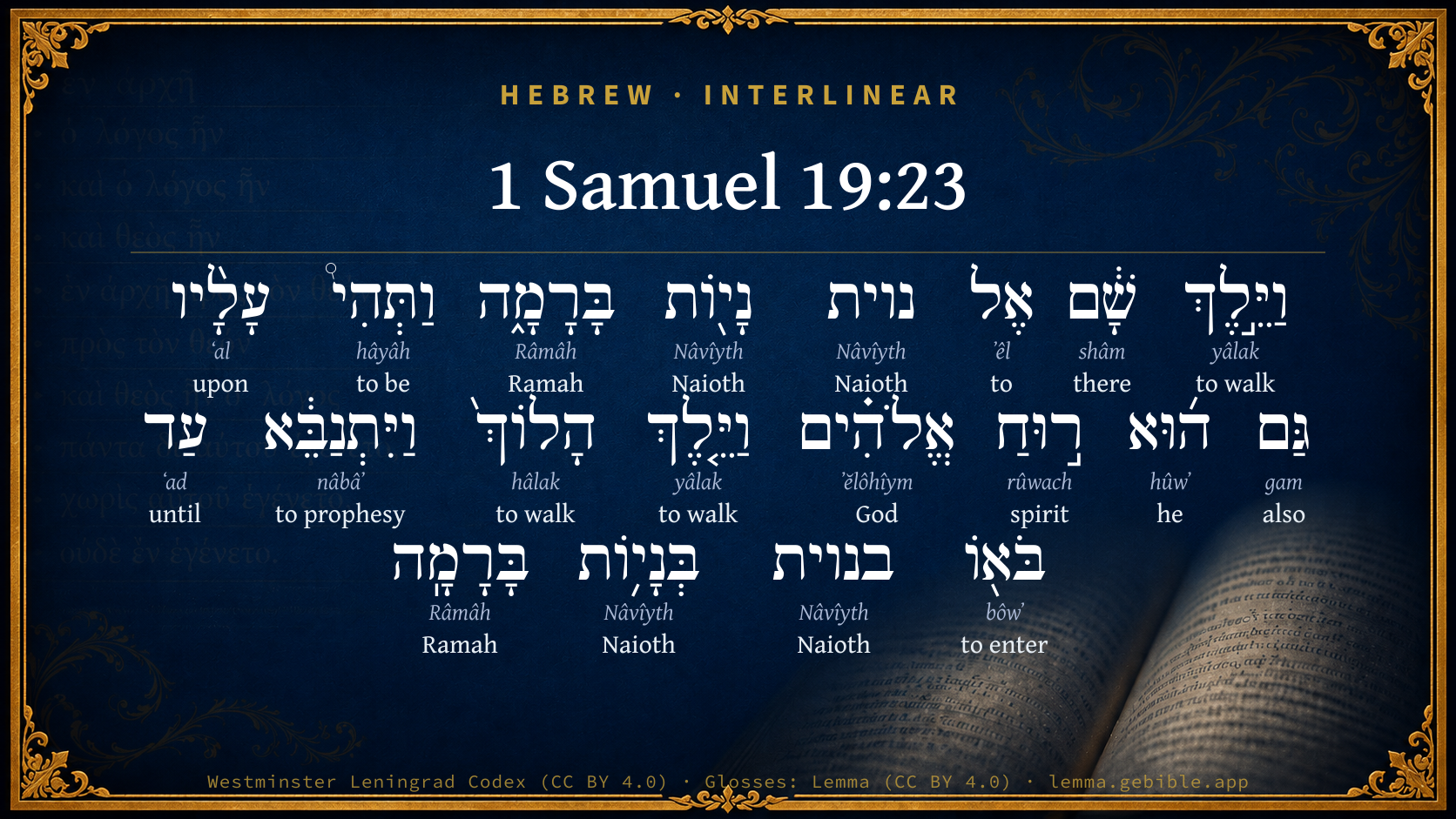
  1. וַיֵּ֣לֶךְ yâlak H3212 “and · to walk” Conjunction + Verb, Qal, Sequential Imperfect, 3rd Person, Masculine, Singular
  2. שָׁ֔ם shâm H8033 “there” Adverb
  3. אֶל ʼêl H413 “to” Preposition
  4. נָי֖וֹת Nâvîyth H5121 “Naioth” Noun, Proper
  5. בָּרָמָ֑ה Râmâh H7414 “in/at the · Ramah” Preposition, Determined + Noun, Proper
  6. וַתְּהִי֩ hâyâh H1961 “and · to be” Conjunction + Verb, Qal, Sequential Imperfect, 3rd Person, Feminine, Singular
  7. עָלָ֨יו ʻal H5921 “upon · him” Preposition + Suffix, Personal, 3rd Person, Masculine, Singular
  8. גַּם gam H1571 “also” Particle, Accusative
  9. ה֜וּא hûwʼ H1931 “he” Pronoun, Personal, 3rd Person, Masculine, Singular
  10. ר֣וּחַ rûwach H7307 “spirit of” Noun, Common, Both, Singular, Construct
  11. אֱלֹהִ֗ים ʼĕlôhîym H430 “God(s)” Noun, Common, Masculine, Plural, Absolute
  12. וַיֵּ֤לֶךְ yâlak H3212 “and · to walk” Conjunction + Verb, Qal, Sequential Imperfect, 3rd Person, Masculine, Singular
  13. הָלוֹךְ֙ hâlak H1980 “to walk” Verb, Qal, Infinitive Absolute
  14. וַיִּתְנַבֵּ֔א nâbâʼ H5012 “and · to prophesy” Conjunction + Verb, Hithpael, Sequential Imperfect, 3rd Person, Masculine, Singular
  15. עַד ʻad H5704 “until” Preposition
  16. בֹּא֖וֹ bôwʼ H935 “to enter · him” Verb, Qal, Infinitive Construct + Suffix, Personal, 3rd Person, Masculine, Singular
  17. בנוית Nâvîyth H5121 “in/at · Naioth” Preposition + Noun, Proper
  18. בְּנָי֥וֹת Nâvîyth H5121 “in/at · Naioth” Preposition + Noun, Proper
  19. בָּרָמָֽה Râmâh H7414 “in/at the · Ramah” Preposition, Determined + Noun, Proper

About this verse

These counts appear in no published source. They are computed here, from the morphology-tagged text and Lemma’s own curated glosses. What Lemma adds →

20
words
15
distinct lemmas
Historical
section

Notable vocabulary

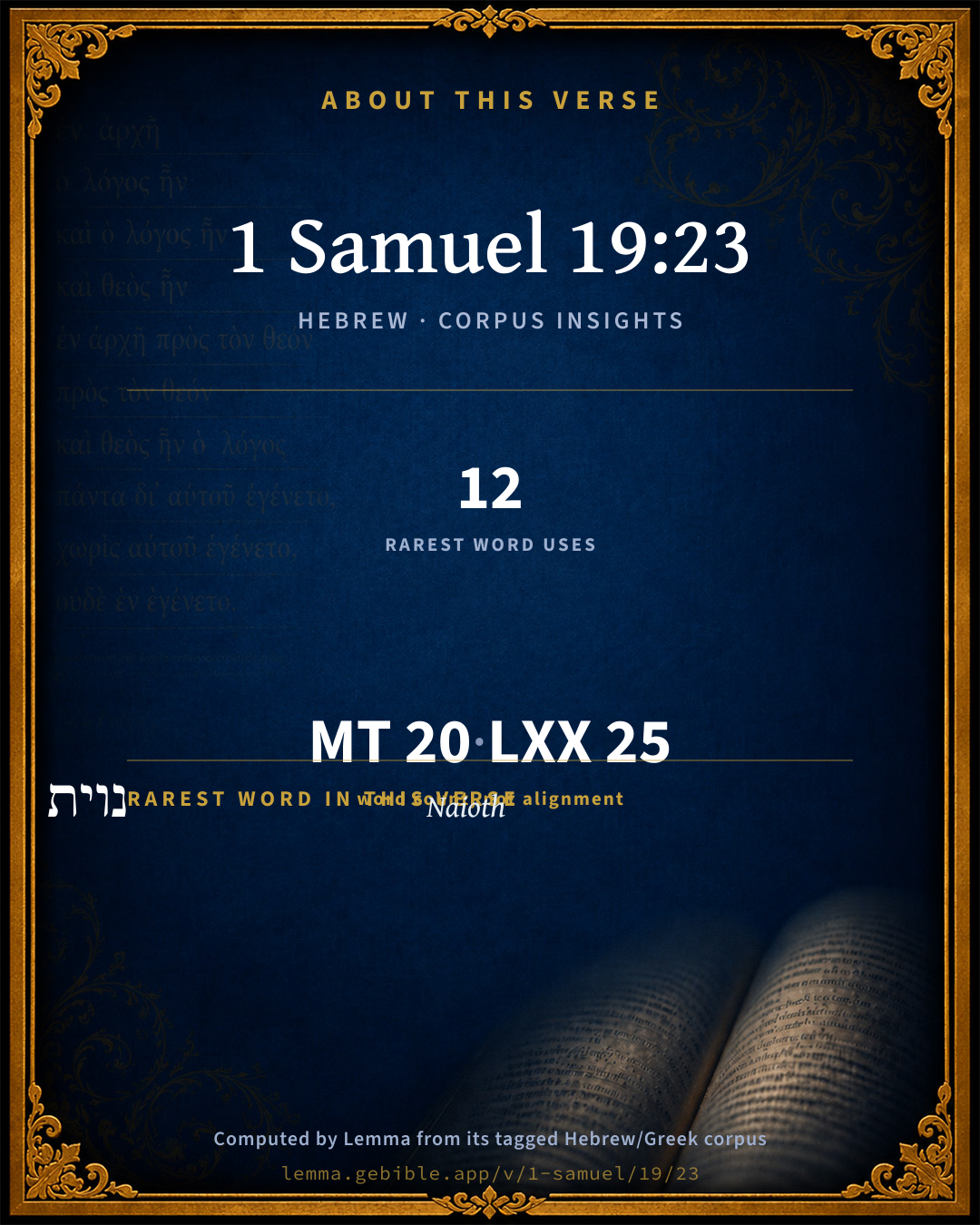
The rarest word here is נוית Naioth H5121 — appearing just 12 times in the whole Hebrew Bible.

Shared distinctive vocabulary

נוית Naioth H5121 occurs in 5 verses of the Hebrew Bible. Also found in:

Grammatical profile

  • 6 verbs
  • 8 nouns
  • 1 pronoun
  • 3 prepositions
  • 1 adverb
  • 1 particle

Verb forms

  • וַיֵּ֣לֶךְ Qal · Sequential Imperfect
  • וַתְּהִי֩ Qal · Sequential Imperfect
  • וַיֵּ֤לֶךְ Qal · Sequential Imperfect
  • הָלוֹךְ֙ Qal · Infinitive Absolute
  • וַיִּתְנַבֵּ֔א Hithpael · Sequential Imperfect
  • בֹּא֖וֹ Qal · Infinitive Construct

Repetition

Words recur within this verse — often emphatic in Hebrew:

  • נוית Naioth H5121 ×4
  • וַיֵּ֣לֶךְ to walk H3212 ×2
  • בָּרָמָ֑ה Ramah H7414 ×2

Hebrew & Septuagint length

In English translation the verse runs 29 words from the Hebrew and 30 from the Septuagint (LXX English) — closely comparable.

A rough comparison of the two English renderings, which tokenize alike — not a word-level alignment.

Word counts can differ between the Hebrew and the Greek without any difference in meaning — e.g. the Hebrew direct-object marker אֵת has no separate Greek word, and Greek often adds the article ὁ.

In the original languages it is 20 Hebrew tokens and 25 Greek tokens — but the two are counted differently (Hebrew bundles its prefixes and suffixes into one token; the Greek is in lemma form), so that isn’t a like-for-like length.

Cross-references

9

Topical passages linked to 1 Samuel 19:23 in the Treasury of Scripture Knowledge — connected by theme and wording, ordered by reader-vote popularity; previews shown in the World English Bible.

  • Proverbs 16:9 A man's heart plans his course, But Yahweh directs his steps.
  • 1 Samuel 10:10 When they came there to the hill, behold, a band of prophets met him; and the Spirit of God came mightily on him, and he prophesied among them.
  • Numbers 24:2 Balaam lifted up his eyes, and he saw Israel dwelling according to their tribes; and the Spirit of God came on him.
  • 1 Samuel 19:20 Saul sent messengers to take David: and when they saw the company of the prophets prophesying, and Samuel standing as head over them, the Spirit of God came on the messengers of Saul, and they also prophesied.
  • Numbers 23:5 Yahweh put a word in Balaam's mouth, and said, Return to Balak, and thus you shall speak.
  • Proverbs 21:1 The king's heart is in Yahweh's hand like the watercourses. He turns it wherever he desires.
  • Matthew 7:22 Many will tell me in that day, 'Lord, Lord, didn't we prophesy in your name, in your name cast out demons, and in your name do many mighty works?'
  • John 11:51 Now he didn't say this of himself, but being high priest that year, he prophesied that Jesus would die for the nation,
  • 1 Corinthians 13:2 If I have the gift of prophecy, and know all mysteries and all knowledge; and if I have all faith, so as to remove mountains, but don't have love, I am nothing.

Cross-references courtesy of OpenBible.info (CC BY 4.0).

Hebrew and Greek witnesses Masoretic Hebrew ↔ Greek Septuagint

The same verse in the two great witnesses to the Old Testament, shown verse-for-verse.

These are two independent witnesses, not word-aligned to each other, and the Septuagint is shown in lemma (dictionary) form.

Hebrew 1 Samuel 19:23 Masoretic · Westminster Leningrad Codex

וַיֵּ֣לֶךְ שָׁ֔ם אֶל נוית נָי֖וֹת בָּרָמָ֑ה וַתְּהִי֩ עָלָ֨יו גַּם ה֜וּא ר֣וּחַ אֱלֹהִ֗ים וַיֵּ֤לֶךְ הָלוֹךְ֙ וַיִּתְנַבֵּ֔א עַד בֹּא֖וֹ בנוית בְּנָי֥וֹת בָּרָמָֽה

He went there to Naioth in Ramah: and the Spirit of God came on him also, and he went on, and prophesied, until he came to Naioth in Ramah.

World English Bible · Public Domain

Greek LXX 1 Samuel 19:23 Septuagint · lemma form

καί πορεύομαι ἐκεῖθεν εἰς ναυαθ ἐν ραμα καί γίγνομαι καί ἐπί αὐτός πνεῦμα θεός καί πορεύομαι προφητεύω ἕως ὁ ἔρχομαι αὐτός εἰς ναυαθ ἐν ραμα

And he went thence to Navath in Rama: and there came the Spirit of God upon him also, and he went on prophesying till he came to Navath in Rama.

LXX2012 (modern English Septuagint) · Public Domain

Hebrew: Westminster Leningrad Codex (CC BY 4.0). Greek: Septuagint (public domain); English from LXX2012 (modern English Septuagint) (Public Domain). How the Septuagint differs from the Hebrew →

Targum (Aramaic paraphrase)

1

The Targum is the ancient Jewish Aramaic paraphrase of the Hebrew Scriptures — an interpretive translation, not the Hebrew text itself. Onkelos (literal) and Pseudo-Jonathan (expansive) render the Torah, and Jonathan the Prophets. Coverage is partial: where no permissively-licensed English translation exists for a verse, only the Aramaic is shown. This is verse-level text, not a word-by-word alignment to the Hebrew.

  1. Targum Jonathan Prophets (Joshua–Malachi)
    וַאֲזַל לְתַמָן לְבֵית אוּלְפָנָא דִי בְרָמָתָא וּשְׁרַת עֲלוֹהִי אַף הוּא רוּחַ נְבוּאָה מִן קֳדָם יְיָ וַאֲזַל מֵיזַל וּמְשַׁבַּח עַד דַאֲתָא לְבֵית אוּלְפָנָא בְרָמָתָא:

    (no public-domain English translation for this verse)

    Targum Jonathan — Aramaic: “Mikraot Gedolot” (public domain). English: “Sefaria Community Translation” (CC0 1.0 (public-domain dedication)); “London "Chaldee Paraphrase," 1871” (public domain). Text via Sefaria.

Commentary

Notes on 1 Samuel 19:23 from classic Christian and Jewish commentators (each source and its license shown beneath its notes). The classic Christian expositions comment on the surrounding passage and are grouped to its opening verse, so a note may address several verses; the Jewish commentaries on the Tanakh (Rashi and others) are per-verse, so they appear only where the commentator wrote on this verse.

Lemma curates 59 commentaries, every one of them public domain or Creative Commons licensed, each selected and text-cleaned for this edition rather than reprinted as found. About our sources →

Trapp's Complete Commentary

John Trapp

1Sa 19:23 And he went thither to Naioth in Ramah: and the Spirit of God was upon him also, and he went on, and prophesied, until he came to Naioth in Ramah.

Ver. 23. And he went on, and prophesied.] Being suddenly cicurated, and sooner than his messengers had been - viz., by the way, and before he came to Naioth. So that the more he hardened himself against God, the more did God show his power upon him.

John Trapp, A Commentary or Exposition upon All the Books of the Old and New Testament (1647–1656) — public domain. Text from a community e-Sword module.

Geneva Bible (1599)

Geneva Bible translators

With a mind to persecute them.

Geneva Bible (1599) marginal notes — public domain. Text via Bolls.life.

Adam Clarke's Commentary

Verse 23. He went on, and prophesied] The Divine Spirit seemed to have seized him at the well of Sechu; and he went on from that prophesying-praying, singing praises, c. till he came to Naioth.

Adam Clarke's Commentary on the Bible (1810–1826) — public domain. Text from a community e-Sword/MySword module.

The Cambridge Bible for Schools and Colleges

gen. ed. J. J. S. Perowne

23. until he came to Naioth] The inspiration seized Saul even before he reached the company of prophets. He was to be convinced of the irresistible might of the Divine Spirit against whose influence he had striven. He was to be taught, if his heart was not already too utterly hardened to learn, that in fighting against David he was fighting against God, and engaging in a futile struggle. For this reason Saul, as the chief agent in David’s persecution, was struck down more completely than his servants, and lay there unconscious “all that day and all that night.”

The Cambridge Bible for Schools and Colleges (gen. ed. J. J. S. Perowne; Cambridge University Press, 1878–1918) — public domain. Text from a community e-Sword module.

John Gill's Exposition

And he went thither to Naioth in Ramah,.... He went on from the well towards the place:

and the Spirit of God was upon him also; as well as upon his messengers; even the spirit of prophecy, as the Targum:

and he went on and prophesied until he came to Naioth in Ramah: in this he differed from his messengers; they did not prophesy till they came to that place, but Saul began to prophesy before he came thither, as he was in his way from the well to it.

John Gill's Exposition of the Whole Bible (1746–1763) — public domain (CC PDM 1.0). Text via the HelloAO Bible API.

Matthew Poole's English Annotations

The Spirit of God was upon him also; it came upon him in the way; whereas it came not upon his messengers till they came to the place; whereby God would convince Saul of the vanity of all his designs against David, and that in them he fought against God himself.

Matthew Poole's English Annotations on the Holy Bible (1683–1685) — public domain. Text from a community e-Sword/MySword module.

Whedon's Commentary on the Bible

Daniel D. Whedon

23. The Spirit of God was upon him also — The same Spirit that had so powerfully affected the three successive bands of messengers that had been sent before him.

He went on, and prophesied — The Spirit seized him sooner than it did his messengers, and also wrought upon him more powerfully. Before he reached the dwellings of the prophets he became the helpless subject of a mighty spiritual power, and was driven on, in spite of himself, to speak and do what he intended not.

Daniel D. Whedon (gen. ed.), Commentary on the Old and New Testaments (1874–1909) — public domain. Text from a community e-Sword module.

John Wesley's Explanatory Notes

The spirit - It came upon him in the way; whereas it came not upon his messengers 'till they came to the place. Hereby God would convince Saul of the vanity of his designs against David, and that in them he fought against God himself.

John Wesley, Explanatory Notes Upon the Whole Bible (1754–1765) — public domain. Text via the GEBible commentary corpus.

unfoldingWord translationNotes

Door43 World Missions Community

This is why they ask, "Is Saul also among the prophets?"

This became a proverb among the Israelites. Apparently people said this to express surprise when a person unexpectedly did something that he had not done before. The implied meaning of the question can be stated explicitly. See how you translated this in 1 Samuel 10:12. AT: "That is the reason that when people see someone doing something that is very unexpected, they say, 'Is Saul also a prophet?'" (See: Proverbs and Assumed Knowledge and Implicit Information)

they ask

Here "they" refers to people in general. The question became a proverb among the people.

unfoldingWord translationNotes — © Distant Shores Media and the Door43 World Missions Community, licensed CC BY-SA 4.0. Source: git.door43.org/Door43/en_tn.

Lesson kit

Teaching starters — assembled from the data on this page, not authored interpretation. Every prompt links to the verse data it draws on. Edit before teaching.

1 Samuel, in the Historical, opens this verse with 20 words (15 distinct Hebrew lemmas). Its most distinctive word is Nâvîyth (“Naioth”). A historical commentator’s framing appears above. Read the whole chapter for the surrounding context.

Discussion questions

  1. What does “Naioth” (Nâvîyth) contribute to the verse as a whole?
  2. How does 1 Samuel 19:18, which shares the word «Naioth», read alongside this verse?
  3. What does the repetition of “Naioth” (4× in this one verse) do in this verse?
  4. The translations on this page render this verse differently — a whole-verse word diff, not a word-by-word alignment. What might account for the different wordings?
  5. «וַיֵּ֣לֶךְ» is a Qal Sequential Imperfect verb. How does that grammatical form shape the action described?
  6. Compare how Trapp's Complete Commentary and Geneva Bible (1599) read this verse. Where do they agree or differ?

Things to notice

Reading settings

Reading text

Shown beneath each verse's original-language words.

Old Testament
Old Testament edition

Read the OT as the Masoretic Hebrew (MT) or the Greek Septuagint (LXX).

English shown for the Greek Septuagint (in the Hebrew ↔ Greek comparison).

Comparing translations? Open the Compare panel on any verse page to stack up to four side by side.