
1 Chronicles 12:18

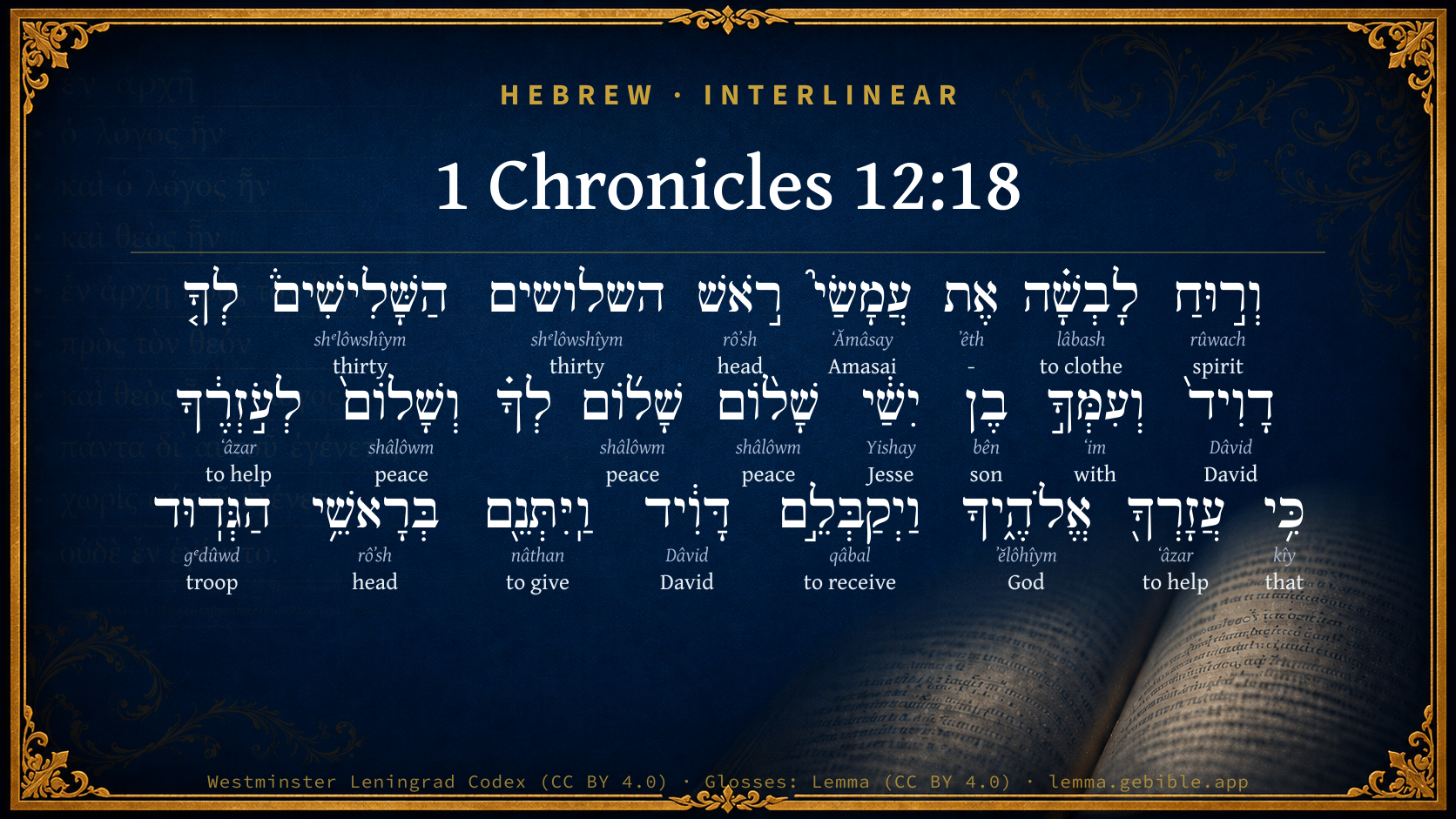
Hebrew (Westminster Leningrad Codex) 1 Chronicles 12:18 appears in the Hebrew Old Testament. The text above is from the Westminster Leningrad Codex. Each word links to its Strong’s number, a concise gloss, and parsing drawn from the Open Scriptures Hebrew Bible morphology. Click any word for its full Brown-Driver-Briggs (BDB) entry.
Download image
Cite this verse

1 Chronicles 12:18 (World English Bible). Public Domain. Lemma interlinear Bible study tool, https://lemma.gebible.app/v/1-chronicles/12/18.

Show BibTeX & RIS
BibTeX
RIS
English Translation
Then the Spirit came on Amasai, who was chief of the thirty, [and he said], "We are yours, David, and on your side, you son of Jesse: peace, peace be to you, and peace be to your helpers; for your God helps you." Then David received them, and made them captains of the band.
World English Bible · Public Domain
Download a study sheet

One document with this verse’s original text, its word-by-word gloss line, the meaning frame, cross-references with their text, attributed commentary, and full source and license credits — printable, and it pastes into notes with its structure intact.

This verse Autodidact and up

Study sheet (.html) Plain text (.txt)

A passage Seminary Student

Up to 50 verses in one chapter. A passage sheet keeps up to 6 commentary sources and 12 cross-references per verse, in the order this page ranks them, and says so on the sheet whenever that leaves anything out. Ask for a single verse and you get the Autodidact verse sheet above.

Everything on this page stays free to read, with no account — the sheet is a download of what is already on screen, not access to it.

Want to remove ads? Support Godless Engineer
Compare translations 3

The same verse in 3 English versions, stacked beneath the original-language interlinear above. Click any original word for its lexicon entry.

Each is an independent rendering of the whole verse — the interlinear is not word-aligned to these translations.

Highlighted words mark where these versions differ — a whole-verse word diff, not a word-by-word alignment.

  • World English Bible Public Domain
    Then the Spirit came on Amasai, who was chief of the thirty, [and he said], "We are yours, David, and on your side, you son of Jesse: peace, peace be to you, and peace be to your helpers; for your God helps you." Then David received them, and made them captains of the band.
  • King James Version Public Domain
    Then the spirit came upon Amasai, who was chief of the captains, and he said, Thine are we, David, and on thy side, thou son of Jesse: peace, peace be unto thee, and peace be to thine helpers; for thy God helpeth thee. Then David received them, and made them captains of the band.
  • unfoldingWord Literal Text CC BY-SA 4.0
    And the Spirit clothed Amasai, the head of the 30: “For you, David, and with you, son of Jesse! Peace, peace to you, and peace to the one helping you, for your God helps you!” And David accepted them, and he appointed them as heads of a troop.

unfoldingWord Literal Text — © unfoldingWord, licensed CC BY-SA 4.0. Word-aligned USFM3 via Door43 (git.door43.org/unfoldingWord/en_ult).

Versions to compare (up to 4)

3 of 4 selected

Show all 18 translations

Every available English version of this verse, each an independent rendering of the whole verse.

  • World English Bible Public Domain
    Then the Spirit came on Amasai, who was chief of the thirty, [and he said], "We are yours, David, and on your side, you son of Jesse: peace, peace be to you, and peace be to your helpers; for your God helps you." Then David received them, and made them captains of the band.
  • Berean Standard Bible Public Domain
    Then the Spirit came upon Amasai, the chief of the Thirty, and he said: “We are yours, O David! We are with you, O son of Jesse! Peace, peace to you, and peace to your helpers, for your God helps you.” So David received them and made them leaders of his troops.
  • Majority Standard Bible Public Domain
    Then the Spirit came upon Amasai, the chief of the Thirty, and he said: “We are yours, O David! We are with you, O son of Jesse! Peace, peace to you, and peace to your helpers, for your God helps you.” So David received them and made them leaders of his troops.
  • King James Version Public Domain
    Then the spirit came upon Amasai, who was chief of the captains, and he said, Thine are we, David, and on thy side, thou son of Jesse: peace, peace be unto thee, and peace be to thine helpers; for thy God helpeth thee. Then David received them, and made them captains of the band.
  • American Standard Version (1901) Public Domain
    Then the Spirit came upon Amasai, who was chief of the thirty, `and he said', Thine are we, David, and on thy side, thou son of Jesse: peace, peace be unto thee, and peace be to thy helpers; for thy God helpeth thee. Then David received them, and made them captains of the band.
  • Revised Version (1885) Public Domain
    Then the spirit came upon Amasai, who was chief of the thirty, and he said, Thine are we, David, and on thy side, thou son of Jesse: peace, peace be unto thee, and peace be to thine helpers; for thy God helpeth thee. Then David received them, and made them captains of the band.
  • Geneva Bible (1599) Public Domain
    And the spirit came vpon Amasai, which was the chiefe of thirtie, and he said, Thine are we, Dauid, and with thee, O sonne of Ishai. Peace, peace be vnto thee, and peace be vnto thine helpers: for thy God helpeth thee. Then Dauid receiued them, and made them captaines of the garison.
  • Douay-Rheims (1899) Public Domain
    But the spirit came upon Amasai the chief among thirty, and he said: We are thine, O David, and for thee, O son of Isai: peace, peace be to thee, and peace to thy helpers. For thy God helpeth thee. So David received them, and made them captains of the band.
  • Young's Literal Translation Public Domain
    And the Spirit hath clothed Amasai, head of the captains: `To thee, O David, and with thee, O son of Jesse -- peace! peace to thee, and peace to thy helper, for thy God hath helped thee;' and David receiveth them, and putteth them among the heads of the troop.
  • Literal Standard Version CC BY-SA 4.0
    And the Spirit has clothed Amasai, head of the captains: “To you, O David, and with you, O son of Jesse—peace! Peace to you, and peace to your helper, for your God has helped you”; and David receives them, and puts them among the heads of the troop.
  • Unlocked Literal Bible CC BY-SA 4.0
    Then the Spirit came on Amasai, who was chief of the thirty. Amasai said, “We are yours, David. We are on your side, son of Jesse. Peace, may peace be to whoever helps you. May peace be to your helpers, for your God is helping you.” Then David received them and made them commanders over his men.
  • unfoldingWord Literal Text CC BY-SA 4.0
    And the Spirit clothed Amasai, the head of the 30: “For you, David, and with you, son of Jesse! Peace, peace to you, and peace to the one helping you, for your God helps you!” And David accepted them, and he appointed them as heads of a troop.
  • Darby Bible Public Domain
    And the Spirit came upon Amasai, the chief of the captains, [and he said,] Thine [are we], David, And with thee, thou son of Jesse: Peace, peace be to thee! And peace be to thy helpers! For thy God helps thee. And David received them, and made them chiefs of bands.
  • World Messianic Bible Public Domain
    Then the Spirit came on Amasai, who was chief of the thirty, and he said, “We are yours, David, and on your side, you son of Jesse. Peace, peace be to you, and peace be to your helpers; for your God helps you.” Then David received them and made them captains of the band.
  • Webster's Bible Public Domain
    Then the spirit came upon Amasai, who was chief of the captains, and he said, Thine are we, David, and on thy side, thou son of Jesse: peace, peace be to thee, and peace be to thy helpers; for thy God helpeth thee. Then David received them, and made them captains of the band.
  • Free Bible Version CC BY-SA 4.0
    Then the Spirit came upon Amasai, the leader of the Thirty. “We are yours, David, and we are with you, son of Jesse! May peace, prosperity, and success be yours and those who help you, for God is the one who is helping you.” So David allowed them to join him, and put them in charge of his bands of raiders.
  • Bible in Basic English Public Domain
    Then the spirit came on Amasai, who was chief of the captains, and he said, We are yours, David, we are on your side, O son of Jesse: may peace be with you and peace be with your helpers; for God is your helper. Then David took them into his army and made them captains of the band.
  • JPS Tanakh (1917) Public Domain
    (12-19) Then the spirit clothed Amasai, who was chief of the captains: Thine are we, David, and on thy side, thou son of Jesse; peace, peace be unto thee, and peace be to thy helpers; for thy God helpeth thee. Then David received them, and made them captains of the band.

Literal Standard Version (2020), Covenant Press — licensed CC BY-SA 4.0. Text via the HelloAO Bible API (eBible.org). Unlocked Literal Bible (unfoldingWord) — licensed CC BY-SA 4.0. Text via the HelloAO Bible API (eBible.org). unfoldingWord Literal Text — © unfoldingWord, licensed CC BY-SA 4.0. Word-aligned USFM3 via Door43 (git.door43.org/unfoldingWord/en_ult). Free Bible Version, Dr. Jonathan Gallagher — licensed CC BY-SA 4.0. Text via the HelloAO Bible API (eBible.org).

Word by word

More ways to search: Search by grammar → Find every occurrence → Compare this word →

Practice this passage: Drill this verse → Learn its vocabulary →

עֲמָשַׂי֮
ʻĂmâsay
H6022
“Amasai”
Noun, Proper
Part of Speech
Noun
Type
Proper
Full BDB Definition

Origin: from H6006

TWOT: None

Amasai = "burdensome" - a warrior and chief of the captains of Judah and Benjamin who joined David at Ziklag - a Kohathite Levite, father of Mahath and ancestor of Samuel - a priest who blew the trumpet before the ark - another Kohathite Levite in the reign of king Hezekiah of Judah
  1. וְר֣וּחַ rûwach H7307 “and · spirit” Conjunction + Noun, Common, Both, Singular, Absolute
  2. לָבְשָׁ֗ה lâbash H3847 “to clothe” Verb, Qal, Perfect, 3rd Person, Feminine, Singular
  3. אֶת ʼêth H853 “-” Particle, Direct Object
  4. רֹ֣אשׁ rôʼsh H7218 “head of” Noun, Common, Masculine, Singular, Construct
  5. השלושים shᵉlôwshîym H7970 “the · thirty” Particle, Definite Article + Adjective, Cardinal number, Both, Plural, Absolute
  6. הַשָּׁלִישִׁים֒ shᵉlôwshîym H7970 “the · thirty” Particle, Definite Article + Adjective, Cardinal number, Both, Plural, Absolute
  7. דָוִיד֙ Dâvid H1732 “David” Noun, Proper
  8. וְעִמְּךָ֣ ʻim H5973 “and · with · you” Conjunction + Preposition + Suffix, Personal, 2nd Person, Masculine, Singular
  9. בֶן bên H1121 “son of” Noun, Common, Masculine, Singular, Construct
  10. יִשַׁ֔י Yishay H3448 “Jesse” Noun, Proper
  11. שָׁל֨וֹם shâlôwm H7965 “peace” Noun, Common, Masculine, Singular, Absolute
  12. שָׁל֜וֹם shâlôwm H7965 “peace” Noun, Common, Masculine, Singular, Absolute
  13. וְשָׁלוֹם֙ shâlôwm H7965 “and · peace” Conjunction + Noun, Common, Masculine, Singular, Absolute
  14. לְעֹ֣זְרֶ֔ךָ ʻâzar H5826 “to/for · helping · you” Preposition + Verb, Qal, Participle Active, Masculine, Singular, Construct + Suffix, Personal, 2nd Person, Masculine, Singular
  15. כִּ֥י kîy H3588 “that” Conjunction
  16. עֲזָרְךָ֖ ʻâzar H5826 “to help · you” Verb, Qal, Perfect, 3rd Person, Masculine, Singular + Suffix, Personal, 2nd Person, Masculine, Singular
  17. אֱלֹהֶ֑יךָ ʼĕlôhîym H430 “God(s) · your” Noun, Common, Masculine, Plural, Construct + Suffix, Personal, 2nd Person, Masculine, Singular
  18. וַיְקַבְּלֵ֣ם qâbal H6901 “and · to receive · them” Conjunction + Verb, Piel, Sequential Imperfect, 3rd Person, Masculine, Singular + Suffix, Personal, 3rd Person, Masculine, Plural
  19. דָּוִ֔יד Dâvid H1732 “David” Noun, Proper
  20. וַֽיִּתְּנֵ֖ם nâthan H5414 “and · to give · them” Conjunction + Verb, Qal, Sequential Imperfect, 3rd Person, Masculine, Singular + Suffix, Personal, 3rd Person, Masculine, Plural
  21. בְּרָאשֵׁ֥י rôʼsh H7218 “in/at · heads of” Preposition + Noun, Common, Masculine, Plural, Construct
  22. הַגְּדֽוּד gᵉdûwd H1416 “the · troop” Particle, Definite Article + Noun, Common, Masculine, Singular, Absolute

About this verse

These counts appear in no published source. They are computed here, from the morphology-tagged text and Lemma’s own curated glosses. What Lemma adds →

25
words
17
distinct lemmas
Historical
section

Notable vocabulary

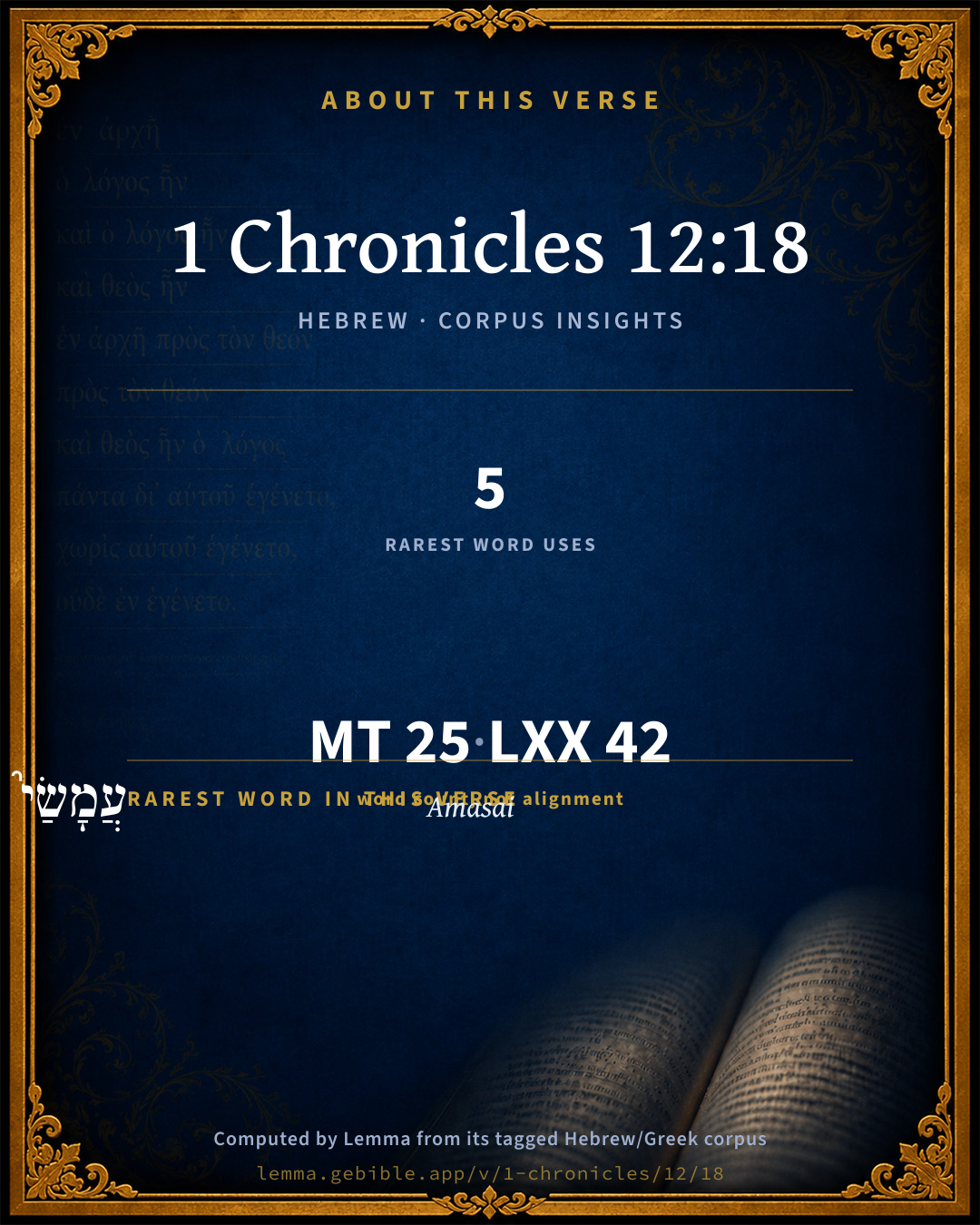
The rarest word here is עֲמָשַׂי֮ Amasai H6022 — appearing just 5 times in the whole Hebrew Bible.

Shared distinctive vocabulary

עֲמָשַׂי֮ Amasai H6022 occurs in 5 verses of the Hebrew Bible. Also found in:

Grammatical profile

  • 5 verbs
  • 13 nouns
  • 2 adjectives
  • 3 prepositions
  • 1 conjunction
  • 1 particle

Verb forms

  • לָבְשָׁ֗ה Qal · Perfect
  • לְעֹ֣זְרֶ֔ךָ Qal · Participle Active
  • עֲזָרְךָ֖ Qal · Perfect
  • וַיְקַבְּלֵ֣ם Piel · Sequential Imperfect
  • וַֽיִּתְּנֵ֖ם Qal · Sequential Imperfect

Repetition

Words recur within this verse — often emphatic in Hebrew:

  • שָׁל֨וֹם peace H7965 ×3
  • רֹ֣אשׁ head H7218 ×2
  • השלושים thirty H7970 ×2
  • דָוִיד֙ David H1732 ×2
  • לְעֹ֣זְרֶ֔ךָ to help H5826 ×2

Hebrew & Septuagint length

In English translation the verse runs 54 words from the Hebrew and 50 from the Septuagint (LXX English) — closely comparable.

A rough comparison of the two English renderings, which tokenize alike — not a word-level alignment.

Word counts can differ between the Hebrew and the Greek without any difference in meaning — e.g. the Hebrew direct-object marker אֵת has no separate Greek word, and Greek often adds the article ὁ.

In the original languages it is 25 Hebrew tokens and 42 Greek tokens — but the two are counted differently (Hebrew bundles its prefixes and suffixes into one token; the Greek is in lemma form), so that isn’t a like-for-like length.

Cross-references

23

Topical passages linked to 1 Chronicles 12:18 in the Treasury of Scripture Knowledge — connected by theme and wording, ordered by reader-vote popularity; previews shown in the World English Bible.

  • Judges 6:34 But the Spirit of Yahweh came on Gideon; and he blew a trumpet; and Abiezer was gathered together after him.
  • Judges 3:10 The Spirit of Yahweh came on him, and he judged Israel; and he went out to war, and Yahweh delivered Cushan Rishathaim king of Mesopotamia into his hand: and his hand prevailed against Cushan Rishathaim.
  • 2 Samuel 17:25 Absalom set Amasa over the host instead of Joab. Now Amasa was the son of a man, whose name was Ithra the Israelite, who went in to Abigail the daughter of Nahash, sister to Zeruiah, Joab's mother.
  • John 6:67–68 Jesus said therefore to the twelve, "You don't also want to go away, do you?"
  • Ruth 1:16 Ruth said, "Don't entreat me to leave you, and to return from following after you, for where you go, I will go; and where you lodge, I will lodge; your people shall be my people, and your God my God;
  • 2 Samuel 20:4–8 Then said the king to Amasa, Call me the men of Judah together within three days, and be here present.
  • 1 Kings 9:22 But of the children of Israel did Solomon make no bondservants; but they were the men of war, and his servants, and his princes, and his captains, and rulers of his chariots and of his horsemen.
  • 2 Kings 9:32 He lifted up his face to the window, and said, Who is on my side? who? There looked out to him two or three eunuchs.
  • 2 Kings 10:5 He who was over the household, and he who was over the city, the elders also, and those who brought up [the children], sent to Jehu, saying, We are your servants, and will do all that you shall bid us; we will not make any man king: you do that which is good in your eyes.
  • 1 Chronicles 2:17 Abigail bore Amasa; and the father of Amasa was Jether the Ishmaelite.
  • Isaiah 59:17 He put on righteousness as a breastplate, and a helmet of salvation on his head; and he put on garments of vengeance for clothing, and was clad with zeal as a mantle.
  • Matthew 12:30 "He who is not with me is against me, and he who doesn't gather with me, scatters.
  • Galatians 6:16 As many as walk by this rule, peace and mercy be on them, and on God's Israel.
  • Ephesians 6:23–24 Peace be to the brothers, and love with faith, from God the Father and the Lord Jesus Christ.
  • Judges 13:25 The Spirit of Yahweh began to move him in Mahaneh-dan, between Zorah and Eshtaol.
  • 1 Samuel 8:12 and he will appoint them to him for captains of thousands, and captains of fifties; and [he will set some] to plow his ground, and to reap his harvest, and to make his instruments of war, and the instruments of his chariots.
  • 1 Samuel 22:7 Saul said to his servants who stood about him, Hear now, you Benjamites; will the son of Jesse give everyone of you fields and vineyards, will he make you all captains of thousands and captains of hundreds,
  • 1 Samuel 25:5–6 David sent ten young men, and David said to the young men, Go up to Carmel, and go to Nabal, and greet him in my name:
  • 1 Samuel 25:28–29 Please forgive the trespass of your handmaid: for Yahweh will certainly make my lord a sure house, because my lord fights the battles of Yahweh; and evil shall not be found in you all your days.
  • 2 Samuel 5:2 In times past, when Saul was king over us, it was you who led out and brought in Israel: and Yahweh said to you, You shall be shepherd of my people Israel, and you shall be prince over Israel.
  • 2 Samuel 15:21 Ittai answered the king, and said, As Yahweh lives, and as my lord the king lives, surely in what place my lord the king shall be, whether for death or for life, even there also will your servant be.
  • 2 Samuel 19:13 Say you to Amasa, Aren't you my bone and my flesh? God do so to me, and more also, if you aren't captain of the host before me continually in the room of Joab.
  • Zechariah 8:23 Thus says Yahweh of Hosts: "In those days, ten men will take hold, out of all the languages of the nations, they will take hold of the skirt of him who is a Jew, saying, 'We will go with you, for we have heard that God is with you.'"

Cross-references courtesy of OpenBible.info (CC BY 4.0).

Hebrew and Greek witnesses Masoretic Hebrew ↔ Greek Septuagint

The same verse in the two great witnesses to the Old Testament, shown verse-for-verse.

These are two independent witnesses, not word-aligned to each other, and the Septuagint is shown in lemma (dictionary) form.

Hebrew 1 Chronicles 12:18 Masoretic · Westminster Leningrad Codex

וְר֣וּחַ לָבְשָׁ֗ה אֶת עֲמָשַׂי֮ רֹ֣אשׁ השלושים הַשָּׁלִישִׁים֒ לְךָ֤ דָוִיד֙ וְעִמְּךָ֣ בֶן יִשַׁ֔י שָׁל֨וֹם שָׁל֜וֹם לְךָ֗ וְשָׁלוֹם֙ לְעֹ֣זְרֶ֔ךָ כִּ֥י עֲזָרְךָ֖ אֱלֹהֶ֑יךָ וַיְקַבְּלֵ֣ם דָּוִ֔יד וַֽיִּתְּנֵ֖ם בְּרָאשֵׁ֥י הַגְּדֽוּד

Then the Spirit came on Amasai, who was chief of the thirty, [and he said], "We are yours, David, and on your side, you son of Jesse: peace, peace be to you, and peace be to your helpers; for your God helps you." Then David received them, and made them captains of the band.

World English Bible · Public Domain

Greek LXX 1 Chronicles 12:18 Septuagint · lemma form

καί δαυίδ ἐκἔρχομαι εἰς ἀπάντησις αὐτός καί εἶπον αὐτός εἰ εἰς εἰρήνη ἥκω πρός ἐγώ εἰμί ἐγώ καρδία κατά ἑαυτοῦ ἐπί σύ καί εἰ ὁ παραδίδωμι ἐγώ ὁ ἐχθρός ἐγώ οὐ ἐν ἀλήθεια χείρ ὁράω ὁ θεός ὁ πατήρ ἐγώ καί ἐλέγχω

And the Spirit came upon Amasai, a captain of the thirty, and he said, Go, David, son of Jesse, you and your people, peace, peace be to you, and peace to your helpers, for your God has helped you. And David received them, and made them captains of the forces.

LXX2012 (modern English Septuagint) · Public Domain

On this verse, Ellicott's Commentary for English Readers discusses the Septuagint’s reading. Read the note in Commentary ↓

Hebrew: Westminster Leningrad Codex (CC BY 4.0). Greek: Septuagint (public domain); English from LXX2012 (modern English Septuagint) (Public Domain). How the Septuagint differs from the Hebrew →

Commentary

Notes on 1 Chronicles 12:18 from classic Christian and Jewish commentators (each source and its license shown beneath its notes). The classic Christian expositions comment on the surrounding passage and are grouped to its opening verse, so a note may address several verses; the Jewish commentaries on the Tanakh (Rashi and others) are per-verse, so they appear only where the commentator wrote on this verse.

Lemma curates 59 commentaries, every one of them public domain or Creative Commons licensed, each selected and text-cleaned for this edition rather than reprinted as found. About our sources →

Trapp's Complete Commentary

John Trapp

1Ch 12:18 Then the spirit came upon Amasai, [who was] chief of the captains, [and he said], Thine [are we], David, and on thy side, thou son of Jesse: peace, peace [be] unto thee, and peace [be] to thine helpers; for thy God helpeth thee. Then David received them, and made them captains of the band.

Ver. 18. Then the spirit came upon Amasai.] Heb., Clothed Amasai or Abishai, as some read it, together with whose words there went forth power, such as wrought in David’s heart a firm belief of their fidelity: he was not thenceforth jealous of them at all. Pray for such a spirit upon our rulers and teachers.

Peace, peace be unto thee,] i.e., Pax omnimoda, Perfect peace, as Isa 26:3. This he spake by the motion of the spirit, met by a motion of the same spirit wrought in David’s heart, causing him to rest in what Amasai said as undoubtedly true. After the same manner is saving faith wrought in God’s elect. {Eph 1:13} Let us be faithful in weakness, though but weak in faith.

John Trapp, A Commentary or Exposition upon All the Books of the Old and New Testament (1647–1656) — public domain. Text from a community e-Sword module.

The Biblical Illustrator

Joseph S. Exell

1Ch_12:16; 1Ch_12:18

And there came of the children of Benjamin and Judah to the hold unto David.

Recruits for King Jesus

I want to run a parallel between the case of David and that of our Lord Jesus Christ.

I. Here is a very commendable example. Many of these men of Judah and Benjamin went to join themselves to David.

1. Because they bad heard that he was the Lords anointed If Jesus be Gods anointed, let Him be your beloved.

2 Because of his personal excellences.

3. Because he was so misrepresented and abused by his enemies.

4. Because they believed that he had a great future before him.

II. A. cautious inquiry. See what David said to them.

1. He set before them the right way; He said, If ye be come peaceably unto me to help me, mine heart shall be knit unto you. Here are three questions--

(1) Do you come to Christ and accept Him?

(2) Do you come with a desire to maintain peace among your Christian brethren?

(3) Do you come with the intent of helping the Lord Jesus Christ to spread abroad His truth?

2. He set before them the wrong way: But if ye be come to betray me to my enemies, seeing there is no wrong in mine hands, the God of our fathers look thereon, and rebuke it.

Some betray the Lord Christ to His enemies--

1. By giving up the doctrines of the gospel.

2. By their inconsistent lives.

3. By apostasy.

III. A cordial enlistment. Thine are we, David, and on thy side, etc. (C. H. Spurgeon.)

David and his helpers

Man is not an independent being. He is dependent for his life, his thought, his feeling--dependent upon God his Creator and his Preserver. He is dependent for the comforts and conveniences of life--dependent upon his fellow-men. And he that seems perhaps to be the most independent amongst us, is after all the most dependent upon his fellows. Man was never made to be independent here. He was never made to be alone. Some such circumstances as these gave rise to the peculiar position of the son of Jesse, as we read of him in the text. David was then combating against a twofold enemy--Saul, the king, his predecessor in office, and the Philistines, the hereditary foes of Israel. Let us mark the concurrent circumstances of these times. Davids cause was not the winning side when these secessions broke off from the strength of Saul and attached themselves to the cause of the son of Jesse. He was as yet in point of numbers and of strength in a very small minority. He was not in power; and, so far as human appearances went, he was very far from power. Every appearance was against him. He himself, though the captain of a band, was a fugitive. And Saul was in power, for Saul was king. David is possessed of but scanty resources, but Saul can command the ways and the means and the supplies of a kingdom. And yet these men come, and they volunteer their services to the son of Jesse. They came not to the throne of one that rules, but they came to the cave of one that hides himself. No marvel that David should have suspected their proper aim, and should have inquired, inquisitively, as to the motive of their coming, as to the object of their visit in this the day of his distress and of his darkness. And this accounts for his inquiry in the verse preceding my text. We would learn from this text the value and the estimate to be set upon Christian co-operation. The downcast and the down-trodden may be rallied by a sympathising word, and may be aroused; and thus arise to his work and to his labour from the very consciousness that he is not altogether alone. Christian co-operation was given to Elijah. The assurance that God one day gave the Tishbite, that there were still seven thousand men who had not bowed the knee to Baal, mightily reassured the prophet. And when we come to inquire into the circumstances of this case a little further, respecting David, we are enabled to find out what was the kind of help, the quality of the help that he obtained. This may be judged of by considering the time in which the help was vouchsafed. As I have said, it was not in the time of his prosperity, but it was some time anterior to that, and in the time of his greatest adversity. Now, it is a law, or axiom, a practical law, that those men are most to be trusted in prosperity that have stood the firmest in the day of adversity. And verily, in practice, these men receive the reward of their fidelity. These men came and chose not the winning side; but there was a mark about even that declining interest--Thy God helpeth thee. That decided the question. If God be for David, what can Saul do against him? If God be for us, who can be against us? God is not forgetful of your work and labour of love which you have showed toward His name. Mark, for instance, His twelve--His chosen ones. They had attached themselves to the person of the lowly Jesus, when there was no mark of distinction, of royalty, of kingly power: at His call they obeyed. Never were there purer days in the Christian faith than when the Christian faith was persecuted. Thus was it with Davids auxiliaries: they looked not to the present adversity, but to the future glory. Thy God helpeth thee, was sufficient as an indication of what would be. These were powerful men. Their faces were like the faces of lions; bold as a lion; and they were as swift as the roes upon the mountains. They were able to ford the depths of Jordan at its full, and in its overflowing, and to rout their enemies to the east and to the west. Truly, with such auxiliaries, David might well thank God, and take courage. But this was not all. His hopes begin to brighten, his prospects begin to look up. Day after day added its gradual increase to his army, until by and by it became a mighty host like unto the host of God. That is what the Scripture says. Each tribe sent its proportion. Thousands, tens of thousands, flocked to the standard of David, and enlisted in defence of the cause of the son of Jesse, until well-nigh half a million of men may be counted, from the enumeration of our context, as having resorted to his cause. This, from beginnings small, but good; this, from incipient stages scanty, yet hopeful. And all these men are well spoken of. They were mighty men of valour; they were ready armed; they were famous throughout the house of their fathers; they were no anonymous helpers, but it is said they were expressed by name to come and make David king. And the value of that help was great because it was a right hearty help--such a help as we need, such a help as is indispensable if we are to be helped at all. We want no halfhearted men, but we want men of God--they are the best, they are the surest, they are the safest, they are the most and the longest to be depended upon. Our experience of human helpers has been a chequered experience. Some that began with us have not continued; some from whom we expected much, perhaps, have broken down midway, departed from us, and went not with us to the work; some that promised nothing, and from whom we expected nothing, have been the most ready, and have been the foremost to come and say, Thine are we, David, and on thy side, thou son of Jesse: peace, peace be unto thee, and peace be to thine helpers. (R. Maguire, M. A.)

Fitness for the service of the great King

I. Intelligence is required.

II. Courage is required.

III. Unity is required.

IV. Enthusiasm is required. (J. Wolfendale.)

The Biblical Illustrator, edited by Joseph S. Exell (c. 1880s–1900s) — public domain. Text from a community e-Sword module.

Joseph Benson's Commentary

1Ch 12:18. The Spirit came upon Amasai — Not only saving graces, but other heroical and generous motions are ascribed to God’s Spirit, which here stirred up in him a more than ordinary greatness of mind and resolution. Thy God helpeth thee — We have seen evidences of God’s singular and gracious care of thee, and kindness to thee; and if we should oppose thee we should fight against God, and his word and providence. Then David made them captains of the band — Of those forces which they brought with them: or, he put them among the heads, or officers of his band; that is, he gave them commands, either now in his small army, each according to his quality; or afterward, when he was advanced to the kingdom: for it is not here said when he did this.

Joseph Benson's Commentary on the Old and New Testaments (1811–1818) — public domain. Text from a community e-Sword module.

Geneva Bible (1599)

Geneva Bible translators

The spirit of boldness and courage moved him to speak thus.

Geneva Bible (1599) marginal notes — public domain. Text via Bolls.life.

Adam Clarke's Commentary

Verse 18. The spirit came upon Amasai] "The spirit of fortitude clothed Amasai, the chief of the mighty men; and he answered, For thy sake, O David, are we come, that we may be with thee, thou son of Jesse. Prosperity be to thee by night and by day; and prosperity be to thy helpers; for the Word of the Lord is thy assistant." - T.

Adam Clarke's Commentary on the Bible (1810–1826) — public domain. Text from a community e-Sword/MySword module.

Ellicott's Commentary for English Readers

(18) Then the spirit came upon Amasai.—Literally, and spirit clothed Amasai. The term for “God” (Elohim) has probably fallen out of the Heb. ext. (Comp. 2Ch_24:20, and Jdg_6:34.) We, in these days, may word it differently, and say, Under a sudden impulse of enthusiasm, Amasai exclaimed, &c. But if we look deeper, and seek a definite interpretation of our terms, we shall allow that the impulses of spirit are spiritual, and that enthusiasm for truth and right is indeed a sort of divine possession. The Syriac renders: “The spirit of valour clothed Amasai.” Comp. Isa_11:2.) The spirit of Jehovah is the source of true courage, as of all other spiritual gifts.

Amasai.—Perhaps the same as Amasa (1Ch_2:17), son of Abigail, David’s sister, whom Joab murdered out of jealousy (2Sa_17:25; 2Sa_20:4-10).

Chief of the captains.—The Heb. text reads, “head of the Thirty,” with which the LXX., Svr., and Vulg. agree. The Heb. margin (Qri) has “knights,” or “chariot-soldiers” (Authorised Version, “captains”), which is less probable. Amasai’s name is not given in the catalogue of the Thirty (1 Chronicles 11), and he is here called “chief of the Thirty” by anticipation.

Thine are we, David.—The structure of Amasas inspired utterance is poetical—

“To thee, David!

And with thee, son of Ishai!

Peace, peace to thee.

And peace to thine helper;

For thy God hath holpen thee!

On thy side.—Heb., with thee. (Comp. 1Ch_11:10; and our Saviour’s “He that is not with me is against me.”)

Peace, peace be unto thee.—David had said, “If ye be come for peace”—that is, with friendly intent. Amasai answers, We will be fast friends with thee, and with all who befriend thee, because God is on thy side. (Comp, the usual Oriental greeting, Salãm ‘alaikum—Peace to you!) David’s past history gave ample evidence of Divine support.

Then David received them.—A late Heb. word (qibbçl). The chronicler resumes his narrative.

Made them captains of the band.—Literally, and bestowed them among the heads of the band—made them officers of his little army, which was continually growing by such adhesions, (Comp. 1Sa_22:2, and 1Sa_23:13.)

A Bible Commentary for English Readers, edited by Charles John Ellicott (1878–1897) — public domain. Text from a community e-Sword module.

The Cambridge Bible for Schools and Colleges

gen. ed. J. J. S. Perowne

18. the spirit came upon A.] Lit. a spirit (i.e. from God) clothed itself with (i.e. entered into) Amasai. Cp. 2Ch_24:20; Jdg_6:34.

Amasai] Probably to be identified with “Amasa” (2Sa_17:25; 2Sa_19:13).

chiefs of the captains] So A.V. rightly, following the K’rî. The “captains” are Amasai’s companions. R.V., following the C’thîb, reads “chief of the thirty”; cp. 1Ch_11:15; 1Ch_11:25.

Thine are we, David, and on thy side] Lit. “For thee, David, and with thee.”

for thy God helpeth thee] The belief that David’s frequent escapes from Saul were due to Divine protection influenced Amasai and his companions in joining David.

The Cambridge Bible for Schools and Colleges (gen. ed. J. J. S. Perowne; Cambridge University Press, 1878–1918) — public domain. Text from a community e-Sword module.

John Gill's Exposition

And they helped David against the band of the rovers,.... The Amalekites, who, while he was gone with the Philistines, had seized on Ziklag, and burnt it, and carried the women captive, with what spoil they could make; these coming to David thus opportunely, assisted him in his pursuit and defeat of them:

for they were all mighty men of valour, and were captains in the host; or army of David.

John Gill's Exposition of the Whole Bible (1746–1763) — public domain (CC PDM 1.0). Text via the HelloAO Bible API.

Albert Barnes' Notes on the Bible

Amasai - The marginal reference identifies him with Amasa, David’s nephew, but it seems unlikely that David would have misdoubted a band led by his own nephew.

The passionate earnestness of Amasai’s speech is strongly marked in the original, and will be better seen by omitting the words which our Version adds in italics. Here, as in 1Ch 12:8-15, we have manifestly the actual words of a very ancient record.

Albert Barnes' Notes on the Bible (1834–1885) — public domain. Text from a community e-Sword/MySword module.

Haydock's Catholic Bible Commentary

Spirit of God (Calmet; or good will, Du Hamel) prompted Amasai, the chief of "the officers." (Calmet) --- Band, or "of a company." (Haydock)

George Leo Haydock (1774–1849), Haydock's Catholic Family Bible and Commentary, 1859 edition — public domain. Excludes Psalms (Douay-Rheims chapter numbering differs from Protestant) and Deuterocanonical books (Catholic canon only).

Matthew Poole's English Annotations

The Spirit came upon Amasai; not only saving graces, but other heroical and generous motions, are ascribed to God’s Spirit, which here stirred up in him a more than ordinary greatness and presentness of mind and resolution.

Thy God helpeth thee; we have observed God’s singular and gracious care of thee, and kindness to thee, and if we should oppose thee, we should be fighters against God and his word and providence.

Captains of the band, i. e. of those forces which they brought with them. Or, he put them among the heads or officers of his band, i.e. he gave them commands, either now in his small army, each according to his quality; or afterwards, when he was advanced to the kingdom; for it is not here expressed when he did this.

Matthew Poole's English Annotations on the Holy Bible (1683–1685) — public domain. Text from a community e-Sword/MySword module.

Whedon's Commentary on the Bible

Daniel D. Whedon

18. The spirit came upon Amasai — Hebrews clothed Amasai, that is, enwrapped him as with armour. See note on Jdg_6:34.

Thine are we, David — This speech of Amasai is full of emotion, and rises to poetic parallelism.

To thee, O David!

And with thee, O son of Jesse!

Peace, peace unto thee,

And peace unto thy helpers;

For helpeth thee thy God.

Daniel D. Whedon (gen. ed.), Commentary on the Old and New Testaments (1874–1909) — public domain. Text from a community e-Sword module.

The Pulpit Commentary

The response of the band, by the mouth of Amasai was worthy of the character of the appeal that David made, both in its heartiness and its high tone. Amasai. Possibly the same with Amasa, (1Ch_2:17) the son of Abigail (David"s sister), wife of Jether. (2Sa_17:25 2Sa_18:6 2Sa_19:13 2Sa_20:10) Ewald discusses this point ("Genesis Int.," 2:544). He was made captain of the host by Absalom, afterwards by David, and Joab put an end to his life. The Spirit (see Num_11:26; Neh_9:30) The more literal translation of the verb came upon is clothed. Most interesting and instructive is the subject of the gradually developing manifestation of the agency of the eternal Spirit from the beginning of the world. Through the ascending illustrations of his natural work in creation, (Gen_1:2) his relation to human bodily life (Gen_2:7; Job_27:3) his intellectual work of various kinds (Gen_41:38; Exo_28:3; Num_24:2; Jud_1:9:29) we are led on to his highest spiritual functions.

The Spirit that taught to speak and taught to hear aright.

The words of Amasai, the uttering of which is especially ascribed to the impulse of the Spirit, must be worthy of some particular notice. They may be depended upon for containing and being ready to convey some instructive lessons or illustrations of important principle. The caution or suspicion of David at a moment of such uncertainty for him has been accounted for and justified. Amasai"s answer that moment to the doubting language and bearing of David should properly decide all either one way or the other, if he is to be depended on to speak truth and without dissembling. But how did David know this? Could he unerringly read the signs and trust his own power to discern? There are moments when honesty and truth may be said to be unable to do anything else than recognize honesty and truth; they know their own face as a man knows his own face in a mirror. Tone also tells the truth, that mere words may not be depended upon to tell, and certainly tone and look and manner all added are very reliable witnesses one way or the other, witnesses of sincerity or insincerity. Any way, it is scarcely open to us in any fairness to suppose that David would, by carelessness or by self-confidence, lose the second moment the very advantages which his caution and venial suspicion show that he was in quest of the former moment. So we may suppose at all events that the same Spirit who taught Amasai to speak aright taught David to hear aright. At the same time, that Spirit himself seldom moves without signs accompanying and following. Some evidences of this may be observable as we proceed. Notice

I SOME EVIDENCES OF SINCERITY STAMPED ON THE ANSWER OF AMASAI

1. Its promptness. There was no hesitation, no casting about for words, no lingering to contrive safe words A falsehood is often boldly spoken, and the tongue of insincerity is practised in glibness and smoothness. But this will generally be in paths already well known, and not as now, when perhaps the last thing to have been expected from the lip of David was the boldness that was required for the outspeaking of suspicion.

2. Its unqualified frankness. No limping sentence, no lame engagement, no offer nor attempt at contract or bargain, but uncompromising self-surrender: "Thine are we, David, and on thy side, thou son of Jesse." Such is the style of these men and of zealous fidelity of service.

3. The absence of the slightest appearance of feeling offended. There might have seemed room in such a case, some plausible room, for betraying a sense of affrontedness. Honest men come up to offer their allegiance, love, and very life, and they are met with question sceptical of their honesty. This was a growingly good sign of their sincerity, for the affronted man often enough knows, as often as any bystander, that there is no affront; that that which may sound like affront or look like it is the necessity of wisdom and of the position, and he betrays himself in seeing the affront betrays that he wishes to take it.

1. The discrimination shown in the selection of one word used in this reply. "Peace" is the key-word of their reply. David had said had happened to say no, had designed to say, "If ye be come peaceably unto me to help me." Everything lay really in that word peaceably. " And the men questioned, perceived, and felt it, and Amasai, led by the Spirit,

2. answers both to the spirit and to the letter of the somewhat plaintive melancholy "if" of David. "Peace" is the burden of his response.

3. The heart and earnestness thrown into the reply, Peace, peace be unto thee, and peace be to thine helpers." David"s was a question of peace for himself, and of help for himself. But such is the confidence in their cause and in themselves as honest men, that those who come to him engage and assure "Peace, peace" for him and for those who should help him. This looks like men thoroughly conversant with their subject and thoroughly confident in it. They seem to want to say that there is no stint of peace; their persuasion of it is such that they are sure it is "enough" for him and "enough for all.

1. The piety and right sound practical theology thrown into it. The answer does not "heal slightly." It does not promise "peace" from a barren source. It does not rest its own confidence on man. For thy God helpeth thee" is the assigned ground of Amasai"s confidence, that peace dawning splendidly and surely now for David and for his cause. These men themselves had done right to wait till they were sure that the call was of God, and that God was with David, and that the cause of David was the cause of God. And as soon as they were convinced of this they came to David. And they came to help, nerve, and brace up his own faith, while they would say to him, "If God be with thee, who can be against thee?" "If God be with thee, what but peace can attend thy steps and those of all thy helpers?

II SOME EVIDENCE OF A GOOD TRUSTFUL HEART IN DAVID.

1. He also makes no delay. He receives them who had answered so well and so much to the point. He receives them graciously. " And became then and there a feeble, humble, but real type of him who "receives graciously" all who humbly and with the spirit of self-surrender and faithful service come to him.

2. He heartily trusts. As they had with heart replied to him, and with enthusiasm proffered to join him and his cause, he throws at once to the winds the last symptom of a suspicion, and reposes a hearty trust in the new-comers. "He made them captains of the band." There were trust and promotion at the same time. It is not one of the least interesting parts of the study of the manner of Jesus" miracles to observe how against those occasions on which for some good reason he saw fit to keep even an earnest supplicant waiting, there were others in which alike with signal promptness he blessed them, and with signal trust and condescension called them to his service. It now needed no condescension on the part of David, but it did need trust, and he finally acquits himself herein of any suspicion of possessing a heart that loves suspicion.

Loyalty.

It was the suspicion and the adjuration of David that called forth this passionate language of devotion and loyalty on the part of Amasai, the spokesman of the men of Benjamin and Judah. When these men came forward, offering their swords to the valiant son of Jesse, he appears to have suspected them of treacherous designs. If language could prove their sincerity, the language recorded in the text must have had this effect: "Thine are we, David, and on thy side, peace be unto thee, and to thine helpers; for thy God helpeth thee." It is remarkable that this utterance is declared to have been prompted by "the Spirit," i.e. of God himself, who is the Author of truth, sincerity, and fidelity. If we take this language as appropriate, when addressed by Christians to their Divine Lord, it brings before our minds the nature and obligation of Christian loyalty.

I CHRISTIANS RECOGNIZE IN THEIR SAVIOUR THE "HELP Or THE LORD." This is the literal meaning of the name "Jesus," i.e. the Help or Salvation of Jehovah." David"s Son and David"s Lord is" mighty to save;" in him the Lord has indeed "laid help upon One who is mighty.

II CHRISTIANS ACKNOWLEDGE THE ROYAL AUTHORITY OF CHRIST. He was King, even when Here upon earth m his humiliation, even when crowned with thorns, when his sceptre was a reed, when he wore the purple robe laid over his shoulders in mockery. How much more manifestly is he King, now that he is in glory! Every loyal subject of the Lord Christ delights to acknowledge his sovereignty, to do him homage, to offer him tribute, to obey his will.

III CHRISTIANS OFFER TO CHRIST THEIR HEARTS AND THEIR SERVICE. "Thine are we." Such is the exclamation of the true soldiers of the cross. We are his by every bend. He has a right to our love, our life, our all. Let him be enthroned in our spirits; let him rule in our life; let his love inspire our devotion; let his law direct our active service.

IV CHRISTIANS DESIRE AND PRAY FOR THE PROSPERITY OF CHRIST"S CAUSE. "Peace," said the Benjamite to David, "Peace be unto thee, and to thine helpers!" If our hearts are given to Christ, nothing will be so dear to us as the progress of his kingdom, the prosperity of his cause, the honour of his gracious Name. "Pray for the peace of Jerusalem." "Prayer also shall be made for him continually, and daily shall he be praised. T.

David"s mighty men: motive for service.

Let us now glance at the motive of these noble men who joined David"s standard. Despising the court of Saul and all its honours, they were drawn to David. His exile and reproach were dearer to them than it all. And why? Instructed by the Spirit of God, they recognized the Lord"s anointed. They looked not at the present, but forward to that hour when the king should reign. For this they counted all the honours of Saul as worthless. They esteemed David"s reproach because they had respect to his future glory, Need I say what this teaches? The people of God now are gathered round Jesus, the rejected One, the Exile from this world. They esteem the reproach of Christ, for they have respect to the recompense of the reward. "Choosing rather to suffer affliction with the people of God than to enjoy the pleasures of sin for a season." They "know whom they have believed." "The heathen rage, and the people imagine a vain thing." The world has set itself against Christ. Yet they know, notwithstanding all this, that "the Lord hath set his King on his holy hill of Zion." Jesus is that King. And his love has drawn them out from this world"s ruler and god, and with joy they move onward under the "Captain of their salvation. W.

The Pulpit Commentary (1880–1919), ed. H.D.M. Spence-Jones & Joseph S. Exell — public domain. Text from a community e-Sword module.

John Wesley's Explanatory Notes

The Spirit - Not only saving graces, but other heroical and generous motions are ascribed to God's spirit, which here stirred up in him a more that ordinary greatness of mind and resolution.

John Wesley, Explanatory Notes Upon the Whole Bible (1754–1765) — public domain. Text via the GEBible commentary corpus.

Keil & Delitzsch

C. F. Keil & F. Delitzsch

And they helped David against the band of the rovers,.... The Amalekites, who, while he was gone with the Philistines, had seized on Ziklag, and burnt it, and carried the women captive, with what spoil they could make; these coming to David thus opportunely, assisted him in his pursuit and defeat of them:

for they were all mighty men of valour, and were captains in the host; or army of David.

Keil & Delitzsch — Biblical Commentary on the Old Testament (1861–1891) — public domain (CC PDM 1.0). Text via the HelloAO Bible API. (Old Testament only.)

unfoldingWord translationNotes

Door43 World Missions Community

the Spirit came on Amasai

The Spirit empowering Amasai is spoken of as if the Spirit came on him. AT: "the Spirit empowered Amasai" (See: Metaphor)

Amasai

This is the name of a man. (See: How to Translate Names)

the thirty

"the 30 soldiers" (See: Numbers)

We are yours, David. We are on your side, son of Jesse

These phrases share similar meanings. The idioms "we are yours" and "we are on your side" both mean that the men support David. AT: "We are devoted to you, David. We support you, son of Jesse" (See: Parallelism and Idiom)

Peace, may peace be to whoever helps you

Here the word "peace" refers to prosperity and well-being. The word is repeated to emphasize great prosperity. AT: "May whoever helps you greatly prosper" (See: Doublet)

translationWords

Holy Spirit

chief

Jesse

commander

unfoldingWord translationNotes — © Distant Shores Media and the Door43 World Missions Community, licensed CC BY-SA 4.0. Source: git.door43.org/Door43/en_tn.

Rashi

Rabbi Shlomo Yitzchaki (Rashi)

And David came out before them from the stronghold.

my heart will be upon you as one My heart and your heart will be like one heart.

but if you have come to betray me to my adversaries although there is no injustice in my hands for what have I done to Saul that he is stalking my soul to take it for nothing?

Rashi on the Tanakh — English translations: “The Judaica Press complete Tanach with Rashi, translated by A. J. Rosenberg” (CC BY 4.0); “Pentateuch with Rashi's commentary by M. Rosenbaum and A.M. Silbermann, 1929-1934” (public domain); “The Metsudah Tanach series, Lakewood, N.J” (CC BY 4.0); and “The Book of Joshua, Metsudah Publications, 1997” (CC BY 4.0). Text via Sefaria.

Lesson kit

Teaching starters — assembled from the data on this page, not authored interpretation. Every prompt links to the verse data it draws on. Edit before teaching.

1 Chronicles, in the Historical, opens this verse with 25 words (17 distinct Hebrew lemmas). Its most distinctive word is ʻĂmâsay (“Amasai”). A historical commentator’s framing appears above. Read the whole chapter for the surrounding context.

Discussion questions

  1. The word ʻĂmâsay carries the sense “Amasai.” How does it shape the verse?
  2. How does 1 Chronicles 6:25, which shares the word «Amasai», read alongside this verse?
  3. What does the repetition of “peace” (3× in this one verse) do in this verse?
  4. The translations on this page render this verse differently — a whole-verse word diff, not a word-by-word alignment. What might account for the different wordings?
  5. «לָבְשָׁ֗ה» is a Qal Perfect verb. How does that grammatical form shape the action described?
  6. Compare how Trapp's Complete Commentary and The Biblical Illustrator read this verse. Where do they agree or differ?

Things to notice

Reading settings

Reading text

Shown beneath each verse's original-language words.

Old Testament
Old Testament edition

Read the OT as the Masoretic Hebrew (MT) or the Greek Septuagint (LXX).

English shown for the Greek Septuagint (in the Hebrew ↔ Greek comparison).

Comparing translations? Open the Compare panel on any verse page to stack up to four side by side.