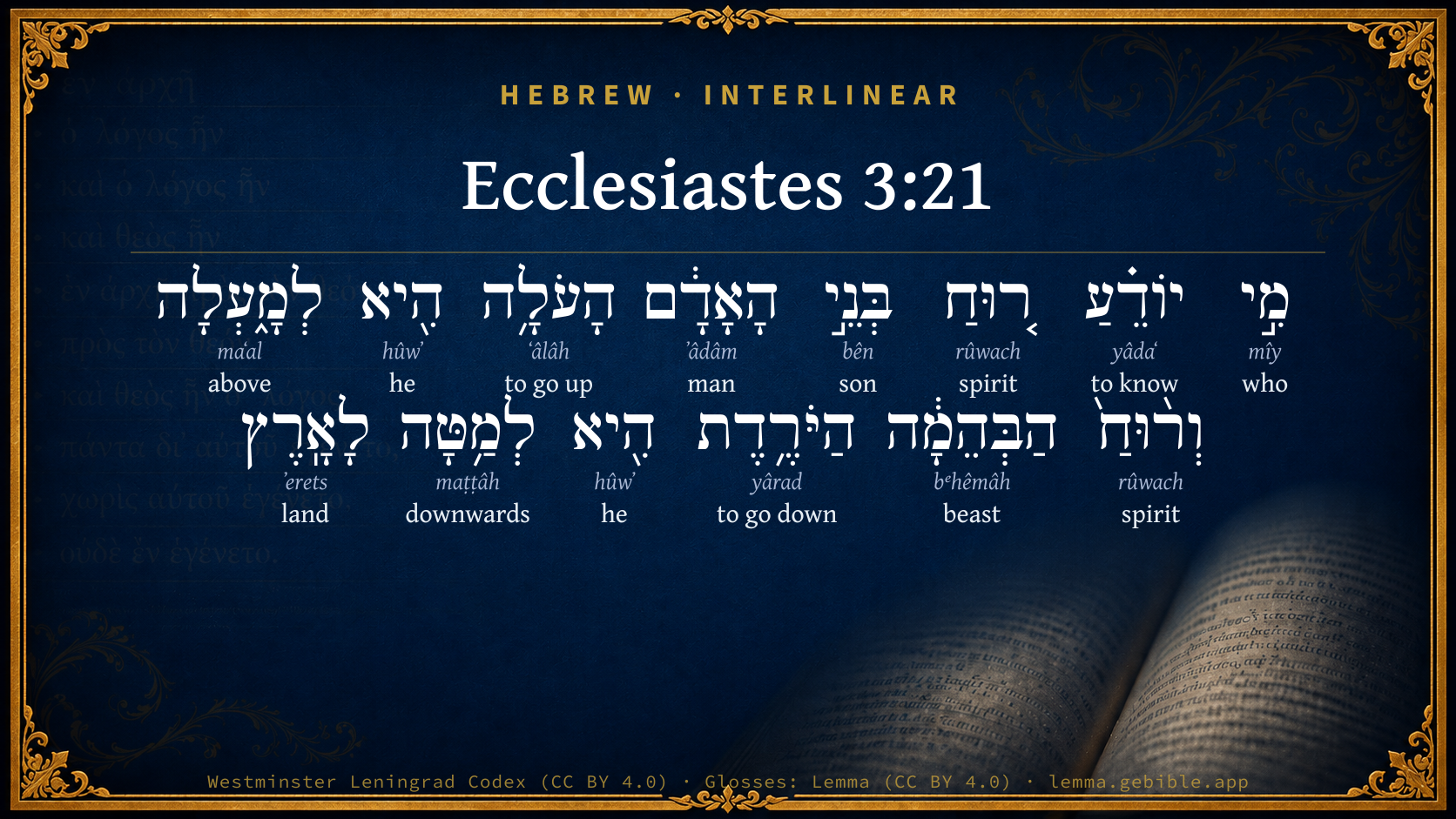
Ecclesiastes 3:21

Hebrew (Westminster Leningrad Codex) Ecclesiastes 3:21 appears in the Hebrew Old Testament. The text above is from the Westminster Leningrad Codex. Each word links to its Strong’s number, a concise gloss, and parsing drawn from the Open Scriptures Hebrew Bible morphology. Click any word for its full Brown-Driver-Briggs (BDB) entry.
Download image
Cite this verse

Ecclesiastes 3:21 (World English Bible). Public Domain. Lemma interlinear Bible study tool, https://lemma.gebible.app/v/ecclesiastes/3/21.

Show BibTeX & RIS
BibTeX
RIS
English Translation
Who knows the spirit of man, whether it goes upward, and the spirit of the animal, whether it goes downward to the earth?"
World English Bible · Public Domain
Download a study sheet

One document with this verse’s original text, its word-by-word gloss line, the meaning frame, cross-references with their text, attributed commentary, and full source and license credits — printable, and it pastes into notes with its structure intact.

This verse Autodidact and up

Study sheet (.html) Plain text (.txt)

A passage Seminary Student

Up to 50 verses in one chapter. A passage sheet keeps up to 6 commentary sources and 12 cross-references per verse, in the order this page ranks them, and says so on the sheet whenever that leaves anything out. Ask for a single verse and you get the Autodidact verse sheet above.

Everything on this page stays free to read, with no account — the sheet is a download of what is already on screen, not access to it.

Want to remove ads? Support Godless Engineer
Compare translations 3

The same verse in 3 English versions, stacked beneath the original-language interlinear above. Click any original word for its lexicon entry.

Each is an independent rendering of the whole verse — the interlinear is not word-aligned to these translations.

Highlighted words mark where these versions differ — a whole-verse word diff, not a word-by-word alignment.

  • World English Bible Public Domain
    Who knows the spirit of man, whether it goes upward, and the spirit of the animal, whether it goes downward to the earth?"
  • King James Version Public Domain
    Who knoweth the spirit of man that goeth upward, and the spirit of the beast that goeth downward to the earth?
  • unfoldingWord Literal Text CC BY-SA 4.0
    Who knows? The spirit of the sons of humanity, it the one going up, upwards, and the spirit of the animal, it the one going down, downwards to the earth.

unfoldingWord Literal Text — © unfoldingWord, licensed CC BY-SA 4.0. Word-aligned USFM3 via Door43 (git.door43.org/unfoldingWord/en_ult).

Versions to compare (up to 4)

3 of 4 selected

Show all 18 translations

Every available English version of this verse, each an independent rendering of the whole verse.

  • World English Bible Public Domain
    Who knows the spirit of man, whether it goes upward, and the spirit of the animal, whether it goes downward to the earth?"
  • Berean Standard Bible Public Domain
    Who knows if the spirit of man rises upward and the spirit of the animal descends into the earth?
  • Majority Standard Bible Public Domain
    Who knows if the spirit of man rises upward and the spirit of the animal descends into the earth?
  • King James Version Public Domain
    Who knoweth the spirit of man that goeth upward, and the spirit of the beast that goeth downward to the earth?
  • American Standard Version (1901) Public Domain
    Who knoweth the spirit of man, whether it goeth upward, and the spirit of the beast, whether it goeth downward to the earth?
  • Revised Version (1885) Public Domain
    Who knoweth the spirit of man whether it goeth upward, and the spirit of the beast whether it goeth downward to the earth?
  • Geneva Bible (1599) Public Domain
    Who knoweth whether the spirit of man ascend vpward, and the spirit of the beast descend downeward to the earth?
  • Douay-Rheims (1899) Public Domain
    Who knoweth if the spirit of the children of Adam ascend upward, and if the spirit of the beasts descend downward?
  • Young's Literal Translation Public Domain
    Who knoweth the spirit of the sons of man that is going up on high, and the spirit of the beast that is going down below to the earth?
  • Literal Standard Version CC BY-SA 4.0
    Who knows the spirit of the sons of man that is going up on high, and the spirit of the beast that is going down below to the earth?
  • Unlocked Literal Bible CC BY-SA 4.0
    Who knows whether the spirit of mankind goes upward and the spirit of animals goes downward into the earth?
  • unfoldingWord Literal Text CC BY-SA 4.0
    Who knows? The spirit of the sons of humanity, it the one going up, upwards, and the spirit of the animal, it the one going down, downwards to the earth.
  • Darby Bible Public Domain
    Who knoweth the spirit of the children of men? Doth it go upwards? and the spirit of the beasts, doth it go downwards to the earth?
  • World Messianic Bible Public Domain
    Who knows the spirit of man, whether it goes upward, and the spirit of the animal, whether it goes downward to the earth?”
  • Webster's Bible Public Domain
    Who knoweth the spirit of man that goeth upward, and the spirit of the beast that goeth downward to the earth?
  • Free Bible Version CC BY-SA 4.0
    Who really knows whether the breath of life of human beings goes up above, and the breath of life of animals goes down below to the earth?
  • Bible in Basic English Public Domain
    Who is certain that the spirit of the sons of men goes up to heaven, or that the spirit of the beasts goes down to the earth?
  • JPS Tanakh (1917) Public Domain
    Who knoweth the spirit of man whether it goeth upward, and the spirit of the beast whether it goeth downward to the earth?

Literal Standard Version (2020), Covenant Press — licensed CC BY-SA 4.0. Text via the HelloAO Bible API (eBible.org). Unlocked Literal Bible (unfoldingWord) — licensed CC BY-SA 4.0. Text via the HelloAO Bible API (eBible.org). unfoldingWord Literal Text — © unfoldingWord, licensed CC BY-SA 4.0. Word-aligned USFM3 via Door43 (git.door43.org/unfoldingWord/en_ult). Free Bible Version, Dr. Jonathan Gallagher — licensed CC BY-SA 4.0. Text via the HelloAO Bible API (eBible.org).

Word by word

More ways to search: Search by grammar → Find every occurrence → Compare this word →

Practice this passage: Drill this verse → Learn its vocabulary →

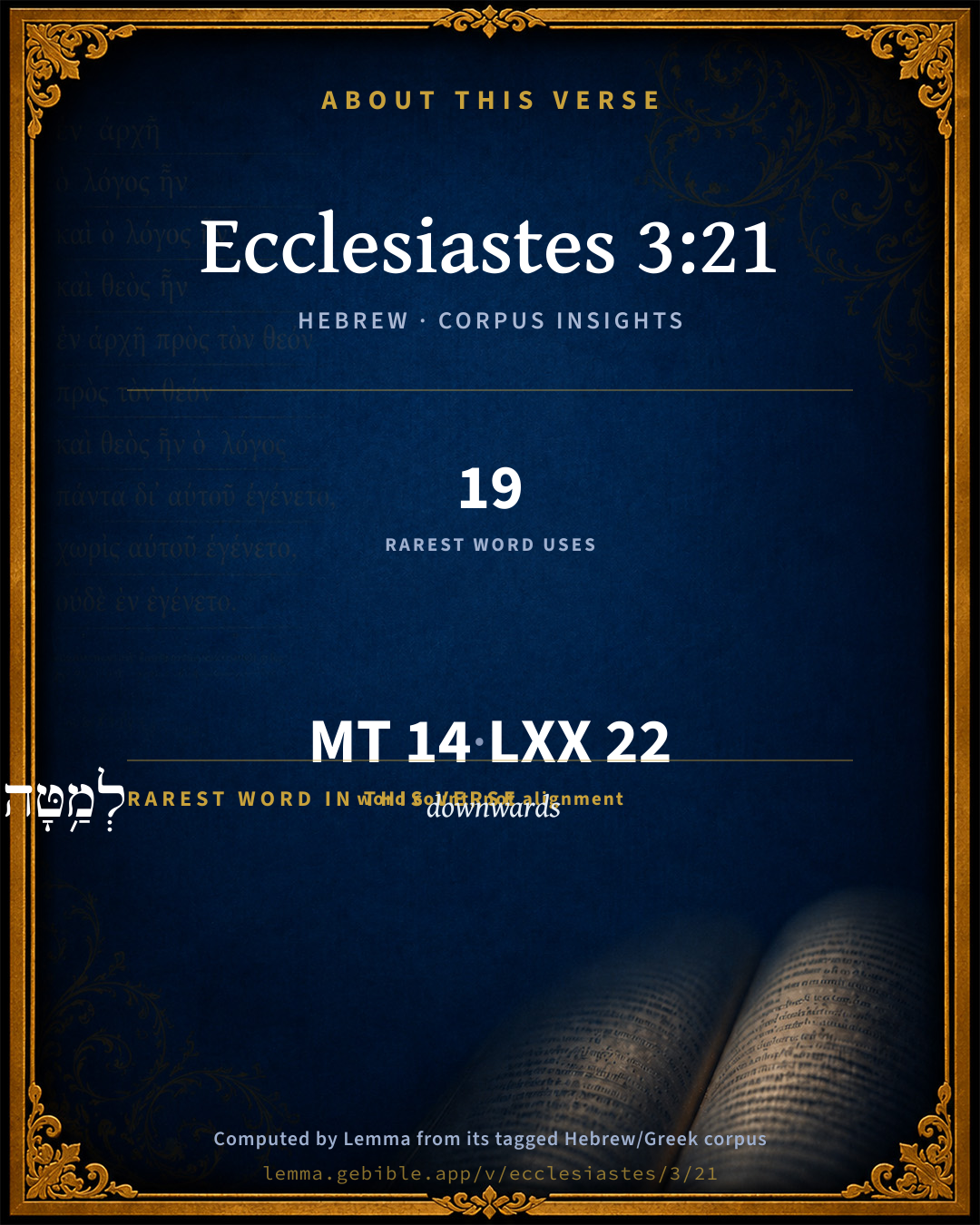
לְמַ֥טָּה
maṭṭâh
H4295
“to/for · downwards”
Preposition + Adverb
Part of Speech
Preposition + Adverb
Full BDB Definition

Origin: from H5786 with directive enclitic appended

TWOT: 1352a

downwards, below - downwards - under (of age) - beneath
  1. מִ֣י mîy H4310 “who” Particle, Interrogative
  2. יוֹדֵ֗עַ yâdaʻ H3045 “knowing” Verb, Qal, Participle Active, Masculine, Singular, Absolute
  3. ר֚וּחַ rûwach H7307 “spirit of” Noun, Common, Both, Singular, Construct
  4. בְּנֵ֣י bên H1121 “sons of” Noun, Common, Masculine, Plural, Construct
  5. הָאָדָ֔ם ʼâdâm H120 “the · man” Particle, Definite Article + Noun, Common, Masculine, Singular, Absolute
  6. הָעֹלָ֥ה ʻâlâh H5927 “the · going up” Particle, Definite Article + Verb, Qal, Participle Active, Feminine, Singular, Absolute
  7. הִ֖יא hûwʼ H1931 “he” Pronoun, Personal, 3rd Person, Feminine, Singular
  8. לְמָ֑עְלָה maʻal H4605 “to/for · above · toward” Preposition + Adverb + Suffix, Demonstrative
  9. וְר֨וּחַ֙ rûwach H7307 “and · spirit of” Conjunction + Noun, Common, Both, Singular, Construct
  10. הַבְּהֵמָ֔ה bᵉhêmâh H929 “the · beast” Particle, Definite Article + Noun, Common, Feminine, Singular, Absolute
  11. הַיֹּרֶ֥דֶת yârad H3381 “the · going down” Particle, Definite Article + Verb, Qal, Participle Active, Feminine, Singular, Absolute
  12. הִ֖יא hûwʼ H1931 “he” Pronoun, Personal, 3rd Person, Feminine, Singular
  13. לָאָֽרֶץ ʼerets H776 “to/for the · land” Preposition, Determined + Noun, Common, Both, Singular, Absolute

About this verse

These counts appear in no published source. They are computed here, from the morphology-tagged text and Lemma’s own curated glosses. What Lemma adds →

14
words
12
distinct lemmas
Wisdom
section

Notable vocabulary

The rarest word here is לְמַ֥טָּה downwards H4295 — appearing just 19 times in the whole Hebrew Bible.

Shared distinctive vocabulary

לְמַ֥טָּה downwards H4295 occurs in 18 verses of the Hebrew Bible. Also found in:

Grammatical profile

  • 3 verbs
  • 6 nouns
  • 2 pronouns
  • 2 adverbs
  • 1 particle

Verb forms

  • יוֹדֵ֗עַ Qal · Participle Active
  • הָעֹלָ֥ה Qal · Participle Active
  • הַיֹּרֶ֥דֶת Qal · Participle Active

Repetition

Words recur within this verse — often emphatic in Hebrew:

  • ר֚וּחַ spirit H7307 ×2
  • הִ֖יא he H1931 ×2

Hebrew & Septuagint length

In English translation the verse runs 23 words from the Hebrew and 28 from the Septuagint (LXX English) — closely comparable.

A rough comparison of the two English renderings, which tokenize alike — not a word-level alignment.

Word counts can differ between the Hebrew and the Greek without any difference in meaning — e.g. the Hebrew direct-object marker אֵת has no separate Greek word, and Greek often adds the article ὁ.

In the original languages it is 14 Hebrew tokens and 22 Greek tokens — but the two are counted differently (Hebrew bundles its prefixes and suffixes into one token; the Greek is in lemma form), so that isn’t a like-for-like length.

Cross-references

7

Topical passages linked to Ecclesiastes 3:21 in the Treasury of Scripture Knowledge — connected by theme and wording, ordered by reader-vote popularity; previews shown in the World English Bible.

  • Ecclesiastes 12:7 And the dust returns to the earth as it was, And the spirit returns to God who gave it.
  • John 14:3 If I go and prepare a place for you, I will come again, and will receive you to myself; that where I am, you may be there also.
  • 2 Corinthians 5:1 For we know that if the earthly house of our tent is dissolved, we have a building from God, a house not made with hands, eternal, in the heavens.
  • Luke 16:22–23 It happened that the beggar died, and that he was carried away by the angels to Abraham's bosom. The rich man also died, and was buried.
  • Philippians 1:23 But I am in a dilemma between the two, having the desire to depart and be with Christ, which is far better.
  • Acts 1:25 to take part in this ministry and apostleship from which Judas fell away, that he might go to his own place."
  • 2 Corinthians 5:8 We are of good courage, I say, and are willing rather to be absent from the body, and to be at home with the Lord.

Cross-references courtesy of OpenBible.info (CC BY 4.0).

Hebrew and Greek witnesses Masoretic Hebrew ↔ Greek Septuagint

The same verse in the two great witnesses to the Old Testament, shown verse-for-verse.

These are two independent witnesses, not word-aligned to each other, and the Septuagint is shown in lemma (dictionary) form.

Hebrew Ecclesiastes 3:21 Masoretic · Westminster Leningrad Codex

מִ֣י יוֹדֵ֗עַ ר֚וּחַ בְּנֵ֣י הָאָדָ֔ם הָעֹלָ֥ה הִ֖יא לְמָ֑עְלָה וְר֨וּחַ֙ הַבְּהֵמָ֔ה הַיֹּרֶ֥דֶת הִ֖יא לְמַ֥טָּה לָאָֽרֶץ

Who knows the spirit of man, whether it goes upward, and the spirit of the animal, whether it goes downward to the earth?"

World English Bible · Public Domain

Greek LXX Ecclesiastes 3:21 Septuagint · lemma form

καί τίς οἶδα πνεῦμα υἱός ὁ ἄνθρωπος εἰ ἀναβαίνω αὐτός εἰς ἄνω καί πνεῦμα ὁ κτῆνος εἰ καταβαίνω αὐτός κάτω εἰς γῆ

And who has seen the spirit of the sons of man, whether it goes upward? and the spirit of the beast, whether it goes downward to the earth?

LXX2012 (modern English Septuagint) · Public Domain

On this verse, Ellicott's Commentary for English Readers discusses the Septuagint’s reading. Read the note in Commentary ↓

Hebrew: Westminster Leningrad Codex (CC BY 4.0). Greek: Septuagint (public domain); English from LXX2012 (modern English Septuagint) (Public Domain). How the Septuagint differs from the Hebrew →

Commentary

Notes on Ecclesiastes 3:21 from classic Christian and Jewish commentators (each source and its license shown beneath its notes). The classic Christian expositions comment on the surrounding passage and are grouped to its opening verse, so a note may address several verses; the Jewish commentaries on the Tanakh (Rashi and others) are per-verse, so they appear only where the commentator wrote on this verse.

Lemma curates 59 commentaries, every one of them public domain or Creative Commons licensed, each selected and text-cleaned for this edition rather than reprinted as found. About our sources →

Trapp's Complete Commentary

John Trapp

Ecc 3:21 Who knoweth the spirit of man that goeth upward, and the spirit of the beast that goeth downward to the earth?

Ver. 21. Who knoweth the Spirit?] q.d., Who but a man that is spiritually rational, and rationally spiritual? Who but he that hath "the mind of Christ?" {1Co 2:16} that hath seen the insides of nature and grace? Whether Plato and Cicero believed themselves in what they wrote touching the immortality of the soul, is a great question.

John Trapp, A Commentary or Exposition upon All the Books of the Old and New Testament (1647–1656) — public domain. Text from a community e-Sword module.

Tyndale Open Study Notes

Tyndale Open Resources

3:21 the human spirit goes up: Cp. 12:7.

Tyndale Open Study Notes — © Tyndale Open Resources, licensed CC BY-SA 4.0. Text via the HelloAO Bible API.

Geneva Bible (1599)

Geneva Bible translators

Meaning, that reason cannot comprehend that which faith believeth herein.

Geneva Bible (1599) marginal notes — public domain. Text via Bolls.life.

Jamieson, Fausset & Brown

Robert Jamieson, A. R. Fausset & David Brown

Who knoweth--Not doubt of the destination of man's spirit (Ecc 12:7); but "how few, by reason of the outward mortality to which man is as liable as the beast and which is the ground of the skeptic's argument, comprehend the wide difference between man and the beast" (Isa 53:1). The Hebrew expresses the difference strongly, "The spirit of man that ascends, it belongeth to on high; but the spirit of the beast that descends, it belongeth to below, even to the earth." Their destinations and proper element differ utterly [WEISS].

Jamieson, Fausset & Brown — Commentary Critical and Explanatory on the Whole Bible (1871) — public domain (CC PDM 1.0). Text via the HelloAO Bible API.

Adam Clarke's Commentary

Verse 21. Who knoweth the spirit of man] I think the meaning of this important verse is well taken by the above able writer: -

The nobler part of man, 'tis true, survives

The frail corporeal frame: but who regards

The difference? Those who live like beasts, as such

Would die, and be no more, if their own fate

Depended on themselves. Who once reflects,

Amidst his revels, that the human soul,

Of origin celestial, mounts aloft,

While that of brutes to earth shall downward go?"

The word רוח ruach, which is used in this and the nineteenth verse, has two significations, breath and spirit. It signifies spirit, or an incorporeal substance, as distinguished from flesh, or a corporeal one, 1Kg 22:21-22, and Isa 31:3. And it signifies the spirit or soul of man, Ps 31:6; Isa 57:16, and in this book, Ec 12:7, and in many other places. In this book it is used also to signify the breath, spirit, or soul of a beast. While it was said in Ec 3:19, they have all one breath, i.e., the man and the beast live the same kind of animal life; in this verse, a proper distinction is made between the רוח ruach, or soul of man, and the רוח ruach, or soul of the beast: the one goeth upwards, the other goeth downwards. The literal translation of these important words is this: "Who considereth the רוח ruach) immortal spirit of the sons of Adam, which ascendeth? it is from above; (היא למעלה hi lemalah;) and the spirit or breath of the cattle which descendeth? it is downwards unto the earth," i.e., it tends to the earth only. This place gives no countenance to the materiality of the soul; and yet it is the strongest hold to which the cold and fruitless materialist can resort.

Solomon most evidently makes an essential difference between the human soul and that of brutes. Both have souls, but of different natures: the soul of man was made for God, and to God it shall return: God is its portion, and when a holy soul leaves the body, it goes to paradise. The soul of the beast was made to derive its happiness from this lower world. Brutes shall have a resurrection, and have an endless enjoyment in a new earth. The body of man shall arise, and join his soul that is already above; and both enjoy final blessedness in the fruition of God. That Solomon did not believe they had the same kind of spirit, and the same final lot, as some materialists and infidels say, is evident from Ec 12:7: "The spirit shall return unto God who gave it."

Adam Clarke's Commentary on the Bible (1810–1826) — public domain. Text from a community e-Sword/MySword module.

Ellicott's Commentary for English Readers

(21) The LXX., followed by a great body of interpreters, ancient and modern, translate, “Who knoweth whether the spirit of man goeth upward?” &c, and this agrees better with the context of this paragraph. The sceptical thought is, “We see that death resolves into dust (Gen_3:19; Ecc_12:7; see also Sir_41:10) the bodies of men and animals alike; and if it be alleged that there is a difference as to what becomes of their spirits, can this be asserted with the certainty of knowledge?” The writer here seems to have read both Psa_49:14 and Pro_15:24.

A Bible Commentary for English Readers, edited by Charles John Ellicott (1878–1897) — public domain. Text from a community e-Sword module.

The Cambridge Bible for Schools and Colleges

gen. ed. J. J. S. Perowne

21. Who knoweth the spirit of man that goeth upward] The words imply a strictly sceptical rather than a negative answer. They do not actually deny, still less do they affirm, as some have thought, that the spirit of man does ascend to a higher life, while that of the brute returns to dust. This would indeed be inconsistent with the whole context, and the consensus of the LXX., the Vulgate, the Targum, and the Syriac versions, all of which give “Who knoweth whether the spirit of man goeth upward?” is practically decisive. It is not till nearly the close of the book, with all its many wanderings of thought, that the seeker rests in that measure of the hope of immortality which we find in ch. Ecc_12:7. Here we have the accents, almost the very formula, of Pyrrhonism (Diog. Laert. ix. 11, §. 73), as borrowed from Euripides:

τίς δʼ οἶδεν εἰ τὸ ζῇν μὲν ἐστι κατθανεῖν,

τὸ κατθανεῖν δὲ ζῇν νομίζεται βροτοῖς.

“Who knoweth if true life be found in death,

While mortals think of what is death as life?”

Once more Lucretius echoes the phase of thought through which the Debater was passing:

“Ignoratur enim quae sit natura animai,

Nata sit an contra nascentibus insinuetur,

Et simul intereat nobiscum morte dirempta,

An tenebras Orci visat vastasque lacunas.”

“We know not what the nature of the soul,

Or born, or entering into men at birth,

Or whether with our frame it perisheth,

Or treads the gloom and regions vast of death.”

De Rer. Nat. i. 113–116.

So far, however, as scepticism is a step above denial, we may note this as an advance. There is at least the conception of a spirit that ascends to a life higher than its own, as a possible solution of the great enigma presented by the disorders of the world.

The Cambridge Bible for Schools and Colleges (gen. ed. J. J. S. Perowne; Cambridge University Press, 1878–1918) — public domain. Text from a community e-Sword module.

John Gill's Exposition

Who knoweth the spirit of man that goeth upward?.... There is indeed a difference between a man and a beast; though they have one breath, they have not one spirit or soul; man has a rational and immortal soul, which, when he dies, goes upwards to God that gave it; to be judged by him, and disposed of by him, in its proper apartment, until the day of the resurrection of the body;

and the spirit of the beast that goeth downward to the earth? when the beast dies, its spirit goes down to the earth, from whence it came, and is resolved into it, and is no more. But who is it that sees, or can see and know with the eyes of his body, the difference of these two spirits, or the ascent of the one, and the descent of the other?, Or who knows by the dint of reason, by the strength of his own understanding, without a divine revelation, that man has an immortal soul which goes upwards at death, when that of a beast goes downwards? No man, clearly and fully, as appears from the doubts and half faith of the wisest Heathens concerning it: or rather who knows and considers this difference between the spirit of a man and the spirit of a beast, and thinks within himself what a precious and immortal soul he has, and is concerned for the salvation of it? Very few; and hence it is they live and die like beasts, as they do. The Midrash interprets this of the souls of the righteous that go up to heaven, and of the souls of the wicked that go down to hell.

John Gill's Exposition of the Whole Bible (1746–1763) — public domain (CC PDM 1.0). Text via the HelloAO Bible API.

Haydock's Catholic Bible Commentary

Who knoweth, &c., viz., experimentally; since no one in this life can see a spirit. But as to the spirits of the beasts, which is merely animal, and becomes extinct by the death of the beast, who can tell the manner it acts so as to give life and motion, and by death to descend downward, that is, to be no more? (Challoner) --- Few are able to prove that the soul of man is immortal rather that that of beasts, since the bodies of both are subject to the like inconveniences. The objection is answered [in] chap. xii. 7. (Calmet) --- The difficulty of answering is intimated by "Who?" &c., Psalm xiv. 1. (Menochius)

George Leo Haydock (1774–1849), Haydock's Catholic Family Bible and Commentary, 1859 edition — public domain. Excludes Psalms (Douay-Rheims chapter numbering differs from Protestant) and Deuterocanonical books (Catholic canon only).

Matthew Poole's English Annotations

It might be objected, that the conditions of men and beasts are vastly differing, because man’s spirit goeth upward to God, Ecc 12:7, but the spirit of a beast goeth downward, together with its body, and perisheth with it. To this he answers, Who knoweth this? which is not to be understood as if no man did know it, or as if the thing were utterly uncertain and unknown, for he knew it, and positively affirms it, Ecc 12:7; but that few know it; as the same manner of expression is understood, Pro 31:10, Who can find? Isa 53:1, Who hath believed? &c.; which note the scarcity or difficulty, but not the nullity or impossibility of the thing. Besides, he seems here to speak not so much of a speculative as of a practical knowledge, as such words are most commonly used. Who considers or regards this, or layeth it to heart? True it is, there is such a difference, which also is known and believed by wise and good men; but the generality of mankind never mind it; their hearts are wholly set upon this life, and upon present and sensible things, and they place all their hopes and happiness in them, and take no thought nor care for the things of the future and invisible world. And as to them with whom Solomon hath to do in this matter, the argument is strong and good, being, as logicians call it, an argument to the man; and there is no considerable difference between sensual men and beasts, because their affections are set upon the same objects, and both of them are partakers of the same sensual satisfactions, and subject to the same sensual pains and miseries, and their hopes and felicity perish together, to wit, at death, and therefore such men are no more happy than the beasts that perish. Others understand it thus, Who knoweth this? to wit, by sense or experience, or merely by his own reason, or without the help of Divine revelation. But, with the leave of so many worthy interpreters, and with submission to better judgments, the former seems to be the truer sense.

Matthew Poole's English Annotations on the Holy Bible (1683–1685) — public domain. Text from a community e-Sword/MySword module.

Whedon's Commentary on the Bible

Daniel D. Whedon

21. Who knoweth, etc. — Let us bear in mind that this is the language of a distressed man, who certainly finds no comfort in what his eyes can see. Shall consolation be found in the invisible? This verse is of the nature of a challenge. Who can show that the spirit of man takes after death any course different from that taken by the spirit of a beast? Or, if we render it, as Hebrew questions are often rendered, by the opposite declaration, “No man knoweth,” etc., we need not be alarmed. At this stage of the inquiry, the affirmation of a future life would be out of place. We shall by and by see it in its place.

Daniel D. Whedon (gen. ed.), Commentary on the Old and New Testaments (1874–1909) — public domain. Text from a community e-Sword module.

The Pulpit Commentary

Who knoweth the spirit of man that goeth upward, and the spirit of the beast that goeth downward to the earth? The statement is here too categorically rendered, though, for dogmatical purposes, the Masorites seem to have punctuated the text with a view to such interpretation. But, as Wright and others point out, the analogy of two other passages, (Ecc_2:19 Ecc_6:12) where "who knoweth" occurs, intimates that the phrases which follow are interrogative. So the translation should be, "Who knoweth as regards the spirit (ruach) of the sons of men whether it goeth upward, and as regards the spirit (ruach) of the beast whether it goeth downward under the earth?" Vulgate, Quis novit si spiritus, etc.? Septuagint, Tiv ei=de pneuma uiJwn tou ajnqrwpou eij ajnabainei aujto anw; "Who ever saw the spirit of the sons of man, whether it goeth upward?" The Authorized Version, which gives the Masoretic reading, is supposed to harmonize better with the assertion at the end of the book, (Ecc_12:7) that the spirit returns to the God who gave it. But there is no formal denial of the immortality of the soul in the present passage as we render it. The question, indeed, is not touched. The author is confirming his previous assertion that, in one point of view, man is not superior to brute. Now he says, looking at the matter merely externally, and taking not into consideration any higher notion, no one knows the destiny of the living powers, whether God deals differently with the spirit of man and of beast. Phenomenally, the principle of life in both is identical, and its cessation is identical; and what becomes of the spirit in either case neither eye nor mind can discover. The distinction which reason or religion assumes, viz. that man"s spirit goes upward and the brute"s downward, is incapable of proof, is quite beyond experience. What is meant by "upward" and "downward" may be seen by reference to the gnome in Pro_15:24, "To the wise the way of life goeth upward, that he may depart from Sheol beneath." The contrast shows that Sheol is regarded as a place of punishment or annihilation; this is further confirmed by Psa_49:14, Psa_49:15, "They are appointed as a flock for Sheol: death shall be their shepherd their beauty shall be for Sheol to consume But God will redeem my soul from the power of Sheol; for he shall receive me." Koheleth neither denies nor affirms in this passage the immortality of the soul; that he believed in it we learn from other expressions; but he is not concerned with parading it here. Commentators quote Lucretius" sceptical thought ("De Rer. Nat.," 1:113-116)

Ignoratur enim quae sit natura animal, Nata sit, an contra nascentibus insinuetur, Et simul interest nobiscum, morte dimenta, An tenebras Orci visat vastasque lacunas.

We know not what the nature of the soul, Born in the womb, or at the birth infused, Whether it dies with us, or wings its way Unto the gloomy pools of Orcus vast.

But Koheleth"s inquiry suggests the possibility of a different destiny for the spirits of man and brute, though he does not at this moment make any definite assertion on the subject. Later on he explains the view taken by the believer in Divine revelation. (Ecc_12:7)

The Pulpit Commentary (1880–1919), ed. H.D.M. Spence-Jones & Joseph S. Exell — public domain. Text from a community e-Sword module.

John Wesley's Explanatory Notes

Who knoweth? - True it is, there is a difference, which is known by good men; but the generality of mankind never mind it: their hearts are wholly set on present and sensible things, and take no thought for the things of the future and invisible world.

John Wesley, Explanatory Notes Upon the Whole Bible (1754–1765) — public domain. Text via the GEBible commentary corpus.

Keil & Delitzsch

C. F. Keil & F. Delitzsch

"Who knoweth with regard to the spirit of the children of men, whether it mounteth upward; and with regard to the spirit of a beast, whether it goeth downward to the earth?" The interrogative meaning of העלה and הירדת is recognised by all the old translators: lxx, Targ., Syr., Jerome, Venet., Luther. Among the moderns, Heyder (vid., Psychol. p. 410), Hengst., Hahn, Dale, and Bullock take the h in both cases as the article: "Who knoweth the spirit of the children of men, that which goeth upward ... ?" But (1) thus rendered the question does not accord with the connection, which requires a sceptical question; (2) following "who knoweth," after Ecc 2:19; Ecc 6:12, cf. Jos 2:14, an interrogative continuance of the sentence was to be expected; and (3) in both cases היא stands as designation of the subject only for the purpose of marking the interrogative clause (cf. Jer 2:14), and of making it observable that ha'olah and hayorěděth are not appos. belonging as objects to רוח and ורוח. It is questionable, indeed, whether the punctuation of these words, העלה and היּרדת, as they lie before us, proceeds from an interrogative rendering. Saadia in Emunoth c. vi., and Juda Halevi in the Kuzri ii. 80, deny this; and so also do Aben Ezra and Kimchi. And they may be right. For instead of העלה, the pointing ought to have been העלה (cf. העלה, Job 13:25) when used as interrog. an ascendens; even before א the compens. lengthening of the interrog. ha is nowhere certainly found

(Note: For ה is to be read with a Pattach in Jdg 6:31; Jdg 12:5; Neh 6:11; cf. under Gen 19:9; Gen 27:21. In Num 16:22 the ה of האישׁ is the art., the question is not formally designated.

instead of the virtual reduplication; and thus also the parallel היּר is not to be judged after היּי, Lev 10:19, הדּ, Eze 18:29, - we must allow that the punctation seeks, by the removal of the two interrog. ha (ה), to place that which is here said in accord with Ecc 12:7. But there is no need for this. For יודע מי does not quite fall in with that which Lucretius says (Lib. I):

"Ignoratur enim quae sit natura animai,

Nata sit an contra nascentibus insinuetur?

An simul intereat nobiscum morte diremta?"

It may certainly be said of mi yode'a, as of ignoratur, that it does not exclude every kind of knowledge, but only a sure and certain knowledge resting on sufficient grounds; interire and ירד לם are also scarcely different, for neither of the two necessarily signifies annihilation, but both the discontinuance of independent individual existence. But the putting of the question by Koheleth is different, for it discloses more definitely than this by Lucretius, the possibility of a different end for the spirit of a man from that which awaits the spirit of a beast, and thus of a specific distinction between these two principles of life. In the formation even of the dilemma: Whether upwards or downwards, there lies an inquiring knowledge; and it cannot surprise us if Koheleth finally decides that the way of the spirit of a man is upwards, although it is not said that he rested this on the ground of demonstrative certainty. It is enough that, with the moral necessity of a final judgment beyond the sphere of this present life, at the same time also the continued existence of the spirit of man presented itself to him as a postulate of faith. One may conclude from the desiderium aeternitatis (Ecc 3:11) implanted in man by the Creator, that, like the instincts implanted in the beasts, it will be calculated not for deception, but for satisfaction; and from the למעלה, Pro 15:24 - i.e., the striving of a wise man rising above earthly, temporary, common things, - that death will not put an end to this striving, but will help it to reach its goal. But this is an indirect proof, which, however, is always inferior to the direct in force of argument. He presupposes that the Omnipotence and Wisdom which formed the world is also at the same time Love. Thus, though at last, it is faith which solves the dilemma, and we see from Ecc 12:7 that this faith held sway over Koheleth. In the Book of Sirach, also, the old conception of Hades shows itself as yet dominant; but after the οὐκ ἀτηάνατος υἱὸς ἀντηρώπου, 17:25, we read towards the end, where he speaks of Elias: καὶ τὰρ ἡμεῖς ζωῇ ζησόμεθα, 48:11. In the passage before us, Koheleth remains in doubt, without getting over it by the hand of faith. In a certain reference the question he here proposes is to the present day unanswered; for the soul, or, more correctly, according to the biblical mode of conception the spirit from which the soul-life of all corporeal beings proceeds, is a monas, and as such is indestructible. Do the future of the beast's soul and of man's soul not then stand in a solidaric mutual relation to each other? In fact, the future life presents to us mysteries the solution of which is beyond the power of human thought, and we need not wonder that Koheleth, this sober-minded, intelligent man, who was inaccessible to fantastic self-deception, arrives, by the line of thought commenced at Ecc 3:16, also again at the ultimatum.

Keil & Delitzsch — Biblical Commentary on the Old Testament (1861–1891) — public domain (CC PDM 1.0). Text via the HelloAO Bible API. (Old Testament only.)

unfoldingWord translationNotes

Door43 World Missions Community

Who knows whether the spirit ... into the earth?

The author asks this rhetorical question to emphasize that no one truly knows what happens after people and animals die. This question can be written as a statement. AT: "No one knows whether the spirit ... into the earth." (See: Rhetorical Question)

there is nothing better for anyone than to

See how you translated this phrase in Ecclesiastes 3:12.

Who can bring him back to see what happens after him?

The author uses this rhetorical question to emphasize that no one will see what happens after he dies. This question can be written as a statement. AT: "No one of us knows what happens to us after we die." (See: Rhetorical Question)

translationWords

spirit

earth

works

assign

unfoldingWord translationNotes — © Distant Shores Media and the Door43 World Missions Community, licensed CC BY-SA 4.0. Source: git.door43.org/Door43/en_tn.

Rashi

Rabbi Shlomo Yitzchaki (Rashi)

Who knows Like (Joel 2:14): “Whoever knows shall repent.” Who is it who understands and puts his heart to [the fact] that the spirit of the children of men ascends above and stands in judgment, and the spirit of the beast descends below to the earth, and does not have to give an accounting. Therefore, one must not behave like a beast, which does not care about its deeds.

Rashi on the Tanakh — English translations: “The Judaica Press complete Tanach with Rashi, translated by A. J. Rosenberg” (CC BY 4.0); “Pentateuch with Rashi's commentary by M. Rosenbaum and A.M. Silbermann, 1929-1934” (public domain); “The Metsudah Tanach series, Lakewood, N.J” (CC BY 4.0); and “The Book of Joshua, Metsudah Publications, 1997” (CC BY 4.0). Text via Sefaria.

Lesson kit

Teaching starters — assembled from the data on this page, not authored interpretation. Every prompt links to the verse data it draws on. Edit before teaching.

Ecclesiastes, in the Wisdom, opens this verse with 14 words (12 distinct Hebrew lemmas). Its most distinctive word is maṭṭâh (“downwards”). A historical commentator’s framing appears above. Read the whole chapter for the surrounding context.

Discussion questions

  1. How does “downwards” (maṭṭâh) shape what this verse is saying?
  2. Exodus 26:24 shares the word «downwards» with this verse. How do the two illuminate each other?
  3. “spirit” occurs 2× in this one verse. What is the effect of the repetition?
  4. These translations render this verse differently. What is at stake in choosing one wording over another?
  5. The verb «יוֹדֵ֗עַ» is Qal Participle Active. How does its form color the action?
  6. Reading how Trapp's Complete Commentary and Tyndale Open Study Notes read this verse, where do the two commentators agree and where do they part?

Things to notice

Reading settings

Reading text

Shown beneath each verse's original-language words.

Old Testament
Old Testament edition

Read the OT as the Masoretic Hebrew (MT) or the Greek Septuagint (LXX).

English shown for the Greek Septuagint (in the Hebrew ↔ Greek comparison).

Comparing translations? Open the Compare panel on any verse page to stack up to four side by side.