
1 Samuel 16:15

Hebrew (Westminster Leningrad Codex) 1 Samuel 16:15 appears in the Hebrew Old Testament. The text above is from the Westminster Leningrad Codex. Each word links to its Strong’s number, a concise gloss, and parsing drawn from the Open Scriptures Hebrew Bible morphology. Click any word for its full Brown-Driver-Briggs (BDB) entry.
Download image
Cite this verse

1 Samuel 16:15 (World English Bible). Public Domain. Lemma interlinear Bible study tool, https://lemma.gebible.app/v/1-samuel/16/15.

Show BibTeX & RIS
BibTeX
RIS
English Translation
Saul's servants said to him, See now, an evil spirit from God troubles you.
World English Bible · Public Domain
Download a study sheet

One document with this verse’s original text, its word-by-word gloss line, the meaning frame, cross-references with their text, attributed commentary, and full source and license credits — printable, and it pastes into notes with its structure intact.

This verse Autodidact and up

Study sheet (.html) Plain text (.txt)

A passage Seminary Student

Up to 50 verses in one chapter. A passage sheet keeps up to 6 commentary sources and 12 cross-references per verse, in the order this page ranks them, and says so on the sheet whenever that leaves anything out. Ask for a single verse and you get the Autodidact verse sheet above.

Everything on this page stays free to read, with no account — the sheet is a download of what is already on screen, not access to it.

Want to remove ads? Support Godless Engineer
Compare translations 3

The same verse in 3 English versions, stacked beneath the original-language interlinear above. Click any original word for its lexicon entry.

Each is an independent rendering of the whole verse — the interlinear is not word-aligned to these translations.

Highlighted words mark where these versions differ — a whole-verse word diff, not a word-by-word alignment.

  • World English Bible Public Domain
    Saul's servants said to him, See now, an evil spirit from God troubles you.
  • King James Version Public Domain
    And Saul's servants said unto him, Behold now, an evil spirit from God troubleth thee.
  • unfoldingWord Literal Text CC BY-SA 4.0
    And the servants of Saul said to him, “Behold, please, a bad spirit from God is terrifying you.

unfoldingWord Literal Text — © unfoldingWord, licensed CC BY-SA 4.0. Word-aligned USFM3 via Door43 (git.door43.org/unfoldingWord/en_ult).

Versions to compare (up to 4)

3 of 4 selected

Show all 18 translations

Every available English version of this verse, each an independent rendering of the whole verse.

  • World English Bible Public Domain
    Saul's servants said to him, See now, an evil spirit from God troubles you.
  • Berean Standard Bible Public Domain
    Saul’s servants said to him, “Surely a spirit of distress from God is tormenting you.
  • Majority Standard Bible Public Domain
    Saul’s servants said to him, “Surely a spirit of distress from God is tormenting you.
  • King James Version Public Domain
    And Saul's servants said unto him, Behold now, an evil spirit from God troubleth thee.
  • American Standard Version (1901) Public Domain
    And Saul's servants said unto him, Behold now, an evil spirit from God troubleth thee.
  • Revised Version (1885) Public Domain
    And Saul’s servants said unto him, Behold now, an evil spirit from God troubleth thee.
  • Geneva Bible (1599) Public Domain
    And Sauls seruants said vnto him, Beholde nowe, the euill spirite of God vexeth thee.
  • Douay-Rheims (1899) Public Domain
    And the servants of Saul said to him: Behold now an evil spirit from God troubleth thee.
  • Young's Literal Translation Public Domain
    and the servants of Saul say unto him, `Lo, we pray thee, a spirit of sadness `from' God is terrifying thee;
  • Literal Standard Version CC BY-SA 4.0
    and the servants of Saul say to him, “Now behold, a spirit of sadness [from] God is terrifying you;
  • Unlocked Literal Bible CC BY-SA 4.0
    Saul's servants said to him, “Look, a harmful spirit from God troubles you.
  • unfoldingWord Literal Text CC BY-SA 4.0
    And the servants of Saul said to him, “Behold, please, a bad spirit from God is terrifying you.
  • Darby Bible Public Domain
    And Saul's servants said to him, Behold now, an evil spirit from God troubles thee.
  • World Messianic Bible Public Domain
    Saul’s servants said to him, “See now, an evil spirit from God troubles you.
  • Webster's Bible Public Domain
    And Saul's servants said to him, Behold now, an evil spirit from God troubleth thee.
  • Free Bible Version CC BY-SA 4.0
    Saul's servants told him, “It's definitely an evil spirit from God that's tormenting you.
  • Bible in Basic English Public Domain
    And Saul's servants said to him, See now, an evil spirit from God is troubling you.
  • JPS Tanakh (1917) Public Domain
    And Saul's servants said unto him: 'Behold now, an evil spirit from God terrifieth thee.

Literal Standard Version (2020), Covenant Press — licensed CC BY-SA 4.0. Text via the HelloAO Bible API (eBible.org). Unlocked Literal Bible (unfoldingWord) — licensed CC BY-SA 4.0. Text via the HelloAO Bible API (eBible.org). unfoldingWord Literal Text — © unfoldingWord, licensed CC BY-SA 4.0. Word-aligned USFM3 via Door43 (git.door43.org/unfoldingWord/en_ult). Free Bible Version, Dr. Jonathan Gallagher — licensed CC BY-SA 4.0. Text via the HelloAO Bible API (eBible.org).

Word by word

More ways to search: Search by grammar → Find every occurrence → Compare this word →

Practice this passage: Drill this verse → Learn its vocabulary →

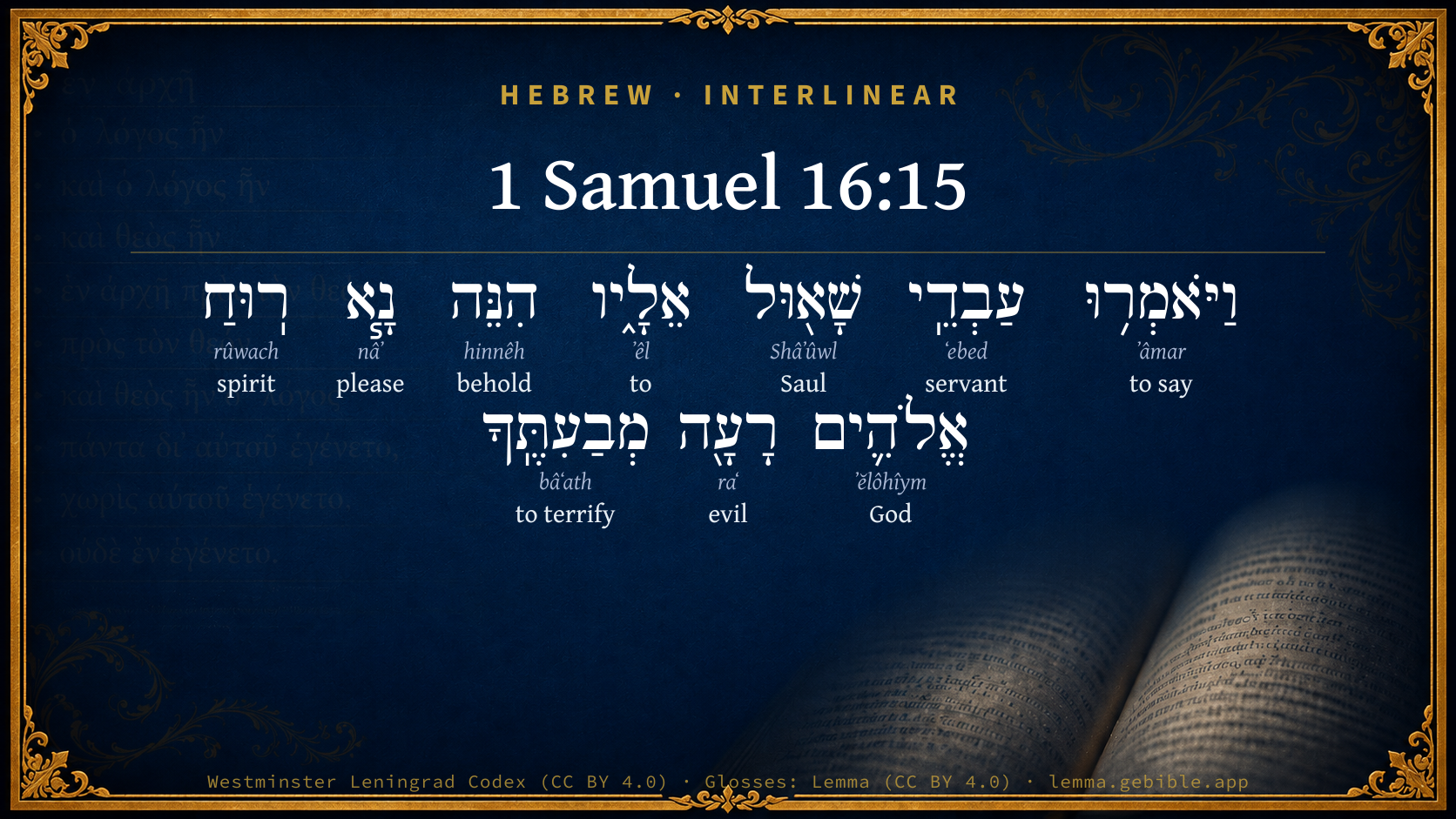
מְבַעִתֶּֽךָ
bâʻath
H1204
“terrifying · you”
Verb, Piel, Participle Active, Masculine, Singular, Construct + Suffix, Personal, 2nd Person, Masculine, Singular
Part of Speech
Verb
Stem
Piel
Form
Participle Active
Gender
Masculine
Number
Singular
State
Construct
Full BDB Definition

Origin: a primitive root

TWOT: 265

to terrify, startle, fall upon, dismay, be overtaken by sudden terror - (Niphal) to be terrified - (Piel) - to fall upon, overwhelm - to terrify
  1. וַיֹּאמְר֥וּ ʼâmar H559 “and · to say” Conjunction + Verb, Qal, Sequential Imperfect, 3rd Person, Masculine, Plural
  2. עַבְדֵֽי ʻebed H5650 “servants of” Noun, Common, Masculine, Plural, Construct
  3. שָׁא֖וּל Shâʼûwl H7586 “Saul” Noun, Proper
  4. אֵלָ֑יו ʼêl H413 “to · him” Preposition + Suffix, Personal, 3rd Person, Masculine, Singular
  5. הִנֵּה hinnêh H2009 “behold” Particle, Demonstrative
  6. נָ֧א nâʼ H4994 “please” Particle, Exhortation
  7. רֽוּחַ rûwach H7307 “spirit of” Noun, Common, Both, Singular, Construct
  8. אֱלֹהִ֛ים ʼĕlôhîym H430 “God(s)” Noun, Common, Masculine, Plural, Absolute
  9. רָעָ֖ה raʻ H7451 “evil” Adjective, Adjective, Feminine, Singular, Absolute

About this verse

These counts appear in no published source. They are computed here, from the morphology-tagged text and Lemma’s own curated glosses. What Lemma adds →

10
words
10
distinct lemmas
Historical
section

Notable vocabulary

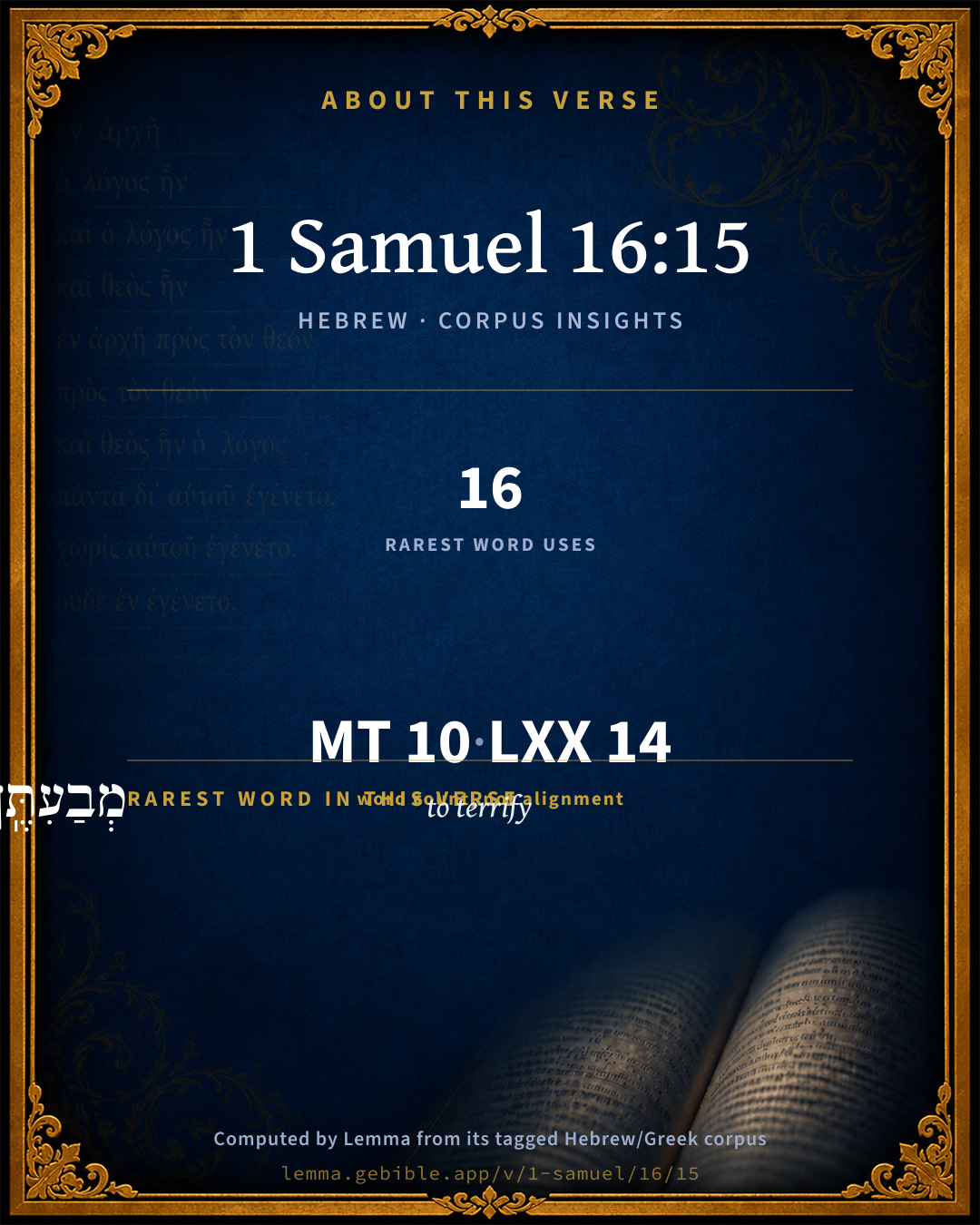
The rarest word here is מְבַעִתֶּֽךָ to terrify H1204 — appearing just 16 times in the whole Hebrew Bible.

Shared distinctive vocabulary

מְבַעִתֶּֽךָ to terrify H1204 occurs in 16 verses of the Hebrew Bible. Also found in:

Grammatical profile

  • 2 verbs
  • 4 nouns
  • 1 adjective
  • 1 preposition
  • 2 particles

Verb forms

  • וַיֹּאמְר֥וּ Qal · Sequential Imperfect
  • מְבַעִתֶּֽךָ Piel · Participle Active

Hebrew & Septuagint length

In English translation the verse runs 14 words from the Hebrew and 16 from the Septuagint (LXX English) — closely comparable.

A rough comparison of the two English renderings, which tokenize alike — not a word-level alignment.

Word counts can differ between the Hebrew and the Greek without any difference in meaning — e.g. the Hebrew direct-object marker אֵת has no separate Greek word, and Greek often adds the article ὁ.

In the original languages it is 10 Hebrew tokens and 14 Greek tokens — but the two are counted differently (Hebrew bundles its prefixes and suffixes into one token; the Greek is in lemma form), so that isn’t a like-for-like length.

Hebrew and Greek witnesses Masoretic Hebrew ↔ Greek Septuagint

The same verse in the two great witnesses to the Old Testament, shown verse-for-verse.

These are two independent witnesses, not word-aligned to each other, and the Septuagint is shown in lemma (dictionary) form.

Hebrew 1 Samuel 16:15 Masoretic · Westminster Leningrad Codex

וַיֹּאמְר֥וּ עַבְדֵֽי שָׁא֖וּל אֵלָ֑יו הִנֵּה נָ֧א רֽוּחַ אֱלֹהִ֛ים רָעָ֖ה מְבַעִתֶּֽךָ

Saul's servants said to him, See now, an evil spirit from God troubles you.

World English Bible · Public Domain

Greek LXX 1 Samuel 16:15 Septuagint · lemma form

καί εἶπον ὁ παῖς σαούλ πρός αὐτός ἰδού δή πνεῦμα κύριος πονηρός πνίγω σύ

And Saul's servants said to him, Behold now, an evil spirit from the Lord torments you.

LXX2012 (modern English Septuagint) · Public Domain

Hebrew: Westminster Leningrad Codex (CC BY 4.0). Greek: Septuagint (public domain); English from LXX2012 (modern English Septuagint) (Public Domain). How the Septuagint differs from the Hebrew →

Targum (Aramaic paraphrase)

1

The Targum is the ancient Jewish Aramaic paraphrase of the Hebrew Scriptures — an interpretive translation, not the Hebrew text itself. Onkelos (literal) and Pseudo-Jonathan (expansive) render the Torah, and Jonathan the Prophets. Coverage is partial: where no permissively-licensed English translation exists for a verse, only the Aramaic is shown. This is verse-level text, not a word-by-word alignment to the Hebrew.

  1. Targum Jonathan Prophets (Joshua–Malachi)
    וַאֲמַרוּ עַבְדֵי שָׁאוּל לֵיהּ הָא כְעַן רוּחַ בִּישָׁא מִן קֳדָם יְיָ מְבַעֲתָא לָךְ:

    (no public-domain English translation for this verse)

    Targum Jonathan — Aramaic: “Mikraot Gedolot” (public domain). English: “Sefaria Community Translation” (CC0 1.0 (public-domain dedication)); “London "Chaldee Paraphrase," 1871” (public domain). Text via Sefaria.

Commentary

Notes on 1 Samuel 16:15 from classic Christian and Jewish commentators (each source and its license shown beneath its notes). The classic Christian expositions comment on the surrounding passage and are grouped to its opening verse, so a note may address several verses; the Jewish commentaries on the Tanakh (Rashi and others) are per-verse, so they appear only where the commentator wrote on this verse.

Lemma curates 59 commentaries, every one of them public domain or Creative Commons licensed, each selected and text-cleaned for this edition rather than reprinted as found. About our sources →

Trapp's Complete Commentary

John Trapp

1Sa 16:15 And Saul’s servants said unto him, Behold now, an evil spirit from God troubleth thee.

Ver. 15. And Saul’s servants.] That is, His physicians. "And Joseph commanded his servants the physicians." {Gen 50:2} Yεραποντας θεραπευοντας.

John Trapp, A Commentary or Exposition upon All the Books of the Old and New Testament (1647–1656) — public domain. Text from a community e-Sword module.

Joseph Benson's Commentary

1Sa 16:15-16. His servants said, &c. — His courtiers could not but observe the change which had taken place in him, and the strange disturbance in his mind, and very probably ascribed it to the hand of God upon him. When the evil spirit from God is upon thee — When a melancholy fit seizeth thee. He shall play with his hand, and thou shalt be well — And the success confirmed their opinion. It is true, music cannot, of itself, have a direct influence on an evil spirit, to cause it to depart; yet because such a spirit, it seems, had not got possession of him, but only occasionally troubled him, by working on the passions of his mind, and humours of his body; and because it is manifest that music hath great power over these, frequently composing the spirits, and cheering and delighting the mind, and thereby gradually altering, qualifying, and sweetening the very juices and humours of the body; it is not strange if that evil spirit had not that power over Saul when these good effects of music had been experienced by him, which it had had before. Thus Satan had less power over lunatics in the decrease than in the increase of the moon, Mat 17:15; Mat 17:18. And seeing music prepared the Lord’s prophets for the entertainment of the good spirit, as 2Ki 3:15, why might it not dispose Saul to the resistance of the evil spirit? and why might not the cheering of his heart, in some measure, strengthen him against those temptations of the devil which were encouraged and strengthened by his melancholy humour? And by this means David, without any contrivance of himself or his friends, is brought to court, soon after he was anointed to the kingdom. Those whom God designs for any service, his providence will concur with his grace to prepare and qualify them for it.

Joseph Benson's Commentary on the Old and New Testaments (1811–1818) — public domain. Text from a community e-Sword module.

Ellicott's Commentary for English Readers

(15) An evil spirit from God.—The form in which the evil spirit manifested itself in Saul was apparently an incurable melancholy, which at times blazed forth in fits of uncontrollable jealous anger. When Saul’s attendants, his officers, and those about his person, perceived the mental malady under which their king was evidently suffering, they counselled that he should try whether the evil influence which troubled him could not be charmed away by music.

There is no doubt but that King Saul’s nervous, excitable temperament was peculiarly subject to such influences. We have some striking instances of this power exercised by sacred music over the king in the incidents related in 1Sa_10:10; 1Sa_19:23-24, where the songs and chaunts of the pupils of the prophetic schools had so powerful an influence over Saul. The solemn declaration of God through his prophet Samuel, that the kingdom was taken away from him and his house, weighed upon his naturally nervous and excitable mind. He became gloomy, and suspicious of his dearest friends, and, as we know, at times sought to take their lives; at times would command terrible massacres, such as that of the priests at Nob (1Sa_22:17-19). As the sad life advanced, we see the nobler traits in his character growing fainter, and the evil becoming more and more obvious. It was a species of insanity, fatal alike to the poor victim of the malady and to the prosperity of the kingdom over which he ruled. History gives us not a few similar instances of monarchs given up to the “evil spirit from God,” and who, in consequence, became a prey to insanity in one form or other.

A Bible Commentary for English Readers, edited by Charles John Ellicott (1878–1897) — public domain. Text from a community e-Sword module.

John Gill's Exposition

And Saul's servants said unto him,.... His courtiers, who observing him to act in a frantic manner, to be dull and melancholy, timorous, and irresolute, unsteady, divided, and distressed; or his physicians, who were called in to assist him, and remove his disorder from him:

behold, now an evil spirit from God troubleth thee: the disorder was not from any natural cause, or any bodily disease, and therefore out of the reach of physicians to do any service, but was from an evil spirit suffered of God to harass and disturb him.

John Gill's Exposition of the Whole Bible (1746–1763) — public domain (CC PDM 1.0). Text via the HelloAO Bible API.

Albert Barnes' Notes on the Bible

The “evil” or “melancholy” spirit here spoken of was “the Spirit of God,” or “of Jehovah,” as being God’s messenger and minister, sent by Him to execute His righteous purpose upon Saul (see 1Ki 22:19-22 note).

Albert Barnes' Notes on the Bible (1834–1885) — public domain. Text from a community e-Sword/MySword module.

Whedon's Commentary on the Bible

Daniel D. Whedon

15. An evil spirit… troubleth thee — A demon like those mentioned so frequently in the New Testament, sent by permission of the Lord, as Satan in the case of Job. Job_2:7. See notes on Mat_4:24, and Mar_5:2. It is not only by Saul’s servants, but by the sacred writer himself, that we are told it was an evil spirit from the Lord; so we cannot regard it as merely a superstitious and mistaken notion of Saul’s physicians. Compare 1Sa_18:10; 1Sa_19:9. But while he thus became possessed by a supernatural evil power, it is very likely that a mental disease bordering on insanity was the substratum on which the evil spirit worked. After Samuel’s last words of judgment the king could not be happy in his kingdom. The more he thought upon his doom, the more it harrowed up his soul. It was, perhaps, his highest ambition to be the father of a race of kings, and to have this hope suddenly dashed from him was to have darkness settle over all his life. “The Hebrew mind so linked itself to the future by the contemplation of posterity that it is scarcely possible to us, with our looser attachment to the time beyond ourselves, to apprehend, in all its intensity, the deep distress of mind with which any Hebrew, and much more a king, regarded the prospect that there would be no son of his succeeding.” — Kitto. Saul’s future gradually became full of ghostly images, and when, disengaged at times from the excitements of war and the cares of government, he sat down to think upon his darkened fortunes, his mind and heart, forsaken of all divine influences from Jehovah, became an easy prey to foul suspicions and gloomy fears — a most inviting state for demoniacal possession. The evil spirit, entering and revelling amid these mental disorders, carried him at times to the wildest height of madness.

Daniel D. Whedon (gen. ed.), Commentary on the Old and New Testaments (1874–1909) — public domain. Text from a community e-Sword module.

Lesson kit

Teaching starters — assembled from the data on this page, not authored interpretation. Every prompt links to the verse data it draws on. Edit before teaching.

1 Samuel, in the Historical, opens this verse with 10 words (10 distinct Hebrew lemmas). Its most distinctive word is bâʻath (“to terrify”). A historical commentator’s framing appears above. Read the whole chapter for the surrounding context.

Discussion questions

  1. How does “to terrify” (bâʻath) shape what this verse is saying?
  2. How does 1 Samuel 16:14, which shares the word «to terrify», read alongside this verse?
  3. These translations render this verse differently. What is at stake in choosing one wording over another?
  4. «וַיֹּאמְר֥וּ» is a Qal Sequential Imperfect verb. How does that grammatical form shape the action described?
  5. Compare how Trapp's Complete Commentary and Joseph Benson's Commentary read this verse. Where do they agree or differ?

Things to notice

Reading settings

Reading text

Shown beneath each verse's original-language words.

Old Testament
Old Testament edition

Read the OT as the Masoretic Hebrew (MT) or the Greek Septuagint (LXX).

English shown for the Greek Septuagint (in the Hebrew ↔ Greek comparison).

Comparing translations? Open the Compare panel on any verse page to stack up to four side by side.