
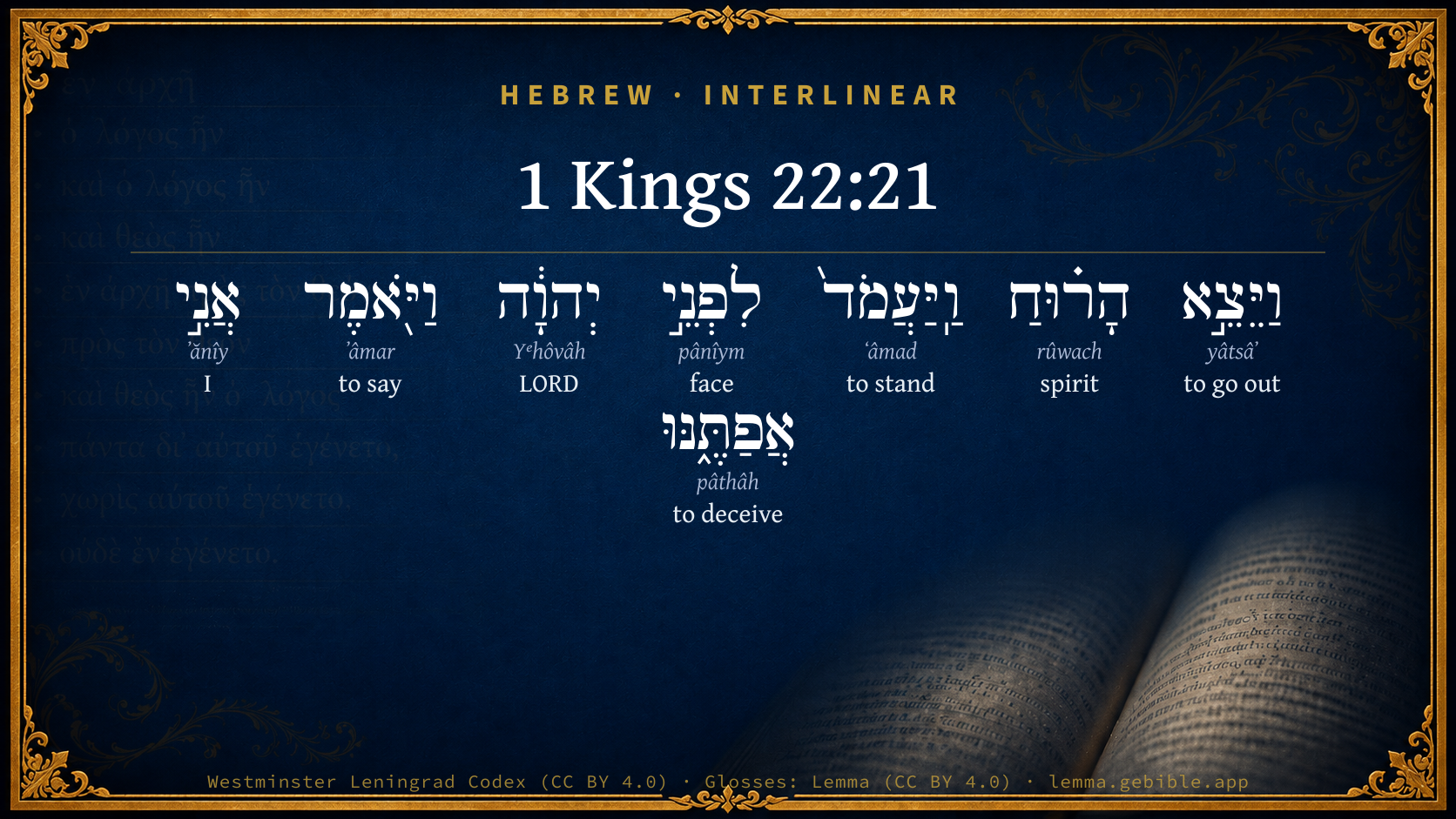
1 Kings 22:21

Hebrew (Westminster Leningrad Codex) 1 Kings 22:21 appears in the Hebrew Old Testament. The text above is from the Westminster Leningrad Codex. Each word links to its Strong’s number, a concise gloss, and parsing drawn from the Open Scriptures Hebrew Bible morphology. Click any word for its full Brown-Driver-Briggs (BDB) entry.
Download image
Cite this verse

1 Kings 22:21 (World English Bible). Public Domain. Lemma interlinear Bible study tool, https://lemma.gebible.app/v/1-kings/22/21.

Show BibTeX & RIS
BibTeX
RIS
English Translation
There came forth a spirit, and stood before Yahweh, and said, I will entice him.
World English Bible · Public Domain
Download a study sheet

One document with this verse’s original text, its word-by-word gloss line, the meaning frame, cross-references with their text, attributed commentary, and full source and license credits — printable, and it pastes into notes with its structure intact.

This verse Autodidact and up

Study sheet (.html) Plain text (.txt)

A passage Seminary Student

Up to 50 verses in one chapter. A passage sheet keeps up to 6 commentary sources and 12 cross-references per verse, in the order this page ranks them, and says so on the sheet whenever that leaves anything out. Ask for a single verse and you get the Autodidact verse sheet above.

Everything on this page stays free to read, with no account — the sheet is a download of what is already on screen, not access to it.

Want to remove ads? Support Godless Engineer
Compare translations 3

The same verse in 3 English versions, stacked beneath the original-language interlinear above. Click any original word for its lexicon entry.

Each is an independent rendering of the whole verse — the interlinear is not word-aligned to these translations.

Highlighted words mark where these versions differ — a whole-verse word diff, not a word-by-word alignment.

  • World English Bible Public Domain
    There came forth a spirit, and stood before Yahweh, and said, I will entice him.
  • King James Version Public Domain
    And there came forth a spirit, and stood before the LORD, and said, I will persuade him.
  • unfoldingWord Literal Text CC BY-SA 4.0
    Then a spirit came out and stood to the face of Yahweh. And he said, ‘I, I will deceive.’ And Yahweh said to him, ‘By what?’

unfoldingWord Literal Text — © unfoldingWord, licensed CC BY-SA 4.0. Word-aligned USFM3 via Door43 (git.door43.org/unfoldingWord/en_ult).

Versions to compare (up to 4)

3 of 4 selected

Show all 18 translations

Every available English version of this verse, each an independent rendering of the whole verse.

  • World English Bible Public Domain
    There came forth a spirit, and stood before Yahweh, and said, I will entice him.
  • Berean Standard Bible Public Domain
    Then a spirit came forward, stood before the LORD, and said, ‘I will entice him.’ ‘By what means?’ asked the LORD.
  • Majority Standard Bible Public Domain
    Then a spirit came forward, stood before the LORD, and said, ‘I will entice him.’ ‘By what means?’ asked the LORD.
  • King James Version Public Domain
    And there came forth a spirit, and stood before the LORD, and said, I will persuade him.
  • American Standard Version (1901) Public Domain
    And there came forth a spirit, and stood before Jehovah, and said, I will entice him.
  • Revised Version (1885) Public Domain
    And there came forth a spirit, and stood before the LORD, and said, I will entice him.
  • Geneva Bible (1599) Public Domain
    Then there came forth a spirit, and stoode before the Lord, and sayd, I wil entise him. And the Lord sayd vnto him, Wherewith?
  • Douay-Rheims (1899) Public Domain
    And there came forth a spirit, and stood before the Lord, and said: I will deceive him. And the Lord said to him: By what means?
  • Young's Literal Translation Public Domain
    `And the spirit goeth out, and standeth before Jehovah, and saith, I -- I do entice him; and Jehovah saith unto him, By what?
  • Literal Standard Version CC BY-SA 4.0
    And the spirit goes out and stands before YHWH, and says, I entice him; and YHWH says to him, By what?
  • Unlocked Literal Bible CC BY-SA 4.0
    Then a spirit came forward, stood before Yahweh, and said, 'I will entice him.' Yahweh said to him, 'How?'
  • unfoldingWord Literal Text CC BY-SA 4.0
    Then a spirit came out and stood to the face of Yahweh. And he said, ‘I, I will deceive.’ And Yahweh said to him, ‘By what?’
  • Darby Bible Public Domain
    And there came forth a spirit, and stood before Jehovah, and said, I will entice him.
  • World Messianic Bible Public Domain
    A spirit came out and stood before the LORD, and said, ‘I will entice him.’
  • Webster's Bible Public Domain
    And there came forth a spirit, and stood before the LORD, and said, I will persuade him.
  • Free Bible Version CC BY-SA 4.0
    Finally a spirit came and approached the Lord and said, ‘I will trick him.’
  • Bible in Basic English Public Domain
    Then a spirit came forward and took his place before the Lord and said, I will get him to do it by a trick.
  • JPS Tanakh (1917) Public Domain
    And there came forth the spirit, and stood before the LORD, and said: I will entice him.

Literal Standard Version (2020), Covenant Press — licensed CC BY-SA 4.0. Text via the HelloAO Bible API (eBible.org). Unlocked Literal Bible (unfoldingWord) — licensed CC BY-SA 4.0. Text via the HelloAO Bible API (eBible.org). unfoldingWord Literal Text — © unfoldingWord, licensed CC BY-SA 4.0. Word-aligned USFM3 via Door43 (git.door43.org/unfoldingWord/en_ult). Free Bible Version, Dr. Jonathan Gallagher — licensed CC BY-SA 4.0. Text via the HelloAO Bible API (eBible.org).

Word by word

More ways to search: Search by grammar → Find every occurrence → Compare this word →

Practice this passage: Drill this verse → Learn its vocabulary →

אֲפַתֶּ֑נּוּ
pâthâh
H6601
“to deceive · us”
Verb, Piel, Imperfect, 1st Person, Common, Singular + Suffix, Personal, 1st Person, Common, Plural
Part of Speech
Verb
Stem
Piel
Form
Imperfect
Person
1st Person
Gender
Common
Number
Singular
Full BDB Definition

Origin: a primitive root

TWOT: 1853

to be spacious, be open, be wide - (Qal) to be spacious or open or wide - (Hiphil) to make spacious, make open - to be simple, entice, deceive, persuade - (Qal) - to be open-minded, be simple, be naive - to be enticed, be deceived - (Niphal) to be deceived, be gullible - (Piel) - to persuade, seduce - to deceive - (Pual) - to be persuaded - to be deceived
  1. וַיֵּצֵ֣א yâtsâʼ H3318 “and · to go out” Conjunction + Verb, Qal, Sequential Imperfect, 3rd Person, Masculine, Singular
  2. הָר֗וּחַ rûwach H7307 “the · spirit” Particle, Definite Article + Noun, Common, Both, Singular, Absolute
  3. וַֽיַּעֲמֹד֙ ʻâmad H5975 “and · to stand” Conjunction + Verb, Qal, Sequential Imperfect, 3rd Person, Masculine, Singular
  4. לִפְנֵ֣י pânîym H6440 “to/for · face(s) of” Preposition + Noun, Common, Both, Plural, Construct
  5. יְהוָ֔ה Yᵉhôvâh H3068 “LORD” Noun, Proper
  6. וַיֹּ֖אמֶר ʼâmar H559 “and · to say” Conjunction + Verb, Qal, Sequential Imperfect, 3rd Person, Masculine, Singular
  7. אֲנִ֣י ʼănîy H589 “I” Pronoun, Personal, 1st Person, Common, Singular

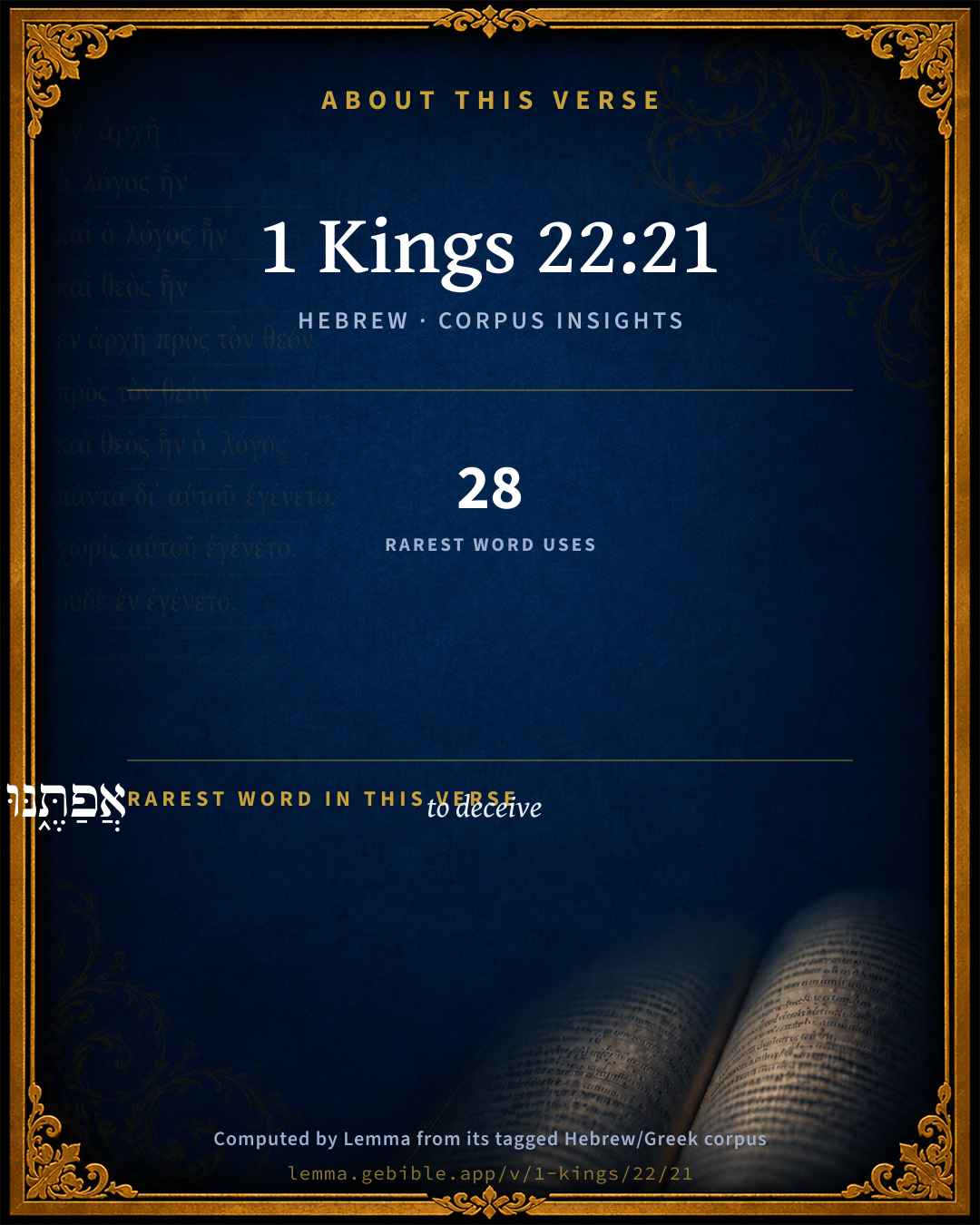
About this verse

These counts appear in no published source. They are computed here, from the morphology-tagged text and Lemma’s own curated glosses. What Lemma adds →

8
words
8
distinct lemmas
Historical
section

Shared distinctive vocabulary

אֲפַתֶּ֑נּוּ to deceive H6601 occurs in 26 verses of the Hebrew Bible. Also found in:

Grammatical profile

  • 4 verbs
  • 3 nouns
  • 1 pronoun

Verb forms

  • וַיֵּצֵ֣א Qal · Sequential Imperfect
  • וַֽיַּעֲמֹד֙ Qal · Sequential Imperfect
  • וַיֹּ֖אמֶר Qal · Sequential Imperfect
  • אֲפַתֶּ֑נּוּ Piel · Imperfect

Hebrew & Septuagint length

In English translation the verse runs 15 words from the Hebrew and 17 from the Septuagint (LXX English) — closely comparable.

A rough comparison of the two English renderings, which tokenize alike — not a word-level alignment.

Word counts can differ between the Hebrew and the Greek without any difference in meaning — e.g. the Hebrew direct-object marker אֵת has no separate Greek word, and Greek often adds the article ὁ.

Cross-references

3

Topical passages linked to 1 Kings 22:21 in the Treasury of Scripture Knowledge — connected by theme and wording, ordered by reader-vote popularity; previews shown in the World English Bible.

  • 1 Kings 22:23 Now therefore, behold, Yahweh has put a lying spirit in the mouth of all these your prophets; and Yahweh has spoken evil concerning you.
  • Job 1:6–7 Now it happened on the day when the sons of God came to present themselves before Yahweh, that Satan also came among them.
  • Job 2:1 Again it happened on the day when the sons of God came to present themselves before Yahweh, that Satan came also among them to present himself before Yahweh.

Cross-references courtesy of OpenBible.info (CC BY 4.0).

Hebrew and Greek witnesses Masoretic Hebrew ↔ Greek Septuagint

The same verse in the two great witnesses to the Old Testament, shown verse-for-verse.

These are two independent witnesses, not word-aligned to each other, and the Septuagint is shown in lemma (dictionary) form.

Hebrew 1 Kings 22:21 Masoretic · Westminster Leningrad Codex

וַיֵּצֵ֣א הָר֗וּחַ וַֽיַּעֲמֹד֙ לִפְנֵ֣י יְהוָ֔ה וַיֹּ֖אמֶר אֲנִ֣י אֲפַתֶּ֑נּוּ

There came forth a spirit, and stood before Yahweh, and said, I will entice him.

World English Bible · Public Domain

Greek LXX 1 Kings 22:21 Septuagint · lemma form

καί ἐκἔρχομαι πνεῦμα καί ἵστημι ἐνώπιον κύριος καί εἶπον ἐγώ ἀπατάω αὐτός καί εἶπον πρός αὐτός κύριος ἐν τίς

And there came forth a spirit and stood before the Lord, and said, I will deceive him.

LXX2012 (modern English Septuagint) · Public Domain

Hebrew: Westminster Leningrad Codex (CC BY 4.0). Greek: Septuagint (public domain); English from LXX2012 (modern English Septuagint) (Public Domain). How the Septuagint differs from the Hebrew →

Targum (Aramaic paraphrase)

1

The Targum is the ancient Jewish Aramaic paraphrase of the Hebrew Scriptures — an interpretive translation, not the Hebrew text itself. Onkelos (literal) and Pseudo-Jonathan (expansive) render the Torah, and Jonathan the Prophets. Coverage is partial: where no permissively-licensed English translation exists for a verse, only the Aramaic is shown. This is verse-level text, not a word-by-word alignment to the Hebrew.

  1. Targum Jonathan Prophets (Joshua–Malachi)
    וּנְפַק רוּחָא וְקָם קֳדָם יְיָ וַאֲמַר אֲנָא אַטְעִינֵיהּ וַאֲמַר יְיָ לֵיהּ בְּמָא:

    (no public-domain English translation for this verse)

    Targum Jonathan — Aramaic: “Mikraot Gedolot” (public domain). English: “Sefaria Community Translation” (CC0 1.0 (public-domain dedication)); “London "Chaldee Paraphrase," 1871” (public domain). Text via Sefaria.

Commentary

Notes on 1 Kings 22:21 from classic Christian and Jewish commentators (each source and its license shown beneath its notes). The classic Christian expositions comment on the surrounding passage and are grouped to its opening verse, so a note may address several verses; the Jewish commentaries on the Tanakh (Rashi and others) are per-verse, so they appear only where the commentator wrote on this verse.

Lemma curates 59 commentaries, every one of them public domain or Creative Commons licensed, each selected and text-cleaned for this edition rather than reprinted as found. About our sources →

Trapp's Complete Commentary

John Trapp

1Ki 22:21 And there came forth a spirit, and stood before the LORD, and said, I will persuade him.

Ver. 21. And there came forth a spirit.] An evil spirit, haply, from the left hand of God’s throne.

I will persuade him.] {See Trapp on "1Ki 22:6"}

John Trapp, A Commentary or Exposition upon All the Books of the Old and New Testament (1647–1656) — public domain. Text from a community e-Sword module.

Geneva Bible (1599)

Geneva Bible translators

Here we see that though the devil be ever ready to bring us to destruction, yet he hath no further power than God giveth him.

Geneva Bible (1599) marginal notes — public domain. Text via Bolls.life.

Ellicott's Commentary for English Readers

(21) A spirit.—It should be the spirit. The definite article is explained by some, perhaps rather weakly, as simply anticipatory of the description which follows. Others take the phrase to signify “the spirit of prophecy,” a kind of emanation from the Godhead, looked upon as the medium of the prophetic inspiration, which is an expression conceivable, but certainly unprecedented. Perhaps without introducing into this passage the distinct idea of “the Satan,” i.e., the enemy, which we find in Job 1, 2; 1Ch_21:1; Zec_3:1-2. it may be best to interpret it by the conception, common to all religions recognising the terrible existence of evil in the world, of a spiritual power of evil (called euphemistically, “the spirit”) overruled to work out the judgments of God. The absolute subordination of such spirits of evil in every notice of them in the Old Testament precludes all danger of the monstrous dualism of so many Eastern religions. The reference of the power of divination to such spirits is found in the New Testament also. (See Act_16:16-18.)

A Bible Commentary for English Readers, edited by Charles John Ellicott (1878–1897) — public domain. Text from a community e-Sword module.

The Cambridge Bible for Schools and Colleges

gen. ed. J. J. S. Perowne

21. And there came forth a spirit] The Hebrew has ‘the spirit’ as is noted on the margin of the R.V. It seems therefore to imply some definite power which imparted to prophets their gifts; the prophetic spirit. That God allowed this power to delude Ahab was because of the king’s persistence in evil. God therefore gives him over to it, and causes the prophets whom he has chosen for himself, to the rejection of Micaiah and such as he, to be the instruments of his destruction. Thus when Isaiah is sent to rebellious Israel (Isa_6:10) his mission is described as of this nature. God says to him ‘Make the heart of this people fat and make their ears heavy, and shut their eyes, lest they see with their eyes, and hear with their ears, and understand with their hearts.’ In this wise and with like effect comes the spirit from God into the mouths of Ahab’s four hundred.

The Cambridge Bible for Schools and Colleges (gen. ed. J. J. S. Perowne; Cambridge University Press, 1878–1918) — public domain. Text from a community e-Sword module.

John Gill's Exposition

But Zedekiah the son of Chenaanah went near,.... Stepped in haste and passion from the place where he was:

and smote Micaiah on the cheek; in contempt of him, and to show his indignation at what he said; this he did in open court, before two kings; one he believed would favour and screen him in this lawless action, and the other, out of his own jurisdiction, had not courage and presence of mind to resent it:

and said, which way went the Spirit of the Lord from me to speak unto thee? hereby boasting that he had the Spirit of the Lord, and was directed by him in what he said, and still remained with him, and could not possibly go to Micaiah, and suggest the very reverse; and therefore pertly asks him which way the spirit went, intimating that it was impossible he could steer a course contrary to himself.

John Gill's Exposition of the Whole Bible (1746–1763) — public domain (CC PDM 1.0). Text via the HelloAO Bible API.

Albert Barnes' Notes on the Bible

A spirit - “The spirit “ - which some explain as “the evil spirit” - i. e. Satan; others as simply “the spirit” who should “persuade.”

Albert Barnes' Notes on the Bible (1834–1885) — public domain. Text from a community e-Sword/MySword module.

Matthew Poole's English Annotations

An evil spirit came out of the knot or company of them, standing possibly on the left hand, and presented himself before the throne, as having something to say to the Lord.

Matthew Poole's English Annotations on the Holy Bible (1683–1685) — public domain. Text from a community e-Sword/MySword module.

Whedon's Commentary on the Bible

Daniel D. Whedon

21. There came forth a spirit — Literally, the spirit; that is, the particular spirit that served as the agent of Divine judgment in this judicial blinding of Ahab’s heart. This spirit was but one of that vast host of evil powers whose ministry so largely affects the children of disobedience. This scene before the throne of the Lord is in perfect keeping with that recorded in Job_1:6-12. it is not merely vision and parable, but, in harmony with other Scriptures, opens to us the knowledge of a vast host of unseen spirits, going to and fro seeking whom they may destroy, (2 Peter 5:8,) yet all held in check, and often, if not always, used by Jehovah himself to execute his wise and holy purposes.

Daniel D. Whedon (gen. ed.), Commentary on the Old and New Testaments (1874–1909) — public domain. Text from a community e-Sword module.

The Pulpit Commentary

And there came forth a spirit Heb. the spirit. By some, especially of the earlier commentators, understood of the evil spirit. But the view now generally adopted (Thenius, Keil, Bahr) is that "the spirit of prophecy" is meant, "the power which, going forth from God and taking possession of a man, makes him a prophet. (1Sa_10:6, 10 19:20, 23) The aybn; is the jWrh vyai" (Hos_9:7) Bahr. This power is here personified, and stood before the Lord, and said, I emphatic in the Hebrew will persuade or entice him.

The Pulpit Commentary (1880–1919), ed. H.D.M. Spence-Jones & Joseph S. Exell — public domain. Text from a community e-Sword module.

John Wesley's Explanatory Notes

A spirit - An evil spirit came, and presented himself before the throne.

John Wesley, Explanatory Notes Upon the Whole Bible (1754–1765) — public domain. Text via the GEBible commentary corpus.

unfoldingWord translationNotes

Door43 World Missions Community

be a lying spirit in the mouth of all his prophets

Here the word "spirit" refers to the attitudes of the prophets and the words "the mouth" represents what they will say. AT: "cause all his prophets to speak lies" (See: Metonymy)

see

"pay attention, because what I am about to say is both true and important"

has put a lying spirit in the mouth of all these prophets of yours

Here the word "spirit" refers to the attitudes of the prophets and the words "the mouth" represents what they will say. AT: "has caused all of your prophets to speak lies" (See: Metonymy)

translationWords

spirit

decree

unfoldingWord translationNotes — © Distant Shores Media and the Door43 World Missions Community, licensed CC BY-SA 4.0. Source: git.door43.org/Door43/en_tn.

Rashi

Rabbi Shlomo Yitzchaki (Rashi)

And a spirit came forth. The spirit of Navos.

Rashi on the Tanakh — English translations: “The Judaica Press complete Tanach with Rashi, translated by A. J. Rosenberg” (CC BY 4.0); “Pentateuch with Rashi's commentary by M. Rosenbaum and A.M. Silbermann, 1929-1934” (public domain); “The Metsudah Tanach series, Lakewood, N.J” (CC BY 4.0); and “The Book of Joshua, Metsudah Publications, 1997” (CC BY 4.0). Text via Sefaria.

Lesson kit

Teaching starters — assembled from the data on this page, not authored interpretation. Every prompt links to the verse data it draws on. Edit before teaching.

1 Kings, in the Historical, opens this verse with 8 words (8 distinct Hebrew lemmas). Its most distinctive word is pâthâh (“to deceive”). A historical commentator’s framing appears above. Read the whole chapter for the surrounding context.

Discussion questions

  1. How does “to deceive” (pâthâh) shape what this verse is saying?
  2. Genesis 9:27 shares the word «to deceive» with this verse. How do the two illuminate each other?
  3. These translations render this verse differently. What is at stake in choosing one wording over another?
  4. The verb «וַיֵּצֵ֣א» is Qal Sequential Imperfect. How does its form color the action?
  5. Reading how Trapp's Complete Commentary and Geneva Bible (1599) read this verse, where do the two commentators agree and where do they part?

Things to notice

Reading settings

Reading text

Shown beneath each verse's original-language words.

Old Testament
Old Testament edition

Read the OT as the Masoretic Hebrew (MT) or the Greek Septuagint (LXX).

English shown for the Greek Septuagint (in the Hebrew ↔ Greek comparison).

Comparing translations? Open the Compare panel on any verse page to stack up to four side by side.