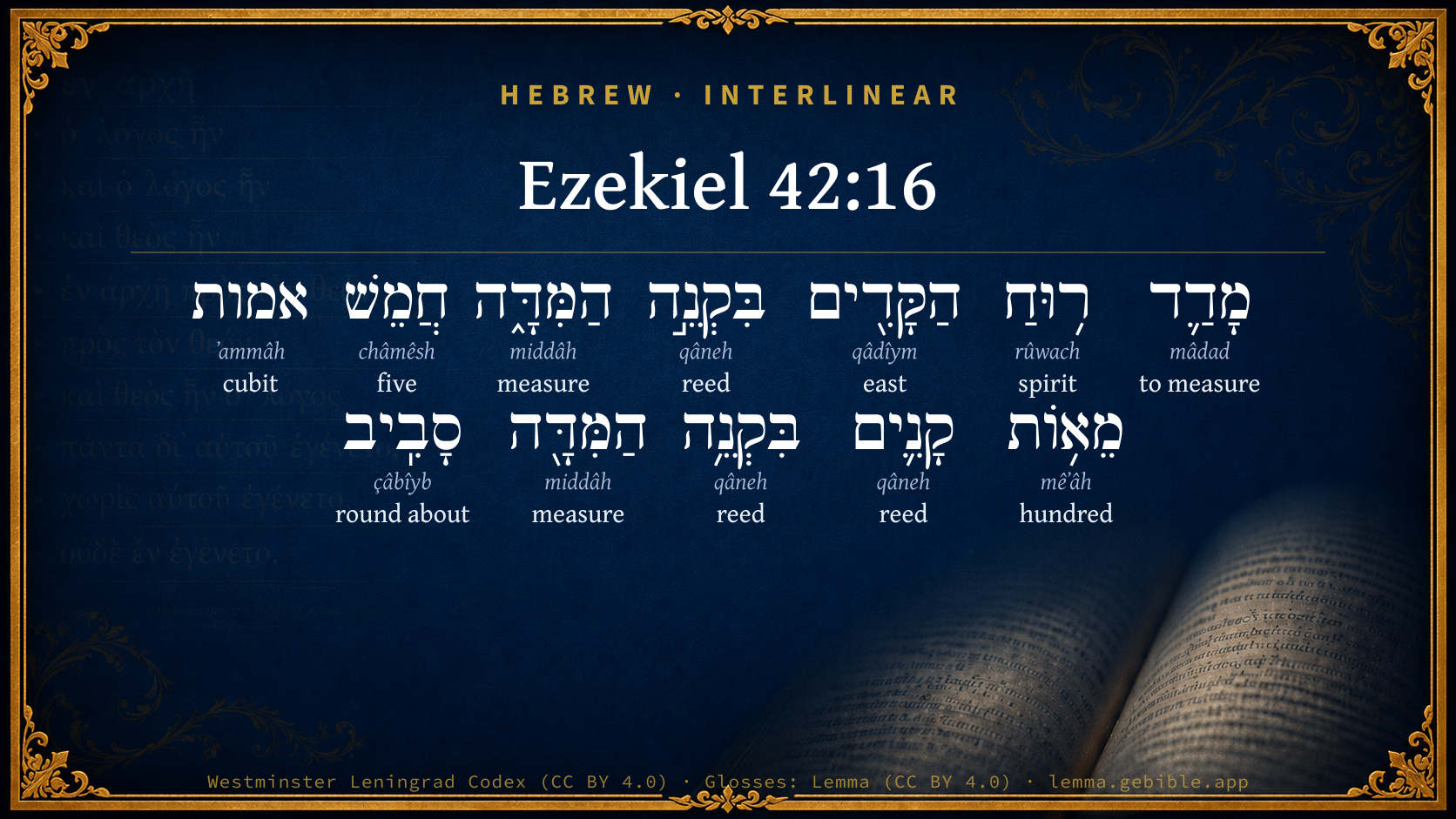
Ezekiel 42:16

Hebrew (Westminster Leningrad Codex) Ezekiel 42:16 appears in the Hebrew Old Testament. The text above is from the Westminster Leningrad Codex. Each word links to its Strong’s number, a concise gloss, and parsing drawn from the Open Scriptures Hebrew Bible morphology. Click any word for its full Brown-Driver-Briggs (BDB) entry.
Download image
Cite this verse

Ezekiel 42:16 (World English Bible). Public Domain. Lemma interlinear Bible study tool, https://lemma.gebible.app/v/ezekiel/42/16.

Show BibTeX & RIS
BibTeX
RIS
English Translation
He measured on the east side with the measuring reed five hundred reeds, with the measuring reed round about.
World English Bible · Public Domain
Download a study sheet

One document with this verse’s original text, its word-by-word gloss line, the meaning frame, cross-references with their text, attributed commentary, and full source and license credits — printable, and it pastes into notes with its structure intact.

This verse Autodidact and up

Study sheet (.html) Plain text (.txt)

A passage Seminary Student

Up to 50 verses in one chapter. A passage sheet keeps up to 6 commentary sources and 12 cross-references per verse, in the order this page ranks them, and says so on the sheet whenever that leaves anything out. Ask for a single verse and you get the Autodidact verse sheet above.

Everything on this page stays free to read, with no account — the sheet is a download of what is already on screen, not access to it.

Want to remove ads? Support Godless Engineer
Compare translations 3

The same verse in 3 English versions, stacked beneath the original-language interlinear above. Click any original word for its lexicon entry.

Each is an independent rendering of the whole verse — the interlinear is not word-aligned to these translations.

Highlighted words mark where these versions differ — a whole-verse word diff, not a word-by-word alignment.

  • World English Bible Public Domain
    He measured on the east side with the measuring reed five hundred reeds, with the measuring reed round about.
  • King James Version Public Domain
    He measured the east side with the measuring reed, five hundred reeds, with the measuring reed round about.
  • unfoldingWord Literal Text CC BY-SA 4.0
    He measured the east side with a measuring stick—five hundred cubits with the measuring stick.

unfoldingWord Literal Text — © unfoldingWord, licensed CC BY-SA 4.0. Word-aligned USFM3 via Door43 (git.door43.org/unfoldingWord/en_ult).

Versions to compare (up to 4)

3 of 4 selected

Show all 18 translations

Every available English version of this verse, each an independent rendering of the whole verse.

  • World English Bible Public Domain
    He measured on the east side with the measuring reed five hundred reeds, with the measuring reed round about.
  • Berean Standard Bible Public Domain
    With a measuring rod he measured the east side to be five hundred cubits long.
  • Majority Standard Bible Public Domain
    With a measuring rod he measured the east side to be five hundred cubits long.
  • King James Version Public Domain
    He measured the east side with the measuring reed, five hundred reeds, with the measuring reed round about.
  • American Standard Version (1901) Public Domain
    He measured on the east side with the measuring reed five hundred reeds, with the measuring reed round about.
  • Revised Version (1885) Public Domain
    He measured on the east side with the measuring reed, five hundred reeds, with the measuring reed round about.
  • Geneva Bible (1599) Public Domain
    He measured the East side with the measuring rod, fiue hundreth reedes, euen with the measuring reede round about.
  • Douay-Rheims (1899) Public Domain
    And he measured toward the east with the measuring reed, five hundred reeds with the measuring reed round about.
  • Young's Literal Translation Public Domain
    He hath measured the east side with the measuring-reed, five hundred reeds, with the measuring-reed round about.
  • Literal Standard Version CC BY-SA 4.0
    He has measured the east side with the measuring-reed, five hundred reeds, with the measuring-reed all around.
  • Unlocked Literal Bible CC BY-SA 4.0
    He measured the east side with a measuring stick—five hundred cubits with the measuring stick.
  • unfoldingWord Literal Text CC BY-SA 4.0
    He measured the east side with a measuring stick—five hundred cubits with the measuring stick.
  • Darby Bible Public Domain
    He measured the east side with the measuring-reed, five hundred reeds, with the measuring-reed round about.
  • World Messianic Bible Public Domain
    He measured on the east side with the measuring reed five hundred reeds, with the measuring reed all around.
  • Webster's Bible Public Domain
    He measured the east side with the measuring reed, five hundred reeds, with the measuring reed around.
  • Free Bible Version CC BY-SA 4.0
    Using the measuring rod he measured the east side. It was five hundred cubits long.
  • Bible in Basic English Public Domain
    He went round and took the measure of it on the east side with the measuring rod, five hundred, measured with the rod all round.
  • JPS Tanakh (1917) Public Domain
    He measured the east side with the measuring reed, five hundred reeds, with the measuring reed round about.

Literal Standard Version (2020), Covenant Press — licensed CC BY-SA 4.0. Text via the HelloAO Bible API (eBible.org). Unlocked Literal Bible (unfoldingWord) — licensed CC BY-SA 4.0. Text via the HelloAO Bible API (eBible.org). unfoldingWord Literal Text — © unfoldingWord, licensed CC BY-SA 4.0. Word-aligned USFM3 via Door43 (git.door43.org/unfoldingWord/en_ult). Free Bible Version, Dr. Jonathan Gallagher — licensed CC BY-SA 4.0. Text via the HelloAO Bible API (eBible.org).

Word by word

More ways to search: Search by grammar → Find every occurrence → Compare this word →

Practice this passage: Drill this verse → Learn its vocabulary →

מָדַ֛ד
mâdad
H4058
“to measure”
Verb, Qal, Perfect, 3rd Person, Masculine, Singular
Part of Speech
Verb
Stem
Qal
Form
Perfect
Person
3rd Person
Gender
Masculine
Number
Singular
Full BDB Definition

Origin: a primitive root

TWOT: 1146

to measure, stretch - (Qal) to measure - (Niphal) to be measured - (Piel) - to extend, continue - to measure, measure off - (Po) measured - (Hithpolel) to extend oneself, stretch oneself
  1. ר֥וּחַ rûwach H7307 “spirit of” Noun, Common, Both, Singular, Construct
  2. הַקָּדִ֖ים qâdîym H6921 “the · east” Particle, Definite Article + Noun, Common, Masculine, Singular, Absolute
  3. בִּקְנֵ֣ה qâneh H7070 “in/at · reed of” Preposition + Noun, Common, Masculine, Singular, Construct
  4. הַמִּדָּ֑ה middâh H4060 “the · measure” Particle, Definite Article + Noun, Common, Feminine, Singular, Absolute
  5. חֲמֵשׁ châmêsh H2568 “five” Adjective, Cardinal number, Feminine, Singular, Absolute
  6. אמות ʼammâh H520 “cubits of” Noun, Common, Feminine, Plural, Construct
  7. מֵא֥וֹת mêʼâh H3967 “hundred” Adjective, Cardinal number, Both, Plural, Absolute
  8. קָנִ֛ים qâneh H7070 “reeds” Noun, Common, Masculine, Plural, Absolute
  9. בִּקְנֵ֥ה qâneh H7070 “in/at · reed of” Preposition + Noun, Common, Masculine, Singular, Construct
  10. הַמִּדָּ֖ה middâh H4060 “the · measure” Particle, Definite Article + Noun, Common, Feminine, Singular, Absolute
  11. סָבִֽיב çâbîyb H5439 “round about” Noun, Common, Both, Singular, Absolute

About this verse

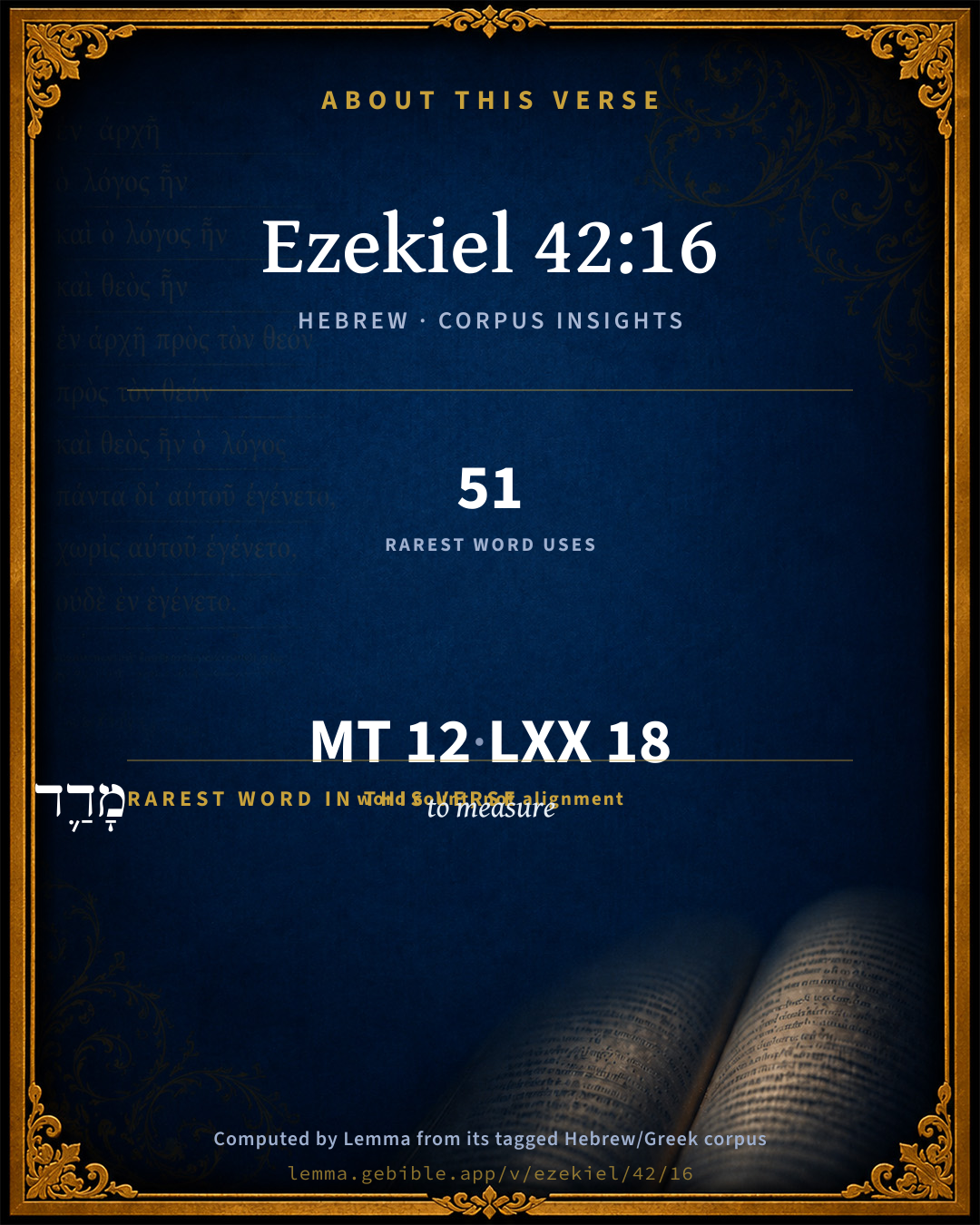
These counts appear in no published source. They are computed here, from the morphology-tagged text and Lemma’s own curated glosses. What Lemma adds →

12
words
9
distinct lemmas
Prophets
section

Shared distinctive vocabulary

מָדַ֛ד to measure H4058 occurs in 49 verses of the Hebrew Bible. Also found in:

Grammatical profile

  • 1 verb
  • 9 nouns
  • 2 adjectives

Verb forms

  • מָדַ֛ד Qal · Perfect

Repetition

Words recur within this verse — often emphatic in Hebrew:

  • בִּקְנֵ֣ה reed H7070 ×3
  • הַמִּדָּ֑ה measure H4060 ×2

Hebrew & Septuagint length

In English translation the verse runs 19 words from the Hebrew and 17 from the Septuagint (LXX English) — closely comparable.

A rough comparison of the two English renderings, which tokenize alike — not a word-level alignment.

Word counts can differ between the Hebrew and the Greek without any difference in meaning — e.g. the Hebrew direct-object marker אֵת has no separate Greek word, and Greek often adds the article ὁ.

In the original languages it is 12 Hebrew tokens and 18 Greek tokens — but the two are counted differently (Hebrew bundles its prefixes and suffixes into one token; the Greek is in lemma form), so that isn’t a like-for-like length.

Cross-references

3

Topical passages linked to Ezekiel 42:16 in the Treasury of Scripture Knowledge — connected by theme and wording, ordered by reader-vote popularity; previews shown in the World English Bible.

  • Ezekiel 40:3 He brought me there; and, behold, there was a man, whose appearance was like the appearance of brass, with a line of flax in his hand, and a measuring reed; and he stood in the gate.
  • Zechariah 2:1 I lifted up my eyes, and saw, and, behold, a man with a measuring line in his hand.
  • Revelation 11:1–2 A reed like a rod was given to me. Someone said, "Rise, and measure God's temple, and the altar, and those who worship in it.

Cross-references courtesy of OpenBible.info (CC BY 4.0).

Hebrew and Greek witnesses Masoretic Hebrew ↔ Greek Septuagint

The same verse in the two great witnesses to the Old Testament, shown verse-for-verse.

These are two independent witnesses, not word-aligned to each other, and the Septuagint is shown in lemma (dictionary) form.

Hebrew Ezekiel 42:16 Masoretic · Westminster Leningrad Codex

מָדַ֛ד ר֥וּחַ הַקָּדִ֖ים בִּקְנֵ֣ה הַמִּדָּ֑ה חֲמֵשׁ אמות מֵא֥וֹת קָנִ֛ים בִּקְנֵ֥ה הַמִּדָּ֖ה סָבִֽיב

He measured on the east side with the measuring reed five hundred reeds, with the measuring reed round about.

World English Bible · Public Domain

Greek LXX Ezekiel 42:16 Septuagint · lemma form

καί ἵστημι κατά νῶτον ὁ πύλη ὁ βλέπω κατά ἀνατολή καί διαμετρέω πεντακόσιοι ἐν ὁ κάλαμος ὁ μέτρον

And he stood behind the gate looking eastward, and measured five hundred cubits with the measuring reed.

LXX2012 (modern English Septuagint) · Public Domain

On this verse, The Cambridge Bible for Schools and Colleges discusses the Septuagint’s reading. Read the note in Commentary ↓

Hebrew: Westminster Leningrad Codex (CC BY 4.0). Greek: Septuagint (public domain); English from LXX2012 (modern English Septuagint) (Public Domain). How the Septuagint differs from the Hebrew →

Targum (Aramaic paraphrase)

1

The Targum is the ancient Jewish Aramaic paraphrase of the Hebrew Scriptures — an interpretive translation, not the Hebrew text itself. Onkelos (literal) and Pseudo-Jonathan (expansive) render the Torah, and Jonathan the Prophets. Coverage is partial: where no permissively-licensed English translation exists for a verse, only the Aramaic is shown. This is verse-level text, not a word-by-word alignment to the Hebrew.

  1. Targum Jonathan Prophets (Joshua–Malachi)
    וּמְשַׁח רוּחַ קִידוּמָא בִּקְנֵי מִשְׁחֲתָא חֲמֵשׁ מְאָה קְנִין בִּקְנֵי מִשְׁחֲתָא סְחוֹר סְחוֹר:

    (no public-domain English translation for this verse)

    Targum Jonathan — Aramaic: “Mikraot Gedolot” (public domain). English: “Sefaria Community Translation” (CC0 1.0 (public-domain dedication)); “London "Chaldee Paraphrase," 1871” (public domain). Text via Sefaria.

Commentary

Notes on Ezekiel 42:16 from classic Christian and Jewish commentators (each source and its license shown beneath its notes). The classic Christian expositions comment on the surrounding passage and are grouped to its opening verse, so a note may address several verses; the Jewish commentaries on the Tanakh (Rashi and others) are per-verse, so they appear only where the commentator wrote on this verse.

Lemma curates 59 commentaries, every one of them public domain or Creative Commons licensed, each selected and text-cleaned for this edition rather than reprinted as found. About our sources →

The Cambridge Bible for Schools and Colleges

gen. ed. J. J. S. Perowne

16. five hundred reeds] Rather: cubits. Five hundred reeds, the reed being 6 cubits, would give a measurement of 3000 cubits. No allusion is made to such a space surrounding the house buildings anywhere else. On the contrary in Eze_45:2 the area of the temple buildings is said to be 500 cubits square, and the free place about it 50 cubits. LXX. omits the word “reeds” everywhere in these verses, expressly giving “cubits” in Eze_42:17. In Eze_42:20 (Heb.) allusion is made to the wall, and “reeds” is omitted. That the outer wall of the temple buildings formed a square of 500 cubits appears from measurements given elsewhere. Taking the direction N. to S. we have 50 (outer gate, Eze_40:21) + 100 (gate to gate, Eze_40:23) + 50 (inner gate, Eze_40:36) + 100 (inner court, Eze_40:47) + 50 (inner gate) + 100 (gate to gate) + 50 (outer gate) = 500. Or going from E. to W. the result is the same: 50 (outer gate) + 100 (gate to gate) + 50 (inner gate) + 100 (inner court) + 100 (house, Eze_41:13) + 100 (building behind house, Eze_41:13) = 500.

round about] The word is wanting in Eze_42:18, and Eze_42:19 reads: he turned about and measured. LXX. reads in the latter way in all the Eze_42:16-18, attaching the word to the beginning of the following verse, no doubt rightly, cf. a similar case 1Sa_14:21. In LXX. also Eze_42:18-19 are transposed, the natural order round the wall being followed.

The Cambridge Bible for Schools and Colleges (gen. ed. J. J. S. Perowne; Cambridge University Press, 1878–1918) — public domain. Text from a community e-Sword module.

Trapp's Complete Commentary

John Trapp

Eze 42:16 He measured the east side with the measuring reed, five hundred reeds, with the measuring reed round about.

Ver. 16. Five hundred reeds.] Lo, here the large extent of the Holy Catholic Church, the communion of saints. {See Trapp on "Eze 40:1}

John Trapp, A Commentary or Exposition upon All the Books of the Old and New Testament (1647–1656) — public domain. Text from a community e-Sword module.

Tyndale Open Study Notes

Tyndale Open Resources

42:16-20 Having finished his tour of the inner courtyard, Ezekiel was shown the overall dimensions of the area. The whole complex was square, which denoted holiness and differentiated it from the less regular design of Solomon’s Temple and the Tabernacle before it, in which only the Most Holy Place was square. • The description of the Temple finished where it began, with a mention of a wall all around it (see 40:5); Ezekiel reminds us again that the purpose of that wall was to separate what was holy from what was common.

Tyndale Open Study Notes — © Tyndale Open Resources, licensed CC BY-SA 4.0. Text via the HelloAO Bible API.

Jamieson, Fausset & Brown

Robert Jamieson, A. R. Fausset & David Brown

five hundred reeds--the Septuagint substitutes "cubits" for "reeds," to escape the immense compass assigned to the whole, namely, a square of five hundred rods or three thousand cubits (two feet each; Eze 40:5), in all a square of one and one-seventh miles, that is, more than all ancient Jerusalem; also, there is much space thus left unappropriated. FAIRBAIRN rightly supports English Version, which agrees with the Hebrew. The vast extent is another feature marking the ideal character of the temple. It symbolizes the great enlargement of the kingdom of God, when Jehovah-Messiah shall reign at Jerusalem, and from thence to the ends of the earth (Isa 2:2-4; Jer 3:17; Rom 11:12, Rom 11:15).

Jamieson, Fausset & Brown — Commentary Critical and Explanatory on the Whole Bible (1871) — public domain (CC PDM 1.0). Text via the HelloAO Bible API.

Adam Clarke's Commentary

Verse 16. - 19. He measured the east - north - south - west side] Each of which was five hundred reeds: and, as the building was square, the area must have been nearly thirteen thousand paces. No wonder this was called a city. See Eze 40:2.

Adam Clarke's Commentary on the Bible (1810–1826) — public domain. Text from a community e-Sword/MySword module.

Ellicott's Commentary for English Readers

(16) With the measuring reed.—According to Eze_40:5 the reed was six cubits long; 500 reeds therefore, the measure of each side of the square, was 3,000 cubits, or about 5,000 feet = nearly a mile. Of course such a space, quite as large as was ever enclosed by the walls of ancient Jerusalem, would have been impossible upon the hill of Moriah, and various efforts have been made by some of the commentators to reduce the size; but the use of the reed as the unit of measurement is decisive. The objection to the size is without value, as Keil well says, “for the simple reason that in Ezekiel 45, 48 there follow still further statements concerning the separation of the sanctuary from the rest of the land, which are in perfect harmony with this, and show most indisputably that the Temple seen by Ezekiel was not to have its seat in the ancient Jerusalem;” nor, it may be added, in any other earthly locality. It is a vision not designed to have a material realisation.

A Bible Commentary for English Readers, edited by Charles John Ellicott (1878–1897) — public domain. Text from a community e-Sword module.

John Gill's Exposition

He measured the east side,.... He began with that, being at the east gate: the building was foursquare, and so was the wall about it, and had each four equilateral sides, which were separately measured; here the east side, from the two angles of it, the north and south points:

with the measuring reed; which consisted of six cubits, and which cubits were larger than the common sort by a hand's breadth; so that a measuring reed measured three yards and a half: and the whole measure of the east side were

five hundred reeds: which make one thousand seven hundred and fifty yards:

with the measuring reed round about; not round about the building, since only one side, as yet, was measured; but round about that side, or from angle to angle, or from one side to the other: having finished one side, he went to another, until he had measured all round; but did not go four times round it, only once.

John Gill's Exposition of the Whole Bible (1746–1763) — public domain (CC PDM 1.0). Text via the HelloAO Bible API.

Haydock's Catholic Bible Commentary

Five. Hebrew emoth should be meoth, "three hundred, as it is printed (yet not in the Protestant version. Haydock) thrice just after, and as it is written here in Manuscript 4. Camb. 1. 2." (Kennicott) --- Reeds. Septuagint, "cubits," as Hebrew, St. Jerome, &c., insinuate. The mountain was only five hundred paces square, even when it was enlarged in the time of Josephus. (Jewish Wars vi. 14.; Greek) --- We must therefore read cubits. (Calmet) --- If we retain reeds, (Haydock) the wall will be twelve thousand cubits, (Menochius) which seems improbable. (Tournemine) See chap. xlv. (Haydock)

George Leo Haydock (1774–1849), Haydock's Catholic Family Bible and Commentary, 1859 edition — public domain. Excludes Psalms (Douay-Rheims chapter numbering differs from Protestant) and Deuterocanonical books (Catholic canon only).

Matthew Poole's English Annotations

He, the angel, or Christ in the appearance of a man,

measured the east side, from the two opposite angles of the inside north and south, with the measuring reed, which was of six cubits and one hand or three inches.

Round about; as Eze 42:15. The four square was five hundred reeds, that is, each wall was one hundred and twenty-five reeds, say some, yet this hath its difficulties, though I think it more likely than the conjecture of L. C.; and, for aught I see, the guess of Villalpandus may be admitted, that the whole square was four times measured round about, from the east round, from the north round, &c., as this: the 17th, 18th, and 19th verses repeat it.

Matthew Poole's English Annotations on the Holy Bible (1683–1685) — public domain. Text from a community e-Sword/MySword module.

The Pulpit Commentary

Five hundred reeds. Ewald, Hitzig, and Smend, with others, following the LXX, regard this wall as that of the outer court, and change the "reeds" into "cubits;" but the majority of expositors adhere to the text, and understand the wall to be that of a great quadrangle which encompassed the whole structure, or the outer court and all within.

The Pulpit Commentary (1880–1919), ed. H.D.M. Spence-Jones & Joseph S. Exell — public domain. Text from a community e-Sword module.

unfoldingWord translationNotes

Door43 World Missions Community

He measured

The word "he" refers to the man who looked like bronze. (See: Ezekiel 40:3)

measuring stick

See how you translated this in Ezekiel 40:5.

five hundred cubits

Each long cubit was about 54 centimeters. See how you translated this in Ezekiel 40:5. AT: "500 cubits" or "about 270 meters" (See: Biblical Distance)

unfoldingWord translationNotes — © Distant Shores Media and the Door43 World Missions Community, licensed CC BY-SA 4.0. Source: git.door43.org/Door43/en_tn.

Lesson kit

Teaching starters — assembled from the data on this page, not authored interpretation. Every prompt links to the verse data it draws on. Edit before teaching.

Ezekiel, in the Prophets, opens this verse with 12 words (9 distinct Hebrew lemmas). Its most distinctive word is mâdad (“to measure”). A historical commentator’s framing appears above. Read the whole chapter for the surrounding context.

Discussion questions

  1. How does “to measure” (mâdad) shape what this verse is saying?
  2. Exodus 16:18 shares the word «to measure» with this verse. How do the two illuminate each other?
  3. “reed” occurs 3× in this one verse. What is the effect of the repetition?
  4. These translations render this verse differently. What is at stake in choosing one wording over another?
  5. The verb «מָדַ֛ד» is Qal Perfect. How does its form color the action?
  6. Reading how The Cambridge Bible for Schools and Colleges and Trapp's Complete Commentary read this verse, where do the two commentators agree and where do they part?

Things to notice

Reading settings

Reading text

Shown beneath each verse's original-language words.

Old Testament
Old Testament edition

Read the OT as the Masoretic Hebrew (MT) or the Greek Septuagint (LXX).

English shown for the Greek Septuagint (in the Hebrew ↔ Greek comparison).

Comparing translations? Open the Compare panel on any verse page to stack up to four side by side.