Ecclesiastes 10:4

Hebrew (Westminster Leningrad Codex) Ecclesiastes 10:4 appears in the Hebrew Old Testament. The text above is from the Westminster Leningrad Codex. Each word links to its Strong’s number, a concise gloss, and parsing drawn from the Open Scriptures Hebrew Bible morphology. Click any word for its full Brown-Driver-Briggs (BDB) entry.
Download image
Cite this verse

Ecclesiastes 10:4 (World English Bible). Public Domain. Lemma interlinear Bible study tool, https://lemma.gebible.app/v/ecclesiastes/10/4.

Show BibTeX & RIS
BibTeX
RIS
English Translation
If the spirit of the ruler rises up against you, don't leave your place; for gentleness lays great offenses to rest.
World English Bible · Public Domain
Download a study sheet

One document with this verse’s original text, its word-by-word gloss line, the meaning frame, cross-references with their text, attributed commentary, and full source and license credits — printable, and it pastes into notes with its structure intact.

This verse Autodidact and up

Study sheet (.html) Plain text (.txt)

A passage Seminary Student

Up to 50 verses in one chapter. A passage sheet keeps up to 6 commentary sources and 12 cross-references per verse, in the order this page ranks them, and says so on the sheet whenever that leaves anything out. Ask for a single verse and you get the Autodidact verse sheet above.

Everything on this page stays free to read, with no account — the sheet is a download of what is already on screen, not access to it.

Want to remove ads? Support Godless Engineer
Compare translations 3

The same verse in 3 English versions, stacked beneath the original-language interlinear above. Click any original word for its lexicon entry.

Each is an independent rendering of the whole verse — the interlinear is not word-aligned to these translations.

Highlighted words mark where these versions differ — a whole-verse word diff, not a word-by-word alignment.

  • World English Bible Public Domain
    If the spirit of the ruler rises up against you, don't leave your place; for gentleness lays great offenses to rest.
  • King James Version Public Domain
    If the spirit of the ruler rise up against thee, leave not thy place; for yielding pacifieth great offences.
  • unfoldingWord Literal Text CC BY-SA 4.0
    If the spirit of the ruler rises against you, do not leave your place, for calmness will cause great sins to leave. q1

unfoldingWord Literal Text — © unfoldingWord, licensed CC BY-SA 4.0. Word-aligned USFM3 via Door43 (git.door43.org/unfoldingWord/en_ult).

Versions to compare (up to 4)

3 of 4 selected

Show all 18 translations

Every available English version of this verse, each an independent rendering of the whole verse.

  • World English Bible Public Domain
    If the spirit of the ruler rises up against you, don't leave your place; for gentleness lays great offenses to rest.
  • Berean Standard Bible Public Domain
    If the ruler’s temper flares against you, do not abandon your post, for calmness lays great offenses to rest.
  • Majority Standard Bible Public Domain
    If the ruler’s temper flares against you, do not abandon your post, for calmness lays great offenses to rest.
  • King James Version Public Domain
    If the spirit of the ruler rise up against thee, leave not thy place; for yielding pacifieth great offences.
  • American Standard Version (1901) Public Domain
    If the spirit of the ruler rise up against thee, leave not thy place; for gentleness allayeth great offences.
  • Revised Version (1885) Public Domain
    If the spirit of the ruler rise up against thee, leave not thy place; for yielding allayeth great offences.
  • Geneva Bible (1599) Public Domain
    If the spirite of him that ruleth, rise vp against thee, leaue not thy place: for gentlenes pacifieth great sinnes.
  • Douay-Rheims (1899) Public Domain
    If the spirit of him that hath power, ascend upon thee, leave not thy place: because care will make the greatest sins to cease.
  • Young's Literal Translation Public Domain
    If the spirit of the ruler go up against thee, Thy place leave not, For yielding quieteth great sinners.
  • Literal Standard Version CC BY-SA 4.0
    If the spirit of the ruler goes up against you, do not leave your place, || For yielding quiets great sinners.
  • Unlocked Literal Bible CC BY-SA 4.0
    If the emotions of a ruler rise up against you, do not leave your work. Calm can quiet down great outrage.
  • unfoldingWord Literal Text CC BY-SA 4.0
    If the spirit of the ruler rises against you, do not leave your place, for calmness will cause great sins to leave. q1
  • Darby Bible Public Domain
    If the spirit of the ruler rise up against thee, leave not thy place; for quietness pacifieth great offences.
  • World Messianic Bible Public Domain
    If the spirit of the ruler rises up against you, don’t leave your place; for gentleness lays great offenses to rest.
  • Webster's Bible Public Domain
    If the spirit of the ruler riseth against thee, leave not thy place; for yielding pacifieth great offenses.
  • Free Bible Version CC BY-SA 4.0
    If your superior gets angry with you, don't give up and leave. If you stay calm even bad mistakes can be resolved.
  • Bible in Basic English Public Domain
    If the wrath of the ruler is against you, keep in your place; in him who keeps quiet even great sins may be overlooked.
  • JPS Tanakh (1917) Public Domain
    If the spirit of the ruler rise up against thee, leave not thy place; for gentleness allayeth great offences.

Literal Standard Version (2020), Covenant Press — licensed CC BY-SA 4.0. Text via the HelloAO Bible API (eBible.org). Unlocked Literal Bible (unfoldingWord) — licensed CC BY-SA 4.0. Text via the HelloAO Bible API (eBible.org). unfoldingWord Literal Text — © unfoldingWord, licensed CC BY-SA 4.0. Word-aligned USFM3 via Door43 (git.door43.org/unfoldingWord/en_ult). Free Bible Version, Dr. Jonathan Gallagher — licensed CC BY-SA 4.0. Text via the HelloAO Bible API (eBible.org).

Word by word

More ways to search: Search by grammar → Find every occurrence → Compare this word →

Practice this passage: Drill this verse → Learn its vocabulary →

מַרְפֵּ֔א
marpêʼ
H4832
“healing”
Noun, Common, Masculine, Singular, Absolute
Part of Speech
Noun
Type
Common
Gender
Masculine
Number
Singular
State
Absolute
Full BDB Definition

Origin: from H7495

TWOT: 2196c

health, healing, cure - healing, cure - health, profit, sound (of mind) - healing - incurable (with negative)
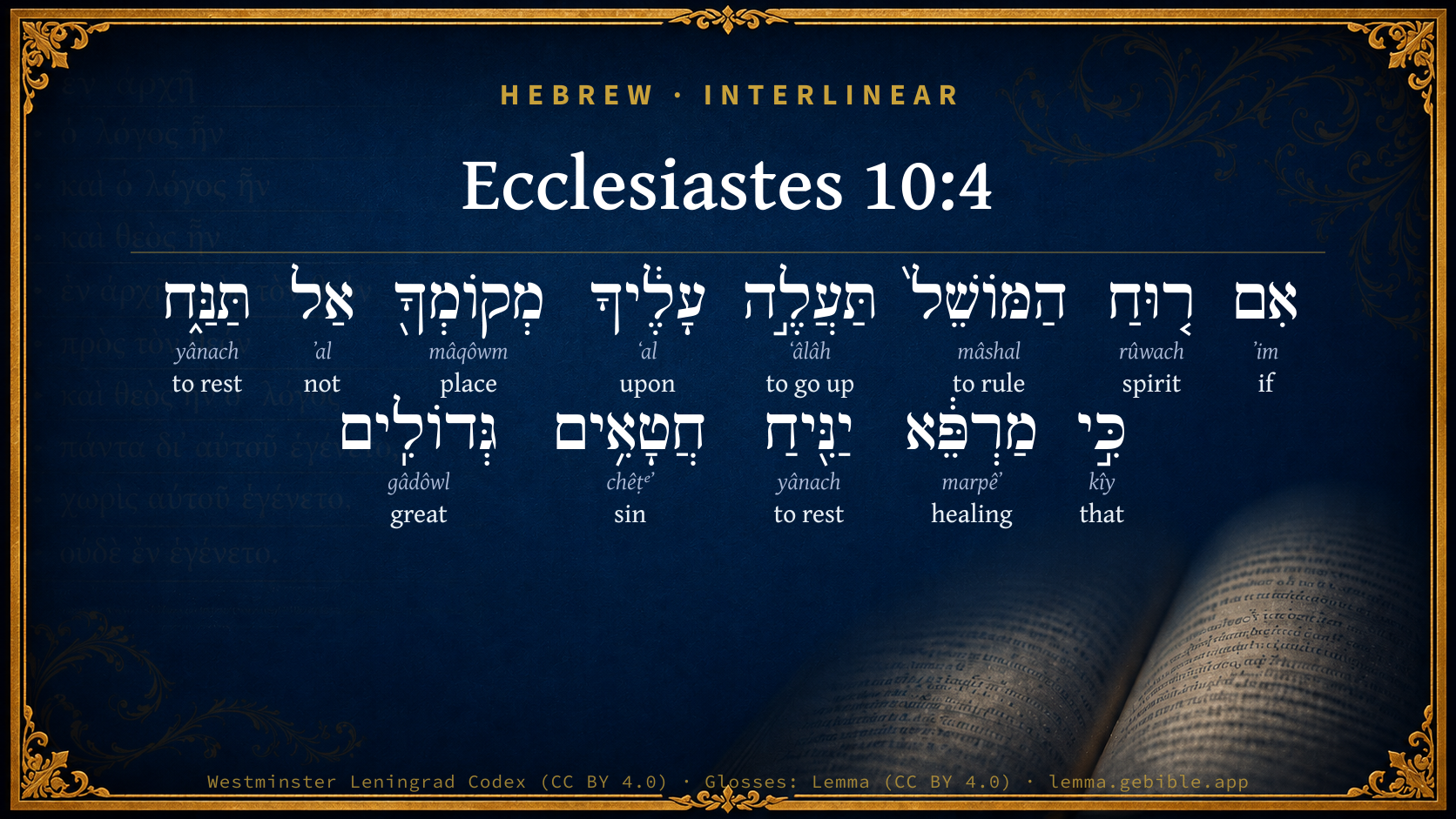
  1. אִם ʼim H518 “if” Conjunction
  2. ר֤וּחַ rûwach H7307 “spirit of” Noun, Common, Both, Singular, Construct
  3. הַמּוֹשֵׁל֙ mâshal H4910 “the · ruling” Particle, Definite Article + Verb, Qal, Participle Active, Masculine, Singular, Absolute
  4. תַּעֲלֶ֣ה ʻâlâh H5927 “to go up” Verb, Qal, Imperfect, 3rd Person, Feminine, Singular
  5. עָלֶ֔יךָ ʻal H5921 “upon · you” Preposition + Suffix, Personal, 2nd Person, Masculine, Singular
  6. מְקוֹמְךָ֖ mâqôwm H4725 “place · your” Noun, Common, Masculine, Singular, Construct + Suffix, Personal, 2nd Person, Masculine, Singular
  7. אַל ʼal H408 “not” Particle, Negative
  8. תַּנַּ֑ח yânach H3240 “to rest” Verb, Hiphil, Jussive, 2nd Person, Masculine, Singular
  9. כִּ֣י kîy H3588 “that” Conjunction
  10. יַנִּ֖יחַ yânach H3240 “to rest” Verb, Hiphil, Imperfect, 3rd Person, Masculine, Singular
  11. חֲטָאִ֥ים chêṭᵉʼ H2399 “sins” Noun, Common, Masculine, Plural, Absolute
  12. גְּדוֹלִֽים gâdôwl H1419 “great” Adjective, Adjective, Masculine, Plural, Absolute

About this verse

These counts appear in no published source. They are computed here, from the morphology-tagged text and Lemma’s own curated glosses. What Lemma adds →

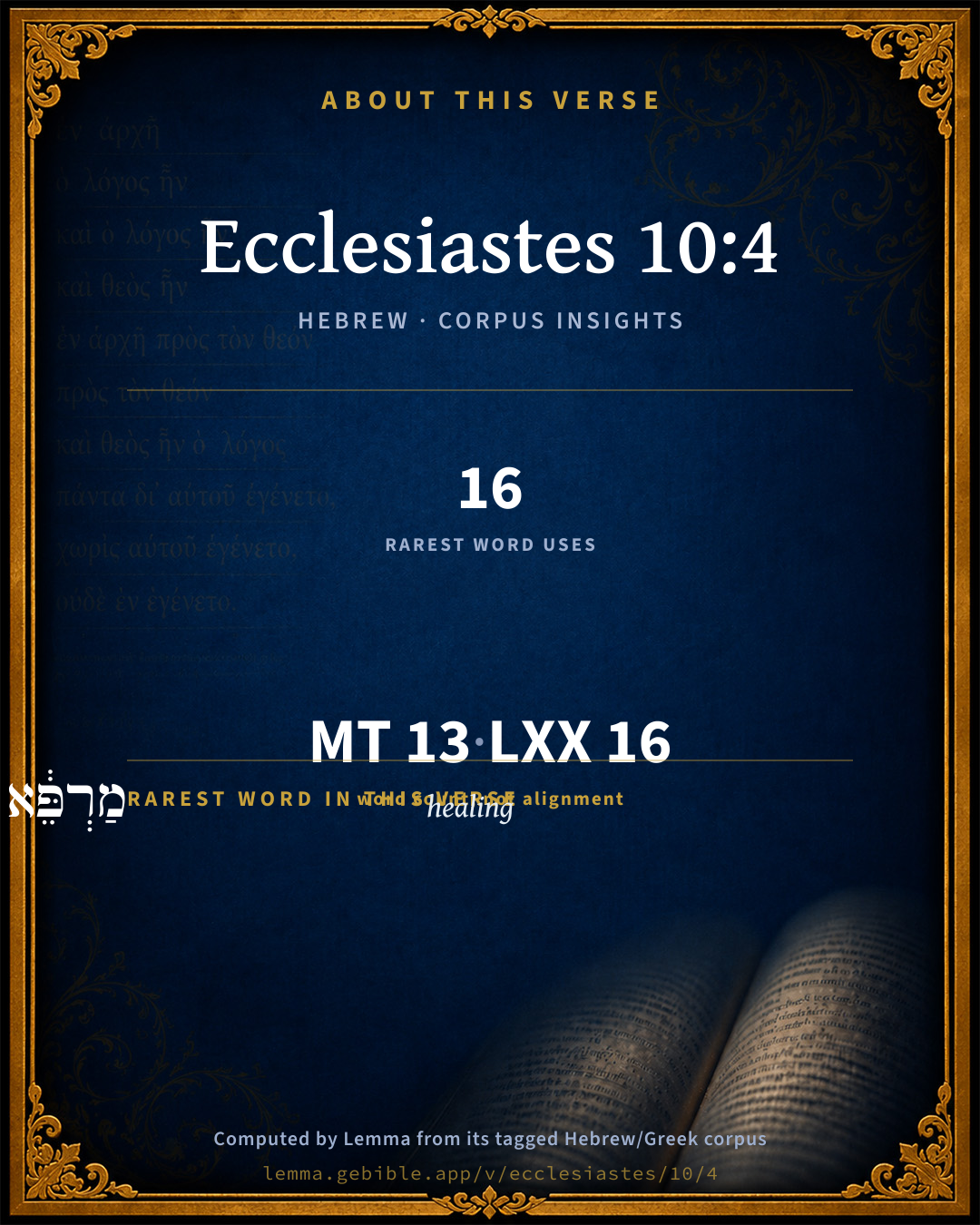
13
words
12
distinct lemmas
Wisdom
section

Notable vocabulary

The rarest word here is מַרְפֵּ֔א healing H4832 — appearing just 16 times in the whole Hebrew Bible.

Shared distinctive vocabulary

מַרְפֵּ֔א healing H4832 occurs in 15 verses of the Hebrew Bible. Also found in:

Grammatical profile

  • 4 verbs
  • 4 nouns
  • 1 adjective
  • 1 preposition
  • 2 conjunctions
  • 1 particle

Verb forms

  • הַמּוֹשֵׁל֙ Qal · Participle Active
  • תַּעֲלֶ֣ה Qal · Imperfect
  • תַּנַּ֑ח Hiphil · Jussive
  • יַנִּ֖יחַ Hiphil · Imperfect

Repetition

A word recurs within this verse — often emphatic in Hebrew:

  • תַּנַּ֑ח to rest H3240 ×2

Hebrew & Septuagint length

In English translation the verse runs 21 words from the Hebrew and 23 from the Septuagint (LXX English) — closely comparable.

A rough comparison of the two English renderings, which tokenize alike — not a word-level alignment.

Word counts can differ between the Hebrew and the Greek without any difference in meaning — e.g. the Hebrew direct-object marker אֵת has no separate Greek word, and Greek often adds the article ὁ.

In the original languages it is 13 Hebrew tokens and 16 Greek tokens — but the two are counted differently (Hebrew bundles its prefixes and suffixes into one token; the Greek is in lemma form), so that isn’t a like-for-like length.

Cross-references

3

Topical passages linked to Ecclesiastes 10:4 in the Treasury of Scripture Knowledge — connected by theme and wording, ordered by reader-vote popularity; previews shown in the World English Bible.

  • Proverbs 25:15 By patience a ruler is persuaded. A soft tongue breaks the bone.
  • Ecclesiastes 8:3 Don't be hasty to go out of his presence. Don't persist in an evil thing, for he does whatever pleases him,
  • 1 Samuel 25:24–44 She fell at his feet, and said, On me, my lord, on me be the iniquity; and please let your handmaid speak in your ears. Hear the words of your handmaid.

Cross-references courtesy of OpenBible.info (CC BY 4.0).

Hebrew and Greek witnesses Masoretic Hebrew ↔ Greek Septuagint

The same verse in the two great witnesses to the Old Testament, shown verse-for-verse.

These are two independent witnesses, not word-aligned to each other, and the Septuagint is shown in lemma (dictionary) form.

Hebrew Ecclesiastes 10:4 Masoretic · Westminster Leningrad Codex

אִם ר֤וּחַ הַמּוֹשֵׁל֙ תַּעֲלֶ֣ה עָלֶ֔יךָ מְקוֹמְךָ֖ אַל תַּנַּ֑ח כִּ֣י מַרְפֵּ֔א יַנִּ֖יחַ חֲטָאִ֥ים גְּדוֹלִֽים

If the spirit of the ruler rises up against you, don't leave your place; for gentleness lays great offenses to rest.

World English Bible · Public Domain

Greek LXX Ecclesiastes 10:4 Septuagint · lemma form

ἐάν πνεῦμα ὁ ἐξουσιάζω ἀναβαίνω ἐπί σύ τόπος σύ μή ἀποἵημι ὅτι ἴαμα καταπαύω ἁμαρτία μέγας

If the spirit of the ruler rise up against you, leave not your place; for soothing will put an end to great offenses.

LXX2012 (modern English Septuagint) · Public Domain

On this verse, Keil & Delitzsch discusses the Septuagint’s reading. Read the note in Commentary ↓

Hebrew: Westminster Leningrad Codex (CC BY 4.0). Greek: Septuagint (public domain); English from LXX2012 (modern English Septuagint) (Public Domain). How the Septuagint differs from the Hebrew →

Commentary

Notes on Ecclesiastes 10:4 from classic Christian and Jewish commentators (each source and its license shown beneath its notes). The classic Christian expositions comment on the surrounding passage and are grouped to its opening verse, so a note may address several verses; the Jewish commentaries on the Tanakh (Rashi and others) are per-verse, so they appear only where the commentator wrote on this verse.

Lemma curates 59 commentaries, every one of them public domain or Creative Commons licensed, each selected and text-cleaned for this edition rather than reprinted as found. About our sources →

Matthew Henry's Commentary

The scope of these verses is to keep subjects loyal and dutiful to the government. In Solomon's reign the people were very rich, and lived in prosperity, which perhaps made them proud and petulant, and when the taxes were high, though they had enough to pay them with, it is probable that many conducted themselves insolently towards the government and threatened to rebel. To such Solomon here gives some necessary cautions.

I. Let not subjects carry on a quarrel with their prince upon any private personal disgust (Ecc 10:4): "If the spirit of the ruler rise up against thee, if upon some misinformation given him, or some mismanagement of thine, he is displeased at thee, and threaten thee, yet leave not thy place, forget not the duty of a subject, revolt not from thy allegiance, do not, in a passion, quit thy post in his service and throw up thy commission, as despairing ever to regain his favour. No, wait awhile, and thou wilt find he is not implacable, but that yielding pacifies great offences." Solomon speaks for himself, and for every wise and good man that is a master, or a magistrate, that he could easily forgive those, upon their submission, whom yet, upon their provocation, he had been very angry with. It is safer and better to yield to an angry prince than to contend with him.

II. Let not subjects commence a quarrel with their prince, though the public administration be not in every thing as they would have it. He grants there is an evil often seen under the sun, and it is a king's-evil, an evil which the king only can cure, for it is an error which proceeds from the ruler (Ecc 10:5); it is a mistake which rulers, consulting their personal affections more than the public interests, are too often guilty of, that men are not preferred according to their merit, but folly is set in great dignity, men of shattered brains, and broken fortunes, are put in places of power and trust, while the rich men of good sense and good estates, whose interest would oblige them to be true to the public, and whose abundance would be likely to set them above temptations to bribery and extortion, yet sit in low places, and can get no preferment (Ecc 10:6), either the ruler knows not how to value them or the terms of preferment are such as they cannot in conscience comply with. It is ill with a people when vicious men are advanced and men of worth are kept under hatches. This is illustrated Ecc 10:7. "I have seen servants upon horses, men not so much of mean extraction and education (if that were all, it were the more excusable, nay, there is many a wise servant who with good reason has rule over a son that causes shame), but of sordid, servile, mercenary dispositions. I have seen these riding in pomp and state as princes, while princes, men of noble birth and qualities, fit to rule a kingdom, have been forced to walk as servants upon the earth, poor and despised." Thus God, in his providence, punishes a wicked people; but, as far as it is the ruler's act and deed, it is certainly his error, and a great evil, a grievance to the subject and very provoking; but it is an error under the sun, which will certainly be rectified above the sun, and when it shall shine no more, for in heaven it is only wisdom and holiness that are set in great dignity. But, if the prince be guilty of his error, yet let not the subjects leave their place, nor rise up against the government, nor form any project for the alteration of it; nor let the prince carry on the humour too far, nor set such servants, such beggars, on horseback, as will ride furiously over the ancient land-marks of the constitution, and threaten the subversion of it.

1. Let neither prince nor people violently attempt any changes, nor make a forcible entry upon a national settlement, for they will both find it of dangerous consequence, which he shows here by four similitudes, the scope of which is to give us a caution not to meddle to our own hurt. Let not princes invade the rights and liberties of their subjects; let not subjects mutiny and rebel against their princes; for, (1.) He that digs a pit for another, it is ten to one but he falls into it himself, and his violent dealing returns upon his own head. If princes become tyrants, or subjects become rebels, all histories will tell both what is likely to be their fate and that it is at their utmost peril, and it were better for both to be content within their own bounds. (2.) Whoso breaks a hedge, an old hedge, that has long been a land-mark, let him expect that a serpent, or adder, such as harbour in rotten hedges, will bite him; some viper or other will fasten upon his hand, Act 28:3. God, by his ordinance, as by a hedge, has inclosed the prerogatives and powers of princes; their persons are under his special protection; those therefore that form any treasonable designs against their peace, their crown, and dignity, are but twisting halters for themselves. (3.) Whoso removes stones, to pull down a wall or building, does but pluck them upon himself; he shall be hurt therewith, and will wish that he had let them alone. Those that go about to alter a well-modelled well-settled government, under colour of redressing some grievances and correcting some faults in it, will quickly perceive not only that it is easier to find fault than to mend, to demolish that which is good than to build up that which is better, but that they thrust their own fingers into the fire and overwhelm themselves in the ruin they occasion. (4.) He that cleaves the wood, especially if, as it follows, he has sorry tools (Ecc 10:10), shall be endangered thereby; the chips, or his own axe-head, will fly in his face. If we meet with knotty pieces of timber, and we think to master them by force and violence, and hew them to pieces, they may not only prove too hard for us, but the attempt may turn to our own damage.

2. Rather let both prince and people act towards each other with prudence, mildness, and good temper: Wisdom is profitable to direct the ruler how to manage a people that are inclined to be turbulent, so as neither, on the one hand, by a supine negligence to embolden and encourage them, nor, on the other hand, by rigour and severity to exasperate and provoke them to any seditious practices. It is likewise profitable to direct the subjects how to act towards a prince that is inclined to bear hard upon them, so as not to alienate his affections from them, but to win upon him by humble remonstrances (not insolent demands, such as the people made upon Rehoboam), by patient submissions and peaceable expedients. The same rule is to be observed in all relations, for the preserving of the comfort of them. Let wisdom direct to gentle methods and forbear violent ones. (1.) Wisdom will teach us to whet the tool we are to make use of, rather than, by leaving it blunt, oblige ourselves to exert so much the more strength, Ecc 10:10. We might save ourselves a great deal of labour, and prevent a great deal of danger, if we did whet before we cut, that is, consider and premeditate what is fit to be said and done in every difficult case, that we may accommodate ourselves to it and may do our work smoothly and easily both to others and to ourselves. Wisdom will direct how to sharpen and put an edge upon both ourselves and those we employ, not to work deceitfully (Psa 52:2), but to work cleanly and cleverly. The mower loses no time when he is whetting his scythe. (2.) Wisdom will teach us to enchant the serpent we are to contend with, rather than think to out-hiss it (Ecc 10:11): The serpent will bite if he be not by singing and music charmed and enchanted, against which therefore he stops his ears (Psa 58:4, Psa 58:5); and a babbler is no better to all those who enter the lists with him, who therefore must not think by dint of words to out-talk him, but be prudent management to enchant him. He that is lord of the tongue (so the phrase is), a ruler that has liberty of speech and may say what he will, it is as dangerous dealing with him as with a serpent uncharmed; but, if you use the enchantment of a mild and humble submission, you may be safe and out of danger; herein wisdom, the meekness of wisdom, is profitable to direct. By long forbearing is a prince persuaded, Pro 25:15. Jacob enchanted Esau with a present and Abigail David. To those that may say any thing it is wisdom to say nothing that is provoking.

Matthew Henry's Commentary on the Whole Bible (1708–1710) — public domain (CC PDM 1.0). Text via the HelloAO Bible API.

Trapp's Complete Commentary

John Trapp

Ecc 10:4 If the spirit of the ruler rise up against thee, leave not thy place; for yielding pacifieth great offences.

Ver. 4. If the spirit of thy ruler rise up, &c., leave not thy place.] Thine office, duty, and obedience; a metaphor from military matters. A soldier must not start from his station, but keep to the place assigned him by his captain; {a} so here,

“ Perdidit arma, locum virtutis descruit, &c. ” - Horat.

Others render it, "Do not persist in thy place," do not stand to affront anger, but go aside a little out of sight, as Jonathan, when his father had thrown a javelin at him, went forth shooting. {See Trapp on "Ecc 8:3"} {See Trapp on "Pro 15:1"}

For yielding pacifieth great offences.] Thus by yielding David pacified Saul; Abigail, David. See Pro 25:15. {See Trapp on "Pro 25:15"} Salve the wound and save thyself. The weak reed, by bending in a rough wind, receiveth no hurt, when the sturdy oak is turned up by the roots.

{a} Ne λειποπακτες audiat.

John Trapp, A Commentary or Exposition upon All the Books of the Old and New Testament (1647–1656) — public domain. Text from a community e-Sword module.

Joseph Benson's Commentary

Ecc 10:4. If the spirit of a ruler — His passion or wrath; rise up against thee — Upon some misinformation given him, or mismanagement of thine; leave not thy place — In anger or discontent. Withdraw not thyself rashly and hastily from his presence and service: see on Ecc 8:3. Continue in a diligent and faithful discharge of thy duty, as becomes a subject, and modestly and humbly submit to him. For yielding pacifieth, &c. — Hebrew יניח מרפא, healing maketh to cease great sins: that is, a submissive, meek deportment, which is of a healing nature, appeaseth wrath conceived for great offences.

Joseph Benson's Commentary on the Old and New Testaments (1811–1818) — public domain. Text from a community e-Sword module.

Keil & Delitzsch

C. F. Keil & F. Delitzsch

This verse shows what is the wise conduct of a subject, and particularly of a servant, when the anger of the ruler breaks forth: "If the ill-humour of the ruler rise up against thee, do not leave thy post; for patience leaves out great sins." Luther connects Ecc 10:4 and Ecc 10:3 by "therefore;" for by the potentate he understands such an one as, himself a fool, holds all who contradict him to be fools: then it is best to let his folly rage on. But the מושׁל is a different person from the סכל; and מק אל־תּנּח does not mean, "let not yourself get into a passion," or, as he more accurately explains in the Annotationes: "remain self-possessed" (similarly Hitzig: lose not thy mental state of composure), but, in conformity with תלך ... אל, Ecc 8:3, "forsake not the post (synon. מצּב and מעמד, Isa 22:19, cf. 23) which thou hast received." The person addressed is thus represented not merely as a subject, but officially as a subordinate officer: if the ruler's displeasure (רוּח, as at Jdg 8:3; Pro 29:11) rises up against him (עלה, as elsewhere; cf. אף, Psa 73:21; or חמה, Sa2 11:20), he ought not, in the consciousness that he does not merit his displeasure, hastily give up his situation which has been entrusted to him and renounce submission; for patience, gentleness (regarding מרפּא, vid., Pro 12:18) 'גּד ... 'ין.

This concluding clause of the verse is usually translated: "It appeaseth (pacifieth) great sins" (lxx καταπαύσει, Symm. παύσει). The phrase (חמה) אף הניח is not to be compared, for it signifies quieting by an exhausting outbreak; on the contrary, יניח in the passage before us must signify quieting, as the preventing of an outbreak (cf. Pro 15:1). It appears more correct to render הנּיח in both cases in the sense of ἐᾶν, missum facere: to leave great sins is = not to commit them, to give up the lust thereto; for hinniahh signifies to let go, to leave off, e.g., Jer 14:9; and to indulge, Est 3:8, here as at Ecc 7:18; Ecc 11:6, "to keep the hands from something." The great sins cannot certainly be thought of as those of the ruler; for on his part only one comes into view, if indeed, according to the old legal conception, it could be called such, viz., cruel proceeding with reference to him who wilfully withdraws from him, and thus proves his opposition; much rather we are to think of the great sins into which he who is the object of the ruler's displeasure might fall, viz., treason (Ecc 8:2), insubordination, self-destruction, and at the same time, since he does not stand alone, or make common cause with others who are discontented, the drawing of others into inevitable ruin (Ecc 8:3). All these sins, into which he falls who answers wrath with wrath, patience avoids, and puts a check to them. The king's anger is perhaps justified; the admonition, however, would be otherwise expressed than by 'l-tnch mq', if it were not presupposed that it was not justified; and thus without meta'basis eis a'llo ge'nos an I-section follows the reflection regarding wise deportment as over against the king's displeasure, a section which describes from experience and from personal observation the world turned upside down in the state.

Keil & Delitzsch — Biblical Commentary on the Old Testament (1861–1891) — public domain (CC PDM 1.0). Text via the HelloAO Bible API. (Old Testament only.)

Tyndale Open Study Notes

Tyndale Open Resources

10:4 A boss can be anyone in authority.

Tyndale Open Study Notes — © Tyndale Open Resources, licensed CC BY-SA 4.0. Text via the HelloAO Bible API.

Geneva Bible (1599)

Geneva Bible translators

If thy superior be angry with thee, be thou discrete, and not moved.

Geneva Bible (1599) marginal notes — public domain. Text via Bolls.life.

Jamieson, Fausset & Brown

Robert Jamieson, A. R. Fausset & David Brown

spirit--anger.

yielding pacifieth-- (Pro 15:1). This explains "leave not thy place"; do not in a resisting spirit withdraw from thy post of duty (Ecc 8:3).

Jamieson, Fausset & Brown — Commentary Critical and Explanatory on the Whole Bible (1871) — public domain (CC PDM 1.0). Text via the HelloAO Bible API.

Adam Clarke's Commentary

Verse 4. If the spirit of the ruler rise up against thee] If the king get incensed against thee.

Leave not thy place] Humble thyself before him, that is thy place and duty; for yielding to him, and not standing stoutly in thy defence, pacifieth great offenses: and then, when his anger is appeased, he will hear any thing in thy justification, if thou have any thing to offer. This is good advice to a child in reference to his parents, and to an inferior of any kind in reference to his superiors.

Several of the fathers understood this differently, If the spirit of the ruler - the influence of Satan - hath risen up against and prevailed over thee, to bring thee into some sin; leave not thy place - do not despair of God's mercy; humble thyself before him, and seek pardon through the Son of his love, and this will be מרפא marpe, a remedy or cure even for חטאים גדולים chataim gedolim, great errors or sins. All this is true in itself, whether found in this text or not.

Adam Clarke's Commentary on the Bible (1810–1826) — public domain. Text from a community e-Sword/MySword module.

Ellicott's Commentary for English Readers

(4) We return now to the thought of Ecc_8:3. For “spirit” in the sense of “anger,” see Jdg_8:3.

Rise up.—Psa_78:21; 2Sa_11:20.

Yielding.—Literally, healing. (See Pro_15:4.)

Pacifieth great offences.—Rather, probably, quieteth great offences, that is to say, not so much “puts an end to the offence felt by the ruler,” as to the offences likely to be committed if he do not restrain himself.

A Bible Commentary for English Readers, edited by Charles John Ellicott (1878–1897) — public domain. Text from a community e-Sword module.

The Cambridge Bible for Schools and Colleges

gen. ed. J. J. S. Perowne

4. If the spirit of the ruler rise up against thee] To the picture of the boastful self-assertion of the fool is appended as a contrast, that of the self-effacement of the wise. The scene brought before us is that of a statesman, or minister, whose advice runs counter to that of the ruler. The “spirit,” what we should call the “temper,” of the latter “rises up” against the former. What shall the adviser do? His natural impulse is to “leave his place,” i. e. either to cut short his interview, or, resign his office. He won’t be slighted, will not put up with contradiction. That, however, is precisely what the wise of heart will not do. Yielding, i. e. the temper of conciliation (the Hebrew noun is literally the healing, or the healthy, mood of mind) puts to rest, or puts a stop to, great offences. The history of all nations, our own included, presents manifold instances of both modes of action, sometimes, as in the case of Chatham’s behaviour to George III., in the same statesman at different times, sometimes in the attitude of rival statesmen towards the same sovereign. Interpreters after their manner, seeing either the golden or the silver side of the shields, have referred the last words either to the angry acts of the ruler, or to the sins of rebellion in the minister. It can scarcely be questioned, however, that the proverb includes both. The maxim has its parallel in our English proverb, “Least said is soonest mended.”

The Cambridge Bible for Schools and Colleges (gen. ed. J. J. S. Perowne; Cambridge University Press, 1878–1918) — public domain. Text from a community e-Sword module.

John Gill's Exposition

If the spirit of the ruler rise up against thee,.... The wrath of the civil magistrate, the chief ruler of the land, the sovereign prince or king, to whom men are and should be subject: if his wrath on any occasion breaks out in a furious manner, and, like a storm and tempest, is very blustering and threatening:

leave not thy place; at court; thine office under the prince, do not throw it up in a passion, and quit his service upon it; and much less forget thy duty and allegiance to him, and go into disloyalty and rebellion; see Ecc 8:3;

for yielding pacifieth great offences; bearing his anger patiently, submitting to his displeasure quietly, making no returns, or at least giving soft answers, and behaving in a modest and humble manner; in time his wrath will subside, and he will be pacified, and forgive the offences committed; or be convinced that there were none, or however not so great as to require such resentment; see Pro 15:1. The Targum is,

"if a spirit of evil concupiscence rules over thee; thy good place, in which thou wert used to stand, leave not:''

some understand this of a man's having a spirit of rule and government coming upon him, or of his being advanced to power and authority, that then he should not forget the low estate in which he had been. Jarchi interprets it of the spirit of the governor of the world, strictly inquiring into the actions of men; and healing their sins by chastisements, which cause them to leave them.

John Gill's Exposition of the Whole Bible (1746–1763) — public domain (CC PDM 1.0). Text via the HelloAO Bible API.

Albert Barnes' Notes on the Bible

If the spirit ... - i. e., If he is angry.

Leave not thy place - i. e., Do not lose thy self-control and quit his presence. Gentleness on thy part will calm both thyself and him, and prevent great wrongs being committed by either.

Albert Barnes' Notes on the Bible (1834–1885) — public domain. Text from a community e-Sword/MySword module.

Haydock's Catholic Bible Commentary

Place. If the devil tempt or persuade thee to sin, repent and humble thyself; or if thou hast offended the great, shew submission.

George Leo Haydock (1774–1849), Haydock's Catholic Family Bible and Commentary, 1859 edition — public domain. Excludes Psalms (Douay-Rheims chapter numbering differs from Protestant) and Deuterocanonical books (Catholic canon only).

Matthew Poole's English Annotations

The spirit; the passion or wrath, as is manifest from the following words, which is oft called spirit, as Jdg 8:3; 2Ch 21:16; Pro 25:28; Ecc 7:9.

Leave not thy place, to wit, in anger or discontent. Withdraw not thyself rashly and hastily from his presence and service, according to the advice, Ecc 8:3. Continue in a diligent and faithful discharge of thy duty, as becomes a subject; do not return anger for anger, but modestly and humbly submit thyself to him.

Yielding, Heb. healing; a gentle and submissive carriage, which is of a healing nature; whereas pride and passion do exasperate and widen the breach already made. Pacifieth, Heb. maketh them to rest or cease; preventeth or removeth them.

Great offences, Heb. great sins; either,

1. Such sins as the offended ruler might commit in the prosecution of his wrath against thee. Or rather,

2. Such as possibly thou hast committed against him, for which he is incensed against thee; or the greatest offences or injuries that one man commits against another, and much more those slight miscarriages of thine towards the ruler. Let not therefore a false opinion concerning his unreconcilableness to thee make thee desperate, and draw thee into rebellion.

Matthew Poole's English Annotations on the Holy Bible (1683–1685) — public domain. Text from a community e-Sword/MySword module.

Whedon's Commentary on the Bible

Daniel D. Whedon

4. Leave not thy place — There is something painful in Koheleth’s repeated counsel of behaviour under oppressive rulers. He must have lived in troublous and tyrannical times. In the absence of an arm of vengeance raised upon the tyrant, meekness and deference will tend to pacify him, and prevent extreme outrages. Stay patiently in thy place, and not rush into fury and revolt.

Daniel D. Whedon (gen. ed.), Commentary on the Old and New Testaments (1874–1909) — public domain. Text from a community e-Sword module.

The Pulpit Commentary

Vers. 4-7. Section 12. Illustration of the conduct of wisdom under capricious rulers, or when fools are exalted to high stations.

If the spirit of the ruler rise up against thee. "Spirit" (ruach) is here equivalent to "anger," as Jud_1:8:3; Pro_29:11. The idea seems to be that a statesman or councilor gives wise advice to a monarch, which the latter takes in bad part, and shows strong resentment against the person who offered it. Now, when a man knows himself to be in the right, and yet finds his counsel rejected, perhaps with scorn and reproach added, he is naturally prone to feel sore, and to show by some overt act his sense of the ill treatment which he has received. But what says wisdom? Leave not thy place (makom) i.e. position, pest, office. Do not hastily resign the situation at court to which you have been appointed. Some, not so suitably, take the expression, "leave thy place," figuratively, as equivalent to "give way to anger, renounce the temper which becomes you, lose your self-possession." But Wright, from the analogous use of matstsale and maamad in Isa_22:19, confirms the interpretationwhich we have adopted. Compare the advice in Ecc_8:3, where, however, the idea is rather of open rebellion than of a resentment which shows itself by withdrawal. Origen ("De Princip.," 3:2) explained "the spirit of the ruler" to be the evil spirit; and Gregory, commenting on this passage, writes ("Moral.," 3:43), "As though he had said in plain words, "If thou perceivest the spirit of the tempter to prevail against thee in aught, quit not the lowliness of penitence;" and that it was the abasement of penitence that he called "our place," he shows by the words that follow, "for healing Vulgate pacifieth great offences." For what else is the humility of mourning, save the remedy of sin?" (Oxford transl.). For yielding pacifieth great offenses. Marpe, "yielding," is rendered "healing" by the versions. Thus iama (Septuagint); euratio (Vulgate). But this translation is not so suitable as that of Symmachus, swfrosunh, "moderation." The word is used in the sense of" gentleness," "meekness,"; (Pro_14:30 Pro_15:4) and the gnome expresses the truth that a calm, conciliating spirit, not prone to take offence, but patient under trying circumstances, obviates great sins. The sins are those of the subject. This quiet resignation saves him from conspiracy, rebellion, treason, etc., into which his untempered resentment might hurry him. We may compare Pro_15:1 and Pro_25:15; and Horace, "Cam.," 3. 3, "Justum et tenacem propositi virum," etc.

The man whose soul is firm and strong, Bows not to any tyrant"s frown, And on the rabble"s clamorous throng In proud disdain looks coldly down. (Stanley. )

They who regard the "offenses" as those of the ruler explain them to mean oppression and injustice; but it seems plain from the run of the sentence that the minister, not the monarch, is primarily in the mind of the writer, though, of course, it is quite true that the submission of the former might save the ruler from the commission of some wrong.

A pacifying spirit. The circumstances which suggested this admonition were special; we seem to be introduced to the court of a powerful and arbitrary Oriental sovereign. The caprice and injustice of the monarch arouses the indignation of the courtier, who is ready to rise in resentment anti anger. But the counsel is given, "Leave not thy place." Presentment fans the flame of wrath; submission assuages it. "Yielding allayeth great offences." Now, the circumstances apply only to a few, but the principle which they suggest is of wide and general application. A submissive and pacificatory spirit promotes harmony.

I MEN MUST EXPECT TO ENCOUNTER ANGER AND ARROGANCE FROM THEIR FELLOW-MEN. Those who occupy positions of authority expect deference from their inferiors. Birth, rank, station, are apt to foster an arbitrary habit in their possessors. And whilst there are many and beautiful exceptions to this rule, especially owing to the influence of Christ"s example and spirit, it is not to be questioned that arrogance is the special fault of the officially great.

II ANGER AND ARROGANCE NATURALLY AROUSE RESENTMENT. We are so constituted that, apart from the controlling and restraining influence of reason and religious principles, we return blow for blow. Anger enkindles anger, as flint and steel enkindle fire. Hence words are spoken which may never be forgotten, and may ever be regretted; estrangements take place which may lead to bitter feuds; blows may follow, or duels, or war.

III THE WISDOM AND THE DUTY OF SELF-CONTROL. The common proverb is, "It takes two to make a quarrel." Because offence is given, offence need not be taken; because injury and insult are inflicted, it does not of necessity follow that they should be avenged. Several motives concur to restrain resentment.

1. Self-respect. The man who loses temper and self-command, upon subsequent reflection, feels himself so much less a man; he despises himself.

2. Prudence. This is the motive specially relied upon in this passage, h dealing with "the ruler," whose spirit rises up against him, the courtier is reminded of the ruler"s power, and is admonished not to provoke him to the exercise of that power, for in that case all favor may lead to disgrace and denudation.

3. Religious principle. This is the motive which, in the case of the Christian, is most powerful. The example of the patient and meek Redeemer, who reviled not again, and who besought mercy for his murderers, is never absent from the mind of those who trust and love him. His love constrains, his precept controls, his example impels. And thus forbearance and forgiveness characterize Christ"s disciples, in those circumstances in which otherwise resentment and revenge might animate the heart.

IV THE PACIFYING POWER OF PATIENT SUBMISSION. "Yielding pacifieth allayeth great offences." It is not required that the injured party should approve the action of his injurer; or affirmed that no opportunity may occur of just and dignified rebuke. But silence, quietness of spirit, and control of natural impulse, will in many cases produce a good result. He who bears wrong patiently is the stronger and better for the discipline; and his demeanor may melt the wrongdoer to contrition, and will at all events lead him to reflection. Thus the threatened conflict may be avoided; a lesson may be administered to the hasty and arrogant, and the best interests of society may be promoted. Thus the Word of God is honored, and witness is given to the power which Christ possesses to subdue and govern the unruly nature of man. T.

The Pulpit Commentary (1880–1919), ed. H.D.M. Spence-Jones & Joseph S. Exell — public domain. Text from a community e-Sword module.

John Wesley's Explanatory Notes

The spirit - The passion. Leave not - In anger or discontent. Continue in a diligent and faithful discharge of thy duty, and modestly and humbly submit to him. Yielding - A gentle and submissive carriage.

John Wesley, Explanatory Notes Upon the Whole Bible (1754–1765) — public domain. Text via the GEBible commentary corpus.

unfoldingWord translationNotes

Door43 World Missions Community

If the emotions of a ruler rise up against you

Here a ruler is represented by his "emotions" AT: "If a ruler becomes angry with you" (See: Metonymy)

Calm can quiet down great outrage

"By remaining calm you may cause an outraged person to become quiet"

translationWords

rule

works

unfoldingWord translationNotes — © Distant Shores Media and the Door43 World Missions Community, licensed CC BY-SA 4.0. Source: git.door43.org/Door43/en_tn.

Rashi

Rabbi Shlomo Yitzchaki (Rashi)

If the spirit of the Ruler the Ruler of the World, ascends upon you to scrutinize you with the Divine Standard of Justice.

do not leave your place Do not leave your virtue to say to Him, “What will my righteousness avail me?”

for a cure The stringencies of the judgment with the afflictions that come upon you are a cure for your iniquities, and will assuage great sins for you.

Rashi on the Tanakh — English translations: “The Judaica Press complete Tanach with Rashi, translated by A. J. Rosenberg” (CC BY 4.0); “Pentateuch with Rashi's commentary by M. Rosenbaum and A.M. Silbermann, 1929-1934” (public domain); “The Metsudah Tanach series, Lakewood, N.J” (CC BY 4.0); and “The Book of Joshua, Metsudah Publications, 1997” (CC BY 4.0). Text via Sefaria.

Lesson kit

Teaching starters — assembled from the data on this page, not authored interpretation. Every prompt links to the verse data it draws on. Edit before teaching.

Ecclesiastes, in the Wisdom, opens this verse with 13 words (12 distinct Hebrew lemmas). Its most distinctive word is marpêʼ (“healing”). A historical commentator’s framing appears above. Read the whole chapter for the surrounding context.

Discussion questions

  1. How does “healing” (marpêʼ) shape what this verse is saying?
  2. How does 2 Chronicles 21:18, which shares the word «healing», read alongside this verse?
  3. What does the repetition of “to rest” (2× in this one verse) do in this verse?
  4. These translations render this verse differently. What is at stake in choosing one wording over another?
  5. «הַמּוֹשֵׁל֙» is a Qal Participle Active verb. How does that grammatical form shape the action described?
  6. Compare how Matthew Henry's Commentary and Trapp's Complete Commentary read this verse. Where do they agree or differ?

Things to notice

Reading settings

Reading text

Shown beneath each verse's original-language words.

Old Testament
Old Testament edition

Read the OT as the Masoretic Hebrew (MT) or the Greek Septuagint (LXX).

English shown for the Greek Septuagint (in the Hebrew ↔ Greek comparison).

Comparing translations? Open the Compare panel on any verse page to stack up to four side by side.